

- Market Size (2026)
- USD 318.6 Mn
- Forecast (2036)
- USD 1139.5 Mn
- CAGR (2026 to 2036)
- 13.6%
Soilless Substrate-Specific Fertility Solution Market Size, Market Forecast and Outlook By FMI
Summary of the Soilless Substrate-Specific Fertility Solution Market
- Demand and Growth Drivers
- Protected cultivation expansion supports substrate-specific nutrition programs because greenhouse operators need tighter root-zone control and more stable crop quality. Related FMI work on growing media systems points to the same operating need inside intensive horticulture.
- Recirculating hydroponic systems remain a major demand engine because reused irrigation water requires tighter nutrient correction and ion balancing. That requirement also supports investment discussed in FMI coverage of fertigation control systems.
- Localized water-soluble fertilizer capacity supports adoption because growers need shorter lead times and blends matched to crop and water conditions.
- Product and Segment View
- Coco coir remains the leading substrate segment because greenhouse vegetables and berry programs use it across a broad commercial base.
- Commercial greenhouses remain the leading demand center because large installations rely on standardized feeding programs and close nutrient control. This demand pattern fits FMI analysis of indoor leafy green precision nutrition programs and other controlled-crop models.
- Recirculating hydroponics remains a high-value system segment because formula design needs continual monitoring and repeated nutrient adjustment.
- Geography and Competitive Outlook
- China remains a major growth center because facility agriculture modernization is widening the base for recipe-led nutrition programs. Similar expansion themes appear in FMI discussion of nutrient dosing pumps used in intensive horticulture.
- Canada sustains strong value demand because dense greenhouse vegetable production raises nutrient-use intensity per hectare.
- Suppliers that pair soluble fertilizer quality with substrate diagnostics and recipe support are likely to strengthen share through the forecast period.
- Analyst Opinion
- Sabyasachi Ghosh, Principal Consultant at FMI, says, “As protected cultivation shifts toward data‑led operations, the real differentiation will come from suppliers who make intentional, insight‑driven decisions, aligning nutrient programs with how each substrate actually behaves under specific irrigation strategies. Those who treat nutrition not as a product but as a strategic tool for consistency and predictability will be the ones who ultimately gain share in this evolving market.”
- Soilless Substrate-Specific Fertility Solution Market Value Analysis
- Demand is moving from generic soluble feeding toward media-specific nutrition programs across protected horticulture. FMI notes a comparable input specialization trend in fertilizer additives.
- Crop steering requirements in greenhouse vegetables, berries, and propagation crops are lifting adoption.
- Recirculating hydroponics supports additional value because drain-water control requires tighter formula management.
- Growers are buying programs that support yield consistency and operating precision in controlled systems.
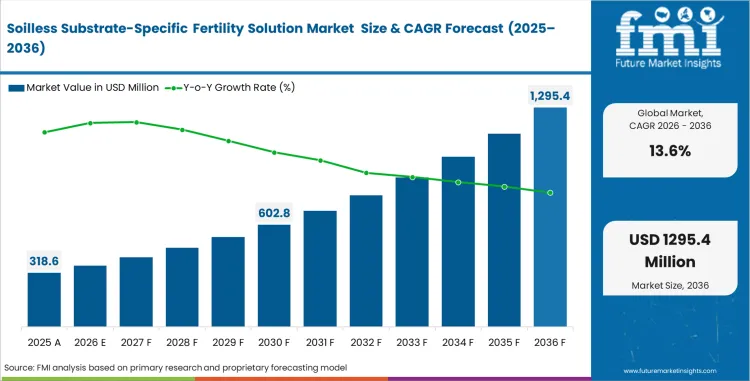
Key Takeaways
- The soilless substrate-specific fertility solution market was valued at USD 280.5 million in 2025.
- By 2036, the soilless substrate-specific fertility solution market is projected to reach USD 1,139.5 million.
- FMI projects a 13.6% CAGR for the market between 2026 and 2036.
- The market is expected to create an incremental opportunity of USD 820.9 million during the forecast period.
- Commercial greenhouses are expected to account for 46.0% of farm format demand in 2026 because nutrient precision matters more in controlled systems. That pattern aligns with FMI coverage of controlled environment agriculture (CEA) and hydroponics.
- China at 16.3% CAGR and India at 15.7% CAGR are projected to post the fastest country-level expansion through 2036.
Soilless Substrate-Specific Fertility Solution Market Definition
The soilless substrate-specific fertility solution market includes water-soluble fertilizers, stock solutions, micronutrient packs, pH and alkalinity correctives, calcium and magnesium support products, and functional nutrient additives designed for crops grown without field soil. These products are tailored to coco coir, rockwool, peat-lite blends, perlite systems, and recirculating hydroponic environments.
Soilless Substrate-Specific Fertility Solution Market Inclusions
The market scope covers commercially traded fertility inputs designed for soilless growing systems. Segmentation follows substrate type, crop class, system format, nutrient family, farm format, and region. The forecast captures revenue from media-adjusted soluble nutrition programs sold into greenhouse vegetables, indoor greens, berries, ornamentals, nurseries, propagation centers, and related controlled-environment operations from 2026 to 2036.
Soilless Substrate-Specific Fertility Solution Market Exclusions
The scope excludes commodity field fertilizers sold without substrate-specific formulation design. It also excludes crop protection products with no fertility function and irrigation hardware sold without nutrient program content.
Soilless Substrate-Specific Fertility Solution Market Research Methodology
- Primary Research: FMI analysts interviewed greenhouse crop advisors, fertilizer suppliers, substrate specialists, and controlled-environment growers across priority markets.
- Desk Research: The model used official greenhouse statistics, protected-cultivation policy records, and public horticulture production data from major countries.
- Market sizing and forecasting: The forecast combined protected-cropping indicators with specialty fertilizer intensity in substrate-grown systems.
- Data validation: Country assumptions were checked against greenhouse output, horticulture expansion signals, and recent specialty nutrient capacity developments.
Why is the Soilless Substrate-Specific Fertility Solution Market Growing?
- Commercial protected horticulture is creating stronger demand for nutrient programs matched to substrate buffering, irrigation strategy, and crop stage.
- Operators using coco coir and recirculating systems need tighter calcium and pH control than standard mixes usually provide.
- Recirculating hydroponics adds further pressure for formula precision because return water changes nutrient ratios during production.
Operators need products that help maintain stable EC and ion balance across repeated irrigation cycles. That requirement supports higher-value feeding programs and closer technical support from suppliers. The market for soilless substrate-specific fertility solutions is expanding faster than general fertilizer categories because these products sit close to yield protection in high-value crops. Growers buy them to protect uniformity, reduce formulation errors, and manage water chemistry with greater precision.
Market Segmentation Analysis
- Coco coir accounts for 34.0% of the substrate type segment in 2026. Rockwool and peat-lite programs retain commercial relevance in intensive protected systems.
- Commercial greenhouses account for 46.0% of demand in 2026 because large operators purchase through standardized recipe programs.
- Recirculating hydroponics leads the system format segment at 37.0% because return-water chemistry raises the value of targeted nutrient correction.
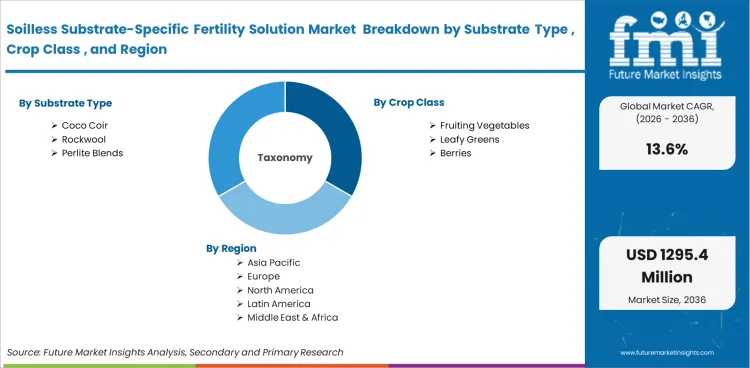
The market is divided by substrate type, crop class, system format, nutrient family, farm format, and region. Major substrate categories include coco coir, rockwool, peat-lite, perlite blends, and other media. Key crop classes include leafy greens, fruiting vegetables, berries, ornamentals, and propagation crops.
Insights into the Coco Coir Substrate Type Segment
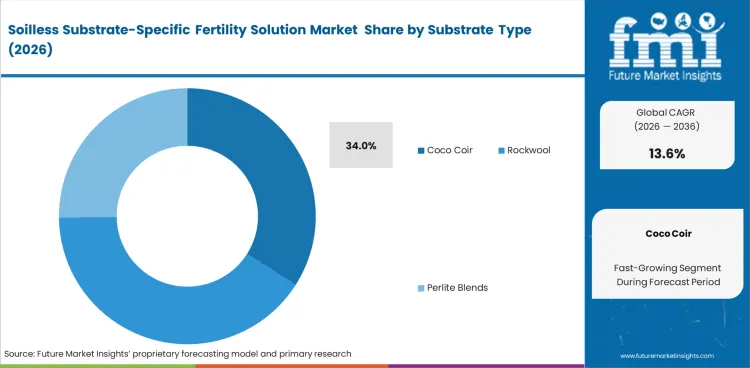
- In 2026, coco coir is expected to account for 34.0% of the substrate type segment. Commercial growers favor it because buffering capacity and air-filled porosity support consistent root development across tomatoes and propagation crops.
- The medium also fits drip irrigation programs used in large greenhouse clusters where repeatable fertigation matters. Similar substrate logic appears across
Insights into the Fruiting Vegetables Crop Class Segment
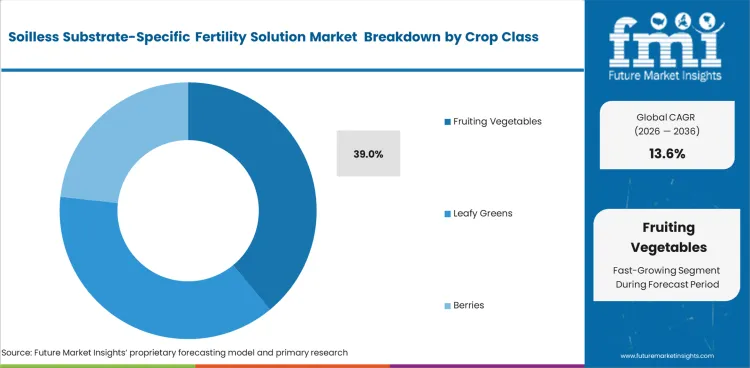
- Fruiting vegetables are expected to hold 39.0% of the crop class segment in 2026. Crops like tomatoes and cucumbers consume larger nutrient volumes per square meter than many short-cycle crops and they need close calcium and EC management through long harvest windows.
- Growers also rely on recipe adjustments to protect fruit quality, shelf life, and yield consistency across changing weather and water conditions.
Insights into the Complete Feeds Nutrient Family Segment
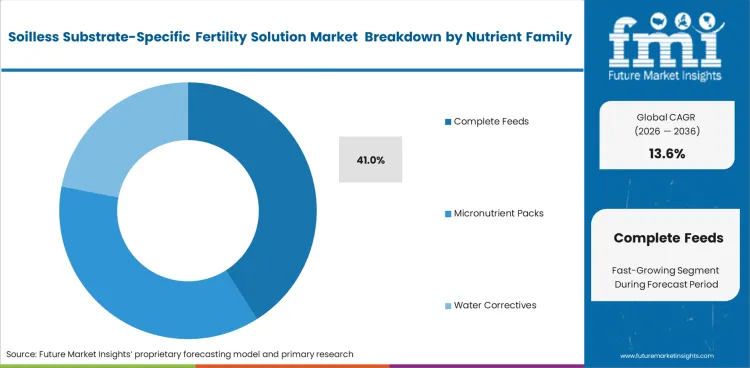
- Complete feeds are expected to account for 41.0% of the nutrient family segment in 2026. Growers prefer them in routine production because they simplify stock-tank preparation and support consistent macro and micro delivery across standard crop programs.
- Adoption is strongest where operators manage many houses or multiple irrigation zones and need fewer formulation errors during daily mixing.
Insights into the Commercial Greenhouses Farm Format Segment
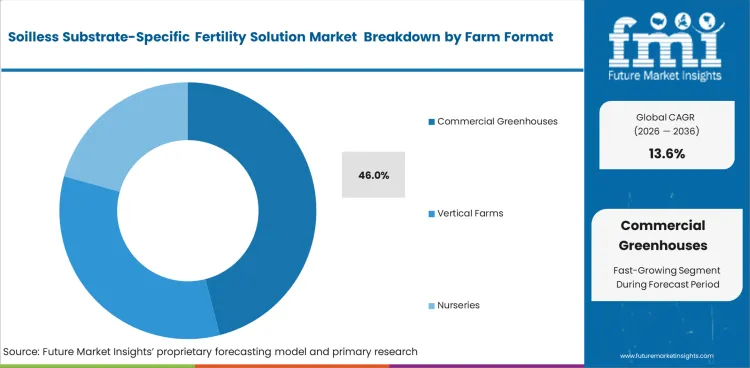
- In 2026, commercial greenhouses are expected to account for 46.0% of the market. Large greenhouse clusters buy substrate-specific fertility programs because high crop density and long production cycles raise the cost of nutrient imbalance.
- Standardized recipe programs help operators manage crop steering and reduce variability across multiple houses.
Insights into the Recirculating Hydroponics System Format Segment
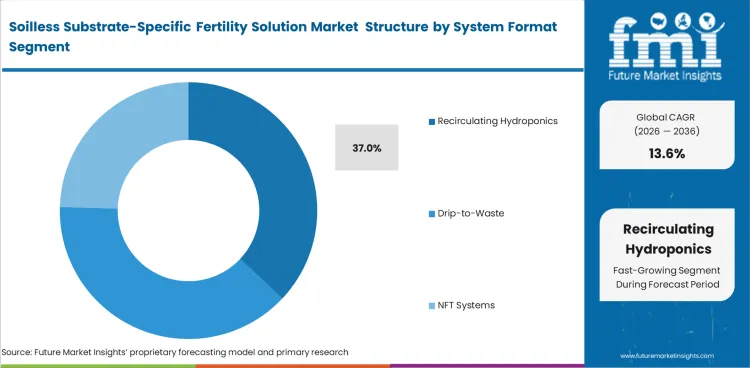
- Recirculating hydroponics is expected to hold 37.0% of the market in 2026. Reused irrigation water changes nutrient ratios over time. Operators therefore need products that account for source water quality and selective ion uptake across crop stages.
- Commercial value in this segment comes from nutrient monitoring and formula correction rather than commodity tonnage alone. Suppliers that support drain-water interpretation and recipe adjustment can defend pricing more effectively than vendors focused on simple drip-to-waste programs.
Soilless Substrate-Specific Fertility Solution Market Drivers, Restraints, and Opportunities
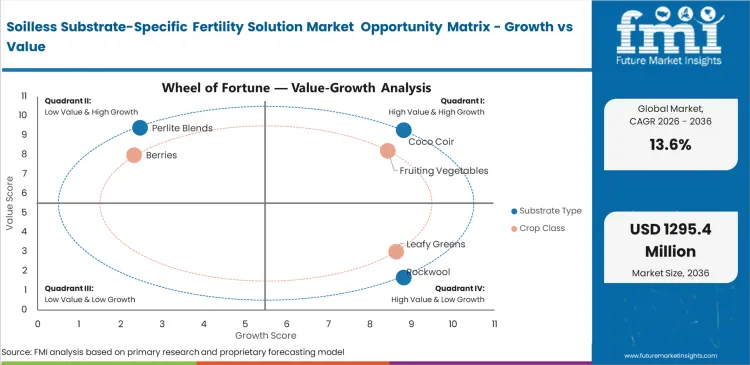
- Protected horticulture expansion and facility agriculture upgrades are increasing demand for media-adjusted soluble nutrition programs.
- High energy and greenhouse capital costs can slow acreage additions and delay upgrades from generic feeding to specialized formulas.
- Local specialty fertilizer production and crop-specific recipe support can improve supplier access in emerging controlled-environment agriculture.
Protected Cultivation Expansion
Demand is supported by rising commercial acreage under greenhouses and other controlled growing structures. These systems use higher-value crops and tighter irrigation control. That operating profile raises the need for substrate-matched nutrition instead of broad field-fertilizer programs. Similar economics appear in FMI analysis of microalgae fertilizers and agricultural enzymes where efficiency gains carry more weight than bulk nutrient volume.
Water Quality and Recirculation Management
Root-zone control carries more value in recirculating systems because reused water brings dissolved ions back into the feed plan. Suppliers gain ground when they help growers correct bicarbonate load, calcium balance, and micronutrient drift across the production cycle.
Analysis of Soilless Substrate-Specific Fertility Solution Market By Key Countries
.webp "Top Country Growth Comparison Soilless Substrate Specific Fertility Solution Market Cagr (2026 2036)")
| Country | CAGR |
|---|---|
| Canada | 15.2% |
| United States | 12.4% |
| Netherlands | 11.8% |
|
Spain |
12.9% |
|
China |
16.3% |
|
India |
15.7% |
|
Japan |
10.4% |
Source: FMI analysis based on primary research and public protected-cultivation indicators
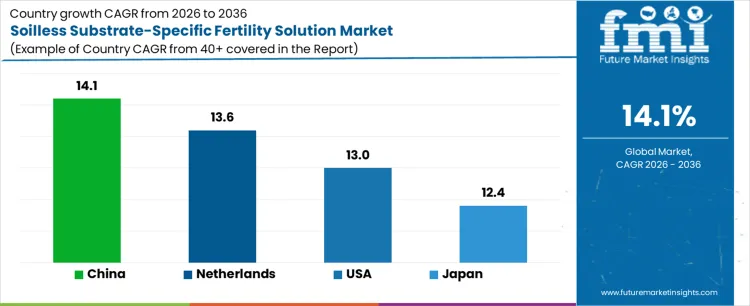
Soilless Substrate-Specific Fertility Solution Market CAGR Analysis By Country
- China is expected to lead the market with a 16.3% CAGR, as facility agriculture modernization and large-scale protected cultivation are anticipated to continue widening the commercial base for nutrient precision.
- India, at 15.7%, is projected to reflect greenhouse and horticulture development from a lower organized base, while improving access to specialty soluble fertilizers is expected to support this expansion.
- Canada, with a CAGR of 15.2%, is anticipated to show strong value expansion because greenhouse vegetable production is expected to remain concentrated and nutrient use per hectare is projected to stay high in commercial operations.
- The Netherlands, at 11.8% CAGR, and Japan, at 10.4% CAGR, are predicted to grow below the global average, as both markets are expected to remain more mature demand centers, while continuing to support premium formulation sales.
The global market is expected to grow at a CAGR of 13.6% from 2026 to 2036. FMI report assessed more than 30 countries. The leading national demand centers are summarized below.
Demand Outlook for Soilless Substrate-Specific Fertility Solution Market in Canada
Canada is projected to grow at a CAGR of 15.2% through 2036. Dense greenhouse vegetable production and high nutrient-use intensity keep the country above the global average. Large operators need media-specific feeding programs that support crop steering and uniform production across concentrated protected acreage.
- Dense greenhouse vegetable production supports high-value nutrient programs.
- Commercial operators buy more standardized recipes across multiple houses.
- Yield protection keeps demand firm for technical feeding support.
Future Outlook for Soilless Substrate-Specific Fertility Solution Market in the United States
The United States is projected to grow at a CAGR of 12.4% through 2036. Commercial greenhouse vegetables, indoor greens, and nursery systems continue to broaden use of controlled feeding programs. Wide regional variation in water quality also supports demand for correction products and tailored mixes.
- Indoor greens support demand for precision soluble feeds.
- Water correction needs increase the value of tailored nutrient programs.
- Nursery and propagation systems widen the addressable demand base.
Opportunity Analysis of Soilless Substrate-Specific Fertility Solution Market in the Netherlands
The Netherlands is projected to grow at a CAGR of 11.8% through 2036. Growth is slower than in newer expansion markets because Dutch greenhouse systems are already highly developed. The country still remains a premium demand center for advanced fertigation programs.
- High-tech greenhouses keep demand centered on recipe precision.
- Mature commercial systems support premium formulation sales.
- Water and yield management sustain technical-service value.
In-depth Analysis of Soilless Substrate-Specific Fertility Solution Market in Spain
Spain industry is estimated to record a CAGR of 12.9% during the forecast period. Intensive greenhouse vegetable production continues to rely on efficient fertigation and substrate-managed systems. Export-oriented crop programs support demand for stable quality and dependable nutrient control.
- Greenhouse vegetables remain the core demand base.
- Export production supports strict quality targets.
- Efficient fertigation sustains demand for soluble formula accuracy.
Sales Analysis of Soilless Substrate-Specific Fertility Solution Market in China
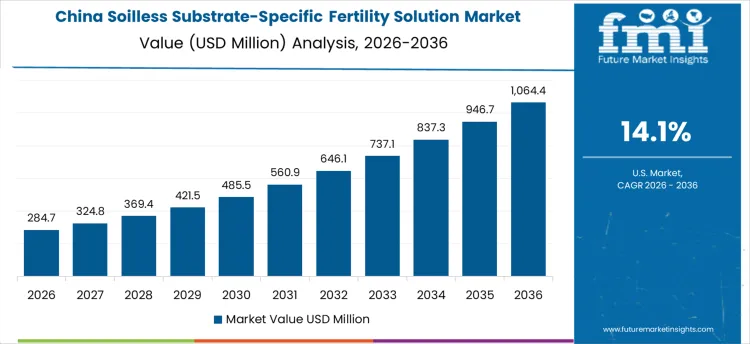
China is anticipated to garner a CAGR of 16.3% through 2036. Large facility-agriculture scale and modernization policy create room for recipe-based nutrient programs. Broad protected area and local supply development keep China at the front of the growth curve.
- Facility agriculture scale supports rapid volume buildout.
- Modernization plans support higher input-quality targets.
- Localized supply can improve access to substrate-specific nutrition.
In-depth Analysis of Soilless Substrate-Specific Fertility Solution Market in India
Demand in India is set to expand at a CAGR of 15.7% by 2036. Organized horticulture and controlled-cultivation systems continue to broaden from a lower base. New specialty fertilizer capacity and public support for horticulture upgrades can strengthen supplier reach during the forecast period.
- Horticulture modernization broadens the commercial demand base.
- Lower starting penetration leaves more room for fast expansion.
- Local specialty fertilizer supply can improve delivery and customization.
Future Outlook for Soilless Substrate-Specific Fertility Solution Market in Japan
Japan is projected to grow at a CAGR of 10.4% through 2036. Growth remains moderate because the market is more mature. Controlled-environment agriculture and smart fertigation continue to support premium demand in high-value crops.
- Mature facility horticulture supports premium recipe demand.
- Smart agriculture keeps demand firm for controlled feeding programs.
- High-value crops sustain demand for stable nutrient quality.
Competitive Landscape and Strategic Positioning
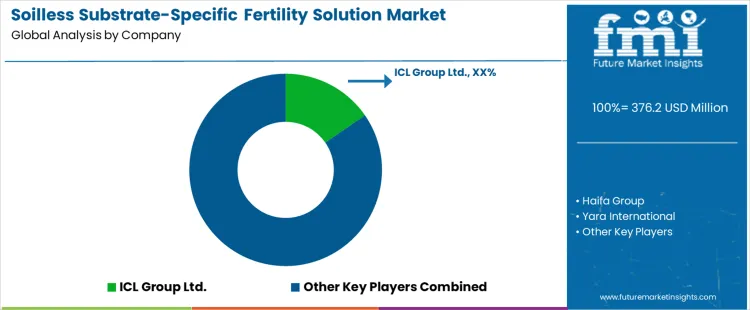
Soilless Substrate-Specific Fertility Solution Market Analysis By Company
- ICL Group leads the field because it combines specialty fertilizer manufacturing with technical crop nutrition support across protected horticulture.
- Haifa Group, Yara International, and SQM retain strong positions in soluble nutrition and fertigation products used in substrate-grown crops.
- Regional and specialist suppliers compete through crop-stage recipes, water correction support, and close agronomic service in intensive growing systems.
ICL Group is among key players as it combines specialty fertilizer scale with direct relevance in controlled-environment horticulture. Haifa Group and Yara International remain strong in soluble nutrition. SQM, COMPO EXPERT, Van Iperen International, and OAT Agrio compete through product breadth and crop-specific support. Competitive positioning here overlaps with FMI coverage of potassium sulfate in the EU where crop-specific soluble inputs retain premium value.
Barriers include the technical nature of formulation support and the need for reliable soluble quality. Buyer preference for proven feeding programs in high-value crops adds another hurdle. Strategic priorities include local supply access, water-quality support, and better use of substrate diagnostics in nutrient planning.
Key Companies in the Soilless Substrate-Specific Fertility Solution Market
- Key global companies active in the soilless substrate-specific fertility solution market include:
- ICL Group, Haifa Group, Yara International, and SQM maintain large manufacturing bases for soluble nutrition programs and established links with greenhouse and controlled-environment growers.
- COMPO EXPERT, Van Iperen International, and OAT Agrio remain relevant in regional and specialist programs through crop-stage formulation support and media-specific nutrient advice.
Competitive Benchmarking: Soilless Substrate-Specific Fertility Solution Market
| Company | Soluble Product Breadth | Substrate Recipe Support | Protected-Crop Access | Geographic Footprint |
|---|---|---|---|---|
| ICL Group | High | Strong | Strong | Global |
| Haifa Group | High | Strong | Strong | Global |
| Yara International | High | Moderate | Strong | Global |
| SQM | Medium | Moderate | Moderate | Global |
| COMPO EXPERT | Medium | Moderate | Moderate | Europe |
| Van Iperen International | Medium | Strong | Moderate | Europe, Global |
| OAT Agrio | Medium | Strong | Moderate | Asia |
Source: Future Market Insights competitive analysis, 2026.
Key Developments in Soilless Substrate-Specific Fertility Solution Market
- In March 2026, ICL Group opened a specialty fertilizer manufacturing facility in India to strengthen supply for water-soluble nutrition programs.
- In 2025, Haifa Group highlighted Haifa Soluble DUO as a water-soluble fertilizer launch aimed at precise calcium and potassium delivery.
Key Players in the Soilless Substrate-Specific Fertility Solution Market:
Major Global Players:
- ICL Group
- Haifa Group
- Yara International
- SQM
- COMPO EXPERT
- Van Iperen International
- OAT Agrio
Report Scope and Coverage
| Parameter | Details |
|---|---|
| Quantitative Units | USD 318.6 million to USD 1,139.5 million, at a CAGR of 13.6% |
| Market Definition | The soilless substrate-specific fertility solution market covers media-adjusted water-soluble nutrient programs for crops grown without field soil. |
| Regions Covered | North America, Europe, Asia Pacific, and other major controlled-environment markets |
| Countries Covered | Canada, United States, Netherlands, Spain, China, India, Japan, and 30 plus countries |
| Key Companies Profiled | ICL Group, Haifa Group, Yara International, SQM, COMPO EXPERT, Van Iperen International, OAT Agrio |
| Forecast Period | 2026 to 2036 |
| Approach | Hybrid bottom-up and top-down methodology starting with public greenhouse and protected-cultivation indicators, then projecting adoption across substrate-managed systems. |
Soilless Substrate-Specific Fertility Solution Market by Segment
Soilless Substrate-Specific Fertility Solution Market Segmented by Substrate Type:
- Coco Coir
- Rockwool
- Peat-lite
- Perlite Blends
- Other Media
Soilless Substrate-Specific Fertility Solution Market Segmented by Crop Class:
- Leafy Greens
- Fruiting Vegetables
- Berries
- Ornamentals
- Propagation Crops
Soilless Substrate-Specific Fertility Solution Market Segmented by System Format:
- Recirculating Hydroponics
- Drip-to-Waste
- Ebb-and-Flow
- NFT Systems
- Deep-water Culture
Soilless Substrate-Specific Fertility Solution Market Segmented by Nutrient Family:
- Complete Feeds
- Micronutrient Packs
- Water Correctives
- Calcium Products
- Functional Additives
Soilless Substrate-Specific Fertility Solution Market Segmented by Farm Format:
- Commercial Greenhouses
- Vertical Farms
- Nurseries
- Research Facilities
- Specialty Growers
Soilless Substrate-Specific Fertility Solution Market by Region:
- North America
- Canada
- United States
- Europe
- Netherlands
- Spain
- Asia Pacific
- China
- India
- Japan
Research Sources and Bibliography
- Statistics Canada. (2025, April 24). The Daily: Greenhouse, sod and nursery industries, 2024.
- Statistics Netherlands. (2024, September 25). Area used to grow greenhouse vegetables has increased in ten years.
- Ministerio de Agricultura, Pesca y Alimentación. (2024, April 23). Análisis de campaña 2023/24 de hortalizas.
- Agriculture and Agri-Food Canada. (2025, October 15). Statistical overview of the Canadian greenhouse vegetable and mushroom industry 2024.
- USA Department of Agriculture Foreign Agricultural Service. (2024, June 25). Planting Seeds Annual 2024: China.
- Department of Agriculture & Farmers Welfare, Government of India. (2025, March 13). Annual report 2024-25.
- National Horticulture Board. (2024, December 31). Revision in the Scheme Guidelines of MIDH and NHB.
- USA Department of Agriculture, Economic Research Service. (2024, April).
Vegetables and Pulses Outlook: April 2024. - Shanghai Municipal Agriculture and Rural Affairs Commission. (2024, May 15). Shanghai Action Plan for the Modernization and Upgrading of Facility Agriculture (2024–2027).
Ministry of Agriculture, Forestry and Fisheries of Japan. (2024, December 25). Introduction of Exhibiting Companies at the Smart Agriculture Promotion Forum 2024 in the Kinki Region. - ICL Growing Solutions. (2026, March 19). ICL Group opens specialty fertilizer manufacturing facility in India.
- Haifa Group. (2025). Haifa Group showcases its commitment to smarter crop nutrition.
This Report Answers
- What is the current and future size of the soilless substrate-specific fertility solution market?
- How fast is the soilless substrate-specific fertility solution market expected to grow between 2026 and 2036?
- Which substrate type is likely to lead the soilless substrate-specific fertility solution market by 2026?
- Which farm format segment is expected to account for the highest demand in the soilless substrate-specific fertility solution market by 2026?
- What factors are driving demand for soilless substrate-specific fertility solutions globally?
- How are protected cultivation trends influencing adoption of soilless substrate-specific fertility solutions?
- Why are recirculating hydroponic systems emerging as a major demand center for soilless substrate-specific fertility solutions?
- Which countries are projected to show the fastest growth in the soilless substrate-specific fertility solution market through 2036?
- What is driving expansion of the soilless substrate-specific fertility solution market in China and India?
- Who are the key companies active in the soilless substrate-specific fertility solution market?
- How does FMI estimate and validate the soilless substrate-specific fertility solution market forecast?
Frequently Asked Questions
What is the global demand for soilless substrate-specific fertility solution in 2026?
In 2026, the global soilless substrate-specific fertility solution market is expected to reach USD 318.6 million.
How large will the soilless substrate-specific fertility solution market be in 2036?
By 2036, the soilless substrate-specific fertility solution market is expected to reach USD 1,139.5 million.
How fast will demand for soilless substrate-specific fertility solution expand between 2026 and 2036?
Demand for soilless substrate-specific fertility solution is expected to expand at a CAGR of 13.6% between 2026 and 2036.
Which farm format segment is expected to lead the soilless substrate-specific fertility solution market by 2026?
Commercial greenhouses are expected to account for 46.0% of the market in 2026. That share confirms greenhouse operations as the primary demand center for substrate-specific fertility programs.
What is driving growth of the soilless substrate-specific fertility solution market in China?
China is projected to grow at a CAGR of 16.3% through 2036 because facility agriculture modernization and large protected-cropping scale support wider adoption.
What is driving growth of the soilless substrate-specific fertility solution market in India?
India is projected to grow at a CAGR of 15.7% through 2036 because horticulture modernization and broader access to specialty soluble fertilizers are improving supplier reach.
What does this report mean by the soilless substrate-specific fertility solution market definition?
The market includes nutrient solutions designed for crops grown in coco coir, rockwool, peat-lite, perlite, and recirculating hydroponic systems.
How does FMI build and validate the soilless substrate-specific fertility solution forecast?
Forecasting uses a hybrid bottom-up and top-down model that starts with public protected-cultivation indicators and checks them against commercial activity by country.
Preview the report firsthand - request a free sample
Get SampleGet the brochure for pricing and purchase details.
Get PDFTable of Content
- Executive Summary
- Global Market Outlook
- Demand-side Trends
- Supply-side Trends
- Technology Roadmap Analysis
- Analysis and Recommendations
- Market Overview
- Market Coverage / Taxonomy
- Market Definition / Scope / Limitations
- Research Methodology
- Chapter Orientation
- Analytical Lens and Working Hypotheses
- Market Structure, Signals, and Trend Drivers
- Benchmarking and Cross-market Comparability
- Market Sizing, Forecasting, and Opportunity Mapping
- Research Design and Evidence Framework
- Desk Research Programme (Secondary Evidence)
- Company Annual and Sustainability Reports
- Peer-reviewed Journals and Academic Literature
- Corporate Websites, Product Literature, and Technical Notes
- Earnings Decks and Investor Briefings
- Statutory Filings and Regulatory Disclosures
- Technical White Papers and Standards Notes
- Trade Journals, Industry Magazines, and Analyst Briefs
- Conference Proceedings, Webinars, and Seminar Materials
- Government Statistics Portals and Public Data Releases
- Press Releases and Reputable Media Coverage
- Specialist Newsletters and Curated Briefings
- Sector Databases and Reference Repositories
- FMI Internal Proprietary Databases and Historical Market Datasets
- Subscription Datasets and Paid Sources
- Social Channels, Communities, and Digital Listening Inputs
- Additional Desk Sources
- Expert Input and Fieldwork (Primary Evidence)
- Primary Modes
- Qualitative Interviews and Expert Elicitation
- Quantitative Surveys and Structured Data Capture
- Blended Approach
- Why Primary Evidence is Used
- Field Techniques
- Interviews
- Surveys
- Focus Groups
- Observational and In-context Research
- Social and Community Interactions
- Stakeholder Universe Engaged
- C-suite Leaders
- Board Members
- Presidents and Vice Presidents
- R&D and Innovation Heads
- Technical Specialists
- Domain Subject-matter Experts
- Scientists
- Physicians and Other Healthcare Professionals
- Governance, Ethics, and Data Stewardship
- Research Ethics
- Data Integrity and Handling
- Primary Modes
- Tooling, Models, and Reference Databases
- Desk Research Programme (Secondary Evidence)
- Data Engineering and Model Build
- Data Acquisition and Ingestion
- Cleaning, Normalisation, and Verification
- Synthesis, Triangulation, and Analysis
- Quality Assurance and Audit Trail
- Market Background
- Market Dynamics
- Drivers
- Restraints
- Opportunity
- Trends
- Scenario Forecast
- Demand in Optimistic Scenario
- Demand in Likely Scenario
- Demand in Conservative Scenario
- Opportunity Map Analysis
- Product Life Cycle Analysis
- Supply Chain Analysis
- Investment Feasibility Matrix
- Value Chain Analysis
- PESTLE and Porter’s Analysis
- Regulatory Landscape
- Regional Parent Market Outlook
- Production and Consumption Statistics
- Import and Export Statistics
- Market Dynamics
- Global Market Analysis 2021 to 2025 and Forecast, 2026 to 2036
- Historical Market Size Value (USD Million) Analysis, 2021 to 2025
- Current and Future Market Size Value (USD Million) Projections, 2026 to 2036
- Y-o-Y Growth Trend Analysis
- Absolute $ Opportunity Analysis
- Global Market Pricing Analysis 2021 to 2025 and Forecast 2026 to 2036
- Global Market Analysis 2021 to 2025 and Forecast 2026 to 2036, By Substrate Type
- Introduction / Key Findings
- Historical Market Size Value (USD Million) Analysis By Substrate Type , 2021 to 2025
- Current and Future Market Size Value (USD Million) Analysis and Forecast By Substrate Type , 2026 to 2036
- Coco Coir
- Rockwool
- Perlite Blends
- Coco Coir
- Y-o-Y Growth Trend Analysis By Substrate Type , 2021 to 2025
- Absolute $ Opportunity Analysis By Substrate Type , 2026 to 2036
- Global Market Analysis 2021 to 2025 and Forecast 2026 to 2036, By Crop Class
- Introduction / Key Findings
- Historical Market Size Value (USD Million) Analysis By Crop Class, 2021 to 2025
- Current and Future Market Size Value (USD Million) Analysis and Forecast By Crop Class, 2026 to 2036
- Fruiting Vegetables
- Leafy Greens
- Berries
- Fruiting Vegetables
- Y-o-Y Growth Trend Analysis By Crop Class, 2021 to 2025
- Absolute $ Opportunity Analysis By Crop Class, 2026 to 2036
- Global Market Analysis 2021 to 2025 and Forecast 2026 to 2036, By Nutrient Family
- Introduction / Key Findings
- Historical Market Size Value (USD Million) Analysis By Nutrient Family, 2021 to 2025
- Current and Future Market Size Value (USD Million) Analysis and Forecast By Nutrient Family, 2026 to 2036
- Complete Feeds
- Micronutrient Packs
- Water Correctives
- Complete Feeds
- Y-o-Y Growth Trend Analysis By Nutrient Family, 2021 to 2025
- Absolute $ Opportunity Analysis By Nutrient Family, 2026 to 2036
- Global Market Analysis 2021 to 2025 and Forecast 2026 to 2036, By Farm Format
- Introduction / Key Findings
- Historical Market Size Value (USD Million) Analysis By Farm Format, 2021 to 2025
- Current and Future Market Size Value (USD Million) Analysis and Forecast By Farm Format, 2026 to 2036
- Commercial Greenhouses
- Vertical Farms
- Nurseries
- Commercial Greenhouses
- Y-o-Y Growth Trend Analysis By Farm Format, 2021 to 2025
- Absolute $ Opportunity Analysis By Farm Format, 2026 to 2036
- Global Market Analysis 2021 to 2025 and Forecast 2026 to 2036, By System Format
- Introduction / Key Findings
- Historical Market Size Value (USD Million) Analysis By System Format, 2021 to 2025
- Current and Future Market Size Value (USD Million) Analysis and Forecast By System Format, 2026 to 2036
- Recirculating Hydroponics
- Drip-to-Waste
- NFT Systems
- Recirculating Hydroponics
- Y-o-Y Growth Trend Analysis By System Format, 2021 to 2025
- Absolute $ Opportunity Analysis By System Format, 2026 to 2036
- Global Market Analysis 2021 to 2025 and Forecast 2026 to 2036, By Region
- Introduction
- Historical Market Size Value (USD Million) Analysis By Region, 2021 to 2025
- Current Market Size Value (USD Million) Analysis and Forecast By Region, 2026 to 2036
- North America
- Latin America
- Western Europe
- Eastern Europe
- East Asia
- South Asia and Pacific
- Middle East & Africa
- Market Attractiveness Analysis By Region
- North America Market Analysis 2021 to 2025 and Forecast 2026 to 2036, By Country
- Historical Market Size Value (USD Million) Trend Analysis By Market Taxonomy, 2021 to 2025
- Market Size Value (USD Million) Forecast By Market Taxonomy, 2026 to 2036
- By Country
- USA
- Canada
- Mexico
- By Substrate Type
- By Crop Class
- By Nutrient Family
- By Farm Format
- By System Format
- By Country
- Market Attractiveness Analysis
- By Country
- By Substrate Type
- By Crop Class
- By Nutrient Family
- By Farm Format
- By System Format
- Key Takeaways
- Latin America Market Analysis 2021 to 2025 and Forecast 2026 to 2036, By Country
- Historical Market Size Value (USD Million) Trend Analysis By Market Taxonomy, 2021 to 2025
- Market Size Value (USD Million) Forecast By Market Taxonomy, 2026 to 2036
- By Country
- Brazil
- Chile
- Rest of Latin America
- By Substrate Type
- By Crop Class
- By Nutrient Family
- By Farm Format
- By System Format
- By Country
- Market Attractiveness Analysis
- By Country
- By Substrate Type
- By Crop Class
- By Nutrient Family
- By Farm Format
- By System Format
- Key Takeaways
- Western Europe Market Analysis 2021 to 2025 and Forecast 2026 to 2036, By Country
- Historical Market Size Value (USD Million) Trend Analysis By Market Taxonomy, 2021 to 2025
- Market Size Value (USD Million) Forecast By Market Taxonomy, 2026 to 2036
- By Country
- Germany
- UK
- Italy
- Spain
- France
- Nordic
- BENELUX
- Rest of Western Europe
- By Substrate Type
- By Crop Class
- By Nutrient Family
- By Farm Format
- By System Format
- By Country
- Market Attractiveness Analysis
- By Country
- By Substrate Type
- By Crop Class
- By Nutrient Family
- By Farm Format
- By System Format
- Key Takeaways
- Eastern Europe Market Analysis 2021 to 2025 and Forecast 2026 to 2036, By Country
- Historical Market Size Value (USD Million) Trend Analysis By Market Taxonomy, 2021 to 2025
- Market Size Value (USD Million) Forecast By Market Taxonomy, 2026 to 2036
- By Country
- Russia
- Poland
- Hungary
- Balkan & Baltic
- Rest of Eastern Europe
- By Substrate Type
- By Crop Class
- By Nutrient Family
- By Farm Format
- By System Format
- By Country
- Market Attractiveness Analysis
- By Country
- By Substrate Type
- By Crop Class
- By Nutrient Family
- By Farm Format
- By System Format
- Key Takeaways
- East Asia Market Analysis 2021 to 2025 and Forecast 2026 to 2036, By Country
- Historical Market Size Value (USD Million) Trend Analysis By Market Taxonomy, 2021 to 2025
- Market Size Value (USD Million) Forecast By Market Taxonomy, 2026 to 2036
- By Country
- China
- Japan
- South Korea
- By Substrate Type
- By Crop Class
- By Nutrient Family
- By Farm Format
- By System Format
- By Country
- Market Attractiveness Analysis
- By Country
- By Substrate Type
- By Crop Class
- By Nutrient Family
- By Farm Format
- By System Format
- Key Takeaways
- South Asia and Pacific Market Analysis 2021 to 2025 and Forecast 2026 to 2036, By Country
- Historical Market Size Value (USD Million) Trend Analysis By Market Taxonomy, 2021 to 2025
- Market Size Value (USD Million) Forecast By Market Taxonomy, 2026 to 2036
- By Country
- India
- ASEAN
- Australia & New Zealand
- Rest of South Asia and Pacific
- By Substrate Type
- By Crop Class
- By Nutrient Family
- By Farm Format
- By System Format
- By Country
- Market Attractiveness Analysis
- By Country
- By Substrate Type
- By Crop Class
- By Nutrient Family
- By Farm Format
- By System Format
- Key Takeaways
- Middle East & Africa Market Analysis 2021 to 2025 and Forecast 2026 to 2036, By Country
- Historical Market Size Value (USD Million) Trend Analysis By Market Taxonomy, 2021 to 2025
- Market Size Value (USD Million) Forecast By Market Taxonomy, 2026 to 2036
- By Country
- Kingdom of Saudi Arabia
- Other GCC Countries
- Turkiye
- South Africa
- Other African Union
- Rest of Middle East & Africa
- By Substrate Type
- By Crop Class
- By Nutrient Family
- By Farm Format
- By System Format
- By Country
- Market Attractiveness Analysis
- By Country
- By Substrate Type
- By Crop Class
- By Nutrient Family
- By Farm Format
- By System Format
- Key Takeaways
- Key Countries Market Analysis
- USA
- Pricing Analysis
- Market Share Analysis, 2025
- By Substrate Type
- By Crop Class
- By Nutrient Family
- By Farm Format
- By System Format
- Canada
- Pricing Analysis
- Market Share Analysis, 2025
- By Substrate Type
- By Crop Class
- By Nutrient Family
- By Farm Format
- By System Format
- Mexico
- Pricing Analysis
- Market Share Analysis, 2025
- By Substrate Type
- By Crop Class
- By Nutrient Family
- By Farm Format
- By System Format
- Brazil
- Pricing Analysis
- Market Share Analysis, 2025
- By Substrate Type
- By Crop Class
- By Nutrient Family
- By Farm Format
- By System Format
- Chile
- Pricing Analysis
- Market Share Analysis, 2025
- By Substrate Type
- By Crop Class
- By Nutrient Family
- By Farm Format
- By System Format
- Germany
- Pricing Analysis
- Market Share Analysis, 2025
- By Substrate Type
- By Crop Class
- By Nutrient Family
- By Farm Format
- By System Format
- UK
- Pricing Analysis
- Market Share Analysis, 2025
- By Substrate Type
- By Crop Class
- By Nutrient Family
- By Farm Format
- By System Format
- Italy
- Pricing Analysis
- Market Share Analysis, 2025
- By Substrate Type
- By Crop Class
- By Nutrient Family
- By Farm Format
- By System Format
- Spain
- Pricing Analysis
- Market Share Analysis, 2025
- By Substrate Type
- By Crop Class
- By Nutrient Family
- By Farm Format
- By System Format
- France
- Pricing Analysis
- Market Share Analysis, 2025
- By Substrate Type
- By Crop Class
- By Nutrient Family
- By Farm Format
- By System Format
- India
- Pricing Analysis
- Market Share Analysis, 2025
- By Substrate Type
- By Crop Class
- By Nutrient Family
- By Farm Format
- By System Format
- ASEAN
- Pricing Analysis
- Market Share Analysis, 2025
- By Substrate Type
- By Crop Class
- By Nutrient Family
- By Farm Format
- By System Format
- Australia & New Zealand
- Pricing Analysis
- Market Share Analysis, 2025
- By Substrate Type
- By Crop Class
- By Nutrient Family
- By Farm Format
- By System Format
- China
- Pricing Analysis
- Market Share Analysis, 2025
- By Substrate Type
- By Crop Class
- By Nutrient Family
- By Farm Format
- By System Format
- Japan
- Pricing Analysis
- Market Share Analysis, 2025
- By Substrate Type
- By Crop Class
- By Nutrient Family
- By Farm Format
- By System Format
- South Korea
- Pricing Analysis
- Market Share Analysis, 2025
- By Substrate Type
- By Crop Class
- By Nutrient Family
- By Farm Format
- By System Format
- Russia
- Pricing Analysis
- Market Share Analysis, 2025
- By Substrate Type
- By Crop Class
- By Nutrient Family
- By Farm Format
- By System Format
- Poland
- Pricing Analysis
- Market Share Analysis, 2025
- By Substrate Type
- By Crop Class
- By Nutrient Family
- By Farm Format
- By System Format
- Hungary
- Pricing Analysis
- Market Share Analysis, 2025
- By Substrate Type
- By Crop Class
- By Nutrient Family
- By Farm Format
- By System Format
- Kingdom of Saudi Arabia
- Pricing Analysis
- Market Share Analysis, 2025
- By Substrate Type
- By Crop Class
- By Nutrient Family
- By Farm Format
- By System Format
- Turkiye
- Pricing Analysis
- Market Share Analysis, 2025
- By Substrate Type
- By Crop Class
- By Nutrient Family
- By Farm Format
- By System Format
- South Africa
- Pricing Analysis
- Market Share Analysis, 2025
- By Substrate Type
- By Crop Class
- By Nutrient Family
- By Farm Format
- By System Format
- USA
- Market Structure Analysis
- Competition Dashboard
- Competition Benchmarking
- Market Share Analysis of Top Players
- By Regional
- By Substrate Type
- By Crop Class
- By Nutrient Family
- By Farm Format
- By System Format
- Competition Analysis
- Competition Deep Dive
- ICL Group
- Overview
- Product Portfolio
- Profitability by Market Segments (Product/Age /Sales Channel/Region)
- Sales Footprint
- Strategy Overview
- Marketing Strategy
- Product Strategy
- Channel Strategy
- Haifa Group
- Yara International
- SQM
- COMPO EXPERT
- Van Iperen International
- OAT Agrio
- ICL Group
- Competition Deep Dive
- Assumptions & Acronyms Used


