

- Industry Size (2026)
- USD 271 Mn
- Forecast (2036)
- USD 1058.8 Mn
- CAGR (2026 to 2036)
- 14.6%
Regenerative Grassland Fertility Management Package Market Forecast and Outlook 2026 to 2036
The regenerative grassland fertility management package market is valued at USD 271 million in 2026 and is projected to reach USD 1,058.8 million by 2036, growing at a compound annual growth rate (CAGR) of 14.6%. This market is characterized by stable, ongoing demand driven by a long-term commitment to sustainable land management practices. Buyers are not only looking for immediate solutions but are also focused on the long-term benefits of soil health and ecosystem restoration. As regenerative practices gain traction, repeat usage becomes common, with customers seeking continuous support for fertility management year after year. Buyer commitment levels will be influenced by the proven effectiveness of these packages in improving soil quality and boosting grassland productivity. The need for consistency and reliability will shape purchasing behavior, as these products are integrated into broader regenerative farming systems. Suppliers who can deliver both performance and scalability will capture long-term value, positioning themselves as trusted partners in sustainable agricultural practices.
Quick Stats of the Regenerative Grassland Fertility Management Package Market
- Regenerative Grassland Fertility Management Package Market Value (2026): USD 271 million
- Regenerative Grassland Fertility Management Package Market Forecast Value (2036): USD 1,058.8 million
- Regenerative Grassland Fertility Management Package Market Global Forecast CAGR (2026-2036): 14.6%
- Regenerative Grassland Fertility Management Package Market Leading Segment: Direct Sales Channel 60%
- Key Growth Regions in Regenerative Grassland Fertility Management Package Market: USA
- Top Players in Regenerative Grassland Fertility Management Package Market: Nutrien, Yara International, BASF, Corteva, UPL, Syngenta
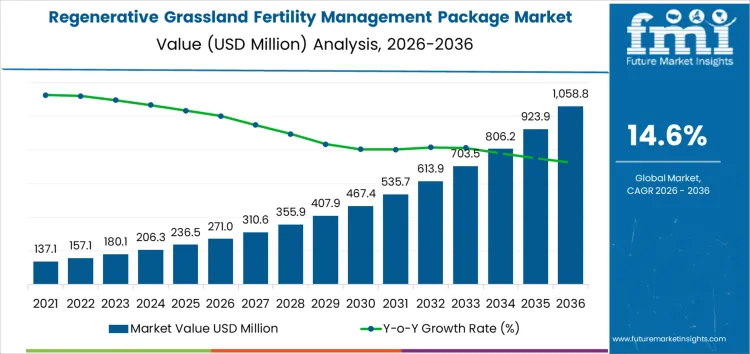
What is the Growth Forecast for the Regenerative Grassland Fertility Management Package Market through 2036?
The growth momentum analysis for the regenerative grassland fertility management package market reveals an accelerating phase in the early years followed by stable growth as the market matures. From 2026 to 2031, the market will experience a strong surge, growing from USD 271 million to USD 540.7 million. This acceleration will be driven by the increasing adoption of regenerative agriculture, supported by growing consumer demand for sustainably produced food and heightened awareness of the environmental impact of conventional farming methods. During this phase, farmers will seek out solutions that improve soil fertility, sequester carbon, and enhance biodiversity, all of which regenerative grassland management packages can offer. As a result, the market will see a noticeable increase in adoption, fueling growth in the early years.
From 2031 to 2036, the market will experience stable, sustained growth. From USD 540.7 million in 2031, the market will rise to USD 1,058.8 million by 2036, but the rate of growth will moderate. This deceleration is typical of a maturing market where the technology becomes standardized, and growth is driven by continued innovation and broader adoption across the agricultural industry. During this phase, the focus will shift to optimizing existing solutions and enhancing the efficiency of fertility management practices. The market will still expand, but at a more predictable and steady pace, reflecting the technology’s integration into mainstream farming practices and the continued drive toward sustainable agriculture.
Regenerative Grassland Fertility Management Package Market Key Takeaways
| Metric | Value |
|---|---|
| Industry Sales Value (2026) | USD 271 million |
| Industry Forecast Value (2036) | USD 1,058.8 million |
| Industry Forecast CAGR (2026-2036) | 14.6% |
What Is Driving the Demand for Regenerative Grassland Fertility Management Package Market?
Historical demand for grassland fertility management has been shaped by long-standing agricultural reliance on soil nutrients to support forage production, livestock systems, and ecosystem productivity. Traditional grassland management focused on periodic fertilizer application and grazing rotation to maintain pasture yield and quality. Soil fertility research has highlighted the importance of balanced nutrient levels, organic matter, and microbial activity for sustaining grassland productivity and resilience, particularly where overgrazing and land degradation reduced organic carbon and nutrient stocks. Regenerative principles that seek to restore soil biology and structure are rooted in agronomy and restoration ecology, where practices such as cover cropping, planting of deep-rooted perennial grasses and legumes, and reduction of soil disturbance are used to improve soil fertility and nutrient cycling. Native plant species selection has been shown to influence nutrient cycling and enhance carbon and nitrogen concentrations in degraded soils, reflecting early scientific interest in using plant traits to regenerate soil fertility. These historical developments provided context for fertility packages that integrate ecological approaches with nutrient management in grassland systems.
Future demand for regenerative grassland fertility management packages is expected to grow as regenerative agriculture practices expand globally and as stakeholders prioritise soil health, carbon sequestration, and sustainable productivity. The regenerative agriculture market is projected to reach about USD 41.31 billion by 2034 at roughly 14 % CAGR from 2025, driven by interest in soil restoration, biodiversity, nutrient cycling, and ecosystem resilience. Regenerative grassland fertility packages typically combine soil amendments, cover cropping strategies, grazing plans, and microbial or organic inputs to enhance nutrient availability while rebuilding soil organic matter and structure. Growth factors include increasing adoption of holistic planned grazing, policy incentives that support soil health outcomes, and broader emphasis on climate-smart agriculture that links soil carbon storage with nutrient management. Technical drivers include advances in soil testing and tailored fertility inputs that respond to site-specific conditions, while challenges such as knowledge gaps and upfront costs of transition may influence adoption. Continued integration of regenerative grassland fertility solutions with market incentives and soil health frameworks is likely to shape future uptake in livestock and forage systems.
What are the Leading Segments in the Global Regenerative Grassland Fertility Management Package Market?
The global regenerative grassland fertility management package market is segmented by form and channel. Among forms, liquid leads the market, capturing 45% of the share, followed by solid, gas, and gel forms. Liquid fertilizers are preferred due to their ease of application, rapid absorption, and compatibility with regenerative farming practices. On the channel side, direct sales dominate the market, holding 60% of the share, followed by retail, online, and distributor channels. Direct sales are favored due to their ability to provide personalized service, technical support, and tailored fertility management packages for large-scale grassland operations.
What Drives the Growth of Liquid Fertilizers in the Regenerative Grassland Fertility Management Package Market?
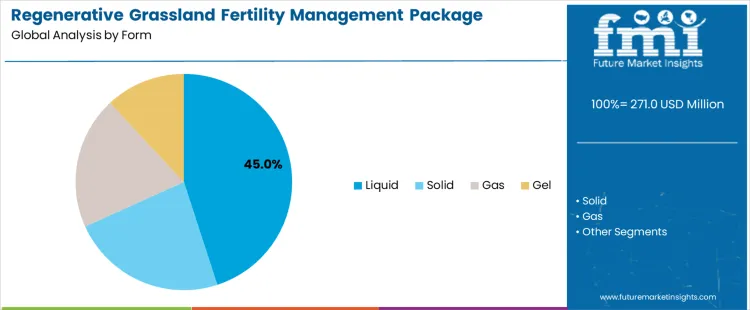
Liquid fertilizers are the leading form in the regenerative grassland fertility management package market, holding 45% of the share. This growth is primarily driven by the increasing adoption of liquid fertilizers in regenerative agriculture, where the focus is on improving soil health and reducing chemical inputs. Liquid fertilizers are highly efficient, offering rapid absorption of nutrients, which is crucial in regenerative farming systems that aim to improve soil biodiversity and promote sustainable grassland management. These fertilizers are particularly compatible with modern application systems, such as irrigation or fertigation, allowing for precise nutrient delivery and minimizing waste. The flexibility of liquid fertilizers in adapting to various soil types and farming systems, along with their quick impact on plant health, makes them highly popular among regenerative grassland management practitioners. As the demand for sustainable farming practices and soil health improvement grows, liquid fertilizers will continue to be the dominant form in this market.
What is Driving the Demand for Direct Sales in the Regenerative Grassland Fertility Management Package Market?
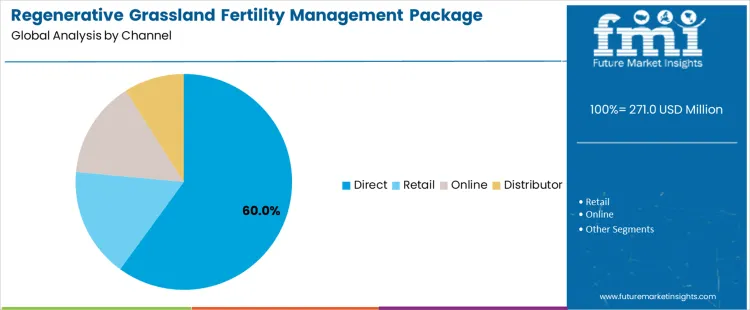
Direct sales are the leading channel in the regenerative grassland fertility management package market, capturing 60% of the share. This demand is driven by the need for specialized, tailored solutions that can address the unique challenges of regenerative grassland management. Direct sales enable manufacturers to provide personalized advice, customized fertility management packages, and technical support to large-scale grassland operations. This direct relationship also ensures that the specific needs of grassland managers and regenerative farmers are met, whether it is for improving soil fertility, enhancing biodiversity, or reducing environmental impact. Direct sales also allow for stronger, long-term customer relationships, as farmers and grassland managers require ongoing support for the successful implementation of regenerative practices. As the market for regenerative agriculture continues to expand, direct sales will remain the preferred channel due to the high level of service, support, and expertise they provide.
What are the Key Dynamics in the Regenerative Grassland Fertility Management Package Market?
Historical demand for grassland fertility management has been shaped by long-standing agricultural reliance on soil nutrients to support forage production, livestock systems, and ecosystem productivity. Traditional grassland management focused on periodic fertilizer application and grazing rotation to maintain pasture yield and quality. Soil fertility research has highlighted the importance of balanced nutrient levels, organic matter, and microbial activity for sustaining grassland productivity and resilience, particularly where overgrazing and land degradation reduced organic carbon and nutrient stocks. Regenerative principles that seek to restore soil biology and structure are rooted in agronomy and restoration ecology, where practices such as cover cropping, planting of deep-rooted perennial grasses and legumes, and reduction of soil disturbance are used to improve soil fertility and nutrient cycling. Native plant species selection has been shown to influence nutrient cycling and enhance carbon and nitrogen concentrations in degraded soils, reflecting early scientific interest in using plant traits to regenerate soil fertility. These historical developments provided context for fertility packages that integrate ecological approaches with nutrient management in grassland systems.
Future demand for regenerative grassland fertility management packages is expected to grow as regenerative agriculture practices expand globally and as stakeholders prioritise soil health, carbon sequestration, and sustainable productivity. The regenerative agriculture market is projected to reach about USD 41.31 billion by 2034, driven by interest in soil restoration, biodiversity, nutrient cycling, and ecosystem resilience. The regenerative grassland fertility management package market is defined by demand for soil nutrient solutions that support long-term grassland productivity and ecosystem function. Packages combine soil testing, tailored fertilizer inputs, and best practice guidance to match nutrient supply with plant demand. Adoption reflects interest in nutrient cycling, soil organic matter, and biodiversity in grazing systems. Regulatory frameworks on land use and environmental protection influence program design. Service delivery models, data collection tools, and agronomic support shape how packages are evaluated and implemented by ranchers and land managers.
What are the Main Drivers Supporting Growth in this Market?
Growth in this market is driven by emphasis on nutrient use efficiency and soil health in grassland systems. Ranchers and land managers seek fertility packages that improve forage quality and support carrying capacity without excessive nutrient losses. Scientific evidence linking soil biology, carbon storage, and nutrient cycling reinforces interest in integrated soil-plant strategies. Policies that encourage reduced runoff and enhanced land stewardship contribute to demand. Advances in soil testing technologies and decision support tools enable more precise nutrient planning. Collaboration between advisers, agronomists, and product suppliers supports adoption of regenerative approaches.
What Restraints Are Limiting Market Expansion?
Market expansion is constrained by variability in soil conditions, climate, and grazing management practices, which can lead to inconsistent outcomes. Cost of comprehensive fertility packages, including testing and advisory services, can deter uptake among smaller operations. Lack of familiarity with regenerative principles and measurement tools may limit acceptance. Differences in regulatory and incentive structures across regions add complexity for service providers and end users. Data requirements for demonstrating improvements in soil nutrient status or ecosystem indicators can create administrative burdens that slow adoption.
What Emerging Trends Are Shaping the Future of this Market?
Emerging trends include integration of precision agriculture tools that map soil nutrient variability and track changes over time. Use of remote sensing and field sensors is increasing to inform fertility decisions and monitor forage response. There is growing interest in combining organic amendments with mineral inputs to support biological activity and improve soil structure. Partnerships between research institutions, extension services, and private providers are producing localized guidance on regenerative grassland fertility. Data-driven benchmarking and feedback systems are facilitating adaptive management and long-term evaluation of program outcomes.
What is the Country-Wise Analysis of the Regenerative Grassland Fertility Management Package Market?
The regenerative grassland fertility management package market is growing as part of a broader shift towards sustainable land management practices in agriculture. These packages focus on enhancing soil health and fertility, promoting biodiversity, and improving carbon sequestration in grasslands, which are critical components of the global carbon cycle. The USA, Australia, New Zealand, and China are leading the way in the adoption of regenerative agricultural practices, with each country focusing on improving the health of grasslands to enhance productivity and environmental sustainability. Developed markets like the U.S., Australia, and New Zealand are seeing strong demand for these fertility management packages, driven by their focus on environmental stewardship and sustainable agriculture. In China, the demand for regenerative grassland practices is rising as the country seeks to improve the sustainability of its agricultural systems. As global awareness of the need for sustainable farming practices increases, the market for regenerative grassland fertility management packages is expected to expand significantly.
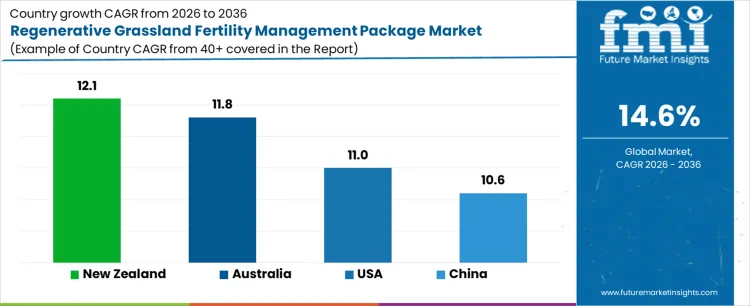
| Country | CAGR (2026-2036) |
|---|---|
| USA | 11% |
| Australia | 11.8% |
| New Zealand | 12.1% |
| China | 10.6% |
What is the Growth Outlook for the Regenerative Grassland Fertility Management Package Market in the USA?
The regenerative grassland fertility management package market in the USA is expected to grow steadily, with a projected CAGR of 11% from 2026 to 2036. As one of the largest agricultural producers globally, the USA is increasingly focusing on sustainable land management practices that promote long-term soil health and carbon sequestration. USA farmers are adopting regenerative grassland fertility packages to enhance soil fertility, improve grassland biodiversity, and boost resilience to climate change. These packages help farmers manage their land in a way that increases productivity while reducing the environmental impact of traditional farming methods. Government support for sustainable farming practices, combined with growing awareness of the benefits of regenerative agriculture, is expected to drive continued demand for regenerative grassland fertility management packages in the USA
What is the Market Outlook for the Regenerative Grassland Fertility Management Package Market in Australia?
Australia is projected to experience strong growth in the regenerative grassland fertility management package market, with a projected CAGR of 11.8% from 2026 to 2036. Australia has long been focused on improving the sustainability of its farming practices, especially given the country’s vulnerability to climate change, droughts, and soil degradation. Regenerative grassland practices, including soil health improvement and carbon sequestration, are gaining traction among Australian farmers as a way to combat these challenges. The adoption of regenerative grassland fertility management packages is seen as a key solution to improve land productivity and environmental resilience. With a strong emphasis on sustainable agriculture and government initiatives supporting regenerative farming practices, the market for these fertility packages is expected to continue expanding in Australia over the coming decade.
What is the Growth Forecast for the Regenerative Grassland Fertility Management Package Market in New Zealand?
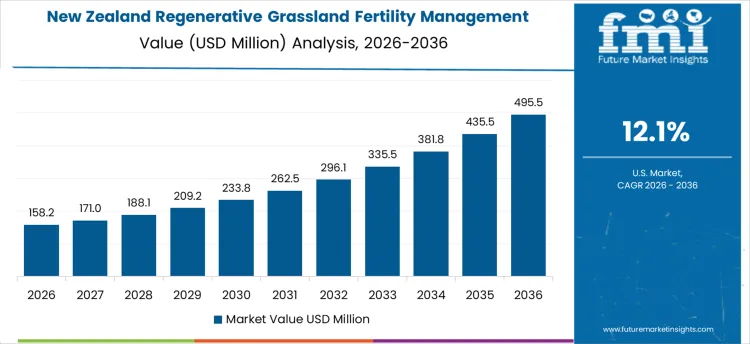
New Zealand is expected to see the highest growth in the regenerative grassland fertility management package market, with a projected CAGR of 12.1% from 2026 to 2036. New Zealand's agricultural sector is increasingly adopting regenerative practices to improve the health of its grasslands, which are essential for livestock farming. With a strong focus on sustainability, New Zealand farmers are turning to regenerative grassland fertility management packages to boost soil fertility, reduce greenhouse gas emissions, and improve pasture productivity. These packages help farmers implement practices that enhance biodiversity, improve carbon sequestration, and make agricultural systems more resilient to climate change. As the demand for sustainable farming solutions grows, the market for regenerative grassland fertility management packages in New Zealand is expected to expand rapidly in the coming years.
What is the Market Outlook for the Regenerative Grassland Fertility Management Package Market in China?
China is projected to experience steady growth in the regenerative grassland fertility management package market, with a projected CAGR of 10.6% from 2026 to 2036. China is actively seeking solutions to improve the sustainability of its agricultural practices, particularly in grassland and pasture management. The country is focused on reducing soil degradation, improving soil fertility, and enhancing the productivity of its agricultural lands. The adoption of regenerative grassland fertility management packages is seen as a way to address these challenges while promoting environmental sustainability. With increasing government support for sustainable agriculture and the rising recognition of the benefits of regenerative practices, China’s market for regenerative grassland fertility management packages is expected to grow steadily, contributing to the country’s broader environmental and agricultural goals.
What are the Growth Prospects for the Regenerative Grassland Fertility Management Package Market Globally?
Globally, the regenerative grassland fertility management package market is set to expand significantly, driven by the growing need for sustainable agricultural practices that promote long-term soil health, biodiversity, and carbon sequestration. As awareness of the environmental impacts of conventional farming methods rises, there is a growing adoption of regenerative practices in grassland and pasture management worldwide. These practices, which include enhancing soil fertility and improving ecosystem resilience, are becoming essential for tackling global challenges such as climate change, food security, and land degradation. With increasing government initiatives, policy support, and consumer demand for environmentally responsible farming practices, the global market for regenerative grassland fertility management packages is expected to grow across both developed and emerging markets.
What is the Competitive Landscape for the Regenerative Grassland Fertility Management Package Market?
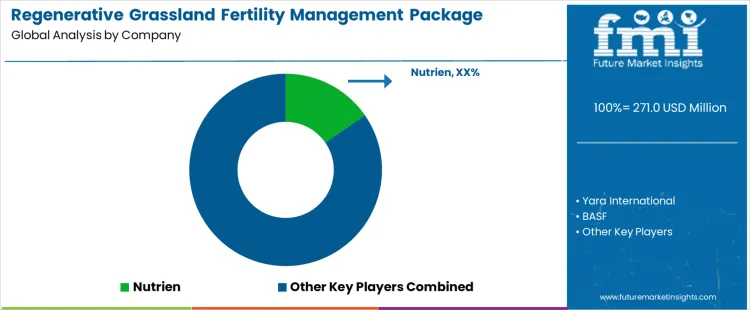
The regenerative grassland fertility management package market is growing as the agricultural sector increasingly focuses on sustainable and regenerative farming practices to improve soil health, enhance biodiversity, and reduce environmental impact. Nutrien leads the market with its innovative regenerative grassland fertility management packages, offering nutrient management solutions that support grassland regeneration and soil fertility while minimizing environmental harm. Their emphasis on sustainability, product performance, and regenerative agriculture practices has positioned them as a dominant player in the market. Yara International, BASF, and Corteva are significant competitors, each providing specialized products and programs for grassland fertility management. Yara International focuses on nutrient optimization and sustainable farming solutions, while BASF and Corteva offer advanced technologies that promote healthy grassland ecosystems and improve soil fertility.
UPL and Syngenta further contribute to the competitive landscape by offering their own regenerative grassland fertility management programs. UPL emphasizes sustainable agriculture practices and soil health enhancement, while Syngenta provides solutions designed to support regenerative farming techniques and improve land productivity. These companies compete by focusing on innovation, sustainability, and their ability to meet the growing demand for regenerative agriculture solutions. As the focus on sustainable land management and regenerative farming practices increases, the market for regenerative grassland fertility management packages is expected to continue growing, fostering further innovation and competition in the sector.
Key Players of the Regenerative Grassland Fertility Management Package Market
- Nutrien
- Yara International
- BASF
- Corteva
- UPL
- Syngenta
Scope of the Report
| Items | Values |
|---|---|
| Quantitative Units (2026) | USD million |
| Application | Standard, Premium, Industrial, Other |
| Form | Liquid, Solid, Gas, Gel |
| Channel | Direct, Retail, Online, Distributor |
| Companies | Nutrien, Yara International, BASF, Corteva, UPL, Syngenta |
| Regions Covered | North America, Latin America, Western Europe, Eastern Europe, South Asia & Pacific, East Asia, Middle East & Africa |
| Countries Covered | United States, Canada, Mexico, Brazil, Argentina, Germany, France, United Kingdom, Italy, Spain, Netherlands, China, India, Japan, South Korea, ANZ, GCC Countries, South Africa |
| Additional Attributes | Dollar by sales by application, form, and channel, and by region. Includes analysis of market trends in regenerative grassland fertility management packages, performance of fertility inputs across grassland systems, cost and deployment drivers, regulatory and environmental considerations affecting regenerative practices, adoption patterns among ranchers and land managers, market share and competitive positioning of key companies, innovations in grassland fertility and soil health technologies, and evaluation of impact on grassland productivity, soil carbon sequestration, biodiversity outcomes, and economic viability of regenerative practices. |
Regenerative Grassland Fertility Management Package Market Segmentation
Application
- Standard
- Premium
- Industrial
- Other
Form
- Liquid
- Solid
- Gas
- Gel
Channel
- Direct
- Retail
- Online
- Distributor
Region
- Asia Pacific
- China
- Japan
- South Korea
- India
- Australia & New Zealand
- ASEAN
- Rest of Asia Pacific
- Europe
- Germany
- United Kingdom
- France
- Italy
- Spain
- Nordic
- BENELUX
- Rest of Europe
- North America
- United States
- Canada
- Mexico
- Latin America
- Brazil
- Chile
- Rest of Latin America
- Middle East & Africa
- Kingdom of Saudi Arabia
- Other GCC Countries
- Turkey
- South Africa
- Other African Union
- Rest of Middle East & Africa
Frequently Asked Questions
How big is the regenerative grassland fertility management package market in 2026?
The global regenerative grassland fertility management package market is estimated to be valued at USD 271.0 million in 2026.
What will be the size of regenerative grassland fertility management package market in 2036?
The market size for the regenerative grassland fertility management package market is projected to reach USD 1,058.8 million by 2036.
How much will be the regenerative grassland fertility management package market growth between 2026 and 2036?
The regenerative grassland fertility management package market is expected to grow at a 14.6% CAGR between 2026 and 2036.
What are the key application types in the regenerative grassland fertility management package market?
The key application types in regenerative grassland fertility management package market are standard, premium, industrial and other.
Which form segment will contribute significant share in the regenerative grassland fertility management package market in 2026?
In terms of form, liquid segment to command 45.0% share in the regenerative grassland fertility management package market in 2026.
Preview the report firsthand - request a free sample
Get SampleGet the brochure for pricing and purchase details.
Get PDFTable of Content
- Executive Summary
- Global Market Outlook
- Demand-side Trends
- Supply-side Trends
- Technology Roadmap Analysis
- Analysis and Recommendations
- Market Overview
- Market Coverage / Taxonomy
- Market Definition / Scope / Limitations
- Market Background
- Market Dynamics
- Drivers
- Restraints
- Opportunity
- Trends
- Scenario Forecast
- Demand in Optimistic Scenario
- Demand in Likely Scenario
- Demand in Conservative Scenario
- Opportunity Map Analysis
- Product Life Cycle Analysis
- Supply Chain Analysis
- Investment Feasibility Matrix
- Value Chain Analysis
- PESTLE and Porter’s Analysis
- Regulatory Landscape
- Regional Parent Market Outlook
- Production and Consumption Statistics
- Import and Export Statistics
- Market Dynamics
- Global Market Analysis 2021 to 2025 and Forecast, 2026 to 2036
- Historical Market Size Value (USD Million) Analysis, 2021 to 2025
- Current and Future Market Size Value (USD Million) Projections, 2026 to 2036
- Y-o-Y Growth Trend Analysis
- Absolute $ Opportunity Analysis
- Global Market Pricing Analysis 2021 to 2025 and Forecast 2026 to 2036
- Global Market Analysis 2021 to 2025 and Forecast 2026 to 2036, By Application
- Introduction / Key Findings
- Historical Market Size Value (USD Million) Analysis By Application , 2021 to 2025
- Current and Future Market Size Value (USD Million) Analysis and Forecast By Application , 2026 to 2036
- Standard
- Premium
- Industrial
- Other
- Standard
- Y-o-Y Growth Trend Analysis By Application , 2021 to 2025
- Absolute $ Opportunity Analysis By Application , 2026 to 2036
- Global Market Analysis 2021 to 2025 and Forecast 2026 to 2036, By Form
- Introduction / Key Findings
- Historical Market Size Value (USD Million) Analysis By Form, 2021 to 2025
- Current and Future Market Size Value (USD Million) Analysis and Forecast By Form, 2026 to 2036
- Liquid
- Solid
- Gas
- Gel
- Liquid
- Y-o-Y Growth Trend Analysis By Form, 2021 to 2025
- Absolute $ Opportunity Analysis By Form, 2026 to 2036
- Global Market Analysis 2021 to 2025 and Forecast 2026 to 2036, By Channel
- Introduction / Key Findings
- Historical Market Size Value (USD Million) Analysis By Channel, 2021 to 2025
- Current and Future Market Size Value (USD Million) Analysis and Forecast By Channel, 2026 to 2036
- Direct
- Retail
- Online
- Distributor
- Direct
- Y-o-Y Growth Trend Analysis By Channel, 2021 to 2025
- Absolute $ Opportunity Analysis By Channel, 2026 to 2036
- Global Market Analysis 2021 to 2025 and Forecast 2026 to 2036, By Region
- Introduction
- Historical Market Size Value (USD Million) Analysis By Region, 2021 to 2025
- Current Market Size Value (USD Million) Analysis and Forecast By Region, 2026 to 2036
- North America
- Latin America
- Western Europe
- Eastern Europe
- East Asia
- South Asia and Pacific
- Middle East & Africa
- Market Attractiveness Analysis By Region
- North America Market Analysis 2021 to 2025 and Forecast 2026 to 2036, By Country
- Historical Market Size Value (USD Million) Trend Analysis By Market Taxonomy, 2021 to 2025
- Market Size Value (USD Million) Forecast By Market Taxonomy, 2026 to 2036
- By Country
- USA
- Canada
- Mexico
- By Application
- By Form
- By Channel
- By Country
- Market Attractiveness Analysis
- By Country
- By Application
- By Form
- By Channel
- Key Takeaways
- Latin America Market Analysis 2021 to 2025 and Forecast 2026 to 2036, By Country
- Historical Market Size Value (USD Million) Trend Analysis By Market Taxonomy, 2021 to 2025
- Market Size Value (USD Million) Forecast By Market Taxonomy, 2026 to 2036
- By Country
- Brazil
- Chile
- Rest of Latin America
- By Application
- By Form
- By Channel
- By Country
- Market Attractiveness Analysis
- By Country
- By Application
- By Form
- By Channel
- Key Takeaways
- Western Europe Market Analysis 2021 to 2025 and Forecast 2026 to 2036, By Country
- Historical Market Size Value (USD Million) Trend Analysis By Market Taxonomy, 2021 to 2025
- Market Size Value (USD Million) Forecast By Market Taxonomy, 2026 to 2036
- By Country
- Germany
- UK
- Italy
- Spain
- France
- Nordic
- BENELUX
- Rest of Western Europe
- By Application
- By Form
- By Channel
- By Country
- Market Attractiveness Analysis
- By Country
- By Application
- By Form
- By Channel
- Key Takeaways
- Eastern Europe Market Analysis 2021 to 2025 and Forecast 2026 to 2036, By Country
- Historical Market Size Value (USD Million) Trend Analysis By Market Taxonomy, 2021 to 2025
- Market Size Value (USD Million) Forecast By Market Taxonomy, 2026 to 2036
- By Country
- Russia
- Poland
- Hungary
- Balkan & Baltic
- Rest of Eastern Europe
- By Application
- By Form
- By Channel
- By Country
- Market Attractiveness Analysis
- By Country
- By Application
- By Form
- By Channel
- Key Takeaways
- East Asia Market Analysis 2021 to 2025 and Forecast 2026 to 2036, By Country
- Historical Market Size Value (USD Million) Trend Analysis By Market Taxonomy, 2021 to 2025
- Market Size Value (USD Million) Forecast By Market Taxonomy, 2026 to 2036
- By Country
- China
- Japan
- South Korea
- By Application
- By Form
- By Channel
- By Country
- Market Attractiveness Analysis
- By Country
- By Application
- By Form
- By Channel
- Key Takeaways
- South Asia and Pacific Market Analysis 2021 to 2025 and Forecast 2026 to 2036, By Country
- Historical Market Size Value (USD Million) Trend Analysis By Market Taxonomy, 2021 to 2025
- Market Size Value (USD Million) Forecast By Market Taxonomy, 2026 to 2036
- By Country
- India
- ASEAN
- Australia & New Zealand
- Rest of South Asia and Pacific
- By Application
- By Form
- By Channel
- By Country
- Market Attractiveness Analysis
- By Country
- By Application
- By Form
- By Channel
- Key Takeaways
- Middle East & Africa Market Analysis 2021 to 2025 and Forecast 2026 to 2036, By Country
- Historical Market Size Value (USD Million) Trend Analysis By Market Taxonomy, 2021 to 2025
- Market Size Value (USD Million) Forecast By Market Taxonomy, 2026 to 2036
- By Country
- Kingdom of Saudi Arabia
- Other GCC Countries
- Turkiye
- South Africa
- Other African Union
- Rest of Middle East & Africa
- By Application
- By Form
- By Channel
- By Country
- Market Attractiveness Analysis
- By Country
- By Application
- By Form
- By Channel
- Key Takeaways
- Key Countries Market Analysis
- USA
- Pricing Analysis
- Market Share Analysis, 2025
- By Application
- By Form
- By Channel
- Canada
- Pricing Analysis
- Market Share Analysis, 2025
- By Application
- By Form
- By Channel
- Mexico
- Pricing Analysis
- Market Share Analysis, 2025
- By Application
- By Form
- By Channel
- Brazil
- Pricing Analysis
- Market Share Analysis, 2025
- By Application
- By Form
- By Channel
- Chile
- Pricing Analysis
- Market Share Analysis, 2025
- By Application
- By Form
- By Channel
- Germany
- Pricing Analysis
- Market Share Analysis, 2025
- By Application
- By Form
- By Channel
- UK
- Pricing Analysis
- Market Share Analysis, 2025
- By Application
- By Form
- By Channel
- Italy
- Pricing Analysis
- Market Share Analysis, 2025
- By Application
- By Form
- By Channel
- Spain
- Pricing Analysis
- Market Share Analysis, 2025
- By Application
- By Form
- By Channel
- France
- Pricing Analysis
- Market Share Analysis, 2025
- By Application
- By Form
- By Channel
- India
- Pricing Analysis
- Market Share Analysis, 2025
- By Application
- By Form
- By Channel
- ASEAN
- Pricing Analysis
- Market Share Analysis, 2025
- By Application
- By Form
- By Channel
- Australia & New Zealand
- Pricing Analysis
- Market Share Analysis, 2025
- By Application
- By Form
- By Channel
- China
- Pricing Analysis
- Market Share Analysis, 2025
- By Application
- By Form
- By Channel
- Japan
- Pricing Analysis
- Market Share Analysis, 2025
- By Application
- By Form
- By Channel
- South Korea
- Pricing Analysis
- Market Share Analysis, 2025
- By Application
- By Form
- By Channel
- Russia
- Pricing Analysis
- Market Share Analysis, 2025
- By Application
- By Form
- By Channel
- Poland
- Pricing Analysis
- Market Share Analysis, 2025
- By Application
- By Form
- By Channel
- Hungary
- Pricing Analysis
- Market Share Analysis, 2025
- By Application
- By Form
- By Channel
- Kingdom of Saudi Arabia
- Pricing Analysis
- Market Share Analysis, 2025
- By Application
- By Form
- By Channel
- Turkiye
- Pricing Analysis
- Market Share Analysis, 2025
- By Application
- By Form
- By Channel
- South Africa
- Pricing Analysis
- Market Share Analysis, 2025
- By Application
- By Form
- By Channel
- USA
- Market Structure Analysis
- Competition Dashboard
- Competition Benchmarking
- Market Share Analysis of Top Players
- By Regional
- By Application
- By Form
- By Channel
- Competition Analysis
- Competition Deep Dive
- Nutrien
- Overview
- Product Portfolio
- Profitability by Market Segments (Product/Age /Sales Channel/Region)
- Sales Footprint
- Strategy Overview
- Marketing Strategy
- Product Strategy
- Channel Strategy
- Yara International
- BASF
- Corteva
- UPL
- Syngenta
- Nutrien
- Competition Deep Dive
- Assumptions & Acronyms Used
- Research Methodology


