

- Industry Size (2026)
- USD 0.6 Bn
- Forecast (2036)
- USD 2.5 Bn
- CAGR (2026 to 2036)
- 14.7%
Regenerative No-Till Compatible Weed Control Adjuvant Market Forecast and Outlook 2026 to 2036
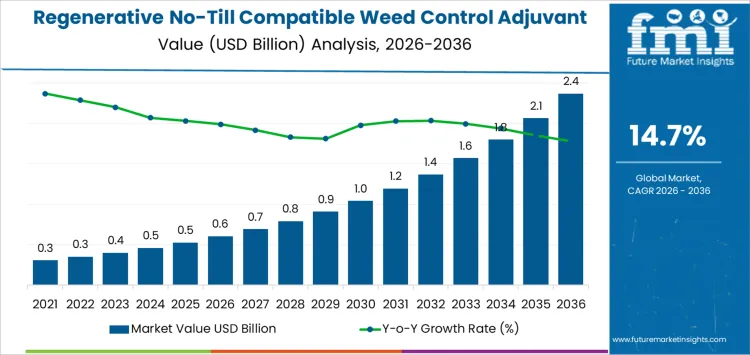
The global regenerative no-till compatible weed control adjuvant market is projected to grow significantly from USD 0.6 billion in 2026 to USD 2.5 billion by 2036, with a robust CAGR of 14.7%. The market is driven by the increasing adoption of regenerative agriculture practices that focus on enhancing soil health and carbon sequestration. Residue-compatible penetration enhancers lead the market with a 34% share, enabling effective herbicide penetration while preserving the benefits of no-till systems. Row crops (corn, soybean, cotton) hold the largest share at 49%, driven by their extensive cultivation and reliance on efficient weed management in no-till systems.
Quick Stats for Regenerative No-Till Compatible Weed Control Adjuvant Market
- Regenerative No-Till Compatible Weed Control Adjuvant Market Value (2026): USD 0.6 billion
- Regenerative No-Till Compatible Weed Control Adjuvant Market Forecast Value (2036): USD 2.5 billion
- Regenerative No-Till Compatible Weed Control Adjuvant Market Forecast CAGR: 14.7%
- Leading Adjuvant Function Type in Regenerative No-Till Compatible Weed Control Adjuvant Market: Residue-Compatible Penetration Enhancers (34%)
- Key Growth Regions in Regenerative No-Till Compatible Weed Control Adjuvant Market: USA, Brazil, Argentina, Australia, France
- Key Players in Regenerative No-Till Compatible Weed Control Adjuvant Market: Wilbur-Ellis Agribusiness, CHS Inc. (Ag Retail & Solutions), Attune Agriculture, Brandt Consolidated, Simplot Grower Solutions
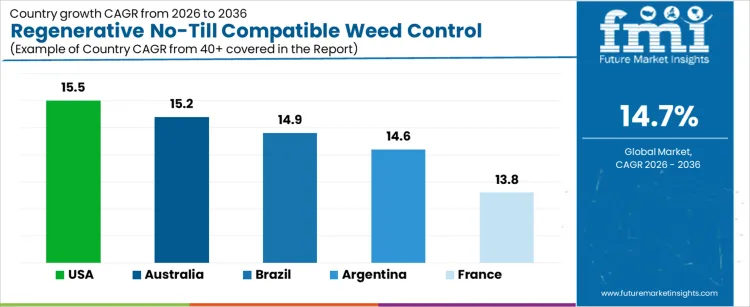
USA leads the market with a 15.5% CAGR, supported by the rapid adoption of no-till farming methods and government incentives for eco-friendly practices. Brazil follows with a 14.9% growth rate, driven by its large agricultural base and need for efficient weed control in no-till systems. Argentina’s market grows at 14.6%, reflecting the country’s focus on eco-friendly farming, while Australia’s market expands at 15.2%, driven by a commitment to soil conservation. France grows at 13.8%, influenced by its strong regulatory framework and the rising adoption of no-till systems. The increasing demand for environmentally friendly weed control solutions will continue to drive growth in these regions.
Regenerative No‑Till Compatible Weed Control Adjuvant Market Key Takeaways
| Metric | Value |
|---|---|
| Industry Value (2026) | USD 0.6 billion |
| Forecast Value (2036) | USD 2.5 billion |
| Forecast CAGR (2026 to 2036) | 14.7% |
Source: FMI analysis based on primary research and proprietary forecasting model
How is the Global Regenerative No‑Till Compatible Weed Control Adjuvant Sector Advancing?
The global regenerative no‑till compatible weed control adjuvant market is growing rapidly as growers pivot toward eco-friendly farming practices that support soil health and long‑term productivity. No‑till systems minimize soil disturbance to preserve structure, moisture, and microbial ecosystems, but controlling weeds without plowing requires highly effective chemical tools. Regenerative no‑till compatible weed control adjuvants are formulated to enhance herbicide performance in ways that support no‑till principles, including improved spray retention on plant surfaces, reduced drift, and better uptake under challenging field conditions. These adjuvants help growers maintain clean fields while protecting the benefits of reduced tillage.
Demand for no‑till compatible adjuvants is driven by increasing adoption of regenerative agriculture, where soil carbon sequestration, reduced erosion, and biodiversity are priorities. Traditional adjuvants may not perform optimally in low‑disturbance systems or can negatively affect soil biology, so products designed for compatibility with no‑till help bridge effective weed control with ecological goals. Advances in adjuvant chemistry have improved compatibility with a wide range of herbicide classes while maintaining performance under variable weather and crop canopies, making them valuable tools for growers across cereals, oilseeds, and specialty crops.
What is the Segment-Wise Analysis for the Global Regenerative No-Till Compatible Weed Control Adjuvant Market?
The global regenerative no-till compatible weed control adjuvant market is segmented by adjuvant function type and crop system. Residue-compatible penetration enhancers lead the market with a 34% share, as they enhance herbicide penetration while being compatible with no-till practices. Other significant adjuvant functions include drift & volatility reduction adjuvants, soil-surface stability & retention agents, and rainfastness & wash-off control agents. In terms of crop systems, row crops (corn, soybean, cotton) hold the largest share at 49%, followed by cereals & grains, oilseeds & pulses, and plantation & specialty crops.
How Do Residue-Compatible Penetration Enhancers Lead the Global Regenerative No-Till Compatible Weed Control Adjuvant Market?
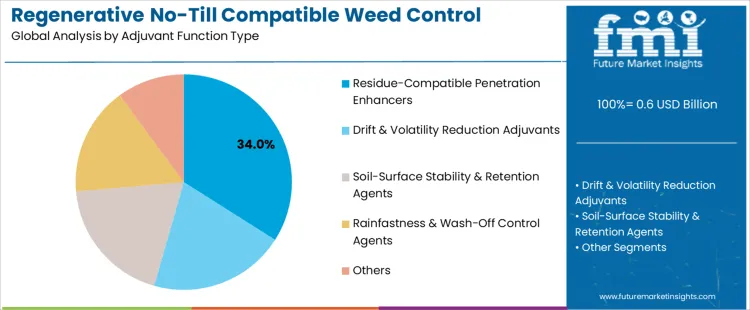
Residue-compatible penetration enhancers hold a 34% share in the global regenerative no-till compatible weed control adjuvant market due to their ability to improve the effectiveness of herbicides while aligning with no-till farming practices. These adjuvants enhance herbicide penetration into weeds without disturbing soil residue, which is a key factor in regenerative and no-till systems. By ensuring better herbicide uptake and reducing the impact of soil residues on herbicide efficacy, residue-compatible penetration enhancers provide an essential tool for farmers adopting eco-friendly farming practices. Their ability to improve weed control in no-till systems has made them the preferred choice in the market.
Why Do Row Crops (Corn, Soybean, Cotton) Hold the Largest Market Share in the Global Regenerative No-Till Compatible Weed Control Adjuvant Market?
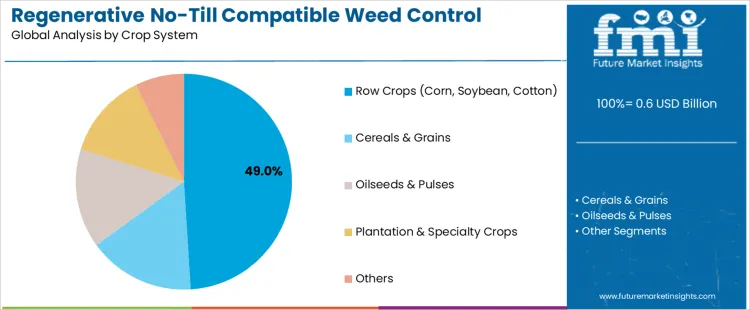
Row crops (corn, soybean, cotton) hold the largest share of 49% in the global regenerative no-till compatible weed control adjuvant market due to their extensive cultivation and high dependency on efficient weed management. In no-till farming systems, where minimal soil disturbance is crucial, effective herbicide application becomes more challenging. Regenerative no-till compatible weed control adjuvants, such as residue-compatible penetration enhancers and drift reduction agents, are critical for ensuring successful weed control in these crops. As the adoption of no-till practices increases in row crop farming, the demand for adjuvants that support these systems continues to drive their market dominance.
What is Shaping the Regenerative No Till Compatible Weed Control Adjuvant Market?
The regenerative notill compatible weed control adjuvant market is shaped by the growing emphasis on eco-friendly farming practices that enhance soil health and reduce mechanical disturbance. Notill systems minimize erosion, improve organic matter, and support carbon sequestration, but they also rely on effective chemical tools to manage weeds. Adjuvants that improve herbicide performance while being compatible with notill principles are increasingly adopted.
What Challenges Are Limiting Adoption of Regenerative No Till Compatible Weed Control Adjuvants?
Adoption is limited by cost considerations and performance uncertainty under varied field conditions. Specialized adjuvants designed for notill systems can carry higher upfront prices, which may deter budgetsensitive growers. Efficacy can vary with residue cover, soil moisture, and weed spectrum, leading to caution among users without localized performance data. Some growers also lack agronomic support or experience integrating adjuvants with conservation tillage practices, slowing uptake. Regional differences in notill adoption rates and varying definitions of “regenerative” practices complicate standardization and recommendations for herbicide adjuvant use.
What Key Trends Are Shaping the Regenerative No Till Compatible Weed Control Adjuvant Market?
Key trends include the development of adjuvants that combine lowdrift, enhanced adhesion, and improved rainfastness to maximize herbicide performance in residuerich notill fields. There is rising interest in biobased and lowtoxicity adjuvants that align with environmental stewardship and eco-friendly certification standards. Integration with precision spraying systems, variablerate technology, and sensorguided application is enhancing placement efficiency and reducing waste. Collaborative efforts between adjuvant manufacturers, crop protection companies, and regenerative agriculture advisors are driving tailored solutions.
What is the Growth Outlook for the Regenerative No-Till Compatible Weed Control Adjuvant Market by Country?
| Country | CAGR (%) |
|---|---|
| USA | 15.5% |
| Brazil | 14.9% |
| Argentina | 14.6% |
| Australia | 15.2% |
| France | 13.8% |
Source: FMI analysis based on primary research and proprietary forecasting model
The regenerative no-till compatible weed control adjuvant market is growing rapidly, with the USA leading at a 15.5% CAGR, driven by the increasing adoption of regenerative farming practices and no-till farming methods that promote soil health. Brazil follows closely with 14.9%, supported by its large-scale agricultural industry and the need for effective weed control solutions in no-till systems. Argentina’s market grows at 14.6%, fueled by the country’s focus on eco-friendly farming practices and increasing demand for eco-friendly weed control methods. Australia’s market grows at 15.2%, driven by the need to improve soil conservation and enhance crop productivity through no-till farming. France’s market grows at 13.8%, as farmers increasingly adopt no-till systems and seek compatible weed control solutions.
Why is the USA Leading in the Regenerative No-Till Compatible Weed Control Adjuvant Market?
The USA’s regenerative no-till compatible weed control adjuvant market is growing at 15.5%, driven by the increasing shift towards regenerative and no-till farming practices. No-till farming is known for its ability to improve soil structure, reduce erosion, and increase organic matter in the soil. As the adoption of no-till systems rises, there is an increasing need for effective weed control solutions that work within this approach. Regenerative no-till compatible adjuvants help improve the efficacy of herbicides while maintaining soil health. These adjuvants enhance the performance of weed control applications without disrupting the ecological balance. As farmers in the USA continue to focus on duarbility, improving soil health, and reducing chemical inputs, the demand for regenerative no-till compatible weed control adjuvants is growing rapidly. Government support for eco-friendly farming practices and the push for climate-smart agriculture are further accelerating the growth.
What is Driving the Growth of the Regenerative No-Till Compatible Weed Control Adjuvant Market in Brazil?
Brazil’s regenerative no-till compatible weed control adjuvant market is growing at 14.9%, supported by the country’s large agricultural base and the increasing adoption of no-till farming methods. Brazil, as a major producer of crops like soybeans, sugarcane, and coffee, is looking for solutions to maintain soil fertility and improve yields while minimizing environmental impact. Regenerative no-till farming is gaining popularity as it offers an eco-friendly way to manage soil health and reduce input costs. These adjuvants enhance herbicide effectiveness in no-till systems while reducing potential damage to the soil structure. As Brazil’s agricultural industry moves toward eco-friendlier practices, the demand for no-till compatible weed control solutions is expected to continue growing. with regulatory pressure to reduce chemical pesticide use, regenerative adjuvants offer an eco-friendly alternative, driving steady growth.
How is the Regenerative No-Till Compatible Weed Control Adjuvant Market Expanding in Argentina?
Argentina’s regenerative no-till compatible weed control adjuvant market is growing at 14.6%, driven by the country’s widespread adoption of no-till farming systems, particularly in its major agricultural regions. Argentina, one of the world’s largest producers of soybeans and wheat, is focusing on improving soil conservation and enhancing crop productivity. No-till farming methods help preserve soil structure, reduce water runoff, and increase carbon sequestration. The demand for regenerative no-till compatible weed control adjuvants is rising as these products improve weed control efficacy while maintaining soil health and supporting eco-friendly farming practices. The adoption of these adjuvants aligns with Argentina’s broader goals of improving agricultural duarbility and reducing reliance on chemical pesticides.
What is Contributing to the Growth of the Regenerative No-Till Compatible Weed Control Adjuvant Market in Australia?
Australia’s regenerative no-till compatible weed control adjuvant market is growing at 15.2%, driven by the country’s focus on eco-friendly agriculture and soil health. With large-scale farming systems that rely on no-till practices, Australia’s agricultural sector is adopting solutions that improve soil conservation and reduce the impact of weeds without harming the environment. Regenerative no-till compatible weed control adjuvants offer a way to enhance herbicide effectiveness while supporting soil structure and maintaining biodiversity. These adjuvants also help reduce the need for frequent chemical applications, which is particularly important in Australia’s arid climate. As Australian farmers increasingly embrace no-till farming and focus on improving long-term soil fertility, the demand for these eco-friendly weed control solutions is expected to continue to grow.
What is Driving the Growth of the Regenerative No-Till Compatible Weed Control Adjuvant Market in France?
France’s regenerative no-till compatible weed control adjuvant market is growing at 13.8%, supported by the country’s increasing adoption of eco-friendly farming practices and integrated pest management systems. No-till farming is gaining traction in France, particularly as farmers look for ways to conserve soil and reduce the environmental impact of traditional tilling. Regenerative no-till compatible adjuvants help improve the performance of herbicides in no-till systems while promoting soil health and reducing the impact of pesticides on the surrounding ecosystem. With growing awareness about the benefits of reduced tillage and ecological farming, the demand for these eco-friendly adjuvants is expected to rise.
Competitive Analysis Outlook
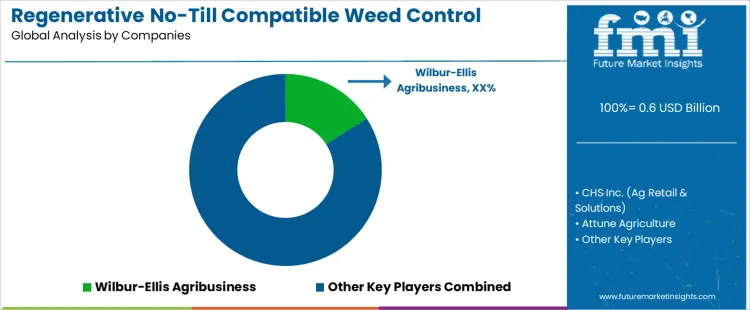
In the regenerative no‑till compatible weed control adjuvant market Wilbur‑Ellis Agribusiness, CHS Inc. (Ag Retail & Solutions), Attune Agriculture, Brandt Consolidated, Simplot Grower Solutions, and others are positioned with product brochures that emphasize improved spray performance under no‑till and low‑disturbance systems. Brochures from Wilbur‑Ellis Agribusiness describe adjuvant formulations engineered to enhance herbicide spread and uptake in residue‑laden environments. Performance data is presented alongside recommended spray practices. At CHS Inc. materials highlight adjuvant systems with broad compatibility and usage guidance tailored to no‑till conditions, with visual summaries of droplet retention and coverage. Short technical notes support agronomists and custom applicators. Attune Agriculture collateral is focused on surfactant blends that improve deposition and reduce drift risk, with product briefs showing improved weed suppression in reduced‑tillage operations.
Brandt Consolidated brochures present tailored adjuvants that are described with emphasis on compatibility with a range of herbicides and no‑till crop types. Clear dosage charts and crop stage information are provided to aid decision making. Simplot Grower Solutions literature positions its adjuvant offerings within integrated crop management plans, with performance summaries that show enhanced weed control outcomes and minimal negative impact on cover crops. Others in this market are featured with niche solutions that address specific weed challenges or regional soil types. Product sheets in this segment are crafted to simplify selection through clear specifications, tank‑mix charts, and field performance highlights.
Key Players in Regenerative No-Till Compatible Weed Control Adjuvant Market
- Wilbur-Ellis Agribusiness
- CHS Inc. (Ag Retail & Solutions)
- Attune Agriculture
- Brandt Consolidated
- Simplot Grower Solutions
- Others
Scope of Report
| Items | Values |
|---|---|
| Quantitative Units (2026) | USD billion |
| Adjuvant Function Type | Residue-Compatible Penetration Enhancers, Drift & Volatility Reduction Adjuvants, Soil-Surface Stability & Retention Agents, Rainfastness & Wash-Off Control Agents, Others |
| Crop System | Row Crops (Corn, Soybean, Cotton), Cereals & Grains, Oilseeds & Pulses, Plantation & Specialty Crops, Others |
| Regions Covered | Asia Pacific, Europe, North America, Latin America, Middle East & Africa |
| Countries Covered | USA, China, Japan, South Korea, India, Australia & New Zealand, ASEAN, Germany, UK, France, Italy, Spain, Nordic, BENELUX, Brazil, Chile, Mexico, Saudi Arabia, Other GCC Countries, Turkey, South Africa, Other African Union |
| Key Companies Profiled | Wilbur-Ellis Agribusiness, CHS Inc. (Ag Retail & Solutions), Attune Agriculture, Brandt Consolidated, Simplot Grower Solutions, Others |
| Additional Attributes | Dollar sales by adjuvant function type, crop system, and region; regional CAGR and growth outlook; distribution channels including agricultural suppliers, adjuvant manufacturers, and eco-friendly farming programs; innovation trends in no-till compatible weed control adjuvants; competitive positioning of global vs regional suppliers. |
Regenerative No-Till Compatible Weed Control Adjuvant Market by Segments
Adjuvant Function Type:
- Residue-Compatible Penetration Enhancers
- Drift & Volatility Reduction Adjuvants
- Soil-Surface Stability & Retention Agents
- Rainfastness & Wash-Off Control Agents
- Others
Crop System:
- Row Crops (Corn, Soybean, Cotton)
- Cereals & Grains
- Oilseeds & Pulses
- Plantation & Specialty Crops
- Others
Region:
- Asia Pacific
- China
- Japan
- South Korea
- India
- Australia & New Zealand
- ASEAN
- Rest of Asia Pacific
- Europe
- Germany
- United Kingdom
- France
- Italy
- Spain
- Nordic
- BENELUX
- Rest of Europe
- North America
- United States
- Canada
- Mexico
- Latin America
- Brazil
- Chile
- Rest of Latin America
- Middle East & Africa
- Kingdom of Saudi Arabia
- Other GCC Countries
- Turkey
- South Africa
- Other African Union
- Rest of Middle East & Africa
Frequently Asked Questions
How big is the regenerative no-till compatible weed control adjuvant market in 2026?
The global regenerative no-till compatible weed control adjuvant market is estimated to be valued at USD 0.6 billion in 2026.
What will be the size of regenerative no-till compatible weed control adjuvant market in 2036?
The market size for the regenerative no-till compatible weed control adjuvant market is projected to reach USD 2.4 billion by 2036.
How much will be the regenerative no-till compatible weed control adjuvant market growth between 2026 and 2036?
The regenerative no-till compatible weed control adjuvant market is expected to grow at a 14.7% CAGR between 2026 and 2036.
What are the key product types in the regenerative no-till compatible weed control adjuvant market?
The key product types in regenerative no-till compatible weed control adjuvant market are residue-compatible penetration enhancers, drift & volatility reduction adjuvants, soil-surface stability & retention agents, rainfastness & wash-off control agents and others.
Which crop system segment to contribute significant share in the regenerative no-till compatible weed control adjuvant market in 2026?
In terms of crop system, row crops (corn, soybean, cotton) segment to command 49.0% share in the regenerative no-till compatible weed control adjuvant market in 2026.
Preview the report firsthand - request a free sample
Get SampleGet the brochure for pricing and purchase details.
Get PDFTable of Content
- Executive Summary
- Global Market Outlook
- Demand-side Trends
- Supply-side Trends
- Technology Roadmap Analysis
- Analysis and Recommendations
- Market Overview
- Market Coverage / Taxonomy
- Market Definition / Scope / Limitations
- Market Background
- Market Dynamics
- Drivers
- Restraints
- Opportunity
- Trends
- Scenario Forecast
- Demand in Optimistic Scenario
- Demand in Likely Scenario
- Demand in Conservative Scenario
- Opportunity Map Analysis
- Product Life Cycle Analysis
- Supply Chain Analysis
- Investment Feasibility Matrix
- Value Chain Analysis
- PESTLE and Porter’s Analysis
- Regulatory Landscape
- Regional Parent Market Outlook
- Production and Consumption Statistics
- Import and Export Statistics
- Market Dynamics
- Global Market Analysis 2021 to 2025 and Forecast, 2026 to 2036
- Historical Market Size Value (USD Million) Analysis, 2021 to 2025
- Current and Future Market Size Value (USD Million) Projections, 2026 to 2036
- Y-o-Y Growth Trend Analysis
- Absolute $ Opportunity Analysis
- Global Market Pricing Analysis 2021 to 2025 and Forecast 2026 to 2036
- Global Market Analysis 2021 to 2025 and Forecast 2026 to 2036, By Adjuvant Function Type
- Introduction / Key Findings
- Historical Market Size Value (USD Million) Analysis By Adjuvant Function Type , 2021 to 2025
- Current and Future Market Size Value (USD Million) Analysis and Forecast By Adjuvant Function Type , 2026 to 2036
- Residue-Compatible Penetration Enhancers
- Drift & Volatility Reduction Adjuvants
- Soil-Surface Stability & Retention Agents
- Rainfastness & Wash-Off Control Agents
- Others
- Y-o-Y Growth Trend Analysis By Adjuvant Function Type , 2021 to 2025
- Absolute $ Opportunity Analysis By Adjuvant Function Type , 2026 to 2036
- Global Market Analysis 2021 to 2025 and Forecast 2026 to 2036, By Crop System
- Introduction / Key Findings
- Historical Market Size Value (USD Million) Analysis By Crop System, 2021 to 2025
- Current and Future Market Size Value (USD Million) Analysis and Forecast By Crop System, 2026 to 2036
- Row Crops (Corn, Soybean, Cotton)
- Cereals & Grains
- Oilseeds & Pulses
- Plantation & Specialty Crops
- Others
- Y-o-Y Growth Trend Analysis By Crop System, 2021 to 2025
- Absolute $ Opportunity Analysis By Crop System, 2026 to 2036
- Global Market Analysis 2021 to 2025 and Forecast 2026 to 2036, By Region
- Introduction
- Historical Market Size Value (USD Million) Analysis By Region, 2021 to 2025
- Current Market Size Value (USD Million) Analysis and Forecast By Region, 2026 to 2036
- North America
- Latin America
- Western Europe
- Eastern Europe
- East Asia
- South Asia and Pacific
- Middle East & Africa
- Market Attractiveness Analysis By Region
- North America Market Analysis 2021 to 2025 and Forecast 2026 to 2036, By Country
- Historical Market Size Value (USD Million) Trend Analysis By Market Taxonomy, 2021 to 2025
- Market Size Value (USD Million) Forecast By Market Taxonomy, 2026 to 2036
- By Country
- USA
- Canada
- Mexico
- By Adjuvant Function Type
- By Crop System
- By Country
- Market Attractiveness Analysis
- By Country
- By Adjuvant Function Type
- By Crop System
- Key Takeaways
- Latin America Market Analysis 2021 to 2025 and Forecast 2026 to 2036, By Country
- Historical Market Size Value (USD Million) Trend Analysis By Market Taxonomy, 2021 to 2025
- Market Size Value (USD Million) Forecast By Market Taxonomy, 2026 to 2036
- By Country
- Brazil
- Chile
- Rest of Latin America
- By Adjuvant Function Type
- By Crop System
- By Country
- Market Attractiveness Analysis
- By Country
- By Adjuvant Function Type
- By Crop System
- Key Takeaways
- Western Europe Market Analysis 2021 to 2025 and Forecast 2026 to 2036, By Country
- Historical Market Size Value (USD Million) Trend Analysis By Market Taxonomy, 2021 to 2025
- Market Size Value (USD Million) Forecast By Market Taxonomy, 2026 to 2036
- By Country
- Germany
- UK
- Italy
- Spain
- France
- Nordic
- BENELUX
- Rest of Western Europe
- By Adjuvant Function Type
- By Crop System
- By Country
- Market Attractiveness Analysis
- By Country
- By Adjuvant Function Type
- By Crop System
- Key Takeaways
- Eastern Europe Market Analysis 2021 to 2025 and Forecast 2026 to 2036, By Country
- Historical Market Size Value (USD Million) Trend Analysis By Market Taxonomy, 2021 to 2025
- Market Size Value (USD Million) Forecast By Market Taxonomy, 2026 to 2036
- By Country
- Russia
- Poland
- Hungary
- Balkan & Baltic
- Rest of Eastern Europe
- By Adjuvant Function Type
- By Crop System
- By Country
- Market Attractiveness Analysis
- By Country
- By Adjuvant Function Type
- By Crop System
- Key Takeaways
- East Asia Market Analysis 2021 to 2025 and Forecast 2026 to 2036, By Country
- Historical Market Size Value (USD Million) Trend Analysis By Market Taxonomy, 2021 to 2025
- Market Size Value (USD Million) Forecast By Market Taxonomy, 2026 to 2036
- By Country
- China
- Japan
- South Korea
- By Adjuvant Function Type
- By Crop System
- By Country
- Market Attractiveness Analysis
- By Country
- By Adjuvant Function Type
- By Crop System
- Key Takeaways
- South Asia and Pacific Market Analysis 2021 to 2025 and Forecast 2026 to 2036, By Country
- Historical Market Size Value (USD Million) Trend Analysis By Market Taxonomy, 2021 to 2025
- Market Size Value (USD Million) Forecast By Market Taxonomy, 2026 to 2036
- By Country
- India
- ASEAN
- Australia & New Zealand
- Rest of South Asia and Pacific
- By Adjuvant Function Type
- By Crop System
- By Country
- Market Attractiveness Analysis
- By Country
- By Adjuvant Function Type
- By Crop System
- Key Takeaways
- Middle East & Africa Market Analysis 2021 to 2025 and Forecast 2026 to 2036, By Country
- Historical Market Size Value (USD Million) Trend Analysis By Market Taxonomy, 2021 to 2025
- Market Size Value (USD Million) Forecast By Market Taxonomy, 2026 to 2036
- By Country
- Kingdom of Saudi Arabia
- Other GCC Countries
- Turkiye
- South Africa
- Other African Union
- Rest of Middle East & Africa
- By Adjuvant Function Type
- By Crop System
- By Country
- Market Attractiveness Analysis
- By Country
- By Adjuvant Function Type
- By Crop System
- Key Takeaways
- Key Countries Market Analysis
- USA
- Pricing Analysis
- Market Share Analysis, 2025
- By Adjuvant Function Type
- By Crop System
- Canada
- Pricing Analysis
- Market Share Analysis, 2025
- By Adjuvant Function Type
- By Crop System
- Mexico
- Pricing Analysis
- Market Share Analysis, 2025
- By Adjuvant Function Type
- By Crop System
- Brazil
- Pricing Analysis
- Market Share Analysis, 2025
- By Adjuvant Function Type
- By Crop System
- Chile
- Pricing Analysis
- Market Share Analysis, 2025
- By Adjuvant Function Type
- By Crop System
- Germany
- Pricing Analysis
- Market Share Analysis, 2025
- By Adjuvant Function Type
- By Crop System
- UK
- Pricing Analysis
- Market Share Analysis, 2025
- By Adjuvant Function Type
- By Crop System
- Italy
- Pricing Analysis
- Market Share Analysis, 2025
- By Adjuvant Function Type
- By Crop System
- Spain
- Pricing Analysis
- Market Share Analysis, 2025
- By Adjuvant Function Type
- By Crop System
- France
- Pricing Analysis
- Market Share Analysis, 2025
- By Adjuvant Function Type
- By Crop System
- India
- Pricing Analysis
- Market Share Analysis, 2025
- By Adjuvant Function Type
- By Crop System
- ASEAN
- Pricing Analysis
- Market Share Analysis, 2025
- By Adjuvant Function Type
- By Crop System
- Australia & New Zealand
- Pricing Analysis
- Market Share Analysis, 2025
- By Adjuvant Function Type
- By Crop System
- China
- Pricing Analysis
- Market Share Analysis, 2025
- By Adjuvant Function Type
- By Crop System
- Japan
- Pricing Analysis
- Market Share Analysis, 2025
- By Adjuvant Function Type
- By Crop System
- South Korea
- Pricing Analysis
- Market Share Analysis, 2025
- By Adjuvant Function Type
- By Crop System
- Russia
- Pricing Analysis
- Market Share Analysis, 2025
- By Adjuvant Function Type
- By Crop System
- Poland
- Pricing Analysis
- Market Share Analysis, 2025
- By Adjuvant Function Type
- By Crop System
- Hungary
- Pricing Analysis
- Market Share Analysis, 2025
- By Adjuvant Function Type
- By Crop System
- Kingdom of Saudi Arabia
- Pricing Analysis
- Market Share Analysis, 2025
- By Adjuvant Function Type
- By Crop System
- Turkiye
- Pricing Analysis
- Market Share Analysis, 2025
- By Adjuvant Function Type
- By Crop System
- South Africa
- Pricing Analysis
- Market Share Analysis, 2025
- By Adjuvant Function Type
- By Crop System
- USA
- Market Structure Analysis
- Competition Dashboard
- Competition Benchmarking
- Market Share Analysis of Top Players
- By Regional
- By Adjuvant Function Type
- By Crop System
- Competition Analysis
- Competition Deep Dive
- Wilbur-Ellis Agribusiness
- Overview
- Product Portfolio
- Profitability by Market Segments (Product/Age /Sales Channel/Region)
- Sales Footprint
- Strategy Overview
- Marketing Strategy
- Product Strategy
- Channel Strategy
- CHS Inc. (Ag Retail & Solutions)
- Attune Agriculture
- Brandt Consolidated
- Simplot Grower Solutions
- Others
- Wilbur-Ellis Agribusiness
- Competition Deep Dive
- Assumptions & Acronyms Used
- Research Methodology


