

- Industry Size (2026)
- USD 434.3 Mn
- Forecast (2036)
- USD 1652.9 Mn
- CAGR (2026 to 2036)
- 14.3%
Regenerative Braking Optimization Software Market Forecast and Outlook 2026 to 2036
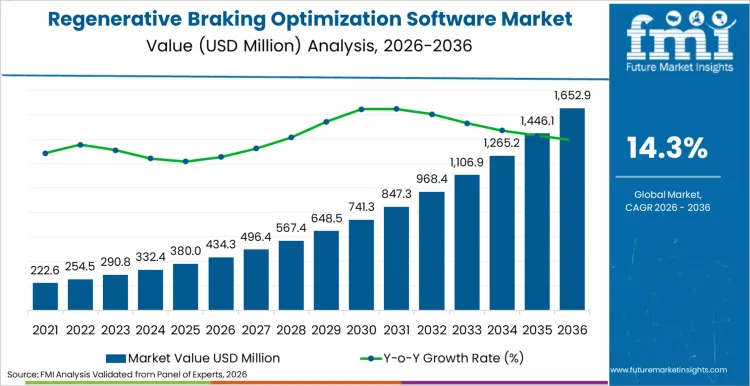
Spending on regenerative braking optimization software amounts to USD 434.3 million in 2026 and is expected to reach USD 1,652.9 million by 2036 at a 14.3% CAGR. Demand is driven by the need to increase energy recovery while preserving predictable braking behavior and vehicle stability. Vehicle programs define recovery targets, blending priorities, and driver response envelopes during control strategy design. Software choice determines how torque requests, battery limits, and stability constraints interact in real time. Once a control strategy is frozen within a platform, later changes require renewed calibration, safety analysis, and validation testing. Volume growth follows the expansion of electrified platforms and the shift toward software-defined vehicle control architectures.
Participation in the regenerative braking optimization software market is governed by platform governance, safety case ownership, and responsibility for vehicle-level behavior. Access depends on inclusion within approved control stacks rather than application-level substitution. Evaluation focuses on recovery efficiency across drive cycles, consistency of pedal response, and robustness under fault or low-traction conditions. Approved software configurations remain in place across full model cycles because calibration sets and compliance documentation attach to specific vehicle definitions. Supplier replacement occurs during platform transitions rather than mid-cycle updates. Revenue development reflects the number of vehicle programs relying on software-centered optimization of braking and energy management strategies.
Regenerative Braking Optimization Software Market Quick Stats
- Regenerative Braking Optimization Software Market Value (2026): USD 434.3 million
- Regenerative Braking Optimization Software Market Forecast Value (2036): USD 1,652.9 million
- Regenerative Braking Optimization Software Market Forecast CAGR (2026 to 2036): 14.3%
- Leading Optimization Focus in Regenerative Braking Optimization Software Market: Energy recovery maximization
- Key Growth Regions in Regenerative Braking Optimization Software Market: China, USA, Germany, South Korea, Japan
- Top Players in Regenerative Braking Optimization Software Market: Bosch, Continental, Aptiv, NVIDIA, Siemens, MathWorks, dSPACE, AVL, ZF Friedrichshafen, Valeo
What is the Growth Forecast for the Regenerative Braking Optimization Software Market through 2036?
Control logic now determines how much recoverable energy reaches the battery rather than the motor or inverter alone. The regenerative braking optimization software market in 2026 stands at USD 434.3 million, up from USD 222.6 million in 2021, reflecting wider reliance on software to manage deceleration, battery acceptance limits, and axle torque coordination. Engineering teams evaluate these packages through recovery yield, pedal mapping accuracy, and behavior near low speed handover to friction brakes. Integration work targets vehicle platforms, not optional feature bundles. Program decisions sit inside chassis and powertrain architecture councils. The rise to USD 1,652.9 million by 2036 represents a 14.3% growth path driven by higher control complexity per vehicle and broader deployment across passenger and commercial EV lines.
Platform governance defines purchasing patterns in the regenerative braking optimization software market. Contracts follow multiyear vehicle programs tied to safety cases and validation plans. Stock exposure remains limited since value concentrates in code, calibration sets, and update pipelines. Cost structure reflects development headcount, test mileage, simulation infrastructure, and certification work. OEM teams track energy recovery consistency, transition smoothness, and fault rate rather than license price alone. Annual values pass through USD 741.3 million in 2030 and USD 1,265.2 million in 2033 as more models move to software centered brake control stacks. The move to USD 1,652.9 million in 2036 comes from wider adoption in volume segments, higher algorithm density, and longer platform lifetimes that lock these packages into core vehicle control layers.
Regenerative Braking Optimization Software Market Key Takeaways
| Metric | Value |
|---|---|
| Market Value (2026) | USD 434.3 million |
| Forecast Value (2036) | USD 1,652.9 million |
| Forecast CAGR (2026 to 2036) | 14.3% |
Source: Future Market Insights’ proprietary forecasting model and primary research
How Is the Regenerative Braking Optimization Software Market Being Used to Stabilize Energy Recovery Without Compromising Brake Feel?
Energy recovery in electric vehicles depends less on hardware limits than on how consistently software can decide when and how to apply it. Optimization software in this market manages torque requests, blending thresholds, and state dependent limits that change from second to second. Calibration teams focus on lift off behavior, transition smoothness, and low speed control because these define whether drivers perceive the system as predictable. Engineers validate behavior across battery temperature, state of charge, and road friction since each shifts the safe recovery window. Test programs also stress split surface and emergency scenarios to confirm that recovery never delays friction braking. Qualification depends on repeatable response under changing conditions, not on peak recuperation figures, because inconsistency shows up as hesitation, surge, or uneven deceleration.
Program management treats this software as a control layer that must remain stable across vehicle updates and platform variants. Automakers measure value through reduced recalibration cycles, fewer field complaints, and consistent pedal maps between trims. A tuning set that works only in narrow conditions forces frequent revisions and slows rollout schedules. Production teams track sensor drift and actuator response times because software decisions amplify small hardware differences. Service organizations focus on update sequencing and rollback safety since many issues appear after calibration changes. Supplier selection favors groups that can maintain long term logic ownership and documentation. Contracts define responsibility for tuning changes, safety coverage, and regression testing because braking behavior affects certification, warranty exposure, and brand risk more than incremental gains in recovered energy.
How Do Calibration Complexity and Fleet-Level Learning Objectives Shape Demand in the Regenerative Braking Optimization Software Market by Optimization Focus and Data Inputs in 2026?
In the regenerative braking optimization software market, program scope starts from calibration workload, update cadence, and cross-platform consistency rather than from algorithm novelty. Teams supporting passenger electric vehicle platforms, commercial fleet electrification, and vehicle dynamics software stacks require tools that keep blending behavior stable while adapting to energy, comfort, and component life targets. By optimization focus, usage spans energy recovery maximization, drivability and comfort tuning, brake wear minimization, and other objectives. By data inputs, demand covers SOC and SoH plus thermal data, route and traffic prediction, driver behavior models, and other sources. Portfolio structure reflects validation scope, data governance, and reuse across vehicle lines.
Why Does Energy Recovery Remain the Primary Optimization Anchor?
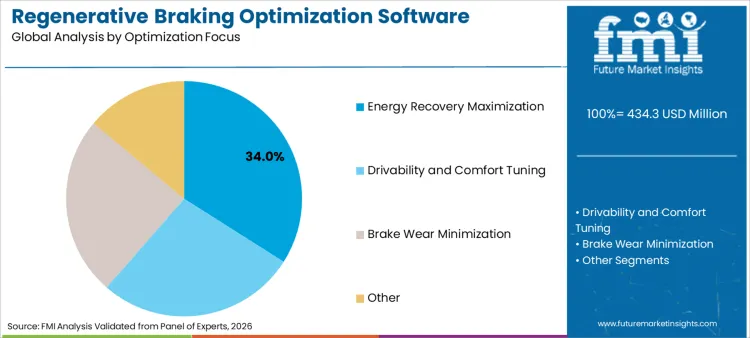
Energy recovery maximization represents about 34% share, reflecting its direct impact on range consistency and charging interval planning. In passenger electric vehicle platforms, this objective sets the baseline for lift-off deceleration curves and blending thresholds. Drivability and comfort tuning addresses pedal feel smoothness and low-speed transitions, which affects acceptance clinics and brand signatures. Brake wear minimization targets service cost and uptime in commercial fleet electrification, with schedules tied to pad and disc life. Other objectives remain secondary. Engineering teams evaluate focus areas through deceleration maps and recovery yield. Validation teams evaluate through corner cases and thermal limits. Manufacturing teams evaluate through calibration variant count and release timing.
After a focus set is selected, objective weights, constraints, and acceptance gates are fixed across releases. A change alters regression plans and test matrices. Program planning then stabilizes cycles to avoid repeated retuning. Supplier interfaces and vehicle networks align to the chosen objective mix. Service diagnostics and update tools also follow that structure. Volume growth comes from deploying the same objective stack across more models rather than reshuffling priorities. The operating result favors energy-first stacks that keep range outcomes predictable while containing calibration scope and release risk.
Why Do SOC, Thermal, and Predictive Inputs Define the Data Backbone?
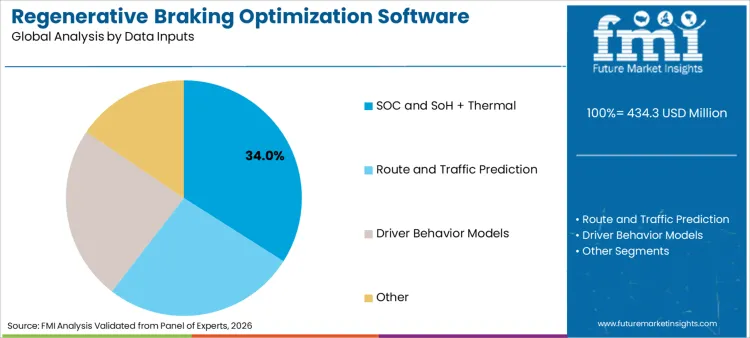
SOC and SoH plus thermal inputs account for about 34% share, reflecting their role in bounding safe regeneration and protecting cells and power electronics. These signals anchor real-time decisions and guard against over-recovery under cold or hot conditions. Route and traffic prediction supports anticipatory deceleration and downhill capture, which benefits vehicle dynamics software stacks in urban and mountainous duty cycles. Driver behavior models adapt thresholds to habitual patterns, improving comfort consistency. Other inputs remain situational. Architecture teams assess inputs through latency and reliability. Security teams assess through access control. Compliance teams assess through traceability and audit logs.
Input selection fixes sensor interfaces, data rates, and fallback strategies. A change requires new fault trees, new validation scenarios, and revised safety arguments. Planning then aligns release trains to the chosen data contract. Toolchains, simulators, and test farms mirror that structure. Field operations and warranty workflows also depend on the same signals. Expansion occurs by extending coverage to more vehicles and geographies rather than altering the input set. Demand therefore concentrates in stacks that combine SOC and thermal bounds with selective prediction layers to preserve deterministic behavior and certification clarity.
Why Are Energy Capture Targets and Vehicle Control Stability Driving the Regenerative Braking Optimization Software Market?
Regenerative Braking Optimization Software Market demand is influenced by vehicle manufacturers that require software capable of maximizing energy capture while maintaining predictable deceleration characteristics. Optimization software refines control logic that governs when and how much kinetic energy is recaptured into the battery across varied driving conditions. Engineering teams assess tools based on ability to model braking events, integrate with vehicle networks, and adapt to vehicle mass and battery charge states. Buyers prioritize software that improves range estimates, reduces reliance on friction braking, and supports smoother interaction with stability and traction systems. Value is measured in improved efficiency metrics, consistent driver experience, and reduced subsystem wear.
What Challenges Are Affecting Adoption and Integration in the Regenerative Braking Optimization Software Market?
Regenerative Braking Optimization Software Market growth is affected by calibration complexity, platform specificity, and extended validation cycles required within vehicle programs. Optimization algorithms must balance competing objectives such as energy capture, brake feel consistency, and safety compliance, which require extensive simulation and vehicle-level testing before deployment. Differences in drive architecture, tire friction profiles, and battery management strategies require tailored parameter sets that limit reuse without adjustment. Software cost pressures in competitive segments influence supplier selection, while integration with legacy control systems adds engineering workload. Procurement teams must plan software adoption early in development cycles to allow sufficient tuning and verification.
How Are Product Features and Supply Approaches Shaping the Regenerative Braking Optimization Software Market?
Regenerative Braking Optimization Software Market offerings are structured around defined modeling capabilities, integration standards, and performance validation outputs that help automotive teams match software tools to program requirements. Suppliers provide libraries of braking event templates, calibration interfaces, and diagnostic tools that support iterative refinement of control logic. Portfolio segmentation by vehicle class and expected duty profile helps OEMs align tool choice with development targets and production timelines. Commercial models increasingly bundle software support services, version updates, and training modules that align with development milestones. Technical collaboration focuses on controller mapping, test sequence design, and performance benchmarking to help manufacturers maintain consistency and reliability in braking optimization across multiple configurations.
What is the Demand for Regenerative Braking Optimization Software by Country?
| Country | CAGR (%) |
|---|---|
| USA | 13.5% |
| Japan | 12.3% |
| South Korea | 13.2% |
| Germany | 13.3% |
| China | 16.9% |
Source: Future Market Insights’ proprietary forecasting model and primary research
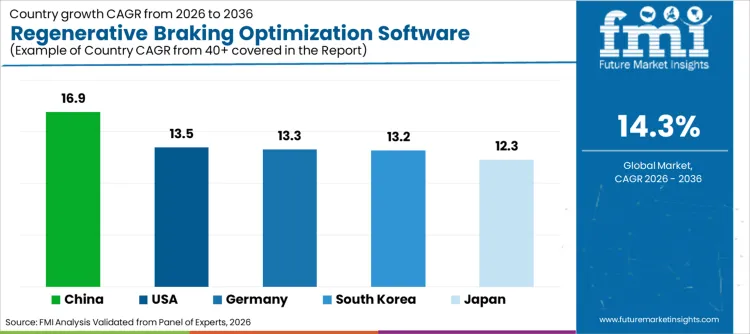
The demand for regenerative braking optimization software is rising across electric and hybrid vehicle platforms where software driven energy recovery, torque blending, and system efficiency are critical for performance and range. China leads at 16.9% CAGR, supported by rapid EV adoption, large scale vehicle production, and OEM focus on software enabled regenerative strategies to maximize energy recovery. The USA grows at 13.5%, driven by increasing EV platforms and software integration for improved braking efficiency. Germany records 13.3%, shaped by premium EV models and stringent regulatory and performance requirements. South Korea advances at 13.2%, reflecting steady growth in EV and hybrid vehicle development. Japan posts 12.3%, within a mature EV market emphasizing system reliability, drivability, and optimized energy recuperation.
How Fleet Expansion Drives the Regenerative Braking Optimization Software Market in the USA
The regenerative braking optimization software market in the United States is expanding at a 13.5% CAGR as electric vehicle manufacturers seek to maximize energy recovery across growing fleet volumes. Software selection focuses on algorithms that maintain braking stability, torque consistency, and smooth pedal response under varying loads. Engineering teams assess integration with battery management systems, traction control modules, and vehicle dynamics under repeated testing. Once a solution passes validation, deployment spans multiple EV platforms and assembly lines, limiting requalification needs. Growth is driven by new model launches, fleet upgrades, and the introduction of performance-oriented vehicles. Supplier participation depends on technical documentation, audit compliance, and post-deployment support. Commercial success relies on predictable multi-platform performance and long-term operational reliability.
How High-Frequency Testing Shapes the Regenerative Braking Optimization Software Market in Japan
In Japan, the regenerative braking optimization software market is progressing at a 12.3% CAGR due to rigorous high-frequency performance testing of EV systems. Adoption requires verified braking response, energy recovery efficiency, and integration with traction and stability control systems. Engineers examine system latency, torque distribution, thermal behavior, and consistency across repeated simulated driving scenarios. Once validated, the software is deployed across multiple vehicle lines. Supplier eligibility depends on documentation completeness, inspection results, and technical support capabilities. Market growth follows EV platform expansions, fleet upgrades, and introduction of next-generation vehicles. Commercial positioning depends on consistent software performance, integration reliability, and maintenance support across assembly lines and operational environments.
How Platform Vehicle Load Considerations Drive the Regenerative Braking Optimization Software Market in South Korea
Operational demands in high-volume EV assembly lines are influencing the regenerative braking optimization software market in South Korea, where growth is tracking a 13.2% CAGR. Algorithms are assessed for consistent torque delivery, energy recapture, and braking stability across multiple vehicle variants. Technical teams evaluate system responsiveness, thermal management, and coordination with traction and battery systems. Once approved, software is applied across all compatible vehicles without repeated recalibration. Supplier access requires demonstration of integration capability, technical documentation, and successful validation runs. Volume growth corresponds with fleet expansion, platform rollouts, and higher-spec EV introductions. Commercial success relies on multi-model performance consistency, seamless integration, and long-term software support.
How Multi-Line Implementation and Quality Oversight Influence the Regenerative Braking Optimization Software Market in Germany
Germany’s regenerative braking optimization software market is advancing at a 13.3% CAGR under multi-line implementation and centralized quality oversight. Individual assembly plants cannot independently deploy software without meeting system performance verification requirements. Evaluation emphasizes torque modulation, braking stability, energy recovery efficiency, and system reliability under repeated operation. Once a solution is validated, it is deployed across multiple assembly lines with uniform operational standards. Volume growth follows fleet expansion and new EV platform launches rather than isolated model introduction. Supplier participation depends on audit compliance, documentation integrity, and integration support capabilities. Commercial success relies on verified multi-platform performance and reliable technical assistance across distributed assembly lines.
How Production Scaling and Vehicle Platform Expansion Drive the Regenerative Braking Optimization Software Market in China
In China, the regenerative braking optimization software market is growing at a 16.9% CAGR as EV manufacturers scale production and expand platform offerings. Software selection focuses on maximizing energy recovery, ensuring smooth braking response, and maintaining system reliability under high-volume assembly conditions. Engineering teams assess torque distribution, thermal management, and compatibility with battery management and traction control units. Once validated, software is deployed across multiple plants and vehicle lines. Domestic suppliers gain advantage through proximity to large-scale facilities, while imported solutions serve premium vehicle segments. Volume growth is driven by fleet expansion, new model introductions, and platform replication across production sites. Commercial advantage depends on consistent system performance, technical support, and verified operational reliability across multiple assembly lines.
What Strategies Are Leading Companies Using to Optimize Regenerative Braking Software?
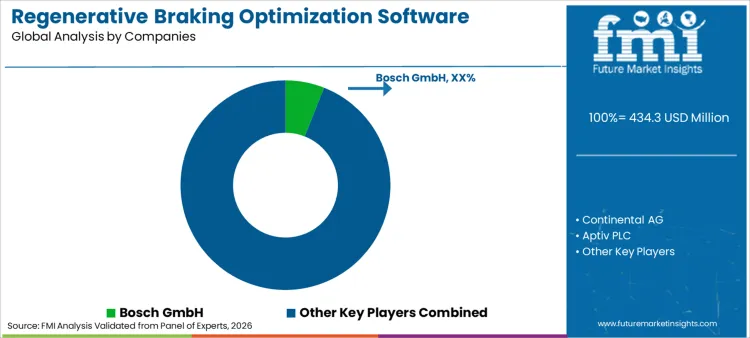
Energy recovery efficiency, control system adaptability, and software robustness dictate adoption in the Regenerative Braking Optimization Software Market. Bosch, Continental, Aptiv, NVIDIA, Siemens, MathWorks, dSPACE, AVL List, ZF Friedrichshafen, and Valeo compete through algorithm validation, vehicle simulation, and integration testing. Once deployed, torque management, battery load coordination, and braking responsiveness anchor supplier selection. Bosch provides OEM-customized optimization algorithms with predictive control. Continental delivers modular software for multi-platform EV architectures. Aptiv integrates electronic control units for real-time regenerative performance. NVIDIA offers AI-assisted predictive models to maximize energy capture. Siemens focuses on system-level simulation solutions. MathWorks emphasizes model-based design for software validation. dSPACE supplies hardware-in-the-loop testing platforms. AVL List delivers full-vehicle energy optimization frameworks. ZF Friedrichshafen and Valeo provide modular control software compatible with multiple braking architectures.
Simulation accuracy, algorithm stability, and integration support define competitive positioning in the Regenerative Braking Optimization Software Market. Automotive engineers assess braking energy recovery, torque response consistency, software reliability, and interface compatibility during validation. Suppliers capable of reproducible software deployment, scalable updates, and technical guidance gain preference. Bosch secures adoption through predictive control integration and OEM support. Continental maintains share in large-scale EV programs requiring reliable software. Aptiv captures adoption in embedded control environments. NVIDIA supports predictive AI-based optimization. Siemens focuses on simulation-driven validation. MathWorks assists in model-based design and software testing workflows. dSPACE provides real-time HIL testing. AVL List targets full-vehicle optimization. ZF Friedrichshafen and Valeo serve modular software programs across EV and hybrid platforms. Market positions vary by vehicle type, braking architecture, energy storage configuration, and regional OEM standards.
Key Players in Regenerative Braking Optimization Software Market
- Bosch GmbH
- Continental AG
- Aptiv PLC
- NVIDIA Corporation
- Siemens AG
- The MathWorks, Inc.
- dSPACE GmbH
- AVL List GmbH
- ZF Friedrichshafen AG
- Valeo SA
Scope of the Report
| Items | Values |
|---|---|
| Quantitative Units (2026) | USD million |
| Optimization Focus | Energy recovery maximization, drivability and comfort tuning, brake wear minimization, other |
| Data Inputs | SOC and SoH plus thermal, route and traffic prediction, driver behavior models, other |
| Deployment | On-board embedded, cloud analytics, hybrid, other |
| Customer | OEMs, Tier-1 suppliers, fleet operators, other |
| Regions Covered | Asia Pacific, Europe, North America, Latin America, Middle East & Africa |
| Countries Covered | United States, Canada, Mexico, Germany, United Kingdom, France, Italy, Spain, Nordics, BENELUX, China, Japan, South Korea, India, Australia & New Zealand, ASEAN, Brazil, Chile, Saudi Arabia, Turkey, South Africa, and other regional markets |
| Key Companies Profiled | Bosch, Continental, Aptiv, NVIDIA, Siemens, MathWorks, dSPACE, AVL List, ZF Friedrichshafen, Valeo |
| Additional Attributes | Dollar sales by optimization focus, data inputs, deployment, and customer, software-centered control of regenerative and friction braking coordination, energy recovery yield and pedal feel consistency, calibration workload and safety validation cycles, integration with traction, stability, and battery management systems, simulation and HIL-based testing, software update governance and lifecycle management, multi-year platform adoption and homologation alignment, and regional adoption patterns across passenger, commercial, and fleet electric vehicle programs |
Regenerative Braking Optimization Software Market Segmentation
Optimization Focus:
- Energy Recovery Maximization
- Drivability and Comfort Tuning
- Brake Wear Minimization
- Other
Data Inputs:
- SOC and SoH + Thermal
- Route and Traffic Prediction
- Driver Behavior Models
- Other
Deployment:
- On-Board Embedded
- Cloud Analytics
- Hybrid
- Other
Customer:
- OEMs
- Tier-1 Suppliers
- Fleet Operators
- Other
Region
- Asia Pacific
- China
- Japan
- South Korea
- India
- Australia & New Zealand
- ASEAN
- Rest of Asia Pacific
- Europe
- Germany
- United Kingdom
- France
- Italy
- Spain
- Nordic
- BENELUX
- Rest of Europe
- North America
- United States
- Canada
- Mexico
- Latin America
- Brazil
- Chile
- Rest of Latin America
- Middle East & Africa
- Kingdom of Saudi Arabia
- Other GCC Countries
- Turkey
- South Africa
- Other African Union
- Rest of Middle East & Africa
Bibliography
- International Energy Agency. (2024). Global EV Outlook 2024. International Energy Agency.
- United Nations Economic Commission for Europe. (2017/Rev.5 2024). UN Regulation No. 79: Uniform provisions concerning the approval of vehicles with regard to steering equipment. UNECE.
- International Organization for Standardization. (2023). ISO 21782-1:2023 - Electrically propelled road vehicles - Test specification for electric propulsion components - Part 1: General test conditions and definitions. ISO.
- International Organization for Standardization. (2023). ISO 21434:2023 - Road vehicles - Cybersecurity engineering. ISO.
- International Organization for Standardization. (2024). ISO 24089:2024 - Road vehicles - Software update engineering. ISO.
Frequently Asked Questions
How big is the regenerative braking optimization software market in 2026?
The regenerative braking optimization software market is projected to be valued at USD 434.3 million in 2026.
What will be the size of the regenerative braking optimization software market in 2036?
The market size for regenerative braking optimization software is projected to reach USD 1,652.9 million by 2036.
How fast will the regenerative braking optimization software market grow between 2026 and 2036?
Demand for regenerative braking optimization software is projected to grow at a 14.3% CAGR between 2026 and 2036.
Which optimization focus holds a significant share in the regenerative braking optimization software market in 2026?
In terms of optimization focus, energy recovery maximization is expected to account for a 34% share in 2026.
Which data input category contributes a major share in the regenerative braking optimization software market in 2026?
SOC and SoH plus thermal data inputs are expected to represent a 34% share in the regenerative braking optimization software market in 2026.
Preview the report firsthand - request a free sample
Get SampleGet the brochure for pricing and purchase details.
Get PDFTable of Content
- Executive Summary
- Global Market Outlook
- Demand-side Trends
- Supply-side Trends
- Technology Roadmap Analysis
- Analysis and Recommendations
- Market Overview
- Market Coverage / Taxonomy
- Market Definition / Scope / Limitations
- Market Background
- Market Dynamics
- Drivers
- Restraints
- Opportunity
- Trends
- Scenario Forecast
- Demand in Optimistic Scenario
- Demand in Likely Scenario
- Demand in Conservative Scenario
- Opportunity Map Analysis
- Product Life Cycle Analysis
- Supply Chain Analysis
- Investment Feasibility Matrix
- Value Chain Analysis
- PESTLE and Porter’s Analysis
- Regulatory Landscape
- Regional Parent Market Outlook
- Production and Consumption Statistics
- Import and Export Statistics
- Market Dynamics
- Global Market Analysis 2021 to 2025 and Forecast, 2026 to 2036
- Historical Market Size Value (USD Million) Analysis, 2021 to 2025
- Current and Future Market Size Value (USD Million) Projections, 2026 to 2036
- Y-o-Y Growth Trend Analysis
- Absolute $ Opportunity Analysis
- Global Market Pricing Analysis 2021 to 2025 and Forecast 2026 to 2036
- Global Market Analysis 2021 to 2025 and Forecast 2026 to 2036, By Optimization Focus
- Introduction / Key Findings
- Historical Market Size Value (USD Million) Analysis By Optimization Focus , 2021 to 2025
- Current and Future Market Size Value (USD Million) Analysis and Forecast By Optimization Focus , 2026 to 2036
- Energy Recovery Maximization
- Drivability and Comfort Tuning
- Brake Wear Minimization
- Other
- Energy Recovery Maximization
- Y-o-Y Growth Trend Analysis By Optimization Focus , 2021 to 2025
- Absolute $ Opportunity Analysis By Optimization Focus , 2026 to 2036
- Global Market Analysis 2021 to 2025 and Forecast 2026 to 2036, By Data Inputs
- Introduction / Key Findings
- Historical Market Size Value (USD Million) Analysis By Data Inputs, 2021 to 2025
- Current and Future Market Size Value (USD Million) Analysis and Forecast By Data Inputs, 2026 to 2036
- SOC and SoH + Thermal
- Route and Traffic Prediction
- Driver Behavior Models
- Other
- SOC and SoH + Thermal
- Y-o-Y Growth Trend Analysis By Data Inputs, 2021 to 2025
- Absolute $ Opportunity Analysis By Data Inputs, 2026 to 2036
- Global Market Analysis 2021 to 2025 and Forecast 2026 to 2036, By Deployment
- Introduction / Key Findings
- Historical Market Size Value (USD Million) Analysis By Deployment, 2021 to 2025
- Current and Future Market Size Value (USD Million) Analysis and Forecast By Deployment, 2026 to 2036
- On-Board Embedded
- Cloud Analytics
- Hybrid
- Other
- On-Board Embedded
- Y-o-Y Growth Trend Analysis By Deployment, 2021 to 2025
- Absolute $ Opportunity Analysis By Deployment, 2026 to 2036
- Global Market Analysis 2021 to 2025 and Forecast 2026 to 2036, By Customer
- Introduction / Key Findings
- Historical Market Size Value (USD Million) Analysis By Customer, 2021 to 2025
- Current and Future Market Size Value (USD Million) Analysis and Forecast By Customer, 2026 to 2036
- OEMs
- Tier-1 Suppliers
- Fleet Operators
- Other
- OEMs
- Y-o-Y Growth Trend Analysis By Customer, 2021 to 2025
- Absolute $ Opportunity Analysis By Customer, 2026 to 2036
- Global Market Analysis 2021 to 2025 and Forecast 2026 to 2036, By Region
- Introduction
- Historical Market Size Value (USD Million) Analysis By Region, 2021 to 2025
- Current Market Size Value (USD Million) Analysis and Forecast By Region, 2026 to 2036
- North America
- Latin America
- Western Europe
- Eastern Europe
- East Asia
- South Asia and Pacific
- Middle East & Africa
- Market Attractiveness Analysis By Region
- North America Market Analysis 2021 to 2025 and Forecast 2026 to 2036, By Country
- Historical Market Size Value (USD Million) Trend Analysis By Market Taxonomy, 2021 to 2025
- Market Size Value (USD Million) Forecast By Market Taxonomy, 2026 to 2036
- By Country
- USA
- Canada
- Mexico
- By Optimization Focus
- By Data Inputs
- By Deployment
- By Customer
- By Country
- Market Attractiveness Analysis
- By Country
- By Optimization Focus
- By Data Inputs
- By Deployment
- By Customer
- Key Takeaways
- Latin America Market Analysis 2021 to 2025 and Forecast 2026 to 2036, By Country
- Historical Market Size Value (USD Million) Trend Analysis By Market Taxonomy, 2021 to 2025
- Market Size Value (USD Million) Forecast By Market Taxonomy, 2026 to 2036
- By Country
- Brazil
- Chile
- Rest of Latin America
- By Optimization Focus
- By Data Inputs
- By Deployment
- By Customer
- By Country
- Market Attractiveness Analysis
- By Country
- By Optimization Focus
- By Data Inputs
- By Deployment
- By Customer
- Key Takeaways
- Western Europe Market Analysis 2021 to 2025 and Forecast 2026 to 2036, By Country
- Historical Market Size Value (USD Million) Trend Analysis By Market Taxonomy, 2021 to 2025
- Market Size Value (USD Million) Forecast By Market Taxonomy, 2026 to 2036
- By Country
- Germany
- UK
- Italy
- Spain
- France
- Nordic
- BENELUX
- Rest of Western Europe
- By Optimization Focus
- By Data Inputs
- By Deployment
- By Customer
- By Country
- Market Attractiveness Analysis
- By Country
- By Optimization Focus
- By Data Inputs
- By Deployment
- By Customer
- Key Takeaways
- Eastern Europe Market Analysis 2021 to 2025 and Forecast 2026 to 2036, By Country
- Historical Market Size Value (USD Million) Trend Analysis By Market Taxonomy, 2021 to 2025
- Market Size Value (USD Million) Forecast By Market Taxonomy, 2026 to 2036
- By Country
- Russia
- Poland
- Hungary
- Balkan & Baltic
- Rest of Eastern Europe
- By Optimization Focus
- By Data Inputs
- By Deployment
- By Customer
- By Country
- Market Attractiveness Analysis
- By Country
- By Optimization Focus
- By Data Inputs
- By Deployment
- By Customer
- Key Takeaways
- East Asia Market Analysis 2021 to 2025 and Forecast 2026 to 2036, By Country
- Historical Market Size Value (USD Million) Trend Analysis By Market Taxonomy, 2021 to 2025
- Market Size Value (USD Million) Forecast By Market Taxonomy, 2026 to 2036
- By Country
- China
- Japan
- South Korea
- By Optimization Focus
- By Data Inputs
- By Deployment
- By Customer
- By Country
- Market Attractiveness Analysis
- By Country
- By Optimization Focus
- By Data Inputs
- By Deployment
- By Customer
- Key Takeaways
- South Asia and Pacific Market Analysis 2021 to 2025 and Forecast 2026 to 2036, By Country
- Historical Market Size Value (USD Million) Trend Analysis By Market Taxonomy, 2021 to 2025
- Market Size Value (USD Million) Forecast By Market Taxonomy, 2026 to 2036
- By Country
- India
- ASEAN
- Australia & New Zealand
- Rest of South Asia and Pacific
- By Optimization Focus
- By Data Inputs
- By Deployment
- By Customer
- By Country
- Market Attractiveness Analysis
- By Country
- By Optimization Focus
- By Data Inputs
- By Deployment
- By Customer
- Key Takeaways
- Middle East & Africa Market Analysis 2021 to 2025 and Forecast 2026 to 2036, By Country
- Historical Market Size Value (USD Million) Trend Analysis By Market Taxonomy, 2021 to 2025
- Market Size Value (USD Million) Forecast By Market Taxonomy, 2026 to 2036
- By Country
- Kingdom of Saudi Arabia
- Other GCC Countries
- Turkiye
- South Africa
- Other African Union
- Rest of Middle East & Africa
- By Optimization Focus
- By Data Inputs
- By Deployment
- By Customer
- By Country
- Market Attractiveness Analysis
- By Country
- By Optimization Focus
- By Data Inputs
- By Deployment
- By Customer
- Key Takeaways
- Key Countries Market Analysis
- USA
- Pricing Analysis
- Market Share Analysis, 2025
- By Optimization Focus
- By Data Inputs
- By Deployment
- By Customer
- Canada
- Pricing Analysis
- Market Share Analysis, 2025
- By Optimization Focus
- By Data Inputs
- By Deployment
- By Customer
- Mexico
- Pricing Analysis
- Market Share Analysis, 2025
- By Optimization Focus
- By Data Inputs
- By Deployment
- By Customer
- Brazil
- Pricing Analysis
- Market Share Analysis, 2025
- By Optimization Focus
- By Data Inputs
- By Deployment
- By Customer
- Chile
- Pricing Analysis
- Market Share Analysis, 2025
- By Optimization Focus
- By Data Inputs
- By Deployment
- By Customer
- Germany
- Pricing Analysis
- Market Share Analysis, 2025
- By Optimization Focus
- By Data Inputs
- By Deployment
- By Customer
- UK
- Pricing Analysis
- Market Share Analysis, 2025
- By Optimization Focus
- By Data Inputs
- By Deployment
- By Customer
- Italy
- Pricing Analysis
- Market Share Analysis, 2025
- By Optimization Focus
- By Data Inputs
- By Deployment
- By Customer
- Spain
- Pricing Analysis
- Market Share Analysis, 2025
- By Optimization Focus
- By Data Inputs
- By Deployment
- By Customer
- France
- Pricing Analysis
- Market Share Analysis, 2025
- By Optimization Focus
- By Data Inputs
- By Deployment
- By Customer
- India
- Pricing Analysis
- Market Share Analysis, 2025
- By Optimization Focus
- By Data Inputs
- By Deployment
- By Customer
- ASEAN
- Pricing Analysis
- Market Share Analysis, 2025
- By Optimization Focus
- By Data Inputs
- By Deployment
- By Customer
- Australia & New Zealand
- Pricing Analysis
- Market Share Analysis, 2025
- By Optimization Focus
- By Data Inputs
- By Deployment
- By Customer
- China
- Pricing Analysis
- Market Share Analysis, 2025
- By Optimization Focus
- By Data Inputs
- By Deployment
- By Customer
- Japan
- Pricing Analysis
- Market Share Analysis, 2025
- By Optimization Focus
- By Data Inputs
- By Deployment
- By Customer
- South Korea
- Pricing Analysis
- Market Share Analysis, 2025
- By Optimization Focus
- By Data Inputs
- By Deployment
- By Customer
- Russia
- Pricing Analysis
- Market Share Analysis, 2025
- By Optimization Focus
- By Data Inputs
- By Deployment
- By Customer
- Poland
- Pricing Analysis
- Market Share Analysis, 2025
- By Optimization Focus
- By Data Inputs
- By Deployment
- By Customer
- Hungary
- Pricing Analysis
- Market Share Analysis, 2025
- By Optimization Focus
- By Data Inputs
- By Deployment
- By Customer
- Kingdom of Saudi Arabia
- Pricing Analysis
- Market Share Analysis, 2025
- By Optimization Focus
- By Data Inputs
- By Deployment
- By Customer
- Turkiye
- Pricing Analysis
- Market Share Analysis, 2025
- By Optimization Focus
- By Data Inputs
- By Deployment
- By Customer
- South Africa
- Pricing Analysis
- Market Share Analysis, 2025
- By Optimization Focus
- By Data Inputs
- By Deployment
- By Customer
- USA
- Market Structure Analysis
- Competition Dashboard
- Competition Benchmarking
- Market Share Analysis of Top Players
- By Regional
- By Optimization Focus
- By Data Inputs
- By Deployment
- By Customer
- Competition Analysis
- Competition Deep Dive
- Bosch GmbH
- Overview
- Product Portfolio
- Profitability by Market Segments (Product/Age /Sales Channel/Region)
- Sales Footprint
- Strategy Overview
- Marketing Strategy
- Product Strategy
- Channel Strategy
- Continental AG
- Aptiv PLC
- NVIDIA Corporation
- Siemens AG
- The MathWorks, Inc.
- dSPACE GmbH
- AVL List GmbH
- ZF Friedrichshafen AG
- Valeo SA
- Bosch GmbH
- Competition Deep Dive
- Assumptions & Acronyms Used
- Research Methodology


