

- Industry Size (2026)
- USD 2.7 Bn
- Forecast (2036)
- USD 5.4 Bn
- CAGR (2026 to 2036)
- 7.20%
Bt-Corn Pest Management Insecticides Market Forecast and Outlook 2026 to 2036
The global Bt-Corn Pest Management Insecticides Market is projected to grow from USD 2.7 billion in 2026 to USD 5.4 billion by 2036, with a CAGR of 7.20%. The growth of this market is driven by the increasing demand for effective pest control solutions that complement the use of Bt-corn, a genetically modified crop designed to resist pests like the European corn borer. While Bt-corn reduces the need for traditional chemical insecticides, pest management insecticides remain essential to prevent resistance development and ensure crop protection.
The market benefits from the global rise in corn demand, requiring efficient pest control for maintaining high crop yields. Advances in insecticide formulations and new Bt-corn hybrids with enhanced resistance are fueling market expansion. As the need for sustainable farming practices increases, Bt-corn pest management insecticides are becoming essential for maintaining agricultural productivity and food security, driving substantial growth in the coming years.
Quick Stats for Bt-Corn Pest Management Insecticides Market
- Bt-Corn Pest Management Insecticides Market Value (2026): USD 2.7 Billion
- Bt-Corn Pest Management Insecticides Market Forecast Value (2036): USD 5.4 Billion
- Bt-Corn Pest Management Insecticides Market Forecast CAGR 2026 to 2036: 7.20%
- Leading Product Type in Bt-Corn Pest Management Insecticides Market: Bt Cry Protein Insecticides
- Key Growth Regions in Bt-Corn Pest Management Insecticides Market: North America, Latin America, Asia Pacific
- Top Key Players in Bt-Corn Pest Management Insecticides Market: Bayer CropScience, Syngenta Group, Corteva Agriscience, BASF SE, UPL Limited
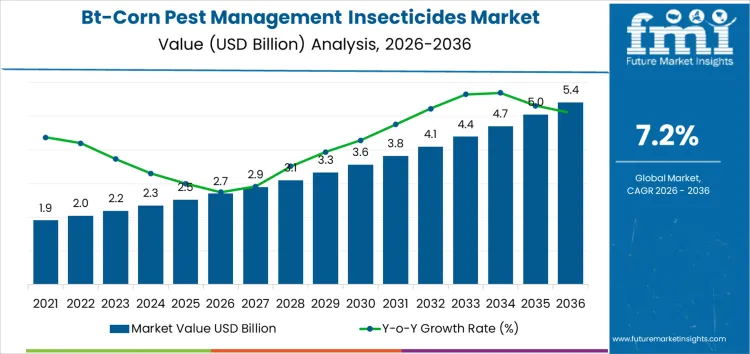
Bt-Corn Pest Management Insecticides Market Key Takeaways
| Metric | Value |
|---|---|
| Industry Value (2026) | USD 2.7 Billion |
| Forecast Value (2036) | USD 5.4 Billion |
| Forecast CAGR 2026 to 2036 | 7.20% |
How Is the Global Bt-Corn Pest Management Insecticides Market Advancing?
The global Bt-corn pest management insecticides market is experiencing steady growth, driven by the increasing demand for effective, environmentally responsible pest control solutions in agriculture. Bt-corn, genetically engineered to express the Bacillus thuringiensis (Bt) protein, provides inherent protection against specific pests, particularly the European corn borer and other pests that damage corn crops. While Bt-corn itself reduces the need for chemical insecticides, pest management solutions are still required to manage resistance and ensure continued crop protection.
A major driver of the market is the growing global demand for corn, coupled with the need for more efficient pest management strategies to maintain high crop yields. The widespread adoption of Bt-corn in regions such as North America, Latin America, and parts of Asia is fueling the demand for complementary pest management insecticides to ensure that pests do not develop resistance to the Bt protein. As the agricultural industry faces challenges related to pest resistance, chemical pest management solutions that work in conjunction with Bt-corn are critical for maintaining long-term crop protection.
Technological advancements in insecticide formulations and the development of new Bt-corn hybrids with enhanced pest resistance are further driving the market’s growth. These innovations are improving the effectiveness of pest management strategies, reducing the reliance on traditional chemical insecticides, and addressing concerns related to environmental impact and resistance. As the demand for sustainable agriculture practices grows and pest management becomes increasingly complex, the Bt-corn pest management insecticides market is expected to expand, providing essential solutions to ensure food security and improve agricultural productivity.
What Is the Segment-Wise Analysis for the Bt-Corn Pest Management Insecticides Market?
The Bt-corn pest management insecticides market is segmented by product type and application method. Bt Cry protein insecticides lead the product type segment with a 46% share, followed by Bt-based formulated sprays, Bt synergist blends, and other insecticides. Bt Cry proteins are effective in controlling pests in Bt corn, as they are designed to target specific insect pests. In terms of application method, foliar spray dominates with a 49% share, followed by seed treatment, soil application, and other methods. The growing adoption of Bt-corn and integrated pest management strategies is driving the demand for these insecticides across various application methods.
Why Do Bt Cry Protein Insecticides Lead the Bt-Corn Pest Management Insecticides Market?
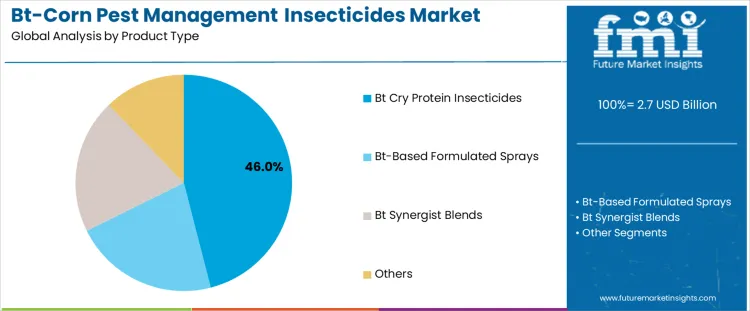
Bt Cry protein insecticides lead the Bt-corn pest management insecticides market with a 46% share due to their high efficiency in controlling specific insect pests, such as corn rootworms and European corn borers. These insecticides are based on naturally occurring proteins produced by the bacterium Bacillus thuringiensis and have a targeted mode of action that reduces harm to non-target organisms. The growing adoption of genetically modified Bt corn, which incorporates Bt Cry proteins, has significantly increased the demand for Bt Cry protein insecticides. Their selective and eco-friendly nature makes them the preferred choice for integrated pest management in corn production.
How Does the Foliar Spray Application Method Contribute to the Bt-Corn Pest Management Insecticides Market?
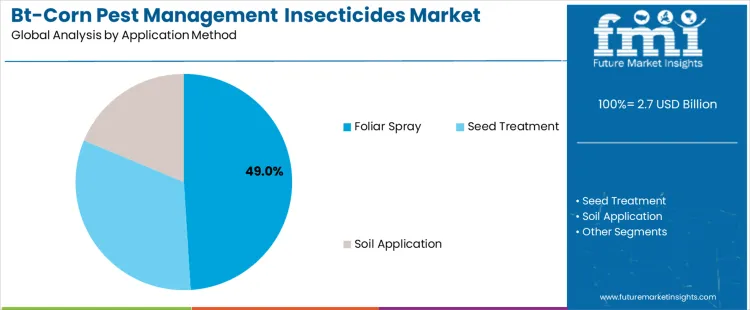
The foliar spray application method accounts for 49% of the application method segment in the Bt-corn pest management insecticides market. Foliar spraying is widely used for the effective application of insecticides on crops, providing targeted coverage of the plant surface to control pest infestations. This method is popular for Bt Cry protein insecticides and other formulations, as it allows for quick absorption and effective pest control. As pest resistance management becomes more important, foliar spraying remains a key method in applying Bt insecticides to Bt corn, ensuring that crops are protected from pest damage while minimizing environmental impact.
What Are the Key Dynamics for the Bt-Corn Pest Management Insecticides Market?
The Bt-corn pest management insecticides market is driven by the growing adoption of genetically modified (GM) crops, particularly Bt-corn, which is engineered to produce toxins that protect against specific pests. While Bt-corn reduces the need for conventional chemical insecticides, additional pest management strategies, including chemical insecticides, are still necessary to control pest populations and ensure crop yields. The increasing global demand for corn as a staple food, animal feed, and industrial product, coupled with the rise in pest resistance to conventional insecticides, is driving the demand for specialized insecticides used in conjunction with Bt-corn.
Why Is the Bt-Corn Pest Management Insecticides Market Growing?
The market for Bt-corn pest management insecticides is growing due to the increasing adoption of genetically modified crops like Bt-corn that offer built-in resistance to certain pests, such as the European corn borer. While Bt-corn significantly reduces the need for traditional insecticide applications, the rising issue of pest resistance to Bt proteins is leading to the demand for additional chemical insecticides. The global need for higher agricultural productivity to meet the demands of growing populations and changing climate conditions is driving the use of integrated pest management solutions, including targeted insecticides to complement Bt-corn traits.
How Are the Key Drivers Shaping the Bt-Corn Pest Management Insecticides Market?
Key drivers for the Bt-corn pest management insecticides market include the growing concerns over pest resistance to Bt proteins, which has led to the continued use of chemical insecticides in conjunction with Bt-corn. As Bt-corn adoption grows, integrated pest management (IPM) practices are increasingly being used, where chemical insecticides are applied to manage pest populations effectively. The demand for higher agricultural productivity and improved crop protection is driving the development of insecticides that target specific pests without harming beneficial insects or the environment. Regulatory approval and consumer acceptance of genetically modified crops are further encouraging market growth.
What is the Growth Outlook for the Bt-Corn Pest Management Insecticides Market by Country?
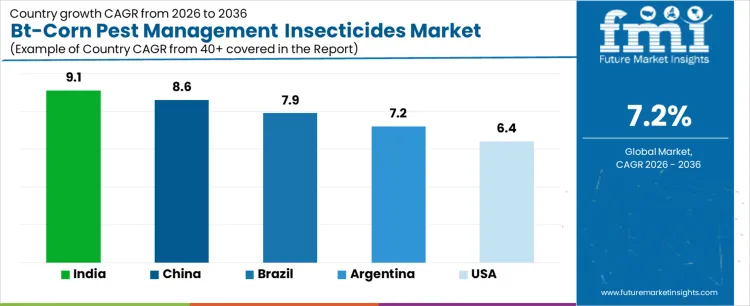
| Country | CAGR (%) |
|---|---|
| India | 9.1% |
| China | 8.6% |
| Brazil | 7.9% |
| Argentina | 7.2% |
| USA | 6.4% |
The Bt-corn pest management insecticides market is expanding globally, with India leading at 9.1%, driven by the adoption of genetically modified crops and the need for sustainable pest control. China follows at 8.6%, supported by the country’s focus on improving crop productivity and biotechnology adoption. Brazil’s market grows at 7.9%, fueled by large-scale corn production and the use of Bt-corn for pest resistance. Argentina grows at 7.2%, driven by its increasing adoption of Bt-corn to optimize yields and manage pest threats. The USA grows at 6.4%, supported by its advanced agricultural practices and regulatory framework for GM crops.
What is Driving the Growth of the Bt-Corn Pest Management Insecticides Market in India?
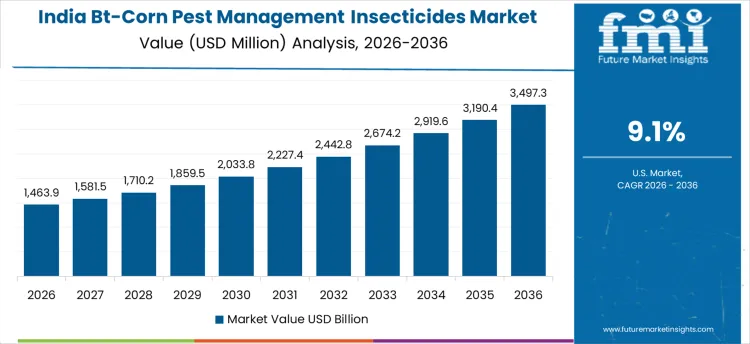
India’s Bt-corn pest management insecticides market is growing at 9.1%, driven by the expanding adoption of genetically modified (GM) Bt-corn varieties and the increasing demand for pest-resistant crops. As India’s agricultural sector faces the challenges of pest outbreaks that damage crops, Bt-corn, which is genetically engineered to resist specific pests, offers a significant advantage in improving crop yield and quality. The use of Bt-corn pest management insecticides, particularly in combination with integrated pest management (IPM) strategies, is growing in response to the need for more sustainable agricultural practices. Government support for biotechnology adoption, as well as increasing awareness among farmers about the benefits of Bt-corn and its pest management solutions, is further driving market growth. As India’s agricultural industry continues to evolve, the demand for Bt-corn insecticides will remain strong.
How is the Bt-Corn Pest Management Insecticides Market Expanding in China?
China’s Bt-corn pest management insecticides market is growing at 8.6%, supported by the country’s strong focus on improving crop productivity and managing pest-related issues. China is one of the largest producers of corn, and with the increasing adoption of Bt-corn varieties, there is a growing need for pest management solutions to protect these crops from insect damage. Bt-corn pest management insecticides are becoming essential in maintaining the effectiveness of genetically modified crops and optimizing yields. China’s government has also been actively promoting biotechnology, including GM crops, to address food security concerns. As farmers increasingly adopt Bt-corn for its pest resistance and improved yield potential, the demand for specialized insecticides for pest management will continue to rise, contributing to market growth.
How is the Bt-Corn Pest Management Insecticides Market Expanding in Brazil?
Brazil’s Bt-corn pest management insecticides market is growing at 7.9%, driven by the country’s large-scale adoption of genetically modified crops, including Bt-corn, which provides effective pest resistance. Brazil is one of the world’s leading corn producers, and the adoption of Bt-corn has become critical in managing pest outbreaks that can significantly reduce crop yields. The growing emphasis on sustainable agricultural practices, along with the need for effective pest control in large-scale corn farming, is driving the use of Bt-corn pest management insecticides. Brazil’s regulatory framework, which supports the safe use of biotechnology in agriculture, further contributes to the market’s growth. As the demand for high-yielding, pest-resistant corn varieties rises, the market for Bt-corn insecticides in Brazil is expected to continue expanding.
What is Driving the Growth of the Bt-Corn Pest Management Insecticides Market in Argentina?
Argentina’s Bt-corn pest management insecticides market is growing at 7.2%, driven by the country’s increasing adoption of Bt-corn to improve crop productivity and manage pest-related issues. Argentina, one of the leading corn exporters globally, is utilizing Bt-corn varieties to combat insect pests that damage crops, thereby improving yields and reducing pesticide use. The adoption of Bt-corn pest management insecticides is gaining traction, as they effectively complement the genetically modified crops and ensure their success in the field. Argentina’s favorable regulatory environment for GM crops, combined with the need for more efficient and environmentally friendly pest control methods, is fueling the demand for specialized insecticides in the Bt-corn market. As the country’s corn production continues to grow, the demand for Bt-corn insecticides is expected to rise, supporting market expansion.
How is the Bt-Corn Pest Management Insecticides Market Expanding in the USA?
The Bt-corn pest management insecticides market in the USA is growing at 6.4%, driven by the widespread adoption of genetically modified Bt-corn varieties and the need for sustainable pest control solutions. The USA is one of the largest producers of corn, and Bt-corn is increasingly being used to protect crops from insect pests such as the European corn borer and rootworms. While Bt-corn reduces the need for chemical pesticides, the use of pest management insecticides remains essential in managing pest populations and ensuring high crop yields. The USA’s regulatory environment supports the use of GM crops, and farmers are increasingly adopting integrated pest management strategies to enhance crop protection. As the demand for Bt-corn continues to rise, the market for pest management insecticides will continue to expand, contributing to the growth of the Bt-corn insecticide market in the USA.
How Are Companies Competing in the Bt-Corn Pest Management Insecticides Market?
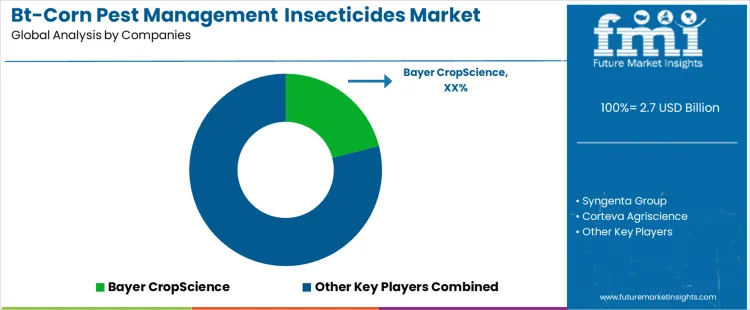
Competition in the Bt-corn pest management insecticides market is driven by efficacy against key corn pests, spectrum of control, resistance management, regulatory compliance, and stewardship support for growers. Bayer CropScience positions its Bt-based products and trait-linked technologies with strong emphasis on broad-spectrum efficacy and integrated resistance management plans. Its product materials highlight consistent control of major lepidopteran pests, field performance data, and guidance on refuge strategies that help farmers maintain long-term pest suppression.
Syngenta Group competes by offering diverse Bt and bioinsecticide solutions often integrated with broader crop protection portfolios, and its brochures stress fit with IPM (Integrated Pest Management) programs and compatibility with hybrid and trait platforms. Corteva Agriscience differentiates with trait-paired Bt technologies and supportive agronomic tools designed to manage evolving pest pressures; its product literature underscores efficacy data across geographies and pest spectra alongside clear use-rate recommendations.
BASF SE brings novel Bt formulations and combination products that target hard-to-control corn pests, with documentation focusing on mode-of-action clarity and improved field longevity. UPL Limited and Others compete by providing regional Bt-based insecticides and biologicals tailored to local pest complexes and farmer needs, with materials that emphasize affordability, regulatory alignment, and practical application guidance.
Key Players in Bt-Corn Pest Management Insecticides Market
- Bayer CropScience
- Syngenta Group
- Corteva Agriscience
- BASF SE
- UPL Limited
- Others
Scope of Report
| Attributes | Description |
|---|---|
| Quantitative Unit (2026) | USD Billion |
| Product Type | Bt Cry Protein Insecticides, Bt-Based Formulated Sprays, Bt Synergist Blends, Others |
| Application Method | Foliar Spray, Seed Treatment, Soil Application |
| Regions Covered | Asia Pacific, Europe, North America, Latin America, Middle East & Africa |
| Countries Covered | China, Japan, South Korea, India, Australia & New Zealand, ASEAN, Germany, United Kingdom, France, Italy, Spain, Nordic, BENELUX, United States, Canada, Mexico, Brazil, Chile, Turkey, South Africa, Other GCC Countries |
| Key Companies Profiled | Bayer CropScience, Syngenta Group, Corteva Agriscience, BASF SE, UPL Limited, Others |
| Additional Attributes | Dollar sales by product type, application method, and region; regional CAGR and growth outlook for the Bt-Corn pest management insecticides market. |
Bt-Corn Pest Management Insecticides Market by Key Segments
Product Type
- Bt Cry Protein Insecticides
- Bt-Based Formulated Sprays
- Bt Synergist Blends
- Others
Application Method
- Foliar Spray
- Seed Treatment
- Soil Application
Region
- Asia Pacific
- China
- Japan
- South Korea
- India
- Australia & New Zealand
- ASEAN
- Rest of Asia Pacific
- Europe
- Germany
- United Kingdom
- France
- Italy
- Spain
- Nordic
- BENELUX
- Rest of Europe
- North America
- United States
- Canada
- Mexico
- Latin America
- Brazil
- Chile
- Rest of Latin America
- Middle East & Africa
- Kingdom of Saudi Arabia
- Other GCC Countries
- Turkey
- South Africa
- Other African Union
- Rest of Middle East & Africa
Bibliography
- FAO. (2024). Integrated pest management in genetically modified maize systems. Food and Agriculture Organization of the United Nations.
- OECD. (2024). Environmental and agronomic performance of Bt crops and associated pest control strategies. Organisation for Economic Co‑operation and Development.
- ISAAA. (2024). Global status of commercialized biotech/GM crops: Bt maize adoption and pest resistance trends. International Service for the Acquisition of Agri‑biotech Applications.
- Tabashnik, B. E., et al. (2024). Managing insect resistance to Bt crops: Recent advances and future challenges. Annual Review of Entomology.
- European Commission – Joint Research Centre (JRC). (2024). Sustainability and risk assessment of Bt‑based pest control systems in maize cultivation. Publications Office of the European Union.
Frequently Asked Questions
How big is the bt-corn pest management insecticides market in 2026?
The global bt-corn pest management insecticides market is estimated to be valued at USD 2.7 billion in 2026.
What will be the size of bt-corn pest management insecticides market in 2036?
The market size for the bt-corn pest management insecticides market is projected to reach USD 5.4 billion by 2036.
How much will be the bt-corn pest management insecticides market growth between 2026 and 2036?
The bt-corn pest management insecticides market is expected to grow at a 7.2% CAGR between 2026 and 2036.
What are the key product types in the bt-corn pest management insecticides market?
The key product types in bt-corn pest management insecticides market are bt cry protein insecticides, bt-based formulated sprays, bt synergist blends and others.
Which application method segment to contribute significant share in the bt-corn pest management insecticides market in 2026?
In terms of application method, foliar spray segment to command 49.0% share in the bt-corn pest management insecticides market in 2026.
Preview the report firsthand - request a free sample
Get SampleGet the brochure for pricing and purchase details.
Get PDFTable of Content
- Executive Summary
- Global Market Outlook
- Demand-side Trends
- Supply-side Trends
- Technology Roadmap Analysis
- Analysis and Recommendations
- Market Overview
- Market Coverage / Taxonomy
- Market Definition / Scope / Limitations
- Market Background
- Market Dynamics
- Drivers
- Restraints
- Opportunity
- Trends
- Scenario Forecast
- Demand in Optimistic Scenario
- Demand in Likely Scenario
- Demand in Conservative Scenario
- Opportunity Map Analysis
- Product Life Cycle Analysis
- Supply Chain Analysis
- Investment Feasibility Matrix
- Value Chain Analysis
- PESTLE and Porter’s Analysis
- Regulatory Landscape
- Regional Parent Market Outlook
- Production and Consumption Statistics
- Import and Export Statistics
- Market Dynamics
- Global Market Analysis 2021 to 2025 and Forecast, 2026 to 2036
- Historical Market Size Value (USD Million) Analysis, 2021 to 2025
- Current and Future Market Size Value (USD Million) Projections, 2026 to 2036
- Y-o-Y Growth Trend Analysis
- Absolute $ Opportunity Analysis
- Global Market Pricing Analysis 2021 to 2025 and Forecast 2026 to 2036
- Global Market Analysis 2021 to 2025 and Forecast 2026 to 2036, By Product Type
- Introduction / Key Findings
- Historical Market Size Value (USD Million) Analysis By Product Type , 2021 to 2025
- Current and Future Market Size Value (USD Million) Analysis and Forecast By Product Type , 2026 to 2036
- Bt Cry Protein Insecticides
- Bt-Based Formulated Sprays
- Bt Synergist Blends
- Others
- Bt Cry Protein Insecticides
- Y-o-Y Growth Trend Analysis By Product Type , 2021 to 2025
- Absolute $ Opportunity Analysis By Product Type , 2026 to 2036
- Global Market Analysis 2021 to 2025 and Forecast 2026 to 2036, By Application Method
- Introduction / Key Findings
- Historical Market Size Value (USD Million) Analysis By Application Method, 2021 to 2025
- Current and Future Market Size Value (USD Million) Analysis and Forecast By Application Method, 2026 to 2036
- Foliar Spray
- Seed Treatment
- Soil Application
- Foliar Spray
- Y-o-Y Growth Trend Analysis By Application Method, 2021 to 2025
- Absolute $ Opportunity Analysis By Application Method, 2026 to 2036
- Global Market Analysis 2021 to 2025 and Forecast 2026 to 2036, By Region
- Introduction
- Historical Market Size Value (USD Million) Analysis By Region, 2021 to 2025
- Current Market Size Value (USD Million) Analysis and Forecast By Region, 2026 to 2036
- North America
- Latin America
- Western Europe
- Eastern Europe
- East Asia
- South Asia and Pacific
- Middle East & Africa
- Market Attractiveness Analysis By Region
- North America Market Analysis 2021 to 2025 and Forecast 2026 to 2036, By Country
- Historical Market Size Value (USD Million) Trend Analysis By Market Taxonomy, 2021 to 2025
- Market Size Value (USD Million) Forecast By Market Taxonomy, 2026 to 2036
- By Country
- USA
- Canada
- Mexico
- By Product Type
- By Application Method
- By Country
- Market Attractiveness Analysis
- By Country
- By Product Type
- By Application Method
- Key Takeaways
- Latin America Market Analysis 2021 to 2025 and Forecast 2026 to 2036, By Country
- Historical Market Size Value (USD Million) Trend Analysis By Market Taxonomy, 2021 to 2025
- Market Size Value (USD Million) Forecast By Market Taxonomy, 2026 to 2036
- By Country
- Brazil
- Chile
- Rest of Latin America
- By Product Type
- By Application Method
- By Country
- Market Attractiveness Analysis
- By Country
- By Product Type
- By Application Method
- Key Takeaways
- Western Europe Market Analysis 2021 to 2025 and Forecast 2026 to 2036, By Country
- Historical Market Size Value (USD Million) Trend Analysis By Market Taxonomy, 2021 to 2025
- Market Size Value (USD Million) Forecast By Market Taxonomy, 2026 to 2036
- By Country
- Germany
- UK
- Italy
- Spain
- France
- Nordic
- BENELUX
- Rest of Western Europe
- By Product Type
- By Application Method
- By Country
- Market Attractiveness Analysis
- By Country
- By Product Type
- By Application Method
- Key Takeaways
- Eastern Europe Market Analysis 2021 to 2025 and Forecast 2026 to 2036, By Country
- Historical Market Size Value (USD Million) Trend Analysis By Market Taxonomy, 2021 to 2025
- Market Size Value (USD Million) Forecast By Market Taxonomy, 2026 to 2036
- By Country
- Russia
- Poland
- Hungary
- Balkan & Baltic
- Rest of Eastern Europe
- By Product Type
- By Application Method
- By Country
- Market Attractiveness Analysis
- By Country
- By Product Type
- By Application Method
- Key Takeaways
- East Asia Market Analysis 2021 to 2025 and Forecast 2026 to 2036, By Country
- Historical Market Size Value (USD Million) Trend Analysis By Market Taxonomy, 2021 to 2025
- Market Size Value (USD Million) Forecast By Market Taxonomy, 2026 to 2036
- By Country
- China
- Japan
- South Korea
- By Product Type
- By Application Method
- By Country
- Market Attractiveness Analysis
- By Country
- By Product Type
- By Application Method
- Key Takeaways
- South Asia and Pacific Market Analysis 2021 to 2025 and Forecast 2026 to 2036, By Country
- Historical Market Size Value (USD Million) Trend Analysis By Market Taxonomy, 2021 to 2025
- Market Size Value (USD Million) Forecast By Market Taxonomy, 2026 to 2036
- By Country
- India
- ASEAN
- Australia & New Zealand
- Rest of South Asia and Pacific
- By Product Type
- By Application Method
- By Country
- Market Attractiveness Analysis
- By Country
- By Product Type
- By Application Method
- Key Takeaways
- Middle East & Africa Market Analysis 2021 to 2025 and Forecast 2026 to 2036, By Country
- Historical Market Size Value (USD Million) Trend Analysis By Market Taxonomy, 2021 to 2025
- Market Size Value (USD Million) Forecast By Market Taxonomy, 2026 to 2036
- By Country
- Kingdom of Saudi Arabia
- Other GCC Countries
- Turkiye
- South Africa
- Other African Union
- Rest of Middle East & Africa
- By Product Type
- By Application Method
- By Country
- Market Attractiveness Analysis
- By Country
- By Product Type
- By Application Method
- Key Takeaways
- Key Countries Market Analysis
- USA
- Pricing Analysis
- Market Share Analysis, 2025
- By Product Type
- By Application Method
- Canada
- Pricing Analysis
- Market Share Analysis, 2025
- By Product Type
- By Application Method
- Mexico
- Pricing Analysis
- Market Share Analysis, 2025
- By Product Type
- By Application Method
- Brazil
- Pricing Analysis
- Market Share Analysis, 2025
- By Product Type
- By Application Method
- Chile
- Pricing Analysis
- Market Share Analysis, 2025
- By Product Type
- By Application Method
- Germany
- Pricing Analysis
- Market Share Analysis, 2025
- By Product Type
- By Application Method
- UK
- Pricing Analysis
- Market Share Analysis, 2025
- By Product Type
- By Application Method
- Italy
- Pricing Analysis
- Market Share Analysis, 2025
- By Product Type
- By Application Method
- Spain
- Pricing Analysis
- Market Share Analysis, 2025
- By Product Type
- By Application Method
- France
- Pricing Analysis
- Market Share Analysis, 2025
- By Product Type
- By Application Method
- India
- Pricing Analysis
- Market Share Analysis, 2025
- By Product Type
- By Application Method
- ASEAN
- Pricing Analysis
- Market Share Analysis, 2025
- By Product Type
- By Application Method
- Australia & New Zealand
- Pricing Analysis
- Market Share Analysis, 2025
- By Product Type
- By Application Method
- China
- Pricing Analysis
- Market Share Analysis, 2025
- By Product Type
- By Application Method
- Japan
- Pricing Analysis
- Market Share Analysis, 2025
- By Product Type
- By Application Method
- South Korea
- Pricing Analysis
- Market Share Analysis, 2025
- By Product Type
- By Application Method
- Russia
- Pricing Analysis
- Market Share Analysis, 2025
- By Product Type
- By Application Method
- Poland
- Pricing Analysis
- Market Share Analysis, 2025
- By Product Type
- By Application Method
- Hungary
- Pricing Analysis
- Market Share Analysis, 2025
- By Product Type
- By Application Method
- Kingdom of Saudi Arabia
- Pricing Analysis
- Market Share Analysis, 2025
- By Product Type
- By Application Method
- Turkiye
- Pricing Analysis
- Market Share Analysis, 2025
- By Product Type
- By Application Method
- South Africa
- Pricing Analysis
- Market Share Analysis, 2025
- By Product Type
- By Application Method
- USA
- Market Structure Analysis
- Competition Dashboard
- Competition Benchmarking
- Market Share Analysis of Top Players
- By Regional
- By Product Type
- By Application Method
- Competition Analysis
- Competition Deep Dive
- Bayer CropScience
- Overview
- Product Portfolio
- Profitability by Market Segments (Product/Age /Sales Channel/Region)
- Sales Footprint
- Strategy Overview
- Marketing Strategy
- Product Strategy
- Channel Strategy
- Syngenta Group
- Corteva Agriscience
- BASF SE
- UPL Limited
- Others
- Bayer CropScience
- Competition Deep Dive
- Assumptions & Acronyms Used
- Research Methodology


