

- Market Size (2026)
- USD 184.6 Mn
- Forecast (2036)
- USD 474.5 Mn
- CAGR (2026 to 2036)
- 9.9%
Urban Rooftop Farm-Safe Pest Management Chemistry Market Size, Market Forecast and Outlook By FMI
The urban rooftop farm-safe pest management chemistry market was valued at USD 168.0 million in 2025. The market is expected to reach USD 184.6 million by the end of 2026. Industry is projected to expand at a CAGR of 9.9% from 2026 to 2036 and reach USD 474.5 million by 2036. Foliar sprays are projected to lead the application method segment with 46.0% in 2026 and by end user, commercial growers are projected to lead with 34.0% in 2026.
Summary of the Urban Rooftop Farm-Safe Pest Management Chemistry
- Demand and Growth Drivers
- Demand is supported by expansion in rooftop food production and compact greenhouse formats. Controlled urban growing systems add further support through vertical farming and indoor farming infrastructure.
- Product use is higher in edible crop systems built around freshness and low-residue positioning. Wider use of IPM programs and protected-crop routines supports product use in compact urban farms.
- Product and Segment View
- Microbials and botanicals form the core chemistry garnering stable demand. Selective low-residue actives remain close to product classes tracked in agricultural microbials and biorational pesticide markets.
- Liquid formats hold a larger share because dosing, spray coverage, and compatibility matter in compact growing spaces.
- Use is concentrated in leafy greens and herbs. Fruiting vegetables grown in rooftop greenhouse or hydroponic systems add a second demand pocket.
- Geography and Competitive Outlook
- Singapore and the Netherlands carry higher near-term value because protected cultivation know-how is more established. The United States further witnesses expansion through urban agriculture programs.
- Supplier competition is led by biological crop-protection companies with greenhouse programs and low-residue product portfolios. These portfolios remain close to biocontrol agents and biocontrol solutions categories.
- Entry becomes harder once crop label fit and repeat performance enter supplier decisions. Small-order economics add a second hurdle for new entrants.
- Analyst Opinion
- Nikhil Kaitwade, Principal Analyst states, “ Our analysis indicates that dense protected‑crop rooftop systems will anchor early demand for pest‑management chemistry, as these operations prioritize yield stability and residue integrity to protect premium fresh‑produce margins.”
- Urban Rooftop Farm-Safe Pest Management Chemistry Market Value Analysis
- Market value is estimated at USD 184.6 million in 2026 and is forecast to reach USD 474.5 million by 2036.
- Industry is expected to rise at a steady pace as rooftop operations rely on repeat pest‑control programs rather than occasional corrective treatments.
- Revenue concentration remains higher in greenhouse roofs and hydroponic roofs, reflecting demand patterns similar to controlled‑environment agriculture and commercial greenhouse systems.
- The demand outlook keeps total size modest, but spending per site increases once growers shift from basic sanitation‑led control to planned IPM‑based chemistry programs.
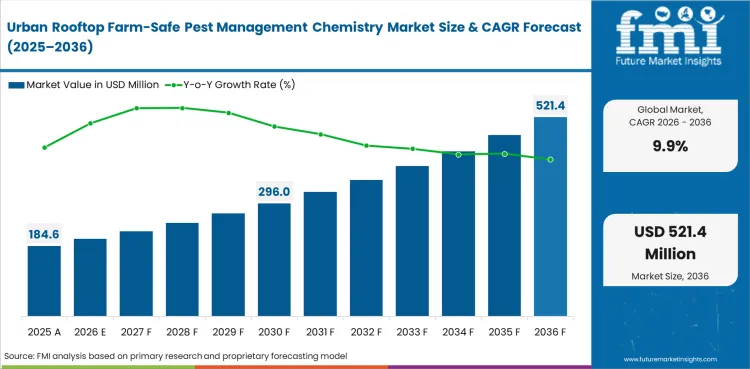
Key Takeaways
- The market reached USD 168.0 million in 2025.
- Market value is projected to reach USD 474.5 million by 2036.
- During the forecast period, industry size is estimated to grow at a CAGR of 9.9%.
- Incremental opportunity across 2026 to 2036 is USD 289.9 million.
- Foliar sprays are projected to account for 46.0% of the application method segment in 2026.
- Singapore is projected to post the fastest country CAGR of 11.8% through 2036. The Netherlands is anticipated to rise at a CAGR of 11.2% during the forecast period.
- Demand rises faster in rooftop greenhouse and hydroponic programs because crop loss and harvest timing carry more weight in premium fresh produce programs. Residue profile adds a second purchase filter in these systems.
Urban Rooftop Farm-Safe Pest Management Chemistry Market Definition
Urban rooftop farm-safe pest management chemistry includes pesticide and biopesticide formulations used in rooftop food-production systems. Coverage focuses on crop safety, low residue, and controlled application. It also includes low-risk and biologically oriented chemistries, rooftop greenhouses, and hydroponic roofs.
Urban Rooftop Farm-Safe Pest Management Chemistry Market Inclusions
This market scope includes microbial products, botanical actives, and mineral chemistries. It also includes soaps, oils, and other selective pest-management formulations. Foliar sprays, root drenches, and spot treatment are also included.
Urban Rooftop Farm-Safe Pest Management Chemistry Market Exclusions
Scope of the market excludes broad-acre agricultural pesticides and non-crop urban pest control.
Pure beneficial insect programs without chemistry sales also fall outside scope.
Rooftop nutrient inputs and sanitation chemicals without crop-protection positioning are excluded. Field-crop demand and ornamental rooftop landscaping are excluded. Residential garden pesticide spending is excluded as well.
Urban Rooftop Farm-Safe Pest Management Chemistry Market Research Methodology
- Primary Research: Discussions with biological input suppliers, protected-crop specialists, and urban agriculture participants.
- Desk Research: Review of official urban agriculture, IPM, and biopesticide sources, along with verified supplier portfolios and product positioning.
- Market sizing and forecasting: Bottom-up niche allocation within urban agriculture and rooftop protected-crop inputs, cross-checked against product-use intensity and adjacent water filtration systems for hydroponics demand.
- Data validation: Share, CAGR, and segment logic validated through protected-crop operating conditions and repeat chemistry use in compact urban farms.
Why is the Urban Rooftop Farm-Safe Pest Management Chemistry Market Growing?
- Rooftop farms need pest-control programs built for compact and residue-sensitive growing environments. Labor-visible production also constrains the product choice.
- Biological and low-risk products fit edible crop programs built around local sale and freshness. Short harvest cycles add overlap with bioinsecticides and bionematicides.
- Greenhouse roofs and hydroponic roofs create repeat demand because pest outbreaks can interrupt short-cycle production. Premium harvest timing raises the cost of disruption.
Urban rooftop food production does not operate like open-field agriculture. Growers work with tighter crop spacing and higher visual quality requirements. They have less room for residue tolerance or harsh application programs. Product selection shifts toward chemistries built for enclosed systems and short re-entry expectations. Repeat treatment programs matter when growers need to protect[1] crop finish.
Crop mix also shapes purchase behavior. Leafy greens and high-value fruiting crops face visible pest injury more often in compact systems. These crops face mildew pressure more often than low-value rooftop plantings. Harvest timing loss can cut usable output quickly as a result growers pay closer attention to safer chemistry programs that protect continuity.
Market Segmentation Analysis
- Microbials are projected to lead the chemistry type segment with 29.0% in 2026 because low-residue biological control fits rooftop edible crops and protected growing systems.
- Foliar sprays are projected to lead the application method segment with 46.0% in 2026 because canopy coverage, quick deployment, and low-volume dosing matter in compact growing layouts.
- Leafy greens are projected to lead the crop type segment with 24.0% in 2026 because short-cycle fresh produce is common in rooftop commercial production.
The market for urban rooftop farm-safe pest management chemistry is divided into groups based on chemistry type, pest target, formulation, application method, crop type, farm format, end user, and region. There are microbials, botanicals, minerals, soaps, oils, biochemicals, and selectives by chemistry type. By pest target, the market includes insects, mites, fungi, bacteria, nematodes, mollusks, and mixed pests. Based on formulation, it is segmented into liquids, powders, granules, baits, gels, suspensions, and concentrates. By application method, the market covers foliar sprays, root drenches, mist sprays, bait placement, spot treatment, seed treatment, and surface wash. By crop type, the market includes leafy greens, fruiting crops, herbs, microgreens, berries, ornamentals, and mixed crops. By farm format, the market covers greenhouse roofs, open roofs, container roofs, raised beds, hydroponics, aquaponics, and modular roofs. By end user, the market includes commercial growers, institutions, households, restaurants, community farms, retail rooftops, and service firms.
Insights into the Chemistry Type Segment
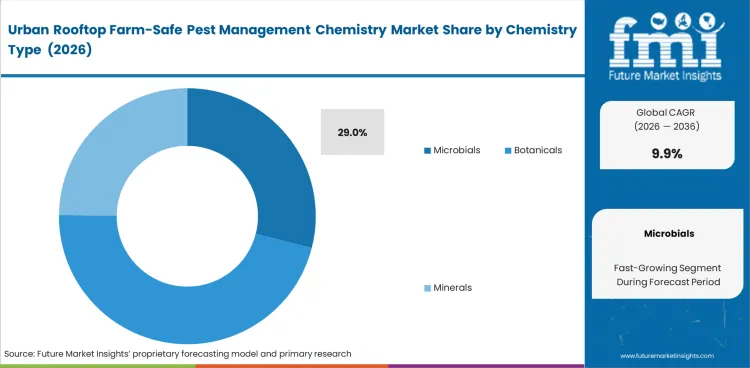
- Microbials are expected to account for 29.0% of the chemistry type segment in 2026 because low-residue products fit rooftop IPM routines more closely.
- Botanical and mineral products carry practical value in corrective use. Repeat preference remains higher for microbial-led programs used across edible protected crops.
Insights into the Application Method Segment
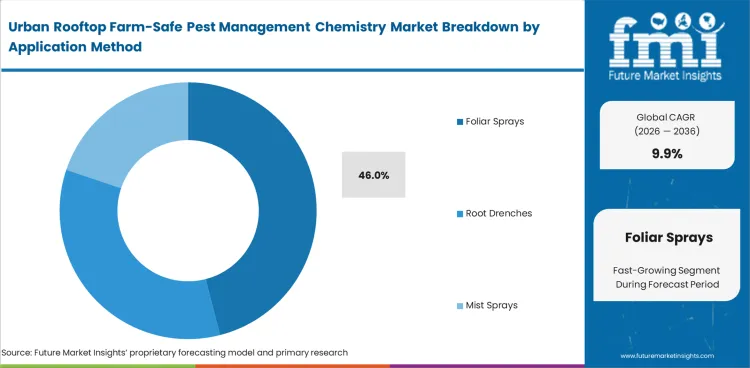
- Foliar sprays are likely to secure 46.0% of the application method segment in 2026 as compact crop canopies favor direct surface application.
- Root drenches gain support in hydroponic and transplant-linked systems affected by root-zone pressure.
Insights into the Crop Type Segment
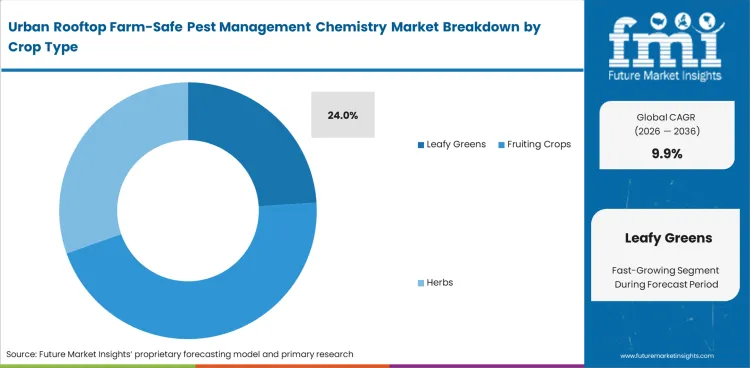
- Leafy greens are projected to contribute 24.0% of the crop type segment in 2026 because short crop cycles raise exposure to visible pest injury propelling demand over the forecast.
- Fruiting crops and herbs carry steady demand in programs built around mildew control and insect suppression.
Insights into the Farm Format Segment
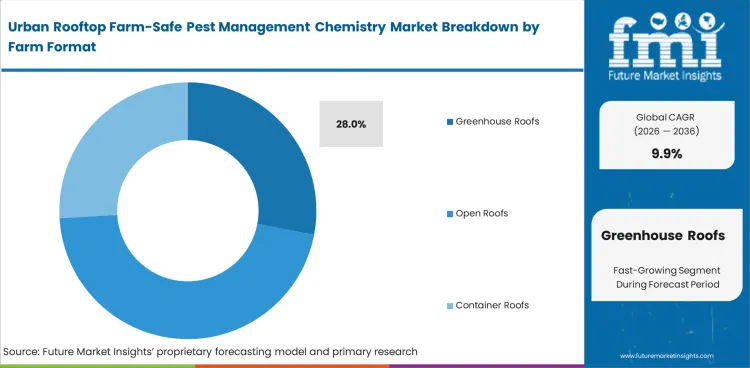
- Greenhouse roofs are projected to represent 28.0% of the farm format segment in 2026 because managed climate control and higher crop density support regular chemistry use.
- Open roofs and raised beds are also garnering stable demand in the market. Spend per site stays lower in less standardized production formats.
Urban Rooftop Farm-Safe Pest Management Chemistry Market Drivers, Restraints, and Opportunities
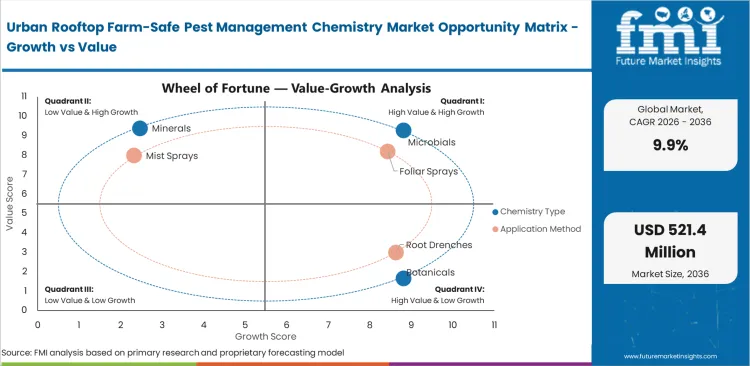
- Urban agriculture support programs and rooftop food-production visibility are expanding the addressable base for safe crop-protection inputs.
- Narrow label fit and small site scale keep adoption below broader greenhouse biologicals demand. Fragmented purchasing adds another limit on supplier efficiency.
- Opportunity is highest in supplier programs that combine chemistry with guidance.
Market scale is driven primarily by planned commercial rooftops and greenhouse roofs that operate structured production programs and require repeat pest‑management use. In contrast, hobby and community rooftop setups adopt formal chemistry programs. This uneven participation limits broad‑based scale and concentrates demand among professional operators, favoring suppliers with protected‑crop expertise over broad, generalist portfolios.
Residue-Sensitive Urban Food Production
Freshness claims and short delivery distance shape product choice in local rooftop produce. Premium crop appearance adds another filter on product selection. FAO’s guide notes 34 bio preparations tested in urban and peri-urban gardens and estates. That record points to low-residue crop-protection interest in urban food systems. Natural overlap appears with agri natural enemy pest control and bio-rational fungicides. Both categories are built around lower-residue crop protection. [1]
Protected-Crop Program Advantage
Rooftop greenhouse and hydroponic operators integrate pest‑management chemistry as part of broader protected‑crop production routines rather than corrective use. This embedded adoption raises repeat demand and shifts purchasing toward performance‑proven programs. As a result, suppliers offering crop‑specific guidance and proven compatibility in enclosed growing systems hold a clear and defensible commercial edge.
Analysis of Urban Rooftop Farm-Safe Pest Management Chemistry Market By Key Countries
.webp "Top Country Growth Comparison Urban Rooftop Farm Safe Pest Management Chemistry Market Cagr (2026 2036)")
| Country | CAGR |
|---|---|
| Singapore | 11.8% |
| Netherlands | 11.2% |
| United States | 10.4% |
| Japan | 10.1% |
| United Arab Emirates | 10.0% |
| India | 9.6% |
Source: FMI analysis based on primary research and proprietary forecasting model
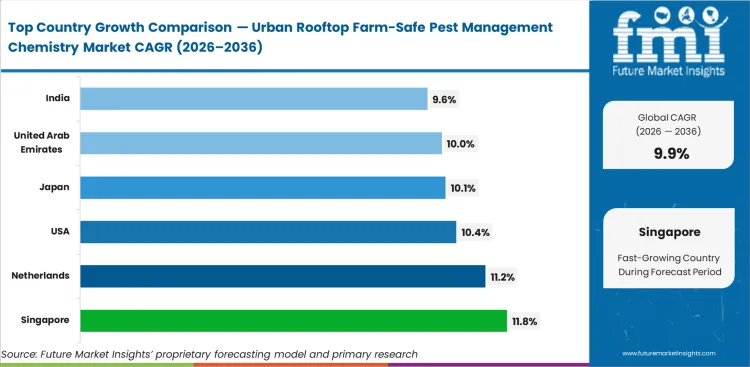
Urban Rooftop Farm-Safe Pest Management Chemistry Market CAGR Analysis By Country
- Singapore is projected to advance at a CAGR of 11.8% during the forecast period as dense-city food strategy and controlled growing systems are driving rooftop-safe chemistry demand.
- Netherlands is projected to expand at a CAGR of 11.2% by 2036. Protected horticulture depth and biological control familiarity support this pace.
- United States is forecast to record a CAGR of 10.4% through 2036. Urban agriculture support and established greenhouse input channels support market formation.
- India is likely to progress at a CAGR of 9.6% through 2036. Rooftop interest is rising from a smaller metro-level base, and conversion into formal input programs remains slower[2] .
Country‑level performance underscores that growth is anchored in cities where protected cultivation is already a strategic priority. Markets with dense‑city layouts and premium fresh‑produce programs generate outsized demand for rooftop‑safe chemistry. Broad agricultural regions contribute comparitively less as their production models do not depend on residue‑controlled, enclosed‑system inputs.
Demand Outlook for Urban Rooftop Farm-Safe Pest Management Chemistry in Singapore
Singapore carries high value in this niche because food-security planning and controlled urban cultivation are closely linked. Demand for urban rooftop farm-safe pest management chemistry in Singapore is expected to rise at a CAGR of 11.8% through 2036. Enclosed crop systems and premium local produce programs support this pace[3] . Supplier scope improves in programs built around short crop cycles and visible quality standards.
- High-value protected growing supports repeat chemistry demand.
- Residue-sensitive fresh produce programs favor low-risk inputs.
- Compact production systems raise the value of precise application.
Future Outlook for Urban Rooftop Farm-Safe Pest Management Chemistry in the Netherlands
Protected horticulture capability gives the Netherlands a strong operating base for this niche. Sales of urban rooftop farm-safe pest management chemistry in the Netherlands are likely to increase at a CAGR of 11.2% through 2036. Biological crop-protection familiarity and greenhouse-linked technical support underpin this pace. Product fit improves in rooftop formats built on existing protected-crop management practice.
- Biological control adoption is already well understood.
- Technical advisory networks improve product confidence.
- Rooftop greenhouse formats fit existing grower routines.
Opportunity Analysis of Urban Rooftop Farm-Safe Pest Management Chemistry in the United States
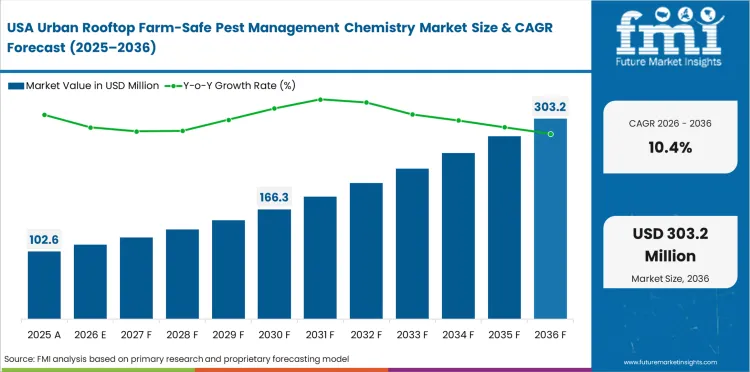
Urban farming programs and specialty crop channels support demand formation in the United States. Protected-crop suppliers strengthen the same market base. The market for urban rooftop farm-safe pest management chemistry in the United States is set to expand at a CAGR of 10.4% through 2036. Urban agriculture support and broader low-residue input availability support this pace[4] . Supplier scope rises after rooftop farms shift from manual control into structured IPM programs.
- Grant-backed and education-led projects improve market visibility.
- Specialty input channels support access to approved products.
- Commercial roofs create steadier repeat demand than hobby sites.
In-depth Analysis of Urban Rooftop Farm-Safe Pest Management Chemistry in Japan
Japan fits the market well because space-efficient production and premium fresh food economics support controlled urban growing. Demand for urban rooftop farm-safe pest management chemistry in Japan is expected to rise at a CAGR of 10.1% through 2036. Protected cultivation and quality-sensitive crop programs support careful chemistry use. Supplier value is higher in product lines built around crop safety and finish quality.
- Dense urban production favors compact growing systems.
- Premium produce channels support controlled pest management.
- Technical products gain traction in quality-sensitive crops.
Sales Analysis of Urban Rooftop Farm-Safe Pest Management Chemistry in the United Arab Emirates
Urban controlled farming and water-efficient crop systems are anticipated to propel the industry in the United Arab Emirates. Sales of urban rooftop farm-safe pest management chemistry in the United Arab Emirates are likely to increase at a CAGR of 10.0% through 2036. Protected cultivation and high-value local production models support this pace. Demand stays selective, and supplier scope improves in managed premium projects.
- Controlled environment farming supports treatment planning.
- Premium urban produce raises crop-loss sensitivity.
- Managed projects buy more consistently than informal rooftop gardens.
Demand Outlook for Urban Rooftop Farm-Safe Pest Management Chemistry in India
India is expanding as demand in the country is concentrated in metro-level rooftop and protected urban crop activity. Demand for urban rooftop farm-safe pest management chemistry in India is expected to rise at a CAGR of 9.6% through 2036. Rooftop cultivation interest and growing use of biological crop-protection products support this pace.
- Metro gardening and urban farming visibility are rising.
- Biological products fit low-volume premium crop systems.
Organized operators generate steadier repeat sales than fragmented small-scale purchasers.
Competitive Landscape and Strategic Positioning
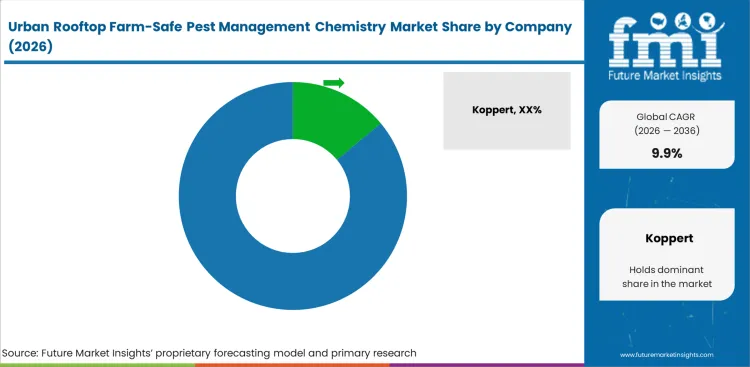
- Competition is led by biological crop-protection suppliers with greenhouse and nursery depth. Specialty-crop experience strengthens their position.
- Product fit matters more than broad portfolio scale because rooftop farms need residue-sensitive solutions. Enclosed-system compatibility remains essential.
- Entry barriers arise from technical support and crop-use confidence. Distribution reach and repeat performance in protected crops add further barriers.
Large agrochemical companies do not lead this market because rooftop farms purchase inputs the same way greenhouse and specialty‑crop growers do. This gives an advantage to suppliers already active in biological products and protected‑cultivation systems, where low‑residue and enclosed‑environment compatibility are essential. There is also connected demand from greenhouse multi‑layer setups and smart‑farming systems that use similar input requirements. In rooftop environments, simply supplying products is not enough. Growers depend on companies that can provide crop‑specific advice and technical support. Consistent, reliable performance in small but quality‑sensitive operations matters more to them than having a large product catalog.
Key Companies in the Urban Rooftop Farm-Safe Pest Management Chemistry Market
Key global companies leading the Urban Rooftop Farm-Safe Pest Management Chemistry market include:
- Biological crop-protection specialists: Koppert, Biobest, Andermatt Group
- Protected-crop and greenhouse-focused suppliers: BioWorks, BioSafe Systems, Certis Biologicals
- Broader biological platform participants: Bioceres Crop Solutions / ProFarm, regional specialty distributors, and protected-crop solution providers
Competitive Benchmarking: Urban Rooftop Farm-Safe Pest Management Chemistry
| Company | Protected-Crop Focus | Biological Portfolio Breadth | Technical Support Depth | Geographic Footprint |
|---|---|---|---|---|
| Koppert | High | High | Strong | Global |
| Biobest | High | Medium | Strong | Global |
| Andermatt Group | Medium | High | Medium | Global |
| Certis Biologicals | Medium | High | Medium | Multi-country |
| BioWorks | High | Medium | Strong | North America |
Source: Future Market Insights competitive analysis, 2026. Ratings reflect relative positioning based on protected-crop focus, biological portfolio breadth, and technical support depth.
Key Developments in Urban Rooftop Farm-Safe Pest Management Chemistry
- In December 2024, Andermatt acquired the beneficial insect business of Entocare C.V., expanding its biological crop-protection capability for protected cultivation and related urban farming programs. [2]
- In June 2025, Koppert and Amoéba signed a major distribution agreement for an innovative biofungicide solution, strengthening access to biological disease-control products for greenhouse and specialty-crop applications. [3]
- In February 2026, BioSafe Systems introduced BioPhyter, adding a new biological product with relevance for controlled growing systems such as hydroponics and protected urban crop production. [4]
Key Players in the Urban Rooftop Farm-Safe Pest Management Chemistry:
Major Global Players:
- Koppert
- Biobest
- Andermatt Group
- Certis Biologicals
Emerging Players/Startups
- BioWorks
- BioSafe Systems
- ProFarm
Report Scope and Coverage
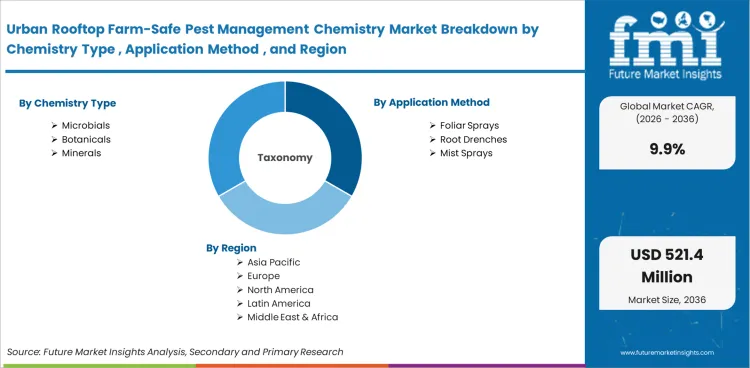
| Parameter | Details |
|---|---|
| Quantitative Units | USD million for value and CAGR from 2026 to 2036 |
| Market Definition | Low-residue and rooftop-compatible pest-management chemistries used in edible urban rooftop crop systems |
| Regions Covered | North America, Europe, Asia Pacific, Middle East, and Rest of World |
| Countries Covered | Singapore, Netherlands, United States, Japan, United Arab Emirates, India |
| Key Companies Profiled | Koppert, Biobest, Andermatt Group, Certis Biologicals, BioWorks, BioSafe Systems, ProFarm |
| Forecast Period | 2026 to 2036 |
| Approach | Primary research, protected-crop comparison, urban agriculture demand mapping, and FMI forecasting model |
Urban Rooftop Farm-Safe Pest Management Chemistry Market by Segments
Urban Rooftop Farm-Safe Pest Management Chemistry Market Segmented by Chemistry Type:
- Microbials
- Botanicals
- Minerals
- Soaps
- Oils
- Biochemicals
- Selectives
Urban Rooftop Farm-Safe Pest Management Chemistry Market Segmented by Pest Target:
- Insects
- Mites
- Fungi
- Bacteria
- Nematodes
- Mollusks
- Mixed Pests
Urban Rooftop Farm-Safe Pest Management Chemistry Market Segmented by Formulation:
- Liquids
- Powders
- Granules
- Baits
- Gels
- Suspensions
- Concentrates
Urban Rooftop Farm-Safe Pest Management Chemistry Market Segmented by Application Method:
- Foliar Sprays
- Root Drenches
- Mist Sprays
- Bait Placement
- Spot Treatment
- Seed Treatment
- Surface Wash
Urban Rooftop Farm-Safe Pest Management Chemistry Market Segmented by Crop Type:
- Leafy Greens
- Fruiting Crops
- Herbs
- Microgreens
- Berries
- Ornamentals
- Mixed Crops
Urban Rooftop Farm-Safe Pest Management Chemistry Market Segmented by Farm Format:
- Greenhouse Roofs
- Open Roofs
- Container Roofs
- Raised Beds
- Hydroponics
- Aquaponics
- Modular Roofs
Urban Rooftop Farm-Safe Pest Management Chemistry Market Segmented by End User:
- Commercial Growers
- Institutions
- Households
- Restaurants
- Community Farms
- Retail Rooftops
- Service Firms
Urban Rooftop Farm-Safe Pest Management Chemistry Market Segmented by Region:
- North America
- USA
- Canada
- Mexico
- Latin America
- Brazil
- Chile
- Rest of Latin America
- Western Europe
- Germany
- UK
- Italy
- Spain
- France
- Nordic
- BENELUX
- Rest of Western Europe
- Eastern Europe
- Russia
- Poland
- Hungary
- Balkan & Baltic
- Rest of Eastern Europe
- East Asia
- China
- Japan
- South Korea
- South Asia and Pacific
- India
- ASEAN
- Australia & New Zealand
- Rest of South Asia and Pacific
- Middle East & Africa
- Kingdom of Saudi Arabia
- Other GCC Countries
- Turkiye
- South Africa
- Other African Union
- Rest of Middle East & Africa
Research Sources and Bibliography
- Food and Agriculture Organization of the United Nations. (n.d.). Biopreparations for the sustainable management of pests and diseases in urban and peri-urban agriculture.
- Andermatt Group. (2024, December). Andermatt acquires beneficial insect business of Entocare C.V.
- Koppert Biological Systems. (2025, June). Koppert and Amoéba sign major distribution agreement for innovative biofungicide solution.
- BioSafe Systems. (2026, February). Introducing BioPhyter
- European Parliamentary Research Service. (2025, January). Urban agriculture: State of play.
- Farm Service Agency. (2024, April). Applications for USDA Urban Agriculture and Innovative Production Grants Due April 9.
- United States Environmental Protection Agency. (2026, March). Minimum Risk Pesticides Exempted from FIFRA Registration.
- United States Environmental Protection Agency. (2026, February). Biopesticide Active Ingredients.
- Md. Ashikuzzaman, Mohammad Shahidul Hasan Swapan, and Atiq Zaman. (2025, June). Integrating urban rooftop farming into city governance in megacities: A systematic literature review.
This Report Answers
- How large is the market in 2025, 2026, and 2036?
- Which chemistry type leads the market?
- Which application method carries the largest share?
- Which crop segment carries the largest share?
- Why do rooftop greenhouse systems generate higher chemistry spend per site?
- Which countries post the fastest CAGR through 2036?
- Which supplier groups hold an edge in this niche?
- Why do microbial products lead demand?
- Why do small rooftop sites slow supplier scale efficiency?
- How does this niche differ from broad greenhouse biologicals demand?
- Which operating conditions support repeat purchase?
- Which product traits shape supplier preference in premium urban crops?
Frequently Asked Questions
What is the urban rooftop farm-safe pest management chemistry market?
It covers pest-management chemistries used in rooftop edible crop systems built around residue profile, crop safety, and controlled application.
Why is this market smaller than the broader biopesticides market?
Rooftop food production is still a niche installed base, and many sites do not run structured chemistry programs.
Which product type leads the market?
Microbials lead because low-residue protected-crop programs use microbial products more often than harsher chemistry classes.
Why do foliar sprays account for the largest share?
Leaf-level visibility, quick treatment response, and compact canopies make foliar use more practical than other routes in many rooftop systems.
Which crop segment is most important?
Leafy greens lead because short harvest cycles and visible quality loss make pest control more important in this crop group.
Which end users matter most?
Commercial growers matter most because repeat product purchase is higher in managed production systems than in hobby or community plots.
Which countries offer the strongest growth outlook?
Singapore, the Netherlands, and the United States offer the best near-term commercial outlook.
What is the main barrier to adoption?
Fragmented purchasing and small site scale reduce supplier efficiency and slow standardization.
How do suppliers win in this market?
Suppliers win through protected-crop depth, low-residue product fit, and technical guidance instead of catalog size alone.
Is this market closer to field crop protection or greenhouse inputs?
It behaves much closer to greenhouse and specialty-crop input demand than to broad-acre crop protection.
Preview the report firsthand - request a free sample
Get SampleGet the brochure for pricing and purchase details.
Get PDFTable of Content
- Key Takeaways
- Market Size and CAGR
- Top Growth Driver
- Fastest Growing Segment
- Leading Region
- Key Companies
- Emerging Opportunities
- Executive Summary
- Global Market Outlook
- Demand-side Trends
- Supply-side Trends
- Technology Roadmap Analysis
- Analysis and Recommendations
- Analyst Perspective (What is happening? Why now? What should investors know?)
- Key Questions Answered
- How large is the market?
- What is the CAGR?
- What are key trends?
- Which region dominates?
- Who are the leaders?
- Market Overview
- Market Coverage / Taxonomy
- Market Definition / Scope / Limitations
- Research Methodology
- Chapter Orientation
- Analytical Lens and Working Hypotheses
- Market Structure, Signals, and Trend Drivers
- Benchmarking and Cross-market Comparability
- Market Sizing, Forecasting, and Opportunity Mapping
- Research Design and Evidence Framework
- Desk Research Programme (Secondary Evidence)
- Expert Input and Fieldwork (Primary Evidence)
- Tooling, Models, and Reference Databases
- Data Engineering and Model Build
- Quality Assurance and Audit Trail
- Market Background
- Market Dynamics (Drivers, Restraints, Opportunity, Trends)
- Scenario Forecast (Optimistic, Likely, Conservative)
- Impact Analysis
- AI Impact
- Sustainability Impact
- Regulatory Impact
- Technology Impact
- Consumer / Buyer Analysis
- Purchase Drivers
- Adoption Barriers
- Buyer Journey
- Opportunity Map Analysis
- Product Life Cycle Analysis
- Supply Chain Analysis
- Investment Feasibility Matrix
- Value Chain Analysis
- PESTLE and Porter's Analysis
- Regulatory Landscape
- Regional Parent Market Outlook
- Production and Consumption Statistics
- Import and Export Statistics
- Global Market Analysis and Forecast, 2021 to 2036
- Historical Market Size Value (USD Million) & Volume (Unit) Analysis, 2021 to 2025
- Current and Future Market Size Value (USD Million) & Volume (Unit) Projections, 2026 to 2036
- Y-o-Y Growth Trend Analysis
- Absolute $ Opportunity Analysis
- Global Market Pricing Analysis, 2021 to 2036
- Global Market Analysis and Forecast, By Chemistry Type, 2021 to 2036
- Introduction / Key Findings
- Historical Market Size Value (USD Million) & Volume (Unit) Analysis By Chemistry Type, 2021 to 2025
- Current and Future Market Size Value (USD Million) & Volume (Unit) Analysis and Forecast By Chemistry Type, 2026 to 2036
- Microbials
- Botanicals
- Minerals
- Soaps
- Oils
- Biochemicals
- Selectives
- Microbials
- Y-o-Y Growth Trend Analysis By Chemistry Type, 2021 to 2025
- Absolute $ Opportunity Analysis By Chemistry Type, 2026 to 2036
- Global Market Analysis and Forecast, By Pest Target, 2021 to 2036
- Introduction / Key Findings
- Historical Market Size Value (USD Million) & Volume (Unit) Analysis By Pest Target, 2021 to 2025
- Current and Future Market Size Value (USD Million) & Volume (Unit) Analysis and Forecast By Pest Target, 2026 to 2036
- Insects
- Mites
- Fungi
- Bacteria
- Nematodes
- Mollusks
- Mixed Pests
- Insects
- Y-o-Y Growth Trend Analysis By Pest Target, 2021 to 2025
- Absolute $ Opportunity Analysis By Pest Target, 2026 to 2036
- Global Market Analysis and Forecast, By Formulation, 2021 to 2036
- Introduction / Key Findings
- Historical Market Size Value (USD Million) & Volume (Unit) Analysis By Formulation, 2021 to 2025
- Current and Future Market Size Value (USD Million) & Volume (Unit) Analysis and Forecast By Formulation, 2026 to 2036
- Liquids
- Powders
- Granules
- Baits
- Gels
- Suspensions
- Concentrates
- Liquids
- Y-o-Y Growth Trend Analysis By Formulation, 2021 to 2025
- Absolute $ Opportunity Analysis By Formulation, 2026 to 2036
- Global Market Analysis and Forecast, By Application Method, 2021 to 2036
- Introduction / Key Findings
- Historical Market Size Value (USD Million) & Volume (Unit) Analysis By Application Method, 2021 to 2025
- Current and Future Market Size Value (USD Million) & Volume (Unit) Analysis and Forecast By Application Method, 2026 to 2036
- Foliar Sprays
- Root Drenches
- Mist Sprays
- Bait Placement
- Spot Treatment
- Seed Treatment
- Surface Wash
- Foliar Sprays
- Y-o-Y Growth Trend Analysis By Application Method, 2021 to 2025
- Absolute $ Opportunity Analysis By Application Method, 2026 to 2036
- Global Market Analysis and Forecast, By Crop Type, 2021 to 2036
- Introduction / Key Findings
- Historical Market Size Value (USD Million) & Volume (Unit) Analysis By Crop Type, 2021 to 2025
- Current and Future Market Size Value (USD Million) & Volume (Unit) Analysis and Forecast By Crop Type, 2026 to 2036
- Leafy Greens
- Fruiting Crops
- Herbs
- Microgreens
- Berries
- Ornamentals
- Mixed Crops
- Leafy Greens
- Y-o-Y Growth Trend Analysis By Crop Type, 2021 to 2025
- Absolute $ Opportunity Analysis By Crop Type, 2026 to 2036
- Global Market Analysis and Forecast, By Farm Format
- Introduction / Key Findings
- Historical Market Size Value (USD Million) & Volume (Unit) Analysis By Farm Format, 2021 to 2025
- Current and Future Market Size Value (USD Million) & Volume (Unit) Analysis and Forecast By Farm Format, 2026 to 2036
- Greenhouse Roofs
- Open Roofs
- Container Roofs
- Raised Beds
- Hydroponics
- Aquaponics
- Modular Roofs
- Greenhouse Roofs
- Y-o-Y Growth Trend Analysis By Farm Format, 2021 to 2025
- Absolute $ Opportunity Analysis By Farm Format, 2026 to 2036
- Global Market Analysis and Forecast, By End User
- Introduction / Key Findings
- Historical Market Size Value (USD Million) & Volume (Unit) Analysis By End User, 2021 to 2025
- Current and Future Market Size Value (USD Million) & Volume (Unit) Analysis and Forecast By End User, 2026 to 2036
- Commercial Growers
- Institutions
- Households
- Restaurants
- Community Farms
- Retail Rooftops
- Service Firms
- Commercial Growers
- Y-o-Y Growth Trend Analysis By End User, 2021 to 2025
- Absolute $ Opportunity Analysis By End User, 2026 to 2036
- Global Market Analysis and Forecast, By Region, 2021 to 2036
- Introduction
- Historical Market Size Value (USD Million) & Volume (Unit) Analysis By Region, 2021 to 2025
- Current Market Size Value (USD Million) & Volume (Unit) Analysis and Forecast By Region, 2026 to 2036
- North America
- Latin America
- Western Europe
- Eastern Europe
- East Asia
- South Asia and Pacific
- Middle East & Africa
- Market Attractiveness Analysis By Region
- North America Market Analysis and Forecast, By Country, 2021 to 2036
- Historical Market Size Value (USD Million) & Volume (Unit) Trend Analysis By Market Taxonomy, 2021 to 2025
- Market Size Value (USD Million) & Volume (Unit) Forecast By Market Taxonomy, 2026 to 2036
- By Country
- USA
- Canada
- Mexico
- By Chemistry Type
- By Pest Target
- By Formulation
- By Application Method
- By Crop Type
- By Farm Format
- By End User
- By Country
- Market Attractiveness Analysis
- By Country
- By Chemistry Type
- By Pest Target
- By Formulation
- By Application Method
- By Crop Type
- By Farm Format
- By End User
- Key Takeaways
- Latin America Market Analysis and Forecast, By Country
- Historical Market Size Value (USD Million) & Volume (Unit) Trend Analysis By Market Taxonomy, 2021 to 2025
- Market Size Value (USD Million) & Volume (Unit) Forecast By Market Taxonomy, 2026 to 2036
- By Country
- Brazil
- Chile
- Rest of Latin America
- By Chemistry Type
- By Pest Target
- By Formulation
- By Application Method
- By Crop Type
- By Farm Format
- By End User
- By Country
- Market Attractiveness Analysis
- By Country
- By Chemistry Type
- By Pest Target
- By Formulation
- By Application Method
- By Crop Type
- By Farm Format
- By End User
- Key Takeaways
- Western Europe Market Analysis and Forecast, By Country
- Historical Market Size Value (USD Million) & Volume (Unit) Trend Analysis By Market Taxonomy, 2021 to 2025
- Market Size Value (USD Million) & Volume (Unit) Forecast By Market Taxonomy, 2026 to 2036
- By Country
- Germany
- UK
- Italy
- Spain
- France
- Nordic
- BENELUX
- Rest of Western Europe
- By Chemistry Type
- By Pest Target
- By Formulation
- By Application Method
- By Crop Type
- By Farm Format
- By End User
- By Country
- Market Attractiveness Analysis
- By Country
- By Chemistry Type
- By Pest Target
- By Formulation
- By Application Method
- By Crop Type
- By Farm Format
- By End User
- Key Takeaways
- Eastern Europe Market Analysis and Forecast, By Country
- Historical Market Size Value (USD Million) & Volume (Unit) Trend Analysis By Market Taxonomy, 2021 to 2025
- Market Size Value (USD Million) & Volume (Unit) Forecast By Market Taxonomy, 2026 to 2036
- By Country
- Russia
- Poland
- Hungary
- Balkan & Baltic
- Rest of Eastern Europe
- By Chemistry Type
- By Pest Target
- By Formulation
- By Application Method
- By Crop Type
- By Farm Format
- By End User
- By Country
- Market Attractiveness Analysis
- By Country
- By Chemistry Type
- By Pest Target
- By Formulation
- By Application Method
- By Crop Type
- By Farm Format
- By End User
- Key Takeaways
- East Asia Market Analysis and Forecast, By Country
- Historical Market Size Value (USD Million) & Volume (Unit) Trend Analysis By Market Taxonomy, 2021 to 2025
- Market Size Value (USD Million) & Volume (Unit) Forecast By Market Taxonomy, 2026 to 2036
- By Country
- China
- Japan
- South Korea
- By Chemistry Type
- By Pest Target
- By Formulation
- By Application Method
- By Crop Type
- By Farm Format
- By End User
- By Country
- Market Attractiveness Analysis
- By Country
- By Chemistry Type
- By Pest Target
- By Formulation
- By Application Method
- By Crop Type
- By Farm Format
- By End User
- Key Takeaways
- South Asia and Pacific Market Analysis and Forecast, By Country
- Historical Market Size Value (USD Million) & Volume (Unit) Trend Analysis By Market Taxonomy, 2021 to 2025
- Market Size Value (USD Million) & Volume (Unit) Forecast By Market Taxonomy, 2026 to 2036
- By Country
- India
- ASEAN
- Australia & New Zealand
- Rest of South Asia and Pacific
- By Chemistry Type
- By Pest Target
- By Formulation
- By Application Method
- By Crop Type
- By Farm Format
- By End User
- By Country
- Market Attractiveness Analysis
- By Country
- By Chemistry Type
- By Pest Target
- By Formulation
- By Application Method
- By Crop Type
- By Farm Format
- By End User
- Key Takeaways
- Middle East & Africa Market Analysis and Forecast, By Country
- Historical Market Size Value (USD Million) & Volume (Unit) Trend Analysis By Market Taxonomy, 2021 to 2025
- Market Size Value (USD Million) & Volume (Unit) Forecast By Market Taxonomy, 2026 to 2036
- By Country
- Kingdom of Saudi Arabia
- Other GCC Countries
- Türkiye
- South Africa
- Other African Union
- Rest of Middle East & Africa
- By Chemistry Type
- By Pest Target
- By Formulation
- By Application Method
- By Crop Type
- By Farm Format
- By End User
- By Country
- Market Attractiveness Analysis
- By Country
- By Chemistry Type
- By Pest Target
- By Formulation
- By Application Method
- By Crop Type
- By Farm Format
- By End User
- Key Takeaways
- Key Countries Market Analysis
- USA
- Pricing Analysis
- Market Share Analysis, 2025
- By Chemistry Type
- By Pest Target
- By Formulation
- By Application Method
- By Crop Type
- By Farm Format
- By End User
- Canada
- Pricing Analysis
- Market Share Analysis, 2025
- By Chemistry Type
- By Pest Target
- By Formulation
- By Application Method
- By Crop Type
- By Farm Format
- By End User
- Mexico
- Pricing Analysis
- Market Share Analysis, 2025
- By Chemistry Type
- By Pest Target
- By Formulation
- By Application Method
- By Crop Type
- By Farm Format
- By End User
- Brazil
- Pricing Analysis
- Market Share Analysis, 2025
- By Chemistry Type
- By Pest Target
- By Formulation
- By Application Method
- By Crop Type
- By Farm Format
- By End User
- Chile
- Pricing Analysis
- Market Share Analysis, 2025
- By Chemistry Type
- By Pest Target
- By Formulation
- By Application Method
- By Crop Type
- By Farm Format
- By End User
- Germany
- Pricing Analysis
- Market Share Analysis, 2025
- By Chemistry Type
- By Pest Target
- By Formulation
- By Application Method
- By Crop Type
- By Farm Format
- By End User
- UK
- Pricing Analysis
- Market Share Analysis, 2025
- By Chemistry Type
- By Pest Target
- By Formulation
- By Application Method
- By Crop Type
- By Farm Format
- By End User
- Italy
- Pricing Analysis
- Market Share Analysis, 2025
- By Chemistry Type
- By Pest Target
- By Formulation
- By Application Method
- By Crop Type
- By Farm Format
- By End User
- Spain
- Pricing Analysis
- Market Share Analysis, 2025
- By Chemistry Type
- By Pest Target
- By Formulation
- By Application Method
- By Crop Type
- By Farm Format
- By End User
- France
- Pricing Analysis
- Market Share Analysis, 2025
- By Chemistry Type
- By Pest Target
- By Formulation
- By Application Method
- By Crop Type
- By Farm Format
- By End User
- India
- Pricing Analysis
- Market Share Analysis, 2025
- By Chemistry Type
- By Pest Target
- By Formulation
- By Application Method
- By Crop Type
- By Farm Format
- By End User
- ASEAN
- Pricing Analysis
- Market Share Analysis, 2025
- By Chemistry Type
- By Pest Target
- By Formulation
- By Application Method
- By Crop Type
- By Farm Format
- By End User
- Australia & New Zealand
- Pricing Analysis
- Market Share Analysis, 2025
- By Chemistry Type
- By Pest Target
- By Formulation
- By Application Method
- By Crop Type
- By Farm Format
- By End User
- China
- Pricing Analysis
- Market Share Analysis, 2025
- By Chemistry Type
- By Pest Target
- By Formulation
- By Application Method
- By Crop Type
- By Farm Format
- By End User
- Japan
- Pricing Analysis
- Market Share Analysis, 2025
- By Chemistry Type
- By Pest Target
- By Formulation
- By Application Method
- By Crop Type
- By Farm Format
- By End User
- South Korea
- Pricing Analysis
- Market Share Analysis, 2025
- By Chemistry Type
- By Pest Target
- By Formulation
- By Application Method
- By Crop Type
- By Farm Format
- By End User
- Russia
- Pricing Analysis
- Market Share Analysis, 2025
- By Chemistry Type
- By Pest Target
- By Formulation
- By Application Method
- By Crop Type
- By Farm Format
- By End User
- Poland
- Pricing Analysis
- Market Share Analysis, 2025
- By Chemistry Type
- By Pest Target
- By Formulation
- By Application Method
- By Crop Type
- By Farm Format
- By End User
- Hungary
- Pricing Analysis
- Market Share Analysis, 2025
- By Chemistry Type
- By Pest Target
- By Formulation
- By Application Method
- By Crop Type
- By Farm Format
- By End User
- Kingdom of Saudi Arabia
- Pricing Analysis
- Market Share Analysis, 2025
- By Chemistry Type
- By Pest Target
- By Formulation
- By Application Method
- By Crop Type
- By Farm Format
- By End User
- Türkiye
- Pricing Analysis
- Market Share Analysis, 2025
- By Chemistry Type
- By Pest Target
- By Formulation
- By Application Method
- By Crop Type
- By Farm Format
- By End User
- South Africa
- Pricing Analysis
- Market Share Analysis, 2025
- By Chemistry Type
- By Pest Target
- By Formulation
- By Application Method
- By Crop Type
- By Farm Format
- By End User
- USA
- Market Structure Analysis
- Competition Dashboard
- Competition Benchmarking
- Market Share Analysis of Top Players
- By Regional
- By Chemistry Type
- By Pest Target
- By Formulation
- By Application Method
- By Crop Type
- By Farm Format
- By End User
- Emerging Startups
- Innovation Benchmarking
- Competition Analysis
- Competition Deep Dive
- Koppert
- Overview
- Product Portfolio
- Profitability by Market Segments (Product/Region/Sales Channel)
- Sales Footprint
- Strategy Overview
- Marketing Strategy
- Product Strategy
- Channel Strategy
- Biobest
- Andermatt Group
- Certis Biologicals
- BioWorks
- Koppert
- Case Studies
- Success Stories
- Recent Developments
- Competition Deep Dive
- Assumptions & Acronyms Used


