

- Industry Size (2026)
- USD 1.7 Bn
- Forecast (2036)
- USD 3.7 Bn
- CAGR (2026 to 2036)
- 8.1%
Urban Turf Insecticides Market Forecast and Outlook 2026 to 2036
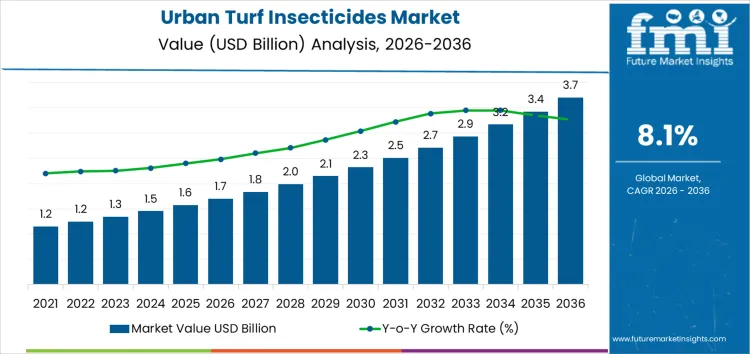
The urban turf insecticides market is valued at USD 1.7 billion in 2026 and is projected to reach USD 3.7 billion by 2036, reflecting a CAGR of 8.1%. Production concentration is observed among a limited number of manufacturers specializing in pest control for urban landscapes, sports fields, and recreational areas. Regional distribution frameworks and municipal procurement policies influence availability and supply planning. Reliability is affected by seasonal demand, active pest cycles, and regulatory compliance. Smaller operators encounter constraints in sourcing certified active ingredients and maintaining consistent supply across multiple jurisdictions. Cost structures and application effectiveness determine pricing power, while margin concentration favors producers able to provide validated, multi-season solutions tailored to turf-specific pest challenges.
Performance is shaped by integration with municipal and commercial turf maintenance programs, regulatory approvals, and climate-specific pest prevalence. Adoption varies geographically depending on turf density, local climate, and municipal pest management strategies. Margin concentration favors suppliers offering multi-season efficacy, technical support, and certification verification, enabling predictable revenue streams. Fragmentation persists in smaller regional providers and niche markets. Leading operators achieve concentrated value by maintaining production control, validated application outcomes, and regulatory alignment. Reliability, consistency, and integration with client maintenance programs determine long-term performance, while output volume alone does not guarantee sustainable margins or concentrated revenue in this specialized market.
Quick Stats of the Urban Turf Insecticides Market
- Urban Turf Insecticides Market Value (2026): USD 1.7 billion
- Urban Turf Insecticides Forecast Value (2036): USD 3.7 billion
- Urban Turf Insecticides Forecast CAGR 2026 to 2036: 8.1%
- Urban Turf Insecticides Leading Pest Type: Grubs & Beetles (33.5% share)
- Urban Turf Insecticides Leading Insecticide Type: Pyrethroids (31.8% share)
- Urban Turf Insecticides Key Growth Regions: USA, Canada, Germany, UK, Japan
- Urban Turf Insecticides Top Players: BASF SE, Syngenta Group, Bayer CropScience, Corteva Agriscience, FMC Corporation
What is the Growth Forecast for Urban Turf Insecticides Market through 2036?
Between 2026 and 2031, the urban turf insecticides market is projected to grow from USD 1.7 billion to USD 2.3 billion, generating an absolute increase of USD 0.6 billion. Volume contributes approximately 67% of growth, driven by adoption of pyrethroids, neonicotinoids, organophosphates, and biological insecticides across grubs, beetles, ants, crawlers, and sod webworms. Liquid, granular, and emulsifiable concentrate formulations support expanded application in residential, commercial, and municipal turf areas. Price growth accounts for 33%, influenced by premium formulations, differentiated efficacy, and regulatory compliance. Value capture favors suppliers providing effective, safe, and consistent pest management solutions.
From 2031 to 2036, the market is expected to expand from USD 2.3 billion to USD 3.7 billion, adding USD 1.4 billion. Volume remains the dominant driver, contributing roughly 65% of growth due to increased adoption in urban landscaping, golf courses, and municipal projects. Price growth represents 35%, supported by advanced formulations, specialty products, and differentiated delivery methods. Competitive advantage favors suppliers with proven efficacy, broad distribution networks, and integrated technical support. Leading companies include BASF SE, Syngenta Group, Bayer CropScience, Corteva Agriscience, and FMC Corporation.
Urban Turf Insecticides Market Key Takeaways
| Metric | Value |
|---|---|
| Market Value (2026) | USD 1.7 billion |
| Forecast Value (2036) | USD 3.7 billion |
| Forecast CAGR 2026 to 2036 | 8.10% |
How Is Demand Shaping the Urban Turf Insecticides Market?
Urban turf insecticides are increasingly used to protect lawns, golf courses, parks, and recreational areas from pest infestations that compromise turf quality. Historically, pest management relied on broad-spectrum chemicals, resulting in inconsistent control and potential environmental impact. Modern insecticides are formulated for targeted action against specific turf pests while minimizing harm to beneficial insects and surrounding ecosystems. Landscape managers, municipal authorities, and golf course operators prioritize efficacy, residual activity, and regulatory compliance. Early adoption focused on premium recreational spaces, while current demand extends to residential lawns, institutional campuses, and public green areas driven by aesthetic standards, turf health requirements, and urban beautification initiatives. Application method, turf compatibility, and safety influence product selection.
Rising urban development, stricter environmental regulations, and heightened expectations for visually appealing landscapes are driving market growth. Compared with earlier formulations, contemporary products emphasize selective pest control, long-lasting efficacy, and integration with integrated pest management strategies. Cost structures depend on active ingredient production, formulation processes, and application technologies, concentrating margins among suppliers delivering reliable, regulatory-compliant insecticides. Landscape managers adopt these products to maintain turf quality, prevent pest damage, and ensure safety for users. By 2036, urban turf insecticides are expected to be widely implemented across public and private green spaces, supporting sustainable maintenance, aesthetic standards, and pest-resilient urban environments.
What Factors Are Shaping the Demand for Urban Turf Insecticides in Terms of Pest Type and Insecticide Type?
The demand for urban turf insecticides is segmented by pest type and insecticide type. Pest types include grubs and beetles, ants and crawlers, chinch bugs, sod webworms, and other insects. Insecticide types include pyrethroids, neonicotinoids, organophosphates, biological insecticides, and other formulations. Adoption is influenced by pest pressure, turfgrass species, and regulatory compliance. Uptake is driven by the need for effective pest control, maintaining lawn quality, and minimizing damage to public and private green spaces. Pest and insecticide selection depends on infestation severity, turf use, and environmental considerations, ensuring optimal control and operational efficiency in urban landscaping.
Why Are Grubs and Beetles Leading the Pest Type Segment in Urban Turf Insecticides?
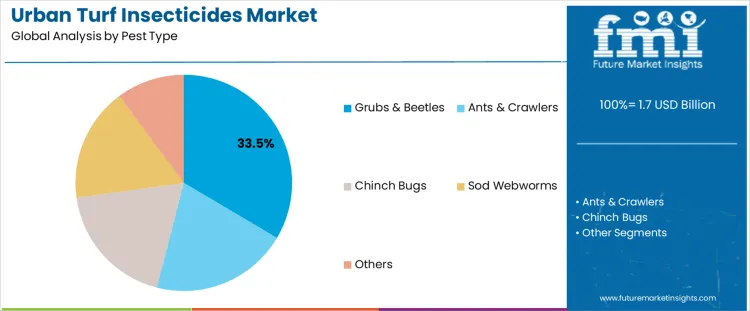
Grubs and beetles account for approximately 34% of total pest type demand, making them the leading category. These pests damage turfgrass roots, leading to thinning, yellowing, and increased susceptibility to disease. Adoption is driven by seasonal infestations and their impact on residential lawns, parks, and golf courses. Landscapers and property managers implement targeted insecticide applications during peak larval and adult activity periods to protect turf health. Monitoring pest populations, timing interventions, and selecting effective formulations ensure consistent control. The segment leads because grubs and beetles represent the most economically significant pest group affecting urban turf maintenance and quality.
Operational factors further support adoption. Turf managers calibrate application rates, adjust spray timing, and consider environmental conditions to maximize efficacy while minimizing runoff. Integrated pest management practices are applied alongside chemical interventions to reduce resistance development. The segment leads because controlling grubs and beetles preserves turf quality, reduces maintenance costs, and ensures safe and reliable urban landscaping operations.
Why Are Pyrethroids Representing the Largest Insecticide Type Segment in Urban Turf Pest Control?
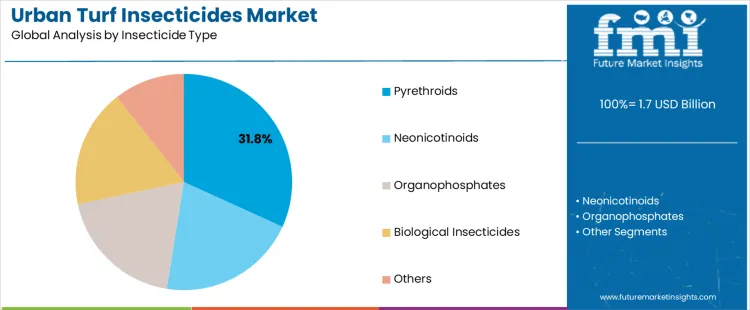
Pyrethroids account for approximately 31.8% of total insecticide type demand, making them the largest category. These insecticides provide rapid knockdown of turf pests, long residual activity, and broad-spectrum control. Adoption is reinforced by compatibility with turfgrass species, ease of application, and regulatory approval for urban use. Landscape managers apply pyrethroids to control grubs, beetles, and surface-feeding insects efficiently, reducing visible damage and maintaining aesthetic standards. Maintenance includes monitoring pest populations, assessing turf health, and ensuring proper application to maximize performance.
Operational considerations influence adoption. Pyrethroids must withstand irrigation, rainfall, and temperature variations while maintaining efficacy. Proper calibration, spray coverage, and timing optimize results. The segment leads because pyrethroids deliver consistent control, maintain turf aesthetics, and provide operational efficiency, making them the preferred choice for urban turf pest management programs.
How Are Urban Turf Insecticides Protecting Landscapes and Recreational Areas?
Urban turf insecticides are increasingly used to control pests such as grubs, ants, and sod webworms in parks, sports fields, golf courses, and residential lawns. Adoption is strongest in regions with high urban green space density, professional landscaping services, and municipal maintenance programs. Products are selected for efficacy, minimal environmental impact, and safety for public areas. Growth is driven by pest management requirements, regulatory compliance, and aesthetic standards. Investment focuses on formulation effectiveness, ease of application, and durability. Landscape managers and municipal authorities prioritize insecticides that protect turf health while maintaining safety for users and the environment.
Why Are Regional Pest Prevalence and Urban Landscaping Policies Driving Adoption?
Demand is influenced by local pest populations, climate conditions, and regulations for chemical use in public spaces. Urban managers adopt insecticides to maintain turf quality, prevent damage, and meet safety and aesthetic standards. Products offering targeted control, low environmental impact, and residual protection gain preference. Adoption is concentrated in regions with dense urban greenery and professional maintenance infrastructure. Turf protection, regulatory compliance, and landscape appearance drive procurement rather than cost. Suppliers providing effective, safe, and approved formulations gain advantage among municipal and commercial landscapers.
What Factors Limit Broader Deployment of Urban Turf Insecticides?
High costs, application restrictions, and public safety concerns restrict adoption. Environmental conditions, pesticide resistance, and timing of application affect efficacy. Regulatory approvals and local restrictions on chemical use can delay implementation. Smaller municipalities or residential areas may lack technical expertise or equipment for proper application. These factors concentrate early use among well-resourced municipalities, commercial landscaping firms, and golf courses with established maintenance programs, limiting penetration in smaller or resource-constrained regions.
How Are Innovations and Industry Collaboration Shaping Market Growth?
Recent developments include environmentally friendly formulations, targeted delivery systems, and integrated pest management-compatible products. Collaboration between chemical manufacturers, turf management companies, and regulatory agencies ensures efficacy, safety, and compliance. Pilot programs validate performance, turf health impact, and environmental safety before large-scale use. Quality monitoring, traceability, and adherence to regulations maintain reliability. Focus is on turf protection, application efficiency, and environmental compliance rather than cost or volume. Collaborative efforts enable broader adoption of urban turf insecticides, preserving turf health and aesthetics in public and commercial landscapes.
What is the Demand for Urban Turf Insecticides by Country?
| Country | CAGR (%) |
|---|---|
| USA | 9.2 |
| Canada | 8.4 |
| Germany | 7.8 |
| UK | 7.6 |
| Japan | 7.1 |
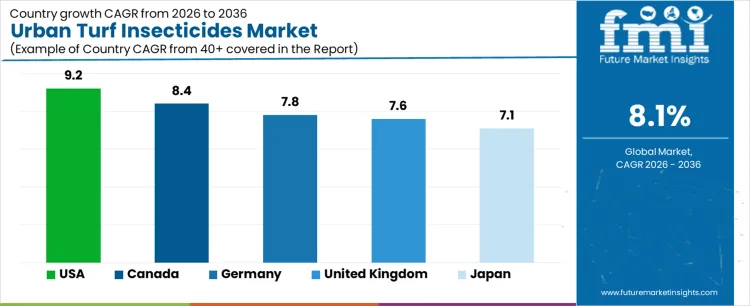
Demand for urban turf insecticides is rising as municipalities, sports facilities, and residential communities prioritize pest management to maintain healthy lawns and recreational spaces. The USA leads with a 9.2% CAGR, driven by extensive urban landscaping, high adoption of professional turf care, and investment in insecticide solutions. Canada follows at 8.4%, supported by municipal programs and sports facility maintenance. Germany records 7.8% growth, shaped by urban green space management and regulatory-compliant pest control practices. The UK grows at 7.6%, reflecting adoption in public parks and residential areas. Japan shows 7.1% CAGR, driven by steady demand for turf maintenance in urban and recreational facilities.
How Is the United States Experiencing Growth in the Urban Turf Insecticides Market?
United States is experiencing growth at a CAGR of 9.2%, supported by increasing adoption of insecticides in urban landscaping, golf courses, and recreational turf to control pests and maintain turf quality. Landscape managers, municipal authorities, and turf care service providers are deploying products optimized for efficacy, environmental safety, and minimal non-target impact. Demand is concentrated in metropolitan areas, sports complexes, and public green spaces. Investments focus on product performance, regulatory compliance, and application precision rather than geographic expansion. Growth reflects rising urban landscaping activities, increasing maintenance of recreational spaces, and adoption of advanced pest control technologies to sustain turf health.
- Urban landscaping drives adoption.
- Insecticides target turf pests and maintain quality.
- Metropolitan areas and recreational spaces concentrate demand.
- Product performance and regulatory compliance guide investment.
How Is Canada Witnessing Adoption With Municipal and Sports Turf Programs?
Canada is witnessing growth at a CAGR of 8.4%, supported by adoption of insecticides in golf courses, sports fields, and urban green areas to control pest infestations and maintain turf aesthetics. Landscape managers and municipal authorities are deploying products designed for environmental safety, precision application, and pest resistance. Demand is concentrated in major cities and recreational facilities across provinces such as Ontario, British Columbia, and Quebec. Investments prioritize product efficacy, regulatory compliance, and application efficiency rather than large-scale expansion. Growth reflects increasing investment in urban turf management, public awareness of turf health, and adoption of sustainable insecticide technologies.
- Municipal and sports turf programs drive adoption.
- Products control pests while maintaining turf health.
- Major cities and recreational facilities concentrate demand.
- Product efficacy and application efficiency guide investment.
How Is Germany Experiencing Growth With Urban Green Space Management?
Germany is experiencing growth at a CAGR of 7.8%, fueled by adoption of urban turf insecticides to protect lawns, parks, and sports fields from pest damage. Landscape management companies, municipal authorities, and recreational facilities are using products optimized for efficacy, safety, and regulatory compliance. Demand is concentrated in major cities, sports complexes, and public parks. Investments focus on product performance, application precision, and environmental safety rather than expansion of managed areas. Growth reflects government regulations on urban landscaping, increasing recreational facility development, and adoption of advanced pest management solutions.
- Urban green space management drives adoption.
- Insecticides protect lawns, parks, and sports fields.
- Major cities and recreational complexes concentrate demand.
- Product performance and environmental safety guide investment.
How Is the United Kingdom Witnessing Expansion With Turf Management Programs?
United Kingdom is witnessing growth at a CAGR of 7.6%, supported by adoption of insecticides in urban and recreational turf to maintain aesthetic quality and manage pest populations. Landscape service providers and municipal authorities are deploying products designed for high efficacy, safe application, and regulatory compliance. Demand is concentrated in metropolitan areas, sports facilities, and golf courses. Investments prioritize product effectiveness, application precision, and compliance rather than area expansion. Growth reflects increasing recreational turf development, municipal investment in green spaces, and adoption of targeted pest management solutions for urban landscapes.
- Turf management programs drive adoption.
- Insecticides maintain turf quality and control pests.
- Metropolitan areas and sports facilities concentrate demand.
- Product effectiveness and application precision guide investment.
How Is Japan Experiencing Moderate Growth With Urban Turf Protection?
Japan is experiencing growth at a CAGR of 7.1%, fueled by adoption of insecticides in urban lawns, golf courses, and public parks to control pest infestations and improve turf aesthetics. Landscape managers and municipal authorities are using products optimized for efficacy, environmental compliance, and precision application. Demand is concentrated in major cities, recreational facilities, and urban green spaces. Investments focus on product performance, regulatory adherence, and application precision rather than large-scale expansion. Growth reflects urban development, rising demand for well-maintained green spaces, and adoption of advanced turf pest management technologies.
- Urban turf protection drives adoption.
- Insecticides target pests and maintain turf aesthetics.
- Major cities and recreational facilities concentrate demand.
- Product performance and regulatory adherence guide investment.
Who Competes in the Urban Turf Insecticides Market and What Defines Their Approaches?
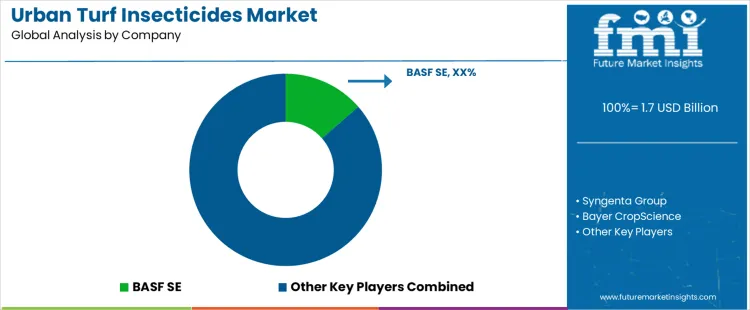
Competition in the urban turf insecticides market is directed by effectiveness against target pests, turf safety, and alignment with regulatory limits for residential and commercial landscapes. BASF SE supplies insecticides formulated to control turf insects while preserving grass health under frequent use conditions. Syngenta Group offers chemistry platforms engineered for key turf pest pressures with documented performance across soil and foliar applications. Bayer CropScience focuses on active ingredients combined with guidance for application timing that minimises turf stress. Corteva Agriscience develops insecticide solutions aligned with resistance management to address recurring pest challenges in high-use areas. FMC Corporation delivers products emphasising turf safety and activity against resistant insect populations.
Other market players supply regional or niche insecticide blends that target specific urban turf pests prevalent in local ecosystems. Differences in mode of action, persistence on turf surfaces, and compatibility with integrated pest management influence supplier relevance. Companies that combine effective insect suppression, documented turf safety, and agronomic support strengthen adoption among landscape professionals, golf courses, and municipal programs. Focus on pest specificity and reduced non target impact shapes supplier positions in a market where turf quality and user safety are priorities.
Key Players in the Urban Turf Insecticides Market
- BASF SE
- Syngenta Group
- Bayer CropScience
- Corteva Agriscience
- FMC Corporation
- Others
Scope of the Report
| Items | Values |
|---|---|
| Quantitative Units (2026) | USD billion |
| Pest Type | Grubs & Beetles, Ants & Crawlers, Chinch Bugs, Sod Webworms, Others |
| Insecticide Type | Pyrethroids, Neonicotinoids, Organophosphates, Biological Insecticides, Others |
| Formulation Type | Liquid Formulations, Granules, Emulsifiable Concentrates, Others |
| Region | Asia Pacific, Europe, North America, Latin America, Middle East & Africa |
| Key Countries Covered | China, Japan, South Korea, India, Australia & New Zealand, Germany, UK, France, Italy, Spain, Nordic, BENELUX, United States, Canada, Mexico, Brazil, Chile, Kingdom of Saudi Arabia, Other GCC Countries, Turkey, South Africa, Other African Union |
| Key Companies Profiled | BASF SE, Syngenta Group, Bayer CropScience, Corteva Agriscience, FMC Corporation, Others |
| Additional Attributes | Dollar sales by pest type, insecticide type, and formulation type; regional CAGR, volume and value growth projections; adoption in municipal, commercial, and recreational turf; integration with pest management programs; technical support and certification compliance |
Urban Turf Insecticides Market Segmentation
Pest Type:
- Grubs & Beetles
- Ants & Crawlers
- Chinch Bugs
- Sod Webworms
- Others
Insecticide Type:
- Pyrethroids
- Neonicotinoids
- Organophosphates
- Biological Insecticides
- Others
Formulation Type:
- Liquid Formulations
- Granules
- Emulsifiable Concentrates
- Others
Region:
- Asia Pacific
- China
- Japan
- South Korea
- India
- Australia & New Zealand
- ASEAN
- Rest of Asia Pacific
- Europe
- Germany
- UK
- France
- Italy
- Spain
- Nordic
- BENELUX
- Rest of Europe
- North America
- United States
- Canada
- Mexico
- Latin America
- Brazil
- Chile
- Rest of Latin America
- Middle East & Africa
- Kingdom of Saudi Arabia
- Other GCC Countries
- Turkey
- South Africa
- Other African Union
- Rest of Middle East & Africa
Bibliography
- Food and Agriculture Organization of the United Nations (FAO). (2024). Urban pest management and insect control in managed turf and recreational landscapes. FAO Plant Production and Protection Division.
- United States Environmental Protection Agency (EPA). (2024). Insecticide use, exposure assessment, and environmental safety in urban landscapes and turfgrass systems. U.S. Environmental Protection Agency.
- European Food Safety Authority (EFSA). (2024). Risk assessment of insecticides applied in amenity grasslands, parks, and urban green spaces.
EFSA Journal. - Organisation for Economic Co‑operation and Development (OECD). (2024). Pesticide application in urban environments: turf management, public exposure, and policy frameworks. OECD Environment, Health and Safety Programme.
- United States Department of Agriculture (USDA). (2024). Insect pests of turfgrass systems and integrated pest management strategies for urban landscapes. USDA Agricultural Research Service.
Frequently Asked Questions
How big is the urban turf insecticides market in 2026?
The global urban turf insecticides market is estimated to be valued at USD 1.7 billion in 2026.
What will be the size of urban turf insecticides market in 2036?
The market size for the urban turf insecticides market is projected to reach USD 3.7 billion by 2036.
How much will be the urban turf insecticides market growth between 2026 and 2036?
The urban turf insecticides market is expected to grow at a 8.1% CAGR between 2026 and 2036.
What are the key product types in the urban turf insecticides market?
The key product types in urban turf insecticides market are grubs & beetles, ants & crawlers, chinch bugs, sod webworms and others.
Which insecticide type segment to contribute significant share in the urban turf insecticides market in 2026?
In terms of insecticide type, pyrethroids segment to command 31.8% share in the urban turf insecticides market in 2026.
Preview the report firsthand - request a free sample
Get SampleGet the brochure for pricing and purchase details.
Get PDFTable of Content
- Executive Summary
- Global Market Outlook
- Demand-side Trends
- Supply-side Trends
- Technology Roadmap Analysis
- Analysis and Recommendations
- Market Overview
- Market Coverage / Taxonomy
- Market Definition / Scope / Limitations
- Market Background
- Market Dynamics
- Drivers
- Restraints
- Opportunity
- Trends
- Scenario Forecast
- Demand in Optimistic Scenario
- Demand in Likely Scenario
- Demand in Conservative Scenario
- Opportunity Map Analysis
- Product Life Cycle Analysis
- Supply Chain Analysis
- Investment Feasibility Matrix
- Value Chain Analysis
- PESTLE and Porter’s Analysis
- Regulatory Landscape
- Regional Parent Market Outlook
- Production and Consumption Statistics
- Import and Export Statistics
- Market Dynamics
- Global Market Analysis 2021 to 2025 and Forecast, 2026 to 2036
- Historical Market Size Value (USD Million) Analysis, 2021 to 2025
- Current and Future Market Size Value (USD Million) Projections, 2026 to 2036
- Y-o-Y Growth Trend Analysis
- Absolute $ Opportunity Analysis
- Global Market Pricing Analysis 2021 to 2025 and Forecast 2026 to 2036
- Global Market Analysis 2021 to 2025 and Forecast 2026 to 2036, By Pest Type
- Introduction / Key Findings
- Historical Market Size Value (USD Million) Analysis By Pest Type , 2021 to 2025
- Current and Future Market Size Value (USD Million) Analysis and Forecast By Pest Type , 2026 to 2036
- Grubs & Beetles
- Ants & Crawlers
- Chinch Bugs
- Sod Webworms
- Others
- Grubs & Beetles
- Y-o-Y Growth Trend Analysis By Pest Type , 2021 to 2025
- Absolute $ Opportunity Analysis By Pest Type , 2026 to 2036
- Global Market Analysis 2021 to 2025 and Forecast 2026 to 2036, By Insecticide Type
- Introduction / Key Findings
- Historical Market Size Value (USD Million) Analysis By Insecticide Type, 2021 to 2025
- Current and Future Market Size Value (USD Million) Analysis and Forecast By Insecticide Type, 2026 to 2036
- Pyrethroids
- Neonicotinoids
- Organophosphates
- Biological Insecticides
- Others
- Pyrethroids
- Y-o-Y Growth Trend Analysis By Insecticide Type, 2021 to 2025
- Absolute $ Opportunity Analysis By Insecticide Type, 2026 to 2036
- Global Market Analysis 2021 to 2025 and Forecast 2026 to 2036, By Formulation Type
- Introduction / Key Findings
- Historical Market Size Value (USD Million) Analysis By Formulation Type, 2021 to 2025
- Current and Future Market Size Value (USD Million) Analysis and Forecast By Formulation Type, 2026 to 2036
- Liquid Formulations
- Granules
- Emulsifiable Concentrates
- Others
- Liquid Formulations
- Y-o-Y Growth Trend Analysis By Formulation Type, 2021 to 2025
- Absolute $ Opportunity Analysis By Formulation Type, 2026 to 2036
- Global Market Analysis 2021 to 2025 and Forecast 2026 to 2036, By Region
- Introduction
- Historical Market Size Value (USD Million) Analysis By Region, 2021 to 2025
- Current Market Size Value (USD Million) Analysis and Forecast By Region, 2026 to 2036
- North America
- Latin America
- Western Europe
- Eastern Europe
- East Asia
- South Asia and Pacific
- Middle East & Africa
- Market Attractiveness Analysis By Region
- North America Market Analysis 2021 to 2025 and Forecast 2026 to 2036, By Country
- Historical Market Size Value (USD Million) Trend Analysis By Market Taxonomy, 2021 to 2025
- Market Size Value (USD Million) Forecast By Market Taxonomy, 2026 to 2036
- By Country
- USA
- Canada
- Mexico
- By Pest Type
- By Insecticide Type
- By Formulation Type
- By Country
- Market Attractiveness Analysis
- By Country
- By Pest Type
- By Insecticide Type
- By Formulation Type
- Key Takeaways
- Latin America Market Analysis 2021 to 2025 and Forecast 2026 to 2036, By Country
- Historical Market Size Value (USD Million) Trend Analysis By Market Taxonomy, 2021 to 2025
- Market Size Value (USD Million) Forecast By Market Taxonomy, 2026 to 2036
- By Country
- Brazil
- Chile
- Rest of Latin America
- By Pest Type
- By Insecticide Type
- By Formulation Type
- By Country
- Market Attractiveness Analysis
- By Country
- By Pest Type
- By Insecticide Type
- By Formulation Type
- Key Takeaways
- Western Europe Market Analysis 2021 to 2025 and Forecast 2026 to 2036, By Country
- Historical Market Size Value (USD Million) Trend Analysis By Market Taxonomy, 2021 to 2025
- Market Size Value (USD Million) Forecast By Market Taxonomy, 2026 to 2036
- By Country
- Germany
- UK
- Italy
- Spain
- France
- Nordic
- BENELUX
- Rest of Western Europe
- By Pest Type
- By Insecticide Type
- By Formulation Type
- By Country
- Market Attractiveness Analysis
- By Country
- By Pest Type
- By Insecticide Type
- By Formulation Type
- Key Takeaways
- Eastern Europe Market Analysis 2021 to 2025 and Forecast 2026 to 2036, By Country
- Historical Market Size Value (USD Million) Trend Analysis By Market Taxonomy, 2021 to 2025
- Market Size Value (USD Million) Forecast By Market Taxonomy, 2026 to 2036
- By Country
- Russia
- Poland
- Hungary
- Balkan & Baltic
- Rest of Eastern Europe
- By Pest Type
- By Insecticide Type
- By Formulation Type
- By Country
- Market Attractiveness Analysis
- By Country
- By Pest Type
- By Insecticide Type
- By Formulation Type
- Key Takeaways
- East Asia Market Analysis 2021 to 2025 and Forecast 2026 to 2036, By Country
- Historical Market Size Value (USD Million) Trend Analysis By Market Taxonomy, 2021 to 2025
- Market Size Value (USD Million) Forecast By Market Taxonomy, 2026 to 2036
- By Country
- China
- Japan
- South Korea
- By Pest Type
- By Insecticide Type
- By Formulation Type
- By Country
- Market Attractiveness Analysis
- By Country
- By Pest Type
- By Insecticide Type
- By Formulation Type
- Key Takeaways
- South Asia and Pacific Market Analysis 2021 to 2025 and Forecast 2026 to 2036, By Country
- Historical Market Size Value (USD Million) Trend Analysis By Market Taxonomy, 2021 to 2025
- Market Size Value (USD Million) Forecast By Market Taxonomy, 2026 to 2036
- By Country
- India
- ASEAN
- Australia & New Zealand
- Rest of South Asia and Pacific
- By Pest Type
- By Insecticide Type
- By Formulation Type
- By Country
- Market Attractiveness Analysis
- By Country
- By Pest Type
- By Insecticide Type
- By Formulation Type
- Key Takeaways
- Middle East & Africa Market Analysis 2021 to 2025 and Forecast 2026 to 2036, By Country
- Historical Market Size Value (USD Million) Trend Analysis By Market Taxonomy, 2021 to 2025
- Market Size Value (USD Million) Forecast By Market Taxonomy, 2026 to 2036
- By Country
- Kingdom of Saudi Arabia
- Other GCC Countries
- Turkiye
- South Africa
- Other African Union
- Rest of Middle East & Africa
- By Pest Type
- By Insecticide Type
- By Formulation Type
- By Country
- Market Attractiveness Analysis
- By Country
- By Pest Type
- By Insecticide Type
- By Formulation Type
- Key Takeaways
- Key Countries Market Analysis
- USA
- Pricing Analysis
- Market Share Analysis, 2025
- By Pest Type
- By Insecticide Type
- By Formulation Type
- Canada
- Pricing Analysis
- Market Share Analysis, 2025
- By Pest Type
- By Insecticide Type
- By Formulation Type
- Mexico
- Pricing Analysis
- Market Share Analysis, 2025
- By Pest Type
- By Insecticide Type
- By Formulation Type
- Brazil
- Pricing Analysis
- Market Share Analysis, 2025
- By Pest Type
- By Insecticide Type
- By Formulation Type
- Chile
- Pricing Analysis
- Market Share Analysis, 2025
- By Pest Type
- By Insecticide Type
- By Formulation Type
- Germany
- Pricing Analysis
- Market Share Analysis, 2025
- By Pest Type
- By Insecticide Type
- By Formulation Type
- UK
- Pricing Analysis
- Market Share Analysis, 2025
- By Pest Type
- By Insecticide Type
- By Formulation Type
- Italy
- Pricing Analysis
- Market Share Analysis, 2025
- By Pest Type
- By Insecticide Type
- By Formulation Type
- Spain
- Pricing Analysis
- Market Share Analysis, 2025
- By Pest Type
- By Insecticide Type
- By Formulation Type
- France
- Pricing Analysis
- Market Share Analysis, 2025
- By Pest Type
- By Insecticide Type
- By Formulation Type
- India
- Pricing Analysis
- Market Share Analysis, 2025
- By Pest Type
- By Insecticide Type
- By Formulation Type
- ASEAN
- Pricing Analysis
- Market Share Analysis, 2025
- By Pest Type
- By Insecticide Type
- By Formulation Type
- Australia & New Zealand
- Pricing Analysis
- Market Share Analysis, 2025
- By Pest Type
- By Insecticide Type
- By Formulation Type
- China
- Pricing Analysis
- Market Share Analysis, 2025
- By Pest Type
- By Insecticide Type
- By Formulation Type
- Japan
- Pricing Analysis
- Market Share Analysis, 2025
- By Pest Type
- By Insecticide Type
- By Formulation Type
- South Korea
- Pricing Analysis
- Market Share Analysis, 2025
- By Pest Type
- By Insecticide Type
- By Formulation Type
- Russia
- Pricing Analysis
- Market Share Analysis, 2025
- By Pest Type
- By Insecticide Type
- By Formulation Type
- Poland
- Pricing Analysis
- Market Share Analysis, 2025
- By Pest Type
- By Insecticide Type
- By Formulation Type
- Hungary
- Pricing Analysis
- Market Share Analysis, 2025
- By Pest Type
- By Insecticide Type
- By Formulation Type
- Kingdom of Saudi Arabia
- Pricing Analysis
- Market Share Analysis, 2025
- By Pest Type
- By Insecticide Type
- By Formulation Type
- Turkiye
- Pricing Analysis
- Market Share Analysis, 2025
- By Pest Type
- By Insecticide Type
- By Formulation Type
- South Africa
- Pricing Analysis
- Market Share Analysis, 2025
- By Pest Type
- By Insecticide Type
- By Formulation Type
- USA
- Market Structure Analysis
- Competition Dashboard
- Competition Benchmarking
- Market Share Analysis of Top Players
- By Regional
- By Pest Type
- By Insecticide Type
- By Formulation Type
- Competition Analysis
- Competition Deep Dive
- BASF SE
- Overview
- Product Portfolio
- Profitability by Market Segments (Product/Age /Sales Channel/Region)
- Sales Footprint
- Strategy Overview
- Marketing Strategy
- Product Strategy
- Channel Strategy
- Syngenta Group
- Bayer CropScience
- Corteva Agriscience
- FMC Corporation
- Others
- BASF SE
- Competition Deep Dive
- Assumptions & Acronyms Used
- Research Methodology


