

- Industry Size (2026)
- USD 980 Mn
- Forecast (2036)
- USD 2135.4 Mn
- CAGR (2026 to 2036)
- 8.1%
Grow Trays and Channels Market Forecast and Outlook 2026 to 2036
The grow trays and channels market is projected to reach USD 2,135.4 million by 2036, growing at a CAGR of 8.1% from its 2026 value of USD 980 million. Regional demand concentration will play a pivotal role in shaping market dynamics, with North America, Europe, and Asia Pacific driving much of the growth. Adoption patterns will vary, as regions with more developed agricultural technologies, such as Europe and North America, are likely to see faster adoption, while markets in emerging economies may adopt at a slower pace due to cost considerations and infrastructure limitations.
Geographic cost advantages will come into play, particularly in Asia Pacific, where lower manufacturing costs provide a competitive edge. Companies operating in these regions will benefit from economies of scale, positioning them as cost-effective suppliers. The growth rate will be influenced by these regional differences, with certain areas accelerating market penetration while others lag behind, creating both opportunities and challenges for global players.
Quick Stats for the Grow Trays and Channels Market
- Grow Trays and Channels Market Value (2026): USD 980 million
- Grow Trays and Channels Market Forecast Value (2036): USD 2,135.4 million
- Grow Trays and Channels Market Global Forecast CAGR 2026 to 2036: 8.1%
- Grow Trays and Channels Market Leading Segment: Food-Grade PP or HDPE (54%)
- Key Growth Regions in Grow Trays and Channels Market: India
- Top Players in Grow Trays and Channels Market: Pöppelmann, A.M.A. Horticulture, AutoPot, Netafim, Rivulis, HydroGarden, CropKing, AmHydro, Botanicare, Active Aqua
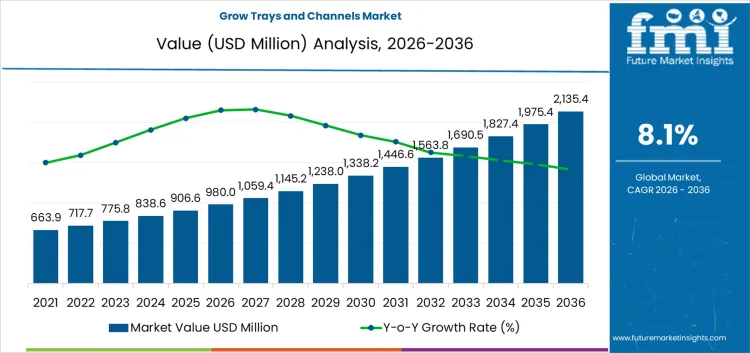
What is the Growth Rate Volatility Index for the Grow Trays and Channels Market through 2036?
The growth rate volatility index for the grow trays and channels market is expected to show moderate fluctuations over the forecast period, with an initial phase of steady growth followed by some periods of higher growth rates as the market matures.In the early years (2026-2028), the market will experience stable growth, with values rising from USD 980 million in 2026 to USD 1,145.2 million in 2028. During this phase, the growth rate will likely remain relatively consistent as the demand for grow trays and channels continues to increase due to the rise of controlled agricultural systems.
Between 2028 and 2032, the market will experience a slight acceleration, with the value rising from USD 1,238 million in 2029 to USD 1,563.8 million by 2032. This increase reflects the growing popularity of hydroponic and vertical farming solutions, especially in urban areas and regions with limited arable land.
Post 2032, the market will experience a more stable growth phase, reaching USD 2,135.4 million by 2036. This later phase of the forecast period will see slower growth as the market reaches a more mature stage, with growth being primarily driven by replacement cycles, technological improvements, and the expansion of agricultural operations using grow trays and channels. Overall, the market will experience moderate volatility, with stronger growth in the early and middle years, followed by a more gradual expansion toward the end of the forecast period.
Grow Trays and Channels Market Key Takeaways
| Metric | Value |
|---|---|
| Industry Sales Value (2026) | USD 980 million |
| Industry Forecast Value (2036) | USD 2,135.4 million |
| Industry Forecast CAGR 2026 to 2036 | 8.1% |
What Is Driving the Grow Trays and Channels Market?
Historically, the grow trays and channels market developed as controlled-environment agriculture and nursery production sought better methods for seedling propagation, plant spacing, and root management. Conventional flat beds and individual pots dominated early horticulture because they were familiar and inexpensive, but growers faced challenges with uniform irrigation, root air pruning, and efficient space utilization. As commercial nurseries and greenhouse operations expanded, producers adopted modular trays and channel systems that standardized plant spacing, improved drainage, and supported mechanized handling for transplant and harvest operations. Early adoption was strongest in ornamental and vegetable seedling production where consistent plant quality, reduced labor for handling, and batch traceability were key competitive factors. These early systems demonstrated benefits in uniform water distribution and ease of sanitation between crop cycles, helping to reduce disease incidence and variances in growth. This period clarified how structured tray and channel designs improved operational repeatability compared with traditional containers, especially in high-throughput propagation environments.
Future demand for grow trays and channels is expected to be shaped by increased investment in vertical farming, hydroponic and aquaponic systems, and efforts to increase yield per unit area in both urban and rural horticulture. Growth drivers include expansion of controlled-environment agriculture where modular trays and channels are integrated with nutrient delivery, automated irrigation, and lighting systems to optimize growth conditions for leafy greens, herbs, and specialty crops. Designs that support efficient water recycling, easy sanitation, and compatibility with mechanized transplanting and harvesting will be valued as producers aim to reduce labor costs and improve crop uniformity. The trend toward sustainable farming practices will further elevate demand for reusable, durable tray and channel materials that balance strength with ease of cleaning and long service life. Challenges include cost sensitivity among smaller growers and variability in crop types that may require customized tray dimensions or channel geometries. Long-term market growth will depend on how effectively suppliers offer scalable, multi-function systems that align with evolving production methods, space constraints, and performance expectations across greenhouse, vertical farm, and field nursery operations.
What are the Key Segments in the Grow Trays and Channels Market?
The Grow Trays and Channels market is segmented by material and crop type. Material segments include food-grade PP or HDPE, PVC, ABS or PC blends, and others, with food-grade PP or HDPE leading the market at 54%. Crop type segments include leafy greens, herbs, microgreens, and others, with leafy greens representing the largest share at 52%. The market is driven by the increasing demand for efficient, sustainable, and cost-effective growing solutions for indoor farming, particularly as urban agriculture and vertical farming systems gain popularity. The choice of materials and crop types is influenced by factors such as durability, flexibility, environmental sustainability, and crop-specific requirements.
What is Driving Growth in the Food-Grade PP or HDPE Material Segment?
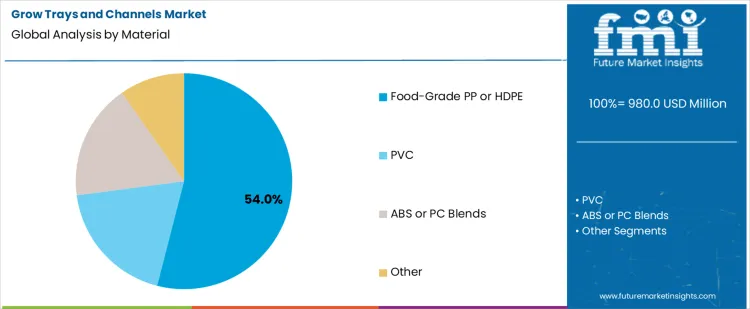
Food-grade PP (Polypropylene) or HDPE (High-Density Polyethylene) dominates the material segment in the Grow Trays and Channels market, accounting for 54% of the market share. This growth is primarily driven by the durability, cost-effectiveness, and food safety compliance of PP and HDPE materials. These materials are highly resistant to chemicals, UV degradation, and extreme weather conditions, making them ideal for use in both indoor and outdoor farming environments. PP and HDPE are also lightweight, which makes them easier to handle and transport, while their non-toxic, food-safe properties ensure that they meet the strict regulations required for growing edible crops. Additionally, these materials are recyclable, contributing to more sustainable farming practices. As the demand for leafy greens, herbs, and microgreens continues to rise in the agricultural industry, especially in urban farming and hydroponic systems, the need for affordable and durable growing trays made from food-grade PP or HDPE is expected to grow. These materials are well-suited for both small-scale and large-scale operations, particularly in vertical farming setups, where space efficiency and longevity are key considerations.
What is Driving the Demand for Leafy Greens in the Crop Type Segment?
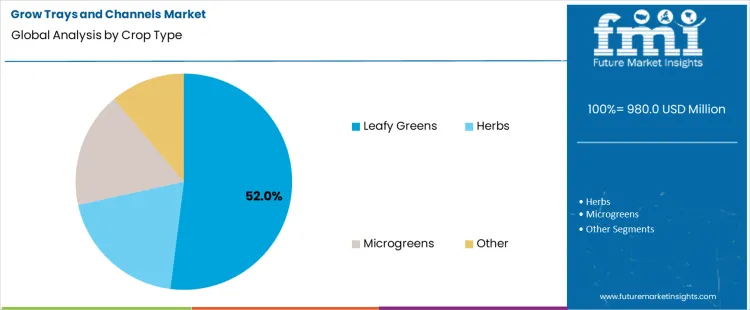
Leafy greens are the largest crop type segment in the Grow Trays and Channels market, holding 52% of the market share. This growth is driven by the rising consumer demand for fresh, nutritious vegetables like lettuce, spinach, kale, and arugula, which are widely used in salads, sandwiches, and other dishes. Leafy greens are fast-growing crops that thrive in controlled environments, making them ideal for indoor and vertical farming systems. They also have relatively low space requirements compared to other crops, making them a popular choice for urban farming initiatives, hydroponic systems, and greenhouse operations. The increasing focus on health-conscious eating and the demand for locally grown, fresh produce are further fueling the growth of leafy greens cultivation. As more consumers shift towards plant-based diets and sustainable food sources, the need for efficient, high-quality growing systems for leafy greens is expected to continue growing. This trend is particularly strong in regions such as North America and Europe, where demand for fresh, locally grown produce is increasing.
What are the Key Dynamics in the Grow Trays and Channels Market?
The grow trays and channels market is expanding due to the increasing popularity of hydroponics and vertical farming methods, which require efficient and organized systems for plant growth. Grow trays and channels are used to hold plants and provide an optimal growing environment, particularly in soil-free agriculture methods. These systems help maximize space utilization, improve water and nutrient efficiency, and support faster plant growth. The market is driven by the growing demand for sustainable agriculture, the rise of urban farming, and the increasing need for locally grown, organic produce. As more consumers seek fresh and pesticide-free crops, the demand for grow trays and channels in both commercial and residential settings is expected to rise.
What are the Key Drivers of Growth in the Grow Trays and Channels Market?
The key drivers of growth in the grow trays and channels market include the rising global demand for sustainable and space-efficient agricultural solutions. Urbanization and the need for local food production are pushing the adoption of vertical farming and hydroponic systems, which rely heavily on grow trays and channels for efficient plant cultivation. The increasing focus on reducing water usage in agriculture, along with the rising popularity of soil-free farming methods, is also driving market growth, as these systems provide more controlled environments for plant growth and resource management. Additionally, technological advancements in hydroponics, such as the development of more durable, lightweight, and modular grow trays and channels, are making these systems more accessible and easier to implement for both large-scale commercial operations and smaller urban farms. The growing consumer demand for fresh, organic, and locally grown produce is further fueling market expansion.
What are the Key Restraints in the Grow Trays and Channels Market?
Despite its growth potential, the grow trays and channels market faces several challenges. One major restraint is the high initial investment required for setting up hydroponic or vertical farming systems, including the cost of purchasing grow trays and channels, as well as the necessary infrastructure such as lighting, pumps, and water filtration systems. This upfront cost can be prohibitive for small-scale growers or new entrants to the market. Additionally, the maintenance and upkeep of these systems, including ensuring proper water and nutrient delivery, can add to operational costs. Another challenge is the limited awareness and adoption of hydroponic and vertical farming methods, especially in regions where traditional farming practices dominate. Furthermore, the longevity of materials used in grow trays and channels may be a concern, as some systems may degrade over time or require frequent replacements, which could increase the total cost of ownership.
What are the Key Trends in the Grow Trays and Channels Market?
Several key trends are shaping the grow trays and channels market. One significant trend is the increasing adoption of automated and smart technologies in hydroponic farming. Grow trays and channels are now being integrated with sensors, IoT devices, and mobile apps to monitor plant health, water levels, nutrient concentrations, and environmental conditions in real-time. This integration allows for more efficient and precise farming, reducing waste and optimizing growth conditions. Another trend is the growing interest in sustainable and eco-friendly farming practices. Manufacturers of grow trays and channels are focusing on using recyclable materials and designing systems that minimize water and energy consumption. Additionally, modular and customizable designs are gaining popularity, allowing growers to tailor systems to their specific needs and available space. As demand for urban farming solutions rises, there is also a trend toward more compact and easy-to-install grow trays and channels, making them suitable for residential and small-scale commercial applications. These trends are driving the innovation and adoption of grow trays and channels in various agricultural sectors.
What is the Country-Wise Analysis of the Grow Trays and Channels Market?
The grow trays and channels market is growing as industries such as horticulture, agriculture, and urban farming increasingly adopt efficient and space-saving solutions for plant cultivation. Grow trays and channels are essential for optimizing space, providing proper drainage, and ensuring uniform growth in hydroponic and aquaponic systems. The market is driven by the increasing demand for sustainable farming, vertical farming, and locally grown produce. Countries like India, China, Indonesia, Mexico, and the USA are witnessing significant growth in this market, fueled by the rising popularity of urban farming, the expansion of greenhouse agriculture, and the growing focus on sustainable and efficient farming practices.
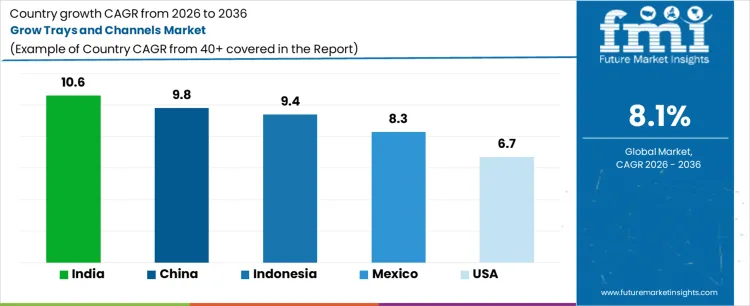
| Country | CAGR (%) |
|---|---|
| India | 10.6 |
| China | 9.8 |
| Indonesia | 9.4 |
| Mexico | 8.3 |
| USA | 6.7 |
What is Driving the Growth of the Grow Trays and Channels Market in India?
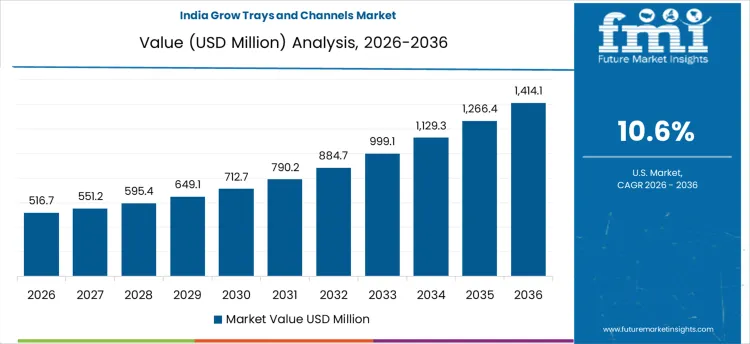
India’s grow trays and channels market is growing at a CAGR of 10.6%, the highest among the countries analyzed. The growth is primarily driven by the expansion of urban farming, vertical farming, and hydroponic agriculture in India. As urban areas face space constraints, the demand for efficient and space-saving farming solutions like grow trays and channels is increasing. Additionally, the government’s focus on improving agricultural efficiency, promoting sustainable farming practices, and supporting urban agriculture initiatives is contributing to the market’s growth. With a rising interest in locally grown produce and food security, the adoption of grow trays and channels in India is expected to continue to rise, especially in urban farming and greenhouse sectors.
How is the Grow Trays and Channels Market Performing in China?
China’s grow trays and channels market is growing at a CAGR of 9.8%. As China’s urbanization continues, the need for space-efficient farming solutions is driving the demand for grow trays and channels. The country’s growing interest in hydroponics, vertical farming, and sustainable agriculture is contributing to the adoption of these systems. China’s government has been actively promoting the development of modern agricultural techniques to ensure food security and improve sustainability. The rise in food production for local consumption and export is further boosting the market for grow trays and channels. As the demand for urban farming solutions and efficient crop cultivation systems grows, China’s market for grow trays and channels is expected to grow steadily.
What Factors are Shaping the Grow Trays and Channels Market in Indonesia?
Indonesia’s grow trays and channels market is growing at a CAGR of 9.4%. The market is driven by the growing demand for efficient farming systems, particularly in urban and peri-urban areas, where space for traditional farming is limited. Indonesia’s expanding interest in hydroponics and aquaponics systems, which rely heavily on grow trays and channels, is contributing to the growth of the market. Additionally, the rise of vertical farming and the country’s push for sustainable agricultural practices are increasing the demand for these systems. Indonesia’s government is also supporting agricultural innovation and improving food security, which further contributes to the market’s expansion. As urban agriculture becomes more prevalent, the demand for grow trays and channels is expected to rise.
How is the Grow Trays and Channels Market Evolving in Mexico?
Mexico’s grow trays and channels market is growing at a CAGR of 8.3%. The country’s growing agricultural sector, particularly in greenhouse and hydroponic farming, is driving the need for space-efficient and effective growing systems. With a focus on improving food production and ensuring sustainability, Mexico’s agricultural industry is increasingly adopting modern farming solutions such as grow trays and channels. The rise in demand for locally grown produce and the expansion of urban agriculture are contributing to the growth of this market. Additionally, the government’s support for sustainable farming practices and food security initiatives is expected to continue driving the adoption of these systems in Mexico’s agricultural sector.
What is Contributing to the Growth of the Grow Trays and Channels Market in the USA?
The grow trays and channels market in the USA is growing at a CAGR of 6.7%. While the growth rate is slower compared to other countries, the USA remains a key market for the adoption of grow trays and channels due to its expanding urban farming, hydroponic systems, and greenhouse agriculture sectors. With the increasing focus on sustainability, food security, and local food production, the demand for efficient farming solutions is rising. The USA’s growing interest in vertical farming and controlled-environment agriculture is contributing to the demand for these systems. As urban agriculture continues to gain popularity, the market for grow trays and channels in the USA is expected to continue growing, supported by the country’s commitment to sustainable farming practices.
What is the Competitive Landscape for the Grow Trays and Channels Market?
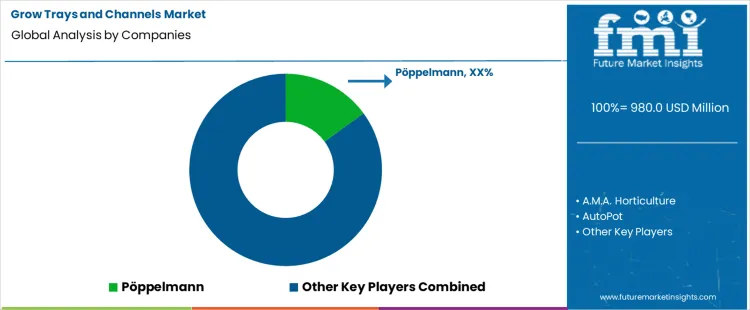
The grow trays and channels market is expanding as indoor and hydroponic farming methods gain popularity, allowing growers to maximize space and optimize plant growth in controlled environments. Pöppelmann leads the market, offering high-quality grow trays and channels designed for efficient water and nutrient distribution in various hydroponic systems. Pöppelmann’s expertise in producing durable, versatile, and sustainable materials positions it as a key player in the market, catering to both small-scale and commercial farming operations.
A.M.A. Horticulture is a significant competitor, providing reliable and cost-effective grow trays and channels for hydroponic systems. Their solutions are designed for efficient plant growth and are widely used in greenhouse and indoor farming environments. AutoPot specializes in innovative self-watering hydroponic systems, including trays and channels that ensure optimal water and nutrient delivery to plants. AutoPot’s automated solutions are popular among commercial growers for their ease of use and efficiency. Netafim, a global leader in irrigation technology, offers advanced grow trays and channels integrated with its irrigation systems, focusing on water conservation, efficiency, and scalability for large-scale operations.
Rivulis, another major player in the irrigation industry, provides high-performance grow trays and channels that integrate seamlessly with drip irrigation systems, helping growers maximize yields while minimizing resource usage. HydroGarden and CropKing focus on delivering customizable and efficient hydroponic systems, including grow trays and channels, that cater to both hobbyists and professional growers. AmHydro specializes in large-scale hydroponic farming solutions, offering durable grow trays and channels that help optimize plant growth. Botanicare and Active Aqua also compete in the market by providing quality, cost-effective hydroponic systems that include trays and channels designed for efficient nutrient and water management.
To stay competitive in the grow trays and channels market, companies focus on product innovation, sustainability, and scalability. Pöppelmann continues to lead by enhancing its materials and designs to offer more durable, customizable, and sustainable grow trays and channels that meet the growing demands of hydroponic farming. A.M.A. Horticulture focuses on providing cost-effective solutions without compromising on quality, ensuring that their products remain accessible to a wide range of growers. AutoPot is advancing its offerings with self-watering solutions that integrate seamlessly with trays and channels, reducing labor costs and improving plant growth efficiency.
Netafim and Rivulis are investing in integrated irrigation systems, offering grow trays and channels that optimize water and nutrient delivery for both small and large-scale operations. HydroGarden and CropKing continue to innovate by providing modular and flexible systems that cater to various hydroponic setups, making it easier for growers to scale their operations. AmHydro focuses on developing robust, high-capacity grow trays and channels designed for commercial-scale farming, ensuring high yields and efficiency. Botanicare and Active Aqua are improving their product lines by focusing on energy efficiency and ease of use, ensuring that growers can optimize their operations with minimal effort. These strategies position these companies to capture a significant share of the growing grow trays and channels market, catering to the increasing demand for efficient and sustainable hydroponic farming solutions.
Key Players of the Grow Trays and Channels Market
- Pöppelmann
- A.M.A. Horticulture
- AutoPot
- Netafim
- Rivulis
- HydroGarden
- CropKing
- AmHydro
- Botanicare
- Active Aqua
Scope of the Report
| Items | Values |
|---|---|
| Quantitative Units (2026) | USD Million |
| Product Type | NFT Channels, Deep-Water Culture Rafts, Multi-Cell Grow Trays, Other |
| Material | Food-Grade PP or HDPE, PVC, ABS or PC Blends, Other |
| Crop Type | Leafy Greens, Herbs, Microgreens, Other |
| Sales Channel | Distributors & Grow Shops, Online B2B, OEM Bundled, Other |
| Companies | Pöppelmann, A.M.A. Horticulture, AutoPot, Netafim, Rivulis, HydroGarden, CropKing, AmHydro, Botanicare, Active Aqua |
| Regions Covered | North America, Latin America, Western Europe, Eastern Europe, South Asia and Pacific, East Asia, Middle East & Africa |
| Countries Covered | United States, Canada, Mexico, Brazil, Argentina, Germany, France, United Kingdom, Italy, Spain, Netherlands, China, India, Japan, South Korea, ANZ, GCC Countries, South Africa |
| Additional Attributes | Dollar by sales by product type, material, crop type, and sales channel. Includes market trends towards sustainability, automation, cost-effectiveness, and the role of grow trays and channels in improving hydroponic and controlled-environment agriculture. |
Grow Trays and Channels Market Segmentation
Product Type
- NFT Channels
- Deep-Water Culture Rafts
- Multi-Cell Grow Trays
- Other
Material
- Food-Grade PP or HDPE
- PVC
- ABS or PC Blends
- Other
Crop Type
- Leafy Greens
- Herbs
- Microgreens
- Other
Sales Channel
- Distributors & Grow Shops
- Online B2B
- OEM Bundled
- Other
Region
- Asia Pacific
- China
- Japan
- India
- Australia & New Zealand
- ASEAN
- Rest of Asia Pacific
- Europe
- Germany
- United Kingdom
- France
- Italy
- Spain
- Nordic
- BENELUX
- Rest of Europe
- North America
- United States
- Canada
- Mexico
- Latin America
- Brazil
- Argentina
- Rest of Latin America
- Middle East & Africa
- Kingdom of Saudi Arabia
- Other GCC Countries
- South Africa
- Rest of Middle East & Africa
Bibliography
- Pöppelmann. (2023). Sustainable Hydroponic Farming Solutions with Grow Trays and Channels. Pöppelmann.
- A.M.A. Horticulture. (2023). Cost-Effective Hydroponic Solutions for Efficient Plant Cultivation. A.M.A. Horticulture.
- AutoPot. (2023). Self-Watering Hydroponic Systems for Optimal Plant Growth. AutoPot.
- Netafim. (2023). Advanced Irrigation and Grow Tray Integration for Maximizing Yields. Netafim.
- Rivulis. (2023). High-Performance Grow Trays and Channels with Integrated Drip Irrigation Solutions. Rivulis.
Frequently Asked Questions
How big is the grow trays and channels market in 2026?
The global grow trays and channels market is estimated to be valued at USD 980.0 million in 2026.
What will be the size of grow trays and channels market in 2036?
The market size for the grow trays and channels market is projected to reach USD 2,135.4 million by 2036.
How much will be the grow trays and channels market growth between 2026 and 2036?
The grow trays and channels market is expected to grow at a 8.1% CAGR between 2026 and 2036.
What are the key product types in the grow trays and channels market?
The key product types in grow trays and channels market are nft channels, deep-water culture rafts, multi-cell grow trays and other.
Which material segment to contribute significant share in the grow trays and channels market in 2026?
In terms of material, food-grade pp or hdpe segment to command 54.0% share in the grow trays and channels market in 2026.
Preview the report firsthand - request a free sample
Get SampleGet the brochure for pricing and purchase details.
Get PDFTable of Content
- Executive Summary
- Global Market Outlook
- Demand-side Trends
- Supply-side Trends
- Technology Roadmap Analysis
- Analysis and Recommendations
- Market Overview
- Market Coverage / Taxonomy
- Market Definition / Scope / Limitations
- Market Background
- Market Dynamics
- Drivers
- Restraints
- Opportunity
- Trends
- Scenario Forecast
- Demand in Optimistic Scenario
- Demand in Likely Scenario
- Demand in Conservative Scenario
- Opportunity Map Analysis
- Product Life Cycle Analysis
- Supply Chain Analysis
- Investment Feasibility Matrix
- Value Chain Analysis
- PESTLE and Porter’s Analysis
- Regulatory Landscape
- Regional Parent Market Outlook
- Production and Consumption Statistics
- Import and Export Statistics
- Market Dynamics
- Global Market Analysis 2021 to 2025 and Forecast, 2026 to 2036
- Historical Market Size Value (USD Million) Analysis, 2021 to 2025
- Current and Future Market Size Value (USD Million) Projections, 2026 to 2036
- Y-o-Y Growth Trend Analysis
- Absolute $ Opportunity Analysis
- Global Market Pricing Analysis 2021 to 2025 and Forecast 2026 to 2036
- Global Market Analysis 2021 to 2025 and Forecast 2026 to 2036, By Product Type
- Introduction / Key Findings
- Historical Market Size Value (USD Million) Analysis By Product Type , 2021 to 2025
- Current and Future Market Size Value (USD Million) Analysis and Forecast By Product Type , 2026 to 2036
- NFT Channels
- Deep-Water Culture Rafts
- Multi-Cell Grow Trays
- Other
- NFT Channels
- Y-o-Y Growth Trend Analysis By Product Type , 2021 to 2025
- Absolute $ Opportunity Analysis By Product Type , 2026 to 2036
- Global Market Analysis 2021 to 2025 and Forecast 2026 to 2036, By Material
- Introduction / Key Findings
- Historical Market Size Value (USD Million) Analysis By Material, 2021 to 2025
- Current and Future Market Size Value (USD Million) Analysis and Forecast By Material, 2026 to 2036
- Food-Grade PP or HDPE
- PVC
- ABS or PC Blends
- Other
- Food-Grade PP or HDPE
- Y-o-Y Growth Trend Analysis By Material, 2021 to 2025
- Absolute $ Opportunity Analysis By Material, 2026 to 2036
- Global Market Analysis 2021 to 2025 and Forecast 2026 to 2036, By Crop Type
- Introduction / Key Findings
- Historical Market Size Value (USD Million) Analysis By Crop Type, 2021 to 2025
- Current and Future Market Size Value (USD Million) Analysis and Forecast By Crop Type, 2026 to 2036
- Leafy Greens
- Herbs
- Microgreens
- Other
- Leafy Greens
- Y-o-Y Growth Trend Analysis By Crop Type, 2021 to 2025
- Absolute $ Opportunity Analysis By Crop Type, 2026 to 2036
- Global Market Analysis 2021 to 2025 and Forecast 2026 to 2036, By Sales Channel
- Introduction / Key Findings
- Historical Market Size Value (USD Million) Analysis By Sales Channel, 2021 to 2025
- Current and Future Market Size Value (USD Million) Analysis and Forecast By Sales Channel, 2026 to 2036
- Distributors & Grow Shops
- Online B2B
- OEM Bundled
- Other
- Distributors & Grow Shops
- Y-o-Y Growth Trend Analysis By Sales Channel, 2021 to 2025
- Absolute $ Opportunity Analysis By Sales Channel, 2026 to 2036
- Global Market Analysis 2021 to 2025 and Forecast 2026 to 2036, By Region
- Introduction
- Historical Market Size Value (USD Million) Analysis By Region, 2021 to 2025
- Current Market Size Value (USD Million) Analysis and Forecast By Region, 2026 to 2036
- North America
- Latin America
- Western Europe
- Eastern Europe
- East Asia
- South Asia and Pacific
- Middle East & Africa
- Market Attractiveness Analysis By Region
- North America Market Analysis 2021 to 2025 and Forecast 2026 to 2036, By Country
- Historical Market Size Value (USD Million) Trend Analysis By Market Taxonomy, 2021 to 2025
- Market Size Value (USD Million) Forecast By Market Taxonomy, 2026 to 2036
- By Country
- USA
- Canada
- Mexico
- By Product Type
- By Material
- By Crop Type
- By Sales Channel
- By Country
- Market Attractiveness Analysis
- By Country
- By Product Type
- By Material
- By Crop Type
- By Sales Channel
- Key Takeaways
- Latin America Market Analysis 2021 to 2025 and Forecast 2026 to 2036, By Country
- Historical Market Size Value (USD Million) Trend Analysis By Market Taxonomy, 2021 to 2025
- Market Size Value (USD Million) Forecast By Market Taxonomy, 2026 to 2036
- By Country
- Brazil
- Chile
- Rest of Latin America
- By Product Type
- By Material
- By Crop Type
- By Sales Channel
- By Country
- Market Attractiveness Analysis
- By Country
- By Product Type
- By Material
- By Crop Type
- By Sales Channel
- Key Takeaways
- Western Europe Market Analysis 2021 to 2025 and Forecast 2026 to 2036, By Country
- Historical Market Size Value (USD Million) Trend Analysis By Market Taxonomy, 2021 to 2025
- Market Size Value (USD Million) Forecast By Market Taxonomy, 2026 to 2036
- By Country
- Germany
- UK
- Italy
- Spain
- France
- Nordic
- BENELUX
- Rest of Western Europe
- By Product Type
- By Material
- By Crop Type
- By Sales Channel
- By Country
- Market Attractiveness Analysis
- By Country
- By Product Type
- By Material
- By Crop Type
- By Sales Channel
- Key Takeaways
- Eastern Europe Market Analysis 2021 to 2025 and Forecast 2026 to 2036, By Country
- Historical Market Size Value (USD Million) Trend Analysis By Market Taxonomy, 2021 to 2025
- Market Size Value (USD Million) Forecast By Market Taxonomy, 2026 to 2036
- By Country
- Russia
- Poland
- Hungary
- Balkan & Baltic
- Rest of Eastern Europe
- By Product Type
- By Material
- By Crop Type
- By Sales Channel
- By Country
- Market Attractiveness Analysis
- By Country
- By Product Type
- By Material
- By Crop Type
- By Sales Channel
- Key Takeaways
- East Asia Market Analysis 2021 to 2025 and Forecast 2026 to 2036, By Country
- Historical Market Size Value (USD Million) Trend Analysis By Market Taxonomy, 2021 to 2025
- Market Size Value (USD Million) Forecast By Market Taxonomy, 2026 to 2036
- By Country
- China
- Japan
- South Korea
- By Product Type
- By Material
- By Crop Type
- By Sales Channel
- By Country
- Market Attractiveness Analysis
- By Country
- By Product Type
- By Material
- By Crop Type
- By Sales Channel
- Key Takeaways
- South Asia and Pacific Market Analysis 2021 to 2025 and Forecast 2026 to 2036, By Country
- Historical Market Size Value (USD Million) Trend Analysis By Market Taxonomy, 2021 to 2025
- Market Size Value (USD Million) Forecast By Market Taxonomy, 2026 to 2036
- By Country
- India
- ASEAN
- Australia & New Zealand
- Rest of South Asia and Pacific
- By Product Type
- By Material
- By Crop Type
- By Sales Channel
- By Country
- Market Attractiveness Analysis
- By Country
- By Product Type
- By Material
- By Crop Type
- By Sales Channel
- Key Takeaways
- Middle East & Africa Market Analysis 2021 to 2025 and Forecast 2026 to 2036, By Country
- Historical Market Size Value (USD Million) Trend Analysis By Market Taxonomy, 2021 to 2025
- Market Size Value (USD Million) Forecast By Market Taxonomy, 2026 to 2036
- By Country
- Kingdom of Saudi Arabia
- Other GCC Countries
- Turkiye
- South Africa
- Other African Union
- Rest of Middle East & Africa
- By Product Type
- By Material
- By Crop Type
- By Sales Channel
- By Country
- Market Attractiveness Analysis
- By Country
- By Product Type
- By Material
- By Crop Type
- By Sales Channel
- Key Takeaways
- Key Countries Market Analysis
- USA
- Pricing Analysis
- Market Share Analysis, 2025
- By Product Type
- By Material
- By Crop Type
- By Sales Channel
- Canada
- Pricing Analysis
- Market Share Analysis, 2025
- By Product Type
- By Material
- By Crop Type
- By Sales Channel
- Mexico
- Pricing Analysis
- Market Share Analysis, 2025
- By Product Type
- By Material
- By Crop Type
- By Sales Channel
- Brazil
- Pricing Analysis
- Market Share Analysis, 2025
- By Product Type
- By Material
- By Crop Type
- By Sales Channel
- Chile
- Pricing Analysis
- Market Share Analysis, 2025
- By Product Type
- By Material
- By Crop Type
- By Sales Channel
- Germany
- Pricing Analysis
- Market Share Analysis, 2025
- By Product Type
- By Material
- By Crop Type
- By Sales Channel
- UK
- Pricing Analysis
- Market Share Analysis, 2025
- By Product Type
- By Material
- By Crop Type
- By Sales Channel
- Italy
- Pricing Analysis
- Market Share Analysis, 2025
- By Product Type
- By Material
- By Crop Type
- By Sales Channel
- Spain
- Pricing Analysis
- Market Share Analysis, 2025
- By Product Type
- By Material
- By Crop Type
- By Sales Channel
- France
- Pricing Analysis
- Market Share Analysis, 2025
- By Product Type
- By Material
- By Crop Type
- By Sales Channel
- India
- Pricing Analysis
- Market Share Analysis, 2025
- By Product Type
- By Material
- By Crop Type
- By Sales Channel
- ASEAN
- Pricing Analysis
- Market Share Analysis, 2025
- By Product Type
- By Material
- By Crop Type
- By Sales Channel
- Australia & New Zealand
- Pricing Analysis
- Market Share Analysis, 2025
- By Product Type
- By Material
- By Crop Type
- By Sales Channel
- China
- Pricing Analysis
- Market Share Analysis, 2025
- By Product Type
- By Material
- By Crop Type
- By Sales Channel
- Japan
- Pricing Analysis
- Market Share Analysis, 2025
- By Product Type
- By Material
- By Crop Type
- By Sales Channel
- South Korea
- Pricing Analysis
- Market Share Analysis, 2025
- By Product Type
- By Material
- By Crop Type
- By Sales Channel
- Russia
- Pricing Analysis
- Market Share Analysis, 2025
- By Product Type
- By Material
- By Crop Type
- By Sales Channel
- Poland
- Pricing Analysis
- Market Share Analysis, 2025
- By Product Type
- By Material
- By Crop Type
- By Sales Channel
- Hungary
- Pricing Analysis
- Market Share Analysis, 2025
- By Product Type
- By Material
- By Crop Type
- By Sales Channel
- Kingdom of Saudi Arabia
- Pricing Analysis
- Market Share Analysis, 2025
- By Product Type
- By Material
- By Crop Type
- By Sales Channel
- Turkiye
- Pricing Analysis
- Market Share Analysis, 2025
- By Product Type
- By Material
- By Crop Type
- By Sales Channel
- South Africa
- Pricing Analysis
- Market Share Analysis, 2025
- By Product Type
- By Material
- By Crop Type
- By Sales Channel
- USA
- Market Structure Analysis
- Competition Dashboard
- Competition Benchmarking
- Market Share Analysis of Top Players
- By Regional
- By Product Type
- By Material
- By Crop Type
- By Sales Channel
- Competition Analysis
- Competition Deep Dive
- Pöppelmann
- Overview
- Product Portfolio
- Profitability by Market Segments (Product/Age /Sales Channel/Region)
- Sales Footprint
- Strategy Overview
- Marketing Strategy
- Product Strategy
- Channel Strategy
- A.M.A. Horticulture
- AutoPot
- Netafim
- Rivulis
- HydroGarden
- CropKing
- AmHydro
- Botanicare
- Active Aqua
- Pöppelmann
- Competition Deep Dive
- Assumptions & Acronyms Used
- Research Methodology


