

- Industry Size (2026)
- USD 8.4 Bn
- Forecast (2036)
- USD 19.5 Bn
- CAGR (2026 to 2036)
- 8.8%
Copper Rotor Asynchronous Motors Market Forecast and Outlook 2026 to 2036
In 2026, the copper rotor asynchronous motors market stands at USD 8.4 billion and is projected to reach USD 19.5 billion by 2036, implying a CAGR of 8.8%. Adoption is concentrated in applications where efficiency gains justify higher upfront cost, including compressors, pumps, conveyors, and heavy duty industrial drives. Demand is strongest in regions with high electricity prices or strict energy efficiency standards, since operating cost savings drive the investment case. Manufacturing scale and casting capability for copper rotors remain geographically concentrated, which shapes both pricing and supply availability across markets.
Purchasing decisions are typically made by industrial users and OEMs based on total lifecycle cost rather than on motor purchase price. Efficiency class compliance, thermal performance, and load profile compatibility influence specification choices. Many users adopt these motors first in continuous duty or high load factor applications, while standard aluminum rotor designs remain in less demanding service. Retrofit and new equipment programs drive uptake more than routine replacements. The market grows through gradual substitution in energy intensive processes and through regulatory pressure on efficiency standards, not through broad displacement of conventional induction motors across all industrial uses.
Quick Stats for Copper Rotor Asynchronous Motors Market
- Copper Rotor Asynchronous Motors Market Value (2026): USD 8.4 billion
- Copper Rotor Asynchronous Motors Market Forecast Value (2036): USD 19.5 billion
- Copper Rotor Asynchronous Motors Market Forecast CAGR 2026 to 2036: 8.8%
- Leading Type in Copper Rotor Asynchronous Motors Market: Low-voltage copper rotor motors
- Key Growth Regions in Copper Rotor Asynchronous Motors Market: Asia Pacific, North America, Europe
- Top Players in Copper Rotor Asynchronous Motors Market: WEG, Siemens, ABB, Toshiba International Corporation, Nidec Corporation, TECO Electric & Machinery, Baldor Electric Company (Hitachi Group)

What is the Growth Forecast for Copper Rotor Asynchronous Motors Market through 2036?
The copper rotor asynchronous motors market grows as energy efficiency requirements and lifecycle operating cost calculations begin to outweigh pure purchase price in industrial motor selection. Starting from about USD 4.8 billion, the market moves through roughly USD 5.6 billion and USD 6.4 billion as high-duty-cycle applications in pumps, compressors, and process equipment start to justify the higher upfront cost of copper rotors through lower losses and reduced heat generation. When spending reaches around USD 7.5 billion and then about USD 8.4 billion, adoption is no longer confined to premium or demonstration projects. It becomes part of standard motor upgrade and replacement programs in energy-intensive industries where electricity cost dominates total cost of ownership.
As installed base and awareness expand, the market advances through approximately USD 9.9 billion, USD 11.6 billion, and USD 13.7 billion, driven by systematic replacement of older aluminum-rotor motors in continuous-operation environments. By the time it passes roughly USD 14.9 billion and then moves toward USD 16.3 and USD 17.6 billion, growth is increasingly shaped by regulatory efficiency classes, corporate energy reduction targets, and carbon accounting practices. Approaching about USD 19.5 billion, demand is less about proving the concept and more about scaling proven economics across large motor fleets. Value creation comes from higher penetration in medium and large power ratings and from retrofit programs rather than from expansion in the number of motor-driven assets themselves.
Copper Rotor Asynchronous Motors Market Key Takeaways
| Metric | Value |
|---|---|
| Market Value (2026) | USD 8.4 billion |
| Forecast Value (2036) | USD 19.5 billion |
| Forecast CAGR 2026 to 2036 | 8.8% |
How Is the Copper Rotor Asynchronous Motors Market Driving Industrial Efficiency?
Copper rotor asynchronous motors are increasingly adopted to provide reliable, energy-efficient, and high-performance operation in industrial and commercial machinery. Historically, motors relied on aluminum rotors, which offered cost advantages but limited electrical conductivity, torque performance, and thermal efficiency. Modern copper rotor designs enhance electrical and mechanical performance, reduce energy losses, and improve operational reliability under heavy loads and continuous operation.
Industrial equipment manufacturers, process plant operators, and OEMs prioritize motor efficiency, durability, and compliance with industrial standards. Early adoption focused on high-demand manufacturing and processing sectors, while current demand spans HVAC systems, pumps, compressors, and material handling equipment, driven by efficiency requirements, performance consistency, and long-term operational cost reduction. Rotor conductivity, thermal performance, and mechanical robustness influence supplier selection.
Meeting operational efficiency and minimizing downtime are shaping market growth. Compared with aluminum rotor motors, copper rotor variants emphasize higher torque output, improved energy efficiency, and extended service life. Cost structures depend on copper quality, manufacturing precision, and insulation integrity, concentrating margins among suppliers capable of delivering reliable, high-performance motors. Manufacturers adopt these motors to reduce energy consumption, enhance process reliability, and ensure equipment longevity. By 2036, copper rotor asynchronous motors are expected to be widely deployed across industrial and commercial sectors, supporting high-performance operation, energy savings, and reduced maintenance requirements.
What Factors Are Shaping the Demand for Copper Rotor Asynchronous Motors, Segment wise by Motor Type and End Use Industry, in 2026?
The copper rotor asynchronous motors market in 2026 is segmented by motor type and by end use industry. By motor class, demand is divided into low voltage copper rotor motors, medium voltage copper rotor motors, high efficiency copper rotor motors, and explosion proof or heavy duty copper rotor motors, each optimized for different power ranges, duty cycles, and installation environments. By end use, demand is organized around industrial machinery, HVAC and building systems, pumps and compressors, and mining and metallurgy, which differ in operating hours, load variability, and maintenance tolerance. These segments reflect how buyers weigh efficiency gains against upfront cost and service requirements.
Why Do Low Voltage Copper Rotor Motors Anchor Volume Demand?

Low voltage copper rotor motors account for about 46% of demand in 2026 because they fit the largest population of industrial drives and building equipment. Conveyors, fans, small pumps, and general purpose machines typically operate in this voltage class, which creates very high unit volumes. Copper rotors improve efficiency and reduce rotor losses without changing the basic installation footprint, which allows like for like replacement in existing equipment. Procurement teams favor this path because it avoids changes to drives, cabling, and protection systems. The manufacturing ecosystem for these motors is also mature, which supports consistent supply and predictable pricing. This combination of application breadth, retrofit compatibility, and stable sourcing keeps low voltage units as the main volume driver.
Medium voltage and specialized designs serve narrower but critical roles. Medium voltage motors are used in larger machines, yet project volumes are lower and purchase cycles are longer. High efficiency variants are selected where energy cost dominates lifecycle economics, but they are not specified for every duty. Explosion proof and heavy duty motors are essential in hazardous or abrasive environments, though their use is limited to specific sites. These categories contribute to value, but they do not match the unit throughput created by the broad base of low voltage applications.
Why Does Industrial Machinery Lead End Use Demand?

Industrial machinery represents about 44% of demand in 2026 because it concentrates the widest range of continuous and intermittent drive applications. Production lines, material handling systems, and process equipment rely on large numbers of motors that operate for many hours per day. Even small efficiency improvements translate into meaningful energy savings at plant level, which supports the case for copper rotor designs. Replacement demand is also steady because motors are standardized components with predictable wear and maintenance cycles. Once a plant adopts a specific motor family, it tends to standardize across many machines, which multiplies volume per site.
HVAC systems, pumps, and mining equipment follow different purchasing patterns. Building systems involve many motors, but replacement cycles are slower and cost sensitivity is higher. Pumps and compressors often specify higher power classes, which reduces unit counts. Mining and metallurgy require rugged, specialized motors, yet fleet sizes are limited to site scale. These segments are important, but none matches the combination of diversity, scale, and steady replacement that keeps industrial machinery as the largest end use market for copper rotor asynchronous motors.
How Are the Key Dynamics Reshaping the Copper Rotor Asynchronous Motors Market?
The category is being shaped by efficiency regulation pressure, cautious replacement behavior, and the slow shift toward standardized motor platforms. Copper rotor designs offer higher efficiency and lower losses, but adoption is gated by retrofit economics and long equipment lifecycles. At the same time, large industrial buyers want fewer motor variants to simplify spares, maintenance, and compliance reporting. This creates a market where technical advantage alone is not enough. Scale comes from being specified into new equipment platforms and fleet standards rather than from broad replacement of existing installed bases, and growth follows policy enforcement and OEM design decisions more than spot purchases.
Why Are Efficiency Regulations Driving Copper Rotor Motors?
Demand is anchored in mandated efficiency classes and rising energy cost scrutiny. In pumps, compressors, and fans, motors run for thousands of hours, so small efficiency gains translate into visible operating cost reductions and easier compliance. Copper rotor designs reduce losses and help OEMs and plant operators meet higher efficiency thresholds without changing system architecture. Once a machine family is certified with a given motor design, it is reused across many projects. This ties volume to new equipment production and regulated upgrades rather than to discretionary retrofits, and makes policy enforcement and tender specifications the main demand trigger.
What Is Slowing Wider Adoption of Copper Rotor Designs?
The main barrier is replacement economics and risk. Many industrial motors have long remaining service life, and replacing them early rarely passes simple payback tests. Copper rotor motors also cost more upfront and may require requalification in certified equipment. In some applications, efficiency gains are diluted by variable loads or duty cycles. Maintenance teams also prefer familiar designs with known spares. These factors make buyers wait for natural replacement points or new projects, keeping adoption focused on new installations rather than on broad, rapid fleet upgrades.
How Are Platform Standards Changing Motor Procurement?
The trend is toward motor family standardization. Large OEMs and industrial groups increasingly define approved motor platforms that cover ranges of power and duty. Once a copper rotor design is included in these standards, it benefits from repeat orders across many machines and sites. Procurement shifts to framework agreements and long term supplier relationships. Documentation, efficiency labeling, and lifecycle support become part of selection criteria. Over time, success depends less on selling individual motors and more on being embedded in standardized equipment platforms and multi-year sourcing programs.
What is the Demand for Copper Rotor Asynchronous Motors by Country?
| Country | CAGR (%) |
|---|---|
| USA | 8.2% |
| UK | 7.8% |
| China | 9.5% |
| India | 10.2% |
| Brazil | 8.5% |
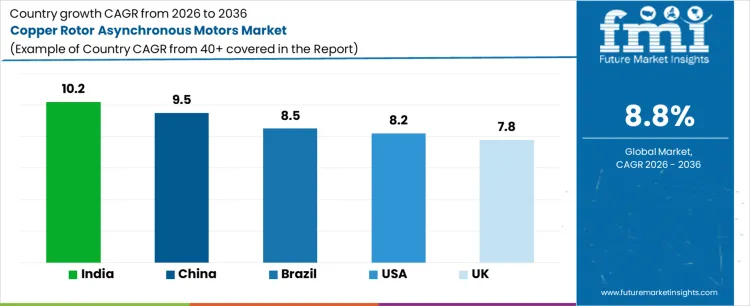
Demand for copper rotor asynchronous motors is rising as industrial, commercial, and manufacturing sectors adopt high-efficiency electric motors for improved performance, energy management, and equipment reliability. India leads with a 10.2% CAGR, driven by increasing industrial production, modernization of manufacturing facilities, and adoption of efficient motor systems. China follows at 9.5%, supported by expanding industrial operations and demand for energy-efficient electric motors. Brazil records 8.5% growth, shaped by industrial automation and replacement demand. The US grows at 8.2%, influenced by industrial upgrades and integration of high-performance motors. The UK shows 7.8% CAGR, reflecting steady adoption in manufacturing, commercial, and industrial applications.
How is the United States experiencing growth in the copper rotor asynchronous motors market?
United States is experiencing growth at a CAGR of 8.2%, driven by industrial automation, HVAC systems, and manufacturing applications across the Midwest, Texas, and California. Installed base size and predictable replacement cycles encourage steady adoption of high-efficiency copper rotor motors. Industry concentration among automotive, aerospace, and heavy machinery sectors anchors demand. Investments focus on motor reliability, energy efficiency, and integration with automated production lines. Growth reflects the increasing need for durable, low-maintenance motors that improve operational productivity in manufacturing and industrial facilities.
- Industrial automation and HVAC systems drive adoption.
- Manufacturing and heavy machinery hubs concentrate demand.
- Motor reliability and energy efficiency guide investment.
- Replacement cycles support recurring demand.
How is the United Kingdom witnessing growth in the copper rotor asynchronous motors market?
United Kingdom is witnessing growth at a CAGR of 7.8%, supported by labor cost structure and productivity pressures in industrial and manufacturing sectors in Birmingham, Manchester, and Glasgow. Adoption favors motors that reduce downtime and maintenance labor, enhancing workforce productivity. Industry concentration in industrial equipment and factory automation anchors demand. Investments focus on efficiency, reliability, and compliance with UK electrical and safety standards. Growth reflects operational efficiency requirements, labor optimization, and replacement of aging motor fleets.
- Industrial and factory automation drive adoption.
- Urban industrial hubs concentrate demand.
- Reduced maintenance and efficiency guide investment.
- Replacement of aging motors supports adoption.
How is China experiencing growth in the copper rotor asynchronous motors market?
China is experiencing growth at a CAGR of 9.5%, fueled by industrial clusters in Guangdong, Jiangsu, and Zhejiang where heavy manufacturing, automation, and construction equipment require high-performance copper rotor motors. Market concentration is high in urban industrial zones, while shorter replacement cycles support rapid adoption. Investments focus on cost-effective production, energy efficiency, and integration with high-volume automated systems. Growth reflects strong industrial expansion, rising electricity demand, and emphasis on reliable, high-efficiency motors for factories and industrial operations.
- Industrial clusters drive adoption.
- Urban manufacturing zones concentrate demand.
- Cost-effective, energy-efficient motors guide investment.
- Shorter replacement cycles accelerate uptake.
How is India witnessing growth in the copper rotor asynchronous motors market?
India is experiencing growth at a CAGR of 10.2%, supported by capital intensity and payback expectations in manufacturing, power generation, and industrial applications across Maharashtra, Delhi, and Tamil Nadu. Urban industrial hubs concentrate demand, where replacement of conventional motors with copper rotor variants enhances operational efficiency. Investments focus on energy savings, reliability, and durability in high-load operations. Growth reflects the expanding industrial sector, rising electricity costs, and adoption of energy-efficient motors to reduce operational expenditure.
- Manufacturing and power generation drive adoption.
- Urban industrial hubs concentrate demand.
- Energy efficiency and reliability guide investment.
- Payback considerations support adoption.
How is Brazil experiencing growth in the copper rotor asynchronous motors market?
Brazil is experiencing growth at a CAGR of 8.5%, driven by industrial automation, mining, and agriculture machinery in São Paulo, Rio de Janeiro, and Minas Gerais. Installed base size is moderate, with replacement cycles aligned to operational requirements. Industry concentration exists in urban industrial zones, while regional dispersion increases adoption in agricultural applications. Investments focus on durability, energy efficiency, and compatibility with existing industrial systems. Growth reflects the need for reliable, low-maintenance motors to support diverse industrial and agricultural operations.
- Industrial automation and agriculture machinery drive adoption.
- Urban industrial hubs concentrate demand.
- Motor durability and energy efficiency guide investment.
- Replacement cycles sustain recurring demand.
Copper Rotor Asynchronous Motors Market What Distinguishes the Leading Global Suppliers?
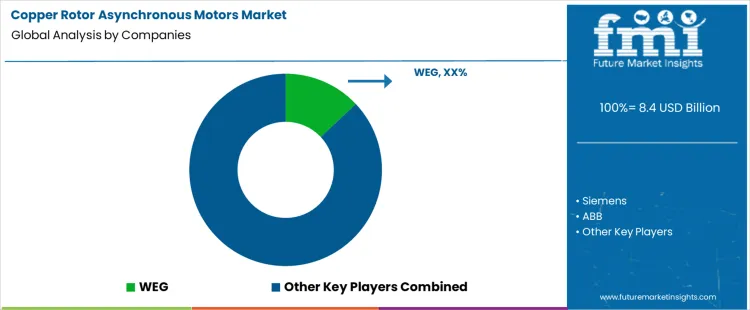
Competition in the copper rotor asynchronous motors market is shaped by motor efficiency, thermal performance, and suitability for industrial drives and heavy duty applications. WEG supplies copper rotor motors engineered for high starting torque and durability, with design choices that support harsh industrial environments. Siemens develops asynchronous motors with emphasis on energy efficiency and integration with variable frequency drives for process control.
ABB provides copper rotor asynchronous machines that balance mechanical robustness with reduced maintenance needs for conveyors, compressors, and pumps. Toshiba International Corporation offers motors designed for steady operation under prolonged load, prioritising cooling performance and serviceability. Nidec Corporation delivers motors with refined copper winding strategies that support consistent performance across speed ranges, with attention to manufacturing precision and lifecycle cost.
TECO Electric & Machinery supplies copper rotor motors with designs suited to regional industrial standards and retrofit applications, focusing on reliability and local support networks. Baldor Electric Company (a Hitachi Group company) provides motors engineered for high torque and long operational life, emphasising rugged construction and compatibility with industrial control systems. Other regional and specialty manufacturers address niche requirements such as explosion proof builds or motors optimised for specific speed torque profiles.
Market differentiation arises from efficiency ratings, thermal management, duty cycle suitability, and integration with drive systems. Suppliers with documented performance standards, after sales service, and adaptability to automation environments maintain relevance in sectors where motor reliability and lifecycle cost are priorities. Adoption reflects industrial demand for devices that minimise downtime, support predictive maintenance, and contribute to energy use reduction across manufacturing and process industries.
Key Players in the Copper Rotor Asynchronous Motors Market
- WEG
- Siemens
- ABB
- Toshiba International Corporation
- Nidec Corporation
- TECO Electric & Machinery
- Baldor Electric Company (a Hitachi Group company)
Scope of the Report
| Items | Values |
|---|---|
| Quantitative Units (2026) | USD billion |
| Motor Type | Low-Voltage Copper Rotor Motors, Medium-Voltage Copper Rotor Motors, High-Efficiency Copper Rotor Motors, Explosion-Proof/Industrial Copper Rotor Motors |
| End-Use Industry | Industrial Machinery, HVAC and Building Systems, Pumps and Compressors, Mining and Metallurgy |
| Regions Covered | Asia Pacific, Europe, North America, Latin America, Middle East & Africa |
| Countries Covered | China, Japan, South Korea, India, Australia & New Zealand, ASEAN, Germany, United Kingdom, France, Italy, Spain, Nordic, BENELUX, United States, Canada, Mexico, Brazil, Chile, Saudi Arabia, Turkey, South Africa, and other regional markets |
| Key Companies Profiled | WEG, Siemens, ABB, Toshiba International Corporation, Nidec Corporation, TECO Electric & Machinery, Baldor Electric Company (Hitachi Group) |
| Additional Attributes | Dollar sales by motor type and end use; low-voltage motors and industrial machinery as leading segments; demand driven by energy efficiency standards and lifecycle cost economics; adoption led by retrofit and new equipment programs in high-duty-cycle applications; growth shaped by regulatory efficiency classes, platform standardization, and OEM specification rather than routine motor replacements. |
Copper Rotor Asynchronous Motors Market Segmentation
Motor Type:
- Low-voltage copper rotor motors
- Medium-voltage copper rotor motors
- High-efficiency copper rotor motors
- Explosion-proof/industrial copper rotor motors
End-Use Industry:
- Industrial machinery
- HVAC and building systems
- Pumps and compressors
- Mining and metallurgy
Region:
- Asia Pacific
- China
- Japan
- South Korea
- India
- Australia & New Zealand
- ASEAN
- Rest of Asia Pacific
- Europe
- Germany
- United Kingdom
- France
- Italy
- Spain
- Nordic
- BENELUX
- Rest of Europe
- North America
- United States
- Canada
- Mexico
- Latin America
- Brazil
- Chile
- Rest of Latin America
- Middle East & Africa
- Kingdom of Saudi Arabia
- Other GCC Countries
- Turkey
- South Africa
- Other African Union
- Rest of Middle East & Africa
Bibliography
- International Electrotechnical Commission. (2023). IEC 60034-30-1: Rotating electrical machines - Efficiency classes of line operated AC motors (IE code). IEC.
- International Energy Agency. (2024). Energy efficiency 2024. IEA.
- European Commission. (2023). Commission Regulation (EU) 2019/1781 and amendments on ecodesign requirements for electric motors and variable speed drives. European Union.
- U.S. Department of Energy. (2024). Energy conservation standards for electric motors. Office of Energy Efficiency and Renewable Energy.
- U.S. Department of Energy. (2024). Determining electric motor efficiency and load analysis. Office of Energy Efficiency and Renewable Energy, Motor Systems Program
- Bureau of Energy Efficiency. (2023). Star labelling programme for electric motors. Ministry of Power, Government of India.
- State Administration for Market Regulation of China. (2023). Minimum allowable values of energy efficiency and energy efficiency grades for small and medium three-phase asynchronous motors (GB 18613-2020 implementation guidance). Government of China.
Frequently Asked Questions
How big is the copper rotor asynchronous motors market in 2026?
The global copper rotor asynchronous motors market is estimated to be valued at USD 8.4 billion in 2026.
What will be the size of copper rotor asynchronous motors market in 2036?
The market size for the copper rotor asynchronous motors market is projected to reach USD 19.5 billion by 2036.
How much will be the copper rotor asynchronous motors market growth between 2026 and 2036?
The copper rotor asynchronous motors market is expected to grow at a 8.8% CAGR between 2026 and 2036.
What are the key product types in the copper rotor asynchronous motors market?
The key product types in copper rotor asynchronous motors market are low‑voltage copper rotor motors , medium‑voltage copper rotor motors, high‑efficiency copper rotor motors and explosion‑proof/industrial copper rotor motors.
Which end‑use industry segment to contribute significant share in the copper rotor asynchronous motors market in 2026?
In terms of end‑use industry, industrial machinery segment to command 44.0% share in the copper rotor asynchronous motors market in 2026.
Preview the report firsthand - request a free sample
Get SampleGet the brochure for pricing and purchase details.
Get PDFTable of Content
- Executive Summary
- Global Market Outlook
- Demand-side Trends
- Supply-side Trends
- Technology Roadmap Analysis
- Analysis and Recommendations
- Market Overview
- Market Coverage / Taxonomy
- Market Definition / Scope / Limitations
- Market Background
- Market Dynamics
- Drivers
- Restraints
- Opportunity
- Trends
- Scenario Forecast
- Demand in Optimistic Scenario
- Demand in Likely Scenario
- Demand in Conservative Scenario
- Opportunity Map Analysis
- Product Life Cycle Analysis
- Supply Chain Analysis
- Investment Feasibility Matrix
- Value Chain Analysis
- PESTLE and Porter’s Analysis
- Regulatory Landscape
- Regional Parent Market Outlook
- Production and Consumption Statistics
- Import and Export Statistics
- Market Dynamics
- Global Market Analysis 2021 to 2025 and Forecast, 2026 to 2036
- Historical Market Size Value (USD Million) Analysis, 2021 to 2025
- Current and Future Market Size Value (USD Million) Projections, 2026 to 2036
- Y-o-Y Growth Trend Analysis
- Absolute $ Opportunity Analysis
- Global Market Pricing Analysis 2021 to 2025 and Forecast 2026 to 2036
- Global Market Analysis 2021 to 2025 and Forecast 2026 to 2036, By Motor Type
- Introduction / Key Findings
- Historical Market Size Value (USD Million) Analysis By Motor Type, 2021 to 2025
- Current and Future Market Size Value (USD Million) Analysis and Forecast By Motor Type, 2026 to 2036
- Low‑voltage copper rotor motors
- Medium‑voltage copper rotor motors
- High‑efficiency copper rotor motors
- Explosion‑proof/industrial copper rotor motors
- Low‑voltage copper rotor motors
- Y-o-Y Growth Trend Analysis By Motor Type, 2021 to 2025
- Absolute $ Opportunity Analysis By Motor Type, 2026 to 2036
- Global Market Analysis 2021 to 2025 and Forecast 2026 to 2036, By End‑Use Industry
- Introduction / Key Findings
- Historical Market Size Value (USD Million) Analysis By End‑Use Industry, 2021 to 2025
- Current and Future Market Size Value (USD Million) Analysis and Forecast By End‑Use Industry, 2026 to 2036
- Industrial machinery
- HVAC and building systems
- Pumps and compressors
- Mining and metallurgy
- Industrial machinery
- Y-o-Y Growth Trend Analysis By End‑Use Industry, 2021 to 2025
- Absolute $ Opportunity Analysis By End‑Use Industry, 2026 to 2036
- Global Market Analysis 2021 to 2025 and Forecast 2026 to 2036, By Region
- Introduction
- Historical Market Size Value (USD Million) Analysis By Region, 2021 to 2025
- Current Market Size Value (USD Million) Analysis and Forecast By Region, 2026 to 2036
- North America
- Latin America
- Western Europe
- Eastern Europe
- East Asia
- South Asia and Pacific
- Middle East & Africa
- Market Attractiveness Analysis By Region
- North America Market Analysis 2021 to 2025 and Forecast 2026 to 2036, By Country
- Historical Market Size Value (USD Million) Trend Analysis By Market Taxonomy, 2021 to 2025
- Market Size Value (USD Million) Forecast By Market Taxonomy, 2026 to 2036
- By Country
- USA
- Canada
- Mexico
- By Motor Type
- By End‑Use Industry
- By Country
- Market Attractiveness Analysis
- By Country
- By Motor Type
- By End‑Use Industry
- Key Takeaways
- Latin America Market Analysis 2021 to 2025 and Forecast 2026 to 2036, By Country
- Historical Market Size Value (USD Million) Trend Analysis By Market Taxonomy, 2021 to 2025
- Market Size Value (USD Million) Forecast By Market Taxonomy, 2026 to 2036
- By Country
- Brazil
- Chile
- Rest of Latin America
- By Motor Type
- By End‑Use Industry
- By Country
- Market Attractiveness Analysis
- By Country
- By Motor Type
- By End‑Use Industry
- Key Takeaways
- Western Europe Market Analysis 2021 to 2025 and Forecast 2026 to 2036, By Country
- Historical Market Size Value (USD Million) Trend Analysis By Market Taxonomy, 2021 to 2025
- Market Size Value (USD Million) Forecast By Market Taxonomy, 2026 to 2036
- By Country
- Germany
- UK
- Italy
- Spain
- France
- Nordic
- BENELUX
- Rest of Western Europe
- By Motor Type
- By End‑Use Industry
- By Country
- Market Attractiveness Analysis
- By Country
- By Motor Type
- By End‑Use Industry
- Key Takeaways
- Eastern Europe Market Analysis 2021 to 2025 and Forecast 2026 to 2036, By Country
- Historical Market Size Value (USD Million) Trend Analysis By Market Taxonomy, 2021 to 2025
- Market Size Value (USD Million) Forecast By Market Taxonomy, 2026 to 2036
- By Country
- Russia
- Poland
- Hungary
- Balkan & Baltic
- Rest of Eastern Europe
- By Motor Type
- By End‑Use Industry
- By Country
- Market Attractiveness Analysis
- By Country
- By Motor Type
- By End‑Use Industry
- Key Takeaways
- East Asia Market Analysis 2021 to 2025 and Forecast 2026 to 2036, By Country
- Historical Market Size Value (USD Million) Trend Analysis By Market Taxonomy, 2021 to 2025
- Market Size Value (USD Million) Forecast By Market Taxonomy, 2026 to 2036
- By Country
- China
- Japan
- South Korea
- By Motor Type
- By End‑Use Industry
- By Country
- Market Attractiveness Analysis
- By Country
- By Motor Type
- By End‑Use Industry
- Key Takeaways
- South Asia and Pacific Market Analysis 2021 to 2025 and Forecast 2026 to 2036, By Country
- Historical Market Size Value (USD Million) Trend Analysis By Market Taxonomy, 2021 to 2025
- Market Size Value (USD Million) Forecast By Market Taxonomy, 2026 to 2036
- By Country
- India
- ASEAN
- Australia & New Zealand
- Rest of South Asia and Pacific
- By Motor Type
- By End‑Use Industry
- By Country
- Market Attractiveness Analysis
- By Country
- By Motor Type
- By End‑Use Industry
- Key Takeaways
- Middle East & Africa Market Analysis 2021 to 2025 and Forecast 2026 to 2036, By Country
- Historical Market Size Value (USD Million) Trend Analysis By Market Taxonomy, 2021 to 2025
- Market Size Value (USD Million) Forecast By Market Taxonomy, 2026 to 2036
- By Country
- Kingdom of Saudi Arabia
- Other GCC Countries
- Turkiye
- South Africa
- Other African Union
- Rest of Middle East & Africa
- By Motor Type
- By End‑Use Industry
- By Country
- Market Attractiveness Analysis
- By Country
- By Motor Type
- By End‑Use Industry
- Key Takeaways
- Key Countries Market Analysis
- USA
- Pricing Analysis
- Market Share Analysis, 2025
- By Motor Type
- By End‑Use Industry
- Canada
- Pricing Analysis
- Market Share Analysis, 2025
- By Motor Type
- By End‑Use Industry
- Mexico
- Pricing Analysis
- Market Share Analysis, 2025
- By Motor Type
- By End‑Use Industry
- Brazil
- Pricing Analysis
- Market Share Analysis, 2025
- By Motor Type
- By End‑Use Industry
- Chile
- Pricing Analysis
- Market Share Analysis, 2025
- By Motor Type
- By End‑Use Industry
- Germany
- Pricing Analysis
- Market Share Analysis, 2025
- By Motor Type
- By End‑Use Industry
- UK
- Pricing Analysis
- Market Share Analysis, 2025
- By Motor Type
- By End‑Use Industry
- Italy
- Pricing Analysis
- Market Share Analysis, 2025
- By Motor Type
- By End‑Use Industry
- Spain
- Pricing Analysis
- Market Share Analysis, 2025
- By Motor Type
- By End‑Use Industry
- France
- Pricing Analysis
- Market Share Analysis, 2025
- By Motor Type
- By End‑Use Industry
- India
- Pricing Analysis
- Market Share Analysis, 2025
- By Motor Type
- By End‑Use Industry
- ASEAN
- Pricing Analysis
- Market Share Analysis, 2025
- By Motor Type
- By End‑Use Industry
- Australia & New Zealand
- Pricing Analysis
- Market Share Analysis, 2025
- By Motor Type
- By End‑Use Industry
- China
- Pricing Analysis
- Market Share Analysis, 2025
- By Motor Type
- By End‑Use Industry
- Japan
- Pricing Analysis
- Market Share Analysis, 2025
- By Motor Type
- By End‑Use Industry
- South Korea
- Pricing Analysis
- Market Share Analysis, 2025
- By Motor Type
- By End‑Use Industry
- Russia
- Pricing Analysis
- Market Share Analysis, 2025
- By Motor Type
- By End‑Use Industry
- Poland
- Pricing Analysis
- Market Share Analysis, 2025
- By Motor Type
- By End‑Use Industry
- Hungary
- Pricing Analysis
- Market Share Analysis, 2025
- By Motor Type
- By End‑Use Industry
- Kingdom of Saudi Arabia
- Pricing Analysis
- Market Share Analysis, 2025
- By Motor Type
- By End‑Use Industry
- Turkiye
- Pricing Analysis
- Market Share Analysis, 2025
- By Motor Type
- By End‑Use Industry
- South Africa
- Pricing Analysis
- Market Share Analysis, 2025
- By Motor Type
- By End‑Use Industry
- USA
- Market Structure Analysis
- Competition Dashboard
- Competition Benchmarking
- Market Share Analysis of Top Players
- By Regional
- By Motor Type
- By End‑Use Industry
- Competition Analysis
- Competition Deep Dive
- WEG
- Overview
- Product Portfolio
- Profitability by Market Segments (Product/Age /Sales Channel/Region)
- Sales Footprint
- Strategy Overview
- Marketing Strategy
- Product Strategy
- Channel Strategy
- Siemens
- ABB
- Toshiba International Corporation
- Nidec Corporation
- TECO Electric & Machinery
- Baldor Electric Company (a Hitachi Group company)
- WEG
- Competition Deep Dive
- Assumptions & Acronyms Used
- Research Methodology


