

- Industry Size (2026)
- USD 70.3 Bn
- Forecast (2036)
- USD 125.8 Bn
- CAGR (2026 to 2036)
- 6.0%
Linear Low-Density Polyethylene Market Size, Market Forecast and Outlook By FMI
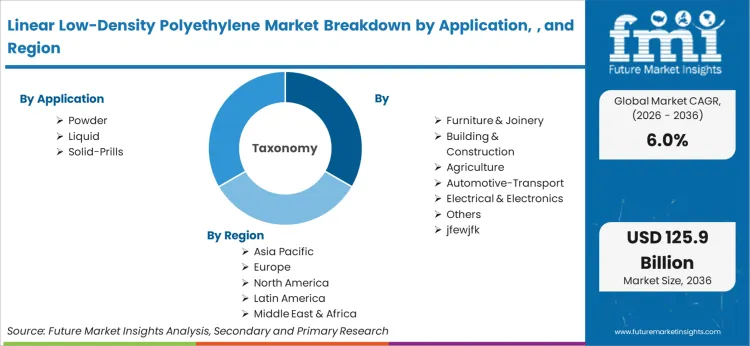
In 2025, the linear low-density polyethylene market was valued at USD 66.3 billion. Based on Future Market Insights' analysis, demand is estimated to reach USD 70.3 billion in 2026 and USD 118.7 billion by 2035, before rising further to approximately USD 125.8 billion by 2036. This trajectory reflects a CAGR of 6.0% during the forecast period.
Absolute dollar growth of more than USD 55.5 billion between 2026 and 2036 signals a market expanding at a robust pace, underpinned by sustained demand from packaging applications where downgauging and performance requirements drive LLDPE adoption. The films segment accounts for 52.7% of market value, reflecting the material's dominance in stretch wrap, food packaging, and agricultural films.
Summary of Linear Low-Density Polyethylene Market
- Demand Drivers in the Market
- Flexible packaging growth in food, consumer goods, and e-commerce applications, where LLDPE films provide necessary strength, puncture resistance, and sealability at minimal thickness.
- Agricultural film consumption for greenhouse covers, mulch films, and silage wraps, requiring UV stability and mechanical durability that LLDPE formulations provide.
- Industrial applications including stretch wrap for pallet unitization, heavy-duty sacks, and protective packaging, where load retention and tear resistance are critical.
- Key Segments Analyzed in the FMI Report
- Application: Films, which account for 52.7% of market value in 2026, driven by the material's inherent flexibility, high impact strength, and resistance to environmental stress cracking that make it ideal for producing thin yet durable films.
- Analyst Opinion at FMI
- Nikhil Kaitwade, principal consultant for Chemicals & Materials at Future Market Insights observes: "LLDPE's value proposition in packaging is fundamentally about doing more with less. The ability to downgauge film thickness while maintaining performance directly translates to material cost savings and reduced environmental footprint-two priorities that increasingly align. Suppliers that can demonstrate consistent resin quality for high-speed extrusion lines and develop grades compatible with recycling streams will capture share as converters optimize for both economics and sustainability."
- Strategic Implications/Executive Takeaways
- Prioritize development of high-performance film grades for specific applications: stretch hood, collation shrink, and heavy-duty sack films where downgauging potential creates value.
- Align product portfolios with circular economy requirements by developing LLDPE grades compatible with mechanical recycling and incorporating post-consumer recycled content.
- Build technical service capabilities that help converters optimize extrusion parameters, reduce scrap rates, and troubleshoot film defects, strengthening customer relationships beyond resin supply.
- Methodology
- The market view is grounded in primary input from film extruders, converters, and resin producers, and in technical and policy sources focused on polymer science and packaging sustainability, avoiding reliance on secondary market research reports from competing providers.
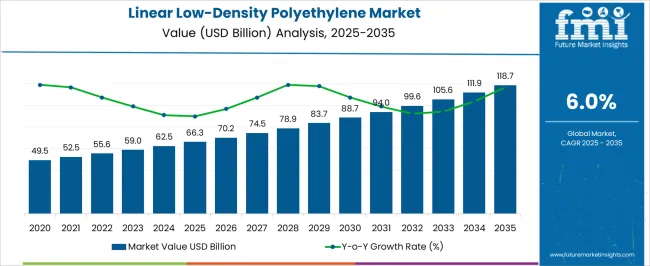
North America, Europe, and Asia-Pacific account for the bulk of incremental revenues through 2036, but the underlying demand logic is distinct in each region. In North America, ethane-based polyethylene production from shale gas provides cost advantage, supporting domestic consumption and export competitiveness. In Europe, circular economy initiatives drive demand for recyclable LLDPE grades and mechanical recycling integration. Across Asia-Pacific, rising packaged goods consumption, e-commerce growth, and agricultural modernization generate the highest growth rates, with China and India as primary demand centers .
Linear Low-Density Polyethylene Market Definition
Linear low-density polyethylene (LLDPE) is a thermoplastic polymer produced by copolymerization of ethylene with alpha-olefins such as butene, hexene, or octene, resulting in a linear backbone with short branch chains. This structure provides superior tensile strength, puncture resistance, and elongation compared to conventional low-density polyethylene, while maintaining flexibility and processability. For this report, the market covers LLDPE resins used in film extrusion, injection molding, rotomolding, and other applications across packaging, consumer goods, industrial, and agricultural sectors.
Linear Low-Density Polyethylene Market Inclusions
The report provides a comprehensive analysis of the linear low-density polyethylene market, covering global and regional market sizes in value terms and a 10-year forecast from 2026 to 2036. It includes segmental breakdowns by application, across core regions including North America, Latin America, Western Europe, Eastern Europe, East Asia, South Asia & Pacific, and the Middle East & Africa.
Linear Low-Density Polyethylene Market Exclusions
The scope excludes other polyethylene grades including low-density polyethylene (LDPE) and high-density polyethylene (HDPE) unless they are part of a product family marketed primarily as LLDPE. It also omits finished products such as bags, films, and containers where the resin has been converted. Very low-volume, specialty copolymer grades for niche applications that do not contribute meaningfully to global revenue pools are likewise outside the quantified scope.
Linear Low-Density Polyethylene Market Research Methodology
- Primary research: Structured interviews were conducted with procurement managers in packaging converting companies, film extruders, and injection molders, alongside resin producers and distributors on capacity utilization, pricing dynamics, and regional supply-demand balances.
- Desk research: Technical documentation and application guides from major LLDPE manufacturers, together with industry publications on polymer science and end-use sector reports from government agencies and industry associations, were assessed to benchmark performance and to align market modeling with the latest data on packaging consumption and industrial production.
- Market-sizing and forecasting: A hybrid top-down and bottom-up modeling framework was applied, reconstructing LLDPE demand from film extrusion capacity, packaging consumption patterns, and industrial production indices, then validating outputs against publicly available data from government statistical agencies and industry associations.
- Data validation and update cycle: Model outputs undergo consistency checks across regions and applications, with iterative calibration using new capacity announcements, trade flow data, and emerging sustainability regulations.
Segmental Analysis
Linear Low-Density Polyethylene Market Analysis by Application
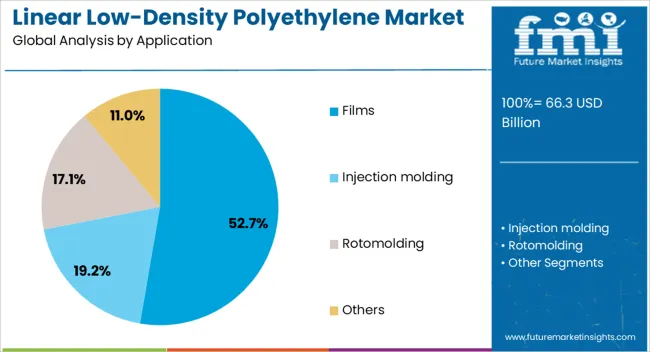
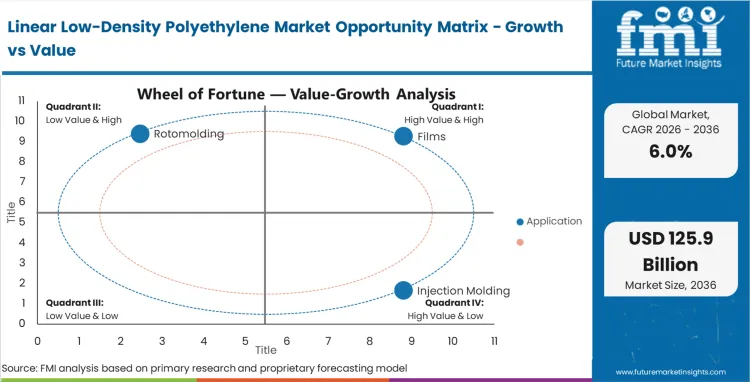
Based on FMI's linear low-density polyethylene market assessment, Films constitute 52.7% of global market value in 2026, establishing their position as the dominant application. This leadership reflects LLDPE's inherent flexibility, high impact strength, and resistance to environmental stress cracking, which make it ideal for producing thin yet durable films . Advances in extrusion and blown film technologies have improved manufacturing efficiency and enabled development of films with enhanced barrier properties, catering to evolving end-user needs.
Within films, stretch wrap for pallet unitization represents a significant volume, requiring high stretchability and load retention. Food packaging films demand sealability, optical properties, and migration compliance. Agricultural films require UV stability and mechanical durability for multi-season use. Injection molding applications include caps, closures, and housewares where impact resistance and processability are valued. Rotomolding consumes LLDPE for large hollow parts including tanks, containers, and playground equipment.
Linear Low-Density Polyethylene Market Drivers, Restraints, Opportunities and Trends
Drivers
Flexible Packaging Growth
Global flexible packaging consumption continues to expand, driven by food preservation requirements, convenience trends, and lightweighting initiatives that favor plastic films over rigid alternatives.
LLDPE's superior puncture resistance and tear strength compared to LDPE allow film thickness reduction while maintaining performance, a critical advantage in cost-optimized packaging. E-commerce growth increases demand for protective packaging, including void fill and mailer bags, further driving LLDPE consumption.
Agricultural Modernization
Rising food demand and climate variability drive adoption of protected cultivation methods including greenhouses and polytunnels, which require durable plastic films. LLDPE-based agricultural films provide the mechanical strength and UV stability necessary for multi-season service.
Mulch films improve crop yields through moisture retention and weed control, while silage films enable efficient forage preservation. Government programs supporting agricultural productivity in emerging economies accelerate adoption.
Industrial and Institutional Demand
Stretch wrap consumption correlates with manufacturing output and goods movement, as palletized distribution requires load securement. Heavy-duty sacks for bulk materials including fertilizers, resins, and construction products consume LLDPE for its strength and puncture resistance. Industrial packaging applications value LLDPE's balance of properties for demanding environments.
Restraints
Feedstock Price Volatility
LLDPE production depends on ethylene, which is derived from natural gas (ethane) in North America and the Middle East and from naphtha in Europe and Asia. Feedstock cost fluctuations, driven by energy prices and supply-demand balances, create margin pressure for producers and pricing uncertainty for converters. Regional feedstock cost differentials influence trade flows and competitiveness.
Environmental Regulation and Plastic Waste Concerns
Single-use plastics restrictions in various jurisdictions affect LLDPE consumption in applications including carrier bags and certain packaging formats. Extended producer responsibility schemes impose costs on packaging producers and incentivize material reduction or substitution. Public pressure on plastic waste drives converters to seek recyclable solutions and incorporate recycled content.
Opportunities
Recyclable and Circular Solutions
Development of LLDPE grades designed for mechanical recycling enables packaging to remain in circular value streams. Monomaterial film structures using LLDPE simplify recycling compared to multi-material laminates. Incorporation of post-consumer recycled LLDPE into new films creates demand for high-quality recyclate and supports circular economy positioning.
Specialty Film Applications
High-performance film segments including stretch hood, collation shrink, and form-fill-seal applications require LLDPE grades with tailored molecular architecture. Metallocene-catalyzed LLDPE provides enhanced properties for demanding applications, commanding price premiums. Barrier film development incorporating LLDPE in coextruded structures addresses food waste reduction through extended shelf life.
Regional Analysis
.webp "Top Country Growth Comparison Linear Low Density Polyethylene Market Cagr (2026 2036)")
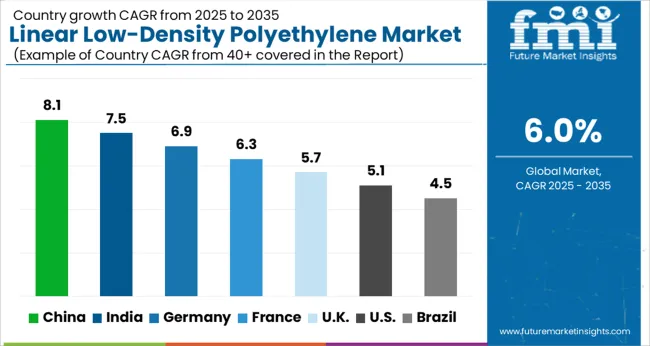
| Countries | Value CAGR (2026 to 2036) |
|---|---|
| United States | 5.1% |
| Germany | 6.9% |
| France | 6.3% |
| United Kingdom | 5.7% |
| China | 8.1% |
| India | 7.5% |
| Brazil | 4.5% |
Source: Future Market Insights analysis, supported by proprietary forecasting model and primary research
United States
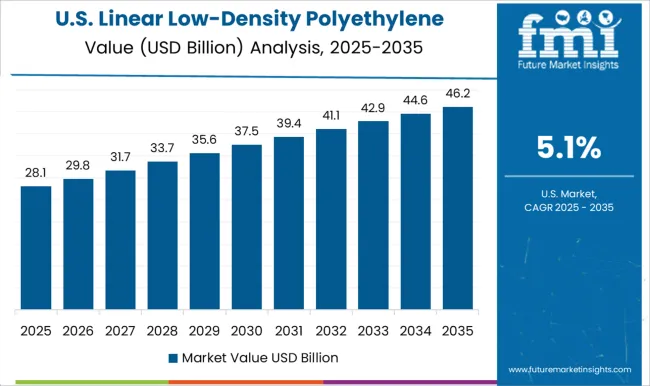
The United States LLDPE market is projected to grow at a 5.1% CAGR from 2026 to 2036. Ethane-based polyethylene production from shale gas provides cost advantage, supporting domestic consumption and export competitiveness.
Flexible packaging demand from food, consumer goods, and e-commerce sectors drives film consumption. Industrial stretch wrap consumption correlates with manufacturing output and goods movement. Recycled content integration and circular economy initiatives influence product development.
Germany
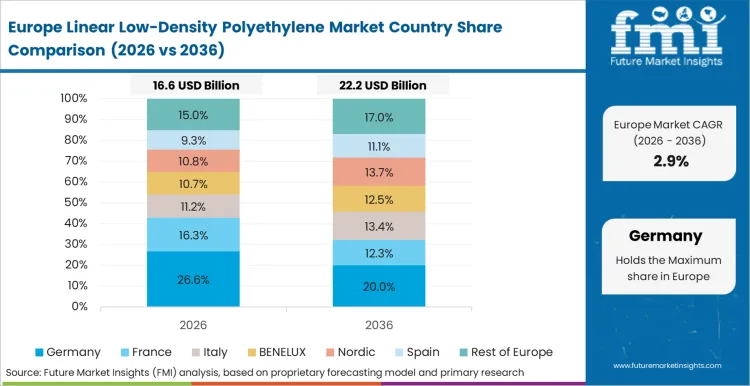
Germany's LLDPE market is forecast to grow at a 6.9% CAGR from 2026 to 2036. Strong packaging machinery manufacturing and converting industry drive demand for high-performance film grades.
Circular economy leadership under German packaging law creates requirements for recyclable design and recycled content. Industrial and agricultural film applications contribute to consumption. Quality focus favors metallocene LLDPE for demanding applications.
France
France's LLDPE market is projected to grow at a 6.3% CAGR from 2026 to 2036. Food packaging requirements and retail sector dynamics drive film consumption. Agricultural film demand for protected cultivation supports LLDPE adoption.
Environmental regulations including anti-waste law shape packaging design and material selection. Recycling infrastructure development creates opportunities for circular LLDPE solutions.
United Kingdom
The United Kingdom's LLDPE market is expected to grow at a 5.7% CAGR from 2026 to 2036. Plastic packaging tax incentivizes recycled content incorporation in films and other applications.
Food and consumer goods packaging drives film demand. E-commerce growth increases protective packaging consumption. Agricultural film applications contribute to demand, though market size is smaller than continental Europe.
China
China's LLDPE market is projected to grow at an 8.1% CAGR from 2026 to 2036, the highest among key countries. Rapid expansion of packaging, automotive, and construction sectors drives adoption. E-commerce boom and rising industrial output increase flexible packaging consumption.
Domestic manufacturers scale production capacities, while foreign suppliers introduce advanced grades. Government policies supporting manufacturing and export growth stimulate market expansion. Strong supply chain infrastructure and high consumer demand position China as leading LLDPE market globally.
India
India's LLDPE market is expected to expand at a 7.5% CAGR from 2026 to 2036. Packaging, automotive, and construction industries requiring lightweight, durable polymer solutions drive adoption. Domestic production upgrades meet increasing demand for films, bags, and sheets.
International collaborations introduce advanced grades. Food processing and agricultural sector growth increase film consumption. Government manufacturing initiatives support industrial polymer demand.
Brazil
Brazil's LLDPE market is projected to grow at a 4.5% CAGR from 2026 to 2036. Agricultural sector demand for films including greenhouse covers, mulch films, and silage wraps drives consumption.
Food packaging requirements contribute to film demand. Economic cycles affecting industrial production influence growth rates. Domestic production capacity serves local market, with imports supplementing specialty grades.
Competitive Aligners for Market Players
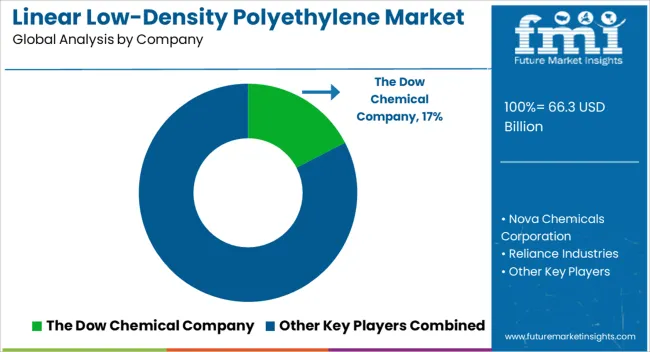
The LLDPE market features a mix of global integrated petrochemical producers and regional manufacturers with feedstock access and downstream integration. Competitive positioning hinges on feedstock cost position, production scale, technology licensing, and relationships with large-volume converters.
Leading players such as Dow, ExxonMobil, SABIC, and Borealis leverage their global manufacturing footprints, proprietary catalyst technologies, and extensive product portfolios to serve multinational converters and brand owners. Their metallocene LLDPE grades command premium pricing in demanding applications.
National oil companies and their affiliates in the Middle East and Asia benefit from advantaged feedstock costs. Regional producers including Reliance Industries, Sinopec, and Braskem serve domestic markets with cost-competitive production and relationships with local converters.
From a strategic perspective, differentiation is moving beyond commodity resin production toward demonstrable capability in three areas. These include application-specific grade development for film, molding, and rotomolding applications; circular economy solutions including recyclable design and recycled content integration; and technical service supporting converter productivity and quality optimization.
Key Developments
- Dow has expanded its ELITE™ enhanced polyethylene portfolio for high-performance film applications including stretch hood and collation shrink, offering downgauging potential and improved load retention. The company's commitment to circular economy includes mechanical recycling integration and development of resins compatible with recycled content.
- ExxonMobil has advanced its Exceed™ metallocene LLDPE grades for food packaging and industrial films, providing enhanced toughness and processability. The company's performance polyethylene portfolio targets demanding applications where conventional LLDPE cannot meet requirements.
- SABIC has developed TRUCIRCLE™ portfolio including certified circular polymers from advanced recycling and renewable-based polymers from bio-feedstocks, addressing brand owner sustainability commitments. These products enable LLDPE applications with reduced carbon footprint and circular material content.
Key Players Profiled
- The Dow Chemical Company
- Nova Chemicals Corporation
- Reliance Industries Limited
- LyondellBasell Industries N.V.
- Saudi Basic Industries Corporation (SABIC)
- China National Petroleum Corporation (CNPC)
- China Petroleum & Chemical Corporation (Sinopec)
- Exxon Mobil Corporation
- Borealis AG
- Mitsui & Co., Ltd.
- Westlake Corporation
- Sasol Limited
- Chevron Phillips Chemical Company LLC
- Mitsubishi Chemical Corporation
- Braskem S.A.
- Basell Polyolefins
- INEOS Group AG
Scope of the Report
| Metric | Value |
|---|---|
| Quantitative Units | USD 70.3 billion (2026) to approximately USD 125.8 billion (2036), at a CAGR of 6.0%, with 2025 historic value of USD 66.3 billion |
| Market Definition | Linear low-density polyethylene is a thermoplastic polymer produced by copolymerization of ethylene with alpha-olefins, providing superior tensile strength, puncture resistance, and elongation compared to conventional LDPE, used primarily in film extrusion, injection molding, and rotomolding applications. |
| Application Segmentation | Films (52.7% in 2025); Injection Molding; Rotomolding; Others |
| Regions Covered | North America, Latin America, Western Europe, Eastern Europe, East Asia, South Asia & Pacific, Middle East & Africa |
| Countries Covered | United States, Germany, France, United Kingdom, China, India, Brazil |
| Key Companies Profiled | The Dow Chemical Company; Nova Chemicals Corporation; Reliance Industries Limited; LyondellBasell Industries N.V.; Saudi Basic Industries Corporation (SABIC); China National Petroleum Corporation (CNPC); China Petroleum & Chemical Corporation (Sinopec); Exxon Mobil Corporation; Borealis AG; Mitsui & Co., Ltd.; Westlake Corporation; Sasol Limited; Chevron Phillips Chemical Company LLC; Mitsubishi Chemical Corporation; Braskem S.A.; Basell Polyolefins; INEOS Group AG |
| Forecast Period | 2026 to 2036 |
| Approach | Hybrid top-down and bottom-up market modeling validated through primary interviews with film extruders, converters, and resin producers, supported by benchmarking against packaging consumption data, industrial production indices, and trade flow statistics. |
Linear Low-Density Polyethylene Market Analysis by Segments
Application
- Films
- Injection Molding
- Rotomolding
- Others
Region
- North America
- Latin America
- Western Europe
- Eastern Europe
- East Asia
- South Asia & Pacific
- Middle East & Africa
Bibliography
- Flexible Packaging Association. (2025). Flexible packaging industry overview. FPA.
- Food and Agriculture Organization. (2025). Agricultural films and protected cultivation. FAO.
- American Chemistry Council. (2025). Plastics market watch: Polyethylene. ACC.
- International Energy Agency. (2025). Petrochemical industry feedstock outlook. IEA.
- European Commission. (2024). Packaging and packaging waste regulation. EC.
- United Nations Comtrade Database. (2025). Polyethylene international trade statistics. UN Comtrade.
- United Nations Industrial Development Organization. (2025). International Yearbook of Industrial Statistics. UNIDO.
- Plastics Europe. (2025). Plastics - the facts. Plastics Europe.
- German Federal Statistical Office. (2025). Industrial production statistics. Destatis.
- National Bureau of Statistics of China. (2025). China statistical yearbook on industry. China Statistics Press.
- Government of India, Ministry of Petroleum and Natural Gas. (2025). Indian petroleum and natural gas statistics. MPNG.
- Brazilian Institute of Geography and Statistics. (2025). Industrial production indicators. IBGE.
- USA Energy Information Administration. (2025). Natural gas liquids and petrochemical feedstocks. EIA.
- Plastics Recycling Europe. (2025). Mechanical recycling of polyolefins. PRE.
- European Bioplastics. (2025). Bioplastics market data. EUBP.
This bibliography is provided for reader reference and is not exhaustive. The full report contains the complete reference list and detailed citations.
This Report Addresses
- Market intelligence to enable structured strategic decision-making across LLDPE producers, converters, and industry investors.
- Market size estimation and 10-year revenue forecasts from 2026 to 2036, including validated CAGR and absolute dollar opportunity sizing.
- Growth opportunity mapping across Application and regional demand pockets, with emphasis on film applications and flexible packaging-driven consumption patterns.
- Segment and regional forecasting covering LLDPE film grades, alongside application-specific demand trajectories across packaging, agricultural, and industrial sectors.
- Competition strategy assessment, including feedstock cost position, technology licensing, and buyer leverage dynamics shaping sourcing decisions.
- Product and technology tracking focused on metallocene catalyst development, film downgauging, and circular economy integration.
- Regional packaging consumption analysis covering flexible packaging growth, e-commerce trends, and agricultural modernization influencing LLDPE procurement.
- Report delivery in PDF, Excel, and presentation-ready formats to support executive planning, capacity investment decisions, and competitive benchmarking.
Frequently Asked Questions
What is the size of the global linear low-density polyethylene market in 2025 and how fast is it expected to grow through 2036?
The global linear low-density polyethylene market is valued at USD 66.3 billion in 2025 and is projected to grow at a 6.0% CAGR, reaching about USD 70.3 billion in 2026 and approximately USD 125.8 billion by 2036.
Why do Films hold 52.7% of the market in 2026?
Films lead due to LLDPE's inherent flexibility, high impact strength, and resistance to environmental stress cracking, which make it ideal for producing thin yet durable films for packaging, agriculture, and industrial wrapping applications.
How does flexible packaging growth affect LLDPE demand?
Global flexible packaging consumption expands with food preservation requirements, convenience trends, and lightweighting initiatives. LLDPE's superior puncture resistance and tear strength allow film thickness reduction while maintaining performance, driving adoption.
What role does agricultural modernization play in market growth?
Rising food demand and climate variability drive adoption of protected cultivation requiring durable plastic films. LLDPE-based agricultural films provide mechanical strength and UV stability for multi-season service in greenhouses, mulch films, and silage wraps.
How do feedstock costs influence regional competitiveness?
LLDPE production depends on ethylene from natural gas (ethane) in North America and Middle East or naphtha in Europe and Asia. Regional feedstock cost differentials influence trade flows and competitiveness, with advantaged positions in shale gas regions.
Why is China's LLDPE market projected to grow at an 8.1% CAGR?
China's 8.1% CAGR reflects rapid expansion of packaging, automotive, and construction sectors, e-commerce boom increasing flexible packaging demand, domestic production scaling, and government policies supporting manufacturing and export growth.
What drives India's 7.5% growth forecast?
India's 7.5% CAGR is driven by packaging, automotive, and construction industries requiring lightweight polymer solutions, domestic production upgrades, international collaborations introducing advanced grades, and food processing and agricultural sector growth.
How does Germany achieve 6.9% growth?
Germany's 6.9% CAGR reflects strong packaging machinery manufacturing and converting industry, circular economy leadership creating requirements for recyclable design, and quality focus favoring metallocene LLDPE for demanding applications.
What factors contribute to the United States' 5.1% growth?
The United States' 5.1% CAGR reflects ethane-based polyethylene production cost advantage, flexible packaging demand from food and e-commerce sectors, industrial stretch wrap consumption, and circular economy initiatives influencing product development.
How are leading manufacturers like Dow positioning in the market?
Dow expands its ELITE™ enhanced polyethylene portfolio for high-performance film applications including stretch hood and collation shrink, offering downgauging potential and improved load retention, with commitment to circular economy integration .
What is ExxonMobil's strategic focus?
ExxonMobil advances Exceed™ metallocene LLDPE grades for food packaging and industrial films, providing enhanced toughness and processability for demanding applications where conventional LLDPE cannot meet requirements.
How does SABIC address sustainability requirements?
SABIC develops TRUCIRCLE™ portfolio including certified circular polymers from advanced recycling and renewable-based polymers from bio-feedstocks, enabling LLDPE applications with reduced carbon footprint and circular material content.
What opportunities exist in specialty film applications?
High-performance film segments including stretch hood, collation shrink, and form-fill-seal applications require LLDPE grades with tailored molecular architecture. Metallocene-catalyzed LLDPE provides enhanced properties commanding price premiums.
How do environmental regulations affect the market?
Single-use plastics restrictions affect LLDPE consumption in carrier bags and certain packaging formats. Extended producer responsibility schemes impose costs and incentivize material reduction, while public pressure drives recyclable solutions and recycled content.
What is the significance of metallocene LLDPE?
Metallocene-catalyzed LLDPE provides enhanced toughness, clarity, and sealing performance compared to conventional Ziegler-Natta grades, enabling downgauging and improved performance in demanding film applications, commanding price premiums.
How does e-commerce growth impact LLDPE consumption?
E-commerce expansion increases demand for protective packaging including void fill, mailer bags, and stretch wrap for palletized distribution, all consuming LLDPE films. This trend is particularly strong in rapidly digitizing Asian markets.
What role does recycling play in market development?
Development of LLDPE grades designed for mechanical recycling enables packaging to remain in circular value streams. Monomaterial film structures using LLDPE simplify recycling, and incorporation of post-consumer recycled content creates demand for high-quality recyclate.
How do agricultural film applications vary by region?
Greenhouse film consumption is highest in Mediterranean climates and protected cultivation regions. Mulch films are widely used in row crop agriculture. Silage films serve livestock feed preservation. Regional agricultural practices drive specific LLDPE grade requirements.
Preview the report firsthand - request a free sample
Get SampleGet the brochure for pricing and purchase details.
Get PDFTable of Content
- Executive Summary
- Global Market Outlook
- Demand-side Trends
- Supply-side Trends
- Technology Roadmap Analysis
- Analysis and Recommendations
- Market Overview
- Market Coverage / Taxonomy
- Market Definition / Scope / Limitations
- Research Methodology
- Chapter Orientation
- Analytical Lens and Working Hypotheses
- Market Structure, Signals, and Trend Drivers
- Benchmarking and Cross-market Comparability
- Market Sizing, Forecasting, and Opportunity Mapping
- Research Design and Evidence Framework
- Desk Research Programme (Secondary Evidence)
- Company Annual and Sustainability Reports
- Peer-reviewed Journals and Academic Literature
- Corporate Websites, Product Literature, and Technical Notes
- Earnings Decks and Investor Briefings
- Statutory Filings and Regulatory Disclosures
- Technical White Papers and Standards Notes
- Trade Journals, Industry Magazines, and Analyst Briefs
- Conference Proceedings, Webinars, and Seminar Materials
- Government Statistics Portals and Public Data Releases
- Press Releases and Reputable Media Coverage
- Specialist Newsletters and Curated Briefings
- Sector Databases and Reference Repositories
- FMI Internal Proprietary Databases and Historical Market Datasets
- Subscription Datasets and Paid Sources
- Social Channels, Communities, and Digital Listening Inputs
- Additional Desk Sources
- Expert Input and Fieldwork (Primary Evidence)
- Primary Modes
- Qualitative Interviews and Expert Elicitation
- Quantitative Surveys and Structured Data Capture
- Blended Approach
- Why Primary Evidence is Used
- Field Techniques
- Interviews
- Surveys
- Focus Groups
- Observational and In-context Research
- Social and Community Interactions
- Stakeholder Universe Engaged
- C-suite Leaders
- Board Members
- Presidents and Vice Presidents
- R&D and Innovation Heads
- Technical Specialists
- Domain Subject-matter Experts
- Scientists
- Physicians and Other Healthcare Professionals
- Governance, Ethics, and Data Stewardship
- Research Ethics
- Data Integrity and Handling
- Primary Modes
- Tooling, Models, and Reference Databases
- Desk Research Programme (Secondary Evidence)
- Data Engineering and Model Build
- Data Acquisition and Ingestion
- Cleaning, Normalisation, and Verification
- Synthesis, Triangulation, and Analysis
- Quality Assurance and Audit Trail
- Market Background
- Market Dynamics
- Drivers
- Restraints
- Opportunity
- Trends
- Scenario Forecast
- Demand in Optimistic Scenario
- Demand in Likely Scenario
- Demand in Conservative Scenario
- Opportunity Map Analysis
- Product Life Cycle Analysis
- Supply Chain Analysis
- Investment Feasibility Matrix
- Value Chain Analysis
- PESTLE and Porter’s Analysis
- Regulatory Landscape
- Regional Parent Market Outlook
- Production and Consumption Statistics
- Import and Export Statistics
- Market Dynamics
- Global Market Analysis 2021 to 2025 and Forecast, 2026 to 2036
- Historical Market Size Value (USD Million) Analysis, 2021 to 2025
- Current and Future Market Size Value (USD Million) Projections, 2026 to 2036
- Y-o-Y Growth Trend Analysis
- Absolute $ Opportunity Analysis
- Global Market Pricing Analysis 2021 to 2025 and Forecast 2026 to 2036
- Global Market Analysis 2021 to 2025 and Forecast 2026 to 2036, By Application
- Introduction / Key Findings
- Historical Market Size Value (USD Million) Analysis By Application , 2021 to 2025
- Current and Future Market Size Value (USD Million) Analysis and Forecast By Application , 2026 to 2036
- Films
- Injection Molding
- Rotomolding
- Films
- Y-o-Y Growth Trend Analysis By Application , 2021 to 2025
- Absolute $ Opportunity Analysis By Application , 2026 to 2036
- Global Market Analysis 2021 to 2025 and Forecast 2026 to 2036, By Region
- Introduction
- Historical Market Size Value (USD Million) Analysis By Region, 2021 to 2025
- Current Market Size Value (USD Million) Analysis and Forecast By Region, 2026 to 2036
- North America
- Latin America
- Western Europe
- Eastern Europe
- East Asia
- South Asia and Pacific
- Middle East & Africa
- Market Attractiveness Analysis By Region
- North America Market Analysis 2021 to 2025 and Forecast 2026 to 2036, By Country
- Historical Market Size Value (USD Million) Trend Analysis By Market Taxonomy, 2021 to 2025
- Market Size Value (USD Million) Forecast By Market Taxonomy, 2026 to 2036
- By Country
- USA
- Canada
- Mexico
- By Application
- By Country
- Market Attractiveness Analysis
- By Country
- By Application
- Key Takeaways
- Latin America Market Analysis 2021 to 2025 and Forecast 2026 to 2036, By Country
- Historical Market Size Value (USD Million) Trend Analysis By Market Taxonomy, 2021 to 2025
- Market Size Value (USD Million) Forecast By Market Taxonomy, 2026 to 2036
- By Country
- Brazil
- Chile
- Rest of Latin America
- By Application
- By Country
- Market Attractiveness Analysis
- By Country
- By Application
- Key Takeaways
- Western Europe Market Analysis 2021 to 2025 and Forecast 2026 to 2036, By Country
- Historical Market Size Value (USD Million) Trend Analysis By Market Taxonomy, 2021 to 2025
- Market Size Value (USD Million) Forecast By Market Taxonomy, 2026 to 2036
- By Country
- Germany
- UK
- Italy
- Spain
- France
- Nordic
- BENELUX
- Rest of Western Europe
- By Application
- By Country
- Market Attractiveness Analysis
- By Country
- By Application
- Key Takeaways
- Eastern Europe Market Analysis 2021 to 2025 and Forecast 2026 to 2036, By Country
- Historical Market Size Value (USD Million) Trend Analysis By Market Taxonomy, 2021 to 2025
- Market Size Value (USD Million) Forecast By Market Taxonomy, 2026 to 2036
- By Country
- Russia
- Poland
- Hungary
- Balkan & Baltic
- Rest of Eastern Europe
- By Application
- By Country
- Market Attractiveness Analysis
- By Country
- By Application
- Key Takeaways
- East Asia Market Analysis 2021 to 2025 and Forecast 2026 to 2036, By Country
- Historical Market Size Value (USD Million) Trend Analysis By Market Taxonomy, 2021 to 2025
- Market Size Value (USD Million) Forecast By Market Taxonomy, 2026 to 2036
- By Country
- China
- Japan
- South Korea
- By Application
- By Country
- Market Attractiveness Analysis
- By Country
- By Application
- Key Takeaways
- South Asia and Pacific Market Analysis 2021 to 2025 and Forecast 2026 to 2036, By Country
- Historical Market Size Value (USD Million) Trend Analysis By Market Taxonomy, 2021 to 2025
- Market Size Value (USD Million) Forecast By Market Taxonomy, 2026 to 2036
- By Country
- India
- ASEAN
- Australia & New Zealand
- Rest of South Asia and Pacific
- By Application
- By Country
- Market Attractiveness Analysis
- By Country
- By Application
- Key Takeaways
- Middle East & Africa Market Analysis 2021 to 2025 and Forecast 2026 to 2036, By Country
- Historical Market Size Value (USD Million) Trend Analysis By Market Taxonomy, 2021 to 2025
- Market Size Value (USD Million) Forecast By Market Taxonomy, 2026 to 2036
- By Country
- Kingdom of Saudi Arabia
- Other GCC Countries
- Turkiye
- South Africa
- Other African Union
- Rest of Middle East & Africa
- By Application
- By Country
- Market Attractiveness Analysis
- By Country
- By Application
- Key Takeaways
- Key Countries Market Analysis
- USA
- Pricing Analysis
- Market Share Analysis, 2025
- By Application
- Canada
- Pricing Analysis
- Market Share Analysis, 2025
- By Application
- Mexico
- Pricing Analysis
- Market Share Analysis, 2025
- By Application
- Brazil
- Pricing Analysis
- Market Share Analysis, 2025
- By Application
- Chile
- Pricing Analysis
- Market Share Analysis, 2025
- By Application
- Germany
- Pricing Analysis
- Market Share Analysis, 2025
- By Application
- UK
- Pricing Analysis
- Market Share Analysis, 2025
- By Application
- Italy
- Pricing Analysis
- Market Share Analysis, 2025
- By Application
- Spain
- Pricing Analysis
- Market Share Analysis, 2025
- By Application
- France
- Pricing Analysis
- Market Share Analysis, 2025
- By Application
- India
- Pricing Analysis
- Market Share Analysis, 2025
- By Application
- ASEAN
- Pricing Analysis
- Market Share Analysis, 2025
- By Application
- Australia & New Zealand
- Pricing Analysis
- Market Share Analysis, 2025
- By Application
- China
- Pricing Analysis
- Market Share Analysis, 2025
- By Application
- Japan
- Pricing Analysis
- Market Share Analysis, 2025
- By Application
- South Korea
- Pricing Analysis
- Market Share Analysis, 2025
- By Application
- Russia
- Pricing Analysis
- Market Share Analysis, 2025
- By Application
- Poland
- Pricing Analysis
- Market Share Analysis, 2025
- By Application
- Hungary
- Pricing Analysis
- Market Share Analysis, 2025
- By Application
- Kingdom of Saudi Arabia
- Pricing Analysis
- Market Share Analysis, 2025
- By Application
- Turkiye
- Pricing Analysis
- Market Share Analysis, 2025
- By Application
- South Africa
- Pricing Analysis
- Market Share Analysis, 2025
- By Application
- USA
- Market Structure Analysis
- Competition Dashboard
- Competition Benchmarking
- Market Share Analysis of Top Players
- By Regional
- By Application
- Competition Analysis
- Competition Deep Dive
- The Dow Chemical Company
- Overview
- Product Portfolio
- Profitability by Market Segments (Product/Age /Sales Channel/Region)
- Sales Footprint
- Strategy Overview
- Marketing Strategy
- Product Strategy
- Channel Strategy
- Nova Chemicals Corporation
- Reliance Industries Limited
- LyondellBasell Industries N.V.
- Saudi Basic Industries Corporation (SABIC)
- China National Petroleum Corporation (CNPC)
- China Petroleum & Chemical Corporation (Sinopec)
- The Dow Chemical Company
- Competition Deep Dive
- Assumptions & Acronyms Used


