

- Industry Size (2026)
- USD 1.3 Bn
- Forecast (2036)
- USD 2.0 Bn
- CAGR (2026 to 2036)
- 4.40%
Polyethylene Wax Market Size, Market Forecast and Outlook By FMI
The polyethylene wax market was valued at USD 1.2 billion in 2025 and is projected to reach USD 1.3 billion in 2026, reflecting a CAGR of 4.40%. Continued investment is expected to drive the market to USD 2.0 billion by 2036, supported by growing demand for consistent melt‑viscosity reduction in rigid PVC processing.
Procurement directors in high-throughput compounding sectors are currently forced to shift their sourcing strategies away from unpredictable byproduct waxes toward purpose-synthesized alternatives. Formulators who previously relied on off-spec polyolefin streams for cost savings now face stringent rheology requirements in high-speed extrusion lines. Operations managers who delay qualifying dedicated synthetic polymer wax variants risk continuous batch rejections due to fluctuating drop points. Instead of chasing theoretical viscosity minimums, procurement desks are realizing that batch-to-batch thermal consistency is the only variable that prevents costly extruder downtime. This shift creates a structural baseline for specialty polymers, fundamentally changing how performance additives are specified across global supply chains.
Summary of Polyethylene Wax Market
- Definition
- Low-molecular-weight polyethylene fractions functioning as crucial rheology modifiers and surface processing aids. The structural boundary separates these performance additives from structural polyolefin resins based on specific drop-point and melt-viscosity parameters.
- Demand Drivers in the Market
- High-speed extrusion requirements force rigid PVC compounders to integrate highly stable internal and external lubricants.
- Stringent mechanical stability standards push hot-melt adhesive formulators to specify waxes that do not compromise cohesive strength.
- Surface scratch-resistance mandates obligate industrial coatings manufacturers to adopt micronized wax slip agents.
- Key Segments Analyzed in the FMI Report
- Pellets: Expected to hold 45.2% share in 2026, as dust-free handling reduces explosion risks in high-throughput compounding facilities.
- Polymerization: Anticipated to dominate by process in 2026, delivering the exact molecular weight distribution required by tier-1 formulators.
- Plastics & Polymers: Secures 38.4% share due to absolute dependence on flow modifiers for continuous PVC and masterbatch processing.
- India: 6.2% compound growth, structurally driven by massive scaling of domestic PVC pipe extrusion capacity for water infrastructure.
- Analyst Opinion at FMI
- Nikhil Kaitwade, Principal Analyst, Chemicals, at FMI, opines, "The generalist assumption evaluates wax selection purely on a cost-per-kilogram basis against natural alternatives. However, procurement directors actually index vendor selection on drop-point consistency batch-to-batch. A marginal price advantage is immediately erased if an unpredictable melt viscosity forces a masterbatch producer to recalibrate their extrusion temperatures mid-run."
- Strategic Implications / Executive Takeaways
- Masterbatch compounding heads must qualify metallocene-catalyzed variants to capture premium food-contact packaging contracts.
- Thermal cracking operators should upgrade purification infrastructure to avoid exclusion from high-margin formulation supply chains.
- Procurement directors face shrinking spot-market reliability, requiring long-term supply agreements with primary polymerization producers.
- Methodology
- Research design utilizes a supply-side capacity audit cross-referenced with demand-side extrusion installations.
- Regional data is anchored to historical resin throughput and specialized masterbatch penetration rates.
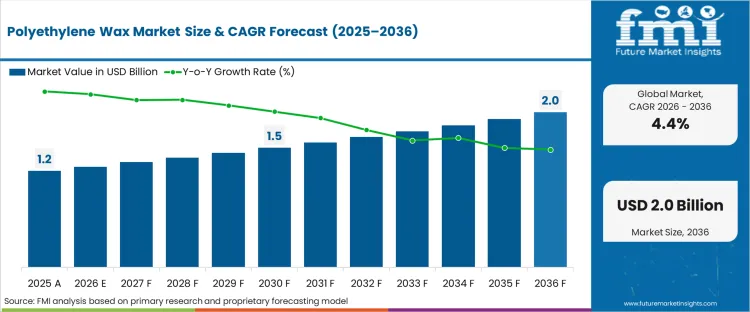
Before growth accelerates beyond standard industrial baselines, the transition to non-toxic additive profiles in food-contact packaging must be fully absorbed by converters. Global resin compounders trigger this shift when they update their approved substance lists to exclude uncharacterized thermal-cracking residues that pose migration risks. Once this qualification gate is passed, extruders can standardize their lubricant packages across both industrial and sensitive consumer-contact lines, eliminating dual-inventory complexities.
India is projected to expand at 6.2%, followed by China at 5.5% and Brazil at 4.8%. Germany is anticipated to track a CAGR of 4.1%, while the United Kingdom garners 3.9%. The United States is estimated to register 3.8%, and Japan follows at 3.2%. This structural divergence is a direct consequence of where heavy municipal infrastructure and PVC pipe extrusion capacity are actively scaling against regions focused purely on specialized compounding and high-value coatings.
Polyethylene Wax Market Key Takeaways
| Metric | Details |
|---|---|
| Industry Size (2026) | USD 1.3 billion |
| Industry Value (2036) | USD 2.0 billion |
| CAGR (2026–2036) | 4.40% |
Source: Future Market Insights (FMI) analysis, based on proprietary forecasting model and primary research
Polyethylene Wax Market Definition
The Polyethylene Wax Market encompasses the production and formulation of low-molecular-weight polyethylene used primarily to modify the rheological, thermal, and surface properties of host materials. Functionally, it is distinguished from fully polymerized plastics by its lower viscosity and specific melting point ranges, serving as a processing aid, slip agent, or binder rather than a structural resin.
Polyethylene Wax Market Inclusions
Scope includes purpose-synthesized waxes derived from direct ethylene polymerization, waxes recovered through the thermal cracking of waste polyolefins, and chemically modified variants such as oxidized polyethylene waxes. Formulations utilized across industrial lubricants, PVC extrusion, hot-melt adhesives, and specialized coating applications fall strictly within this parameter.
Polyethylene Wax Market Exclusions
The market explicitly excludes high-molecular-weight polyethylene resins (HDPE, LDPE) utilized for primary structural molding, as these function as base polymers rather than performance additives. Natural waxes such as carnauba wax and beeswax are also excluded, as their chemical architectures and thermal degradation profiles cater to entirely different formulation requirements.
Polyethylene Wax Market Research Methodology
- Primary Research: Direct interviews with procurement directors at tier-1 masterbatch producers and formulation scientists at global adhesives manufacturers.
- Desk Research: Aggregation of technical data sheets, REACH compliance registries, and polymer additive qualification specifications from primary manufacturers.
- Market-Sizing and Forecasting: Baseline anchored to observable regional capacities in masterbatch compounding and hot-melt adhesive blending volumes.
- Data Validation and Update Cycle: Forecasts triangulated against independent data streams tracking global rigid PVC extrusion machinery installations and resin consumption.
Segmental Analysis
Polyethylene Wax Market Analysis by Form
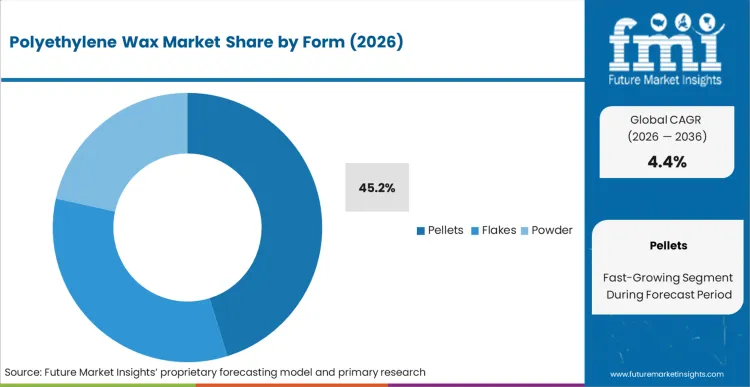
Powder formats, while historically utilized for rapid dispersion, present severe combustible dust hazards that modern environmental health and safety frameworks are actively penalizing. Pellets capture 45.2% share as formulation facilities mandate dust-free handling architectures to mitigate these explosion risks on the compounding floor. According to FMI's estimates, plant managers prioritize pelletized formats not for superior chemical performance, but because they eliminate the need for costly ATEX-certified dust extraction capital expenditure. The operational consequence is a cleaner, continuous feeding mechanism into the extruder throat, directly improving throughput consistency. Formulators who cling to legacy powder supply chains for fractional raw-material savings inevitably face elevated insurance premiums and localized compliance audits. High-throughput wax injector machine systems are increasingly optimized for these solid formats to ensure precise volumetric dosing.
- Combustibility Profile: Pelletized architectures eliminate ambient dust generation during material transfer. Plant safety directors bypass costly ventilation upgrades while maintaining OSHA compliance.
- Feeding Geometry: Uniform pellet sizing allows precise gravimetric dosing. Process engineers achieve tighter tolerances in their final masterbatch formulations.
- Dispersion Energy: Solid pellets require higher initial shear energy to incorporate into low-temperature batches. Formulators must adjust mixing cycles to prevent un-melted inclusions in the final matrix.
Polyethylene Wax Market Analysis by Process
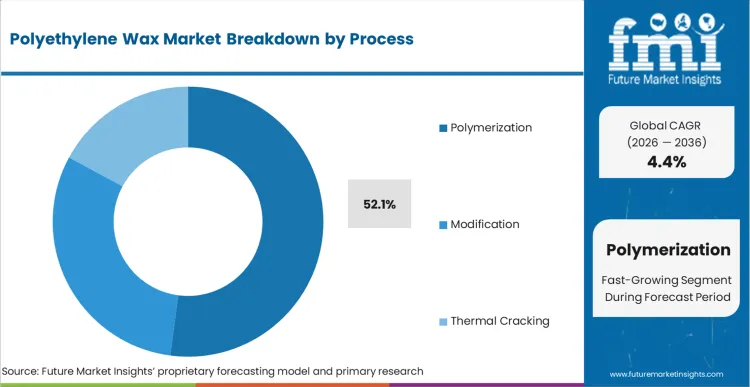
Thermal cracking variants, while cost-effective, introduce unpredictable molecular weight distributions that cause highly calibrated hot-melt adhesive lines to fail mid-application. As per FMI's projection, the shift toward metallocene catalysts within the polymerization segment provides even narrower molecular weight control, fundamentally changing how high-performance binders are engineered. Polymerization processes hold 52.1% share because they yield purpose-synthesized waxes with absolute structural predictability. Formulators formulating hot melt adhesives require this precision to balance open time against cohesive strength. Adhesive manufacturers who source cracked byproduct waxes to protect margins suffer compounding variability that ultimately compromises their end-user bonding specifications. The emergence of high-purity paraffin wax alternatives has further pushed the polymerization segment to innovate on specific drop-point targets.
- Architectural Control: Direct ethylene polymerization creates precise, narrow molecular weight distributions. Formulation scientists lock in predictable thermal degradation curves for demanding applications.
- Byproduct Contamination: Synthesized waxes bypass the catalyst residue and thermal-history impurities found in recycled streams. Quality assurance teams eliminate the need for secondary purification testing.
- Supply Integration: Primary polymerization is tied directly to major petrochemical cracker operations. Procurement directors must navigate tight allocations during broader polyolefin market shortages.
Polyethylene Wax Market Analysis by Application
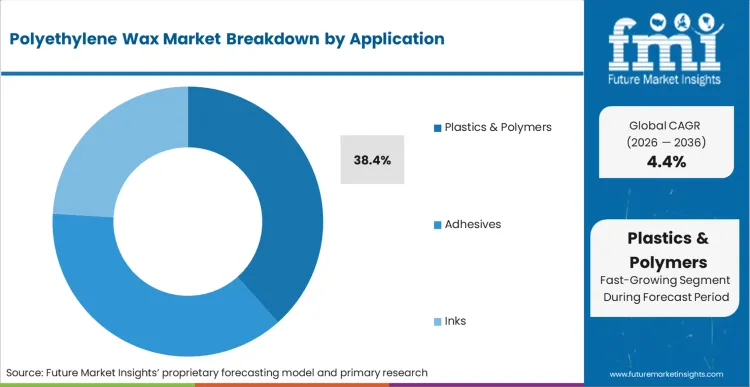
Plastics and polymer processing lines cannot operate continuously without internal and external lubricants managing friction under high shear. Manufacturers delaying the qualification of optimized wax packages operate at lower line speeds and experience higher scrap rates due to thermal burning. The dominant 38.4% share held by Plastics & Polymers is a direct consequence of this absolute dependence; without specific wax addition, rigid PVC degrades thermally before it exits the die. Based on FMI's assessment, extrusion managers rely on these additives not just for throughput speed, but to dictate the surface finish and mechanical integrity of the final profile. The introduction of highly oxidized variants is reshaping how these processors balance metal release with fusion promotion in complex sealed wax packaging applications.
- Shear Moderation: Wax molecules migrate to the polymer-metal interface during extrusion. Process engineers push line speeds higher without triggering premature thermal degradation.
- Fusion Delay: Internal lubrication properties slightly delay the plastification of resin particles. Operations managers widen their processing window, reducing the risk of catastrophic extruder barrel lock-ups.
- Plate-out Resistance: Poorly compatible waxes separate and deposit on calibration tooling. Tooling technicians must schedule more frequent teardowns if the wax architecture is improperly matched.
Polyethylene Wax Market Drivers, Restraints, and Opportunities
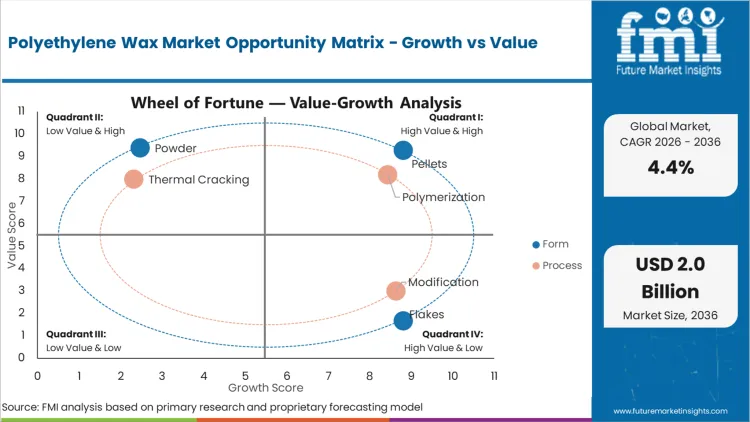
Increasing throughput demands on rigid packaging and pipe extrusion lines compel masterbatch compounders to specify highly tailored plastic additives that ensure zero thermal degradation. This structural pressure forces processing engineers to move away from generic commodity waxes and adopt specialized, purpose-synthesized variants that offer precise melt-viscosity control. The commercial stakes are defined by continuous operation; a masterbatch producer failing to integrate stable external lubricants faces immediate line speed reductions and compromised product gloss, losing ground to competitors offering defect-free, high-speed processability. Integrating bio wax components is also becoming a key differentiator for brands targeting sustainable retail segments.
The most significant structural friction in this space is the exhaustive formulator qualification cycle. Switching a wax supplier is not a simple procurement substitution; it requires adhesive and compounding chemists to completely re-validate the thermal stability and open-time parameters of their entire product portfolio. This installed-base switching cost inherently slows the adoption of new, potentially superior metallocene waxes. While technical support teams offer extensive reformulation guidelines, the liability of a failed field application keeps many tier-1 formulators locked into legacy Ziegler-Natta wax contracts despite performance ceilings.
Opportunities in the Polyethylene Wax Market
- Metallocene Transition: Narrow molecular weight distributions enable precise tailoring of adhesive open times. Tier-1 adhesive formulators capture high-margin packaging contracts by delivering superior bond strength with lower coating weights.
- Oxidized Functionalization: Controlled oxidation creates polar sites on the non-polar wax backbone. Emulsion manufacturers capture emerging opportunities in water-based car wax polishes and specialized printing inks.
- Recycled Stream Purification: Advanced filtration of thermally cracked waste plastics yields cost-competitive industrial waxes. Regional polymer recyclers establish lucrative off-take agreements with lower-tier asphalt and bitumen modifiers.
Regional Analysis
Based on the regional analysis, the Polyethylene Wax Market is segmented into North America, Latin America, Europe, East Asia, South Asia & Pacific, and Middle East & Africa across 40 plus countries.
.webp "Top Country Growth Comparison Polyethylene Wax Market Cagr (2026 2036)")
| Country | CAGR (2026 to 2036) |
|---|---|
| India | 6.2% |
| China | 5.5% |
| Brazil | 4.8% |
| Germany | 4.1% |
| United Kingdom | 3.9% |
| United States | 3.8% |
| Japan | 3.2% |
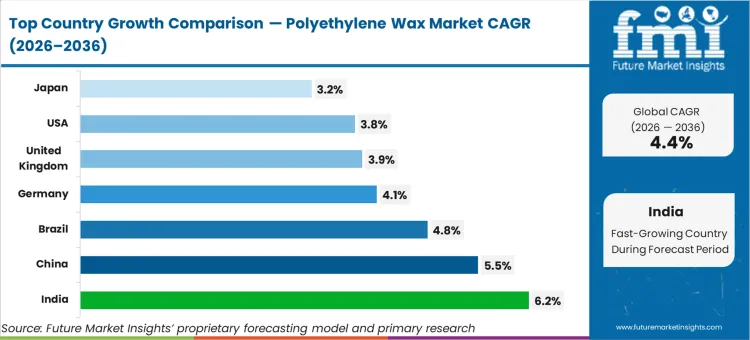
Source: Future Market Insights (FMI) analysis, based on proprietary forecasting model and primary research
Asia Pacific Polyethylene Wax Market Analysis
The trajectory across the broader Asia Pacific theater presents a dual dynamic, blending aggressive infrastructure-led mandates with stringent environmental restructuring. Unlike regions reliant on imports, the domestic availability of massive ethylene polymerization capacity allows East Asian formulators to rapidly transition away from heavily polluting thermal cracking operations. Simultaneously, South Asian operations heads are prioritizing bulk supply reliability and basic thermal stability to support massive domestic mandates for agricultural water management and urban sanitation projects. In FMI's view, this dual-engine environment pushes tier-2 masterbatch producers toward primary synthesized waxes to maintain their operational licenses, while the rapid scaling of domestic PVC compounding capacity makes additive consistency batch-to-batch the critical metric preventing widespread extrusion bottlenecks.
- India: Massive state-sponsored agricultural irrigation projects pull incredible volumes of rigid PVC pipe extrusion across the nation. Local compounding facilities operate under intense continuous-production mandates, requiring highly reliable bulk external lubricants to prevent thermal degradation during high-shear processing. The market is advancing at a 6.2% compound annual rate through 2036. Extrusion managers who achieve stable line speeds without tooling plate-out capture significant margins in a highly price-sensitive infrastructure procurement environment.
- China: The forced modernization of domestic PVC compounding plants requires precise rheology modifiers to run state-of-the-art twin-screw extruders efficiently. Chinese process engineers are sustaining a 5.5% CAGR to 2036 as they aggressively upgrade their additive packages. Legacy cracked waxes cause unacceptable plate-out on advanced tooling, forcing this structural shift away from off-spec byproducts. This transition positions tier-1 Chinese masterbatch producers to aggressively capture export market share in high-grade architectural plastics.
- Japan: Japan's highly mature industrial base operates under stringent quality qualification standards that heavily favor established metallocene-catalyzed waxes. Adhesive formulators here face immense pressure to deliver ultra-low VOC emission profiles for automotive interiors, often utilizing specialized beeswax for cosmetics data to model surface migration. Japan's industry is tracking 3.2% annual growth to 2036. Procurement directors locking in long-term supply of premium, narrow-distribution waxes maintain their competitive moat against lower-cost regional challengers.
FMI's report includes granular analysis of the broader Asia Pacific bloc, including South Korea, Taiwan, and the ASEAN car wax manufacturing hubs. These adjacent markets reflect a rapid pivot toward specialty oxidized waxes to support their highly concentrated electronics packaging sectors.
Europe Polyethylene Wax Market Analysis
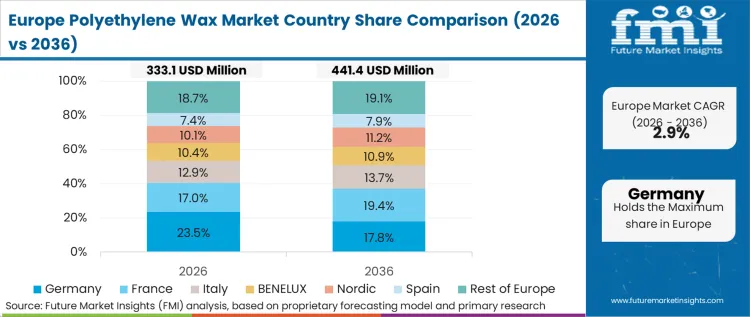
European procurement directors operate under a defensive posture, prioritizing absolute chemical traceability over raw material cost. The European landscape is defined by the strict regulatory calendar governing food contact materials and chemical transparency under REACH frameworks. FMI analysts opine that the transition toward bio-based and highly refined synthesized waxes is structurally guaranteed by these compliance mandates, directly impacting the formulation of packaging adhesives utilized in tier-1 retail networks. This policy-led environment forces packaging adhesive formulators and masterbatch producers to comprehensively audit their wax supply chains, systematically eliminating uncharacterized byproduct waxes to avoid audit failures.
- Germany: Coating formulators here must integrate highly specified micronized waxes to achieve scratch resistance without compromising visual clarity. The Germany car wax segment specifically demands exactingly precise surface modification additives to maintain premium finishes. Polyethylene wax consumption is advancing at 4.1% compound between 2026 and 2036. Formulators who successfully qualify these advanced wax architectures seamlessly integrate into the highly lucrative tier-1 automotive supply chain.
- United Kingdom: The UK's advanced corrugated packaging sector requires hot-melt adhesives capable of withstanding extreme cold-chain logistics without brittle failure. Demand for polyethylene wax is sustaining a 3.9% CAGR to 2036. Formulation chemists must specify waxes with highly predictable low-temperature flexural properties to prevent failure in high-speed fulfillment environments. Operations that achieve this balance drastically reduce end-user box pop-opens, securing long-term contracts.
FMI's report includes evaluation of the Nordic region and Eastern European manufacturing centers. The uk car wax market also provides a secondary driver as consumers shift toward high-durability synthetic surface protections.
North America and Latin America Polyethylene Wax Market Analysis
The structural trajectory across the Americas is defined by the geographic contrast between the highly industrialized North American compounding sector and the rapidly expanding infrastructure build-out in Latin America. Sourcing patterns in this hemisphere are shifting as procurement managers navigate tight petrochemical allocations and seek reliable domestic supply alternatives to insulate their plants from logistical disruptions. According to FMI's estimates, this environment forces leading formulators to secure long-term contracts with regional ethylene polymerization facilities rather than relying on spot-market imports. The availability of abundant feedstock in the Gulf Coast provides a distinct cost advantage, shaping how polyolefin derivatives are priced.
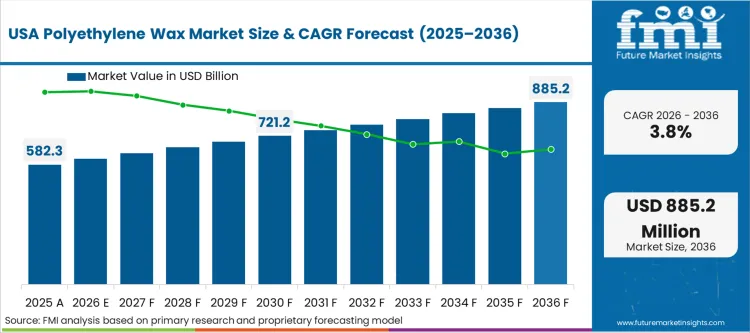
- United States: Masterbatch and hot-melt adhesive manufacturers in the US are currently forced to optimize supply chains around advanced metallocene architectures to meet stringent FDA food-contact compliances. The usa car wax sector also leverages these waxes for superior moisture barrier properties. The market is advancing at 3.8% compound between 2026 and 2036. Procurement directors who establish integrated supply agreements insulate their operations from global shipping volatility and maintain uninterrupted continuous extrusion runs.
- Brazil: Massive investments in domestic agricultural and municipal water networks dictate the heavy consumption of rigid PVC pipes. Brazil is projected at 4.8% compound growth over the forecast period as operations managers scale up compounding capacities to meet physical infrastructure needs. Local extrusion facilities must qualify robust external lubricants to prevent thermal burning under varying ambient conditions. Companies that secure reliable, high-volume wax deliveries capture dominant market share in a highly cost-sensitive civil engineering environment.
FMI's report includes comprehensive coverage of the broader Americas, including the paraffins supply dynamics in Mexico. These structural shifts are enabling regional compounders to bypass historical import bottlenecks.
Competitive Aligners for Market Players
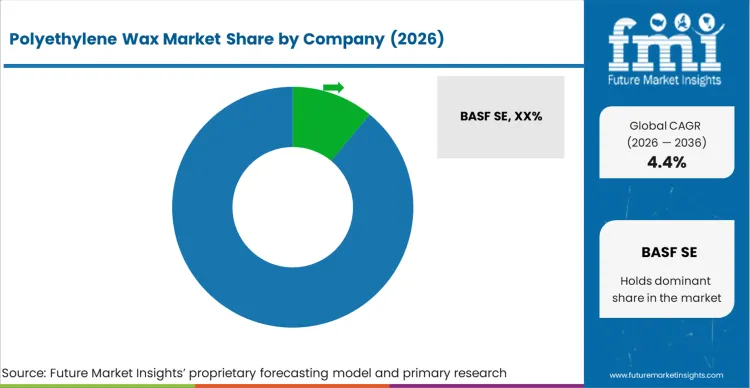
The competitive structure of the synthesized polyethylene wax market is heavily concentrated at the top, an unavoidable consequence of the massive capital requirements tied to direct ethylene polymerization and metallocene catalysis. Leading companies such as BASF SE, Clariant AG, and Ineos Group dominate the premium tier because they control the primary petrochemical feedstock and the proprietary catalyst architectures required to produce exceptionally narrow molecular weight distributions. Buyers in high-performance sectors, such as tier-1 hot-melt adhesives and automotive coatings, do not select vendors based on theoretical viscosity limits. Instead, they use batch-to-batch thermal consistency, specifically the drop point variance across multiple production runs, as the primary variable to distinguish qualified primary producers from unpredictable thermal-cracking vendors. A marginal price advantage per kilogram is immediately erased if an unpredictable melt viscosity forces a masterbatch producer to recalibrate their extrusion temperatures mid-run.
Incumbents maintain their structural advantage through deeply embedded qualification cycles within their customers' formulation portfolios. Companies like Honeywell International, Westlake Chemical, and Mitsui Chemicals provide extensive technical data and REACH-compliant characterization, making the cost for a buyer to switch prohibitively high in terms of re-validation testing. A challenger attempting to replicate this position cannot simply rely on matching a technical specification sheet. They must build comprehensive application-testing infrastructure to prove non-interference in complex powder coatings or high-speed engineering plastics compounding. Offering a lower procurement price is insufficient; challengers must offer guaranteed rheological matching and zero plate-out risk to displace established supply contracts that have been validated over thousands of operating hours.
Large buyers resist this vendor lock-in by aggressively qualifying secondary suppliers like SCG Chemicals for their mid-tier and commodity applications, such as basic PVC pipe extrusion where tolerances are slightly more forgiving. The structural tension between a procurement director's preference for supply diversity and the dominant vendors' push for highly specialized, functionalized waxes will govern competitive positioning through 2036. As regulatory pressure on food-contact and low-VOC formulations intensifies across Western markets, the industry is structurally biased toward further consolidation. Smaller thermal-cracking operators lack the capital to meet tightening purity and characterization standards, inevitably forcing mid-market compounders to align their supply chains with the few global entities capable of delivering absolute chemical traceability.
Key Players in Polyethylene Wax Market
- BASF SE
- Clariant AG
- Mitsui Chemicals
- Honeywell International
- Ineos Group
- Westlake Chemical
- SCG Chemicals
- Trecora Resources
Scope of the Report
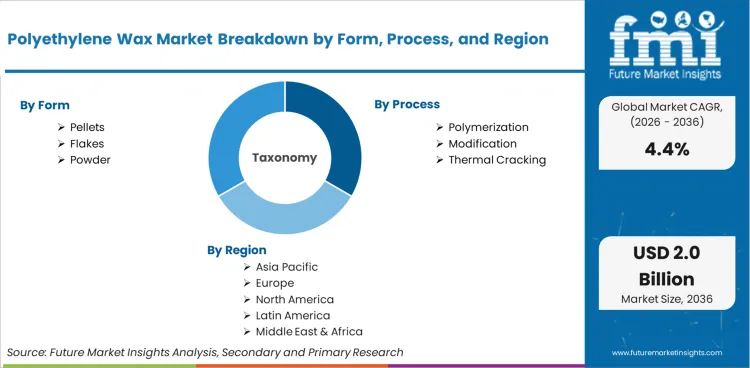
| Metric | Value |
|---|---|
| Quantitative Units | USD 1.3 billion to USD 2.0 billion, at a CAGR of 4.40% |
| Market Definition | Low-molecular-weight polyethylene fractions functioning as crucial rheology modifiers and surface processing aids, distinct from structural resins. |
| Form Segmentation | Pellets, Flakes, Powder, Liquid |
| Process Segmentation | Polymerization, Modification, Thermal Cracking |
| Application Segmentation | Plastics & Polymers, Adhesives, Coatings, Inks |
| Regions Covered | North America, Latin America, Europe, East Asia, South Asia & Pacific, Middle East & Africa |
| Countries Covered | India, China, Brazil, Germany, UK, US, Japan, and 40 plus countries |
| Key Companies Profiled | BASF SE, Clariant AG, Mitsui Chemicals, Honeywell International, Ineos Group, Westlake Chemical, SCG Chemicals |
| Forecast Period | 2026 to 2036 |
| Approach | Primary research engaged procurement directors at tier-1 masterbatch producers. Baseline anchored to observable regional capacities in masterbatch compounding. |
Source: Future Market Insights (FMI) analysis, based on proprietary forecasting model and primary research
Polyethylene Wax Market Analysis by Segments
-
Form:
- Pellets
- Flakes
- Powder
- Liquid
-
Process:
- Polymerization
- Modification
- Thermal Cracking
-
Application:
- Plastics & Polymers
- Adhesives
- Coatings
- Inks
-
Region:
- North America
- United States
- Canada
- Europe
- Germany
- United Kingdom
- Asia Pacific
- India
- China
- Japan
- North America
Bibliography
- European Chemicals Agency (ECHA). (2025, January). Candidate List of substances of very high concern for Authorisation. ECHA.
- BASF SE. (2024, November). Technical Information: Performance Additives for Plastic Compounding. BASF Advanced Materials.
- Clariant AG. (2024, August). Sustainability in Waxes: Metallocene Catalysis for Hot Melt Adhesives. Clariant Technical Papers.
- American Chemistry Council. (2025, February). State of the Plastics Industry: Compounding and Extrusion Metrics. ACC Publications.
- Honeywell International. (2024, December). A-C® Polyethylenes and Copolymers Product Guide for Coatings. Honeywell Specialty Additives.
- Westlake Chemical. (2025, March). Epolene® Polymers for Hot Melt Adhesives and Plastics Modification. Westlake Epoxies & Polymers.
- International Wax Federation. (2024, June). Global Supply Dynamics of Synthetic Waxes. IWF Reports.
- Plastics Industry Association. (2024, October). Global Extrusion Machinery Installation Report. PLASTICS Market Watch.
- Society of Plastics Engineers. (2024, September). Rheological impacts of external lubricants in twin-screw PVC extrusion. SPE Journals.
This bibliography is provided for reader reference. The full FMI report contains the complete reference list with primary source documentation.
This Report Addresses
- Market intelligence to support strategic decision making across purpose-synthesized waxes and thermal cracking residues.
- Market size estimation and 10-year revenue forecasts from 2026 to 2036, supported by baseline anchoring to masterbatch compounding volumes.
- Growth opportunity mapping across Pellets and Polymerization dimensions with emphasis on the transition to non-toxic additives in food-contact packaging.
- Segment and regional revenue forecasts covering Plastics & Polymers applications across heavily regulated REACH environments in Europe.
- Competition strategy assessment including proprietary catalyst architectures and formulator qualification cycles.
- Additive development tracking including metallocene-catalyzed waxes and highly specific drop-point standardizations discussed in this article.
- Market access analysis covering ATEX-certified dust extraction compliance and tier-1 vendor qualification pathways.
- Market report delivery in PDF, Excel, PPT, and interactive dashboard formats for executive strategy, procurement desk planning, and operational benchmarking use.
Frequently Asked Questions
How large is the Polyethylene Wax Market in 2026?
The sector is expected to reach USD 1.3 billion in 2026. This figure establishes the baseline spending by global compounding and adhesive formulation industries before the widespread shift to premium metallocene variants accelerates total value through the end of the decade.
What will it be valued at by 2036?
Sustained investment lifts the valuation to USD 2.0 billion through 2036. This expansion reflects the deepening reliance on purpose-synthesized waxes to manage high-speed extrusion rheology, moving away from low-cost, off-spec byproducts that compromise batch consistency.
What CAGR is projected?
A CAGR of 4.40% is projected during the forecast period. This steady rate mirrors the underlying capital expenditure cycles in global PVC pipe extrusion and packaging logistics, rather than volatile consumer trends or short-term commodity price spikes.
Which Form segment leads?
Pellets hold a dominant 45.2% share. Facilities mandate pelletized architectures because they eliminate the combustible dust hazards associated with powders, fundamentally bypassing costly ventilation compliance upgrades and ATEX certification requirements on the factory floor.
Which Process segment leads?
Polymerization dominates the process landscape. Synthesized waxes bypass the catalyst residue and thermal-history impurities of recycled streams, giving formulators the absolute architectural predictability required for sensitive hot-melt and food-contact applications.
Which Application segment leads?
Plastics & Polymers secure the leading 38.4% share. Rigid PVC processing lines literally cannot operate continuously without these specific external lubricants managing friction and preventing catastrophic thermal degradation inside the extruder barrel during high-shear runs.
What drives rapid growth?
High-speed extrusion requirements force rigid PVC compounders to integrate highly stable lubricants. A masterbatch producer cannot increase line throughput without a corresponding upgrade to their wax package to prevent catastrophic die plate-out and surface defects.
What is the primary restraint?
The exhaustive formulator qualification cycle acts as structural friction. Switching a wax supplier requires an adhesive chemist to completely re-validate the thermal stability of their entire portfolio, making incumbents difficult to displace despite the availability of superior new metallocene chemistries.
Which country grows fastest?
India is projected to expand at 6.2%, significantly outpacing mature markets like Germany at 4.1%. India's growth is structurally driven by massive domestic PVC pipe extrusion scaling for water infrastructure projects, whereas Germany focuses on lower-volume, specialized automotive coating formulations.
How do REACH regulations impact European procurement?
European frameworks penalize uncharacterized thermal-cracking residues in consumer packaging. Procurement directors must systematically eliminate these byproduct waxes and secure long-term allocations of highly traceable synthesized variants to maintain their license to operate in tier-1 retail networks.
Why are metallocene catalysts changing adhesive formulations?
Narrow molecular weight distributions enabled by metallocene catalysis allow precise tailoring of adhesive open times. Formulators utilize this control to deliver superior bond strength with lower coating weights, capturing high-margin packaging contracts from global brands.
Why is the competitive landscape so concentrated?
Direct ethylene polymerization requires massive petrochemical feedstock integration and proprietary catalyst architectures. Challengers face insurmountable capital barriers to entry, leaving the premium tier dominated by a handful of global chemical giants with integrated supply chains.
What is the significance of oxidized polyethylene waxes?
Controlled oxidation creates polar sites on the naturally non-polar wax backbone, enabling compatibility with water-based systems. This is essential for emerging low-VOC industrial coatings and high-performance floor polishes that require emulsifiable additives.
How does dust extraction compliance shape facility design?
Plant safety directors actively specify pelletized additives to remain under the threshold for mandatory ATEX-certified ventilation systems. This allows capital to be diverted back into direct production machinery rather than facility maintenance and compliance upgrades.
Why is PVC pipe manufacturing heavily reliant on external lubricants?
Without specific wax migration to the polymer-metal interface, the intense shear forces inside twin-screw extruders would cause the rigid PVC matrix to burn. This results in high scrap rates and potential damage to expensive calibration tooling.
What role do slip agents play in automotive coatings?
Micronized wax slip agents migrate to the surface of the curing clear coat to alter tactile friction. This delivers the rigorous scratch and mar resistance demanded by tier-1 automotive OEMs while maintaining visual clarity and gloss.
How do petrochemical allocations affect wax supply?
Synthetic waxes are often tied to the production cycles of major polyolefin crackers. During periods of tight resin supply, wax availability can become a critical bottleneck for compounders who lack long-term, integrated supply agreements with primary producers.
What differentiates thermal cracking from polymerization?
Thermal cracking recovers waxes from recycled plastics, offering a lower price point but higher variability in drop points. Polymerization synthesizes waxes from ethylene gas, ensuring high purity and precise molecular weight control for high-spec applications.
Why are flakes preferred in certain regional markets?
Flake formats offer a middle ground between the high dispersion speed of powders and the safety of pellets. They are often favored in manual-feeding operations common in smaller-scale compounding facilities across Latin America and parts of Southeast Asia.
Are bio-based alternatives structurally viable by 2036?
The Nordic transition toward sustainable polymers is forcing the commercialization of renewable ethylene-derived waxes. These will ultimately penetrate premium cosmetic and packaging sectors by 2036 as carbon-neutral mandates become standard procurement requirements.
Preview the report firsthand - request a free sample
Get SampleGet the brochure for pricing and purchase details.
Get PDFTable of Content
- Executive Summary
- Global Market Outlook
- Demand-side Trends
- Supply-side Trends
- Technology Roadmap Analysis
- Analysis and Recommendations
- Market Overview
- Market Coverage / Taxonomy
- Market Definition / Scope / Limitations
- Research Methodology
- Chapter Orientation
- Analytical Lens and Working Hypotheses
- Market Structure, Signals, and Trend Drivers
- Benchmarking and Cross-market Comparability
- Market Sizing, Forecasting, and Opportunity Mapping
- Research Design and Evidence Framework
- Desk Research Programme (Secondary Evidence)
- Company Annual and Sustainability Reports
- Peer-reviewed Journals and Academic Literature
- Corporate Websites, Product Literature, and Technical Notes
- Earnings Decks and Investor Briefings
- Statutory Filings and Regulatory Disclosures
- Technical White Papers and Standards Notes
- Trade Journals, Industry Magazines, and Analyst Briefs
- Conference Proceedings, Webinars, and Seminar Materials
- Government Statistics Portals and Public Data Releases
- Press Releases and Reputable Media Coverage
- Specialist Newsletters and Curated Briefings
- Sector Databases and Reference Repositories
- FMI Internal Proprietary Databases and Historical Market Datasets
- Subscription Datasets and Paid Sources
- Social Channels, Communities, and Digital Listening Inputs
- Additional Desk Sources
- Expert Input and Fieldwork (Primary Evidence)
- Primary Modes
- Qualitative Interviews and Expert Elicitation
- Quantitative Surveys and Structured Data Capture
- Blended Approach
- Why Primary Evidence is Used
- Field Techniques
- Interviews
- Surveys
- Focus Groups
- Observational and In-context Research
- Social and Community Interactions
- Stakeholder Universe Engaged
- C-suite Leaders
- Board Members
- Presidents and Vice Presidents
- R&D and Innovation Heads
- Technical Specialists
- Domain Subject-matter Experts
- Scientists
- Physicians and Other Healthcare Professionals
- Governance, Ethics, and Data Stewardship
- Research Ethics
- Data Integrity and Handling
- Primary Modes
- Tooling, Models, and Reference Databases
- Desk Research Programme (Secondary Evidence)
- Data Engineering and Model Build
- Data Acquisition and Ingestion
- Cleaning, Normalisation, and Verification
- Synthesis, Triangulation, and Analysis
- Quality Assurance and Audit Trail
- Market Background
- Market Dynamics
- Drivers
- Restraints
- Opportunity
- Trends
- Scenario Forecast
- Demand in Optimistic Scenario
- Demand in Likely Scenario
- Demand in Conservative Scenario
- Opportunity Map Analysis
- Product Life Cycle Analysis
- Supply Chain Analysis
- Investment Feasibility Matrix
- Value Chain Analysis
- PESTLE and Porter’s Analysis
- Regulatory Landscape
- Regional Parent Market Outlook
- Production and Consumption Statistics
- Import and Export Statistics
- Market Dynamics
- Global Market Analysis 2021 to 2025 and Forecast, 2026 to 2036
- Historical Market Size Value (USD Million) Analysis, 2021 to 2025
- Current and Future Market Size Value (USD Million) Projections, 2026 to 2036
- Y-o-Y Growth Trend Analysis
- Absolute $ Opportunity Analysis
- Global Market Pricing Analysis 2021 to 2025 and Forecast 2026 to 2036
- Global Market Analysis 2021 to 2025 and Forecast 2026 to 2036, By Form
- Introduction / Key Findings
- Historical Market Size Value (USD Million) Analysis By Form , 2021 to 2025
- Current and Future Market Size Value (USD Million) Analysis and Forecast By Form , 2026 to 2036
- Pellets
- Flakes
- Powder
- Pellets
- Y-o-Y Growth Trend Analysis By Form , 2021 to 2025
- Absolute $ Opportunity Analysis By Form , 2026 to 2036
- Global Market Analysis 2021 to 2025 and Forecast 2026 to 2036, By Process
- Introduction / Key Findings
- Historical Market Size Value (USD Million) Analysis By Process, 2021 to 2025
- Current and Future Market Size Value (USD Million) Analysis and Forecast By Process, 2026 to 2036
- Polymerization
- Modification
- Thermal Cracking
- Polymerization
- Y-o-Y Growth Trend Analysis By Process, 2021 to 2025
- Absolute $ Opportunity Analysis By Process, 2026 to 2036
- Global Market Analysis 2021 to 2025 and Forecast 2026 to 2036, By Application
- Introduction / Key Findings
- Historical Market Size Value (USD Million) Analysis By Application, 2021 to 2025
- Current and Future Market Size Value (USD Million) Analysis and Forecast By Application, 2026 to 2036
- Plastics & Polymers
- Adhesives
- Inks
- Plastics & Polymers
- Y-o-Y Growth Trend Analysis By Application, 2021 to 2025
- Absolute $ Opportunity Analysis By Application, 2026 to 2036
- Global Market Analysis 2021 to 2025 and Forecast 2026 to 2036, By Region
- Introduction
- Historical Market Size Value (USD Million) Analysis By Region, 2021 to 2025
- Current Market Size Value (USD Million) Analysis and Forecast By Region, 2026 to 2036
- North America
- Latin America
- Western Europe
- Eastern Europe
- East Asia
- South Asia and Pacific
- Middle East & Africa
- Market Attractiveness Analysis By Region
- North America Market Analysis 2021 to 2025 and Forecast 2026 to 2036, By Country
- Historical Market Size Value (USD Million) Trend Analysis By Market Taxonomy, 2021 to 2025
- Market Size Value (USD Million) Forecast By Market Taxonomy, 2026 to 2036
- By Country
- USA
- Canada
- Mexico
- By Form
- By Process
- By Application
- By Country
- Market Attractiveness Analysis
- By Country
- By Form
- By Process
- By Application
- Key Takeaways
- Latin America Market Analysis 2021 to 2025 and Forecast 2026 to 2036, By Country
- Historical Market Size Value (USD Million) Trend Analysis By Market Taxonomy, 2021 to 2025
- Market Size Value (USD Million) Forecast By Market Taxonomy, 2026 to 2036
- By Country
- Brazil
- Chile
- Rest of Latin America
- By Form
- By Process
- By Application
- By Country
- Market Attractiveness Analysis
- By Country
- By Form
- By Process
- By Application
- Key Takeaways
- Western Europe Market Analysis 2021 to 2025 and Forecast 2026 to 2036, By Country
- Historical Market Size Value (USD Million) Trend Analysis By Market Taxonomy, 2021 to 2025
- Market Size Value (USD Million) Forecast By Market Taxonomy, 2026 to 2036
- By Country
- Germany
- UK
- Italy
- Spain
- France
- Nordic
- BENELUX
- Rest of Western Europe
- By Form
- By Process
- By Application
- By Country
- Market Attractiveness Analysis
- By Country
- By Form
- By Process
- By Application
- Key Takeaways
- Eastern Europe Market Analysis 2021 to 2025 and Forecast 2026 to 2036, By Country
- Historical Market Size Value (USD Million) Trend Analysis By Market Taxonomy, 2021 to 2025
- Market Size Value (USD Million) Forecast By Market Taxonomy, 2026 to 2036
- By Country
- Russia
- Poland
- Hungary
- Balkan & Baltic
- Rest of Eastern Europe
- By Form
- By Process
- By Application
- By Country
- Market Attractiveness Analysis
- By Country
- By Form
- By Process
- By Application
- Key Takeaways
- East Asia Market Analysis 2021 to 2025 and Forecast 2026 to 2036, By Country
- Historical Market Size Value (USD Million) Trend Analysis By Market Taxonomy, 2021 to 2025
- Market Size Value (USD Million) Forecast By Market Taxonomy, 2026 to 2036
- By Country
- China
- Japan
- South Korea
- By Form
- By Process
- By Application
- By Country
- Market Attractiveness Analysis
- By Country
- By Form
- By Process
- By Application
- Key Takeaways
- South Asia and Pacific Market Analysis 2021 to 2025 and Forecast 2026 to 2036, By Country
- Historical Market Size Value (USD Million) Trend Analysis By Market Taxonomy, 2021 to 2025
- Market Size Value (USD Million) Forecast By Market Taxonomy, 2026 to 2036
- By Country
- India
- ASEAN
- Australia & New Zealand
- Rest of South Asia and Pacific
- By Form
- By Process
- By Application
- By Country
- Market Attractiveness Analysis
- By Country
- By Form
- By Process
- By Application
- Key Takeaways
- Middle East & Africa Market Analysis 2021 to 2025 and Forecast 2026 to 2036, By Country
- Historical Market Size Value (USD Million) Trend Analysis By Market Taxonomy, 2021 to 2025
- Market Size Value (USD Million) Forecast By Market Taxonomy, 2026 to 2036
- By Country
- Kingdom of Saudi Arabia
- Other GCC Countries
- Turkiye
- South Africa
- Other African Union
- Rest of Middle East & Africa
- By Form
- By Process
- By Application
- By Country
- Market Attractiveness Analysis
- By Country
- By Form
- By Process
- By Application
- Key Takeaways
- Key Countries Market Analysis
- USA
- Pricing Analysis
- Market Share Analysis, 2025
- By Form
- By Process
- By Application
- Canada
- Pricing Analysis
- Market Share Analysis, 2025
- By Form
- By Process
- By Application
- Mexico
- Pricing Analysis
- Market Share Analysis, 2025
- By Form
- By Process
- By Application
- Brazil
- Pricing Analysis
- Market Share Analysis, 2025
- By Form
- By Process
- By Application
- Chile
- Pricing Analysis
- Market Share Analysis, 2025
- By Form
- By Process
- By Application
- Germany
- Pricing Analysis
- Market Share Analysis, 2025
- By Form
- By Process
- By Application
- UK
- Pricing Analysis
- Market Share Analysis, 2025
- By Form
- By Process
- By Application
- Italy
- Pricing Analysis
- Market Share Analysis, 2025
- By Form
- By Process
- By Application
- Spain
- Pricing Analysis
- Market Share Analysis, 2025
- By Form
- By Process
- By Application
- France
- Pricing Analysis
- Market Share Analysis, 2025
- By Form
- By Process
- By Application
- India
- Pricing Analysis
- Market Share Analysis, 2025
- By Form
- By Process
- By Application
- ASEAN
- Pricing Analysis
- Market Share Analysis, 2025
- By Form
- By Process
- By Application
- Australia & New Zealand
- Pricing Analysis
- Market Share Analysis, 2025
- By Form
- By Process
- By Application
- China
- Pricing Analysis
- Market Share Analysis, 2025
- By Form
- By Process
- By Application
- Japan
- Pricing Analysis
- Market Share Analysis, 2025
- By Form
- By Process
- By Application
- South Korea
- Pricing Analysis
- Market Share Analysis, 2025
- By Form
- By Process
- By Application
- Russia
- Pricing Analysis
- Market Share Analysis, 2025
- By Form
- By Process
- By Application
- Poland
- Pricing Analysis
- Market Share Analysis, 2025
- By Form
- By Process
- By Application
- Hungary
- Pricing Analysis
- Market Share Analysis, 2025
- By Form
- By Process
- By Application
- Kingdom of Saudi Arabia
- Pricing Analysis
- Market Share Analysis, 2025
- By Form
- By Process
- By Application
- Turkiye
- Pricing Analysis
- Market Share Analysis, 2025
- By Form
- By Process
- By Application
- South Africa
- Pricing Analysis
- Market Share Analysis, 2025
- By Form
- By Process
- By Application
- USA
- Market Structure Analysis
- Competition Dashboard
- Competition Benchmarking
- Market Share Analysis of Top Players
- By Regional
- By Form
- By Process
- By Application
- Competition Analysis
- Competition Deep Dive
- BASF SE
- Overview
- Product Portfolio
- Profitability by Market Segments (Product/Age /Sales Channel/Region)
- Sales Footprint
- Strategy Overview
- Marketing Strategy
- Product Strategy
- Channel Strategy
- Clariant AG
- Mitsui Chemicals
- Honeywell International
- Ineos Group
- Westlake Chemical
- SCG Chemicals
- BASF SE
- Competition Deep Dive
- Assumptions & Acronyms Used


