

- Industry Size (2026)
- USD 1.5 Bn
- Forecast (2036)
- USD 2.1 Bn
- CAGR (2026 to 2036)
- 3.2%
Wax Injector Machine Market Forecast and Outlook 2026 to 2036
The wax injector machine market is likely to be valued at USD 1.5 billion in 2026 and is expected to reach USD 2.1 billion by 2036, reflecting a CAGR of 3.2%. These machines sit inside lost wax and investment casting workflows, where dimensional accuracy and surface fidelity are determined before any metal is poured. Their economic role is tied to pattern consistency, cavity fill stability, and cycle repeatability rather than to headline injection pressure or clamping force. Use is concentrated in jewelry, aerospace, medical components, and precision industrial castings, where scrap at the pattern stage multiplies downstream cost. Demand therefore follows the mix of high tolerance casting programs rather than overall foundry throughput.
Process engineers, not general purchasing teams, typically control equipment selection because injection behavior becomes part of a qualified production recipe. Once a wax formulation and injection profile are validated for a given tool family, machine changes are avoided due to requalification risk and tooling interaction effects. Investment is often triggered by new part families, tighter tolerance requirements, or the need to stabilize yield rather than by capacity expansion alone. Buyers focus on temperature control stability, shot repeatability, and maintenance access more than on nominal machine size. The market grows through rising precision requirements and pattern quality control, not through broad expansion of casting volumes or routine equipment replacement.
Quick Stats for Wax Injector Machine Market
- Wax Injector Machine Market Value (2026): USD 1.5 billion
- Wax Injector Machine Market Forecast Value (2036): USD 2.1 billion
- Wax Injector Machine Market Forecast CAGR 2026 to 2036: 3.2%
- Leading Product Type in Wax Injector Machine Market: Automatic wax injector machines
- Leading End-Use Industry in Wax Injector Machine Market: Jewelry casting
- Key Growth Regions in Wax Injector Machine Market: Asia Pacific, Europe, North America
- Top Players in Wax Injector Machine Market: Moldmaster (Wuhan Jingke), RDM Worldwide, Lindberg/MPH (Quintus Technologies), Mecosan SA, Shimpo Co., Ltd., Thorwesten GmbH, HWM (Hot Wax Machines)
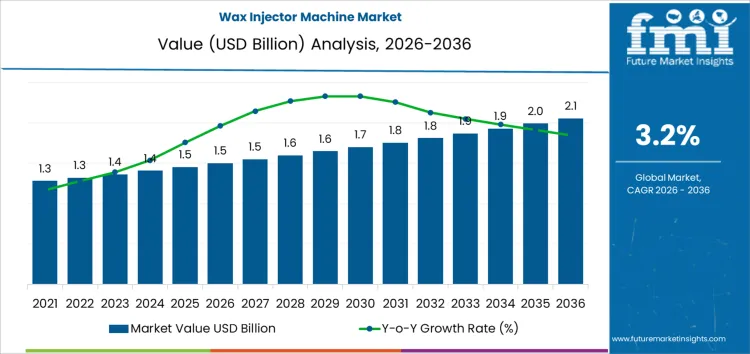
What is the Growth Forecast for the Wax Injector Machine Market through 2036?
The wax injector machine segment is shaped mainly by investment activity in precision casting, jewelry manufacturing, dental laboratories, and small to mid-sized foundry operations rather than broad industrial machinery cycles. In the early stage, demand is driven largely by the replacement of older manual or semi-automatic units, along with modest capacity additions in lost-wax casting workflows. As adoption increases, buyers place greater importance on injection consistency, mold repeatability, and stable cycle times. Machines are increasingly selected not just for throughput, but for their ability to reduce wax pattern defects, minimize rework, and lower downstream scrap in precision casting processes.
Over the long term, growth is supported by gradual formalization of casting operations and rising quality expectations rather than rapid expansion of total casting capacity. Workshops and industrial users increasingly upgrade equipment to achieve better dimensional accuracy and repeatable output for complex and detailed components. Demand also shifts toward higher-specification machines equipped with improved temperature regulation, more precise pressure control, and greater automation that simplifies operation and improves process reliability. Procurement decisions remain strongly focused on stable performance, consistent pattern quality, long equipment life, and ease of use. Overall, the segment advances steadily as precision manufacturers prioritize process control and quality assurance across casting environments.
Wax Injector Machine Market Key Takeaways
| Metric | Value |
|---|---|
| Market Value (2026) | USD 1.5 billion |
| Forecast Value (2036) | USD 2.1 billion |
| Forecast CAGR 2026 to 2036 | 3.2% |
How Is the Wax Injector Machine Market Enhancing Precision in Casting and Manufacturing?
Wax injector machines are increasingly used to produce precise wax patterns for investment casting, jewelry, and specialty manufacturing processes. Historically, wax pattern production relied on manual pouring or basic injection methods, which often resulted in inconsistencies, defects, and longer production cycles. Modern wax injector machines integrate automated injection control, temperature regulation, and high-pressure systems to ensure uniform pattern density, accurate replication, and reduced material waste.
Jewelry manufacturers, precision casting foundries, and industrial component producers prioritize injection consistency, machine reliability, and cycle speed. Early adoption focused on high-value jewelry and aerospace components, while current demand spans automotive parts, dental prosthetics, and specialty tooling, driven by quality standards, operational efficiency, and defect reduction. Injection pressure, temperature control, and pattern uniformity influence supplier selection.
Improving pattern accuracy and minimizing production defects are driving market adoption. Compared with manual methods, automated wax injectors provide faster throughput, consistent pattern quality, and reduced labor dependence. Cost structures depend on hydraulic systems, temperature control precision, and mold adaptability, concentrating margins among suppliers capable of delivering reliable, high-performance machines. Manufacturers implement wax injector machines to enhance casting accuracy, streamline production workflows, and reduce material waste. Moving forward, these machines are expected to become essential in precision casting and jewelry production, supporting high-quality replication, efficient manufacturing, and consistent output across diverse applications.
What Is Driving Demand for Wax Injector Machines Across Key Segments in 2026?
The Wax Injector Machine Market in 2026 is structured primarily by requirements for dimensional repeatability, surface integrity of wax patterns, and control of downstream casting defect rates rather than by injection speed or nominal clamping force alone. By product type, demand in the Wax Injector Machine Market is distributed across automatic wax injector machines, semi-automatic wax injector machines, manual wax injector machines, and high-capacity industrial wax injectors.
By end-use industry, demand in the Wax Injector Machine Market is concentrated in jewelry casting, dental prosthetics, foundry and metal casting, and model and pattern making. These segments reflect differences in tolerance for pattern variation, batch size, and the economic impact of scrap or rework at later production stages. In investment casting workflows, the quality of the wax pattern determines not only dimensional accuracy but also surface finish and internal defect risk in the final metal part.
How Do Consistency and Throughput Requirements Shape Product Type Demand in the Wax Injector Machine Market?
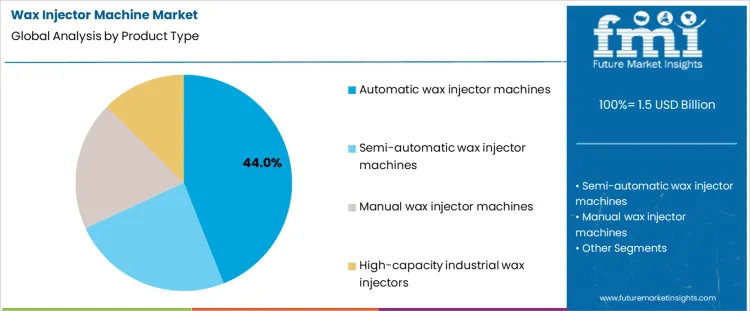
Automatic wax injector machines account for approximately 44% of demand in the Wax Injector Machine Market because they provide the highest level of control over injection pressure, temperature, and cycle repeatability. In jewelry casting and dental prosthetics, even minor dimensional or surface variations can render parts unusable or require manual rework, which is labor-intensive and difficult to standardize. Automated systems reduce operator dependence and stabilize output quality across long production runs.
Semi-automatic machines are used where moderate volumes and mixed pattern portfolios require some flexibility without fully sacrificing control. Manual machines remain relevant in small workshops and prototyping environments, but their output consistency is limited by operator technique and process variability. High-capacity industrial wax injectors are specified in foundry environments where multi-cavity tooling and continuous production schedules dominate. The structure of the Wax Injector Machine Market is therefore not a simple progression from manual to automated equipment. It reflects a segmentation based on how each user group balances investment cost against the economic consequences of pattern defects, rework, and downstream scrap.
Why Does Jewelry Casting Represent the Largest End Use Segment in the Wax Injector Machine Market?
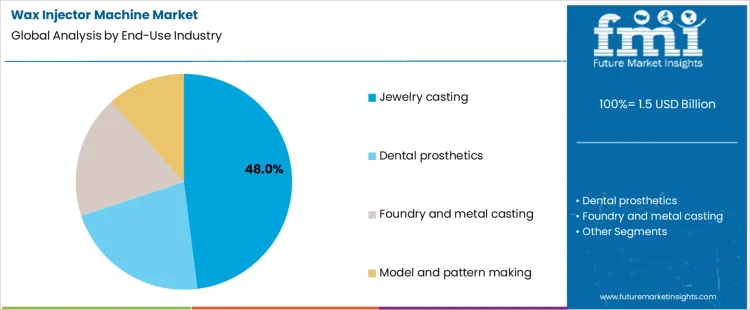
Jewelry casting accounts for approximately 48% of demand in the Wax Injector Machine Market because this segment combines high production volumes with extremely tight requirements for surface finish and dimensional precision. Jewelry manufacturers often operate with small, intricate designs and short product cycles, which makes pattern accuracy and repeatability central to production efficiency. Defects at the wax stage typically propagate through the entire investment casting process, resulting in precious metal losses and additional labor costs.
Dental prosthetics also require high precision, but production volumes are lower and more customized. Foundry and general metal casting use wax injection for specific applications, but this represents a smaller share of total casting activity. Model and pattern making is intermittent and project-based. Jewelry casting, by contrast, involves continuous, high-frequency pattern production with direct material cost exposure. This combination of scale, precision sensitivity, and economic impact of defects explains why jewelry casting remains the dominant application segment in the Wax Injector Machine Market.
How Are the Key Dynamics Reshaping the Wax Injector Machine Market?
The Wax Injector Machine Market is being reshaped by how investment casting shops chase stable output rather than peak speed. In most foundries, wax injection is not the bottleneck until suddenly it is. A small defect at this stage multiplies across the entire downstream process, wasting shell, metal, energy, and time. As casting operations become more synchronized and less tolerant of scrap, the reliability of wax pattern production becomes a system-level constraint. This pushes the Wax Injector Machine Market toward machines that behave predictably across long runs, not machines that only look good on cycle-time specifications.
Why the Wax Injector Machine Market Is Yield-Stability Driven-In investment casting, bad wax patterns are silent killers. They look acceptable, pass early checks, and only fail after shelling or pouring. By then, the cost is enormous. Temperature control, pressure stability, and shot repeatability decide whether patterns stay consistent across shifts. The Wax Injector Machine Market benefits where foundries start treating wax injection as a quality-critical process, not a preparatory step. Once scrap is traced back to pattern variability, machines get upgraded or standardized. Demand follows efforts to stabilize yield curves, not efforts to maximize hourly output or add new casting capacity.
Why the Wax Injector Machine Market Is a Bottleneck Management Story-In many shops, shell building and casting are balanced carefully, but wax rooms are treated as support areas. When orders rise or part mixes change, injection suddenly becomes the pacing constraint. Adding people does not fix temperature recovery times or mold change delays. The Wax Injector Machine Market grows when managers realize that flow problems upstream cannot be solved downstream. Multi-station machines, faster thermal recovery, and better changeover control are adopted not for elegance, but to protect line balance. Growth follows flow rebalancing projects, not general equipment refresh cycles.
Why the Wax Injector Machine Market Follows Part-Mix Complexity-Simple parts tolerate simple machines. Complex aerospace, medical, and precision industrial parts do not. Thin walls, tight tolerances, and multi-cavity tooling amplify every inconsistency in injection behavior. As foundries move toward higher-value, more complex castings, the wax room quietly becomes a precision manufacturing area. The Wax Injector Machine Market therefore follows how difficult the part portfolio becomes, not how many castings are poured. Where part mix shifts toward complexity, machine capability must change. Where parts stay simple, old machines survive far longer than their depreciation schedules suggest.
What is the Demand for Wax Injector Machines by Country?
| Country | CAGR (%) |
|---|---|
| USA | 3.0% |
| UK | 2.8% |
| China | 3.5% |
| India | 3.8% |
| Brazil | 3.1% |
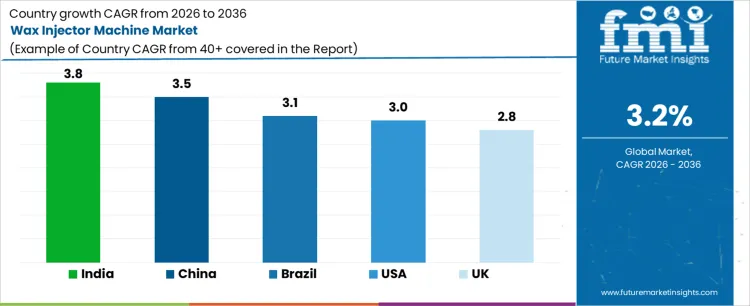
Demand for wax injector machines is rising as jewelry, dental, and industrial manufacturers adopt automated equipment to improve precision, efficiency, and production speed. India leads with a 3.8% CAGR, driven by growing jewelry and dental manufacturing sectors and increasing adoption of automated wax injection processes. China follows at 3.5%, supported by expansion in jewelry production and industrial applications. Brazil records 3.1% growth, shaped by adoption in small-scale manufacturing and craft industries. The USA grows at 3.0%, influenced by replacement demand and precision manufacturing. The UK shows 2.8% CAGR, reflecting steady adoption across jewelry, dental, and industrial applications.
How do casting process economics shape demand in the Wax Injector Machine Market in the United States?
Process yield targets and mold utilization rates keep Wax Injector Machine Market demand in United States on a 3% CAGR path. Investment casting foundries and jewelry manufacturers control most purchase decisions. Equipment selection focuses on injection consistency, temperature control, and cycle repeatability. Scrap reduction and pattern stability drive return calculations. Once a production recipe is validated, machine configurations remain stable for long periods. Tooling compatibility influences upgrade timing. Import machines serve high precision aerospace and medical casting programs. Domestic suppliers compete on service access and spare availability. Replacement demand follows process changes rather than wear alone. Capital spending aligns with new program awards and capacity rebalancing. Commercial success depends on participation in foundry expansion projects and early involvement during process line design stages.
Why do quality control requirements guide purchases in the Wax Injector Machine Market in the United Kingdom?
Process control standards and dimensional consistency targets keep Wax Injector Machine Market demand in United Kingdom expanding at a 2.8% CAGR. Jewelry casting, dental labs, and industrial investment casting workshops form the main buyer base. Equipment choice emphasizes injection pressure stability, temperature uniformity, and repeatable mold filling. Once approved, machine settings remain fixed across long production runs. Replacement activity follows introduction of new wax formulations or pattern designs. Import systems serve higher precision applications. Local distributors support installation and calibration. Spending decisions follow program launches and workflow changes rather than routine equipment refresh. Tooling compatibility and operator training influence selection. Commercial visibility depends on inclusion in standardized casting workflows and early engagement during process development rather than transactional equipment sales.
What scale manufacturing factors drive demand in the Wax Injector Machine Market in China?
High volume jewelry production and industrial casting output keep Wax Injector Machine Market demand in China on a 3.5% CAGR growth track. Large workshops and factory clusters drive batch purchases. Domestic equipment suppliers dominate standard models through pricing and delivery speed. International brands retain roles in high precision and automated systems. Process engineers control machine selection during line setup. Once installed, machines remain in service across extended production cycles. Order timing follows capacity additions and new product lines. Yield improvement and cycle stability shape investment decisions. Margin structure depends on mix between standard and automated units. Commercial success depends on access to large production clusters and early positioning inside new workshop buildouts rather than sales to small independent operators.
Why does process modernization drive growth in the Wax Injector Machine Market in India?
Transition from manual pattern making toward controlled casting lines keeps Wax Injector Machine Market demand in India on a 3.8% CAGR path. Jewelry manufacturing, automotive components, and industrial castings support adoption. Equipment choice focuses on consistency, ease of operation, and temperature stability. Import machines serve higher precision and export oriented facilities. Domestic suppliers cover mainstream requirements. Process engineers define specifications during workshop upgrades. Once qualified, machine configurations stay unchanged for long cycles. Replacement demand remains secondary to capacity expansion. Capital spending follows workshop formalization and customer quality requirements. Training and service support influence acceptance. Commercial success depends on alignment with modernization projects and participation in new casting line setups rather than spot sales into fragmented workshops.
How do production mix changes influence demand in the Wax Injector Machine Market in Brazil?
Shifts in jewelry, dental, and industrial casting volumes keep Wax Injector Machine Market demand in Brazil on a 3.1% CAGR path. Mid-sized workshops and specialized foundries form the core buyer group. Equipment selection emphasizes reliability, temperature stability, and mold fill consistency. Import machines serve higher accuracy requirements. Local suppliers compete on service response and parts availability. Once a machine is qualified, replacement follows process change rather than wear. Spending timing aligns with new customer contracts and product mix adjustments. Tooling compatibility affects upgrade decisions. Automation adoption remains selective. Commercial success depends on participation in workshop expansion and product line change projects rather than short cycle equipment replacement campaigns.
How Are Suppliers Differentiating Technology and Performance in the Wax Injector Machine Market?

Moldmaster (Wuhan Jingke) supplies wax injector machines engineered for precise temperature control and consistent shot delivery, supporting complex mold geometries in investment casting processes. RDM Worldwide provides machines that balance cycle speed with reliable thermal stability, appealing to foundries where repeatability affects product yield. Lindberg/MPH, now part of Quintus Technologies, delivers wax injection systems integrated with pressure control and programmable profiles to manage flow characteristics in intricate tooling. Mecosan SA offers equipment with robust structural design and ease of maintenance that suits continuous production environments. Shimpo Co., Ltd. supplies compact wax injectors tailored to smaller operations that require adjustable parameters without sacrificing consistency.
Thorwesten GmbH develops machines focused on energy-efficient heating systems and uniform wax distribution for high-accuracy parts. HWM (Hot Wax Machines) provides solutions with simplified controls and modular components that support retrofit installations and flexible factory layouts. Other regional manufacturers contribute niche models optimized for specific casting alloys or limited floor space. Competitive distinction arises from thermal regulation precision, injection pressure control, ease of operator adjustment, and integration with upstream pattern handling systems. Buyers evaluate machines on cycle time performance, temperature uniformity, and service support availability, as these affect tooling life, defect rates, and throughput in precision casting operations. Suppliers that combine documented performance data with responsive technical support maintain relevance where quality tolerances and production continuity are critical.
Key Players in the Wax Injector Machine Market
- Moldmaster (Wuhan Jingke)
- RDM Worldwide
- Lindberg/MPH (Part of Quintus Technologies)
- Mecosan SA
- Shimpo Co., Ltd.
- Thorwesten GmbH
- HWM (Hot Wax Machines)
Scope of the Report
| Items | Values |
|---|---|
| Quantitative Units (2026) | USD billion |
| Product Type | Automatic wax injector machines, Semi-automatic wax injector machines, Manual wax injector machines, High-capacity industrial wax injectors |
| End-Use Industry | Jewelry casting, Dental prosthetics, Foundry and metal casting, Model and pattern making |
| Region | Asia Pacific, Europe, North America, Latin America, Middle East & Africa |
| Countries Covered | China, Japan, South Korea, India, Australia & New Zealand, ASEAN, Germany, United Kingdom, France, Italy, Spain, Nordic, BENELUX, United States, Canada, Mexico, Brazil, Chile, Saudi Arabia, Turkey, South Africa, and other regional markets |
| Key Companies Profiled | Moldmaster (Wuhan Jingke), RDM Worldwide, Lindberg/MPH (Quintus Technologies), Mecosan SA, Shimpo Co., Ltd., Thorwesten GmbH, HWM (Hot Wax Machines) |
| Additional Attributes | Dollar by sales by product type and end-use industry; demand driven by precision casting and pattern quality control; growth led by automation, temperature stability, and shot repeatability; purchasing shaped by process validation, tooling compatibility, yield stability, and downstream scrap reduction rather than capacity expansion or machine speed. |
Wax Injector Machine Market Segmentation
Product Type:
- Automatic wax injector machines
- Semi-automatic wax injector machines
- Manual wax injector machines
- High-capacity industrial wax injectors
End-Use Industry:
- Jewelry casting
- Dental prosthetics
- Foundry and metal casting
- Model and pattern making
Region:
- Asia Pacific
- China
- Japan
- South Korea
- India
- Australia & New Zealand
- ASEAN
- Rest of Asia Pacific
- Europe
- Germany
- United Kingdom
- France
- Italy
- Spain
- Nordic
- BENELUX
- Rest of Europe
- North America
- United States
- Canada
- Mexico
- Latin America
- Brazil
- Chile
- Rest of Latin America
- Middle East & Africa
- Kingdom of Saudi Arabia
- Other GCC Countries
- Turkey
- South Africa
- Other African Union
- Rest of Middle East & Africa
Bibliography
- International Electrotechnical Commission. (2024). IEC 60296:2024 Fluids for electrotechnical applications – Unused liquid dielectrics for electrical transformers and capacitors – Specification. IEC.
- International Organization for Standardization. (2024). ISO 9001:2024 Quality management systems – Requirements. ISO.
- ASTM International. (2024). ASTM D202-24: Standard test methods for sampling and testing wax patterns and other materials for investment casting. ASTM International.
Frequently Asked Questions
How big is the wax injector machine market in 2026?
The global wax injector machine market is estimated to be valued at USD 1.5 billion in 2026.
What will be the size of wax injector machine market in 2036?
The market size for the wax injector machine market is projected to reach USD 2.1 billion by 2036.
How much will be the wax injector machine market growth between 2026 and 2036?
The wax injector machine market is expected to grow at a 3.2% CAGR between 2026 and 2036.
What are the key product types in the wax injector machine market?
The key product types in wax injector machine market are automatic wax injector machines , semi‑automatic wax injector machines, manual wax injector machines and high‑capacity industrial wax injectors.
Which end‑use industry segment to contribute significant share in the wax injector machine market in 2026?
In terms of end‑use industry, jewelry casting segment to command 48.0% share in the wax injector machine market in 2026.
Preview the report firsthand - request a free sample
Get SampleGet the brochure for pricing and purchase details.
Get PDFTable of Content
- Executive Summary
- Global Market Outlook
- Demand-side Trends
- Supply-side Trends
- Technology Roadmap Analysis
- Analysis and Recommendations
- Market Overview
- Market Coverage / Taxonomy
- Market Definition / Scope / Limitations
- Market Background
- Market Dynamics
- Drivers
- Restraints
- Opportunity
- Trends
- Scenario Forecast
- Demand in Optimistic Scenario
- Demand in Likely Scenario
- Demand in Conservative Scenario
- Opportunity Map Analysis
- Product Life Cycle Analysis
- Supply Chain Analysis
- Investment Feasibility Matrix
- Value Chain Analysis
- PESTLE and Porter’s Analysis
- Regulatory Landscape
- Regional Parent Market Outlook
- Production and Consumption Statistics
- Import and Export Statistics
- Market Dynamics
- Global Market Analysis 2021 to 2025 and Forecast, 2026 to 2036
- Historical Market Size Value (USD Million) Analysis, 2021 to 2025
- Current and Future Market Size Value (USD Million) Projections, 2026 to 2036
- Y-o-Y Growth Trend Analysis
- Absolute $ Opportunity Analysis
- Global Market Pricing Analysis 2021 to 2025 and Forecast 2026 to 2036
- Global Market Analysis 2021 to 2025 and Forecast 2026 to 2036, By Product Type
- Introduction / Key Findings
- Historical Market Size Value (USD Million) Analysis By Product Type , 2021 to 2025
- Current and Future Market Size Value (USD Million) Analysis and Forecast By Product Type , 2026 to 2036
- Automatic wax injector machines
- Semi‑automatic wax injector machines
- Manual wax injector machines
- High‑capacity industrial wax injectors
- Automatic wax injector machines
- Y-o-Y Growth Trend Analysis By Product Type , 2021 to 2025
- Absolute $ Opportunity Analysis By Product Type , 2026 to 2036
- Global Market Analysis 2021 to 2025 and Forecast 2026 to 2036, By End‑Use Industry
- Introduction / Key Findings
- Historical Market Size Value (USD Million) Analysis By End‑Use Industry, 2021 to 2025
- Current and Future Market Size Value (USD Million) Analysis and Forecast By End‑Use Industry, 2026 to 2036
- Jewelry casting
- Dental prosthetics
- Foundry and metal casting
- Model and pattern making
- Jewelry casting
- Y-o-Y Growth Trend Analysis By End‑Use Industry, 2021 to 2025
- Absolute $ Opportunity Analysis By End‑Use Industry, 2026 to 2036
- Global Market Analysis 2021 to 2025 and Forecast 2026 to 2036, By Region
- Introduction
- Historical Market Size Value (USD Million) Analysis By Region, 2021 to 2025
- Current Market Size Value (USD Million) Analysis and Forecast By Region, 2026 to 2036
- North America
- Latin America
- Western Europe
- Eastern Europe
- East Asia
- South Asia and Pacific
- Middle East & Africa
- Market Attractiveness Analysis By Region
- North America Market Analysis 2021 to 2025 and Forecast 2026 to 2036, By Country
- Historical Market Size Value (USD Million) Trend Analysis By Market Taxonomy, 2021 to 2025
- Market Size Value (USD Million) Forecast By Market Taxonomy, 2026 to 2036
- By Country
- USA
- Canada
- Mexico
- By Product Type
- By End‑Use Industry
- By Country
- Market Attractiveness Analysis
- By Country
- By Product Type
- By End‑Use Industry
- Key Takeaways
- Latin America Market Analysis 2021 to 2025 and Forecast 2026 to 2036, By Country
- Historical Market Size Value (USD Million) Trend Analysis By Market Taxonomy, 2021 to 2025
- Market Size Value (USD Million) Forecast By Market Taxonomy, 2026 to 2036
- By Country
- Brazil
- Chile
- Rest of Latin America
- By Product Type
- By End‑Use Industry
- By Country
- Market Attractiveness Analysis
- By Country
- By Product Type
- By End‑Use Industry
- Key Takeaways
- Western Europe Market Analysis 2021 to 2025 and Forecast 2026 to 2036, By Country
- Historical Market Size Value (USD Million) Trend Analysis By Market Taxonomy, 2021 to 2025
- Market Size Value (USD Million) Forecast By Market Taxonomy, 2026 to 2036
- By Country
- Germany
- UK
- Italy
- Spain
- France
- Nordic
- BENELUX
- Rest of Western Europe
- By Product Type
- By End‑Use Industry
- By Country
- Market Attractiveness Analysis
- By Country
- By Product Type
- By End‑Use Industry
- Key Takeaways
- Eastern Europe Market Analysis 2021 to 2025 and Forecast 2026 to 2036, By Country
- Historical Market Size Value (USD Million) Trend Analysis By Market Taxonomy, 2021 to 2025
- Market Size Value (USD Million) Forecast By Market Taxonomy, 2026 to 2036
- By Country
- Russia
- Poland
- Hungary
- Balkan & Baltic
- Rest of Eastern Europe
- By Product Type
- By End‑Use Industry
- By Country
- Market Attractiveness Analysis
- By Country
- By Product Type
- By End‑Use Industry
- Key Takeaways
- East Asia Market Analysis 2021 to 2025 and Forecast 2026 to 2036, By Country
- Historical Market Size Value (USD Million) Trend Analysis By Market Taxonomy, 2021 to 2025
- Market Size Value (USD Million) Forecast By Market Taxonomy, 2026 to 2036
- By Country
- China
- Japan
- South Korea
- By Product Type
- By End‑Use Industry
- By Country
- Market Attractiveness Analysis
- By Country
- By Product Type
- By End‑Use Industry
- Key Takeaways
- South Asia and Pacific Market Analysis 2021 to 2025 and Forecast 2026 to 2036, By Country
- Historical Market Size Value (USD Million) Trend Analysis By Market Taxonomy, 2021 to 2025
- Market Size Value (USD Million) Forecast By Market Taxonomy, 2026 to 2036
- By Country
- India
- ASEAN
- Australia & New Zealand
- Rest of South Asia and Pacific
- By Product Type
- By End‑Use Industry
- By Country
- Market Attractiveness Analysis
- By Country
- By Product Type
- By End‑Use Industry
- Key Takeaways
- Middle East & Africa Market Analysis 2021 to 2025 and Forecast 2026 to 2036, By Country
- Historical Market Size Value (USD Million) Trend Analysis By Market Taxonomy, 2021 to 2025
- Market Size Value (USD Million) Forecast By Market Taxonomy, 2026 to 2036
- By Country
- Kingdom of Saudi Arabia
- Other GCC Countries
- Turkiye
- South Africa
- Other African Union
- Rest of Middle East & Africa
- By Product Type
- By End‑Use Industry
- By Country
- Market Attractiveness Analysis
- By Country
- By Product Type
- By End‑Use Industry
- Key Takeaways
- Key Countries Market Analysis
- USA
- Pricing Analysis
- Market Share Analysis, 2025
- By Product Type
- By End‑Use Industry
- Canada
- Pricing Analysis
- Market Share Analysis, 2025
- By Product Type
- By End‑Use Industry
- Mexico
- Pricing Analysis
- Market Share Analysis, 2025
- By Product Type
- By End‑Use Industry
- Brazil
- Pricing Analysis
- Market Share Analysis, 2025
- By Product Type
- By End‑Use Industry
- Chile
- Pricing Analysis
- Market Share Analysis, 2025
- By Product Type
- By End‑Use Industry
- Germany
- Pricing Analysis
- Market Share Analysis, 2025
- By Product Type
- By End‑Use Industry
- UK
- Pricing Analysis
- Market Share Analysis, 2025
- By Product Type
- By End‑Use Industry
- Italy
- Pricing Analysis
- Market Share Analysis, 2025
- By Product Type
- By End‑Use Industry
- Spain
- Pricing Analysis
- Market Share Analysis, 2025
- By Product Type
- By End‑Use Industry
- France
- Pricing Analysis
- Market Share Analysis, 2025
- By Product Type
- By End‑Use Industry
- India
- Pricing Analysis
- Market Share Analysis, 2025
- By Product Type
- By End‑Use Industry
- ASEAN
- Pricing Analysis
- Market Share Analysis, 2025
- By Product Type
- By End‑Use Industry
- Australia & New Zealand
- Pricing Analysis
- Market Share Analysis, 2025
- By Product Type
- By End‑Use Industry
- China
- Pricing Analysis
- Market Share Analysis, 2025
- By Product Type
- By End‑Use Industry
- Japan
- Pricing Analysis
- Market Share Analysis, 2025
- By Product Type
- By End‑Use Industry
- South Korea
- Pricing Analysis
- Market Share Analysis, 2025
- By Product Type
- By End‑Use Industry
- Russia
- Pricing Analysis
- Market Share Analysis, 2025
- By Product Type
- By End‑Use Industry
- Poland
- Pricing Analysis
- Market Share Analysis, 2025
- By Product Type
- By End‑Use Industry
- Hungary
- Pricing Analysis
- Market Share Analysis, 2025
- By Product Type
- By End‑Use Industry
- Kingdom of Saudi Arabia
- Pricing Analysis
- Market Share Analysis, 2025
- By Product Type
- By End‑Use Industry
- Turkiye
- Pricing Analysis
- Market Share Analysis, 2025
- By Product Type
- By End‑Use Industry
- South Africa
- Pricing Analysis
- Market Share Analysis, 2025
- By Product Type
- By End‑Use Industry
- USA
- Market Structure Analysis
- Competition Dashboard
- Competition Benchmarking
- Market Share Analysis of Top Players
- By Regional
- By Product Type
- By End‑Use Industry
- Competition Analysis
- Competition Deep Dive
- Moldmaster (Wuhan Jingke)
- Overview
- Product Portfolio
- Profitability by Market Segments (Product/Age /Sales Channel/Region)
- Sales Footprint
- Strategy Overview
- Marketing Strategy
- Product Strategy
- Channel Strategy
- RDM Worldwide
- Lindberg/MPH (Part of Quintus Technologies)
- Mecosan SA
- Shimpo Co., Ltd.
- Thorwesten GmbH
- HWM (Hot Wax Machines)
- Moldmaster (Wuhan Jingke)
- Competition Deep Dive
- Assumptions & Acronyms Used
- Research Methodology


