

- Market Size (2026)
- USD 1.2 Bn
- Forecast (2036)
- USD 2.2 Bn
- CAGR (2026 to 2036)
- 6.3%
Injector Deposit-Resistant Fuel Injection Component Platforms Market Size, Market Forecast and Outlook By FMI
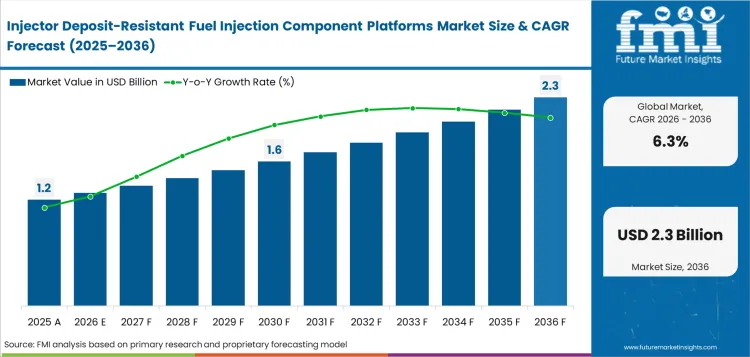
The injector deposit-resistant fuel injection component platforms market was valued at USD 1.1 billion in 2025. The market is projected to reach USD 1.2 billion by the end of 2026 and expand at a CAGR of 6.3% between 2026 and 2036 to reach USD 2.2 billion by 2036. Gasoline direct injection injector platforms are expected to lead the component type category with 38.5% share in 2026. OEM fitment is projected to lead the sales channel segment with 64.0% share in 2026.
Summary of the Injector Deposit-Resistant Fuel Injection Component Platforms Market
- Demand and Growth Drivers
- Higher injection pressure is increasing the need for injector tips with stronger residue control.
- Hybrid engine cycles raise hot-soak exposure across gasoline direct injection injector platforms.
- Stricter particulate rules support demand for spray stability across engine operating life.
- Fuel blend variation increases purchasers’ interest in seals and coatings with compatibility proof.
- Product and Segment View
- Gasoline direct injection injectors are projected to account for 38.5% of component type in 2026.
- In 2026, DLC-coated injector nozzles are expected to record 33.0% of coating share.
- Passenger car applications are projected to capture 49.0% demand in 2026.
- OEM fitment channels are expected to represent 64.0% of channel revenue in 2026.
- Geography and Competitive Outlook
- China is projected to record 7.8% CAGR during the forecast period.
- India is expected to advance at 7.2% CAGR by 2036 through vehicle injection penetration.
- Bosch and DENSO hold stronger positions through validated injector programs and engine calibration support.
- PHINIA and Hitachi Astemo are offering hydrogen injection projects and high-pressure pump development.
- Analyst Opinion
- Nikhil Kaitwade, Principal Consultant at FMI states: “Many basic market summaries classify injector deposits as repair problems without explaining OEM validation risk. The addressable market is limited to fuel injection parts proven through flow-retention and fuel-exposure testing. A deposit-resistant injector must protect spray shape after heat cycling and fuel exposure. A coating claim without flow-retention data has limited purchase value. OEMs need warranty confidence across fuel blends and driving cycles. Aftermarket brands need fitment accuracy and diagnostic compatibility. Supplier selection is based on machining precision and coating durability. Calibration support shapes OEM approval. The most capable companies tend to combine injection hardware with engine testing and fuel chemistry knowledge.”
- Injector Deposit-Resistant Fuel Injection Component Platforms Market Value Analysis
- Gasoline direct injection injectors now serve direct combustion-chamber exposure across compact turbocharged engines.
- DLC-coated nozzle surfaces are in demand as users need lower residue adhesion and stable flow.
- OEM fitment channels support premium value as automakers qualify injectors before platform release.
- OEM approval increases when suppliers provide fuel compatibility data and coating durability results.
- Low-cost replacements face the most price pressure because of testing and coating premiums required for validated injectors.
Key Takeaways, Market Size, and Forecast
- Injector deposit-resistant fuel injection component platforms market valuation was USD 1.1 billion in 2025.
- Revenue is expected to reach USD 2.2 billion by 2036.
- Industry is set to expand at 6.3% CAGR across 2026 to 2036.
- Incremental opportunity across 2026 to 2036 is USD 1.0 billion.
- Gasoline direct injection injectors are expected to lead the component type category with 38.5% share in 2026.
- China is likely to post a CAGR of 7.8% in the market through 2036.
- DLC-coated injector nozzles are projected to account for 33.0% coating share in 2026.
- OEM fitment channels are expected to contribute 64.0% of channel revenue in 2026.
Injector deposit-resistant fuel injection component platforms are expected to gain use as modern engines run at higher pressure and temperature. Innospec’s February 2026 patent targets injector fouling in systems above 1,500 bar and has 58 patent citations. Afton Chemical’s June 2024 patent also shows continued work on Mannich-based quaternary ammonium detergent chemistry. TotalEnergies’ three-additive GDI strategy supports the shift toward multi-component deposit control. These filings show why single-additive systems are becoming less sufficient for modern injectors. Demand is likely to follow GDI fleet growth and stricter emissions control needs.
Injector Deposit-Resistant Fuel Injection Component Platforms Market Definition
Injector deposit-resistant fuel injection component platforms include fuel system parts designed to reduce residue formation and flow drift. Scope includes injectors and nozzles. High-pressure pumps and fuel rails are included. Seals and electronic control units are covered. These components serve gasoline direct injection and diesel common rail systems. Flex-fuel and hydrogen combustion systems are covered. Products are used across passenger vehicles and commercial vehicles. Off-highway engines and performance applications are covered. The market includes OEM-qualified platforms and replacement components with verified deposit resistance. Fuel additives and injector cleaning products are excluded because the scope covers physical injection components.
Injector Deposit-Resistant Fuel Injection Component Platforms Market Inclusions
Market coverage includes all commercially traded injector deposit-resistant fuel injection component platforms classified by component type, including injectors, nozzles, high-pressure pumps, fuel rails, seals, and control units; technologies, including gasoline direct injection, diesel common rail, dual-fuel injection, hydrogen injection, and flex-fuel injection; coating types, including DLC coatings, ceramic coatings, fluoropolymer coatings, stainless-steel surface treatments, and laser-textured surfaces; and vehicle classes, including passenger cars, light commercial vehicles, heavy-duty vehicles, off-highway equipment, and performance vehicles. Revenue scope covers 2026 to 2036. Market participants include fuel injection system manufacturers, injector and nozzle suppliers, pump and rail manufacturers, coating technology providers, engine component companies, automakers, commercial vehicle manufacturers, aftermarket service providers, distributors, testing laboratories, and emission regulatory bodies.
Scope includes gasoline direct injection injectors and diesel common rail injectors. High-pressure pumps and fuel rails are included within platform-level fuel delivery systems. Injector seals and control units are covered if designed for deposit-sensitive engine programs. DLC-coated and ceramic-coated components are included. Fluoropolymer-coated and laser-textured components are covered. OEM fitment parts and dealer replacement components are included across global vehicle applications. Aftermarket service components are included if designed for deposit-prone direct-injection engines.
Injector Deposit-Resistant Fuel Injection Component Platforms Market Exclusions
Scope excludes fuel additives and injector cleaning chemicals. Standard injectors without deposit-resistant material or design claims are outside scope. Carburetor systems and basic low-pressure fuel delivery parts are excluded. Fuel tanks and fuel filters are outside scope unless integrated into validated injection platforms. Generic engine sensors are excluded if not used for injector deposit control. Battery electric vehicle powertrain parts are outside this combustion-focused scope.
Injector Deposit-Resistant Fuel Injection Component Platforms Market Research Methodology
- Primary Research: FMI analysts reviewed fuel injection suppliers and engine component distributors. OEM powertrain planners and aftermarket service specialists were reviewed separately. The research focused on injector deposits and fuel system selection criteria. It reviewed warranty exposure and replacement behavior across direct-injection engines.
- Desk Research: Desk research covered vehicle production statistics and emission rule updates. Fuel blend policies and direct-injection technology literature helped define platform exposure. Technical product releases and official company announcements defined supplier activity. Gasoline and diesel systems were reviewed separately. Dual-fuel and hydrogen systems were reviewed.
- Market Sizing and Forecasting: The sizing model combined vehicle production and direct-injection penetration. Component value per vehicle and replacement part pricing were considered after segment review. Forecasts were cross-checked with hybrid demand and commercial engine retention. Aftermarket replacement patterns and OEM platform qualification were reviewed separately.
- Data Validation: Validation compared company portfolios and public vehicle production signals. Emission rule timing and recent injector developments were checked separately. Forecasts were adjusted for electrification pressure and regional fuel quality differences.
Factors Advancing the Injector Deposit-Resistant Fuel Injection Component Platforms Market
- Higher fuel pressure increases deposit sensitivity across smaller spray holes and tighter injector geometries.
- Hybrid stop-start cycles raise thermal exposure across injector tips during repeated engine shutdowns.
- Emission compliance raises the value of stable spray shape across vehicle operating life.
- Ethanol and biodiesel blends create demand for seals and surfaces with fuel compatibility proof.
- Hydrogen combustion programs create early value for gas injectors and advanced sealing systems.
Fuel injection platforms are becoming more sensitive as engine makers raise pressure and reduce spray-hole size. Small nozzle changes can affect atomization and combustion quality across gasoline direct injection engines. Deposit-resistant components reduce flow drift and protect spray pattern consistency during hot operation. Suppliers serving automotive fuel injector demand need coating and machining capability beyond basic component supply.
Emission rules are increasing the cost of poor injector performance. Euro 7 and U.S. multipollutant standards place greater pressure on particle control and durability. Deposits can increase particulate output by affecting spray formation and cold-start behavior. OEMs therefore need injectors with flow-retention data after fuel aging and heat cycling. This shifts supplier qualification toward complete fuel injection system platforms with hardware and calibration support.
Hybrid engines increase injector testing needs because frequent restarts raise hot-soak exposure. Engines in hybrid vehicles can operate under short cycles and frequent restart conditions. Repeated shutdowns leave heat near injector tips and can increase residue formation. Deposit-resistant injectors protect restart quality and reduce warranty exposure in hybrid use. Suppliers with automotive fuel delivery system experience can support injectors and pumps. Fuel rails and control units can be handled through the same platform knowledge.
Market Segmentation Analysis
- Gasoline direct injection injectors are estimated to account for 38.5% share in 2026 because of direct heat exposure.
- In 2026, DLC-coated injector nozzles are expected to hold 33.0% share because of low-friction surface behavior.
- Passenger cars are anticipated to capture 49.0% of vehicle class demand in 2026.
- OEM fitment channels are set to represent 64.0% of channel revenue in 2026.
- Gasoline direct injection technology is expected to contribute 44.0% in 2026.
The market is divided into component type and technology. Coating type and vehicle class are covered. Sales channel and region complete the segmentation. Component type covers injectors and nozzles. High-pressure pumps and rails are included. Seals and control units are covered as well. Technology includes gasoline direct injection and diesel common rail. Dual-fuel injection and hydrogen injection are included. Coating type includes DLC and ceramic coatings. Fluoropolymer coatings and laser-textured surfaces are covered as well.
Injector Deposit-Resistant Fuel Injection Component Platforms Market Analysis By Component Type
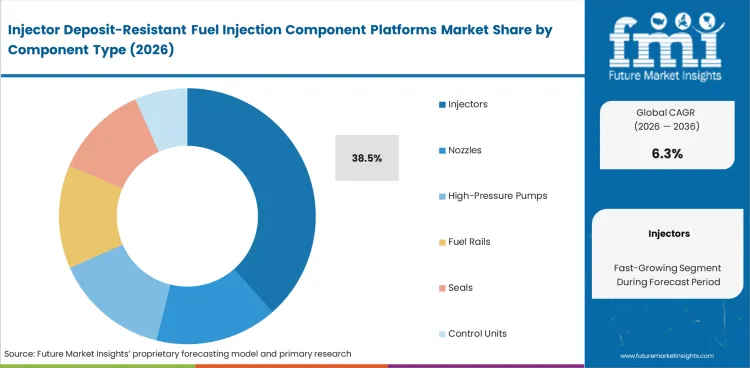
- Gasoline direct injection injectors are projected to account for 38.5% of component type share in 2026. GDI injectors lead as direct combustion exposure creates higher deposit risk.
- High-pressure pumps follow closely as stable pressure delivery supports spray consistency across direct-injection systems.
Gasoline direct injection injectors face heat and residue exposure inside the combustion chamber. Spray-hole deposits can reduce atomization and increase particulate formation. Deposit-resistant designs help maintain flow consistency after repeated hot-soak cycles. This demand is part of gasoline direct injection systems as automakers continue using downsized gasoline engines and hybrids.
Injector Deposit-Resistant Fuel Injection Component Platforms Market Analysis By Coating Type
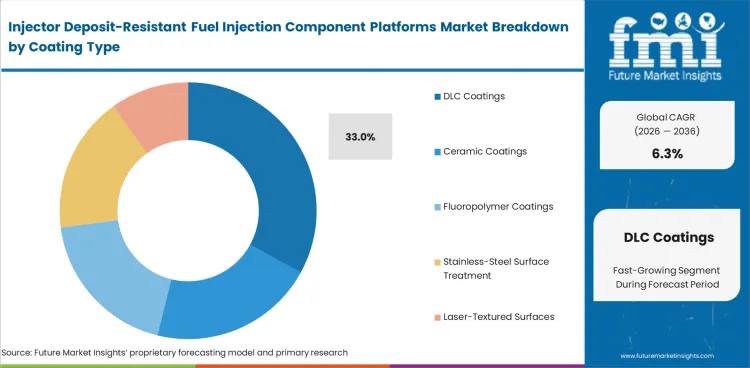
- DLC-coated injector nozzles are expected to represent 33.0% in 2026. DLC coatings are used because low-friction surfaces reduce residue adhesion and wear.
- Ceramic coatings gain value in hotter duty cycles where thermal stability and surface protection are required.
Injector Deposit-Resistant Fuel Injection Component Platforms Market Analysis By Vehicle Class
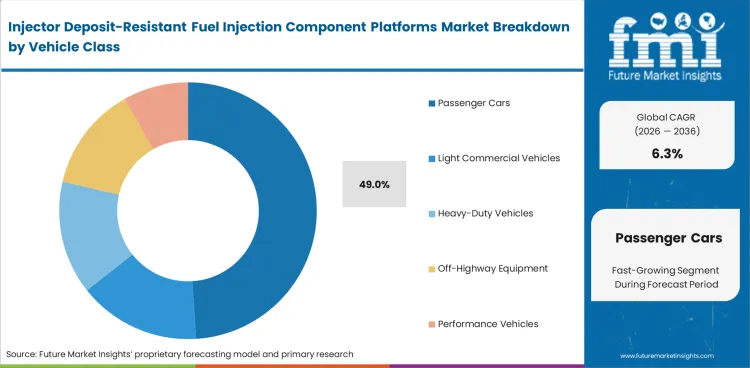
- Passenger cars are anticipated to represent 49.0% demand in 2026 because of large direct-injection engine volumes.
- Heavy-duty vehicles retain higher service value as long service intervals increase injector fouling exposure.
Injector Deposit-Resistant Fuel Injection Component Platforms Market Analysis By Sales Channel
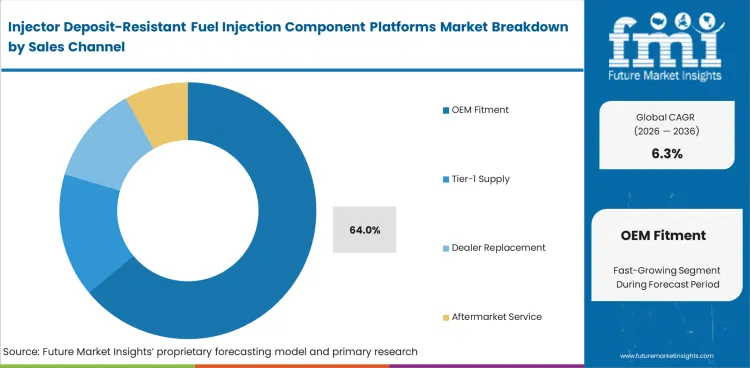
- OEM fitment channels are expected to hold 64.0% share in 2026 through factory qualification and warranty control. OEM fitment leads as automakers need validated parts for emission compliance.
- Aftermarket service channels expand as older direct-injection vehicles require injector replacement after misfire diagnosis.
Injector Deposit-Resistant Fuel Injection Component Platforms Market Drivers, Restraints, and Opportunities
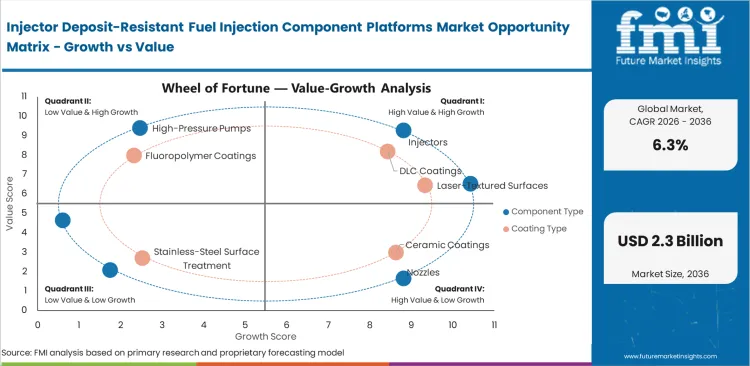
- High-pressure engines support demand for injector tips with stronger residue and wear resistance.
- Hybrid duty cycles increase hot-soak exposure across gasoline direct injection components.
- Hydrogen engines create opportunities for gas injectors with material and sealing proof.
- High coating and testing cost limits adoption in low-price replacement components.
- Fuel-quality variation creates opportunity for suppliers with wider validation data.
Fuel Pressure and Spray Stability
Fuel pressure is rising across direct-injection gasoline and diesel engines. Higher pressure supports better atomization but increases sensitivity across injector tips and nozzle holes. A small deposit layer can change spray angle and fuel distribution inside the cylinder. Deposit-resistant platforms reduce this risk and protect combustion consistency. Suppliers with nozzle machining and fuel delivery control units capability can support complete engine programs.
Fuel Blend Compatibility
Fuel blend variation creates a design challenge for injector platforms. Ethanol and biodiesel can change deposit chemistry. Low-sulfur fuels can affect seal exposure. Components need surface treatments and elastomers proven against local fuel conditions. Flex-fuel markets favor suppliers that can prove seal durability across ethanol-rich fuel blends. This need is part of B20-B30 biodiesel fuel injection components across diesel platforms using blended fuels.
Hydrogen Injection Readiness
Hydrogen combustion creates an emerging platform opportunity for suppliers with gas metering knowledge. Hydrogen injectors need sealing strength and fast response. Material compatibility is required. Hydrogen injection volumes are limited today but each qualified injector carries a higher unit price. Commercial vehicles and motorsport programs are testing hydrogen injection under severe duty cycles. This creates a link with gas and dual-fuel injection systems in the USA as fleets review lower-carbon combustion options.
Emissions Rules Are Raising Validation Burden
Regulatory compliance is becoming more dependent on real-world fuel economy and emissions proof. EPA reported in February 2026 that the average model year 2024 new vehicle increased fuel economy by 0.1 mpg to a record high 27.2 mpg. EPA stated that average new vehicle fuel economy improved 16 out of the last 20 years and increased 41% compared to model year 2004. This matters for deposit-resistant injectors because spray stability and flow consistency affect OEM ability to protect combustion efficiency over the vehicle operating life. Thermal durability and deposit control affect the same warranty risk. [1]
Analysis of Injector Deposit-Resistant Fuel Injection Component Platforms Market By Key Countries
.webp "Top Country Growth Comparison Injector Deposit Resistant Fuel Injection Component Platforms Market Cagr (2026 2036)")
| Country | CAGR |
|---|---|
| China | 7.8% |
| India | 7.2% |
| United States | 6.1% |
| South Korea | 6.0% |
| Germany | 5.8% |
| Japan | 5.6% |
| United Kingdom | 5.4% |
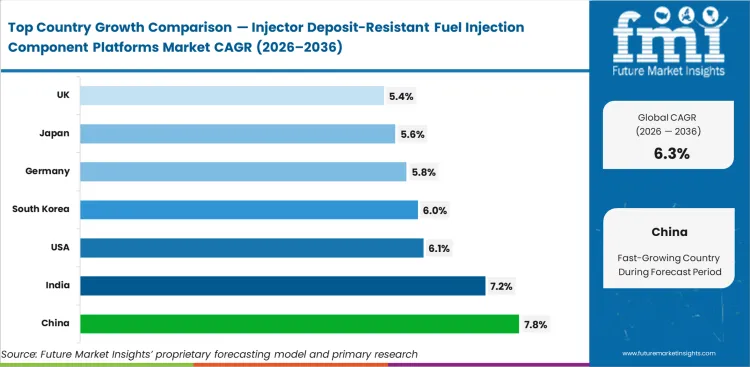
Source: FMI analysis based on primary research and proprietary forecasting model.
Injector Deposit-Resistant Fuel Injection Component Platforms CAGR Analysis By Country
- China is likely to progress at a CAGR of 7.8% by 2036, supported by hybrid and range-extended vehicle output.
- India is projected to record a CAGR of 7.2% through 2036 because of compact vehicle and two-wheeler injection penetration.
- The United States is set to record a CAGR of 6.1% during the assessment period, supported by SUV and pickup engines.
- South Korea is anticipated to expand at a CAGR of 6.0% over the forecast period through export vehicle programs.
- Germany is likely to post a CAGR of 5.8% by 2036, supported by premium engine validation needs.
- Japan is expected to advance at 5.6% CAGR through 2036 as hybrid platforms support injector precision.
- The United Kingdom is expected to register 5.4% CAGR through 2036 because of specialty engine testing activity.
Demand Outlook for Injector Deposit-Resistant Fuel Injection Component Platforms in China
China’s demand is shaped by large vehicle output and continued hybrid engine use. OICA reported global vehicle production at 96.4 million units in 2025, while Asia accounted for the largest share of output. China is projected at 7.8% CAGR by 2036 with hybrids and range-extended vehicles supporting injection platform demand. Local suppliers secure orders through cost control and fast validation cycles. Foreign suppliers retain an advantage in high-pressure injector coatings and calibration support. The opportunity is part of the wider automotive market through China’s scale in gasoline and hybrid platforms.
- Hybrid and range-extended vehicle platforms require reliable GDI injectors across frequent restart cycles.
- Local production scale supports injectors and pumps. Fuel rails and control units benefit across passenger and commercial vehicle classes.
- Emission compliance raises demand for spray stability and lower particulate formation in gasoline engines.
Sales Analysis of Injector Deposit-Resistant Fuel Injection Component Platforms in India
India is expected to expand at 7.2% CAGR through 2036 with compact vehicles and two-wheeler injection adoption. SIAM reported passenger vehicle sales of 46.43 lakh units in FY2025-26. Two-wheeler sales reached 2.17 crore units during the same fiscal year. This base supports lower-cost injectors and pump assemblies across gasoline platforms. Ethanol blending increases the need for seal and surface compatibility. Suppliers can build scale through compact engines and two-wheeler fuel injection system demand across urban mobility.
- Compact cars and scooters create demand for affordable injection platforms with stable spray control.
- Ethanol blending supports demand for seals and injector surfaces with compatibility proof.
- Urban stop-start driving increases deposit exposure across small gasoline engines and hybrid platforms.
Demand Analysis of Injector Deposit-Resistant Fuel Injection Component Platforms in the United States
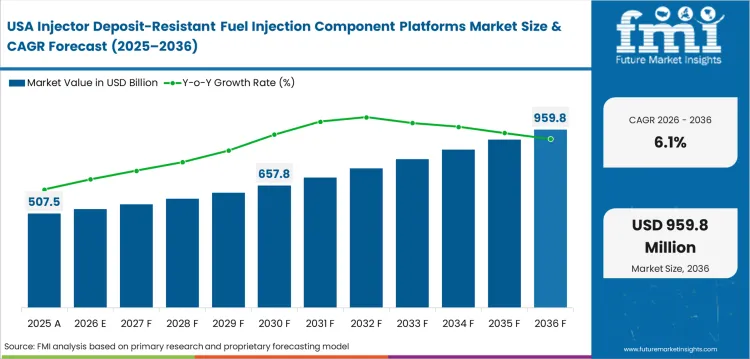
The United States has a high-value demand base because of light trucks and SUVs. Pickup engines support component replacement demand. EPA finalized multipollutant standards for model year 2027 and later light-duty and medium-duty vehicles. The United States is forecast to grow at 6.1% CAGR during the study period, supported by direct-injection gasoline engines and fleet replacement needs. OEMs need deposit-resistant injectors to protect emissions performance across vehicle life. Aftermarket channels benefit as older GDI vehicles require injector replacement after misfire diagnosis. Demand is part of automotive fuel systems across both factory and service channels.
- Pickup and SUV engines create demand for durable injectors under towing and high-load use.
- Emission standards increase pressure on automakers to protect spray quality across vehicle life.
- Dealer repair channels need verified replacements for emissions-related injector service work.
Demand Outlook for Injector Deposit-Resistant Fuel Injection Component Platforms in South Korea
South Korea combines export vehicle programs with advanced engine control capability. Hyundai and Kia platforms support demand for gasoline and hybrid injection systems. Alternative fuel injection systems provide an additional supply option beyond conventional systems. South Korea is expected to record 6.0% CAGR through 2036 as export engines require validated injection components. Hyundai KEFICO supports local supply through GDI systems and engine control units. Suppliers benefit from close coordination with OEM calibration teams. Replacement demand is smaller compared with OEM fitment but rises as older GDI fleets age.
- Export vehicle programs need injector platforms aligned with export emission markets and fuel specifications.
- Local engine control capability supports tighter integration between injectors and calibration software.
- Hybrid platforms create demand for stable restart behavior and lower deposit sensitivity.
Future Outlook for Injector Deposit-Resistant Fuel Injection Component Platforms in Germany
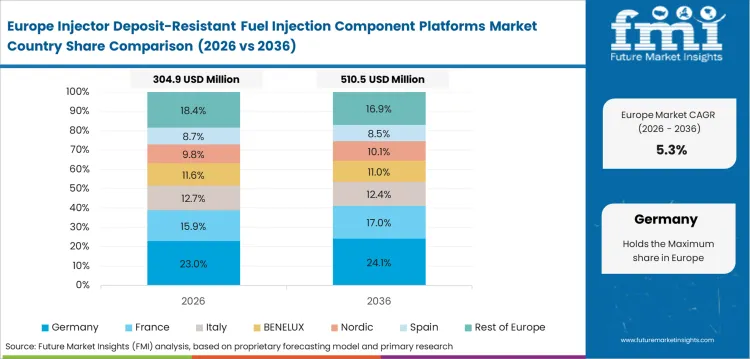
Germany is expected to advance at 5.8% CAGR over the forecast period as premium engines require tighter injection control. VDA reported domestic passenger car production of 305,900 units in January 2026. Germany-based suppliers and automakers apply strict validation standards for injectors and fuel system parts. Deposit-resistant platforms must pass fuel exposure and pressure durability tests. Emissions-related tests shape approval. Hydrogen engine trials create demand for injectors with sealing and material compatibility. Germany is part of automotive components through high-value powertrain supply chains.
- Premium gasoline engines require high-pressure injectors with verified spray stability and durability data.
- Supplier networks support coating and machining capability. Calibration capability helps advanced injection platforms.
- Hydrogen engine testing creates demand for gas injectors with sealing and material compatibility proof.
Demand Outlook for Injector Deposit-Resistant Fuel Injection Component Platforms in Japan
Japan’s market reflects hybrid leadership and compact engine efficiency. Japan-based automakers use fuel injection precision to manage fuel economy and emissions performance. Japan is projected to rise at 5.6% CAGR through 2036 as hybrid vehicles support injector demand. DENSO and Hitachi Astemo provide domestic capability across injectors, pumps, and engine management. End users focus on long-term field reliability and production consistency. Small engine packaging increases sensitivity to spray drift and deposit formation. Demand is part of automotive electronics as control units shape fuel delivery accuracy.
- Hybrid engine programs need injectors that handle frequent restart and short-cycle operation.
- Compact gasoline engines increase sensitivity to spray drift and nozzle residue formation.
- Domestic Tier-1 suppliers strengthen qualification through integrated engine management capability.
In-depth Analysis of Injector Deposit-Resistant Fuel Injection Component Platforms in the United Kingdom
The United Kingdom is smaller in vehicle production but important for specialty engineering and engine testing. SMMT reported UK vehicle production at 764,715 units during 2025. Hydrogen engine development and motorsport programs create specific value for advanced injector platforms. The United Kingdom is projected to rise at 5.4% CAGR through 2036 as hydrogen testing and aftermarket service support demand. PHINIA’s involvement in hydrogen injector projects strengthens local relevance. Companies focus on validation evidence, performance durability, and compliance support.
- Hydrogen engine projects create demand for injectors with gas sealing and material compatibility.
- Motorsport and specialty engineering support high-flow injector validation under severe operating conditions.
- Aftermarket service channels need reliable replacement injectors for aging direct-injection gasoline fleets.
Competitive Landscape and Strategic Positioning
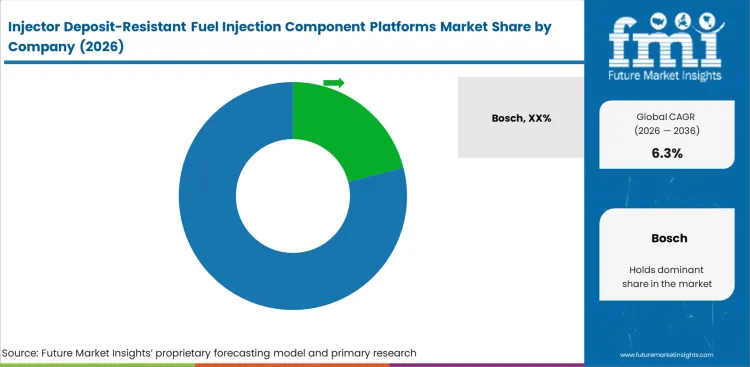
- The market is moderately consolidated with global fuel system suppliers controlling OEM-qualified programs.
- Smaller specialists win orders using coating systems, performance injectors, and targeted replacement parts.
- Barriers to entry include coating validation, flow testing, and engine calibration requirements.
- Regional suppliers can win aftermarket orders if fitment and fuel compatibility meet the needs of users.
Competitive strength comes from proof of injector durability across heat and pressure. Fuel exposure testing shapes supplier approval. Companies test flow retention and spray stability before platform approval. OEM qualification and calibration support decide final supplier selection. Bosch’s hydrogen injector activity shows supplier movement toward alternative combustion platforms. In deposit-sensitive applications, injector failure can create warranty complaints and emissions service events. Suppliers with proven testing and fuel system program experience hold stronger positions in OEM channels.
Established companies benefit from product breadth across gasoline and diesel injection systems. Hydrogen injection adds a higher-value technical path. Bosch supports commercial vehicle and hydrogen platforms. DENSO brings injector and engine management integration. PHINIA supplies GDI and diesel injection technologies. Direct hydrogen injection strengthens its alternative fuel position. Hitachi Astemo supports fuel supply systems and high-pressure pumps. These manufacturers can serve automakers from component design through engine calibration. That capability reduces switching risk for automakers.
Specialist companies win orders through coating expertise and calibrated replacement injector programs. Stanadyne participates through diesel common rail and performance injection products. Marelli supports fuel system electronics and regional powertrain control needs. Hyundai KEFICO benefits from close links with Korean vehicle platforms. Larger suppliers may form partnerships to access hydrogen injector testing and fuel compatibility data.
Key Companies in the Injector Deposit-Resistant Fuel Injection Component Platforms Market
Injector deposit-resistant fuel injection component platform competition includes fuel system suppliers, high-pressure pump specialists, coating technology providers, and aftermarket injection brands.
- Global Leaders: Bosch and DENSO use OEM injection access and calibration support to protect platform positions. PHINIA and Hitachi Astemo use fuel system programs and platform experience to serve high-pressure applications.
- Fuel System Specialists: Stanadyne and Marelli use high-pressure injection and engine control units to serve specialized programs. Specialty fuel system components strengthen their platform role.
- OEM-Linked Suppliers: Hyundai KEFICO participates through GDI systems and control units for Korean vehicle platforms. This position supports tight integration between fuel delivery hardware and engine management software.
- Aftermarket and Performance Channels: Specialist injector brands address older GDI and diesel vehicles needing replacement parts. These companies use fitment accuracy and flow matching to serve replacements. Service channel reach supports replacement sales.
Competitive Benchmarking: Injector Deposit-Resistant Fuel Injection Component Platforms Market
| Company | Deposit Resistance Capability | Fuel System Depth | OEM Access | Geographic Footprint |
|---|---|---|---|---|
| Bosch | High | High | High | Global |
| DENSO | High | High | High | Global |
| PHINIA | High | High | High | Global |
| Hitachi Astemo | Medium | High | High | Global |
| Stanadyne | Medium | High | Medium | North America and Europe |
| Marelli | Medium | Medium | Medium | Global |
| Hyundai KEFICO | Medium | Medium | High | Asia and Global OEM Programs |
Source: Future Market Insights competitive analysis, 2026. Ratings reflect relative positioning based on deposit resistance capability, fuel system depth, and OEM access.
Key Developments in Injector Deposit-Resistant Fuel Injection Component Platforms Market
- In April 2025, Bosch presented hydrogen injectors at ACT Expo. This supports commercial vehicle combustion programs using alternative fuel injection systems.
- In January 2025, PHINIA strengthened its Alpine Racing partnership for hydrogen powertrain development. This supports direct hydrogen injector validation under motorsport conditions.
- In March 2025, Cummins reported Project Brunel hydrogen engine progress with PHINIA participation. This supports medium-duty injector development for hydrogen combustion.
- In August 2024, Hitachi Astemo introduced Generation 5 high-pressure pumps capable of up to 500 bar. This supports newer hybrid and direct-injection fuel delivery platforms.
- In April 2024, Stanadyne’s 2P DCR fuel pump won an Automotive News PACE Award. This reinforces diesel common rail innovation for clean propulsion systems.
- In March 2026, Marelli launched engine control units for gasoline and flex fuels. CNG capability supports regional fuel delivery control.
Key Players in the Injector Deposit-Resistant Fuel Injection Component Platforms Market
Global Fuel Injection System Suppliers
- Bosch
- DENSO
- PHINIA
- Hitachi Astemo
High-Pressure Pump and Injector Specialists
- Stanadyne
- Marelli
OEM-Linked Fuel Control Suppliers
- Hyundai KEFICO
Aftermarket and Service Channel Suppliers
- Delphi Technologies
- Standard Motor Products
- GB Remanufacturing
Report Scope and Coverage
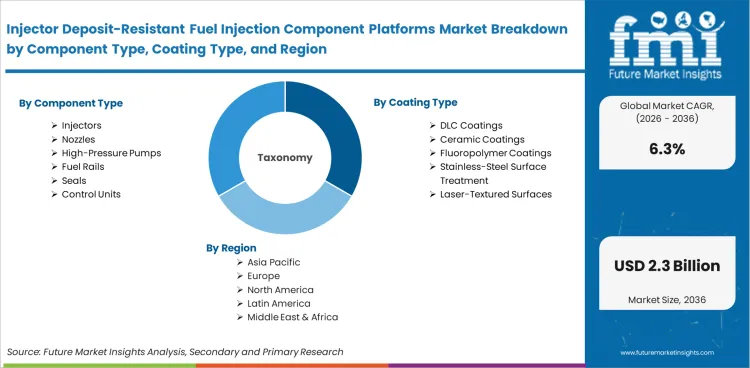
Injector Deposit-Resistant Fuel Injection Component Platforms Market Breakdown By Component Type, Technology, Coating Type, Vehicle Class, Sales Channel and Region
| Parameter | Details |
|---|---|
| Quantitative Units | USD 1.2 billion in 2026 to USD 2.2 billion by 2036, at 6.3% CAGR |
| Market Definition | Fuel injection components designed to reduce deposits, flow drift, spray instability, and related performance loss |
| Regions Covered | North America, Latin America, Europe, East Asia, South Asia and Pacific, Middle East and Africa |
| Countries Covered | China, India, United States, South Korea, Germany, Japan, United Kingdom and 30+ countries |
| Key Companies Profiled | Bosch, DENSO, PHINIA, Hitachi Astemo, Stanadyne, Marelli and Hyundai KEFICO |
| Forecast Period | 2026 to 2036 |
| Approach | Hybrid bottom-up and top-down method using vehicle production, injection penetration and component pricing checks |
Injector Deposit-Resistant Fuel Injection Component Platforms by Segments
Injector Deposit-Resistant Fuel Injection Component Platforms Market Segmented by Component Type:
- Injectors
- Nozzles
- High-Pressure Pumps
- Fuel Rails
- Seals
- Control Units
Injector Deposit-Resistant Fuel Injection Component Platforms Market Segmented by Technology:
- Gasoline Direct Injection
- Diesel Common Rail
- Dual-Fuel Injection
- Hydrogen Injection
- Flex-Fuel Injection
Injector Deposit-Resistant Fuel Injection Component Platforms Market Segmented by Coating Type:
- DLC Coatings
- Ceramic Coatings
- Fluoropolymer Coatings
- Stainless-Steel Surface Treatment
- Laser-Textured Surfaces
Injector Deposit-Resistant Fuel Injection Component Platforms Market Segmented by Vehicle Class:
- Passenger Cars
- Light Commercial Vehicles
- Heavy-Duty Vehicles
- Off-Highway Equipment
- Performance Vehicles
Injector Deposit-Resistant Fuel Injection Component Platforms Market Segmented by Sales Channel:
- OEM Fitment
- Tier-1 Supply
- Dealer Replacement
- Aftermarket Service
Injector Deposit-Resistant Fuel Injection Component Platforms Market by Region:
- North America
- USA
- Canada
- Mexico
- Latin America
- Brazil
- Chile
- Rest of Latin America
- Western Europe
- Germany
- UK
- Italy
- Spain
- France
- Nordic
- BENELUX
- Rest of Western Europe
- Eastern Europe
- Russia
- Poland
- Hungary
- Balkan & Baltic
- Rest of Eastern Europe
- East Asia
- China
- Japan
- South Korea
- South Asia and Pacific
- India
- ASEAN
- Australia & New Zealand
- Rest of South Asia and Pacific
- Middle East & Africa
- Kingdom of Saudi Arabia
- Other GCC Countries
- Turkiye
- South Africa
- Other African Union
- Rest of Middle East & Africa
Research Sources and Bibliography
- United States Environmental Protection Agency. (2026, February 19). Highlights of the Automotive Trends Report | US EPA.
- European Union. (2024, April). Regulation (EU) 2024/1257 of the European Parliament and of the Council. European Union.
- International Council on Clean Transportation. (2024, March). Euro 7: The new emission standard for light- and heavy-duty vehicles. ICCT.
- United States Environmental Protection Agency. (2024, March). Final rule: Multi-pollutant emissions standards for model years 2027 and later light-duty and medium-duty vehicles. EPA.
- International Organization of Motor Vehicle Manufacturers. (2026, April). Auto industry growth shifted east in 2025 amid global repositioning. OICA.
- Society of Indian Automobile Manufacturers. (2026, April). Auto Industry Performance of Q4 January-March 2026 and FY 2025-26. SIAM.
- Verband der Automobilindustrie. (2026, February). Car production in Germany in January 2026. VDA.
- Society of Motor Manufacturers and Traders. (2026, February). Vehicle production down in January amid weak global markets. SMMT.
- Bosch. (2025, April). Bosch at the ready with range of mobility solutions for today’s and tomorrow’s commercial vehicle needs. Bosch.
- PHINIA. (2025, January). PHINIA strengthens strategic partnership with Alpine Racing to drive innovation in motorsports. PHINIA.
- Cummins. (2025, March). Cummins and partners celebrate successful hydrogen engine project. Cummins.
- Hitachi Astemo. (2024, August). Hitachi Astemo to present automotive solutions at Automechanika Frankfurt 2024. Hitachi Astemo.
- Stanadyne. (2024, April). Stanadyne’s 2P DCR fuel pump wins a 2024 Automotive News PACE Award. Stanadyne.
- Marelli. (2026, March). Marelli launches new range of engine control units for gasoline, flex fuels and CNG. Marelli.
- Hyundai KEFICO. (2026). Internal combustion engine: GDI. Hyundai KEFICO.
The bibliography is provided for reader reference and uses FMI market anchors, trade body data, regulatory sources, and official company publications.
This Report Answers
- What is the projected size of the injector deposit-resistant fuel injection component platforms market in 2026 and 2036?
- What CAGR is forecast for deposit-resistant fuel injection component demand between 2026 and 2036?
- Which component type is projected to lead injector deposit-resistant fuel injection platform demand in 2026?
- Which coating type is expected to account for the highest share in 2026?
- Which countries are forecast to record faster market expansion through 2036?
- Which companies hold deeper positions in injectors, pumps, coatings, and calibration systems?
- What components are included and excluded from this injector deposit-resistant platform scope?
- Which vehicle classes shape OEM and aftermarket component buying?
- What methodology supports FMI’s market size and country-level forecast view?
Frequently Asked Questions
What is the global demand for injector deposit-resistant fuel injection component platforms in 2026?
For 2026, the global injector deposit-resistant fuel injection component platforms market is expected to be worth USD 1.2 billion through wider use in gasoline direct injection, diesel common rail, hybrid, and alternative fuel engine platforms.
What is the projected value of the injector deposit-resistant fuel injection component platforms market by 2036?
By 2036, the valuation is projected to reach USD 2.2 billion as high-pressure injectors, coated nozzles, fuel rails, and control units gain wider OEM and replacement channel use.
What CAGR is expected for the market between 2026 and 2036?
The market is forecast to expand at 6.3% CAGR between 2026 and 2036 across global combustion, hybrid, commercial vehicle, and alternative fuel engine applications.
Which component type is projected to lead in 2026?
Gasoline direct injection injectors are projected to account for 38.5% share in 2026 through direct combustion exposure and stronger sensitivity to nozzle deposits.
Which coating type is expected to lead in 2026?
DLC-coated injector nozzles are expected to represent 33.0% share in 2026 as suppliers use low-friction surfaces to reduce residue adhesion and wear.
Which country is forecast to expand fastest through 2036?
China is projected to record 7.8% CAGR through 2036 as hybrid output, gasoline direct injection platforms, and range-extended vehicle programs support component demand.
What is included in the injector deposit-resistant fuel injection component platforms market?
The scope includes injectors, nozzles, pumps, rails, seals, and control units designed to reduce deposit formation and flow drift across fuel injection systems.
What method supports the forecast?
FMI used vehicle production, direct-injection penetration, component pricing, replacement cycles, and company portfolio checks to validate the market forecast.
Preview the report firsthand - request a free sample
Get SampleGet the brochure for pricing and purchase details.
Get PDFTable of Content
- Executive Summary
- Global Market Outlook
- Demand-side Trends
- Supply-side Trends
- Technology Roadmap Analysis
- Analysis and Recommendations
- Market Overview
- Market Coverage / Taxonomy
- Market Definition / Scope / Limitations
- Research Methodology
- Chapter Orientation
- Analytical Lens and Working Hypotheses
- Market Structure, Signals, and Trend Drivers
- Research Design and Evidence Framework
- Desk Research Programme (Secondary Evidence)
- Company Annual and Sustainability Reports
- Peer-reviewed Journals and Academic Literature
- Corporate Websites, Product Literature, and Technical Notes
- Earnings Decks and Investor Briefings
- Statutory Filings and Regulatory Disclosures
- Technical White Papers and Standards Notes
- Trade Journals, Industry Magazines, and Analyst Briefs
- Conference Proceedings, Webinars, and Seminar Materials
- Government Statistics Portals and Public Data Releases
- Press Releases and Reputable Media Coverage
- Specialist Newsletters and Curated Briefings
- Sector Databases and Reference Repositories
- FMI Internal Proprietary Databases and Historical Market Datasets
- Subscription Datasets and Paid Sources
- Social Channels, Communities, and Digital Listening Inputs
- Additional Desk Sources
- Expert Input and Fieldwork (Primary Evidence)
- Primary Modes
- Qualitative Interviews and Expert Elicitation
- Quantitative Surveys and Structured Data Capture
- Blended Approach
- Why Primary Evidence is Used
- Field Techniques
- Interviews
- Surveys
- Board Members
- Presidents and Vice Presidents
- R&D and Innovation Heads
- Technical Specialists
- Domain Subject-matter Experts
- Scientists
- Physicians and Other Healthcare Professionals
- Governance, Ethics, and Data Stewardship
- Research Ethics
- Data Integrity and Handling
- Primary Modes
- Tooling, Models, and Reference Databases
- Desk Research Programme (Secondary Evidence)
- Data Engineering and Model Build
- Data Acquisition and Ingestion
- Cleaning, Normalisation, and Verification
- Synthesis, Triangulation, and Analysis
- Quality Assurance and Audit Trail
- Market Background
- Market Dynamics
- Drivers
- Restraints
- Opportunity
- Trends
- Scenario Forecast
- Demand in Optimistic Scenario
- Demand in Likely Scenario
- Demand in Conservative Scenario
- Opportunity Map Analysis
- Product Life Cycle Analysis
- Supply Chain Analysis
- Investment Feasibility Matrix
- Value Chain Analysis
- PESTLE and Porter’s Analysis
- Regulatory Landscape
- Regional Parent Market Outlook
- Production and Consumption Statistics
- Import and Export Statistics
- Market Dynamics
- Global Market Analysis 2021 to 2025 and Forecast, 2026 to 2036
- Historical Market Size Value (USD Million) Analysis, 2021 to 2025
- Current and Future Market Size Value (USD Million) Projections, 2026 to 2036
- Y-o-Y Growth Trend Analysis
- Absolute $ Opportunity Analysis
- Global Market Pricing Analysis 2021 to 2025 and Forecast 2026 to 2036
- Global Market Analysis 2021 to 2025 and Forecast 2026 to 2036, By Component Type
- Introduction / Key Findings
- Historical Market Size Value (USD Million) Analysis By Component Type , 2021 to 2025
- Current and Future Market Size Value (USD Million) Analysis and Forecast By Component Type , 2026 to 2036
- Injectors
- Nozzles
- High-Pressure Pumps
- Fuel Rails
- Seals
- Control Value (USD Million)s
- Injectors
- Y-o-Y Growth Trend Analysis By Component Type , 2021 to 2025
- Absolute $ Opportunity Analysis By Component Type , 2026 to 2036
- Global Market Analysis 2021 to 2025 and Forecast 2026 to 2036, By Coating Type
- Introduction / Key Findings
- Historical Market Size Value (USD Million) Analysis By Coating Type, 2021 to 2025
- Current and Future Market Size Value (USD Million) Analysis and Forecast By Coating Type, 2026 to 2036
- DLC Coatings
- Ceramic Coatings
- Fluoropolymer Coatings
- Stainless-Steel Surface Treatment
- Laser-Textured Surfaces
- DLC Coatings
- Y-o-Y Growth Trend Analysis By Coating Type, 2021 to 2025
- Absolute $ Opportunity Analysis By Coating Type, 2026 to 2036
- Global Market Analysis 2021 to 2025 and Forecast 2026 to 2036, By Vehicle Class
- Introduction / Key Findings
- Historical Market Size Value (USD Million) Analysis By Vehicle Class, 2021 to 2025
- Current and Future Market Size Value (USD Million) Analysis and Forecast By Vehicle Class, 2026 to 2036
- Passenger Cars
- Light Commercial Vehicles
- Heavy-Duty Vehicles
- Off-Highway Equipment
- Performance Vehicles
- Passenger Cars
- Y-o-Y Growth Trend Analysis By Vehicle Class, 2021 to 2025
- Absolute $ Opportunity Analysis By Vehicle Class, 2026 to 2036
- Global Market Analysis 2021 to 2025 and Forecast 2026 to 2036, By Sales Channel
- Introduction / Key Findings
- Historical Market Size Value (USD Million) Analysis By Sales Channel, 2021 to 2025
- Current and Future Market Size Value (USD Million) Analysis and Forecast By Sales Channel, 2026 to 2036
- OEM Fitment
- Tier-1 Supply
- Dealer Replacement
- Aftermarket Service
- OEM Fitment
- Y-o-Y Growth Trend Analysis By Sales Channel, 2021 to 2025
- Absolute $ Opportunity Analysis By Sales Channel, 2026 to 2036
- Global Market Analysis 2021 to 2025 and Forecast 2026 to 2036, By Region
- Introduction
- Historical Market Size Value (USD Million) Analysis By Region, 2021 to 2025
- Current Market Size Value (USD Million) Analysis and Forecast By Region, 2026 to 2036
- North America
- Latin America
- Western Europe
- Eastern Europe
- East Asia
- South Asia and Pacific
- Middle East & Africa
- Market Attractiveness Analysis By Region
- North America Market Analysis 2021 to 2025 and Forecast 2026 to 2036, By Country
- Historical Market Size Value (USD Million) Trend Analysis By Market Taxonomy, 2021 to 2025
- Market Size Value (USD Million) Forecast By Market Taxonomy, 2026 to 2036
- By Country
- USA
- Canada
- Mexico
- By Component Type
- By Coating Type
- By Vehicle Class
- By Sales Channel
- By Country
- Market Attractiveness Analysis
- By Country
- By Component Type
- By Coating Type
- By Vehicle Class
- By Sales Channel
- Key Takeaways
- Latin America Market Analysis 2021 to 2025 and Forecast 2026 to 2036, By Country
- Historical Market Size Value (USD Million) Trend Analysis By Market Taxonomy, 2021 to 2025
- Market Size Value (USD Million) Forecast By Market Taxonomy, 2026 to 2036
- By Country
- Brazil
- Chile
- Rest of Latin America
- By Component Type
- By Coating Type
- By Vehicle Class
- By Sales Channel
- By Country
- Market Attractiveness Analysis
- By Country
- By Component Type
- By Coating Type
- By Vehicle Class
- By Sales Channel
- Key Takeaways
- Western Europe Market Analysis 2021 to 2025 and Forecast 2026 to 2036, By Country
- Historical Market Size Value (USD Million) Trend Analysis By Market Taxonomy, 2021 to 2025
- Market Size Value (USD Million) Forecast By Market Taxonomy, 2026 to 2036
- By Country
- Germany
- UK
- Italy
- Spain
- France
- Nordic
- BENELUX
- Rest of Western Europe
- By Component Type
- By Coating Type
- By Vehicle Class
- By Sales Channel
- By Country
- Market Attractiveness Analysis
- By Country
- By Component Type
- By Coating Type
- By Vehicle Class
- By Sales Channel
- Key Takeaways
- Eastern Europe Market Analysis 2021 to 2025 and Forecast 2026 to 2036, By Country
- Historical Market Size Value (USD Million) Trend Analysis By Market Taxonomy, 2021 to 2025
- Market Size Value (USD Million) Forecast By Market Taxonomy, 2026 to 2036
- By Country
- Russia
- Poland
- Hungary
- Balkan & Baltic
- Rest of Eastern Europe
- By Component Type
- By Coating Type
- By Vehicle Class
- By Sales Channel
- By Country
- Market Attractiveness Analysis
- By Country
- By Component Type
- By Coating Type
- By Vehicle Class
- By Sales Channel
- Key Takeaways
- East Asia Market Analysis 2021 to 2025 and Forecast 2026 to 2036, By Country
- Historical Market Size Value (USD Million) Trend Analysis By Market Taxonomy, 2021 to 2025
- Market Size Value (USD Million) Forecast By Market Taxonomy, 2026 to 2036
- By Country
- China
- Japan
- South Korea
- By Component Type
- By Coating Type
- By Vehicle Class
- By Sales Channel
- By Country
- Market Attractiveness Analysis
- By Country
- By Component Type
- By Coating Type
- By Vehicle Class
- By Sales Channel
- Key Takeaways
- South Asia and Pacific Market Analysis 2021 to 2025 and Forecast 2026 to 2036, By Country
- Historical Market Size Value (USD Million) Trend Analysis By Market Taxonomy, 2021 to 2025
- Market Size Value (USD Million) Forecast By Market Taxonomy, 2026 to 2036
- By Country
- India
- ASEAN
- Australia & New Zealand
- Rest of South Asia and Pacific
- By Component Type
- By Coating Type
- By Vehicle Class
- By Sales Channel
- By Country
- Market Attractiveness Analysis
- By Country
- By Component Type
- By Coating Type
- By Vehicle Class
- By Sales Channel
- Key Takeaways
- Middle East & Africa Market Analysis 2021 to 2025 and Forecast 2026 to 2036, By Country
- Historical Market Size Value (USD Million) Trend Analysis By Market Taxonomy, 2021 to 2025
- Market Size Value (USD Million) Forecast By Market Taxonomy, 2026 to 2036
- By Country
- Kingdom of Saudi Arabia
- Other GCC Countries
- Turkiye
- South Africa
- Other African Union
- Rest of Middle East & Africa
- By Component Type
- By Coating Type
- By Vehicle Class
- By Sales Channel
- By Country
- Market Attractiveness Analysis
- By Country
- By Component Type
- By Coating Type
- By Vehicle Class
- By Sales Channel
- Key Takeaways
- Key Countries Market Analysis
- USA
- Pricing Analysis
- Market Share Analysis, 2025
- By Component Type
- By Coating Type
- By Vehicle Class
- By Sales Channel
- Canada
- Pricing Analysis
- Market Share Analysis, 2025
- By Component Type
- By Coating Type
- By Vehicle Class
- By Sales Channel
- Mexico
- Pricing Analysis
- Market Share Analysis, 2025
- By Component Type
- By Coating Type
- By Vehicle Class
- By Sales Channel
- Brazil
- Pricing Analysis
- Market Share Analysis, 2025
- By Component Type
- By Coating Type
- By Vehicle Class
- By Sales Channel
- Chile
- Pricing Analysis
- Market Share Analysis, 2025
- By Component Type
- By Coating Type
- By Vehicle Class
- By Sales Channel
- Germany
- Pricing Analysis
- Market Share Analysis, 2025
- By Component Type
- By Coating Type
- By Vehicle Class
- By Sales Channel
- UK
- Pricing Analysis
- Market Share Analysis, 2025
- By Component Type
- By Coating Type
- By Vehicle Class
- By Sales Channel
- Italy
- Pricing Analysis
- Market Share Analysis, 2025
- By Component Type
- By Coating Type
- By Vehicle Class
- By Sales Channel
- Spain
- Pricing Analysis
- Market Share Analysis, 2025
- By Component Type
- By Coating Type
- By Vehicle Class
- By Sales Channel
- France
- Pricing Analysis
- Market Share Analysis, 2025
- By Component Type
- By Coating Type
- By Vehicle Class
- By Sales Channel
- India
- Pricing Analysis
- Market Share Analysis, 2025
- By Component Type
- By Coating Type
- By Vehicle Class
- By Sales Channel
- ASEAN
- Pricing Analysis
- Market Share Analysis, 2025
- By Component Type
- By Coating Type
- By Vehicle Class
- By Sales Channel
- Australia & New Zealand
- Pricing Analysis
- Market Share Analysis, 2025
- By Component Type
- By Coating Type
- By Vehicle Class
- By Sales Channel
- China
- Pricing Analysis
- Market Share Analysis, 2025
- By Component Type
- By Coating Type
- By Vehicle Class
- By Sales Channel
- Japan
- Pricing Analysis
- Market Share Analysis, 2025
- By Component Type
- By Coating Type
- By Vehicle Class
- By Sales Channel
- South Korea
- Pricing Analysis
- Market Share Analysis, 2025
- By Component Type
- By Coating Type
- By Vehicle Class
- By Sales Channel
- Russia
- Pricing Analysis
- Market Share Analysis, 2025
- By Component Type
- By Coating Type
- By Vehicle Class
- By Sales Channel
- Poland
- Pricing Analysis
- Market Share Analysis, 2025
- By Component Type
- By Coating Type
- By Vehicle Class
- By Sales Channel
- Hungary
- Pricing Analysis
- Market Share Analysis, 2025
- By Component Type
- By Coating Type
- By Vehicle Class
- By Sales Channel
- Kingdom of Saudi Arabia
- Pricing Analysis
- Market Share Analysis, 2025
- By Component Type
- By Coating Type
- By Vehicle Class
- By Sales Channel
- Turkiye
- Pricing Analysis
- Market Share Analysis, 2025
- By Component Type
- By Coating Type
- By Vehicle Class
- By Sales Channel
- South Africa
- Pricing Analysis
- Market Share Analysis, 2025
- By Component Type
- By Coating Type
- By Vehicle Class
- By Sales Channel
- USA
- Market Structure Analysis
- Competition Dashboard
- Competition Benchmarking
- Market Share Analysis of Top Players
- By Regional
- By Component Type
- By Coating Type
- By Vehicle Class
- By Sales Channel
- Competition Analysis
- Competition Deep Dive
- Bosch
- Overview
- Product Portfolio
- Profitability by Market Segments (Product/Age /Sales Channel/Region)
- Sales Footprint
- Strategy Overview
- Marketing Strategy
- Product Strategy
- Channel Strategy
- DENSO
- PHINIA
- Hitachi Astemo
- Stanadyne
- Marelli
- Hyundai KEFICO
- Bosch
- Competition Deep Dive
- Assumptions & Acronyms Used


