

- Industry Size (2026)
- USD 6.3 Bn
- Forecast (2036)
- USD 8.6 Bn
- CAGR (2026 to 2036)
- 3.2%
Fuel Filters and Water Separators Market Forecast and Outlook 2026 to 2036
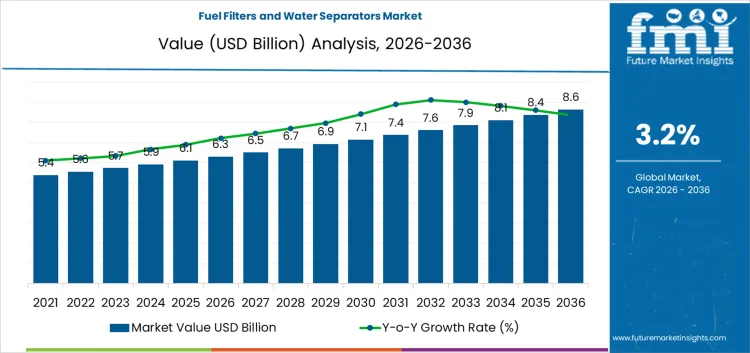
The fuel filters and water separators market is valued at USD 6.3 billion in 2026 and is projected to reach USD 8.6 billion by 2036, reflecting a CAGR of 3.2%. Demand in the first half of the period is shaped by risk control rather than by unit sales of vehicles. Operators in logistics, mining, and agriculture treat fuel contamination as a direct cost exposure tied to injector failures and downtime. Procurement policies often specify filter change intervals by hours of operation, not by mileage. Regional fuel quality variance raises usage rates in many emerging routes. Suppliers compete on verified separation efficiency, housing integrity, and field failure records.
By the later years, purchasing behavior reflects tighter warranty terms and closer alignment between engine makers and filtration suppliers. Engine platforms increasingly lock specific filter designs into service manuals, which narrows substitution and stabilizes volumes. Price sensitivity remains, yet switching costs rise because validation and fitment risks sit with the operator. Distribution shifts toward bundled service contracts rather than standalone part sales. Capacity planning follows installed base geography more than production forecasts. Growth remains steady, supported by operating hour intensity, fuel storage practices, and compliance routines, rather than by changes in vehicle mix or short cycle equipment turnover.
Quick Stats of the Fuel Filters and Water Separators Market
- Fuel Filters and Water Separators Market Value (2026): USD 6.3 billion
- Fuel Filters and Water Separators Forecast Value (2036): USD 8.6 billion
- Fuel Filters and Water Separators Forecast CAGR 2026 to 2036: 3.2%
- Leading Fuel Type in Fuel Filters and Water Separators Market: Diesel Filters & Separators (58% share)
- Leading Technology in Fuel Filters and Water Separators Market: Multi-Stage Filtration (36% share)
- Key Growth Regions in Fuel Filters and Water Separators Market: India, Indonesia, China, Brazil, Mexico
- Top Players in Fuel Filters and Water Separators Market: Cummins Filtration (Fleetguard), Donaldson, Parker Hannifin (Racor), MANN+HUMMEL, MAHLE, Bosch, Denso, Hengst, UFI Filters, Sogefi
What is the Growth Forecast for Fuel Filters and Water Separators Market through 2036?
Between 2026 and 2031, the fuel filters and water separators market is expected to increase from USD 6.3 billion along a path consistent with a 3.2% CAGR, reflecting a business shaped by operating conditions rather than by vehicle styling cycles. Diesel applications set the pace because contamination risk, fuel quality variability, and injector sensitivity make filtration performance a reliability issue rather than a maintenance preference. Multi-stage systems and water separation media see steady uptake in commercial and off-highway fleets, where downtime costs dominate procurement logic. Demand patterns are anchored in service intervals and usage intensity, not in new vehicle sales alone. The aftermarket carries more weight than OEM channels, placing emphasis on distribution reach, parts availability, and consistent field performance across varied operating environments.
From 2031 to 2036, the market is projected to reach USD 8.6 billion, with expansion continuing to follow fleet growth and equipment utilization rather than step changes in powertrain design. Heated filter assemblies and higher-efficiency separation systems gain relevance in colder and higher-moisture operating regions, though they remain niche in volume terms. Fleet operators increasingly standardize filtration specifications across mixed vehicle groups to simplify maintenance logistics. This favors suppliers able to offer broad catalogs with dependable supply continuity. Competitive strength rests on field-proven reliability, manufacturing scale, and service network integration, supporting the position of companies such as Cummins Filtration (Fleetguard), Donaldson, Parker Hannifin (Racor), MANN+HUMMEL, MAHLE, Bosch, Denso, Hengst, UFI Filters, and Sogefi.
Fuel Filters and Water Separators Market Key Takeaways
| Metric | Value |
|---|---|
| Market Value (2026) | USD 6.3 billion |
| Forecast Value (2036) | USD 8.6 billion |
| Forecast CAGR 2026 to 2036 | 3.2% |
How Are Fuel Filters and Water Separators Improving Engine Reliability?
Fuel filters and water separators are increasingly adopted to protect engines from contaminants, water ingress, and particulate matter, ensuring consistent performance and longevity. Historically, engines relied on basic filtration, which often allowed debris and moisture to enter fuel systems, leading to injector fouling, corrosion, and operational inefficiencies. Modern fuel filters integrate high-efficiency filtration media, water separation membranes, and sediment traps to remove particulates and water while maintaining steady fuel flow. Automotive OEMs, engine manufacturers, and fleet operators prioritize filtration efficiency, flow rate, and compliance with fuel system standards. Early adoption focused on diesel engines and heavy-duty vehicles, while current demand spans passenger cars, trucks, marine engines, and industrial equipment, driven by stricter fuel quality requirements, emission standards, and reliability expectations. Flow capacity, material durability, and separation efficiency influence supplier selection.
Rising fuel system complexity, fuel quality variability, and regulatory compliance are shaping market growth. Compared with conventional filters, modern fuel filter and water separator systems emphasize enhanced water removal, fine particulate capture, and chemical resistance for long-term reliability. Cost structures depend on media material, housing quality, and assembly precision, concentrating margins among suppliers capable of delivering certified, high-performance solutions. Manufacturers and operators adopt these systems to prevent engine damage, ensure fuel efficiency, and maintain compliance with emission and safety standards. By 2036, fuel filters and water separators are expected to become standard across passenger, commercial, and industrial engines, supporting operational reliability, reduced maintenance, and engine longevity.
What Factors Are Shaping the Demand for Fuel Filters and Water Separators by Fuel Type and Filtration Technology in 2026?
The fuel filters and water separators market in 2026 is segmented by fuel type and by filtration technology. By fuel type, demand is divided into diesel, gasoline, CNG or LPG, and other applications, each facing different contamination risks and service practices. By technology, demand is organized around multi stage filtration, water separation media, heated filter assemblies, and other configurations that manage particulate load, moisture presence, and cold flow behavior. These segments reflect how engine durability targets, regional fuel quality, service interval planning, and failure risk management shape component selection across commercial fleets and passenger vehicle populations operating under varied climatic and regulatory conditions.
Why Do Diesel Filters and Separators Account for the Majority of Demand?
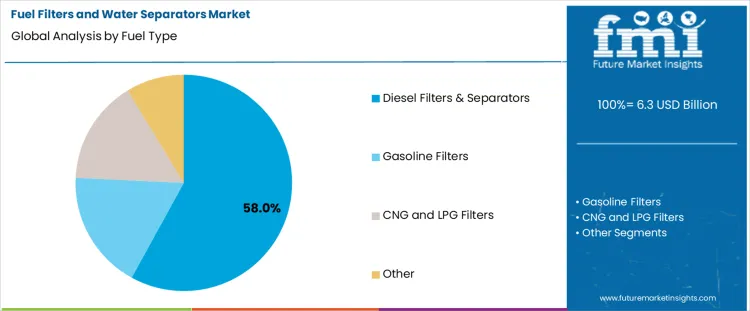
Diesel filters and separators account for about 58% of demand in 2026, reflecting the sensitivity of diesel injection systems to particulate contamination and water presence. High pressure common rail systems operate with tight tolerances, where minor impurities can cause rapid wear or injector failure. Fleet operators and equipment owners therefore specify more robust filtration as a form of asset protection rather than routine maintenance. Diesel fuel distribution chains also face higher water ingress risk during storage and transport, which increases the need for separation stages. Service schedules in commercial vehicles reinforce regular replacement cycles. This combination of technical vulnerability, usage intensity, and downtime cost keeps diesel applications as the anchor of the overall market.
Gasoline and CNG or LPG filters follow different demand logic shaped by fuel system design and contamination profiles. Gasoline systems operate at lower pressures and face fewer water related risks, which reduces the need for complex separation stages. CNG and LPG systems focus more on particulate and oil carryover control from compression and storage processes. Their vehicle populations are smaller and more regionally concentrated, which limits aggregate volume. Replacement intervals also tend to be longer or tied to specific service events. As a result, these segments grow in line with their respective vehicle fleets but remain structurally smaller than diesel, where filtration and separation are treated as continuous risk control rather than routine service items.
Why Does Multi Stage Filtration Lead Among Technology Choices?

Multi stage filtration represents about 36% of demand in 2026 because it addresses contamination as a sequence of problems rather than a single event. These systems combine coarse and fine stages to manage both large particles and fine debris without excessive pressure drop. This approach fits engines that operate under variable fuel quality and high duty cycles, which is common in commercial transport and off highway equipment. From a maintenance perspective, staged systems provide more predictable performance over the service interval. They also offer a margin of protection against sudden contamination events. This layered risk management logic makes multi stage designs the preferred baseline where engine protection outweighs component simplicity.
Water separation media and heated assemblies serve specific operating constraints rather than general use. Dedicated separation media focuses on environments with frequent moisture exposure, such as humid climates or fuel supply chains with higher storage turnover. Heated filter assemblies address cold flow issues that can block filters in low temperature conditions. Both technologies add cost, wiring, or packaging complexity, which limits use to vehicles that face these exact risks. Their adoption depends on geography, duty cycle, and fleet operating profiles rather than universal engine requirements. This keeps them important but specialized solutions, while multi stage filtration remains the default choice for broad, mixed condition operation across large vehicle populations.
Why Are Diesel Fleet Economics and Fuel Quality Variability Sustaining Demand for Fuel Filters and Water Separators through 2036?
Demand is anchored in operating risk rather than in vehicle sales. In commercial transport, construction, mining, and agriculture, engine downtime carries high cost, and filtration is treated as insurance against injector failure and pump damage. In many regions, inconsistent fuel storage and distribution conditions increase water and particulate contamination risk, making separation systems necessary even in newer equipment. Fleet maintenance schedules are built around preventive replacement rather than visible failure. Equipment owners also extend asset life cycles, which keeps filtration demand steady in older fleets. This makes volume growth depend more on utilization intensity and fuel quality exposure than on new engine deliveries.
What Cost Sensitivity and Standardization Are Limiting Margin Expansion in This Segment?
The restraint is commercial, not technical. Filters and separators are specified parts with clear performance thresholds, which encourages competitive bidding and frequent supplier switching. Fleet buyers focus on total operating cost and often treat filtration as a consumable expense to be minimized. Many engines accept multiple approved part numbers, reducing supplier lock in. Distribution chains carry heavy inventory, creating pressure to move stock through price promotions. In some markets, low cost imports undercut established brands despite shorter service life. These conditions keep volumes resilient but compress margins and limit the ability to push premium pricing across large portions of the installed base.
How Are Emissions Rules, Engine Design, and Service Practices Changing the Role of Filtration Systems?
Structural change is driven by the engine, not the filter. High pressure common rail systems and tighter emissions tolerances reduce contamination tolerance, which raises the functional importance of water separation and fine filtration. At the same time, service strategies are becoming more data driven, with condition based maintenance replacing fixed intervals in some fleets. OEMs also integrate filtration more tightly into engine modules, influencing replacement part design and access. Longer drain intervals reduce unit turnover but increase performance requirements per unit. Over time, the category shifts toward fewer variants, higher specification units, and closer alignment with engine platform families.
What is the Demand for Fuel Filters and Water Separators by Country?
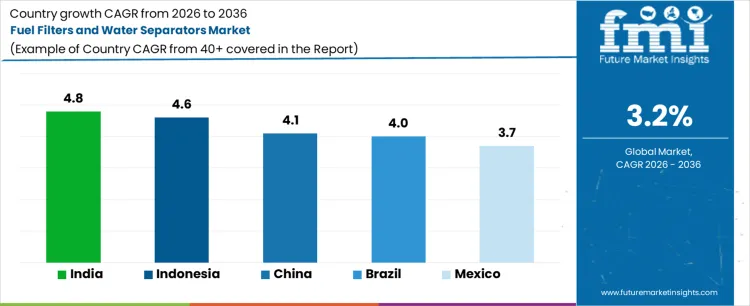
| Country | CAGR (%) |
|---|---|
| India | 4.8% |
| China | 4.1% |
| Indonesia | 4.6% |
| Brazil | 4.0% |
| Mexico | 3.7% |
Demand for fuel filters and water separators is rising as automotive and commercial vehicle manufacturers focus on engine reliability, fuel system protection, and emission control. India leads with a 4.8% CAGR, driven by growing vehicle production, increasing use of diesel engines, and replacement demand in the aftermarket. Indonesia follows at 4.6%, supported by fleet expansion and rising adoption of quality fuel filtration solutions. China records 4.1% growth, shaped by steady automotive manufacturing and maintenance practices. Brazil grows at 4.0%, influenced by fleet modernization and compliance with emission standards. Mexico shows 3.7% CAGR, reflecting moderate adoption in passenger and commercial vehicles and incremental demand for fuel system protection components.
How is India experiencing growth in the fuel filters and water separators market?

India is experiencing growth at a CAGR of 4.8%, supported by adoption of fuel filters and water separators market solutions to improve engine performance, fuel system reliability, and contamination control. Manufacturers and suppliers are producing filters optimized for high separation efficiency, durability, and compatibility with diesel and gasoline engines. Demand is concentrated in automotive manufacturing hubs, commercial vehicle fleets, and service centers. Investments focus on material quality, filtration performance, and adherence to automotive and environmental standards rather than large-scale deployment. Growth reflects rising vehicle production, industrial adoption of high-quality fuel filtration solutions, and increasing focus on fuel system efficiency.
- Fuel system reliability drives adoption.
- Filters optimize separation efficiency and durability.
- Automotive hubs and service centers concentrate demand.
- Material quality and standards compliance guide investment.
How is China witnessing growth in the fuel filters and water separators market?
China is witnessing growth at a CAGR of 4.1%, fueled by adoption of fuel filters and water separators market solutions to improve engine durability, fuel contamination prevention, and operational efficiency. Manufacturers and suppliers are deploying filters optimized for separation efficiency, material reliability, and compatibility with commercial and passenger vehicle engines. Demand is concentrated in automotive production hubs, service centers, and fleet maintenance facilities. Investments prioritize material performance, filtration efficiency, and compliance with automotive and environmental regulations rather than fleet-scale deployment. Growth reflects industrial adoption of advanced fuel filtration systems, increasing vehicle production, and focus on engine protection.
- Engine durability drives adoption.
- Filters enhance separation efficiency and material reliability.
- Automotive hubs and service centers concentrate demand.
- Material performance and compliance guide investment.
How is Indonesia experiencing growth in the fuel filters and water separators market?
Indonesia is experiencing growth at a CAGR of 4.6%, supported by adoption of fuel filters and water separators market solutions to improve fuel system reliability, engine protection, and operational efficiency. Manufacturers and suppliers are producing filters optimized for high separation efficiency, durability, and compatibility with diesel and gasoline engines. Demand is concentrated in commercial vehicle fleets, automotive production hubs, and maintenance facilities. Investments focus on material quality, filtration performance, and adherence to safety and environmental standards rather than large-scale deployment. Growth reflects moderate vehicle production, industrial adoption of high-quality fuel filtration, and focus on engine protection.
- Fuel system efficiency drives adoption.
- Filters optimize separation performance and durability.
- Commercial fleets and production hubs concentrate demand.
- Material quality and compliance guide investment.
How is Brazil witnessing growth in the fuel filters and water separators market?
Brazil is witnessing growth at a CAGR of 4%, fueled by adoption of fuel filters and water separators market solutions to enhance engine protection, fuel system reliability, and contamination prevention. Manufacturers and suppliers are deploying filters optimized for separation efficiency, durability, and integration with automotive engines. Demand is concentrated in automotive production hubs, commercial fleets, and service centers. Investments prioritize material performance, filtration reliability, and compliance with automotive and environmental standards rather than large-scale deployment. Growth reflects industrial adoption of high-quality fuel filtration systems, moderate vehicle production, and focus on fuel system efficiency.
- Engine protection drives adoption.
- Filters enhance separation efficiency and durability.
- Automotive hubs and fleet centers concentrate demand.
- Material performance and compliance guide investment.
How is Mexico experiencing growth in the fuel filters and water separators market?
Mexico is experiencing growth at a CAGR of 3.7%, supported by adoption of fuel filters and water separators market solutions to improve fuel system reliability, engine performance, and contamination protection. Manufacturers and suppliers are producing filters optimized for separation efficiency, material durability, and compatibility with commercial and passenger vehicle engines. Demand is concentrated in automotive manufacturing hubs, service centers, and commercial fleets. Investments focus on material quality, filtration performance, and adherence to automotive standards rather than fleet-scale deployment. Growth reflects moderate vehicle production, industrial adoption of fuel filtration technologies, and focus on engine protection and operational efficiency.
- Fuel system reliability drives adoption.
- Filters optimize separation efficiency and material durability.
- Automotive hubs and service centers concentrate demand.
- Material quality and standards compliance guide investment.
Who Competes in the Fuel Filters and Water Separators Market and What Defines Their Capabilities?

Competition in the fuel filters and water separators market is defined by filtration efficiency, water separation performance, and compatibility with diesel and gasoline engines. Cummins Filtration (Fleetguard) supplies filters engineered for high particulate retention, water separation, and reliable operation in commercial and industrial engines. Donaldson develops fuel filters and water separators with optimized media and structural integrity for long-term durability. Parker Hannifin (Racor) provides separators designed for high water-holding capacity and low pressure drop in heavy-duty applications. MANN+HUMMEL delivers fuel filters optimized for fine particulate capture and consistent flow. MAHLE supplies filters with high efficiency, thermal stability, and integration compatibility with engine systems.
Bosch provides fuel filters and separators designed for passenger and commercial vehicles with high contaminant retention. Denso delivers compact, high-performance filters compatible with modern engine management systems. Hengst develops fuel filters with advanced media and structural resilience for extended service life. UFI Filters supplies separators designed for efficient water removal and flow consistency. Sogefi delivers filters optimized for fuel economy and reliability under varying conditions. Other regional and specialty suppliers focus on high-performance filtration, durability, and OEM-specific applications. Competitive differentiation arises from filtration efficiency, water separation capacity, pressure tolerance, thermal stability, and compatibility with engine fuel systems across vehicle segments.
Key Players in the Fuel Filters and Water Separators Market
- Cummins Filtration (Fleetguard)
- Donaldson
- Parker Hannifin (Racor)
- MANN+HUMMEL
- MAHLE
- Bosch
- Denso
- Hengst
- UFI Filters
- Sogefi
Scope of the Report
| Items | Values |
|---|---|
| Quantitative Units (2026) | USD billion |
| Fuel Type | Diesel Filters & Separators, Gasoline Filters, CNG/LPG Filters, Other |
| Technology | Multi-Stage Filtration, Water Separation Media, Heated Filter Assemblies, Other |
| Vehicle Type | Medium & Heavy Commercial Vehicles, Passenger Cars, Light Commercial Vehicles, Off-Highway |
| Sales Channel | Aftermarket, OEM Fitment, Fleet Service, Other |
| Regions Covered | Asia Pacific, Europe, North America, Latin America, Middle East & Africa |
| Countries Covered | China, Japan, South Korea, India, Australia & New Zealand, ASEAN, Germany, United Kingdom, France, Italy, Spain, Nordic, BENELUX, United States, Canada, Mexico, Brazil, Chile, Saudi Arabia, Turkey, South Africa, and other regional markets |
| Key Companies Profiled | Cummins Filtration (Fleetguard), Donaldson, Parker Hannifin (Racor), MANN+HUMMEL, MAHLE, Bosch, Denso, Hengst, UFI Filters, Sogefi |
| Additional Attributes | Dollar sales by fuel type, technology, vehicle type, and sales channel, demand driven by operating hour intensity and fuel quality variability, dominance of diesel and commercial applications in volume consumption, replacement-led purchasing patterns anchored in fleet maintenance cycles, integration with engine platforms and service manuals limiting substitution, and regional differences in filtration usage linked to climate, storage practices, and contamination risk. |
Fuel Filters and Water Separators Market Segmentation
Fuel Type:
- Diesel Filters & Separators
- Gasoline Filters
- CNG/LPG Filters
- Other
Technology:
- Multi-Stage Filtration
- Water Separation Media
- Heated Filter Assemblies
- Other
Vehicle Type:
- Medium & Heavy Commercial Vehicles
- Passenger Cars
- Light Commercial Vehicles
- Off-Highway
Sales Channel:
- Aftermarket
- OEM Fitment
- Fleet Service
- Other
Region
- Asia Pacific
- China
- Japan
- South Korea
- India
- Australia & New Zealand
- ASEAN
- Rest of Asia Pacific
- Europe
- Germany
- United Kingdom
- France
- Italy
- Spain
- Nordic
- BENELUX
- Rest of Europe
- North America
- United States
- Canada
- Mexico
- Latin America
- Brazil
- Chile
- Rest of Latin America
- Middle East & Africa
- Kingdom of Saudi Arabia
- Other GCC Countries
- Turkey
- South Africa
- Other African Union
- Rest of Middle East & Africa
Bibliography
- United States Environmental Protection Agency. (2024). Diesel fuel standards and diesel fuel quality regulations. USA Environmental Protection Agency.
- United States Environmental Protection Agency. (2023). 40 CFR Part 1065 and Part 86 Emissions testing and durability requirements for engines. USA Government Publishing Office.
- Ministry of Environment, Forest and Climate Change, Government of India. (2024). Bharat Stage VI emission standards and fuel quality requirements. Government of India.
- European Commission. (2024). Fuel quality directive and diesel fuel specifications in the European Union. European Commission.
- California Air Resources Board. (2024). Heavy-duty diesel engine emission standards and fuel system durability requirements. California Environmental Protection Agency.
Frequently Asked Questions
How big is the fuel filters and water separators market in 2026?
The global fuel filters and water separators market is estimated to be valued at USD 6.3 billion in 2026.
What will be the size of fuel filters and water separators market in 2036?
The market size for the fuel filters and water separators market is projected to reach USD 8.6 billion by 2036.
How much will be the fuel filters and water separators market growth between 2026 and 2036?
The fuel filters and water separators market is expected to grow at a 3.2% CAGR between 2026 and 2036.
What are the key product types in the fuel filters and water separators market?
The key product types in fuel filters and water separators market are diesel filters & separators, gasoline filters, cng and lpg filters and other.
Which technology segment to contribute significant share in the fuel filters and water separators market in 2026?
In terms of technology, multi-stage filtration segment to command 36.0% share in the fuel filters and water separators market in 2026.
Preview the report firsthand - request a free sample
Get SampleGet the brochure for pricing and purchase details.
Get PDFTable of Content
- Executive Summary
- Global Market Outlook
- Demand-side Trends
- Supply-side Trends
- Technology Roadmap Analysis
- Analysis and Recommendations
- Market Overview
- Market Coverage / Taxonomy
- Market Definition / Scope / Limitations
- Market Background
- Market Dynamics
- Drivers
- Restraints
- Opportunity
- Trends
- Scenario Forecast
- Demand in Optimistic Scenario
- Demand in Likely Scenario
- Demand in Conservative Scenario
- Opportunity Map Analysis
- Product Life Cycle Analysis
- Supply Chain Analysis
- Investment Feasibility Matrix
- Value Chain Analysis
- PESTLE and Porter’s Analysis
- Regulatory Landscape
- Regional Parent Market Outlook
- Production and Consumption Statistics
- Import and Export Statistics
- Market Dynamics
- Global Market Analysis 2021 to 2025 and Forecast, 2026 to 2036
- Historical Market Size Value (USD Million) Analysis, 2021 to 2025
- Current and Future Market Size Value (USD Million) Projections, 2026 to 2036
- Y-o-Y Growth Trend Analysis
- Absolute $ Opportunity Analysis
- Global Market Pricing Analysis 2021 to 2025 and Forecast 2026 to 2036
- Global Market Analysis 2021 to 2025 and Forecast 2026 to 2036, By Fuel Type
- Introduction / Key Findings
- Historical Market Size Value (USD Million) Analysis By Fuel Type , 2021 to 2025
- Current and Future Market Size Value (USD Million) Analysis and Forecast By Fuel Type , 2026 to 2036
- Diesel Filters & Separators
- Gasoline Filters
- CNG and LPG Filters
- Other
- Diesel Filters & Separators
- Y-o-Y Growth Trend Analysis By Fuel Type , 2021 to 2025
- Absolute $ Opportunity Analysis By Fuel Type , 2026 to 2036
- Global Market Analysis 2021 to 2025 and Forecast 2026 to 2036, By Technology
- Introduction / Key Findings
- Historical Market Size Value (USD Million) Analysis By Technology, 2021 to 2025
- Current and Future Market Size Value (USD Million) Analysis and Forecast By Technology, 2026 to 2036
- Multi-Stage Filtration
- Water Separation Media
- Heated Filter Assemblies
- Other
- Multi-Stage Filtration
- Y-o-Y Growth Trend Analysis By Technology, 2021 to 2025
- Absolute $ Opportunity Analysis By Technology, 2026 to 2036
- Global Market Analysis 2021 to 2025 and Forecast 2026 to 2036, By Vehicle Type
- Introduction / Key Findings
- Historical Market Size Value (USD Million) Analysis By Vehicle Type, 2021 to 2025
- Current and Future Market Size Value (USD Million) Analysis and Forecast By Vehicle Type, 2026 to 2036
- Medium & Heavy Commercial Vehicles
- Passenger Cars
- Light Commercial Vehicles
- Off-Highway
- Medium & Heavy Commercial Vehicles
- Y-o-Y Growth Trend Analysis By Vehicle Type, 2021 to 2025
- Absolute $ Opportunity Analysis By Vehicle Type, 2026 to 2036
- Global Market Analysis 2021 to 2025 and Forecast 2026 to 2036, By Sales Channel
- Introduction / Key Findings
- Historical Market Size Value (USD Million) Analysis By Sales Channel, 2021 to 2025
- Current and Future Market Size Value (USD Million) Analysis and Forecast By Sales Channel, 2026 to 2036
- Aftermarket
- OEM Fitment
- Fleet Service
- Other
- Aftermarket
- Y-o-Y Growth Trend Analysis By Sales Channel, 2021 to 2025
- Absolute $ Opportunity Analysis By Sales Channel, 2026 to 2036
- Global Market Analysis 2021 to 2025 and Forecast 2026 to 2036, By Region
- Introduction
- Historical Market Size Value (USD Million) Analysis By Region, 2021 to 2025
- Current Market Size Value (USD Million) Analysis and Forecast By Region, 2026 to 2036
- North America
- Latin America
- Western Europe
- Eastern Europe
- East Asia
- South Asia and Pacific
- Middle East & Africa
- Market Attractiveness Analysis By Region
- North America Market Analysis 2021 to 2025 and Forecast 2026 to 2036, By Country
- Historical Market Size Value (USD Million) Trend Analysis By Market Taxonomy, 2021 to 2025
- Market Size Value (USD Million) Forecast By Market Taxonomy, 2026 to 2036
- By Country
- USA
- Canada
- Mexico
- By Fuel Type
- By Technology
- By Vehicle Type
- By Sales Channel
- By Country
- Market Attractiveness Analysis
- By Country
- By Fuel Type
- By Technology
- By Vehicle Type
- By Sales Channel
- Key Takeaways
- Latin America Market Analysis 2021 to 2025 and Forecast 2026 to 2036, By Country
- Historical Market Size Value (USD Million) Trend Analysis By Market Taxonomy, 2021 to 2025
- Market Size Value (USD Million) Forecast By Market Taxonomy, 2026 to 2036
- By Country
- Brazil
- Chile
- Rest of Latin America
- By Fuel Type
- By Technology
- By Vehicle Type
- By Sales Channel
- By Country
- Market Attractiveness Analysis
- By Country
- By Fuel Type
- By Technology
- By Vehicle Type
- By Sales Channel
- Key Takeaways
- Western Europe Market Analysis 2021 to 2025 and Forecast 2026 to 2036, By Country
- Historical Market Size Value (USD Million) Trend Analysis By Market Taxonomy, 2021 to 2025
- Market Size Value (USD Million) Forecast By Market Taxonomy, 2026 to 2036
- By Country
- Germany
- UK
- Italy
- Spain
- France
- Nordic
- BENELUX
- Rest of Western Europe
- By Fuel Type
- By Technology
- By Vehicle Type
- By Sales Channel
- By Country
- Market Attractiveness Analysis
- By Country
- By Fuel Type
- By Technology
- By Vehicle Type
- By Sales Channel
- Key Takeaways
- Eastern Europe Market Analysis 2021 to 2025 and Forecast 2026 to 2036, By Country
- Historical Market Size Value (USD Million) Trend Analysis By Market Taxonomy, 2021 to 2025
- Market Size Value (USD Million) Forecast By Market Taxonomy, 2026 to 2036
- By Country
- Russia
- Poland
- Hungary
- Balkan & Baltic
- Rest of Eastern Europe
- By Fuel Type
- By Technology
- By Vehicle Type
- By Sales Channel
- By Country
- Market Attractiveness Analysis
- By Country
- By Fuel Type
- By Technology
- By Vehicle Type
- By Sales Channel
- Key Takeaways
- East Asia Market Analysis 2021 to 2025 and Forecast 2026 to 2036, By Country
- Historical Market Size Value (USD Million) Trend Analysis By Market Taxonomy, 2021 to 2025
- Market Size Value (USD Million) Forecast By Market Taxonomy, 2026 to 2036
- By Country
- China
- Japan
- South Korea
- By Fuel Type
- By Technology
- By Vehicle Type
- By Sales Channel
- By Country
- Market Attractiveness Analysis
- By Country
- By Fuel Type
- By Technology
- By Vehicle Type
- By Sales Channel
- Key Takeaways
- South Asia and Pacific Market Analysis 2021 to 2025 and Forecast 2026 to 2036, By Country
- Historical Market Size Value (USD Million) Trend Analysis By Market Taxonomy, 2021 to 2025
- Market Size Value (USD Million) Forecast By Market Taxonomy, 2026 to 2036
- By Country
- India
- ASEAN
- Australia & New Zealand
- Rest of South Asia and Pacific
- By Fuel Type
- By Technology
- By Vehicle Type
- By Sales Channel
- By Country
- Market Attractiveness Analysis
- By Country
- By Fuel Type
- By Technology
- By Vehicle Type
- By Sales Channel
- Key Takeaways
- Middle East & Africa Market Analysis 2021 to 2025 and Forecast 2026 to 2036, By Country
- Historical Market Size Value (USD Million) Trend Analysis By Market Taxonomy, 2021 to 2025
- Market Size Value (USD Million) Forecast By Market Taxonomy, 2026 to 2036
- By Country
- Kingdom of Saudi Arabia
- Other GCC Countries
- Turkiye
- South Africa
- Other African Union
- Rest of Middle East & Africa
- By Fuel Type
- By Technology
- By Vehicle Type
- By Sales Channel
- By Country
- Market Attractiveness Analysis
- By Country
- By Fuel Type
- By Technology
- By Vehicle Type
- By Sales Channel
- Key Takeaways
- Key Countries Market Analysis
- USA
- Pricing Analysis
- Market Share Analysis, 2025
- By Fuel Type
- By Technology
- By Vehicle Type
- By Sales Channel
- Canada
- Pricing Analysis
- Market Share Analysis, 2025
- By Fuel Type
- By Technology
- By Vehicle Type
- By Sales Channel
- Mexico
- Pricing Analysis
- Market Share Analysis, 2025
- By Fuel Type
- By Technology
- By Vehicle Type
- By Sales Channel
- Brazil
- Pricing Analysis
- Market Share Analysis, 2025
- By Fuel Type
- By Technology
- By Vehicle Type
- By Sales Channel
- Chile
- Pricing Analysis
- Market Share Analysis, 2025
- By Fuel Type
- By Technology
- By Vehicle Type
- By Sales Channel
- Germany
- Pricing Analysis
- Market Share Analysis, 2025
- By Fuel Type
- By Technology
- By Vehicle Type
- By Sales Channel
- UK
- Pricing Analysis
- Market Share Analysis, 2025
- By Fuel Type
- By Technology
- By Vehicle Type
- By Sales Channel
- Italy
- Pricing Analysis
- Market Share Analysis, 2025
- By Fuel Type
- By Technology
- By Vehicle Type
- By Sales Channel
- Spain
- Pricing Analysis
- Market Share Analysis, 2025
- By Fuel Type
- By Technology
- By Vehicle Type
- By Sales Channel
- France
- Pricing Analysis
- Market Share Analysis, 2025
- By Fuel Type
- By Technology
- By Vehicle Type
- By Sales Channel
- India
- Pricing Analysis
- Market Share Analysis, 2025
- By Fuel Type
- By Technology
- By Vehicle Type
- By Sales Channel
- ASEAN
- Pricing Analysis
- Market Share Analysis, 2025
- By Fuel Type
- By Technology
- By Vehicle Type
- By Sales Channel
- Australia & New Zealand
- Pricing Analysis
- Market Share Analysis, 2025
- By Fuel Type
- By Technology
- By Vehicle Type
- By Sales Channel
- China
- Pricing Analysis
- Market Share Analysis, 2025
- By Fuel Type
- By Technology
- By Vehicle Type
- By Sales Channel
- Japan
- Pricing Analysis
- Market Share Analysis, 2025
- By Fuel Type
- By Technology
- By Vehicle Type
- By Sales Channel
- South Korea
- Pricing Analysis
- Market Share Analysis, 2025
- By Fuel Type
- By Technology
- By Vehicle Type
- By Sales Channel
- Russia
- Pricing Analysis
- Market Share Analysis, 2025
- By Fuel Type
- By Technology
- By Vehicle Type
- By Sales Channel
- Poland
- Pricing Analysis
- Market Share Analysis, 2025
- By Fuel Type
- By Technology
- By Vehicle Type
- By Sales Channel
- Hungary
- Pricing Analysis
- Market Share Analysis, 2025
- By Fuel Type
- By Technology
- By Vehicle Type
- By Sales Channel
- Kingdom of Saudi Arabia
- Pricing Analysis
- Market Share Analysis, 2025
- By Fuel Type
- By Technology
- By Vehicle Type
- By Sales Channel
- Turkiye
- Pricing Analysis
- Market Share Analysis, 2025
- By Fuel Type
- By Technology
- By Vehicle Type
- By Sales Channel
- South Africa
- Pricing Analysis
- Market Share Analysis, 2025
- By Fuel Type
- By Technology
- By Vehicle Type
- By Sales Channel
- USA
- Market Structure Analysis
- Competition Dashboard
- Competition Benchmarking
- Market Share Analysis of Top Players
- By Regional
- By Fuel Type
- By Technology
- By Vehicle Type
- By Sales Channel
- Competition Analysis
- Competition Deep Dive
- Cummins Filtration (Fleetguard)
- Overview
- Product Portfolio
- Profitability by Market Segments (Product/Age /Sales Channel/Region)
- Sales Footprint
- Strategy Overview
- Marketing Strategy
- Product Strategy
- Channel Strategy
- Donaldson
- Parker Hannifin (Racor)
- MANN+HUMMEL
- MAHLE
- Bosch
- Denso
- Hengst
- UFI Filters
- Sogefi
- Cummins Filtration (Fleetguard)
- Competition Deep Dive
- Assumptions & Acronyms Used
- Research Methodology


