

- Industry Size (2026)
- USD 0.51 Bn
- Forecast (2036)
- USD 0.81 Bn
- CAGR (2026 to 2036)
- 4.7%
Water Draw Off Valves Market Size, Market Forecast and Outlook By FMI
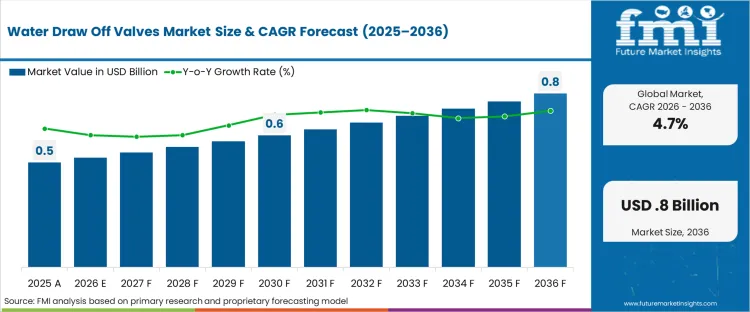
The global water draw off valves market is estimated at USD 0.49 billion in 2025 and is projected to reach USD 0.51 billion in 2026. Over the forecast period from 2026 to 2036, the market is expected to rise to USD 0.81 billion, reflecting a CAGR of 4.7%. The market remains fundamentally maintenance-led rather than expansion-led. Demand is tied to the regular servicing of boilers, calorifiers, water heaters, and process-water systems where drainage, flushing, sampling, and isolation functions remain necessary during inspection and repair cycles.
Brass-based valves are expected to remain the largest material category in 2026 because they continue to offer a practical balance of machinability, corrosion resistance, field familiarity, and cost efficiency. Manual draw off valves still account for the largest installed base, especially in routine plumbing and water-heating applications where buyers value simplicity and low replacement cost. At the same time, thermostatic and more service-oriented valve formats are steadily gaining share in environments where temperature control, hygiene, and safe maintenance procedures matter more. Commercial water heating systems remain the leading end-use block, supported by the large installed base of hot-water assets in hotels, hospitals, schools, and other service-intensive properties.
Summary of Water Draw Off Valves Market
- Key Drivers
- Water heating, boiler, and process-water systems cannot be serviced efficiently without dependable drain and draw-off points. These valves do not sit at the visible end of building technology, yet they remain essential during cleaning, inspection, flushing, and system shutdown procedures. That gives the market a dependable replacement floor even when broader construction conditions soften.
- Public buildings, healthcare facilities, hospitality properties, and educational campuses are under pressure to maintain reliable hot-water service while also managing risks linked to temperature control, stagnation, and hygiene. This shifts value away from the cheapest generic fittings and toward valve solutions that support safer servicing, controlled discharge, and more predictable operating performance.
- A large share of water-heating and plumbing assets in mature economies is already installed, which means replacement and refurbishment work creates a durable source of valve demand. In schools, hospitals, hotels, and industrial plants, operators often prefer targeted maintenance and system life extension over full equipment replacement. That supports recurring demand for robust service valves that can be installed with minimal disruption.
- Key Segments Analyzed in the Report
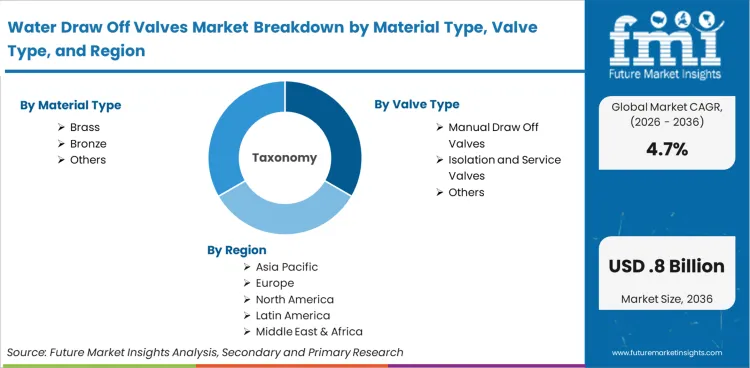
- Material Type: Brass, Bronze, Stainless Steel, Engineered Plastics, Others
- Valve Type: Manual Draw Off Valves, Thermostatic Draw Off Valves, Isolation and Service Valves, Others
- End Use: Commercial Water Heating Systems, Institutional Plumbing, Industrial Boilers and Process Water Systems, Residential Hot Water Systems
- Region: North America, Latin America, Western Europe, Eastern Europe, East Asia, South Asia and Pacific, Middle East and Africa
- Analyst Opinion
- “This is a steady operating-necessity market rather than a headline growth market. Buyers often ignore these valves until a service event exposes failure, leakage, or unsafe discharge conditions. That creates a very practical buying pattern. Suppliers that perform well are not the ones with the most dramatic messaging, but the ones that deliver reliable shutoff, good corrosion resistance, easier servicing, and consistent field performance under ordinary maintenance conditions. The strongest pricing opportunities sit in applications where hygiene, uptime, and safety matter more than first-cost procurement alone”, says Nikhil Kaitwade, Principal Consultant at FMI.
Water Draw Off Valves Market Definition
The water draw off valves market covers valves used to drain, draw, isolate, or service water in plumbing, boiler, hot-water, and process-water systems. These valves are installed to support controlled discharge, system emptying, inspection, flushing, and maintenance activity. The market includes manual draw off valves, thermostatic draw off valves, isolation and service valves, and related variants designed for serviceability and safe discharge within water-based systems.
Water Draw Off Valves Market Inclusions
The scope includes revenue generated from draw off valves sold into plumbing, hot-water, boiler, and service-water applications. It covers replacement and retrofit demand linked to maintenance-driven valve changeout across commercial, institutional, industrial, and residential systems. The study also includes engineered variants designed for controlled drainage, service isolation, and related maintenance functions where these products operate as identifiable valve components rather than as part of inseparable appliance systems.
Water Draw Off Valves Market Exclusions
The market excludes broad plumbing fittings that do not perform a direct draw off, drain, or service-isolation function. It also excludes complete water-heating appliances sold without separable valve scope, along with general-purpose process control valves that do not serve a maintenance-drain or service-water role. Large system-level controls and unrelated valve categories are outside the scope of this market.
Water Draw Off Valves Market Research Methodology
This study evaluates the water draw off valves market across material type, valve type, end use, and region, with 2025 as the base year and 2026 to 2036 as the forecast period. Market sizing is based on the replacement intensity of service valves in commercial and institutional hot-water systems, maintenance requirements in boiler and process-water assets, and supplier positioning in public-health and service-valve categories. The assessment also considers the installed base of maintainable plumbing infrastructure, replacement behavior across mature building stock, and the gradual shift toward safer, application-specific service valves in regulated environments.
Key Drivers, Restraints, and Trends in Water Draw Off Valves Market
Drivers
Demand remains steady because plumbing and hot-water systems continue to require controlled draining and servicing throughout their operating life. In commercial buildings, institutional complexes, and industrial facilities, service valves are part of routine maintenance logic rather than optional upgrades. Their demand is closely linked to the simple fact that boilers, calorifiers, storage systems, and hot-water circuits all need reliable access points for inspection, flushing, and controlled shutdown. This gives the category resilience even when new-build activity weakens.
Restraints
The main restraint is commoditization at the low end of the market. In routine procurement channels, many buyers treat service valves as interchangeable line items, especially where product failure risk is underestimated at the point of purchase. That creates price pressure and limits margin expansion for standard products. The category also lacks the urgency and visibility of more advanced plumbing hardware, so product differentiation can be harder to communicate unless reliability or compliance issues become obvious in field use.
Trends
The main trend is a slow but meaningful shift away from simple drain hardware toward safer and more application-specific service valves. Thermostatic formats, controlled-discharge variants, and designs better suited to hygiene-sensitive installations are gaining more attention in institutional and commercial settings. This does not mean the market is being transformed overnight. It means that value growth is increasingly tied to safety, service efficiency, and use-case specificity rather than to raw unit growth alone.
Segmental Analysis
Water Draw Off Valves Market Analysis by Material Type
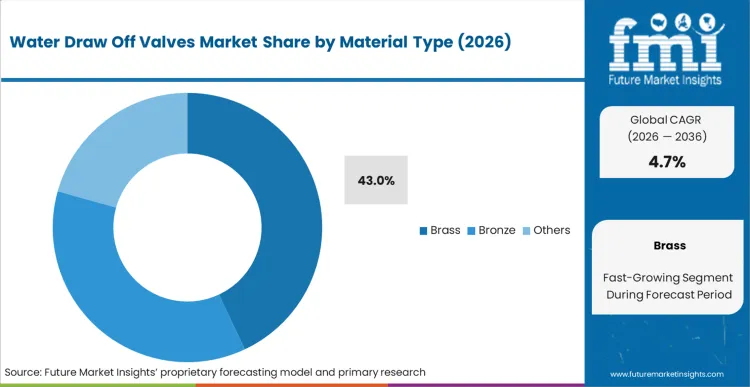
Brass is expected to remain the leading material segment in 2026, holding 43% share. Its position is supported by a combination of cost efficiency, machinability, corrosion resistance, and broad compatibility with existing plumbing systems. In maintenance-heavy categories, buyers tend to prefer materials that are already familiar to installers and service teams, and brass continues to meet that requirement across a wide installed base. Bronze and stainless steel retain importance in applications where corrosion conditions, service expectations, or specification requirements are stricter, but their use is more selective. Engineered plastics and other materials continue to appear in niche and cost-sensitive settings, though they remain secondary in value terms.
Water Draw Off Valves Market Analysis by Valve Type
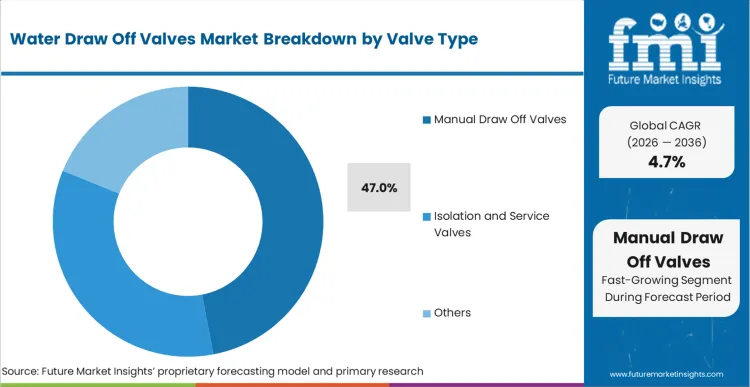
Manual draw off valves are projected to remain the leading valve type in 2026, holding 47% share because they still dominate the installed base across routine service and drainage applications. Their value proposition remains simple: low complexity, easy replacement, and suitability for everyday maintenance tasks. However, thermostatic draw off valves and more engineered service-valve variants are gaining traction where scald prevention, controlled discharge, and tighter maintenance discipline are becoming more important. This trend is more visible in institutional plumbing and commercial hot-water systems than in the most price-sensitive parts of the market.
Water Draw Off Valves Market Analysis by End Use
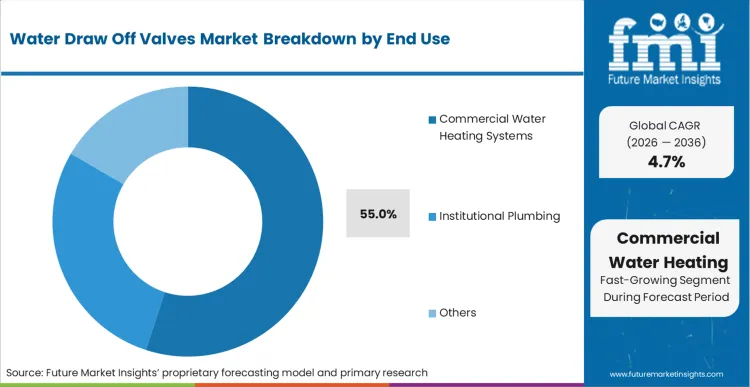
Commercial water heating systems are expected to remain the leading end-use segment in 2026. Hotels, hospitals, schools, office buildings, and other service-intensive properties rely on water-heating assets that require regular maintenance and dependable draining points. These environments create repeat demand because serviceability is built into daily operations. Institutional plumbing also represents a meaningful source of demand, particularly where safety, hygiene, and system uptime matter. Industrial boilers and process-water systems contribute additional value in applications where maintenance access is critical, while residential hot-water systems provide a broader but typically lower-value replacement base.
Competitive Aligners for Market Players
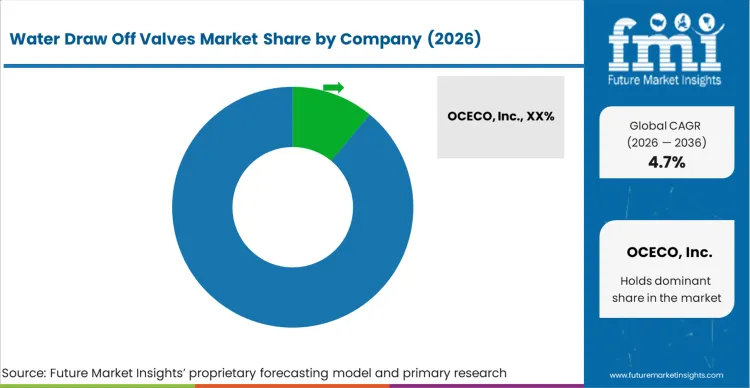
Competition in this market is shaped less by dramatic innovation and more by practical reliability in field use. Buyers care about fit, compliance, corrosion resistance, shutoff consistency, and ease of servicing. Suppliers that can combine lead-free compliance, compact designs, dependable sealing, and installer-friendly operation are better placed than those competing only on catalog breadth or low initial price. In this category, trust is built less through marketing language and more through how the valve performs when maintenance teams actually need it.
Key Players in Water Draw Off Valves Market
- OCECO, Inc.
- SCHELL GmbH & Co. KG
- Crane Fluid Systems
- Milwaukee Valve Company
- Watts Water Technologies, Inc.
- Apollo Valves
- Caleffi S.p.A.
- Spirax Sarco
- Pegler Yorkshire
- Reliance Worldwide Corporation
Strategic Outlook by FMI on Water Draw Off Valves Market
FMI expects the water draw off valves market to grow at a measured pace through 2036. This is a maintenance-led category with defensible replacement demand, not a volatility-driven growth market. The strongest opportunities are likely to remain in commercial, institutional, and industrial settings where service safety, uptime, and compliance matter more than the lowest procurement cost. Revenue growth should come less from sudden expansion in unit demand and more from a gradual shift toward better-specified and more application-specific valve solutions.
Over time, suppliers that position themselves around reliability, compliance, and service efficiency should be better placed than those relying only on commodity replacement channels. Thermostatic and controlled-discharge formats may not displace manual valves in volume terms anytime soon, but they are likely to capture a larger share of incremental value where buyers are managing hygiene, temperature, and maintenance risk more actively.
Scope of the Report
| Attribute | Details |
|---|---|
| Market Title | Water Draw Off Valves Market |
| Base Year | 2025 |
| Forecast Period | 2026 to 2036 |
| Quantitative Units | USD Billion for market value and CAGR for growth rate |
| Material Types Covered | Brass, Bronze, Stainless Steel, Engineered Plastics, Others |
| Valve Types Covered | Manual Draw Off Valves, Thermostatic Draw Off Valves, Isolation and Service Valves, Others |
| End Uses Covered | Commercial Water Heating Systems, Institutional Plumbing, Industrial Boilers and Process Water Systems, Residential Hot Water Systems |
| Regions Covered | North America, Latin America, Western Europe, Eastern Europe, East Asia, South Asia and Pacific, Middle East and Africa |
Bibliography
- OCECO, Inc. Water Draw Off Valves.
- SCHELL. Angle Valves, Draw-off Taps, and Public Health Fittings Brochure.
- Crane Fluid Systems. Public Health Valves and General Valves.
- Milwaukee Valve Company. Gate Valves and Globe Valves Product Pages.
- Spirax Sarco. Boiler Fittings and Mountings.
Frequently Asked Questions
What is the projected size of the water draw off valves market by 2036?
The global water draw off valves market is projected to reach USD 0.81 billion by 2036, rising from USD 0.51 billion in 2026.
What is the expected CAGR of the water draw off valves market from 2026 to 2036?
The market is expected to expand at a CAGR of 4.7% during the forecast period.
Which material type is expected to lead the water draw off valves market in 2026?
Brass is expected to remain the leading material segment in 2026 because it offers a practical combination of cost efficiency, machinability, and corrosion resistance.
Which valve type leads the water draw off valves market?
Manual draw off valves continue to lead the market by installed base, supported by their simplicity and broad use in routine service applications.
Which end use segment is expected to lead the water draw off valves market in 2026?
Commercial water heating systems are projected to remain the leading end-use segment in 2026 due to steady maintenance and servicing needs across hotels, hospitals, schools, and similar properties.
What is driving growth in the water draw off valves market?
Growth is being supported by replacement demand in boilers and hot-water systems, ongoing refurbishment of institutional and commercial plumbing assets, and the gradual shift toward safer and more application-specific service valves.
Preview the report firsthand - request a free sample
Get SampleGet the brochure for pricing and purchase details.
Get PDFTable of Content
- Executive Summary
- Global Market Outlook
- Demand-side Trends
- Supply-side Trends
- Technology Roadmap Analysis
- Analysis and Recommendations
- Market Overview
- Market Coverage / Taxonomy
- Market Definition / Scope / Limitations
- Research Methodology
- Chapter Orientation
- Analytical Lens and Working Hypotheses
- Market Structure, Signals, and Trend Drivers
- Benchmarking and Cross-market Comparability
- Market Sizing, Forecasting, and Opportunity Mapping
- Research Design and Evidence Framework
- Desk Research Programme (Secondary Evidence)
- Company Annual and Sustainability Reports
- Peer-reviewed Journals and Academic Literature
- Corporate Websites, Product Literature, and Technical Notes
- Earnings Decks and Investor Briefings
- Statutory Filings and Regulatory Disclosures
- Technical White Papers and Standards Notes
- Government Statistics Portals and Public Data Releases
- Press Releases and Reputable Media Coverage
- Specialist Newsletters and Curated Briefings
- Sector Databases and Reference Repositories
- FMI Internal Proprietary Databases and Historical Market Datasets
- Subscription Datasets and Paid Sources
- Social Channels, Communities, and Digital Listening Inputs
- Additional Desk Sources
- Expert Input and Fieldwork (Primary Evidence)
- Primary Modes
- Qualitative Interviews and Expert Elicitation
- Quantitative Surveys and Structured Data Capture
- Blended Approach
- Why Primary Evidence is Used
- Field Techniques
- Interviews
- Surveys
- Focus Groups
- Observational and In-context Research
- Social and Community Interactions
- Stakeholder Universe Engaged
- C-suite Leaders
- Board Members
- Presidents and Vice Presidents
- R&D and Innovation Heads
- Technical Specialists
- Domain Subject-matter Experts
- Scientists
- Physicians and Other Healthcare Professionals
- Governance, Ethics, and Data Stewardship
- Research Ethics
- Data Integrity and Handling
- Primary Modes
- Tooling, Models, and Reference Databases
- Desk Research Programme (Secondary Evidence)
- Data Engineering and Model Build
- Data Acquisition and Ingestion
- Cleaning, Normalisation, and Verification
- Synthesis, Triangulation, and Analysis
- Quality Assurance and Audit Trail
- Market Background
- Market Dynamics
- Drivers
- Restraints
- Opportunity
- Trends
- Scenario Forecast
- Demand in Optimistic Scenario
- Demand in Likely Scenario
- Demand in Conservative Scenario
- Opportunity Map Analysis
- Product Life Cycle Analysis
- Supply Chain Analysis
- Investment Feasibility Matrix
- Value Chain Analysis
- PESTLE and Porter’s Analysis
- Regulatory Landscape
- Regional Parent Market Outlook
- Production and Consumption Statistics
- Import and Export Statistics
- Market Dynamics
- Global Market Analysis 2021 to 2025 and Forecast, 2026 to 2036
- Historical Market Size Value (USD Million) Analysis, 2021 to 2025
- Current and Future Market Size Value (USD Million) Projections, 2026 to 2036
- Y-o-Y Growth Trend Analysis
- Absolute $ Opportunity Analysis
- Global Market Pricing Analysis 2021 to 2025 and Forecast 2026 to 2036
- Global Market Analysis 2021 to 2025 and Forecast 2026 to 2036, By Material Type
- Introduction / Key Findings
- Historical Market Size Value (USD Million) Analysis By Material Type , 2021 to 2025
- Current and Future Market Size Value (USD Million) Analysis and Forecast By Material Type , 2026 to 2036
- Brass
- Bronze
- Others
- Brass
- Y-o-Y Growth Trend Analysis By Material Type , 2021 to 2025
- Absolute $ Opportunity Analysis By Material Type , 2026 to 2036
- Global Market Analysis 2021 to 2025 and Forecast 2026 to 2036, By Valve Type
- Introduction / Key Findings
- Historical Market Size Value (USD Million) Analysis By Valve Type, 2021 to 2025
- Current and Future Market Size Value (USD Million) Analysis and Forecast By Valve Type, 2026 to 2036
- Manual Draw Off Valves
- Isolation and Service Valves
- Others
- Manual Draw Off Valves
- Y-o-Y Growth Trend Analysis By Valve Type, 2021 to 2025
- Absolute $ Opportunity Analysis By Valve Type, 2026 to 2036
- Global Market Analysis 2021 to 2025 and Forecast 2026 to 2036, By End Use
- Introduction / Key Findings
- Historical Market Size Value (USD Million) Analysis By End Use, 2021 to 2025
- Current and Future Market Size Value (USD Million) Analysis and Forecast By End Use, 2026 to 2036
- Commercial Water Heating Systems
- Institutional Plumbing
- Others
- Commercial Water Heating Systems
- Y-o-Y Growth Trend Analysis By End Use, 2021 to 2025
- Absolute $ Opportunity Analysis By End Use, 2026 to 2036
- Global Market Analysis 2021 to 2025 and Forecast 2026 to 2036, By Region
- Introduction
- Historical Market Size Value (USD Million) Analysis By Region, 2021 to 2025
- Current Market Size Value (USD Million) Analysis and Forecast By Region, 2026 to 2036
- North America
- Latin America
- Western Europe
- Eastern Europe
- East Asia
- South Asia and Pacific
- Middle East & Africa
- Market Attractiveness Analysis By Region
- North America Market Analysis 2021 to 2025 and Forecast 2026 to 2036, By Country
- Historical Market Size Value (USD Million) Trend Analysis By Market Taxonomy, 2021 to 2025
- Market Size Value (USD Million) Forecast By Market Taxonomy, 2026 to 2036
- By Country
- USA
- Canada
- Mexico
- By Material Type
- By Valve Type
- By End Use
- By Country
- Market Attractiveness Analysis
- By Country
- By Material Type
- By Valve Type
- By End Use
- Key Takeaways
- Latin America Market Analysis 2021 to 2025 and Forecast 2026 to 2036, By Country
- Historical Market Size Value (USD Million) Trend Analysis By Market Taxonomy, 2021 to 2025
- Market Size Value (USD Million) Forecast By Market Taxonomy, 2026 to 2036
- By Country
- Brazil
- Chile
- Rest of Latin America
- By Material Type
- By Valve Type
- By End Use
- By Country
- Market Attractiveness Analysis
- By Country
- By Material Type
- By Valve Type
- By End Use
- Key Takeaways
- Western Europe Market Analysis 2021 to 2025 and Forecast 2026 to 2036, By Country
- Historical Market Size Value (USD Million) Trend Analysis By Market Taxonomy, 2021 to 2025
- Market Size Value (USD Million) Forecast By Market Taxonomy, 2026 to 2036
- By Country
- Germany
- UK
- Italy
- Spain
- France
- Nordic
- BENELUX
- Rest of Western Europe
- By Material Type
- By Valve Type
- By End Use
- By Country
- Market Attractiveness Analysis
- By Country
- By Material Type
- By Valve Type
- By End Use
- Key Takeaways
- Eastern Europe Market Analysis 2021 to 2025 and Forecast 2026 to 2036, By Country
- Historical Market Size Value (USD Million) Trend Analysis By Market Taxonomy, 2021 to 2025
- Market Size Value (USD Million) Forecast By Market Taxonomy, 2026 to 2036
- By Country
- Russia
- Poland
- Hungary
- Balkan & Baltic
- Rest of Eastern Europe
- By Material Type
- By Valve Type
- By End Use
- By Country
- Market Attractiveness Analysis
- By Country
- By Material Type
- By Valve Type
- By End Use
- Key Takeaways
- East Asia Market Analysis 2021 to 2025 and Forecast 2026 to 2036, By Country
- Historical Market Size Value (USD Million) Trend Analysis By Market Taxonomy, 2021 to 2025
- Market Size Value (USD Million) Forecast By Market Taxonomy, 2026 to 2036
- By Country
- China
- Japan
- South Korea
- By Material Type
- By Valve Type
- By End Use
- By Country
- Market Attractiveness Analysis
- By Country
- By Material Type
- By Valve Type
- By End Use
- Key Takeaways
- South Asia and Pacific Market Analysis 2021 to 2025 and Forecast 2026 to 2036, By Country
- Historical Market Size Value (USD Million) Trend Analysis By Market Taxonomy, 2021 to 2025
- Market Size Value (USD Million) Forecast By Market Taxonomy, 2026 to 2036
- By Country
- India
- ASEAN
- Australia & New Zealand
- Rest of South Asia and Pacific
- By Material Type
- By Valve Type
- By End Use
- By Country
- Market Attractiveness Analysis
- By Country
- By Material Type
- By Valve Type
- By End Use
- Key Takeaways
- Middle East & Africa Market Analysis 2021 to 2025 and Forecast 2026 to 2036, By Country
- Historical Market Size Value (USD Million) Trend Analysis By Market Taxonomy, 2021 to 2025
- Market Size Value (USD Million) Forecast By Market Taxonomy, 2026 to 2036
- By Country
- Kingdom of Saudi Arabia
- Other GCC Countries
- Turkiye
- South Africa
- Other African Union
- Rest of Middle East & Africa
- By Material Type
- By Valve Type
- By End Use
- By Country
- Market Attractiveness Analysis
- By Country
- By Material Type
- By Valve Type
- By End Use
- Key Takeaways
- Key Countries Market Analysis
- USA
- Pricing Analysis
- Market Share Analysis, 2025
- By Material Type
- By Valve Type
- By End Use
- Canada
- Pricing Analysis
- Market Share Analysis, 2025
- By Material Type
- By Valve Type
- By End Use
- Mexico
- Pricing Analysis
- Market Share Analysis, 2025
- By Material Type
- By Valve Type
- By End Use
- Brazil
- Pricing Analysis
- Market Share Analysis, 2025
- By Material Type
- By Valve Type
- By End Use
- Chile
- Pricing Analysis
- Market Share Analysis, 2025
- By Material Type
- By Valve Type
- By End Use
- Germany
- Pricing Analysis
- Market Share Analysis, 2025
- By Material Type
- By Valve Type
- By End Use
- UK
- Pricing Analysis
- Market Share Analysis, 2025
- By Material Type
- By Valve Type
- By End Use
- Italy
- Pricing Analysis
- Market Share Analysis, 2025
- By Material Type
- By Valve Type
- By End Use
- Spain
- Pricing Analysis
- Market Share Analysis, 2025
- By Material Type
- By Valve Type
- By End Use
- France
- Pricing Analysis
- Market Share Analysis, 2025
- By Material Type
- By Valve Type
- By End Use
- India
- Pricing Analysis
- Market Share Analysis, 2025
- By Material Type
- By Valve Type
- By End Use
- ASEAN
- Pricing Analysis
- Market Share Analysis, 2025
- By Material Type
- By Valve Type
- By End Use
- Australia & New Zealand
- Pricing Analysis
- Market Share Analysis, 2025
- By Material Type
- By Valve Type
- By End Use
- China
- Pricing Analysis
- Market Share Analysis, 2025
- By Material Type
- By Valve Type
- By End Use
- Japan
- Pricing Analysis
- Market Share Analysis, 2025
- By Material Type
- By Valve Type
- By End Use
- South Korea
- Pricing Analysis
- Market Share Analysis, 2025
- By Material Type
- By Valve Type
- By End Use
- Russia
- Pricing Analysis
- Market Share Analysis, 2025
- By Material Type
- By Valve Type
- By End Use
- Poland
- Pricing Analysis
- Market Share Analysis, 2025
- By Material Type
- By Valve Type
- By End Use
- Hungary
- Pricing Analysis
- Market Share Analysis, 2025
- By Material Type
- By Valve Type
- By End Use
- Kingdom of Saudi Arabia
- Pricing Analysis
- Market Share Analysis, 2025
- By Material Type
- By Valve Type
- By End Use
- Turkiye
- Pricing Analysis
- Market Share Analysis, 2025
- By Material Type
- By Valve Type
- By End Use
- South Africa
- Pricing Analysis
- Market Share Analysis, 2025
- By Material Type
- By Valve Type
- By End Use
- USA
- Market Structure Analysis
- Competition Dashboard
- Competition Benchmarking
- Market Share Analysis of Top Players
- By Regional
- By Material Type
- By Valve Type
- By End Use
- Competition Analysis
- Competition Deep Dive
- OCECO, Inc.
- Overview
- Product Portfolio
- Profitability by Market Segments (Product/Age /Sales Channel/Region)
- Sales Footprint
- Strategy Overview
- Marketing Strategy
- Product Strategy
- Channel Strategy
- SCHELL GmbH & Co. KG
- Milwaukee Valve Company
- Caleffi S.p.A.
- Spirax Sarco
- OCECO, Inc.
- Competition Deep Dive
- Assumptions & Acronyms Used


