

- Market Size (2026)
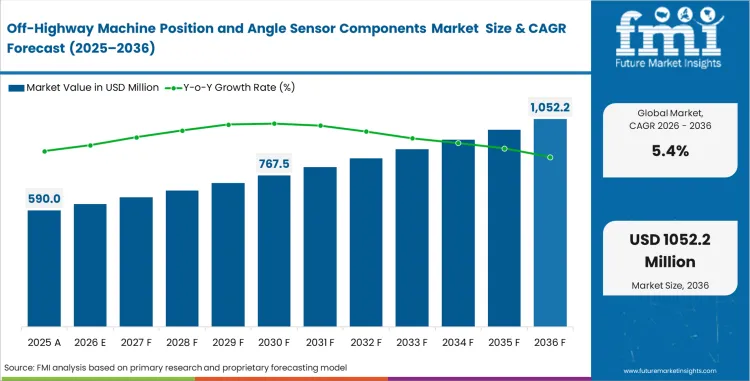
- USD 590.0 Mn
- Forecast (2036)
- USD 995.0 Mn
- CAGR (2026 to 2036)
- 5.4%
Off-Highway Machine Position and Angle Sensor Components Market Size, Forecast, and Outlook By FMI
Summary of the Off-Highway Machine Position and Angle Sensor Components
- Demand and Growth Drivers
- Excavators and tractors use more electronically controlled systems than before. This raises demand for position and angle sensor components.
- Demand is stronger in applications that require motion feedback and steering angle reading.
- Cylinder travel measurement uses these products because stable machine response depends on accurate signal input.
- Safety-rated signal paths and digital outputs support higher value in premium machines through better diagnostics and cleaner communication.
- Product and Segment View
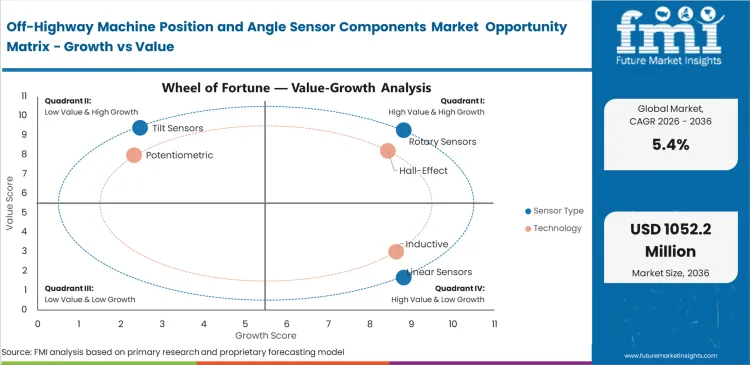
- Rotary and linear sensors cover much of the motion- and position-sensing demand in industrial machines. Tilt sensors add coverage in applications that require angle measurement.
- Hall‑effect sensors and inductive arc position sensors are better suited for dirty, high‑vibration environments due to their non‑contact operation and higher resistance to contamination.
- OEM integration drives demand, as sensor calibration and alignment along with mounting are typically locked in during the machine design phase whichincreases switching costs and longterm attachment.
- Geography and Competitive Outlook
- India and China support faster unit demand because local equipment production is rising and more machines are using position and angle sensors.
- United States and Germany support demand for higher-specification sensors because premium machine models use tighter control systems and more advanced electronic functions.
- Supplier advantage depends on strong sealing and proven validation support during OEM approval.
- Analyst Opinion
- Principal Analyst in Automotive Domain, Nikhil Kaitwade, at FMI States, “Wider electronic control use across off-highway machines is raising sensor demand. OEMs prefer rugged sensor packages with stable output and long service life. Higher margins come from safety-ready designs rather than basic analog parts. Supplier approval depends on validation history. Interface fit and service support matter as well.”
- Off-Highway Machine Position and Angle Sensor Components Market Value Analysis
- Stronger pricing is supported by redundant sensor designs and safety-capable outputs. These features raise system criticality and improve supplier differentiation.
- OEM programs secure larger revenue share because early design integration and ECU matching raise switching costs and extend supplier retention.
- Sensors used in steering and boom control see higher adoption because these functions need high-precision position feedback. Articulation applications add demand where safety-critical control depends on stable sensing.
- Commodity analog sensors face higher pricing pressure in mature machine platforms because functional performance is already standardized. This limits supplier differentiation and reduces pricing power.
Key Takeaways, Market Size, and Forecast
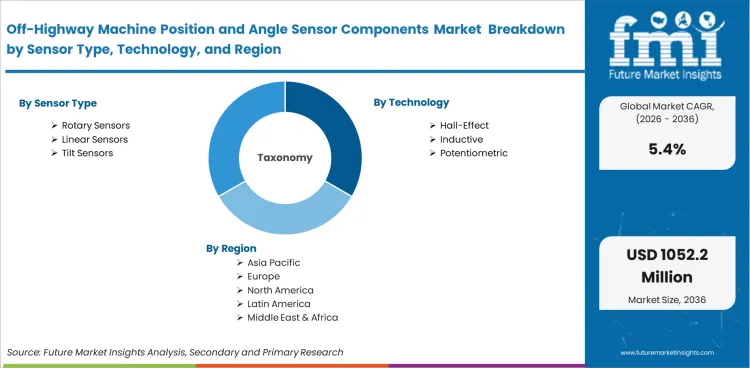
- The market reached USD 560.0 million in 2025.
- Market size is projected to reach USD 995.0 million by 2036.
- The market is expected to expand at a CAGR of 5.4% between 2026 and 2036.
- Incremental opportunity from 2026 to 2036 is estimated at USD 405.0 million.
- Rotary sensors are expected to account for 38.0% share in 2026.
- India and China are expected to be the two fastest growing markets with CAGRs of 6.8% and 6.4% through 2036.
- Commercial value comes from ruggedized sensors designed for motion control in harsh operating environments.
Off-Highway Machine Position and Angle Sensor Components Market Definition
Off-highway machine position and angle sensor components are sensing parts used in heavy mobile equipment. These products include rotary sensors and linear sensors. The market also includes arc sensors and draw-wire sensors. Tilt sensors are also included of in this market as these sensors measure steering angle and boom position. End use includes construction and farm equipment. It is also used in mining equipment and material handling machines, as well as forestry machines.
Off-Highway Machine Position and Angle Sensor Components Market Inclusions
Market scope includes hall-effect sensors and inductive sensors. It also includes potentiometric sensors and MEMS sensors, along with magneto strictive sensors. Scope includes OEM parts and aftermarket replacements. Application scope includes mobile hydraulics and cabin controls. It also includes pedal links and steering systems. Fork height systems are also included. Boom position functions are part of scope inclusions. Output scope includes analog voltage and PWM. It also includes CANopen and SAE J1939, as well as SSI.
Off-Highway Machine Position and Angle Sensor Components Market Exclusions
This market excludes radar systems and lidar systems. It also excludes cameras and construction equipment telematics control units. Full machine control systems are outside this market scope. Pressure-only sensors and inertial navigation modules sold as perception stacks are excluded. Full actuator assemblies and automation software is also excluded.
Off-Highway Machine Position and Angle Sensor Components Market Research Methodology
- Primary Research: OEM discussions and supplier checks across construction and agriculture equipment, and mining machines.
- Desk Research: Review of public product portfolios and company releases. Industry association material was also reviewed.
- Market sizing and forecasting: Bottom-up component revenue model built on equipment output and sensor content.
- Data validation: Cross-check against supplier exposure and machine mix. Interface adoption was also reviewed.
Why Is the Off‑Highway Machine Position and Angle Sensor Components Market Growing?
- Core machine functions require reliable position feedback to ensure accurate and repeatable motion control.
- Safety‑critical functions depend on stable, low‑noise signals to support predictable system response.
- Higher‑end machine programs increasingly specify rugged electronics designed for long service life and harsh operating conditions.
Accurate position feedback is essential for boom and arm movement, and stabilizer motion depends on the same control quality. Improved sensing accuracy enhances actuation quality and reduces control drift across repeated duty cycles.
Safety‑capable sensor packages raise average selling prices. While single‑channel analog sensors continue to account for unit volume in older fleets, higher margins are achieved through SIL‑ or PL‑ready designs supporting CANopen Safety or J1939. Safety-architected sensor designs support higher integrity requirements.
Supplier changes are limited by long validation cycles. OEMs rarely switch sensor suppliers on price alone. Mounting geometry and wiring interfaces influence approvals. ECU logic and proven field reliability influence approvals as well. Qualification often spans multiple platform generations. Service teams favor suppliers with established field performance histories.
Market Segmentation Analysis
- The rotary sensors segment is estimated to account for 38.0% share in 2026 because steering shafts and pedals need angular feedback across many machine classes. Throttle-linked functions add another volume base for this format.
- The Hall-effect category is expected to hold 34.0% share in 2026 because non-contact measurement supports stronger durability in dusty and vibration-heavy machine environments.
- Analog voltage is anticipated to capture 41.0% of the market in 2026 because legacy ECU compatibility keeps this output format in a large installed base.
- The boom linkage segment is expected to account for 26.0% share in 2026 because boom motion control depends on stable position feedback during repeated work cycles.
- Construction is expected to account for 33.0% share in 2026 because excavators and loaders use multiple position and angle sensing points per unit. Dumpers and telehandlers add further sensor content per machine.
- The shaft-mount category is likely to account for 29.0% share in 2026 because shaft-based installation fits a broad range of steering position sensor and pedal-linked measurement points.
- In 2026, OEM fitment is expected to contribute 82.0% of total market share because calibration and mounting geometry are fixed during machine design. ECU logic is fixed at the same stage.
The market is divided into sensor type, technology, output interface, application point, machine type, mounting format, sales channel, and region. Sensor type covers rotary sensors, linear sensors, tilt sensors, arc sensors, and draw-wire sensors. Technology includes Hall-effect, inductive, potentiometric, MEMS, and magnetostrictive formats. Output interface covers analog voltage, PWM, CANopen, SAE J1939, and SSI. Application point includes boom linkage, steering joints, hydraulic cylinders, cab controls, transmission shift, and outriggers. Machine type covers construction, agriculture, mining, material handling, and forestry. Mounting format includes shaft-mount, flange-mount, cylinder-mount, arc-mount, and draw-wire designs. Sales channel covers OEM fitment and aftermarket.
Insights into the Rotary Sensors Segment
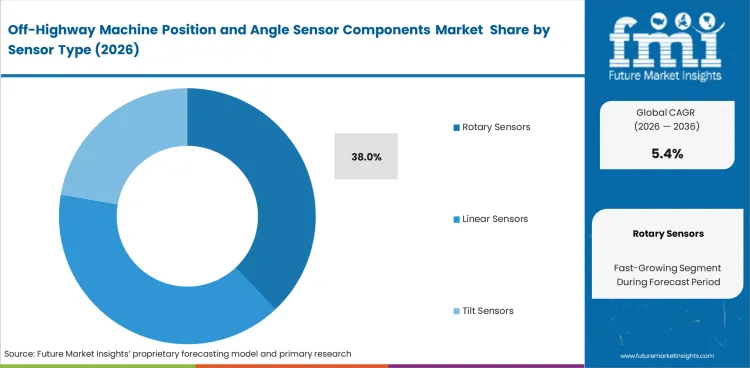
- In 2026, rotary sensors are expected to contribute 38.0% of total market share. Steering shafts and pedals keep this format in a strong lead.
- Linear and tilt formats are widely used in booms and cylinders. Stabilizers and fork-position systems add further demand where longer travel feedback is required.
Insights into the Hall-effect Segment
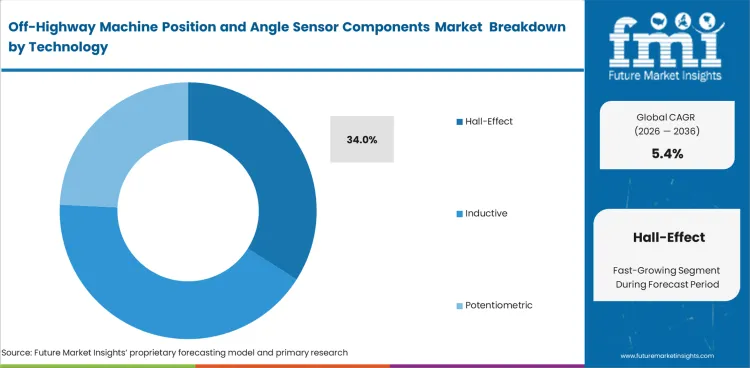
- The Hall-effect segment is estimated to account for 34.0% share in 2026. Non-contact measurement and sealing strength support adoption in harsh-duty applications.
- Inductive technology is gaining weight in angle and arc measurement applications that require repeatability with lower wear exposure.
Insights into the Analog Voltage Segment
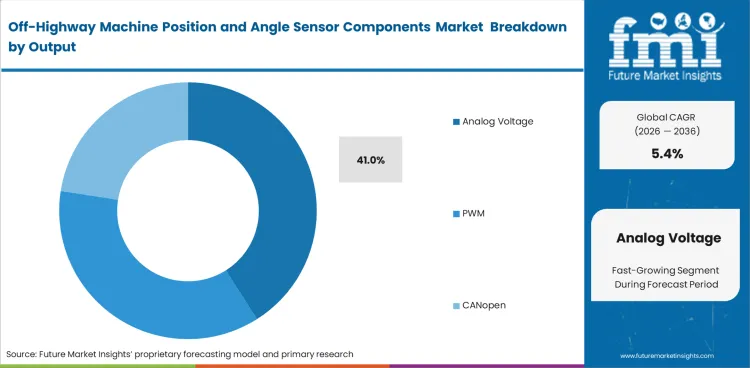
- The analog voltage category is expected to hold 41.0% share in 2026. Legacy ECU compatibility and lower integration effort keep analog output in a large installed base.
- CANopen and SAE J1939 are used more often in new platforms that require diagnostics and safety-oriented communication.
Insights into the Construction Segment
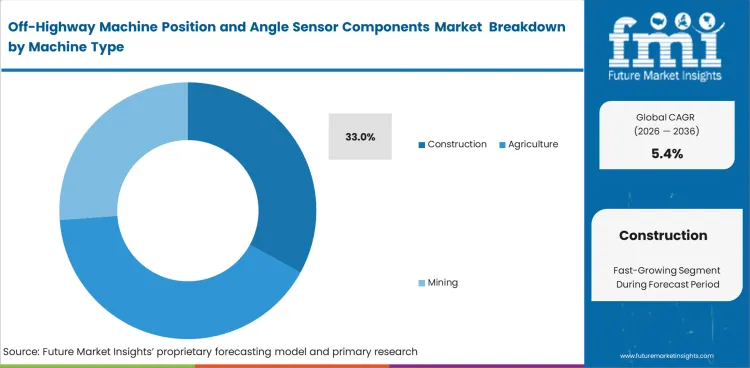
- Construction is anticipated to capture 33.0% of the market in 2026 because excavators and loaders use several position and angle channels per unit.
- Dumpers and aerial platforms add further demand. Agriculture uses these sensors in hitch control and pedal sensing.
Off-Highway Machine Position and Angle Sensor Components Market Drivers, Restraints, and Opportunities
- Growth comes from gradual expansion in sensor content across machine platforms rather than sudden unit-volume jumps.
- Machine builders are adding more electronic control to motion functions that need better precision and smoother actuation.
- Safety focused control functions are increasing sensor requirements in steering boom and stabilizer systems.
Growth in this market is driven by rising sensor content per machine rather than increases in equipment shipment volumes. As machine builders raise performance and safety expectations each platform adds more sensing points per function. This supports steady demand expansion even when equipment shipment growth is moderate.
Hydraulic Motion Feedback Gains Wider Importance
Booms and arms need precise position or angle feedback for smoother machine response. Stabilizers need the same control quality for better consistency. Demand is stronger in equipment classes with higher safety exposure and repeated duty cycles. Sensor use supports bucket path control. Boom movement stability during long operating shifts depends on the same feedback quality. NIOSH states that struck-by incidents are the leading cause of nonfatal injuries and the second leading cause of workplace deaths among construction workers. This supports the case for better motion control and safer machine operation.
Validation Time Slows New Supplier Entry
Machine builders rarely switch sensor suppliers on price alone. Mounting geometry, harness compatibility and ECU logic as well as field durability data create a high qualification barrier for new entrants. Platform teams prefer known failure behavior and proven service records once a part is released into serial production. Approval can take longer in machines carrying tighter safety logic or higher field downtime cost.
Analysis of Off-Highway Machine Position and Angle Sensor Components Market By Key Countries
.webp "Top Country Growth Comparison Off Highway Machine Position And Angle Sensor Components Market Cagr (2026 2036)")
| Country | CAGR |
|---|---|
| India | 6.8% |
| China | 6.4% |
| Brazil | 5.9% |
| United States | 5.1% |
| Germany | 4.7% |
| France | 4.6% |
| Japan | 4.5% |
Source: FMI analysis based on primary research and proprietary forecasting model
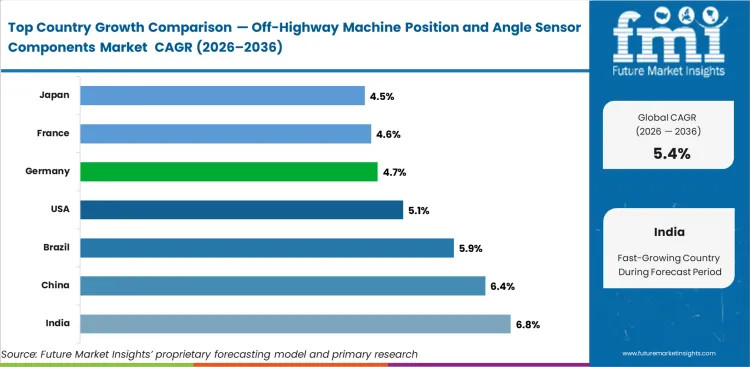
Off-Highway Machine Position and Angle Sensor Components Market CAGR Analysis By Country
- India is projected to grow at a 6.8 percent CAGR through 2036 as demand rises for smarter construction equipment. Improving local electronics integration is expanding sensor fitment across a wider range of machine platforms.
- China is expected to expand at a 6.4 percent CAGR by 2036 supported by high equipment production volumes. Wider adoption of digital hydraulic systems is increasing sensor content per machine.
- Brazil is forecast to register a 5.9 percent CAGR during the forecast driven by stable agricultural equipment demand. A strong service network sustains replacement sensor demand across the installed base.
- The United States is likely to record a 5.1 percent CAGR through 2036 because premium machine platforms carry higher component value per unit. Safety focused designs and redundant sensing raise average content levels.
Market growth reflects a steady rise in sensor adoption across construction and premium equipment platforms. FMIs analysis captures these trends through a bottom up assessment covering more than 30 countries, offering a balanced view of regional demand patterns and OEM sourcing behavior across developed and emerging markets.
Demand Outlook for Off-Highway Machine Position and Angle Sensor Components in India
India has a large tractor base and a rising construction equipment fleet. Demand for off-highway machine position and angle sensor components in India is expected to rise at a 6.8% CAGR through 2036 because domestic equipment production is expanding. Electronics content is rising across more machine categories. Supplier focus is strongest in hitch position sensing, boom angle sensing, and pedal sensing programs where equipment makers need accurate movement tracking.
- Tractor demand supports sensor fitment across a wide machine base.
- Equipment makers keep strict control over component cost.
- Local sourcing is gaining more importance in supply decisions.
Future Outlook for Off-Highway Machine Position and Angle Sensor Components in China
China has high machine output and wider automation use across off-highway equipment. Sales of off-highway machine position and angle sensor components in China are projected to increase at a 6.4% CAGR through 2036 because excavator demand is rising. Digital hydraulic systems are gaining wider use across new programs. Large OEM platforms support higher shipment volume because sensor content per machine is increasing.
- Domestic OEM scale supports larger sourcing programs.
- Digital output formats fit more new machine platforms.
- Export programs require stronger product validation.
Opportunity Analysis of Off-Highway Machine Position and Angle Sensor Components in Brazil
Brazil has strong agricultural equipment demand and a stable construction machinery base. Demand for off-highway machine position and angle sensor components in Brazil is forecast to expand at a 5.9% CAGR through 2036 because mechanization is advancing. Field service demand remains firm across operating fleets. Supplier position is stronger in durable linear and rotary sensor products built for harsh operating conditions.
- Agricultural equipment creates repeat replacement demand.
- Service reach matters more in aftermarket supply.
- Simple mounting supports easier replacement sales.
In-depth Analysis of Off-Highway Machine Position and Angle Sensor Components in the United States
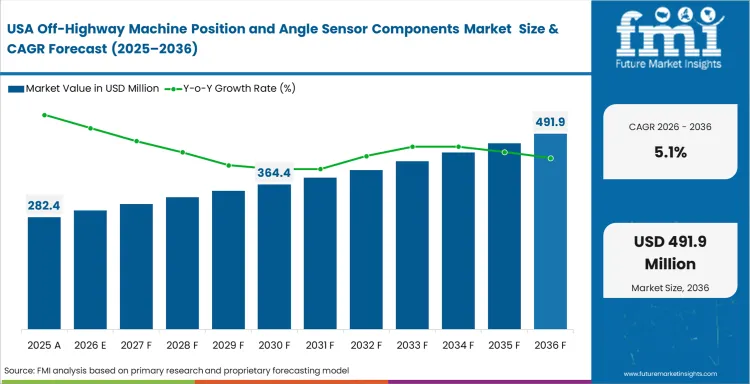
The United States has a premium machine mix and a broad rental fleet base. Demand for off-highway machine position and angle sensor components in the United States is expected to grow at a 5.1% CAGR through 2036 because sealed housings and redundant outputs are used more widely. Demand stays stronger in lift systems and boom systems where safety requirements are tighter.
- Premium platforms raise component value per machine.
- Validation standards are stricter across OEM programs.
- Serviceability shapes repeat supplier awards.
Sales Analysis of Off-Highway Machine Position and Angle Sensor Components in Germany
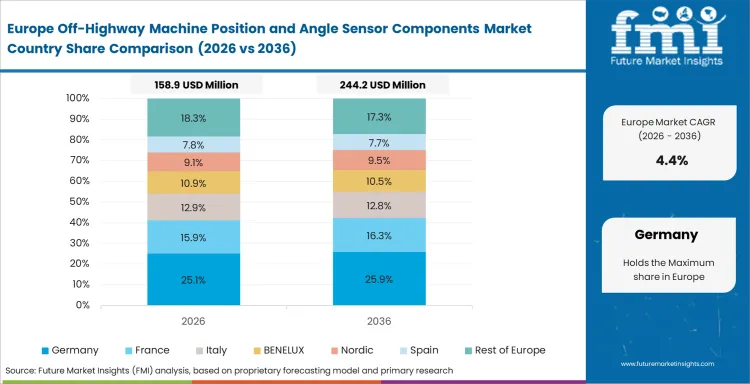
Germany has a mature base of premium machinery and engineered hydraulic systems. Sales of off-highway machine position and angle sensor components in Germany are likely to rise at a 4.7% CAGR during the forecast period as export-grade equipment needs precise control performance. Adoption stays stronger in higher-specification machines that use these components more widely.
- Precision standards guide product selection.
- Digital outputs are gaining more relevance.
- Long qualification cycles can delay entry.
Demand Outlook for Off-Highway Machine Position and Angle Sensor Components in Japan
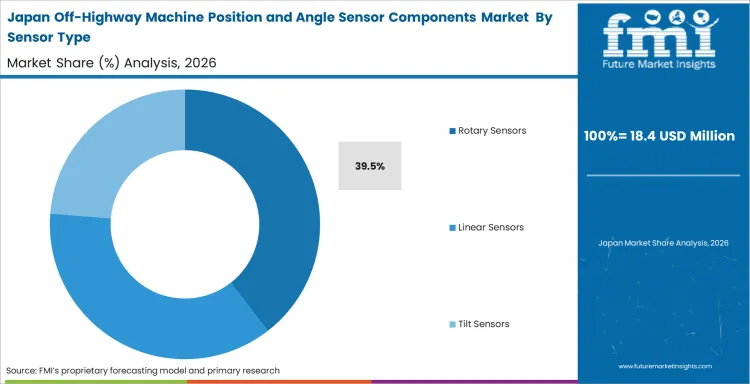
Japan has high engineering standards and a mature equipment base. Demand for off-highway machine position and angle sensor components in Japan is projected to increase at a 4.5% CAGR through 2036 as compact machine demand remains steady.
- Compact machines require smaller sensor packages.
- Output stability supports supplier retention.
- Mature demand limits faster expansion.
Competitive Landscape and Strategic Positioning
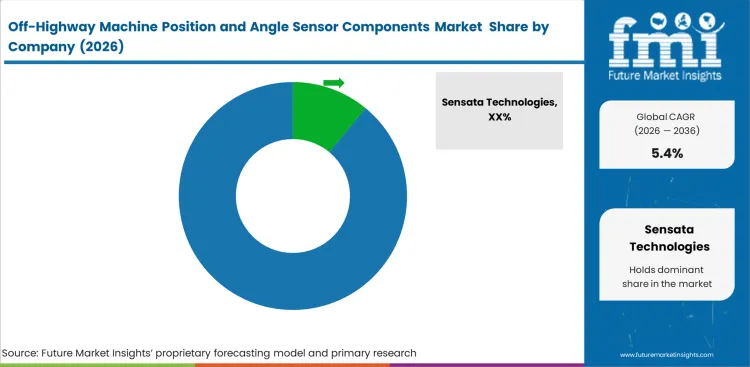
- Top suppliers compete primarily on rugged packaging and redundancy to meet harsh duty requirements.
- Interface flexibility adds value in platforms that demand multiple output options.
- OEM awards favor suppliers with proven validation history and strong field reliability.
New entrants face a difficult path once sensor geometry and ECU logic are fixed within a platform. Sensata and Danfoss form the core competitive leaders due to their broad off highway sensor portfolios. Bosch and TE Connectivity contribute scale and system level integration strength. Piher and Gefran are more closely aligned with steering hitch fork and joystick sensing applications where mechanical fit and durability are critical.
Product selection is driven by operational risk rather than unit price. Sealing quality and shock resistance directly influence supplier approval decisions. Engineering support and service history shape long term retention because field failures create downtime costs that exceed sensor pricing.
Key Companies in the Off-Highway Machine Position and Angle Sensor Components Market
Key global companies leading the Off-Highway Machine Position and Angle Sensor Components market include:
- Broad off-highway sensor suppliers: Sensata Technologies and Danfoss. Robert Bosch GmbH adds wider industrial scale.
- Connectivity and control-linked players: TE Connectivity and CTS Corporation.
- Application-driven niche sensor specialists: Piher Sensing Systems, Gefran, and Temposonics.
Competitive Benchmarking: Off-Highway Machine Position and Angle Sensor Components
| Company | Off-Highway Portfolio | Safety-Ready Outputs | Mobile-Machine Fit | Geographic Footprint |
|---|---|---|---|---|
| Sensata Technologies | High | High | High | Global |
| Danfoss | High | High | High | Global |
| Robert Bosch GmbH | Medium | High | High | Global |
| TE Connectivity | Medium | High | Medium | Global |
| Piher Sensing Systems | High | Medium | High | Global |
| Gefran | High | High | High | Global |
Source: Future Market Insights competitive analysis, 2026. Ratings reflect relative positioning based on off-highway portfolio, safety-ready outputs, and mobile-machine fit.
Key Developments in Off-Highway Machine Position and Angle Sensor Components
- In November 2024, Temposonics GmbH & Co. KG announced a safety-rated flexible position sensor for easy in-field serviceability; the launch added a field-serviceable linear sensor with CANopen Safety and J1939-76 outputs for mobile hydraulic systems.
- In March 2025, FORVIA HELLA introduced a universal angular sensor with CIPOS® technology; the launch expanded angular sensing options for agricultural and construction machinery with precise angle and inclination measurement.
Key Players in the Off-Highway Machine Position and Angle Sensor Components:
Major Global Players:
- Sensata Technologies
- Danfoss
- Robert Bosch GmbH
- TE Connectivity
Emerging Players/Startups
- Piher Sensing Systems
- Gefran
- Temposonics
Report Scope and Coverage
| Parameter | Details |
|---|---|
| Quantitative Units | USD Million |
| Market Definition | Standalone position and angle sensor components used in off-highway machines |
| Regions Covered | North America, Latin America, Europe, Asia Pacific, Middle East & Africa |
| Countries Covered | India, China, Brazil, United States, Germany, France, Japan |
| Key Companies Profiled | Sensata Technologies, Danfoss, Robert Bosch GmbH, TE Connectivity, Piher Sensing Systems, Gefran, Temposonics |
| Forecast Period | 2026 to 2036 |
| Approach | Primary research, product mapping, bottom-up forecasting, and validation checks |
Off-Highway Machine Position and Angle Sensor Components Market by Segments
Off-Highway Machine Position and Angle Sensor Components Market Segmented by Sensor Type:
- Rotary sensors
- Linear sensors
- Tilt sensors
- Arc sensors
- Draw-wire sensors
Off-Highway Machine Position and Angle Sensor Components Market Segmented by Technology:
- Hall-effect
- Inductive
- Potentiometric
- MEMS
- Magnetostrictive
Off-Highway Machine Position and Angle Sensor Components Market Segmented by Output Interface:
- Analog voltage
- PWM
- CANopen
- SAE J1939
- SSI
Off-Highway Machine Position and Angle Sensor Components Market Segmented by Application Point:
- Boom linkage
- Steering joints
- Hydraulic cylinders
- Cab controls
- Transmission shift
- Outriggers
Off-Highway Machine Position and Angle Sensor Components Market Segmented by Machine Type:
- Construction
- Agriculture
- Mining
- Material handling
- Forestry
Off-Highway Machine Position and Angle Sensor Components Market Segmented by Mounting Format:
- Shaft-mount
- Flange-mount
- Cylinder-mount
- Arc-mount
- Draw-wire
Off-Highway Machine Position and Angle Sensor Components Market Segmented by Sales Channel:
- OEM fitment
- Aftermarket
Research Sources and Bibliography
- Temposonics GmbH & Co. KG. (2024, November 20). TEMPOSONICS MH-SERIES FLEX SAFETY.
- HELLA GmbH & Co. KGaA. (2025, March 12). Precision and versatility: FORVIA HELLA introduces universal angular sensor with CIPOS® technology.
- FORVIA HELLA. (2025, March 12). Precision and versatility: FORVIA HELLA introduces universal angular sensor with CIPOS® technology.
- Changjoo Lee, Simon Schätzle, Stefan Andreas Lang, and Timo Oksanen. (2024, December). Image quality safety model for the safety of the intended functionality in highly automated agricultural machines.
- Wentao Bian, Yanyi Liu, and Yin Wu. (2024, December). A Bluetooth-Based Automated Agricultural Machinery Positioning System.
- Hideyuki Konya and Yutaka Kikuchi. (2024, July). Risk Analysis, Safety Assurance Requirements, and Safety Evaluation Test for Robotic Agricultural Machinery.
- Zeru Liu and Jung In Kim. (2025, July). Autonomous Earthwork Machinery for Urban Construction: A Review of Integrated Control, Fleet Coordination, and Safety Assurance.
- Martyna Konieczna-Fuławka, Anton Koval, George Nikolakopoulos, Matteo Fumagalli, Laura Santas Moreu, Victor Vigara-Puche, Jakob Müller, and Michael Prenner. (2025, June). Autonomous Mobile Inspection Robots in Deep Underground Mining—The Current State of the Art and Future Perspectives. Link:
This Report Answers
- What was the market value in 2025?
- What is the projected market value by 2036?
- What is the forecast CAGR for 2026 to 2036?
- Which sensor type leads demand in 2026?
- Which technology base leads the market mix?
- Which output interface carries the largest share?
- Which application point holds the top share?
- Which machine type leads component fitment?
- Which sales channel dominates demand?
- Which country shows the fastest growth path?
- What limits new supplier entry?
- What lifts average selling price in this market?
Frequently Asked Questions
What is driving demand in this market?
Demand comes from broader electronic control use in off-highway machines and a rising need for reliable motion feedback across hydraulic and safety functions.
Which sensor type leads market demand?
Rotary sensors lead because steering, pedals, joysticks, and throttle-linked functions need angular feedback across many machine classes.
Why does OEM fitment hold the larger share?
OEM fitment leads because sensor geometry, ECU calibration, and mounting logic are fixed during machine design.
How do buyers judge competing sensor suppliers?
Buyers focus on sealing, redundancy, signal stability, connector fit, and engineering support.
What limits faster market expansion?
Long qualification cycles and price pressure on standard analog parts limit faster gains.
Which countries show the fastest growth path?
India leads, followed by China and Brazil.
How is digital output changing the market?
CANopen and SAE J1939 gain more weight in premium machines because diagnostics and cleaner communication add more value.
What makes safety-certified sensors attractive?
Safety-certified designs reduce integration effort in lift, boom, and stabilizer functions and support tighter machine-control programs.
Preview the report firsthand - request a free sample
Get SampleGet the brochure for pricing and purchase details.
Get PDFTable of Content
- Executive Summary
- Global Market Outlook
- Demand-side Trends
- Supply-side Trends
- Technology Roadmap Analysis
- Analysis and Recommendations
- Market Overview
- Market Coverage / Taxonomy
- Market Definition / Scope / Limitations
- Research Methodology
- Chapter Orientation
- Analytical Lens and Working Hypotheses
- Market Structure, Signals, and Trend Drivers
- Benchmarking and Cross-market Comparability
- Market Sizing, Forecasting, and Opportunity Mapping
- Research Design and Evidence Framework
- Desk Research Programme (Secondary Evidence)
- Company Annual and Sustainability Reports
- Peer-reviewed Journals and Academic Literature
- Corporate Websites, Product Literature, and Technical Notes
- Earnings Decks and Investor Briefings
- Statutory Filings and Regulatory Disclosures
- Technical White Papers and Standards Notes
- Trade Journals, Industry Magazines, and Analyst Briefs
- Conference Proceedings, Webinars, and Seminar Materials
- Government Statistics Portals and Public Data Releases
- Press Releases and Reputable Media Coverage
- Specialist Newsletters and Curated Briefings
- Sector Databases and Reference Repositories
- FMI Internal Proprietary Databases and Historical Market Datasets
- Subscription Datasets and Paid Sources
- Social Channels, Communities, and Digital Listening Inputs
- Additional Desk Sources
- Expert Input and Fieldwork (Primary Evidence)
- Primary Modes
- Qualitative Interviews and Expert Elicitation
- Quantitative Surveys and Structured Data Capture
- Blended Approach
- Why Primary Evidence is Used
- Field Techniques
- Interviews
- Surveys
- Focus Groups
- Observational and In-context Research
- Social and Community Interactions
- Stakeholder Universe Engaged
- C-suite Leaders
- Board Members
- Presidents and Vice Presidents
- R&D and Innovation Heads
- Technical Specialists
- Domain Subject-matter Experts
- Scientists
- Physicians and Other Healthcare Professionals
- Governance, Ethics, and Data Stewardship
- Research Ethics
- Data Integrity and Handling
- Primary Modes
- Tooling, Models, and Reference Databases
- Desk Research Programme (Secondary Evidence)
- Data Engineering and Model Build
- Data Acquisition and Ingestion
- Cleaning, Normalisation, and Verification
- Synthesis, Triangulation, and Analysis
- Quality Assurance and Audit Trail
- Market Background
- Market Dynamics
- Drivers
- Restraints
- Opportunity
- Trends
- Scenario Forecast
- Demand in Optimistic Scenario
- Demand in Likely Scenario
- Demand in Conservative Scenario
- Opportunity Map Analysis
- Product Life Cycle Analysis
- Supply Chain Analysis
- Investment Feasibility Matrix
- Value Chain Analysis
- PESTLE and Porter’s Analysis
- Regulatory Landscape
- Regional Parent Market Outlook
- Production and Consumption Statistics
- Import and Export Statistics
- Market Dynamics
- Global Market Analysis 2021 to 2025 and Forecast, 2026 to 2036
- Historical Market Size Value (USD Million) Analysis, 2021 to 2025
- Current and Future Market Size Value (USD Million) Projections, 2026 to 2036
- Y-o-Y Growth Trend Analysis
- Absolute $ Opportunity Analysis
- Global Market Pricing Analysis 2021 to 2025 and Forecast 2026 to 2036
- Global Market Analysis 2021 to 2025 and Forecast 2026 to 2036, By Sensor Type
- Introduction / Key Findings
- Historical Market Size Value (USD Million) Analysis By Sensor Type , 2021 to 2025
- Current and Future Market Size Value (USD Million) Analysis and Forecast By Sensor Type , 2026 to 2036
- Rotary Sensors
- Linear Sensors
- Tilt Sensors
- Rotary Sensors
- Y-o-Y Growth Trend Analysis By Sensor Type , 2021 to 2025
- Absolute $ Opportunity Analysis By Sensor Type , 2026 to 2036
- Global Market Analysis 2021 to 2025 and Forecast 2026 to 2036, By Technology
- Introduction / Key Findings
- Historical Market Size Value (USD Million) Analysis By Technology, 2021 to 2025
- Current and Future Market Size Value (USD Million) Analysis and Forecast By Technology, 2026 to 2036
- Hall-Effect
- Inductive
- Potentiometric
- Hall-Effect
- Y-o-Y Growth Trend Analysis By Technology, 2021 to 2025
- Absolute $ Opportunity Analysis By Technology, 2026 to 2036
- Global Market Analysis 2021 to 2025 and Forecast 2026 to 2036, By Output
- Introduction / Key Findings
- Historical Market Size Value (USD Million) Analysis By Output, 2021 to 2025
- Current and Future Market Size Value (USD Million) Analysis and Forecast By Output, 2026 to 2036
- Analog Voltage
- PWM
- CANopen
- Analog Voltage
- Y-o-Y Growth Trend Analysis By Output, 2021 to 2025
- Absolute $ Opportunity Analysis By Output, 2026 to 2036
- Global Market Analysis 2021 to 2025 and Forecast 2026 to 2036, By Machine Type
- Introduction / Key Findings
- Historical Market Size Value (USD Million) Analysis By Machine Type, 2021 to 2025
- Current and Future Market Size Value (USD Million) Analysis and Forecast By Machine Type, 2026 to 2036
- Construction
- Agriculture
- Mining
- Construction
- Y-o-Y Growth Trend Analysis By Machine Type, 2021 to 2025
- Absolute $ Opportunity Analysis By Machine Type, 2026 to 2036
- Global Market Analysis 2021 to 2025 and Forecast 2026 to 2036, By Region
- Introduction
- Historical Market Size Value (USD Million) Analysis By Region, 2021 to 2025
- Current Market Size Value (USD Million) Analysis and Forecast By Region, 2026 to 2036
- North America
- Latin America
- Western Europe
- Eastern Europe
- East Asia
- South Asia and Pacific
- Middle East & Africa
- Market Attractiveness Analysis By Region
- North America Market Analysis 2021 to 2025 and Forecast 2026 to 2036, By Country
- Historical Market Size Value (USD Million) Trend Analysis By Market Taxonomy, 2021 to 2025
- Market Size Value (USD Million) Forecast By Market Taxonomy, 2026 to 2036
- By Country
- USA
- Canada
- Mexico
- By Sensor Type
- By Technology
- By Output
- By Machine Type
- By Country
- Market Attractiveness Analysis
- By Country
- By Sensor Type
- By Technology
- By Output
- By Machine Type
- Key Takeaways
- Latin America Market Analysis 2021 to 2025 and Forecast 2026 to 2036, By Country
- Historical Market Size Value (USD Million) Trend Analysis By Market Taxonomy, 2021 to 2025
- Market Size Value (USD Million) Forecast By Market Taxonomy, 2026 to 2036
- By Country
- Brazil
- Chile
- Rest of Latin America
- By Sensor Type
- By Technology
- By Output
- By Machine Type
- By Country
- Market Attractiveness Analysis
- By Country
- By Sensor Type
- By Technology
- By Output
- By Machine Type
- Key Takeaways
- Western Europe Market Analysis 2021 to 2025 and Forecast 2026 to 2036, By Country
- Historical Market Size Value (USD Million) Trend Analysis By Market Taxonomy, 2021 to 2025
- Market Size Value (USD Million) Forecast By Market Taxonomy, 2026 to 2036
- By Country
- Germany
- UK
- Italy
- Spain
- France
- Nordic
- BENELUX
- Rest of Western Europe
- By Sensor Type
- By Technology
- By Output
- By Machine Type
- By Country
- Market Attractiveness Analysis
- By Country
- By Sensor Type
- By Technology
- By Output
- By Machine Type
- Key Takeaways
- Eastern Europe Market Analysis 2021 to 2025 and Forecast 2026 to 2036, By Country
- Historical Market Size Value (USD Million) Trend Analysis By Market Taxonomy, 2021 to 2025
- Market Size Value (USD Million) Forecast By Market Taxonomy, 2026 to 2036
- By Country
- Russia
- Poland
- Hungary
- Balkan & Baltic
- Rest of Eastern Europe
- By Sensor Type
- By Technology
- By Output
- By Machine Type
- By Country
- Market Attractiveness Analysis
- By Country
- By Sensor Type
- By Technology
- By Output
- By Machine Type
- Key Takeaways
- East Asia Market Analysis 2021 to 2025 and Forecast 2026 to 2036, By Country
- Historical Market Size Value (USD Million) Trend Analysis By Market Taxonomy, 2021 to 2025
- Market Size Value (USD Million) Forecast By Market Taxonomy, 2026 to 2036
- By Country
- China
- Japan
- South Korea
- By Sensor Type
- By Technology
- By Output
- By Machine Type
- By Country
- Market Attractiveness Analysis
- By Country
- By Sensor Type
- By Technology
- By Output
- By Machine Type
- Key Takeaways
- South Asia and Pacific Market Analysis 2021 to 2025 and Forecast 2026 to 2036, By Country
- Historical Market Size Value (USD Million) Trend Analysis By Market Taxonomy, 2021 to 2025
- Market Size Value (USD Million) Forecast By Market Taxonomy, 2026 to 2036
- By Country
- India
- ASEAN
- Australia & New Zealand
- Rest of South Asia and Pacific
- By Sensor Type
- By Technology
- By Output
- By Machine Type
- By Country
- Market Attractiveness Analysis
- By Country
- By Sensor Type
- By Technology
- By Output
- By Machine Type
- Key Takeaways
- Middle East & Africa Market Analysis 2021 to 2025 and Forecast 2026 to 2036, By Country
- Historical Market Size Value (USD Million) Trend Analysis By Market Taxonomy, 2021 to 2025
- Market Size Value (USD Million) Forecast By Market Taxonomy, 2026 to 2036
- By Country
- Kingdom of Saudi Arabia
- Other GCC Countries
- Turkiye
- South Africa
- Other African Union
- Rest of Middle East & Africa
- By Sensor Type
- By Technology
- By Output
- By Machine Type
- By Country
- Market Attractiveness Analysis
- By Country
- By Sensor Type
- By Technology
- By Output
- By Machine Type
- Key Takeaways
- Key Countries Market Analysis
- USA
- Pricing Analysis
- Market Share Analysis, 2025
- By Sensor Type
- By Technology
- By Output
- By Machine Type
- Canada
- Pricing Analysis
- Market Share Analysis, 2025
- By Sensor Type
- By Technology
- By Output
- By Machine Type
- Mexico
- Pricing Analysis
- Market Share Analysis, 2025
- By Sensor Type
- By Technology
- By Output
- By Machine Type
- Brazil
- Pricing Analysis
- Market Share Analysis, 2025
- By Sensor Type
- By Technology
- By Output
- By Machine Type
- Chile
- Pricing Analysis
- Market Share Analysis, 2025
- By Sensor Type
- By Technology
- By Output
- By Machine Type
- Germany
- Pricing Analysis
- Market Share Analysis, 2025
- By Sensor Type
- By Technology
- By Output
- By Machine Type
- UK
- Pricing Analysis
- Market Share Analysis, 2025
- By Sensor Type
- By Technology
- By Output
- By Machine Type
- Italy
- Pricing Analysis
- Market Share Analysis, 2025
- By Sensor Type
- By Technology
- By Output
- By Machine Type
- Spain
- Pricing Analysis
- Market Share Analysis, 2025
- By Sensor Type
- By Technology
- By Output
- By Machine Type
- France
- Pricing Analysis
- Market Share Analysis, 2025
- By Sensor Type
- By Technology
- By Output
- By Machine Type
- India
- Pricing Analysis
- Market Share Analysis, 2025
- By Sensor Type
- By Technology
- By Output
- By Machine Type
- ASEAN
- Pricing Analysis
- Market Share Analysis, 2025
- By Sensor Type
- By Technology
- By Output
- By Machine Type
- Australia & New Zealand
- Pricing Analysis
- Market Share Analysis, 2025
- By Sensor Type
- By Technology
- By Output
- By Machine Type
- China
- Pricing Analysis
- Market Share Analysis, 2025
- By Sensor Type
- By Technology
- By Output
- By Machine Type
- Japan
- Pricing Analysis
- Market Share Analysis, 2025
- By Sensor Type
- By Technology
- By Output
- By Machine Type
- South Korea
- Pricing Analysis
- Market Share Analysis, 2025
- By Sensor Type
- By Technology
- By Output
- By Machine Type
- Russia
- Pricing Analysis
- Market Share Analysis, 2025
- By Sensor Type
- By Technology
- By Output
- By Machine Type
- Poland
- Pricing Analysis
- Market Share Analysis, 2025
- By Sensor Type
- By Technology
- By Output
- By Machine Type
- Hungary
- Pricing Analysis
- Market Share Analysis, 2025
- By Sensor Type
- By Technology
- By Output
- By Machine Type
- Kingdom of Saudi Arabia
- Pricing Analysis
- Market Share Analysis, 2025
- By Sensor Type
- By Technology
- By Output
- By Machine Type
- Turkiye
- Pricing Analysis
- Market Share Analysis, 2025
- By Sensor Type
- By Technology
- By Output
- By Machine Type
- South Africa
- Pricing Analysis
- Market Share Analysis, 2025
- By Sensor Type
- By Technology
- By Output
- By Machine Type
- USA
- Market Structure Analysis
- Competition Dashboard
- Competition Benchmarking
- Market Share Analysis of Top Players
- By Regional
- By Sensor Type
- By Technology
- By Output
- By Machine Type
- Competition Analysis
- Competition Deep Dive
- Sensata Technologies
- Overview
- Product Portfolio
- Profitability by Market Segments (Product/Age /Sales Channel/Region)
- Sales Footprint
- Strategy Overview
- Marketing Strategy
- Product Strategy
- Channel Strategy
- Danfoss
- Robert Bosch GmbH
- TE Connectivity
- Piher Sensing Systems
- Gefran
- Sensata Technologies
- Competition Deep Dive
- Assumptions & Acronyms Used


