

- Market Size (2026)
- USD 300.0 Mn
- Forecast (2036)
- USD 1300.0 Mn
- CAGR (2026 to 2036)
- 13.2%
High-Voltage Isolation and Leakage Sensor Components Market Size, Market Forecast and Outlook By FMI
Summary of the High-Voltage Isolation and Leakage Sensor Components
- Demand and Growth Drivers
- Demand rises as EV and charging-system architectures adopt higher voltage layouts carrying stricter safety-monitoring requirements.
- Growth is supported by 800 V platform adoption, charging-network expansion, and strong focus on insulation-fault visibility across vehicle systems.
- Adoption is moderated by validation effort and longer approval cycles in safety-critical electronics.
- Product and Segment View
- Insulation monitors lead the product segment because continuous isolation supervision remains a core requirement in high-voltage systems.
- Passenger cars create the largest revenue base as BEV production increases in this class and line-fit demand is broader.
- Battery packs hold the leading mounting-point share due to direct electrical-safety relevance and repeated monitoring need at pack level.
- OEM line-fit holds the largest channel share because qualification alignment during vehicle build supports earlier integration and broader fitment across all vehicle types.
- Geography and Competitive Outlook
- India and China lead expansion due to faster EV build-out and charger additions.
- The United States and Germany retain value due to installed-base depth and wider electrification programs.
- Supplier position comes from safety-validation depth and interface fit.
- Analyst Opinion
- Nikhil Kaitwade, Principal Analyst states: “Commercial value is strongest in monitoring systems serving 800 V vehicle platforms and higher-power charging systems because OEMs and charging operators place more weight on diagnostic clarity and safety confidence than on quoted part cost. Demand is being shaped by wider vehicle electrification and by charger deployment across high-traffic routes. Preference for interface-ready hardware with proven validation history supports product uptake. Opportunity is widening in charger-side and fleet-service programs because fault visibility and faster maintenance response increase operating value.”
- High-Voltage Isolation and Leakage Sensor Components Market Value Analysis
- Revenue capture is stronger across validated high-voltage monitoring hardware than across stand-alone replacement parts lacking system-level fit.
- Passenger EV programs account for higher market value because installed volumes and platform refresh rates are both higher.
- 800 V migration supports better pricing due to higher monitoring complexity and wider interface requirements.
- This market is a part of focused layer inside broader automotive battery management systems and power electronics.
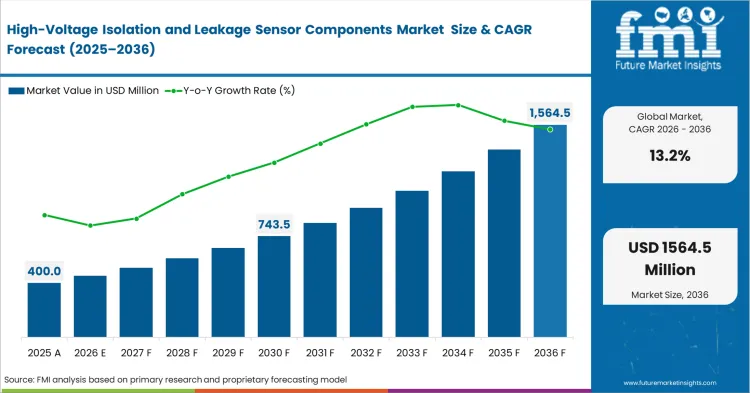
Key Takeaways, Market Size, and Forecast
- The market reached USD 300.0 million The market is forecast to reach USD 1,300.0 million by 2036.
- Demand for high-voltage isolation and leakage sensor components is expected to expand at a CAGR of 13.2% from 2026 to 2036.
- Incremental opportunity across 2026 to 2036 is USD 900.0 million.
- Insulation monitors lead product type demand with a 34.0% share in 2026.
- India is likely to post a CAGR of 16.8% in high-voltage isolation and leakage sensor components by 2036.
- China is expected to record a CAGR of 15.4% during the same period.
- Revenue concentration is higher in OEM line-fit and charger-linked programs tied with active BEV platforms.
High-Voltage Isolation and Leakage Sensor Components Market Definition
High-voltage isolation and leakage sensor components include electrical safety devices used to monitor insulation resistance and detect leakage current. It also includes identify residual-fault conditions and support safe operation in electric vehicles and charging systems. Commercial relevance is highest across battery packs and onboard chargers and charger cabinets. Market dynamics depend more on safety performance and lifecycle fit than on simple sensor replacement volume.
High-Voltage Isolation and Leakage Sensor Components Market Inclusions
The scope includes insulation monitors and leakage sensors. Residual monitors and fault locators are also included. Scope also includes systems using CAN and analog. Digital and LIN outputs are part of scope. The scope covers OEM line-fit and EVSE OEM and aftermarket demand across various vehicle types and selected off-highway charging sites. Product relevance also extends to battery pack and DC contactors for electric vehicles including junction-box integration.
High-Voltage Isolation and Leakage Sensor Components Market Exclusions
The scope excludes full battery management systems plus full charger cabinets. The scope excludes general-purpose low-voltage relays and software-only diagnostics plus current sensors sold without a direct isolation or leakage-monitoring role. Broad EV electrical spend is counted only where direct isolation or leakage sensing content forms part of revenue.
High-Voltage Isolation and Leakage Sensor Components Market Research Methodology
- Primary Research: Interviews with sensor suppliers and EV electrical-system teams and charger-side technical participants.
- Desk Research: Review of EV sales trends and charging deployment. Safety rules and adjacent electrification hardware demand were also reviewed.
- Market sizing and forecasting: Bottom-up build based on EV production and charger installations. Content per platform and regional pricing assumptions were also considered.
- Data validation: Cross-checks include supplier participation and adjacent electrification benchmarks such as current sensing and Hall-effect current sensing used across EV electrical architectures.
Why is the High-Voltage Isolation and Leakage Sensor Components Market Growing?
- 800 V electrical architectures gain adoption across a larger share of new EV programs as faster charging and higher powertrain efficiency become more important.
- Charging infrastructure expansion supports recurring demand across public networks and fleet charging systems.
- Platform-ready monitoring modules with integrated diagnostic capability are widening revenue scope.
Vehicle engineering teams place more weight on safety assurance and fault visibility than on low component cost. This shift directs purchasing toward solutions built for continuous monitoring because stronger insulation supervision improves protection across active high-voltage systems. The main commercial gain comes from lower electrical risk and better system uptime. Added support comes from the shift toward charger-dense EV charging networks across EV charging stations and private charging installations.
Fleet electrification in some Asia Pacific countries and Western regions is adding incremental revenue. Passenger EV platforms contribute higher production volumes and monitoring hardware gains wider deployment during vehicle use and charging activity. Supplier qualification continues to limit expansion. Demand is stronger in programs with validated integration pathways and established approval records.
Aftermarket and service channels add a steady secondary revenue stream. Operators extending the service life of electric fleets and charging assets use monitoring upgrades as a practical way to improve safety without major system redesign. Adoption is slower in lower-volume vehicle platforms because validation cost is high and scaling potential is limited. Revenue concentrates among larger OEMs and charger manufacturers with the ability to support multi-platform deployment.
Market Segmentation Analysis
- The insulation monitors segment is estimated to account for 34.0% share in 2026, due to direct relevance in high-voltage insulation supervision.
- The 800 V category is expected to hold 41.0% share in 2026, driven by rising platform migration and higher charging-power needs.
- Battery packs are anticipated to capture 29.0% of the market in 2026, owing to stronger monitoring concentration at pack level.
- BEV is expected to account for 56.0% share in 2026, supported by wider full-electric platform scale and richer high-voltage content.
- OEM line-fit is set to represent 72.0% of market share in 2026, supported by qualification alignment during vehicle and charger build.
- Passenger cars are expected to hold 49.0% share in 2026, owing to broad EV delivery volume and high commercial scale.
- In 2026, CAN is expected to contribute 46.0% of total market share, due to deeper use in automotive control-system communication.
The market is divided into product type voltage class vehicle type mounting point output interface sales channel and end use. Product type explains safety function. Voltage class explains monitoring intensity and system load. Vehicle type and sales channel explain revenue concentration across OEM line-fit and charger-linked programs.
Insights into the Product Type Segment
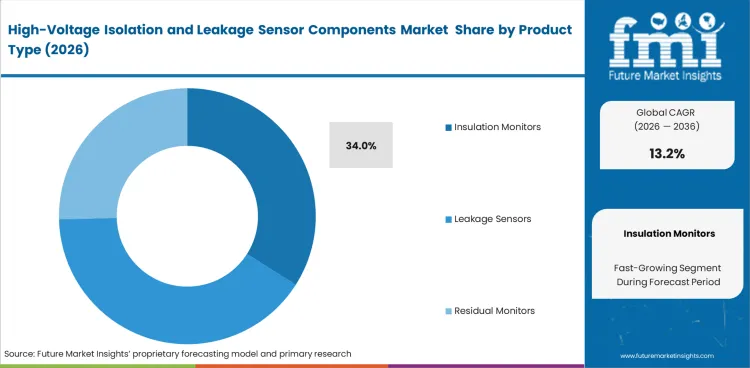
- Insulation monitors are expected to account for 34.0% share in 2026. Demand stays high due to direct use in continuous isolation supervision and fault-risk detection.
- Leakage sensors and residual monitors gain relevance in charging systems and in programs needing better fault localization. Usage is stronger in systems paired with broader electrical-safety hardware.
Insights into the Voltage Class Segment
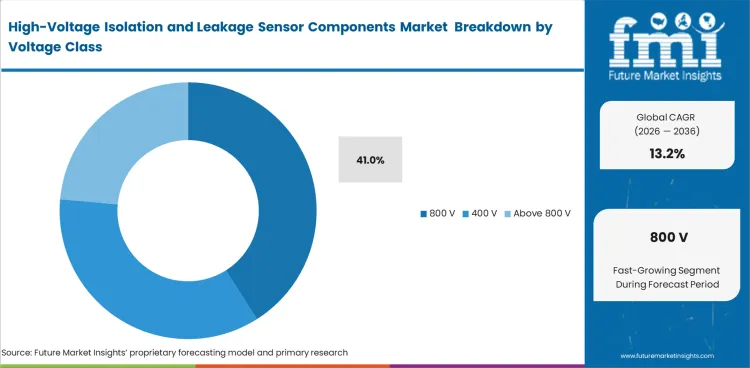
- 800 V is anticipated to capture 41.0% share of the market in 2026. Commercial value is stronger because faster charging support raises electrical stress and monitoring need. 400 V and above 800 V still hold installed-base demand. More investment is moving toward products suited to richer high-voltage architectures. This shift supports demand around electric vehicle drive motors. It supports traction inverters and integrated power modules.
Insights into the Mounting Point Segment
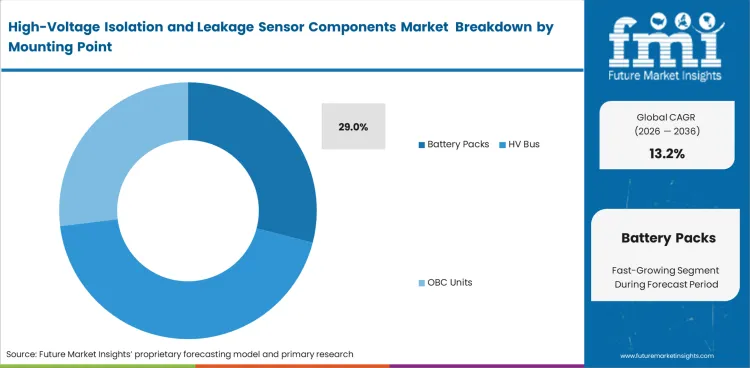
- Battery packs are set to represent 29.0% of share in 2026. Revenue concentration is higher at this mounting point owing to pack-level safety relevance and repeated monitoring need.
- DC chargers and OBC units add value in charging and power-distribution monitoring. Demand in these areas is stronger in programs driven by broader charger and vehicle protection requirements.
Insights into the Vehicle Type Segment
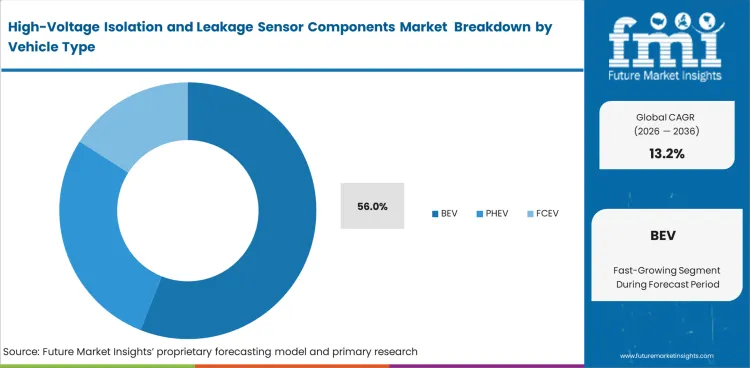
- BEV is expected to account for 56.0% share in 2026. Higher electrical architecture intensity and wider platform volume keep demand tighter across this class.
- PHEV and e-truck demand add value in selective but technically rich programs. Supplier relevance in these areas is stronger where monitoring hardware needs to work alongside broader electrified control systems.
Insights into the Sales Channel Segment
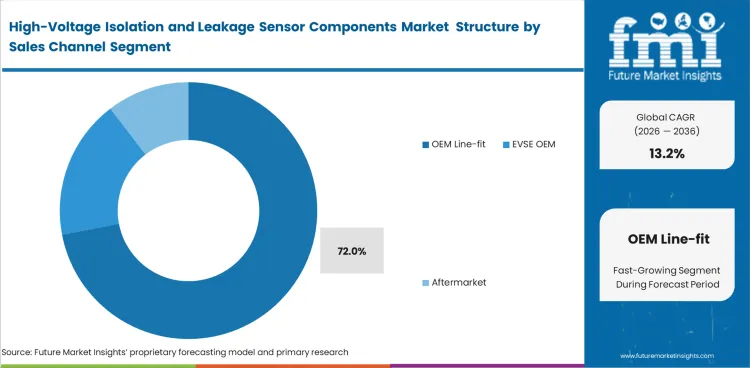
- OEM line-fit is estimated to account for 72.0% share in 2026. Program-level integration during vehicle and charger build keeps this route ahead due to qualification alignment and part commonality.
- EVSE OEM and aftermarket replacement still add value due to charger-side deployment and service demand. OEM line-fit gains more relevance in fleets active in higher-volume EV production and charging rollout, including programs connected with on-board chargers and AC charging stations.
Insights into the End Use Segment
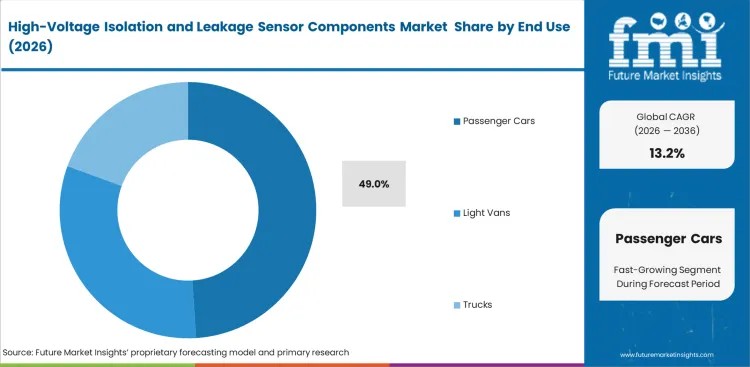
- Passenger cars are expected to hold 49.0% share in 2026. Product demand is higher in this segment due to broad EV output and recurring platform refresh cycles.
- Trucks and buses add value in smaller but specialized programs. Charging sites and off-highway systems also contribute value in focused applications. Demand across these groups is stronger in fleets supported by approved upgrades and higher-power operating requirements.
Insights into the Output Interface Segment
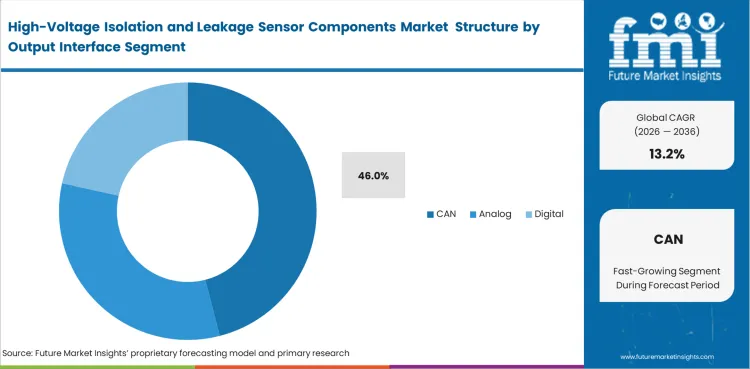
- In 2026, CAN segment is expected to contribute 46.0% of total market share. Commercial value stays highest in this category due to deep automotive use and stronger control-system integration.
- Analog and LIN demand still contribute across selected platforms. Revenue in these categories is more selective and supported by application-specific integration economics.
High-Voltage Isolation and Leakage Sensor Components Market Drivers, Restraints, and Opportunities
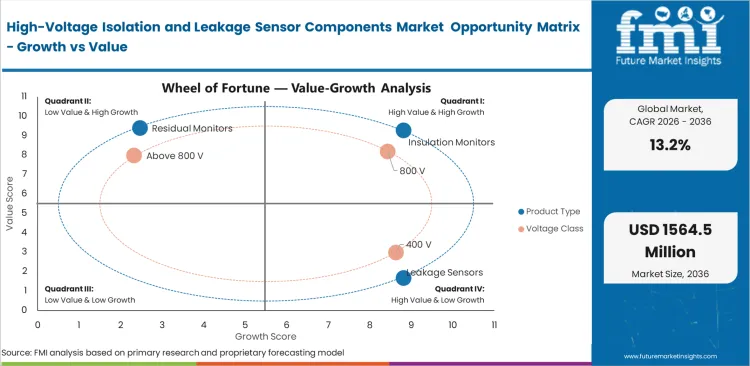
- 800 V migration raises monitoring depth and improves content value per platform.
- Qualification effort and platform-specific approval cycles slow expansion.
- EV charging build-out and fleet-service demand support upgrade opportunity.
Market growth comes from safety value and charging-system expansion. Approval costs and integration complexity across mixed platforms still constrain adoption. Opportunity is strongest on vehicle and charger platforms with large installed bases and OEMs willing to spend on validated safety-led hardware. Demand in this area also connects with broader electrical architecture used in vehicle contactors and relays for electric vehicles.
800 V Platform Economics
800 V programs gain traction in EV fleets due to faster charging and stronger powertrain efficiency. Manufacturers place more value on programs carrying higher electrical-system stress than on programs focused only on low part cost. Supplier advantage depends on validated monitoring performance and stable interface behavior. This makes high-voltage readiness a practical revenue lever.
Qualification Pressure Across Mixed Platforms
Mixed platform portfolios create support complexity and raise engineering burden for suppliers. Approval work still varies by OEM architecture and charger design practice. New participants face pressure at this stage since proven fit data and safety-validation depth matter early in account selection.
Charging-side Visibility and Operational Value
Charging-system visibility matters more in high-use public and fleet charging conditions. Isolation and leakage monitoring offer direct operating value because service teams need reliable fault identification during live system use. Revenue gains therefore come from operational relevance rather than from passive component replacement, especially in systems already shaped by galvanic isolation and related protection requirements.
Integrated Safety Hardware Selling
Isolation monitoring is now considered part of a wider set of EV safety equipment. OEMs and charger builders often evaluate monitoring upgrades alongside other electrification hardware. This creates cross-sell potential for suppliers active in charging infrastructure, closed-loop current transducers and other advanced sensor categories. Package-based selling can improve account retention and increase program value.
Analysis of High-Voltage Isolation and Leakage Sensor Components Market By Key Countries
.webp "Top Country Growth Comparison High Voltage Isolation And Leakage Sensor Components Market Cagr (2026 2036)")
| Country | CAGR |
|---|---|
| India | 16.8% |
| China | 15.4% |
| Germany | 13.6% |
| France | 12.9% |
| South Korea | 11.8% |
| United States | 10.7% |
| Japan | 8.9% |
Source: FMI analysis based on primary research and proprietary forecasting model
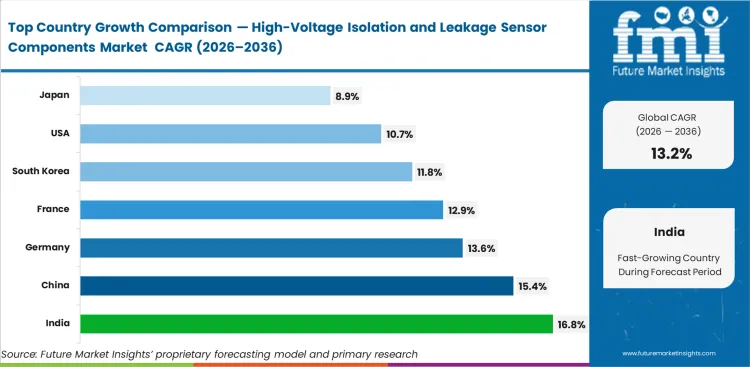
High-Voltage Isolation and Leakage Sensor Components Market CAGR Analysis By Country
- India is projected to advance at a CAGR of 16.8% because fast EV additions and rising charger deployment support monitoring demand.
- China is projected to expand at a CAGR of 15.4% due to large EV volume and deep service networks.
- Germany is forecast to record a CAGR of 13.6% as engineering-led EV programs and premium platform standards support demand.
- France is set to post a CAGR of 12.9% supported by EV uptake and public charging additions.
- South Korea is expected to register a CAGR of 11.8% backed by battery-industry depth and strong EV integration.
- United States is likely to progress at a CAGR of 10.7% owing to a large installed EV base and charger investment.
- Japan is anticipated to grow at a CAGR of 8.9% driven by quality-sensitive development and stable electrification progress.
Growth momentum remains strongest across Asia while Western markets retain commercial value through installed-base depth and replacement demand.
Demand Outlook for High-Voltage Isolation and Leakage Sensor Components in India
India has strong relevance due to fast EV expansion and rising charging throughput. Demand for high-voltage isolation and leakage sensor components in India is anticipated to rise at a CAGR of 16.8% through 2036. Supplier gains are stronger across local assembly programs and operators adding charging assets at scale.
- Fast assembly additions support OEM line-fit demand across expanding domestic EV programs.
- Charger growth supports monitoring demand across public charging networks and fleet charging sites.
- Local sourcing aligns with cost-in-use priorities across domestic programs focused on scale and efficiency.
Future Outlook for High-Voltage Isolation and Leakage Sensor Components in China
China holds a large EV base and an expanding charging network. Sales of high-voltage isolation and leakage sensor components in China are expected to increase at a CAGR of 15.4% during the forecast period. Commercial upside is higher in programs linked with local supply support and wide platform coverage.
- Large vehicle volume supports long-term demand across passenger EV programs and commercial platforms.
- Charger depth supports charger-side opportunity across urban charging corridors and service networks.
- Service networks add value to safety hardware through stronger maintenance access and replacement support.
Opportunity Analysis of High-Voltage Isolation and Leakage Sensor Components in Germany
Germany benefits from engineering-led EV programs and premium platform standards. The high-voltage isolation and leakage sensor components market in Germany is expected to expand at a CAGR of 13.6% through 2036. Product mix is concentrated in richer safety systems and approved hardware for active high-voltage programs.
- Premium platform mix supports higher-value content across advanced EV architectures and safety-focused designs.
- Engineering depth supports qualified supply across demanding OEM programs and integration pathways.
- OEM standards favor proven suppliers with validation strength and stable program support.
In-depth Analysis of High-Voltage Isolation and Leakage Sensor Components in France
France gains from electrification progress and charging additions. France is set to record a CAGR of 12.9% in high-voltage isolation and leakage sensor components during the assessment period. Supplier relevance improves in accounts pairing EV growth with broader charging build-out.
- EV uptake supports line-fit demand across passenger vehicle programs and urban mobility fleets.
- Charging expansion supports new installations across public infrastructure programs and operator-backed activity.
- Approval culture favors stable parts with consistent field performance and lower qualification risk.
Sales Analysis of High-Voltage Isolation and Leakage Sensor Components in South Korea
South Korea possesses strong battery depth and a large EV supply footprint. High-voltage isolation and leakage sensor components adoption in South Korea is likely to advance at a CAGR of 11.8% by 2036. Revenue mix prospects are positive due to premium EV content and richer local platform support.
- Battery depth supports recurring sales across integrated EV supply chains and battery-linked programs.
- Premium EVs add value density across higher-spec platforms and richer electrical safety content.
- Technical integration supports system demand across advanced vehicle platforms and local supplier ecosystems.
Demand Outlook for High-Voltage Isolation and Leakage Sensor Components in the United States
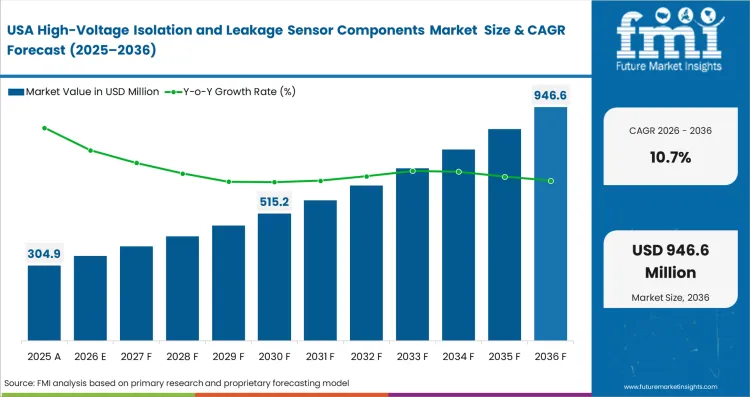
The United States gains from a wide installed base and a large charger investment pool. High-voltage isolation and leakage sensor components demand across the United States is set to rise at 10.7% CAGR through 2036. Supplier access improves near OEM programs and across charging-system build-out.
- Installed base supports recurring revenue across active electric fleets and long-life charging assets.
- Charger growth supports new programs across public infrastructure additions and private charging deployments.
- Platform diversity supports broad demand across passenger EVs and commercial electrification programs.
Future Outlook for High-Voltage Isolation and Leakage Sensor Components in Japan
Japan retains value in quality-led EV programs and mature electrification activity. The market for high-voltage isolation and leakage sensor components in Japan is expected to grow at a CAGR of 8.9% during the study period. Revenue gains are steady and align with replacement demand and program support work.
- Quality focus supports premium systems across established OEM programs and higher-spec platforms.
- Mature base supports stable aftermarket flow across existing EV fleets and service networks.
- Commercial value is higher in approved programs with tested hardware and supplier continuity.
Competitive Landscape and Strategic Positioning
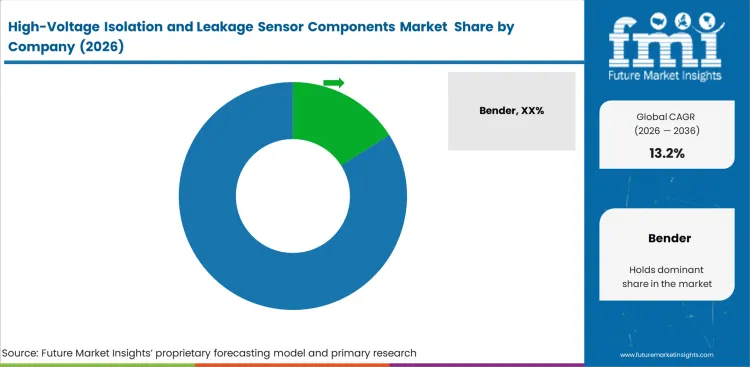
- Some of the key players include includes Bender and Sensata Technologies, LEM, Littelfuse, Eaton, ABB, and Phoenix Contact.
- Entry barriers come from safety-validation depth, platform-fit data, and buyer trust in installed products.
- Strategic focus is moving toward always-on monitoring. It is moving toward charger-side integration and richer diagnostic support.
Key players in this market lead due to broad product coverage across insulation supervision and leakage monitoring. Many suppliers support charger-linked safety hardware through adjacent electrification programs. OEMs buying these systems place more weight on approval history and service support than on list price alone. This helps larger qualified suppliers stay ahead in EV programs and charging programs. Wider coverage improves supplier position because it supports repeat business and smoother deployment across approved platforms.
New entrants can participate in select retrofit opportunities and charger-side programs. Scaling to full presence however remains difficult. Lengthy platform approval processes and lower-volume specialized programs often limit returns on validation investment. Supplier acceptance also depends on proven field performance and stable technical support after installation. Competitive advantage favors companies with broad multi-platform coverage and stronger aftermarket support. Wider program reach improves commercial position in long-cycle electrification accounts.
Key Companies in the High-Voltage Isolation and Leakage Sensor Components Market
Key global companies leading the High-Voltage Isolation and Leakage Sensor Components category include:
- Broad insulation-monitoring and electrification suppliers such as Bender, Sensata Technologies, and ABB.
- Electrical protection and charger-side participants such as Eaton, Phoenix Contact, and Littelfuse.
- Current-sensing and high-voltage measurement specialists such as LEM.
Competitive Benchmarking: High-Voltage Isolation and Leakage Sensor Components
| Company | Insulation Monitoring Depth | Charger-side Support | Platform Coverage | Geographic Footprint |
|---|---|---|---|---|
| Bender | High | High | Strong | Global |
| Sensata Technologies | High | High | Strong | Global |
| ABB | Medium | High | Strong | Global |
| Eaton | Medium | High | Medium | Global |
| Phoenix Contact | Medium | High | Medium | Global |
| LEM | Medium | Medium | Strong | Global |
| Littelfuse | Medium | Medium | Medium | Global |
Source: Future Market Insights competitive analysis, 2026. Ratings reflect relative positioning based on insulation monitoring depth plus charger-side support and platform coverage.
Key Developments in High-Voltage Isolation and Leakage Sensor Components
- In February 2024, Bender introduced the ISOMETER® iso175 for hybrid and electric vehicle drive systems. [1]
- In March 2025, Sensata Technologies launched the next-generation SIM200 insulation monitoring device for high-voltage systems. [2]
- In February 2026, Phoenix Contact announced direct integration of the charging controller into a CCS charging inlet. [3]
Key Players in the High-Voltage Isolation and Leakage Sensor Components:
Major Global Players:
- Bender
- Sensata Technologies
- ABB
- Eaton
Emerging Players/Startups
- Phoenix Contact
- LEM
- Littelfuse
Report Scope and Coverage
| Parameter | Details |
|---|---|
| Quantitative Units | USD million for value and CAGR from 2026 to 2036 |
| Market Definition | Certified monitoring components used for insulation supervision, leakage detection, residual monitoring, and fault visibility in high-voltage vehicle and charging systems |
| Regions Covered | North America, Europe, Asia Pacific, Middle East and Africa |
| Countries Covered | India, China, Germany, France, South Korea, United States, Japan |
| Key Companies Profiled | Bender, Sensata Technologies, ABB, Eaton, Phoenix Contact, LEM, Littelfuse |
| Forecast Period | 2026 to 2036 |
| Approach | Primary interviews, desk research, bottom-up sizing, and forecast validation against EV demand and charging assumptions |
High-Voltage Isolation and Leakage Sensor Components Market by Segments
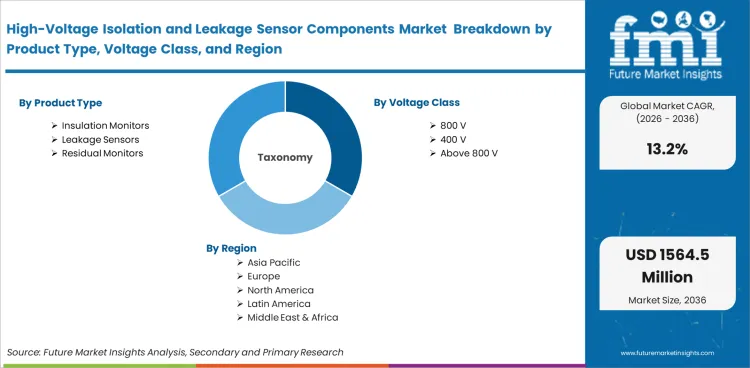
High-Voltage Isolation and Leakage Sensor Components Market Segmented by Product Type:
- Insulation Monitors
- Leakage Sensors
- Residual Monitors
- Fault Locators
High-Voltage Isolation and Leakage Sensor Components Market Segmented by Voltage Class:
- 400 V
- 800 V
- Above 800 V
High-Voltage Isolation and Leakage Sensor Components Market Segmented by Vehicle Type:
- BEV
- PHEV
- FCEV
- E-trucks
High-Voltage Isolation and Leakage Sensor Components Market Segmented by Mounting Point:
- Battery Packs
- HV Bus
- OBC Units
- DC Chargers
- Junction Boxes
High-Voltage Isolation and Leakage Sensor Components Market Segmented by Output Interface:
- CAN
- Analog
- Digital
- LIN
High-Voltage Isolation and Leakage Sensor Components Market Segmented by Sales Channel:
- OEM Line-fit
- EVSE OEM
- Aftermarket
High-Voltage Isolation and Leakage Sensor Components Market Segmented by End Use:
- Passenger Cars
- Light Vans
- Trucks
- Buses
- Charging Sites
- Off-highway
High-Voltage Isolation and Leakage Sensor Components Market Segmented by Region:
- North America
- USA
- Canada
- Mexico
- Latin America
- Brazil
- Chile
- Rest of Latin America
- Western Europe
- Germany
- UK
- Italy
- Spain
- France
- Nordic
- BENELUX
- Rest of Western Europe
- Eastern Europe
- Russia
- Poland
- Hungary
- Balkan & Baltic
- Rest of Eastern Europe
- East Asia
- China
- Japan
- South Korea
- South Asia and Pacific
- India
- ASEAN
- Australia & New Zealand
- Rest of South Asia and Pacific
- Middle East & Africa
- Kingdom of Saudi Arabia
- Other GCC Countries
- Turkiye
- South Africa
- Other African Union
- Rest of Middle East & Africa
Research Sources and Bibliography
- Bender. (2024, February 19). The new ISOMETER® iso175.
- Sensata Technologies. (2025, March 24). Sensata Launches Next-Gen SIM200 Insulation Monitoring Device Designed to Deliver Advanced Safety Monitoring in High Voltage Systems.
- Phoenix Contact. (2026, February 20). A world first in High Power Charging: Phoenix Contact integrates the charging controller directly into a CCS charging inlet for the first time.
- International Energy Agency. (2025, May 14). Global EV Outlook 2025.
- National Highway Traffic Safety Administration. (2024, April 15). Federal Motor Vehicle Safety Standards; FMVSS No. 305a Electric-Powered Vehicles: Electric Powertrain Integrity Global Technical Regulation No. 20; Incorporation by Reference.
- USA Department of Energy. (2024, June 27). Electric Drive Technical Team Roadmap.
This Report Answers
- Which product type leads revenue in high-voltage isolation and leakage sensor components?
- Which voltage class leads adoption across new EV programs?
- Which vehicle class holds the top revenue share?
- Which sales route carries higher value across the forecast period?
- Which end-user group creates the deepest demand base?
- Which countries post the fastest gains through 2036?
- Which factors support charger-side monitoring demand?
- Which limits slow platform expansion?
- Which supplier capabilities matter most during qualification?
- Which adjacent electrification categories overlap with this category?
- Which programs suit new supplier entry best?
- Which revenue pockets offer stronger aftermarket depth?
Frequently Asked Questions
What does this market cover?
It covers monitoring components used for insulation supervision, leakage detection, residual monitoring, and fault visibility in high-voltage vehicle and charging systems.
What supports market growth?
EV scale-up, charger deployment, and 800 V migration support demand.
What limits faster adoption?
Qualification effort, platform-fit complexity, and approval cycles on specialized systems can limit pace.
Which segment leads product demand?
Insulation monitors lead due to direct operating value in isolation supervision.
Which voltage class leads adoption?
800 V leads due to richer monitoring need and faster charging support.
Which vehicle type leads demand?
BEV platforms lead due to broad installed base and deeper high-voltage content.
Which sales route leads revenue?
OEM line-fit leads, while charger-side and aftermarket activity add durable secondary value.
Which countries grow fastest?
India and China lead due to EV additions and charging growth.
What matters most to buyers?
Approval history, monitoring reliability, interface fit, and service support matter most.
What keeps supplier entry hard?
Validation depth, platform coverage, and support capability keep entry barriers above simple component categories.
Preview the report firsthand - request a free sample
Get SampleGet the brochure for pricing and purchase details.
Get PDFTable of Content
- Key Takeaways
- Market Size and CAGR
- Top Growth Driver
- Fastest Growing Segment
- Leading Region
- Key Companies
- Emerging Opportunities
- Executive Summary
- Global Market Outlook
- Demand-side Trends
- Supply-side Trends
- Technology Roadmap Analysis
- Analysis and Recommendations
- Analyst Perspective (What is happening? Why now? What should investors know?)
- Key Questions Answered
- How large is the market?
- What is the CAGR?
- What are key trends?
- Which region dominates?
- Who are the leaders?
- Market Overview
- Market Coverage / Taxonomy
- Market Definition / Scope / Limitations
- Research Methodology
- Chapter Orientation
- Analytical Lens and Working Hypotheses
- Market Structure, Signals, and Trend Drivers
- Benchmarking and Cross-market Comparability
- Market Sizing, Forecasting, and Opportunity Mapping
- Research Design and Evidence Framework
- Desk Research Programme (Secondary Evidence)
- Expert Input and Fieldwork (Primary Evidence)
- Tooling, Models, and Reference Databases
- Data Engineering and Model Build
- Quality Assurance and Audit Trail
- Market Background
- Market Dynamics (Drivers, Restraints, Opportunity, Trends)
- Scenario Forecast (Optimistic, Likely, Conservative)
- Impact Analysis
- AI Impact
- Sustainability Impact
- Regulatory Impact
- Technology Impact
- Consumer / Buyer Analysis
- Purchase Drivers
- Adoption Barriers
- Buyer Journey
- Opportunity Map Analysis
- Product Life Cycle Analysis
- Supply Chain Analysis
- Investment Feasibility Matrix
- Value Chain Analysis
- PESTLE and Porter's Analysis
- Regulatory Landscape
- Regional Parent Market Outlook
- Production and Consumption Statistics
- Import and Export Statistics
- Global Market Analysis and Forecast, 2021 to 2036
- Historical Market Size Value (USD Million) & Volume (Unit) Analysis, 2021 to 2025
- Current and Future Market Size Value (USD Million) & Volume (Unit) Projections, 2026 to 2036
- Y-o-Y Growth Trend Analysis
- Absolute $ Opportunity Analysis
- Global Market Pricing Analysis, 2021 to 2036
- Global Market Analysis and Forecast, By Product Type, 2021 to 2036
- Introduction / Key Findings
- Historical Market Size Value (USD Million) & Volume (Unit) Analysis By Product Type, 2021 to 2025
- Current and Future Market Size Value (USD Million) & Volume (Unit) Analysis and Forecast By Product Type, 2026 to 2036
- Insulation Monitors
- Leakage Sensors
- Residual Monitors
- Fault Locators
- Insulation Monitors
- Y-o-Y Growth Trend Analysis By Product Type, 2021 to 2025
- Absolute $ Opportunity Analysis By Product Type, 2026 to 2036
- Global Market Analysis and Forecast, By Voltage Class, 2021 to 2036
- Introduction / Key Findings
- Historical Market Size Value (USD Million) & Volume (Unit) Analysis By Voltage Class, 2021 to 2025
- Current and Future Market Size Value (USD Million) & Volume (Unit) Analysis and Forecast By Voltage Class, 2026 to 2036
- 800 V
- 400 V
- Above 800 V
- 800 V
- Y-o-Y Growth Trend Analysis By Voltage Class, 2021 to 2025
- Absolute $ Opportunity Analysis By Voltage Class, 2026 to 2036
- Global Market Analysis and Forecast, By Vehicle Type, 2021 to 2036
- Introduction / Key Findings
- Historical Market Size Value (USD Million) & Volume (Unit) Analysis By Vehicle Type, 2021 to 2025
- Current and Future Market Size Value (USD Million) & Volume (Unit) Analysis and Forecast By Vehicle Type, 2026 to 2036
- BEV
- PHEV
- FCEV
- E-trucks
- BEV
- Y-o-Y Growth Trend Analysis By Vehicle Type, 2021 to 2025
- Absolute $ Opportunity Analysis By Vehicle Type, 2026 to 2036
- Global Market Analysis and Forecast, By Mounting Point, 2021 to 2036
- Introduction / Key Findings
- Historical Market Size Value (USD Million) & Volume (Unit) Analysis By Mounting Point, 2021 to 2025
- Current and Future Market Size Value (USD Million) & Volume (Unit) Analysis and Forecast By Mounting Point, 2026 to 2036
- Battery Packs
- HV Bus
- OBC Value (USD Million) & Volume (Unit)s
- DC Chargers
- Junction Boxes
- Battery Packs
- Y-o-Y Growth Trend Analysis By Mounting Point, 2021 to 2025
- Absolute $ Opportunity Analysis By Mounting Point, 2026 to 2036
- Global Market Analysis and Forecast, By Output Interface, 2021 to 2036
- Introduction / Key Findings
- Historical Market Size Value (USD Million) & Volume (Unit) Analysis By Output Interface, 2021 to 2025
- Current and Future Market Size Value (USD Million) & Volume (Unit) Analysis and Forecast By Output Interface, 2026 to 2036
- CAN
- Analog
- Digital
- LIN
- CAN
- Y-o-Y Growth Trend Analysis By Output Interface, 2021 to 2025
- Absolute $ Opportunity Analysis By Output Interface, 2026 to 2036
- Global Market Analysis and Forecast, By Sales Channel
- Introduction / Key Findings
- Historical Market Size Value (USD Million) & Volume (Unit) Analysis By Sales Channel, 2021 to 2025
- Current and Future Market Size Value (USD Million) & Volume (Unit) Analysis and Forecast By Sales Channel, 2026 to 2036
- OEM Line-fit
- EVSE OEM
- Aftermarket
- OEM Line-fit
- Y-o-Y Growth Trend Analysis By Sales Channel, 2021 to 2025
- Absolute $ Opportunity Analysis By Sales Channel, 2026 to 2036
- Global Market Analysis and Forecast, By End Use
- Introduction / Key Findings
- Historical Market Size Value (USD Million) & Volume (Unit) Analysis By End Use, 2021 to 2025
- Current and Future Market Size Value (USD Million) & Volume (Unit) Analysis and Forecast By End Use, 2026 to 2036
- Passenger Cars
- Light Vans
- Trucks
- Buses
- Charging Sites
- Off-highway
- Passenger Cars
- Y-o-Y Growth Trend Analysis By End Use, 2021 to 2025
- Absolute $ Opportunity Analysis By End Use, 2026 to 2036
- Global Market Analysis and Forecast, By Region, 2021 to 2036
- Introduction
- Historical Market Size Value (USD Million) & Volume (Unit) Analysis By Region, 2021 to 2025
- Current Market Size Value (USD Million) & Volume (Unit) Analysis and Forecast By Region, 2026 to 2036
- North America
- Latin America
- Western Europe
- Eastern Europe
- East Asia
- South Asia and Pacific
- Middle East & Africa
- Market Attractiveness Analysis By Region
- North America Market Analysis and Forecast, By Country, 2021 to 2036
- Historical Market Size Value (USD Million) & Volume (Unit) Trend Analysis By Market Taxonomy, 2021 to 2025
- Market Size Value (USD Million) & Volume (Unit) Forecast By Market Taxonomy, 2026 to 2036
- By Country
- USA
- Canada
- Mexico
- By Product Type
- By Voltage Class
- By Vehicle Type
- By Mounting Point
- By Output Interface
- By Sales Channel
- By End Use
- By Country
- Market Attractiveness Analysis
- By Country
- By Product Type
- By Voltage Class
- By Vehicle Type
- By Mounting Point
- By Output Interface
- By Sales Channel
- By End Use
- Key Takeaways
- Latin America Market Analysis and Forecast, By Country
- Historical Market Size Value (USD Million) & Volume (Unit) Trend Analysis By Market Taxonomy, 2021 to 2025
- Market Size Value (USD Million) & Volume (Unit) Forecast By Market Taxonomy, 2026 to 2036
- By Country
- Brazil
- Chile
- Rest of Latin America
- By Product Type
- By Voltage Class
- By Vehicle Type
- By Mounting Point
- By Output Interface
- By Sales Channel
- By End Use
- By Country
- Market Attractiveness Analysis
- By Country
- By Product Type
- By Voltage Class
- By Vehicle Type
- By Mounting Point
- By Output Interface
- By Sales Channel
- By End Use
- Key Takeaways
- Western Europe Market Analysis and Forecast, By Country
- Historical Market Size Value (USD Million) & Volume (Unit) Trend Analysis By Market Taxonomy, 2021 to 2025
- Market Size Value (USD Million) & Volume (Unit) Forecast By Market Taxonomy, 2026 to 2036
- By Country
- Germany
- UK
- Italy
- Spain
- France
- Nordic
- BENELUX
- Rest of Western Europe
- By Product Type
- By Voltage Class
- By Vehicle Type
- By Mounting Point
- By Output Interface
- By Sales Channel
- By End Use
- By Country
- Market Attractiveness Analysis
- By Country
- By Product Type
- By Voltage Class
- By Vehicle Type
- By Mounting Point
- By Output Interface
- By Sales Channel
- By End Use
- Key Takeaways
- Eastern Europe Market Analysis and Forecast, By Country
- Historical Market Size Value (USD Million) & Volume (Unit) Trend Analysis By Market Taxonomy, 2021 to 2025
- Market Size Value (USD Million) & Volume (Unit) Forecast By Market Taxonomy, 2026 to 2036
- By Country
- Russia
- Poland
- Hungary
- Balkan & Baltic
- Rest of Eastern Europe
- By Product Type
- By Voltage Class
- By Vehicle Type
- By Mounting Point
- By Output Interface
- By Sales Channel
- By End Use
- By Country
- Market Attractiveness Analysis
- By Country
- By Product Type
- By Voltage Class
- By Vehicle Type
- By Mounting Point
- By Output Interface
- By Sales Channel
- By End Use
- Key Takeaways
- East Asia Market Analysis and Forecast, By Country
- Historical Market Size Value (USD Million) & Volume (Unit) Trend Analysis By Market Taxonomy, 2021 to 2025
- Market Size Value (USD Million) & Volume (Unit) Forecast By Market Taxonomy, 2026 to 2036
- By Country
- China
- Japan
- South Korea
- By Product Type
- By Voltage Class
- By Vehicle Type
- By Mounting Point
- By Output Interface
- By Sales Channel
- By End Use
- By Country
- Market Attractiveness Analysis
- By Country
- By Product Type
- By Voltage Class
- By Vehicle Type
- By Mounting Point
- By Output Interface
- By Sales Channel
- By End Use
- Key Takeaways
- South Asia and Pacific Market Analysis and Forecast, By Country
- Historical Market Size Value (USD Million) & Volume (Unit) Trend Analysis By Market Taxonomy, 2021 to 2025
- Market Size Value (USD Million) & Volume (Unit) Forecast By Market Taxonomy, 2026 to 2036
- By Country
- India
- ASEAN
- Australia & New Zealand
- Rest of South Asia and Pacific
- By Product Type
- By Voltage Class
- By Vehicle Type
- By Mounting Point
- By Output Interface
- By Sales Channel
- By End Use
- By Country
- Market Attractiveness Analysis
- By Country
- By Product Type
- By Voltage Class
- By Vehicle Type
- By Mounting Point
- By Output Interface
- By Sales Channel
- By End Use
- Key Takeaways
- Middle East & Africa Market Analysis and Forecast, By Country
- Historical Market Size Value (USD Million) & Volume (Unit) Trend Analysis By Market Taxonomy, 2021 to 2025
- Market Size Value (USD Million) & Volume (Unit) Forecast By Market Taxonomy, 2026 to 2036
- By Country
- Kingdom of Saudi Arabia
- Other GCC Countries
- Türkiye
- South Africa
- Other African Union
- Rest of Middle East & Africa
- By Product Type
- By Voltage Class
- By Vehicle Type
- By Mounting Point
- By Output Interface
- By Sales Channel
- By End Use
- By Country
- Market Attractiveness Analysis
- By Country
- By Product Type
- By Voltage Class
- By Vehicle Type
- By Mounting Point
- By Output Interface
- By Sales Channel
- By End Use
- Key Takeaways
- Key Countries Market Analysis
- USA
- Pricing Analysis
- Market Share Analysis, 2025
- By Product Type
- By Voltage Class
- By Vehicle Type
- By Mounting Point
- By Output Interface
- By Sales Channel
- By End Use
- Canada
- Pricing Analysis
- Market Share Analysis, 2025
- By Product Type
- By Voltage Class
- By Vehicle Type
- By Mounting Point
- By Output Interface
- By Sales Channel
- By End Use
- Mexico
- Pricing Analysis
- Market Share Analysis, 2025
- By Product Type
- By Voltage Class
- By Vehicle Type
- By Mounting Point
- By Output Interface
- By Sales Channel
- By End Use
- Brazil
- Pricing Analysis
- Market Share Analysis, 2025
- By Product Type
- By Voltage Class
- By Vehicle Type
- By Mounting Point
- By Output Interface
- By Sales Channel
- By End Use
- Chile
- Pricing Analysis
- Market Share Analysis, 2025
- By Product Type
- By Voltage Class
- By Vehicle Type
- By Mounting Point
- By Output Interface
- By Sales Channel
- By End Use
- Germany
- Pricing Analysis
- Market Share Analysis, 2025
- By Product Type
- By Voltage Class
- By Vehicle Type
- By Mounting Point
- By Output Interface
- By Sales Channel
- By End Use
- UK
- Pricing Analysis
- Market Share Analysis, 2025
- By Product Type
- By Voltage Class
- By Vehicle Type
- By Mounting Point
- By Output Interface
- By Sales Channel
- By End Use
- Italy
- Pricing Analysis
- Market Share Analysis, 2025
- By Product Type
- By Voltage Class
- By Vehicle Type
- By Mounting Point
- By Output Interface
- By Sales Channel
- By End Use
- Spain
- Pricing Analysis
- Market Share Analysis, 2025
- By Product Type
- By Voltage Class
- By Vehicle Type
- By Mounting Point
- By Output Interface
- By Sales Channel
- By End Use
- France
- Pricing Analysis
- Market Share Analysis, 2025
- By Product Type
- By Voltage Class
- By Vehicle Type
- By Mounting Point
- By Output Interface
- By Sales Channel
- By End Use
- India
- Pricing Analysis
- Market Share Analysis, 2025
- By Product Type
- By Voltage Class
- By Vehicle Type
- By Mounting Point
- By Output Interface
- By Sales Channel
- By End Use
- ASEAN
- Pricing Analysis
- Market Share Analysis, 2025
- By Product Type
- By Voltage Class
- By Vehicle Type
- By Mounting Point
- By Output Interface
- By Sales Channel
- By End Use
- Australia & New Zealand
- Pricing Analysis
- Market Share Analysis, 2025
- By Product Type
- By Voltage Class
- By Vehicle Type
- By Mounting Point
- By Output Interface
- By Sales Channel
- By End Use
- China
- Pricing Analysis
- Market Share Analysis, 2025
- By Product Type
- By Voltage Class
- By Vehicle Type
- By Mounting Point
- By Output Interface
- By Sales Channel
- By End Use
- Japan
- Pricing Analysis
- Market Share Analysis, 2025
- By Product Type
- By Voltage Class
- By Vehicle Type
- By Mounting Point
- By Output Interface
- By Sales Channel
- By End Use
- South Korea
- Pricing Analysis
- Market Share Analysis, 2025
- By Product Type
- By Voltage Class
- By Vehicle Type
- By Mounting Point
- By Output Interface
- By Sales Channel
- By End Use
- Russia
- Pricing Analysis
- Market Share Analysis, 2025
- By Product Type
- By Voltage Class
- By Vehicle Type
- By Mounting Point
- By Output Interface
- By Sales Channel
- By End Use
- Poland
- Pricing Analysis
- Market Share Analysis, 2025
- By Product Type
- By Voltage Class
- By Vehicle Type
- By Mounting Point
- By Output Interface
- By Sales Channel
- By End Use
- Hungary
- Pricing Analysis
- Market Share Analysis, 2025
- By Product Type
- By Voltage Class
- By Vehicle Type
- By Mounting Point
- By Output Interface
- By Sales Channel
- By End Use
- Kingdom of Saudi Arabia
- Pricing Analysis
- Market Share Analysis, 2025
- By Product Type
- By Voltage Class
- By Vehicle Type
- By Mounting Point
- By Output Interface
- By Sales Channel
- By End Use
- Türkiye
- Pricing Analysis
- Market Share Analysis, 2025
- By Product Type
- By Voltage Class
- By Vehicle Type
- By Mounting Point
- By Output Interface
- By Sales Channel
- By End Use
- South Africa
- Pricing Analysis
- Market Share Analysis, 2025
- By Product Type
- By Voltage Class
- By Vehicle Type
- By Mounting Point
- By Output Interface
- By Sales Channel
- By End Use
- USA
- Market Structure Analysis
- Competition Dashboard
- Competition Benchmarking
- Market Share Analysis of Top Players
- By Regional
- By Product Type
- By Voltage Class
- By Vehicle Type
- By Mounting Point
- By Output Interface
- By Sales Channel
- By End Use
- Emerging Startups
- Innovation Benchmarking
- Competition Analysis
- Competition Deep Dive
- Bender
- Overview
- Product Portfolio
- Profitability by Market Segments (Product/Region/Sales Channel)
- Sales Footprint
- Strategy Overview
- Marketing Strategy
- Product Strategy
- Channel Strategy
- Sensata Technologies
- ABB
- Eaton
- Bender
- Case Studies
- Success Stories
- Recent Developments
- Competition Deep Dive
- Assumptions & Acronyms Used


