

- Industry Size (2026)
- USD 2.94 Bn
- Forecast (2036)
- USD 4.79 Bn
- CAGR (2026 to 2036)
- 5%
Machine Tool Oils Market Size, Market Forecast and Outlook By FMI
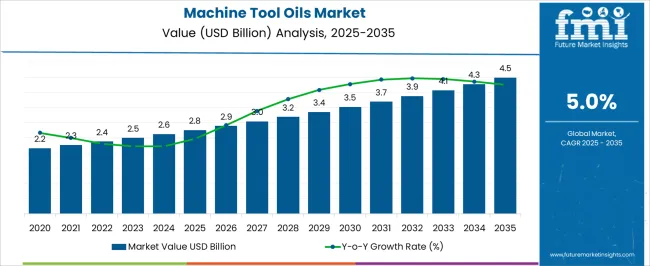
The machine tool oils market was valued at USD 2.8 billion in 2025, projected to reach USD 2.94 billion in 2026, and is forecast to expand to USD 4.79 billion by 2036 at a 5% CAGR.
Summary of Machine Tool Oils Market
- Market Overview
- The machine tool oils market is valued at USD 2.8 billion in 2025 and is projected to reach USD 4.79 billion by 2036.
- The industry is expected to grow at a 5% CAGR from 2026 to 2036, creating an incremental opportunity of USD 1.85 billion.
- The market is an industrial consumables category where demand tracks machine tool fleet size, operating hour utilization, oil change interval specifications, and formulation chemistry migration toward extended-life and low-mist alternatives.
- Demand and Growth Drivers
- Demand is sustained by lubricant consumption across the global installed base of machine tools in metalworking and precision manufacturing.
- Hydraulic oil maintains the leading share due to its role in powering clamping, feeding, and positioning mechanisms.
- Workplace health regulations are shifting formulation chemistry toward low-mist, extended-life synthetic alternatives.
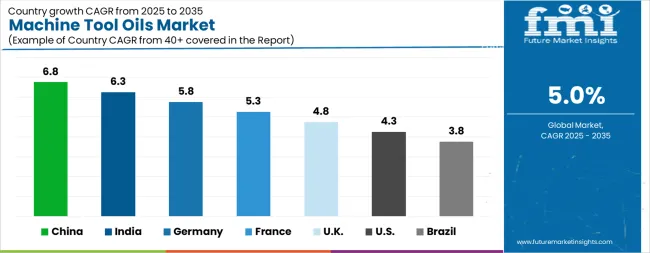
- Among key countries, China at 6.8%, India at 6.3%, Germany at 5.8%, France at 5.3%, UK at 4.8%, USA at 4.3%, Brazil at 3.8%.
- Product and Segment View
- The market covers hydraulic oil, mineral oil, and sideway oil formulations for machine tool lubrication across metalworking facilities.
- These lubricants serve bearings, gears, hydraulic systems, slideway guides, and electric motor applications.
- Hydraulic Oil leads by Product Type with 45% share in 2026.
- Bearings leads by Applications with 20% share in 2026.
- The scope includes machine tool-specific lubricants, excluding metalworking cutting fluids, automotive oils, and general industrial greases.
- Geography and Competitive Outlook
- China and India are the fastest-growing markets due to large machine tool fleets and expanding metalworking manufacturing capacity.
- Germany and USA sustain demand through precision manufacturing specifications and extended-life synthetic fluid adoption.
- Competition is shaped by formulation technology, OEM approval breadth, and industrial distribution network density, with key players including Exxon Mobil Corporation, Lubriplate Lubricants Company, Eldons Lubricants Industry, Eastern Petroleum Private Limited, Ashburn Chemical Technologies, Petro-Canada Lubricants, RBM Oil Corporation.
- Analyst Opinion at FMI
- Nikhil Kaitwade, Principal Consultant for Chemicals and Materials, opines,: 'As per FMI analysis, the machine tool oils market is entering a phase where specification precision, compliance requirements, and lifecycle economics define procurement decisions. Organizations delaying standardization risk exclusion from procurement cycles where qualification thresholds tighten progressively.'
- Strategic Implications / Executive Takeaways
- Lubricant formulators must develop extended-life synthetic and semi-synthetic machine tool oil products that reduce change intervals while meeting tightening workplace mist exposure regulations.
- Manufacturing facility managers should implement oil condition monitoring programs to optimize change intervals based on actual fluid degradation rather than fixed time-based schedules.
- Procurement teams must evaluate total lubricant lifecycle cost including disposal fees and workplace health compliance when comparing conventional mineral oils against synthetic alternatives.
Machine Tool Oils Market Key Takeaways
| Metric | Details |
|---|---|
| Industry Size (2026) | USD 2.94 billion |
| Industry Value (2036) | USD 4.79 billion |
| CAGR (2026-2036) | 5% |
Source: Future Market Insights, 2026
Demand is sustained by the ongoing consumption of lubricants across the global installed base of machine tools operating in metalworking, fabrication, and precision manufacturing facilities. Hydraulic oil maintains the leading product share at 45.0% due to its critical role in powering the hydraulic systems that drive clamping, feeding, and positioning mechanisms across CNC lathes, milling machines, and presses. The market grows at a measured pace reflecting replacement consumption tied to machine operating hours and oil change intervals rather than new equipment production alone. Tightening workplace health regulations governing mist exposure and fluid disposal are shifting formulation chemistry toward low-mist, extended-life synthetic and semi-synthetic alternatives.
All major markets reflect manufacturing activity and machine tool fleet utilization. China leads at 6.8% CAGR driven by the large installed base of metalworking machinery consuming hydraulic, mineral, and sideway oils at production-volume-dependent replacement intervals. India follows at 6.3% sustained by expanding machine tool fleets across automotive, electronics, and general engineering sectors. Germany maintains 5.8% growth anchored by precision manufacturing oil specifications and extended-life synthetic fluid adoption. France at 5.3% and UK at 4.8% sustain steady replacement demand. USA at 4.3% and Brazil at 3.8% reflect fleet maintenance consumption across automotive and general manufacturing.
Machine Tool Oils Market Definition
Machine Tool Oils Market encompasses lubricant formulations designed for machine tool hydraulic systems, slideway guides, and spindle bearings across metalworking and precision manufacturing operations. Product categories include hydraulic oil, mineral oil, and sideway oil consumed at intervals determined by machine operating hours, load conditions, and fluid life specifications. Procurement follows manufacturing facility maintenance schedules and fluid specification requirements.
Machine Tool Oils Market Inclusions
Market scope includes hydraulic oil, mineral oil, and sideway oil for machine tool applications across bearings, gears, hydraulics, and slideway lubrication. Coverage spans global and regional market sizes, the 2026 to 2036 forecast period, and segment breakdowns by product type, application, and region.
Machine Tool Oils Market Exclusions
The scope excludes metalworking fluids used during cutting and grinding operations (cutting oils, coolants), general industrial lubricants, automotive engine oils, and grease products. It also omits oil recycling and disposal services.
Machine Tool Oils Market Research Methodology
- Primary Research: Analysts conducted structured interviews with procurement directors and industry specialists to map decision gates and specification requirements in the machine tool oils market.
- Desk Research: Data collection aggregated regulatory filings, industry standards, trade association reports, and publicly available corporate disclosures.
- Market-Sizing and Forecasting: Baseline values derive from a bottom-up aggregation of procurement volumes and revenue data, applying region-specific adoption curves to project future demand.
- Data Validation and Update Cycle: Projections are tested against publicly reported expenditure guidance and procurement records from major end-use operators.
Why is the Machine Tool Oils Market Growing?
The Machine Tool Oils market is experiencing steady growth due to increasing demand for high-performance lubrication solutions across industrial and manufacturing sectors. The market is being driven by the rising adoption of precision machinery, automated production lines, and advanced metalworking processes that require consistent and reliable lubrication for operational efficiency. Factors such as minimizing machine wear, enhancing cutting tool life, and reducing energy consumption are influencing the selection of specialized oils.
The market outlook is further shaped by the growing focus on sustainable operations, where environmentally friendly and long-life lubricants are preferred to reduce maintenance frequency and disposal costs. Additionally, the adoption of advanced manufacturing technologies, including CNC machines, robotics, and smart factories, has intensified the requirement for high-quality machine tool oils.
Increasing production activities in emerging economies, coupled with modernization of industrial equipment in developed regions, are expected to create continued growth opportunities for the Machine Tool Oils market The ability of these oils to enhance machine performance while maintaining operational safety and efficiency positions them as a critical component in modern manufacturing infrastructure.
Segmental Analysis
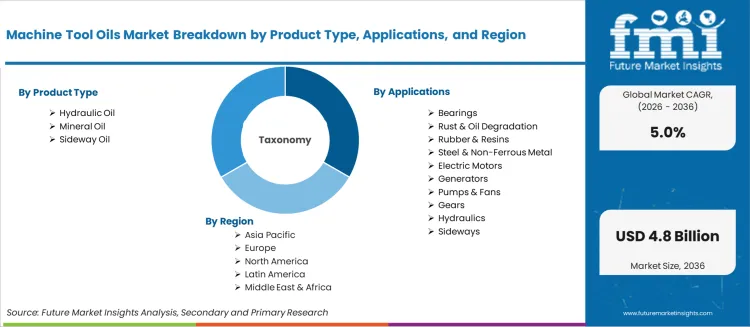
The machine tool oils market is segmented by product type, applications, and geographic regions. By product type, machine tool oils market is divided into Hydraulic Oil, Mineral Oil, and Sideway Oil. In terms of applications, machine tool oils market is classified into Bearings, Rust & Oil Degradation, Rubber & Resins, Steel & Non-Ferrous Metal, Electric Motors, Generators, Pumps & Fans, Gears, Hydraulics, and Sideways. Regionally, the machine tool oils industry is classified into North America, Latin America, Western Europe, Eastern Europe, Balkan & Baltic Countries, Russia & Belarus, Central Asia, East Asia, South Asia & Pacific, and the Middle East & Africa.
Insights into the Hydraulic Oil Segment
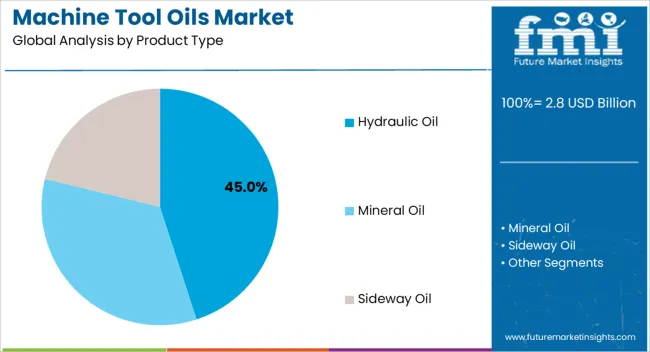
The Hydraulic Oil product type is projected to hold 45.00% of the Machine Tool Oils market revenue share in 2026, making it the leading segment among product types. The growth of this segment is being driven by its critical role in transmitting power within hydraulic systems, ensuring smooth operation, and protecting machinery from wear and corrosion. Hydraulic oils are widely preferred in industrial machines due to their high thermal stability, low volatility, and excellent lubricity, which reduce downtime and enhance productivity.
The ability of hydraulic oils to operate effectively under high-pressure conditions and varying temperature ranges has contributed to their dominant position. Additionally, the ease of maintenance, compatibility with diverse hydraulic systems, and longer service life have further supported adoption.
As industries focus on improving efficiency and minimizing operational costs, the preference for high-performance hydraulic oils continues to grow Increasing automation and the deployment of advanced machine tools that require precise hydraulic control are expected to reinforce the leadership of this segment in the market over the coming years.
Insights into the Bearings Segment
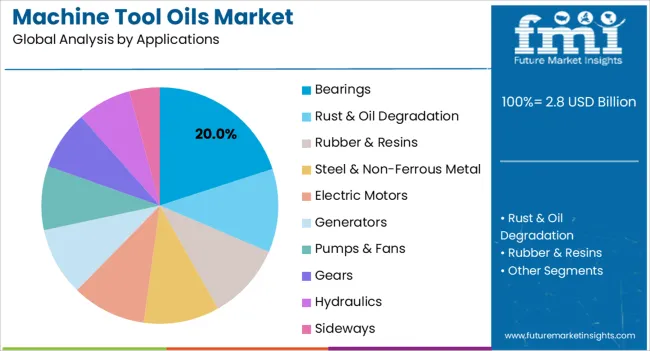
The Bearings application segment is estimated to account for 20.00% of the Machine Tool Oils market revenue share in 2026, establishing it as the largest application within its category. The growth of this segment is being driven by the essential role of lubricants in reducing friction, preventing wear, and maintaining the operational accuracy of bearings in industrial machinery.
Machine tool oils for bearings are critical in enhancing rotational efficiency, improving load handling capacity, and extending the service life of both high-speed and heavy-load equipment. The adoption of precision machinery and automated manufacturing systems has heightened the demand for specialized oils that provide consistent performance under continuous operation.
Furthermore, the ability of these oils to protect against oxidation, corrosion, and contamination has reinforced their importance in industrial maintenance strategies As industries increasingly prioritize reliability, reduced maintenance frequency, and enhanced equipment longevity, the bearings application segment is anticipated to sustain its prominence in the Machine Tool Oils market, offering significant opportunities for growth in the coming decade.
Market Overview
Global Machine Tool Oils Market: Definition and Introduction
Every year, millions of dollars are spent on the replacement of machine tools due to the low performance of lubricants. Machine tool oils are the ideal solution for increasing the lubrication of equipment. Proper synchronisation is required during the operation of equipment for the efficient working of the procedure.
In case of improper synchronisation, the engine is likely to malfunction, which is likely to result in the emission of harmful gases. This can be avoided with the usage of machine tool oils. Thus, machine tool oils play a vital role in the working of machine tools.
Generally, machine tool oils have been divided into three types: hydraulic oil, mineral oil and slideway oils. The usage of machine tool oils varies on the basis of condition or operations. In terms of notable properties, machine tool oils have tackiness and act as anti-rust and anti-foam additives for enabling the higher loading of machine tools.
Moreover, machine tool oils significantly reduce the odours, provide significant corrosion protection for all ferrous & non-ferrous materials and are resistant to bacteria, which helps maintain cleanliness. The primary application of machine tool oils is to avoid corrosion, provide ease of cleanliness and to increase the lubrication of machine tools. Moreover, machine tool oils handle the mechanism of operation and the rate of operation.
Furthermore, machine tool oils provide improved surface finish to the job.
Analysis of Machine Tool Oils Market By Key Countries
.webp "Top Country Growth Comparison Machine Tool Oils Market Cagr (2026 2036)")
| Country | CAGR |
|---|---|
| China | 6.8% |
| India | 6.3% |
| Germany | 5.8% |
| France | 5.3% |
| UK | 4.8% |
| USA | 4.3% |
| Brazil | 3.8% |
Country-wise Analysis
The Machine Tool Oils Market is expected to register a CAGR of 5.0% during the forecast period, exhibiting varied country level momentum. China leads with the highest CAGR of 6.8%, followed by India at 6.3%. Developed markets such as Germany, France, and the UK continue to expand steadily, while the USA is likely to grow at consistent rates. Brazil posts the lowest CAGR at 3.8%, yet still underscores a broadly positive trajectory for the global Machine Tool Oils Market. In 2024, Germany held a dominant revenue in the Western Europe market and is expected to grow with a CAGR of 5.8%. The USA Machine Tool Oils Market is estimated to be valued at USD 1.0 billion in 2026 and is anticipated to reach a valuation of USD 1.5 billion by 2036. Sales are projected to rise at a CAGR of 4.3% over the forecast period between 2026 and 2036. While Japan and South Korea markets are estimated to be valued at USD 143.8 million and USD 84.3 million respectively in 2026.
Key Players in the Machine Tool Oils Market
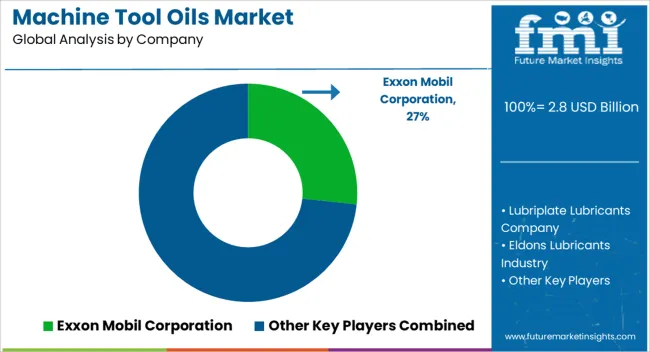
- Exxon Mobil Corporation
- Lubriplate Lubricants Company
- Eldons Lubricants Industry
- Eastern Petroleum Private Limited
- Ashburn Chemical Technologies
- Petro-Canada Lubricants
- RBM Oil Corporation
- Sarlboro Petrochemical Industry
- Xinxiang Tianrui Hydraulic Equipment
- Bel-Ray Company
- Lubrication Engineers
- ROCOL(ITW)
- Texas Refinery
- Brugarolas
- Behran Oil
Scope of the Report
| Metric | Value |
|---|---|
| Quantitative Units | USD 2.94 billion to USD 4.79 billion, at a CAGR of 5% |
| Market Definition | Machine tool oils are lubricant formulations for hydraulic systems, slideway guides, and bearings in metalworking machinery, consumed at intervals tied to operating hours and load conditions. |
| Segmentation | Product Type: Hydraulic Oil, Mineral Oil, Sideway Oil; Applications: Bearings, Rust & Oil Degradation, Rubber & Resins, Steel & Non-Ferrous Metal, Electric Motors, Generators, Pumps & Fans, Gears, Hydraulics, Sideways |
| Regions Covered | North America, Latin America, Europe, East Asia, South Asia, Oceania, Middle East & Africa |
| Countries Covered | China, India, Germany, France, UK, USA, Brazil, and 40 plus countries |
| Key Companies Profiled | Exxon Mobil Corporation, Lubriplate Lubricants Company, Eldons Lubricants Industry, Eastern Petroleum Private Limited, Ashburn Chemical Technologies, Petro-Canada Lubricants, RBM Oil Corporation, Sarlboro Petrochemical Industry |
| Forecast Period | 2026 to 2036 |
| Approach | Forecasting models apply a bottom-up methodology starting with regional activity metrics and cross-validate against industry data and corporate disclosures. |
Machine Tool Oils Market by Segments
Product Type:
- Hydraulic Oil
- Mineral Oil
- Sideway Oil
Applications:
- Bearings
- Rust & Oil Degradation
- Rubber & Resins
- Steel & Non-Ferrous Metal
- Electric Motors
- Generators
- Pumps & Fans
- Gears
- Hydraulics
- Sideways
Region:
- North America
- USA
- Canada
- Mexico
- Latin America
- Brazil
- Chile
- Rest of Latin America
- Western Europe
- Germany
- UK
- Italy
- Spain
- France
- Nordic
- BENELUX
- Rest of Western Europe
- Eastern Europe
- Russia
- Poland
- Hungary
- Balkan & Baltic
- Rest of Eastern Europe
- East Asia
- China
- Japan
- South Korea
- South Asia and Pacific
- India
- ASEAN
- Australia & New Zealand
- Rest of South Asia and Pacific
- Middle East & Africa
- Kingdom of Saudi Arabia
- Other GCC Countries
- Turkiye
- South Africa
- Other African Union
- Rest of Middle East & Africa
Bibliography
- 1. International Organization for Standardization. (2024). ISO 6743: Lubricants, Industrial Oils and Related Products, Classification. ISO.
- 2. European Chemicals Agency. (2025). REACH Regulation: Metalworking Fluid Restrictions Update. ECHA.
- 3. Organisation for Economic Co-operation and Development. (2024). Industrial Lubricants and Environmental Performance. OECD.
- 4. Occupational Safety and Health Administration. (2025). Metalworking Fluid Exposure Standards. OSHA.
- 5. United Nations Industrial Development Organization. (2024). Manufacturing Sector Lubricant Consumption Assessment. UNIDO.
This bibliography is provided for reader reference. The full Future Market Insights report contains the complete reference list with primary research documentation.
Frequently Asked Questions
How large is the demand for Machine Tool Oils in the global market in 2026?
Demand for Machine Tool Oils in the global market is estimated to be valued at USD 2.94 billion in 2026.
What will be the market size of Machine Tool Oils in the global market by 2036?
Market size for Machine Tool Oils is projected to reach USD 4.79 billion by 2036.
What is the expected demand growth for Machine Tool Oils between 2026 and 2036?
Demand for Machine Tool Oils is expected to grow at a CAGR of 5% between 2026 and 2036.
Which Product Type is poised to lead global sales by 2026?
Hydraulic Oil accounts for 45% share in 2026 based on FMI analysis.
How is the role of Bearings in driving Machine Tool Oils adoption in 2026?
Bearings represents 20% of segment share in 2026 as per FMI's machine tool oils market report.
What is the fastest-growing country market in this report?
China is projected to grow at a CAGR of 6.8% during 2026 to 2036.
What is Machine Tool Oils and what is it mainly used for?
Machine tool oils are lubricant formulations for hydraulic systems, slideway guides, and bearings in metalworking machinery, consumed at intervals tied to operating hours and load conditions.
What is included in the scope of this Machine Tool Oils report?
The market covers hydraulic oil, mineral oil, and sideway oil for machine tool bearings, gears, hydraulics, and slideway lubrication applications.
Preview the report firsthand - request a free sample
Get SampleGet the brochure for pricing and purchase details.
Get PDFTable of Content
- Demand-side Trends
- Supply-side Trends
- Technology Roadmap Analysis
- Analysis and Recommendations
- Market Overview
- Market Structure, Signals, and Trend Drivers
- Benchmarking and Cross-market Comparability
- Market Sizing, Forecasting, and Opportunity Mapping
- Research Design and Evidence Framework
- Desk Research Programme (Secondary Evidence)
- Company Annual and Sustainability Reports
- Peer-reviewed Journals and Academic Literature
- Specialist Newsletters and Curated Briefings
- Sector Databases and Reference Repositories
- FMI Internal Proprietary Databases and Historical Market Datasets
- Subscription Datasets and Paid Sources
- Social Channels, Communities, and Digital Listening Inputs
- Additional Desk Sources
- Expert Input and Fieldwork (Primary Evidence)
- Primary Modes
- Qualitative Interviews and Expert Elicitation
- Quantitative Surveys and Structured Data Capture
- Blended Approach
- Why Primary Evidence is Used
- Field Techniques
- Interviews
- Surveys
- Focus Groups
- Observational and In-context Research
- Social and Community Interactions
- Stakeholder Universe Engaged
- C-suite Leaders
- Board Members
- Presidents and Vice Presidents
- R&D and Innovation Heads
- Technical Specialists
- Domain Subject-matter Experts
- Scientists
- Physicians and Other Healthcare Professionals
- Governance, Ethics, and Data Stewardship
- Research Ethics
- Data Integrity and Handling
- Primary Modes
- Tooling, Models, and Reference Databases
- Desk Research Programme (Secondary Evidence)
- Data Engineering and Model Build
- Data Acquisition and Ingestion
- Cleaning, Normalisation, and Verification
- Synthesis, Triangulation, and Analysis
- Quality Assurance and Audit Trail
- Market Background
- Market Dynamics
- Drivers
- Restraints
- Opportunity
- Trends
- Scenario Forecast
- Demand in Optimistic Scenario
- Demand in Likely Scenario
- Demand in Conservative Scenario
- Opportunity Map Analysis
- Product Life Cycle Analysis
- Supply Chain Analysis
- Investment Feasibility Matrix
- Value Chain Analysis
- PESTLE and Porter’s Analysis
- Regulatory Landscape
- Regional Parent Market Outlook
- Production and Consumption Statistics
- Import and Export Statistics
- Market Dynamics
- Global Market Analysis 2021 to 2025 and Forecast, 2026 to 2036
- Historical Market Size Value (USD Million) Analysis, 2021 to 2025
- Current and Future Market Size Value (USD Million) Projections, 2026 to 2036
- Y-o-Y Growth Trend Analysis
- Absolute $ Opportunity Analysis
- Global Market Pricing Analysis 2021 to 2025 and Forecast 2026 to 2036
- Global Market Analysis 2021 to 2025 and Forecast 2026 to 2036, By Product Type
- Introduction / Key Findings
- Historical Market Size Value (USD Million) Analysis By Product Type , 2021 to 2025
- Current and Future Market Size Value (USD Million) Analysis and Forecast By Product Type , 2026 to 2036
- Hydraulic Oil
- Mineral Oil
- Sideway Oil
- Hydraulic Oil
- Y-o-Y Growth Trend Analysis By Product Type , 2021 to 2025
- Absolute $ Opportunity Analysis By Product Type , 2026 to 2036
- Global Market Analysis 2021 to 2025 and Forecast 2026 to 2036, By Applications
- Introduction / Key Findings
- Historical Market Size Value (USD Million) Analysis By Applications, 2021 to 2025
- Current and Future Market Size Value (USD Million) Analysis and Forecast By Applications, 2026 to 2036
- Bearings
- Rust & Oil Degradation
- Rubber & Resins
- Steel & Non-Ferrous Metal
- Electric Motors
- Generators
- Pumps & Fans
- Gears
- Hydraulics
- Sideways
- Bearings
- Y-o-Y Growth Trend Analysis By Applications, 2021 to 2025
- Absolute $ Opportunity Analysis By Applications, 2026 to 2036
- Global Market Analysis 2021 to 2025 and Forecast 2026 to 2036, By Region
- Introduction
- Historical Market Size Value (USD Million) Analysis By Region, 2021 to 2025
- Current Market Size Value (USD Million) Analysis and Forecast By Region, 2026 to 2036
- North America
- Latin America
- Western Europe
- Eastern Europe
- East Asia
- South Asia and Pacific
- Middle East & Africa
- Market Attractiveness Analysis By Region
- North America Market Analysis 2021 to 2025 and Forecast 2026 to 2036, By Country
- Historical Market Size Value (USD Million) Trend Analysis By Market Taxonomy, 2021 to 2025
- Market Size Value (USD Million) Forecast By Market Taxonomy, 2026 to 2036
- By Country
- USA
- Canada
- Mexico
- By Product Type
- By Applications
- By Country
- Market Attractiveness Analysis
- By Country
- By Product Type
- By Applications
- Key Takeaways
- Latin America Market Analysis 2021 to 2025 and Forecast 2026 to 2036, By Country
- Historical Market Size Value (USD Million) Trend Analysis By Market Taxonomy, 2021 to 2025
- Market Size Value (USD Million) Forecast By Market Taxonomy, 2026 to 2036
- By Country
- Brazil
- Chile
- Rest of Latin America
- By Product Type
- By Applications
- By Country
- Market Attractiveness Analysis
- By Country
- By Product Type
- By Applications
- Key Takeaways
- Western Europe Market Analysis 2021 to 2025 and Forecast 2026 to 2036, By Country
- Historical Market Size Value (USD Million) Trend Analysis By Market Taxonomy, 2021 to 2025
- Market Size Value (USD Million) Forecast By Market Taxonomy, 2026 to 2036
- By Country
- Germany
- UK
- Italy
- Spain
- France
- Nordic
- BENELUX
- Rest of Western Europe
- By Product Type
- By Applications
- By Country
- Market Attractiveness Analysis
- By Country
- By Product Type
- By Applications
- Key Takeaways
- Eastern Europe Market Analysis 2021 to 2025 and Forecast 2026 to 2036, By Country
- Historical Market Size Value (USD Million) Trend Analysis By Market Taxonomy, 2021 to 2025
- Market Size Value (USD Million) Forecast By Market Taxonomy, 2026 to 2036
- By Country
- Russia
- Poland
- Hungary
- Balkan & Baltic
- Rest of Eastern Europe
- By Product Type
- By Applications
- By Country
- Market Attractiveness Analysis
- By Country
- By Product Type
- By Applications
- Key Takeaways
- East Asia Market Analysis 2021 to 2025 and Forecast 2026 to 2036, By Country
- Historical Market Size Value (USD Million) Trend Analysis By Market Taxonomy, 2021 to 2025
- Market Size Value (USD Million) Forecast By Market Taxonomy, 2026 to 2036
- By Country
- China
- Japan
- South Korea
- By Product Type
- By Applications
- By Country
- Market Attractiveness Analysis
- By Country
- By Product Type
- By Applications
- Key Takeaways
- South Asia and Pacific Market Analysis 2021 to 2025 and Forecast 2026 to 2036, By Country
- Historical Market Size Value (USD Million) Trend Analysis By Market Taxonomy, 2021 to 2025
- Market Size Value (USD Million) Forecast By Market Taxonomy, 2026 to 2036
- By Country
- India
- ASEAN
- Australia & New Zealand
- Rest of South Asia and Pacific
- By Product Type
- By Applications
- By Country
- Market Attractiveness Analysis
- By Country
- By Product Type
- By Applications
- Key Takeaways
- Middle East & Africa Market Analysis 2021 to 2025 and Forecast 2026 to 2036, By Country
- Historical Market Size Value (USD Million) Trend Analysis By Market Taxonomy, 2021 to 2025
- Market Size Value (USD Million) Forecast By Market Taxonomy, 2026 to 2036
- By Country
- Kingdom of Saudi Arabia
- Other GCC Countries
- Turkiye
- South Africa
- Other African Union
- Rest of Middle East & Africa
- By Product Type
- By Applications
- By Country
- Market Attractiveness Analysis
- By Country
- By Product Type
- By Applications
- Key Takeaways
- Key Countries Market Analysis
- USA
- Pricing Analysis
- Market Share Analysis, 2025
- By Product Type
- By Applications
- Canada
- Pricing Analysis
- Market Share Analysis, 2025
- By Product Type
- By Applications
- Mexico
- Pricing Analysis
- Market Share Analysis, 2025
- By Product Type
- By Applications
- Brazil
- Pricing Analysis
- Market Share Analysis, 2025
- By Product Type
- By Applications
- Chile
- Pricing Analysis
- Market Share Analysis, 2025
- By Product Type
- By Applications
- Germany
- Pricing Analysis
- Market Share Analysis, 2025
- By Product Type
- By Applications
- UK
- Pricing Analysis
- Market Share Analysis, 2025
- By Product Type
- By Applications
- Italy
- Pricing Analysis
- Market Share Analysis, 2025
- By Product Type
- By Applications
- Spain
- Pricing Analysis
- Market Share Analysis, 2025
- By Product Type
- By Applications
- France
- Pricing Analysis
- Market Share Analysis, 2025
- By Product Type
- By Applications
- India
- Pricing Analysis
- Market Share Analysis, 2025
- By Product Type
- By Applications
- ASEAN
- Pricing Analysis
- Market Share Analysis, 2025
- By Product Type
- By Applications
- Australia & New Zealand
- Pricing Analysis
- Market Share Analysis, 2025
- By Product Type
- By Applications
- China
- Pricing Analysis
- Market Share Analysis, 2025
- By Product Type
- By Applications
- Japan
- Pricing Analysis
- Market Share Analysis, 2025
- By Product Type
- By Applications
- South Korea
- Pricing Analysis
- Market Share Analysis, 2025
- By Product Type
- By Applications
- Russia
- Pricing Analysis
- Market Share Analysis, 2025
- By Product Type
- By Applications
- Poland
- Pricing Analysis
- Market Share Analysis, 2025
- By Product Type
- By Applications
- Hungary
- Pricing Analysis
- Market Share Analysis, 2025
- By Product Type
- By Applications
- Kingdom of Saudi Arabia
- Pricing Analysis
- Market Share Analysis, 2025
- By Product Type
- By Applications
- Turkiye
- Pricing Analysis
- Market Share Analysis, 2025
- By Product Type
- By Applications
- South Africa
- Pricing Analysis
- Market Share Analysis, 2025
- By Product Type
- By Applications
- USA
- Market Structure Analysis
- Competition Dashboard
- Competition Benchmarking
- Market Share Analysis of Top Players
- By Regional
- By Product Type
- By Applications
- Competition Analysis
- Competition Deep Dive
- Exxon Mobil Corporation
- Overview
- Product Portfolio
- Profitability by Market Segments (Product/Age /Sales Channel/Region)
- Sales Footprint
- Strategy Overview
- Marketing Strategy
- Product Strategy
- Channel Strategy
- Lubriplate Lubricants Company
- Eldons Lubricants Industry
- Eastern Petroleum Private Limited
- Ashburn Chemical Technologies
- Petro-Canada Lubricants
- RBM Oil Corporation
- Sarlboro Petrochemical Industry
- Xinxiang Tianrui Hydraulic Equipment
- Bel-Ray Company
- Lubrication Engineers
- ROCOL(ITW)
- Texas Refinery
- Brugarolas
- Behran Oil
- Exxon Mobil Corporation
- Competition Deep Dive
- Assumptions & Acronyms Used


