

- Industry Size (2026)
- USD 23.75 Bn
- Forecast (2036)
- USD 67.45 Bn
- CAGR (2026 to 2036)
- 11.0%
Machine Vision System And Services Market Size, Market Forecast and Outlook By FMI
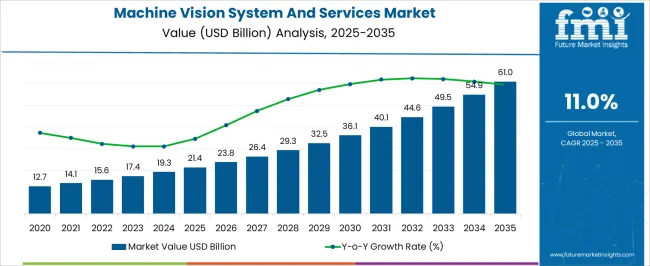
The machine vision system and services market was valued at USD 21.40 billion in 2025, projected to reach USD 23.75 billion in 2026, and is forecast to expand to USD 67.45 billion by 2036 at an 11.0% CAGR. Accelerating deployment of automated quality inspection systems across discrete manufacturing lines and tightening regulatory compliance thresholds for product traceability are the primary forces pushing capital allocation toward machine vision platforms. As per FMI, investment cycles that once treated machine vision as a line-level enhancement now classify it as a mandatory infrastructure component for any facility pursuing zero-defect manufacturing targets.
Summary of Machine Vision System And Services Market
- Market Snapshot
- The machine vision system and services market is valued at USD 21.40 billion in 2025 and is projected to reach USD 67.45 billion by 2036.
- The industry is expected to grow at an 11.0% CAGR from 2026 to 2036, creating an incremental opportunity of USD 43.70 billion.
- The market is a technology-intensive industrial automation category where imaging precision, AI inference speed, and system integration depth define competitive positioning.
- Demand and Growth Drivers
- Demand is rising as discrete manufacturers face mandatory zero-defect quality thresholds from automotive OEMs and semiconductor fabrication standards.
- Deep learning integration into smart camera platforms is triggering a replacement cycle for legacy rule-based inspection systems.
- Government-backed industrial modernization programmes in China and India are accelerating greenfield deployment of inline vision stations.
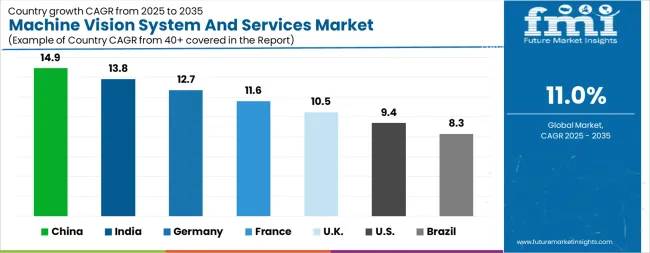
- Among key countries, China leads at 14.9% CAGR, followed by India at 13.8%, Germany at 12.7%, France at 11.6%, UK at 10.5%, USA at 9.4%, and Brazil at 8.3%.
- Product and Segment View
- The market includes 3D measurement systems, 2D measurement systems, and 1D measurement systems deployed for inline and offline industrial inspection.
- Applications span flaw detection, part identification, robotic positioning guidance, dimensional measurement, and assembly verification.
- 3D Measurement leads by type with 46.2% share in 2026, driven by demand for volumetric defect classification in automotive and semiconductor manufacturing.
- Flaw Detection leads by application with 32.6% share in 2026.
- Smart Camera leads by component with 36.9% share in 2026, as on-device AI inference reduces reliance on centralized processing.
- Geography and Competitive Outlook
- China and India are the fastest-growing markets due to manufacturing modernization investments, while Europe and North America represent mature, high-value replacement demand bases.
- Competition is shaped by imaging sensor precision, AI software ecosystem breadth, and integration partnerships with robotics and automation OEMs.
- Key players include Keyence Corporation, Cognex Corporation, Omron Corporation, SICK AG, Atlas Copco AB, ISRA Vision AG, Basler AG, National Instruments Corporation, TKH Group, Datalogic S.P.A, and MVTEC Software GMBH.
- Analyst Opinion at FMI
- Sudip saha, Principal Consultant for Technology observe that: 'In my analysis, I have observed that the defining constraint in modern production is not throughput speed but inspection resolution. Assembly lines that cannot classify sub-surface material defects in real time face systematic yield losses that compound across multi-stage manufacturing processes. Facilities delaying the transition from 2D rule-based systems to 3D AI-trained classification models will find their quality audit pass rates falling below the contractual thresholds set by tier-one automotive and semiconductor buyers. Capital planning teams that treat machine vision as a discretionary upgrade rather than a mandatory infrastructure investment risk permanent exclusion from the precision manufacturing supply chains their competitors are actively qualifying for.'
- Strategic Implications / Executive Takeaways
- Vision system vendors must secure certified integration pathways with tier-one robotics OEMs to qualify for large-scale automotive and semiconductor facility contracts.
- Manufacturing directors should mandate AI-capable smart camera specifications in all new production line procurement to avoid costly retrofit cycles within 24 months.
- Quality engineering teams must develop in-house deep learning model training competencies to reduce dependency on vendor-supplied classification algorithms.
Machine Vision System And Services Market Key Takeaways
| Metric | Details |
|---|---|
| Industry Size (2026) | USD 23.75 billion |
| Industry Value (2036) | USD 67.45 billion |
| CAGR (2026-2036) | 11.0% |
Source: Future Market Insights, 2026
The convergence of deep learning inference engines with industrial-grade imaging hardware is compressing the time-to-deployment for inline inspection stations. Automotive OEMs now mandate vision-guided robotics for welding seam verification and paint surface anomaly detection across their tier-one supplier base. Semiconductor fabrication facilities are scaling 3D metrology systems to handle sub-micron defect classification on advanced node wafers. FMI analysts observe that the migration from rule-based machine vision to AI-trained classification models is creating a secondary procurement cycle as facilities replace legacy fixed-algorithm cameras with smart camera platforms capable of on-device model execution.
All leading industrial economies reflect differentiated adoption trajectories. China sets the pace with a 14.9% CAGR, fuelled by state-backed manufacturing modernization programmes and aggressive deployment across consumer electronics assembly hubs in Guangdong and Jiangsu. India follows at 13.8%, driven by the Production Linked Incentive scheme accelerating vision system integration in automotive and pharmaceutical packaging lines. Germany expands at 12.7%, anchored by its Mittelstand precision engineering sector upgrading to Industry 4.0 compliant inspection cells. France registers a 11.6% pace as its aerospace and luxury goods manufacturing sectors invest in surface inspection automation. United Kingdom operations advance at 10.5%, supported by food and beverage safety compliance requirements. United States operations grow at 9.4%, with mature automotive and semiconductor fabs executing replacement cycles for next-generation 3D systems. Brazil tracks at 8.3%, reflecting early-stage adoption in agribusiness processing and automotive component manufacturing.
Machine Vision System And Services Market Definition
Machine Vision System And Services represents the integrated hardware and software platforms designed to capture, process, and interpret visual information from industrial environments for automated inspection, measurement, identification, and process guidance. System architectures include line-scan and area-scan cameras, structured light and laser triangulation sensors, frame grabbers, embedded vision processors, and specialized illumination modules. The services component covers system integration, calibration, AI model training, and ongoing maintenance contracts. These platforms operate across discrete and process manufacturing settings where non-contact, high-speed quality assessment is required.
Machine Vision System And Services Market Inclusions
Market scope includes 3D, 2D, and 1D measurement and inspection systems, smart cameras with on-device processing, frame grabbers, industrial lenses, machine vision lighting modules, embedded vision computing platforms, and associated integration, calibration, and maintenance services. Software components covering image acquisition, preprocessing, deep learning classification, and reporting dashboards are fully incorporated.
Machine Vision System And Services Market Exclusions
Standard CCTV surveillance systems lacking industrial inspection algorithms are excluded. Consumer-grade imaging devices, standalone barcode scanners without integrated vision processing, and general-purpose industrial automation controllers not specifically designed for vision tasks fall outside analytical parameters. Medical diagnostic imaging systems governed by separate regulatory frameworks are explicitly omitted from the valuation.
Machine Vision System And Services Market Research Methodology
- Primary Research: Analysts engaged with manufacturing automation leads, quality assurance directors, and vision system integration engineers to map the specific procurement triggers and compliance thresholds driving system upgrades.
- Desk Research: Data collection phases aggregated industrial automation standards publications, national manufacturing modernization programme documentation, and OEM supplier qualification requirements.
- Market-Sizing and Forecasting: Baseline values derive from a bottom-up aggregation of vision system shipments by component category, applying region-specific automation penetration curves to project future adoption velocity.
- Data Validation and Update Cycle: Projections are tested against publicly reported capital expenditure guidance from leading automotive, semiconductor, and electronics manufacturing conglomerates.
Why is the Machine Vision System And Services Market Growing?
The Machine Vision System and Services market is witnessing strong growth, driven by increasing automation across manufacturing, automotive, electronics, and quality inspection industries. Demand is being fueled by the need for precise measurement, defect detection, and process optimization in production lines. The integration of AI-powered analytics, high-resolution imaging, and real-time monitoring is enhancing operational efficiency while reducing errors and downtime.
Advancements in 3D measurement technologies, including laser scanning and structured light imaging, are enabling highly accurate inspections for complex components. Adoption is further supported by the growing emphasis on smart factories, Industry 4.0 initiatives, and predictive maintenance strategies. Market expansion is being reinforced by increasing investments in industrial automation, research, and development of cost-effective vision solutions.
The ability to integrate vision systems with robotics, data analytics, and cloud-based platforms allows organizations to optimize productivity and maintain quality standards Regulatory compliance and safety monitoring requirements are also driving the adoption of machine vision systems and services, positioning the market for sustained growth in the coming decade.
Segmental Analysis
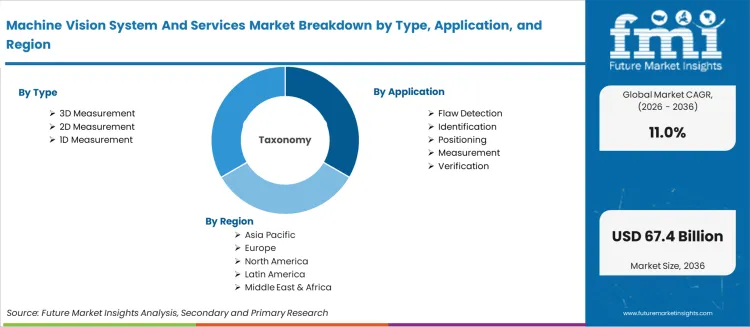
The machine vision system and services market is segmented by type, application, component, end-user vertical, and geographic regions. By type, machine vision system and services market is divided into 3D Measurement, 2D Measurement, and 1D Measurement. In terms of application, machine vision system and services market is classified into Flaw Detection, Identification, Positioning, Measurement, and Verification. Based on component, machine vision system and services market is segmented into Smart Camera, Lenses, Lighting, Frame Grabber, and Embedded System. By end-user vertical, machine vision system and services market is segmented into Automotive, Electronics, Healthcare, Industrial, and Others. Regionally, the machine vision system and services industry is classified into North America, Latin America, Western Europe, Eastern Europe, Balkan & Baltic Countries, Russia & Belarus, Central Asia, East Asia, South Asia & Pacific, and the Middle East & Africa.
Insights into the 3D Measurement Type Segment
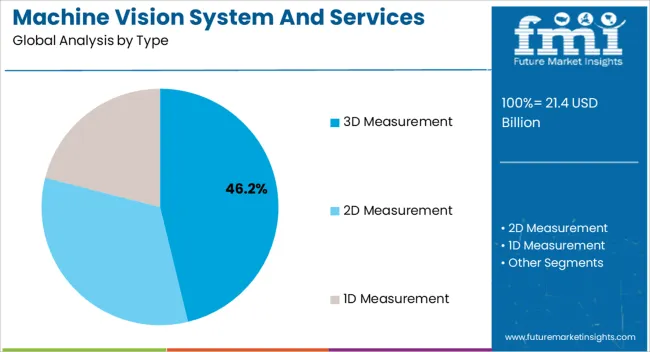
The 3D measurement type segment is projected to hold 46.2% of the market revenue in 2026, establishing it as the leading type. Growth is being driven by the ability of 3D measurement systems to deliver highly accurate spatial data for complex geometries and assemblies, which is critical for quality control and process optimization. These systems allow manufacturers to perform precise dimensional analysis, reduce scrap, and minimize rework costs.
Advancements in structured light scanning, laser triangulation, and photogrammetry are enhancing measurement speed and resolution, enabling real-time inspection of high-volume production lines. Integration with software analytics and AI enables automated decision-making, further improving efficiency and reducing human error.
The versatility of 3D measurement systems across industries such as automotive, electronics, and aerospace reinforces their adoption As organizations prioritize precision, efficiency, and traceability in production processes, the 3D measurement segment is expected to maintain its leadership, supported by continuous technological innovation and improved system integration capabilities.
Insights into the Flaw Detection Application Segment
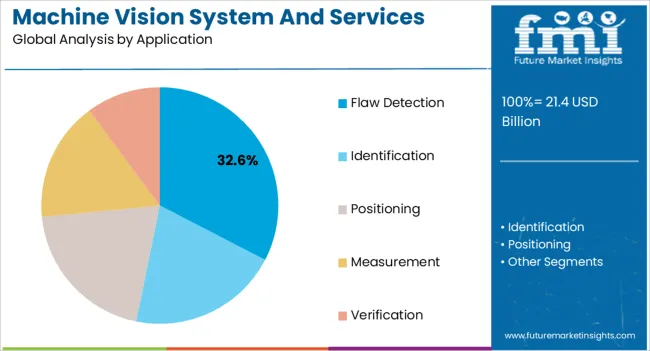
The flaw detection application segment is anticipated to account for 32.6% of the market revenue in 2026, making it the leading application area. Its growth is being driven by the critical need to identify defects, anomalies, and quality inconsistencies in production lines to ensure compliance with stringent quality standards. Machine vision systems enable real-time detection of surface defects, assembly errors, and dimensional inaccuracies, reducing operational losses and improving product reliability.
The integration of AI and deep learning algorithms enhances detection accuracy under varying environmental conditions and complex component geometries. Flaw detection applications are increasingly being adopted in industries such as electronics, automotive, and pharmaceuticals, where precision and safety are paramount.
Automation of inspection processes reduces reliance on manual checks, increasing throughput while maintaining high quality As manufacturers continue to pursue zero-defect production strategies and improve operational efficiency, the flaw detection application segment is expected to remain a primary driver of market growth, supported by advancements in imaging, software analytics, and integration with industrial automation systems.
Insights into the Smart Camera Component Segment
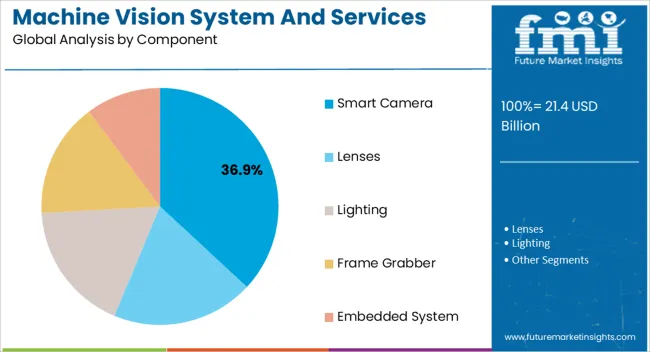
The smart camera component segment is projected to hold 36.9% of the market revenue in 2026, establishing it as the leading component type. Its adoption is being driven by the integration of imaging sensors, processing units, and software in a single compact device, enabling real-time data acquisition and analysis. Smart cameras provide high-speed inspection, automated decision-making, and seamless connectivity with industrial networks, enhancing productivity and reducing errors.
These devices are increasingly being deployed in automated production lines for quality control, object recognition, and process monitoring across manufacturing, logistics, and electronics industries. Advances in embedded AI, high-resolution optics, and edge computing are further improving accuracy, performance, and scalability.
The ability to adapt functionality via software without major hardware modifications offers cost efficiency and flexibility As industrial automation and smart manufacturing adoption accelerate, smart cameras are expected to maintain their market leadership, supported by continuous innovation, operational efficiency improvements, and enhanced integration with machine vision systems and robotics.
Market Overview
Machine Vision System And Services Market Overview
Machine vision technology is a vital part of industrial automated production process that serves to improve the overall speed and quality of a final product. Superior to normal human visual sense, machine vision technology offers a critical capability of judging a product being manufactured.
Machine vision system and service providers allow manufacturers to achieve rapid production lines with accurate, precise non-contact product measurement, and closed-loop process control. High quality product inspection, lesser setup time and quick downtime, and increased production flexibility are among top advantages machine vision systems offer.
Virtually employed by all industrial manufacturing verticals, vision inspection enabled early detection and resolution of production inconsistency. In addition to boosting production efficiency, it also helps increase product integrity and thereby fulfil all associated legal compliance standards. In a nutshell, manufacturers cannot afford to bypass machine vision technology during the production process, as it ultimately helps companies to preserve their brands’ reputation in the long run.
Analysis of Machine Vision System And Services Market By Key Countries
.webp "Top Country Growth Comparison Machine Vision System And Services Market Cagr (2026 2036)")
| Country | CAGR |
|---|---|
| China | 14.9% |
| India | 13.8% |
| Germany | 12.7% |
| France | 11.6% |
| UK | 10.5% |
| USA | 9.4% |
| Brazil | 8.3% |
Country-wise Analysis
The Machine Vision System And Services Market is expected to register a CAGR of 11.0% during the forecast period, exhibiting varied country level momentum. China leads with the highest CAGR of 14.9%, followed by India at 13.8%. Developed markets such as Germany, France, and the UK continue to expand steadily, while the USA is likely to grow at consistent rates. Brazil posts the lowest CAGR at 8.3%, yet still underscores a broadly positive trajectory for the global Machine Vision System And Services Market. In 2026, Germany held a dominant revenue in the Western Europe market and is expected to grow with a CAGR of 12.7%. The USA Machine Vision System And Services Market is estimated to be valued at USD 7.7 billion in 2025 and is anticipated to reach a valuation of USD 18.8 billion by 2035. Sales are projected to rise at a CAGR of 9.4% over the forecast period between 2025 and 2035. While Japan and South Korea markets are estimated to be valued at USD 1.2 billion and USD 716.5 million respectively in 2025.
Key Players in the Machine Vision System And Services Market
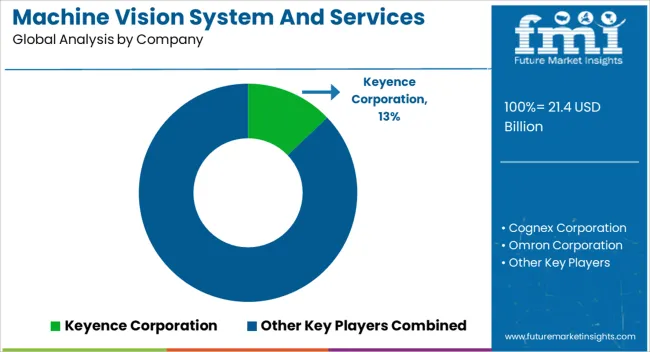
- Keyence Corporation
- Cognex Corporation
- Omron Corporation
- SICK AG
- Atlas Copco AB
- ISRA Vision AG
- Balser AG
- National Instruments Corporation
- TKH Group
- Datalogic S.P.A
- MVTEC Software GMBH
- Optotune
- Deci AI
- Relation Therapeutics
- Lenovo
Scope of the Report
| Metric | Value |
|---|---|
| Quantitative Units | USD 23.75 billion to USD 67.45 billion, at a CAGR of 11.0% |
| Market Definition | Machine Vision System And Services encompasses integrated imaging hardware, AI-driven processing software, and professional services built to automate industrial inspection, dimensional measurement, part identification, and robotic guidance across manufacturing environments. |
| Type Segmentation | 3D Measurement, 2D Measurement, 1D Measurement |
| Application Segmentation | Flaw Detection, Identification, Positioning, Measurement, Verification |
| Component Segmentation | Smart Camera, Lenses, Lighting, Frame Grabber, Embedded System |
| End-User Vertical Segmentation | Automotive, Electronics, Healthcare, Industrial, Others |
| Regions Covered | North America, Latin America, Europe, East Asia, South Asia, Oceania, Middle East & Africa |
| Countries Covered | China, India, Germany, France, UK, USA, Brazil, and 40 plus countries |
| Key Companies Profiled | Keyence Corporation, Cognex Corporation, Omron Corporation, SICK AG, Atlas Copco AB, ISRA Vision AG, Basler AG, National Instruments Corporation, TKH Group, Datalogic S.P.A, MVTEC Software GMBH |
| Forecast Period | 2026 to 2036 |
| Approach | Forecasting models apply a bottom-up methodology starting with global installed base metrics for industrial vision systems and projecting conversion rates to AI-enabled smart camera platforms. |
Machine Vision System And Services Market by Segments
Type:
- 3D Measurement
- 2D Measurement
- 1D Measurement
Application:
- Flaw Detection
- Identification
- Positioning
- Measurement
- Verification
Component:
- Smart Camera
- Lenses
- Lighting
- Frame Grabber
- Embedded System
End-User Vertical:
- Automotive
- Electronics
- Healthcare
- Industrial
- Others
Region:
- North America
- USA
- Canada
- Mexico
- Latin America
- Brazil
- Chile
- Rest of Latin America
- Western Europe
- Germany
- UK
- Italy
- Spain
- France
- Nordic
- BENELUX
- Rest of Western Europe
- Eastern Europe
- Russia
- Poland
- Hungary
- Balkan & Baltic
- Rest of Eastern Europe
- East Asia
- China
- Japan
- South Korea
- South Asia and Pacific
- India
- ASEAN
- Australia & New Zealand
- Rest of South Asia and Pacific
- Middle East & Africa
- Kingdom of Saudi Arabia
- Other GCC Countries
- Turkiye
- South Africa
- Other African Union
- Rest of Middle East & Africa
Bibliography
- 1. International Federation of Robotics. (2025). World Robotics 2025: Industrial Robots. IFR.
- 2. European Machine Vision Association. (2025). EMVA Market Statistics 2025. EMVA.
- 3. Ministry of Industry and Information Technology, People's Republic of China. (2025). Intelligent Manufacturing Development Plan (2025-2030). MIIT.
- 4. Department for Promotion of Industry and Internal Trade, India. (2025). Production Linked Incentive Scheme: Progress Report 2025. DPIIT.
- 5. German Federal Ministry for Economic Affairs and Climate Action. (2024). Industry 4.0 Platform: Annual Implementation Report. BMWK.
- 6. International Organization for Standardization. (2024). ISO 13849-1:2023 Safety of machinery. ISO.
This bibliography is provided for reader reference. The full Future Market Insights report contains the complete reference list with primary research documentation.
Frequently Asked Questions
How large is the demand for Machine Vision System And Services in the global market in 2026?
Demand for Machine Vision System And Services in the global market is estimated to be valued at USD 23.75 billion in 2026.
What will be the market size of Machine Vision System And Services by 2036?
Market size for Machine Vision System And Services is projected to reach USD 67.45 billion by 2036.
What is the expected demand growth for Machine Vision System And Services between 2026 and 2036?
Demand for Machine Vision System And Services is expected to grow at a CAGR of 11.0% between 2026 and 2036.
Which Type is poised to lead global sales by 2026?
3D Measurement accounts for 46.2% share in 2026 as manufacturers require volumetric defect classification capabilities for advanced automotive and semiconductor quality assurance processes.
How significant is the role of Flaw Detection in driving Machine Vision System And Services adoption in 2026?
Flaw Detection represents 32.6% of application share as automated quality inspection mandates across tier-one automotive and electronics supply chains require real-time surface and sub-surface anomaly identification.
What is driving demand in China?
State-backed manufacturing modernization programmes and aggressive consumer electronics assembly automation across Guangdong and Jiangsu provinces fuel demand for scalable inline inspection systems.
What is the growth outlook for India in this report?
India is projected to grow at a CAGR of 13.8% during 2026 to 2036, driven by Production Linked Incentive scheme adoption and automotive manufacturing expansion.
What does Machine Vision System And Services mean in this report?
The scope encompasses integrated imaging hardware, AI-driven processing software, and professional services built to automate industrial inspection, dimensional measurement, part identification, and robotic guidance across manufacturing environments.
Preview the report firsthand - request a free sample
Get SampleGet the brochure for pricing and purchase details.
Get PDFTable of Content
- Executive Summary
- Global Market Outlook
- Demand-side Trends
- Supply-side Trends
- Technology Roadmap Analysis
- Analysis and Recommendations
- Market Overview
- Market Coverage / Taxonomy
- Market Definition / Scope / Limitations
- Research Methodology
- Chapter Orientation
- Analytical Lens and Working Hypotheses
- Market Structure, Signals, and Trend Drivers
- Benchmarking and Cross-market Comparability
- Market Sizing, Forecasting, and Opportunity Mapping
- Research Design and Evidence Framework
- Desk Research Programme (Secondary Evidence)
- Company Annual and Sustainability Reports
- Peer-reviewed Journals and Academic Literature
- Corporate Websites, Product Literature, and Technical Notes
- Earnings Decks and Investor Briefings
- Statutory Filings and Regulatory Disclosures
- Technical White Papers and Standards Notes
- Trade Journals, Industry Magazines, and Analyst Briefs
- Conference Proceedings, Webinars, and Seminar Materials
- Government Statistics Portals and Public Data Releases
- Press Releases and Reputable Media Coverage
- Specialist Newsletters and Curated Briefings
- Sector Databases and Reference Repositories
- FMI Internal Proprietary Databases and Historical Market Datasets
- Subscription Datasets and Paid Sources
- Social Channels, Communities, and Digital Listening Inputs
- Additional Desk Sources
- Expert Input and Fieldwork (Primary Evidence)
- Primary Modes
- Qualitative Interviews and Expert Elicitation
- Quantitative Surveys and Structured Data Capture
- Blended Approach
- Why Primary Evidence is Used
- Field Techniques
- Interviews
- Surveys
- Focus Groups
- Observational and In-context Research
- Social and Community Interactions
- Stakeholder Universe Engaged
- C-suite Leaders
- Board Members
- Presidents and Vice Presidents
- R&D and Innovation Heads
- Technical Specialists
- Domain Subject-matter Experts
- Scientists
- Physicians and Other Healthcare Professionals
- Governance, Ethics, and Data Stewardship
- Research Ethics
- Data Integrity and Handling
- Primary Modes
- Tooling, Models, and Reference Databases
- Desk Research Programme (Secondary Evidence)
- Data Engineering and Model Build
- Data Acquisition and Ingestion
- Cleaning, Normalisation, and Verification
- Synthesis, Triangulation, and Analysis
- Quality Assurance and Audit Trail
- Market Background
- Market Dynamics
- Drivers
- Restraints
- Opportunity
- Trends
- Scenario Forecast
- Demand in Optimistic Scenario
- Demand in Likely Scenario
- Demand in Conservative Scenario
- Opportunity Map Analysis
- Product Life Cycle Analysis
- Supply Chain Analysis
- Investment Feasibility Matrix
- Value Chain Analysis
- PESTLE and Porter’s Analysis
- Regulatory Landscape
- Regional Parent Market Outlook
- Production and Consumption Statistics
- Import and Export Statistics
- Market Dynamics
- Global Market Analysis 2021 to 2025 and Forecast, 2026 to 2036
- Historical Market Size Value (USD Million) Analysis, 2021 to 2025
- Current and Future Market Size Value (USD Million) Projections, 2026 to 2036
- Y-o-Y Growth Trend Analysis
- Absolute $ Opportunity Analysis
- Global Market Pricing Analysis 2021 to 2025 and Forecast 2026 to 2036
- Global Market Analysis 2021 to 2025 and Forecast 2026 to 2036, By Type
- Introduction / Key Findings
- Historical Market Size Value (USD Million) Analysis By Type , 2021 to 2025
- Current and Future Market Size Value (USD Million) Analysis and Forecast By Type , 2026 to 2036
- 3D Measurement
- 2D Measurement
- 1D Measurement
- 3D Measurement
- Y-o-Y Growth Trend Analysis By Type , 2021 to 2025
- Absolute $ Opportunity Analysis By Type , 2026 to 2036
- Global Market Analysis 2021 to 2025 and Forecast 2026 to 2036, By Application
- Introduction / Key Findings
- Historical Market Size Value (USD Million) Analysis By Application, 2021 to 2025
- Current and Future Market Size Value (USD Million) Analysis and Forecast By Application, 2026 to 2036
- Flaw Detection
- Identification
- Positioning
- Measurement
- Verification
- Flaw Detection
- Y-o-Y Growth Trend Analysis By Application, 2021 to 2025
- Absolute $ Opportunity Analysis By Application, 2026 to 2036
- Global Market Analysis 2021 to 2025 and Forecast 2026 to 2036, By Component
- Introduction / Key Findings
- Historical Market Size Value (USD Million) Analysis By Component, 2021 to 2025
- Current and Future Market Size Value (USD Million) Analysis and Forecast By Component, 2026 to 2036
- Smart Camera
- Lenses
- Lighting
- Frame Grabber
- Embedded System
- Smart Camera
- Y-o-Y Growth Trend Analysis By Component, 2021 to 2025
- Absolute $ Opportunity Analysis By Component, 2026 to 2036
- Global Market Analysis 2021 to 2025 and Forecast 2026 to 2036, By End-User Vertical
- Introduction / Key Findings
- Historical Market Size Value (USD Million) Analysis By End-User Vertical, 2021 to 2025
- Current and Future Market Size Value (USD Million) Analysis and Forecast By End-User Vertical, 2026 to 2036
- Automotive
- Electronics
- Healthcare
- Industrial
- Others
- Automotive
- Y-o-Y Growth Trend Analysis By End-User Vertical, 2021 to 2025
- Absolute $ Opportunity Analysis By End-User Vertical, 2026 to 2036
- Global Market Analysis 2021 to 2025 and Forecast 2026 to 2036, By Region
- Introduction
- Historical Market Size Value (USD Million) Analysis By Region, 2021 to 2025
- Current Market Size Value (USD Million) Analysis and Forecast By Region, 2026 to 2036
- North America
- Latin America
- Western Europe
- Eastern Europe
- East Asia
- South Asia and Pacific
- Middle East & Africa
- Market Attractiveness Analysis By Region
- North America Market Analysis 2021 to 2025 and Forecast 2026 to 2036, By Country
- Historical Market Size Value (USD Million) Trend Analysis By Market Taxonomy, 2021 to 2025
- Market Size Value (USD Million) Forecast By Market Taxonomy, 2026 to 2036
- By Country
- USA
- Canada
- Mexico
- By Type
- By Application
- By Component
- By End-User Vertical
- By Country
- Market Attractiveness Analysis
- By Country
- By Type
- By Application
- By Component
- By End-User Vertical
- Key Takeaways
- Latin America Market Analysis 2021 to 2025 and Forecast 2026 to 2036, By Country
- Historical Market Size Value (USD Million) Trend Analysis By Market Taxonomy, 2021 to 2025
- Market Size Value (USD Million) Forecast By Market Taxonomy, 2026 to 2036
- By Country
- Brazil
- Chile
- Rest of Latin America
- By Type
- By Application
- By Component
- By End-User Vertical
- By Country
- Market Attractiveness Analysis
- By Country
- By Type
- By Application
- By Component
- By End-User Vertical
- Key Takeaways
- Western Europe Market Analysis 2021 to 2025 and Forecast 2026 to 2036, By Country
- Historical Market Size Value (USD Million) Trend Analysis By Market Taxonomy, 2021 to 2025
- Market Size Value (USD Million) Forecast By Market Taxonomy, 2026 to 2036
- By Country
- Germany
- UK
- Italy
- Spain
- France
- Nordic
- BENELUX
- Rest of Western Europe
- By Type
- By Application
- By Component
- By End-User Vertical
- By Country
- Market Attractiveness Analysis
- By Country
- By Type
- By Application
- By Component
- By End-User Vertical
- Key Takeaways
- Eastern Europe Market Analysis 2021 to 2025 and Forecast 2026 to 2036, By Country
- Historical Market Size Value (USD Million) Trend Analysis By Market Taxonomy, 2021 to 2025
- Market Size Value (USD Million) Forecast By Market Taxonomy, 2026 to 2036
- By Country
- Russia
- Poland
- Hungary
- Balkan & Baltic
- Rest of Eastern Europe
- By Type
- By Application
- By Component
- By End-User Vertical
- By Country
- Market Attractiveness Analysis
- By Country
- By Type
- By Application
- By Component
- By End-User Vertical
- Key Takeaways
- East Asia Market Analysis 2021 to 2025 and Forecast 2026 to 2036, By Country
- Historical Market Size Value (USD Million) Trend Analysis By Market Taxonomy, 2021 to 2025
- Market Size Value (USD Million) Forecast By Market Taxonomy, 2026 to 2036
- By Country
- China
- Japan
- South Korea
- By Type
- By Application
- By Component
- By End-User Vertical
- By Country
- Market Attractiveness Analysis
- By Country
- By Type
- By Application
- By Component
- By End-User Vertical
- Key Takeaways
- South Asia and Pacific Market Analysis 2021 to 2025 and Forecast 2026 to 2036, By Country
- Historical Market Size Value (USD Million) Trend Analysis By Market Taxonomy, 2021 to 2025
- Market Size Value (USD Million) Forecast By Market Taxonomy, 2026 to 2036
- By Country
- India
- ASEAN
- Australia & New Zealand
- Rest of South Asia and Pacific
- By Type
- By Application
- By Component
- By End-User Vertical
- By Country
- Market Attractiveness Analysis
- By Country
- By Type
- By Application
- By Component
- By End-User Vertical
- Key Takeaways
- Middle East & Africa Market Analysis 2021 to 2025 and Forecast 2026 to 2036, By Country
- Historical Market Size Value (USD Million) Trend Analysis By Market Taxonomy, 2021 to 2025
- Market Size Value (USD Million) Forecast By Market Taxonomy, 2026 to 2036
- By Country
- Kingdom of Saudi Arabia
- Other GCC Countries
- Turkiye
- South Africa
- Other African Union
- Rest of Middle East & Africa
- By Type
- By Application
- By Component
- By End-User Vertical
- By Country
- Market Attractiveness Analysis
- By Country
- By Type
- By Application
- By Component
- By End-User Vertical
- Key Takeaways
- Key Countries Market Analysis
- USA
- Pricing Analysis
- Market Share Analysis, 2025
- By Type
- By Application
- By Component
- By End-User Vertical
- Canada
- Pricing Analysis
- Market Share Analysis, 2025
- By Type
- By Application
- By Component
- By End-User Vertical
- Mexico
- Pricing Analysis
- Market Share Analysis, 2025
- By Type
- By Application
- By Component
- By End-User Vertical
- Brazil
- Pricing Analysis
- Market Share Analysis, 2025
- By Type
- By Application
- By Component
- By End-User Vertical
- Chile
- Pricing Analysis
- Market Share Analysis, 2025
- By Type
- By Application
- By Component
- By End-User Vertical
- Germany
- Pricing Analysis
- Market Share Analysis, 2025
- By Type
- By Application
- By Component
- By End-User Vertical
- UK
- Pricing Analysis
- Market Share Analysis, 2025
- By Type
- By Application
- By Component
- By End-User Vertical
- Italy
- Pricing Analysis
- Market Share Analysis, 2025
- By Type
- By Application
- By Component
- By End-User Vertical
- Spain
- Pricing Analysis
- Market Share Analysis, 2025
- By Type
- By Application
- By Component
- By End-User Vertical
- France
- Pricing Analysis
- Market Share Analysis, 2025
- By Type
- By Application
- By Component
- By End-User Vertical
- India
- Pricing Analysis
- Market Share Analysis, 2025
- By Type
- By Application
- By Component
- By End-User Vertical
- ASEAN
- Pricing Analysis
- Market Share Analysis, 2025
- By Type
- By Application
- By Component
- By End-User Vertical
- Australia & New Zealand
- Pricing Analysis
- Market Share Analysis, 2025
- By Type
- By Application
- By Component
- By End-User Vertical
- China
- Pricing Analysis
- Market Share Analysis, 2025
- By Type
- By Application
- By Component
- By End-User Vertical
- Japan
- Pricing Analysis
- Market Share Analysis, 2025
- By Type
- By Application
- By Component
- By End-User Vertical
- South Korea
- Pricing Analysis
- Market Share Analysis, 2025
- By Type
- By Application
- By Component
- By End-User Vertical
- Russia
- Pricing Analysis
- Market Share Analysis, 2025
- By Type
- By Application
- By Component
- By End-User Vertical
- Poland
- Pricing Analysis
- Market Share Analysis, 2025
- By Type
- By Application
- By Component
- By End-User Vertical
- Hungary
- Pricing Analysis
- Market Share Analysis, 2025
- By Type
- By Application
- By Component
- By End-User Vertical
- Kingdom of Saudi Arabia
- Pricing Analysis
- Market Share Analysis, 2025
- By Type
- By Application
- By Component
- By End-User Vertical
- Turkiye
- Pricing Analysis
- Market Share Analysis, 2025
- By Type
- By Application
- By Component
- By End-User Vertical
- South Africa
- Pricing Analysis
- Market Share Analysis, 2025
- By Type
- By Application
- By Component
- By End-User Vertical
- USA
- Market Structure Analysis
- Competition Dashboard
- Competition Benchmarking
- Market Share Analysis of Top Players
- By Regional
- By Type
- By Application
- By Component
- By End-User Vertical
- Competition Analysis
- Competition Deep Dive
- Keyence Corporation
- Overview
- Product Portfolio
- Profitability by Market Segments (Product/Age /Sales Channel/Region)
- Sales Footprint
- Strategy Overview
- Marketing Strategy
- Product Strategy
- Channel Strategy
- Cognex Corporation
- Omron Corporation
- SICK AG
- Atlas Copco AB
- ISRA Vision AG
- Balser AG
- National Instruments Corporation
- TKH Group
- Datalogic S.P.A
- MVTEC Software GMBH
- Optotune
- Deci AI
- Relation Therapeutics
- Lenovo
- Keyence Corporation
- Competition Deep Dive
- Assumptions & Acronyms Used


