

- Industry Size (2026)
- USD 2.0 Bn
- Forecast (2036)
- USD 4.1 Bn
- CAGR (2026 to 2036)
- 7.5%
Water-Saving Cleaning Chemical Systems for Professional Use Market Size, Market Forecast and Outlook By FMI
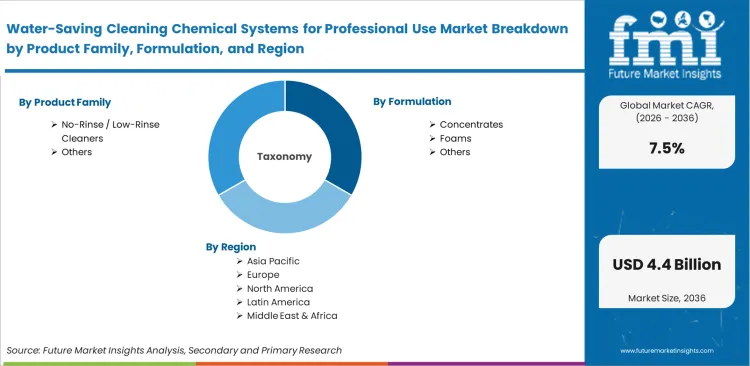
The low-rinse cleaning chemicals market size stood at USD 1.8 billion in 2025. Sales are projected to cross USD 2.0 billion in 2026 at a CAGR of 7.5% during the forecast years. Sustained investment propels cumulative revenue to USD 4.1 billion through 2036 as regional municipalities impose severe utility surcharges on commercial wastewater generation.
Summary of Water-Saving Cleaning Chemical Systems for Professional Use Market
- Market Snapshot
- The water-saving cleaning chemical systems for professional use market is valued at USD 1.86 billion in 2025 and is projected to reach USD 4.10 billion by 2036.
- The market is expected to grow at a 7.5% CAGR from 2026 to 2036, creating an gradual opportunity of USD 2.1 billion.
- This is a professional-use cleaning systems category where rinse reduction, low-moisture application, and controlled dosing matter more than simple bulk chemical consumption.
- Demand is strongest in commercial and institutional environments where water intensity, labor efficiency, and cleaning uptime are increasingly managed together.
- Demand and Growth Drivers
- FMI states that growth is being driven by adoption of no-rinse, low-rinse, and spray-on/wipe-off formats across commercial and institutional settings.
- EPA’s commercial water-conservation guidance recommends alternative cleaning methods that require little or no water for washdowns and suggests switching from wet carpet cleaning to dry methods where practical.
- Industry water-conservation standards indicate that enzyme cleaners effectively break down grease and residue so less water is needed for scrubbing and rinsing floors.
- Green building certification frameworks support this market by mandating conservation goals and strategies that promote conservation of energy, water, and chemicals used for cleaning.
- The category grows faster than the broader professional-cleaning market because it is tied to explicit resource-efficiency upgrades rather than only routine cleaning replacement cycles.
- Product and Segment View
- No-rinse and low-rinse cleaners lead the product family segment, with share expected to reach 34%, reflecting their role in reducing water use during routine cleaning processes.
- Concentrates are widely adopted in water-saving programs due to dilution control and transport efficiency, with the formulation segment projected to account for 36% share.
- Commercial kitchens and foodservice operations represent the largest end-use segment, contributing an estimated 28% share, supported by the need for faster cleaning cycles and reduced rinsing requirements.
- Enzyme-based cleaners are aligned with lower water usage during cleaning, placing the chemistry segment at 26% share in this model.
- Managed accounts and contract-based sourcing keep direct institutional supply dominant, with the channel expected to represent 42% share.
- Geography and Competitive Outlook
- China and Brazil are the fastest-growth markets in the published set, while the USA, UK, and Germany remain strong professional-use markets with solid efficiency-led adoption.
- Key players include Ecolab, Diversey, SC Johnson Professional, Kärcher, 3M, Solenis, Zep, Betco, Spartan Chemical, and Nilfisk. The market is moderately concentrated because the offer increasingly centers on systems, process compatibility, and account support rather than stand-alone commodity SKUs.
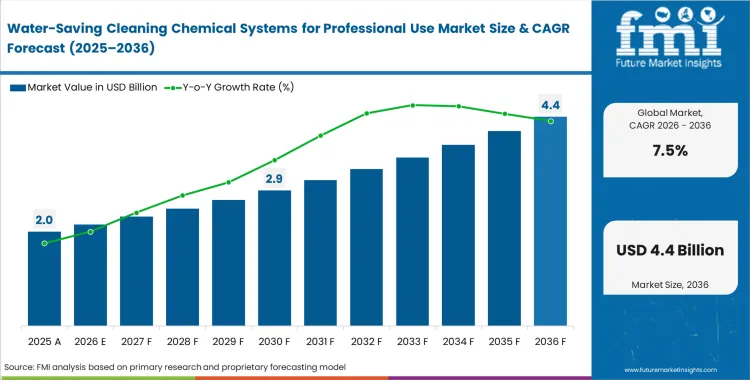
Commercial facilities face pressure balancing elevated sanitation protocols with escalating municipal utility tariffs across their portfolios. Escalating utility tariffs drive the renegotiation of master service agreements, evaluating the professional water-saving cleaning systems market to find solutions that combine broad-spectrum soil removal with single-pass application mechanics. Delaying protocol upgrades exposes commercial operators to severe financial penalties when uncalibrated legacy equipment exceeds allotted monthly utility quotas. Premium brands frequently sacrifice total yield volume to maintain absolute low-rinse chemical performance to maintain absolute low-rinse chemical performance, complicating bulk purchasing strategies for budget-constrained buyers seeking verified water saving cleaning chemicals. Evaluating accurate total cost of ownership models proves critical for scaling operations efficiently.
When regional water authorities mandate utility footprint reductions across all commercial properties, global adoption accelerates rapidly. Equipment lock-in forces franchised building service contractors to align immediately with approved professional cleaning products vendor lists. Standardized dosing equipment eliminates manual dilution errors, drastically reducing total solvent consumption while guaranteeing compliance with strict municipal wastewater discharge regulations governing high-traffic hospitality venues.
China is projected to expand at an estimated CAGR of 8.5% from 2026 to 2036, as state-funded metropolitan infrastructure projects strictly enforce commercial utility consumption limits, while Brazil tracks at 8.3% driven by corporate mandates establishing uniform facility efficiency standards. India advances at 8.0% alongside United States at 7.2% and United Kingdom at 7.2%. Germany scales at 7.1% while Japan registers 6.6%. Structural divergence separates emerging regions building initial scarcity compliance infrastructure from mature economies aggressively pushing absolute zero-waste environmental thresholds.
Segmental Analysis
Water-Saving Cleaning Chemical Systems for Professional Use Market Analysis by Product Family
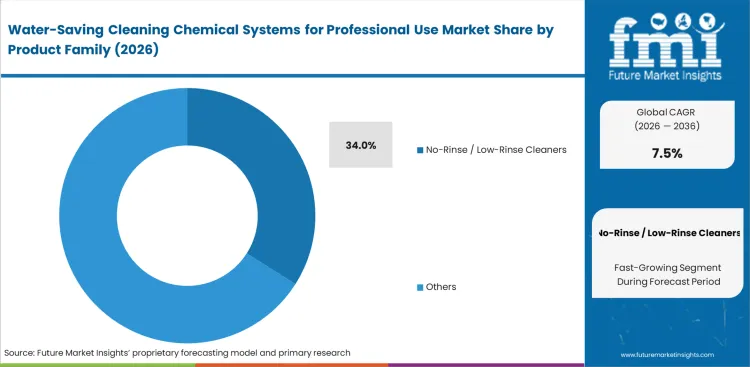
No-rinse / low-rinse cleaners projected to account for 34.0% share in 2026 driven by the continuous deployment of targeted formulations. Night-shift crews rely heavily on fast-acting chemistry within the no-rinse cleaning chemicals market, avoiding the confusion of switching routines between dry zones and traditional wet environments. Establishing correct material compatibility actually determines long-term contract retention, as excess moisture visibly warps synthetic laminate flooring. Formulators increasingly supply highly regulated ready to use rtu cleaning and disinfection chemicals to balance specialized soil removal power with strict building utility regulations. Facilities failing to match the correct chemistry to porous finishes cause irreversible moisture damage, resulting in costly restorative repair bills that negate prior utility cost savings.
- Purchase drives: Sudden municipal utility rate hikes force risk management officers to instantly override existing supply contracts, selecting premium low-moisture formulas immediately.
- Validation protocols: Infection control audits verify pathogen elimination efficacy on standardized test surfaces without violating liquid discharge thresholds.
- Contract renewals: Custodial staff feedback dictates long-term brand survival, as formulations requiring excessive mechanical scrubbing prompt union representatives to block vendor renewals entirely.
Water-Saving Cleaning Chemical Systems for Professional Use Market Analysis by Formulation
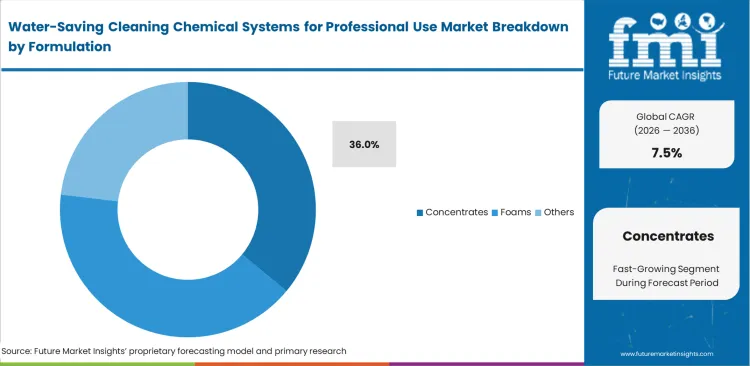
Shipping liquid water across continental supply chains degrades environmental sustainability metrics. Concentrates are estimated to account for 36.0% share in 2026 as site supervisors prioritize logistical efficiency without sacrificing application control. Commercial distributors supply highly regulated super concentrate cleaning chemical networks to offer unparalleled cost control, provided workers follow correct dilution procedures. Employing reliable eco label certified cleaning chemicals for professional users drastically reduces the risk of accidental chemical runoff. Without strictly calibrated dosing systems, custodial staff manually mixing concentrated water-saving cleaners often over-pour, instantly negating both the environmental benefit and the financial utility savings. Operating without proper dispenser calibration inevitably creates massive supply shortages halfway through the month, forcing emergency purchasing at premium retail pricing.
- Operational savings: Eliminating massive fluid transfer requirements significantly reduces specialized plumbing technician fees.
- Unexpected expenditures: Purchasing pre-mixed liquids vastly increases total freight transportation costs over the lifespan of a multi-year institutional contract.
- Lifecycle comparisons: Total cost of ownership metrics prove concentrated low-moisture systems vastly outperform traditional washdown alternatives financially, positioning labor compliance as the primary determinant for successful implementation.
Water-Saving Cleaning Chemical Systems for Professional Use Market Analysis by End-use Environment
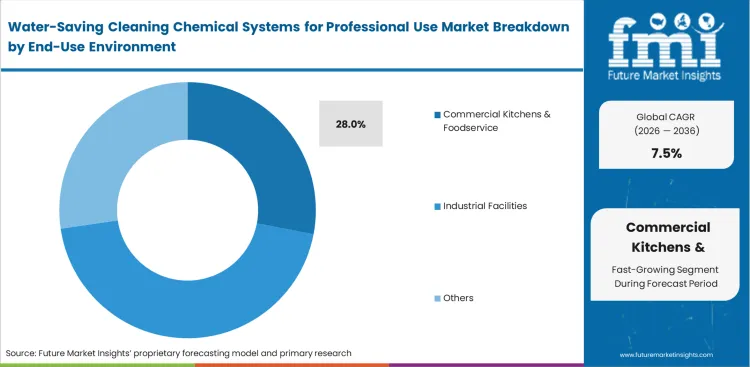
Commercial kitchens & foodservice are anticipated to account for 28.0% share in 2026, propelled directly by property management firms aggressively accumulating LEED points to justify premium rental rates per square foot. Sustainability officers embed specific environmental criteria into all vendor service level agreements, refusing to onboard any janitorial firm utilizing conventional flood-and-mop techniques. Centralized purchasing departments specify exact cleaning chemicals for retail delivery systems to standardize safety across hundreds of regional branches, heavily utilizing water-saving cleaners for commercial kitchens. Specialized air duct cleaning chemicals teams push for compliant dry chemicals not to save the planet, but to secure recognized badges that attract elite multinational tenants. Property owners delaying the transition to low-rinse sanitation chemicals for kitchens watch helplessly as environmentally conscious anchor tenants relocate to newer, fully certified competitive developments nearby.
- Initial implementation: Replacing wet degreasers with mild dry-foam alternatives temporarily slows routine turnaround times while staff adapt to new dwell requirements.
- Hardware friction: Hard water infrastructure severely limits the lathering capability of low-solvent surfactants across legacy plumbing architectures.
- Realized advantages: Eliminating excess floor moisture drastically reduces slip-and-fall liability claims, generating significant measurable declines in facility insurance premiums.
Water-Saving Cleaning Chemical Systems for Professional Use Market Analysis by Chemistry Platform
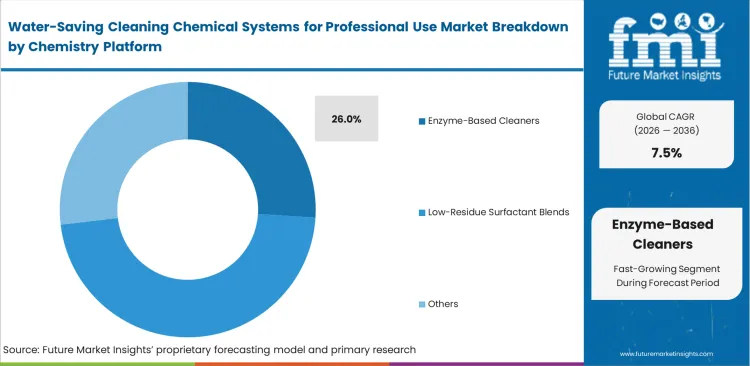
Balancing heavy-duty sanitation against strict utility consumption limits challenges formulators daily. Enzyme-based cleaners capture 26.0% share, offering stable broad-spectrum performance without requiring massive fluid agitation to activate. Contract cleaning managers rely on these biological compounds for routine sanitation, valuing continuous organic digestion cycles that eliminate secondary rinsing entirely. Deploying advanced low voc cleaning chemicals neutralizes active pathogen threats while maintaining safe indoor air quality metrics across enclosed public spaces. Teams incorporating enzyme cleaners for reduced water use experience fewer tenant complaints regarding visible soap scum. Ignoring staff feedback regarding dry-foam application times causes surging employee turnover, multiplying recruitment costs far beyond initial chemical budget limits.
- Performance maximums: Enzyme-based formulas maintain active soil-lifting properties even when applied to heavily trafficked resilient flooring with absolute minimal moisture.
- Temperature constraints: Cold ambient environments severely restrict biological activation speed, forcing operations managers to ensure proper dwell times during winter months.
- Safety thresholds: Regulatory data sheets dictate exact maximum exposure limits, ensuring compliance officers reject any formulation lacking comprehensive toxicity testing documentation.
Water-Saving Cleaning Chemical Systems for Professional Use Market Analysis by Supply Channel
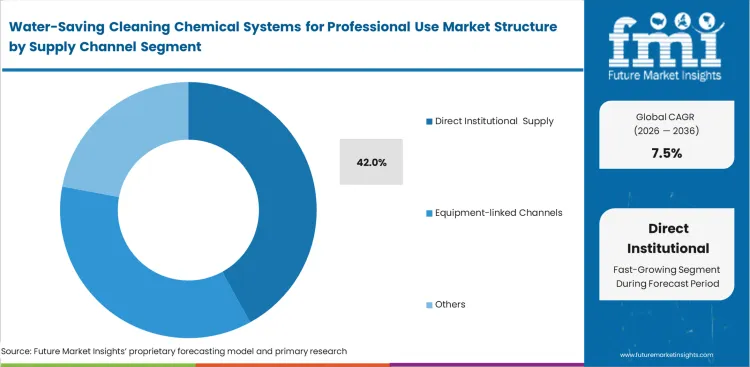
Enterprise control demands centralized distribution architecture for consistent chemical deployment. Direct institutional supply represents 42.0% share, enabling global healthcare and commercial brands to enforce strict low-moisture hygiene standards across thousands of affiliated properties. Supply chain vice presidents negotiate bulk pricing, securing reliable access to specialized dilution control cleaning chemical cartridges worldwide. Relying strictly on centralized hubs leaves remote facilities vulnerable during logistical strikes. Administrators lacking backup regional suppliers face complete operational shutdowns, forcing unacceptable compromises utilizing unauthorized high-fluid retail chemicals that violate internal utility consumption policies.
- Early adopters: Flagship clinical properties pioneer direct supply agreements to guarantee absolute fluid restriction across sensitive electronics wards.
- Mainstream followers: Mid-scale academic institutions adopt centralized purchasing to match premium hygiene standards while simplifying staff training protocols.
- Late converts: Independent public facilities finally abandon local hardware stores when administrators demand hospital-grade low-moisture disinfection proofs.
Water-Saving Cleaning Chemical Systems for Professional Use Market Drivers, Restraints, and Opportunities
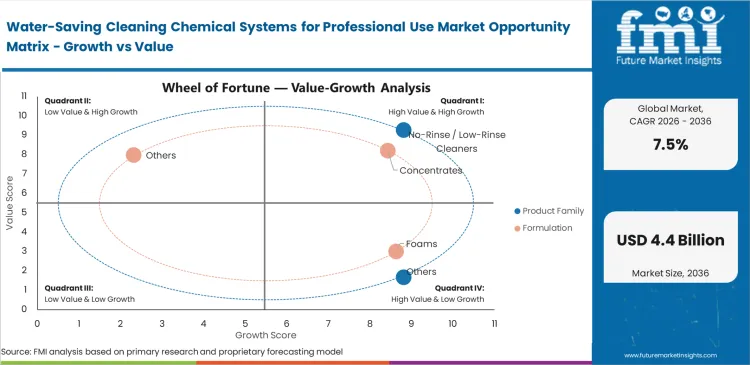
Municipal water-use restrictions are pushing facilities toward low-moisture cleaning methods, particularly in regions facing drought-related limits. Cleaning teams working in these environments avoid products that require multiple rinse cycles, as excess water use creates both compliance and operational challenges. Faster turnaround without residual floor moisture improves safety by reducing slip risks, while also supporting quicker reopening of cleaned areas. Use of concentrated formulations helps lower total water consumption and utility costs, even when unit pricing is higher. In settings such as schools and indoor sports facilities, limiting excess moisture also prevents surface damage during routine maintenance.
Hard water conditions create performance challenges for low-rinse systems. Minerals such as calcium and magnesium interact with cleaning agents, reducing foaming and leaving visible residue when rinsing is minimized. This issue becomes more pronounced in high-visibility areas such as locker rooms and fitness facilities, where surface appearance directly affects user perception. Repeated complaints linked to residue buildup can lead to discontinuation of certain formulations, even when they meet water-saving requirements.
Opportunities
- Biological encapsulation: Living bacterial cultures consume residual organic waste embedded deeply within porous grout lines without requiring secondary washdown procedures, directly supporting green cleaning water conservation.
- Electrostatic application: Specialized spraying equipment engineered to perform effectively with highly concentrated disinfectant chemicals reduces fluid application volumes significantly across massive healthcare properties.
- Probiotic dry maintainers: Utilizing competitive exclusion principles establishes long-lasting biological barriers against opportunistic surface pathogens while entirely bypassing harsh liquid bleaches.
Water-Saving Cleaning Chemical Systems for Professional Use Market Regional Analysis
.webp "Top Country Growth Comparison Water Saving Cleaning Chemical Systems For Professional Use Market Cagr (2026 2036)")
Based on regional analysis, the market is segmented into Asia Pacific, Latin America, North America, and Western Europe across numerous key countries.
| Country | CAGR (2026 to 2036) |
|---|---|
| China | 8.5% |
| Brazil | 8.3% |
| India | 8.0% |
| United States | 7.2% |
| United Kingdom | 7.2% |
| Germany | 7.1% |
| Japan | 6.6% |
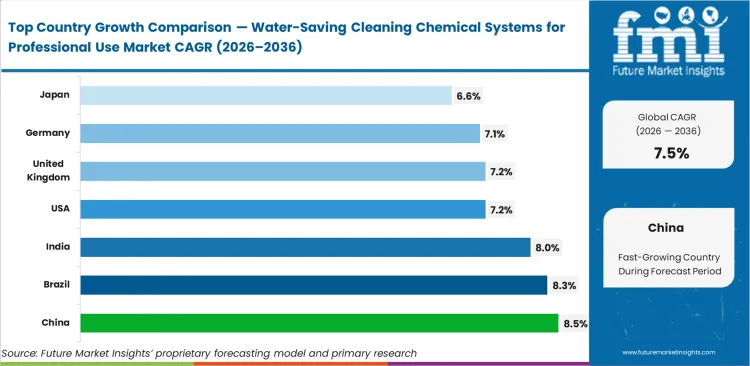
Source: Future Market Insights (FMI) analysis, based on proprietary forecasting model and primary research
Water-Saving Cleaning Chemical Systems for Professional Use Market Asia Pacific Analysis
Centralized government mandates dictate aggressive environmental standards for newly constructed urban commercial zones. Property developers building massive mixed-use districts must secure strict green building permits prior to occupancy, forcing an immediate transition toward low-moisture sanitation chemistry. Procurement officers negotiate bulk contracts covering entire skyscraper portfolios, prioritizing highly concentrated formulas that minimize storage footprint in dense metropolitan hubs. Expanding medical tourism drives demand further, as private hospitals upgrade sanitation protocols to match international accreditation requirements. Sourcing advanced systems for massive cleaning chemicals for airports aligns perfectly with regional municipal regulations targeting excessive commercial wastewater generation.
- China: Urban development policies strictly gate commercial occupancy permits behind rigorous utility conservation credentials. Water-saving cleaning chemicals China adoption in China is set to accelerate at a CAGR of 8.5% by 2036. This is rising as building service contractors transitioning early to certified low-rinse formulas dominate competitive municipal bidding processes across coastal metropolitan zones. Establishing a verified environmental compliance history secures preferred vendor status for highly profitable future state-funded infrastructure projects. Operations directors flatly refuse to risk massive institutional investments by utilizing unverified legacy products requiring fluid volumes.
- India: Rapid expansion of private commercial infrastructure creates massive new requirements for standardized sanitation protocols. Purchasing directors moving away from traditional flood-mop procedures prioritize safer dry-foam chemistries to prevent floor damage. Volume surges as corporate networks standardize procurement across hundreds of regional branches. Expansion is anticipated to register 8.0% CAGR during the forecast as awareness regarding facility utility limits permanently penetrates the commercial property sector.
- Japan: Japan integrates labor constraints with controlled-environment requirements, where the water-saving cleaning chemical systems market advances at a CAGR of 6.6% between 2026 and 2036 as aging workforce conditions reduce tolerance for physically intensive cleaning processes. Demand is concentrated in precision manufacturing and healthcare environments where excess moisture can disrupt operations and damage sensitive equipment. Low-rinse and pre-measured systems reduce both physical strain and contamination risk.
Water-Saving Cleaning Chemical Systems for Professional Use Market Latin America Analysis
Multinational corporate mandates establish uniform facility hygiene standards across all regional operations, successfully bypassing much slower municipal regulatory timelines. International networks entering the territory absolutely refuse to compromise their deeply established low-utility clinical protocols, forcing local janitorial distributors to immediately overhaul their entire institutional chemical inventory. Facility managers operating within premium commercial real estate sectors constantly balance pathogen control against preserving delicate interior architectural finishes, utilizing advanced systems that leave zero standing fluid behind after application. Eliminating heavy mop buckets drastically reduces custodial staff physical injuries, effectively solving chronic absenteeism problems currently plaguing regional contract cleaning firms. Incorporating specialized green floor care systems entirely removes hazardous wastewater pooling from enclosed maintenance bays.
- Brazil: Brazil reflects this shift, where the water-saving cleaning chemical systems market is expected to grow at a CAGR of 8.3% from 2026 to 2036 as multinational occupancy requirements prioritize strict control over facility-level water consumption. Adoption of low-moisture systems improves asset efficiency while reducing operational risks linked to excess wastewater generation.
Water-Saving Cleaning Chemical Systems for Professional Use Market North America Analysis
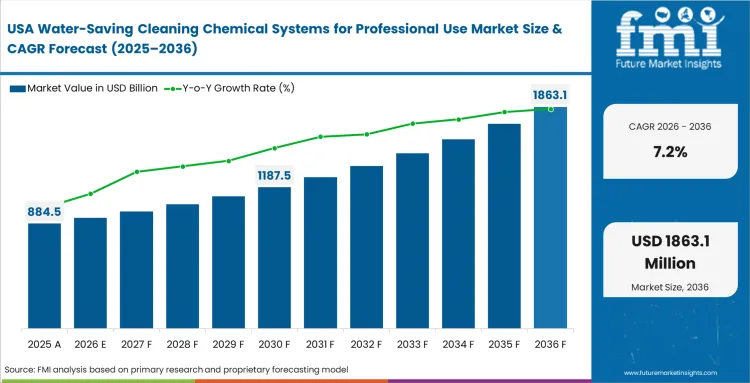
Strict occupational health guidelines structurally encode low-moisture requirements directly into vast government service contracts across the entire continent. State-level facility directors face automatic budget penalties if their custodial supply manifests contain high-volume conventional washdown chemicals. Private sector property management firms actively mimic these federal guidelines, attempting to align their commercial portfolios with recognized green building certifications to attract elite multinational tenants. Educational districts phase out legacy flood-and-extract carpet routines, responding directly to intense pressure from parent advocacy groups demanding zero-mold learning environments. Employing highly regulated fragrance free cleaning chemicals safely sanitizes confined spaces without leaving residual moisture that promotes fungal growth.
- United States: Corporate real estate trusts mandate certified protocols to satisfy escalating environmental reporting demands from demanding institutional investors. Water-saving cleaning chemicals USA volume outpaces historical averages as vice presidents secure premium rental rates by marketing buildings as fully compliant green environments lacking excessive utility consumption. Industry is predicted to rise at a CAGR of 7.2% by 2036 as low-moisture chemistry becomes the undisputed national standard. Mastering complex municipal water compliance documentation allows distributors to deeply entrench themselves within regional commercial supply chains, preventing agile startups from gaining market share. Resolving slip-and-fall liabilities immediately reduces legal costs tied to wet-floor claims.
Water-Saving Cleaning Chemical Systems for Professional Use Market Western Europe Analysis
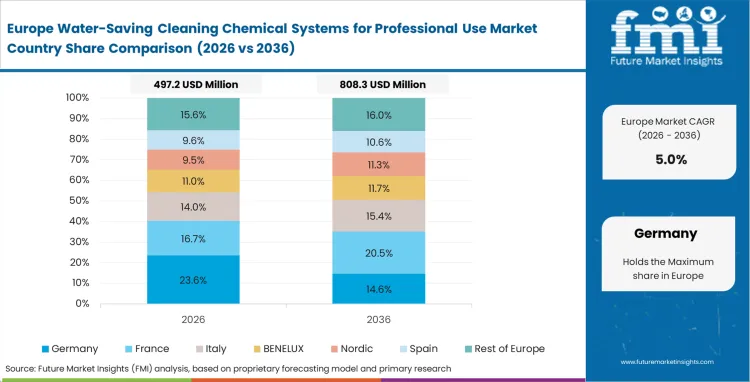
Overarching regulatory frameworks systematically eliminate hazardous and highly wasteful chemicals from institutional supply chains across the entire continent. Sustainability directors for massive healthcare networks actively overhaul infection control protocols, seeking verified solutions that never compromise stringent environmental emission limits or require massive freshwater resources. Cross-border facility management firms quickly consolidate their supplier bases, deliberately choosing manufacturers capable of delivering identically certified formulas across multiple jurisdictions to guarantee absolute legal compliance. Sourcing green cleaning chemicals for industrial maintenance acts as an absolute baseline necessity for commercial survival when participating in highly competitive civic maintenance tenders.
- United Kingdom: The United Kingdom combines cost pressure with regulatory enforcement, where the water-saving cleaning chemical systems market is expected to grow at a CAGR of 7.2% from 2026 to 2036 as local authorities shift toward systems that reduce both water usage and logistics overhead.
- Germany: Germany integrates water regulation directly into facility operations, with the market advancing at a CAGR of 7.1% through 2036 as wastewater penalties and usage caps eliminate high-consumption cleaning practices. Early adoption of low-rinse systems reduces compliance risk while maintaining operational continuity.
Water-Saving Cleaning Chemical Systems for Professional Use Market Competitive Aligners
Chemical manufacturers dominating institutional sanitation embed themselves deeply into facility operations, moving far beyond basic material supply. Financial controllers exploring alternative water-saving cleaning chemical suppliers must carefully calculate the costs of removing existing dry-foam dispensers, retraining entire custodial fleets, and navigating temporary operational disruptions. These formidable transition expenses effectively secure highly lucrative, decade-long agreements covering intense floor cleaning detergent and care chemicals programs. Water-saving floor cleaning chemicals anchor these massive enterprise contracts.
Large property management firms resist this equipment lock-in by specifying open-source dispensing hardware across their real estate portfolios. Administrators increasingly demand wall-mounted dilution stations capable of accepting generic concentrate cartridges, allowing them to instantly switch no-rinse cleaner manufacturers for commercial use if pricing escalates unexpectedly. Formulators capable of delivering massive volumes of highly concentrated restroom cleaning chemicals secure secondary institutional accounts effortlessly. Utilizing specialized water-saving restroom cleaners alongside hospitality water-saving cleaning chemicals solidifies vendor dominance across diverse portfolios.
Innovation across the commercial chemical sector focuses heavily on eliminating the high-volume water agents historically required for resilient tile maintenance. Bidding on government tenders without exact environmental validations guarantees automatic disqualification, forcing chemical formulators to align their entire product catalogs with strict federal purchasing guidelines. Supplying comprehensive commercial laundry detergent systems alongside advanced low-moisture floor systems allows manufacturers to secure complete facility maintenance contracts.
Key Players in Water-Saving Cleaning Chemical Systems for Professional Use Market
- Ecolab
- Diversey
- SC Johnson Professional
- Kärcher (chemicals)
- 3M
- Solenis
- Zep
Scope of the Report
| Metric | Value |
|---|---|
| Quantitative Units | USD 2.00 billion to USD 4.10 billion, at a CAGR of 7.5% |
| Market Definition | Institutional-grade sanitation agents formulated specifically to minimize or eliminate required rinsing phases. |
| Segmentation | Product Family, Formulation, End-use Environment, Chemistry Platform, Supply Channel |
| Regions Covered | North America, Latin America, Western Europe, Eastern Europe, Asia Pacific, Middle East and Africa |
| Countries Covered | United States, Canada, Brazil, Mexico, Germany, United Kingdom, France, Spain, Italy, Russia, China, Japan, India, South Korea, Australia, Saudi Arabia, United Arab Emirates, South Africa |
| Key Companies Profiled | Ecolab, Diversey, SC Johnson Professional, Kärcher (chemicals), 3M, Solenis, Zep |
| Forecast Period | 2026 to 2036 |
| Approach | Commercial building square footage mapped against baseline floor chemical consumption rates adjusted for zero-rinse application procedures. |
Source: Future Market Insights (FMI) analysis, based on proprietary forecasting model and primary research
Key Segments
Product Family
- No-rinse / low-rinse cleaners
- Spray-on / wipe-off systems
- Foaming cleaners with reduced water use
- Concentrated dilution-control systems
- Dry-clean / low-moisture specialty systems
Formulation
- Concentrates
- Ready-to-use liquids
- Foams
- Pods / cartridges
- Powders / low-moisture formats
End-use Environment
- Commercial kitchens & foodservice
- Institutional buildings
- Industrial facilities
- Healthcare support spaces
- Hospitality operations
Chemistry Platform
- Enzyme-based cleaners
- Low-residue surfactant blends
- Peroxide-based systems
- Alkaline low-rinse systems
- Neutral cleaners
Supply Channel
- Direct institutional supply
- Jan-san distributors
- Facility service contractors
- Equipment-linked channels
- Online / catalog procurement
Region
- North America
- Latin America
- Western Europe
- Eastern Europe
- Asia Pacific
- Middle East and Africa
Bibliography
- Environmental Protection Agency. (2025, November 25). Lean & water toolkit: Chapter 4. (US EPA)
- Green Seal. (2024). GS-42: Commercial and institutional cleaning services (Ed. 2.3). (Green Seal)
- Environmental Protection Agency. (2024, March 2). WaterSense at Work Section 7.4: Glassware washers. (US EPA)
- Massachusetts Executive Office of Energy and Environmental Affairs. (2026). Industrial, commercial & institutional water conservation.
- USA Green Building Council. (2025). LEED v5.
This bibliography is provided for reader reference. The full FMI report contains the complete reference list with primary source documentation.
Frequently Asked Questions
How big is the water-saving cleaning chemicals market?
The valuation stood at USD 1.8 billion in 2025. Projections indicate total sales will cross USD 2.0 billion in 2026, steadily advancing to reach USD 4.1 billion by 2036.
What is the water-saving cleaning chemicals CAGR?
The sector is expected to expand at a 7.5% compound annual growth rate through 2036 as regional municipalities impose severe utility surcharges on commercial wastewater generation.
Why are no-rinse cleaners growing in professional cleaning?
Eliminating heavy mop bucket lifting noticeably reduces daily custodial staff physical injuries. Faster room turnover without residual floor moisture directly improves occupant safety, making single-pass dry sanitation an absolute operational necessity.
Which sectors use water-saving cleaning chemicals most?
Commercial kitchens and foodservice operations capture 28.0% share. Sustainability officers embed utility reduction mandates directly into service level agreements to mitigate slip-and-fall hazards across greasy back-of-house operational zones.
How to choose low-water cleaning systems?
Evaluating the ROI of no-rinse cleaners in professional facilities requires auditing a supplier's ability to provide tamper-proof dilution controls. Administrators prioritize formulations that balance effective heavy-duty soil removal against strict municipal wastewater discharge limits.
Evaluating no-rinse vs low-rinse cleaners, what is the operational difference? No-rinse formulations utilize rapid-evaporation chemistry that leaves zero residue, ideal for sensitive laminates. Low-rinse systems require a single damp wipe to remove emulsified soils, typically deployed across heavy-traffic resilient flooring.
No-rinse formulations utilize rapid-evaporation chemistry that leaves zero residue, ideal for sensitive laminates. Low-rinse systems require a single damp wipe to remove emulsified soils, typically deployed across heavy-traffic resilient flooring.
When comparing concentrate vs RTU water-saving cleaners, which is preferred?
Healthcare and educational facilities prioritize immediate logistical efficiency across sprawling campuses, leaning heavily toward concentrates. Concentrated economics directly override the convenience factor associated with pre-mixed spray bottles.
Who are the top water-saving cleaning chemical companies?
Ecolab holds significant share, alongside Diversey, SC Johnson Professional, and Kärcher. Manufacturers install proprietary, cloud-connected dilution equipment directly into commercial plumbing systems to secure long-term enterprise contracts.
What creates hidden costs for concentrate dosing systems?
Complex venturi mixing valves require specialized technicians for routine recalibration. Administrators absorb unexpected repair expenses whenever localized hard water compromises internal mechanical components. Uncalibrated equipment silently wastes expensive active ingredients, inflating quarterly supply budgets.
How do multi-certified products complicate daily operations?
Meeting overlapping chemical restrictions across three different standards compromises heavy soil removal capabilities. Custodial supervisors discover that heavily restricted surfactants fail to dissolve grease efficiently without hot water. Cleaning staff must apply excessive physical scrubbing, causing labor costs to soar.
Preview the report firsthand - request a free sample
Get SampleGet the brochure for pricing and purchase details.
Get PDFTable of Content
- Executive Summary
- Global Market Outlook
- Demand-side Trends
- Supply-side Trends
- Technology Roadmap Analysis
- Analysis and Recommendations
- Market Overview
- Market Coverage / Taxonomy
- Market Definition / Scope / Limitations
- Research Methodology
- Chapter Orientation
- Analytical Lens and Working Hypotheses
- Market Structure, Signals, and Trend Drivers
- Benchmarking and Cross-market Comparability
- Market Sizing, Forecasting, and Opportunity Mapping
- Research Design and Evidence Framework
- Desk Research Programme (Secondary Evidence)
- Company Annual and Sustainability Reports
- Peer-reviewed Journals and Academic Literature
- Corporate Websites, Product Literature, and Technical Notes
- Earnings Decks and Investor Briefings
- Statutory Filings and Regulatory Disclosures
- Technical White Papers and Standards Notes
- Trade Journals, Industry Magazines, and Analyst Briefs
- Conference Proceedings, Webinars, and Seminar Materials
- Government Statistics Portals and Public Data Releases
- Press Releases and Reputable Media Coverage
- Specialist Newsletters and Curated Briefings
- Sector Databases and Reference Repositories
- FMI Internal Proprietary Databases and Historical Market Datasets
- Subscription Datasets and Paid Sources
- Social Channels, Communities, and Digital Listening Inputs
- Additional Desk Sources
- Expert Input and Fieldwork (Primary Evidence)
- Primary Modes
- Qualitative Interviews and Expert Elicitation
- Quantitative Surveys and Structured Data Capture
- Blended Approach
- Why Primary Evidence is Used
- Field Techniques
- Interviews
- Surveys
- Focus Groups
- Observational and In-context Research
- Social and Community Interactions
- Stakeholder Universe Engaged
- C-suite Leaders
- Board Members
- Presidents and Vice Presidents
- R&D and Innovation Heads
- Technical Specialists
- Domain Subject-matter Experts
- Scientists
- Physicians and Other Healthcare Professionals
- Governance, Ethics, and Data Stewardship
- Research Ethics
- Data Integrity and Handling
- Primary Modes
- Tooling, Models, and Reference Databases
- Desk Research Programme (Secondary Evidence)
- Data Engineering and Model Build
- Data Acquisition and Ingestion
- Cleaning, Normalisation, and Verification
- Synthesis, Triangulation, and Analysis
- Quality Assurance and Audit Trail
- Market Background
- Market Dynamics
- Drivers
- Restraints
- Opportunity
- Trends
- Scenario Forecast
- Demand in Optimistic Scenario
- Demand in Likely Scenario
- Demand in Conservative Scenario
- Opportunity Map Analysis
- Product Life Cycle Analysis
- Supply Chain Analysis
- Investment Feasibility Matrix
- Value Chain Analysis
- PESTLE and Porter’s Analysis
- Regulatory Landscape
- Regional Parent Market Outlook
- Production and Consumption Statistics
- Import and Export Statistics
- Market Dynamics
- Global Market Analysis 2021 to 2025 and Forecast, 2026 to 2036
- Historical Market Size Value (USD Million) Analysis, 2021 to 2025
- Current and Future Market Size Value (USD Million) Projections, 2026 to 2036
- Y-o-Y Growth Trend Analysis
- Absolute $ Opportunity Analysis
- Global Market Pricing Analysis 2021 to 2025 and Forecast 2026 to 2036
- Global Market Analysis 2021 to 2025 and Forecast 2026 to 2036, By Product Family
- Introduction / Key Findings
- Historical Market Size Value (USD Million) Analysis By Product Family , 2021 to 2025
- Current and Future Market Size Value (USD Million) Analysis and Forecast By Product Family , 2026 to 2036
- No-Rinse / Low-Rinse Cleaners
- Others
- No-Rinse / Low-Rinse Cleaners
- Y-o-Y Growth Trend Analysis By Product Family , 2021 to 2025
- Absolute $ Opportunity Analysis By Product Family , 2026 to 2036
- Global Market Analysis 2021 to 2025 and Forecast 2026 to 2036, By Formulation
- Introduction / Key Findings
- Historical Market Size Value (USD Million) Analysis By Formulation, 2021 to 2025
- Current and Future Market Size Value (USD Million) Analysis and Forecast By Formulation, 2026 to 2036
- Concentrates
- Foams
- Others
- Concentrates
- Y-o-Y Growth Trend Analysis By Formulation, 2021 to 2025
- Absolute $ Opportunity Analysis By Formulation, 2026 to 2036
- Global Market Analysis 2021 to 2025 and Forecast 2026 to 2036, By End-Use Environment
- Introduction / Key Findings
- Historical Market Size Value (USD Million) Analysis By End-Use Environment, 2021 to 2025
- Current and Future Market Size Value (USD Million) Analysis and Forecast By End-Use Environment, 2026 to 2036
- Commercial Kitchens & Foodservice
- Industrial Facilities
- Others
- Commercial Kitchens & Foodservice
- Y-o-Y Growth Trend Analysis By End-Use Environment, 2021 to 2025
- Absolute $ Opportunity Analysis By End-Use Environment, 2026 to 2036
- Global Market Analysis 2021 to 2025 and Forecast 2026 to 2036, By Chemistry Platform
- Introduction / Key Findings
- Historical Market Size Value (USD Million) Analysis By Chemistry Platform, 2021 to 2025
- Current and Future Market Size Value (USD Million) Analysis and Forecast By Chemistry Platform, 2026 to 2036
- Enzyme-Based Cleaners
- Low-Residue Surfactant Blends
- Others
- Enzyme-Based Cleaners
- Y-o-Y Growth Trend Analysis By Chemistry Platform, 2021 to 2025
- Absolute $ Opportunity Analysis By Chemistry Platform, 2026 to 2036
- Global Market Analysis 2021 to 2025 and Forecast 2026 to 2036, By Supply Channel
- Introduction / Key Findings
- Historical Market Size Value (USD Million) Analysis By Supply Channel, 2021 to 2025
- Current and Future Market Size Value (USD Million) Analysis and Forecast By Supply Channel, 2026 to 2036
- Direct Institutional Supply
- Equipment-linked Channels
- Others
- Direct Institutional Supply
- Y-o-Y Growth Trend Analysis By Supply Channel, 2021 to 2025
- Absolute $ Opportunity Analysis By Supply Channel, 2026 to 2036
- Global Market Analysis 2021 to 2025 and Forecast 2026 to 2036, By Region
- Introduction
- Historical Market Size Value (USD Million) Analysis By Region, 2021 to 2025
- Current Market Size Value (USD Million) Analysis and Forecast By Region, 2026 to 2036
- North America
- Latin America
- Western Europe
- Eastern Europe
- East Asia
- South Asia and Pacific
- Middle East & Africa
- Market Attractiveness Analysis By Region
- North America Market Analysis 2021 to 2025 and Forecast 2026 to 2036, By Country
- Historical Market Size Value (USD Million) Trend Analysis By Market Taxonomy, 2021 to 2025
- Market Size Value (USD Million) Forecast By Market Taxonomy, 2026 to 2036
- By Country
- USA
- Canada
- Mexico
- By Product Family
- By Formulation
- By End-Use Environment
- By Chemistry Platform
- By Supply Channel
- By Country
- Market Attractiveness Analysis
- By Country
- By Product Family
- By Formulation
- By End-Use Environment
- By Chemistry Platform
- By Supply Channel
- Key Takeaways
- Latin America Market Analysis 2021 to 2025 and Forecast 2026 to 2036, By Country
- Historical Market Size Value (USD Million) Trend Analysis By Market Taxonomy, 2021 to 2025
- Market Size Value (USD Million) Forecast By Market Taxonomy, 2026 to 2036
- By Country
- Brazil
- Chile
- Rest of Latin America
- By Product Family
- By Formulation
- By End-Use Environment
- By Chemistry Platform
- By Supply Channel
- By Country
- Market Attractiveness Analysis
- By Country
- By Product Family
- By Formulation
- By End-Use Environment
- By Chemistry Platform
- By Supply Channel
- Key Takeaways
- Western Europe Market Analysis 2021 to 2025 and Forecast 2026 to 2036, By Country
- Historical Market Size Value (USD Million) Trend Analysis By Market Taxonomy, 2021 to 2025
- Market Size Value (USD Million) Forecast By Market Taxonomy, 2026 to 2036
- By Country
- Germany
- UK
- Italy
- Spain
- France
- Nordic
- BENELUX
- Rest of Western Europe
- By Product Family
- By Formulation
- By End-Use Environment
- By Chemistry Platform
- By Supply Channel
- By Country
- Market Attractiveness Analysis
- By Country
- By Product Family
- By Formulation
- By End-Use Environment
- By Chemistry Platform
- By Supply Channel
- Key Takeaways
- Eastern Europe Market Analysis 2021 to 2025 and Forecast 2026 to 2036, By Country
- Historical Market Size Value (USD Million) Trend Analysis By Market Taxonomy, 2021 to 2025
- Market Size Value (USD Million) Forecast By Market Taxonomy, 2026 to 2036
- By Country
- Russia
- Poland
- Hungary
- Balkan & Baltic
- Rest of Eastern Europe
- By Product Family
- By Formulation
- By End-Use Environment
- By Chemistry Platform
- By Supply Channel
- By Country
- Market Attractiveness Analysis
- By Country
- By Product Family
- By Formulation
- By End-Use Environment
- By Chemistry Platform
- By Supply Channel
- Key Takeaways
- East Asia Market Analysis 2021 to 2025 and Forecast 2026 to 2036, By Country
- Historical Market Size Value (USD Million) Trend Analysis By Market Taxonomy, 2021 to 2025
- Market Size Value (USD Million) Forecast By Market Taxonomy, 2026 to 2036
- By Country
- China
- Japan
- South Korea
- By Product Family
- By Formulation
- By End-Use Environment
- By Chemistry Platform
- By Supply Channel
- By Country
- Market Attractiveness Analysis
- By Country
- By Product Family
- By Formulation
- By End-Use Environment
- By Chemistry Platform
- By Supply Channel
- Key Takeaways
- South Asia and Pacific Market Analysis 2021 to 2025 and Forecast 2026 to 2036, By Country
- Historical Market Size Value (USD Million) Trend Analysis By Market Taxonomy, 2021 to 2025
- Market Size Value (USD Million) Forecast By Market Taxonomy, 2026 to 2036
- By Country
- India
- ASEAN
- Australia & New Zealand
- Rest of South Asia and Pacific
- By Product Family
- By Formulation
- By End-Use Environment
- By Chemistry Platform
- By Supply Channel
- By Country
- Market Attractiveness Analysis
- By Country
- By Product Family
- By Formulation
- By End-Use Environment
- By Chemistry Platform
- By Supply Channel
- Key Takeaways
- Middle East & Africa Market Analysis 2021 to 2025 and Forecast 2026 to 2036, By Country
- Historical Market Size Value (USD Million) Trend Analysis By Market Taxonomy, 2021 to 2025
- Market Size Value (USD Million) Forecast By Market Taxonomy, 2026 to 2036
- By Country
- Kingdom of Saudi Arabia
- Other GCC Countries
- Turkiye
- South Africa
- Other African Union
- Rest of Middle East & Africa
- By Product Family
- By Formulation
- By End-Use Environment
- By Chemistry Platform
- By Supply Channel
- By Country
- Market Attractiveness Analysis
- By Country
- By Product Family
- By Formulation
- By End-Use Environment
- By Chemistry Platform
- By Supply Channel
- Key Takeaways
- Key Countries Market Analysis
- USA
- Pricing Analysis
- Market Share Analysis, 2025
- By Product Family
- By Formulation
- By End-Use Environment
- By Chemistry Platform
- By Supply Channel
- Canada
- Pricing Analysis
- Market Share Analysis, 2025
- By Product Family
- By Formulation
- By End-Use Environment
- By Chemistry Platform
- By Supply Channel
- Mexico
- Pricing Analysis
- Market Share Analysis, 2025
- By Product Family
- By Formulation
- By End-Use Environment
- By Chemistry Platform
- By Supply Channel
- Brazil
- Pricing Analysis
- Market Share Analysis, 2025
- By Product Family
- By Formulation
- By End-Use Environment
- By Chemistry Platform
- By Supply Channel
- Chile
- Pricing Analysis
- Market Share Analysis, 2025
- By Product Family
- By Formulation
- By End-Use Environment
- By Chemistry Platform
- By Supply Channel
- Germany
- Pricing Analysis
- Market Share Analysis, 2025
- By Product Family
- By Formulation
- By End-Use Environment
- By Chemistry Platform
- By Supply Channel
- UK
- Pricing Analysis
- Market Share Analysis, 2025
- By Product Family
- By Formulation
- By End-Use Environment
- By Chemistry Platform
- By Supply Channel
- Italy
- Pricing Analysis
- Market Share Analysis, 2025
- By Product Family
- By Formulation
- By End-Use Environment
- By Chemistry Platform
- By Supply Channel
- Spain
- Pricing Analysis
- Market Share Analysis, 2025
- By Product Family
- By Formulation
- By End-Use Environment
- By Chemistry Platform
- By Supply Channel
- France
- Pricing Analysis
- Market Share Analysis, 2025
- By Product Family
- By Formulation
- By End-Use Environment
- By Chemistry Platform
- By Supply Channel
- India
- Pricing Analysis
- Market Share Analysis, 2025
- By Product Family
- By Formulation
- By End-Use Environment
- By Chemistry Platform
- By Supply Channel
- ASEAN
- Pricing Analysis
- Market Share Analysis, 2025
- By Product Family
- By Formulation
- By End-Use Environment
- By Chemistry Platform
- By Supply Channel
- Australia & New Zealand
- Pricing Analysis
- Market Share Analysis, 2025
- By Product Family
- By Formulation
- By End-Use Environment
- By Chemistry Platform
- By Supply Channel
- China
- Pricing Analysis
- Market Share Analysis, 2025
- By Product Family
- By Formulation
- By End-Use Environment
- By Chemistry Platform
- By Supply Channel
- Japan
- Pricing Analysis
- Market Share Analysis, 2025
- By Product Family
- By Formulation
- By End-Use Environment
- By Chemistry Platform
- By Supply Channel
- South Korea
- Pricing Analysis
- Market Share Analysis, 2025
- By Product Family
- By Formulation
- By End-Use Environment
- By Chemistry Platform
- By Supply Channel
- Russia
- Pricing Analysis
- Market Share Analysis, 2025
- By Product Family
- By Formulation
- By End-Use Environment
- By Chemistry Platform
- By Supply Channel
- Poland
- Pricing Analysis
- Market Share Analysis, 2025
- By Product Family
- By Formulation
- By End-Use Environment
- By Chemistry Platform
- By Supply Channel
- Hungary
- Pricing Analysis
- Market Share Analysis, 2025
- By Product Family
- By Formulation
- By End-Use Environment
- By Chemistry Platform
- By Supply Channel
- Kingdom of Saudi Arabia
- Pricing Analysis
- Market Share Analysis, 2025
- By Product Family
- By Formulation
- By End-Use Environment
- By Chemistry Platform
- By Supply Channel
- Turkiye
- Pricing Analysis
- Market Share Analysis, 2025
- By Product Family
- By Formulation
- By End-Use Environment
- By Chemistry Platform
- By Supply Channel
- South Africa
- Pricing Analysis
- Market Share Analysis, 2025
- By Product Family
- By Formulation
- By End-Use Environment
- By Chemistry Platform
- By Supply Channel
- USA
- Market Structure Analysis
- Competition Dashboard
- Competition Benchmarking
- Market Share Analysis of Top Players
- By Region
- By Product Family
- By Formulation
- By End-Use Environment
- By Chemistry Platform
- By Supply Channel
- Competition Analysis
- Competition Deep Dive
- Ecolab
- Overview
- Product Portfolio
- Profitability by Market Segments (Product/Age /Sales Channel/Region)
- Sales Footprint
- Strategy Overview
- Marketing Strategy
- Product Strategy
- Channel Strategy
- Diversey
- SC Johnson Professional
- Kärcher (chemicals)
- 3M
- Solenis
- Zep
- Ecolab
- Competition Deep Dive
- Assumptions & Acronyms Used


