

- Industry Size (2026)
- USD 6.4 Bn
- Forecast (2036)
- USD 9.9 Bn
- CAGR (2026 to 2036)
- 4.5%
Commercial Laundry Detergent Market Forecast and Outlook 2026 to 2036
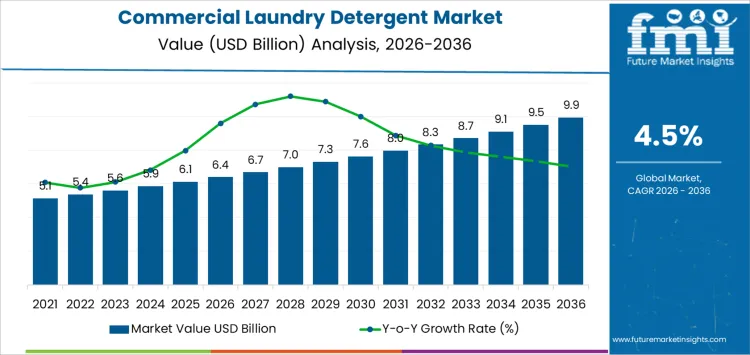
The global commercial laundry detergent market is set to grow steadily, driven by rising demand for effective and efficient cleaning solutions across industries like hospitality, healthcare, and retail. In 2026, the market is valued at USD 6.4 billion and is expected to reach USD 9.9 billion by 20356, with a forecasted CAGR of 4.5%. Liquid detergents hold the largest share at 46%, due to their superior stain removal, ease of use, and suitability for high-efficiency machines. The hospitality and linen services sector, with a 34% market share, leads the demand due to the large volumes of linens, towels, and uniforms requiring regular, high-quality cleaning
Quick Stats for Commercial Laundry Detergent Market
- Commercial Laundry Detergent Market Value (2026): USD 6.4 billion
- Commercial Laundry Detergent Market Forecast Value (2036): USD 9.9 billion
- Commercial Laundry Detergent Market Forecast CAGR: 4.5%
- Leading Detergent Type in Commercial Laundry Detergent Market: Liquid Detergents
- Key Growth Regions in Commercial Laundry Detergent Market: Asia Pacific and North America
- Top Players in Commercial Laundry Detergent Market: Ecolab, Diversey, Henkel, Procter & Gamble Professional, Unilever Professional, Kao Corporation, Reckitt, Zep, Spartan Chemical, Betco
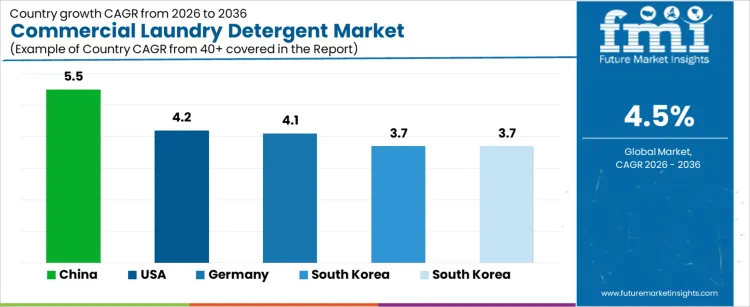
China leads the market with a 5.5% CAGR, driven by rapid urbanization, industrial expansion, and increasing demand in hospitality, healthcare, and retail sectors. Brazil and South Korea show steady growth at 3.7%, supported by rising commercial laundry needs. The USA and Germany also experience moderate growth at 4.2% and 4.1%, respectively, with strong adoption in healthcare, foodservice, and hospitality industries. As sustainability trends continue, the demand for eco-conscious, high-performance detergents is expected to drive further market expansion globally.
Commercial Laundry Detergent Market Key Takeaways
| Metric | Value |
|---|---|
| Industry Value (2026) | USD 6.4 billion |
| Forecast Value (2036) | USD 9.9 billion |
| Forecast CAGR (2026–2036) | 4.5% |
How is the Global Commercial Laundry Detergent Sector Taking Shape Across Cleaning and Maintenance Solutions?
Global commercial laundry detergent market is growing steadily, driven by the increasing demand for efficient and effective cleaning solutions in industries such as hospitality, healthcare, and retail. These sectors require high-performance detergents to handle large volumes of laundry while ensuring the removal of stains, odors, and bacteria. Initially, laundry detergents were focused on providing basic cleaning functions, but with the rising emphasis on hygiene and fabric care, formulations have evolved to offer enhanced stain removal, odor control, and fabric protection.
Industry for commercial laundry detergents will continue to expand, supported by innovations in detergent formulations that meet sustainability and performance demands. The growing trend toward eco-friendly and energy-efficient products will push manufacturers to develop detergents that are both effective and gentle on the environment. Shift towards more concentrated formulations will reduce the environmental impact of packaging and transportation. Challenges such as the rising cost of raw materials, increased regulatory scrutiny, and the need for products to meet diverse consumer preferences will shape the market's growth trajectory. As industries increasingly prioritize sustainability and cost-efficiency, commercial laundry detergents will play a key role in maintaining high cleanliness standards across various sectors.
What Is the Segment-Wise Analysis for the Global Commercial Laundry Detergent Market?
The global commercial laundry detergent market is driven by detergent types and end-use laundry sectors. Liquid detergents lead with a 46% share, due to their ease of use, superior stain removal, and effectiveness in both commercial and industrial laundry settings. Other popular detergent types include powder detergents, single-dose packs, and various specialized formulations. In terms of end-use sectors, hospitality & linen services account for 34% of the market, driven by the high volume of laundry in hotels, resorts, and linen rental services.
Why Do Liquid Detergents Lead the Global Commercial Laundry Detergent Market?
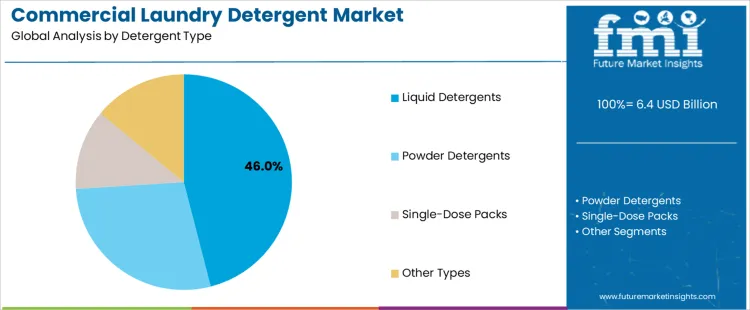
Liquid detergents hold a 46% share of the global commercial laundry detergent market due to their effectiveness in tackling a wide range of stains and soils, making them ideal for use in high-volume laundry settings. These detergents dissolve quickly, ensuring better cleaning performance at lower temperatures compared to powders. Their ability to be used in both high-efficiency machines and traditional machines further boosts their popularity. Liquid detergents are particularly favored in commercial environments like hotels, hospitals, and industrial laundry services where efficiency and effectiveness are crucial. Their easy application, quick dissolution, and excellent stain-fighting power continue to make liquid detergents the leading choice in the commercial laundry market.
Why Does the Hospitality & Linen Services Sector Hold the Largest Share in the Global Commercial Laundry Detergent Market?
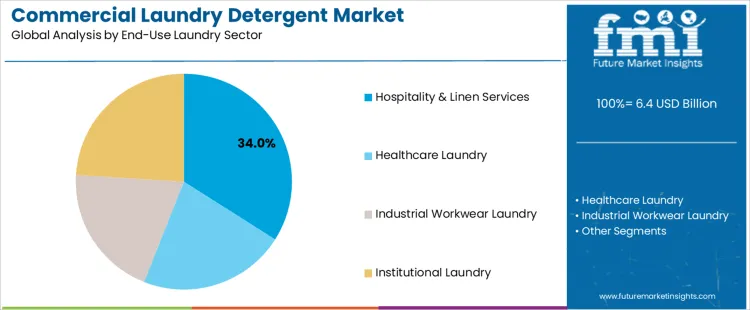
The hospitality & linen services sector accounts for 34% of the global commercial laundry detergent market, driven by the high demand for regular laundry cleaning in hotels, resorts, and linen rental businesses. These services handle large volumes of linens, towels, bedding, and uniforms, which require consistent, high-quality cleaning products to maintain cleanliness and hygiene standards. As the demand for efficient, stain-resistant, and fresh-smelling laundry products rises, liquid detergents and other specialized detergents are increasingly used to meet these needs. The sector's continued growth, alongside its focus on maintaining high standards for guests and clients, ensures its dominant position in the commercial laundry detergent market.
What is Shaping the Commercial Laundry Detergent Market?
The commercial laundry detergent market is growing due to the increasing demand for efficient and cost-effective laundry solutions across industries such as hospitality, healthcare, and retail. As businesses focus on maintaining high standards of cleanliness and hygiene, there is a rising need for powerful detergents that can handle large volumes of laundry. Innovations in detergent formulations that offer superior stain removal, color protection, and fabric care are driving the market forward.
What Are the Key Drivers for the Commercial Laundry Detergent Market?
Demand for commercial laundry detergent is primarily driven by the need for efficient, high-performance cleaning solutions in sectors that deal with large-scale laundry, such as hotels, hospitals, and laundromats. Businesses are focusing on maintaining high levels of cleanliness and hygiene, which requires powerful detergents capable of removing tough stains and odors while being gentle on fabrics. Innovations in detergent formulations that offer multi-functional benefits, such as stain removal, odor control, and fabric care, are also driving market growth. Shift towards environmentally friendly, biodegradable, and sustainable detergents is gaining traction.
What Are the Constraints Limiting the Adoption of Commercial Laundry Detergents?
Adoption of commercial laundry detergents is limited by the potential costs associated with high-performance, eco-friendly products. Some sustainable detergents may come at a premium price, which can deter businesses operating on tight budgets. Some detergents may not be suitable for all fabrics or washing machines, limiting their appeal. The need for specific formulations for different types of fabrics and laundry requirements can also complicate product selection and increase the cost of operation for businesses. Competition from DIY or homemade cleaning alternatives is another factor limiting growth in certain markets.
What is the Growth Outlook for the Commercial Laundry Detergent Market by Country?
| Country | CAGR (%) |
|---|---|
| USA | 4.2% |
| Germany | 4.1% |
| China | 5.5% |
| South Korea | 3.7% |
| Brazil | 3.7% |
The commercial laundry detergent market is seeing steady growth, with China leading at a 5.5% CAGR, driven by the expansion of the hospitality, retail, and manufacturing sectors. Brazil and South Korea follow with a 3.7% growth rate, supported by rising demand for laundry solutions in both commercial and residential spaces. The USA and Germany show moderate growth at 4.2% and 4.1%, respectively, reflecting steady demand from businesses such as hotels, hospitals, and industrial facilities.
Why is the Commercial Laundry Detergent Market Growing in China?
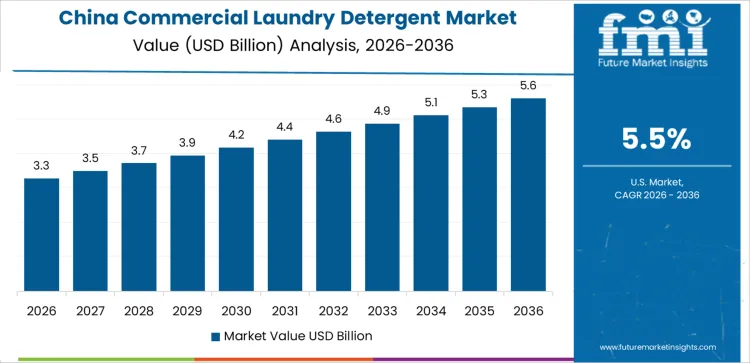
China’s commercial laundry detergent market is growing at a 5.5% CAGR, driven by rapid urbanization and the expanding hospitality, healthcare, and manufacturing industries. As China’s middle class grows, there is an increasing demand for commercial laundry services, including hotels, restaurants, and hospitals, all of which require high-quality, efficient detergents. The growing retail and tourism sectors also contribute to the rise in demand for laundry services. China’s increasing focus on improving hygiene standards and addressing environmental concerns is driving the adoption of more sustainable and effective laundry detergents. With businesses seeking cost-effective, high-performance products, China’s commercial laundry detergent market is expected to continue growing at a strong pace.
What is Contributing to the Growth of the Commercial Laundry Detergent Market in Brazil?
Brazil’s commercial laundry detergent market is growing at a 3.7% CAGR, driven by increasing demand in the hospitality, healthcare, and industrial sectors. As the country’s commercial and residential sectors continue to expand, there is a growing need for efficient laundry solutions in both hotels and hospitals, where hygiene is critical. Brazil’s rising disposable income is leading to more consumers seeking laundry services, further boosting demand. The market is also seeing a shift toward sustainable and eco-friendly laundry detergents, as Brazilian businesses and consumers become more environmentally conscious. The commercial laundry detergent market is expected to continue growing steadily as Brazil’s economy recovers, particularly in key sectors such as hospitality and retail.
How is the Commercial Laundry Detergent Market Expanding in the USA?
The USA’s commercial laundry detergent market is growing at a 4.2% CAGR, supported by increasing demand from the hospitality, healthcare, and industrial sectors. With a strong emphasis on cleanliness, particularly in hotels, hospitals, and foodservice industries, the need for high-performance detergents is rising. As businesses focus on reducing costs, the use of concentrated laundry detergents and more efficient washing solutions is gaining traction. The growing consumer preference for sustainable products is also contributing to the adoption of eco-friendly detergents in commercial laundry operations. As regulations around hygiene and sustainability evolve, the demand for high-quality, cost-effective laundry detergents is expected to remain strong, driving steady growth in the USA.
Why is the Commercial Laundry Detergent Market Growing in South Korea?
South Korea’s commercial laundry detergent market is growing at a 3.7% CAGR, driven by increasing demand for laundry services in commercial establishments such as hotels, hospitals, and large retail outlets. South Korea’s high standards for cleanliness and hygiene, particularly in public spaces, are contributing to the steady demand for commercial laundry detergents. As the country continues to urbanize and its middle class grows, there is a rising need for efficient and high-quality laundry solutions. The trend toward sustainability is also influencing the market, with more businesses seeking eco-friendly and concentrated detergents that reduce packaging waste. The commercial laundry detergent market in South Korea is expected to continue growing at a moderate pace, supported by increasing demand for commercial cleaning services.
What is Shaping the Commercial Laundry Detergent Market Growth in Germany?
Germany’s commercial laundry detergent market is growing at a 4.1% CAGR, driven by the continued demand for high-performance detergents in industries such as hospitality, healthcare, and manufacturing. Germany’s focus on cleanliness, hygiene, and sustainability is fueling the adoption of eco-friendly and concentrated laundry detergents. The growing number of hotels, hospitals, and large-scale businesses requiring efficient and environmentally responsible laundry solutions is contributing to market growth. Germany’s well-established commercial laundry services sector, along with a strong regulatory framework promoting sustainability, is ensuring the continued demand for high-quality detergents. As the market embraces more eco-conscious products, Germany’s commercial laundry detergent market is expected to see steady and consistent growth.
How Do Major Players Compete in the Commercial Laundry Detergent Market?
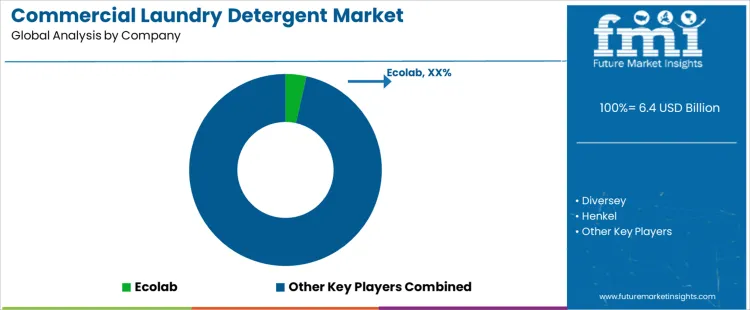
The commercial laundry detergent market is highly competitive, with leading players like Ecolab, Diversey, and Henkel at the forefront. Ecolab dominates with its innovative solutions, offering powerful detergents designed for large-scale operations in industries like hospitality, healthcare, and foodservice. Ecolab’s emphasis on sustainability and high efficiency makes its products a popular choice for businesses looking to reduce both environmental impact and operational costs. Diversey also competes strongly, focusing on high-performance detergents that deliver superior cleaning while meeting sustainability goals. Their products are trusted in commercial environments, including hospitals and laundromats, where cleanliness and hygiene are top priorities.
Henkel, Procter & Gamble Professional, and Unilever Professional are major players, bringing consumer trust to the commercial laundry detergent market. Henkel leverages its strong brand, Persil, to offer effective cleaning solutions for industrial laundry applications. Procter & Gamble Professional focuses on delivering high-quality detergents under trusted brands like Tide, ensuring maximum cleaning power for large-scale laundry operations. Unilever Professional offers products designed with sustainability in mind, catering to eco-conscious businesses while ensuring high-performance cleaning in commercial settings.
Kao Corporation, Reckitt, Zep, Spartan Chemical, and Betco also play key roles in the market by providing specialized solutions for different commercial needs. Kao Corporation brings strong performance and environmental responsibility with its products aimed at both industrial and professional laundry services. Reckitt offers detergent products that emphasize quality and efficiency, catering to businesses seeking effective cleaning solutions. Zep and Spartan Chemical focus on offering bulk laundry detergents, targeting commercial and industrial clients with cost-effective solutions. Betco provides a range of detergents with a focus on versatility, ensuring they meet the unique needs of various commercial laundry environments.
Key Players in Commercial Laundry Detergent Market Key Takeaways
- Ecolab
- Diversey
- Henkel
- Procter & Gamble Professional
- Unilever Professional
- Kao Corporation
- Reckitt
- Zep
- Spartan Chemical
- Betco
Scope of Report
| Items | Values |
|---|---|
| Quantitative Units (2026) | USD billion |
| End Use Application | Hospitality & Linen Services, Healthcare Laundry, Industrial Workwear Laundry, Institutional Laundry |
| Detergent Type | Powder Detergents, Liquid Detergents, Single-Dose Packs, Other Types |
| Wash System | Auto-Dosed Systems, Manual Dosing, Cartridge/Closed-Loop, Other Systems |
| Performance Positioning | High-Efficiency / Low-Temp, Bleach-Compatible Systems, Enzyme-Enhanced Systems, Standard Commercial |
| End-Use Sector | Hospitality & Linen Services, Healthcare Laundry, Industrial Workwear Laundry, Institutional Laundry |
| Regions Covered | Asia Pacific, Europe, North America, Latin America, Middle East & Africa |
| Countries Covered | USA, China, Japan, South Korea, India, Australia & New Zealand, ASEAN, Germany, UK, France, Italy, Spain, Nordic, BENELUX, Brazil, Chile, Mexico, Saudi Arabia, Other GCC Countries, Turkey, South Africa, Other African Union, Rest of Regions |
| Key Companies Profiled | Ecolab, Diversey, Henkel, Procter & Gamble Professional, Unilever Professional, Kao Corporation, Reckitt, Zep, Spartan Chemical, Betco |
| Additional Attributes | Dollar sales by detergent type, wash system, and performance positioning; regional CAGR and growth outlook; distribution channels including retail, DTC, e-commerce, and institutional buyers; product form prevalence in powders, liquids, and single-dose packs; innovation trends in high-efficiency and bleach-compatible formulations; competitive positioning of global vs regional suppliers. |
Commercial Laundry Detergent Market Key Takeaways by Segments
Detergent Type
- Powder Detergents
- Liquid Detergents
- Single-Dose Packs
- Other Types
End-Use Laundry Sector
- Hospitality & Linen Services
- Healthcare Laundry
- Industrial Workwear Laundry
- Institutional Laundry
Wash System
- Auto-Dosed Systems
- Manual Dosing
- Cartridge/Closed-Loop
- Other Systems
Performance Positioning
- High-Efficiency / Low-Temp
- Bleach-Compatible Systems
- Enzyme-Enhanced Systems
- Standard Commercial
Region:
- Asia Pacific
- China
- Japan
- South Korea
- India
- Australia & New Zealand
- ASEAN
- Rest of Asia Pacific
- Europe
- Germany
- United Kingdom
- France
- Italy
- Spain
- Nordic
- BENELUX
- Rest of Europe
- North America
- United States
- Canada
- Mexico
- Latin America
- Brazil
- Chile
- Rest of Latin America
- Middle East & Africa
- Kingdom of Saudi Arabia
- Other GCC Countries
- Turkey
- South Africa
- Other African Union
- Rest of Middle East & Africa
Frequently Asked Questions
How big is the commercial laundry detergent market in 2026?
The global commercial laundry detergent market is estimated to be valued at USD 6.4 billion in 2026.
What will be the size of commercial laundry detergent market in 2036?
The market size for the commercial laundry detergent market is projected to reach USD 9.9 billion by 2036.
How much will be the commercial laundry detergent market growth between 2026 and 2036?
The commercial laundry detergent market is expected to grow at a 4.5% CAGR between 2026 and 2036.
What are the key product types in the commercial laundry detergent market?
The key product types in commercial laundry detergent market are liquid detergents, powder detergents, single-dose packs and other types.
Which end-use laundry sector segment to contribute significant share in the commercial laundry detergent market in 2026?
In terms of end-use laundry sector, hospitality & linen services segment to command 34.0% share in the commercial laundry detergent market in 2026.
Preview the report firsthand - request a free sample
Get SampleGet the brochure for pricing and purchase details.
Get PDFTable of Content
- Executive Summary
- Global Market Outlook
- Demand-side Trends
- Supply-side Trends
- Technology Roadmap Analysis
- Analysis and Recommendations
- Market Overview
- Market Coverage / Taxonomy
- Market Definition / Scope / Limitations
- Market Background
- Market Dynamics
- Drivers
- Restraints
- Opportunity
- Trends
- Scenario Forecast
- Demand in Optimistic Scenario
- Demand in Likely Scenario
- Demand in Conservative Scenario
- Opportunity Map Analysis
- Product Life Cycle Analysis
- Supply Chain Analysis
- Investment Feasibility Matrix
- Value Chain Analysis
- PESTLE and Porter’s Analysis
- Regulatory Landscape
- Regional Parent Market Outlook
- Production and Consumption Statistics
- Import and Export Statistics
- Market Dynamics
- Global Market Analysis 2021 to 2025 and Forecast, 2026 to 2036
- Historical Market Size Value (USD Million) Analysis, 2021 to 2025
- Current and Future Market Size Value (USD Million) Projections, 2026 to 2036
- Y-o-Y Growth Trend Analysis
- Absolute $ Opportunity Analysis
- Global Market Pricing Analysis 2021 to 2025 and Forecast 2026 to 2036
- Global Market Analysis 2021 to 2025 and Forecast 2026 to 2036, By Detergent Type
- Introduction / Key Findings
- Historical Market Size Value (USD Million) Analysis By Detergent Type , 2021 to 2025
- Current and Future Market Size Value (USD Million) Analysis and Forecast By Detergent Type , 2026 to 2036
- Liquid Detergents
- Powder Detergents
- Single-Dose Packs
- Other Types
- Y-o-Y Growth Trend Analysis By Detergent Type , 2021 to 2025
- Absolute $ Opportunity Analysis By Detergent Type , 2026 to 2036
- Global Market Analysis 2021 to 2025 and Forecast 2026 to 2036, By End-Use Laundry Sector
- Introduction / Key Findings
- Historical Market Size Value (USD Million) Analysis By End-Use Laundry Sector, 2021 to 2025
- Current and Future Market Size Value (USD Million) Analysis and Forecast By End-Use Laundry Sector, 2026 to 2036
- Hospitality & Linen Services
- Healthcare Laundry
- Industrial Workwear Laundry
- Institutional Laundry
- Y-o-Y Growth Trend Analysis By End-Use Laundry Sector, 2021 to 2025
- Absolute $ Opportunity Analysis By End-Use Laundry Sector, 2026 to 2036
- Global Market Analysis 2021 to 2025 and Forecast 2026 to 2036, By Wash System
- Introduction / Key Findings
- Historical Market Size Value (USD Million) Analysis By Wash System, 2021 to 2025
- Current and Future Market Size Value (USD Million) Analysis and Forecast By Wash System, 2026 to 2036
- Auto-Dosed Systems
- Manual Dosing
- Cartridge/Closed-Loop
- Other Systems
- Y-o-Y Growth Trend Analysis By Wash System, 2021 to 2025
- Absolute $ Opportunity Analysis By Wash System, 2026 to 2036
- Global Market Analysis 2021 to 2025 and Forecast 2026 to 2036, By Performance Positioning
- Introduction / Key Findings
- Historical Market Size Value (USD Million) Analysis By Performance Positioning, 2021 to 2025
- Current and Future Market Size Value (USD Million) Analysis and Forecast By Performance Positioning, 2026 to 2036
- High-Efficiency / Low-Temp
- Bleach-Compatible Systems
- Enzyme-Enhanced Systems
- Standard Commercial
- Y-o-Y Growth Trend Analysis By Performance Positioning, 2021 to 2025
- Absolute $ Opportunity Analysis By Performance Positioning, 2026 to 2036
- Global Market Analysis 2021 to 2025 and Forecast 2026 to 2036, By Region
- Introduction
- Historical Market Size Value (USD Million) Analysis By Region, 2021 to 2025
- Current Market Size Value (USD Million) Analysis and Forecast By Region, 2026 to 2036
- North America
- Latin America
- Western Europe
- Eastern Europe
- East Asia
- South Asia and Pacific
- Middle East & Africa
- Market Attractiveness Analysis By Region
- North America Market Analysis 2021 to 2025 and Forecast 2026 to 2036, By Country
- Historical Market Size Value (USD Million) Trend Analysis By Market Taxonomy, 2021 to 2025
- Market Size Value (USD Million) Forecast By Market Taxonomy, 2026 to 2036
- By Country
- USA
- Canada
- Mexico
- By Detergent Type
- By End-Use Laundry Sector
- By Wash System
- By Performance Positioning
- By Country
- Market Attractiveness Analysis
- By Country
- By Detergent Type
- By End-Use Laundry Sector
- By Wash System
- By Performance Positioning
- Key Takeaways
- Latin America Market Analysis 2021 to 2025 and Forecast 2026 to 2036, By Country
- Historical Market Size Value (USD Million) Trend Analysis By Market Taxonomy, 2021 to 2025
- Market Size Value (USD Million) Forecast By Market Taxonomy, 2026 to 2036
- By Country
- Brazil
- Chile
- Rest of Latin America
- By Detergent Type
- By End-Use Laundry Sector
- By Wash System
- By Performance Positioning
- By Country
- Market Attractiveness Analysis
- By Country
- By Detergent Type
- By End-Use Laundry Sector
- By Wash System
- By Performance Positioning
- Key Takeaways
- Western Europe Market Analysis 2021 to 2025 and Forecast 2026 to 2036, By Country
- Historical Market Size Value (USD Million) Trend Analysis By Market Taxonomy, 2021 to 2025
- Market Size Value (USD Million) Forecast By Market Taxonomy, 2026 to 2036
- By Country
- Germany
- UK
- Italy
- Spain
- France
- Nordic
- BENELUX
- Rest of Western Europe
- By Detergent Type
- By End-Use Laundry Sector
- By Wash System
- By Performance Positioning
- By Country
- Market Attractiveness Analysis
- By Country
- By Detergent Type
- By End-Use Laundry Sector
- By Wash System
- By Performance Positioning
- Key Takeaways
- Eastern Europe Market Analysis 2021 to 2025 and Forecast 2026 to 2036, By Country
- Historical Market Size Value (USD Million) Trend Analysis By Market Taxonomy, 2021 to 2025
- Market Size Value (USD Million) Forecast By Market Taxonomy, 2026 to 2036
- By Country
- Russia
- Poland
- Hungary
- Balkan & Baltic
- Rest of Eastern Europe
- By Detergent Type
- By End-Use Laundry Sector
- By Wash System
- By Performance Positioning
- By Country
- Market Attractiveness Analysis
- By Country
- By Detergent Type
- By End-Use Laundry Sector
- By Wash System
- By Performance Positioning
- Key Takeaways
- East Asia Market Analysis 2021 to 2025 and Forecast 2026 to 2036, By Country
- Historical Market Size Value (USD Million) Trend Analysis By Market Taxonomy, 2021 to 2025
- Market Size Value (USD Million) Forecast By Market Taxonomy, 2026 to 2036
- By Country
- China
- Japan
- South Korea
- By Detergent Type
- By End-Use Laundry Sector
- By Wash System
- By Performance Positioning
- By Country
- Market Attractiveness Analysis
- By Country
- By Detergent Type
- By End-Use Laundry Sector
- By Wash System
- By Performance Positioning
- Key Takeaways
- South Asia and Pacific Market Analysis 2021 to 2025 and Forecast 2026 to 2036, By Country
- Historical Market Size Value (USD Million) Trend Analysis By Market Taxonomy, 2021 to 2025
- Market Size Value (USD Million) Forecast By Market Taxonomy, 2026 to 2036
- By Country
- India
- ASEAN
- Australia & New Zealand
- Rest of South Asia and Pacific
- By Detergent Type
- By End-Use Laundry Sector
- By Wash System
- By Performance Positioning
- By Country
- Market Attractiveness Analysis
- By Country
- By Detergent Type
- By End-Use Laundry Sector
- By Wash System
- By Performance Positioning
- Key Takeaways
- Middle East & Africa Market Analysis 2021 to 2025 and Forecast 2026 to 2036, By Country
- Historical Market Size Value (USD Million) Trend Analysis By Market Taxonomy, 2021 to 2025
- Market Size Value (USD Million) Forecast By Market Taxonomy, 2026 to 2036
- By Country
- Kingdom of Saudi Arabia
- Other GCC Countries
- Turkiye
- South Africa
- Other African Union
- Rest of Middle East & Africa
- By Detergent Type
- By End-Use Laundry Sector
- By Wash System
- By Performance Positioning
- By Country
- Market Attractiveness Analysis
- By Country
- By Detergent Type
- By End-Use Laundry Sector
- By Wash System
- By Performance Positioning
- Key Takeaways
- Key Countries Market Analysis
- USA
- Pricing Analysis
- Market Share Analysis, 2025
- By Detergent Type
- By End-Use Laundry Sector
- By Wash System
- By Performance Positioning
- Canada
- Pricing Analysis
- Market Share Analysis, 2025
- By Detergent Type
- By End-Use Laundry Sector
- By Wash System
- By Performance Positioning
- Mexico
- Pricing Analysis
- Market Share Analysis, 2025
- By Detergent Type
- By End-Use Laundry Sector
- By Wash System
- By Performance Positioning
- Brazil
- Pricing Analysis
- Market Share Analysis, 2025
- By Detergent Type
- By End-Use Laundry Sector
- By Wash System
- By Performance Positioning
- Chile
- Pricing Analysis
- Market Share Analysis, 2025
- By Detergent Type
- By End-Use Laundry Sector
- By Wash System
- By Performance Positioning
- Germany
- Pricing Analysis
- Market Share Analysis, 2025
- By Detergent Type
- By End-Use Laundry Sector
- By Wash System
- By Performance Positioning
- UK
- Pricing Analysis
- Market Share Analysis, 2025
- By Detergent Type
- By End-Use Laundry Sector
- By Wash System
- By Performance Positioning
- Italy
- Pricing Analysis
- Market Share Analysis, 2025
- By Detergent Type
- By End-Use Laundry Sector
- By Wash System
- By Performance Positioning
- Spain
- Pricing Analysis
- Market Share Analysis, 2025
- By Detergent Type
- By End-Use Laundry Sector
- By Wash System
- By Performance Positioning
- France
- Pricing Analysis
- Market Share Analysis, 2025
- By Detergent Type
- By End-Use Laundry Sector
- By Wash System
- By Performance Positioning
- India
- Pricing Analysis
- Market Share Analysis, 2025
- By Detergent Type
- By End-Use Laundry Sector
- By Wash System
- By Performance Positioning
- ASEAN
- Pricing Analysis
- Market Share Analysis, 2025
- By Detergent Type
- By End-Use Laundry Sector
- By Wash System
- By Performance Positioning
- Australia & New Zealand
- Pricing Analysis
- Market Share Analysis, 2025
- By Detergent Type
- By End-Use Laundry Sector
- By Wash System
- By Performance Positioning
- China
- Pricing Analysis
- Market Share Analysis, 2025
- By Detergent Type
- By End-Use Laundry Sector
- By Wash System
- By Performance Positioning
- Japan
- Pricing Analysis
- Market Share Analysis, 2025
- By Detergent Type
- By End-Use Laundry Sector
- By Wash System
- By Performance Positioning
- South Korea
- Pricing Analysis
- Market Share Analysis, 2025
- By Detergent Type
- By End-Use Laundry Sector
- By Wash System
- By Performance Positioning
- Russia
- Pricing Analysis
- Market Share Analysis, 2025
- By Detergent Type
- By End-Use Laundry Sector
- By Wash System
- By Performance Positioning
- Poland
- Pricing Analysis
- Market Share Analysis, 2025
- By Detergent Type
- By End-Use Laundry Sector
- By Wash System
- By Performance Positioning
- Hungary
- Pricing Analysis
- Market Share Analysis, 2025
- By Detergent Type
- By End-Use Laundry Sector
- By Wash System
- By Performance Positioning
- Kingdom of Saudi Arabia
- Pricing Analysis
- Market Share Analysis, 2025
- By Detergent Type
- By End-Use Laundry Sector
- By Wash System
- By Performance Positioning
- Turkiye
- Pricing Analysis
- Market Share Analysis, 2025
- By Detergent Type
- By End-Use Laundry Sector
- By Wash System
- By Performance Positioning
- South Africa
- Pricing Analysis
- Market Share Analysis, 2025
- By Detergent Type
- By End-Use Laundry Sector
- By Wash System
- By Performance Positioning
- USA
- Market Structure Analysis
- Competition Dashboard
- Competition Benchmarking
- Market Share Analysis of Top Players
- By Regional
- By Detergent Type
- By End-Use Laundry Sector
- By Wash System
- By Performance Positioning
- Competition Analysis
- Competition Deep Dive
- Ecolab
- Overview
- Product Portfolio
- Profitability by Market Segments (Product/Age /Sales Channel/Region)
- Sales Footprint
- Strategy Overview
- Marketing Strategy
- Product Strategy
- Channel Strategy
- Diversey
- Henkel
- Procter & Gamble Professional
- Unilever Professional
- Kao Corporation
- Reckitt
- Zep
- Spartan Chemical
- Betco
- Ecolab
- Competition Deep Dive
- Assumptions & Acronyms Used
- Research Methodology


