

- Industry Size (2026)
- USD 122.4 Bn
- Forecast (2036)
- USD 198.6 Bn
- CAGR (2026 to 2036)
- 5.0%
Laundry Care Market Size, Market Forecast and Outlook By FMI
In 2025, the laundry care market was valued at USD 115.7 billion. Demand for laundry care products is estimated to grow to USD 122.4 billion in 2026 and USD 198.6 billion by 2036. The market projects a CAGR of 5.0% during the forecast period.
Buying preferences are shifting toward detergents compatible with low-temperature cycles, lower water usage, and space-efficient packaging, reflecting rising sensitivity to household utility costs without diluting performance expectations. R&D pipelines are aligning with this demand shift through polymer-enabled soil release technologies, micro-encapsulation platforms, and controlled fragrance diffusion systems, supporting consistent performance across varied textile categories while sustaining brand-level differentiation in crowded retail shelves.
Summary of Laundry Care Market
- Laundry Care Market Definition
- The industry covers cleaning formulations and fabric care systems utilized for textile washing including household laundry, commercial operations, and specialized fabric treatment.
- Demand Drivers in the Market
- Rising household formation rates drive product acquisition for routine textile maintenance.
- Automatic washing machine adoption expands demand for specific detergent formulations compatible with machine requirements.
- Product innovation in concentrated formulas reduces packaging waste while maintaining cleaning performance standards.
- Key Segments Analyzed in the Report
- Product Type: Laundry Detergents (68%) versus fabric softeners and specialized cleaning agents.
- Form: Liquid (54%) versus powder formulations and unit-dose formats.
- Geography: High-growth Asia Pacific versus mature North American and European markets.
- Analyst Opinion at FMI
- Nandini Roy, Senior Consultant for Consumer Products at Future Market Insights, opines, "In the coming Laundry Care Market Report for 2026 to 2036, industry stakeholders will find insights into concentrated formulation adoption patterns that require compatibility testing across diverse washing machine types and water hardness conditions. My findings indicate that enzyme stability requirements directly impact product shelf life specifications and packaging material selection could restrict market entry for manufacturers targeting premium positioning through botanical ingredient integration."
- Strategic Implications/Executive Takeaways
- Shift focus from general-purpose cleaning to specialized fabric care formulations.
- Treat subscription delivery models as primary growth channel rather than supplementary distribution method.
- Prioritize packaging reduction initiatives to address consumer disposal concerns and logistics cost optimization.
- Methodology
- Validated through direct retail sales data and household consumption surveys.
- Zero reliance on speculative consumer behavior trend forecasting.
- Based on verifiable brand performance metrics and verified distribution agreements.
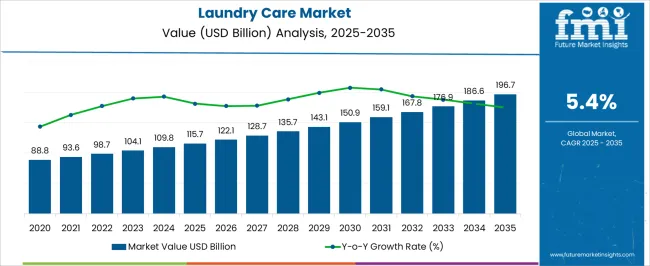
| Metric | Value | Year/Period |
|---|---|---|
| Market size | USD 115.7 billion | 2025 |
| Market size | USD 122.4 billion | 2026 |
| Market size | USD 198.6 billion | 2036 |
The category’s competitive positioning is increasingly shaped by high-concentration formats that cut packaging material intensity, improve per-wash cost economics, and reduce storage footprint. Brands are scaling direct-to-consumer routes alongside retail presence, supported by stronger claims around cleaning validation, dermatological safety assessments, and appliance compatibility testing. Portfolio extensions into plant-derived actives, skin-sensitive formulations, and targeted fabric care solutions across mainstream retail formats signal the transition of laundry care from basic household consumables toward value-added segments focused on garment lifespan and user skin comfort.
In its Q1 2025 trading update, Kris Licht, CEO, Reckitt Benckiser Group plc said “We delivered a solid first quarter driven by Core Reckitt with continued strong growth in Emerging Markets. We continue to execute against our strategy to make Reckitt a more efficient, world-class consumer health and hygiene company, driven by increased investment, innovation, and our Fuel for Growth programme. Our portfolio of high growth, high-margin Powerbrands underpins our resilience, and we maintain our outlook for full year 2025 whilst recognising the more challenging macroeconomic outlook.” [1]
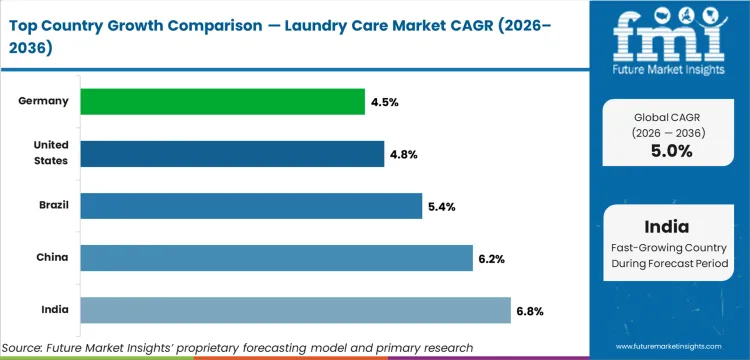
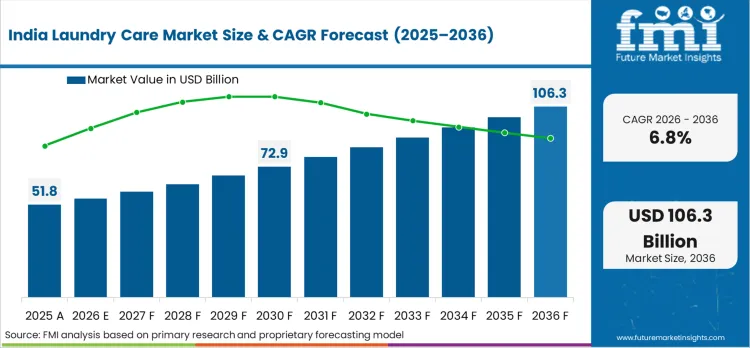
Growth traction remains in developed markets such as the United States (4.8% CAGR) and Germany (4.5% CAGR), supported by mature retail ecosystems and premium segment penetration. Japan (4.9% CAGR) adds momentum through advanced formulation capabilities and demand for compact, space-saving product formats. High-growth markets including China (6.2%), India (6.8%), and Brazil (5.4%) are being fueled by expanding household formation, rising penetration of automatic washing machines, and accelerating uptake of mass-market detergent tiers as modern retail spreads into secondary urban centers.
Laundry Care Definition
Laundry care products serve as the primary cleaning agent category for textile maintenance, encompassing formulations designed for fabric washing across household and commercial applications. The laundry care market comprises the global development, production, and distribution of cleaning solutions featuring surfactant systems, enzyme complexes, and fragrance compounds for textile care in domestic and institutional contexts.
Laundry Care Market Inclusions
The report includes a comprehensive analysis of market dynamics, featuring Global and Regional Market Sizes (Volume and Value) and a 10-year Forecast (2026-2036). It covers segmental breakdowns by product type (Laundry Detergents, Fabric Softeners, Bleach, Stain Removers), form (Liquid, Powder, Pods/Capsules, Sheets), distribution channels (Supermarkets and Hypermarkets, Convenience Stores, Online Retail, Specialty Stores), and applications (Household, Commercial).
Laundry Care Market Exclusions
The scope excludes dry cleaning chemicals, industrial textile processing agents, washing machine manufacturing, and water treatment systems. It also omits raw material suppliers, packaging machinery manufacturers, and laundry service operations, focusing strictly on finished consumer-ready cleaning products designed for textile washing and their immediate retail applications. Report does not account for institutional bulk supply contracts or private label manufacturing arrangements with negligible brand differentiation.
Laundry Care Market Research Methodology
- Primary Research: Interviews were conducted with laundry care manufacturers, retail category managers, commercial laundry operators, distribution channel representatives, and household cleaning product associations across major markets. Formulation chemists clarified ingredient functionality and performance testing protocols.
- Desk Research: Consumer purchase data from retail analytics platforms, household cleaning behavior surveys, and import/export statistics from trade organizations supported market benchmarking.
- Market-Sizing and Forecasting: A hybrid top-down and bottom-up model was developed. Demand was reconstructed from brand sales figures, retail point-of-sale data, and commercial procurement volumes, then validated against manufacturing capacity and distribution network coverage.
- Data Validation and Update Cycle: Outputs undergo variance checks across retail and wholesale datasets, cross-verification with consumer goods industry associations, and structured expert review prior to release.
Segmental Analysis
Laundry Care Market Analysis by Product Type
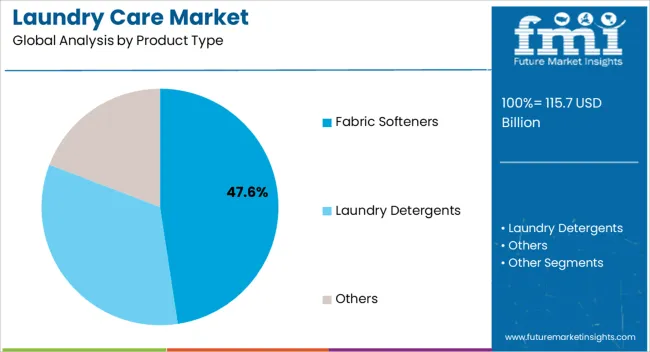
Demand for laundry detergents is projected to account for nearly 68% of total market share in 2026. Volume expansion within this segment is being shaped by manufacturers advancing multi-enzyme systems and fine-tuning surfactant blends to serve households seeking consistent cleaning performance across mixed fabric loads, while keeping per-wash costs within affordable ranges.
- Cold Water Washing Compatibility: Producers are rolling out enzyme technologies engineered for higher activity in low-temperature cycles, broadening product relevance as energy-saving wash habits gain traction. This shift aligns with household efforts to manage utility expenses and is influencing brand selection across single-family and multi-unit residential settings.
- Concentrated Formula Development: High-concentration detergent formats are gaining ground due to their ability to reduce packaging requirements while improving cost efficiency and storage convenience. These formulations lower logistics intensity and support margin optimization, while fitting both conventional retail distribution and direct-to-consumer delivery models.
Laundry Care Market Analysis by Form
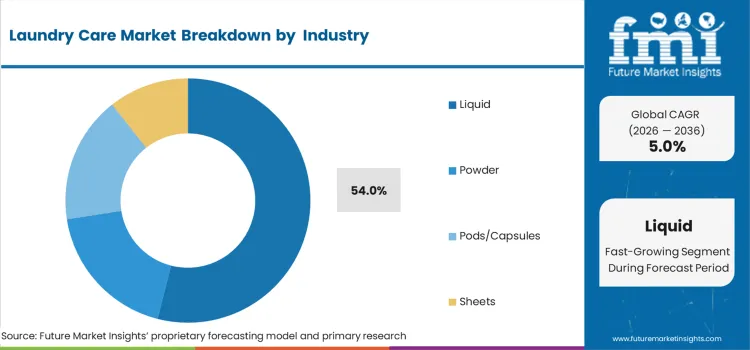
Liquid detergents are expected to command about 54% of the market in 2026, supported by consumer preference for flexible dosing and the ease of applying products directly onto stained areas. This format benefits from rapid solubility and strong compatibility with high-efficiency washing machines, reinforcing buyer preference for liquids in everyday fabric care routines. Continued improvements in cap-based dosing systems and pour-spout ergonomics help sustain category leadership, while the ability to apply detergent straight to fabric provides an edge over powder alternatives that require full dissolution during wash cycles.
- Dosing Precision Control: The liquid segment capitalizes on calibrated caps and integrated pump mechanisms that enable accurate portioning. This supports consumer trust among households tracking per-wash costs and seeking predictable cleaning outcomes across varying load sizes.
- Pre-Treatment Application: Brands are emphasizing direct-on-fabric use cases and stain-focused treatment claims to influence purchase behavior. This positioning supports repeat demand for managing heavily soiled garments and targeted care needs across specialty textiles.
Laundry Care Market Drivers, Restraints, and Opportunities
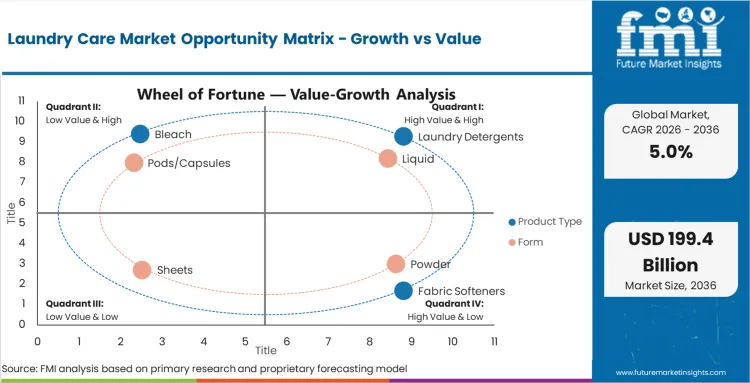
Long-run trend analysis shows laundry care steadily repositioning from a basic household staple into a more advanced fabric treatment category. The projected 2026 market size reflects how consumers are increasingly weighing textile preservation, skin-friendliness, and sustainability considerations alongside core cleaning performance, showing a shift away from purely functional purchase drivers to green chemicals.
Conventional powder detergents continue to face displacement from liquids and unit-dose formats, yet their perceived value-for-money and strong cleaning concentration sustain steady demand among price-sensitive buyers. This pragmatic purchasing behavior helps preserve revenue across detergent formats, even as consumer preferences diversify. The outlook factors in saturation dynamics across mature economies, with incremental volume gains increasingly sourced from developing regions where automatic washing machines are entering households for the first time.
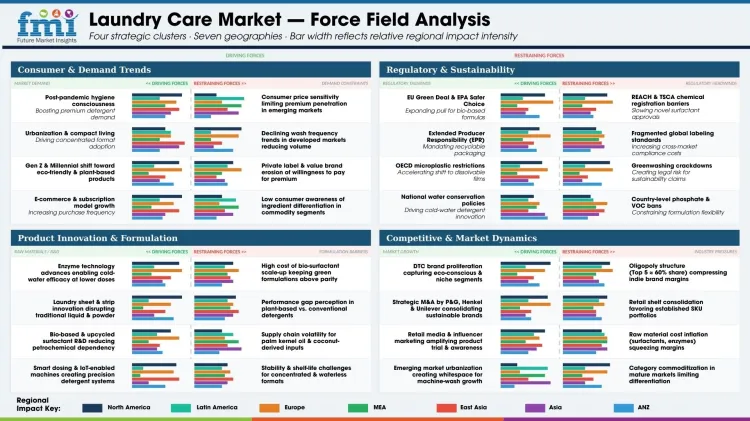
- Multi-Functional Product Integration: Product strategies are moving toward bundled performance propositions that combine soil removal with in-wash fabric conditioning and longer-lasting scent delivery. This integrated positioning reduces reliance on separate additives and supports competitive differentiation within crowded retail shelves.
- Enzyme Formulation Standards: Protease, amylase, and lipase inclusion is becoming a standard performance requirement rather than a differentiating feature. This raises formulation benchmarks, pushing manufacturers to transition from legacy surfactant-centric recipes toward more complex enzyme-driven systems.
- Raw Material Cost Management: Margin protection amid volatility in surfactant and polymer input prices is being addressed through tighter procurement coordination with oleochemical supply partners. These sourcing adjustments aim to stabilize unit economics while aligning with retailer pricing bands and distributor margin expectations.
Regional Analysis
Based on regional analysis, the laundry care market is segmented into North America, Latin America, Europe, East Asia, South Asia, Oceania and Middle East & Africa across 40 countries. The full report also offers market attractiveness analysis based on regional trends.
.webp "Top Country Growth Comparison Laundry Care Market Cagr (2026 2036)")
| Country | CAGR (2026 to 2036) |
|---|---|
| United States | 4.8% |
| Germany | 4.5% |
| China | 6.2% |
| India | 6.8% |
| Brazil | 5.4% |
Source: Market analysis based on proprietary forecasting model and primary research
North America Laundry Care Market Analysis
The laundry care sector in North America is expanding on the back of rising household formation, broader uptake of high-efficiency washing machines, and growing consumer focus on specialized fabric care to support garment lifespan. Dense retail networks continue to enable wider brand availability, while the steady rise of online channels is encouraging subscription-based replenishment models across multiple age groups.
- United States: Sales of laundry care products in the United States are forecast to advance at a 4.8% CAGR through 2036. Market momentum is supported by growing preference for high-concentration detergent formats and packaging light-weighting initiatives implemented across brand portfolios.
The study provides in-depth evaluation of North American market development, with country-level coverage of the United States and Canada. It examines shifts in household laundry habits, changes in retail channel structures, and format-level demand patterns linked to evolving distribution strategies.
Asia Pacific Laundry Care Market Overview
Asia Pacific is emerging as the most dynamic regional market, driven by rapid expansion of middle-income households and accelerating penetration of automatic washing machines. Multinational players such as Procter & Gamble and Unilever remain at the forefront of formulation innovation, while regional producers broaden access through value-priced product tiers. China plays a central role in the regional supply chain as a key source of surfactants, enzymes, and packaging inputs.
- China: With an estimated 6.2% CAGR, China’s market growth is underpinned by urban household expansion and wider standardization of washing machine usage, supporting the rollout of premium commercial laundry detergent segments alongside the scaling of domestic brands across provincial markets.
- India: The market in India is projected to grow at 6.8% CAGR, supported by rising disposable incomes that are accelerating automatic washing machine uptake and strengthening local manufacturing based on cost-efficient production platforms.
The report evaluates East and South Asian laundry care markets from 2021 to 2036, covering consumer formation trends, retail channel maturation, and formulation pathways across China, Japan, South Korea, India, Singapore, and Australia. It also outlines how price-tier strategies are being used to widen market access across urban and semi-urban geographies.
Europe Laundry Care Market Overview
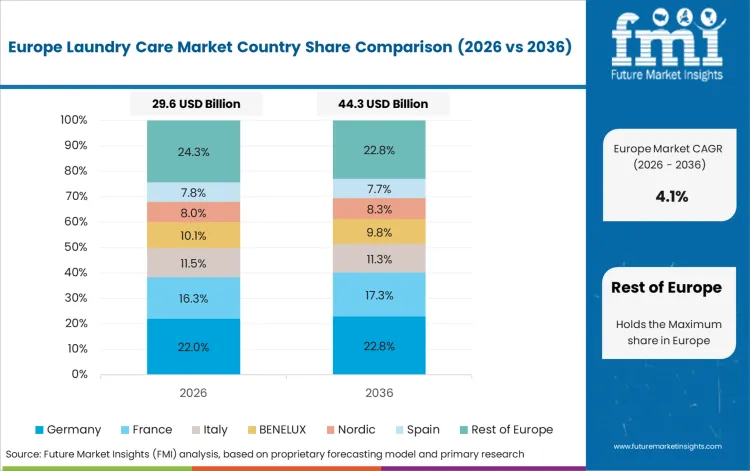
Europe represents a mature consumer goods landscape where category development is shaped by regulatory alignment on environmental standards and a strong shift toward concentrated detergent formats across Germany, the United Kingdom, and France. Key industry participants such as Henkel AG and Unilever are expanding eco-certified product portfolios to capture sustainability-driven demand.
- Germany: The German laundry care market is set to expand at a 4.5% CAGR through 2036, supported by growing use of cold-water wash programs and preference for biodegradable ingredient systems. Private-label detergents are gaining shelf space across discount retail chains, increasing price competition while sustaining category volumes through value-oriented purchasing.
European market coverage includes country-level analysis of the United Kingdom, Germany, France, Italy, Spain, the Netherlands, and the Nordic region, offering insights into consumer usage patterns and evolving retail procurement practices across the continent.
Competitive Landscape for Laundry Care Market Players
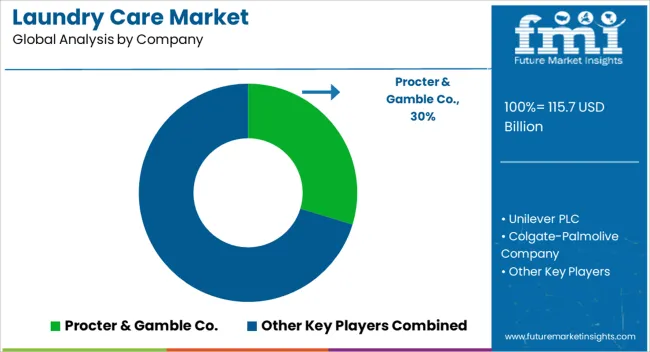
The laundry care market is characterized by robust competition among global consumer goods manufacturers, regional formulators, and emerging digital-first brands. Market leaders are differentiated by their scale of distribution, depth of formulation expertise, and ability to innovate across product performance, sustainability attributes, and channel-specific strategies. Strategic initiatives across players include portfolio expansion through advanced enzyme systems, concentrated formats, eco-friendly ingredient platforms, and targeted regional product offerings aligned with local consumer preferences.
Manufacturers continue to leverage research and development to deepen performance claims, expand low-temperature wash compatibility, and integrate multifunctional benefits such as odor control and fabric conditioning within single-product formats. Rapid growth in e-commerce has prompted players to strengthen direct-to-consumer offerings, implement subscription-based replenishment models, and tailor digital marketing campaigns to engage younger, value-seeking consumers.
Recent Developments
The report includes comprehensive coverage of key industry developments and competitive positioning:
- In June 2025, Unilever announced to acquire men’s personal care brand Dr. Squatch. Dr. Squatch has reached millions of people through its retail and direct-to-consumer model with natural, high-performance personal care products. [3]
Key Players in Laundry Care Market
- Procter & Gamble Co.
- Unilever PLC
- Henkel AG & Co. KGaA
- Church & Dwight Co., Inc.
- Reckitt Benckiser Group plc
- Kao Corporation
- The Clorox Company
- Colgate-Palmolive Company
- SC Johnson & Son, Inc.
- Lion Corporation
Scope of the Report
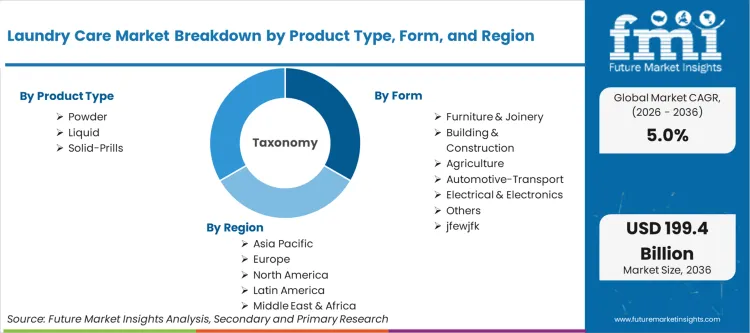
| Metric | Value |
|---|---|
| Quantitative Units | USD 122.4 billion (2026) to USD 198.6 billion (2036), at a CAGR of 5.0% |
| Market Definition | The laundry care market comprises the global development, production, and distribution of cleaning formulations including detergents, fabric softeners, and specialized treatment products designed for textile washing across household and commercial applications. |
| Product Type Segmentation | Laundry Detergents, Fabric Softeners, Bleach, Stain Removers |
| Form Coverage | Liquid, Powder, Pods/Capsules, Sheets |
| Distribution Channel Coverage | Supermarkets and Hypermarkets, Convenience Stores, Online Retail, Specialty Stores |
| Application Segmentation | Household, Commercial |
| Regions Covered | North America, Latin America, Europe, East Asia, South Asia, Oceania, Middle East and Africa |
| Countries Covered | United States, Canada, United Kingdom, Germany, France, China, Japan, India, Brazil, UAE and 40 countries |
| Key Companies Profiled | Procter & Gamble Co., Unilever PLC, Henkel AG & Co. KGaA, Church & Dwight Co. Inc., Reckitt Benckiser Group plc, Kao Corporation, The Clorox Company, Colgate-Palmolive Company, SC Johnson & Son Inc., Lion Corporation |
| Forecast Period | 2026 to 2036 |
| Approach | Hybrid top down and bottom up market modeling validated through retail sales tracking and household consumption surveys, supported by distribution network verification and washing behavior pattern analysis |
Laundry Care Market Analysis by Segments
Product Type:
- Laundry Detergents
- Fabric Softeners
- Bleach
- Stain Removers
Form:
- Liquid
- Powder
- Pods/Capsules
- Sheets
Distribution Channel:
- Supermarkets and Hypermarkets
- Convenience Stores
- Online Retail
- Specialty Stores
- Others (direct sales, subscription services)
Application:
- Household
- Commercial
Region:
- Asia Pacific
- China
- Japan
- South Korea
- India
- Australia
- Singapore
- Thailand
- Rest of Asia Pacific
- Europe
- United Kingdom
- Germany
- France
- Italy
- Spain
- Netherlands
- Scandinavia
- Switzerland
- Rest of Europe
- North America
- United States
- Canada
- Latin America
- Brazil
- Mexico
- Argentina
- Rest of Latin America
- Middle East & Africa
- United Arab Emirates
- Saudi Arabia
- South Africa
- Israel
- Rest of Middle East & Africa
Bibliography
- [1] Reckitt. (2025, April 22). Q1 2025 Trading Update. Reckitt plc.
- [2] Henkel AG & Co. KGaA. (2026, February 4). Henkel agrees to acquire specialty coatings company Stahl
- [3] Unilever PLC. (2025, June 23). Unilever to acquire men’s personal care brand Dr. Squatch
- [4] Church & Dwight Co., Inc. (2025, May 12). Church & Dwight to acquire the Touchland® brand for $700 million plus earn-out.
- [5] Colgate-Palmolive Company. (2025, February 13). Colgate-Palmolive Company announces agreement to acquire Prime100
- This bibliography is provided for reader reference and is not exhaustive. The full report contains the complete reference list and detailed citations.
This Report Addresses
- Market intelligence to enable strategic decision making across established and emerging household care markets
- Market size estimation and 10-year revenue forecasts from 2026 to 2036, supported by validated retail sales data and household consumption surveys
- Growth opportunity mapping across product types and application segments with emphasis on distribution optimization
- Segment and regional revenue forecasts covering detergents, fabric softeners, specialized cleaning agents, and retail distribution networks
- Competition strategy assessment including brand portfolio management, retailer partnership requirements, and formulation positioning
- Product development tracking including enzyme technology innovations, concentrated formula trends, and packaging format adoption
- Market access analysis covering distribution agreements, private label manufacturing strategies, and retail category management programs
- Market report delivery in PDF, Excel, PPT, and interactive dashboard formats for executive and operational use
Frequently Asked Questions
How large is the demand for Laundry Care products in the global market in 2026?
Demand for Laundry Care products in the global market is estimated to be valued at USD 122.4 billion in 2026.
What will be the market size of Laundry Care products in the global market by 2036?
Market size for Laundry Care products is projected to reach USD 198.6 billion by 2036.
What is the expected demand growth for Laundry Care products in the global market between 2026 and 2036?
Demand for Laundry Care products in the global market is expected to grow at a CAGR of 5.0% between 2026 and 2036.
Which Product Type is poised to lead global sales by 2026?
Laundry Detergents is expected to be the dominant product type, capturing approximately 68.0% of global market share in 2026 due to multi-functional formulations and widespread household adoption.
How significant is the role of Liquid format in driving Laundry Care adoption in 2026?
Liquid format represents a primary product form, projected to hold approximately 54% share of the total market in 2026 as dosing flexibility and pre-treatment capabilities maintain format preference.
What is Driving Laundry Care Demand in the United States?
Concentrated formula adoption and increased packaging reduction initiatives across product categories are driving growth.
What Consumer Trends are Referenced for the United States?
Fabric care specialization patterns and subscription delivery model adoption are referenced as key consumer behavior shifts.
What is the United States Growth Outlook in this Report?
The United States is projected to grow at a CAGR of 4.8% during 2026 to 2036.
Why is Europe described as Important for Laundry Care Development in this Report?
Growth is driven by environmental compliance standards and concentrated formula preferences that establish product specification requirements.
What Type of Product Development Dominates in Europe?
Eco-label certified formulations with biodegradable ingredients and cold water washing compatibility dominate regional market segments.
What is Germany Growth Outlook in this Report?
Germany is projected to expand at a CAGR of 4.5% during 2026 to 2036.
Does the Report Cover China in its Regional Analysis?
China is included within East Asia under the regional scope of analysis.
What are the Sources referred to for analyzing the Market in China?
Household formation data, washing machine penetration statistics, and retail sales tracking covering purchase patterns, format preference analysis, and brand selection evolution are cited as primary reference sources.
What is the Main Development Theme Linked to China in Asia Coverage?
Asia Pacific development is associated with urban household growth enabling premium product tier development across provincial markets.
Does the Report Cover India in its Regional Analysis?
India is included within South Asia under the regional coverage framework.
What is the Main India Related Development Theme in Asia Coverage?
Rising disposable income levels creating foundation for automatic washing machine adoption and local manufacturing using cost-effective production methods is emphasized.
Which Distribution Strategies are Strategically Important for Asia Pacific Market Entry?
Retail partnership models and affordable product tier development are prioritized for cost-effective market penetration across regional markets.
What is Laundry Care and What is It Mainly Used For?
Laundry care involves cleaning formulations primarily used for textile washing including household laundry, commercial operations, and specialized fabric treatment.
What does Laundry Care Market Mean in this Report?
Laundry care market refers to global development, manufacturing, and retail distribution of cleaning products across various application categories and consumer segments.
What is Included in the Scope of this Laundry Care Market Report?
Scope covers products by type, key distribution channels such as supermarkets and online platforms, and application segments including household and commercial use.
What is Excluded from the Scope of this Report?
Dry cleaning chemicals, industrial textile processing agents, washing machine manufacturing, and water treatment systems are excluded unless part of consumer laundry care product offerings.
What does Market Forecast Mean on this Page?
Market forecast represents model-based projections built on retail sales trends and household consumption assumptions for strategic planning purposes.
How is the Laundry Care Market Forecast Built and Validated?
Forecast is developed using hybrid modeling validated through retail point-of-sale data, household consumption surveys, and distribution network verification.
What does Zero Reliance on Speculative Third Party Market Research Mean Here?
Market analysis is based on verifiable sales figures, household behavior data, and product adoption patterns rather than speculative consumer trend predictions.
Preview the report firsthand - request a free sample
Get SampleGet the brochure for pricing and purchase details.
Get PDFTable of Content
- Global Market Outlook
- Demand-side Trends
- Supply-side Trends
- Market Overview
- Market Coverage / Taxonomy
- Market Definition / Scope / Limitations
- Research Methodology
- Chapter Orientation
- Analytical Lens and Working Hypotheses
- Market Structure, Signals, and Trend Drivers
- Benchmarking and Cross-market Comparability
- Market Sizing, Forecasting, and Opportunity Mapping
- Research Design and Evidence Framework
- Desk Research Programme (Secondary Evidence)
- Company Annual and Sustainability Reports
- Peer-reviewed Journals and Academic Literature
- Corporate Websites, Product Literature, and Technical Notes
- Earnings Decks and Investor Briefings
- Statutory Filings and Regulatory Disclosures
- Technical White Papers and Standards Notes
- Expert Input and Fieldwork (Primary Evidence)
- Primary Modes
- Qualitative Interviews and Expert Elicitation
- Quantitative Surveys and Structured Data Capture
- Blended Approach
- Why Primary Evidence is Used
- Field Techniques
- Interviews
- Surveys
- Focus Groups
- Observational and In-context Research
- Social and Community Interactions
- Stakeholder Universe Engaged
- C-suite Leaders
- Board Members
- Presidents and Vice Presidents
- R&D and Innovation Heads
- Technical Specialists
- Domain Subject-matter Experts
- Scientists
- Physicians and Other Healthcare Professionals
- Governance, Ethics, and Data Stewardship
- Research Ethics
- Data Integrity and Handling
- Primary Modes
- Tooling, Models, and Reference Databases
- Data Engineering and Model Build
- Data Acquisition and Ingestion
- Cleaning, Normalisation, and Verification
- Synthesis, Triangulation, and Analysis
- Quality Assurance and Audit Trail
- Desk Research Programme (Secondary Evidence)
- Market Background
- Market Dynamics
- Drivers
- Restraints
- Opportunity
- Trends
- Scenario Forecast
- Demand in Optimistic Scenario
- Demand in Likely Scenario
- Demand in Conservative Scenario
- Opportunity Map Analysis
- Product Life Cycle Analysis
- Supply Chain Analysis
- Investment Feasibility Matrix
- Value Chain Analysis
- PESTLE and Porter’s Analysis
- Regulatory Landscape
- Regional Parent Market Outlook
- Production and Consumption Statistics
- Import and Export Statistics
- Market Dynamics
- Global Market Analysis 2021 to 2025 and Forecast, 2026 to 2036
- Historical Market Size Value (USD Million) Analysis, 2021 to 2025
- Current and Future Market Size Value (USD Million) Projections, 2026 to 2036
- Y-o-Y Growth Trend Analysis
- Absolute $ Opportunity Analysis
- Global Market Pricing Analysis 2021 to 2025 and Forecast 2026 to 2036
- Global Market Analysis 2021 to 2025 and Forecast 2026 to 2036, By Product Type
- Introduction / Key Findings
- Historical Market Size Value (USD Million) Analysis By Product Type , 2021 to 2025
- Current and Future Market Size Value (USD Million) Analysis and Forecast By Product Type , 2026 to 2036
- Laundry Detergents
- Fabric Softeners
- Bleach
- Laundry Detergents
- Y-o-Y Growth Trend Analysis By Product Type , 2021 to 2025
- Absolute $ Opportunity Analysis By Product Type , 2026 to 2036
- Global Market Analysis 2021 to 2025 and Forecast 2026 to 2036, By Form
- Introduction / Key Findings
- Historical Market Size Value (USD Million) Analysis By Form, 2021 to 2025
- Current and Future Market Size Value (USD Million) Analysis and Forecast By Form, 2026 to 2036
- Liquid
- Powder
- Pods/Capsules
- Sheets
- Liquid
- Y-o-Y Growth Trend Analysis By Form, 2021 to 2025
- Absolute $ Opportunity Analysis By Form, 2026 to 2036
- Global Market Analysis 2021 to 2025 and Forecast 2026 to 2036, By Region
- Introduction
- Historical Market Size Value (USD Million) Analysis By Region, 2021 to 2025
- Current Market Size Value (USD Million) Analysis and Forecast By Region, 2026 to 2036
- North America
- Latin America
- Western Europe
- Eastern Europe
- East Asia
- South Asia and Pacific
- Middle East & Africa
- Market Attractiveness Analysis By Region
- North America Market Analysis 2021 to 2025 and Forecast 2026 to 2036, By Country
- Historical Market Size Value (USD Million) Trend Analysis By Market Taxonomy, 2021 to 2025
- Market Size Value (USD Million) Forecast By Market Taxonomy, 2026 to 2036
- By Country
- USA
- Canada
- Mexico
- By Product Type
- By Form
- By Country
- Market Attractiveness Analysis
- By Country
- By Product Type
- By Form
- Key Takeaways
- Latin America Market Analysis 2021 to 2025 and Forecast 2026 to 2036, By Country
- Historical Market Size Value (USD Million) Trend Analysis By Market Taxonomy, 2021 to 2025
- Market Size Value (USD Million) Forecast By Market Taxonomy, 2026 to 2036
- By Country
- Brazil
- Chile
- Rest of Latin America
- By Product Type
- By Form
- By Country
- Market Attractiveness Analysis
- By Country
- By Product Type
- By Form
- Key Takeaways
- Western Europe Market Analysis 2021 to 2025 and Forecast 2026 to 2036, By Country
- Historical Market Size Value (USD Million) Trend Analysis By Market Taxonomy, 2021 to 2025
- Market Size Value (USD Million) Forecast By Market Taxonomy, 2026 to 2036
- By Country
- Germany
- UK
- Italy
- Spain
- France
- Nordic
- BENELUX
- Rest of Western Europe
- By Product Type
- By Form
- By Country
- Market Attractiveness Analysis
- By Country
- By Product Type
- By Form
- Key Takeaways
- Eastern Europe Market Analysis 2021 to 2025 and Forecast 2026 to 2036, By Country
- Historical Market Size Value (USD Million) Trend Analysis By Market Taxonomy, 2021 to 2025
- Market Size Value (USD Million) Forecast By Market Taxonomy, 2026 to 2036
- By Country
- Russia
- Poland
- Hungary
- Balkan & Baltic
- Rest of Eastern Europe
- By Product Type
- By Form
- By Country
- Market Attractiveness Analysis
- By Country
- By Product Type
- By Form
- Key Takeaways
- East Asia Market Analysis 2021 to 2025 and Forecast 2026 to 2036, By Country
- Historical Market Size Value (USD Million) Trend Analysis By Market Taxonomy, 2021 to 2025
- Market Size Value (USD Million) Forecast By Market Taxonomy, 2026 to 2036
- By Country
- China
- Japan
- South Korea
- By Product Type
- By Form
- By Country
- Market Attractiveness Analysis
- By Country
- By Product Type
- By Form
- Key Takeaways
- South Asia and Pacific Market Analysis 2021 to 2025 and Forecast 2026 to 2036, By Country
- Historical Market Size Value (USD Million) Trend Analysis By Market Taxonomy, 2021 to 2025
- Market Size Value (USD Million) Forecast By Market Taxonomy, 2026 to 2036
- By Country
- India
- ASEAN
- Australia & New Zealand
- Rest of South Asia and Pacific
- By Product Type
- By Form
- By Country
- Market Attractiveness Analysis
- By Country
- By Product Type
- By Form
- Key Takeaways
- Middle East & Africa Market Analysis 2021 to 2025 and Forecast 2026 to 2036, By Country
- Historical Market Size Value (USD Million) Trend Analysis By Market Taxonomy, 2021 to 2025
- Market Size Value (USD Million) Forecast By Market Taxonomy, 2026 to 2036
- By Country
- Kingdom of Saudi Arabia
- Other GCC Countries
- Turkiye
- South Africa
- Other African Union
- Rest of Middle East & Africa
- By Product Type
- By Form
- By Country
- Market Attractiveness Analysis
- By Country
- By Product Type
- By Form
- Key Takeaways
- Key Countries Market Analysis
- USA
- Pricing Analysis
- Market Share Analysis, 2025
- By Product Type
- By Form
- Canada
- Pricing Analysis
- Market Share Analysis, 2025
- By Product Type
- By Form
- Mexico
- Pricing Analysis
- Market Share Analysis, 2025
- By Product Type
- By Form
- Brazil
- Pricing Analysis
- Market Share Analysis, 2025
- By Product Type
- By Form
- Chile
- Pricing Analysis
- Market Share Analysis, 2025
- By Product Type
- By Form
- Germany
- Pricing Analysis
- Market Share Analysis, 2025
- By Product Type
- By Form
- UK
- Pricing Analysis
- Market Share Analysis, 2025
- By Product Type
- By Form
- Italy
- Pricing Analysis
- Market Share Analysis, 2025
- By Product Type
- By Form
- Spain
- Pricing Analysis
- Market Share Analysis, 2025
- By Product Type
- By Form
- France
- Pricing Analysis
- Market Share Analysis, 2025
- By Product Type
- By Form
- India
- Pricing Analysis
- Market Share Analysis, 2025
- By Product Type
- By Form
- ASEAN
- Pricing Analysis
- Market Share Analysis, 2025
- By Product Type
- By Form
- Australia & New Zealand
- Pricing Analysis
- Market Share Analysis, 2025
- By Product Type
- By Form
- China
- Pricing Analysis
- Market Share Analysis, 2025
- By Product Type
- By Form
- Japan
- Pricing Analysis
- Market Share Analysis, 2025
- By Product Type
- By Form
- South Korea
- Pricing Analysis
- Market Share Analysis, 2025
- By Product Type
- By Form
- Russia
- Pricing Analysis
- Market Share Analysis, 2025
- By Product Type
- By Form
- Poland
- Pricing Analysis
- Market Share Analysis, 2025
- By Product Type
- By Form
- Hungary
- Pricing Analysis
- Market Share Analysis, 2025
- By Product Type
- By Form
- Kingdom of Saudi Arabia
- Pricing Analysis
- Market Share Analysis, 2025
- By Product Type
- By Form
- Turkiye
- Pricing Analysis
- Market Share Analysis, 2025
- By Product Type
- By Form
- South Africa
- Pricing Analysis
- Market Share Analysis, 2025
- By Product Type
- By Form
- USA
- Market Structure Analysis
- Competition Dashboard
- Competition Benchmarking
- Market Share Analysis of Top Players
- By Regional
- By Product Type
- By Form
- Competition Analysis
- Competition Deep Dive
- Procter & Gamble Co.
- Overview
- Product Portfolio
- Profitability by Market Segments (Product/Age /Sales Channel/Region)
- Sales Footprint
- Strategy Overview
- Marketing Strategy
- Product Strategy
- Channel Strategy
- Unilever PLC
- Henkel AG & Co. KGaA
- Church & Dwight Co., Inc.
- Reckitt Benckiser Group plc
- Kao Corporation
- Procter & Gamble Co.
- Competition Deep Dive
- Assumptions & Acronyms Used


