

- Industry Size (2026)
- USD 3.4 Bn
- Forecast (2036)
- USD 5.1 Bn
- CAGR (2026 to 2036)
- 4.1%
Pre-treater Laundry Product Market Size, Market Forecast and Outlook By FMI
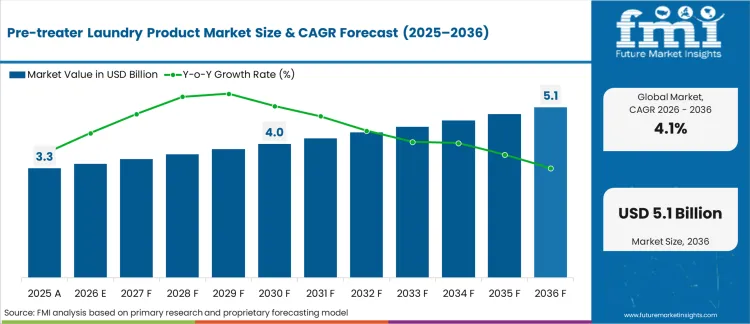
Valuation of the pre-treater laundry product market reached USD 3.3 billion in 2025. The industry is set to attain USD 3.4 billion in 2026 and progress to USD 5.1 billion by 2036. Growth over the forecast timeline is calculated at a CAGR of 4.1%.
The pre-treater laundry product market is expanding due to rising consumer focus on fabric longevity and stain removal precision. Households are investing in higher-value garments, including performance wear and delicate fabrics, which require targeted stain treatment before regular washing. Standard detergents often fail to remove protein-based, oil-based, and pigment stains completely. Pre-treaters address this gap through enzyme-based and surfactant-rich formulations designed for localized application. Growing participation in outdoor activities, sports, and food delivery consumption increases exposure to stubborn stains. Consumers are prioritizing solutions that prevent repeat washing cycles, reduce fabric damage, and preserve color integrity, strengthening category demand.
Summary of Pre-treater Laundry Product Market
- Pre-treater Laundry Product Market Definition:
- The market addresses specialized fabric pre-treatment formulations applied prior to washing in domestic settings, commercial laundry facilities, and institutional textile care systems.
- Demand Drivers in the Market:
- Growing attention toward advanced fabric care practices increases adoption of targeted stain removal solutions prior to regular washing cycles.
- Higher apparel replacement costs encourage consumers to use pre-treatment products that help preserve garment quality and durability.
- Continuous advancements in enzyme-based formulations shorten application time while delivering consistent and reliable stain removal performance.
- Key Segments Analyzed in the Report
- Product Type: Spray Pre-treaters (47%) versus stick applicators and gel formulations.
- Distribution Channel: Supermarkets and Hypermarkets (41%) versus convenience stores and online retail platforms.
- Geography: High-growth Asia Pacific versus mature North American and European markets.
- Analyst Opinion at FMI:
- Nandini Roy Choudhury, Senior Consultant for Consumer Products at Future Market Insights, comments, "The latest edition of the Pre-treater Laundry Product Market Report for 2026 to 2036 highlights technical considerations around enzyme durability, requiring formulations that maintain cleaning consistency under diverse wash temperatures and mineral content levels. My research indicates that rising ingredient transparency expectations influence competitive differentiation, while rigorous performance benchmarking standards may limit participation for producers focused on value-driven retail segments."
- Strategic Implications/Executive Takeaways:
- Redirect product development toward enzyme-driven stain removal technologies rather than conventional all-purpose solutions.
- Elevate in-store shelf placement strategy as a core route-to-market decision instead of treating it as an auxiliary expansion tactic.
- Strengthen stability and compatibility assessments within formulations to ensure uniform performance and reinforce long-term market credibility.
- Methodology:
- Validated through direct retail sales data and household product usage surveys.
- Zero reliance on speculative fabric care trend forecasting.
- Based on verifiable brand performance metrics and confirmed distribution agreements.
Urban living patterns and dual-income households are influencing purchasing behavior toward convenience-oriented laundry solutions. As per the Our World in Data Organization, over 4 billion people reside in urban areas. [1] Time-constrained consumers prefer ready-to-use sprays, pens, and foam applicators that simplify stain treatment. Product innovations such as trigger sprays with controlled dosage and fast-acting formulas are supporting repeat usage. Retail shelf expansion in supermarkets and hypermarkets has improved visibility of stain-specific solutions targeting grease, wine, ink, and cosmetic residues. E-commerce growth enables subscription-based replenishment models, increasing purchase frequency. Marketing strategies centered on fabric care education and demonstration-driven campaigns are enhancing consumer awareness regarding the benefits of pre-treatment in overall wash performance.
Enzyme-driven technologies allow effective cleaning at lower temperatures, aligning with energy conservation practices. Regulatory scrutiny around harsh chemical agents is pushing manufacturers toward biodegradable and phosphate-free compositions. Hospitality, healthcare, and food service operators are adopting pre-treaters to manage hygiene standards and extend linen life cycles. As textile prices rise globally, cost avoidance through garment preservation becomes a practical driver. These structural factors collectively strengthen long-term demand for pre-treater laundry products across residential and institutional segments.
Leading companies are heavily investing in product innovations and capacity innovations to stand out from the competition. In January 2026, Henkel Singapore moved its operations to Geneo at Singapore Science Park to establish a next-generation innovation facility. “The opening of our new Singapore office underscores Henkel’s commitment to building a strong, future-ready foundation in Asia Pacific. Singapore’s dynamic ecosystem, world-class infrastructure, and robust talent pipeline make it an ideal location for us to accelerate our global ambitions and strengthen our regional presence,” said Mark Dorn, Executive Vice President. [2]
Pre-treater Laundry Product Market Key Takeaways
| Metric | Value |
|---|---|
| Market Value (2026) | USD 3.4 billion |
| Market Forecast Value (2036) | USD 5.1 billion |
| Forecast CAGR (2026-2036) | 4.1% |
Source: FMI analysis based on proprietary forecasting model and primary research
Pre-treater Laundry Product Market Definition
Pre-treater laundry products form a specialized fabric care category aimed at treating visible stains before standard laundering processes. The market covers worldwide research, formulation, production, and distribution of performance-driven cleaning agents incorporating enzyme technologies, surfactant combinations, and purpose-built stain treatment solutions for effective pre-wash application.
Pre-treater Laundry Product Market Inclusions
This report offers a detailed assessment of industry performance, covering worldwide and regional market valuation and volume metrics, supported by a forecast spanning 2026 to 2036. It analyzes key segments by product format, namely spray, stick, gel, and powder pre-treaters. Channel-wise evaluation spans supermarkets and hypermarkets, convenience stores, online platforms, and specialty retailers. Application insights extend across residential laundry, commercial laundry services, hospitality operations, and healthcare institutions.
Pre-treater Laundry Product Market Exclusions
The scope excludes general-purpose detergents, fabric softeners, industrial cleaning chemicals, and dry cleaning solvents. It also omits laundry equipment manufacturers, enzyme production facilities, and packaging material suppliers, focusing strictly on finished consumer-ready pre-treatment products designed for stain removal applications and their immediate retail channels. Report does not account for private label contract manufacturing or bulk institutional supply agreements with negligible brand differentiation.
Pre-treater Laundry Product Market Research Methodology
- Primary Research: Interviews were conducted with household product manufacturers, retail category managers, distribution channel representatives, and laundry service operators across major markets. Fabric care specialists clarified enzyme effectiveness standards and application techniques.
- Desk Research: Consumer purchase data from retail tracking services, household cleaning product adoption rates from consumer surveys, and import/export statistics from trade organizations supported market benchmarking.
- Market-Sizing and Forecasting: A hybrid top-down and bottom-up model was developed. Demand was reconstructed from brand sales figures, retail shelf space allocation data, and commercial laundry procurement volumes, then validated against manufacturing output capacity and distribution network coverage.
- Data Validation and Update Cycle: Outputs undergo variance checks across retail and wholesale datasets, cross-verification with household product industry associations, and structured expert review prior to release.
Segmental Analysis
Pre-treater Laundry Product Market Analysis by Product Type
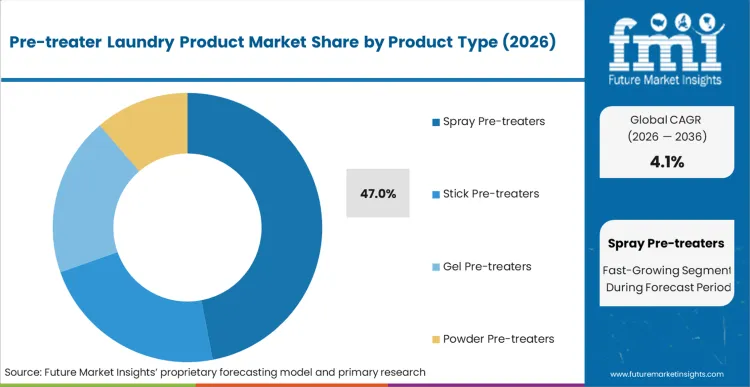
The spray pre-treaters segment is projected to register 47% share in 2026. Spray pre-treaters are witnessing strong demand due to their precision application and ease in laundry care. Consumers prefer targeted stain removal rather than soaking entire garments. Trigger-based spray systems allow direct application on collars, cuffs, underarm areas, and food stains without product wastage. This controlled dosage improves cost efficiency per wash. Households dealing with frequent grease, sauce, cosmetic, and ink stains view sprays as a quick intervention before machine cycles. The convenience of immediate application without dilution supports adoption among busy urban consumers.
- Rapid Stain Penetration Systems: Manufacturers are integrating enzyme-activated liquid bases that begin breaking down protein and oil stains within minutes of contact. This immediate action reduces dwell time before machine cycles, supporting consumers seeking faster laundry turnaround. Fast-response chemistry strengthens repeat usage across households managing school uniforms, workwear, and sports apparel.
- Cold-Water Performance Capability: Spray pre-treaters are being formulated to deliver high efficacy in low-temperature washes. This aligns with energy-saving washing habits and sustainability goals within residential and institutional settings. Effective stain removal without hot water reduces utility costs and positions spray formats as efficient companions to modern high-efficiency washing machines.
Pre-treater Laundry Product Market Analysis by Distribution Channel
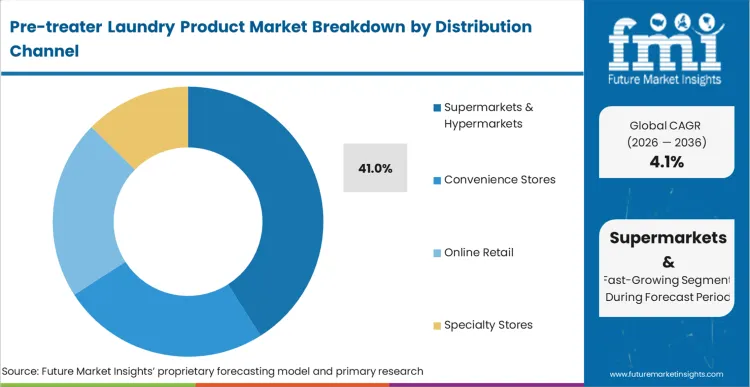
The supermarkets and hypermarkets segment is slated to capture a 41% market share in 2026. Shelf merchandising strategies strengthen in-store conversion. End-cap displays highlighting tough stain removal claims attract attention during promotional cycles. Demonstration-led marketing, including visual before-and-after imagery, influences purchase decisions at the point of sale. Supermarkets and hypermarkets support multi-pack discounts and bundled pricing with detergents, increasing basket value. Bulk buying behavior among families favors purchasing stain removers alongside regular laundry supplies, ensuring consistent replenishment.
- In-Store Demonstration Campaigns: Brands are deploying live stain removal demonstrations and digital screen displays within laundry aisles to educate shoppers on pre-treatment benefits. Visual proof of performance builds credibility and supports trial among first-time buyers. This approach strengthens consumer confidence when selecting between enzyme-based and solvent-based formulations.
- Data-Driven Shelf Allocation: Large retailers are using sales analytics and loyalty program insights to optimize shelf space for high-rotation stain remover SKUs. Assortment planning based on regional stain patterns, such as food spills or outdoor dirt exposure, improves inventory turnover. This precision stocking strategy enhances product availability while supporting steady category revenue growth.
Pre-treater Laundry Product Market Drivers, Restraints, and Opportunities
Expansion of high-efficiency washing machines is strengthening category relevance. Modern machines operate with lower water levels and shorter cycles, limiting the time available for deep stain breakdown. Pre-treatment before machine loading enhances cleaning outcomes under these conditions. Consumers are increasingly optimizing wash performance per cycle to reduce electricity and water consumption. This behavioral shift supports adoption of auxiliary laundry products designed to maximize first-wash effectiveness. Greater awareness of fabric preservation and color retention is influencing households to integrate pre-treatment as a standard step within laundry routines.
Institutional hygiene protocols are further supporting market growth. Hotels, healthcare facilities, food processing units, and quick-service restaurants face strict cleanliness benchmarks. Linen quality directly affects brand perception and compliance standards in these sectors. Pre-treaters allow localized stain correction before bulk laundering, improving operational efficiency and extending textile lifespan.
Price sensitivity in emerging economies limits penetration of specialized laundry additives. Many households continue to rely solely on multipurpose detergents to control overall washing expenses. Limited consumer awareness regarding the functional difference between detergents and pre-treaters slows category expansion in lower-income regions. Shelf competition from stain-removal detergents with built-in boosters reduces standalone product demand. Environmental scrutiny over certain surfactants and chemical agents increases compliance costs for manufacturers. Smaller retail outlets often allocate minimal shelf space to secondary laundry products, restricting visibility. These factors collectively moderate growth momentum in price-conscious and rural markets.
Product innovation centered on plant-based enzymes and biodegradable formulations creates scope for premium positioning. Cold-water compatible pre-treaters aligned with energy-efficient washing habits present expansion potential. E-commerce subscription models allow recurring replenishment and consumer education through digital content. Institutional adoption across hospitality, healthcare, and food service sectors offers volume-based growth avenues. Travel-friendly stain remover pens and compact sprays target on-the-go usage occasions. Smart packaging with measured-dose triggers improves cost efficiency per wash and enhances user convenience. As textile prices rise globally, preventive fabric care solutions present long-term revenue opportunities for manufacturers and retailers.
Regional Analysis
Based on regional analysis, the pre-treater laundry product market is segmented into North America, Latin America, Europe, East Asia, South Asia, Oceania and Middle East & Africa across 40 countries. The full report also offers market attractiveness analysis based on regional trends.
.webp "Top Country Growth Comparison Pre Treater Laundry Product Market Cagr (2026 2036)")
| Country | CAGR (2026 to 2036) |
|---|---|
| United States | 4.3% |
| United Kingdom | 3.9% |
| Germany | 3.8% |
| China | 5.2% |
| India | 4.7% |
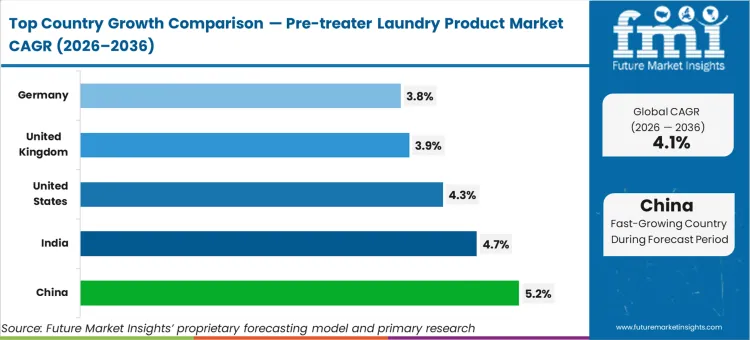
Source: Market analysis based on proprietary forecasting model and primary research
North America Pre-treater Laundry Product Market Analysis
North America's pre-treater laundry product market is growing substantially. Consumers in the region show preference for phosphate-free and biodegradable formulations. Energy-efficient cold-water washing habits are increasing, encouraging use of enzyme-based pre-treaters compatible with lower temperatures. E-commerce growth across North America enables subscription replenishment and product education through digital demonstrations. Brand loyalty remains strong, supporting repeat purchases.
- United States: The U.S. pre-treater laundry products market is projected to expand at 4.3% CAGR from 2026 to 2036. In the United States, high ownership of advanced washing machines supports use of complementary products that enhance wash performance. Consumers frequently manage stains from coffee, sauces, cosmetics, and outdoor activities, increasing reliance on spot-treatment sprays before machine cycles. Large-format retailers such as Walmart and Target allocate defined shelf space to stain removers, improving product visibility. In January 2024, Walmart announced to remodel or convert over 150 stores over the next few years. [3] High penetration of dual-income households drives demand for time-saving solutions that reduce the need for repeat wash cycles.
The analysis delivers extensive coverage of the North American market, including focused evaluation of the United States and Canada. It reviews changing fabric care consumption patterns, category shifts within organized retail, and industry expansion driven by evolving product configurations and structured channel penetration strategies.
Asia Pacific Pre-treater Laundry Product Market Analysis
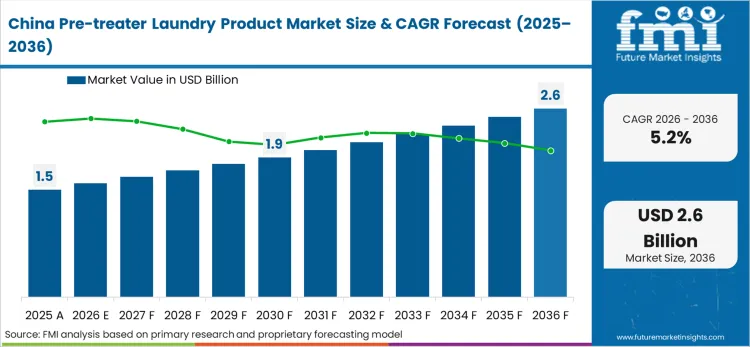
The Asia Pacific pre-treater laundry product market is witnessing steady expansion, supported by rising urban household density and increased awareness of garment care practices. Growing middle-income populations across China, India, and Southeast Asia are allocating higher budgets toward value-added laundry solutions that target stubborn stains. Rapid growth of organized retail chains and e-commerce platforms is improving product accessibility across metropolitan and tier-2 cities.
- China: The Chinese pre-treater laundry product market is set to grow at 5.2% CAGR during the forecast period. The China pre-treater laundry product market is supported by strong domestic manufacturing infrastructure and large-scale chemical processing capabilities. Local producers benefit from integrated supply chains for enzymes and surfactants, enabling competitive production costs and rapid product rollout. Rising disposable income in urban centers such as Shanghai, Beijing, and Guangzhou is increasing spending on premium fabric care solutions designed for targeted stain removal. The State Council of the People’s Republic of China reported in 2025 that the median per capita disposable income in the country witnessed a nominal surge of 5.1% year on year. [4]
- India: The sales of pre-treater laundry products in India are projected to expand at 4.7% CAGR during the study period. Expansion of modern retail outlets and rapid e-commerce growth across tier-1 and tier-2 cities are improving accessibility of spray and gel-based pre-treatment formats. E-commerce giant Amazon has also announced an investment of USD 26 billion in the country by 2030. [5] Domestic manufacturing capabilities enable competitive pricing strategies, supporting broader consumer reach. Demand from organized hospitality, healthcare facilities, and commercial laundry operators in metropolitan regions is strengthening institutional consumption of targeted stain removal products.
The complete study evaluates the pre-treater laundry product market across East and South Asia for the period 2021 to 2036. It reviews household usage behavior, channel expansion patterns, and retail reach across China, Japan, South Korea, India, Singapore, and Australia. The analysis outlines pricing frameworks that influence competitive positioning and support regional market growth.
Europe Pre-treater Laundry Product Market Analysis
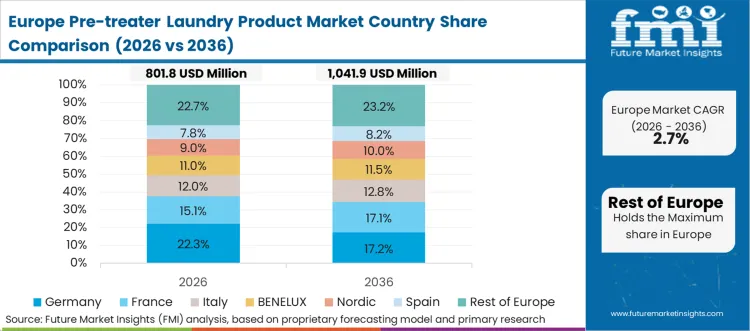
Regulatory oversight influences formulation upgrades across the region. Compliance with European chemical safety and environmental standards encourages development of biodegradable and phosphate-free pre-treatment products. Sustainability-conscious buyers actively seek eco-certified cleaning solutions, supporting premium variants within the category. Private label participation from major retail chains expands affordability while maintaining compliance with ingredient transparency requirements.
- Germany: Demand for pre-treater laundry products in Germany is slated to grow at 3.8% CAGR from 2026 to 2036, driven by established fabric care practices and consumer preference for specialized stain removal solutions. Environmental compliance plays a central role in product development. Manufacturers align formulations with chemical safety and sustainability standards monitored by national authorities such as the Federal Institute for Occupational Safety and Health. Consumers actively seek phosphate-free and biodegradable compositions, encouraging innovation in plant-derived surfactants and concentrated liquid sprays.
- United Kingdom: The U.K. pre-treater laundry products market is slated to expand at 3.9% CAGR during the study period. Inflationary pressure on clothing prices is encouraging households to extend apparel lifespan through preventive stain treatment. Parents managing school uniforms and sports kits rely on pre-treaters to maintain appearance across repeated use. Increased participation in fitness activities and outdoor commuting leads to sweat, mud, and grass stains that require localized treatment before washing. This behavior is embedding pre-treatment as a standard step within household laundry management.
The European pre-treater laundry product market evaluation features country-level insights for the United Kingdom, Germany, France, Italy, Spain, the Netherlands, and the Scandinavian region. It provides structured examination of retail segmentation, shelf allocation dynamics, and evolving consumer purchase behavior across diverse European economies.
Competitive Landscape for Pre-treater Laundry Product Market Players
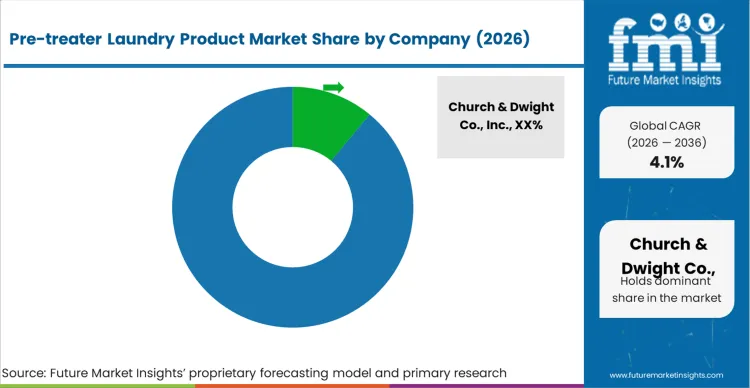
The competitive structure of the pre-treater laundry product market is shaped by innovation cycles, supply chain integration, and brand-led category education. Market participants compete through development of multi-enzyme blends tailored for specific stain categories such as oil-based residues, food pigments, and protein marks. Investment in R&D facilities supports testing under varied wash conditions to ensure formulation reliability across fabric types including cotton, synthetics, and blended textiles.
Strategic collaborations with large retail chains secure premium shelf positioning and promotional visibility during seasonal demand peaks. Brands are introducing compact packaging and measured-dose applicators to enhance convenience and reduce product wastage. Eco-friendly considerations are gaining traction, with select manufacturers incorporating biodegradable surfactants and recyclable packaging materials to align with environmental compliance standards.
Digital marketing campaigns emphasize demonstration-led content to educate consumers on pre-treatment techniques, strengthening product differentiation. Regional players compete aggressively on pricing in emerging economies, while established global brands leverage advertising scale and distribution reach. Competitive intensity remains moderate to high, with success dependent on formulation credibility, channel depth, and consumer trust built through consistent stain removal performance.
Recent Developments:
The report includes comprehensive coverage of key industry developments and competitive positioning:
- In January 2025, Henkel released Smartwash™ Technology, an AI-driven, cartridge-based detergent dosing system that can power washing machines and dishwashers. The company launched Persil and Somat Smartwash to target the European market. [6]
Key Players in Pre-treater Laundry Product Market
- Church & Dwight Co., Inc.
- Reckitt Benckiser LLC
- WHIP-IT INVENTIONS, Inc.
- Unilever Ltd.
- S.C. Johnson & Son, Inc.
- Henkel AG & Co. KGaA
Scope of the Report
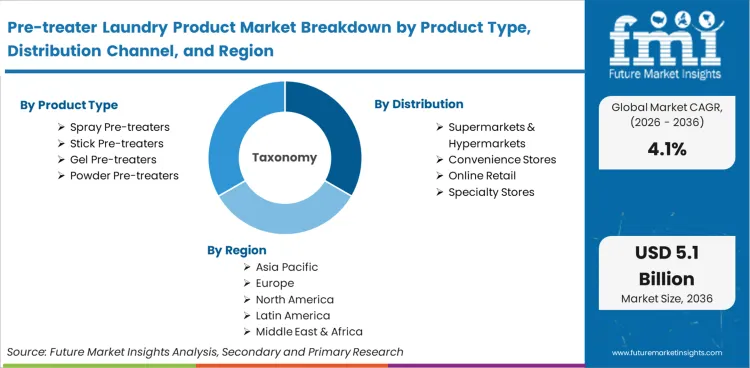
| Metric | Value |
|---|---|
| Quantitative Units | USD 3.4 billion (2026) to USD 5.1 billion (2036), at a CAGR of 4.1% |
| Market Definition | The pre-treater laundry product market comprises the global development, production, and distribution of specialized stain removal formulations including spray treatments, stick applicators, and gel products designed for fabric pre-treatment applications across household and commercial laundry operations. |
| Product Type Segmentation | Spray Pre-treaters, Stick Pre-treaters, Gel Pre-treaters, Powder Pre-treaters |
| Distribution Channel Coverage | Supermarkets and Hypermarkets, Convenience Stores, Online Retail, Specialty Stores |
| Application Segmentation | Household Use, Commercial Laundries, Hospitality Sector, Healthcare Facilities |
| Regions Covered | North America, Latin America, Europe, East Asia, South Asia, Oceania, Middle East and Africa |
| Countries Covered | United States, Canada, United Kingdom, Germany, France, China, Japan, India, Brazil, UAE and 40 countries |
| Key Companies Profiled | Church & Dwight Co. Inc., Reckitt Benckiser LLC, WHIP-IT INVENTIONS Inc., Unilever Ltd., S.C. Johnson & Son Inc., Henkel AG & Co. KGaA |
| Forecast Period | 2026 to 2036 |
| Approach | Hybrid top down and bottom up market modeling validated through retail sales tracking and household product usage surveys, supported by distribution network verification and consumer purchase pattern analysis |
Pre-treater Laundry Product Market Analysis by Segments
Product Type:
- Spray Pre-treaters
- Stick Pre-treaters
- Gel Pre-treaters
- Powder Pre-treaters
Distribution Channel:
- Supermarkets and Hypermarkets
- Convenience Stores
- Online Retail
- Specialty Stores
- Others (wholesale clubs, direct sales)
Application:
- Household Use
- Commercial Laundries
- Hospitality Sector
- Healthcare Facilities
Region:
- Asia Pacific
- China
- Japan
- South Korea
- India
- Australia
- Singapore
- Thailand
- Rest of Asia Pacific
- Europe
- United Kingdom
- Germany
- France
- Italy
- Spain
- Netherlands
- Scandinavia
- Switzerland
- Rest of Europe
- North America
- United States
- Canada
- Latin America
- Brazil
- Mexico
- Argentina
- Rest of Latin America
- Middle East & Africa
- United Arab Emirates
- Saudi Arabia
- South Africa
- Israel
- Rest of Middle East & Africa
Bibliography
- [1] Ritchie, H., Samborska, V., & Roser, M. (2024). Urbanization. Our World in Data.
- [2] Henkel AG & Co. KGaA. (2026, January 27). Henkel strengthens global innovation and supply chain hub with move to Singapore Science Park.
- [3] Walmart. (2024, January 31). Investing in America: Walmart announces new stores, more jobs.
- [4] The State Council Information Office of the People’s Republic of China. (2025, January 17). China sees stable growth in people’s incomes in 2024.
- [5] India Brand Equity Foundation. (n.d.). India’s e-commerce boom: Growth, trends & future prospects.
- [6] PR Newswire. (2025). Henkel’s Smartwash™ defines a new era of clean at CES® 2025.
This bibliography is provided for reader reference and is not exhaustive. The full report contains the complete reference list and detailed citations.
This Report Addresses
- Market intelligence to enable strategic decision making across established and emerging fabric care markets
- Market size estimation and 10-year revenue forecasts from 2026 to 2036, supported by validated retail sales data and household product usage surveys
- Growth opportunity mapping across product types and application segments with emphasis on enzyme technology optimization
- Segment and regional revenue forecasts covering spray pre-treaters, stick applicators, gel formulations, and retail distribution networks
- Competition strategy assessment including retail partnership requirements, enzyme formulation positioning, and brand awareness development
- Product development tracking including enzyme technology innovations, application method trends, and packaging format evolution
- Market access analysis covering distribution agreements, retail category management, and promotional program effectiveness
- Market report delivery in PDF, Excel, PPT, and interactive dashboard formats for executive and operational use
Frequently Asked Questions
How large is the demand for Pre-treater Laundry Products in the global market in 2026?
Demand for Pre-treater Laundry Products in the global market is estimated to be valued at USD 3.4 billion in 2026.
What will be the market size of Pre-treater Laundry Products in the global market by 2036?
Market size for Pre-treater Laundry Products is projected to reach USD 5.1 billion by 2036.
What is the expected demand growth for Pre-treater Laundry Products in the global market between 2026 and 2036?
Demand for Pre-treater Laundry Products in the global market is expected to grow at a CAGR of 4.1% between 2026 and 2036.
Which Product Type is poised to lead global sales by 2026?
Spray Pre-treaters is expected to be the dominant product type, capturing approximately 47.0% of global market share in 2026 due to precision application features and even coverage distribution.
How significant is the role of Supermarkets and Hypermarkets in driving Pre-treater Laundry Product adoption in 2026?
Supermarkets and hypermarkets represent a primary distribution channel, projected to hold approximately 41% share of the total market in 2026 as shelf placement strategies and promotional coordination maintain physical retail relevance.
What is Driving Pre-treater Laundry Product Demand in the United States?
Increasing fabric care awareness and rising adoption of specialized stain removal products across household segments are driving growth.
What Consumer Trends are Referenced for the United States?
Fabric care awareness patterns and garment longevity priorities are referenced as key consumer behavior shifts.
What is the United States Growth Outlook in this Report?
The United States is projected to grow at a CAGR of 4.3% during 2026 to 2036.
Why is Europe described as Important for Product Development in this Report?
Growth is driven by consumer awareness of specialized cleaning products and retail category maturity that establish standardized product specifications.
What Type of Product Development Dominates in Europe?
Enzyme-based pre-treatment formulations with targeted stain removal capabilities and concentrated formats dominate regional market segments.
What is Germany Growth Outlook in this Report?
Germany is projected to expand at a CAGR of 3.8% during 2026 to 2036.
Does the Report Cover China in its Regional Analysis?
China is included within East Asia under the regional scope of analysis.
What are the Sources referred to for analyzing the Market in China?
Household product adoption data, retail infrastructure statistics, and local brand performance tracking covering purchase patterns, price sensitivity analysis, and format preference evolution are cited as primary reference sources.
What is the Main Development Theme Linked to China in Asia Coverage?
Asia Pacific development is associated with rising disposable incomes enabling product standardization across urban centers.
Does the Report Cover India in its Regional Analysis?
India is included within South Asia under the regional coverage framework.
What is the Main India Related Development Theme in Asia Coverage?
Growing middle-class purchasing power creating foundation for specialized cleaning product adoption and local manufacturing using cost-effective production methods is emphasized.
Which Distribution Strategies are Strategically Important for Asia Pacific Market Entry?
Retail partnership development and mid-tier product positioning are prioritized for cost-effective market penetration across regional segments.
What is Pre-treater Laundry Product and What is It Mainly Used For?
Pre-treater laundry products involve specialized stain removal formulations primarily used for fabric pre-treatment including household laundry, commercial cleaning services, and institutional fabric care operations.
What does Pre-treater Laundry Product Market Mean in this Report?
Pre-treater laundry product market refers to global development, manufacturing, and retail distribution of specialized stain removal products across various application categories and consumer segments.
What is Included in the Scope of this Pre-treater Laundry Product Market Report?
Scope covers products by type, key distribution channels such as supermarkets and online platforms, and application segments including household use, commercial laundries, and hospitality operations.
What is Excluded from the Scope of this Report?
General-purpose detergents, fabric softeners, industrial cleaning chemicals, and dry cleaning solvents are excluded unless part of specialized pre-treatment product offerings.
What does Market Forecast Mean on this Page?
Market forecast represents model-based projections built on retail sales trends and household product usage assumptions for strategic planning purposes.
How is the Pre-treater Laundry Product Market Forecast Built and Validated?
Forecast is developed using hybrid modeling validated through retail point-of-sale data, household product usage surveys, and distribution network verification.
What does Zero Reliance on Speculative Third Party Market Research Mean Here?
Market analysis is based on verifiable sales figures, household product adoption data, and retail purchase patterns rather than speculative cleaning product trend predictions.
Preview the report firsthand - request a free sample
Get SampleGet the brochure for pricing and purchase details.
Get PDFTable of Content
- Executive Summary
- Global Market Outlook
- Demand-side Trends
- Supply-side Trends
- Technology Roadmap Analysis
- Analysis and Recommendations
- Market Overview
- Market Coverage / Taxonomy
- Market Definition / Scope / Limitations
- Research Methodology
- Chapter Orientation
- Analytical Lens and Working Hypotheses
- Market Structure, Signals, and Trend Drivers
- Benchmarking and Cross-market Comparability
- Market Sizing, Forecasting, and Opportunity Mapping
- Research Design and Evidence Framework
- Desk Research Programme (Secondary Evidence)
- Company Annual and Sustainability Reports
- Peer-reviewed Journals and Academic Literature
- Corporate Websites, Product Literature, and Technical Notes
- Earnings Decks and Investor Briefings
- Statutory Filings and Regulatory Disclosures
- Technical White Papers and Standards Notes
- Trade Journals, Industry Magazines, and Analyst Briefs
- Conference Proceedings, Webinars, and Seminar Materials
- Government Statistics Portals and Public Data Releases
- Press Releases and Reputable Media Coverage
- Specialist Newsletters and Curated Briefings
- Sector Databases and Reference Repositories
- FMI Internal Proprietary Databases and Historical Market Datasets
- Subscription Datasets and Paid Sources
- Social Channels, Communities, and Digital Listening Inputs
- Additional Desk Sources
- Expert Input and Fieldwork (Primary Evidence)
- Primary Modes
- Qualitative Interviews and Expert Elicitation
- Quantitative Surveys and Structured Data Capture
- Blended Approach
- Why Primary Evidence is Used
- Field Techniques
- Interviews
- Surveys
- Focus Groups
- Observational and In-context Research
- Social and Community Interactions
- Stakeholder Universe Engaged
- C-suite Leaders
- Board Members
- Presidents and Vice Presidents
- R&D and Innovation Heads
- Technical Specialists
- Domain Subject-matter Experts
- Scientists
- Physicians and Other Healthcare Professionals
- Governance, Ethics, and Data Stewardship
- Research Ethics
- Data Integrity and Handling
- Primary Modes
- Tooling, Models, and Reference Databases
- Desk Research Programme (Secondary Evidence)
- Data Engineering and Model Build
- Data Acquisition and Ingestion
- Cleaning, Normalisation, and Verification
- Synthesis, Triangulation, and Analysis
- Quality Assurance and Audit Trail
- Market Background
- Market Dynamics
- Drivers
- Restraints
- Opportunity
- Trends
- Scenario Forecast
- Demand in Optimistic Scenario
- Demand in Likely Scenario
- Demand in Conservative Scenario
- Opportunity Map Analysis
- Product Life Cycle Analysis
- Supply Chain Analysis
- Investment Feasibility Matrix
- Value Chain Analysis
- PESTLE and Porter’s Analysis
- Regulatory Landscape
- Regional Parent Market Outlook
- Production and Consumption Statistics
- Import and Export Statistics
- Market Dynamics
- Global Market Analysis 2021 to 2025 and Forecast, 2026 to 2036
- Historical Market Size Value (USD Million) Analysis, 2021 to 2025
- Current and Future Market Size Value (USD Million) Projections, 2026 to 2036
- Y-o-Y Growth Trend Analysis
- Absolute $ Opportunity Analysis
- Global Market Pricing Analysis 2021 to 2025 and Forecast 2026 to 2036
- Global Market Analysis 2021 to 2025 and Forecast 2026 to 2036, By Product Type
- Introduction / Key Findings
- Historical Market Size Value (USD Million) Analysis By Product Type , 2021 to 2025
- Current and Future Market Size Value (USD Million) Analysis and Forecast By Product Type , 2026 to 2036
- Spray Pre-treaters
- Stick Pre-treaters
- Gel Pre-treaters
- Powder Pre-treaters
- Spray Pre-treaters
- Y-o-Y Growth Trend Analysis By Product Type , 2021 to 2025
- Absolute $ Opportunity Analysis By Product Type , 2026 to 2036
- Global Market Analysis 2021 to 2025 and Forecast 2026 to 2036, By Distribution Channel
- Introduction / Key Findings
- Historical Market Size Value (USD Million) Analysis By Distribution Channel, 2021 to 2025
- Current and Future Market Size Value (USD Million) Analysis and Forecast By Distribution Channel, 2026 to 2036
- Supermarkets and Hypermarkets
- Convenience Stores
- Online Retail
- Specialty Stores
- Supermarkets and Hypermarkets
- Y-o-Y Growth Trend Analysis By Distribution Channel, 2021 to 2025
- Absolute $ Opportunity Analysis By Distribution Channel, 2026 to 2036
- Global Market Analysis 2021 to 2025 and Forecast 2026 to 2036, By Region
- Introduction
- Historical Market Size Value (USD Million) Analysis By Region, 2021 to 2025
- Current Market Size Value (USD Million) Analysis and Forecast By Region, 2026 to 2036
- North America
- Latin America
- Western Europe
- Eastern Europe
- East Asia
- South Asia and Pacific
- Middle East & Africa
- Market Attractiveness Analysis By Region
- North America Market Analysis 2021 to 2025 and Forecast 2026 to 2036, By Country
- Historical Market Size Value (USD Million) Trend Analysis By Market Taxonomy, 2021 to 2025
- Market Size Value (USD Million) Forecast By Market Taxonomy, 2026 to 2036
- By Country
- USA
- Canada
- Mexico
- By Product Type
- By Distribution Channel
- By Country
- Market Attractiveness Analysis
- By Country
- By Product Type
- By Distribution Channel
- Key Takeaways
- Latin America Market Analysis 2021 to 2025 and Forecast 2026 to 2036, By Country
- Historical Market Size Value (USD Million) Trend Analysis By Market Taxonomy, 2021 to 2025
- Market Size Value (USD Million) Forecast By Market Taxonomy, 2026 to 2036
- By Country
- Brazil
- Chile
- Rest of Latin America
- By Product Type
- By Distribution Channel
- By Country
- Market Attractiveness Analysis
- By Country
- By Product Type
- By Distribution Channel
- Key Takeaways
- Western Europe Market Analysis 2021 to 2025 and Forecast 2026 to 2036, By Country
- Historical Market Size Value (USD Million) Trend Analysis By Market Taxonomy, 2021 to 2025
- Market Size Value (USD Million) Forecast By Market Taxonomy, 2026 to 2036
- By Country
- Germany
- UK
- Italy
- Spain
- France
- Nordic
- BENELUX
- Rest of Western Europe
- By Product Type
- By Distribution Channel
- By Country
- Market Attractiveness Analysis
- By Country
- By Product Type
- By Distribution Channel
- Key Takeaways
- Eastern Europe Market Analysis 2021 to 2025 and Forecast 2026 to 2036, By Country
- Historical Market Size Value (USD Million) Trend Analysis By Market Taxonomy, 2021 to 2025
- Market Size Value (USD Million) Forecast By Market Taxonomy, 2026 to 2036
- By Country
- Russia
- Poland
- Hungary
- Balkan & Baltic
- Rest of Eastern Europe
- By Product Type
- By Distribution Channel
- By Country
- Market Attractiveness Analysis
- By Country
- By Product Type
- By Distribution Channel
- Key Takeaways
- East Asia Market Analysis 2021 to 2025 and Forecast 2026 to 2036, By Country
- Historical Market Size Value (USD Million) Trend Analysis By Market Taxonomy, 2021 to 2025
- Market Size Value (USD Million) Forecast By Market Taxonomy, 2026 to 2036
- By Country
- China
- Japan
- South Korea
- By Product Type
- By Distribution Channel
- By Country
- Market Attractiveness Analysis
- By Country
- By Product Type
- By Distribution Channel
- Key Takeaways
- South Asia and Pacific Market Analysis 2021 to 2025 and Forecast 2026 to 2036, By Country
- Historical Market Size Value (USD Million) Trend Analysis By Market Taxonomy, 2021 to 2025
- Market Size Value (USD Million) Forecast By Market Taxonomy, 2026 to 2036
- By Country
- India
- ASEAN
- Australia & New Zealand
- Rest of South Asia and Pacific
- By Product Type
- By Distribution Channel
- By Country
- Market Attractiveness Analysis
- By Country
- By Product Type
- By Distribution Channel
- Key Takeaways
- Middle East & Africa Market Analysis 2021 to 2025 and Forecast 2026 to 2036, By Country
- Historical Market Size Value (USD Million) Trend Analysis By Market Taxonomy, 2021 to 2025
- Market Size Value (USD Million) Forecast By Market Taxonomy, 2026 to 2036
- By Country
- Kingdom of Saudi Arabia
- Other GCC Countries
- Turkiye
- South Africa
- Other African Union
- Rest of Middle East & Africa
- By Product Type
- By Distribution Channel
- By Country
- Market Attractiveness Analysis
- By Country
- By Product Type
- By Distribution Channel
- Key Takeaways
- Key Countries Market Analysis
- USA
- Pricing Analysis
- Market Share Analysis, 2025
- By Product Type
- By Distribution Channel
- Canada
- Pricing Analysis
- Market Share Analysis, 2025
- By Product Type
- By Distribution Channel
- Mexico
- Pricing Analysis
- Market Share Analysis, 2025
- By Product Type
- By Distribution Channel
- Brazil
- Pricing Analysis
- Market Share Analysis, 2025
- By Product Type
- By Distribution Channel
- Chile
- Pricing Analysis
- Market Share Analysis, 2025
- By Product Type
- By Distribution Channel
- Germany
- Pricing Analysis
- Market Share Analysis, 2025
- By Product Type
- By Distribution Channel
- UK
- Pricing Analysis
- Market Share Analysis, 2025
- By Product Type
- By Distribution Channel
- Italy
- Pricing Analysis
- Market Share Analysis, 2025
- By Product Type
- By Distribution Channel
- Spain
- Pricing Analysis
- Market Share Analysis, 2025
- By Product Type
- By Distribution Channel
- France
- Pricing Analysis
- Market Share Analysis, 2025
- By Product Type
- By Distribution Channel
- India
- Pricing Analysis
- Market Share Analysis, 2025
- By Product Type
- By Distribution Channel
- ASEAN
- Pricing Analysis
- Market Share Analysis, 2025
- By Product Type
- By Distribution Channel
- Australia & New Zealand
- Pricing Analysis
- Market Share Analysis, 2025
- By Product Type
- By Distribution Channel
- China
- Pricing Analysis
- Market Share Analysis, 2025
- By Product Type
- By Distribution Channel
- Japan
- Pricing Analysis
- Market Share Analysis, 2025
- By Product Type
- By Distribution Channel
- South Korea
- Pricing Analysis
- Market Share Analysis, 2025
- By Product Type
- By Distribution Channel
- Russia
- Pricing Analysis
- Market Share Analysis, 2025
- By Product Type
- By Distribution Channel
- Poland
- Pricing Analysis
- Market Share Analysis, 2025
- By Product Type
- By Distribution Channel
- Hungary
- Pricing Analysis
- Market Share Analysis, 2025
- By Product Type
- By Distribution Channel
- Kingdom of Saudi Arabia
- Pricing Analysis
- Market Share Analysis, 2025
- By Product Type
- By Distribution Channel
- Turkiye
- Pricing Analysis
- Market Share Analysis, 2025
- By Product Type
- By Distribution Channel
- South Africa
- Pricing Analysis
- Market Share Analysis, 2025
- By Product Type
- By Distribution Channel
- USA
- Market Structure Analysis
- Competition Dashboard
- Competition Benchmarking
- Market Share Analysis of Top Players
- By Regional
- By Product Type
- By Distribution Channel
- Competition Analysis
- Competition Deep Dive
- Church & Dwight Co., Inc.
- Overview
- Product Portfolio
- Profitability by Market Segments (Product/Age /Sales Channel/Region)
- Sales Footprint
- Strategy Overview
- Marketing Strategy
- Product Strategy
- Channel Strategy
- Reckitt Benckiser LLC
- WHIP-IT INVENTIONS, Inc.
- Unilever Ltd.
- S.C. Johnson & Son, Inc.
- Henkel AG & Co. KGaA
- Church & Dwight Co., Inc.
- Competition Deep Dive
- Assumptions & Acronyms Used


