

- Industry Size (2026)
- USD 59.6 Bn
- Forecast (2036)
- USD 108.7 Bn
- CAGR (2026 to 2036)
- 6.2%
Surfactants Market Size, Market Forecast and Outlook By FMI
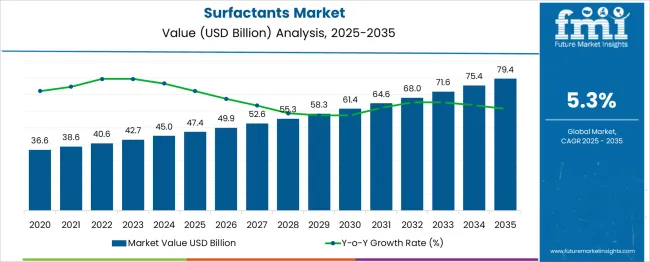
From a valuation of USD 56.1 billion in 2025, the surfactants market is set to cross USD 59.6 billion in 2026 and reach USD 108.7 billion by 2036. The implied CAGR is 6.2%, reflecting a structural transition where buyers prioritize regionally sourced, low-carbon ingredients over commoditized petrochemical imports to mitigate supply volatility.
As per FMI's projection, compliance mandates and retrofit capex are redefining entry barriers. Manufacturers are no longer just competing on price but on the ability to integrate biosurfactants into existing formulations without performance loss. This necessitates significant capital expenditure in upgrading reactor capabilities to handle milder fermentation processes, as seen with recent expansions in Thailand and the US, forcing smaller players to consolidate or exit.
Summary of Surfactants Market
- Surfactants Market Definition:
- Global trade of surface-active agents functioning as detergents and emulsifiers across industrial and consumer sectors.
- Demand Drivers in the Market:
- Shift toward bio based surfactants for detergents due to toxicity concerns.
- Rising hygiene standards in developing economies boosting homecare volumes.
- Industrial demand for biodegradable emulsifiers in agrochemicals.
- Key Segments Analyzed in the FMI Report:
- Source: Synthetic surfactants dominate with 75.0% share but face bio-based erosion.
- Product: Non-ionic surfactants lead (45.0%) due to low-temperature efficacy.
- Geography: High-growth Asia Pacific versus regulation-heavy Europe and North America.
- Analyst Opinion at FMI:
- Nikhil Kaitwade, Principal Consultant for Chemicals and Process Automation, opines, "In the updated version of the Surfactants Market Report for 2026 to 2036, CXOs will find insights into how feedstock volatility is driving a permanent wedge between fossil-based and bio-based pricing. Besides this, my findings point at localized fermentation capacity becoming the single biggest determinant of market share in the next decade."
- Strategic Implications/Executive Takeaways:
- Prioritize R&D in waste-stream fermentation to decouple from palm oil pricing.
- Secure ISCC PLUS certification to defend market share in Europe and North America.
- Localize manufacturing in India and China to mitigate freight costs and tariffs.
- Methodology:
- Validated through first-hand corporate production and capacity data.
- Zero reliance on speculative third-party market research reports.
- Based on verifiable industrial benchmarks and verified sources.
Evonik’s Head of Specialty Additives, Claudine Mollenkopf, stated in January 2024, "As an innovation frontrunner in specialty markets, we strive to offer both excellent product performance and sustainability leadership. Thanks to the ISCC PLUS certification for the production of specialty chemicals such as our surfactants at the Goldschmidt site in Essen, our customers from coatings and inks to adhesives, polyurethane foams and personal care will have access to a wider range of certified additives made from a higher proportion of [renewable raw materials]." [9] Buyers must interpret this as a signal that certified traceability is becoming a prerequisite for contract renewal in premium segments. Suppliers failing to secure mass-balance certifications will likely face exclusion from high-margin personal care and homecare tenders by 2027.
Growth is unevenly distributed, with emerging Asian economies like India (8.1% CAGR) and China (7.8% CAGR) outpacining mature markets. While the USA (5.2%) and Germany (4.7%) focus on replacement demand driven by green chemistry reformulation, Brazil (6.0%) and Japan (3.9%) are scaling domestic output to reduce import reliance.
Surfactants Market Definition
The surfactants market comprises the global trade and production of surface-active agents that lower surface tension between liquids, gases, and solids. These chemical compounds act as detergents, wetting agents, emulsifiers, foaming agents, and dispersants in industrial and consumer applications. Primary value generation stems from the synthesis of hydrophobic tails and hydrophilic heads to create specific cleaning or solubilizing properties.
Surfactants Market Inclusions
Analysis includes anionic, non-ionic, cationic, and amphoteric surfactant classes derived from both petrochemical and oleochemical feedstocks. The report covers applications across homecare cleaning, personal care formulations, industrial and institutional (I&I) cleaning, and niche uses in agriculture or oilfield chemicals. It quantifies value from raw material synthesis through to the sale of active surfactant ingredients to formulators.
Surfactants Market Exclusions
Scope excludes the retail value of finished consumer goods such as bottled shampoos, laundry detergent pods, or ready-to-use industrial degreasers. It also omits non-surfactant additives used in these formulations, such as builders, enzymes, or fragrances, unless they are chemically bonded surfactant hybrids. Equipment for manufacturing surfactants and unrelated upstream crude oil refining are also outside the report boundary.
Surfactants Market Research Methodology
- Primary Research: Interviews with chemical process engineers, procurement heads at FMCG companies, distributors, and sustainability officers verified capacity utilization and pricing shifts.
- Desk Research: Analysis of import/export codes, corporate annual reports, environmental impact assessments, and government industrial output indices provided baseline volumes.
- Market-Sizing and Forecasting: A bottom-up approach aggregated production data from key chemical clusters, validated against top-down demand models from end-use sectors.
- Data Validation and Update Cycle: Anomaly detection algorithms checked CAGR consistency against regional GDP and industrial production metrics before peer review.
Segmental Analysis
Surfactants Market Analysis by Source
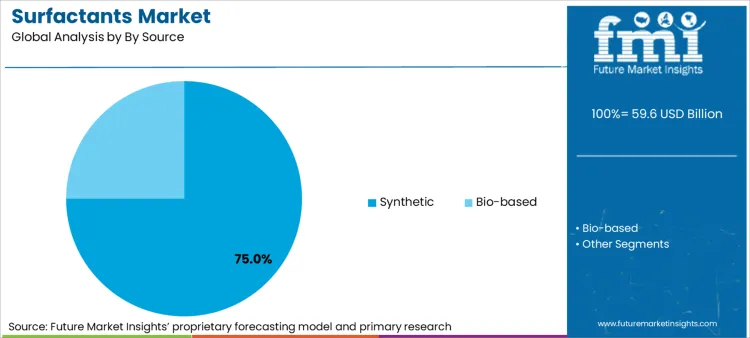
Synthetic surfactants currently hold 75.0% of the market, driven by cost-efficiency and established petrochemical supply chains, yet the trajectory is shifting toward bio-based alternatives. According to FMI's estimates, the premium for bio-based inputs is narrowing as scale improves, encouraging major formulators to blend natural surfactant options into mass-market products.
- Feedstock decoupling: Volatility in crude oil prices pushes manufacturers toward bio-feedstocks to stabilize margins. This shift reduces exposure to petrochemical cycles, evidenced by AIST's projection that Japan's bio-based surfactant value will reach 2.32 trillion yen by 2030, offering suppliers a predictable input cost structure. [1]
- Innovation trajectory: Startups are bypassing first-generation crops by utilizing agricultural waste for surfactant production. AmphiStar’s recent €8.5 million funding rounds in 2024 and 2025 validate this approach, signaling to investors that commercial viability for waste-derived sophorolipids is imminent. [5]
- Procurement mandate: FMCG buyers are aggressively enforcing "fossil-free" targets for 2030 to meet consumer net-zero expectations. This demand pulls forward investment in bio-refineries, forcing traditional suppliers to acquire biotech capabilities or risk losing contracts with global homecare giants. [9]
Surfactants Market Analysis by Product Type
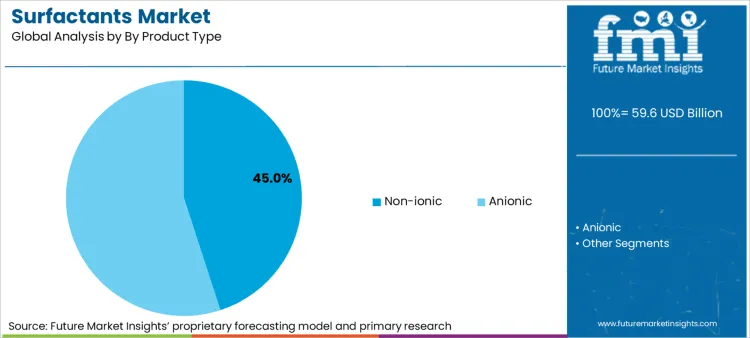
Non-ionic surfactants capture 45.0% of the market, favoured for their stability in cold-water washing and compatibility with enzymes. Demand is bolstered by the linear alkylbenzene sulfonate las replacement trend, where milder non-ionic formulations are preferred for liquid detergents.
- Performance driver: Lower wash temperatures in residential laundry require surfactants that remain active in cold water. This necessity drives the adoption of advanced non-ionic grades, supporting steady volume growth even as total detergent dosage per load decreases. [8]
- Safety formulation: Personal care brands are replacing harsh anionic sulfates with milder non-ionic and amphoteric alternatives to reduce skin irritation. This substitution is accelerating in premium segments, creating a high-value niche for specialized mild surfactants. [9]
- Industrial utility: In industrial cleaning, non-ionic surfactants offer superior grease emulsification without forming insoluble precipitates in hard water. This technical advantage ensures their dominance in I&I applications, securing long-term volume commitments from institutional buyers. [7]
Surfactants Market Analysis by Application
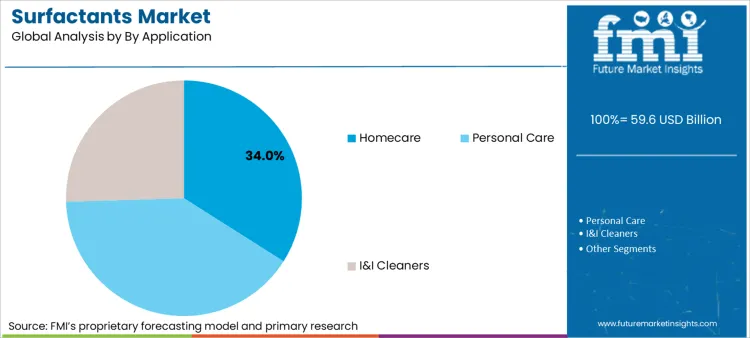
Homecare remains the dominant application with a 34% share, sustained by population growth and hygiene awareness. FMI analysts opine that while volume growth is steady, value growth is accelerating due to the premiumization of personal care surfactants and eco-friendly dishwashing liquids.
- Hygiene expansion: Urbanization in emerging markets creates millions of new households adopting washing machines and liquid detergents. BASF’s 2025 expansion of Alkyl Polyglucosides capacity in Thailand directly targets this surging regional consumption, ensuring supply security for local detergent brands. [2]
- Sustainability shift: Consumers in developed markets are willing to pay a premium for "green" cleaning products. This preference forces brands to reformulate with biodegradable surfactants, driving R&D spending and justifying higher price points for eco-certified product lines. [9]
- Industrial recovery: Recovery in manufacturing output drives demand for industrial cleaners and emulsifiers. Brazil’s industrial sector, closing 2025 with growth in 10 out of 18 surveyed areas, signals a rebound in demand for heavy-duty I&I surfactants used in factory maintenance. [6]
Surfactants Market Drivers, Restraints, and Opportunities
Regulatory pressure on toxicity and biodegradability is the primary driver reshaping the surfactants landscape. Governments are imposing stricter limits on aquatic toxicity and non-biodegradable residues, forcing a wholesale reformulation of cleaning products. This regulatory squeeze compels manufacturers to abandon legacy alkylphenol ethoxylates in favor of environmentally benign alternatives. For instance, Japan’s Cabinet Order in September 2024 designated the surfactant NPE as a Class II Specified Chemical Substance, mandating strict labeling and effectively phasing it out of supply chains. [2] This move accelerates the adoption of compliant bio-based chemistries.
Volatile feedstock pricing acts as a significant restraint, complicating long-term planning for synthetic surfactant producers. Reliance on ethylene and benzene exposes manufacturers to crude oil price swings, while first-generation bio-surfactants face competition with food supply chains for vegetable oils. Producers mitigate this by adopting flexible manufacturing processes or hedging raw material costs. In the US, the Detergent PPI reached 379.5 in December 2025, reflecting the inflationary pressure passed down to formulators, which limits margin expansion for suppliers unable to optimize input costs. [8]
- Waste-to-value synthesis: Utilizing agricultural residues creates a low-cost, sustainable feedstock for biosurfactants, insulating producers from food price inflation. AmphiStar’s launch of waste-derived microbial surfactants in 2024 demonstrates how circular economy models can deliver price-competitive, high-performance ingredients to the hair care surfactants sector. [5]
- Regional manufacturing hubs: Establishing local production reduces logistics costs and tariffs, enhancing competitiveness in price-sensitive markets. Croda’s commissioning of a new plant in Dahej, India, in early 2025 allows it to serve the rapidly expanding local personal care market with shorter lead times and lower inventory risks. [3]
- Smart formulation aids: Developing surfactants that enhance the efficiency of cold-water washing opens new revenue streams in the energy-conscious homecare segment. Innovation in this space allows suppliers to market value-added ingredients that help consumers save on utility bills, justifying premium pricing. [8]
Regional Analysis
Based on the regional analysis, the Surfactants Market is segmented into North America, Latin America, Europe, East Asia, South Asia, Oceania and Middle East & Africa across 40+ countries. The full report also offers market attractiveness analysis based on regional trends.
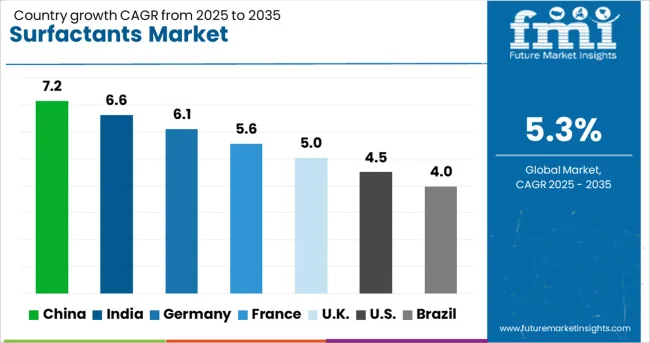
| Country | CAGR (2026 to 2036) |
|---|---|
| India | 8.1% |
| China | 7.8% |
| Brazil | 6.0% |
| USA | 5.2% |
| Germany | 4.7% |
| UK | 4.2% |
| Japan | 3.9% |
Source: Future Market Insights (FMI) analysis, based on proprietary forecasting model and primary research
Asia Pacific Surfactants Market Analysis
Asia Pacific is pivoting from being a low-cost export hub to a center of high-value consumption and green innovation. Demand is fueled by the rising middle class upgrading to liquid detergents and premium personal care products, necessitating localized supply chains. As per FMI's estimates, the region is becoming a critical engine for corporate growth, with major players like Evonik targeting significant revenue expansion here. Evonik’s explicit target to achieve one-third of global sales from Asia-Pacific by 2032, with China sales exceeding €2 billion, underscores the strategic imperative to align production footprints with this demand center. [4]
- India: Growth tracks a CAGR of 8.1% as rising disposable incomes drive the conversion from bar soaps to liquid detergents and premium shampoos. This rapid expansion is supported by Croda’s 18% sales growth in the country, prompting the commissioning of a new dedicated surfactants plant in Dahej in early 2025 to secure local market share. [3]
- China: A CAGR of 7.8% reflects a massive industrial base transitioning toward higher quality and environmental standards. Evonik reported sales exceeding €1.4 billion in 2024, confirming that the market’s appetite for specialty additives remains robust despite broader economic maturation. [4]
- Japan: Expansion at 3.9% CAGR is linked to a sophisticated consumer base demanding high-performance, eco-friendly formulations. This trajectory is supported by AIST’s forecast that the bio-based surfactant market will reach 2.32 trillion yen by 2030, driven by advanced coconut derived surfactants and fermentation technologies. [1]
FMI’s report includes a detailed growth analysis and country-wise assessment for the Asia Pacific region. It highlights prospective opportunities in Indonesia, Thailand, Vietnam, and South Korea, where urbanization is driving similar hygiene trends. Buyers in these markets should watch for localized capacity expansions, similar to BASF’s recent move in Thailand, which aim to reduce import dependence and improve supply agility for regional detergent brands. [2]
North America Surfactants Market Analysis
North America remains a technology leader, focusing on decarbonizing existing supply chains through bio-based substitutions. The market is characterized by a "green recovery," where stringent environmental regulations drive the adoption of renewable chemistries in oilfield surfactants and homecare. Demand is further reinforced by a resilient manufacturing sector that requires specialized surfactants for industrial applications.
- USA: At 5.2% CAGR, the country outlook is shaped by a shift toward concentrated detergents and bio-based industrial fluids. This demand is underpinned by BASF’s investment in a new Alkyl Polyglucosides line in Cincinnati, scheduled for 2026, which addresses the growing need for mild, renewable surfactants in the personal care sector. [2]
FMI’s report includes a detailed growth analysis and country-wise assessment for North America. It identifies Canada and Mexico as key trading partners where integrated supply chains are evolving. In these opportunistic markets, suppliers are focusing on nearshoring strategies to mitigate global logistics risks, ensuring consistent delivery of critical cleaning ingredients to cross-border manufacturing hubs. [2]
Europe Surfactants Market Analysis
Europe serves as the global regulatory laboratory, setting the pace for sustainability standards that ripple across the world. Growth is driven by the replacement of fossil-based ingredients with certified renewable alternatives, supported by frameworks like the Green Deal. While overall volume growth is modest, value expansion is significant as formulators switch to premium, traceable agricultural surfactant and cleaning inputs.
- Germany: A CAGR of 4.7% reflects strong demand for certified sustainable chemicals in the automotive and industrial sectors. This trend is evidenced by Evonik achieving ISCC PLUS certification for its Essen plant in 2024, enabling the supply of traceable, bio-circular surfactants to environmentally conscious European buyers. [9]
- UK: Growth tracks a CAGR of 4.2% as the market recovers from recent industrial contractions. The decline in soap and detergent manufacturing output by 5.8% in 2025 highlights the urgency for innovation and operational efficiency to revitalize the sector and capture new value pockets. [7]
FMI’s report includes a detailed growth analysis and country-wise assessment for Europe. It points to France, Italy, Spain, and Benelux as critical markets where circular economy initiatives are gaining traction. A key theme for buyers in these countries is the increasing availability of surfactants derived from upcycled waste streams, offering a pathway to reduce Scope 3 emissions in downstream consumer products. [5]
Latin America Surfactants Market Analysis
Latin America is emerging as a vital growth frontier, balancing agricultural prowess with industrial modernization. The region’s vast bio-resources position it as a potential leader in oleochemical surfactant production. Recovery in industrial output is stimulating demand for process chemicals, while consumer markets continue to expand.
- Brazil: A steady 6.0% CAGR is underpinned by a rebounding industrial sector and strong agricultural demand for crop protection surfactants. National industrial production ending 2025 with a 0.6% increase signals a stabilizing economic environment that encourages investment in domestic chemical formulation capacities. [6]
FMI’s report includes a detailed growth analysis and country-wise assessment for Latin America. It highlights Argentina, Chile, Colombia, and Mexico as markets with growing potential. Suppliers in these regions are increasingly leveraging local agricultural by-products to produce cost-effective surfactants, reducing reliance on imported synthetic intermediates and hedging against currency fluctuations. [6]
Competitive Aligners for Market Players
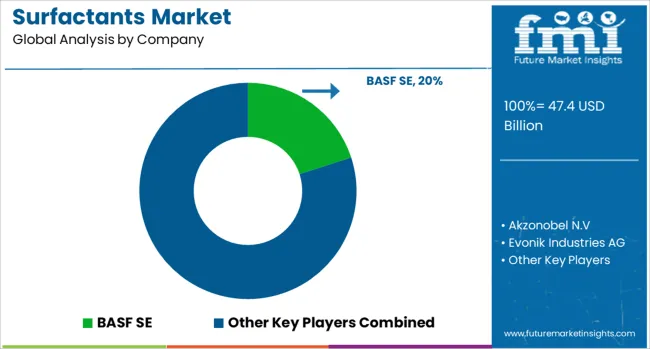
The competitive landscape is bifurcated between massive integrated chemical giants and agile biotech innovators. Major players like BASF and Evonik are leveraging their balance sheets to retrofit assets for sustainability, such as obtaining ISCC PLUS certifications and expanding bio-based capacity. This strategy allows them to defend their entrenched positions with global FMCG accounts that require massive volumes of traceable ingredients.
Conversely, specialized startups are disrupting the market with proprietary fermentation technologies. Companies like AmphiStar are securing millions in funding to commercialize waste-derived surfactants, directly challenging the cost structure of traditional oleochemicals. These agile players act as critical technology partners or acquisition targets for larger firms seeking to rapidly decarbonize their portfolios without decade-long R&D cycles.
Regional champions in Asia are altering the global supply balance by aggressively expanding capacity. Croda’s simultaneous investments in India and China demonstrate a "local-for-local" strategy that insulates them from freight volatility and tariffs. This localization forces Western competitors to either invest in similar regional footprints or retreat to premium, high-service niches where technical support commands a price premium over pure volume.
Recent Developments:
The report includes full coverage of key trends from competitive benchmarking. Some of the recent developments covered in the reports:
- In November 2025, BASF SE inaugurated a production capacity expansion for Alkyl Polyglucosides (APGs) at its Bangpakong site to strengthen regional supply agility. [2]
- In April 2024, AmphiStar secured €6 million from European Circular Bioeconomy Fund, Qbic III, and FFTF to accelerate industrialization of its waste-derived microbial biosurfactants. [5]
Key Players in Surfactants Market
- BASF SE
- Dow
- Evonik Industries
- Croda International
- Solvay
- Clariant
- Stepan Company
Scope of the Report
| Metric | Value |
|---|---|
| Quantitative Units | USD 59.6 billion (2026) to USD 108.7 billion (2036), at a CAGR of 6.2% |
| Market Definition | Global trade and production of surface-active agents functioning as detergents, emulsifiers, and wetting agents. |
| Source Segmentation | Synthetic, Bio-based |
| Product Type Segmentation | Non-ionic, Anionic, Others |
| Application Coverage | Homecare, Personal Care, I&I Cleaners, Others |
| Regions Covered | North America, Latin America, Europe, East Asia, South Asia, Oceania, Middle East and Africa |
| Countries Covered | USA, Canada, Mexico, Brazil, Argentina, Chile, Germany, France, Italy, UK, Spain, China, India, Japan, South Korea, Indonesia, Australia, Saudi Arabia, UAE, South Africa, Turkey |
| Key Companies Profiled | BASF SE, Dow, Evonik Industries, Croda International, Solvay, Clariant, Stepan Company |
| Forecast Period | 2026 to 2036 |
| Approach | Bottom-up aggregation of production data validated against top-down end-use demand models. |
Surfactants Market Analysis by Segments
Source:
- Synthetic
- Bio-based
Product Type:
- Non-ionic
- Anionic
- Others
Application:
- Homecare
- Personal Care
- I&I Cleaners
- Others
Region:
- Asia Pacific
- India
- China
- Japan
- South Korea
- Indonesia
- Australia & New Zealand
- ASEAN
- Rest of Asia Pacific
- Europe
- Germany
- Italy
- France
- United Kingdom
- Spain
- Benelux
- Nordics
- Central & Eastern Europe
- Rest of Europe
- North America
- United States
- Canada
- Mexico
- Latin America
- Brazil
- Argentina
- Chile
- Rest of Latin America
- Middle East & Africa
- Kingdom of Saudi Arabia
- United Arab Emirates
- South Africa
- Turkey
- Rest of Middle East & Africa
Bibliography
- [1] National Institute of Advanced Industrial Science and Technology (AIST). (2030). Biosurfactant Outlook. AIST.
- [2] BASF SE. (2025). Press Release: Capacity expansion for Alkyl Polyglucosides. BASF.
- [3] Croda International Plc. (2024). Annual Report: Consumer Care Business Review. Croda.
- [4] Shanghai Municipal People's Government. (2024). Evonik China Sales and Targets. Shanghai Govt.
- [5] AmphiStar. (2024). Press Release: Pre-Series A Funding. AmphiStar.
- [6] Brazilian Institute of Geography and Statistics (IBGE). (2025). Industrial Production Statistics. IBGE.
- [7] Office for National Statistics (ONS). (2025). GDP Monthly Estimate: Chemical Output. ONS.
- [8] Federal Reserve Bank of St. Louis (FRED). (2025). Producer Price Index by Industry: Soap and Other Detergent Manufacturing. FRED.
- [9] Evonik Industries. (2024). Press Release: ISCC PLUS Sustainability Certification. Evonik.
- [10] BASF SE. (2024). Financial Release: Annual Sales. BASF.
This bibliography is provided for reader reference and is not exhaustive. The full report contains the complete reference list and detailed citations.
This Report Addresses
- Strategic assessment of the shift from synthetic to bio-based surfactant feedstocks.
- Detailed quantification of market value across 2026-2036 with CAGR analysis.
- Granular segmentation by product type, application, and source material.
- Regulatory impact analysis focusing on toxicity bans and eco-labelling.
- Competitive profiling of major incumbents and emerging biotech startups.
- Regional growth mapping identifying high-potential investment zones.
- Technological evaluation of fermentation and waste-to-value production methods.
- Pricing dynamics influenced by crude oil volatility and green premiums.
Frequently Asked Questions
How large is the demand for Surfactants in the global market in 2026?
Demand for Surfactants in the global market is estimated to be valued at USD 59.6 billion in 2026.
What will be the market size of Surfactants in the global market by 2036?
The market size for Surfactants is projected to reach USD 108.7 billion by 2036.
What is the expected demand growth for Surfactants in the global market between 2026 and 2036?
Demand for Surfactants in the global market is expected to grow at a CAGR of 6.2% between 2026 and 2036.
Which Product Type is poised to lead global sales by 2026?
Non-ionic surfactants are expected to lead with 45.0% share, driven by their superior performance in low-temperature laundry applications.
How significant is the role of Homecare in driving Surfactants adoption in 2026?
Homecare represents the dominant segment with a 34% share, fueled by rising hygiene standards and detergent consumption in developing economies.
What is driving demand in India?
Demand is driven by rapid urbanization and the shift from bar soaps to liquid detergents, supported by local capacity expansions.
What compliance standards or regulations are referenced for the United States?
The report references EPA guidelines and voluntary bio-preferred programs that encourage the use of renewable surfactant chemistries.
What is the India growth outlook in this report?
India is projected to grow at a CAGR of 8.1% during 2026 to 2036.
Why is Asia Pacific described as a priority region in this report?
It is a priority due to its dual role as a high-growth consumer market and a central hub for new manufacturing capacity.
What type of demand dominates in Asia Pacific?
Demand is dominated by volume growth in household detergents and increasing uptake of personal care products.
What is China growth outlook in this report?
China is projected to expand at a CAGR of 7.8% during 2026 to 2036.
Does the report cover Japan in its regional analysis?
Yes, Japan is included within East Asia under the regional scope of analysis.
What are the sources referred to for analyzing Japan?
The report refers to AIST data on biosurfactant market projections and government industrial statistics.
What is the main demand theme linked to Japan in its region coverage?
The main theme is the transition toward high-tech, bio-based surfactants and eco-friendly formulations.
Does the report cover Brazil in its regional analysis?
Yes, Brazil is included within Latin America under the regional coverage framework.
What is the main Brazil related demand theme in its region coverage?
Growth is linked to the recovery of the industrial sector and robust agricultural demand for surfactant-based crop protection.
Which product formats or configurations are strategically important for Europe supply chains?
Certified sustainable and traceable surfactant grades, such as those with ISCC PLUS certification, are critical.
What is Surfactants and what is it mainly used for?
Surfactants are surface-active agents used primarily as detergents, emulsifiers, and wetting agents in cleaning and industrial products.
What does Surfactants Market mean in this report?
It refers to the global ecosystem of producing and trading surfactant ingredients for consumer and industrial use.
What is included in the scope of this Surfactants report?
The scope includes synthetic and bio-based surfactants across anionic, non-ionic, and other classes for various applications.
What is excluded from the scope of this report?
Retail finished goods like bottled detergents and non-surfactant additives are excluded from the market value.
What does market forecast mean on this page?
Market forecast represents a model-based projection of future value built on defined economic and industrial assumptions.
How does FMI build and validate the Surfactants forecast?
FMI uses a bottom-up aggregation of production data validated against top-down end-use demand models and expert interviews.
What does zero reliance on speculative third party market research mean here?
It means the analysis relies solely on primary interviews and verifiable public datasets rather than unverified syndicated reports.
Preview the report firsthand - request a free sample
Get SampleGet the brochure for pricing and purchase details.
Get PDFTable of Content
- Executive Summary
- Global Market Outlook
- Demand-side Trends
- Supply-side Trends
- Technology Roadmap Analysis
- Analysis and Recommendations
- Market Overview
- Market Coverage / Taxonomy
- Market Definition / Scope / Limitations
- Research Methodology
- Chapter Orientation
- Analytical Lens and Working Hypotheses
- Market Structure, Signals, and Trend Drivers
- Benchmarking and Cross-market Comparability
- Market Sizing, Forecasting, and Opportunity Mapping
- Research Design and Evidence Framework
- Desk Research Programme (Secondary Evidence)
- Company Annual and Sustainability Reports
- Peer-reviewed Journals and Academic Literature
- Corporate Websites, Product Literature, and Technical Notes
- Earnings Decks and Investor Briefings
- Statutory Filings and Regulatory Disclosures
- Technical White Papers and Standards Notes
- Trade Journals, Industry Magazines, and Analyst Briefs
- Conference Proceedings, Webinars, and Seminar Materials
- Government Statistics Portals and Public Data Releases
- Press Releases and Reputable Media Coverage
- Specialist Newsletters and Curated Briefings
- Sector Databases and Reference Repositories
- FMI Internal Proprietary Databases and Historical Market Datasets
- Subscription Datasets and Paid Sources
- Social Channels, Communities, and Digital Listening Inputs
- Additional Desk Sources
- Expert Input and Fieldwork (Primary Evidence)
- Primary Modes
- Qualitative Interviews and Expert Elicitation
- Quantitative Surveys and Structured Data Capture
- Blended Approach
- Why Primary Evidence is Used
- Field Techniques
- Interviews
- Surveys
- Focus Groups
- Observational and In-context Research
- Social and Community Interactions
- Stakeholder Universe Engaged
- C-suite Leaders
- Board Members
- Presidents and Vice Presidents
- R&D and Innovation Heads
- Technical Specialists
- Domain Subject-matter Experts
- Scientists
- Physicians and Other Healthcare Professionals
- Governance, Ethics, and Data Stewardship
- Research Ethics
- Data Integrity and Handling
- Primary Modes
- Tooling, Models, and Reference Databases
- Desk Research Programme (Secondary Evidence)
- Data Engineering and Model Build
- Data Acquisition and Ingestion
- Cleaning, Normalisation, and Verification
- Synthesis, Triangulation, and Analysis
- Quality Assurance and Audit Trail
- Market Background
- Market Dynamics
- Drivers
- Restraints
- Opportunity
- Trends
- Scenario Forecast
- Demand in Optimistic Scenario
- Demand in Likely Scenario
- Demand in Conservative Scenario
- Opportunity Map Analysis
- Product Life Cycle Analysis
- Supply Chain Analysis
- Investment Feasibility Matrix
- Value Chain Analysis
- PESTLE and Porter’s Analysis
- Regulatory Landscape
- Regional Parent Market Outlook
- Production and Consumption Statistics
- Import and Export Statistics
- Market Dynamics
- Global Market Analysis 2021 to 2025 and Forecast, 2026 to 2036
- Historical Market Size Value (USD Million) Analysis, 2021 to 2025
- Current and Future Market Size Value (USD Million) Projections, 2026 to 2036
- Y-o-Y Growth Trend Analysis
- Absolute $ Opportunity Analysis
- Global Market Pricing Analysis 2021 to 2025 and Forecast 2026 to 2036
- Global Market Analysis 2021 to 2025 and Forecast 2026 to 2036, By By Source
- Introduction / Key Findings
- Historical Market Size Value (USD Million) Analysis By By Source , 2021 to 2025
- Current and Future Market Size Value (USD Million) Analysis and Forecast By By Source , 2026 to 2036
- Synthetic
- Bio-based
- Synthetic
- Y-o-Y Growth Trend Analysis By By Source , 2021 to 2025
- Absolute $ Opportunity Analysis By By Source , 2026 to 2036
- Global Market Analysis 2021 to 2025 and Forecast 2026 to 2036, By By Product Type
- Introduction / Key Findings
- Historical Market Size Value (USD Million) Analysis By By Product Type, 2021 to 2025
- Current and Future Market Size Value (USD Million) Analysis and Forecast By By Product Type, 2026 to 2036
- Non-ionic
- Anionic
- Non-ionic
- Y-o-Y Growth Trend Analysis By By Product Type, 2021 to 2025
- Absolute $ Opportunity Analysis By By Product Type, 2026 to 2036
- Global Market Analysis 2021 to 2025 and Forecast 2026 to 2036, By By Application
- Introduction / Key Findings
- Historical Market Size Value (USD Million) Analysis By By Application, 2021 to 2025
- Current and Future Market Size Value (USD Million) Analysis and Forecast By By Application, 2026 to 2036
- Homecare
- Personal Care
- I&I Cleaners
- Homecare
- Y-o-Y Growth Trend Analysis By By Application, 2021 to 2025
- Absolute $ Opportunity Analysis By By Application, 2026 to 2036
- Global Market Analysis 2021 to 2025 and Forecast 2026 to 2036, By Region
- Introduction
- Historical Market Size Value (USD Million) Analysis By Region, 2021 to 2025
- Current Market Size Value (USD Million) Analysis and Forecast By Region, 2026 to 2036
- North America
- Latin America
- Western Europe
- Eastern Europe
- East Asia
- South Asia and Pacific
- Middle East & Africa
- Market Attractiveness Analysis By Region
- North America Market Analysis 2021 to 2025 and Forecast 2026 to 2036, By Country
- Historical Market Size Value (USD Million) Trend Analysis By Market Taxonomy, 2021 to 2025
- Market Size Value (USD Million) Forecast By Market Taxonomy, 2026 to 2036
- By Country
- USA
- Canada
- Mexico
- By By Source
- By By Product Type
- By By Application
- By Country
- Market Attractiveness Analysis
- By Country
- By By Source
- By By Product Type
- By By Application
- Key Takeaways
- Latin America Market Analysis 2021 to 2025 and Forecast 2026 to 2036, By Country
- Historical Market Size Value (USD Million) Trend Analysis By Market Taxonomy, 2021 to 2025
- Market Size Value (USD Million) Forecast By Market Taxonomy, 2026 to 2036
- By Country
- Brazil
- Chile
- Rest of Latin America
- By By Source
- By By Product Type
- By By Application
- By Country
- Market Attractiveness Analysis
- By Country
- By By Source
- By By Product Type
- By By Application
- Key Takeaways
- Western Europe Market Analysis 2021 to 2025 and Forecast 2026 to 2036, By Country
- Historical Market Size Value (USD Million) Trend Analysis By Market Taxonomy, 2021 to 2025
- Market Size Value (USD Million) Forecast By Market Taxonomy, 2026 to 2036
- By Country
- Germany
- UK
- Italy
- Spain
- France
- Nordic
- BENELUX
- Rest of Western Europe
- By By Source
- By By Product Type
- By By Application
- By Country
- Market Attractiveness Analysis
- By Country
- By By Source
- By By Product Type
- By By Application
- Key Takeaways
- Eastern Europe Market Analysis 2021 to 2025 and Forecast 2026 to 2036, By Country
- Historical Market Size Value (USD Million) Trend Analysis By Market Taxonomy, 2021 to 2025
- Market Size Value (USD Million) Forecast By Market Taxonomy, 2026 to 2036
- By Country
- Russia
- Poland
- Hungary
- Balkan & Baltic
- Rest of Eastern Europe
- By By Source
- By By Product Type
- By By Application
- By Country
- Market Attractiveness Analysis
- By Country
- By By Source
- By By Product Type
- By By Application
- Key Takeaways
- East Asia Market Analysis 2021 to 2025 and Forecast 2026 to 2036, By Country
- Historical Market Size Value (USD Million) Trend Analysis By Market Taxonomy, 2021 to 2025
- Market Size Value (USD Million) Forecast By Market Taxonomy, 2026 to 2036
- By Country
- China
- Japan
- South Korea
- By By Source
- By By Product Type
- By By Application
- By Country
- Market Attractiveness Analysis
- By Country
- By By Source
- By By Product Type
- By By Application
- Key Takeaways
- South Asia and Pacific Market Analysis 2021 to 2025 and Forecast 2026 to 2036, By Country
- Historical Market Size Value (USD Million) Trend Analysis By Market Taxonomy, 2021 to 2025
- Market Size Value (USD Million) Forecast By Market Taxonomy, 2026 to 2036
- By Country
- India
- ASEAN
- Australia & New Zealand
- Rest of South Asia and Pacific
- By By Source
- By By Product Type
- By By Application
- By Country
- Market Attractiveness Analysis
- By Country
- By By Source
- By By Product Type
- By By Application
- Key Takeaways
- Middle East & Africa Market Analysis 2021 to 2025 and Forecast 2026 to 2036, By Country
- Historical Market Size Value (USD Million) Trend Analysis By Market Taxonomy, 2021 to 2025
- Market Size Value (USD Million) Forecast By Market Taxonomy, 2026 to 2036
- By Country
- Kingdom of Saudi Arabia
- Other GCC Countries
- Turkiye
- South Africa
- Other African Union
- Rest of Middle East & Africa
- By By Source
- By By Product Type
- By By Application
- By Country
- Market Attractiveness Analysis
- By Country
- By By Source
- By By Product Type
- By By Application
- Key Takeaways
- Key Countries Market Analysis
- USA
- Pricing Analysis
- Market Share Analysis, 2025
- By By Source
- By By Product Type
- By By Application
- Canada
- Pricing Analysis
- Market Share Analysis, 2025
- By By Source
- By By Product Type
- By By Application
- Mexico
- Pricing Analysis
- Market Share Analysis, 2025
- By By Source
- By By Product Type
- By By Application
- Brazil
- Pricing Analysis
- Market Share Analysis, 2025
- By By Source
- By By Product Type
- By By Application
- Chile
- Pricing Analysis
- Market Share Analysis, 2025
- By By Source
- By By Product Type
- By By Application
- Germany
- Pricing Analysis
- Market Share Analysis, 2025
- By By Source
- By By Product Type
- By By Application
- UK
- Pricing Analysis
- Market Share Analysis, 2025
- By By Source
- By By Product Type
- By By Application
- Italy
- Pricing Analysis
- Market Share Analysis, 2025
- By By Source
- By By Product Type
- By By Application
- Spain
- Pricing Analysis
- Market Share Analysis, 2025
- By By Source
- By By Product Type
- By By Application
- France
- Pricing Analysis
- Market Share Analysis, 2025
- By By Source
- By By Product Type
- By By Application
- India
- Pricing Analysis
- Market Share Analysis, 2025
- By By Source
- By By Product Type
- By By Application
- ASEAN
- Pricing Analysis
- Market Share Analysis, 2025
- By By Source
- By By Product Type
- By By Application
- Australia & New Zealand
- Pricing Analysis
- Market Share Analysis, 2025
- By By Source
- By By Product Type
- By By Application
- China
- Pricing Analysis
- Market Share Analysis, 2025
- By By Source
- By By Product Type
- By By Application
- Japan
- Pricing Analysis
- Market Share Analysis, 2025
- By By Source
- By By Product Type
- By By Application
- South Korea
- Pricing Analysis
- Market Share Analysis, 2025
- By By Source
- By By Product Type
- By By Application
- Russia
- Pricing Analysis
- Market Share Analysis, 2025
- By By Source
- By By Product Type
- By By Application
- Poland
- Pricing Analysis
- Market Share Analysis, 2025
- By By Source
- By By Product Type
- By By Application
- Hungary
- Pricing Analysis
- Market Share Analysis, 2025
- By By Source
- By By Product Type
- By By Application
- Kingdom of Saudi Arabia
- Pricing Analysis
- Market Share Analysis, 2025
- By By Source
- By By Product Type
- By By Application
- Turkiye
- Pricing Analysis
- Market Share Analysis, 2025
- By By Source
- By By Product Type
- By By Application
- South Africa
- Pricing Analysis
- Market Share Analysis, 2025
- By By Source
- By By Product Type
- By By Application
- USA
- Market Structure Analysis
- Competition Dashboard
- Competition Benchmarking
- Market Share Analysis of Top Players
- By Regional
- By By Source
- By By Product Type
- By By Application
- Competition Analysis
- Competition Deep Dive
- BASF SE
- Overview
- Product Portfolio
- Profitability by Market Segments (Product/Age /Sales Channel/Region)
- Sales Footprint
- Strategy Overview
- Marketing Strategy
- Product Strategy
- Channel Strategy
- Dow
- Evonik Industries
- Croda International
- Solvay
- Clariant
- Stepan Company
- BASF SE
- Competition Deep Dive
- Assumptions & Acronyms Used


