

- Industry Size (2026)
- USD 187.96 Bn
- Forecast (2036)
- USD 440.91 Bn
- CAGR (2026 to 2036)
- 8.90%
Homecare Medical Devices Market Size, Market Forecast and Outlook By FMI
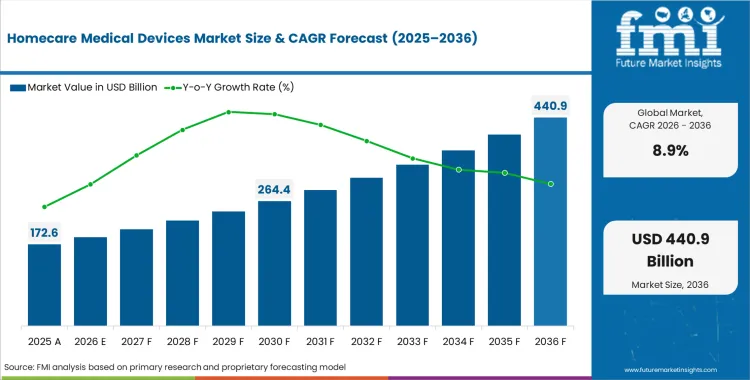
The homecare medical devices market was valued at USD 172.60 billion in 2025, projected to reach USD 187.96 billion in 2026, and is forecast to expand to USD 440.91 billion by 2036 at a 8.90% CAGR. As per FMI, demand acceleration is shaped by structural shifts in consumer preferences, technology adoption cycles, and evolving regulatory frameworks across geographies. Capital allocation patterns across the supply chain indicate that procurement decision-makers are factoring in lifecycle cost models rather than initial acquisition cost alone, a trend that compresses the evaluation window for new entrants.
Summary of Homecare Medical Devices Market
- Market Snapshot
- The homecare medical devices market is valued at USD 172.60 billion in 2025 and is projected to reach USD 440.91 billion by 2036.
- The industry is expected to grow at a 8.90% CAGR from 2026 to 2036, creating an incremental opportunity of USD 252.95 billion.
- The market is a healthcare equipment category where reimbursement policy, aging demographics, and discharge-to-home care models define procurement patterns.
- Demand and Growth Drivers
- Demand is rising as end users adopt upgraded wheelchairs configurations to meet evolving performance and compliance requirements.
- Technology transitions in core product architectures are compressing replacement cycles and pulling forward capital equipment budgets.
- Regulatory and standards body mandates across major economies are creating non-discretionary procurement triggers.
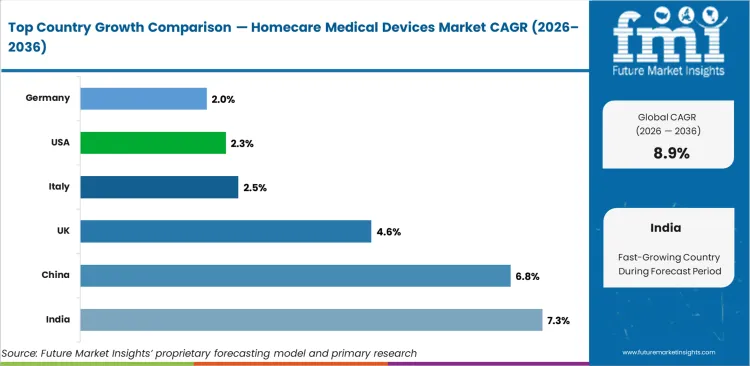
- Among key countries, India leads at 7.3% CAGR, followed by China at 6.8% and UK at 4.6%.
- Product and Segment View
- The market scope covers wheelchairs, scooters, oxygen treatment equipment, accessibility beds, lifts, toilets, others, segmented by product and distribution channel.
- Wheelchairs leads by product with 57.4% share in 2026.
- Online Retailers leads by distribution channel with 39.5% share in 2026.
- Geography and Competitive Outlook
- India and China are the fastest-growing markets due to infrastructure expansion and rising end-user penetration.
- Mature markets in North America and Europe generate upgrade-cycle and replacement demand supported by established distribution networks.
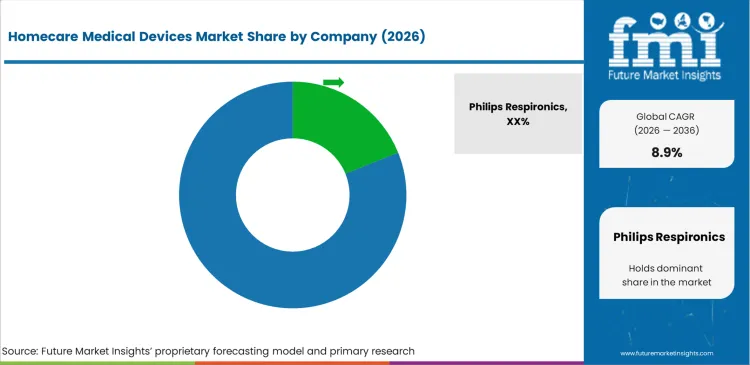
- Competition is shaped by product integration capabilities, distribution reach, and compliance track records, with key players including Philips Respironics, AirSep, SeQual, Drive Medical, Graham-Field, Inogen, Invacare.
- Analyst Opinion at FMI
- Anurag Sharma, Principal Consultant at Future Market Insights, opines: 'In my analysis, I have observed that procurement decision-makers are shifting evaluation criteria from upfront acquisition cost to total lifecycle performance metrics. Organizations that delay alignment with this evaluation framework risk structural displacement from preferred vendor lists. The transition window is narrowing as contract specifications increasingly mandate integrated performance guarantees.'
- Strategic Implications / Executive Takeaways
- Suppliers must secure integration pathways with downstream system architectures to qualify for multi-year procurement frameworks.
- Capital project directors should phase out legacy product specifications and mandate current-generation compatibility in all new equipment procurement cycles.
- Product engineers must develop validated performance documentation that meets evolving regulatory compliance thresholds across target geographies.
Homecare Medical Devices Market Key Takeaways
| Metric | Details |
|---|---|
| Industry Size (2026) | USD 187.96 billion |
| Industry Value (2036) | USD 440.91 billion |
| CAGR (2026 to 2036) | 8.90% |
Source: Future Market Insights, 2026
Based on FMI's report, the homecare medical devices market is undergoing a structural transition from institutional procurement to direct-to-patient distribution. Aging population demographics in developed economies and expanding insurance coverage in emerging markets are creating parallel demand corridors. Reimbursement policy reforms in North America and Europe are incentivizing discharge-to-home care pathways, pulling device adoption from hospital settings into residential environments. Product miniaturization and remote monitoring integration are lowering the clinical supervision threshold for home-based device usage.
Regional growth trajectories reflect divergent adoption maturity levels. India sets the pace with a 7.3% CAGR, followed by China at 6.8% and UK at 4.6%. Italy tracks at 2.5%. USA tracks at 2.3%. Germany tracks at 2.0%. Mature markets generate replacement and upgrade-cycle demand rather than net new deployments, while emerging economies are building installed bases from greenfield conditions.
Homecare Medical Devices Market Definition
The Homecare Medical Devices Market encompasses medical equipment designed for patient use in residential settings without direct clinical supervision. Product categories include wheelchairs, mobility scooters, oxygen therapy equipment, accessibility beds, patient lifts, and assistive toileting devices. These devices support chronic disease management, post-acute recovery, and long-term disability accommodation outside institutional care facilities.
Homecare Medical Devices Market Inclusions
Market scope includes global and regional market size estimates, a ten-year forecast from 2026 to 2036, segmentation by product (wheelchairs, scooters, oxygen treatment equipment, accessibility beds, lifts, toilets, others), by distribution channel (online retailers, pharmacies, retail medical stores), and by region. Pricing trend analysis and competitive positioning assessments are incorporated.
Homecare Medical Devices Market Exclusions
The scope excludes hospital-grade acute care devices, implantable medical devices, pharmaceutical products, telemedicine software platforms, and diagnostic laboratory equipment.
Homecare Medical Devices Market Research Methodology
- Primary Research: Analysts conducted structured interviews with procurement managers, distribution channel operators, and product engineering leads to map purchase decision triggers and supplier evaluation criteria.
- Desk Research: Data collection aggregated regulatory compliance schedules, industry standards publications, trade association reports, and public financial disclosures from listed manufacturers.
- Market-Sizing and Forecasting: Baseline values derive from a bottom-up aggregation of product shipment records and channel sell-through data, applying region-specific adoption curves to project ten-year demand trajectories for the homecare medical devices market.
- Data Validation and Update Cycle: Projections are cross-validated against publicly reported revenue guidance from leading manufacturers and adjusted quarterly against updated trade statistics.
Key Industry Highlights
Rising Demand for Home Oxygen Therapy Accelerating Oxygen Treatment Equipment Sales
The need for oxygen treatment equipment for home use has grown remarkably over the past years. People, particularly the older ones, need constant oxygen for diseases like Chronic Obstructive Pulmonary Disease (COPD) and obstructive sleep apnea (OSA), thereby demanding oxygen cylinders and portable oxygen concentrators to be present at home.
As estimated by the Global Initiative for Chronic Obstructive Lung Disease, more than 200 million people worldwide are affected by COPD, and the majority require long-term oxygen therapy. In turn, this necessitates compact energy-efficient devices which deliver a reliable oxygen flow and minimal maintenance needs. The impact of the COVID-19 pandemic further amplified home oxygen therapy by limiting hospital bed availability.
The preference for non-invasive treatments at home also contributes to the growth of this segment, especially among elderly patients and those with chronic conditions. Innovations like pulse-dose delivery and smart oxygen concentrators with remote monitoring capabilities have further enhanced the usability of these devices.
This increasing adoption can be further evidenced by reimbursement policies for long-term oxygen therapy like Medicare's provision of durable medical equipment. Along with increased public awareness of the respiratory condition, patients prefer self-care in a home environment instead of hospitals; therefore, it is driving a growing demand in oxygen treatment equipment.
Smart Home Integration Revolutionizing the Homecare Medical Devices Market
The integration of smart technologies with homecare medical devices is transforming the market, particularly for accessibility beds, lifts, and toilets. Devices are increasingly being designed with Internet of Things (IoT) capabilities, enabling remote monitoring, voice control, and automation for enhanced user convenience.
For example, accessibility beds with smart controls can adjust height and reclining angles based on pre-set health conditions like pressure ulcer prevention. Smart toilets with automated cleaning, bidet functions, and health monitoring sensors for urine analysis are also gaining popularity in homecare settings.
Lifts integrated with sensors for weight detection and movement tracking ensure safer patient handling, reducing the risk of falls or misuse. These innovations are especially beneficial for elderly users and patients with chronic conditions, as caregivers can monitor device usage and health metrics remotely through connected applications.
The trend is further supported by collaborations between healthcare technology firms and smart home brands to create holistic homecare environments. As home automation continues to grow, the demand for smart-integrated homecare devices is expected to expand rapidly, driving market growth and enhancing patient care experiences.
Pediatric Homecare Devices Creating New Growth Opportunities in Homecare Medical Devices Market
The growing demand for pediatric-specific homecare medical devices, including child-sized wheelchairs, scooters, and adjustable beds, is opening new market opportunities. Many children suffer from conditions such as cerebral palsy, muscular dystrophy, and spinal cord injuries that require mobility and care equipment adapted to their size and developmental needs. Pediatric wheelchairs with lightweight frames, colorful designs, and adjustable components provide both functional support and emotional comfort for young users.
On their part, similar accessibility beds from pediatric use mainly feature safety rails, adjustable height, and pleasant aesthetics to somewhat make the hospital environment less unfriendly. Equipment for oxygen treatments in children which are quieter as well as thinner oxygen concentrators have also rapidly gained acceptance toward oxygen and respiratory care by home. This segment is further supported by the increasing recognition of the importance of early intervention and home-based care for children with chronic conditions.
Manufacturers investing in this niche market are focusing on safety certifications, ergonomic designs, and family-friendly features, making pediatric homecare equipment a rapidly expanding sector. As awareness grows and reimbursement options improve, the pediatric segment is poised to become a key growth driver within the broader homecare medical devices market.
High Cost of Advanced Mobility and Respiratory Devices Limiting Market Penetration
High cost-high priced advanced homecare medical devices remains the biggest challenge for the expansion of this market- especially in economically restrained regions. Smart homecare medical equipment: Smart homecare medical devices, like a programmable control electric wheelchair or an oxygen concentrator with remote monitoring facility, contains advanced technologies and high-priced materials that remain unaffordable for the majority of the people.
All this costs even more by additional costs to maintenance, accessories, and repeated replacement of batteries, which would be built-up overtime. Coverage under insurance programs for durable medical equipment differs vastly by regions so that patients find little to no support when faced with these purchases. Some equipment only partially gets covered so that such adoption will still not encourage purchase in more disadvantageous economies.
Additionally, the financial burden on public health care systems often restricts the budget for home-based medical equipment, limiting access to those in critical need. The safety and reliability of products may be at the mercy of big procurement funds to cover expensive innovative production. Until such time that these inexpensive production methods and wider insurance policies become more prevalent, cost will continue to be a constraint to the widespread adoption of high-tech homecare medical devices, especially in developing regions, whose concerns remain largely focused on affordability.
2021 to 2025 Global Homecare Medical Devices Industry Outlook Compared to Demand Forecast from 2026 to 2036
The global homecare medical devices industry recorded a CAGR of 6.5% during the historical period between 2021 and 2025. The growth of the homecare medical devices industry was positive as it reached a value of USD 158.5 billion in 2025 from USD 116.8 billion in 2021.
With rising demand for more personalized care solutions, the homecare medical devices market has witnessed huge growth. Some of the other trends seen over the last few years have included the adoption of mobility aids like electric wheelchairs and scooters that provide increased mobility for individuals who are afflicted by mobility-related issues.
The reasons behind this change included improvements in design and technology to make devices much more comfortable, customizable, and functional in their application. Availability beds and lifts witnessed increased growth under this segment. This is attributed to the growing trend of wanting to recover post-surgery at home.
Patients requiring joint replacements or spinal surgeries wanted home-based programs for comfort and shortening the hospital stay, leading to greater market growth. High-cost devices have recently been hired for short-term purposes, and this too has been noteworthy. Technological advancements, such as the integration of IoT in oxygen concentrators and mobility aids, also gained traction, improving patient monitoring and safety.
It would be interesting to see the market for homecare medical devices experience further change based on developments related to AI and connectivity. With smarter devices having inbuilt real-time monitoring, adaptable settings, and predictive analytics, care would indeed be more tailored towards the needs of the patients. For instance, oxygen concentrators and mobility aids would be intuitively bettered with sensors set to adjust the user's requirement automatically.
In upcoming years, there will be a greater emphasis on environmentally friendly solutions, wherein the components of manufacturing use sustainable materials and energy-efficient designs. The growth in home healthcare and telemedicine will add to the trend of innovative homecare devices, with patients wanting more convenient and cost-effective care. Customization will continue to be a prime motivator, with devices also becoming even more tailored for individual health, benefiting both comfort as a user and improved outcomes as a care measure.
Market Concentration
Tier 1 companies are the major companies as they hold a 39.7% share worldwide. These companies have substantial market share, established reputations, and offer high-quality, reliable products. They are often the first to introduce new innovations in the market, such as smart features in mobility aids, oxygen therapy devices, and accessibility solutions.
They also have a significant presence in both developed and emerging markets, with distribution networks and support systems that cater to a wide range of customers. Prominent tier 1 players include Drive Medical, Inogen, Philips Respironics, Pride, Permobil (Nordic/Handicare), and Invacare
The tier 2 companies hold a share of 26.2% worldwide. These companies are highly specialized in certain product categories and may cater to niche markets or regions. While their brand recognition may not be as extensive as Tier 1 companies, they are often well-regarded within their specialty. These companies may not offer the same wide range of products as Tier 1 but can still be leaders in the categories they serve, offering high-quality products with specialized features for particular patient needs. Key Companies under this category include AirSep, SeQual, Meyra and Graham-Field
Country-wise Insights
The section below covers the industry analysis for homecare medical devices sales for different countries. Market demand analysis on key countries in several regions of the globe, including North America, Latin America, East Asia, South Asia & Pacific, Western Europe, Eastern Europe, and Middle East & Africa is provided. The United States is anticipated to remain at the forefront in North America, with a CAGR of 2.3% through 2035. In South Asia & Pacific, India is projected to witness the highest CAGR in the market of 7.3% by 2035.
.webp "Top Country Growth Comparison Homecare Medical Devices Market Cagr (2026 2036)")
| Country | Value CAGR (2026 to 2036) |
|---|---|
| United States | 2.3% |
| Germany | 2.0% |
| Italy | 2.5% |
| UK | 4.6% |
| India | 7.3% |
| China | 6.8% |
Technological Advancements and Post-Surgical Recovery Drive USA Homecare Medical Devices Market
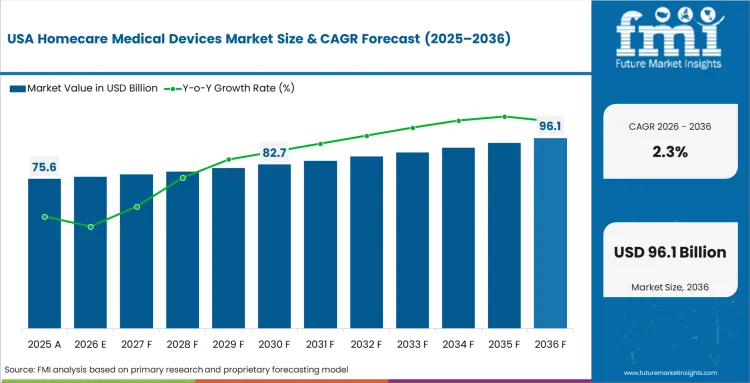
The United States dominates the global market with a high share in 2026. The United States is expected to exhibit a CAGR of 2.3% throughout the forecast period (2026 to 2036).
Advances in homecare medical devices through technological innovations have led to market growth in the United States. In the United States, there are more hospitalization readmission rate reductions and optimization of cost structures in terms of readmissions. Consequently, patients are being discharged early. This, therefore, means an increased demand for homecare devices like accessibility beds, lifts, and oxygen concentrators as patients continue recovery at home.
Integration of smart technologies in homecare devices would make real-time monitoring and intervention possible, which decreases the necessity for frequent visits from doctors. Insurance and health-care providers in the USA have initiated the value-based care programs that concentrate more on affordable home-based treatment options and raise the demand for medical equipment, which can be used in home.
Post-Surgical Rehabilitation Focus and Customization Boosts Homecare Medical Device Market in Germany
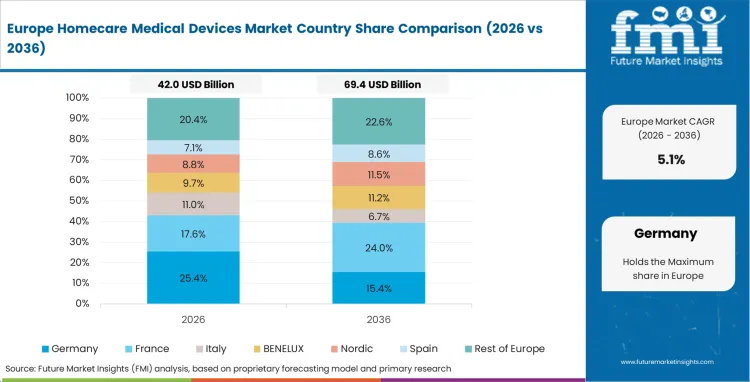
In 2026, Germany held a dominant revenue in the Western Europe market and is expected to grow with a CAGR of 2.0%.
Germany's strong emphasis on post-surgical rehabilitation makes it a unique market for homecare medical devices. Germany has a well-established system of rehabilitation facilities and follow-up programs that emphasize long-term recovery at home, in contrast to other nations. As part of the German Statutory Health Insurance system, patients are increasingly referred for home rehabilitation where they use specialized homecare devices, such as mobility aids and beds with pressure-relief features.
This allows patients to continue their recovery after surgeries like joint replacements or heart surgeries, without long-term hospital stays. The growing focus on highly customized homecare solutions, such as tailor-made wheelchairs and adjustable beds, has fueled market growth. Manufacturers in Germany, including some of Europe’s leading brands, are particularly focused on customization to fit the specific needs of patients, whether it’s bariatric care or those with unique orthopedic or neurological needs.
China's Focus on Respiratory Health Drives Surge in Homecare Medical Devices Market
China occupies a leading value share in East Asia market in 2026 and is expected to grow with a CAGR of 6.8% during the forecasted period.
The market for homecare medical devices in China has been witnessing rapid growth owing to a singular focus on respiratory care at home. The country is witnessing an upsurge in the demand for portable oxygen concentrators and other respiratory care devices, owing to the higher prevalence of chronic respiratory diseases like COPD and asthma, primarily in urban cities with severe air pollution.
Being one of the populous nations in the world with increasing population size of patients handling their respiratory-related ailments, China is increasingly being known for innovations that advance more cost-effective, convenient breathing machines.
The government considered crucial the need for home-based respiratory solutions, and policies are now in place to support wider distribution and local manufacturing of oxygen concentrators and similar devices. Efforts by the government to reduce congestion in hospitals and encourage more home healthcare at the same time have further increased the adoption of user-friendly and cost-effective devices for managing chronic conditions of the respiratory system in home settings.
Category-wise Insights
The section contains information about the leading segments in the industry. Based on product, wheelchair are expected to account 57.4% of the global share in 2025.
Wheelchairs Lead the Homecare Medical Devices Market Due to Increasing Mobility Needs and Customization
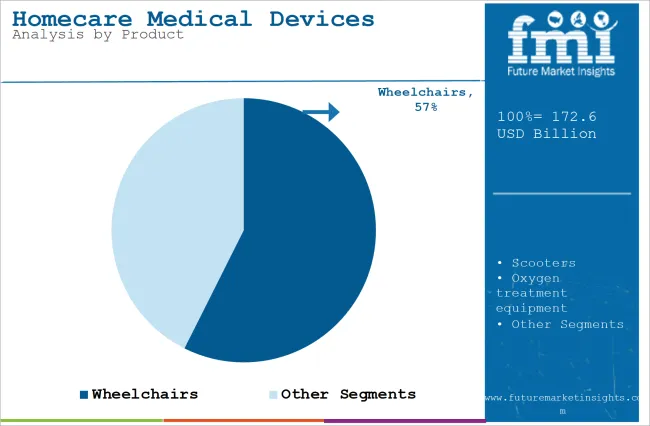
| Product | Value Share (2025) |
|---|---|
| Wheelchairs | 57.4% |
With regard to medical homecare products, the leader remains wheelchairs, considering that they have the capability to ensure proper mobility among most patients afflicted with various disabilities or chronic diseases. The aged and chronic population suffering from ailments like arthritis, stroke, or neurological conditions continue to expand in number and have growing needs for secure, personal means of mobility. It is the support tool for persons with restricted mobility; thus, it improves the quality of their life and allows them to execute everyday functions by themselves.
The trend in the current market is toward customized wheelchairs that cater to the unique requirements, such as an adjustable backrest, special cushioning, and increased maneuverability. Therefore, these customized features help to reach people suffering from conditions such as spinal cord injuries and muscular dystrophy, which place patients in conditions requiring good comfort and support. The integration of advanced technology, such as power-assisted or electric wheelchairs, drives demand further. Wheelchairs are the dominant product in the homecare medical devices market.
Online Retailers Lead the Homecare Medical Devices Market Due to Convenience and Growing E-Commerce Trend
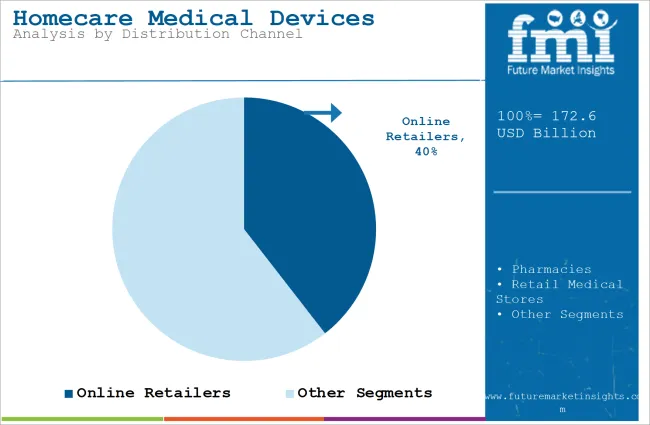
| By Distribution Channel | Value Share (2025) |
|---|---|
| Online Retailers | 39.5% |
Online retailers will account for 39.5% of the distribution channel segment in 2025, and exhibit the highest CAGR in the forecast period.
The largest end-users are online retailers since the homecare medical devices market is increasing by the day owing to the trends of e-commerce and convenience the same provides for consumers. A large number of patients and caregivers are shifting online to purchase such homecare medical devices as wheelchairs, mobility aids, and oxygen equipment with increased adaptation of online shopping. With the ability to browse wide varieties, compare prices, and have them delivered directly to their homes, online retail has become the preferred option for most.
Online retailers also frequently offer rich descriptions of the product, reviews, and even guidance on purchase. The emergence of online health marketplaces along with financing options for purchasing medical equipment thereby makes the online retailers dominantly in this field. In the future, with further expansion of e-commerce, online retailers are expected to drive huge growth in the market for homecare medical devices.
Competitive Landscape
The competition in the homecare medical devices market is highly dynamic and driven by continuous advancements in technology, product customization, and the growing demand for home-based healthcare solutions. Companies are constantly innovating to develop smarter, more efficient devices. For example, oxygen concentrators are being designed to be lighter, more energy-efficient, and equipped with remote monitoring capabilities. The integration of IoT and AI into homecare devices is also a significant factor driving competition.
Recent Industry Developments in Homecare Medical Devices Market
- In Oct 2025, Inogen, Inc., a medical technology company specializing in innovative respiratory products for homecare, has announced the launch of the Inogen® Rove 4™ Portable Oxygen Concentrator in the USA market.
- In May 2025, Küschall (Invacare) has unveiled its latest innovation in mobility solutions, the Champion SL manual wheelchair. Designed for individuals seeking enhanced mobility and comfort, the Champion SL offers a lightweight, durable frame combined with superior customization options.
Scope of the Report
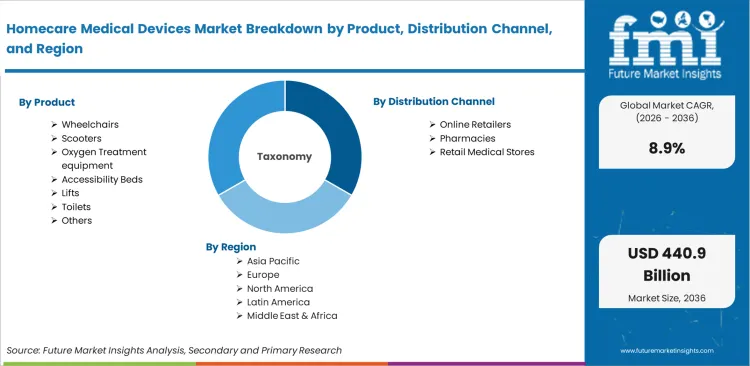
| Metric | Value |
|---|---|
| Quantitative Units | USD 187.96 billion to USD 440.91 billion, at a CAGR of 8.90% |
| Market Definition | The Homecare Medical Devices Market encompasses medical equipment designed for patient use in residential settings without direct clinical supervision. Product categories include wheelchairs, mobility... |
| Product Segmentation | Wheelchairs, Scooters, Oxygen Treatment equipment, Accessibility Beds, Lifts, Toilets, Others |
| Distribution Channel Segmentation | Online Retailers, Pharmacies, Retail Medical Stores |
| Regions Covered | North America, Latin America, Europe, East Asia, South Asia, Oceania, Middle East & Africa |
| Countries Covered | India, China, UK, Italy, USA, Germany, and 40 plus countries |
| Key Companies Profiled | Philips Respironics, AirSep, SeQual, Drive Medical, Graham-Field, Inogen, Invacare, Meyra |
| Forecast Period | 2026 to 2036 |
| Approach | Forecasting models apply a bottom-up methodology starting with global installed base metrics and project conversion rates using region-specific adoption curves. |
Key Segments of Homecare Medical Devices Industry
By Product:
In terms of product, the industry is divided into wheelchairs, scooters, oxygen treatment equipment, accessibility beds, lifts, toilets and other.
By Distribution Channel:
In terms of distribution channel, the industry is segregated into pharmacies, retail medical stores and online retailers.
By Region:
Key countries of North America, Latin America, East Asia, South Asia & Pacific, Western Europe, Eastern Europe, and Middle East and Africa (MEA) have been covered in the report.
Bibliography
- World Health Organization. (2025). Global Report on Assistive Technology. WHO.
- USA Centers for Medicare and Medicaid Services. (2025). Durable Medical Equipment Competitive Bidding Program. CMS.
- European Commission. (2025). Medical Device Regulation (EU MDR 2017/745) Implementation Status. European Commission.
- Philips Respironics. (2025). Annual Report 2025. Philips.
- United Nations Department of Economic and Social Affairs. (2025). World Population Ageing Report. UN DESA.
- Organisation for Economic Co-operation and Development. (2025). Health at a Glance 2025. OECD.
This bibliography is provided for reader reference. The full Future Market Insights report contains the complete reference list with primary research documentation.
This Report Addresses
- Market sizing and quantitative forecast metrics detailing expenditure allocation across homecare medical devices market categories through 2036.
- Segmentation analysis mapping adoption velocity of specific wheelchairs configurations and evaluating technical drivers behind distribution channel migration patterns.
- Regional deployment intelligence comparing growth trajectories in India and China against mature market replacement patterns in North America and Europe.
- Regulatory compliance assessment analyzing how evolving standards frameworks influence procurement specifications and product qualification timelines.
- Competitive posture evaluation tracking integration strategies, distribution alignment, and market share concentration among leading manufacturers.
- Capital project strategic guidance defining procurement specifications and performance thresholds for next-generation product deployments.
- Supply chain risk analysis identifying sourcing concentration, logistics dependencies, and component availability constraints.
- Custom data delivery formats encompassing interactive dashboards, raw Excel datasets, and PDF narrative reports.
Frequently Asked Questions
How large is the demand for Homecare Medical Devices Market in the global market in 2026?
Demand for homecare medical devices market in the global market is estimated to be valued at USD 187.96 billion in 2026.
What will be the market size of Homecare Medical Devices Market in the global market by 2036?
Market size for homecare medical devices market is projected to reach USD 440.91 billion by 2036.
What is the expected demand growth for Homecare Medical Devices Market between 2026 and 2036?
Demand for homecare medical devices market is expected to grow at a CAGR of 8.90% between 2026 and 2036.
Which Product is poised to lead global sales by 2026?
Wheelchairs accounts for 57.4% in 2026 as it addresses the largest share of end-user procurement requirements within the product category.
How does Online Retailers perform by Distribution Channel in 2026?
Online Retailers holds 39.5% of distribution channel share as established procurement channels and consumer access patterns concentrate volume through this route.
What is the India growth outlook in this report?
India is projected to grow at a CAGR of 7.3% during 2026 to 2036.
What is China's growth outlook in this report?
China is projected to expand at a CAGR of 6.8% during 2026 to 2036.
Preview the report firsthand - request a free sample
Get SampleGet the brochure for pricing and purchase details.
Get PDFTable of Content
- Executive Summary
- Global Market Outlook
- Demand-side Trends
- Supply-side Trends
- Technology Roadmap Analysis
- Analysis and Recommendations
- Market Overview
- Market Coverage / Taxonomy
- Market Definition / Scope / Limitations
- Research Methodology
- Chapter Orientation
- Analytical Lens and Working Hypotheses
- Market Structure, Signals, and Trend Drivers
- Company Annual and Sustainability Reports
- Peer-reviewed Journals and Academic Literature
- Corporate Websites, Product Literature, and Technical Notes
- Earnings Decks and Investor Briefings
- Statutory Filings and Regulatory Disclosures
- Technical White Papers and Standards Notes
- Trade Journals, Industry Magazines, and Analyst Briefs
- Conference Proceedings, Webinars, and Seminar Materials
- Government Statistics Portals and Public Data Releases
- Press Releases and Reputable Media Coverage
- Specialist Newsletters and Curated Briefings
- Sector Databases and Reference Repositories
- FMI Internal Proprietary Databases and Historical Market Datasets
- Subscription Datasets and Paid Sources
- Social Channels, Communities, and Digital Listening Inputs
- Additional Desk Sources
- Expert Input and Fieldwork (Primary Evidence)
- Primary Modes
- Qualitative Interviews and Expert Elicitation
- Quantitative Surveys and Structured Data Capture
- Blended Approach
- Why Primary Evidence is Used
- Field Techniques
- Interviews
- Surveys
- Focus Groups
- Observational and In-context Research
- Social and Community Interactions
- Stakeholder Universe Engaged
- C-suite Leaders
- Board Members
- Presidents and Vice Presidents
- R&D and Innovation Heads
- Technical Specialists
- Domain Subject-matter Experts
- Scientists
- Physicians and Other Healthcare Professionals
- Governance, Ethics, and Data Stewardship
- Research Ethics
- Data Integrity and Handling
- Primary Modes
- Tooling, Models, and Reference Databases
- Data Engineering and Model Build
- Data Acquisition and Ingestion
- Cleaning, Normalisation, and Verification
- Synthesis, Triangulation, and Analysis
- Quality Assurance and Audit Trail
- Market Background
- Market Dynamics
- Drivers
- Restraints
- Opportunity
- Trends
- Scenario Forecast
- Demand in Optimistic Scenario
- Demand in Likely Scenario
- Demand in Conservative Scenario
- Opportunity Map Analysis
- Product Life Cycle Analysis
- Supply Chain Analysis
- Investment Feasibility Matrix
- Value Chain Analysis
- PESTLE and Porter’s Analysis
- Regulatory Landscape
- Regional Parent Market Outlook
- Production and Consumption Statistics
- Import and Export Statistics
- Market Dynamics
- Global Market Analysis 2021 to 2025 and Forecast, 2026 to 2036
- Historical Market Size Value (USD Million) Analysis, 2021 to 2025
- Current and Future Market Size Value (USD Million) Projections, 2026 to 2036
- Y-o-Y Growth Trend Analysis
- Absolute $ Opportunity Analysis
- Global Market Pricing Analysis 2021 to 2025 and Forecast 2026 to 2036
- Global Market Analysis 2021 to 2025 and Forecast 2026 to 2036, By Product
- Introduction / Key Findings
- Historical Market Size Value (USD Million) Analysis By Product , 2021 to 2025
- Current and Future Market Size Value (USD Million) Analysis and Forecast By Product , 2026 to 2036
- Wheelchairs
- Scooters
- Oxygen Treatment equipment
- Accessibility Beds
- Lifts
- Toilets
- Others
- Wheelchairs
- Y-o-Y Growth Trend Analysis By Product , 2021 to 2025
- Absolute $ Opportunity Analysis By Product , 2026 to 2036
- Global Market Analysis 2021 to 2025 and Forecast 2026 to 2036, By Distribution Channel
- Introduction / Key Findings
- Historical Market Size Value (USD Million) Analysis By Distribution Channel, 2021 to 2025
- Current and Future Market Size Value (USD Million) Analysis and Forecast By Distribution Channel, 2026 to 2036
- Online Retailers
- Pharmacies
- Retail Medical Stores
- Online Retailers
- Y-o-Y Growth Trend Analysis By Distribution Channel, 2021 to 2025
- Absolute $ Opportunity Analysis By Distribution Channel, 2026 to 2036
- Global Market Analysis 2021 to 2025 and Forecast 2026 to 2036, By Region
- Introduction
- Historical Market Size Value (USD Million) Analysis By Region, 2021 to 2025
- Current Market Size Value (USD Million) Analysis and Forecast By Region, 2026 to 2036
- North America
- Latin America
- Western Europe
- Eastern Europe
- East Asia
- South Asia and Pacific
- Middle East & Africa
- Market Attractiveness Analysis By Region
- North America Market Analysis 2021 to 2025 and Forecast 2026 to 2036, By Country
- Historical Market Size Value (USD Million) Trend Analysis By Market Taxonomy, 2021 to 2025
- Market Size Value (USD Million) Forecast By Market Taxonomy, 2026 to 2036
- By Country
- USA
- Canada
- Mexico
- By Product
- By Distribution Channel
- By Country
- Market Attractiveness Analysis
- By Country
- By Product
- By Distribution Channel
- Key Takeaways
- Latin America Market Analysis 2021 to 2025 and Forecast 2026 to 2036, By Country
- Historical Market Size Value (USD Million) Trend Analysis By Market Taxonomy, 2021 to 2025
- Market Size Value (USD Million) Forecast By Market Taxonomy, 2026 to 2036
- By Country
- Brazil
- Chile
- Rest of Latin America
- By Product
- By Distribution Channel
- By Country
- Market Attractiveness Analysis
- By Country
- By Product
- By Distribution Channel
- Key Takeaways
- Western Europe Market Analysis 2021 to 2025 and Forecast 2026 to 2036, By Country
- Historical Market Size Value (USD Million) Trend Analysis By Market Taxonomy, 2021 to 2025
- Market Size Value (USD Million) Forecast By Market Taxonomy, 2026 to 2036
- By Country
- Germany
- UK
- Italy
- Spain
- France
- Nordic
- BENELUX
- Rest of Western Europe
- By Product
- By Distribution Channel
- By Country
- Market Attractiveness Analysis
- By Country
- By Product
- By Distribution Channel
- Key Takeaways
- Eastern Europe Market Analysis 2021 to 2025 and Forecast 2026 to 2036, By Country
- Historical Market Size Value (USD Million) Trend Analysis By Market Taxonomy, 2021 to 2025
- Market Size Value (USD Million) Forecast By Market Taxonomy, 2026 to 2036
- By Country
- Russia
- Poland
- Hungary
- Balkan & Baltic
- Rest of Eastern Europe
- By Product
- By Distribution Channel
- By Country
- Market Attractiveness Analysis
- By Country
- By Product
- By Distribution Channel
- Key Takeaways
- East Asia Market Analysis 2021 to 2025 and Forecast 2026 to 2036, By Country
- Historical Market Size Value (USD Million) Trend Analysis By Market Taxonomy, 2021 to 2025
- Market Size Value (USD Million) Forecast By Market Taxonomy, 2026 to 2036
- By Country
- China
- Japan
- South Korea
- By Product
- By Distribution Channel
- By Country
- Market Attractiveness Analysis
- By Country
- By Product
- By Distribution Channel
- Key Takeaways
- South Asia and Pacific Market Analysis 2021 to 2025 and Forecast 2026 to 2036, By Country
- Historical Market Size Value (USD Million) Trend Analysis By Market Taxonomy, 2021 to 2025
- Market Size Value (USD Million) Forecast By Market Taxonomy, 2026 to 2036
- By Country
- India
- ASEAN
- Australia & New Zealand
- Rest of South Asia and Pacific
- By Product
- By Distribution Channel
- By Country
- Market Attractiveness Analysis
- By Country
- By Product
- By Distribution Channel
- Key Takeaways
- Middle East & Africa Market Analysis 2021 to 2025 and Forecast 2026 to 2036, By Country
- Historical Market Size Value (USD Million) Trend Analysis By Market Taxonomy, 2021 to 2025
- Market Size Value (USD Million) Forecast By Market Taxonomy, 2026 to 2036
- By Country
- Kingdom of Saudi Arabia
- Other GCC Countries
- Turkiye
- South Africa
- Other African Union
- Rest of Middle East & Africa
- By Product
- By Distribution Channel
- By Country
- Market Attractiveness Analysis
- By Country
- By Product
- By Distribution Channel
- Key Takeaways
- Key Countries Market Analysis
- USA
- Pricing Analysis
- Market Share Analysis, 2025
- By Product
- By Distribution Channel
- Canada
- Pricing Analysis
- Market Share Analysis, 2025
- By Product
- By Distribution Channel
- Mexico
- Pricing Analysis
- Market Share Analysis, 2025
- By Product
- By Distribution Channel
- Brazil
- Pricing Analysis
- Market Share Analysis, 2025
- By Product
- By Distribution Channel
- Chile
- Pricing Analysis
- Market Share Analysis, 2025
- By Product
- By Distribution Channel
- Germany
- Pricing Analysis
- Market Share Analysis, 2025
- By Product
- By Distribution Channel
- UK
- Pricing Analysis
- Market Share Analysis, 2025
- By Product
- By Distribution Channel
- Italy
- Pricing Analysis
- Market Share Analysis, 2025
- By Product
- By Distribution Channel
- Spain
- Pricing Analysis
- Market Share Analysis, 2025
- By Product
- By Distribution Channel
- France
- Pricing Analysis
- Market Share Analysis, 2025
- By Product
- By Distribution Channel
- India
- Pricing Analysis
- Market Share Analysis, 2025
- By Product
- By Distribution Channel
- ASEAN
- Pricing Analysis
- Market Share Analysis, 2025
- By Product
- By Distribution Channel
- Australia & New Zealand
- Pricing Analysis
- Market Share Analysis, 2025
- By Product
- By Distribution Channel
- China
- Pricing Analysis
- Market Share Analysis, 2025
- By Product
- By Distribution Channel
- Japan
- Pricing Analysis
- Market Share Analysis, 2025
- By Product
- By Distribution Channel
- South Korea
- Pricing Analysis
- Market Share Analysis, 2025
- By Product
- By Distribution Channel
- Russia
- Pricing Analysis
- Market Share Analysis, 2025
- By Product
- By Distribution Channel
- Poland
- Pricing Analysis
- Market Share Analysis, 2025
- By Product
- By Distribution Channel
- Hungary
- Pricing Analysis
- Market Share Analysis, 2025
- By Product
- By Distribution Channel
- Kingdom of Saudi Arabia
- Pricing Analysis
- Market Share Analysis, 2025
- By Product
- By Distribution Channel
- Turkiye
- Pricing Analysis
- Market Share Analysis, 2025
- By Product
- By Distribution Channel
- South Africa
- Pricing Analysis
- Market Share Analysis, 2025
- By Product
- By Distribution Channel
- USA
- Market Structure Analysis
- Competition Dashboard
- Competition Benchmarking
- Market Share Analysis of Top Players
- By Regional
- By Product
- By Distribution Channel
- Competition Analysis
- Competition Deep Dive
- Philips Respironics
- Overview
- Product Portfolio
- Profitability by Market Segments (Product/Age /Sales Channel/Region)
- Sales Footprint
- Strategy Overview
- Marketing Strategy
- Product Strategy
- Channel Strategy
- AirSep
- SeQual
- Drive Medical
- Graham-Field
- Inogen
- Invacare
- Meyra
- Nordic / Handicare / Permobil
- O2Concepts Oxlife
- Pride
- Sunrise Medica
- Teijin and TiLite
- Philips Respironics
- Competition Deep Dive
- Assumptions & Acronyms Used


