

- Industry Size (2026)
- USD 14094.6 Mn
- Forecast (2036)
- USD 26941.3 Mn
- CAGR (2026 to 2036)
- 6.7%
Polyolefin for Medical Devices Market Forecast and Outlook By FMI
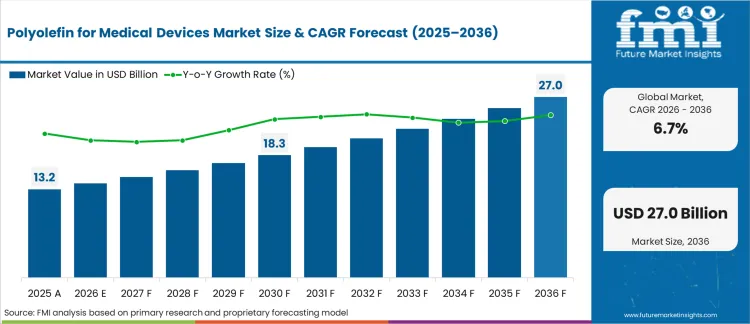
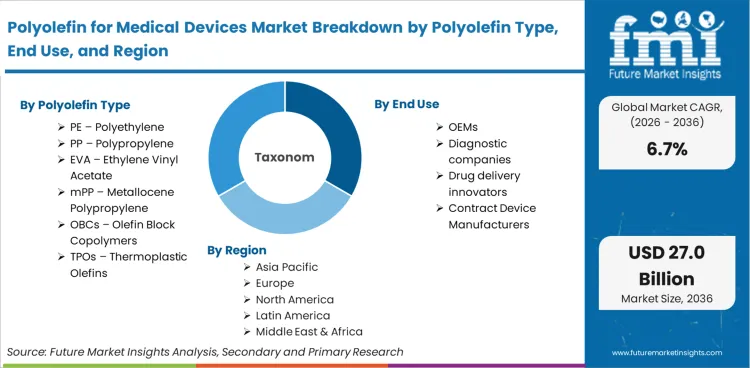
In 2025, the polyolefin for medical devices market was valued at USD 13,174.2 million. Based on Future Market Insights analysis, demand for polyolefin materials in medical devices is estimated to grow to USD 14,094.6 million in 2026 and USD 26,941.3 million by 2036. FMI projects a CAGR of 6.7% during the forecast period.
The market is expected to generate an absolute dollar growth of USD 12,846.7 million between 2026 and 2036. This reflects strong structural expansion driven by rising demand for disposable medical devices, drug delivery systems, and home-use healthcare products. Growth is supported by increasing preference for lightweight, sterilization-compatible, and cost-efficient materials such as PE, PP, EVA, and advanced olefin copolymers. Expanding use in syringes, IV components, diagnostic casings, and wearable injectors reinforces long-term momentum. However, regulatory scrutiny, raw material price volatility, and competition from specialty engineering polymers moderate pricing flexibility.
“Many people aren’t aware that countless plastics products we use every day come from fossil-based components,” said Infinium CEO Robert Schuetzle. “With Infinium eNaphtha, Borealis will create plastics with an ultra-low carbon footprint for customers and end consumers seeking more sustainable, environmentally friendly alternatives.”
Summary of Polyolefin for Medical Devices Market
-
Polyolefin for Medical Devices Market Definition
- The polyolefin for medical devices market includes polyethylene, polypropylene, and specialty olefin-based polymers used in the manufacturing of disposable, semi-durable, and wearable medical devices.
- Demand Drivers in the Market
- Increasing global demand for disposable medical devices such as syringes, IV bags, and blood collection systems is accelerating consumption of medical-grade polyolefins.
- Growth in drug delivery innovations, including auto-injectors and wearable insulin systems, is driving need for high-purity and sterilization-compatible polymer materials.
- Rising regulatory emphasis on biocompatibility, chemical resistance, and sterilization stability is supporting adoption of advanced polyolefin formulations such as mPP and COC/COP.
- Key Segments analysed in the FMI Report
- By Medical Devices: Disposable devices dominate usage due to high production volumes of syringes, tubing, blood bags, and diagnostic consumables.
- By Polyolefin Type: Polypropylene leads adoption owing to strength, clarity, processability, and broad sterilization compatibility.
- By Geography: North America remains a leading region supported by advanced healthcare manufacturing and strong medical device innovation ecosystems.
- Analyst Opinion at FMI
- Ismail Sutaria, Principal Consultant for Packaging Industry at Future Market Insights, opines, ‘CXOs will find in this report strategic insight into how sterilization standards, regulatory compliance, and advanced polymer engineering are shaping growth opportunities in medical-grade polyolefins.’
- Strategic Implications / Executive Takeaways
- Invest in high-purity, sterilization-stable polymer grades to meet evolving regulatory standards.
- Strengthen collaboration with drug delivery innovators to support next-generation wearable and injectable devices.
- Expand regional production capacity to reduce supply chain risk and ensure consistent medical-grade polymer availability.
- Methodology
- Market estimates were validated through interviews with polymer producers and medical device OEMs.
- Secondary research included healthcare production data and regulatory filings.
- Forecasts were developed using device manufacturing output and material consumption modelling.
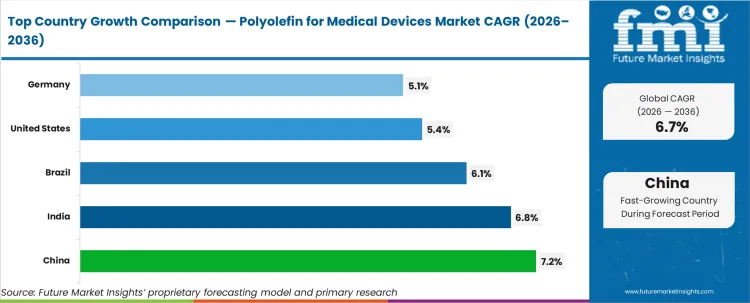
China (7.2%) is projected to record the fastest growth, supported by rapid medical device manufacturing expansion and export capacity. India (6.8%) follows, driven by domestic healthcare infrastructure growth and rising disposable device production. Brazil (6.1%) benefits from increasing diagnostic and hospital equipment demand. The United States (5.4%) and Germany (5.1%) represent mature markets where growth is steady but primarily innovation-led, constrained by regulatory compliance costs and established supplier ecosystems.
Polyolefin for Medical Devices Market Definition
Polyolefin for medical devices market refers to the production and supply of polyolefin-based polymers used in the manufacturing of medical components and devices. Polyolefins include polyethylene (PE), polypropylene (PP), ethylene vinyl acetate (EVA), metallocene polypropylene, olefin block copolymers, and other specialty olefin materials. These materials are used because of their chemical resistance, flexibility, durability, and compatibility with sterilization processes. Their primary function is to provide safe, biocompatible, and processable materials for disposable and semi-durable medical devices. Key end uses include syringes, IV bags, blood bags, catheter components, inhaler housings, insulin pens, diagnostic casings, and wearable drug delivery systems.
Polyolefin for Medical Devices Market Inclusions
Our report provides global and regional market size estimates for 2025 and 2026, with forecasts through 2036 and CAGR analysis. It includes segmentation by medical device type, polyolefin material type, sterilization compatibility, end user, and region. The study covers value-based sizing, regulatory influence assessment, sterilization trend analysis, material innovation developments, and demand patterns across OEMs and contract manufacturers.
Polyolefin for Medical Devices Market Exclusions
The scope excludes non-polyolefin engineering plastics such as polycarbonate, ABS, PEEK, and PVC unless blended within defined polyolefin systems. It does not include finished medical devices or pharmaceutical formulations. The analysis focuses strictly on polyolefin raw materials and compounds used in medical device manufacturing rather than downstream healthcare products.
Polyolefin for Medical Devices Market Research Methodology
- Primary Research: Interviews were conducted with polyolefin resin producers, medical device OEMs, compounders, sterilization service providers, and contract manufacturers. Resin suppliers clarified pricing cycles for medical-grade PE and PP, while OEMs validated material selection trends based on sterilization compatibility and regulatory requirements.
- Desk Research: Regulatory publications from FDA and EU MDR databases, trade statistics, polymer association data, and company annual reports were reviewed to benchmark production volumes and regional demand.
- Market-Sizing and Forecasting: A hybrid top-down and bottom-up approach was applied. Demand was estimated from medical device production volumes and validated against resin manufacturing capacities and healthcare spending trends.
- Data Validation and Update Cycle: Data was cross verified across trade datasets, regulatory filings, and stakeholder interviews, followed by structured expert review prior to final release.
Segment Analysis
Polyolefin for Medical Devices Market Analysis by Polyolefin Type
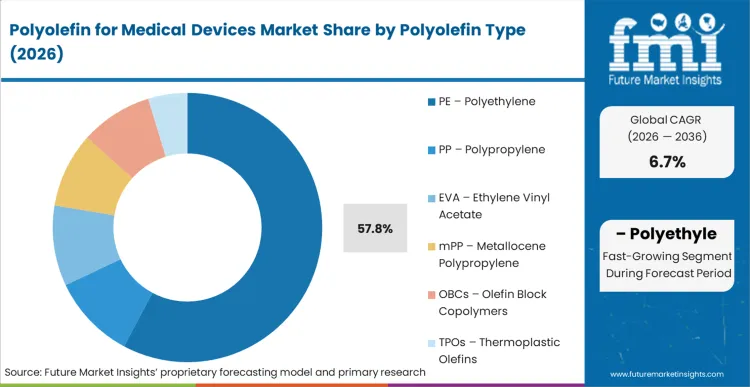
Based on FMI's Polyolefin for Medical Devices market report, consumption of PE - Polyethylene is estimated to hold 57.8% share in 2026. Polyethylene dominates due to its biocompatibility, chemical resistance, flexibility, and ease of sterilization. It addresses critical manufacturer requirements including low extractables, durability under repeated sterilization cycles, and compatibility with tubing, packaging films, and fluid-handling components. PE is widely used in medical tubing, IV bags, squeeze bottles, and protective packaging where flexibility and safety compliance are essential.
- Sterilization Compatibility: Polyethylene performs reliably under ethylene oxide and gamma sterilization processes, ensuring structural integrity and patient safety in regulated environments.
- Regulatory Acceptance: PE grades are widely approved under FDA and global medical material standards, supporting faster product validation for OEMs and device manufacturers.
- Processing Efficiency: Its ease of extrusion and molding supports high-volume production of disposable medical components at competitive cost levels.
Polyolefin for Medical Devices Market Analysis by End User
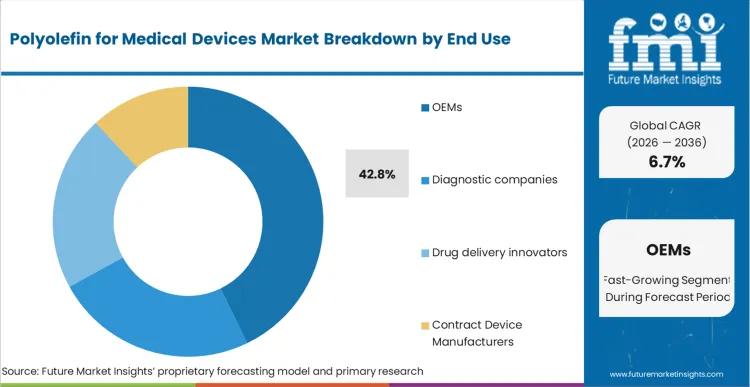
Based on FMI's Polyolefin for Medical Devices market report, consumption by OEMs is estimated to hold 42.8% share in 2026. OEMs lead due to their direct role in large-scale medical device manufacturing, including tubing systems, housings, diagnostic components, and sterile packaging. Polyolefins address OEM priorities related to regulatory compliance, material consistency, lightweight design, and cost-effective scalability.
- High-Volume Production: OEMs require stable polyolefin supply for continuous manufacturing of single-use and disposable medical devices.
- Design Flexibility: Polyolefins allow customization of flexibility, transparency, and impact resistance, supporting innovation in minimally invasive and wearable medical technologies.
- Supply Chain Integration: Strong partnerships between resin suppliers and OEMs ensure material traceability, quality assurance, and compliance with global medical standards.
Polyolefin for Medical Devices Market: Drivers, Restraints, and Opportunities
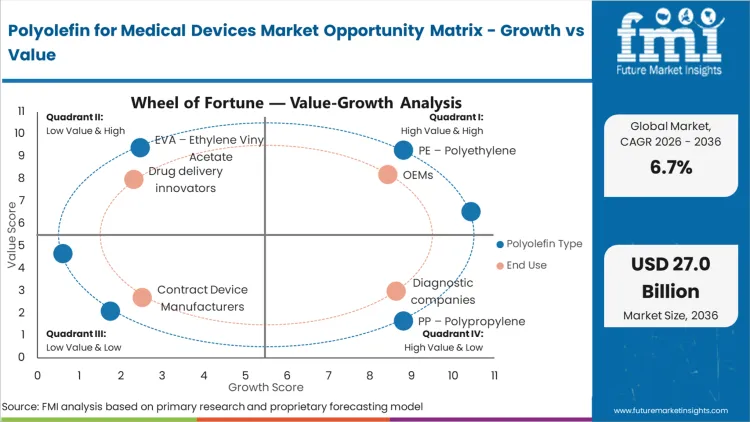
Future Market Insights analysis indicates that the polyolefin for medical devices market is structurally anchored to the global shift toward disposable, lightweight, and chemically stable medical components. Polyolefins such as polyethylene (PE) and polypropylene (PP) are widely used in syringes, IV components, diagnostic housings, packaging films, and non-implantable device parts due to their biocompatibility, sterilization compatibility, and cost efficiency. The market exists at its current scale because healthcare systems increasingly rely on high-volume, single-use medical devices to reduce cross-contamination risks and support infection control protocols. Regulatory frameworks governing medical device safety and material performance reinforce sustained demand for compliant polymer grades.
FMI analysts observe a transition from conventional commodity-grade polyolefins toward medical-grade, high-purity, and specialty formulations. While standard PE and PP continue to dominate volume in basic disposables, growth is increasingly concentrated in clarified polypropylene, metallocene-based polyolefins, and impact-modified grades designed for improved transparency, chemical resistance, and dimensional stability. These advanced materials carry higher per-kilogram pricing due to tighter quality controls and traceability requirements. However, improved performance, compatibility with gamma and ethylene oxide sterilization, and regulatory documentation justify premium positioning, supporting steady value growth even where device unit volumes fluctuate.
- Infection Control Protocols:Expanding use of single-use medical devices in hospitals and clinics continues to drive demand for polyolefin-based components. Disposable systems reduce contamination risks and align with infection prevention standards.
- Medical-Grade Compliance:Regulatory requirements for material traceability, biocompatibility testing, and sterilization validation encourage adoption of certified medical-grade polyolefins rather than industrial-grade resins.
- Advanced Device Innovation:Growth in diagnostic kits, minimally invasive devices, and wearable health monitors is increasing demand for high-clarity and impact-resistant polyolefin formulations tailored to precision medical applications.
Regional Analysis
.webp "Top Country Growth Comparison Polyolefin For Medical Devices Market Cagr (2026 2036)")
The global polyolefin for medical devices market is segmented across Asia Pacific, North America, Europe, and Latin America. Regional performance is influenced by healthcare infrastructure expansion, medical device manufacturing capacity, regulatory compliance standards, and domestic polymer production. The full report provides comprehensive regional market attractiveness analysis.
| Country | CAGR (%) |
|---|---|
| China | 7.2% |
| India | 6.8% |
| Brazil | 6.1% |
| United States | 5.4% |
| Germany | 5.1% |
Source: Future Market Insights (FMI) analysis, based on proprietary forecasting model and primary research
Asia Pacific - Rapid Healthcare Manufacturing Expansion Zone
Asia Pacific serves as the fastest-growing manufacturing base for medical devices and healthcare consumables. The region benefits from expanding hospital infrastructure and rising domestic device production. Key regional players include China Petrochemical Corporation, PetroChina Company Limited, and Reliance Industries Limited, all supplying medical-grade polyolefins. Competitive positioning is shaped by healthcare investment, polymer capacity expansion, and regulatory strengthening.
China
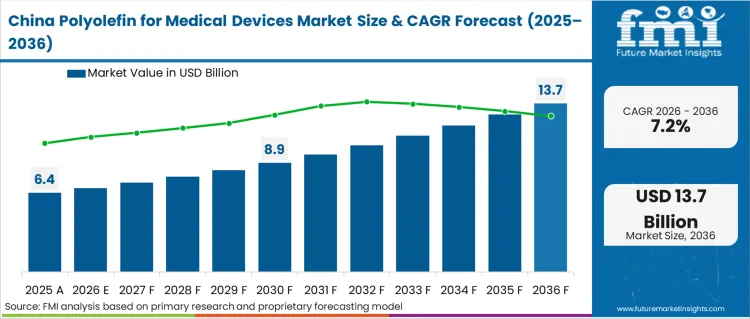
Demand for polyolefin for medical devices in China is projected to rise at 7.2% CAGR through 2036. Growth is driven by rapid expansion of domestic medical device manufacturing and hospital capacity. In 2024, the National Medical Products Administration continued strengthening Good Manufacturing Practice compliance for medical devices, reinforcing requirements for high-purity and traceable polymer materials. China’s Healthy China 2030 initiative continues to expand public healthcare infrastructure, increasing demand for syringes, IV components, and diagnostic device housings made from polypropylene and polyethylene. In 2024, domestic petrochemical producers announced capacity upgrades in high-performance polyolefins to serve medical and hygiene sectors. Rising exports of disposable medical consumables further strengthen demand for compliant polymer grades.
India
Demand for polyolefin for medical devices in India is projected to rise at 6.8% CAGR through 2036. Growth is linked to expansion of domestic medical device production supported by the Production Linked Incentive scheme for medical devices, extended through 2024. The Central Drugs Standard Control Organization continues enforcement of Medical Device Rules, strengthening traceability and packaging compliance requirements that indirectly drive use of certified medical-grade polymers. In 2024, investments in new medical device parks under government initiatives increased domestic manufacturing of syringes, catheters, and IV sets, all reliant on polypropylene and polyethylene. Rising healthcare access under national public health programs also supports growth in disposable medical product demand.
FMI's analysis of polyolefin for medical devices market in Asia Pacific consists of country-wise assessment that includes China and India. Readers can find insights on healthcare expansion, domestic polymer capacity growth, and regulatory compliance trends.
North America to be Advanced Compliance and Innovation Market
North America represents a technologically advanced and regulation-driven market for medical-grade polyolefins. Companies such as Exxon Mobil Corporation, LyondellBasell Industries N.V., and Chevron Phillips Chemical Company LLC supply high-purity resin grades tailored for healthcare applications. Market positioning is defined by regulatory oversight, traceability requirements, and innovation in medical device design.
United States
Demand for polyolefin for medical devices in the United States is projected to rise at 5.4% CAGR through 2036. Growth is influenced by strict oversight from the USA Food and Drug Administration, which enforces quality system regulations for medical device materials. In 2024, continued alignment with ISO 13485 quality management standards reinforced demand for validated, medical-grade polymer resins. Expansion in minimally invasive devices, diagnostic equipment, and single-use medical consumables supports steady polypropylene and polyethylene demand. Public funding for healthcare infrastructure upgrades and increased production of domestically manufactured medical supplies further strengthen resin consumption. Sustainability initiatives in healthcare are also encouraging development of recyclable and lower-carbon polyolefin grades.
FMI's analysis of polyolefin for medical devices market in North America consists of country-wise assessment that includes the United States. Readers can find insights on FDA compliance impact, innovation in medical consumables, and high-purity polymer demand.
Europe: Regulatory Harmonization and Sustainability Market
Europe functions as a compliance-driven and sustainability-focused market for medical device materials. Companies such as Borealis GmbH, TotalEnergies SE, and INEOS Group Holdings S.A. maintain medical-grade polyolefin portfolios aligned with European standards. Competitive positioning is shaped by regulatory harmonization and environmental performance expectations.
Germany
Demand for polyolefin for medical devices in Germany is projected to rise at 5.1% CAGR through 2036. The market is influenced by the European Union Medical Device Regulation, which reinforces strict documentation and material traceability requirements. In 2024, continued MDR implementation reviews strengthened oversight of device material compliance and risk assessment procedures. Germany’s strong medical device manufacturing base supports sustained demand for certified polypropylene and polyethylene grades. Additionally, the European Union’s climate and circular economy objectives encourage development of lower-carbon and recyclable polymer solutions suitable for medical applications. Industrial innovation funding programs continue to support advanced polymer research and healthcare material development.
FMI's analysis of polyolefin for medical devices market in Europe consists of country-wise assessment that includes Germany. Readers can find insights on MDR compliance impact, sustainable polymer innovation, and medical device production trends.
Latin America: The Expanding Healthcare Infrastructure Market
Latin America represents a growing market driven by healthcare infrastructure expansion and domestic production of medical consumables.
Brazil
Demand for polyolefin for medical devices in Brazil is projected to rise at 6.1% CAGR through 2036. Growth is influenced by healthcare system modernization and regulatory enforcement. The Brazilian Health Regulatory Agency (ANVISA) continues to oversee medical device quality standards and material compliance. In 2024, public health procurement programs increased demand for disposable syringes, IV components, and diagnostic consumables manufactured using polypropylene and polyethylene. Investments in domestic petrochemical production capacity also support regional supply of medical-grade polymers. While economic conditions may influence short-term investment cycles, structural healthcare expansion supports sustained polymer demand.
FMI's analysis of polyolefin for medical devices market in Latin America consists of country-wise assessment that includes Brazil. Readers can find insights on public procurement influence, healthcare modernization, and domestic resin production capacity.
Competitive Aligners for Market Players
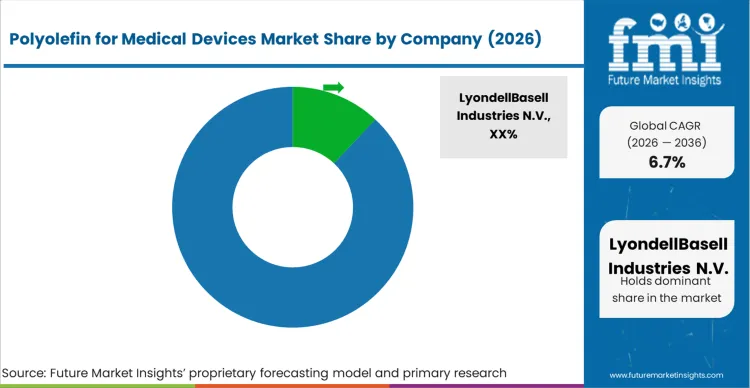
The polyolefin for medical devices market is moderately concentrated, dominated by large global petrochemical and polymer producers with integrated upstream and downstream operations. Companies such as LyondellBasell, Exxon Mobil, SABIC, Dow, Borealis, Braskem, INEOS, TotalEnergies, and Chevron Phillips Chemical account for a substantial share of global polyolefin production capacity. Competition in this segment is driven primarily by material purity, regulatory compliance (USP Class VI, ISO 10993), supply reliability, and long-term contracts with medical device manufacturers and converters. Scale and global distribution capabilities remain key competitive differentiators.
Structural advantages are strongest among companies with vertically integrated feedstock access, advanced polymerization technologies, and dedicated medical-grade product portfolios. Major producers such as LyondellBasell, SABIC, Dow, and Borealis operate global resin manufacturing networks supported by captive ethylene and propylene production, enabling cost stability and supply security. Many of these firms offer controlled medical-grade polyolefin lines with change management protocols, regulatory documentation support, and long-term formulation stability, which create high entry barriers. Companies with regional compounding and technical service centres further strengthen their positioning in regulated healthcare markets.
Buyer leverage in this market is significant but balanced by regulatory constraints. Medical device manufacturers typically require long-term material consistency, validated formulations, and strict change notification agreements, which increase switching costs once a resin grade is qualified. While large OEMs may dual source to mitigate risk, supplier substitution is limited due to regulatory revalidation requirements. As a result, pricing power remains relatively stable for approved medical-grade polyolefin suppliers, especially during feedstock volatility cycles.
Recent Development
- In December 2025, INEOS has announced a major £150 million investment to underpin the long-term future of its Grangemouth site in Scotland, one of the UK’s most important industrial assets and a critical hub for the nation’s manufacturing and energy sectors. Supported by the UK Government, and facilitated by NatWest Group, the investment will upgrade key production units, improve energy efficiency, reduce emissions, and enhance the site’s competitiveness. These investments maintain the site and more than 500 highly skilled direct jobs, as it continues to supply essential raw materials that are vital to the UK economy. From food packaging and housing insulation to automotive parts, hospital equipment, medicines and sustainable technologies, Grangemouth plays a fundamental role in making modern life possible.
- In June 2025, Dow announces significant milestones to mark breakthrough innovation with INNATE™ TF 220 Resin to help enable the design for recyclability and high-performance BOPE films for flexible packaging. From material design to end-of-life solutions, Dow is collaborating with stakeholders across the packaging chain to create impactful, scalable solutions to today's sustainability challenges - transforming vision into commercial reality.
Key Players
- LyondellBasell Industries N.V.
- Exxon Mobil Corporation
- Saudi Basic Industries Corporation
- The Dow Chemical Company
- Borealis GmbH
- Braskem S.A.
- Formosa Plastics Group
- Repsol
- TotalEnergies SE
- INEOS Group Holdings S.A.
- Reliance Industries Limited
- Chevron Phillips Chemical Company LLC.
Scope of Report
| Metric | Value |
|---|---|
| Quantitative Units | USD 13,174.2 million (2025); USD 14,094.6 million (2026) to USD 26,941.3 million (2036), at a CAGR of 6.7% |
| Market Definition | The polyolefin for medical devices market comprises the global production and supply of medical-grade polyethylene, polypropylene, and specialty olefin-based polymers engineered for biocompatibility, sterilization resistance, chemical stability, and regulatory compliance across disposable, semi-durable, and wearable medical device applications. |
| Form Segmentation | Disposable Devices; Semi-Durable Devices; Wearable & Home-Use Devices |
| End Use Segmentation | OEMs; Diagnostic Companies; Drug Delivery Innovators; Contract Device Manufacturers; Hospitals, Clinics & Home Care Providers |
| Application Coverage | Syringes & Needles; IV Bags & Tubing; Blood Bags; Diagnostic Casings; Catheter Components; Inhalers & DPI Housings; Insulin Pens; Auto-Injectors; Transdermal Patch Holders; Surgical Kits |
| Regions Covered | North America; Latin America; East Asia; South Asia & Pacific; Eastern Europe; Western Europe; Middle East & Africa |
| Countries Covered | United States; Germany; France; United Kingdom; China; Japan; India; South Korea; Brazil; Italy; and 40+ countries |
| Key Companies Profiled | LyondellBasell Industries N.V.; Exxon Mobil Corporation; SABIC; The Dow Chemical Company; Borealis GmbH; Others |
| Forecast Period | 2026 to 2036 |
| Approach | Hybrid top-down and bottom-up market modeling validated through primary interviews with polymer producers, medical device OEMs, and contract manufacturers, supported by capacity benchmarking, sterilization compatibility assessment, regulatory compliance analysis (FDA, ISO 10993), and trade flow evaluation across global healthcare supply chains. |
Polyolefin for Medical Devices Market by Segments
By Medical Devices
- Disposable Devices
- Syringes, Needles
- IV Bags and Tubing
- Blood Bags
- Pipette Tips, Test Tubes
- Semi-Durable Devices
- Diagnostic Device Casings
- Catheter Components
- Inhalers and DPI Housings
- Fluid Transfer Systems
- Wearable / Home-Use Devices
- Insulin Pens
- Transdermal Patch Holders
- Smart injectors / auto-injectors
- Surgical kit
By Polyolefin Type
- PE - Polyethylene
- PP - Polypropylene
- EVA - Ethylene Vinyl Acetate
- mPP - Metallocene Polypropylene
- OBCs - Olefin Block Copolymers
- TPOs - Thermoplastic Olefins
- COC/COP - Cyclo-Olefin Copolymer / Cyclo-Olefin Polymer
- EPDM/EPR - Ethylene Propylene Diene Monomer/ Ethylene Propylene Rubber
- PAOs - Polyalphaolefins
By Sterilization Compatibility
- Gamma
- Ethylene Oxide (EtO)
- Steam Autoclave
- E-beam
By End User
- OEMs
- Diagnostic companies
- Drug delivery innovators
- Contract Device Manufacturers
- Hospitals, clinics, home care providers
By Region
- North America
- Latin America
- East Asia
- South Asia & Pacific
- Eastern Europe
- Western Europe
- MEA
Bibliography
- USA Food and Drug Administration (FDA), Use of International Standard ISO 10993-1, “Biological evaluation of medical devices – Part 1: Evaluation and testing within a risk management process” - Guidance for Industry and FDA Staff, September 2023.
- USA Food and Drug Administration (FDA), Quality System Regulation (21 CFR Part 820), January 2024.
- International Organization for Standardization (ISO), ISO 10993-1:2018 Biological Evaluation of Medical Devices - Part 1 (Confirmed 2023 Review), September 2023.
- International Organization for Standardization (ISO), ISO 11607-1:2019 Packaging for Terminally Sterilized Medical Devices - Part 1: Requirements for Materials, Sterile Barrier Systems and Packaging Systems (Confirmed 2023 Review), September 2023.
- ASTM International, ASTM D4976-23 - Standard Specification for Polyethylene Plastics Molding and Extrusion Materials, April 2023.
- ASTM International, ASTM D4101-23 - Standard Specification for Polypropylene Injection and Extrusion Materials, April 2023.
- European Parliament and Council, Regulation (EU) 2017/745 on Medical Devices (MDR), Consolidated Version, December 2023.
- PlasticsEurope, Plastics – The Facts 2024: An Analysis of European Plastics Production, Demand and Waste Data, October 2024.
This Report Addresses
- Market intelligence enabling structured strategic decision making across global medical-grade polyolefin and healthcare manufacturing ecosystems.
- Market size estimation and 10-year revenue forecasts from 2026 to 2036, validated through resin capacity and device output benchmarking.
- Growth opportunity mapping across PE, PP, mPP, COC/COP, TPOs, and advanced olefin copolymers replacing PVC systems.
- Segment and regional revenue forecasts across device categories, sterilization compatibility, end users, and global healthcare hubs.
- Competition strategy assessment covering medical-grade certification protocols, upstream integration, long-term supply agreements, and compliance-driven positioning.
- Material compliance tracking aligned with ISO 10993 biocompatibility standards, FDA quality regulations, and EU MDR requirements.
- Regulatory and sterilization impact analysis addressing gamma, EtO, steam autoclave resilience, infection control protocols, and traceability mandates.
- Market report delivery in PDF, Excel, PPT, and interactive dashboard formats for executive, regulatory, and procurement planning use.
Frequently Asked Questions
How large is the Polyolefin for Medical Devices Market in 2026?
The Polyolefin for Medical Devices Market is valued at 14,094.6 Mn in 2026.
What was the market size of the Polyolefin for Medical Devices Market in 2025?
The market was valued at 13,174.2 Mn in 2025.
What will the market size be for the Polyolefin for Medical Devices Market by 2036?
The market is projected to reach 26,941.3 Mn by 2036.
What is the expected CAGR of the Polyolefin for Medical Devices Market during the forecast period?
The Polyolefin for Medical Devices Market is expected to grow at a CAGR of 6.7%.
Which medical device segment is poised to lead the market?
Disposable devices lead the market with 47.4% share, followed by semi-durable devices at 36.4% and wearable/home-use devices at 16.2%.
Which polyolefin type dominates the market?
PE – Polyethylene dominates with 57.8% share, followed by PP Polypropylene at 23.5%.
How significant are OEMs in the end-user landscape?
OEMs represent the largest end-user segment, accounting for 42.8% of the market, followed by contract device manufacturers at 22.9%.
Which country is projected to grow the fastest in this market?
China is projected to grow at the highest CAGR of 7.2%, followed by India at 6.8% and Brazil at 6.1%.
What is the growth outlook for the United States and Germany?
The United States is projected to grow at a CAGR of 5.4%, while Germany is expected to expand at 5.1% during the forecast period.
Which sterilization compatibility methods are covered in the market analysis?
The market covers polyolefins compatible with gamma, ethylene oxide (EtO), steam autoclave, and e-beam sterilization methods.
Preview the report firsthand - request a free sample
Get SampleGet the brochure for pricing and purchase details.
Get PDFTable of Content
- Executive Summary
- Global Market Outlook
- Demand-side Trends
- Supply-side Trends
- Technology Roadmap Analysis
- Market Coverage / Taxonomy
- Market Definition / Scope / Limitations
- Research Methodology
- Chapter Orientation
- Analytical Lens and Working Hypotheses
- Market Structure, Signals, and Trend Drivers
- Benchmarking and Cross-market Comparability
- Market Sizing, Forecasting, and Opportunity Mapping
- Research Design and Evidence Framework
- Desk Research Programme (Secondary Evidence)
- Company Annual and Sustainability Reports
- Peer-reviewed Journals and Academic Literature
- Corporate Websites, Product Literature, and Technical Notes
- Earnings Decks and Investor Briefings
- Statutory Filings and Regulatory Disclosures
- Technical White Papers and Standards Notes
- Social Channels, Communities, and Digital Listening Inputs
- Additional Desk Sources
- Expert Input and Fieldwork (Primary Evidence)
- Primary Modes
- Qualitative Interviews and Expert Elicitation
- Quantitative Surveys and Structured Data Capture
- Blended Approach
- Why Primary Evidence is Used
- Field Techniques
- Interviews
- Surveys
- Focus Groups
- Observational and In-context Research
- Social and Community Interactions
- Stakeholder Universe Engaged
- C-suite Leaders
- Board Members
- Presidents and Vice Presidents
- R&D and Innovation Heads
- Technical Specialists
- Domain Subject-matter Experts
- Scientists
- Physicians and Other Healthcare Professionals
- Governance, Ethics, and Data Stewardship
- Research Ethics
- Data Integrity and Handling
- Primary Modes
- Tooling, Models, and Reference Databases
- Desk Research Programme (Secondary Evidence)
- Data Engineering and Model Build
- Data Acquisition and Ingestion
- Cleaning, Normalisation, and Verification
- Synthesis, Triangulation, and Analysis
- Quality Assurance and Audit Trail
- Market Background
- Market Dynamics
- Drivers
- Restraints
- Opportunity
- Trends
- Scenario Forecast
- Demand in Optimistic Scenario
- Demand in Likely Scenario
- Demand in Conservative Scenario
- Opportunity Map Analysis
- Product Life Cycle Analysis
- Supply Chain Analysis
- Investment Feasibility Matrix
- Value Chain Analysis
- PESTLE and Porter’s Analysis
- Regulatory Landscape
- Regional Parent Market Outlook
- Production and Consumption Statistics
- Import and Export Statistics
- Market Dynamics
- Global Market Analysis 2021 to 2025 and Forecast, 2026 to 2036
- Historical Market Size Value (USD Million) Analysis, 2021 to 2025
- Current and Future Market Size Value (USD Million) Projections, 2026 to 2036
- Y-o-Y Growth Trend Analysis
- Absolute $ Opportunity Analysis
- Global Market Pricing Analysis 2021 to 2025 and Forecast 2026 to 2036
- Global Market Analysis 2021 to 2025 and Forecast 2026 to 2036, By Polyolefin Type
- Introduction / Key Findings
- Historical Market Size Value (USD Million) Analysis By Polyolefin Type , 2021 to 2025
- Current and Future Market Size Value (USD Million) Analysis and Forecast By Polyolefin Type , 2026 to 2036
- PE – Polyethylene
- PP – Polypropylene
- EVA – Ethylene Vinyl Acetate
- mPP – Metallocene Polypropylene
- OBCs – Olefin Block Copolymers
- TPOs – Thermoplastic Olefins
- PE – Polyethylene
- Y-o-Y Growth Trend Analysis By Polyolefin Type , 2021 to 2025
- Absolute $ Opportunity Analysis By Polyolefin Type , 2026 to 2036
- Global Market Analysis 2021 to 2025 and Forecast 2026 to 2036, By End Use
- Introduction / Key Findings
- Historical Market Size Value (USD Million) Analysis By End Use, 2021 to 2025
- Current and Future Market Size Value (USD Million) Analysis and Forecast By End Use, 2026 to 2036
- OEMs
- Diagnostic companies
- Drug delivery innovators
- Contract Device Manufacturers
- OEMs
- Y-o-Y Growth Trend Analysis By End Use, 2021 to 2025
- Absolute $ Opportunity Analysis By End Use, 2026 to 2036
- Global Market Analysis 2021 to 2025 and Forecast 2026 to 2036, By Region
- Introduction
- Historical Market Size Value (USD Million) Analysis By Region, 2021 to 2025
- Current Market Size Value (USD Million) Analysis and Forecast By Region, 2026 to 2036
- North America
- Latin America
- Western Europe
- Eastern Europe
- East Asia
- South Asia and Pacific
- Middle East & Africa
- Market Attractiveness Analysis By Region
- North America Market Analysis 2021 to 2025 and Forecast 2026 to 2036, By Country
- Historical Market Size Value (USD Million) Trend Analysis By Market Taxonomy, 2021 to 2025
- Market Size Value (USD Million) Forecast By Market Taxonomy, 2026 to 2036
- By Country
- USA
- Canada
- Mexico
- By Polyolefin Type
- By End Use
- By Country
- Market Attractiveness Analysis
- By Country
- By Polyolefin Type
- By End Use
- Key Takeaways
- Latin America Market Analysis 2021 to 2025 and Forecast 2026 to 2036, By Country
- Historical Market Size Value (USD Million) Trend Analysis By Market Taxonomy, 2021 to 2025
- Market Size Value (USD Million) Forecast By Market Taxonomy, 2026 to 2036
- By Country
- Brazil
- Chile
- Rest of Latin America
- By Polyolefin Type
- By End Use
- By Country
- Market Attractiveness Analysis
- By Country
- By Polyolefin Type
- By End Use
- Key Takeaways
- Western Europe Market Analysis 2021 to 2025 and Forecast 2026 to 2036, By Country
- Historical Market Size Value (USD Million) Trend Analysis By Market Taxonomy, 2021 to 2025
- Market Size Value (USD Million) Forecast By Market Taxonomy, 2026 to 2036
- By Country
- Germany
- UK
- Italy
- Spain
- France
- Nordic
- BENELUX
- Rest of Western Europe
- By Polyolefin Type
- By End Use
- By Country
- Market Attractiveness Analysis
- By Country
- By Polyolefin Type
- By End Use
- Key Takeaways
- Eastern Europe Market Analysis 2021 to 2025 and Forecast 2026 to 2036, By Country
- Historical Market Size Value (USD Million) Trend Analysis By Market Taxonomy, 2021 to 2025
- Market Size Value (USD Million) Forecast By Market Taxonomy, 2026 to 2036
- By Country
- Russia
- Poland
- Hungary
- Balkan & Baltic
- Rest of Eastern Europe
- By Polyolefin Type
- By End Use
- By Country
- Market Attractiveness Analysis
- By Country
- By Polyolefin Type
- By End Use
- Key Takeaways
- East Asia Market Analysis 2021 to 2025 and Forecast 2026 to 2036, By Country
- Historical Market Size Value (USD Million) Trend Analysis By Market Taxonomy, 2021 to 2025
- Market Size Value (USD Million) Forecast By Market Taxonomy, 2026 to 2036
- By Country
- China
- Japan
- South Korea
- By Polyolefin Type
- By End Use
- By Country
- Market Attractiveness Analysis
- By Country
- By Polyolefin Type
- By End Use
- Key Takeaways
- South Asia and Pacific Market Analysis 2021 to 2025 and Forecast 2026 to 2036, By Country
- Historical Market Size Value (USD Million) Trend Analysis By Market Taxonomy, 2021 to 2025
- Market Size Value (USD Million) Forecast By Market Taxonomy, 2026 to 2036
- By Country
- India
- ASEAN
- Australia & New Zealand
- Rest of South Asia and Pacific
- By Polyolefin Type
- By End Use
- By Country
- Market Attractiveness Analysis
- By Country
- By Polyolefin Type
- By End Use
- Key Takeaways
- Middle East & Africa Market Analysis 2021 to 2025 and Forecast 2026 to 2036, By Country
- Historical Market Size Value (USD Million) Trend Analysis By Market Taxonomy, 2021 to 2025
- Market Size Value (USD Million) Forecast By Market Taxonomy, 2026 to 2036
- By Country
- Kingdom of Saudi Arabia
- Other GCC Countries
- Turkiye
- South Africa
- Other African Union
- Rest of Middle East & Africa
- By Polyolefin Type
- By End Use
- By Country
- Market Attractiveness Analysis
- By Country
- By Polyolefin Type
- By End Use
- Key Takeaways
- Key Countries Market Analysis
- USA
- Pricing Analysis
- Market Share Analysis, 2025
- By Polyolefin Type
- By End Use
- Canada
- Pricing Analysis
- Market Share Analysis, 2025
- By Polyolefin Type
- By End Use
- Mexico
- Pricing Analysis
- Market Share Analysis, 2025
- By Polyolefin Type
- By End Use
- Brazil
- Pricing Analysis
- Market Share Analysis, 2025
- By Polyolefin Type
- By End Use
- Chile
- Pricing Analysis
- Market Share Analysis, 2025
- By Polyolefin Type
- By End Use
- Germany
- Pricing Analysis
- Market Share Analysis, 2025
- By Polyolefin Type
- By End Use
- UK
- Pricing Analysis
- Market Share Analysis, 2025
- By Polyolefin Type
- By End Use
- Italy
- Pricing Analysis
- Market Share Analysis, 2025
- By Polyolefin Type
- By End Use
- Spain
- Pricing Analysis
- Market Share Analysis, 2025
- By Polyolefin Type
- By End Use
- France
- Pricing Analysis
- Market Share Analysis, 2025
- By Polyolefin Type
- By End Use
- India
- Pricing Analysis
- Market Share Analysis, 2025
- By Polyolefin Type
- By End Use
- ASEAN
- Pricing Analysis
- Market Share Analysis, 2025
- By Polyolefin Type
- By End Use
- Australia & New Zealand
- Pricing Analysis
- Market Share Analysis, 2025
- By Polyolefin Type
- By End Use
- China
- Pricing Analysis
- Market Share Analysis, 2025
- By Polyolefin Type
- By End Use
- Japan
- Pricing Analysis
- Market Share Analysis, 2025
- By Polyolefin Type
- By End Use
- South Korea
- Pricing Analysis
- Market Share Analysis, 2025
- By Polyolefin Type
- By End Use
- Russia
- Pricing Analysis
- Market Share Analysis, 2025
- By Polyolefin Type
- By End Use
- Poland
- Pricing Analysis
- Market Share Analysis, 2025
- By Polyolefin Type
- By End Use
- Hungary
- Pricing Analysis
- Market Share Analysis, 2025
- By Polyolefin Type
- By End Use
- Kingdom of Saudi Arabia
- Pricing Analysis
- Market Share Analysis, 2025
- By Polyolefin Type
- By End Use
- Turkiye
- Pricing Analysis
- Market Share Analysis, 2025
- By Polyolefin Type
- By End Use
- South Africa
- Pricing Analysis
- Market Share Analysis, 2025
- By Polyolefin Type
- By End Use
- USA
- Market Structure Analysis
- Competition Dashboard
- Competition Benchmarking
- Market Share Analysis of Top Players
- By Regional
- By Polyolefin Type
- By End Use
- Competition Analysis
- Competition Deep Dive
- LyondellBasell Industries N.V.
- Overview
- Product Portfolio
- Profitability by Market Segments (Product/Age /Sales Channel/Region)
- Sales Footprint
- Strategy Overview
- Marketing Strategy
- Product Strategy
- Channel Strategy
- Exxon Mobil Corporation
- Saudi Basic Industries Corporation
- The Dow Chemical Company
- Borealis GmbH
- Braskem S.A.
- Formosa Plastics Group
- Repsol
- TotalEnergies SE
- INEOS Group Holdings S.A.
- Reliance Industries Limited
- LyondellBasell Industries N.V.
- Competition Deep Dive
- Assumptions & Acronyms Used


