

- Industry Size (2026)
- USD 3069.0 Mn
- Forecast (2036)
- USD 5600.7 Mn
- CAGR (2026 to 2036)
- 6.2%
Commercial Humidifier Market Forecast and Outlook 2026 to 2036
The commercial humidifier market is valued at USD 3,069.0 million in 2026 and is forecasted to reach USD 5,600.7 million by 2036 at a CAGR of 6.2%. Value formation is anchored in mandatory humidity control across large enclosed environments where air-conditioning and heating systems lower relative moisture levels. Hospitals offices data centers and laboratories require controlled humidity to protect occupants equipment and materials from static discharge drying and dimensional stress. Specification decisions emphasize output stability hygiene performance and integration with centralized HVAC controls. Capital allocation favors systems capable of operating across seasonal load variation with predictable energy and water consumption profiles.
Growth quality reflects structural exposure to climate control intensity regulatory oversight and building system integration constraints. Humidifiers add energy and water load which places scrutiny on efficiency and hygiene management particularly in healthcare and data critical facilities. Water quality scale control and microbial risk shape technology selection and maintenance planning. Retrofit complexity within existing HVAC networks limits rapid substitution and favors phased upgrades. Replacement demand emerges from aging installations compliance revisions and shifts toward tighter humidity tolerances. Procurement prioritizes lifecycle reliability service accessibility and control accuracy which supports expansion tied to utilization and regulatory persistence rather than construction activity.
Quick Stats for Commercial Humidifier Market
- Commercial Humidifier Market Value (2026): USD 3,069.0 million
- Commercial Humidifier Market Forecast Value (2036): USD 5,600.7 million
- Commercial Humidifier Market Forecast CAGR 2026 to 2036: 6.2%
- Leading Humidifier Type by Demand Share: Steam Humidifiers
- Fastest-Growing Countries: India, China, United Arab Emirates, Saudi Arabia, USA
- Top Players in Global Demand: Condair, CAREL, Munters, Armstrong International, DriSteem, Honeywell, Neptronic, STULZ, HygroMatik, Daikin
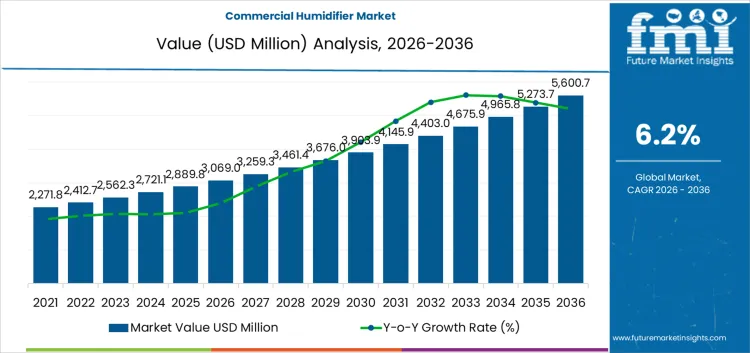
Commercial Humidifier Market Key Takeaways
| Metric | Value |
|---|---|
| Market Value (2026) | USD 3,069.0 million |
| Market Forecast Value (2036) | USD 5,600.7 million |
| Forecast CAGR 2026 to 2036 | 6.2% |
Why is the Demand for Commercial Humidifier Growing?
Demand for commercial humidifiers is increasing as facility operators seek to control indoor humidity to support occupant comfort, asset protection, and operational efficiency in large spaces. Offices, hospitals, museums, and data centers specify humidification systems that maintain moisture within defined parameters because overly dry conditions can affect human health, degrade sensitive materials, and influence static buildup around electronic equipment. Engineers select systems that deliver consistent performance across broad airflow volumes and varied seasonal loads while minimizing energy use and maintenance burden. Procurement teams evaluate unit capacity, control precision, and integration with existing HVAC controls to ensure selection aligns with building automation strategies.
Regulatory guidelines and indoor air quality benchmarks influence specification of commercial humidifiers that support documented humidity ranges and minimize microbial risk through effective water treatment and distribution design. Growth in healthcare infrastructure and education facilities is reinforcing the uptake of commercial humidification solutions that improve ambient conditions for occupants and sensitive processes. Facility planners coordinate placement with air distribution layouts to optimize moisture delivery without disrupting ventilation balance. Technology improvements in steam generation, ultrasonic delivery, and hybrid control algorithms support responsive adjustment to occupancy patterns and external weather changes. Service providers require systems that offer accessible maintenance points and reliable operational records to reduce unplanned downtime. These operational and technical considerations are supporting sustained demand for commercial humidifiers across diverse built environments.
How Are the Segments Classified in the Commercial Humidifier Market?
Demand for commercial humidifiers is shaped by indoor air quality requirements, occupant comfort standards, and protection of sensitive equipment. Controlled humidity supports health outcomes, static control, and material preservation across professional environments. Adoption aligns with regulatory guidance for workplaces, healthcare facilities, and mission-critical infrastructure. System selection prioritizes hygiene performance, control accuracy, energy use, and maintenance accessibility. Segment classification reflects differentiation by humidification method, functional application setting, and integration approach. Structure highlights how moisture generation technology, building use profile, and installation strategy influence specification priorities, utilization intensity, and operational reliability across commercial indoor environments.
Which Humidifier Type Represents the Largest Share of Demand?
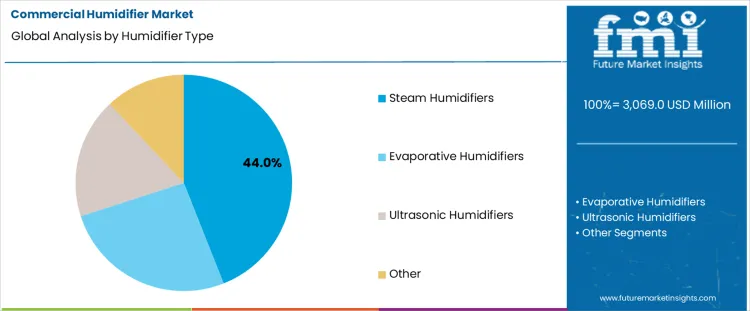
Steam humidifiers hold 44.0%, representing the largest share among humidifier types due to precise humidity control capability. These systems generate sterile steam suitable for environments requiring strict hygiene standards and rapid moisture delivery. Performance remains consistent across varying air temperatures and flow conditions. Control responsiveness supports tight humidity setpoints critical for healthcare and data-sensitive facilities. Evaporative humidifiers provide energy-efficient operation with dependence on air conditions. Ultrasonic systems offer fine mist generation with limited capacity suitability. Humidifier type segmentation reflects preference for reliable, controllable solutions where accuracy, cleanliness, and operational predictability remain essential.
Key Points
- Steam systems deliver precise and hygienic moisture control.
- Rapid response supports tight humidity specifications.
- Other types address efficiency or capacity-specific needs.
Which Application Accounts for the Highest Share of Demand?
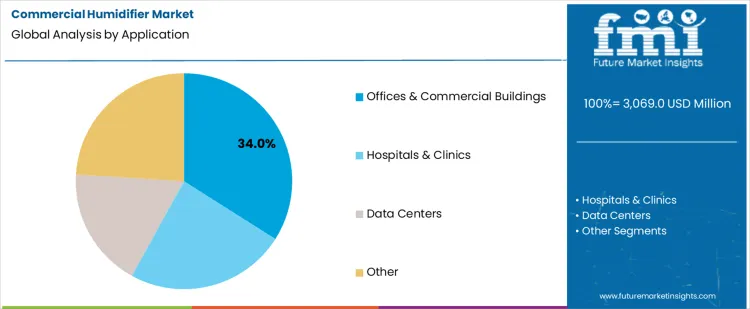
Offices and commercial buildings hold 34.0%, representing the largest share among application settings due to broad occupancy and comfort requirements. Controlled humidity improves perceived comfort, reduces static electricity, and supports building material preservation. Centralized building management systems enable coordinated humidity control across large floor areas. Seasonal climate variation increases reliance on humidification during dry conditions. Hospitals and clinics apply humidifiers for infection control and patient comfort with higher specification rigor. Data centers prioritize humidity to protect electronic equipment. Application segmentation reflects concentration of humidifier deployment within general commercial spaces emphasizing comfort, productivity, and building system integration.
Key Points
- Commercial buildings require humidity for occupant comfort.
- Central systems enable coordinated moisture control.
- Other applications focus on hygiene or equipment protection.
Which System Integration Approach Drives the Largest Share of Demand?
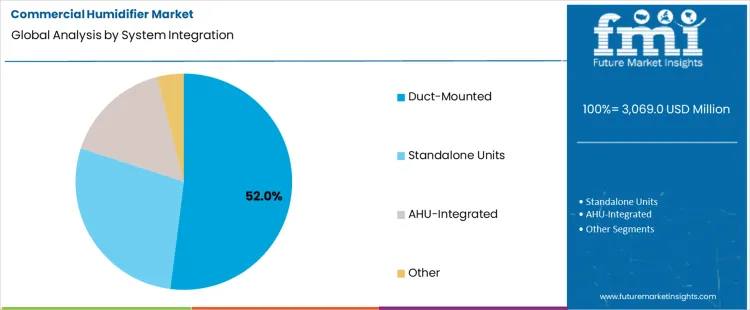
Duct-mounted systems hold 52.0%, representing the largest share among integration approaches due to centralized distribution efficiency. Installation within HVAC ducts enables uniform humidity control across multiple zones. Integration supports automated operation through building control systems. Maintenance access remains consolidated, reducing operational complexity. Standalone units provide localized humidification with limited coverage. AHU-integrated systems offer compact solutions within air handling assemblies. System integration segmentation reflects preference for centralized approaches delivering consistent humidity levels, scalable coverage, and seamless coordination with existing HVAC infrastructure in commercial facilities.
Key Points
- Duct-mounted systems provide uniform humidity distribution.
- Centralized control supports automation and scalability.
- Other approaches address localized or compact installation needs.
What are the Key Dynamics in the Commercial Humidifier Market?
Demand for commercial humidifiers reflects operational need to control indoor humidity across non-residential environments. Adoption spans offices, healthcare facilities, data centers, museums, manufacturing plants, and commercial greenhouses. Global scope aligns with indoor air quality management, process stability, and occupant comfort requirements. Usage centers on steam, evaporative, ultrasonic, and high-pressure humidification systems integrated with building HVAC infrastructure.
How do humidity control requirements and process sensitivity shape adoption?
Commercial buildings require controlled humidity to prevent material degradation, static electricity, and occupant discomfort. Demand increases in healthcare settings where humidity affects infection control and respiratory comfort. Data centers adopt humidifiers to reduce electrostatic discharge risk impacting sensitive electronics. Manufacturing environments rely on precise humidity to maintain product quality in textiles, printing, electronics, and pharmaceuticals. Museums and archives require stable humidity to preserve artifacts and paper-based materials. Integration with building management systems enables automated humidity regulation based on occupancy and ambient conditions. Adoption reflects operational dependence on humidity stability for asset protection and process consistency.
How do energy consumption, water quality, and maintenance constraints influence market scalability?
Humidification systems add energy and water load to building operations. Demand sensitivity rises where steam systems increase electricity or fuel consumption. Water quality affects scale formation, nozzle clogging, and hygiene risk, increasing treatment requirements. Maintenance intensity varies by technology, affecting lifecycle cost predictability. Legionella control requirements raise compliance burden in certain systems. Retrofit installation complexity affects adoption in older buildings. Capital expenditure constraints influence technology selection. Regional building codes and indoor air standards vary, limiting standardized deployment across diverse commercial facilities.
How Is Demand for Commercial Humidifiers Evolving Globally?
Demand for commercial humidifiers is expanding globally due to indoor air quality management needs, process humidity control, and climate-driven conditioning requirements. Adoption aligns with healthcare facilities, data centers, manufacturing cleanrooms, and commercial buildings requiring controlled humidity levels. Dry indoor environments, energy-efficient HVAC integration, and regulatory attention to occupant comfort support sustained uptake. Growth rates in India at 7.4%, China at 6.8%, UAE at 6.2%, Saudi Arabia at 6.0%, and USA at 5.1% indicate steady expansion driven by infrastructure development, climatic conditions, and operational reliability requirements rather than discretionary building upgrades.
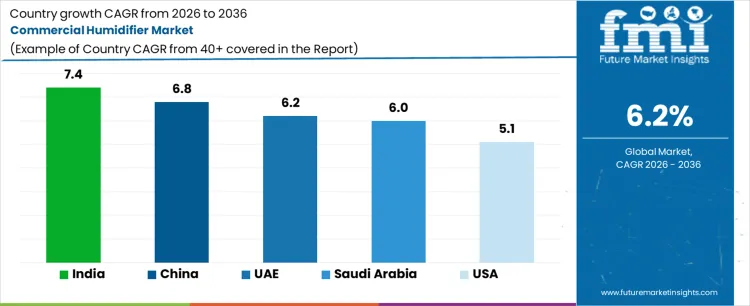
| Country | CAGR (%) |
|---|---|
| India | 7.4% |
| China | 6.8% |
| UAE | 6.2% |
| Saudi Arabia | 6.0% |
| USA | 5.1% |
What Is Driving Strong Growth of Commercial Humidifier Demand in India?
India is growing at a CAGR of 7.4%, supported by rapid expansion of healthcare, data centers, and controlled manufacturing environments. Dry indoor air during extended air-conditioning operation increases need for humidity regulation. Pharmaceutical and food processing facilities require precise humidity control to maintain product quality. Commercial office developments integrate humidifiers to improve occupant comfort and equipment protection. Infrastructure growth across Tier-2 cities expands addressable installation base. Demand growth reflects operational and compliance requirements rather than premium building enhancements.
- Expansion of healthcare and pharmaceutical facilities
- Increased data center and IT infrastructure deployment
- Extended air-conditioning operation causing low humidity
- Growth of commercial buildings beyond major metros
Why Is China Sustaining Elevated Demand for Commercial Humidifiers?
Commercial humidifier demand in China is expanding at a CAGR of 6.8%, driven by industrial process control and large-scale commercial infrastructure. Manufacturing sectors such as electronics and textiles require stable humidity to reduce defects. Urban commercial buildings integrate humidification to manage indoor air quality during heating seasons. Data centers prioritize humidity control to protect sensitive equipment. Domestic manufacturing enables wide availability of centralized and modular systems. Demand growth reflects industrial intensity and building scale rather than short-term construction cycles.
- Electronics and textile process humidity requirements
- Large commercial building HVAC integration
- Data center equipment protection needs
- Strong domestic production and system availability
How Is the UAE Shaping Demand for Commercial Humidifiers?
Commercial humidifier demand in United Arab Emirates is growing at a CAGR of 6.2%, influenced by arid climate conditions and high indoor cooling dependence. Continuous air-conditioning reduces indoor humidity across offices, hotels, and healthcare facilities. Hospitality and retail developments prioritize humidity control to enhance comfort and preserve interiors. Data centers and museums require controlled humidity for asset protection. High building standards support adoption of integrated humidification systems. Demand growth reflects climatic necessity and building quality standards rather than industrial process expansion.
- Arid climate causing persistently low indoor humidity
- Hospitality and retail comfort management needs
- Asset protection in museums and data centers
- High HVAC integration standards in commercial buildings
What Factors Are Supporting Commercial Humidifier Demand in Saudi Arabia?
Saudi Arabia is expanding at a CAGR of 6.0%, shaped by large-scale commercial infrastructure and extreme dry climate conditions. Healthcare expansion requires humidity control for patient comfort and infection management. Industrial facilities use humidifiers to stabilize production environments. Government-led infrastructure projects integrate advanced HVAC systems. Continuous cooling operation intensifies indoor dryness. Growth reflects climate-driven necessity and institutional investment rather than incremental commercial retrofits.
- Extreme arid climate increasing humidification needs
- Healthcare infrastructure expansion
- Industrial environment stabilization requirements
- Government-backed commercial infrastructure projects
Why Is the USA Experiencing Moderate Growth in Commercial Humidifiers?
Commercial humidifier demand in USA is growing at a CAGR of 5.1%, supported by replacement demand and indoor air quality standards. Cold-season heating reduces indoor humidity across offices, hospitals, and educational facilities. Data centers and laboratories require precise humidity management. Building operators upgrade systems to improve energy efficiency and compliance. Installed base maturity moderates growth pace. Demand expansion reflects lifecycle replacement and standards compliance rather than rapid commercial construction growth.
- Cold-season heating causing indoor dryness
- Data center and laboratory humidity control needs
- Indoor air quality and compliance requirements
- Replacement of aging humidification systems
What is the competitive landscape of demand for the commercial humidifier market globally?
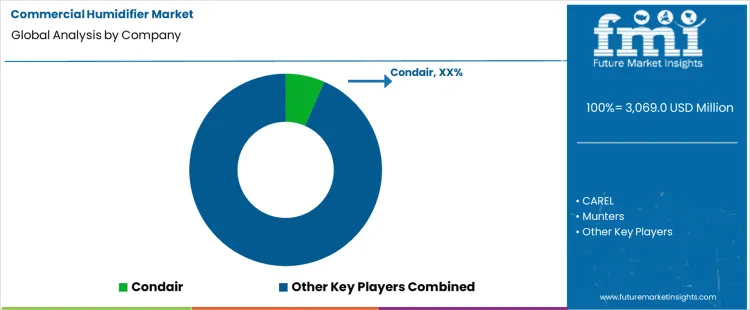
Demand for commercial humidifiers is driven by requirements for indoor air quality, thermal comfort, and process humidity control in offices, healthcare facilities, industrial plants, data centers, and public buildings. Buyers evaluate humidification accuracy, energy efficiency, water quality management, integration with HVAC systems, and ease of maintenance.
Procurement teams prioritize suppliers with proven reliability, global service networks, compliance with air quality and safety standards, and scalable solutions that support variable load conditions. Trend in the global market reflects rising emphasis on workplace comfort, strict IAQ regulations, adaptation to HVAC electrification, and integration of digital controls for optimized performance.
Condair holds leading positioning through a broad portfolio of commercial humidification systems, including steam, evaporative, and adiabatic technologies supported by global distribution and technical support. CAREL supports demand with advanced control-integrated humidifiers tailored to commercial HVAC and process air applications. Munters participates with energy-efficient and precision humidity control systems used in industrial and institutional settings worldwide.
Armstrong International contributes commercial humidifiers and steam systems designed for reliability and integration with large-scale HVAC infrastructures. DriSteem supplies humidification solutions and controls emphasizing hygiene, system efficiency, and ease of integration. Competitive differentiation depends on humidity control precision, water and energy management, integration flexibility with building systems, and ability to meet diverse end-user performance requirements.
Key Players in the Commercial Humidifier Market
- Condair
- CAREL
- Munters
- Armstrong International
- DriSteem
- Honeywell
- Neptronic
- STULZ
- HygroMatik
- Daikin
Scope of the Report
| Items | Values |
|---|---|
| Quantitative Units | USD million |
| Humidifier Type | Steam Humidifiers; Evaporative Humidifiers; Ultrasonic Humidifiers; Other |
| Application | Offices & Commercial Buildings; Hospitals & Clinics; Data Centers; Other |
| System Integration | Duct-Mounted; Standalone Units; AHU-Integrated; Other |
| Sales Channel | HVAC Contractors; Direct or Project Sales; Distributors; Other |
| Regions Covered | Asia Pacific, Europe, North America, Latin America, Middle East & Africa |
| Countries Covered | India, China, UAE, Saudi Arabia, USA, and 40+ countries |
| Key Companies Profiled | Condair; CAREL; Munters; Armstrong International; DriSteem; Honeywell; Neptronic; STULZ; HygroMatik; Daikin |
| Additional Attributes | Dollar sales by humidifier type and application; adoption trends for steam and ultrasonic systems in healthcare and data center environments; humidification capacity, response time, and energy efficiency performance metrics; water quality tolerance, hygiene control, and mineral management considerations; integration with building management systems and AHUs; installation complexity, maintenance frequency, and lifecycle cost factors; project-driven procurement patterns across commercial construction and retrofit activity; compliance with indoor air quality guidelines, healthcare hygiene standards, and HVAC codes influencing commercial humidifier specification. |
Commercial Humidifier Market by Segment
Humidifier Type:
- Steam Humidifiers
- Evaporative Humidifiers
- Ultrasonic Humidifiers
- Other
Application:
- Offices & Commercial Buildings
- Hospitals & Clinics
- Data Centers
- Other
System Integration:
- Duct-Mounted
- Standalone Units
- AHU-Integrated
- Other
Sales Channel:
- HVAC Contractors
- Direct or Project Sales
- Distributors
- Other
Region:
- Asia Pacific
- China
- Japan
- South Korea
- India
- Australia & New Zealand
- ASEAN
- Rest of Asia Pacific
- Europe
- Germany
- United Kingdom
- France
- Italy
- Spain
- Nordic
- BENELUX
- Rest of Europe
- North America
- United States
- Canada
- Mexico
- Latin America
- Brazil
- Chile
- Rest of Latin America
- Middle East & Africa
- Kingdom of Saudi Arabia
- Other GCC Countries
- Turkey
- South Africa
- Other African Union
- Rest of Middle East & Africa
Bibliography
- International Organization for Standardization. (2023). ISO 16890: Air filters for general ventilation - Performance requirements related to indoor air quality, relevant to humidifier-HVAC integration. International Organization for Standardization.
- ASHRAE. (2023). ASHRAE Standard 55: Thermal Environmental Conditions for Human Occupancy, humidity control requirements for commercial buildings. American Society of Heating, Refrigerating and Air-Conditioning Engineers.
- European Committee for Standardization. (2023). EN 13053: Ventilation for buildings - Air handling units, humidification sections and hygiene requirements. CEN.
- International Energy Agency. (2023). Energy use and efficiency considerations in commercial HVAC and humidification systems. International Energy Agency.
Frequently Asked Questions
How big is the commercial humidifier market in 2026?
The global commercial humidifier market is estimated to be valued at USD 3,069.0 million in 2026.
What will be the size of commercial humidifier market in 2036?
The market size for the commercial humidifier market is projected to reach USD 5,600.7 million by 2036.
How much will be the commercial humidifier market growth between 2026 and 2036?
The commercial humidifier market is expected to grow at a 6.2% CAGR between 2026 and 2036.
What are the key product types in the commercial humidifier market?
The key product types in commercial humidifier market are steam humidifiers, evaporative humidifiers, ultrasonic humidifiers and other.
Which application segment to contribute significant share in the commercial humidifier market in 2026?
In terms of application, offices & commercial buildings segment to command 34.0% share in the commercial humidifier market in 2026.
Preview the report firsthand - request a free sample
Get SampleGet the brochure for pricing and purchase details.
Get PDFTable of Content
- Executive Summary
- Global Market Outlook
- Demand-side Trends
- Supply-side Trends
- Technology Roadmap Analysis
- Analysis and Recommendations
- Market Overview
- Market Coverage / Taxonomy
- Market Definition / Scope / Limitations
- Market Background
- Market Dynamics
- Drivers
- Restraints
- Opportunity
- Trends
- Scenario Forecast
- Demand in Optimistic Scenario
- Demand in Likely Scenario
- Demand in Conservative Scenario
- Opportunity Map Analysis
- Product Life Cycle Analysis
- Supply Chain Analysis
- Investment Feasibility Matrix
- Value Chain Analysis
- PESTLE and Porter’s Analysis
- Regulatory Landscape
- Regional Parent Market Outlook
- Production and Consumption Statistics
- Import and Export Statistics
- Market Dynamics
- Global Market Analysis 2021 to 2025 and Forecast, 2026 to 2036
- Historical Market Size Value (USD Million) Analysis, 2021 to 2025
- Current and Future Market Size Value (USD Million) Projections, 2026 to 2036
- Y-o-Y Growth Trend Analysis
- Absolute $ Opportunity Analysis
- Global Market Pricing Analysis 2021 to 2025 and Forecast 2026 to 2036
- Global Market Analysis 2021 to 2025 and Forecast 2026 to 2036, By Humidifier Type
- Introduction / Key Findings
- Historical Market Size Value (USD Million) Analysis By Humidifier Type , 2021 to 2025
- Current and Future Market Size Value (USD Million) Analysis and Forecast By Humidifier Type , 2026 to 2036
- Steam Humidifiers
- Evaporative Humidifiers
- Ultrasonic Humidifiers
- Other
- Steam Humidifiers
- Y-o-Y Growth Trend Analysis By Humidifier Type , 2021 to 2025
- Absolute $ Opportunity Analysis By Humidifier Type , 2026 to 2036
- Global Market Analysis 2021 to 2025 and Forecast 2026 to 2036, By Application
- Introduction / Key Findings
- Historical Market Size Value (USD Million) Analysis By Application, 2021 to 2025
- Current and Future Market Size Value (USD Million) Analysis and Forecast By Application, 2026 to 2036
- Offices & Commercial Buildings
- Hospitals & Clinics
- Data Centers
- Other
- Offices & Commercial Buildings
- Y-o-Y Growth Trend Analysis By Application, 2021 to 2025
- Absolute $ Opportunity Analysis By Application, 2026 to 2036
- Global Market Analysis 2021 to 2025 and Forecast 2026 to 2036, By System Integration
- Introduction / Key Findings
- Historical Market Size Value (USD Million) Analysis By System Integration, 2021 to 2025
- Current and Future Market Size Value (USD Million) Analysis and Forecast By System Integration, 2026 to 2036
- Duct-Mounted
- Standalone Value (USD Million)s
- AHU-Integrated
- Other
- Duct-Mounted
- Y-o-Y Growth Trend Analysis By System Integration, 2021 to 2025
- Absolute $ Opportunity Analysis By System Integration, 2026 to 2036
- Global Market Analysis 2021 to 2025 and Forecast 2026 to 2036, By Sales Channel
- Introduction / Key Findings
- Historical Market Size Value (USD Million) Analysis By Sales Channel, 2021 to 2025
- Current and Future Market Size Value (USD Million) Analysis and Forecast By Sales Channel, 2026 to 2036
- HVAC Contractors
- Direct or Project Sales
- Distributors
- Other
- HVAC Contractors
- Y-o-Y Growth Trend Analysis By Sales Channel, 2021 to 2025
- Absolute $ Opportunity Analysis By Sales Channel, 2026 to 2036
- Global Market Analysis 2021 to 2025 and Forecast 2026 to 2036, By Region
- Introduction
- Historical Market Size Value (USD Million) Analysis By Region, 2021 to 2025
- Current Market Size Value (USD Million) Analysis and Forecast By Region, 2026 to 2036
- North America
- Latin America
- Western Europe
- Eastern Europe
- East Asia
- South Asia and Pacific
- Middle East & Africa
- Market Attractiveness Analysis By Region
- North America Market Analysis 2021 to 2025 and Forecast 2026 to 2036, By Country
- Historical Market Size Value (USD Million) Trend Analysis By Market Taxonomy, 2021 to 2025
- Market Size Value (USD Million) Forecast By Market Taxonomy, 2026 to 2036
- By Country
- USA
- Canada
- Mexico
- By Humidifier Type
- By Application
- By System Integration
- By Sales Channel
- By Country
- Market Attractiveness Analysis
- By Country
- By Humidifier Type
- By Application
- By System Integration
- By Sales Channel
- Key Takeaways
- Latin America Market Analysis 2021 to 2025 and Forecast 2026 to 2036, By Country
- Historical Market Size Value (USD Million) Trend Analysis By Market Taxonomy, 2021 to 2025
- Market Size Value (USD Million) Forecast By Market Taxonomy, 2026 to 2036
- By Country
- Brazil
- Chile
- Rest of Latin America
- By Humidifier Type
- By Application
- By System Integration
- By Sales Channel
- By Country
- Market Attractiveness Analysis
- By Country
- By Humidifier Type
- By Application
- By System Integration
- By Sales Channel
- Key Takeaways
- Western Europe Market Analysis 2021 to 2025 and Forecast 2026 to 2036, By Country
- Historical Market Size Value (USD Million) Trend Analysis By Market Taxonomy, 2021 to 2025
- Market Size Value (USD Million) Forecast By Market Taxonomy, 2026 to 2036
- By Country
- Germany
- UK
- Italy
- Spain
- France
- Nordic
- BENELUX
- Rest of Western Europe
- By Humidifier Type
- By Application
- By System Integration
- By Sales Channel
- By Country
- Market Attractiveness Analysis
- By Country
- By Humidifier Type
- By Application
- By System Integration
- By Sales Channel
- Key Takeaways
- Eastern Europe Market Analysis 2021 to 2025 and Forecast 2026 to 2036, By Country
- Historical Market Size Value (USD Million) Trend Analysis By Market Taxonomy, 2021 to 2025
- Market Size Value (USD Million) Forecast By Market Taxonomy, 2026 to 2036
- By Country
- Russia
- Poland
- Hungary
- Balkan & Baltic
- Rest of Eastern Europe
- By Humidifier Type
- By Application
- By System Integration
- By Sales Channel
- By Country
- Market Attractiveness Analysis
- By Country
- By Humidifier Type
- By Application
- By System Integration
- By Sales Channel
- Key Takeaways
- East Asia Market Analysis 2021 to 2025 and Forecast 2026 to 2036, By Country
- Historical Market Size Value (USD Million) Trend Analysis By Market Taxonomy, 2021 to 2025
- Market Size Value (USD Million) Forecast By Market Taxonomy, 2026 to 2036
- By Country
- China
- Japan
- South Korea
- By Humidifier Type
- By Application
- By System Integration
- By Sales Channel
- By Country
- Market Attractiveness Analysis
- By Country
- By Humidifier Type
- By Application
- By System Integration
- By Sales Channel
- Key Takeaways
- South Asia and Pacific Market Analysis 2021 to 2025 and Forecast 2026 to 2036, By Country
- Historical Market Size Value (USD Million) Trend Analysis By Market Taxonomy, 2021 to 2025
- Market Size Value (USD Million) Forecast By Market Taxonomy, 2026 to 2036
- By Country
- India
- ASEAN
- Australia & New Zealand
- Rest of South Asia and Pacific
- By Humidifier Type
- By Application
- By System Integration
- By Sales Channel
- By Country
- Market Attractiveness Analysis
- By Country
- By Humidifier Type
- By Application
- By System Integration
- By Sales Channel
- Key Takeaways
- Middle East & Africa Market Analysis 2021 to 2025 and Forecast 2026 to 2036, By Country
- Historical Market Size Value (USD Million) Trend Analysis By Market Taxonomy, 2021 to 2025
- Market Size Value (USD Million) Forecast By Market Taxonomy, 2026 to 2036
- By Country
- Kingdom of Saudi Arabia
- Other GCC Countries
- Turkiye
- South Africa
- Other African Union
- Rest of Middle East & Africa
- By Humidifier Type
- By Application
- By System Integration
- By Sales Channel
- By Country
- Market Attractiveness Analysis
- By Country
- By Humidifier Type
- By Application
- By System Integration
- By Sales Channel
- Key Takeaways
- Key Countries Market Analysis
- USA
- Pricing Analysis
- Market Share Analysis, 2025
- By Humidifier Type
- By Application
- By System Integration
- By Sales Channel
- Canada
- Pricing Analysis
- Market Share Analysis, 2025
- By Humidifier Type
- By Application
- By System Integration
- By Sales Channel
- Mexico
- Pricing Analysis
- Market Share Analysis, 2025
- By Humidifier Type
- By Application
- By System Integration
- By Sales Channel
- Brazil
- Pricing Analysis
- Market Share Analysis, 2025
- By Humidifier Type
- By Application
- By System Integration
- By Sales Channel
- Chile
- Pricing Analysis
- Market Share Analysis, 2025
- By Humidifier Type
- By Application
- By System Integration
- By Sales Channel
- Germany
- Pricing Analysis
- Market Share Analysis, 2025
- By Humidifier Type
- By Application
- By System Integration
- By Sales Channel
- UK
- Pricing Analysis
- Market Share Analysis, 2025
- By Humidifier Type
- By Application
- By System Integration
- By Sales Channel
- Italy
- Pricing Analysis
- Market Share Analysis, 2025
- By Humidifier Type
- By Application
- By System Integration
- By Sales Channel
- Spain
- Pricing Analysis
- Market Share Analysis, 2025
- By Humidifier Type
- By Application
- By System Integration
- By Sales Channel
- France
- Pricing Analysis
- Market Share Analysis, 2025
- By Humidifier Type
- By Application
- By System Integration
- By Sales Channel
- India
- Pricing Analysis
- Market Share Analysis, 2025
- By Humidifier Type
- By Application
- By System Integration
- By Sales Channel
- ASEAN
- Pricing Analysis
- Market Share Analysis, 2025
- By Humidifier Type
- By Application
- By System Integration
- By Sales Channel
- Australia & New Zealand
- Pricing Analysis
- Market Share Analysis, 2025
- By Humidifier Type
- By Application
- By System Integration
- By Sales Channel
- China
- Pricing Analysis
- Market Share Analysis, 2025
- By Humidifier Type
- By Application
- By System Integration
- By Sales Channel
- Japan
- Pricing Analysis
- Market Share Analysis, 2025
- By Humidifier Type
- By Application
- By System Integration
- By Sales Channel
- South Korea
- Pricing Analysis
- Market Share Analysis, 2025
- By Humidifier Type
- By Application
- By System Integration
- By Sales Channel
- Russia
- Pricing Analysis
- Market Share Analysis, 2025
- By Humidifier Type
- By Application
- By System Integration
- By Sales Channel
- Poland
- Pricing Analysis
- Market Share Analysis, 2025
- By Humidifier Type
- By Application
- By System Integration
- By Sales Channel
- Hungary
- Pricing Analysis
- Market Share Analysis, 2025
- By Humidifier Type
- By Application
- By System Integration
- By Sales Channel
- Kingdom of Saudi Arabia
- Pricing Analysis
- Market Share Analysis, 2025
- By Humidifier Type
- By Application
- By System Integration
- By Sales Channel
- Turkiye
- Pricing Analysis
- Market Share Analysis, 2025
- By Humidifier Type
- By Application
- By System Integration
- By Sales Channel
- South Africa
- Pricing Analysis
- Market Share Analysis, 2025
- By Humidifier Type
- By Application
- By System Integration
- By Sales Channel
- USA
- Market Structure Analysis
- Competition Dashboard
- Competition Benchmarking
- Market Share Analysis of Top Players
- By Regional
- By Humidifier Type
- By Application
- By System Integration
- By Sales Channel
- Competition Analysis
- Competition Deep Dive
- Condair
- Overview
- Product Portfolio
- Profitability by Market Segments (Product/Age /Sales Channel/Region)
- Sales Footprint
- Strategy Overview
- Marketing Strategy
- Product Strategy
- Channel Strategy
- CAREL
- Munters
- Armstrong International
- DriSteem
- Honeywell
- Neptronic
- STULZ
- HygroMatik
- Daikin
- Condair
- Competition Deep Dive
- Assumptions & Acronyms Used
- Research Methodology


