

- Industry Size (2026)
- USD 2600.0 Mn
- Forecast (2036)
- USD 4235.0 Mn
- CAGR (2026 to 2036)
- 5.0%
Commercial Building Panic Bars Market Forecast and Outlook 2026 to 2036
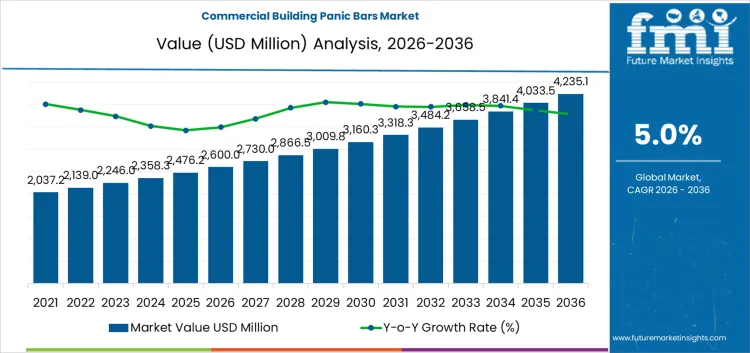
The commercial building panic bars market is likely to be valued at USD 2,600.0 million in 2026 and is forecasted to reach USD 4,235.0 million by 2036 at a CAGR of 5.0%. Value behavior is governed by mandatory life safety compliance rather than discretionary security spending. Panic bars are specified to satisfy fire egress codes, occupant load thresholds, and accessibility rules enforced during permitting and inspection cycles. Specification authority rests with architects and code consultants, limiting substitution once drawings are approved. Retrofit demand appears when audits identify noncompliant exits, creating purchasing tied to inspection outcomes. Capital allocation follows construction approvals and enforcement timelines, anchoring demand to regulatory cadence.
Replacement cycles are influenced by usage intensity, vandal exposure, and finish degradation in high traffic corridors. Electrified variants introduce wiring and control dependencies that raise installation and maintenance cost thresholds. Door construction diversity restricts standardization, requiring project specific hardware preparation and field adjustment. Public sector procurement schedules extend decision timelines and compress order volumes into discrete funding windows. Competitive pricing remains constrained by certification parity, shifting competition toward distributor reach and contractor preference. Value expansion remains persistent but paced by inspection frequency, retrofit backlog clearance, and new building commissioning rates across regulated commercial occupancies globally.
Quick Stats for Commercial Building Panic Bars Market
- Commercial Building Panic Bars Market Value (2026): USD 2,600.0 million
- Commercial Building Panic Bars Market Forecast Value (2036): USD 4,235.1 million
- Commercial Building Panic Bars Market Forecast CAGR 2026 to 2036: 5.0%
- Leading Device Type by Demand Share: Rim Exit Devices
- Fastest-Growing Countries: India, Saudi Arabia, UAE, Indonesia, Vietnam
- Top Players in Global Demand: Allegion, ASSA ABLOY, dormakaba, Hager Companies, Stanley Access Technologies, CR Laurence, Ives, Command Access, Cal-Royal
Commercial Building Panic Bars Market Key Takeaways
| Metric | Value |
|---|---|
| Market Value (2026) | USD 2,600.0 million |
| Market Forecast Value (2036) | USD 4,235.0 million |
| Forecast CAGR 2026 to 2036 | 5.0% |
Why is the Demand for Commercial Building Panic Bars Growing?
Demand for commercial building panic bars is increasing as building owners and facility managers implement safety hardware that supports rapid, controlled egress during emergencies in public and high-occupancy structures. Panic bars are specified on exit doors in offices, schools, hospitals, retail spaces, and assembly venues to comply with life safety codes that mandate touch-activated exit mechanisms capable of immediate operation under duress. Architects and code consultants evaluate product certification to ensure compliance with regional and national fire and egress regulations, and they assess material quality, mechanical reliability, and durability under repeated use. Procurement teams emphasize finish options that withstand heavy foot traffic and environmental exposure while maintaining ease of maintenance to support long-term building operations without frequent service requirements.
Growth in commercial construction activity and upgrades of existing facilities under safety audit schedules reinforces uptake of panic bars that integrate with access control and alarm systems. Property owners prioritize hardware that minimizes risk of entrapment and reduces potential liability by enabling intuitive egress without specialized training. Advances in design focus on smooth actuation, vandal resistance, and compatibility with ADA accessibility requirements, which further drive specification in mixed-use and institutional buildings. Coordination between security consultants, fire safety designers, and installation contractors ensures selected panic bars align with overall life safety strategies. These market-specific safety and compliance drivers are contributing to sustained demand in the commercial building panic bars market.
How Are the Segments Classified in the Commercial Building Panic Bars Market?
Demand for panic bars in commercial buildings is shaped by life safety codes, emergency egress requirements, and occupant density considerations. Facilities require reliable exit hardware enabling rapid door operation during emergencies while maintaining secure access control. Adoption aligns with building code enforcement across offices, education facilities, healthcare settings, and public venues. Device selection prioritizes actuation reliability, door compatibility, and durability under frequent use. Segment classification reflects differentiation by exit device configuration, door construction type, and functional end use, influencing installation density, compliance alignment, and maintenance expectations.
Which Device Type Represents the Largest Share of Demand?

Rim exit devices hold 34.0%, representing the largest share among device types due to installation simplicity and broad door compatibility. These devices mount on the door surface, reducing modification requirements and installation time. Consistent actuation performance supports reliable egress under emergency conditions. Maintenance access remains straightforward, supporting lifecycle serviceability. Vertical rod devices support double-door applications with enhanced latching coverage. Mortise exit devices integrate within door bodies for aesthetic alignment with higher installation complexity. Device type segmentation reflects preference for externally mounted solutions balancing compliance, reliability, and installation efficiency.
Key Points
- Rim devices offer simplified installation and servicing.
- Surface mounting supports broad door compatibility.
- Other devices address multi-door or concealed hardware needs.
Which Door Type Accounts for the Highest Share of Demand?
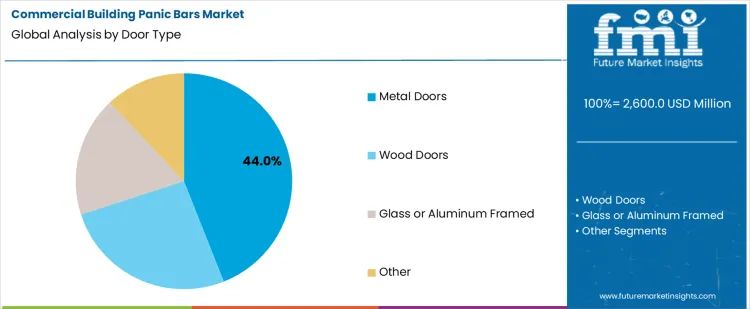
Metal doors hold 44.0%, representing the largest share among door types due to prevalence in commercial construction. Fire-rated and security-rated metal doors commonly require panic hardware for code compliance. Structural rigidity supports repeated actuation without deformation. Compatibility with standardized hardware preparations simplifies installation. Wood doors apply panic bars in educational and hospitality settings with different reinforcement needs. Glass or aluminum-framed doors require specialized mounting approaches. Door type segmentation reflects concentration of panic bar demand where durability, fire resistance, and standardized construction dominate commercial building specifications.
Key Points
- Metal doors dominate commercial and institutional buildings.
- Structural rigidity supports frequent emergency use.
- Other door types require specialized mounting considerations.
Which End Use Drives the Largest Share of Demand?
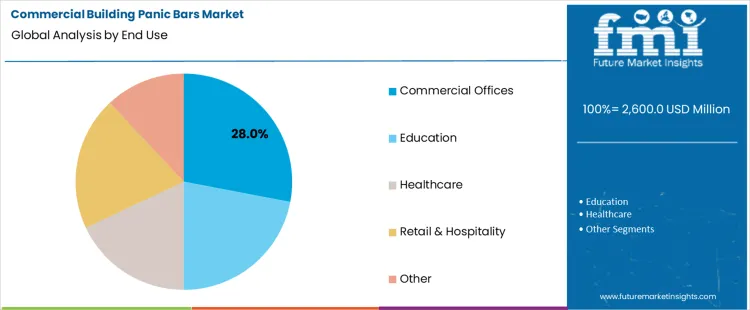
Commercial offices hold 28.0%, representing the largest share among end-use settings due to high occupancy and regulatory oversight. Office buildings require clearly defined egress paths supporting employee and visitor safety. Panic bars enable rapid evacuation during fire or security incidents. Standardized floor plans support consistent hardware deployment. Education facilities prioritize panic hardware for student safety with controlled access needs. Healthcare settings balance egress with patient movement control. Retail and hospitality manage public access with varying traffic patterns. End-use segmentation reflects concentration where workforce density and compliance enforcement drive consistent installation requirements.
Key Points
- Offices require compliant emergency egress solutions.
- Occupant density increases safety hardware deployment.
- Other sectors balance egress with access management needs.
What are the Key Dynamics in the Commercial Building Panic Bars Market?
Demand for commercial building panic bars reflects life safety and emergency egress requirements in non-residential buildings. Adoption concentrates in offices, retail complexes, hospitals, educational institutions, airports, and assembly occupancies. Global scope aligns with fire safety codes and emergency evacuation standards. Usage centers on mechanically actuated exit devices installed on outward-opening doors to enable rapid, unobstructed egress during emergencies.
How do fire safety regulation and occupant load requirements shape adoption?
Commercial buildings with high occupant density require exit hardware enabling immediate door release under panic conditions. Demand increases as building codes mandate panic bars for spaces exceeding defined occupant thresholds. Panic bars allow door opening through horizontal force without fine motor action, supporting evacuation under smoke, low visibility, or crowd pressure. Hospitals and schools prioritize devices compatible with frequent use and infection control cleaning protocols. Retail and assembly spaces require wide activation surfaces to accommodate crowd movement. Integration with fire alarm and access control systems supports automatic unlocking during emergencies. Adoption reflects mandatory compliance with egress safety requirements rather than discretionary security enhancement.
How does compliance complexity, retrofit challenges, and cost pressure influence market scalability?
Panic bar installation must comply with detailed code specifications governing door width, projection, mounting height, and hardware operation. Demand sensitivity rises where retrofit projects involve door replacement or frame modification. Certification to fire and life safety standards increases testing and documentation cost. High-cycle usage accelerates wear, increasing maintenance and replacement frequency. Integration with electronic access systems raises system cost and installation complexity. Aesthetic constraints in premium buildings limit hardware selection. Public sector procurement cycles slow volume adoption. Building-specific door configurations constrain standardization, limiting scalable deployment across heterogeneous commercial properties.
How Is Demand for Commercial Building Panic Bars Evolving Globally?
Demand for commercial building panic bars is expanding globally due to fire safety enforcement, occupancy regulation, and evacuation compliance across public and private facilities. Adoption aligns with emergency egress requirements in offices, hospitals, malls, schools, and transport terminals. Retrofit activity increases where legacy doors are upgraded to meet code revisions and inspection outcomes. Specification emphasizes reliability, durability, and compatibility with access control. Growth rates in India at 6.4%, Saudi Arabia at 6.1%, UAE at 5.8%, Indonesia at 5.4%, and Vietnam at 5.2% indicate steady expansion driven by regulatory enforcement, building utilization intensity, and lifecycle replacement.
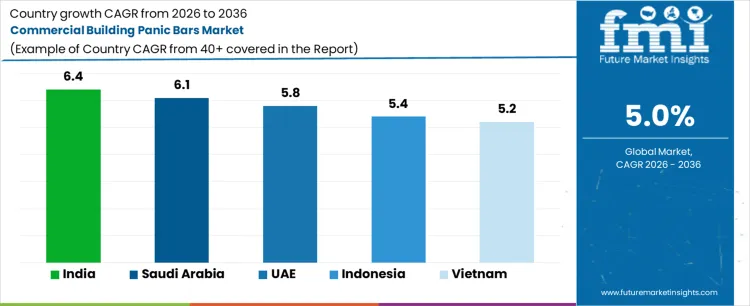
| Country | CAGR (%) |
|---|---|
| India | 6.4% |
| Saudi Arabia | 6.1% |
| UAE | 5.8% |
| Indonesia | 5.4% |
| Vietnam | 5.2% |
What Is Driving Growth of Panic Bar Demand Across India?
Commercial building panic bar demand in India is growing at a CAGR of 6.4%, supported by enforcement of fire and life safety codes across high-occupancy buildings. Hospitals, educational institutions, and malls undergo inspections requiring compliant emergency exits. Metro stations and airports specify panic hardware to manage evacuation under peak loads. Growth of organized commercial real estate increases standardized door hardware adoption. Retrofit programs address non-compliant legacy doors in older facilities. Demand growth reflects compliance enforcement and occupancy risk management rather than premium architectural upgrades.
- Fire safety audits driving retrofit activity
- High-occupancy public buildings specifying compliant exits
- Transport infrastructure egress standardization
- Organized commercial real estate expansion
Why Is Saudi Arabia Experiencing Steady Expansion in Panic Bar Adoption?
Saudi Arabia is expanding at a CAGR of 6.1%, driven by safety compliance within public infrastructure and large venues. Government buildings, healthcare facilities, and religious complexes require reliable emergency egress hardware. Building codes emphasize crowd safety and controlled evacuation. New developments integrate panic bars during commissioning, while existing facilities undergo compliance upgrades. Demand growth reflects institutional safety planning and inspection regimes rather than discretionary fit-out decisions.
- Public and religious facility safety requirements
- Code-driven evacuation compliance
- Commissioning-stage hardware specification
- Compliance upgrades in existing buildings
How Is the UAE Shaping Demand for Commercial Building Panic Bars?
Commercial building panic bar demand in United Arab Emirates is growing at a CAGR of 5.8%, influenced by stringent safety standards and high visitor volumes. Airports, hotels, malls, and offices specify panic hardware to meet evacuation norms. Integration with access control and alarm systems shapes product selection. Tourism and mixed-use developments prioritize certified egress solutions. Retrofit demand arises from periodic compliance reviews. Growth reflects safety governance and building performance standards rather than expansion in basic construction activity.
- High visitor density requiring reliable egress
- Integration with access control and alarms
- Tourism and mixed-use development specifications
- Periodic compliance-driven retrofits
What Factors Are Supporting Panic Bar Demand in Indonesia?
Indonesia is expanding at a CAGR of 5.4%, shaped by urban development and safety regulation adoption. Shopping centers, offices, and hospitals increase focus on emergency exit compliance. Municipal enforcement strengthens inspection outcomes in dense cities. Cost sensitivity favors durable, standardized panic hardware. New public buildings specify compliant exits at design stage. Demand growth reflects urban safety enforcement and standardized procurement rather than high-end architectural differentiation.
- Urban inspection enforcement in dense cities
- Mall and hospital egress compliance needs
- Standardized, durable hardware preference
- Design-stage specification in public buildings
Why Is Vietnam Showing Measured Growth in Panic Bar Demand?
Commercial building panic bar demand in Vietnam is growing at a CAGR of 5.2%, supported by commercial development and regulatory alignment. Offices, factories, and educational facilities adopt compliant exit hardware to meet inspection requirements. Industrial parks standardize egress solutions across buildings. Retrofit activity addresses legacy doors in older premises. Demand growth reflects compliance normalization and facility standardization rather than rapid expansion of high-occupancy venues.
- Regulatory alignment for emergency egress
- Standardization across industrial parks
- Retrofit of legacy building exits
- Compliance-driven procurement practices
What is the competitive landscape of demand for the commercial building panic bars market globally?
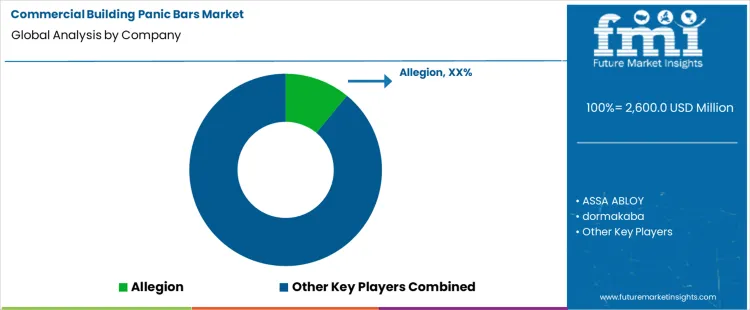
Demand for commercial building panic bars is driven by building safety regulations, fire egress standards, and requirements for accessible and secure exit solutions in schools, hospitals, offices, retail environments, and public facilities. Panic bars, also known as push-bar exit devices, must offer reliable operation, ADA compliance, and durability under frequent use. Buyers evaluate mechanical reliability, finish quality, installation flexibility, compliance with local and international building codes, and integration with access control systems. Procurement teams prioritize suppliers with broad product portfolios, global distribution networks, certified testing to safety standards (such as UL and EN certifications), and strong technical support. Trend in the global market reflects emphasis on life-safety solutions, modernization of legacy hardware, and integration with smart building access systems.
Allegion holds leading positioning through a comprehensive panic bar portfolio under brands such as Von Duprin and LCN, widely specified across global commercial and institutional projects supported by specification and service networks. ASSA ABLOY supports demand with integrated exit devices and access control integration across regional markets backed by broad hardware platforms. dormakaba participates with panic bars and egress hardware designed for durability, code compliance, and ease of installation. Hager Companies contributes exit device solutions and door hardware systems aligned with commercial building standards. Stanley Access Technologies supplies panic bars and related exit hardware leveraging experience in commercial access systems. Competitive differentiation depends on code compliance assurance, mechanical durability, ease of retrofit, integration with building security systems, and ability to support large-scale project specifications.
Key Players in the Commercial Building Panic Bars Market
- Allegion
- ASSA ABLOY
- dormakaba
- Hager Companies
- Norton Rixson (ASSA ABLOY)
- Stanley Access Technologies
- CR Laurence (CRL)
- Ives (Allegion)
- Command Access
- Cal-Royal
Scope of the Report
| Items | Values |
|---|---|
| Quantitative Units | USD million |
| Device Type | Rim Exit Devices; Mortise Exit Devices; Vertical Rod Devices; Other |
| Door Type | Metal Doors; Wood Doors; Glass or Aluminum Framed; Other |
| End Use | Commercial Offices; Education; Healthcare; Retail & Hospitality; Other |
| Sales Channel | Architectural Hardware Distributors; Direct to Contractors; Door OEM Bundles; Other |
| Regions Covered | Asia Pacific, Europe, North America, Latin America, Middle East & Africa |
| Countries Covered | India, Saudi Arabia, UAE, Indonesia, Vietnam, and 40+ countries |
| Key Companies Profiled | Allegion; ASSA ABLOY; dormakaba; Hager Companies; Norton Rixson; Stanley Access Technologies; CR Laurence; Ives; Command Access; Cal-Royal |
| Additional Attributes | Dollar sales by device type, door type, and end use; compliance with life-safety and egress standards across rim, mortise, and vertical rod configurations; durability, cycle testing, and corrosion resistance for high-traffic commercial environments; compatibility with access control, electrified trim, and alarmed exits; installation complexity and retrofit suitability influencing contractor selection; procurement patterns led by architectural specifications and distributor-led fulfillment for education and healthcare projects. |
Commercial Building Panic Bars Market by Segment
Device Type:
- Rim Exit Devices
- Mortise Exit Devices
- Vertical Rod Devices
- Other
Door Type:
- Metal Doors
- Wood Doors
- Glass or Aluminum Framed
- Other
End Use:
- Commercial Offices
- Education
- Healthcare
- Retail & Hospitality
- Other
Sales Channel:
- Architectural Hardware Distributors
- Direct to Contractors
- Door OEM Bundles
- Other
Region:
- Asia Pacific
- China
- Japan
- South Korea
- India
- Australia & New Zealand
- ASEAN
- Rest of Asia Pacific
- Europe
- Germany
- United Kingdom
- France
- Italy
- Spain
- Nordic
- BENELUX
- Rest of Europe
- North America
- United States
- Canada
- Mexico
- Latin America
- Brazil
- Chile
- Rest of Latin America
- Middle East & Africa
- Kingdom of Saudi Arabia
- Other GCC Countries
- Turkey
- South Africa
- Other African Union
- Rest of Middle East & Africa
Bibliography
- European Committee for Standardization. (2023). EN 179:2023-Building hardware-Emergency exit devices operated by a lever handle or push pad. CEN.
- International Code Council. (2024). International Building Code (IBC), 2024 edition. ICC.
- National Fire Protection Association. (2024). NFPA 101: Life Safety Code (2024 edition). NFPA.
- USA Access Board. (2023). ADA standards for accessible design-Door hardware and operable parts. USA Government Publishing Office.
- International Code Council. (2024). International Fire Code (IFC), 2024 edition. ICC.
Frequently Asked Questions
How big is the commercial building panic bars market in 2026?
The global commercial building panic bars market is estimated to be valued at USD 2,600.0 million in 2026.
What will be the size of commercial building panic bars market in 2036?
The market size for the commercial building panic bars market is projected to reach USD 4,235.1 million by 2036.
How much will be the commercial building panic bars market growth between 2026 and 2036?
The commercial building panic bars market is expected to grow at a 5.0% CAGR between 2026 and 2036.
What are the key product types in the commercial building panic bars market?
The key product types in commercial building panic bars market are rim exit devices, mortise exit devices, vertical rod devices and other.
Which door type segment to contribute significant share in the commercial building panic bars market in 2026?
In terms of door type, metal doors segment to command 44.0% share in the commercial building panic bars market in 2026.
Preview the report firsthand - request a free sample
Get SampleGet the brochure for pricing and purchase details.
Get PDFTable of Content
- Executive Summary
- Global Market Outlook
- Demand-side Trends
- Supply-side Trends
- Technology Roadmap Analysis
- Analysis and Recommendations
- Market Overview
- Market Coverage / Taxonomy
- Market Definition / Scope / Limitations
- Market Background
- Market Dynamics
- Drivers
- Restraints
- Opportunity
- Trends
- Scenario Forecast
- Demand in Optimistic Scenario
- Demand in Likely Scenario
- Demand in Conservative Scenario
- Opportunity Map Analysis
- Product Life Cycle Analysis
- Supply Chain Analysis
- Investment Feasibility Matrix
- Value Chain Analysis
- PESTLE and Porter’s Analysis
- Regulatory Landscape
- Regional Parent Market Outlook
- Production and Consumption Statistics
- Import and Export Statistics
- Market Dynamics
- Global Market Analysis 2021 to 2025 and Forecast, 2026 to 2036
- Historical Market Size Value (USD Million) Analysis, 2021 to 2025
- Current and Future Market Size Value (USD Million) Projections, 2026 to 2036
- Y-o-Y Growth Trend Analysis
- Absolute $ Opportunity Analysis
- Global Market Pricing Analysis 2021 to 2025 and Forecast 2026 to 2036
- Global Market Analysis 2021 to 2025 and Forecast 2026 to 2036, By Device Type
- Introduction / Key Findings
- Historical Market Size Value (USD Million) Analysis By Device Type , 2021 to 2025
- Current and Future Market Size Value (USD Million) Analysis and Forecast By Device Type , 2026 to 2036
- Rim Exit Devices
- Mortise Exit Devices
- Vertical Rod Devices
- Other
- Rim Exit Devices
- Y-o-Y Growth Trend Analysis By Device Type , 2021 to 2025
- Absolute $ Opportunity Analysis By Device Type , 2026 to 2036
- Global Market Analysis 2021 to 2025 and Forecast 2026 to 2036, By Door Type
- Introduction / Key Findings
- Historical Market Size Value (USD Million) Analysis By Door Type, 2021 to 2025
- Current and Future Market Size Value (USD Million) Analysis and Forecast By Door Type, 2026 to 2036
- Metal Doors
- Wood Doors
- Glass or Aluminum Framed
- Other
- Metal Doors
- Y-o-Y Growth Trend Analysis By Door Type, 2021 to 2025
- Absolute $ Opportunity Analysis By Door Type, 2026 to 2036
- Global Market Analysis 2021 to 2025 and Forecast 2026 to 2036, By End Use
- Introduction / Key Findings
- Historical Market Size Value (USD Million) Analysis By End Use, 2021 to 2025
- Current and Future Market Size Value (USD Million) Analysis and Forecast By End Use, 2026 to 2036
- Commercial Offices
- Education
- Healthcare
- Retail & Hospitality
- Other
- Commercial Offices
- Y-o-Y Growth Trend Analysis By End Use, 2021 to 2025
- Absolute $ Opportunity Analysis By End Use, 2026 to 2036
- Global Market Analysis 2021 to 2025 and Forecast 2026 to 2036, By Sales Channel
- Introduction / Key Findings
- Historical Market Size Value (USD Million) Analysis By Sales Channel, 2021 to 2025
- Current and Future Market Size Value (USD Million) Analysis and Forecast By Sales Channel, 2026 to 2036
- Architectural Hardware Distributors
- Direct to Contractors
- Door OEM Bundles
- Other
- Architectural Hardware Distributors
- Y-o-Y Growth Trend Analysis By Sales Channel, 2021 to 2025
- Absolute $ Opportunity Analysis By Sales Channel, 2026 to 2036
- Global Market Analysis 2021 to 2025 and Forecast 2026 to 2036, By Region
- Introduction
- Historical Market Size Value (USD Million) Analysis By Region, 2021 to 2025
- Current Market Size Value (USD Million) Analysis and Forecast By Region, 2026 to 2036
- North America
- Latin America
- Western Europe
- Eastern Europe
- East Asia
- South Asia and Pacific
- Middle East & Africa
- Market Attractiveness Analysis By Region
- North America Market Analysis 2021 to 2025 and Forecast 2026 to 2036, By Country
- Historical Market Size Value (USD Million) Trend Analysis By Market Taxonomy, 2021 to 2025
- Market Size Value (USD Million) Forecast By Market Taxonomy, 2026 to 2036
- By Country
- USA
- Canada
- Mexico
- By Device Type
- By Door Type
- By End Use
- By Sales Channel
- By Country
- Market Attractiveness Analysis
- By Country
- By Device Type
- By Door Type
- By End Use
- By Sales Channel
- Key Takeaways
- Latin America Market Analysis 2021 to 2025 and Forecast 2026 to 2036, By Country
- Historical Market Size Value (USD Million) Trend Analysis By Market Taxonomy, 2021 to 2025
- Market Size Value (USD Million) Forecast By Market Taxonomy, 2026 to 2036
- By Country
- Brazil
- Chile
- Rest of Latin America
- By Device Type
- By Door Type
- By End Use
- By Sales Channel
- By Country
- Market Attractiveness Analysis
- By Country
- By Device Type
- By Door Type
- By End Use
- By Sales Channel
- Key Takeaways
- Western Europe Market Analysis 2021 to 2025 and Forecast 2026 to 2036, By Country
- Historical Market Size Value (USD Million) Trend Analysis By Market Taxonomy, 2021 to 2025
- Market Size Value (USD Million) Forecast By Market Taxonomy, 2026 to 2036
- By Country
- Germany
- UK
- Italy
- Spain
- France
- Nordic
- BENELUX
- Rest of Western Europe
- By Device Type
- By Door Type
- By End Use
- By Sales Channel
- By Country
- Market Attractiveness Analysis
- By Country
- By Device Type
- By Door Type
- By End Use
- By Sales Channel
- Key Takeaways
- Eastern Europe Market Analysis 2021 to 2025 and Forecast 2026 to 2036, By Country
- Historical Market Size Value (USD Million) Trend Analysis By Market Taxonomy, 2021 to 2025
- Market Size Value (USD Million) Forecast By Market Taxonomy, 2026 to 2036
- By Country
- Russia
- Poland
- Hungary
- Balkan & Baltic
- Rest of Eastern Europe
- By Device Type
- By Door Type
- By End Use
- By Sales Channel
- By Country
- Market Attractiveness Analysis
- By Country
- By Device Type
- By Door Type
- By End Use
- By Sales Channel
- Key Takeaways
- East Asia Market Analysis 2021 to 2025 and Forecast 2026 to 2036, By Country
- Historical Market Size Value (USD Million) Trend Analysis By Market Taxonomy, 2021 to 2025
- Market Size Value (USD Million) Forecast By Market Taxonomy, 2026 to 2036
- By Country
- China
- Japan
- South Korea
- By Device Type
- By Door Type
- By End Use
- By Sales Channel
- By Country
- Market Attractiveness Analysis
- By Country
- By Device Type
- By Door Type
- By End Use
- By Sales Channel
- Key Takeaways
- South Asia and Pacific Market Analysis 2021 to 2025 and Forecast 2026 to 2036, By Country
- Historical Market Size Value (USD Million) Trend Analysis By Market Taxonomy, 2021 to 2025
- Market Size Value (USD Million) Forecast By Market Taxonomy, 2026 to 2036
- By Country
- India
- ASEAN
- Australia & New Zealand
- Rest of South Asia and Pacific
- By Device Type
- By Door Type
- By End Use
- By Sales Channel
- By Country
- Market Attractiveness Analysis
- By Country
- By Device Type
- By Door Type
- By End Use
- By Sales Channel
- Key Takeaways
- Middle East & Africa Market Analysis 2021 to 2025 and Forecast 2026 to 2036, By Country
- Historical Market Size Value (USD Million) Trend Analysis By Market Taxonomy, 2021 to 2025
- Market Size Value (USD Million) Forecast By Market Taxonomy, 2026 to 2036
- By Country
- Kingdom of Saudi Arabia
- Other GCC Countries
- Turkiye
- South Africa
- Other African Union
- Rest of Middle East & Africa
- By Device Type
- By Door Type
- By End Use
- By Sales Channel
- By Country
- Market Attractiveness Analysis
- By Country
- By Device Type
- By Door Type
- By End Use
- By Sales Channel
- Key Takeaways
- Key Countries Market Analysis
- USA
- Pricing Analysis
- Market Share Analysis, 2025
- By Device Type
- By Door Type
- By End Use
- By Sales Channel
- Canada
- Pricing Analysis
- Market Share Analysis, 2025
- By Device Type
- By Door Type
- By End Use
- By Sales Channel
- Mexico
- Pricing Analysis
- Market Share Analysis, 2025
- By Device Type
- By Door Type
- By End Use
- By Sales Channel
- Brazil
- Pricing Analysis
- Market Share Analysis, 2025
- By Device Type
- By Door Type
- By End Use
- By Sales Channel
- Chile
- Pricing Analysis
- Market Share Analysis, 2025
- By Device Type
- By Door Type
- By End Use
- By Sales Channel
- Germany
- Pricing Analysis
- Market Share Analysis, 2025
- By Device Type
- By Door Type
- By End Use
- By Sales Channel
- UK
- Pricing Analysis
- Market Share Analysis, 2025
- By Device Type
- By Door Type
- By End Use
- By Sales Channel
- Italy
- Pricing Analysis
- Market Share Analysis, 2025
- By Device Type
- By Door Type
- By End Use
- By Sales Channel
- Spain
- Pricing Analysis
- Market Share Analysis, 2025
- By Device Type
- By Door Type
- By End Use
- By Sales Channel
- France
- Pricing Analysis
- Market Share Analysis, 2025
- By Device Type
- By Door Type
- By End Use
- By Sales Channel
- India
- Pricing Analysis
- Market Share Analysis, 2025
- By Device Type
- By Door Type
- By End Use
- By Sales Channel
- ASEAN
- Pricing Analysis
- Market Share Analysis, 2025
- By Device Type
- By Door Type
- By End Use
- By Sales Channel
- Australia & New Zealand
- Pricing Analysis
- Market Share Analysis, 2025
- By Device Type
- By Door Type
- By End Use
- By Sales Channel
- China
- Pricing Analysis
- Market Share Analysis, 2025
- By Device Type
- By Door Type
- By End Use
- By Sales Channel
- Japan
- Pricing Analysis
- Market Share Analysis, 2025
- By Device Type
- By Door Type
- By End Use
- By Sales Channel
- South Korea
- Pricing Analysis
- Market Share Analysis, 2025
- By Device Type
- By Door Type
- By End Use
- By Sales Channel
- Russia
- Pricing Analysis
- Market Share Analysis, 2025
- By Device Type
- By Door Type
- By End Use
- By Sales Channel
- Poland
- Pricing Analysis
- Market Share Analysis, 2025
- By Device Type
- By Door Type
- By End Use
- By Sales Channel
- Hungary
- Pricing Analysis
- Market Share Analysis, 2025
- By Device Type
- By Door Type
- By End Use
- By Sales Channel
- Kingdom of Saudi Arabia
- Pricing Analysis
- Market Share Analysis, 2025
- By Device Type
- By Door Type
- By End Use
- By Sales Channel
- Turkiye
- Pricing Analysis
- Market Share Analysis, 2025
- By Device Type
- By Door Type
- By End Use
- By Sales Channel
- South Africa
- Pricing Analysis
- Market Share Analysis, 2025
- By Device Type
- By Door Type
- By End Use
- By Sales Channel
- USA
- Market Structure Analysis
- Competition Dashboard
- Competition Benchmarking
- Market Share Analysis of Top Players
- By Regional
- By Device Type
- By Door Type
- By End Use
- By Sales Channel
- Competition Analysis
- Competition Deep Dive
- Allegion
- Overview
- Product Portfolio
- Profitability by Market Segments (Product/Age /Sales Channel/Region)
- Sales Footprint
- Strategy Overview
- Marketing Strategy
- Product Strategy
- Channel Strategy
- ASSA ABLOY
- dormakaba
- Hager Companies
- Norton Rixson (ASSA ABLOY)
- Stanley Access Technologies
- CR Laurence (CRL)
- Ives (Allegion)
- Command Access
- Cal-Royal
- Allegion
- Competition Deep Dive
- Assumptions & Acronyms Used
- Research Methodology


