

- Industry Size (2026)
- USD 1783.4 Mn
- Forecast (2036)
- USD 3886.0 Mn
- CAGR (2026 to 2036)
- 8.1%
Detergent Dosing System Market Forecast and Outlook 2026 to 2036
The detergent dosing system market is likely to be valued at USD 1,783.4 million in 2026, forecasted to reach USD 3,886.0 million by 2036, at a CAGR of 8.1% during the forecast period. Demand is anchored in institutional and industrial cleaning operations where precise chemical delivery directly affects hygiene outcomes, operating cost control, and regulatory compliance. Automated dosing adoption is driven by recurring detergent consumption, high wash-cycle volumes, and need for repeatable cleaning performance across healthcare facilities, food processing units, and commercial laundries. Revenue expansion reflects steady system installations combined with aftermarket calibration, service, and replacement demand rather than one-time capital deployment.
Demand formation is shaped by hygiene compliance enforcement, wastewater discharge constraints, and pressure to reduce chemical overuse. Facilities adopt dosing automation to stabilize detergent concentration, limit residue risk, and improve process documentation. Integration with washers, CIP systems, and connected monitoring platforms supports operational consistency and audit readiness. Adoption intensity remains moderated by retrofit complexity, detergent compatibility constraints, and cost sensitivity in smaller operations. Growth remains process-driven, supported by efficiency optimization, sustainability mandates, and automation discipline rather than expansion in cleaning activity volumes.
Quick Stats for Detergent Dosing System Market
- Detergent Dosing System Market Value (2026): USD 1,783.4 million
- Detergent Dosing System Market Forecast Value (2036): USD 3,886.0 million
- Detergent Dosing System Market Forecast CAGR 2026 to 2036: 8.1%
- Leading Dosing Technology by Demand Share: Automated liquid dosing systems
- Fastest-Growing Countries: India, Brazil, China, USA, Germany
- Top Players in Global Demand: Ecolab, Diversey, SEKO, Grundfos, Hydro Systems

Detergent Dosing System Market Key Takeaways
| Metric | Value |
|---|---|
| Market Value (2026) | USD 1,783.4 million |
| Market Forecast Value (2036) | USD 3,886.0 million |
| Forecast CAGR 2026 to 2036 | 8.1% |
Why is the Demand for Detergent Dosing System Growing?
Demand for detergent dosing systems is increasing as commercial laundries, foodservice operations, healthcare facilities, and industrial cleaning services require precision in chemical delivery to maintain cleaning effectiveness while controlling operating costs. Manual dosing often leads to overuse, inconsistent cleaning quality, and elevated chemical expenditure; automated dosing systems deliver controlled volumes of detergent and ancillary chemistries based on load size, water hardness, and soil level. Facility engineers specify systems with reliable metering pumps, sensors, and integration capability with existing water and waste systems because consistent dosing supports repeatable cleaning outcomes and reduces variability in process results. Procurement teams evaluate system compatibility with diverse detergent formulations, maintenance ease, and service support to ensure uptime and predictable performance in high-throughput environments where rigorous hygiene standards are essential.
Growth in demand is shaped by heightened expectations for sanitation quality, environmental stewardship, and operational efficiency. Healthcare and hospitality sectors emphasize strict adherence to cleaning protocols to reduce risk of contamination and enhance guest or patient satisfaction. Regulatory frameworks addressing wastewater discharge quality encourage use of dosing systems that minimize chemical overfeed and optimize treatment plant load with pre-treatment cleaning. Manufacturers of dosing equipment are responding with modular designs that support remote monitoring, calibration feedback, and simplified installation that suits retrofit and new facilities alike. These performance and sustainability considerations are contributing to sustained growth in the detergent dosing system market.
How Is the Detergent Dosing System Industry Segmented by Technology, Application, and Sales Channel?
Demand for detergent dosing systems is shaped by hygiene compliance requirements, chemical cost control, and process standardization across institutional and industrial environments. Adoption is influenced by rising automation in cleaning operations, stricter audit trails, and pressure to minimize human dosing errors. Usage patterns differ across healthcare, pharmaceutical, laboratory, and food processing facilities, with ultrasonic cleaning depending on scale and regulatory exposure. Segmentation clarifies how technology configuration, operational context, and procurement structure determine deployment intensity and system selection across professional cleaning ecosystems.
Which Dosing Technology Holds the Largest Share in Detergent Dosing Systems?

Automated liquid dosing systems hold 30.0%, reflecting preference for precise, repeatable dispensing in regulated and high-usage environments. These systems reduce variability in detergent concentration and support standardized hygiene protocols. IoT-enabled smart dosing systems at 22.0% are adopted where remote monitoring, usage analytics, and compliance reporting are required. Powder detergent dosing units represent 18.0%, commonly used in bulk-cleaning operations with cost sensitivity. Centralized dosing stations at 16.0% support multi-point distribution in large facilities. Manual and semi-automatic dispensers at 14.0% remain relevant for smaller sites with limited automation needs.
Key Points:
- Automated liquid systems prioritize accuracy and consistency.
- Smart dosing supports monitoring and audit readiness.
- Manual systems persist in low-complexity operations.
How Do Application Areas Influence Adoption of Detergent Dosing Systems?
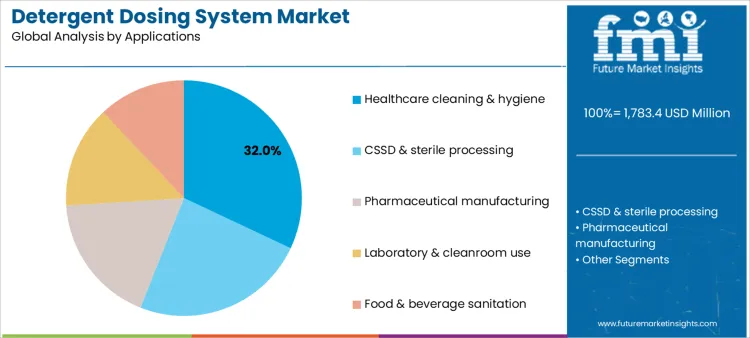
Healthcare cleaning and hygiene accounts for 32.0%, driven by infection prevention protocols and inspection-driven chemical control. CSSD and sterile processing at 24.0% require precise dosing to protect instrument surfaces and downstream sterilization efficacy. Pharmaceutical manufacturing represents 18.0%, where validated cleaning processes depend on controlled detergent concentrations. Laboratory and cleanroom use at 14.0% emphasizes contamination control and reproducibility. Food and beverage sanitation at 12.0% applies dosing systems to meet hygiene standards while managing residue limits. Application segmentation highlights higher adoption where dosing accuracy directly affects compliance and safety outcomes.
Key Points:
- Healthcare environments demand strict dosing control.
- Sterile processing relies on chemical consistency.
- Regulated industries emphasize validated cleaning.
Which Sales Channel Accounts for the Highest Deployment of Detergent Dosing Systems?
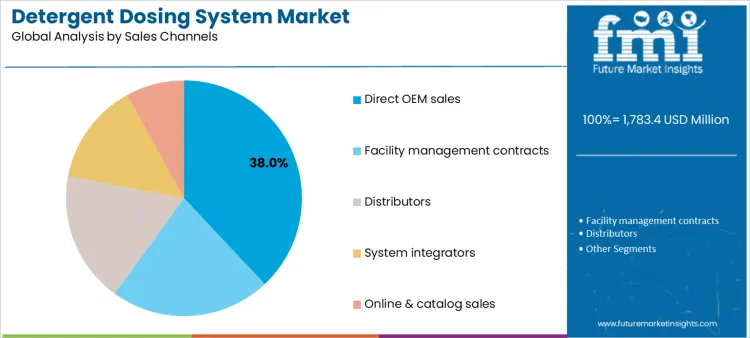
Direct OEM sales represent 38.0%, reflecting demand for customized system design, installation support, and long-term servicing. Facility management contracts at 22.0% integrate dosing systems within outsourced hygiene and cleaning programs. Distributors account for 18.0%, supporting standardized solutions for mid-sized facilities. System integrators at 14.0% deploy dosing systems as part of broader facility automation projects. Online and catalog sales at 8.0% address small-scale purchases and replacement demand. Sales channel segmentation shows concentration where technical complexity and service expectations shape procurement choices.
Key Points:
- OEM channels support customization and lifecycle service.
- Facility contracts bundle dosing with hygiene operations.
- Integrators align dosing with automation upgrades.
What are the Key Dynamics in the Detergent Dosing System Market?
Demand for detergent dosing systems reflects need for precise, repeatable chemical delivery in cleaning and washing operations. Adoption concentrates in commercial laundries, food processing plants, healthcare facilities, hospitality operations, and industrial cleaning applications. Global scope aligns with hygiene compliance and resource efficiency requirements. Usage centers on automated systems that meter detergents and additives accurately based on load size, water hardness, and process conditions.
How do hygiene compliance and operational consistency requirements shape adoption?
Cleaning outcomes depend on correct detergent concentration, contact time, and repeatability across cycles. Demand increases where manual dosing causes variability, fabric damage, residue formation, or hygiene non-compliance. Automated dosing systems deliver consistent chemical quantities, improving wash performance and reducing rewash rates. Healthcare and food processing environments rely on controlled dosing to meet sanitation standards and audit requirements. Commercial laundries use dosing automation to protect textiles while maintaining throughput at high cycle volumes. Integration with washers enables adjustment based on program selection and water quality. Data logging supports traceability and chemical usage optimization. Adoption reflects operational emphasis on consistency, reduced human error, and predictable cleaning performance.
How do installation complexity, chemical compatibility, and cost sensitivity influence market scalability?
Dosing systems must be compatible with diverse detergents, concentrations, and washer interfaces, limiting standardization. Demand sensitivity rises where retrofitting older equipment requires plumbing or electrical modification. Chemical corrosion and crystallization affect pump and tubing lifespan, increasing maintenance needs. Calibration drift impacts dosing accuracy if not routinely managed. Capital cost justification varies between high-volume facilities and small operations. Training requirements influence correct system use and troubleshooting. Supplier lock-in concerns affect procurement decisions. Scalability remains constrained by site-specific integration needs, ongoing maintenance discipline, and cost-benefit evaluation relative to manual dosing alternatives.
How Is Demand for Detergent Dosing Systems Evolving Globally?
Demand for detergent dosing systems is expanding globally as industrial and institutional users prioritize process consistency, chemical efficiency, and compliance with hygiene standards. Automated dosing reduces manual errors, stabilizes formulation outcomes, and lowers chemical wastage across cleaning-intensive operations. Regulatory oversight and audit requirements reinforce precise dosing and documentation. Integration with smart controls and IoT platforms influences procurement decisions. Growth rates in India at 10.6%, Brazil at 10.1%, China at 9.7%, the USA at 6.6%, and Germany at 6.5% indicate sustained expansion driven by operational efficiency, compliance alignment, and automation adoption rather than simple increases in detergent consumption.
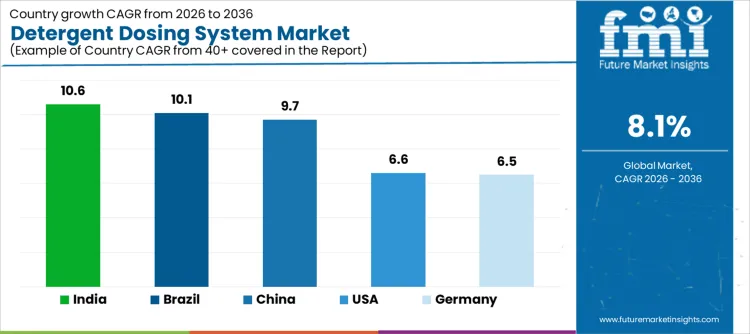
| Country | CAGR (%) |
|---|---|
| India | 10.6% |
| Brazil | 10.1% |
| China | 9.7% |
| USA | 6.6% |
| Germany | 6.5% |
What Is Driving Strong Growth of Detergent Dosing System Demand in India?
Detergent dosing system demand in India is growing at a CAGR of 10.6%, supported by rapid expansion of organized healthcare, food processing, and commercial laundry operations. Facilities adopt automated dosing to maintain hygiene consistency and reduce chemical overuse. Rising accreditation requirements increase focus on documented cleaning processes. Industrial users integrate dosing systems with CIP operations to improve repeatability. Local system integrators offer cost-effective, customized solutions. Growth reflects formalization of hygiene practices, automation uptake, and compliance-driven process control rather than volume-led detergent usage growth.
- Expansion of organized healthcare and food processing
- Accreditation-driven hygiene process standardization
- Integration with CIP and automated cleaning lines
- Availability of locally customized dosing solutions
Why Is Brazil Experiencing Rapid Uptake of Detergent Dosing Systems?
Detergent dosing system demand in Brazil is expanding at a CAGR of 10.1%, driven by modernization of institutional cleaning and industrial sanitation practices. Food and beverage processors emphasize precise chemical control to meet export standards. Commercial laundries adopt dosing automation to control costs and ensure fabric care consistency. Environmental regulations encourage reduced chemical discharge through optimized dosing. Regional suppliers expand technical support capabilities. Growth reflects sanitation process modernization and regulatory alignment rather than expansion of cleaning service volumes.
- Export-oriented food sanitation requirements
- Commercial laundry cost and quality control
- Environmental pressure to reduce chemical discharge
- Expansion of regional technical service networks
How Is China Sustaining Momentum in Detergent Dosing System Adoption?
Detergent dosing system demand in China is growing at a CAGR of 9.7%, aligned with scale of industrial operations and regulatory enforcement. High-volume manufacturing and food processing facilities require consistent cleaning outcomes. Automation supports labor efficiency and reduces variability. Government standards emphasize traceability and controlled chemical usage. Domestic manufacturers supply dosing systems compatible with smart factory initiatives. Growth reflects scale-driven automation, regulatory oversight, and digital integration rather than discretionary upgrades.
- High-volume industrial and food processing demand
- Labor efficiency through automated dosing
- Regulatory emphasis on traceable chemical usage
- Availability of smart factory-compatible systems
What Factors Are Supporting Detergent Dosing System Demand in United States?
Detergent dosing system demand in the United States is expanding at a CAGR of 6.6%, supported by mature hygiene standards and operational optimization efforts. Healthcare and hospitality sectors rely on precise dosing to ensure safety and consistency. Replacement of manual systems with connected dosing platforms sustains demand. Compliance with OSHA and sanitation guidelines influences purchasing. Service contracts and aftermarket support drive system upgrades. Growth reflects efficiency optimization and technology refresh cycles rather than expansion of cleaning-intensive facilities.
- Mature healthcare and hospitality hygiene standards
- Transition from manual to connected dosing systems
- Compliance with occupational and sanitation regulations
- Aftermarket-driven system upgrades and replacements
Why Is Germany Showing Measured Expansion in Detergent Dosing Systems?
Detergent dosing system demand in Germany is growing at a CAGR of 6.5%, shaped by engineering discipline and environmental governance. Industrial users emphasize precise dosing to minimize chemical waste and energy use. Strict wastewater and chemical handling regulations reinforce automated control adoption. Integration with centralized facility management systems supports monitoring and optimization. Procurement prioritizes durability and lifecycle efficiency. Growth remains measured, reflecting optimization of existing operations and compliance stability rather than rapid deployment across new sites.
- Emphasis on chemical efficiency and waste reduction
- Strict wastewater and handling regulations
- Integration with facility management platforms
- Lifecycle-focused procurement strategies
What is the competitive landscape of demand for the detergent dosing system market globally?
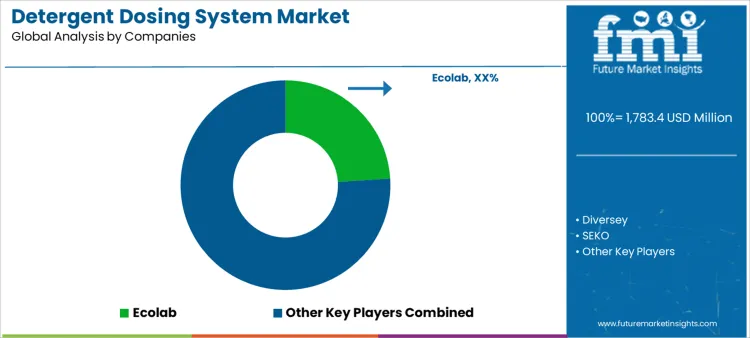
Demand for detergent dosing systems is driven by hygiene compliance, chemical consumption control, and automation across commercial cleaning, food processing, and healthcare facilities. Facility managers and operators evaluate dosing accuracy, system reliability, compatibility with liquid and solid detergents, and integration with washers or cleaning equipment. Buyer assessment includes ease of calibration, chemical savings potential, maintenance requirements, and safety features preventing overdosing. Procurement behavior favors suppliers offering turnkey systems, service support, and compatibility with proprietary or third-party chemistries. Trend in the detergent dosing system market reflects increasing adoption of automated, connected dosing solutions to improve consistency and reduce operational variability.
Ecolab leads competitive positioning through integrated dosing systems embedded within comprehensive cleaning and hygiene programs. Diversey competes by offering flexible dosing platforms aligned with institutional and industrial cleaning workflows. SEKO supports demand with modular dosing systems designed for precision control and adaptability across applications. Grundfos maintains relevance by leveraging pump technology expertise to deliver reliable and energy-efficient dosing solutions. Hydro Systems participates by supplying proportioning and dispensing systems emphasizing chemical accuracy and operator safety. Competitive differentiation centers on dosing precision, system durability, service responsiveness, and ability to optimize chemical usage at scale.
Key Players in the Detergent Dosing System Market
- Ecolab
- Diversey
- SEKO
- Grundfos
- Hydro Systems
- Others
Scope of the Report
| Items | Values |
|---|---|
| Quantitative Units | USD million |
| Dosing Technologies | Automated liquid dosing systems; Powder detergent dosing units; IoT-enabled smart dosing systems; Centralized dosing stations; Manual & semi-automatic dispensers |
| Applications | Healthcare cleaning & hygiene; CSSD & sterile processing; Pharmaceutical manufacturing; Laboratory & cleanroom use; Food & beverage sanitation |
| Sales Channels | Direct OEM sales; Facility management contracts; Distributors; System integrators; Online & catalog sales |
| Regions Covered | Asia Pacific, Europe, North America, Latin America, Middle East & Africa |
| Countries Covered | India, Brazil, China, USA, Germany, and 40+ countries |
| Key Companies Profiled | Ecolab; Diversey; SEKO; Grundfos; Hydro Systems; Others |
| Additional Attributes | Dollar sales by dosing technology, application, and sales channel; automation and dosing accuracy driving operational efficiency in healthcare and food sanitation; scalability across facility sizes and integration with cleaning management systems; IoT-enabled solutions enhancing monitoring, reporting, and system optimization; procurement dynamics influenced by multi-year facility management contracts, distributor networks, and system integration partnerships. |
Detergent Dosing System Market by Segment
Dosing Technologies:
- Automated liquid dosing systems
- Powder detergent dosing units
- IoT-enabled smart dosing systems
- Centralized dosing stations
- Manual & semi-automatic dispensers
Applications:
- Healthcare cleaning & hygiene
- CSSD & sterile processing
- Pharmaceutical manufacturing
- Laboratory & cleanroom use
- Food & beverage sanitation
Sales Channels:
- Direct OEM sales
- Facility management contracts
- Distributors
- System integrators
- Online & catalog sales
Region:
- Asia Pacific
- China
- Japan
- South Korea
- India
- Australia & New Zealand
- ASEAN
- Rest of Asia Pacific
- Europe
- Germany
- United Kingdom
- France
- Italy
- Spain
- Nordic
- BENELUX
- Rest of Europe
- North America
- United States
- Canada
- Mexico
- Latin America
- Brazil
- Chile
- Rest of Latin America
- Middle East & Africa
- Kingdom of Saudi Arabia
- Other GCC Countries
- Turkey
- South Africa
- Other African Union
- Rest of Middle East & Africa
Bibliography
- International Organization for Standardization. (2023). ISO 14001: Environmental management systems-Requirements with guidance for use (Edition in force). ISO.
- International Organization for Standardization. (2024). ISO 22716: Cosmetics-Good manufacturing practices (GMP)-Guidelines on good manufacturing practices (Current edition). ISO.
- World Health Organization. (2023). Water, sanitation, hygiene, and health: Operational monitoring and chemical control in institutional settings. World Health Organization.
- USA. Environmental Protection Agency. (2023). Industrial wastewater treatment guidelines and chemical discharge optimization for cleaning operations. USA. Environmental Protection Agency.
- European Commission. (2023). Best available techniques (BAT) reference document for food, drink, and milk industries (Updated implementation guidance). European Union.
- Organisation for Economic Co-operation and Development. (2023). Chemical usage efficiency, automation, and environmental performance in industrial operations. OECD Publishing.
Frequently Asked Questions
How big is the detergent dosing system market in 2026?
The global detergent dosing system market is estimated to be valued at USD 1,783.4 million in 2026.
What will be the size of detergent dosing system market in 2036?
The market size for the detergent dosing system market is projected to reach USD 3,886.0 million by 2036.
How much will be the detergent dosing system market growth between 2026 and 2036?
The detergent dosing system market is expected to grow at a 8.1% CAGR between 2026 and 2036.
What are the key product types in the detergent dosing system market?
The key product types in detergent dosing system market are automated liquid dosing systems, powder detergent dosing units, iot-enabled smart dosing systems, centralized dosing stations and manual & semi-automatic dispensers.
Which applications segment to contribute significant share in the detergent dosing system market in 2026?
In terms of applications, healthcare cleaning & hygiene segment to command 32.0% share in the detergent dosing system market in 2026.
Preview the report firsthand - request a free sample
Get SampleGet the brochure for pricing and purchase details.
Get PDFTable of Content
- Executive Summary
- Global Market Outlook
- Demand-side Trends
- Supply-side Trends
- Technology Roadmap Analysis
- Analysis and Recommendations
- Market Overview
- Market Coverage / Taxonomy
- Market Definition / Scope / Limitations
- Market Background
- Market Dynamics
- Drivers
- Restraints
- Opportunity
- Trends
- Scenario Forecast
- Demand in Optimistic Scenario
- Demand in Likely Scenario
- Demand in Conservative Scenario
- Opportunity Map Analysis
- Product Life Cycle Analysis
- Supply Chain Analysis
- Investment Feasibility Matrix
- Value Chain Analysis
- PESTLE and Porter’s Analysis
- Regulatory Landscape
- Regional Parent Market Outlook
- Production and Consumption Statistics
- Import and Export Statistics
- Market Dynamics
- Global Market Analysis 2021 to 2025 and Forecast, 2026 to 2036
- Historical Market Size Value (USD Million) Analysis, 2021 to 2025
- Current and Future Market Size Value (USD Million) Projections, 2026 to 2036
- Y-o-Y Growth Trend Analysis
- Absolute $ Opportunity Analysis
- Global Market Pricing Analysis 2021 to 2025 and Forecast 2026 to 2036
- Global Market Analysis 2021 to 2025 and Forecast 2026 to 2036, By Dosing Technologies
- Introduction / Key Findings
- Historical Market Size Value (USD Million) Analysis By Dosing Technologies , 2021 to 2025
- Current and Future Market Size Value (USD Million) Analysis and Forecast By Dosing Technologies , 2026 to 2036
- Automated liquid dosing systems
- Powder detergent dosing units
- IoT-enabled smart dosing systems
- Centralized dosing stations
- Manual & semi-automatic dispensers
- Automated liquid dosing systems
- Y-o-Y Growth Trend Analysis By Dosing Technologies , 2021 to 2025
- Absolute $ Opportunity Analysis By Dosing Technologies , 2026 to 2036
- Global Market Analysis 2021 to 2025 and Forecast 2026 to 2036, By Applications
- Introduction / Key Findings
- Historical Market Size Value (USD Million) Analysis By Applications, 2021 to 2025
- Current and Future Market Size Value (USD Million) Analysis and Forecast By Applications, 2026 to 2036
- Healthcare cleaning & hygiene
- CSSD & sterile processing
- Pharmaceutical manufacturing
- Laboratory & cleanroom use
- Food & beverage sanitation
- Healthcare cleaning & hygiene
- Y-o-Y Growth Trend Analysis By Applications, 2021 to 2025
- Absolute $ Opportunity Analysis By Applications, 2026 to 2036
- Global Market Analysis 2021 to 2025 and Forecast 2026 to 2036, By Sales Channels
- Introduction / Key Findings
- Historical Market Size Value (USD Million) Analysis By Sales Channels, 2021 to 2025
- Current and Future Market Size Value (USD Million) Analysis and Forecast By Sales Channels, 2026 to 2036
- Direct OEM sales
- Facility management contracts
- Distributors
- System integrators
- Online & catalog sales
- Direct OEM sales
- Y-o-Y Growth Trend Analysis By Sales Channels, 2021 to 2025
- Absolute $ Opportunity Analysis By Sales Channels, 2026 to 2036
- Global Market Analysis 2021 to 2025 and Forecast 2026 to 2036, By Region
- Introduction
- Historical Market Size Value (USD Million) Analysis By Region, 2021 to 2025
- Current Market Size Value (USD Million) Analysis and Forecast By Region, 2026 to 2036
- North America
- Latin America
- Western Europe
- Eastern Europe
- East Asia
- South Asia and Pacific
- Middle East & Africa
- Market Attractiveness Analysis By Region
- North America Market Analysis 2021 to 2025 and Forecast 2026 to 2036, By Country
- Historical Market Size Value (USD Million) Trend Analysis By Market Taxonomy, 2021 to 2025
- Market Size Value (USD Million) Forecast By Market Taxonomy, 2026 to 2036
- By Country
- USA
- Canada
- Mexico
- By Dosing Technologies
- By Applications
- By Sales Channels
- By Country
- Market Attractiveness Analysis
- By Country
- By Dosing Technologies
- By Applications
- By Sales Channels
- Key Takeaways
- Latin America Market Analysis 2021 to 2025 and Forecast 2026 to 2036, By Country
- Historical Market Size Value (USD Million) Trend Analysis By Market Taxonomy, 2021 to 2025
- Market Size Value (USD Million) Forecast By Market Taxonomy, 2026 to 2036
- By Country
- Brazil
- Chile
- Rest of Latin America
- By Dosing Technologies
- By Applications
- By Sales Channels
- By Country
- Market Attractiveness Analysis
- By Country
- By Dosing Technologies
- By Applications
- By Sales Channels
- Key Takeaways
- Western Europe Market Analysis 2021 to 2025 and Forecast 2026 to 2036, By Country
- Historical Market Size Value (USD Million) Trend Analysis By Market Taxonomy, 2021 to 2025
- Market Size Value (USD Million) Forecast By Market Taxonomy, 2026 to 2036
- By Country
- Germany
- UK
- Italy
- Spain
- France
- Nordic
- BENELUX
- Rest of Western Europe
- By Dosing Technologies
- By Applications
- By Sales Channels
- By Country
- Market Attractiveness Analysis
- By Country
- By Dosing Technologies
- By Applications
- By Sales Channels
- Key Takeaways
- Eastern Europe Market Analysis 2021 to 2025 and Forecast 2026 to 2036, By Country
- Historical Market Size Value (USD Million) Trend Analysis By Market Taxonomy, 2021 to 2025
- Market Size Value (USD Million) Forecast By Market Taxonomy, 2026 to 2036
- By Country
- Russia
- Poland
- Hungary
- Balkan & Baltic
- Rest of Eastern Europe
- By Dosing Technologies
- By Applications
- By Sales Channels
- By Country
- Market Attractiveness Analysis
- By Country
- By Dosing Technologies
- By Applications
- By Sales Channels
- Key Takeaways
- East Asia Market Analysis 2021 to 2025 and Forecast 2026 to 2036, By Country
- Historical Market Size Value (USD Million) Trend Analysis By Market Taxonomy, 2021 to 2025
- Market Size Value (USD Million) Forecast By Market Taxonomy, 2026 to 2036
- By Country
- China
- Japan
- South Korea
- By Dosing Technologies
- By Applications
- By Sales Channels
- By Country
- Market Attractiveness Analysis
- By Country
- By Dosing Technologies
- By Applications
- By Sales Channels
- Key Takeaways
- South Asia and Pacific Market Analysis 2021 to 2025 and Forecast 2026 to 2036, By Country
- Historical Market Size Value (USD Million) Trend Analysis By Market Taxonomy, 2021 to 2025
- Market Size Value (USD Million) Forecast By Market Taxonomy, 2026 to 2036
- By Country
- India
- ASEAN
- Australia & New Zealand
- Rest of South Asia and Pacific
- By Dosing Technologies
- By Applications
- By Sales Channels
- By Country
- Market Attractiveness Analysis
- By Country
- By Dosing Technologies
- By Applications
- By Sales Channels
- Key Takeaways
- Middle East & Africa Market Analysis 2021 to 2025 and Forecast 2026 to 2036, By Country
- Historical Market Size Value (USD Million) Trend Analysis By Market Taxonomy, 2021 to 2025
- Market Size Value (USD Million) Forecast By Market Taxonomy, 2026 to 2036
- By Country
- Kingdom of Saudi Arabia
- Other GCC Countries
- Turkiye
- South Africa
- Other African Union
- Rest of Middle East & Africa
- By Dosing Technologies
- By Applications
- By Sales Channels
- By Country
- Market Attractiveness Analysis
- By Country
- By Dosing Technologies
- By Applications
- By Sales Channels
- Key Takeaways
- Key Countries Market Analysis
- USA
- Pricing Analysis
- Market Share Analysis, 2025
- By Dosing Technologies
- By Applications
- By Sales Channels
- Canada
- Pricing Analysis
- Market Share Analysis, 2025
- By Dosing Technologies
- By Applications
- By Sales Channels
- Mexico
- Pricing Analysis
- Market Share Analysis, 2025
- By Dosing Technologies
- By Applications
- By Sales Channels
- Brazil
- Pricing Analysis
- Market Share Analysis, 2025
- By Dosing Technologies
- By Applications
- By Sales Channels
- Chile
- Pricing Analysis
- Market Share Analysis, 2025
- By Dosing Technologies
- By Applications
- By Sales Channels
- Germany
- Pricing Analysis
- Market Share Analysis, 2025
- By Dosing Technologies
- By Applications
- By Sales Channels
- UK
- Pricing Analysis
- Market Share Analysis, 2025
- By Dosing Technologies
- By Applications
- By Sales Channels
- Italy
- Pricing Analysis
- Market Share Analysis, 2025
- By Dosing Technologies
- By Applications
- By Sales Channels
- Spain
- Pricing Analysis
- Market Share Analysis, 2025
- By Dosing Technologies
- By Applications
- By Sales Channels
- France
- Pricing Analysis
- Market Share Analysis, 2025
- By Dosing Technologies
- By Applications
- By Sales Channels
- India
- Pricing Analysis
- Market Share Analysis, 2025
- By Dosing Technologies
- By Applications
- By Sales Channels
- ASEAN
- Pricing Analysis
- Market Share Analysis, 2025
- By Dosing Technologies
- By Applications
- By Sales Channels
- Australia & New Zealand
- Pricing Analysis
- Market Share Analysis, 2025
- By Dosing Technologies
- By Applications
- By Sales Channels
- China
- Pricing Analysis
- Market Share Analysis, 2025
- By Dosing Technologies
- By Applications
- By Sales Channels
- Japan
- Pricing Analysis
- Market Share Analysis, 2025
- By Dosing Technologies
- By Applications
- By Sales Channels
- South Korea
- Pricing Analysis
- Market Share Analysis, 2025
- By Dosing Technologies
- By Applications
- By Sales Channels
- Russia
- Pricing Analysis
- Market Share Analysis, 2025
- By Dosing Technologies
- By Applications
- By Sales Channels
- Poland
- Pricing Analysis
- Market Share Analysis, 2025
- By Dosing Technologies
- By Applications
- By Sales Channels
- Hungary
- Pricing Analysis
- Market Share Analysis, 2025
- By Dosing Technologies
- By Applications
- By Sales Channels
- Kingdom of Saudi Arabia
- Pricing Analysis
- Market Share Analysis, 2025
- By Dosing Technologies
- By Applications
- By Sales Channels
- Turkiye
- Pricing Analysis
- Market Share Analysis, 2025
- By Dosing Technologies
- By Applications
- By Sales Channels
- South Africa
- Pricing Analysis
- Market Share Analysis, 2025
- By Dosing Technologies
- By Applications
- By Sales Channels
- USA
- Market Structure Analysis
- Competition Dashboard
- Competition Benchmarking
- Market Share Analysis of Top Players
- By Regional
- By Dosing Technologies
- By Applications
- By Sales Channels
- Competition Analysis
- Competition Deep Dive
- Ecolab
- Overview
- Product Portfolio
- Profitability by Market Segments (Product/Age /Sales Channel/Region)
- Sales Footprint
- Strategy Overview
- Marketing Strategy
- Product Strategy
- Channel Strategy
- Diversey
- SEKO
- Grundfos
- Hydro Systems
- Others
- Ecolab
- Competition Deep Dive
- Assumptions & Acronyms Used
- Research Methodology


