

- Industry Size (2026)
- USD 541 Mn
- Forecast (2036)
- USD 816.3 Mn
- CAGR (2026 to 2036)
- 4.20%
Thermosol Dyeing System Market Forecast and Outlook 2026 to 2036
The thermosol dyeing system market is anticipated to grow from USD 541 million in 2026 to USD 816.3 million by 2036, expanding at a CAGR of 4.20%. Competitive power between 2026 and 2036 is shaped by control over thermal process performance, installed base relationships, and service dependency rather than unit volumes. Leading players defend pricing power through proprietary heat fixation designs, patented airflow control, and system-level integration that is difficult to replicate.
Once installed, thermosol lines become deeply embedded in mill operations, creating high switching costs linked to layout redesign, process revalidation, and production downtime. Entry barriers remain elevated due to capital intensity, engineering complexity, and the need for proven performance credentials in continuous dyeing environments. Fragmentation persists because regional suppliers serve cost-sensitive and mid-scale mills, while global leaders dominate premium installations and upgrades. Consolidation gradually narrows the competitive field in high-efficiency segments, where energy optimization, automation depth, and lifecycle support increasingly determine market control rather than equipment pricing alone.
Quick Stats for Thermosol Dyeing System Market
- Thermosol Dyeing System Market Value (2026): USD 541 Million
- Thermosol Dyeing System Market Forecast Value (2036): USD 816.3 Million
- Thermosol Dyeing System Market Forecast CAGR 2026 to 2036: 4.20%
- Leading Fabric Type in Thermosol Dyeing System Market: Woven Fabrics (52% share)
- Leading Dye Class in Thermosol Dyeing System Market: Disperse Dyes (44% share)
- Key Growth Regions in Thermosol Dyeing System Market: Asia Pacific, Europe, North America, Latin America, Middle East & Africa
- Top Key Players in Thermosol Dyeing System Market: Monforts, Brückner Trockentechnik, Küsters, Zimmer Austria, Krantz Textile, Fongs Textile Machinery, BONAS Textile Machinery, Thies Textile GmbH & Co. KG, Smit Textile, Goller Textilemaschinen GmbH

Thermosol Dyeing System Market Key Takeaways
| Metric | Value |
|---|---|
| Thermosol Dyeing System Market Value (2026) | USD 541 Million |
| Thermosol Dyeing System Market Forecast Value (2036) | USD 816. 3 Million |
| Thermosol Dyeing System Market Forecast CAGR 2026 to 2036 | 4.20% |
Which Factors Influence the Sales of Thermosol Dyeing System?
Growth of the thermosol dyeing system market is supported by increasing demand for high-quality, color-fast textile products across apparel, home textiles, and technical textile applications. Thermosol dyeing systems are widely used for polyester and blended fabrics due to their ability to deliver uniform dye penetration, excellent shade consistency, and high production efficiency. Rising consumption of synthetic textiles, particularly in sportswear, automotive fabrics, and industrial textiles, is reinforcing adoption of thermosol dyeing technology.
Technological improvements in textile processing equipment are further strengthening market growth. Manufacturers are focusing on enhancing temperature control, heat recovery efficiency, and process automation within thermosol dyeing systems. These improvements help textile producers reduce energy consumption, minimize dye wastage, and maintain consistent output quality. Integration of automated controls and monitoring systems also supports higher production speeds and reduced labor dependency, which is important for large-scale textile manufacturing operations.
Environmental compliance and capacity expansion in emerging textile manufacturing regions are creating additional growth opportunities. Stricter regulations related to wastewater discharge, energy efficiency, and chemical usage are encouraging textile mills to adopt advanced dyeing systems with improved process control. At the same time, expansion of textile manufacturing capacity in Asia Pacific, supported by export demand and domestic consumption, is driving investments in modern dyeing equipment. Combined, efficiency benefits, regulatory alignment, and synthetic textile demand are sustaining steady growth of the thermosol dyeing system market over the forecast period.
What Is The Segment Overview Of The Thermosol Dyeing System Market?
The thermosol dyeing system market is segmented by fabric type and dye class, with clear dominance in specific categories. By fabric type, woven fabrics hold the leading position, supported by their extensive use in large-scale textile and apparel production. Other fabric types in the thermosol dyeing system market include knit fabrics, technical textiles, and other specialized materials. By dye class, disperse dyes represent the dominant segment, driven by their strong affinity for synthetic fibers processed through thermosol dyeing systems. Additional dye classes such as reactive dyes, vat dyes, and other dye categories support diversified application requirements across textile manufacturing.
Why Do Woven Fabrics Lead The Thermosol Dyeing System Market By Fabric Type?
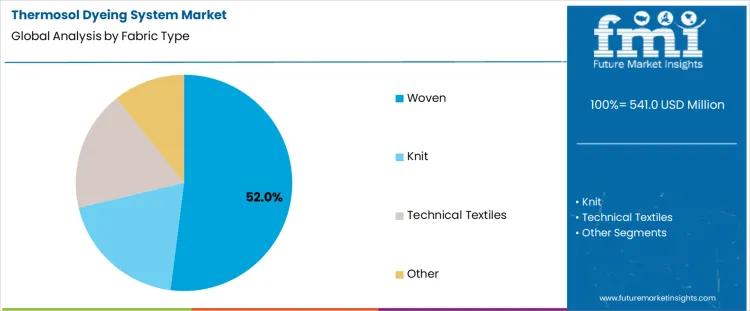
Woven fabrics lead the thermosol dyeing system market by fabric type with 52% share because they dominate global production of polyester and blended textiles. Thermosol dyeing systems are widely used for continuous dyeing of woven fabrics due to their ability to deliver uniform color penetration and high throughput. Woven structures tolerate high-temperature fixation required in thermosol processes without dimensional distortion. These fabrics are extensively used in apparel, home textiles, and industrial fabrics where color consistency is critical. Large-scale mills prefer woven fabric processing using thermosol systems to achieve operational efficiency. This strong alignment between process capability and fabric characteristics explains woven fabric leadership.
Why Do Disperse Dyes Dominate The Thermosol Dyeing System Market By Dye Class?
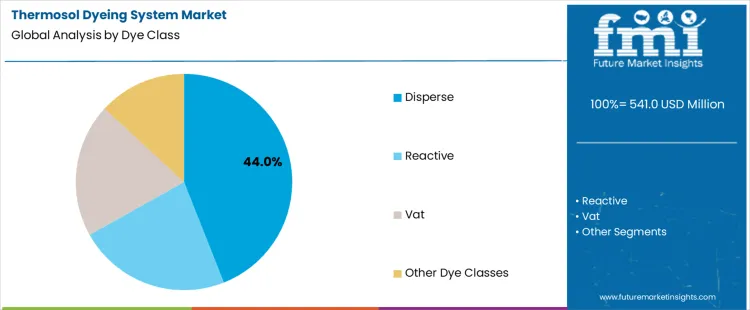
Disperse dyes dominate the thermosol dyeing system market by dye class with 44% share because they are specifically designed for synthetic fibers such as polyester. Thermosol dyeing relies on high-temperature fixation, which enables disperse dyes to sublimate and diffuse effectively into fiber structures. This results in excellent color fastness, uniform shade development, and resistance to washing and light exposure. Apparel and technical textile manufacturer’s use disperse dyes for mass production of dyed polyester fabrics. Compatibility with continuous dyeing lines supports consistent output quality. These performance advantages explain why disperse dyes remain the primary dye class in thermosol dyeing applications.
What Are The Key Dynamics Of The Thermosol Dyeing System Market?
Thermosol dyeing systems are valued for their ability to deliver uniform shade fixation, high color fastness, and efficient large-scale textile processing. Growth in synthetic fiber consumption, expansion of technical textiles, and rising apparel production are supporting adoption. Energy consumption levels, process temperature control, and compatibility with disperse dyes strongly influence system selection. Capital investment requirements, environmental compliance related to emissions, and operational efficiency remain key factors shaping competitiveness in the thermosol dyeing system market.
What Challenges Are Limiting Growth Of The Thermosol Dyeing System Market?
The thermosol dyeing system market faces challenges related to high capital investment and energy-intensive operations. Installation of thermosol dyeing lines requires significant upfront expenditure for padding units, drying chambers, and high-temperature fixation ovens, limiting adoption among small and mid-sized textile processors. High energy consumption during thermosol curing increases operating costs, especially in regions with high electricity or fuel prices. Strict environmental regulations on emissions, effluents, and chemical handling add compliance complexity. Process sensitivity to temperature control and fabric handling also increases dependency on skilled operators, raising operational risk within the thermosol dyeing system market.
How Are Process And Sustainability Trends Shaping The Thermosol Dyeing System Market?
Process optimization and sustainability trends are reshaping the thermosol dyeing system market. Textile manufacturers are adopting advanced temperature control systems, automated fabric tension regulation, and real-time shade monitoring to improve dye fixation consistency. Energy-efficient heating technologies and heat recovery systems are being integrated to reduce fuel consumption. Demand for low-liquor and reduced water usage dyeing processes is increasing, aligning thermosol systems with sustainability goals. Compatibility with eco-friendly disperse dyes and compliance with restricted substance regulations are gaining importance. Digitalization and automation are improving throughput, reproducibility, and quality control across thermosol dyeing system installations.
What is the Country Wise Demand Outlook for Thermosol Dyeing System Market?
Demand for thermosol dyeing systems differs across countries based on textile manufacturing scale, export orientation, and technology adoption levels. Asia remains the primary growth region due to high synthetic fabric production, while Europe and North America show replacement-led demand. China is projected to grow at a CAGR of 5.1% during 2026 to 2036, followed by India at 5.0%, supported by capacity expansion and process modernization. Germany, the USA, and the UK are expected to record CAGRs of 4.1%, 3.9%, and 3.7%, respectively, reflecting mature textile industries with steady technology upgrades. Growth patterns are influenced by efficiency improvement initiatives, energy optimization, and quality consistency requirements.
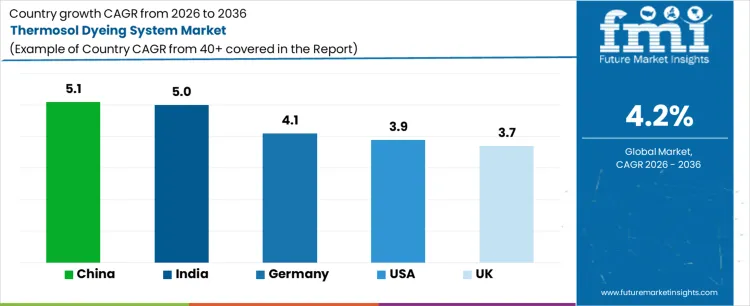
| Country | CAGR (%) |
|---|---|
| China | 5.1% |
| India | 5.0% |
| Germany | 4.1% |
| USA | 3.9% |
| UK | 3.7% |
Why Is Demand for Thermosol Dyeing Systems Expanding in China?
Demand for thermosol dyeing systems in China, expanding at a CAGR of 5.1% during 2026 to 2036, is driven by large-scale production of polyester and blended synthetic fabrics. The thermosol dyeing system market in China benefits from continuous modernization of textile processing lines aimed at improving color consistency, penetration, and throughput. Export-oriented manufacturers are upgrading dyeing infrastructure to meet international quality specifications and delivery timelines. Replacement of conventional dyeing equipment with high-temperature thermosol systems supports recurring demand. Energy efficiency improvement and reduction of reprocessing losses are influencing procurement decisions. Domestic machinery suppliers enhance system affordability and aftersales support, accelerating adoption across textile clusters. Environmental compliance requirements related to controlled dye fixation further support system upgrades. These combined factors position China as a stable, volume-driven growth contributor within the thermosol dyeing system market over the forecast period.
How Is Demand for Thermosol Dyeing Systems Shaping Growth in India?
Demand for thermosol dyeing systems in India, growing at a CAGR of 5.0% from 2026 to 2036, is supported by expanding synthetic textile manufacturing capacity and export-oriented production. The thermosol dyeing system market in India is driven by rising output of polyester fabrics used in apparel, home textiles, and industrial applications. Textile processors are upgrading dyeing infrastructure to improve shade reproducibility, process speed, and batch flexibility. Development of integrated textile parks and modernization of composite mills strengthen equipment demand. Manufacturers prioritize systems that reduce dye wastage and improve operational cost efficiency. Compliance with export quality standards is encouraging adoption of advanced dyeing technologies. Increasing availability of domestic and regional machinery suppliers improves accessibility. These factors collectively support steady expansion of the thermosol dyeing system market in India during the forecast period.
What Sustains Demand for Thermosol Dyeing Systems in Germany?
Demand for thermosol dyeing systems in Germany, expanding at a CAGR of 4.1% during 2026 to 2036, is sustained by technology upgrades within a mature textile processing environment. The thermosol dyeing system market in Germany is characterized by replacement-driven demand rather than new capacity additions. Manufacturers emphasize precision, automation compatibility, and process stability when investing in dyeing systems. Demand is supported by production of technical textiles, automotive fabrics, and specialty materials requiring consistent color fixation. Energy optimization and compliance with stringent environmental standards influence procurement decisions. Investments are typically incremental and focused on improving operational efficiency. Long equipment lifecycles moderate replacement frequency, limiting rapid volume expansion. These dynamics result in stable, value-oriented growth for the thermosol dyeing system market in Germany.
Why Is Demand for Thermosol Dyeing Systems Moderate in the USA?
Demand for thermosol dyeing systems in the USA, growing at a CAGR of 3.9% over the forecast period, reflects a mature textile industry with selective capital investment patterns. The thermosol dyeing system market in the USA is driven primarily by replacement of aging dyeing lines used in specialty and industrial textile production. Manufacturers prioritize reliability, automation integration, and consistency over capacity expansion. Limited growth in mass apparel manufacturing constrains volume demand. Adoption is supported by technical textile applications, including performance fabrics and industrial materials. Investments are focused on productivity enhancement and operational stability. Domestic production scale remains moderate, keeping growth measured. These factors contribute to steady but restrained expansion of the thermosol dyeing system market in the USA.
How Does the UK Maintain Steady Demand for Thermosol Dyeing Systems?
Demand for thermosol dyeing systems in the UK, expanding at a CAGR of 3.7% during 2026 to 2036, is supported by modernization within niche textile manufacturing segments. The thermosol dyeing system market in the UK is influenced by replacement demand across specialty fabric and technical textile producers. Manufacturers focus on quality consistency, controlled dye fixation, and energy efficiency. Limited domestic textile capacity restricts large-scale equipment installations. Investments are typically directed toward refurbishment of existing dyeing lines to improve process reliability. Compliance with environmental and operational standards reinforces system upgrades. Production of high-value textiles sustains baseline equipment utilization. These factors support stable, low-growth expansion of the thermosol dyeing system market in the UK over the forecast period.
How Are Key Players Competing in the Thermosol Dyeing System Market?
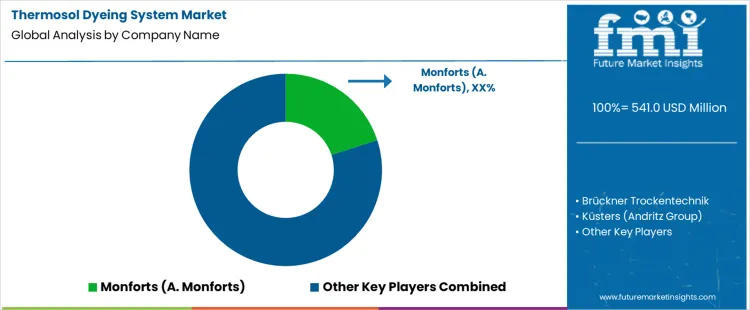
Competition in the thermosol dyeing system market centers on thermal efficiency, uniform dye uptake, and turnkey integration documented in official product brochures. Monforts (A. Monforts) positions its thermosol systems around high-precision temperature control and controlled airflow to maximize dye fixation with minimal energy input. Brochures emphasize patented platen designs, modular conveyor configurations, and programmable logic control packages that support continuous processing for woven and knitted fabrics. Brückner Trockentechnik competes through customizable dryer lengths and segmented heating zones. Official literature highlights adjustable conditioning sections and optimized heat recovery to support a broad range of fiber blends and shades.
Strategic differentiation is reinforced through automation and service frameworks. Küsters (Andritz Group) focuses brochures on integrated fabric handling and real-time process feedback, positioning thermosol lines as part of complete finishing plants with remote diagnostics. Zimmer Austria emphasizes compact footprints and ease of maintenance, with product materials underscoring rapid changeovers and consistent residence time control for reproducible results across batches. Krantz Textile markets thermosol dryers with advanced heat exchange modules aimed at cost-effective throughput with stable dye yields documented in technical brochures.
Mid-tier suppliers leverage flexibility and regional support. Fongs Textile Machinery highlights agile thermosol lines suited to varied production scales, with brochures drawing attention to simplified control interfaces and reduced installation lead times. BONAS Textile Machinery positions its thermosol systems around robust mechanical construction and high uptime, with literature stressing uniform heat distribution and service accessibility. Thies Textile GmbH & Co. KG emphasizes color reproducibility backed by sensor-assisted controls in official datasheets. Smit Textile markets compact thermosol solutions with brochures focused on scalable throughput and integrated safety features. Goller Textilemaschinen GmbH competes on tailored line layouts and energy-smart design documented in product materials. Across the market, competition is defined by brochure-verified thermal performance, control sophistication, and adaptability to diverse fabric types rather than commodity pricing.
Key Players in Thermosol Dyeing System Market
- Monforts (A. Monforts)
- Brückner Trockentechnik
- Küsters (Andritz Group)
- Zimmer Austria
- Krantz Textile
- Fongs Textile Machinery
- BONAS Textile Machinery
- Thies Textile GmbH & Co. KG
- Smit Textile
- Goller Textilemaschinen GmbH
Scope of Report
| Attribute | Description |
|---|---|
| Quantitative Unit | USD Million |
| Fabric Type | Woven, Knit, Technical Textiles, Other |
| Dye Class | Disperse, Reactive, Vat, Other Dye Classes |
| Countries Covered | China, Japan, South Korea, India, Australia & New Zealand, ASEAN, Rest of Asia Pacific, Germany, United Kingdom, France, Italy, Spain, Nordic, BENELUX, Rest of Europe, United States, Canada, Mexico, Brazil, Chile, Rest of Latin America, Kingdom of Saudi Arabia, Other GCC Countries, Turkey, South Africa, Other African Union, Rest of Middle East & Africa |
| Regions Covered | Asia Pacific, Europe, North America, Latin America, Middle East & Africa |
| Key Companies Profiled | Monforts (A. Monforts), Brückner Trockentechnik, Küsters (Andritz Group), Zimmer Austria, Krantz Textile, Fongs Textile Machinery, BONAS Textile Machinery, Thies Textile GmbH & Co. KG, Smit Textile, Goller Textilemaschinen GmbH |
| Additional Attributes | Dollar sales by fabric type and dye class are analyzed across continuous dyeing operations. The report includes country-level demand assessment, growth projections for 2026 to 2036, evaluation of thermal fixation efficiency, assessment of energy and emission performance, competitive benchmarking of machinery suppliers, and analysis of modernization trends in polyester and blended fabric dyeing lines. |
Thermosol Dyeing System Market by Key Segments
Fabric Type:
- Woven
- Knit
- Technical Textiles
- Other
Dye Class:
- Disperse
- Reactive
- Vat
- Other Dye Classes
Region:
- Asia Pacific
- China
- Japan
- South Korea
- India
- Australia & New Zealand
- ASEAN
- Rest of Asia Pacific
- Europe
- Germany
- United Kingdom
- France
- Italy
- Spain
- Nordic
- BENELUX
- Rest of Europe
- North America
- United States
- Canada
- Mexico
- Latin America
- Brazil
- Chile
- Rest of Latin America
- Middle East & Africa
- Kingdom of Saudi Arabia
- Other GCC Countries
- Turkey
- South Africa
- Other African Union
- Rest of Middle East & Africa
Bibliography
- U.S. Bureau of Labor Statistics. (2024). Textile mills and textile product mills (NAICS 313): Industry data and employment. U.S. Department of Labor.
- International Labour Organization. (2024). Textiles, clothing, leather and footwear sector. International Labour Organization.
- World Bank. (2024). Sustainable textiles: Water, energy, and environmental considerations. World Bank.
- National Institute of Standards and Technology. (2024). Advanced manufacturing and process automation programs. U.S. Department of Commerce.
Frequently Asked Questions
How big is the thermosol dyeing system market in 2026?
The global thermosol dyeing system market is estimated to be valued at USD 541.0 million in 2026.
What will be the size of thermosol dyeing system market in 2036?
The market size for the thermosol dyeing system market is projected to reach USD 816.3 million by 2036.
How much will be the thermosol dyeing system market growth between 2026 and 2036?
The thermosol dyeing system market is expected to grow at a 4.2% CAGR between 2026 and 2036.
What are the key product types in the thermosol dyeing system market?
The key product types in thermosol dyeing system market are woven, knit, technical textiles and other.
Which dye class segment to contribute significant share in the thermosol dyeing system market in 2026?
In terms of dye class, disperse segment to command 44.0% share in the thermosol dyeing system market in 2026.
Preview the report firsthand - request a free sample
Get SampleGet the brochure for pricing and purchase details.
Get PDFTable of Content
- Executive Summary
- Global Market Outlook
- Demand-side Trends
- Supply-side Trends
- Technology Roadmap Analysis
- Analysis and Recommendations
- Market Overview
- Market Coverage / Taxonomy
- Market Definition / Scope / Limitations
- Market Background
- Market Dynamics
- Drivers
- Restraints
- Opportunity
- Trends
- Scenario Forecast
- Demand in Optimistic Scenario
- Demand in Likely Scenario
- Demand in Conservative Scenario
- Opportunity Map Analysis
- Product Life Cycle Analysis
- Supply Chain Analysis
- Investment Feasibility Matrix
- Value Chain Analysis
- PESTLE and Porter’s Analysis
- Regulatory Landscape
- Regional Parent Market Outlook
- Production and Consumption Statistics
- Import and Export Statistics
- Market Dynamics
- Global Market Analysis 2021 to 2025 and Forecast, 2026 to 2036
- Historical Market Size Value (USD Million) Analysis, 2021 to 2025
- Current and Future Market Size Value (USD Million) Projections, 2026 to 2036
- Y-o-Y Growth Trend Analysis
- Absolute $ Opportunity Analysis
- Global Market Pricing Analysis 2021 to 2025 and Forecast 2026 to 2036
- Global Market Analysis 2021 to 2025 and Forecast 2026 to 2036, By Fabric Type
- Introduction / Key Findings
- Historical Market Size Value (USD Million) Analysis By Fabric Type , 2021 to 2025
- Current and Future Market Size Value (USD Million) Analysis and Forecast By Fabric Type , 2026 to 2036
- Woven
- Knit
- Technical Textiles
- Other
- Woven
- Y-o-Y Growth Trend Analysis By Fabric Type , 2021 to 2025
- Absolute $ Opportunity Analysis By Fabric Type , 2026 to 2036
- Global Market Analysis 2021 to 2025 and Forecast 2026 to 2036, By Dye Class
- Introduction / Key Findings
- Historical Market Size Value (USD Million) Analysis By Dye Class, 2021 to 2025
- Current and Future Market Size Value (USD Million) Analysis and Forecast By Dye Class, 2026 to 2036
- Disperse
- Reactive
- Vat
- Other Dye Classes
- Disperse
- Y-o-Y Growth Trend Analysis By Dye Class, 2021 to 2025
- Absolute $ Opportunity Analysis By Dye Class, 2026 to 2036
- Global Market Analysis 2021 to 2025 and Forecast 2026 to 2036, By Region
- Introduction
- Historical Market Size Value (USD Million) Analysis By Region, 2021 to 2025
- Current Market Size Value (USD Million) Analysis and Forecast By Region, 2026 to 2036
- North America
- Latin America
- Western Europe
- Eastern Europe
- East Asia
- South Asia and Pacific
- Middle East & Africa
- Market Attractiveness Analysis By Region
- North America Market Analysis 2021 to 2025 and Forecast 2026 to 2036, By Country
- Historical Market Size Value (USD Million) Trend Analysis By Market Taxonomy, 2021 to 2025
- Market Size Value (USD Million) Forecast By Market Taxonomy, 2026 to 2036
- By Country
- USA
- Canada
- Mexico
- By Fabric Type
- By Dye Class
- By Country
- Market Attractiveness Analysis
- By Country
- By Fabric Type
- By Dye Class
- Key Takeaways
- Latin America Market Analysis 2021 to 2025 and Forecast 2026 to 2036, By Country
- Historical Market Size Value (USD Million) Trend Analysis By Market Taxonomy, 2021 to 2025
- Market Size Value (USD Million) Forecast By Market Taxonomy, 2026 to 2036
- By Country
- Brazil
- Chile
- Rest of Latin America
- By Fabric Type
- By Dye Class
- By Country
- Market Attractiveness Analysis
- By Country
- By Fabric Type
- By Dye Class
- Key Takeaways
- Western Europe Market Analysis 2021 to 2025 and Forecast 2026 to 2036, By Country
- Historical Market Size Value (USD Million) Trend Analysis By Market Taxonomy, 2021 to 2025
- Market Size Value (USD Million) Forecast By Market Taxonomy, 2026 to 2036
- By Country
- Germany
- UK
- Italy
- Spain
- France
- Nordic
- BENELUX
- Rest of Western Europe
- By Fabric Type
- By Dye Class
- By Country
- Market Attractiveness Analysis
- By Country
- By Fabric Type
- By Dye Class
- Key Takeaways
- Eastern Europe Market Analysis 2021 to 2025 and Forecast 2026 to 2036, By Country
- Historical Market Size Value (USD Million) Trend Analysis By Market Taxonomy, 2021 to 2025
- Market Size Value (USD Million) Forecast By Market Taxonomy, 2026 to 2036
- By Country
- Russia
- Poland
- Hungary
- Balkan & Baltic
- Rest of Eastern Europe
- By Fabric Type
- By Dye Class
- By Country
- Market Attractiveness Analysis
- By Country
- By Fabric Type
- By Dye Class
- Key Takeaways
- East Asia Market Analysis 2021 to 2025 and Forecast 2026 to 2036, By Country
- Historical Market Size Value (USD Million) Trend Analysis By Market Taxonomy, 2021 to 2025
- Market Size Value (USD Million) Forecast By Market Taxonomy, 2026 to 2036
- By Country
- China
- Japan
- South Korea
- By Fabric Type
- By Dye Class
- By Country
- Market Attractiveness Analysis
- By Country
- By Fabric Type
- By Dye Class
- Key Takeaways
- South Asia and Pacific Market Analysis 2021 to 2025 and Forecast 2026 to 2036, By Country
- Historical Market Size Value (USD Million) Trend Analysis By Market Taxonomy, 2021 to 2025
- Market Size Value (USD Million) Forecast By Market Taxonomy, 2026 to 2036
- By Country
- India
- ASEAN
- Australia & New Zealand
- Rest of South Asia and Pacific
- By Fabric Type
- By Dye Class
- By Country
- Market Attractiveness Analysis
- By Country
- By Fabric Type
- By Dye Class
- Key Takeaways
- Middle East & Africa Market Analysis 2021 to 2025 and Forecast 2026 to 2036, By Country
- Historical Market Size Value (USD Million) Trend Analysis By Market Taxonomy, 2021 to 2025
- Market Size Value (USD Million) Forecast By Market Taxonomy, 2026 to 2036
- By Country
- Kingdom of Saudi Arabia
- Other GCC Countries
- Turkiye
- South Africa
- Other African Union
- Rest of Middle East & Africa
- By Fabric Type
- By Dye Class
- By Country
- Market Attractiveness Analysis
- By Country
- By Fabric Type
- By Dye Class
- Key Takeaways
- Key Countries Market Analysis
- USA
- Pricing Analysis
- Market Share Analysis, 2025
- By Fabric Type
- By Dye Class
- Canada
- Pricing Analysis
- Market Share Analysis, 2025
- By Fabric Type
- By Dye Class
- Mexico
- Pricing Analysis
- Market Share Analysis, 2025
- By Fabric Type
- By Dye Class
- Brazil
- Pricing Analysis
- Market Share Analysis, 2025
- By Fabric Type
- By Dye Class
- Chile
- Pricing Analysis
- Market Share Analysis, 2025
- By Fabric Type
- By Dye Class
- Germany
- Pricing Analysis
- Market Share Analysis, 2025
- By Fabric Type
- By Dye Class
- UK
- Pricing Analysis
- Market Share Analysis, 2025
- By Fabric Type
- By Dye Class
- Italy
- Pricing Analysis
- Market Share Analysis, 2025
- By Fabric Type
- By Dye Class
- Spain
- Pricing Analysis
- Market Share Analysis, 2025
- By Fabric Type
- By Dye Class
- France
- Pricing Analysis
- Market Share Analysis, 2025
- By Fabric Type
- By Dye Class
- India
- Pricing Analysis
- Market Share Analysis, 2025
- By Fabric Type
- By Dye Class
- ASEAN
- Pricing Analysis
- Market Share Analysis, 2025
- By Fabric Type
- By Dye Class
- Australia & New Zealand
- Pricing Analysis
- Market Share Analysis, 2025
- By Fabric Type
- By Dye Class
- China
- Pricing Analysis
- Market Share Analysis, 2025
- By Fabric Type
- By Dye Class
- Japan
- Pricing Analysis
- Market Share Analysis, 2025
- By Fabric Type
- By Dye Class
- South Korea
- Pricing Analysis
- Market Share Analysis, 2025
- By Fabric Type
- By Dye Class
- Russia
- Pricing Analysis
- Market Share Analysis, 2025
- By Fabric Type
- By Dye Class
- Poland
- Pricing Analysis
- Market Share Analysis, 2025
- By Fabric Type
- By Dye Class
- Hungary
- Pricing Analysis
- Market Share Analysis, 2025
- By Fabric Type
- By Dye Class
- Kingdom of Saudi Arabia
- Pricing Analysis
- Market Share Analysis, 2025
- By Fabric Type
- By Dye Class
- Turkiye
- Pricing Analysis
- Market Share Analysis, 2025
- By Fabric Type
- By Dye Class
- South Africa
- Pricing Analysis
- Market Share Analysis, 2025
- By Fabric Type
- By Dye Class
- USA
- Market Structure Analysis
- Competition Dashboard
- Competition Benchmarking
- Market Share Analysis of Top Players
- By Regional
- By Fabric Type
- By Dye Class
- Competition Analysis
- Competition Deep Dive
- Monforts (A. Monforts)
- Overview
- Product Portfolio
- Profitability by Market Segments (Product/Age /Sales Channel/Region)
- Sales Footprint
- Strategy Overview
- Marketing Strategy
- Product Strategy
- Channel Strategy
- Brückner Trockentechnik
- Küsters (Andritz Group)
- Zimmer Austria
- Krantz Textile
- Fongs Textile Machinery
- BONAS Textile Machinery
- Thies Textile GmbH & Co. KG
- Smit Textile
- Goller Textilemaschinen GmbH
- Monforts (A. Monforts)
- Competition Deep Dive
- Assumptions & Acronyms Used
- Research Methodology


