

- Market Size (2026)
- USD 720.0 Mn
- Forecast (2036)
- USD 1598.1 Mn
- CAGR (2026 to 2036)
- 8.3%
Modular Automation Skids Control Systems Market Size, Market Forecast and Outlook By FMI
USD 720.0 million in 2026 and USD 1,598.1 million by 2036 at an 8.3% CAGR.
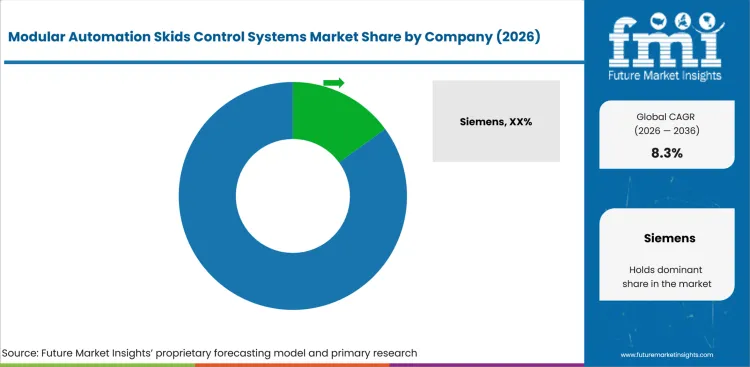
The modular automation skids control systems industry value is forecast to grow from USD 664.8 million in 2025 to USD 1,598.1 million by 2036 at 8.3% CAGR as skid builders move more control engineering into prefabricated process packages. PLC-Centric Integration is forecast to represent 46.0% share in 2026 because most skid packages still need accepted controller families, local sequencing, and clear maintenance access. Process Automation is expected to secure 43.0% share in 2026, led by batch, utility, dosing, and reaction skids that require validated loop control and operator records.
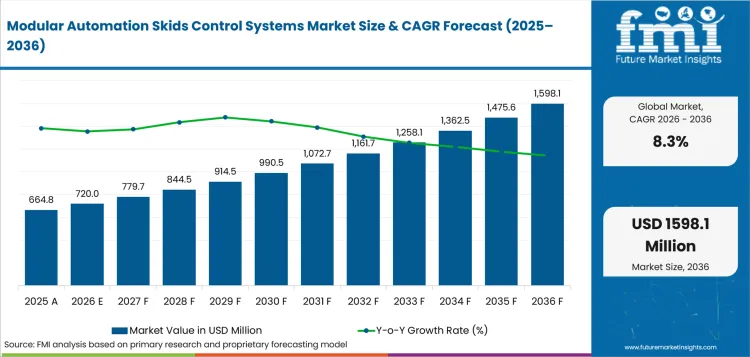
Modular Automation Skids Control Systems Market Overview: Size and Forecast
- 2025 Market Size: USD 664.8 million
- 2026 Market Size: USD 720.0 million
- 2036 Market Size: USD 1,598.1 million
- Forecast CAGR: 8.3% from 2026 to 2036
- Leading Integration Architecture: PLC-Centric Integration
- PLC-Centric Integration Share in 2026: 46.0%
- Leading Deployment: Process Automation
- Process Automation Share in 2026: 43.0%
- Fastest-growing Country: China
- China CAGR: 9.5% by 2036
Summary of the Modular Automation Skids Control Systems Market
- Demand and Growth Drivers
- Skid OEMs are standardizing control templates so similar production units can reuse alarm blocks, recipe objects, and interlock structures.
- Process plants are giving more attention to control packages that connect skid assets with DCS, historian, and MES environments.
- Remote service requirements are increasing demand for secure diagnostics, user roles, and lifecycle documentation inside skid automation packages.
- Product and Segment View
- PLC-Centric Integration is forecast to represent 46.0% share in 2026, led by buyer preference for approved PLC families and maintenance familiarity.
- Process Automation is projected to hold 43.0% share in 2026, supported by batch, utility, and continuous process skid requirements.
- Controllers are expected to secure 38.0% share in 2026, influenced by local sequencing, loop execution, and alarm handling needs.
- Geography and Competitive Outlook
- China is projected to record 9.5% CAGR by 2036, backed by high factory automation volume and domestic integration capacity.
- India is expected to expand at 9.4% CAGR by 2036 as electronics, automotive, and process plants add compact automation assets.
- Siemens, Rockwell Automation, Schneider Electric, ABB, Honeywell, Emerson, Yokogawa, Mitsubishi Electric, Omron, and Phoenix Contact compete through controller depth and lifecycle engineering tools.
- Control platform compatibility is the main competitive marker because buyers prefer skid packages that fit plant standards before shipment.
- Analyst Opinion
- Nandini Roy Choudhury, Principal Consultant at Future Market Insights for industrial domain, says, “I see this market as a control architecture market before I see it as a skid hardware market. Buyers are asking whether a skid can enter a plant without creating a separate control island. That means the controller, I/O layout, recipe interface, alarm model, and cybersecurity design shape the commercial decision. Suppliers win when their skid templates can pass factory acceptance tests quickly and then connect with the main plant system without rework. The pressure is coming from smaller engineering teams, shorter project windows, and tighter validation in process plants.”
Factory automation scale, OT cybersecurity, and advanced manufacturing policy are determining adoption in this market. The International Federation of Robotics reported 542,000 industrial robot installations in 2024 and 4,664,000 robots in operational use worldwide, showing how factories are adding programmable assets at scale. CISA released 10 industrial control systems advisories on August 7, 2025, reinforcing why skid controls need secure remote access, patched controller families, and documented mitigation plans. NIST stated in December 2025 that the AI for Resilient Manufacturing Institute would receive up to USD 70.0 million over 5 years from NIST with at least matching nonfederal funding, increasing the value of reusable engineering libraries and connected control packages.
Which factors support expansion in the modular automation skids control systems market?
Finished skid control packages, lifecycle services, and secure software layers support market value across industrial automation channels.
- Market value is supported by controller, remote I/O, engineering software, and service revenue attached to skid-mounted automation packages.
- Supplier pricing reflects controller family depth, engineering libraries, and factory acceptance testing support before plant commissioning begins.
- Revenue improves as process plants shift more automation decisions into the skid supplier’s scope instead of buying loose components.
- Buyer trust rises when packagers document alarm models, cybersecurity settings, handover files, and spare-part paths before site delivery.
Why is the modular automation skids control systems market growing?
Modular process units need local control packages as buyers shorten site work and move more engineering into supplier shops.
Demand is growing because connected factories now need skid assets that can communicate with plant systems from the first handover. IFR’s 2025 executive summary showed that 24.0% of 2024 robot installations served electrical and electronics, 23.0% served automotive, 16.0% served metal and machinery, 5.0% served plastic and chemical products, and 4.0% served food and beverages. Those industries overlap with the strongest skid control buyers, creating practical demand for repeatable controller templates, remote I/O layouts, and secure data exchange. The result is a shift from component-level procurement toward acceptance-tested control packages that reduce commissioning risk.
How is the modular automation skids control systems market segmented?
The modular automation skids control systems industry is segmented by offering, deployment, application, end-use industry, integration architecture, and region.
- Controllers are projected to account for 38.0% share in 2026, led by their role in local sequencing, loop execution, alarm handling, and plant handover.
- Process Automation is anticipated to hold 43.0% share in 2026 since chemical, pharmaceutical, and food skids require recipe handling, batch records, and validated process objects.
- Machine Control is expected to capture 34.0% share in 2026 due to OEM packages needing compact sequencing, interlock logic, and motion-ready panels.
- Chemicals is forecast to secure 24.0% share in 2026, reflected by dosing, blending, reaction, and utility skids that require repeatable process control.
- PLC-Centric Integration is projected to account for 46.0% share in 2026 because buyers prefer approved controller families with familiar maintenance workflows and spare-part availability.
Which offering leads the modular automation skids control systems market?
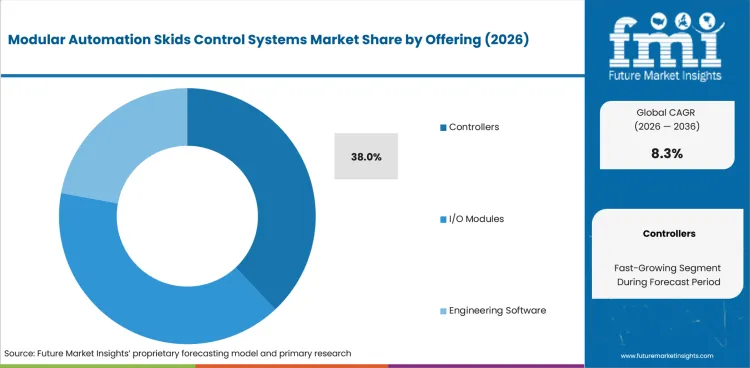
- Controllers are projected to account for 38.0% share in 2026, influenced by local control execution, alarm handling, and factory acceptance testing requirements.
- Engineering Software gains value as reusable libraries, simulation files, and documented objects reduce repeat engineering effort across similar skid projects.
Which deployment leads the modular automation skids control systems market?
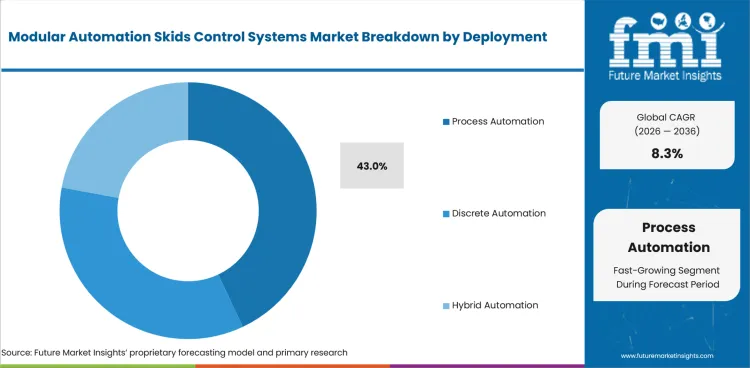
- Process Automation is anticipated to hold 43.0% share in 2026 through batch recipes, loop control, validated operator records, and compact process panels.
- Hybrid Automation gains attention when plants combine machine sequencing with utilities, dosing, and line-level data movement inside one skid package.
Which application leads the modular automation skids control systems market?
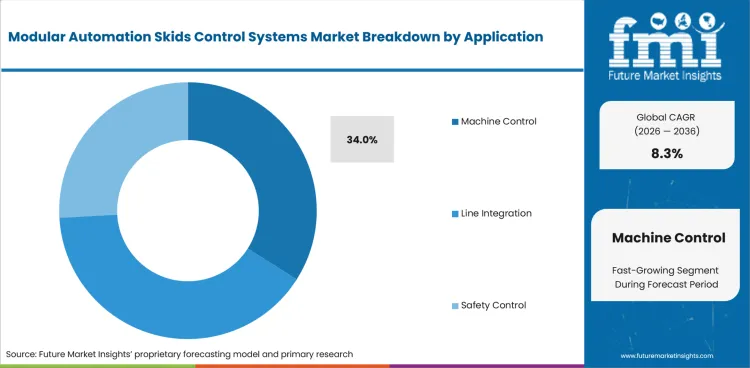
- Machine Control is forecast to secure 34.0% share in 2026, supported by OEM skids that combine sequencing, sensor logic, and actuator coordination.
- Remote Operations gains value as maintenance teams request diagnostics, role-based access, and secure service records for distributed assets.
Which end-use industry leads the modular automation skids control systems market?
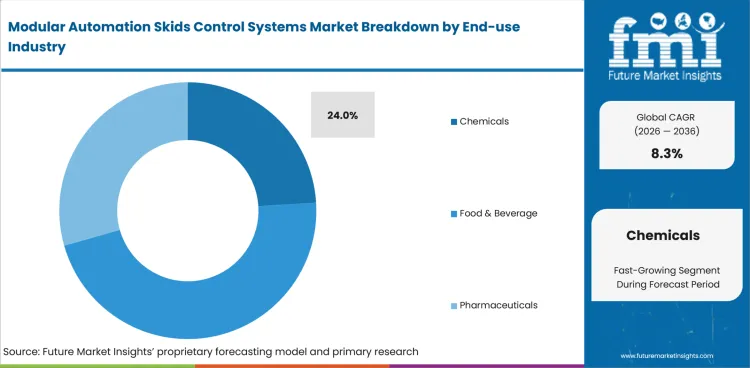
- Chemicals is projected to account for 24.0% share in 2026, led by dosing, blending, and reaction skids that need stable loop control.
- Pharmaceuticals gain importance as validation files, recipe control, and clean utility skids increase documentation requirements before installation.
Which integration architecture leads the modular automation skids control systems market?
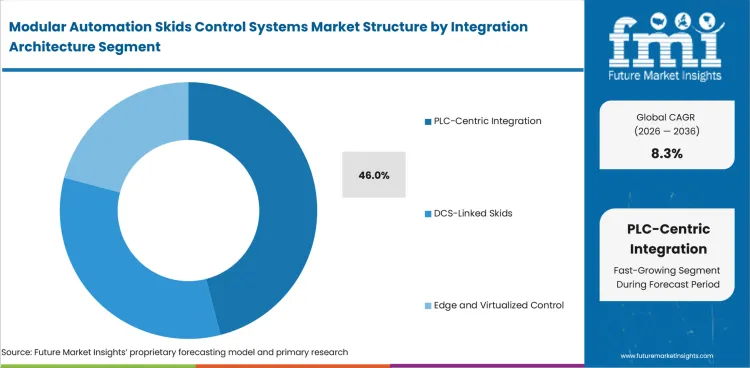
- PLC-Centric Integration is expected to represent 46.0% share in 2026, shaped by approved controller lists, maintenance familiarity, and local execution needs.
- Edge and Virtualized Control grows as software-defined controller options improve remote engineering, testing, and lifecycle flexibility for multi-site fleets.
What are the driver, restraints, and opportunities in the modular automation skids control systems market?
Skid template reuse and connected control packages support expansion while plant standards and cyber review slow supplier switching.
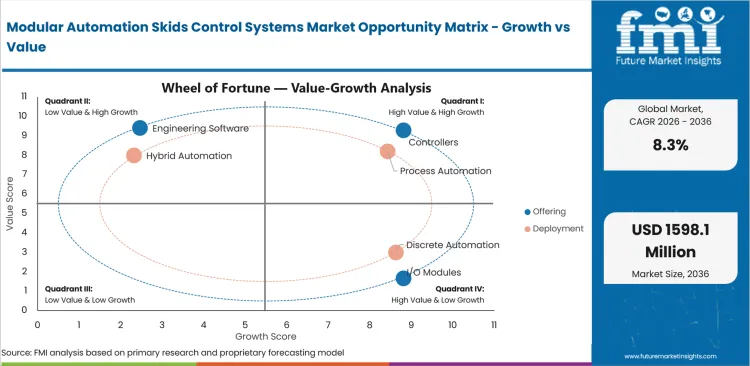
- Driver: Skid OEMs are standardizing controller templates to reduce repeated engineering work across similar process and machine packages.
- Restraint: Legacy plant standards slow supplier change because many buyers approve only limited controller and I/O families.
- Opportunity: Virtual PLC and remote engineering tools can lower upgrade friction for buyers managing multi-site skid fleets.
Control Template Reuse and Factory Acceptance Demand
Template reuse is increasing the value of controller libraries, alarm models, and reusable recipe objects. NIST’s March 2026 Manufacturing USA annual report highlighted a national network of 17 public-private manufacturing innovation institutes, showing how advanced manufacturing programs are organized around reusable technologies and industrial collaboration. That structure mirrors the commercial issue facing skid control suppliers. Buyers want more than hardware because they need documented control behavior before shipment. Suppliers with reusable objects and tested handover files can protect delivery timelines and reduce site rework.
Approved Platform Friction and PLC Exposure Risk
Plant standards remain a restraint because buyers often prefer the controller families already supported by maintenance teams. Cyber review makes the restraint sharper because connected skids can add remote service paths and firmware obligations. CISA released 3 industrial control systems advisories on August 21, 2025, showing why engineers review controller exposure before approving remote connectivity. Suppliers that cannot explain user roles, segmentation, backup procedures, and patch plans may face longer qualification cycles.
Virtual Engineering and Lifecycle Service Opportunity
Virtual engineering is creating an opportunity for suppliers that can test, update, and document control packages with less site disruption. IFR forecast that annual industrial robot installations would grow 6.0% in 2025 to 575,000 units and exceed 700,000 units by 2028. More programmable factory assets increase the need for control packages that can be engineered, simulated, and serviced across multiple plants. This gives software-defined controllers, remote diagnostics, and lifecycle services a clearer commercial role.
Which countries are growing fastest in the modular automation skids control systems market?
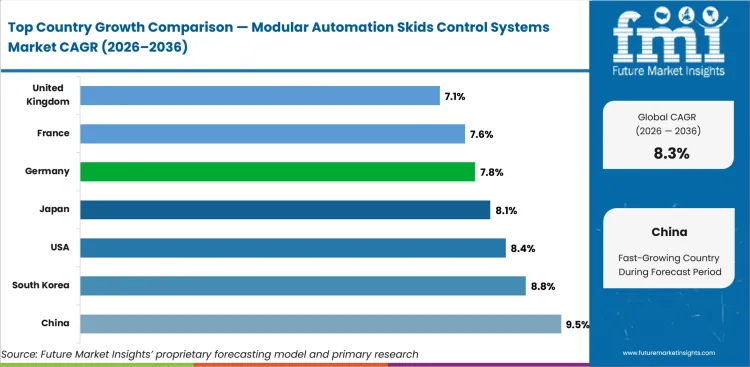
China 9.5% CAGR, India 9.4% CAGR, South Korea 8.8% CAGR, United States 8.4% CAGR, Japan 8.1% CAGR, Germany 7.8% CAGR, France 7.6% CAGR, and United Kingdom 7.1% CAGR through 2036.
.webp "Top Country Growth Comparison Modular Automation Skids Control Systems Market Cagr (2026 2036)")
| Country | CAGR |
|---|---|
| United States | 8.4% |
| United Kingdom | 7.1% |
| Germany | 7.8% |
| France | 7.6% |
| Japan | 8.1% |
| China | 9.5% |
| South Korea | 8.8% |
| India | 9.4% |
Source: Future Market Insights, 2026.
How do country-level CAGRs compare in the modular automation skids control systems market?
China leads country expansion while the United Kingdom records the most cautious outlook among profiled markets.
- The United States is projected to record 8.4% CAGR from 2026 to 2036 due to process retrofit and cybersecurity-led control review.
- The United Kingdom is projected to expand at 7.1% CAGR through 2036 as selective automation and integrator channels support packaged systems.
- Germany is expected to post 7.8% CAGR through 2036 with machinery and process buyers requiring documented automation packages.
- France is estimated to grow at 7.6% CAGR by 2036 through pharmaceutical, food, aerospace, and chemical skid demand.
- Japan is forecast to rise at 8.1% CAGR over the forecast period as local controller ecosystems support reliable skid automation.
- China is forecast to record 9.5% CAGR by 2036 as new factory capacity and local integration depth support skid control packages.
- South Korea is expected to expand at 8.8% CAGR by 2036 with electronics and battery automation supporting packaged controls.
- India is projected to grow at 9.4% CAGR through 2036 as electronics, automotive, and process plants add compact automation assets.
What is the market outlook for modular automation skids control systems in the United States?
A mature retrofit base and strong process automation channels support packaged skid controls across regulated plants.
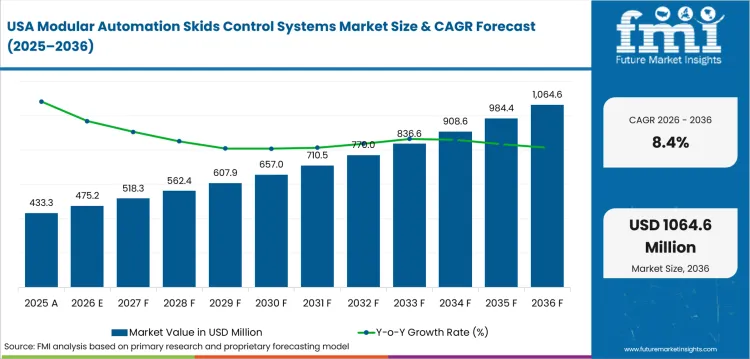
Country Market Snapshot Table
| Parameter | Value |
|---|---|
| Market Size in 2025 (Value) | USD 169.7 million |
| Market Size in 2026 (Value) | USD 184.0 million |
| Market Forecast in 2036 (Value) | USD 412.2 million |
| CAGR (2026 to 2036) | 8.4% |
| Years Considered | 2021 to 2036 |
| Base Year | 2025 |
| Forecast Period | 2026 to 2036 |
| Units Considered | Value (USD million) |
| Leading Sub-Region | Gulf Coast and Midwest process corridors |
United States Modular Automation Skids Control Systems Market Outlook
United States demand is shaped by brownfield plants that need packaged control panels without long production disruption. Buyers ask whether each skid can fit approved controller families, cyber rules, spare-part programs, and historian interfaces.
OEM skid builders and system integrators remain central to supplier selection. Products with documented factory acceptance testing, remote I/O layouts, and service-ready diagnostics can move faster through plant engineering review.
Key Growth Drivers
- Industrial robot deployment gives skid suppliers a large automation context, as the United States recorded 34,164 industrial robot installations in 2024.
- Manufacturing scale supports retrofit potential because NIST reported 15.0 million United States manufacturing employees in 2024.
- Process plants need skid packages that can connect with existing distributed control systems and maintenance workflows without creating separate control islands.
- Automotive, food processing, chemicals, and energy users favor packaged control panels when project teams need shorter site installation windows.
Key Restraints
- Controller standardization can slow supplier change because many plants approve only a narrow set of PLC and I/O families.
- OT security review can delay connected skid acceptance, as CISA released ten industrial control systems advisories on August 7, 2025.
- Commissioning labor constraints can raise project risk when factories need field changes after factory acceptance testing.
What makes United States unique
The United States is unique because retrofit demand, OT cybersecurity review, and large process plants meet in the same buying decision.
Key Companies
- Rockwell Automation
- Emerson
- Honeywell
- Siemens USA
- Schneider Electric USA
- ABB United States
- Phoenix Contact USA
Sales & Marketing Channels
- Direct enterprise automation sales
- OEM skid builder partnerships
- Control system integrator channels
- Engineering procurement contractor routes
- Distributor-led spare parts and service channels
- Factory acceptance testing specialists
Country Segment Breakdown Table
| Segment | Sub-Segments |
|---|---|
| By Offering | Controllers · I/O Modules · Engineering Software · Services |
| By Deployment | Discrete Automation · Process Automation · Hybrid Automation |
| By Application | Machine Control · Line Integration · Safety Control · Remote Operations |
| By End-use Industry | Automotive · Food & Beverage · Chemicals · Pharmaceuticals · Electronics · Metals |
| By Integration Architecture | PLC-Centric Integration · DCS-Linked Skids · Edge and Virtualized Control · Hybrid Control Nodes |
| Key Sub-Regions Covered, Industrial Automation Corridors | Gulf Coast · Midwest · California · Texas · Southeast · New England process clusters |
Frequently Asked Questions
How fast is United States modular automation skids control systems market growing?
Sales in United States are ready to scale at 8.4% CAGR from 2026 to 2036, guided by authorized controller families, cybersecurity checks, and process retrofit projects.
Who leads United States modular automation skids control systems market?
Rockwell Automation, Emerson, Honeywell, Siemens USA compete through controller platforms, integration support, and lifecycle service coverage.
What is driving adoption in United States modular automation skids control systems market?
Authorized controller families, cybersecurity checks, and process retrofit projects are moving buyers toward factory-tested automation skids and reusable control packages.
How is the modular automation skids control systems market performing in the United Kingdom?
Selective automation programs and constrained industrial sites support packaged control panels for process and food applications.
Country Market Snapshot Table
| Parameter | Value |
|---|---|
| Market Size in 2025 (Value) | USD 37.3 million |
| Market Size in 2026 (Value) | USD 40.0 million |
| Market Forecast in 2036 (Value) | USD 79.4 million |
| CAGR (2026 to 2036) | 7.1% |
| Years Considered | 2021 to 2036 |
| Base Year | 2025 |
| Forecast Period | 2026 to 2036 |
| Units Considered | Value (USD million) |
| Leading Sub-Region | Midlands, North West, and national process hubs |
United Kingdom Modular Automation Skids Control Systems Market Outlook
United Kingdom demand is shaped by manufacturers that want modular capacity without major plant rebuilding. Food, pharmaceutical, and specialty chemical users value compact panels, clear documentation, and integrator support.
Buying behavior is cautious and project-led. Suppliers with local engineering coverage, cyber-aware service access, and practical maintenance records can gain stronger acceptance in constrained sites.
Key Growth Drivers
- Automation remains relevant even in a selective investment climate, with the United Kingdom recording 2,500 industrial robot installations in 2024.
- Digital manufacturing support is visible through Made Smarter Innovation, which carries a GBP 147.0 million program budget through 2026.
- Pharmaceutical and food producers use skids when they need validated process steps inside older or space-limited facilities.
- Regional system integrators help smaller manufacturers choose packaged control systems instead of one-off panel builds.
Key Restraints
- Capital approval can be cautious when manufacturers prioritize energy savings before automation replacement.
- Manufacturing represented 8.5% of total United Kingdom GVA in the first quarter of 2026, which narrows the broad industrial pull compared with larger manufacturing economies.
- Limited in-house OT cybersecurity skills can slow acceptance of remotely serviced skid packages.
What makes United Kingdom unique
The United Kingdom is unique because SME advisory programs and trusted integrators strongly influence automation buying.
Key Companies
- Schneider Electric UK
- Rockwell Automation UK
- Siemens UK
- Emerson UK
- ABB UK
- Yokogawa UK
- Phoenix Contact UK
Sales & Marketing Channels
- Regional system integrator networks
- OEM skid builder referrals
- SME digital adoption programs
- Distributor and panel builder routes
- Pharmaceutical validation consultants
- Food industry engineering partners
Country Segment Breakdown Table
| Segment | Sub-Segments |
|---|---|
| By Offering | Controllers · I/O Modules · Engineering Software · Services |
| By Deployment | Discrete Automation · Process Automation · Hybrid Automation |
| By Application | Machine Control · Line Integration · Safety Control · Remote Operations |
| By End-use Industry | Automotive · Food & Beverage · Chemicals · Pharmaceuticals · Electronics · Metals |
| By Integration Architecture | PLC-Centric Integration · DCS-Linked Skids · Edge and Virtualized Control · Hybrid Control Nodes |
| Key Sub-Regions Covered, Industrial Automation Corridors | Midlands · North West England · London · Scotland central belt · Wales manufacturing clusters · Northern Ireland industrial corridors |
Frequently Asked Questions
How fast is United Kingdom modular automation skids control systems market growing?
Sales in United Kingdom are ready to scale at 7.1% CAGR from 2026 to 2036, guided by selective plant upgrades, pharmaceutical validation, and regional integrator trust.
Who leads United Kingdom modular automation skids control systems market?
Schneider Electric UK, Rockwell Automation UK, Siemens UK, Emerson UK compete through controller platforms, integration support, and lifecycle service coverage.
What is driving adoption in United Kingdom modular automation skids control systems market?
Selective plant upgrades, pharmaceutical validation, and regional integrator trust are moving buyers toward factory-tested automation skids and reusable control packages.
What supports modular automation skids control systems demand in Germany?
Supplier depth and strict engineering standards support packaged controls across machinery, chemicals, and pharmaceuticals.
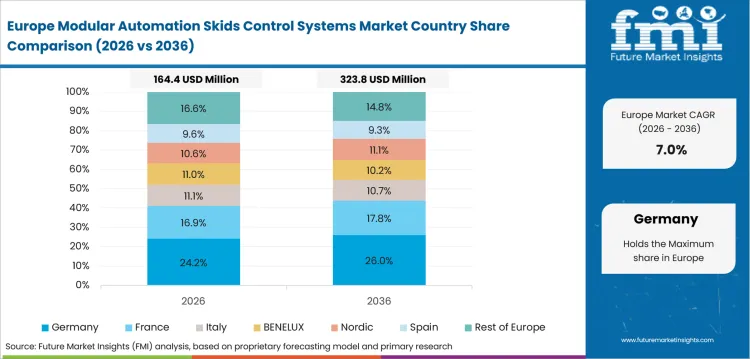
Country Market Snapshot Table
| Parameter | Value |
|---|---|
| Market Size in 2025 (Value) | USD 45.5 million |
| Market Size in 2026 (Value) | USD 49.0 million |
| Market Forecast in 2036 (Value) | USD 103.8 million |
| CAGR (2026 to 2036) | 7.8% |
| Years Considered | 2021 to 2036 |
| Base Year | 2025 |
| Forecast Period | 2026 to 2036 |
| Units Considered | Value (USD million) |
| Leading Sub-Region | Bavaria, North Rhine-Westphalia, and Baden-Württemberg |
Germany Modular Automation Skids Control Systems Market Outlook
Germany demand is driven by factories that expect skid controls to match existing engineering environments. Buyers often evaluate approved controller families, documentation quality, safety acceptance, and data model fit before commercial negotiation.
The market favors suppliers with strong local support and proven industrial portfolios. Skid packages that reduce engineering exceptions can move faster through plant standards and machinery OEM review.
Key Growth Drivers
- Germany installed 26,982 industrial robots in 2024, giving skid control suppliers a deep automation base.
- Interoperability culture supports packaged systems because Plattform Industrie 4.0 brings together more than 300 companies and organizations.
- Machinery exporters need repeatable controller templates that can travel across customer plants and export projects.
- Chemical and pharmaceutical plants require documented batch, loop control, and safety functions before accepting skid packages.
Key Restraints
- High engineering standards raise entry barriers for low-cost controller suppliers without local documentation depth.
- Manufacturing order volatility can delay new automation packages, as German new manufacturing orders fell 3.8% month on month in April 2026.
- Automotive investment cycles can shift priorities away from new line integration when factories focus on efficiency programs.
What makes Germany unique
Germany is unique because customer standards and domestic automation supplier strength are both unusually high.
Key Companies
- Siemens
- Phoenix Contact
- ABB Germany
- Schneider Electric Germany
- Rockwell Automation Germany
- Yokogawa Germany
- Emerson Germany
Sales & Marketing Channels
- Direct sales to machinery OEMs
- Certified system integrator routes
- Panel builder networks
- Chemical plant engineering channels
- Trade fair engagement
- Standards-community relationships
Country Segment Breakdown Table
| Segment | Sub-Segments |
|---|---|
| By Offering | Controllers · I/O Modules · Engineering Software · Services |
| By Deployment | Discrete Automation · Process Automation · Hybrid Automation |
| By Application | Machine Control · Line Integration · Safety Control · Remote Operations |
| By End-use Industry | Automotive · Food & Beverage · Chemicals · Pharmaceuticals · Electronics · Metals |
| By Integration Architecture | PLC-Centric Integration · DCS-Linked Skids · Edge and Virtualized Control · Hybrid Control Nodes |
| Key Sub-Regions Covered, Industrial Automation Corridors | Bavaria · North Rhine-Westphalia · Baden-Württemberg · Lower Saxony · Saxony · Hesse |
Frequently Asked Questions
How fast is Germany modular automation skids control systems market growing?
Sales in Germany are ready to scale at 7.8% CAGR from 2026 to 2036, guided by machinery exports, Industrie 4.0 expectations, and strong controller supplier coverage.
Who leads Germany modular automation skids control systems market?
Siemens, Phoenix Contact, ABB Germany, Schneider Electric Germany compete through controller platforms, integration support, and lifecycle service coverage.
What is driving adoption in Germany modular automation skids control systems market?
Machinery exports, industrie 4.0 expectations, and strong controller supplier coverage are moving buyers toward factory-tested automation skids and reusable control packages.
How is the modular automation skids control systems market developing in France?
Regulated process users and aerospace suppliers support controlled demand for validated skid automation packages.
Country Market Snapshot Table
| Parameter | Value |
|---|---|
| Market Size in 2025 (Value) | USD 33.5 million |
| Market Size in 2026 (Value) | USD 36.0 million |
| Market Forecast in 2036 (Value) | USD 74.9 million |
| CAGR (2026 to 2036) | 7.6% |
| Years Considered | 2021 to 2036 |
| Base Year | 2025 |
| Forecast Period | 2026 to 2036 |
| Units Considered | Value (USD million) |
| Leading Sub-Region | Île-de-France, Auvergne-Rhône-Alpes, and Hauts-de-France |
France Modular Automation Skids Control Systems Market Outlook
France demand is selective and documentation-heavy. Pharmaceutical, food processing, aerospace, and chemical plants value skid controls that reduce site installation work while preserving validation records.
Local service response matters during supplier selection. Vendors with French engineering support and proven controller platforms can improve acceptance in regulated and high-specification plants.
Key Growth Drivers
- France recorded 4,900 industrial robot installations in 2024, creating an automation base for packaged skid controls.
- Industrial innovation policy keeps automation visible, with French Tech 2030 selecting 80 companies in its 2025 class.
- Pharmaceutical facilities need validated skid control files for batch utilities, clean processes, and repeatable commissioning.
- Food producers choose skids when hygiene controls and downtime limits make compact prefabricated packages more attractive.
Key Restraints
- Mid-sized manufacturers may delay automation when payback periods are unclear or service capacity is limited.
- Factory output swings can affect automation timing, as French manufacturing output fell 0.8% in December 2025.
- Local support requirements can outweigh low purchase price when buyers compare controller and software packages.
What makes France unique
France is unique because regulated process users create steady demand even when general automation cycles soften.
Key Companies
- Schneider Electric France
- Siemens France
- Emerson France
- Yokogawa France
- ABB France
- Rockwell Automation France
- Phoenix Contact France
Sales & Marketing Channels
- Direct enterprise automation sales
- EPC and process engineering routes
- Pharmaceutical validation networks
- Food industry integrator channels
- Regional distributor support
- Aerospace process equipment suppliers
Country Segment Breakdown Table
| Segment | Sub-Segments |
|---|---|
| By Offering | Controllers · I/O Modules · Engineering Software · Services |
| By Deployment | Discrete Automation · Process Automation · Hybrid Automation |
| By Application | Machine Control · Line Integration · Safety Control · Remote Operations |
| By End-use Industry | Automotive · Food & Beverage · Chemicals · Pharmaceuticals · Electronics · Metals |
| By Integration Architecture | PLC-Centric Integration · DCS-Linked Skids · Edge and Virtualized Control · Hybrid Control Nodes |
| Key Sub-Regions Covered, Industrial Automation Corridors | Île-de-France · Auvergne-Rhône-Alpes · Hauts-de-France · Grand Est · Occitanie · Nouvelle-Aquitaine |
Frequently Asked Questions
How fast is France modular automation skids control systems market growing?
Sales in France are ready to scale at 7.6% CAGR from 2026 to 2036, guided by validated process skids, aerospace quality requirements, and local service coverage.
Who leads France modular automation skids control systems market?
Schneider Electric France, Siemens France, Emerson France, Yokogawa France compete through controller platforms, integration support, and lifecycle service coverage.
What is driving adoption in France modular automation skids control systems market?
Validated process skids, aerospace quality requirements, and local service coverage are moving buyers toward factory-tested automation skids and reusable control packages.
What is the forecast for modular automation skids control systems in Japan?
Local control suppliers and high reliability expectations support packaged automation across electronics and process plants.
Country Market Snapshot Table
| Parameter | Value |
|---|---|
| Market Size in 2025 (Value) | USD 49.0 million |
| Market Size in 2026 (Value) | USD 53.0 million |
| Market Forecast in 2036 (Value) | USD 115.5 million |
| CAGR (2026 to 2036) | 8.1% |
| Years Considered | 2021 to 2036 |
| Base Year | 2025 |
| Forecast Period | 2026 to 2036 |
| Units Considered | Value (USD million) |
| Leading Sub-Region | Kanto, Chubu, and Kansai industrial corridors |
Japan Modular Automation Skids Control Systems Market Outlook
Japan demand is shaped by automation-heavy manufacturers that expect reliable diagnostics, documented maintenance, and long lifecycle support. Skid control suppliers must show that panels can operate inside conservative qualification processes.
Electronics, automotive, pharmaceutical, and specialty chemical users remain important buyers. Vendors with local product depth and training capacity are better placed to win repeat skid projects.
Key Growth Drivers
- Japan recorded 44,453 industrial robot installations in 2024, confirming a large base for connected machine and process automation.
- Japan’s April 2026 production index stood at 102.5, giving manufacturers a current reference point for equipment planning.
- Local controller ecosystems from Yokogawa, Mitsubishi Electric, and Omron support skid packages across DCS, PLC, and machine automation use cases.
- High-mix electronics and automotive factories need compact automation packages that reduce on-site commissioning effort.
Key Restraints
- Long qualification cycles can slow adoption of new controller families in process plants.
- Japan’s April 2026 inventory ratio index stood at 101.6, which can make manufacturers more cautious about near-term equipment timing.
- Suppliers must provide strong documentation and training support before buyers approve new control architectures.
What makes Japan unique
Japan is unique because domestic control suppliers combine broad portfolios with conservative buyer expectations.
Key Companies
- Yokogawa Electric
- Mitsubishi Electric
- Omron
- Siemens Japan
- ABB Japan
- Schneider Electric Japan
- Rockwell Automation Japan
Sales & Marketing Channels
- Direct OEM automation sales
- Long-term plant account management
- Machine builder partnerships
- Technical training centers
- Distributor and maintenance networks
- Process engineering relationships
Country Segment Breakdown Table
| Segment | Sub-Segments |
|---|---|
| By Offering | Controllers · I/O Modules · Engineering Software · Services |
| By Deployment | Discrete Automation · Process Automation · Hybrid Automation |
| By Application | Machine Control · Line Integration · Safety Control · Remote Operations |
| By End-use Industry | Automotive · Food & Beverage · Chemicals · Pharmaceuticals · Electronics · Metals |
| By Integration Architecture | PLC-Centric Integration · DCS-Linked Skids · Edge and Virtualized Control · Hybrid Control Nodes |
| Key Sub-Regions Covered, Industrial Automation Corridors | Kanto · Chubu · Kansai · Kyushu · Tohoku · Hokkaido industrial areas |
Frequently Asked Questions
How fast is Japan modular automation skids control systems market growing?
Sales in Japan are ready to scale at 8.1% CAGR from 2026 to 2036, guided by local controller depth, high-mix production, and reliability-focused procurement.
Who leads Japan modular automation skids control systems market?
Yokogawa Electric, Mitsubishi Electric, Omron, Siemens Japan compete through controller platforms, integration support, and lifecycle service coverage.
What is driving adoption in Japan modular automation skids control systems market?
Local controller depth, high-mix production, and reliability-focused procurement are moving buyers toward factory-tested automation skids and reusable control packages.
Why is China the fastest-growing modular automation skids control systems market?
Large factory automation volume and rapid industrial capacity additions support strong demand for standardized skid controls.
Country Market Snapshot Table
| Parameter | Value |
|---|---|
| Market Size in 2025 (Value) | USD 153.4 million |
| Market Size in 2026 (Value) | USD 168.0 million |
| Market Forecast in 2036 (Value) | USD 416.3 million |
| CAGR (2026 to 2036) | 9.5% |
| Years Considered | 2021 to 2036 |
| Base Year | 2025 |
| Forecast Period | 2026 to 2036 |
| Units Considered | Value (USD million) |
| Leading Sub-Region | Yangtze River Delta, Pearl River Delta, and Bohai Rim |
China Modular Automation Skids Control Systems Market Outlook
China demand is shaped by large electronics, EV, chemical, food, and metals projects that need fast delivery and localized engineering. Buyers compare control platform fit, price, local service, and integration speed.
Domestic integrators have strong influence on channel access. Global suppliers must localize templates and training while protecting compatibility with plant-level systems.
Key Growth Drivers
- China installed 295,045 industrial robots in 2024, giving modular skid suppliers the world’s largest automation demand base.
- Equipment manufacturing output rose 9.2% in 2025, supporting demand for control packages tied to industrial capacity expansion.
- EV and electronics factories need modular line assets that can be commissioned quickly across repeat plant programs.
- Local integrators can scale packaged control solutions when skid builders require faster customization and commissioning support.
Key Restraints
- Local price competition can compress margins for imported controller, I/O, and engineering software packages.
- Localization pressure is high because NIST reported at least 33 manufacturing innovation centers established in China by 2025.
- Cybersecurity and data governance review can slow remote operations features when suppliers connect skids with plant networks.
What makes China unique
China is unique because automation volume, domestic integration capacity, and price pressure shape every supplier decision.
Key Companies
- Siemens China
- Schneider Electric China
- ABB China
- Rockwell Automation China
- Mitsubishi Electric Automation China
- Omron China
- Phoenix Contact China
Sales & Marketing Channels
- Local system integrators
- OEM skid builder networks
- Direct sales to large factories
- Panel builder partnerships
- Industrial park project routes
- Distributor and service channels
Country Segment Breakdown Table
| Segment | Sub-Segments |
|---|---|
| By Offering | Controllers · I/O Modules · Engineering Software · Services |
| By Deployment | Discrete Automation · Process Automation · Hybrid Automation |
| By Application | Machine Control · Line Integration · Safety Control · Remote Operations |
| By End-use Industry | Automotive · Food & Beverage · Chemicals · Pharmaceuticals · Electronics · Metals |
| By Integration Architecture | PLC-Centric Integration · DCS-Linked Skids · Edge and Virtualized Control · Hybrid Control Nodes |
| Key Sub-Regions Covered, Industrial Automation Corridors | Yangtze River Delta · Pearl River Delta · Bohai Rim · Sichuan-Chongqing corridor · Central China manufacturing belt · Northeast industrial bases |
Frequently Asked Questions
How fast is China modular automation skids control systems market growing?
Sales in China are ready to scale at 9.5% CAGR from 2026 to 2036, guided by factory automation volume, EV capacity, and local integration ecosystems.
Who leads China modular automation skids control systems market?
Siemens China, Schneider Electric China, ABB China, Rockwell Automation China compete through controller platforms, integration support, and lifecycle service coverage.
What is driving adoption in China modular automation skids control systems market?
Factory automation volume, ev capacity, and local integration ecosystems are moving buyers toward factory-tested automation skids and reusable control packages.
How quickly is South Korea adopting modular automation skids control systems?
Electronics and automotive automation density supports strong control package demand in compact industrial corridors.
Country Market Snapshot Table
| Parameter | Value |
|---|---|
| Market Size in 2025 (Value) | USD 41.4 million |
| Market Size in 2026 (Value) | USD 45.0 million |
| Market Forecast in 2036 (Value) | USD 104.6 million |
| CAGR (2026 to 2036) | 8.8% |
| Years Considered | 2021 to 2036 |
| Base Year | 2025 |
| Forecast Period | 2026 to 2036 |
| Units Considered | Value (USD million) |
| Leading Sub-Region | Gyeonggi, Ulsan, and Chungcheong industrial corridors |
South Korea Modular Automation Skids Control Systems Market Outlook
South Korea demand is driven by electronics, battery, automotive, and specialty process industries. Buyers expect compact, reliable control systems that fit high-throughput factories and strict maintenance routines.
Supplier acceptance depends on proven service response and compatibility with existing plant automation. Skid controls with strong diagnostics and cyber-aware remote support are more likely to move through qualification.
Key Growth Drivers
- Public and private robotics investment supports automation demand, as South Korea’s Fourth Intelligent Robot Basic Plan aims to invest more than USD 2.24 billion by 2030.
- Advanced robotics and manufacturing policy supports automation upgrading, as MSIT stated that R&D in 12 critical and emerging technologies will receive more than KRW 30.0 trillion over the next 5 years.
- Battery, semiconductor, and automotive plants need modular control packages that can support repeatable line and utility assets.
- Dense industrial clusters allow integrators to provide faster panel support, service checks, and controller troubleshooting.
Key Restraints
- High automation maturity increases buyer expectations for response time, diagnostics, and lifecycle support.
- South Korea reached 1,220 robots per 10,000 employees, making new suppliers face a demanding benchmark for factory productivity.
- Supplier changes can move slowly when plants require strict compatibility with existing electronics and automotive automation standards.
What makes South Korea unique
South Korea is unique because high robot density and compact industrial clusters make service speed a commercial differentiator.
Key Companies
- Siemens Korea
- Rockwell Automation Korea
- ABB Korea
- Schneider Electric Korea
- Mitsubishi Electric Korea
- Omron Korea
- Yokogawa Korea
Sales & Marketing Channels
- Electronics OEM engineering routes
- Battery plant automation partners
- Automotive supplier networks
- Local system integrators
- Distributor-led service channels
- Panel builder partnerships
Country Segment Breakdown Table
| Segment | Sub-Segments |
|---|---|
| By Offering | Controllers · I/O Modules · Engineering Software · Services |
| By Deployment | Discrete Automation · Process Automation · Hybrid Automation |
| By Application | Machine Control · Line Integration · Safety Control · Remote Operations |
| By End-use Industry | Automotive · Food & Beverage · Chemicals · Pharmaceuticals · Electronics · Metals |
| By Integration Architecture | PLC-Centric Integration · DCS-Linked Skids · Edge and Virtualized Control · Hybrid Control Nodes |
| Key Sub-Regions Covered, Industrial Automation Corridors | Gyeonggi · Ulsan · Chungcheong · Busan · Daegu-Gyeongbuk · Incheon industrial areas |
Frequently Asked Questions
How fast is South Korea modular automation skids control systems market growing?
Sales in South Korea are ready to scale at 8.8% CAGR from 2026 to 2036, guided by electronics capacity, battery plants, and high automation density.
Who leads South Korea modular automation skids control systems market?
Siemens Korea, Rockwell Automation Korea, ABB Korea, Schneider Electric Korea compete through controller platforms, integration support, and lifecycle service coverage.
What is driving adoption in South Korea modular automation skids control systems market?
Electronics capacity, battery plants, and high automation density are moving buyers toward factory-tested automation skids and reusable control packages.
What is driving modular automation skids control systems adoption in India?
Electronics, automotive, and process capacity additions support compact skid automation across fast-expanding industrial clusters.
Country Market Snapshot Table
| Parameter | Value |
|---|---|
| Market Size in 2025 (Value) | USD 28.3 million |
| Market Size in 2026 (Value) | USD 31.0 million |
| Market Forecast in 2036 (Value) | USD 76.1 million |
| CAGR (2026 to 2036) | 9.4% |
| Years Considered | 2021 to 2036 |
| Base Year | 2025 |
| Forecast Period | 2026 to 2036 |
| Units Considered | Value (USD million) |
| Leading Sub-Region | Maharashtra, Gujarat, Tamil Nadu, and Karnataka |
India Modular Automation Skids Control Systems Market Outlook
India demand is shaped by factories adding capacity while managing space, labor, and commissioning constraints. Modular skid controls help buyers add new process or line functions without long field wiring programs.
Local service and price discipline matter during supplier selection. Vendors with training, commissioning support, and scalable controller families can gain better access through OEMs and system integrators.
Key Growth Drivers
- India recorded 9,100 industrial robot installations in 2024, showing a growing base for packaged automation projects.
- Electronics manufacturing creates demand for compact control packages, with the Government of India targeting USD 300.0 billion in electronics production by 2026.
- Automotive, pharmaceuticals, food processing, and chemicals buyers use skid packages to shorten site work and standardize control panels.
- Industrial corridors in western and southern India support faster integrator access for commissioning and after-sales service.
Key Restraints
- Price sensitivity can slow premium controller adoption when buyers compare imported control platforms with local panel alternatives.
- Industrial production timing can affect capital decisions, as India’s Index of Industrial Production grew 4.1% in March 2026.
- Automation skill gaps can lengthen commissioning when plants adopt advanced remote diagnostics or virtual controller tools.
What makes India unique
India is unique because fast capacity additions meet strong price discipline and a growing local integrator base.
Key Companies
- Siemens India
- Schneider Electric India
- Rockwell Automation India
- Yokogawa India
- Phoenix Contact India
- ABB India
- Mitsubishi Electric India
Sales & Marketing Channels
- OEM skid builder partnerships
- System integrator networks
- Industrial distributor routes
- EPC project channels
- Automotive supplier networks
- Pharmaceutical engineering consultants
Country Segment Breakdown Table
| Segment | Sub-Segments |
|---|---|
| By Offering | Controllers · I/O Modules · Engineering Software · Services |
| By Deployment | Discrete Automation · Process Automation · Hybrid Automation |
| By Application | Machine Control · Line Integration · Safety Control · Remote Operations |
| By End-use Industry | Automotive · Food & Beverage · Chemicals · Pharmaceuticals · Electronics · Metals |
| By Integration Architecture | PLC-Centric Integration · DCS-Linked Skids · Edge and Virtualized Control · Hybrid Control Nodes |
| Key Sub-Regions Covered, Industrial Automation Corridors | Maharashtra · Gujarat · Tamil Nadu · Karnataka · Telangana · National Capital Region |
Frequently Asked Questions
How fast is India modular automation skids control systems market growing?
Sales in India are ready to scale at 9.4% CAGR from 2026 to 2036, guided by electronics expansion, process capacity additions, and integrator-led commissioning.
Who leads India modular automation skids control systems market?
Siemens India, Schneider Electric India, Rockwell Automation India, Yokogawa India compete through controller platforms, integration support, and lifecycle service coverage.
What is driving adoption in India modular automation skids control systems market?
Electronics expansion, process capacity additions, and integrator-led commissioning are moving buyers toward factory-tested automation skids and reusable control packages.
Who are the leading companies in the modular automation skids control systems market?
Siemens, Rockwell Automation, Schneider Electric, ABB, Honeywell, Emerson, Yokogawa, Mitsubishi Electric, Omron, and Phoenix Contact.
- Global automation vendors hold an advantage through controller families that plant engineers already approve for production environments.
- Process automation suppliers differentiate with batch objects, historian connectivity, alarm management, and validation support for regulated plants.
- Specialist integrators compete with faster panel customization, local commissioning, and project-specific migration support.
- Software and lifecycle services are becoming more important as buyers ask for remote diagnostics, simulation, cybersecurity review, and upgrade planning.
Automation suppliers in the market compete by combining controller hardware with engineering software and plant acceptance support. Siemens and Rockwell Automation benefit from strong PLC families used in machine and line automation. Schneider Electric, ABB, Honeywell, Emerson, and Yokogawa gain value in process-heavy skids because buyers need loop control, alarms, safety logic, and plant data interfaces. Supplier approval is often decided before price negotiation because the skid must match plant standards.
Engineering reuse has become a competitive separator as skid OEMs move toward repeatable templates. Siemens announced the SIMATIC S7-1200 G2 in April 2024 with motion control, machine safety, higher performance, and seamless scalability. Yokogawa launched CENTUM VP Release 7.01 in June 2025, adding another process-control reference point for DCS-linked skid architecture. Phoenix Contact’s October 2025 Virtual PLCnext Control launch shows how software-based controllers are moving into industrial automation planning.
Regional service reach also affects supplier selection because skid controls must pass factory acceptance testing and then connect on site without rework. Mitsubishi Electric and Omron have strong machine-control positions in Japan and Asia-facing OEM channels. Phoenix Contact benefits where panel-level integration, terminal blocks, remote I/O, and open control platforms matter. Suppliers that can support documented cybersecurity, local commissioning, and lifecycle migration are expected to gain stronger account retention.
How do top modular automation skids control systems companies compare?
Siemens and Rockwell Automation score strongest on PLC platform depth while Yokogawa, Emerson, Honeywell, and ABB score strongly in process-linked control packages.
| Company | Relevance to Market Title | Controller Portfolio | Process Control Fit | Software and Engineering Tools | Channel Reach | Geographic Footprint |
|---|---|---|---|---|---|---|
| Siemens | Very High | Very Strong | Strong | Very Strong | Very Strong | Global |
| Rockwell Automation | Very High | Very Strong | Strong | Very Strong | Very Strong | Global |
| Schneider Electric | Very High | Strong | Strong | Very Strong | Very Strong | Global |
| ABB | High | Strong | Very Strong | Strong | Very Strong | Global |
| Honeywell | High | Moderate to Strong | Very Strong | Strong | Strong | Global |
| Emerson | High | Strong | Very Strong | Strong | Strong | Global |
| Yokogawa | High | Moderate | Very Strong | Strong | Strong | Asia, Europe, Americas |
| Mitsubishi Electric | High | Very Strong | Moderate | Strong | Strong | Asia and global OEM channels |
| Omron | High | Strong | Moderate | Strong | Strong | Asia and machine automation channels |
| Phoenix Contact | High | Strong | Moderate | Strong | Strong | Europe, North America, Asia |
Source: Future Market Insights competitive analysis, 2026.
Who are the key players in the modular automation skids control systems market?
Siemens, Rockwell Automation and Schneider Electric are listed with ABB and Honeywell among other suppliers.
Key global companies leading the modular automation skids control systems market include:
- Siemens
- Rockwell Automation
- Schneider Electric
- ABB
- Honeywell
- Emerson
- Yokogawa
- Mitsubishi Electric
- Omron
- Phoenix Contact
Key Developments in Modular Automation Skids Control Systems Market
- In April 2024, Siemens announced the SIMATIC S7-1200 G2 controller generation as part of Siemens Xcelerator, giving machine builders a newer compact controller platform for motion, safety, performance, and scalable automation tasks.
- In June 2025, Yokogawa unveiled the next-generation Release 7 concept and Release 7.01 of CENTUM VP, strengthening its integrated production control system offering for process plants using DCS-linked skid architectures.
- In October 2025, Phoenix Contact launched Virtual PLCnext Control, a software-based controller solution that enables automation functions in virtualized IT environments and supports edge-oriented control flexibility.
Key Players in the Modular Automation Skids Control Systems Market
Global PLC and Machine Control Suppliers
- Siemens
- Rockwell Automation
- Schneider Electric
- Mitsubishi Electric
- Omron
Process Automation and DCS Suppliers
- ABB
- Honeywell
- Emerson
- Yokogawa
Panel, I/O, and Open Control Specialists
- Phoenix Contact
- Beckhoff Automation
- WAGO
- B&R Industrial Automation
Modular Automation Skids Control Systems Market - Report Scope
| Parameter | Details |
|---|---|
| Forecast period | 2026 to 2036 |
| Historical period | 2021 to 2025 |
| Quantitative unit | Revenue in USD million |
| By offering | Controllers, I/O modules, engineering software, services |
| By deployment | Discrete automation, process automation, hybrid automation |
| By application | Machine control, line integration, safety control, remote operations |
| By end-use industry | Automotive, food and beverage, chemicals, pharmaceuticals, electronics, metals |
| By integration architecture | PLC-centric integration, DCS-linked skids, edge and virtualized control, hybrid control nodes |
| Regions covered | North America, Latin America, Europe, East Asia, South Asia and Pacific, Middle East and Africa |
| Countries covered | United States, United Kingdom, Germany, France, Japan, China, South Korea, India |
| Key companies profiled | Siemens, Rockwell Automation, Schneider Electric, ABB, Honeywell, Emerson, Yokogawa, Mitsubishi Electric, Omron, Phoenix Contact |
| Approach | Bottom-up skid control package revenue using controller pricing, software attach rates, service scope, integration architecture, and country-level automation demand |
Source: Future Market Insights, 2026.
Modular Automation Skids Control Systems Market - Scope & Definition
| Attribute | Detail |
|---|---|
| Market Definition | Skid-mounted automation control packages that include PLCs, distributed controllers, remote I/O, HMI panels, engineering software, and lifecycle services configured for modular industrial skids |
| Functions Covered | Machine sequencing, loop control, alarm handling, interlock execution, line integration, remote diagnostics, and operator interface management |
| Applications Covered | Machine control, line integration, safety control, remote operations, batch control, utility skids, dosing skids, and process modules |
| End-Use Industries | Automotive, food and beverage, chemicals, pharmaceuticals, electronics, metals, and adjacent process industries |
| Grades Covered | PLC-centric integration, DCS-linked skids, edge and virtualized control, and hybrid control nodes |
| Inclusions | Controllers, I/O modules, engineering software, HMI systems, remote access tools, commissioning services, retrofit support, and skid-specific lifecycle services |
| Exclusions | Loose automation components not sold for skid packages, consumer electronics controllers, plant-wide DCS replacements unrelated to skids, and stand-alone robotics assets |
Modular Automation Skids Control Systems Market - Research Methodology
| Method | Description |
|---|---|
| Primary Research | FMI analyst interviews with skid OEMs, automation panel builders, process engineers, system integrators, and plant maintenance teams across key industrial regions |
| Desk Research | Review of OT guidance, smart manufacturing standards, automation product portfolios, industrial robotics data, official company releases, and government manufacturing indicators |
| Market Sizing & Forecasting | Bottom-up approach using skid equipment volume, controller pricing, software attach rates, service scope, integration architecture, end-use adoption, and country automation readiness |
| Data Validation | Cross-verification using robotics installation signals, OT cybersecurity advisories, supplier portfolios, process control architectures, and country-level manufacturing indicators |
Modular Automation Skids Control Systems Market Breakdown by Offering, Deployment, Application, End-use Industry, Integration Architecture, and Region
Modular Automation Skids Control Systems Market Segmented by Offering
- Controllers
- I/O Modules
- Engineering Software
- Services
Modular Automation Skids Control Systems Market Segmented by Deployment
- Discrete Automation
- Process Automation
- Hybrid Automation
Modular Automation Skids Control Systems Market Segmented by Application
- Machine Control
- Line Integration
- Safety Control
- Remote Operations
Modular Automation Skids Control Systems Market Segmented by End-use Industry
- Automotive
- Food & Beverage
- Chemicals
- Pharmaceuticals
- Electronics
- Metals
Modular Automation Skids Control Systems Market Segmented by Integration Architecture
- PLC-Centric Integration
- DCS-Linked Skids
- Edge and Virtualized Control
- Hybrid Control Nodes
Modular Automation Skids Control Systems Market by Region
- North America
- Latin America
- Europe
- East Asia
- South Asia and Pacific
- Middle East and Africa
Research Sources and Bibliography
- ABB. (2025, March 11). ABB launches new generation of Symphony Plus distributed control system.
- Cybersecurity and Infrastructure Security Agency. (2025, August 7). CISA releases ten industrial control systems advisories. USA Department of Homeland Security.
- Cybersecurity and Infrastructure Security Agency. (2025, August 21). CISA releases three industrial control systems advisories. USA Department of Homeland Security.
- German Federal Statistical Office. (2026, June 6). New orders in manufacturing in April 2026: -3.8% on the previous month. Destatis.
- German Federal Statistical Office. (2026, June 18). Stock of orders in manufacturing in April 2026: +0.4% on the previous month. Destatis.
- Government of India, Press Information Bureau. (2025, March 26). Make in India’s leap in electronics manufacturing and exports.
- Government of India, Press Information Bureau. (2026, April 28). Quick estimate of Index of Industrial Production and use-based index for March 2026.
- International Electrotechnical Commission. (2025, December 23). IEC TS 63283-2:2025: Industrial-process measurement, control and automation — Smart manufacturing.
- International Federation of Robotics. (2025, September 25). World Robotics 2025 report: Industrial robots.
- International Federation of Robotics. (2026, April 8). Robot density surges in Europe, Asia, and Americas.
- La French Tech. (2025, June 18). French Tech 2030: The 80 companies selected for the 2025 class.
- Manufacturing USA. (2026, March 17). Manufacturing USA releases its 2025 annual report.
- Ministry of Economy, Trade and Industry. (2026, June 12). Indices of Industrial Production: Revised report for April 2026.
- Ministry of Science and ICT. (2024, August 26). MSIT unveils first master plan for developing critical and emerging technologies (2024-2028): A blueprint for national S&T sovereignty.
- National Bureau of Statistics of China. (2026, January 19). Industrial production operation in December 2025.
- National Institute of Standards and Technology. (2025, December 22). NIST launches centers for AI in manufacturing and critical infrastructure.
- National Institute of Standards and Technology. (2026, March 17). Manufacturing USA 2025 annual report.
- National Institute of Standards and Technology. (2026). USA manufacturing economy.
- Office for National Statistics. (2026, April 16). Index of production, UK: February 2026.
- OPC Foundation. (2026). OPC Unified Architecture — Overview and concepts.
- Phoenix Contact. (2025, October 1). Virtual PLCnext Control: A software-based controller for the industrial future.
- Plattform Industrie 4.0. (2026). Plattform Industrie 4.0.
- Rockwell Automation. (2024, November 19). Rockwell Automation and Microsoft deliver on a shared vision to accelerate industrial transformation.
- Siemens. (2024, April 16). Debut at Hannover Messe 2024: Siemens announces a new generation of controller with SIMATIC S7-1200 G2, part of Siemens Xcelerator.
- State Council Information Office of the People’s Republic of China. (2026, January 19). China’s industrial output up 5.9% in 2025.
- UK Research and Innovation. (2026, March 20). Made Smarter Innovation.
- USA International Trade Administration. (2024, August 28). South Korea robotics industry.
- USA International Trade Administration. (2025, April 18). Japan advanced manufacturing opportunities.
- Yokogawa Electric Corporation. (2025, June 3). Yokogawa announces release of next-generation of the CENTUM VP integrated production control system.
This bibliography is provided for reader reference and is not exhaustive. The full report contains the complete reference list and detailed citations.
This Report Answers
- Market size estimates for 2026 and forecasts through 2036 for the modular automation skids control systems market.
- Insights across regional and country-level automation demand patterns.
- Analysis of demand drivers, deployment preferences, integration architecture trends, and purchasing behavior.
- Evaluation of key offerings including controllers, I/O modules, engineering software, and services.
- Assessment of process automation, discrete automation, and hybrid automation adoption across modular skid projects.
- Identification of opportunities across PLC-centric integration, DCS-linked skids, edge control, and virtualized control packages.
- Evaluation of factory acceptance testing, cybersecurity, remote diagnostics, and lifecycle service requirements.
- Country-level growth analysis covering the United States, United Kingdom, Germany, France, Japan, China, South Korea, and India.
- Assessment of the competitive landscape including leading PLC, DCS, I/O, and industrial software suppliers.
- Analysis of key company developments shaping controller platforms and software-defined industrial automation.
- Regional outlooks across North America, Latin America, Europe, East Asia, South Asia and Pacific, and Middle East and Africa.
- Delivery of market data, forecasts, and supporting analysis in PDF and Excel formats.
Frequently Asked Questions
What is the growth prospect for modular automation skids control systems?
Demand for modular automation skids control systems is expected to rise at a considerable pace as industrial buyers shift toward factory-tested control packages and reusable engineering templates.
Which companies are expected to shape the modular automation skids control systems market?
Siemens, Rockwell Automation, Schneider Electric, ABB, Honeywell, Emerson, Yokogawa, Mitsubishi Electric, Omron, and Phoenix Contact are expected to shape market competition through controller platforms and integration support.
Why are leading automation companies investing in modular automation skids control systems?
Leading automation companies are investing in modular automation skid controls to expand controller, I/O, software, and service revenue across packaged industrial assets.
Why are factory acceptance testing and documentation important in this market?
Factory acceptance testing and documentation help buyers confirm controller behavior, alarm models, interlocks, and data interfaces before the skid reaches the plant.
Which offerings are gaining attention in modular automation skids control systems?
Controllers and engineering software are gaining attention as skid OEMs seek repeatable templates, simulation files, and faster commissioning workflows.
How do regulations and cybersecurity rules influence modular automation skid launches?
Cybersecurity rules influence skid launches through remote access review, firmware planning, network segmentation, and documented vulnerability mitigation.
Why is integration architecture important for modular automation skids?
Integration architecture is important because skid packages must connect with plant-level PLC, DCS, historian, MES, and maintenance systems without creating isolated control islands.
What role do regional system integrators play in modular automation skid adoption?
Regional system integrators support adoption by adapting controller panels, validating interfaces, and providing commissioning support near industrial clusters.
How do virtual PLCs support future modular automation skids?
Virtual PLCs support future skid control by enabling software-based testing, remote engineering, and flexible control deployment across multi-site industrial fleets.
Preview the report firsthand - request a free sample
Get SampleGet the brochure for pricing and purchase details.
Get PDFTable of Content
- Executive Summary
- Global Market Outlook
- Demand-side Trends
- Supply-side Trends
- Technology Roadmap Analysis
- Analysis and Recommendations
- Market Overview
- Market Coverage / Taxonomy
- Market Definition / Scope / Limitations
- Research Methodology
- Research Design
- Primary Research
- Desk Research
- Market Sizing and Forecasting
- Data Validation
- Global Market Analysis 2021 to 2025 and Forecast, 2026 to 2036
- Historical Market Size Value (USD Million) Analysis, 2021 to 2025
- Current and Future Market Size Value (USD Million) Projections, 2026 to 2036
- Y-o-Y Growth Trend Analysis
- Absolute $ Opportunity Analysis
- Global Market Pricing Analysis 2021 to 2025 and Forecast 2026 to 2036
- Global Market Analysis 2021 to 2025 and Forecast 2026 to 2036, By Offering
- Introduction / Key Findings
- Historical Market Size Value (USD Million) Analysis By Offering, 2021 to 2025
- Current and Future Market Size Value (USD Million) Analysis By Offering, 2026 to 2036
- Global Market Analysis 2021 to 2025 and Forecast 2026 to 2036, By Deployment
- Introduction / Key Findings
- Historical Market Size Value (USD Million) Analysis By Deployment, 2021 to 2025
- Current and Future Market Size Value (USD Million) Analysis By Deployment, 2026 to 2036
- Global Market Analysis 2021 to 2025 and Forecast 2026 to 2036, By Application
- Introduction / Key Findings
- Historical Market Size Value (USD Million) Analysis By Application, 2021 to 2025
- Current and Future Market Size Value (USD Million) Analysis By Application, 2026 to 2036
- Global Market Analysis 2021 to 2025 and Forecast 2026 to 2036, By End-use Industry
- Introduction / Key Findings
- Historical Market Size Value (USD Million) Analysis By End-use Industry, 2021 to 2025
- Current and Future Market Size Value (USD Million) Analysis By End-use Industry, 2026 to 2036
- Global Market Analysis 2021 to 2025 and Forecast 2026 to 2036, By Integration Architecture
- Introduction / Key Findings
- Historical Market Size Value (USD Million) Analysis By Integration Architecture, 2021 to 2025
- Current and Future Market Size Value (USD Million) Analysis By Integration Architecture, 2026 to 2036
- Global Market Analysis 2021 to 2025 and Forecast 2026 to 2036, By Region
- Introduction / Key Findings
- Historical Market Size Value (USD Million) Analysis By Region, 2021 to 2025
- Current and Future Market Size Value (USD Million) Analysis By Region, 2026 to 2036
- North America Market Analysis 2021 to 2025 and Forecast 2026 to 2036
- Pricing Analysis
- Market Share Analysis, 2025
- By Country
- By Offering
- By Deployment
- By Application
- By End-use Industry
- By Integration Architecture
- Country-level Analysis
- United States
- Canada
- Latin America Market Analysis 2021 to 2025 and Forecast 2026 to 2036
- Pricing Analysis
- Market Share Analysis, 2025
- By Country
- By Offering
- By Deployment
- By Application
- By End-use Industry
- By Integration Architecture
- Country-level Analysis
- Brazil
- Mexico
- Rest of Latin America
- Western Europe Market Analysis 2021 to 2025 and Forecast 2026 to 2036
- Pricing Analysis
- Market Share Analysis, 2025
- By Country
- By Offering
- By Deployment
- By Application
- By End-use Industry
- By Integration Architecture
- Country-level Analysis
- Germany
- France
- United Kingdom
- Italy
- Spain
- BENELUX
- Nordics
- Rest of Western Europe
- Eastern Europe Market Analysis 2021 to 2025 and Forecast 2026 to 2036
- Pricing Analysis
- Market Share Analysis, 2025
- By Country
- By Offering
- By Deployment
- By Application
- By End-use Industry
- By Integration Architecture
- Country-level Analysis
- Russia
- Poland
- Rest of Eastern Europe
- East Asia Market Analysis 2021 to 2025 and Forecast 2026 to 2036
- Pricing Analysis
- Market Share Analysis, 2025
- By Country
- By Offering
- By Deployment
- By Application
- By End-use Industry
- By Integration Architecture
- Country-level Analysis
- China
- Japan
- South Korea
- South Asia and Pacific Market Analysis 2021 to 2025 and Forecast 2026 to 2036
- Pricing Analysis
- Market Share Analysis, 2025
- By Country
- By Offering
- By Deployment
- By Application
- By End-use Industry
- By Integration Architecture
- Country-level Analysis
- India
- ASEAN
- Australia & New Zealand
- Rest of South Asia and Pacific
- Middle East & Africa Market Analysis 2021 to 2025 and Forecast 2026 to 2036
- Pricing Analysis
- Market Share Analysis, 2025
- By Country
- By Offering
- By Deployment
- By Application
- By End-use Industry
- By Integration Architecture
- Country-level Analysis
- GCC Countries
- South Africa
- Turkey
- Rest of Middle East & Africa
- Market Structure Analysis
- Competition Dashboard
- Competition Benchmarking
- Market Share Analysis of Top Players
- By Region
- By Offering
- By Deployment
- By Application
- By End-use Industry
- By Integration Architecture
- Emerging Startups
- Innovation Benchmarking
- Competition Analysis
- Competition Deep Dive
- Company Profiles
- Case Studies
- Success Stories
- Recent Developments
- Assumptions & Acronyms Used
- List of Tables: Modular Automation Skids Control Systems Market
- List of Figures: Modular Automation Skids Control Systems Market


