

- Industry Size (2026)
- USD 679 Mn
- Forecast (2036)
- USD 1138 Mn
- CAGR (2026 to 2036)
- 5.30%
Stainless Steel Masonry Support System Market Forecast and Outlook 2026 to 2036
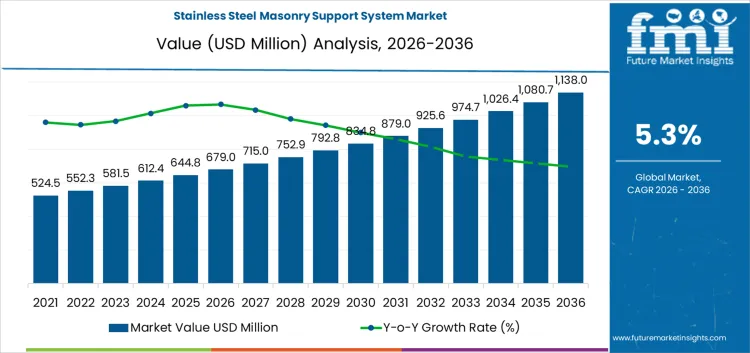
The stainless steel masonry support system market is projected to reach USD 679 million in 2026 and USD 1138 million by 2036, registering a CAGR of 5.3% over the forecast period. Competitive power in this market is shaped by engineering credibility, specification influence, and control over project-level decision making rather than sheer production scale. Established manufacturers defend pricing power through early engagement with architects, façade consultants, and structural engineers, where system selection is often locked in at the design stage.
Proven load performance, certification, and compliance history allow leading suppliers to justify premium pricing in safety-critical applications. Entry barriers remain high due to the need for technical validation, customized fabrication capability, and familiarity with regional building codes. At the same time, fragmentation persists because project requirements vary widely by façade geometry, building height, and local regulations, allowing specialized regional players to coexist alongside global brands.
Quick Stats for Stainless Steel Masonry Support System Market
- Stainless Steel Masonry Support System Market Value (2026): USD 679 Million
- Stainless Steel Masonry Support System Market Forecast Value (2036): USD 1138 Million
- Stainless Steel Masonry Support System Market Forecast CAGR 2026 to 2036: 5.30%
- Leading Product Type in Stainless Steel Masonry Support System Market: Continuous Angle System
- Key Growth Regions in Stainless Steel Masonry Support System Market: Asia Pacific, North America, Latin America, Middle East & Africa
- Top Key Players in Stainless Steel Masonry Support System Market: Leviat; WINCRO; IG Masonry Support; BA Systems; ACS; FIRMA; Blindbolt US; CFS Fixings; SIG Ireland; Vista Engineering; HAZ Metal; Vision Construction
Stainless Steel Masonry Support System Market Key Takeaways
| Metric | Value |
|---|---|
| Stainless Steel Masonry Support System Market Value (2026) | USD 679 Million |
| Stainless Steel Masonry Support System Market Forecast Value (2036) | USD 1138 Million |
| Stainless Steel Masonry Support System Market Forecast CAGR 2026 to 2036 | 5.30% |
Why Is the Stainless Steel Masonry Support System Market Gaining Traction in Modern Construction?
The stainless steel masonry support system market is expanding as construction activity increases across commercial, residential, and institutional buildings. Architects and structural engineers are increasingly specifying masonry support systems to manage load transfer and accommodate differential movement in multi-storey structures. Stainless steel solutions offer high strength, corrosion resistance, and long service life, making them suitable for modern building envelopes that combine aesthetics with structural performance.
Rising focus on building durability and compliance with updated construction standards is supporting demand within the stainless steel masonry support system market. Regulatory frameworks emphasize structural safety, façade stability, and long-term performance, particularly for high-rise developments. Stainless steel masonry supports help prevent cracking, deformation, and moisture-related damage in brick and stone façades. Their compatibility with cavity wall designs and thermal insulation systems is improving adoption in contemporary construction projects.
Urban redevelopment and infrastructure modernization are further contributing to growth in the stainless steel masonry support system market. Refurbishment of aging buildings often requires upgraded support mechanisms that meet current safety requirements. Growth in mixed-use developments, healthcare facilities, and educational institutions is also increasing use of engineered masonry support systems. As builders prioritize reliability, reduced maintenance, and design flexibility, demand for stainless steel masonry support solutions continues to rise over the forecast period.
What Does The Segment Overview Indicate About The Stainless Steel Masonry Support System Market?
The stainless steel masonry support system market is segmented by system type and application, reflecting differences in building design complexity and load-bearing requirements. Continuous angle systems lead the type segment with about 42% share, driven by their structural stability and suitability for large façades. Bracket-based and off-the-shelf systems address customized and time-sensitive projects. On the application side, commercial construction dominates with nearly 45% share, supported by office buildings, mixed-use developments, and institutional projects. Residential, infrastructure, and industrial construction form secondary segments, creating varied demand patterns across building heights, spans, and architectural specifications.
Why Do Continuous Angle Systems Hold The Leading Type Share In The Stainless Steel Masonry Support System Market?
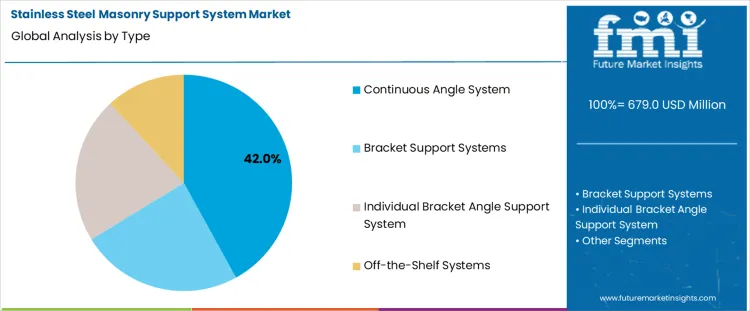
Continuous angle systems account for the leading 42% share in the stainless steel masonry support system market due to their ability to distribute masonry loads evenly across structural frames. These systems are widely used in multi-storey commercial and institutional buildings where long façade spans and consistent load transfer are required. Their compatibility with steel and concrete structures supports adoption in modern construction designs. Variations in demand are visible, with high-rise projects favoring heavy-duty continuous systems, while mid-rise buildings adopt lighter configurations. Ease of installation, design flexibility, and compliance with building codes further reinforce demand. Growing emphasis on façade performance and long-term structural reliability continues to position continuous angle systems as the preferred choice.
How Does Commercial Construction Drive Application Demand In The Stainless Steel Masonry Support System Market?
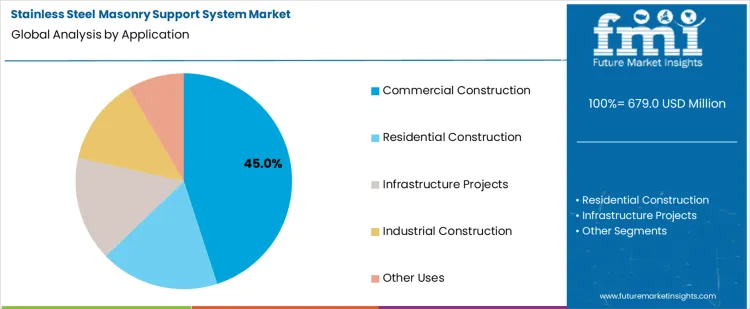
Commercial construction leads application demand in the stainless steel masonry support system market, accounting for approximately 45% share, as large-scale projects require durable and corrosion-resistant façade support solutions. Office complexes, shopping centers, healthcare facilities, and educational buildings rely on masonry systems that ensure structural safety and architectural consistency. The use of stainless steel supports enables long service life with minimal maintenance, which is critical for commercial assets. Demand varies by project scale, with urban developments showing higher adoption due to taller structures and complex façade designs. Expansion of commercial real estate and renovation of aging buildings continue to strengthen this segment’s dominance.
What’s Shaping Growth in the Stainless Steel Masonry Support System Market?
The stainless steel masonry support system market is expanding due to rising construction of mid-rise and high-rise buildings that require durable load-bearing façade solutions. Stainless steel systems offer high corrosion resistance, long service life, and structural reliability for supporting brick and stone cladding. Adoption is increasing in commercial buildings, residential complexes, and institutional projects where façade integrity and maintenance performance are critical. Growth is supported by stricter building codes related to structural safety and façade performance. Demand is also influenced by replacement activity in aging buildings, where older masonry support components are being upgraded to modern stainless steel systems.
What Is Limiting Wider Adoption of Stainless Steel Masonry Support Systems?
Cost considerations remain a major restraint in the stainless steel masonry support system market, as stainless steel components are priced higher than carbon steel or galvanized alternatives. Budget-sensitive projects may opt for lower-cost systems where corrosion exposure is limited. Design complexity and customization requirements can extend lead times and increase fabrication costs. Installation requires skilled labor and accurate alignment, adding to construction expenses. In regions with limited technical awareness, adoption may be slowed by preference for traditional masonry detailing methods. Volatility in stainless steel raw material prices also affects procurement planning and project cost certainty.
How Are Design and Construction Trends Changing the Stainless Steel Masonry Support System Market?
Design and construction trends in the stainless steel masonry support system market emphasize modularity, precision, and compliance. Manufacturers are offering prefabricated and adjustable support systems to simplify installation and reduce on-site labor. Digital design tools and BIM integration are improving coordination between façade engineers, contractors, and suppliers. Demand is rising for systems compatible with thicker insulation layers and energy-efficient wall assemblies. Lightweight yet high-strength configurations are gaining traction to support complex façade geometries. Quality assurance, certification, and traceability are becoming more important as developers seek consistent performance across large multi-building projects.
What is the country-wise growth outlook for the stainless steel masonry support system market?
The stainless steel masonry support system market shows stable expansion across construction-driven economies, supported by rising use of façade support solutions in commercial and high-rise buildings. China leads the outlook with a 9.8% CAGR, driven by large-scale urban construction and adoption of modern building envelopes. India follows at a 9.4% CAGR as commercial infrastructure and residential high-rise activity increase. The USA records a 7.2% CAGR, supported by renovation, seismic compliance, and façade retrofitting demand. Germany grows at a 6.5% CAGR due to engineering-focused building standards and refurbishment projects. The UK posts a 6.3% CAGR, supported by façade modernization and compliance-led construction practices.
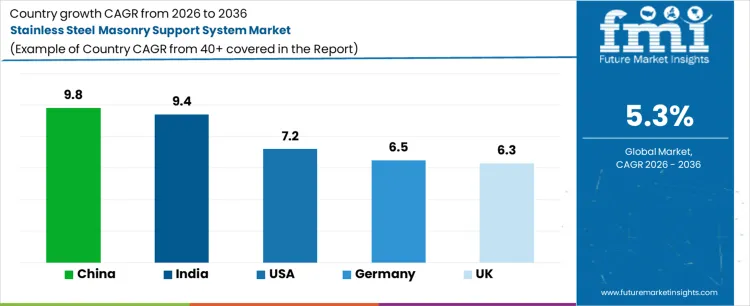
| Country | CAGR |
|---|---|
| China | 9.8% |
| India | 9.4% |
| USA | 7.2% |
| Germany | 6.5% |
| UK | 6.3% |
Why is China leading growth in the stainless steel masonry support system market?
Demand for the stainless steel masonry support system in China is expanding at a CAGR of 9.8%, driven by sustained urban construction activity and large-scale commercial and residential developments. High-rise buildings, mixed-use complexes, and public infrastructure projects increasingly require engineered masonry support solutions to manage load transfer and façade stability. Sales are supported by widespread adoption of modern building envelopes and curtain wall systems across metropolitan regions. Developers and contractors favor stainless steel systems due to corrosion resistance, long service life, and compatibility with complex façade designs. Demand also rises from industrial buildings and transport infrastructure where durability and structural reliability are critical. Local manufacturing capacity and standardized building codes improve availability and project integration. Prefabrication trends and faster construction timelines further strengthen adoption. These factors collectively position China as the strongest growth contributor to the stainless steel masonry support system market.
What is driving strong demand growth in India’s stainless steel masonry support system market?
Demand for the stainless steel masonry support system in India is growing at a CAGR of 9.4%, supported by rising commercial construction and expansion of high-rise residential projects. Urbanization and redevelopment of city centers increase the need for engineered façade support systems that improve structural performance and construction efficiency. Sales growth is linked to office buildings, hospitals, educational institutions, and transit-oriented developments where masonry cladding remains widely used. Stainless steel systems gain preference due to strength, corrosion resistance, and reduced long-term maintenance. Adoption is reinforced by improving construction standards and greater awareness among architects and structural consultants. Demand also benefits from growth in organized real estate development and increased use of prefabricated components. As builders seek consistent load distribution and design flexibility, stainless steel masonry support systems continue to see higher penetration across urban construction projects in India.
Why does the USA show stable expansion for stainless steel masonry support systems?
Sales for the stainless steel masonry support system in the USA are increasing at a CAGR of 7.2%, driven by façade retrofitting, commercial redevelopment, and compliance-led construction upgrades. Demand originates from office buildings, healthcare facilities, institutional structures, and multi-family housing projects requiring durable masonry support solutions. Stainless steel systems are widely used to meet seismic performance requirements and building code specifications. Sales benefit from renovation of aging building stock and replacement of outdated façade support components. Architects and contractors prioritize systems offering design flexibility, load adjustability, and long service life. Adoption is further supported by emphasis on building safety and performance documentation. Although new construction growth is moderate, consistent renovation activity and code compliance needs sustain steady demand for stainless steel masonry support systems across the USA.
What factors support Germany’s steady growth in the stainless steel masonry support system market?
Demand for the stainless steel masonry support system in Germany is advancing at a CAGR of 6.5%, reflecting strong emphasis on engineering precision and building performance. Commercial buildings, public infrastructure, and residential developments increasingly rely on engineered support systems to ensure façade stability and structural integrity. Sales are driven by refurbishment of existing buildings and modernization of façades to meet updated standards. Stainless steel systems are favored for corrosion resistance, structural reliability, and long service life. Demand also benefits from strict building regulations and quality-focused construction practices. Architects and engineers value standardized systems that integrate seamlessly with façade assemblies. Adoption remains consistent across institutional and commercial projects, supporting steady growth for stainless steel masonry support systems in Germany.
Why is the UK experiencing moderate growth in stainless steel masonry support systems?
Demand for the stainless steel masonry support system in the UK is growing at a CAGR of 6.3%, supported by façade renovation and compliance-driven construction activity. Commercial offices, residential complexes, and public buildings increasingly require engineered masonry support solutions for load management and façade safety. Sales are influenced by refurbishment of aging structures and adoption of modern cladding systems. Stainless steel support systems gain traction due to durability, corrosion resistance, and ease of integration with varied façade designs. Building safety regulations and structural assessment requirements encourage use of certified support solutions. Demand also arises from urban redevelopment projects where masonry façades remain prevalent. These factors contribute to steady, value-driven adoption of stainless steel masonry support systems across the UK construction sector.
How are manufacturers competing and differentiating in the stainless steel masonry support system market?
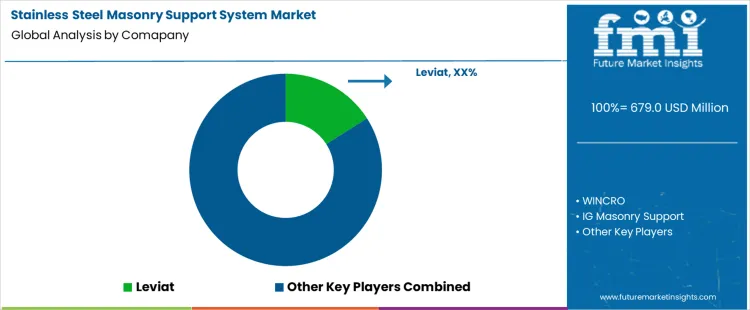
Competition is being shaped by structural reliability, installation accuracy, and compliance confidence. Leviat is being positioned as a design-led supplier where masonry support is integrated into broader structural fixing ecosystems. Product brochures emphasize load performance, thermal break compatibility, and engineered tolerances aligned with modern façade systems. WINCRO and IG Masonry Support are being differentiated through project-specific fabrication. Bespoke brackets, shelf angles, and cavity solutions are being promoted for complex elevations where standard systems are insufficient. Precision manufacturing and early-stage design coordination are being framed as value drivers.
Speed and site efficiency are being used as competitive levers. BA Systems and ACS are being marketed on fast installation, reduced site adjustment, and simplified alignment features. Pre-drilled slots, adjustable components, and clear installation guides are being highlighted in technical literature. FIRMA and CFS Fixings are being positioned around durability and corrosion resistance, with stainless steel grades and finish quality used to signal long service life. Product messaging focuses on predictable performance across commercial, residential, and institutional builds.
A different layer of competition is being driven by connection innovation. Blindbolt US is being differentiated through blind fixing technology that reduces access constraints and installation time. SIG Ireland and Vista Engineering are being positioned as system suppliers offering coordinated masonry support and ancillary components, with brochures stressing compatibility and supply continuity. HAZ Metal and Vision Construction are being marketed on fabrication capability and regional responsiveness, where lead times and customization are decisive. Across the market, competition is being driven less by raw material choice and more by engineering confidence, design support, and execution certainty. Product brochures are being used to translate structural performance into build efficiency, reinforcing trust among architects, contractors, and façade engineers.
Key Players in Stainless Steel Masonry Support System Market
- Leviat
- WINCRO
- IG Masonry Support
- BA Systems
- ACS
- FIRMA
- Blindbolt US
- CFS Fixings
- SIG Ireland
- Vista Engineering
- HAZ Metal
- Vision Construction
Scope of Report
| Attributes | Description |
|---|---|
| Quantitative Unit | USD Million |
| Type | Continuous Angle System, Bracket Support Systems, Individual Bracket Angle Support System, Off-the-Shelf Systems |
| Application | Commercial Construction, Residential Construction, Infrastructure Projects, Industrial Construction, Other Uses |
| Regions Covered | Asia Pacific, Europe, North America, Latin America, Middle East & Africa |
| Countries Covered | China, Japan, South Korea, India, Australia & New Zealand, ASEAN, Rest of Asia Pacific, Germany, United Kingdom, France, Italy, Spain, Nordic, BENELUX, Rest of Europe, United States, Canada, Mexico, Brazil, Chile, Rest of Latin America, Kingdom of Saudi Arabia, Other GCC Countries, Turkey, South Africa, Other African Union, Rest of Middle East & Africa |
| Key Companies Profiled | Leviat, WINCRO, IG Masonry Support, BA Systems, ACS, FIRMA, Blindbolt US, CFS Fixings, SIG Ireland, Vista Engineering, HAZ Metal, Vision Construction |
| Additional Attributes | Dollar sales by system type and application; regional demand analysis for façade and masonry load support; assessment of stainless steel grade usage in structural supports; evaluation of adoption across commercial, residential, and infrastructure construction; analysis of regulatory and building code influence on masonry support system specification. |
Stainless Steel Masonry Support System Market by Key Segments
Type
- Continuous Angle System
- Bracket Support Systems
- Individual Bracket Angle Support System
- Off-the-Shelf Systems
Application
- Commercial Construction
- Residential Construction
- Infrastructure Projects
- Industrial Construction
- Other Uses
Region
- Asia Pacific
- China
- Japan
- South Korea
- India
- Australia & New Zealand
- ASEAN
- Rest of Asia Pacific
- Europe
- Germany
- United Kingdom
- France
- Italy
- Spain
- Nordic
- BENELUX
- Rest of Europe
- North America
- United States
- Canada
- Mexico
- Latin America
- Brazil
- Chile
- Rest of Latin America
- Middle East & Africa
- Kingdom of Saudi Arabia
- Other GCC Countries
- Turkey
- South Africa
- Other African Union
- Rest of Middle East & Africa
Bibliography
- Brick Industry Association. (2025, August). Brick Brief: Supporting brick masonry veneer. Brick Industry Association.
- Brick Industry Association. (2025, April). Technical Note 28B: Brick veneer/cold-formed steel framed walls (final published version). Brick Industry Association.
- IIBEC. (2025, December 2). Anchored brick veneer: What can go wrong and how to… (Technical article PDF). International Institute of Building Enclosure Consultants.
- Leviat. (2024, July). Installation guide: Ancon masonry support systems (Date: 07/2024). Leviat.
- NBS Source. (2024, December 17). CFS AMS masonry support (Construction Fixing Systems): Product data sheet entry. NBS.
Frequently Asked Questions
How big is the stainless steel masonry support system market in 2026?
The global stainless steel masonry support system market is estimated to be valued at USD 679.0 million in 2026.
What will be the size of stainless steel masonry support system market in 2036?
The market size for the stainless steel masonry support system market is projected to reach USD 1,138.0 million by 2036.
How much will be the stainless steel masonry support system market growth between 2026 and 2036?
The stainless steel masonry support system market is expected to grow at a 5.3% CAGR between 2026 and 2036.
What are the key product types in the stainless steel masonry support system market?
The key product types in stainless steel masonry support system market are continuous angle system, bracket support systems, individual bracket angle support system and off-the-shelf systems.
Which application segment to contribute significant share in the stainless steel masonry support system market in 2026?
In terms of application, commercial construction segment to command 45.0% share in the stainless steel masonry support system market in 2026.
Preview the report firsthand - request a free sample
Get SampleGet the brochure for pricing and purchase details.
Get PDFTable of Content
- Executive Summary
- Global Market Outlook
- Demand-side Trends
- Supply-side Trends
- Technology Roadmap Analysis
- Analysis and Recommendations
- Market Overview
- Market Coverage / Taxonomy
- Market Definition / Scope / Limitations
- Market Background
- Market Dynamics
- Drivers
- Restraints
- Opportunity
- Trends
- Scenario Forecast
- Demand in Optimistic Scenario
- Demand in Likely Scenario
- Demand in Conservative Scenario
- Opportunity Map Analysis
- Product Life Cycle Analysis
- Supply Chain Analysis
- Investment Feasibility Matrix
- Value Chain Analysis
- PESTLE and Porter’s Analysis
- Regulatory Landscape
- Regional Parent Market Outlook
- Production and Consumption Statistics
- Import and Export Statistics
- Market Dynamics
- Global Market Analysis 2021 to 2025 and Forecast, 2026 to 2036
- Historical Market Size Value (USD Million) Analysis, 2021 to 2025
- Current and Future Market Size Value (USD Million) Projections, 2026 to 2036
- Y-o-Y Growth Trend Analysis
- Absolute $ Opportunity Analysis
- Global Market Pricing Analysis 2021 to 2025 and Forecast 2026 to 2036
- Global Market Analysis 2021 to 2025 and Forecast 2026 to 2036, By Type
- Introduction / Key Findings
- Historical Market Size Value (USD Million) Analysis By Type , 2021 to 2025
- Current and Future Market Size Value (USD Million) Analysis and Forecast By Type , 2026 to 2036
- Continuous Angle System
- Bracket Support Systems
- Individual Bracket Angle Support System
- Off-the-Shelf Systems
- Continuous Angle System
- Y-o-Y Growth Trend Analysis By Type , 2021 to 2025
- Absolute $ Opportunity Analysis By Type , 2026 to 2036
- Global Market Analysis 2021 to 2025 and Forecast 2026 to 2036, By Application
- Introduction / Key Findings
- Historical Market Size Value (USD Million) Analysis By Application, 2021 to 2025
- Current and Future Market Size Value (USD Million) Analysis and Forecast By Application, 2026 to 2036
- Commercial Construction
- Residential Construction
- Infrastructure Projects
- Industrial Construction
- Other Uses
- Commercial Construction
- Y-o-Y Growth Trend Analysis By Application, 2021 to 2025
- Absolute $ Opportunity Analysis By Application, 2026 to 2036
- Global Market Analysis 2021 to 2025 and Forecast 2026 to 2036, By Region
- Introduction
- Historical Market Size Value (USD Million) Analysis By Region, 2021 to 2025
- Current Market Size Value (USD Million) Analysis and Forecast By Region, 2026 to 2036
- North America
- Latin America
- Western Europe
- Eastern Europe
- East Asia
- South Asia and Pacific
- Middle East & Africa
- Market Attractiveness Analysis By Region
- North America Market Analysis 2021 to 2025 and Forecast 2026 to 2036, By Country
- Historical Market Size Value (USD Million) Trend Analysis By Market Taxonomy, 2021 to 2025
- Market Size Value (USD Million) Forecast By Market Taxonomy, 2026 to 2036
- By Country
- USA
- Canada
- Mexico
- By Type
- By Application
- By Country
- Market Attractiveness Analysis
- By Country
- By Type
- By Application
- Key Takeaways
- Latin America Market Analysis 2021 to 2025 and Forecast 2026 to 2036, By Country
- Historical Market Size Value (USD Million) Trend Analysis By Market Taxonomy, 2021 to 2025
- Market Size Value (USD Million) Forecast By Market Taxonomy, 2026 to 2036
- By Country
- Brazil
- Chile
- Rest of Latin America
- By Type
- By Application
- By Country
- Market Attractiveness Analysis
- By Country
- By Type
- By Application
- Key Takeaways
- Western Europe Market Analysis 2021 to 2025 and Forecast 2026 to 2036, By Country
- Historical Market Size Value (USD Million) Trend Analysis By Market Taxonomy, 2021 to 2025
- Market Size Value (USD Million) Forecast By Market Taxonomy, 2026 to 2036
- By Country
- Germany
- UK
- Italy
- Spain
- France
- Nordic
- BENELUX
- Rest of Western Europe
- By Type
- By Application
- By Country
- Market Attractiveness Analysis
- By Country
- By Type
- By Application
- Key Takeaways
- Eastern Europe Market Analysis 2021 to 2025 and Forecast 2026 to 2036, By Country
- Historical Market Size Value (USD Million) Trend Analysis By Market Taxonomy, 2021 to 2025
- Market Size Value (USD Million) Forecast By Market Taxonomy, 2026 to 2036
- By Country
- Russia
- Poland
- Hungary
- Balkan & Baltic
- Rest of Eastern Europe
- By Type
- By Application
- By Country
- Market Attractiveness Analysis
- By Country
- By Type
- By Application
- Key Takeaways
- East Asia Market Analysis 2021 to 2025 and Forecast 2026 to 2036, By Country
- Historical Market Size Value (USD Million) Trend Analysis By Market Taxonomy, 2021 to 2025
- Market Size Value (USD Million) Forecast By Market Taxonomy, 2026 to 2036
- By Country
- China
- Japan
- South Korea
- By Type
- By Application
- By Country
- Market Attractiveness Analysis
- By Country
- By Type
- By Application
- Key Takeaways
- South Asia and Pacific Market Analysis 2021 to 2025 and Forecast 2026 to 2036, By Country
- Historical Market Size Value (USD Million) Trend Analysis By Market Taxonomy, 2021 to 2025
- Market Size Value (USD Million) Forecast By Market Taxonomy, 2026 to 2036
- By Country
- India
- ASEAN
- Australia & New Zealand
- Rest of South Asia and Pacific
- By Type
- By Application
- By Country
- Market Attractiveness Analysis
- By Country
- By Type
- By Application
- Key Takeaways
- Middle East & Africa Market Analysis 2021 to 2025 and Forecast 2026 to 2036, By Country
- Historical Market Size Value (USD Million) Trend Analysis By Market Taxonomy, 2021 to 2025
- Market Size Value (USD Million) Forecast By Market Taxonomy, 2026 to 2036
- By Country
- Kingdom of Saudi Arabia
- Other GCC Countries
- Turkiye
- South Africa
- Other African Union
- Rest of Middle East & Africa
- By Type
- By Application
- By Country
- Market Attractiveness Analysis
- By Country
- By Type
- By Application
- Key Takeaways
- Key Countries Market Analysis
- USA
- Pricing Analysis
- Market Share Analysis, 2025
- By Type
- By Application
- Canada
- Pricing Analysis
- Market Share Analysis, 2025
- By Type
- By Application
- Mexico
- Pricing Analysis
- Market Share Analysis, 2025
- By Type
- By Application
- Brazil
- Pricing Analysis
- Market Share Analysis, 2025
- By Type
- By Application
- Chile
- Pricing Analysis
- Market Share Analysis, 2025
- By Type
- By Application
- Germany
- Pricing Analysis
- Market Share Analysis, 2025
- By Type
- By Application
- UK
- Pricing Analysis
- Market Share Analysis, 2025
- By Type
- By Application
- Italy
- Pricing Analysis
- Market Share Analysis, 2025
- By Type
- By Application
- Spain
- Pricing Analysis
- Market Share Analysis, 2025
- By Type
- By Application
- France
- Pricing Analysis
- Market Share Analysis, 2025
- By Type
- By Application
- India
- Pricing Analysis
- Market Share Analysis, 2025
- By Type
- By Application
- ASEAN
- Pricing Analysis
- Market Share Analysis, 2025
- By Type
- By Application
- Australia & New Zealand
- Pricing Analysis
- Market Share Analysis, 2025
- By Type
- By Application
- China
- Pricing Analysis
- Market Share Analysis, 2025
- By Type
- By Application
- Japan
- Pricing Analysis
- Market Share Analysis, 2025
- By Type
- By Application
- South Korea
- Pricing Analysis
- Market Share Analysis, 2025
- By Type
- By Application
- Russia
- Pricing Analysis
- Market Share Analysis, 2025
- By Type
- By Application
- Poland
- Pricing Analysis
- Market Share Analysis, 2025
- By Type
- By Application
- Hungary
- Pricing Analysis
- Market Share Analysis, 2025
- By Type
- By Application
- Kingdom of Saudi Arabia
- Pricing Analysis
- Market Share Analysis, 2025
- By Type
- By Application
- Turkiye
- Pricing Analysis
- Market Share Analysis, 2025
- By Type
- By Application
- South Africa
- Pricing Analysis
- Market Share Analysis, 2025
- By Type
- By Application
- USA
- Market Structure Analysis
- Competition Dashboard
- Competition Benchmarking
- Market Share Analysis of Top Players
- By Regional
- By Type
- By Application
- Competition Analysis
- Competition Deep Dive
- Leviat
- Overview
- Product Portfolio
- Profitability by Market Segments (Product/Age /Sales Channel/Region)
- Sales Footprint
- Strategy Overview
- Marketing Strategy
- Product Strategy
- Channel Strategy
- WINCRO
- IG Masonry Support
- BA Systems
- ACS
- FIRMA
- Blindbolt US
- CFS Fixings
- SIG Ireland
- Vista Engineering
- HAZ Metal
- Vision Construction
- Leviat
- Competition Deep Dive
- Assumptions & Acronyms Used
- Research Methodology


