

- Industry Size (2026)
- USD 581 Mn
- Forecast (2036)
- USD 1194 Mn
- CAGR (2026 to 2036)
- 7.5%
Bio-Enzymatic Cleaners Market Forecast and Outlook 2026 to 2036
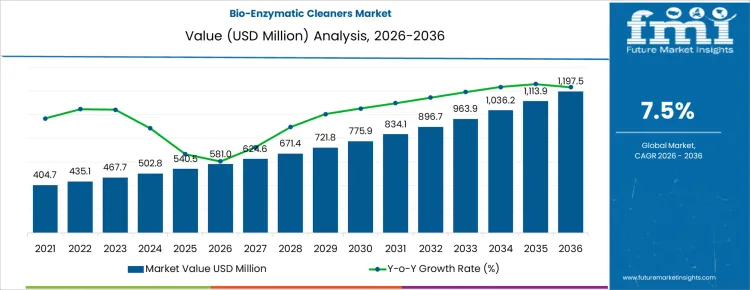
The bio-enzymatic cleaners market is projected to expand from USD 581 million in 2026 to USD 1,197.5 million by 2036, at a CAGR of 7.5%. Initial growth is driven by rising adoption in commercial building maintenance and institutional cleaning, with enzyme-based formulations improving efficiency in drain and pipe maintenance, restroom odor control, and multi-surface cleaning applications. Between 2028 and 2032, demand accelerates as multi-enzyme and bioactive blends enhance cleaning performance, enabling low-temperature, low-water, and eco-preferred operations.
From 2032 onward, market expansion is reinforced by RTU products, liquid concentrates, and innovative pod formats that simplify dosing and improve operational safety. Enzyme formulations dominate key sectors, including hospitality, healthcare, and industrial foodservice, while suppliers target specialized industrial applications and high-volume institutional contracts. Growing emphasis on eco-friendly cleaning and microbial-based grease removal continues to stimulate adoption, sustaining strong market momentum across diverse geographies through 2036.
Quick Stats of the Bio-Enzymatic Cleaners Market:
- Bio-Enzymatic Cleaners Market Value (2026): USD 581 million
- Bio-Enzymatic Cleaners Market Forecast Value (2036): USD 1,197.5 million
- Bio-Enzymatic Cleaners Market Forecast CAGR (2026 to 2036): 7.5%
- Leading Application Focus in the Market: Drain & Pipe Maintenance (32%)
- Key Growth Regions in the Market: China, Brazil, USA, UK, Germany
- Top Players in the Market: Betco, Ecolab, Solenis (Diversey), Zep, Spartan Chemical, SC Johnson Professional, Genesis Biosciences, BiOWiSH Technologies, 3M, Christeyns
What is the Growth Forecast for the Bio-Enzymatic Cleaners Market through 2036?
From 2026 to 2031, the bio-enzymatic cleaners market grows from USD 581 million to approximately USD 838 million, reflecting the early-stage year-on-year growth phase. Annual increments start at USD 37 million in 2026 and rise steadily to USD 59 million in 2031. Growth is driven by adoption in commercial kitchens, healthcare facilities, and institutional cleaning programs where enzyme-based formulations reduce chemical use and enhance cleaning efficiency. Uptake is concentrated in North America and Europe, accounting for roughly 65% of demand, with incremental expansion in Asia Pacific as awareness of bio-enzymatic benefits increases.
Between 2031 and 2036, the market expands from roughly USD 838 million to USD 1,194 million, representing the late-stage year-on-year growth phase. Annual value additions increase to USD 76 million in 2036, supported by multi-site deployments, portfolio-wide adoption, and repeat procurement across foodservice, healthcare, and industrial facilities. Growth is reinforced by regulatory encouragement for environmentally friendly cleaning solutions, wider adoption of enzyme-based chemistries, and integration into automated dosing and dispensing systems. Early growth relied on pilot projects and selective high-value sites, while later expansion is driven by structural normalization and global market penetration.
Bio Enzymatic Cleaners Market Key Takeaways
| Metric | Value |
|---|---|
| Market Value (2026) | USD 581 million |
| Forecast Value (2036) | USD 1,197.5 million |
| Forecast CAGR (2026 to 2036) | 7.5% |
Why Are Bio Enzymatic Cleaners Moving from Problem Solvers to Standard Tools?
Early use of bio enzymatic cleaners was driven by stubborn organic residues that resisted conventional cleaning. Grease traps, drains, floors, and waste areas accumulated proteins and fats that chemical cleaners removed only temporarily. Odours returned because organic material remained intact. Operators adopted enzyme based products to digest soils rather than mask them. Historical demand grew in maintenance, foodservice, and wastewater adjacent areas where repeated cleaning failed. Use expanded through trial and observation, not policy. Products were selected for specific problems, applied selectively, and evaluated by visible results rather than formal cleaning metrics or documentation.
Future demand reflects a shift toward process consistency and measurable outcomes. Cleaning programs are now designed to prevent buildup rather than react to it. Bio enzymatic cleaners fit preventive maintenance schedules by continuing to act after application. Selection is based on enzyme profile, dwell time, and compatibility with surfaces and dispensing systems. Growth follows standardisation of cleaning routines, labour optimisation, and reduced chemical load targets. Enzymes are specified for repeatable performance, not emergency intervention.
What Factors Are Affecting the Demand for Bio Enzymatic Cleaners Market in Terms of Application Focus and Enzyme or Bio Actives Blend?
Demand for bio enzymatic cleaners is shaped by application focus and enzyme or bio active blend selection across maintenance, sanitation, and odor control uses. Drain and pipe maintenance accounts for about 32% of total demand, making it the leading application focus. Restroom odor control, floor and multi surface cleaning, and grease trap or foodservice applications represent additional segments without disclosed share splits. These uses differ in organic load type, contact time, and environmental conditions. Enzyme and bio active blends determine how soils are broken down rather than masked or displaced. Lipase dominant, protease dominant, multi enzyme, and enzyme microbial systems address different organic substrates. Together, these segments explain demand formation driven by waste breakdown efficiency and residual control rather than immediate visual cleaning results.
What Drives Demand by Application Focus in the Bio Enzymatic Cleaners Market?
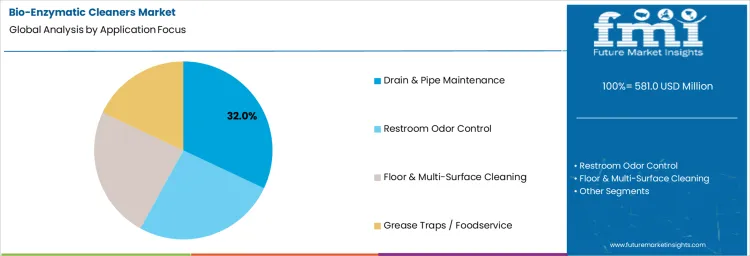
Drain and pipe maintenance leads demand with a 32% share because bio enzymatic action addresses accumulated fats, oils, and organic sludge within enclosed systems. These applications rely on ongoing biological activity rather than one time cleaning. Restroom odor control adopts enzymatic cleaners to degrade odor causing compounds at the source. Floor and multi surface cleaning uses bio enzymatic products where organic residue builds gradually. Grease trap and foodservice applications apply enzymes to manage continuous waste input. Adoption intensity reflects persistence of organic waste rather than cleaning frequency. Demand therefore aligns with maintenance driven degradation needs instead of short cycle surface cleaning.
Application driven demand remains stable because biological cleaning programs operate continuously. Drain systems require repeated dosing. Odor control relies on sustained enzyme activity. Foodservice grease management follows regulatory and maintenance schedules. Surface cleaning applications adopt selectively. These patterns limit rapid shifts across applications. Application focus segmentation highlights reliance on biological breakdown over time. Demand therefore follows infrastructure maintenance requirements rather than episodic cleaning activity.
How Does Enzyme or Bio Actives Blend Shape Demand for Bio Enzymatic Cleaners Market?
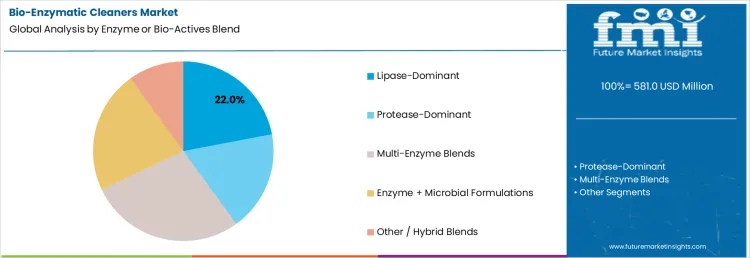
Lipase dominant blends account for about 22% of total demand, making them the leading enzyme type. Their use reflects effectiveness in breaking down fats and oils common in drains and grease systems. Protease dominant blends target protein based residues found in restroom and waste areas. Multi enzyme blends address mixed organic soils across floors and general surfaces. Enzyme plus microbial formulations support long term degradation through sustained biological action. Other hybrid blends address specialized waste profiles. Blend selection depends on substrate composition and required persistence. Demand follows waste type specificity rather than preference for complex formulations.
Lipase systems maintain leadership due to prevalence of fat based waste. Protease blends scale in sanitation focused environments. Multi enzyme products support versatility where soil composition varies. Microbial blends remain concentrated in maintenance programs requiring ongoing activity. Formulators avoid unnecessary complexity once performance is validated. This stabilizes blend demand distribution. Enzyme and bio active segmentation therefore reinforces reliance on targeted biological mechanisms within defined maintenance applications.
How Are Bio-Enzymatic Cleaners Being Applied Across Commercial, Industrial, and Residential Settings?
Use appears in environments where organic soils, grease, and protein-based residues require targeted degradation. Foodservice operators, hospitals, and institutional facilities apply bio-enzymatic cleaners on kitchen surfaces, drains, and waste treatment areas to break down fats, proteins, and carbohydrates. Laundry services use them for stain removal and odor control on textiles. Residential users adopt enzymatic formulations for pet stains, carpets, and hard surfaces. These applications reflect operational and cleaning efficiency priorities rather than decorative purposes, with adoption driven by targeted soil removal, odor mitigation, and environmentally friendly performance.
What Operational and Material Conditions Support Adoption of Bio-Enzymatic Cleaners?
Selection aligns with surfaces and soils where enzymatic action improves cleaning efficacy without harsh chemicals. Formulations are optimized for enzyme stability across temperature, pH, and application conditions. Facility managers rely on cleaners compatible with routine dosing, spray, or soak methods. Environmental regulations and sustainability initiatives favor enzymatic products over conventional chemical cleaners. Packaging and handling are designed to maintain enzyme activity and user convenience. These conditions emerge from operational efficiency, environmental compliance, and targeted soil degradation priorities in structured cleaning workflows.
Which Practical Considerations Limit Wider Use of Bio-Enzymatic Cleaners?
Performance can be affected by extreme temperatures, pH, or chemical interference from other cleaners. Cost per application may be higher than conventional detergents. Enzyme degradation over time or improper storage can reduce effectiveness. Certain surfaces may require supplemental mechanical cleaning or agitation. Consumer awareness and training are needed to optimize product performance. These factors lead to selective deployment where targeted cleaning, environmental impact, and operational efficiency justify incremental cost and handling requirements.
What is the Demand for Bio Enzymatic Cleaners by Country?
| Country | CAGR (%) |
|---|---|
| USA | 7.6% |
| Germany | 6.8% |
| China | 9.2% |
| UK | 7.0% |
| Brazil | 8.9% |
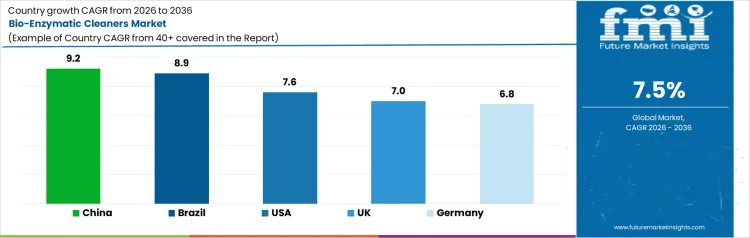
The demand for bio enzymatic cleaners varies across countries, driven by environmental regulations, industrial and commercial cleaning adoption, and rising awareness of eco friendly products. China leads with a 9.2% CAGR, supported by expanding foodservice, hospitality, and industrial cleaning sectors. Brazil follows at 8.9%, driven by growth in commercial kitchens, institutional facilities, and industrial hygiene requirements. The USA grows at 7.6%, reflecting steady adoption in healthcare, foodservice, and industrial cleaning. Germany records 6.8%, shaped by mature cleaning markets and regulatory compliance. The UK posts 7.0%, supported by consistent demand in commercial, healthcare, and institutional cleaning applications.
How Is Enzymatic Cleaning Driving Growth in the United States?
In the United States, revenue from the Bio-Enzymatic Cleaners Market is expanding at a CAGR of 7.6% through 2035, driven by adoption of enzyme-based formulations that efficiently break down organic matter, grease, and stains in commercial, industrial, and institutional facilities. Manufacturers are integrating bio-enzymatic cleaners in kitchens, food processing units, hospitals, and industrial hygiene applications. Demand is concentrated in restaurants, healthcare facilities, schools, and industrial kitchens. Domestic suppliers provide high-performance, surface-compatible formulations suitable for manual and automated cleaning processes. Sustainability initiatives, hygiene standards, and recurring cleaning schedules are sustaining predictable procurement nationwide.
- Restaurants, hospitals, schools, and industrial kitchens drive adoption
- Enzymatic cleaners break down grease, organic matter, and stains
- Domestic suppliers provide surface-compatible, high-performance formulations
- Recurring cleaning schedules sustain predictable procurement
How Are Hygiene and Sustainability Standards Supporting Growth in Germany?
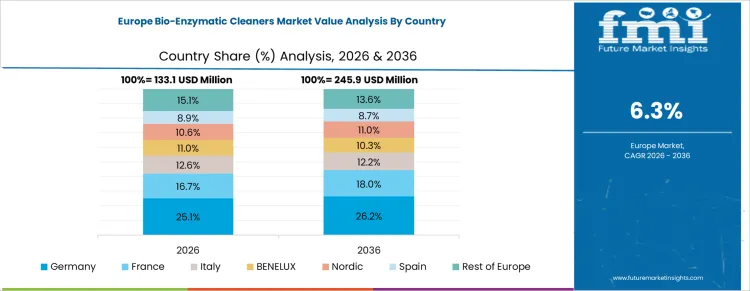
Germany continues to record steady growth in the Bio-Enzymatic Cleaners Market at a CAGR of 6.8% through 2035, supported by strict hygiene standards and preference for environmentally friendly cleaning solutions. Manufacturers are integrating bio-enzymatic cleaners in commercial kitchens, hospitals, and industrial facilities to improve cleaning efficiency while minimizing chemical load. Demand is concentrated in foodservice, healthcare, and institutional operations. Domestic suppliers provide enzyme-based formulations compatible with multiple surfaces and automated cleaning systems. Regulatory compliance, sustainability initiatives, and recurring cleaning programs are sustaining measured adoption nationwide.
- Restaurants, hospitals, and industrial kitchens anchor demand
- Enzymatic cleaners improve efficiency while reducing chemical load
- Domestic suppliers provide surface- and equipment-compatible formulations
- Recurring cleaning programs sustain steady procurement
How Is Foodservice and Industrial Expansion Accelerating Adoption in China?
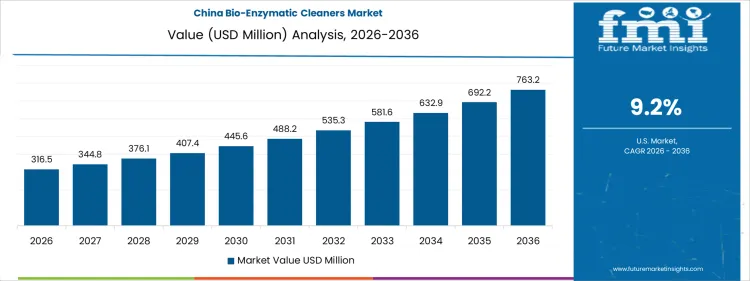
In China, revenue from the Bio-Enzymatic Cleaners Market is growing at a CAGR of 9.2% through 2035, driven by rapid expansion of commercial kitchens, industrial foodservice, and institutional facilities. Manufacturers are adopting enzyme-based cleaners to efficiently remove grease, organic residues, and food stains while supporting sustainability goals. Demand is strong across restaurants, hotels, hospitals, and industrial kitchens. Domestic suppliers are scaling production of high-performance, surface-compatible bio-enzymatic formulations suitable for manual and automated cleaning. Expanding facility networks and structured cleaning programs are sustaining rapid adoption nationwide.
- Restaurants, hotels, hospitals, and industrial kitchens drive adoption
- Enzymatic cleaners remove grease, food residues, and stains
- Domestic suppliers scale high-performance, surface-compatible formulations
- Structured cleaning programs sustain consistent adoption
How Is Hygiene and Industrial Cleaning Supporting Growth in the United Kingdom?
In the United Kingdom, revenue from the Bio-Enzymatic Cleaners Market is expanding at a CAGR of 7.0% through 2035, supported by adoption of enzyme-based cleaning solutions in commercial, industrial, and institutional facilities. Manufacturers are integrating bio-enzymatic cleaners to break down organic matter and grease efficiently while protecting surfaces. Demand is concentrated in restaurants, hospitals, schools, and industrial kitchens. Domestic suppliers provide high-quality, surface-compatible formulations for automated and manual cleaning systems. Recurring cleaning schedules, hygiene compliance, and sustainability initiatives are sustaining predictable procurement nationwide.
- Restaurants, hospitals, schools, and industrial kitchens anchor demand
- Enzymatic cleaners break down grease and organic matter
- Domestic suppliers provide high-quality, surface-compatible formulations
- Recurring cleaning schedules sustain predictable procurement
How Is Industrial and Foodservice Expansion Driving Adoption in Brazil?
Brazil is seeing strong growth in the Bio-Enzymatic Cleaners Market at a CAGR of 8.9% through 2035, supported by increasing commercial kitchens, industrial foodservice, and institutional facilities. Manufacturers are adopting bio-enzymatic cleaners to remove grease, food residues, and organic stains efficiently while improving sustainability. Demand is concentrated in restaurants, hotels, hospitals, and industrial kitchens. Domestic suppliers are expanding production of high-performance, surface-compatible enzyme-based formulations suitable for manual and automated cleaning systems. Growth in facility networks, hygiene standards, and recurring cleaning cycles are sustaining robust procurement nationwide.
- Restaurants, hotels, hospitals, and industrial kitchens drive adoption
- Enzymatic cleaners remove grease, organic matter, and stains
- Domestic suppliers expand high-performance, surface-compatible formulations
- Recurring cleaning cycles sustain robust procurement
Which Companies Compete in The Bio Enzymatic Cleaners Market Through Application Specific Performance and Biological Stability?
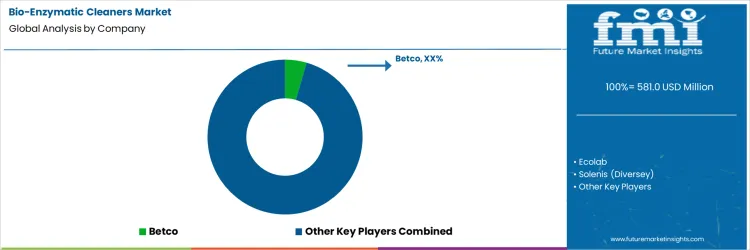
Bio enzymatic cleaners are selected based on their ability to digest organic soils over time rather than deliver immediate visual cleanliness. In foodservice, wastewater, and facility maintenance settings, these products are used where grease, fats, proteins, and starches accumulate beyond routine chemical cleaning. Betco, Ecolab, and Solenis through the Diversey portfolio influence this market by positioning enzyme based cleaners within maintenance programs for drains, floors, and odor control applications. SC Johnson Professional, Zep, and Spartan Chemical supply bio enzymatic formulations aimed at routine use in commercial facilities where safety and surface compatibility are critical. Performance acceptance depends on enzyme stability, activity across temperature ranges, and consistent behavior under repeated dosing conditions.
Specialist biology focused suppliers shape differentiation within the market. Genesis Biosciences and BiOWiSH Technologies contribute enzyme and microbial technologies tailored to specific degradation pathways rather than broad cleaning functions. Christeyns maintains a role in professional hygiene environments, particularly where bio based solutions are integrated into long term maintenance regimes. 3M participates selectively through specialty cleaning systems rather than core enzymatic volume. Local distributors and facility managers influence outcomes by determining dosing frequency, application method, and integration with conventional cleaners. Competitive positioning reflects reliability of biological activity, shelf stability, and alignment with operational practices. Market dynamics are governed by gradual performance validation, user education, and maintenance outcomes rather than rapid substitution or visible cleaning intensity.
Key Players in the Bio Enzymatic Cleaners Market
- Betco
- Ecolab
- Solenis (Diversey)
- Zep
- Spartan Chemical
- SC Johnson Professional
- Genesis Biosciences
- BiOWiSH Technologies
- 3M
- Christeyns
Scope of the Report
| Items | Values |
|---|---|
| Quantitative Units (2026) | USD million |
| Application Focus | Drain & Pipe Maintenance, Restroom Odor Control, Floor & Multi-Surface Cleaning, Grease Traps / Foodservice |
| Enzyme / Bio-Actives Blend | Lipase-Dominant, Protease-Dominant, Multi-Enzyme Blends, Enzyme + Microbial Formulations, Other / Hybrid Blends |
| Product Form | Liquid Concentrates, Ready-to-Use (RTU), Powders / Granules, Pods / Sachets |
| End-User | Commercial Buildings, Hospitality, Healthcare & Institutions, Industrial & Other |
| Region | Asia Pacific (China, Japan, South Korea, India, Australia & New Zealand, ASEAN, Rest of Asia Pacific), Europe (Germany, United Kingdom, France, Italy, Spain, Nordic, BENELUX, Rest of Europe), North America (United States, Canada, Mexico), Latin America (Brazil, Chile, Rest of Latin America), Middle East & Africa (KSA, Other GCC Countries, Turkey, South Africa, Other African Union, Rest of Middle East & Africa) |
| Key Companies Profiled | Betco, Ecolab, Solenis (Diversey), Zep, Spartan Chemical, SC Johnson Professional, Genesis Biosciences, BiOWiSH Technologies, 3M, Christeyns |
| Additional Attributes | Dollar by sales, adoption by application focus and enzyme type, product form segmentation, end-user deployment, regional penetration, operational integration in commercial and institutional settings, dosing system compatibility, sustainability and eco-friendly adoption, regulatory alignment, performance stability under repeated dosing, incremental growth in industrial and healthcare facilities |
Bio Enzymatic Cleaners Market Segmentation
Application Focus:
- Drain & Pipe Maintenance
- Restroom Odor Control
- Floor & Multi-Surface Cleaning
- Grease Traps / Foodservice
Enzyme / Bio-Actives Blend:
- Lipase-Dominant
- Protease-Dominant
- Multi-Enzyme Blends
- Enzyme + Microbial Formulations
- Other / Hybrid Blends
Product Form:
- Liquid Concentrates
- Ready-to-Use (RTU)
- Powders / Granules
- Pods / Sachets
End-User:
- Commercial Buildings
- Hospitality
- Healthcare & Institutions
- Industrial & Other
Region
- Asia Pacific
- China
- Japan
- South Korea
- India
- Australia & New Zealand
- ASEAN
- Rest of Asia Pacific
- Europe
- Germany
- United Kingdom
- France
- Italy
- Spain
- Nordic
- BENELUX
- Rest of Europe
- North America
- United States
- Canada
- Mexico
- Latin America
- Brazil
- Chile
- Rest of Latin America
- Middle East & Africa
- Kingdom of Saudi Arabia
- Other GCC Countries
- Turkey
- South Africa
- Other African Union
- Rest of Middle East & Africa
Frequently Asked Questions
How big is the bio-enzymatic cleaners market in 2026?
The global bio-enzymatic cleaners market is estimated to be valued at USD 581.0 million in 2026.
What will be the size of bio-enzymatic cleaners market in 2036?
The market size for the bio-enzymatic cleaners market is projected to reach USD 1,197.5 million by 2036.
How much will be the bio-enzymatic cleaners market growth between 2026 and 2036?
The bio-enzymatic cleaners market is expected to grow at a 7.5% CAGR between 2026 and 2036.
What are the key product types in the bio-enzymatic cleaners market?
The key product types in bio-enzymatic cleaners market are drain & pipe maintenance, restroom odor control, floor & multi-surface cleaning and grease traps / foodservice.
Which enzyme or bio-actives blend segment to contribute significant share in the bio-enzymatic cleaners market in 2026?
In terms of enzyme or bio-actives blend, lipase-dominant segment to command 22.0% share in the bio-enzymatic cleaners market in 2026.
Preview the report firsthand - request a free sample
Get SampleGet the brochure for pricing and purchase details.
Get PDFTable of Content
- Executive Summary
- Global Market Outlook
- Demand-side Trends
- Supply-side Trends
- Technology Roadmap Analysis
- Analysis and Recommendations
- Market Overview
- Market Coverage / Taxonomy
- Market Definition / Scope / Limitations
- Market Background
- Market Dynamics
- Drivers
- Restraints
- Opportunity
- Trends
- Scenario Forecast
- Demand in Optimistic Scenario
- Demand in Likely Scenario
- Demand in Conservative Scenario
- Opportunity Map Analysis
- Product Life Cycle Analysis
- Supply Chain Analysis
- Investment Feasibility Matrix
- Value Chain Analysis
- PESTLE and Porter’s Analysis
- Regulatory Landscape
- Regional Parent Market Outlook
- Production and Consumption Statistics
- Import and Export Statistics
- Market Dynamics
- Global Market Analysis 2021 to 2025 and Forecast, 2026 to 2036
- Historical Market Size Value (USD Million) Analysis, 2021 to 2025
- Current and Future Market Size Value (USD Million) Projections, 2026 to 2036
- Y-o-Y Growth Trend Analysis
- Absolute $ Opportunity Analysis
- Global Market Pricing Analysis 2021 to 2025 and Forecast 2026 to 2036
- Global Market Analysis 2021 to 2025 and Forecast 2026 to 2036, By Application Focus
- Introduction / Key Findings
- Historical Market Size Value (USD Million) Analysis By Application Focus , 2021 to 2025
- Current and Future Market Size Value (USD Million) Analysis and Forecast By Application Focus , 2026 to 2036
- Drain & Pipe Maintenance
- Restroom Odor Control
- Floor & Multi-Surface Cleaning
- Grease Traps / Foodservice
- Y-o-Y Growth Trend Analysis By Application Focus , 2021 to 2025
- Absolute $ Opportunity Analysis By Application Focus , 2026 to 2036
- Global Market Analysis 2021 to 2025 and Forecast 2026 to 2036, By Enzyme or Bio-Actives Blend
- Introduction / Key Findings
- Historical Market Size Value (USD Million) Analysis By Enzyme or Bio-Actives Blend, 2021 to 2025
- Current and Future Market Size Value (USD Million) Analysis and Forecast By Enzyme or Bio-Actives Blend, 2026 to 2036
- Lipase-Dominant
- Protease-Dominant
- Multi-Enzyme Blends
- Enzyme + Microbial Formulations
- Other / Hybrid Blends
- Y-o-Y Growth Trend Analysis By Enzyme or Bio-Actives Blend, 2021 to 2025
- Absolute $ Opportunity Analysis By Enzyme or Bio-Actives Blend, 2026 to 2036
- Global Market Analysis 2021 to 2025 and Forecast 2026 to 2036, By Product Form
- Introduction / Key Findings
- Historical Market Size Value (USD Million) Analysis By Product Form, 2021 to 2025
- Current and Future Market Size Value (USD Million) Analysis and Forecast By Product Form, 2026 to 2036
- Liquid Concentrates
- Ready-to-Use (RTU)
- Powders / Granules
- Pods / Sachets
- Y-o-Y Growth Trend Analysis By Product Form, 2021 to 2025
- Absolute $ Opportunity Analysis By Product Form, 2026 to 2036
- Global Market Analysis 2021 to 2025 and Forecast 2026 to 2036, By End-User
- Introduction / Key Findings
- Historical Market Size Value (USD Million) Analysis By End-User, 2021 to 2025
- Current and Future Market Size Value (USD Million) Analysis and Forecast By End-User, 2026 to 2036
- Commercial Buildings
- Hospitality
- Healthcare & Institutions
- Industrial & Other
- Y-o-Y Growth Trend Analysis By End-User, 2021 to 2025
- Absolute $ Opportunity Analysis By End-User, 2026 to 2036
- Global Market Analysis 2021 to 2025 and Forecast 2026 to 2036, By Region
- Introduction
- Historical Market Size Value (USD Million) Analysis By Region, 2021 to 2025
- Current Market Size Value (USD Million) Analysis and Forecast By Region, 2026 to 2036
- North America
- Latin America
- Western Europe
- Eastern Europe
- East Asia
- South Asia and Pacific
- Middle East & Africa
- Market Attractiveness Analysis By Region
- North America Market Analysis 2021 to 2025 and Forecast 2026 to 2036, By Country
- Historical Market Size Value (USD Million) Trend Analysis By Market Taxonomy, 2021 to 2025
- Market Size Value (USD Million) Forecast By Market Taxonomy, 2026 to 2036
- By Country
- USA
- Canada
- Mexico
- By Application Focus
- By Enzyme or Bio-Actives Blend
- By Product Form
- By End-User
- By Country
- Market Attractiveness Analysis
- By Country
- By Application Focus
- By Enzyme or Bio-Actives Blend
- By Product Form
- By End-User
- Key Takeaways
- Latin America Market Analysis 2021 to 2025 and Forecast 2026 to 2036, By Country
- Historical Market Size Value (USD Million) Trend Analysis By Market Taxonomy, 2021 to 2025
- Market Size Value (USD Million) Forecast By Market Taxonomy, 2026 to 2036
- By Country
- Brazil
- Chile
- Rest of Latin America
- By Application Focus
- By Enzyme or Bio-Actives Blend
- By Product Form
- By End-User
- By Country
- Market Attractiveness Analysis
- By Country
- By Application Focus
- By Enzyme or Bio-Actives Blend
- By Product Form
- By End-User
- Key Takeaways
- Western Europe Market Analysis 2021 to 2025 and Forecast 2026 to 2036, By Country
- Historical Market Size Value (USD Million) Trend Analysis By Market Taxonomy, 2021 to 2025
- Market Size Value (USD Million) Forecast By Market Taxonomy, 2026 to 2036
- By Country
- Germany
- UK
- Italy
- Spain
- France
- Nordic
- BENELUX
- Rest of Western Europe
- By Application Focus
- By Enzyme or Bio-Actives Blend
- By Product Form
- By End-User
- By Country
- Market Attractiveness Analysis
- By Country
- By Application Focus
- By Enzyme or Bio-Actives Blend
- By Product Form
- By End-User
- Key Takeaways
- Eastern Europe Market Analysis 2021 to 2025 and Forecast 2026 to 2036, By Country
- Historical Market Size Value (USD Million) Trend Analysis By Market Taxonomy, 2021 to 2025
- Market Size Value (USD Million) Forecast By Market Taxonomy, 2026 to 2036
- By Country
- Russia
- Poland
- Hungary
- Balkan & Baltic
- Rest of Eastern Europe
- By Application Focus
- By Enzyme or Bio-Actives Blend
- By Product Form
- By End-User
- By Country
- Market Attractiveness Analysis
- By Country
- By Application Focus
- By Enzyme or Bio-Actives Blend
- By Product Form
- By End-User
- Key Takeaways
- East Asia Market Analysis 2021 to 2025 and Forecast 2026 to 2036, By Country
- Historical Market Size Value (USD Million) Trend Analysis By Market Taxonomy, 2021 to 2025
- Market Size Value (USD Million) Forecast By Market Taxonomy, 2026 to 2036
- By Country
- China
- Japan
- South Korea
- By Application Focus
- By Enzyme or Bio-Actives Blend
- By Product Form
- By End-User
- By Country
- Market Attractiveness Analysis
- By Country
- By Application Focus
- By Enzyme or Bio-Actives Blend
- By Product Form
- By End-User
- Key Takeaways
- South Asia and Pacific Market Analysis 2021 to 2025 and Forecast 2026 to 2036, By Country
- Historical Market Size Value (USD Million) Trend Analysis By Market Taxonomy, 2021 to 2025
- Market Size Value (USD Million) Forecast By Market Taxonomy, 2026 to 2036
- By Country
- India
- ASEAN
- Australia & New Zealand
- Rest of South Asia and Pacific
- By Application Focus
- By Enzyme or Bio-Actives Blend
- By Product Form
- By End-User
- By Country
- Market Attractiveness Analysis
- By Country
- By Application Focus
- By Enzyme or Bio-Actives Blend
- By Product Form
- By End-User
- Key Takeaways
- Middle East & Africa Market Analysis 2021 to 2025 and Forecast 2026 to 2036, By Country
- Historical Market Size Value (USD Million) Trend Analysis By Market Taxonomy, 2021 to 2025
- Market Size Value (USD Million) Forecast By Market Taxonomy, 2026 to 2036
- By Country
- Kingdom of Saudi Arabia
- Other GCC Countries
- Turkiye
- South Africa
- Other African Union
- Rest of Middle East & Africa
- By Application Focus
- By Enzyme or Bio-Actives Blend
- By Product Form
- By End-User
- By Country
- Market Attractiveness Analysis
- By Country
- By Application Focus
- By Enzyme or Bio-Actives Blend
- By Product Form
- By End-User
- Key Takeaways
- Key Countries Market Analysis
- USA
- Pricing Analysis
- Market Share Analysis, 2025
- By Application Focus
- By Enzyme or Bio-Actives Blend
- By Product Form
- By End-User
- Canada
- Pricing Analysis
- Market Share Analysis, 2025
- By Application Focus
- By Enzyme or Bio-Actives Blend
- By Product Form
- By End-User
- Mexico
- Pricing Analysis
- Market Share Analysis, 2025
- By Application Focus
- By Enzyme or Bio-Actives Blend
- By Product Form
- By End-User
- Brazil
- Pricing Analysis
- Market Share Analysis, 2025
- By Application Focus
- By Enzyme or Bio-Actives Blend
- By Product Form
- By End-User
- Chile
- Pricing Analysis
- Market Share Analysis, 2025
- By Application Focus
- By Enzyme or Bio-Actives Blend
- By Product Form
- By End-User
- Germany
- Pricing Analysis
- Market Share Analysis, 2025
- By Application Focus
- By Enzyme or Bio-Actives Blend
- By Product Form
- By End-User
- UK
- Pricing Analysis
- Market Share Analysis, 2025
- By Application Focus
- By Enzyme or Bio-Actives Blend
- By Product Form
- By End-User
- Italy
- Pricing Analysis
- Market Share Analysis, 2025
- By Application Focus
- By Enzyme or Bio-Actives Blend
- By Product Form
- By End-User
- Spain
- Pricing Analysis
- Market Share Analysis, 2025
- By Application Focus
- By Enzyme or Bio-Actives Blend
- By Product Form
- By End-User
- France
- Pricing Analysis
- Market Share Analysis, 2025
- By Application Focus
- By Enzyme or Bio-Actives Blend
- By Product Form
- By End-User
- India
- Pricing Analysis
- Market Share Analysis, 2025
- By Application Focus
- By Enzyme or Bio-Actives Blend
- By Product Form
- By End-User
- ASEAN
- Pricing Analysis
- Market Share Analysis, 2025
- By Application Focus
- By Enzyme or Bio-Actives Blend
- By Product Form
- By End-User
- Australia & New Zealand
- Pricing Analysis
- Market Share Analysis, 2025
- By Application Focus
- By Enzyme or Bio-Actives Blend
- By Product Form
- By End-User
- China
- Pricing Analysis
- Market Share Analysis, 2025
- By Application Focus
- By Enzyme or Bio-Actives Blend
- By Product Form
- By End-User
- Japan
- Pricing Analysis
- Market Share Analysis, 2025
- By Application Focus
- By Enzyme or Bio-Actives Blend
- By Product Form
- By End-User
- South Korea
- Pricing Analysis
- Market Share Analysis, 2025
- By Application Focus
- By Enzyme or Bio-Actives Blend
- By Product Form
- By End-User
- Russia
- Pricing Analysis
- Market Share Analysis, 2025
- By Application Focus
- By Enzyme or Bio-Actives Blend
- By Product Form
- By End-User
- Poland
- Pricing Analysis
- Market Share Analysis, 2025
- By Application Focus
- By Enzyme or Bio-Actives Blend
- By Product Form
- By End-User
- Hungary
- Pricing Analysis
- Market Share Analysis, 2025
- By Application Focus
- By Enzyme or Bio-Actives Blend
- By Product Form
- By End-User
- Kingdom of Saudi Arabia
- Pricing Analysis
- Market Share Analysis, 2025
- By Application Focus
- By Enzyme or Bio-Actives Blend
- By Product Form
- By End-User
- Turkiye
- Pricing Analysis
- Market Share Analysis, 2025
- By Application Focus
- By Enzyme or Bio-Actives Blend
- By Product Form
- By End-User
- South Africa
- Pricing Analysis
- Market Share Analysis, 2025
- By Application Focus
- By Enzyme or Bio-Actives Blend
- By Product Form
- By End-User
- USA
- Market Structure Analysis
- Competition Dashboard
- Competition Benchmarking
- Market Share Analysis of Top Players
- By Regional
- By Application Focus
- By Enzyme or Bio-Actives Blend
- By Product Form
- By End-User
- Competition Analysis
- Competition Deep Dive
- Betco
- Overview
- Product Portfolio
- Profitability by Market Segments (Product/Age /Sales Channel/Region)
- Sales Footprint
- Strategy Overview
- Marketing Strategy
- Product Strategy
- Channel Strategy
- Ecolab
- Solenis (Diversey)
- Zep
- Spartan Chemical
- SC Johnson Professional
- Genesis Biosciences
- BiOWiSH Technologies
- 3M
- Christeyns
- Betco
- Competition Deep Dive
- Assumptions & Acronyms Used
- Research Methodology


