

- Industry Size (2026)
- USD 12.54 Mn
- Forecast (2036)
- USD 35.61 Mn
- CAGR (2026 to 2036)
- 11.0%
Encapsulated Salicylic Acid Market Size, Market Forecast and Outlook By FMI

The encapsulated salicylic acid market was valued at USD 11.30 million in 2025, projected to reach USD 12.54 million in 2026, and is forecast to expand to USD 35.61 million by 2036 at an 11.0% CAGR. As per FMI, growing consumer demand for targeted acne treatment and pore-refining actives with reduced irritation profiles is driving brand owners toward encapsulated delivery systems that control salicylic acid release at the skin surface. Encapsulation addresses the core formulation limitation of free-form salicylic acid, namely its pH sensitivity, crystallisation tendency, and potential to cause localised stinging, enabling broader deployment across leave-on and rinse-off product formats.
Summary of Encapsulated Salicylic Acid Market
- Market snapshot
- The encapsulated salicylic acid market is valued at USD 11.30 million in 2025 and is projected to reach USD 35.61 million by 2036.
- The industry is expected to grow at an 11.0% CAGR from 2026 to 2036, creating an incremental opportunity of USD 23.07 million.
- The market is a specialty active ingredient category where controlled-release technology, irritation reduction, and dermatological efficacy documentation define competitive positioning.
- Demand and growth drivers
- Demand is rising as encapsulation solves the core formulation challenges of salicylic acid: pH sensitivity, crystallisation, and localised irritation at high concentrations.
- Dermocosmetic product lines require documented controlled-release profiles and stability data, accelerating adoption of encapsulated BHA formats over free-form alternatives.
- The expansion of acne-targeting skincare into adult routines, men's grooming, and body care categories is broadening the addressable market beyond traditional facial treatment serums.
- Among key countries, India leads at 14.8% CAGR, followed by China at 13.7%, Japan at 12.6%, the UK at 11.5%, Germany at 10.4%, and the USA at 9.3%.
- Product and segment view
- Encapsulated salicylic acid consists of salicylic acid (beta-hydroxy acid) protected within delivery systems such as polymer microspheres, lipid matrices, or silica carriers to control release and reduce irritation.
- End use applications span skin care, body care, hair care, sun care, colour cosmetics, men's grooming, baby and kids care, and dermocosmetic/professional care.
- Skin Care leads by End Use Application in 2026 as acne treatment serums, pore-refining moisturisers, and exfoliating toners consume the largest share of encapsulated salicylic acid volumes.
- Powder leads by Product Form with 15.2% share in 2026, offering stability and straightforward incorporation into both anhydrous and aqueous formulation systems.
- Scope includes encapsulated salicylic acid active ingredients sold to cosmetic formulators; excludes free-form salicylic acid, prescription-grade BHA preparations, and finished skincare products.
- Geography and competitive outlook
- India and China are the fastest-growing markets due to expanding dermocosmetic channels and rising BHA-based acne care adoption. Japan and Germany anchor mature, clinically positioned active ingredient demand.
- Competition is shaped by encapsulation architecture, controlled-release documentation depth, and formulation compatibility across leave-on and rinse-off product formats.
- Key players include BASF SE, Croda International, Evonik Industries, Symrise (incl. IFF/Givaudan actives), Dow/Dow Inc., Ashland, Clariant, and Seppic.
- Analyst opinion at FMI
- Sabyasachi Ghosh, Principal Consultant for Personal Care Actives, opines: 'FMI is of the opinion that encapsulated salicylic acid is following the same adoption trajectory as encapsulated retinol, where consumer education about active ingredient stability is shifting purchase decisions toward products that can demonstrate controlled-release credentials. Brand owners launching BHA products without encapsulation face increasing scepticism from informed consumers who associate free-form salicylic acid with irritation and inconsistent efficacy. Ingredient suppliers without documented release kinetics data and accelerated stability protocols will struggle to qualify for dermocosmetic development pipelines where clinical substantiation requirements are non-negotiable.'
- Strategic implications / Executive takeaways
- Brand R&D directors must specify encapsulated salicylic acid with documented release kinetics and irritation reduction data to support claims required by dermocosmetic and pharmacy retail channels.
- Ingredient suppliers should develop multi-format portfolios (powder, liquid, gel) to capture demand expansion into body care, scalp treatment, and men's grooming formulation categories.
- Marketing teams must invest in consumer education that differentiates encapsulated BHA products from commodity free-form salicylic acid offerings on stability and efficacy grounds.
Encapsulated Salicylic Acid Market key takeaways
| Metric | Details |
|---|---|
| Industry Size (2026) | USD 12.54 million |
| Industry Value (2036) | USD 35.61 million |
| CAGR (2026 to 2036) | 11.0% |
Source: Future Market Insights, 2026
FMI analysts observe that the dermocosmetic channel is accelerating encapsulated salicylic acid adoption because these product lines require documented controlled-release kinetics and stability data that free-form actives cannot consistently deliver. Encapsulation technologies including polymer microspheres, lipid matrices, and silica-based carriers are enabling sustained BHA delivery that reduces peak concentration irritation while maintaining exfoliation efficacy over extended wear periods. The expansion of acne-targeting skincare beyond the traditional teenage demographic into adult skincare routines, men's grooming, and body care categories is broadening the addressable market for encapsulated salicylic acid actives beyond facial treatment serums.
India leads with a 14.8% CAGR through 2036, driven by a rapidly expanding dermocosmetic retail channel and rising consumer adoption of BHA-based acne care regimens. China follows at 13.7%, supported by domestic beauty brand investment in clinically positioned acne and pore-care product lines. Japan registers a 12.6% pace as its mature skincare market incorporates salicylic acid into body care and scalp treatment categories. The United Kingdom maintains an 11.5% trajectory driven by pharmacy-channel dermatologist-endorsed anti-acne launches. Germany registers a 10.4% pace as pharmaceutical-grade skincare expands encapsulated BHA portfolios. The United States tracks at 9.3%, reflecting a mature acne care market where encapsulation upgrades are migrating from prestige to mass-market tier products.
Encapsulated Salicylic Acid Market definition
Encapsulated salicylic acid comprises salicylic acid (beta-hydroxy acid) active ingredients protected within micro- or nano-scale delivery systems designed to control release kinetics, prevent crystallisation, and reduce skin irritation. Encapsulation architectures include polymer microspheres, lipid matrices, silica shell particles, and cyclodextrin complexes. The category serves cosmetic formulators developing acne treatment, pore refinement, and exfoliation products across skincare, body care, and dermocosmetic channels.
Encapsulated Salicylic Acid Market inclusions
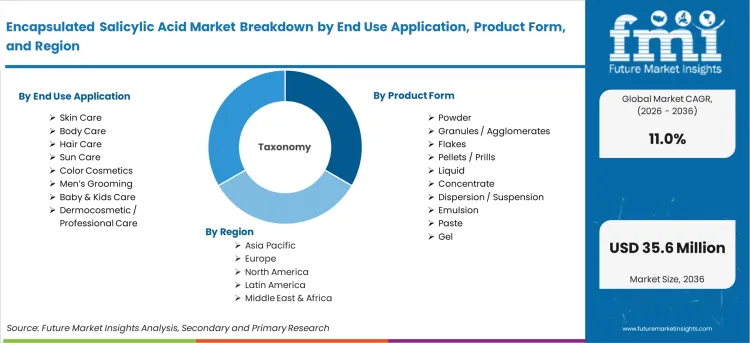
Market scope includes encapsulated salicylic acid actives in powder, granule, liquid, emulsion, gel, paste, and oil forms sold to cosmetic and personal care formulators. The report covers global and regional market sizes for the forecast period 2026 to 2036, with segment breakdowns by end use application and product form.
Encapsulated Salicylic Acid Market exclusions
The scope excludes free-form (unencapsulated) salicylic acid, prescription-grade BHA topical medications, salicylic acid used in industrial or pharmaceutical non-cosmetic applications, and finished skincare products. Encapsulated AHA actives (glycolic, lactic) are outside the defined boundary.
Encapsulated Salicylic Acid Market research methodology
- Primary research: Analysts engaged with cosmetic active ingredient formulators, dermocosmetic brand R&D directors, and encapsulation technology developers to map stability requirements and adoption decision criteria.
- Desk research: Data collection aggregated peer-reviewed salicylic acid efficacy publications, EU Cosmetics Regulation BHA concentration limits, and published dermocosmetic channel expansion statistics.
- Market sizing and forecasting: Baseline values derive from a bottom-up aggregation of encapsulated salicylic acid volumes sold to cosmetic formulators, applying end-use application adoption curves and geographic penetration rates.
- Data validation and update cycle: Projections are cross-validated against published specialty chemical company active ingredient revenue disclosures and dermocosmetic industry growth benchmarks.
Why is the Encapsulated Salicylic Acid Market Growing?
The encapsulated salicylic acid market is expanding as the demand for effective and controlled acne treatment solutions continues to rise. Encapsulated salicylic acid offers a more stable and controlled release of the active ingredient, providing enhanced penetration and minimizing irritation compared to conventional formulations. This has made it particularly appealing in skincare products targeting acne, blemishes, and oil control, where consumers seek effective solutions with reduced side effects. As awareness about skincare ingredients grows, encapsulated salicylic acid has gained popularity for its ability to deliver better results without compromising skin comfort.
Technological advancements in encapsulation techniques are driving the growth of this market. These innovations allow for the targeted release of salicylic acid, enabling more effective and sustained action over time. Encapsulation not only improves the stability of salicylic acid but also helps protect it from degradation, ensuring its potency throughout the shelf life of the product. The increasing demand for gentle yet effective acne treatments has further fueled the adoption of encapsulated salicylic acid in both over-the-counter and professional skincare products.
Despite its growth, challenges such as the cost of production and the complexity of developing stable formulations may limit the accessibility of encapsulated salicylic acid in some regions. Regulatory concerns surrounding the safety of encapsulated ingredients in cosmetics could pose barriers. Ongoing innovation and growing consumer interest in more effective, skin-friendly solutions are expected to drive continued growth in the encapsulated salicylic acid market.
How are End Use Segments and Product Forms Structuring the Global Encapsulated Salicylic Acid Landscape?
Global demand for encapsulated salicylic acid is shaped by end use applications and product form, with notable concentrations in East Asia, Western Europe, and North America. Skin care holds a 11.1% share, supported by the increasing demand for acne treatments, exfoliation, and skin resurfacing. Other significant segments include body care, hair care, sun care, color cosmetics, men’s grooming, baby and kids care, and dermocosmetic or professional care, spanning both mass and professional channels. On the product form side, powders dominate with a 15.2% share, alongside granules/agglomerates, flakes, pellets/prills, liquid solutions, high-active liquid concentrates, dispersions, emulsions, pastes, gels, wax/solid blocks, and oils. These trends reflect a focus on stability, controlled release, and effective formulation to meet consumer needs across diverse regional manufacturing hubs.
Why Does Skin Care Hold the Largest Share in Global Encapsulated Salicylic Acid Usage?
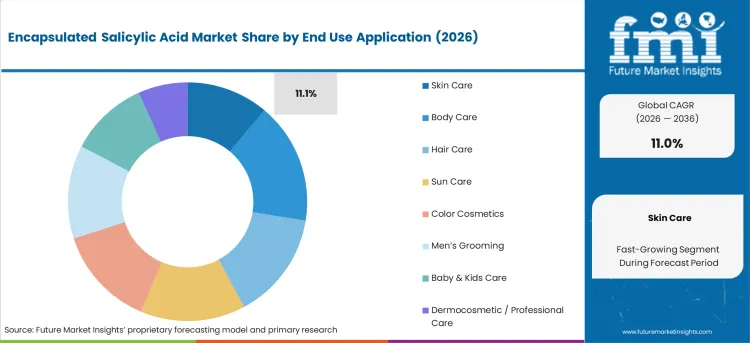
Skin care accounts for 11.1% of global encapsulated salicylic acid usage, driven by the increasing demand for acne treatment, skin exfoliation, and overall skin renewal. Encapsulated salicylic acid is commonly incorporated into cleansers, toners, serums, and spot treatments, where it provides gradual, targeted release, enhancing efficacy and minimizing irritation. Demand is particularly strong in regions like South Korea, Japan, the USA, and Western Europe, where innovations in dermocosmetics and professional skin care products are key drivers. Encapsulation allows salicylic acid to be delivered more effectively to deeper layers of the skin, supporting its use in acne care, anti-aging, and other therapeutic skin treatments. Professional and dermocosmetic brands leverage this technology to target sensitive skin conditions. Ongoing product development in countries such as France, Germany, and the USA continues to emphasize encapsulated actives within regulated cosmetic frameworks.
Why Does Powder Form Dominate Product Positioning in the Global Encapsulated Salicylic Acid Market?
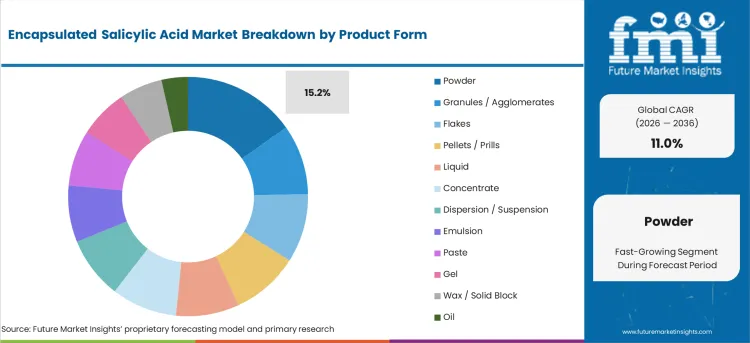
Powder form holds a 15.2% share of global encapsulated salicylic acid demand due to its superior stability, controlled moisture exposure, and consistent performance in formulations. Powders enable precise dosing, facilitating easy integration into emulsions, gels, and other formulations while ensuring uniform product quality across large-scale production in regions like Asia, Europe, and North America. Powder formats also offer logistical advantages, improving transport efficiency by minimizing leakage and reducing the need for refrigeration during global shipping. Manufacturers prefer powders for their compatibility with automated blending systems, providing predictable product quality even in varying climates. Regulatory documentation and microbial specifications for powders are more standardized, making them suitable for export markets. These factors contribute to powder’s dominance as the preferred product form for encapsulated salicylic acid.
What is Shaping the Encapsulated Salicylic Acid Sector Worldwide
The encapsulated salicylic acid sector is influenced by the growing demand for targeted skin care solutions, particularly in the treatment of acne, inflammation, and other skin imperfections. Salicylic acid is well-known for its ability to exfoliate the skin, unclog pores, and reduce acne-causing bacteria. Its potential for causing irritation limits its widespread use, especially for sensitive skin. Encapsulation technology addresses this issue by protecting the active ingredient and enabling controlled release, which reduces irritation while enhancing its efficacy. This technology makes salicylic acid more suitable for daily skin care formulations, including cleansers, serums, and moisturizers, thus expanding its appeal. The increasing focus on personalized skin care and multifunctional products further drives demand for encapsulated salicylic acid solutions.
Which Factors are Driving Global Demand for Encapsulated Salicylic Acid
Demand for encapsulated salicylic acid is growing as consumers seek more effective and gentle solutions for acne, oily skin, and exfoliation. The encapsulation process enhances stability, prevents degradation, and ensures a controlled release, making it more suitable for daily use compared to traditional formulations. Consumers with sensitive skin or those prone to irritation are attracted to encapsulated versions, as it allows the benefits of salicylic acid without the harshness. In addition, the rise of clean beauty trends and the growing awareness of skin health have pushed consumers toward advanced formulations that deliver targeted treatments. The need for gentle but potent acne treatments continues to drive the adoption of encapsulated salicylic acid in both mass-market and premium skincare lines.
What Constraints Are Limiting Adoption of Encapsulated Salicylic Acid
Despite its benefits, the adoption of encapsulated salicylic acid faces challenges related to formulation complexity and cost. Developing stable encapsulated systems requires advanced technologies and precise control over manufacturing processes, which can increase production costs. This can make encapsulated formulations more expensive than traditional salicylic acid products, potentially limiting accessibility for some consumers. The process may affect the speed of visible results, as the controlled release can take longer compared to more immediate, unencapsulated products. Regulatory concerns, particularly in different regions regarding claims and ingredients, may also slow the market expansion. As the sector grows, overcoming these barriers will require continued innovation and consumer education on the benefits of encapsulated salicylic acid.
Which Key Trends Are Redefining Encapsulated Salicylic Acid Globally
Several key trends are redefining the encapsulated salicylic acid sector, including the growing preference for multifunctional skin care products. Encapsulated salicylic acid is increasingly being combined with other actives such as niacinamide, peptides, or hyaluronic acid to address multiple skin concerns, including acne, pigmentation, and hydration. There is also a focus on developing products suitable for a wider range of skin types, especially sensitive skin, where encapsulation allows for gentler yet effective results. Advances in encapsulation technology, such as liposomes or nanocarriers, are improving the stability and penetration of salicylic acid, enhancing its ability to target deeper layers of the skin. The rise of personalized skincare and the demand for sustainable, eco-friendly packaging are also pushing the market towards more innovative and tailored solutions.
What is the Growth Outlook for the Encapsulated Salicylic Acid Market by Country?
.webp "Top Country Growth Comparison Encapsulated Salicylic Acid Market Cagr (2026 2036)")
| Country | CAGR (%) |
|---|---|
| India | 14.8% |
| China | 13.7% |
| Japan | 12.6% |
| UK | 11.5% |
| Germany | 10.4% |
| USA | 9.3% |

The encapsulated salicylic acid market is witnessing substantial global growth, led by India with a 14.8% CAGR, driven by increasing consumer demand for targeted skincare solutions, particularly for acne and blemishes. China follows with a 13.7% CAGR, supported by the rising middle class and growing focus on skincare products that offer controlled release. Japan’s market is growing at 12.6%, bolstered by its emphasis on precision skincare and a focus on effective acne management. The UK and Germany show steady growth at 11.5% and 10.4%, respectively, driven by increased demand for acne treatments and anti-inflammatory skincare. In the USA, the market is growing at a moderate pace of 9.3%, reflecting continued interest in advanced skincare products, despite a mature market.
What is Driving the Growth of Encapsulated Salicylic Acid in India?
India’s encapsulated salicylic acid market is projected to grow at a 14.8% CAGR through 2036. This strong growth is driven by rising demand for targeted skincare solutions, especially for acne and blemish treatment. With a growing middle class and increasing disposable incomes, Indian consumers are becoming more aware of the importance of skincare. The shift toward advanced products that offer controlled release, effective results, and reduced irritation is a key trend. Urbanization is also accelerating demand for premium skincare products. E-commerce platforms are expanding access to encapsulated salicylic acid products, making them more widely available to consumers. Local manufacturing further supports affordability and availability, contributing to increased market penetration and broad adoption of encapsulated salicylic acid in the Indian skincare industry.
What is Fueling Encapsulated Salicylic Acid Growth in China?
China’s encapsulated salicylic acid market is growing at a 13.7% CAGR through 2036. This growth is driven by an increasing focus on skincare, particularly acne and oily skin solutions. Encapsulated salicylic acid is highly favored due to its ability to offer controlled release with minimal irritation, which appeals to consumers with sensitive skin. China’s expanding middle class is increasingly seeking premium skincare products, further driving demand. Additionally, e-commerce platforms have made these advanced skincare treatments more accessible to a wider audience. Young consumers, in particular, are turning to encapsulated salicylic acid for acne management and overall skin health. As skincare awareness rises and more consumers opt for effective, gentle treatments, the encapsulated salicylic acid market in China is expected to continue its rapid expansion.
What is Contributing to Encapsulated Salicylic Acid Market Growth in Japan?
Japan’s encapsulated salicylic acid market is growing at a 12.6% CAGR through 2036, driven by the demand for acne treatments and precision skincare solutions. Encapsulated salicylic acid is favored for its controlled release, which minimizes irritation while targeting acne and other skin blemishes. Japan’s strong skincare culture and focus on scientific formulations further contribute to the demand. The country’s aging population, which often faces skin concerns like acne, also drives the market as consumers seek products that address their specific needs. Japan’s high consumer trust in dermatologically proven products ensures a strong market for encapsulated salicylic acid. As consumers prioritize skin health and seek reliable, effective solutions, the market for encapsulated salicylic acid in Japan continues to grow steadily.
What is Supporting Encapsulated Salicylic Acid Market Growth in the UK?
The UK’s encapsulated salicylic acid market is experiencing steady growth with an 11.5% CAGR through 2036. This growth is driven by an increasing demand for acne treatments and overall skin health solutions. Encapsulated salicylic acid is especially popular for its ability to provide controlled release, reducing skin irritation while delivering effective results. As consumers become more educated on the benefits of salicylic acid for acne and blemish management, its demand is rising. The UK has a strong beauty culture, and clinical skincare treatments are becoming increasingly popular. With skincare products available through retail pharmacies, e-commerce platforms, and specialist stores, the accessibility and availability of encapsulated salicylic acid have improved, further driving growth in the market.
What is Shaping Encapsulated Salicylic Acid Market Trends in Germany?
Germany’s encapsulated salicylic acid market is projected to grow at a 10.4% CAGR through 2036. The demand for encapsulated salicylic acid is driven by the need for effective acne treatments and anti-inflammatory skincare products. Consumers increasingly prefer encapsulated formulations as they target acne and blemishes with minimal irritation. Germany’s established skincare market places a premium on high-quality, scientifically proven products, which supports the growing interest in encapsulated salicylic acid. The country’s aging population, which often experiences acne and skin sensitivity issues, contributes to the sustained demand for these products. The market is further supported by wide distribution through retail pharmacies, dermatology clinics, and online platforms, which ensure better access and availability, boosting the growth of the encapsulated salicylic acid market.
What is Driving Encapsulated Salicylic Acid Growth in the USA?
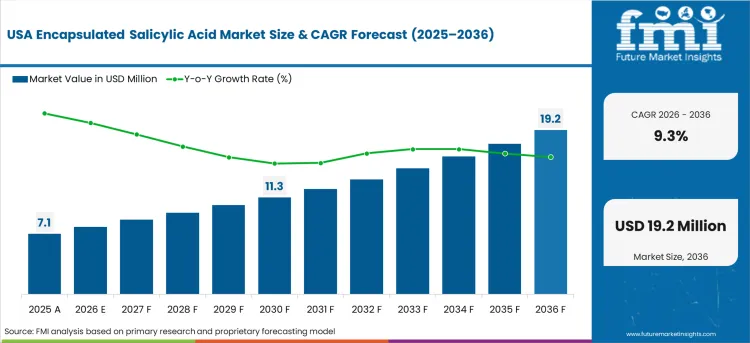
The USA’s encapsulated salicylic acid market is growing at a 9.3% CAGR through 2036. Despite being a mature market, the USA continues to see steady growth in the encapsulated salicylic acid sector. The primary drivers include ongoing consumer demand for acne treatments and products that provide targeted, controlled release. Encapsulated salicylic acid is favored for its ability to deliver effective results while minimizing irritation, which appeals to those with sensitive skin. The growing interest in advanced skincare solutions, especially for acne and oily skin, is contributing to the market’s stability. With widespread availability through retail chains, dermatology clinics, and online platforms, encapsulated salicylic acid products are easily accessible. This continued demand for effective treatments ensures steady growth in the USA’s encapsulated salicylic acid market.
What is Driving the Demand for Encapsulated Salicylic Acid Globally and Who Are the Key Players Shaping the Industry?

The demand for encapsulated salicylic acid is rising due to its ability to offer controlled release, enhanced stability, and reduced irritation compared to conventional formulations. Encapsulated salicylic acid is increasingly used in skincare products, especially those targeting acne, blackheads, and exfoliation. The controlled release of salicylic acid helps to improve skin clarity and texture without causing excessive dryness or irritation, making it ideal for sensitive skin. As consumer interest in effective and gentle skincare products grows, encapsulated salicylic acid is becoming a popular ingredient in formulations designed to treat acne, prevent breakouts, and promote skin health.
Key players shaping the encapsulated salicylic acid industry include BASF SE, Croda International, Evonik Industries, Symrise (including IFF/Givaudan active ingredient businesses), Dow Inc., Ashland, Clariant, and Seppic. BASF SE leads the market with a notable 14.6% share, leveraging its expertise in encapsulation technology and extensive product portfolio. These industry leaders focus on developing high-quality, stable encapsulated salicylic acid solutions to meet the growing demand for acne treatment and exfoliation products. Smaller, specialized providers also contribute by offering custom formulations for specific skincare needs, ensuring a diversified and competitive market.
The expansion of the encapsulated salicylic acid sector is driven by advancements in encapsulation techniques that improve the efficacy and stability of the active ingredient. By protecting salicylic acid from degradation, encapsulation ensures its long-lasting effect on the skin. As consumers increasingly seek products that offer both performance and gentleness, encapsulated salicylic acid is becoming an essential component of a wide range of skincare applications, particularly in acne treatment, exfoliation, and skin rejuvenation.
Key Players in the Encapsulated Salicylic Acid Market
- BASF SE
- Croda International
- Evonik Industries
- Symrise (incl. IFF/Givaudan actives)
- Dow / Dow Inc.
- Ashland
- Clariant
- Seppic
Scope of the report
| Metric | Value |
|---|---|
| Quantitative Units | USD 12.54 million to USD 35.61 million, at a CAGR of 11.0% |
| Market Definition | Encapsulated salicylic acid covers BHA active ingredients protected within delivery systems for controlled release and irritation reduction in cosmetic formulations. |
| End Use Application Segmentation | Skin Care, Body Care, Hair Care, Sun Care, Color Cosmetics, Men's Grooming, Baby & Kids Care, Dermocosmetic/Professional Care |
| Product Form Segmentation | Powder, Granules/Agglomerates, Flakes, Pellets/Prills, Liquid, Concentrate, Dispersion/Suspension, Emulsion, Paste, Gel, Wax/Solid Block, Oil |
| Regions Covered | North America, Latin America, Europe, East Asia, South Asia, Oceania, Middle East & Africa |
| Countries Covered | India, China, Japan, UK, Germany, USA, and 40 plus countries |
| Key Companies Profiled | BASF SE, Croda International, Evonik Industries, Symrise (incl. IFF/Givaudan actives), Dow/Dow Inc., Ashland, Clariant, Seppic |
| Forecast Period | 2026 to 2036 |
| Approach | Bottom-up methodology starting with encapsulated salicylic acid volumes sold to formulators, projecting adoption by end-use application and geography. |
Encapsulated Salicylic Acid Market by Key Segments
End Use Application:
- Skin Care
- Body Care
- Hair Care
- Sun Care
- Color Cosmetics
- Men’s Grooming
- Baby & Kids Care
- Dermocosmetic / Professional Care
Product Form:
- Powder
- Granules / Agglomerates
- Flakes
- Pellets / Prills
- Liquid (Solution)
- Concentrate (High-active Liquid)
- Dispersion / Suspension
- Emulsion
- Paste
- Gel
- Wax / Solid Block
- Oil
Region:
- Asia Pacific
- China
- Japan
- South Korea
- India
- Australia & New Zealand
- ASEAN
- Rest of Asia Pacific
- Europe
- Germany
- United Kingdom
- France
- Italy
- Spain
- Nordic
- BENELUX
- Rest of Europe
- North America
- United States
- Canada
- Mexico
- Latin America
- Brazil
- Chile
- Rest of Latin America
- Middle East & Africa
- Kingdom of Saudi Arabia
- Other GCC Countries
- Turkey
- South Africa
- Other African Union
- Rest of Middle East & Africa
Bibliography
- 1. European Commission. (2024). Regulation (EC) No 1223/2009: Annex III restrictions on salicylic acid in cosmetic products. European Commission.
- 2. Scientific Committee on Consumer Safety. (2024). Opinion on salicylic acid in cosmetic products: Safety assessment update. SCCS.
- 3. United States Food and Drug Administration. (2024). OTC monograph for acne drug products: Salicylic acid concentration limits. FDA.
- 4. International Federation of Societies of Cosmetic Chemists. (2024). Encapsulation technologies for cosmetic actives: BHA delivery systems. IFSCC.
- 5. World Health Organization. (2024). Model list of essential medicines: Dermatological preparations. WHO.
- 6. Organisation for Economic Co-operation and Development. (2024). Cosmetic ingredient safety assessment frameworks. OECD.
This bibliography is provided for reader reference. The full Future Market Insights report contains the complete reference list with primary research documentation.
Frequently Asked Questions
How large is the demand for encapsulated salicylic acid in 2026?
Demand for encapsulated salicylic acid in the global market is estimated to be valued at USD 12.54 million in 2026.
What will be the market size by 2036?
Market size for encapsulated salicylic acid is projected to reach USD 35.61 million by 2036.
What is the expected demand growth between 2026 and 2036?
Demand for encapsulated salicylic acid is expected to grow at a CAGR of 11.0% between 2026 and 2036.
Which End Use Application leads in 2026?
Skin Care leads in 2026 as acne treatment serums, pore-refining moisturisers, and exfoliating products consume the largest share of encapsulated salicylic acid volumes.
What is driving demand in India?
A rapidly expanding dermocosmetic retail channel and rising consumer adoption of BHA-based acne care regimens are fuelling encapsulated salicylic acid growth in India.
What is Japan's growth outlook in this report?
Japan is projected to grow at a CAGR of 12.6% during 2026 to 2036 as its skincare market incorporates salicylic acid into body care and scalp treatment categories.
What is included in the scope of this report?
The scope covers encapsulated salicylic acid actives in all product forms sold to cosmetic formulators; excludes free-form salicylic acid, prescription BHA, and finished products.
Preview the report firsthand - request a free sample
Get SampleGet the brochure for pricing and purchase details.
Get PDFTable of Content
- Executive Summary
- Global Market Outlook
- Demand-side Trends
- Supply-side Trends
- Technology Roadmap Analysis
- Analysis and Recommendations
- Market Overview
- Market Coverage / Taxonomy
- Market Definition / Scope / Limitations
- Research Methodology
- Chapter Orientation
- Analytical Lens and Working Hypotheses
- Market Structure, Signals, and Trend Drivers
- Benchmarking and Cross-market Comparability
- Market Sizing, Forecasting, and Opportunity Mapping
- Research Design and Evidence Framework
- Desk Research Programme (Secondary Evidence)
- Company Annual and Sustainability Reports
- Peer-reviewed Journals and Academic Literature
- Corporate Websites, Product Literature, and Technical Notes
- Earnings Decks and Investor Briefings
- Statutory Filings and Regulatory Disclosures
- Technical White Papers and Standards Notes
- Trade Journals, Industry Magazines, and Analyst Briefs
- Conference Proceedings, Webinars, and Seminar Materials
- Government Statistics Portals and Public Data Releases
- Press Releases and Reputable Media Coverage
- Specialist Newsletters and Curated Briefings
- Sector Databases and Reference Repositories
- FMI Internal Proprietary Databases and Historical Market Datasets
- Subscription Datasets and Paid Sources
- Social Channels, Communities, and Digital Listening Inputs
- Additional Desk Sources
- Expert Input and Fieldwork (Primary Evidence)
- Primary Modes
- Qualitative Interviews and Expert Elicitation
- Quantitative Surveys and Structured Data Capture
- Blended Approach
- Why Primary Evidence is Used
- Field Techniques
- Interviews
- Surveys
- Focus Groups
- Observational and In-context Research
- Social and Community Interactions
- Stakeholder Universe Engaged
- C-suite Leaders
- Board Members
- Presidents and Vice Presidents
- R&D and Innovation Heads
- Technical Specialists
- Domain Subject-matter Experts
- Scientists
- Physicians and Other Healthcare Professionals
- Governance, Ethics, and Data Stewardship
- Research Ethics
- Data Integrity and Handling
- Primary Modes
- Tooling, Models, and Reference Databases
- Desk Research Programme (Secondary Evidence)
- Data Engineering and Model Build
- Data Acquisition and Ingestion
- Cleaning, Normalisation, and Verification
- Synthesis, Triangulation, and Analysis
- Quality Assurance and Audit Trail
- Market Background
- Market Dynamics
- Drivers
- Restraints
- Opportunity
- Trends
- Scenario Forecast
- Demand in Optimistic Scenario
- Demand in Likely Scenario
- Demand in Conservative Scenario
- Opportunity Map Analysis
- Product Life Cycle Analysis
- Supply Chain Analysis
- Investment Feasibility Matrix
- Value Chain Analysis
- PESTLE and Porter’s Analysis
- Regulatory Landscape
- Regional Parent Market Outlook
- Production and Consumption Statistics
- Import and Export Statistics
- Market Dynamics
- Global Market Analysis 2021 to 2025 and Forecast, 2026 to 2036
- Historical Market Size Value (USD Million) Analysis, 2021 to 2025
- Current and Future Market Size Value (USD Million) Projections, 2026 to 2036
- Y-o-Y Growth Trend Analysis
- Absolute $ Opportunity Analysis
- Global Market Pricing Analysis 2021 to 2025 and Forecast 2026 to 2036
- Global Market Analysis 2021 to 2025 and Forecast 2026 to 2036, By End Use Application
- Introduction / Key Findings
- Historical Market Size Value (USD Million) Analysis By End Use Application , 2021 to 2025
- Current and Future Market Size Value (USD Million) Analysis and Forecast By End Use Application , 2026 to 2036
- Skin Care
- Body Care
- Hair Care
- Sun Care
- Color Cosmetics
- Men’s Grooming
- Baby & Kids Care
- Dermocosmetic / Professional Care
- Skin Care
- Y-o-Y Growth Trend Analysis By End Use Application , 2021 to 2025
- Absolute $ Opportunity Analysis By End Use Application , 2026 to 2036
- Global Market Analysis 2021 to 2025 and Forecast 2026 to 2036, By Product Form
- Introduction / Key Findings
- Historical Market Size Value (USD Million) Analysis By Product Form, 2021 to 2025
- Current and Future Market Size Value (USD Million) Analysis and Forecast By Product Form, 2026 to 2036
- Powder
- Granules / Agglomerates
- Flakes
- Pellets / Prills
- Liquid
- Concentrate
- Dispersion / Suspension
- Emulsion
- Paste
- Gel
- Wax / Solid Block
- Powder
- Y-o-Y Growth Trend Analysis By Product Form, 2021 to 2025
- Absolute $ Opportunity Analysis By Product Form, 2026 to 2036
- Global Market Analysis 2021 to 2025 and Forecast 2026 to 2036, By Region
- Introduction
- Historical Market Size Value (USD Million) Analysis By Region, 2021 to 2025
- Current Market Size Value (USD Million) Analysis and Forecast By Region, 2026 to 2036
- North America
- Latin America
- Western Europe
- Eastern Europe
- East Asia
- South Asia and Pacific
- Middle East & Africa
- Market Attractiveness Analysis By Region
- North America Market Analysis 2021 to 2025 and Forecast 2026 to 2036, By Country
- Historical Market Size Value (USD Million) Trend Analysis By Market Taxonomy, 2021 to 2025
- Market Size Value (USD Million) Forecast By Market Taxonomy, 2026 to 2036
- By Country
- USA
- Canada
- Mexico
- By End Use Application
- By Product Form
- By Country
- Market Attractiveness Analysis
- By Country
- By End Use Application
- By Product Form
- Key Takeaways
- Latin America Market Analysis 2021 to 2025 and Forecast 2026 to 2036, By Country
- Historical Market Size Value (USD Million) Trend Analysis By Market Taxonomy, 2021 to 2025
- Market Size Value (USD Million) Forecast By Market Taxonomy, 2026 to 2036
- By Country
- Brazil
- Chile
- Rest of Latin America
- By End Use Application
- By Product Form
- By Country
- Market Attractiveness Analysis
- By Country
- By End Use Application
- By Product Form
- Key Takeaways
- Western Europe Market Analysis 2021 to 2025 and Forecast 2026 to 2036, By Country
- Historical Market Size Value (USD Million) Trend Analysis By Market Taxonomy, 2021 to 2025
- Market Size Value (USD Million) Forecast By Market Taxonomy, 2026 to 2036
- By Country
- Germany
- UK
- Italy
- Spain
- France
- Nordic
- BENELUX
- Rest of Western Europe
- By End Use Application
- By Product Form
- By Country
- Market Attractiveness Analysis
- By Country
- By End Use Application
- By Product Form
- Key Takeaways
- Eastern Europe Market Analysis 2021 to 2025 and Forecast 2026 to 2036, By Country
- Historical Market Size Value (USD Million) Trend Analysis By Market Taxonomy, 2021 to 2025
- Market Size Value (USD Million) Forecast By Market Taxonomy, 2026 to 2036
- By Country
- Russia
- Poland
- Hungary
- Balkan & Baltic
- Rest of Eastern Europe
- By End Use Application
- By Product Form
- By Country
- Market Attractiveness Analysis
- By Country
- By End Use Application
- By Product Form
- Key Takeaways
- East Asia Market Analysis 2021 to 2025 and Forecast 2026 to 2036, By Country
- Historical Market Size Value (USD Million) Trend Analysis By Market Taxonomy, 2021 to 2025
- Market Size Value (USD Million) Forecast By Market Taxonomy, 2026 to 2036
- By Country
- China
- Japan
- South Korea
- By End Use Application
- By Product Form
- By Country
- Market Attractiveness Analysis
- By Country
- By End Use Application
- By Product Form
- Key Takeaways
- South Asia and Pacific Market Analysis 2021 to 2025 and Forecast 2026 to 2036, By Country
- Historical Market Size Value (USD Million) Trend Analysis By Market Taxonomy, 2021 to 2025
- Market Size Value (USD Million) Forecast By Market Taxonomy, 2026 to 2036
- By Country
- India
- ASEAN
- Australia & New Zealand
- Rest of South Asia and Pacific
- By End Use Application
- By Product Form
- By Country
- Market Attractiveness Analysis
- By Country
- By End Use Application
- By Product Form
- Key Takeaways
- Middle East & Africa Market Analysis 2021 to 2025 and Forecast 2026 to 2036, By Country
- Historical Market Size Value (USD Million) Trend Analysis By Market Taxonomy, 2021 to 2025
- Market Size Value (USD Million) Forecast By Market Taxonomy, 2026 to 2036
- By Country
- Kingdom of Saudi Arabia
- Other GCC Countries
- Turkiye
- South Africa
- Other African Union
- Rest of Middle East & Africa
- By End Use Application
- By Product Form
- By Country
- Market Attractiveness Analysis
- By Country
- By End Use Application
- By Product Form
- Key Takeaways
- Key Countries Market Analysis
- USA
- Pricing Analysis
- Market Share Analysis, 2025
- By End Use Application
- By Product Form
- Canada
- Pricing Analysis
- Market Share Analysis, 2025
- By End Use Application
- By Product Form
- Mexico
- Pricing Analysis
- Market Share Analysis, 2025
- By End Use Application
- By Product Form
- Brazil
- Pricing Analysis
- Market Share Analysis, 2025
- By End Use Application
- By Product Form
- Chile
- Pricing Analysis
- Market Share Analysis, 2025
- By End Use Application
- By Product Form
- Germany
- Pricing Analysis
- Market Share Analysis, 2025
- By End Use Application
- By Product Form
- UK
- Pricing Analysis
- Market Share Analysis, 2025
- By End Use Application
- By Product Form
- Italy
- Pricing Analysis
- Market Share Analysis, 2025
- By End Use Application
- By Product Form
- Spain
- Pricing Analysis
- Market Share Analysis, 2025
- By End Use Application
- By Product Form
- France
- Pricing Analysis
- Market Share Analysis, 2025
- By End Use Application
- By Product Form
- India
- Pricing Analysis
- Market Share Analysis, 2025
- By End Use Application
- By Product Form
- ASEAN
- Pricing Analysis
- Market Share Analysis, 2025
- By End Use Application
- By Product Form
- Australia & New Zealand
- Pricing Analysis
- Market Share Analysis, 2025
- By End Use Application
- By Product Form
- China
- Pricing Analysis
- Market Share Analysis, 2025
- By End Use Application
- By Product Form
- Japan
- Pricing Analysis
- Market Share Analysis, 2025
- By End Use Application
- By Product Form
- South Korea
- Pricing Analysis
- Market Share Analysis, 2025
- By End Use Application
- By Product Form
- Russia
- Pricing Analysis
- Market Share Analysis, 2025
- By End Use Application
- By Product Form
- Poland
- Pricing Analysis
- Market Share Analysis, 2025
- By End Use Application
- By Product Form
- Hungary
- Pricing Analysis
- Market Share Analysis, 2025
- By End Use Application
- By Product Form
- Kingdom of Saudi Arabia
- Pricing Analysis
- Market Share Analysis, 2025
- By End Use Application
- By Product Form
- Turkiye
- Pricing Analysis
- Market Share Analysis, 2025
- By End Use Application
- By Product Form
- South Africa
- Pricing Analysis
- Market Share Analysis, 2025
- By End Use Application
- By Product Form
- USA
- Market Structure Analysis
- Competition Dashboard
- Competition Benchmarking
- Market Share Analysis of Top Players
- By Regional
- By End Use Application
- By Product Form
- Competition Analysis
- Competition Deep Dive
- BASF SE
- Overview
- Product Portfolio
- Profitability by Market Segments (Product/Age /Sales Channel/Region)
- Sales Footprint
- Strategy Overview
- Marketing Strategy
- Product Strategy
- Channel Strategy
- Croda International
- Evonik Industries
- Symrise (incl. IFF/Givaudan actives)
- Dow / Dow Inc.
- Ashland
- Clariant
- Seppic
- BASF SE
- Competition Deep Dive
- Assumptions & Acronyms Used


