

- Industry Size (2026)
- USD 1.9 Bn
- Forecast (2036)
- USD 3.6 Bn
- CAGR (2026 to 2036)
- 7.0%
Green Floor Care Chemicals Market Forecast and Outlook 2026 to 2036
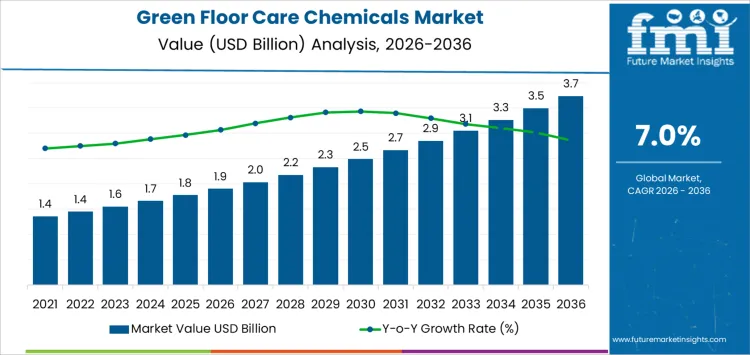
In 2026, the green floor care chemicals market is valued at USD 1.9 billion and is projected to reach USD 3.6 billion by 2036, reflecting a CAGR of 7.0%. Growth from USD 1.3 billion in 2020 is supported by wider adoption of plant based surfactant systems, low VOC solvent free formulations, and enzymatic chemistries across routine floor maintenance programs. Green hard floor cleaners and carpet care products account for a significant share as commercial facilities prioritize frequent cleaning of high traffic surfaces. Concentrate based products dominate early demand due to controlled dosing and reduced storage requirements.
From 2027 to 2031, market value increases from USD 2.0 billion to USD 2.6 billion, then advances steadily toward USD 3.6 billion by 2036. Commercial buildings remain the largest end use segment, followed by healthcare institutions and educational facilities where procurement standards increasingly specify green formulations. Industrial and warehousing sites contribute stable demand tied to safety and compliance considerations. RTU products and tablet formats maintain defined roles in smaller facilities. Long term growth reflects gradual portfolio replacement, contract renewals, and predictable replenishment cycles rather than expansion in floor care frequency.
Quick Stats of the Green Floor Care Chemicals Market
- Green Floor Care Chemicals Market Value (2026): USD 1.9 billion
- Green Floor Care Chemicals Market Forecast Value (2036): USD 3.6 billion
- Green Floor Care Chemicals Market Forecast CAGR (2026-2036): 7.0%
- Leading Floor Care Category: Green Hard Floor Cleaners (34%)
- Key Growth Regions: China, Brazil, USA, UK, Germany
- Top Players: Diversey, Ecolab, 3M, SC Johnson Professional, Betco, Spartan Chemical, Zep, P&G Professional, Unilever Professional, Solenis
What is the Growth Forecast for the Green Floor Care Chemicals Market through 2036?
From 2026 to 2031, the green floor care chemicals market increases from USD 1.9 billion to roughly USD 2.5 billion, reflecting a period of progressive adoption rather than rapid displacement of conventional products. Demand growth in this phase is shaped by gradual specification changes in commercial buildings, education facilities, and healthcare environments where floor appearance and maintenance frequency are tightly managed. Early gains are driven by pilot inclusion in maintenance programs and selective conversion of high-visibility areas. As confidence in cleaning performance improves, annual value additions widen modestly, indicating a steady strengthening of acceptance across professional users.
Between 2031 and 2036, the market expands from approximately USD 2.5 billion to USD 3.6 billion, showing a noticeably steeper growth profile. This phase reflects broader standardization of green floor care products across multi-site facility portfolios and contract cleaning providers. Demand accelerates as procurement frameworks increasingly favor certified formulations, and usage extends beyond routine cleaning into polishing, restoration, and specialty floor treatments. Earlier growth relied on selective deployment, while later expansion is driven by higher consumption intensity, wider surface coverage, and repeat purchasing embedded within long-term floor maintenance strategies across global commercial and institutional facilities.
Green Floor Care Chemicals Market Key Takeaways
| Metric | Value |
|---|---|
| Market Value (2026) | USD 1.9 billion |
| Forecast Value (2036) | USD 3.6 billion |
| Forecast CAGR (2026-2036) | 7.0% |
How Are Material Protection Goals Reshaping the Green Floor Care Chemicals Market from 2026 to 2036?
Use of green floor care chemicals expanded as facility operators balanced surface protection with environmental compliance. Commercial buildings, schools, healthcare sites, and retail spaces adopted cleaners and finishes designed for frequent use on vinyl, stone, wood, and resilient flooring. Historical demand reflected shift away from solvent heavy products toward water based cleaners and low residue finishes. Buyers valued products that maintained gloss and slip resistance while fitting routine machine cleaning cycles. Procurement aligned with facility maintenance contracts and long term floor preservation strategies.
From 2026 to 2036 demand is expected to grow as green building certifications and lifecycle cost management gain weight in procurement decisions. Facility managers prefer floor care systems that reduce recoating frequency and chemical consumption. Product development focuses on durable finishes, mild stripping agents, and compatibility with automated scrubbers. Buyers assess surface longevity, worker safety, and documentation supporting environmental claims. Demand reflects refurbishment activity, expansion of managed facilities, and continued emphasis on floor appearance and safety across commercial and institutional environments.
What Is the Demand for the Green Floor Care Chemicals Market by Floor Care Category and Chemistry Approach for 2026 to 2036?
From 2026 to 2036, the green floor care chemicals market develops as facility operators align maintenance programs with environmental procurement standards and indoor exposure guidelines. Green hard floor cleaners hold a 34% share within floor care categories as routine cleaning dominates overall floor maintenance activity. Plant-based surfactant systems represent 30% of chemistry approaches due to their ability to deliver effective soil removal while meeting environmental and occupational safety expectations. Demand reflects structured daily cleaning cycles, third-party certification influence, and broader acceptance of non-petrochemical formulations across commercial and institutional facilities.
Why do green hard floor cleaners account for 34% of demand in the green floor care chemicals market by floor care category from 2026 to 2036?
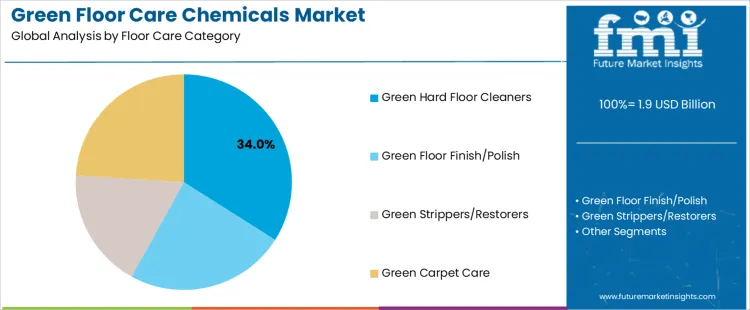
Green hard floor cleaners account for 34% of demand because hard flooring remains the most prevalent surface type across commercial, institutional, and public buildings. Consumption intensity remains high in offices, schools, healthcare facilities, retail centers, and transport infrastructure where floors are cleaned multiple times daily. Usage stays consistent as green hard floor cleaners replace conventional products within existing cleaning schedules without altering equipment or labor routines. Procurement decisions emphasize performance on stone, tile, vinyl, terrazzo, and sealed concrete while maintaining compliance with green purchasing criteria. Buyers favor cleaners that preserve floor finish, reduce residue buildup, and support low-moisture cleaning systems. Price sensitivity remains moderate since floor appearance and safety influence occupant perception and operational risk. Specification control focuses on pH balance, surfactant biodegradability, and compatibility with mechanized scrubbers. Demand continues from 2026 to 2036 as new construction and refurbishment projects increasingly specify green floor maintenance programs. Repeat purchasing patterns remain predictable due to continuous daily consumption tied to routine cleaning cycles across large floor areas.
Why do plant-based surfactant systems represent 30% of demand in the green floor care chemicals market by chemistry approach from 2026 to 2036?
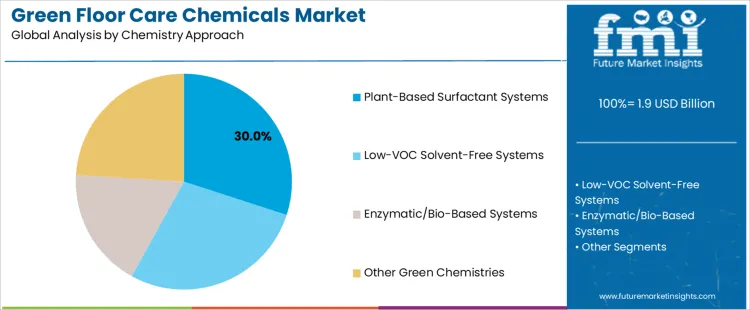
Plant-based surfactant systems represent 30% of demand because they offer effective soil suspension and removal while reducing reliance on petrochemical inputs. Consumption is strong among facilities operating under environmental certification frameworks and corporate sustainability policies. Usage remains steady as these surfactants perform reliably across varied water hardness and temperature conditions common in facility operations. Procurement favors formulations derived from renewable feedstocks that meet biodegradability and toxicity benchmarks without sacrificing cleaning strength. Buyers prioritize consistency in foaming control, residue behavior, and rinse performance. Price sensitivity stays moderate as plant-based systems increasingly match conventional surfactant cost structures at scale. Specification control emphasizes renewable content verification, supply consistency, and formulation stability during storage and use. Demand persists from 2026 to 2036 as professional cleaning programs continue transitioning toward chemistry approaches that balance operational performance with documented environmental attributes.
How Is Demand for Green Floor Care Chemicals Emerging From Changes in Facility Maintenance Practices?
Demand takes shape through routine floor maintenance decisions in offices, schools, healthcare buildings, and public facilities where surface protection and indoor conditions matter. Facility teams select green floor care chemicals to manage daily cleaning without affecting coatings, finishes, or air circulation. Schools and hospitals favor products that support frequent floor care in occupied spaces. Commercial buildings adopt them to maintain appearance across high traffic zones using mechanized equipment. These patterns reflect maintenance practices focused on material compatibility, worker exposure control, and predictable results rather than decorative or branding driven considerations.
What Operational Requirements Are Driving Demand for Green Floor Care Chemicals?
Drivers arise from floor management routines tied to durability and long term asset care. Facility managers adopt green formulations to protect modern floor finishes that require low residue maintenance. Cleaning contractors prefer products that perform consistently across vinyl, linoleum, rubber, and sealed concrete surfaces. Healthcare facilities rely on floor care chemicals that support repeated cleaning cycles without degrading slip resistance. Educational campuses use them to manage large surface areas cleaned during short windows. These requirements stem from operational efficiency, surface longevity, and risk control within structured maintenance programs.
What Practical Constraints Are Limiting Wider Adoption of Green Floor Care Chemicals?
Barriers relate to cost comparison, staff familiarity, and equipment alignment. Some facilities view green floor care products as higher cost alternatives to conventional chemicals. Cleaning teams trained on traditional methods may resist changes that alter dilution or application routines. Older machines are sometimes calibrated for specific chemical properties, limiting flexibility. In mixed use buildings, varied flooring types complicate product standardization. Procurement contracts based on price alone also slow transitions. These constraints limit adoption where budget predictability and established workflows outweigh longer term maintenance considerations.
What is the Growth Outlook for Green Floor Care Chemicals Across Key Countries?
| Country | CAGR (%) |
|---|---|
| China | 8.0% |
| Brazil | 7.8% |
| USA | 6.7% |
| UK | 6.7% |
| Germany | 6.6% |
The green floor care chemicals segment is growing steadily as commercial and institutional users shift toward environmentally compliant maintenance solutions. China leads growth at 8.0%, driven by expansion of green buildings, stricter environmental norms, and rising demand from large commercial facilities. Brazil follows at 7.8%, supported by increased adoption in hospitality, retail, and public infrastructure. The USA and UK each record 6.7%, reflecting strong uptake among professional cleaning contractors and facility managers seeking certified and low impact formulations. Germany at 6.6% shows consistent growth linked to regulated environmental standards and established green procurement practices. Overall expansion is supported by policy alignment, lifecycle cost considerations, and preference for floor care products that meet environmental and performance requirements.
How Are Surface Protection Practices Supporting the Green Floor Care Chemicals Market in the United States?
Green floor care chemicals demand in the United States is growing at a CAGR of 6.70% from 2026 to 2036 as commercial buildings, healthcare facilities, and educational institutions adopt certified floor maintenance solutions. Facility managers apply green floor cleaners, finishes, and strippers to maintain surface durability across vinyl, wood, and stone flooring. Cleaning teams integrate these products into routine maintenance programs aligned with procurement standards. Service contractors standardize green formulations to support compliance across multiple client sites. Growth reflects steady institutional preference for certified floor care solutions within professional environments nationwide.
- Facility managers apply green floor care chemicals to maintain surface durability.
- Cleaning teams integrate certified products into routine maintenance programs.
- Service contractors standardize green formulations across client locations.
What Is Driving Adoption of the Green Floor Care Chemicals Market in Germany?
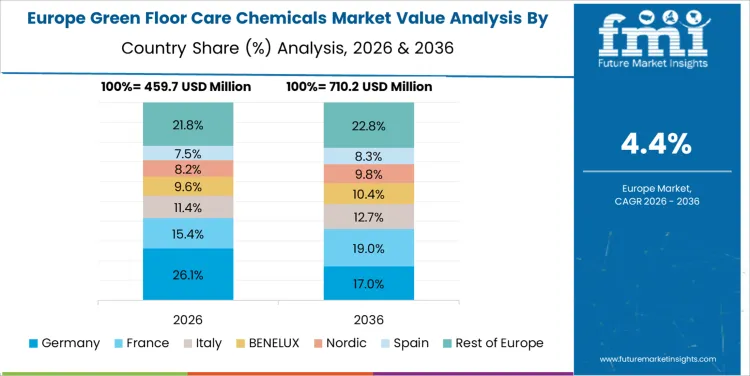
Green floor care chemicals demand in Germany is expanding at a CAGR of 6.60% from 2026 to 2036 as commercial facilities and public institutions follow structured maintenance frameworks. Facility operators use certified floor care products to clean and protect flooring in offices, hospitals, and transit buildings. Maintenance teams follow defined routines aligned with operational guidelines. Centralized procurement supports consistent product selection across facility portfolios. Growth reflects disciplined facility management and continued reliance on certified cleaning solutions within professional floor care operations.
- Facility operators use certified floor care products across public buildings.
- Maintenance teams follow structured routines aligned with operational guidelines.
- Centralized procurement supports consistent floor care product selection.
Why Is the Green Floor Care Chemicals Market Expanding Faster in China?
Green floor care chemicals demand in China is increasing at a CAGR of 8.00% from 2026 to 2036 as commercial construction and facility upgrades accelerate. Newly developed office complexes and retail centers integrate green floor maintenance programs during early operations. Existing facilities increase use of certified floor care chemicals to manage high traffic areas. Service providers supply products suited for large surface areas and frequent cleaning cycles. Growth reflects rapid expansion of commercial infrastructure and rising adoption of certified floor care practices nationwide.
- New facilities integrate green floor care programs during commissioning.
- Existing sites increase chemical use for high traffic floor maintenance.
- Service providers supply products for large scale surface care.
How Are Maintenance Standards Influencing the Green Floor Care Chemicals Market in the United Kingdom?
Green floor care chemicals demand in the United Kingdom is growing at a CAGR of 6.70% from 2026 to 2036 as offices, healthcare sites, and public buildings follow defined maintenance standards. Facility teams apply certified floor care chemicals to preserve appearance and safety across interior spaces. Cleaning schedules align with operational needs and occupancy patterns. Procurement teams support sourcing aligned with institutional guidelines. Growth reflects consistent demand for approved floor care solutions across professional property portfolios.
- Facility teams apply certified chemicals to preserve floor appearance.
- Cleaning schedules align with building occupancy patterns.
- Procurement teams support sourcing aligned with maintenance guidelines.
What Factors Are Supporting Growth of the Green Floor Care Chemicals Market in Brazil?
Green floor care chemicals demand in Brazil is expanding at a CAGR of 7.80% from 2026 to 2036 as commercial facilities and service providers strengthen maintenance practices. Operators increase use of certified floor care products to manage shared spaces in offices, retail centers, and hospitality venues. Service contractors support routine cleaning across diverse flooring types. Property owners invest in maintenance programs to support asset longevity. Growth reflects rising institutional focus on professional floor care across expanding urban infrastructure.
- Operators increase use of certified floor care products in shared spaces.
- Service contractors support routine maintenance across flooring types.
- Property owners invest in programs supporting floor asset longevity.
What Is Driving the Demand for Green Floor Care Chemicals and Which Companies Shape Professional Maintenance Programs?
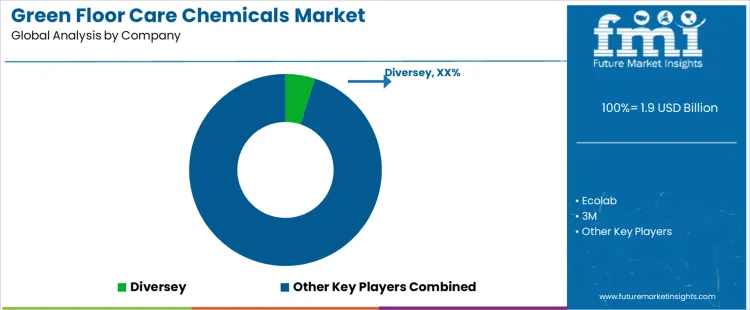
Demand for green floor care chemicals is shaped by sustainability targets, certification requirements, and growing scrutiny of indoor air quality in commercial buildings. Offices, healthcare facilities, schools, airports, and retail centers specify environmentally preferable products for routine floor cleaning and maintenance. Diversey and Ecolab support this shift through green certified detergents, finishes, and stripping agents integrated into structured floor care programs. SC Johnson Professional and P and G Professional supply low impact cleaners used for daily maintenance of vinyl, tile, and sealed concrete. Betco, Spartan Chemical, and Zep serve contract cleaning firms managing large portfolios of mixed floor surfaces. 3M contributes through systems that combine green chemicals with pads and tools to reduce chemical and water usage. These suppliers align products with institutional sustainability policies and audit requirements.
Selection criteria focus on verified certifications, low residue performance, slip resistance, and compatibility with high speed floor equipment. Facility managers favor products that reduce stripping frequency, extend floor finish life, and lower labor intensity. Solenis influences industrial and large facility users through floor and surface care chemistries aligned with environmental compliance thresholds. Unilever Professional supports back of house and public area cleaning with green positioned formulations. Buyers emphasize consistent appearance, fast drying, and worker safety during application. Usage spans lobbies, corridors, classrooms, patient wards, and retail floors with constant foot traffic. Demand visibility tracks expansion of green certified buildings, public procurement mandates, outsourcing of cleaning services, and continued focus on lifecycle cost reduction in professional floor maintenance programs.
Key Players in the Green Floor Care Chemicals Market
- Diversey
- Ecolab
- 3M
- SC Johnson Professional
- Betco
- Spartan Chemical
- Zep
- P&G Professional
- Unilever Professional
- Solenis
Scope of the Report
| Items | Values |
|---|---|
| Quantitative Units (2026) | USD billion |
| Floor Care Category | Green Hard Floor Cleaners; Green Floor Finish and Polish; Green Strippers and Restorers; Green Carpet Care Products |
| Chemistry Approach | Plant Based Surfactant Systems; Low VOC Solvent Free Systems; Enzymatic and Bio Based Systems; Other Green Chemistry Approaches |
| End Use Sector | Commercial Facilities; Healthcare and Institutional Buildings; Educational Facilities; Industrial and Warehousing Sites |
| Concentration Model | Concentrates; Ready to Use Products; Tablets and Powders; Other Concentration Models |
| Regions Covered | Asia Pacific; Europe; North America; Latin America; Middle East and Africa |
| Countries Covered | China; Japan; South Korea; India; Australia and New Zealand; ASEAN; Germany; United Kingdom; France; Italy; Spain; Nordic; BENELUX; United States; Canada; Mexico; Brazil; Chile; Kingdom of Saudi Arabia; Turkey; South Africa; plus additional countries across Asia Pacific, Europe, Latin America, and Middle East and Africa |
| Key Companies Profiled | Diversey; Ecolab; 3M; SC Johnson Professional; Betco; Spartan Chemical; Zep; P and G Professional; Unilever Professional; Solenis |
| Additional Attributes | Dollar by sales across floor care categories and chemistry approaches; adoption of green floor care chemicals driven by environmental procurement standards and indoor air quality requirements; variation in product usage across hard floors, carpets, and specialty surfaces in commercial and institutional buildings; integration of green floor care products into mechanized cleaning and polishing programs; emphasis on surface protection, slip resistance, and residue control in high traffic areas; compatibility requirements with automated scrubbers, high speed burnishers, and routine maintenance equipment; role of certified green formulations in long term floor asset management and contract cleaning programs |
Green Floor Care Chemicals Market Segmentation
Floor Care Category:
- Green Hard Floor Cleaners
- Green Floor Finish/Polish
- Green Strippers/Restorers
- Green Carpet Care
Chemistry Approach:
- Plant-Based Surfactant Systems
- Low-VOC Solvent-Free Systems
- Enzymatic/Bio-Based Systems
- Other Green Chemistries
End-Use Sector:
- Commercial Facilities
- Healthcare & Institutions
- Education
- Industrial & Warehousing
Concentration Model:
- Concentrates
- RTU Products
- Tablets/Powders
- Other Models
Region:
- Asia Pacific
- China
- Japan
- South Korea
- India
- Australia & New Zealand
- ASEAN
- Rest of Asia Pacific
- Europe
- Germany
- United Kingdom
- France
- Italy
- Spain
- Nordic
- BENELUX
- Rest of Europe
- North America
- United States
- Canada
- Mexico
- Latin America
- Brazil
- Chile
- Rest of Latin America
- Middle East & Africa
- Kingdom of Saudi Arabia
- Other GCC Countries
- Turkey
- South Africa
- Other African Union
- Rest of Middle East & Africa
Frequently Asked Questions
How big is the green floor care chemicals market in 2026?
The global green floor care chemicals market is estimated to be valued at USD 1.9 billion in 2026.
What will be the size of green floor care chemicals market in 2036?
The market size for the green floor care chemicals market is projected to reach USD 3.7 billion by 2036.
How much will be the green floor care chemicals market growth between 2026 and 2036?
The green floor care chemicals market is expected to grow at a 7.0% CAGR between 2026 and 2036.
What are the key product types in the green floor care chemicals market?
The key product types in green floor care chemicals market are green hard floor cleaners, green floor finish/polish, green strippers/restorers and green carpet care.
Which chemistry approach segment to contribute significant share in the green floor care chemicals market in 2026?
In terms of chemistry approach, plant-based surfactant systems segment to command 30.0% share in the green floor care chemicals market in 2026.
Preview the report firsthand - request a free sample
Get SampleGet the brochure for pricing and purchase details.
Get PDFTable of Content
- Executive Summary
- Global Market Outlook
- Demand-side Trends
- Supply-side Trends
- Technology Roadmap Analysis
- Analysis and Recommendations
- Market Overview
- Market Coverage / Taxonomy
- Market Definition / Scope / Limitations
- Market Background
- Market Dynamics
- Drivers
- Restraints
- Opportunity
- Trends
- Scenario Forecast
- Demand in Optimistic Scenario
- Demand in Likely Scenario
- Demand in Conservative Scenario
- Opportunity Map Analysis
- Product Life Cycle Analysis
- Supply Chain Analysis
- Investment Feasibility Matrix
- Value Chain Analysis
- PESTLE and Porter’s Analysis
- Regulatory Landscape
- Regional Parent Market Outlook
- Production and Consumption Statistics
- Import and Export Statistics
- Market Dynamics
- Global Market Analysis 2021 to 2025 and Forecast, 2026 to 2036
- Historical Market Size Value (USD Million) Analysis, 2021 to 2025
- Current and Future Market Size Value (USD Million) Projections, 2026 to 2036
- Y-o-Y Growth Trend Analysis
- Absolute $ Opportunity Analysis
- Global Market Pricing Analysis 2021 to 2025 and Forecast 2026 to 2036
- Global Market Analysis 2021 to 2025 and Forecast 2026 to 2036, By Floor Care Category
- Introduction / Key Findings
- Historical Market Size Value (USD Million) Analysis By Floor Care Category , 2021 to 2025
- Current and Future Market Size Value (USD Million) Analysis and Forecast By Floor Care Category , 2026 to 2036
- Green Hard Floor Cleaners
- Green Floor Finish/Polish
- Green Strippers/Restorers
- Green Carpet Care
- Y-o-Y Growth Trend Analysis By Floor Care Category , 2021 to 2025
- Absolute $ Opportunity Analysis By Floor Care Category , 2026 to 2036
- Global Market Analysis 2021 to 2025 and Forecast 2026 to 2036, By Chemistry Approach
- Introduction / Key Findings
- Historical Market Size Value (USD Million) Analysis By Chemistry Approach, 2021 to 2025
- Current and Future Market Size Value (USD Million) Analysis and Forecast By Chemistry Approach, 2026 to 2036
- Plant-Based Surfactant Systems
- Low-VOC Solvent-Free Systems
- Enzymatic/Bio-Based Systems
- Other Green Chemistries
- Y-o-Y Growth Trend Analysis By Chemistry Approach, 2021 to 2025
- Absolute $ Opportunity Analysis By Chemistry Approach, 2026 to 2036
- Global Market Analysis 2021 to 2025 and Forecast 2026 to 2036, By End-Use Sector
- Introduction / Key Findings
- Historical Market Size Value (USD Million) Analysis By End-Use Sector, 2021 to 2025
- Current and Future Market Size Value (USD Million) Analysis and Forecast By End-Use Sector, 2026 to 2036
- Commercial Facilities
- Healthcare & Institutions
- Education
- Industrial & Warehousing
- Y-o-Y Growth Trend Analysis By End-Use Sector, 2021 to 2025
- Absolute $ Opportunity Analysis By End-Use Sector, 2026 to 2036
- Global Market Analysis 2021 to 2025 and Forecast 2026 to 2036, By Concentration Model
- Introduction / Key Findings
- Historical Market Size Value (USD Million) Analysis By Concentration Model, 2021 to 2025
- Current and Future Market Size Value (USD Million) Analysis and Forecast By Concentration Model, 2026 to 2036
- Concentrates
- RTU Products
- Tablets/Powders
- Other Models
- Y-o-Y Growth Trend Analysis By Concentration Model, 2021 to 2025
- Absolute $ Opportunity Analysis By Concentration Model, 2026 to 2036
- Global Market Analysis 2021 to 2025 and Forecast 2026 to 2036, By Region
- Introduction
- Historical Market Size Value (USD Million) Analysis By Region, 2021 to 2025
- Current Market Size Value (USD Million) Analysis and Forecast By Region, 2026 to 2036
- North America
- Latin America
- Western Europe
- Eastern Europe
- East Asia
- South Asia and Pacific
- Middle East & Africa
- Market Attractiveness Analysis By Region
- North America Market Analysis 2021 to 2025 and Forecast 2026 to 2036, By Country
- Historical Market Size Value (USD Million) Trend Analysis By Market Taxonomy, 2021 to 2025
- Market Size Value (USD Million) Forecast By Market Taxonomy, 2026 to 2036
- By Country
- USA
- Canada
- Mexico
- By Floor Care Category
- By Chemistry Approach
- By End-Use Sector
- By Concentration Model
- By Country
- Market Attractiveness Analysis
- By Country
- By Floor Care Category
- By Chemistry Approach
- By End-Use Sector
- By Concentration Model
- Key Takeaways
- Latin America Market Analysis 2021 to 2025 and Forecast 2026 to 2036, By Country
- Historical Market Size Value (USD Million) Trend Analysis By Market Taxonomy, 2021 to 2025
- Market Size Value (USD Million) Forecast By Market Taxonomy, 2026 to 2036
- By Country
- Brazil
- Chile
- Rest of Latin America
- By Floor Care Category
- By Chemistry Approach
- By End-Use Sector
- By Concentration Model
- By Country
- Market Attractiveness Analysis
- By Country
- By Floor Care Category
- By Chemistry Approach
- By End-Use Sector
- By Concentration Model
- Key Takeaways
- Western Europe Market Analysis 2021 to 2025 and Forecast 2026 to 2036, By Country
- Historical Market Size Value (USD Million) Trend Analysis By Market Taxonomy, 2021 to 2025
- Market Size Value (USD Million) Forecast By Market Taxonomy, 2026 to 2036
- By Country
- Germany
- UK
- Italy
- Spain
- France
- Nordic
- BENELUX
- Rest of Western Europe
- By Floor Care Category
- By Chemistry Approach
- By End-Use Sector
- By Concentration Model
- By Country
- Market Attractiveness Analysis
- By Country
- By Floor Care Category
- By Chemistry Approach
- By End-Use Sector
- By Concentration Model
- Key Takeaways
- Eastern Europe Market Analysis 2021 to 2025 and Forecast 2026 to 2036, By Country
- Historical Market Size Value (USD Million) Trend Analysis By Market Taxonomy, 2021 to 2025
- Market Size Value (USD Million) Forecast By Market Taxonomy, 2026 to 2036
- By Country
- Russia
- Poland
- Hungary
- Balkan & Baltic
- Rest of Eastern Europe
- By Floor Care Category
- By Chemistry Approach
- By End-Use Sector
- By Concentration Model
- By Country
- Market Attractiveness Analysis
- By Country
- By Floor Care Category
- By Chemistry Approach
- By End-Use Sector
- By Concentration Model
- Key Takeaways
- East Asia Market Analysis 2021 to 2025 and Forecast 2026 to 2036, By Country
- Historical Market Size Value (USD Million) Trend Analysis By Market Taxonomy, 2021 to 2025
- Market Size Value (USD Million) Forecast By Market Taxonomy, 2026 to 2036
- By Country
- China
- Japan
- South Korea
- By Floor Care Category
- By Chemistry Approach
- By End-Use Sector
- By Concentration Model
- By Country
- Market Attractiveness Analysis
- By Country
- By Floor Care Category
- By Chemistry Approach
- By End-Use Sector
- By Concentration Model
- Key Takeaways
- South Asia and Pacific Market Analysis 2021 to 2025 and Forecast 2026 to 2036, By Country
- Historical Market Size Value (USD Million) Trend Analysis By Market Taxonomy, 2021 to 2025
- Market Size Value (USD Million) Forecast By Market Taxonomy, 2026 to 2036
- By Country
- India
- ASEAN
- Australia & New Zealand
- Rest of South Asia and Pacific
- By Floor Care Category
- By Chemistry Approach
- By End-Use Sector
- By Concentration Model
- By Country
- Market Attractiveness Analysis
- By Country
- By Floor Care Category
- By Chemistry Approach
- By End-Use Sector
- By Concentration Model
- Key Takeaways
- Middle East & Africa Market Analysis 2021 to 2025 and Forecast 2026 to 2036, By Country
- Historical Market Size Value (USD Million) Trend Analysis By Market Taxonomy, 2021 to 2025
- Market Size Value (USD Million) Forecast By Market Taxonomy, 2026 to 2036
- By Country
- Kingdom of Saudi Arabia
- Other GCC Countries
- Turkiye
- South Africa
- Other African Union
- Rest of Middle East & Africa
- By Floor Care Category
- By Chemistry Approach
- By End-Use Sector
- By Concentration Model
- By Country
- Market Attractiveness Analysis
- By Country
- By Floor Care Category
- By Chemistry Approach
- By End-Use Sector
- By Concentration Model
- Key Takeaways
- Key Countries Market Analysis
- USA
- Pricing Analysis
- Market Share Analysis, 2025
- By Floor Care Category
- By Chemistry Approach
- By End-Use Sector
- By Concentration Model
- Canada
- Pricing Analysis
- Market Share Analysis, 2025
- By Floor Care Category
- By Chemistry Approach
- By End-Use Sector
- By Concentration Model
- Mexico
- Pricing Analysis
- Market Share Analysis, 2025
- By Floor Care Category
- By Chemistry Approach
- By End-Use Sector
- By Concentration Model
- Brazil
- Pricing Analysis
- Market Share Analysis, 2025
- By Floor Care Category
- By Chemistry Approach
- By End-Use Sector
- By Concentration Model
- Chile
- Pricing Analysis
- Market Share Analysis, 2025
- By Floor Care Category
- By Chemistry Approach
- By End-Use Sector
- By Concentration Model
- Germany
- Pricing Analysis
- Market Share Analysis, 2025
- By Floor Care Category
- By Chemistry Approach
- By End-Use Sector
- By Concentration Model
- UK
- Pricing Analysis
- Market Share Analysis, 2025
- By Floor Care Category
- By Chemistry Approach
- By End-Use Sector
- By Concentration Model
- Italy
- Pricing Analysis
- Market Share Analysis, 2025
- By Floor Care Category
- By Chemistry Approach
- By End-Use Sector
- By Concentration Model
- Spain
- Pricing Analysis
- Market Share Analysis, 2025
- By Floor Care Category
- By Chemistry Approach
- By End-Use Sector
- By Concentration Model
- France
- Pricing Analysis
- Market Share Analysis, 2025
- By Floor Care Category
- By Chemistry Approach
- By End-Use Sector
- By Concentration Model
- India
- Pricing Analysis
- Market Share Analysis, 2025
- By Floor Care Category
- By Chemistry Approach
- By End-Use Sector
- By Concentration Model
- ASEAN
- Pricing Analysis
- Market Share Analysis, 2025
- By Floor Care Category
- By Chemistry Approach
- By End-Use Sector
- By Concentration Model
- Australia & New Zealand
- Pricing Analysis
- Market Share Analysis, 2025
- By Floor Care Category
- By Chemistry Approach
- By End-Use Sector
- By Concentration Model
- China
- Pricing Analysis
- Market Share Analysis, 2025
- By Floor Care Category
- By Chemistry Approach
- By End-Use Sector
- By Concentration Model
- Japan
- Pricing Analysis
- Market Share Analysis, 2025
- By Floor Care Category
- By Chemistry Approach
- By End-Use Sector
- By Concentration Model
- South Korea
- Pricing Analysis
- Market Share Analysis, 2025
- By Floor Care Category
- By Chemistry Approach
- By End-Use Sector
- By Concentration Model
- Russia
- Pricing Analysis
- Market Share Analysis, 2025
- By Floor Care Category
- By Chemistry Approach
- By End-Use Sector
- By Concentration Model
- Poland
- Pricing Analysis
- Market Share Analysis, 2025
- By Floor Care Category
- By Chemistry Approach
- By End-Use Sector
- By Concentration Model
- Hungary
- Pricing Analysis
- Market Share Analysis, 2025
- By Floor Care Category
- By Chemistry Approach
- By End-Use Sector
- By Concentration Model
- Kingdom of Saudi Arabia
- Pricing Analysis
- Market Share Analysis, 2025
- By Floor Care Category
- By Chemistry Approach
- By End-Use Sector
- By Concentration Model
- Turkiye
- Pricing Analysis
- Market Share Analysis, 2025
- By Floor Care Category
- By Chemistry Approach
- By End-Use Sector
- By Concentration Model
- South Africa
- Pricing Analysis
- Market Share Analysis, 2025
- By Floor Care Category
- By Chemistry Approach
- By End-Use Sector
- By Concentration Model
- USA
- Market Structure Analysis
- Competition Dashboard
- Competition Benchmarking
- Market Share Analysis of Top Players
- By Regional
- By Floor Care Category
- By Chemistry Approach
- By End-Use Sector
- By Concentration Model
- Competition Analysis
- Competition Deep Dive
- Diversey
- Overview
- Product Portfolio
- Profitability by Market Segments (Product/Age /Sales Channel/Region)
- Sales Footprint
- Strategy Overview
- Marketing Strategy
- Product Strategy
- Channel Strategy
- Ecolab
- 3M
- SC Johnson Professional
- Betco
- Spartan Chemical
- Zep
- P&G Professional
- Unilever Professional
- Solenis
- Diversey
- Competition Deep Dive
- Assumptions & Acronyms Used
- Research Methodology


