

- Industry Size (2026)
- USD 9.3 Bn
- Forecast (2036)
- USD 14.0 Bn
- CAGR (2026 to 2036)
- 4.2%
Floor Cleaning Detergent and Care Chemicals Market Forecast and Outlook 2026 to 2036
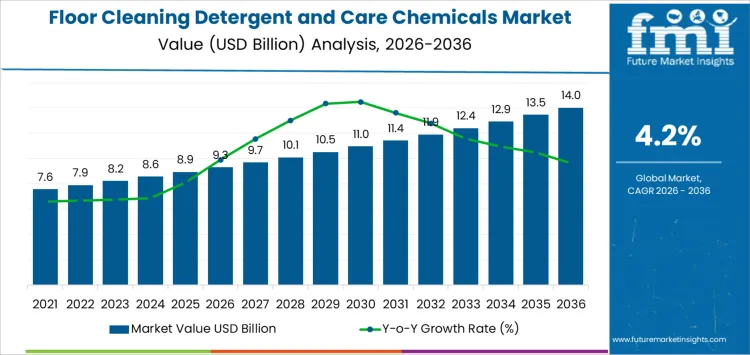
The floor cleaning detergent and care chemicals market is valued at USD 9.3 billion in 2026 and is projected to reach USD 14.0 billion by 2036, reflecting a CAGR of 4.2%. Hard floor cleaners and floor finish products represent the largest demand segments due to regular surface upkeep requirements. Demand growth from USD 7.2 billion in 2020 to USD 9.3 billion in 2026 is supported by consistent consumption across healthcare institutions, commercial facilities, and industrial sites. Neutral and alkaline formulations dominate usage as they allow compatibility across multiple flooring materials and standardized janitorial routines.
From 2027 onward, market value rises from USD 9.7 billion to USD 11.5 billion by 2031, then progresses to USD 14.0 billion by 2036 through steady annual increases. Contract based supply to commercial facilities continues to anchor volumes, while healthcare settings sustain predictable intake aligned with hygiene protocols. Industrial and warehouse environments maintain stable demand for specialty and restorative products. Carpet, upholstery, and stripper chemicals retain defined use cases. Growth reflects formulation turnover and gradual volume expansion rather than changes in cleaning frequency or intensity.
Quick Stats of the Floor Cleaning Detergent and Care Chemicals Market
- Floor Cleaning Detergent and Care Chemicals Market Value (2026): USD 9.3 billion
- Floor Cleaning Detergent and Care Chemicals Market Forecast Value (2036): USD 14.0 billion
- Floor Cleaning Detergent and Care Chemicals Market Forecast CAGR (2026-2036): 4.2%
- Leading Floor Care Category in the Market: Hard Floor Cleaners (34%)
- Key Growth Regions: China, Brazil, USA, UK, Germany
- Top Players: Ecolab, Diversey, SC Johnson Professional, 3M, Procter & Gamble, Reckitt, Clorox, Betco, Spartan Chemical, Zep
What is the Growth Forecast for the Floor Cleaning Detergent and Care Chemicals Market through 2036?
Between 2026 and 2031, the floor cleaning detergent and care chemicals market expands from USD 9.3 billion to around USD 11.0 billion, reflecting steady progression anchored in routine consumption rather than abrupt shifts in usage patterns. Growth in this phase is shaped by ongoing demand from commercial buildings, retail spaces, and institutional facilities where floor maintenance remains a recurring operational requirement. Product upgrades focus on surface compatibility, controlled foam behavior, and labor efficiency. Earlier growth dynamics were driven by volume stability, while this period reflects gradual value uplift through formulation refinement and broader penetration of specialized floor-care products.
From 2031 to 2036, the market grows from approximately USD 11.0 billion to USD 14.0 billion, indicating a firmer pace of expansion as procurement volumes scale across large facility networks. This phase benefits from rising maintenance intensity in logistics centers, healthcare facilities, and transport infrastructure, where floor durability and cleanliness standards are more tightly managed. Growth is reinforced by wider adoption of concentrated formulations and system-based cleaning programs. Earlier expansion relied on replacement demand, whereas later growth reflects higher per-site usage, expanded surface coverage, and more consistent purchasing across global facilities management contracts.
Floor Cleaning Detergent and Care Chemicals Market Key Takeaways
| Metric | Value |
|---|---|
| Market Value (2026) | USD 9.3 billion |
| Forecast Value (2036) | USD 14.0 billion |
| Forecast CAGR (2026-2036) | 4.20% |
What Is Driving the Demand for the Floor Cleaning Detergent and Care Chemicals Market from 2026 to 2036?
Demand for floor cleaning detergent and care chemicals developed through expansion of commercial buildings, retail spaces, healthcare facilities, and public infrastructure that require routine surface maintenance. Facility managers adopted specialised detergents, polishers, and protective coatings to preserve flooring materials such as tile, vinyl, stone, and wood. Historical growth reflected higher cleaning frequency in high footfall environments and wider use of mechanised floor cleaning equipment. Buyers prioritised cleaning efficiency, surface compatibility, and residue control. Procurement decisions aligned with maintenance contracts, hygiene protocols, and durability expectations across institutional and commercial properties.
From 2026 to 2036 demand is expected to increase with growth in urban infrastructure, ageing building stock, and professional facility management services. Expansion of healthcare, transport hubs, and mixed use developments supports higher consumption of floor care products. Product development focuses on concentrated formulations, low residue finishes, and compatibility with automated scrubbers and polishers. Buyers evaluate slip resistance, finish longevity, and compliance with indoor safety standards. Demand depends on refurbishment cycles, outsourcing of cleaning services, and performance requirements tied to appearance, safety, and lifecycle maintenance costs across commercial and institutional facilities.
What Is the Demand for the Floor Cleaning Detergent and Care Chemicals Market by Floor Care Category and Chemistry for 2026 to 2036?
The floor cleaning detergent and care chemicals market from 2026 to 2036 is shaped by high-frequency cleaning requirements, expansion of commercial floor space, and increasing focus on surface longevity across facilities. Hard floor cleaners represent the largest floor care category at 34% due to widespread use on tile, stone, vinyl, and coated concrete surfaces. Neutral and all-purpose detergents also account for 34% by chemistry, reflecting broad acceptance in environments requiring routine cleaning with controlled surface interaction and minimal residue risk.
Why do hard floor cleaners account for 34% of demand in the floor cleaning detergent and care chemicals market by floor care category from 2026 to 2036?
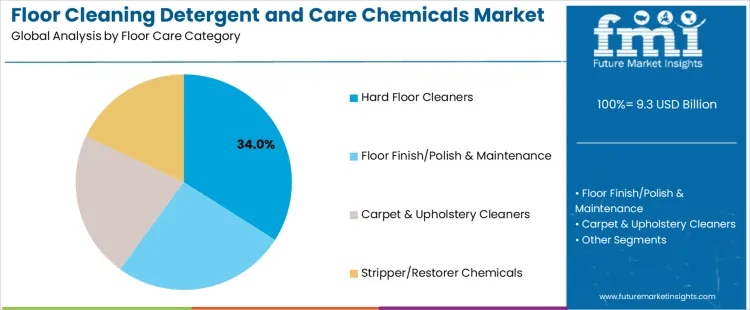
Hard floor cleaners account for 34% of demand because hard surfaces dominate commercial, institutional, and industrial buildings worldwide. Consumption intensity is highest in offices, retail centers, hospitals, schools, airports, and manufacturing facilities where hard flooring supports durability and ease of maintenance. Usage remains consistent as these surfaces require daily or multi-shift cleaning to manage foot traffic, spills, and particulate accumulation. Procurement decisions favor products that deliver effective soil removal without degrading sealants, coatings, or grout lines. Buyers prioritize cleaners that maintain surface appearance while supporting rapid drying to reduce slip risk and operational disruption. Price sensitivity remains moderate since cleaning frequency drives total consumption more than unit pricing. Specification control emphasizes pH balance, low residue formation, and compatibility with mechanized scrubbers and microfiber systems. Demand remains strong from 2026 to 2036 as new construction continues favoring hard flooring for lifecycle cost control. Repeat purchasing patterns remain predictable because hard floor cleaners are consumed continuously as part of standard facility maintenance programs. Substitution pressure from multi-surface cleaners remains limited where dedicated hard floor formulations protect surface finish and extend maintenance intervals.
Why do neutral and all-purpose detergents represent 34% of demand in the floor cleaning detergent and care chemicals market by chemistry from 2026 to 2036?
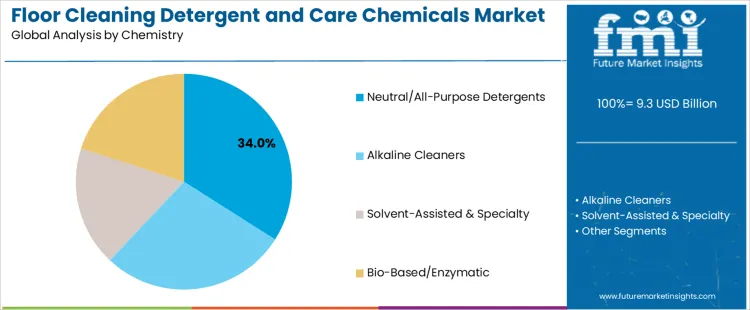
Neutral and all-purpose detergents represent 34% of demand because they provide broad cleaning capability while minimizing risk to sensitive floor materials. Consumption is strong in mixed-use facilities that manage multiple flooring types within a single site, including vinyl, laminate, stone, terrazzo, and sealed wood. Usage remains steady as neutral formulations allow routine cleaning without aggressive chemical action that can dull finishes or weaken protective coatings. Procurement favors detergents that support frequent use, predictable dilution behavior, and compatibility with automated dosing systems. Buyers value chemistry that maintains surface integrity while controlling visible soil and odor. Price sensitivity stays moderate because neutral detergents reduce the need for corrective maintenance and re-polishing. Specification control focuses on residue control, low foaming behavior, and stable performance across temperature and water hardness variations. Demand continues from 2026 to 2036 as facilities standardize cleaning protocols around neutral chemistries to simplify training and reduce chemical inventory complexity. Repeat utilization remains consistent as neutral detergents serve as the default choice for daily floor maintenance across diverse operating environments.
How Is Demand for Floor Cleaning Detergent and Care Chemicals Shaped by Daily Maintenance Practices Across Commercial Spaces?
Demand forms through routine maintenance needs in offices, retail stores, hospitals, and public buildings where floor appearance and safety standards guide purchasing decisions. Facility teams select detergents based on compatibility with tile, vinyl, stone, or coated concrete surfaces. Hospitals favor products that support frequent cleaning without residue buildup. Retail operators choose formulations that maintain gloss under heavy foot traffic. Schools and transit facilities rely on cleaners that dry quickly to reduce slip risk. These requirements arise from daily upkeep practices rather than branding influence, anchoring demand in functional performance and surface specific care needs.
What Facility Level Factors Are Driving Demand for Floor Cleaning Detergent and Care Chemicals?
Drivers originate from changes in flooring materials, maintenance schedules, and labor efficiency goals. Commercial buildings increasingly install coated and polished floors that require specialized care chemicals. Cleaning contractors select concentrated detergents to reduce storage and handling time during multi-site operations. Healthcare facilities adopt neutral pH products to protect floor finishes exposed to frequent sanitation. Retail chains standardize cleaning agents across locations to simplify staff training. These factors reflect operational decisions made by facility managers seeking predictable results, surface longevity, and efficient daily cleaning routines within controlled environments.
What Practical Constraints Are Limiting Broader Use of Advanced Floor Care Chemicals?
Barriers develop from cost controls, staff familiarity, and equipment compatibility. Smaller facilities prefer basic detergents due to tight maintenance budgets. Some advanced care chemicals require specific dilution systems or burnishing equipment, which limits use where tools are outdated. Cleaning staff accustomed to traditional products may resist changes that alter routines. Procurement teams tied to long term supply agreements delay switching to newer formulations. Floors with mixed materials complicate product selection, leading managers to favor general purpose cleaners. These constraints slow adoption where simplicity and cost predictability outweigh performance gains.
What is the Growth Outlook for the Floor Cleaning Detergent and Care Chemicals Market Across Key Countries?
| Country | CAGR (%) |
|---|---|
| China | 5.2% |
| Brazil | 5.0% |
| USA | 3.9% |
| UK | 3.9% |
| Germany | 3.8% |
The floor cleaning detergent and care chemicals market is expanding at a moderate pace across major economies, shaped by commercial hygiene needs, institutional procurement, and replacement driven consumption. China leads at 5.2%, supported by rapid expansion of commercial real estate, public facilities, and large scale janitorial services in urban centers. Brazil follows at 5.0%, driven by growth in hospitality, retail spaces, and outsourced cleaning services. The USA and UK each record 3.9%, reflecting stable demand from healthcare facilities, offices, and retail chains, with limited acceleration due to market maturity. Germany at 3.8% shows steady growth linked to industrial cleaning requirements and consistent institutional demand.
How Are Facility Maintenance Practices Supporting Floor Cleaning Detergent and Care Chemicals Demand in the United States?
Floor cleaning detergent and care chemicals demand in the United States is expanding at a CAGR of 3.9% from 2026 to 2036 as commercial buildings, healthcare facilities, and retail spaces maintain routine floor care programs. Facility managers use detergents and care chemicals to preserve surface appearance and manage daily foot traffic. Healthcare sites rely on consistent floor hygiene to support patient safety protocols. Retail environments apply care chemicals to maintain presentation standards. Growth reflects steady procurement driven by routine maintenance requirements across offices, hospitals, and commercial infrastructure.
- Facility managers rely on detergents for routine floor upkeep.
- Healthcare facilities apply floor care products to support hygiene standards.
- Retail spaces use care chemicals to maintain surface appearance.
What Shapes Floor Cleaning Detergent and Care Chemicals Demand in Germany?
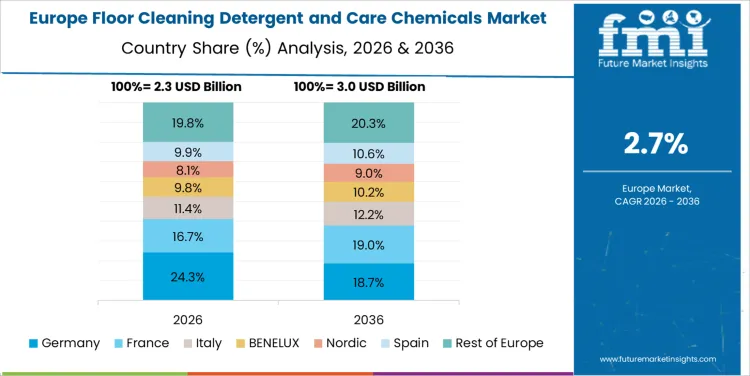
Floor cleaning detergent and care chemicals demand in Germany is growing at a CAGR of 3.8% from 2026 to 2036 as industrial buildings, offices, and public facilities follow structured cleaning schedules. Industrial users apply detergents to maintain safety and surface durability in work areas. Office facilities integrate care chemicals into planned maintenance routines. Public institutions rely on standardized products to support cleanliness across shared spaces. Growth reflects disciplined facility management practices aligned with operational consistency.
- Industrial facilities use detergents to maintain safe work surfaces.
- Offices integrate floor care into planned maintenance routines.
- Public institutions rely on standardized cleaning products.
Why Is China Recording Higher Growth in Floor Cleaning Detergent and Care Chemicals Demand?
Floor cleaning detergent and care chemicals demand in China is increasing at a CAGR of 5.2% from 2026 to 2036 as commercial real estate, transport hubs, and industrial facilities expand floor maintenance programs. Commercial buildings use detergents to manage high traffic surfaces. Transport hubs apply care chemicals to support safety and cleanliness. Industrial facilities integrate floor care products into routine cleaning schedules. Growth reflects broad scale infrastructure use and expanding commercial floor space nationwide.
- Commercial buildings manage high traffic surfaces with detergents.
- Transport hubs apply care chemicals for safety and cleanliness.
- Industrial facilities integrate floor care into routine cleaning.
How Are Service Sector Needs Influencing Demand in the United Kingdom?
Floor cleaning detergent and care chemicals demand in the United Kingdom is rising at a CAGR of 3.9% from 2026 to 2036 as offices, hospitality venues, and healthcare facilities maintain regular floor care programs. Office managers apply detergents to maintain shared workspaces. Hospitality venues rely on care chemicals to support guest area presentation. Healthcare facilities integrate floor cleaning products into daily sanitation routines. Growth reflects steady demand across service sectors that prioritize consistent maintenance.
- Offices use detergents to maintain shared spaces.
- Hospitality venues rely on care chemicals for guest areas.
- Healthcare facilities integrate floor care into sanitation routines.
What Is Supporting Strong Growth in Brazil?
Floor cleaning detergent and care chemicals demand in Brazil is expanding at a CAGR of 5.0% from 2026 to 2036 as commercial centers, retail facilities, and public buildings increase focus on surface maintenance. Commercial centers use detergents to manage frequent foot traffic. Retail facilities apply care chemicals to maintain visual standards. Public buildings integrate floor care products into regular cleaning schedules. Growth reflects rising investment in facility upkeep across urban infrastructure.
- Commercial centers manage heavy foot traffic with detergents.
- Retail facilities apply care chemicals to maintain presentation.
- Public buildings integrate floor care into routine cleaning programs.
What Is Driving the Demand for Floor Cleaning Detergent and Care Chemicals and Which Companies Shape Commercial and Retail Use?
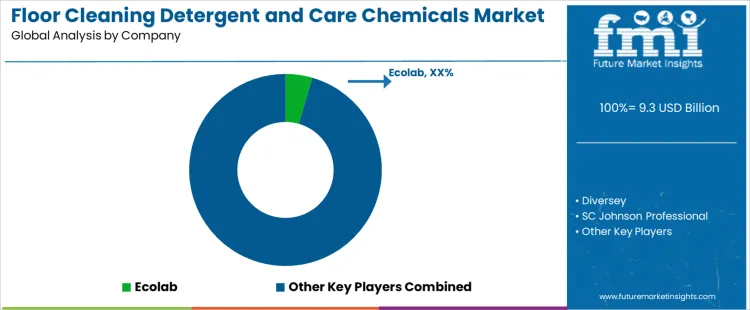
The demand for floor cleaning detergent and care chemicals is shaped by high foot traffic in retail, transport, healthcare, and education facilities, where appearance and slip control matter daily. Ecolab and Diversey supply structured floor care programs that combine detergents, finishes, and maintenance schedules used by large facility operators. SC Johnson Professional supports routine cleaning in offices and public buildings through neutral cleaners suited to frequent use. Betco, Spartan Chemical, and Zep focus on janitorial contractors that manage multiple floor types across wide building portfolios. 3M contributes through floor care systems that link detergents with pads and surface treatment processes.
Household and light commercial demand is influenced by ease of use and visible cleanliness rather than long term surface conditioning. Procter and Gamble, Reckitt, and Clorox shape consumer habits through multi surface floor cleaners used in kitchens, bathrooms, and living areas. Buyers pay attention to residue control, drying time, and fragrance intensity. Procurement in institutions favors products that work across vinyl, tile, stone, and sealed wood without damage. Demand visibility follows growth in urban retail space, renovation of public buildings, and rising outsourcing of cleaning services in commercial real estate.
Key Players in the Floor Cleaning Detergent and Care Chemicals Market
- Ecolab
- Diversey
- SC Johnson Professional
- 3M
- Procter & Gamble
- Reckitt
- Clorox
- Betco
- Spartan Chemical
- Zep
Scope of the Report
| Items | Values |
|---|---|
| Quantitative Units (2026) | USD billion |
| Floor Care Category | Hard Floor Cleaners; Floor Finish and Polish and Maintenance Products; Carpet and Upholstery Cleaners; Stripper and Restorer Chemicals |
| Chemistry | Neutral and All Purpose Detergents; Alkaline Cleaners; Solvent Assisted and Specialty Formulations; Bio Based and Enzymatic |
| End Use Sector | Commercial Facilities; Healthcare and Institutions; Industrial Sites and Warehousing; Residential |
| Sales Model | B2B Jan San Distribution; Direct Contracts with Large Facilities; Retail and E commerce; Other Channels |
| Regions Covered | Asia Pacific; Europe; North America; Latin America; Middle East and Africa |
| Countries Covered | China; Japan; South Korea; India; Australia and New Zealand; ASEAN; Germany; United Kingdom; France; Italy; Spain; Nordic; BENELUX; United States; Canada; Mexico; Brazil; Chile; Kingdom of Saudi Arabia; Turkey; South Africa; plus additional countries across Asia Pacific, Europe, Latin America, and Middle East and Africa |
| Key Companies Profiled | Ecolab; Diversey; SC Johnson Professional; 3M; Procter and Gamble; Reckitt; Clorox; Betco; Spartan Chemical; Zep |
| Additional Attributes | Dollar by sales across floor care categories, chemistry types, end use sectors, and sales models; contract based janitorial procurement patterns; formulation compatibility with hard and resilient flooring materials; finish durability and slip resistance considerations; dilution control and dosing practices; compatibility with mechanized scrubbers and burnishers; residue and drying time management; maintenance cycle alignment with facility schedules; refurbishment and floor lifecycle management practices; influence of outsourcing and facility management contracts on purchasing behavior. |
Floor Cleaning Detergent and Care Chemicals Market Segmentation
Floor Care Category:
- Hard Floor Cleaners
- Floor Finish/Polish & Maintenance
- Carpet & Upholstery Cleaners
- Stripper/Restorer Chemicals
Chemistry:
- Neutral/All-Purpose Detergents
- Alkaline Cleaners
- Solvent-Assisted & Specialty
- Bio-Based/Enzymatic
End-Use Sector:
- Commercial Facilities
- Healthcare & Institutions
- Industrial Sites & Warehousing
- Residential
Sales Model:
- B2B Jan-San Distribution
- Direct Contracts (Large Facilities)
- Retail & E-commerce
- Other Channels
Region:
- Asia Pacific
- China
- Japan
- South Korea
- India
- Australia & New Zealand
- ASEAN
- Rest of Asia Pacific
- Europe
- Germany
- United Kingdom
- France
- Italy
- Spain
- Nordic
- BENELUX
- Rest of Europe
- North America
- United States
- Canada
- Mexico
- Latin America
- Brazil
- Chile
- Rest of Latin America
- Middle East & Africa
- Kingdom of Saudi Arabia
- Other GCC Countries
- Turkey
- South Africa
- Other African Union
- Rest of Middle East & Africa
Frequently Asked Questions
How big is the floor cleaning detergent and care chemicals market in 2026?
The global floor cleaning detergent and care chemicals market is estimated to be valued at USD 9.3 billion in 2026.
What will be the size of floor cleaning detergent and care chemicals market in 2036?
The market size for the floor cleaning detergent and care chemicals market is projected to reach USD 14.0 billion by 2036.
How much will be the floor cleaning detergent and care chemicals market growth between 2026 and 2036?
The floor cleaning detergent and care chemicals market is expected to grow at a 4.2% CAGR between 2026 and 2036.
What are the key product types in the floor cleaning detergent and care chemicals market?
The key product types in floor cleaning detergent and care chemicals market are hard floor cleaners, floor finish/polish & maintenance, carpet & upholstery cleaners and stripper/restorer chemicals.
Which chemistry segment to contribute significant share in the floor cleaning detergent and care chemicals market in 2026?
In terms of chemistry, neutral/all-purpose detergents segment to command 34.0% share in the floor cleaning detergent and care chemicals market in 2026.
Preview the report firsthand - request a free sample
Get SampleGet the brochure for pricing and purchase details.
Get PDFTable of Content
- Executive Summary
- Global Market Outlook
- Demand-side Trends
- Supply-side Trends
- Technology Roadmap Analysis
- Analysis and Recommendations
- Market Overview
- Market Coverage / Taxonomy
- Market Definition / Scope / Limitations
- Market Background
- Market Dynamics
- Drivers
- Restraints
- Opportunity
- Trends
- Scenario Forecast
- Demand in Optimistic Scenario
- Demand in Likely Scenario
- Demand in Conservative Scenario
- Opportunity Map Analysis
- Product Life Cycle Analysis
- Supply Chain Analysis
- Investment Feasibility Matrix
- Value Chain Analysis
- PESTLE and Porter’s Analysis
- Regulatory Landscape
- Regional Parent Market Outlook
- Production and Consumption Statistics
- Import and Export Statistics
- Market Dynamics
- Global Market Analysis 2021 to 2025 and Forecast, 2026 to 2036
- Historical Market Size Value (USD Million) Analysis, 2021 to 2025
- Current and Future Market Size Value (USD Million) Projections, 2026 to 2036
- Y-o-Y Growth Trend Analysis
- Absolute $ Opportunity Analysis
- Global Market Pricing Analysis 2021 to 2025 and Forecast 2026 to 2036
- Global Market Analysis 2021 to 2025 and Forecast 2026 to 2036, By Floor Care Category
- Introduction / Key Findings
- Historical Market Size Value (USD Million) Analysis By Floor Care Category , 2021 to 2025
- Current and Future Market Size Value (USD Million) Analysis and Forecast By Floor Care Category , 2026 to 2036
- Hard Floor Cleaners
- Floor Finish/Polish & Maintenance
- Carpet & Upholstery Cleaners
- Stripper/Restorer Chemicals
- Y-o-Y Growth Trend Analysis By Floor Care Category , 2021 to 2025
- Absolute $ Opportunity Analysis By Floor Care Category , 2026 to 2036
- Global Market Analysis 2021 to 2025 and Forecast 2026 to 2036, By Chemistry
- Introduction / Key Findings
- Historical Market Size Value (USD Million) Analysis By Chemistry, 2021 to 2025
- Current and Future Market Size Value (USD Million) Analysis and Forecast By Chemistry, 2026 to 2036
- Neutral/All-Purpose Detergents
- Alkaline Cleaners
- Solvent-Assisted & Specialty
- Bio-Based/Enzymatic
- Y-o-Y Growth Trend Analysis By Chemistry, 2021 to 2025
- Absolute $ Opportunity Analysis By Chemistry, 2026 to 2036
- Global Market Analysis 2021 to 2025 and Forecast 2026 to 2036, By End-Use Sector
- Introduction / Key Findings
- Historical Market Size Value (USD Million) Analysis By End-Use Sector, 2021 to 2025
- Current and Future Market Size Value (USD Million) Analysis and Forecast By End-Use Sector, 2026 to 2036
- Commercial Facilities
- Healthcare & Institutions
- Industrial Sites & Warehousing
- Residential
- Y-o-Y Growth Trend Analysis By End-Use Sector, 2021 to 2025
- Absolute $ Opportunity Analysis By End-Use Sector, 2026 to 2036
- Global Market Analysis 2021 to 2025 and Forecast 2026 to 2036, By Sales Model
- Introduction / Key Findings
- Historical Market Size Value (USD Million) Analysis By Sales Model, 2021 to 2025
- Current and Future Market Size Value (USD Million) Analysis and Forecast By Sales Model, 2026 to 2036
- B2B Jan-San Distribution
- Direct Contracts (Large Facilities)
- Retail & E-commerce
- Other Channels
- Y-o-Y Growth Trend Analysis By Sales Model, 2021 to 2025
- Absolute $ Opportunity Analysis By Sales Model, 2026 to 2036
- Global Market Analysis 2021 to 2025 and Forecast 2026 to 2036, By Region
- Introduction
- Historical Market Size Value (USD Million) Analysis By Region, 2021 to 2025
- Current Market Size Value (USD Million) Analysis and Forecast By Region, 2026 to 2036
- North America
- Latin America
- Western Europe
- Eastern Europe
- East Asia
- South Asia and Pacific
- Middle East & Africa
- Market Attractiveness Analysis By Region
- North America Market Analysis 2021 to 2025 and Forecast 2026 to 2036, By Country
- Historical Market Size Value (USD Million) Trend Analysis By Market Taxonomy, 2021 to 2025
- Market Size Value (USD Million) Forecast By Market Taxonomy, 2026 to 2036
- By Country
- USA
- Canada
- Mexico
- By Floor Care Category
- By Chemistry
- By End-Use Sector
- By Sales Model
- By Country
- Market Attractiveness Analysis
- By Country
- By Floor Care Category
- By Chemistry
- By End-Use Sector
- By Sales Model
- Key Takeaways
- Latin America Market Analysis 2021 to 2025 and Forecast 2026 to 2036, By Country
- Historical Market Size Value (USD Million) Trend Analysis By Market Taxonomy, 2021 to 2025
- Market Size Value (USD Million) Forecast By Market Taxonomy, 2026 to 2036
- By Country
- Brazil
- Chile
- Rest of Latin America
- By Floor Care Category
- By Chemistry
- By End-Use Sector
- By Sales Model
- By Country
- Market Attractiveness Analysis
- By Country
- By Floor Care Category
- By Chemistry
- By End-Use Sector
- By Sales Model
- Key Takeaways
- Western Europe Market Analysis 2021 to 2025 and Forecast 2026 to 2036, By Country
- Historical Market Size Value (USD Million) Trend Analysis By Market Taxonomy, 2021 to 2025
- Market Size Value (USD Million) Forecast By Market Taxonomy, 2026 to 2036
- By Country
- Germany
- UK
- Italy
- Spain
- France
- Nordic
- BENELUX
- Rest of Western Europe
- By Floor Care Category
- By Chemistry
- By End-Use Sector
- By Sales Model
- By Country
- Market Attractiveness Analysis
- By Country
- By Floor Care Category
- By Chemistry
- By End-Use Sector
- By Sales Model
- Key Takeaways
- Eastern Europe Market Analysis 2021 to 2025 and Forecast 2026 to 2036, By Country
- Historical Market Size Value (USD Million) Trend Analysis By Market Taxonomy, 2021 to 2025
- Market Size Value (USD Million) Forecast By Market Taxonomy, 2026 to 2036
- By Country
- Russia
- Poland
- Hungary
- Balkan & Baltic
- Rest of Eastern Europe
- By Floor Care Category
- By Chemistry
- By End-Use Sector
- By Sales Model
- By Country
- Market Attractiveness Analysis
- By Country
- By Floor Care Category
- By Chemistry
- By End-Use Sector
- By Sales Model
- Key Takeaways
- East Asia Market Analysis 2021 to 2025 and Forecast 2026 to 2036, By Country
- Historical Market Size Value (USD Million) Trend Analysis By Market Taxonomy, 2021 to 2025
- Market Size Value (USD Million) Forecast By Market Taxonomy, 2026 to 2036
- By Country
- China
- Japan
- South Korea
- By Floor Care Category
- By Chemistry
- By End-Use Sector
- By Sales Model
- By Country
- Market Attractiveness Analysis
- By Country
- By Floor Care Category
- By Chemistry
- By End-Use Sector
- By Sales Model
- Key Takeaways
- South Asia and Pacific Market Analysis 2021 to 2025 and Forecast 2026 to 2036, By Country
- Historical Market Size Value (USD Million) Trend Analysis By Market Taxonomy, 2021 to 2025
- Market Size Value (USD Million) Forecast By Market Taxonomy, 2026 to 2036
- By Country
- India
- ASEAN
- Australia & New Zealand
- Rest of South Asia and Pacific
- By Floor Care Category
- By Chemistry
- By End-Use Sector
- By Sales Model
- By Country
- Market Attractiveness Analysis
- By Country
- By Floor Care Category
- By Chemistry
- By End-Use Sector
- By Sales Model
- Key Takeaways
- Middle East & Africa Market Analysis 2021 to 2025 and Forecast 2026 to 2036, By Country
- Historical Market Size Value (USD Million) Trend Analysis By Market Taxonomy, 2021 to 2025
- Market Size Value (USD Million) Forecast By Market Taxonomy, 2026 to 2036
- By Country
- Kingdom of Saudi Arabia
- Other GCC Countries
- Turkiye
- South Africa
- Other African Union
- Rest of Middle East & Africa
- By Floor Care Category
- By Chemistry
- By End-Use Sector
- By Sales Model
- By Country
- Market Attractiveness Analysis
- By Country
- By Floor Care Category
- By Chemistry
- By End-Use Sector
- By Sales Model
- Key Takeaways
- Key Countries Market Analysis
- USA
- Pricing Analysis
- Market Share Analysis, 2025
- By Floor Care Category
- By Chemistry
- By End-Use Sector
- By Sales Model
- Canada
- Pricing Analysis
- Market Share Analysis, 2025
- By Floor Care Category
- By Chemistry
- By End-Use Sector
- By Sales Model
- Mexico
- Pricing Analysis
- Market Share Analysis, 2025
- By Floor Care Category
- By Chemistry
- By End-Use Sector
- By Sales Model
- Brazil
- Pricing Analysis
- Market Share Analysis, 2025
- By Floor Care Category
- By Chemistry
- By End-Use Sector
- By Sales Model
- Chile
- Pricing Analysis
- Market Share Analysis, 2025
- By Floor Care Category
- By Chemistry
- By End-Use Sector
- By Sales Model
- Germany
- Pricing Analysis
- Market Share Analysis, 2025
- By Floor Care Category
- By Chemistry
- By End-Use Sector
- By Sales Model
- UK
- Pricing Analysis
- Market Share Analysis, 2025
- By Floor Care Category
- By Chemistry
- By End-Use Sector
- By Sales Model
- Italy
- Pricing Analysis
- Market Share Analysis, 2025
- By Floor Care Category
- By Chemistry
- By End-Use Sector
- By Sales Model
- Spain
- Pricing Analysis
- Market Share Analysis, 2025
- By Floor Care Category
- By Chemistry
- By End-Use Sector
- By Sales Model
- France
- Pricing Analysis
- Market Share Analysis, 2025
- By Floor Care Category
- By Chemistry
- By End-Use Sector
- By Sales Model
- India
- Pricing Analysis
- Market Share Analysis, 2025
- By Floor Care Category
- By Chemistry
- By End-Use Sector
- By Sales Model
- ASEAN
- Pricing Analysis
- Market Share Analysis, 2025
- By Floor Care Category
- By Chemistry
- By End-Use Sector
- By Sales Model
- Australia & New Zealand
- Pricing Analysis
- Market Share Analysis, 2025
- By Floor Care Category
- By Chemistry
- By End-Use Sector
- By Sales Model
- China
- Pricing Analysis
- Market Share Analysis, 2025
- By Floor Care Category
- By Chemistry
- By End-Use Sector
- By Sales Model
- Japan
- Pricing Analysis
- Market Share Analysis, 2025
- By Floor Care Category
- By Chemistry
- By End-Use Sector
- By Sales Model
- South Korea
- Pricing Analysis
- Market Share Analysis, 2025
- By Floor Care Category
- By Chemistry
- By End-Use Sector
- By Sales Model
- Russia
- Pricing Analysis
- Market Share Analysis, 2025
- By Floor Care Category
- By Chemistry
- By End-Use Sector
- By Sales Model
- Poland
- Pricing Analysis
- Market Share Analysis, 2025
- By Floor Care Category
- By Chemistry
- By End-Use Sector
- By Sales Model
- Hungary
- Pricing Analysis
- Market Share Analysis, 2025
- By Floor Care Category
- By Chemistry
- By End-Use Sector
- By Sales Model
- Kingdom of Saudi Arabia
- Pricing Analysis
- Market Share Analysis, 2025
- By Floor Care Category
- By Chemistry
- By End-Use Sector
- By Sales Model
- Turkiye
- Pricing Analysis
- Market Share Analysis, 2025
- By Floor Care Category
- By Chemistry
- By End-Use Sector
- By Sales Model
- South Africa
- Pricing Analysis
- Market Share Analysis, 2025
- By Floor Care Category
- By Chemistry
- By End-Use Sector
- By Sales Model
- USA
- Market Structure Analysis
- Competition Dashboard
- Competition Benchmarking
- Market Share Analysis of Top Players
- By Regional
- By Floor Care Category
- By Chemistry
- By End-Use Sector
- By Sales Model
- Competition Analysis
- Competition Deep Dive
- Ecolab
- Overview
- Product Portfolio
- Profitability by Market Segments (Product/Age /Sales Channel/Region)
- Sales Footprint
- Strategy Overview
- Marketing Strategy
- Product Strategy
- Channel Strategy
- Diversey
- SC Johnson Professional
- 3M
- Procter & Gamble
- Reckitt
- Clorox
- Betco
- Spartan Chemical
- Zep
- Ecolab
- Competition Deep Dive
- Assumptions & Acronyms Used
- Research Methodology


