

- Industry Size (2026)
- USD 5.4 Bn
- Forecast (2036)
- USD 9.2 Bn
- CAGR (2026 to 2036)
- 5.5%
Ready-to-Use RTU Cleaning and Disinfection Chemicals Market Forecast and Outlook (2026 to 2036)
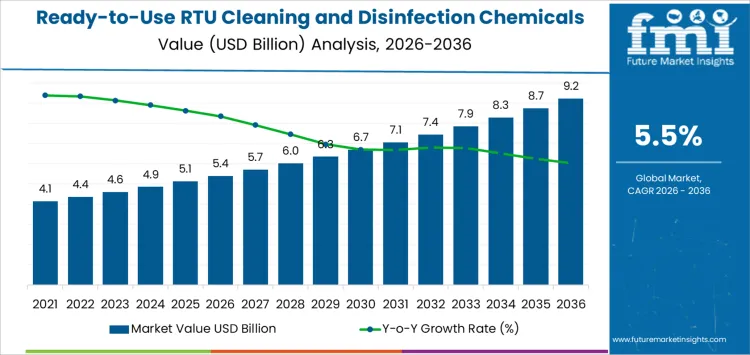
In 2026, the ready to use RTU cleaning and disinfection chemicals market is estimated at USD 5.4 billion and is projected to expand to USD 9.2 billion by 2036, registering a CAGR of 5.5%. Growth from USD 4.0 billion in 2020 reflects steady uptake across commercial facilities, healthcare institutions, and hospitality settings where convenience and time efficiency guide product selection. RTU disinfectants and surface cleaners account for the largest shares due to immediate usability and reduced dilution error. Spray bottles and wipes remain the dominant packaging formats as they support point of use cleaning and standardized application practices.
Between 2027 and 2031, market value rises from USD 5.7 billion to USD 7.5 billion, before progressing toward USD 9.2 billion by 2036 through consistent annual gains. Commercial facilities continue to anchor demand as cleaning frequency remains stable across offices and shared spaces. Healthcare and institutional users maintain predictable consumption tied to compliance requirements and product registration standards. Residential use contributes steady incremental volume through specialty and refill formats. Long term expansion is shaped by routine replacement demand, packaging convenience, and wider acceptance of pre mixed formulations rather than changes in overall cleaning intensity.
Quick Stats of the Ready-to-Use RTU Cleaning and Disinfection Chemicals Market:
- Ready-to-Use RTU Cleaning and Disinfection Chemicals Market Value (2026): USD 5.4 billion
- Ready-to-Use RTU Cleaning and Disinfection Chemicals Market Forecast Value (2036): USD 9.2 billion
- Ready-to-Use RTU Cleaning and Disinfection Chemicals Market Forecast CAGR (2026 to 2036): 5.5%
- Leading Product Category in the Market: RTU Disinfectants (34%)
- Key Growth Regions: China, Brazil, USA, UK, Germany
- Top Players: Clorox, Reckitt, Procter & Gamble, SC Johnson Professional, Ecolab, Diversey, Unilever, 3M, Zep, Betco
What is the Growth Forecast for the Ready-to-Use RTU Cleaning and Disinfection Chemicals Market through 2036?
Between 2026 and 2031, the ready-to-use cleaning and disinfection chemicals market expands from USD 5.4 billion to roughly USD 7.1 billion, reflecting demand rooted in convenience and deployment speed rather than changes in cleaning frequency. Growth in this phase is shaped by wider use across offices, retail spaces, healthcare settings, and transport facilities where pre-diluted formats reduce preparation time and handling variability. Adoption is reinforced by workforce turnover in cleaning operations and the need for consistent outcomes across dispersed sites. Value growth is driven by format preference shifts within existing cleaning budgets rather than new end-use creation.
From 2031 to 2036, the market grows from about USD 7.1 billion to USD 9.2 billion, indicating a stronger uplift in spending intensity. This period reflects broader normalization of RTU formats in contract cleaning, higher per-site usage in high-traffic environments, and expansion across foodservice back-of-house and public infrastructure maintenance. Demand benefits from repeat purchasing patterns, simplified inventory management, and reduced training requirements. Earlier expansion emphasized operational ease, while later growth reflects scale adoption, higher turnover rates of RTU products, and deeper integration into standardized cleaning protocols across global commercial and institutional facilities.
Ready to Use RTU Cleaning and Disinfection Chemicals Market Key Takeaways
| Metric | Value |
|---|---|
| Market Value (2026) | USD 5.4 billion |
| Forecast Value (2036) | USD 9.2 billion |
| Forecast CAGR (2026 to 2036) | 5.50% |
What Is Driving the Demand for the Ready-to-Use RTU Cleaning and Disinfection Chemicals Market from 2026 to 2036?
Use of ready-to-use cleaning and disinfection chemicals expanded as facilities prioritised speed, consistency, and reduced handling risk. Healthcare sites, offices, schools, and retail outlets adopted RTU formats to avoid dilution errors and limit staff exposure to concentrates. Historical demand reflected operational simplicity, especially in environments with high staff turnover or limited training time. Buyers selected RTU products for surface compatibility, stable shelf life, and predictable performance. Consumption patterns aligned with routine wipe-down schedules, infection control protocols, and decentralised cleaning tasks across dispersed facilities.
From 2026 to 2036 demand is expected to grow with expansion of contract cleaning services and decentralised hygiene management. Organisations value RTU products that support rapid deployment across multiple locations without specialised equipment. Product development focuses on low residue formulations, trigger spray ergonomics, and packaging that supports safe disposal. Buyers assess efficacy claims, regulatory compliance, and total cost per application. Demand depends on labour availability, hygiene compliance requirements, and continued preference for simplified cleaning workflows in commercial, institutional, and public environments.
What Is the Demand for the Ready-to-Use RTU Cleaning and Disinfection Chemicals Market by Product Category and Packaging for 2026 to 2036?
From 2026 to 2036, the ready-to-use RTU cleaning and disinfection chemicals market expands as users prioritize speed, consistency, and simplified cleaning routines. RTU disinfectants account for the largest product category share at 34% as facilities rely on pre-diluted solutions for routine hygiene control. Spray bottles dominate packaging at 46% because they support direct application, controlled coverage, and ease of handling across commercial, institutional, and household environments. Demand reflects reduced tolerance for mixing errors, growing reliance on standardized protocols, and rising preference for convenience-led chemical formats.
Why do RTU disinfectants account for 34% of demand in the ready-to-use RTU cleaning and disinfection chemicals market by product category from 2026 to 2036?
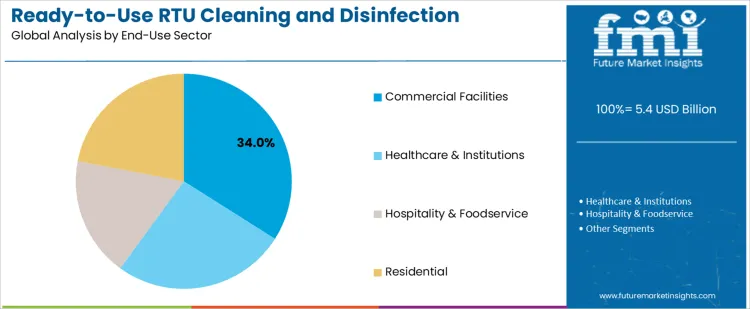
RTU disinfectants account for 34% of demand because they remove dilution steps while delivering verified antimicrobial performance. Consumption intensity remains high in healthcare settings, offices, retail stores, foodservice outlets, and public buildings where surfaces require frequent treatment throughout operating hours. Usage stays consistent as pre-formulated disinfectants align with fixed cleaning schedules and reduce variability between users. Procurement decisions favor products with defined contact times, broad-spectrum efficacy, and surface compatibility across metals, plastics, and coated materials. Buyers value RTU formats that support compliance with hygiene protocols without relying on staff measurement accuracy. Price sensitivity remains moderate because labor efficiency, reduced training time, and lower misuse rates offset per-unit cost differences. Specification control focuses on formulation stability, spray pattern consistency, and residue behavior after drying. Demand remains strong from 2026 to 2036 as organizations maintain heightened hygiene standards and integrate RTU disinfectants into daily operations. Repeat purchasing patterns remain predictable due to continuous surface contact cycles. Substitution pressure from concentrates stays limited where speed, safety, and consistency are prioritized over marginal cost savings.
Why do spray bottles represent 46% of demand in the ready-to-use RTU cleaning and disinfection chemicals market by packaging from 2026 to 2036?
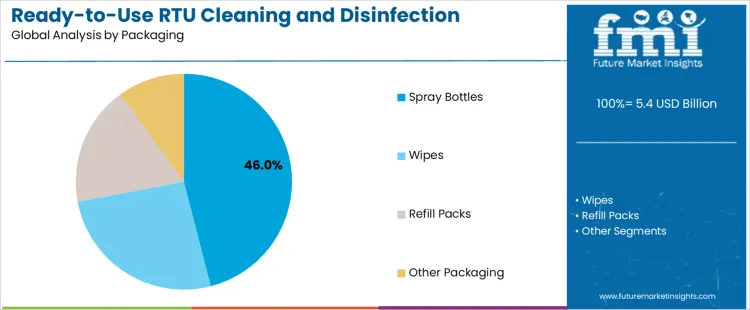
Spray bottles represent 46% of demand because they enable targeted application with minimal preparation and controlled chemical delivery. Consumption is strong across janitorial services, hospitality, healthcare, and household use where users require fast access to cleaning solutions. Usage remains steady as spray packaging supports even coverage on high-touch surfaces such as counters, handles, equipment panels, and fixtures. Procurement favors durable bottles with reliable trigger mechanisms and consistent spray output to reduce fatigue during repeated use. Buyers prioritize packaging that limits leakage, supports one-handed operation, and allows visual monitoring of remaining volume. Price sensitivity remains moderate since packaging reliability directly influences waste reduction and user efficiency. Specification control emphasizes nozzle durability, spray dispersion pattern, and chemical resistance of container materials. Demand continues from 2026 to 2036 as spray bottles remain compatible with RTU formulations and established cleaning practices. Refill compatibility also supports longer packaging lifecycles while maintaining convenience and application precision.
How Is Demand for Ready to Use Cleaning and Disinfection Chemicals Being Defined by Immediate Use Requirements?
Demand develops through facilities that prioritize speed, simplicity, and predictable outcomes in daily sanitation tasks. Healthcare clinics use ready to use products to reduce preparation steps between patient visits. Retail stores rely on RTU sprays for rapid response to spills during operating hours. Transport operators keep RTU disinfectants on hand for spot cleaning of high contact surfaces. Schools select them to support cleaning by non specialist staff during short breaks. These patterns reflect operational needs where preparation time, dilution accuracy, and storage constraints shape purchasing decisions more than formulation flexibility.
What Operational Pressures Are Driving Demand for Ready to Use Cleaning and Disinfection Chemicals? Drivers arise from environments where staff turnover, time limits, and safety rules influence product choice. Hospitals adopt RTU formats to limit handling errors and chemical exposure risks. Contract cleaning firms use them to standardize results across multiple sites without additional training. Food retail outlets prefer RTU disinfectants to meet hygiene checks during peak hours. Public facilities rely on them where temporary staff support cleaning activities. These pressures reflect local workflow realities that favor products requiring minimal setup while delivering consistent performance within structured routines.
What Practical Barriers Are Limiting Wider Adoption of Ready to Use Formats? Barriers relate to cost efficiency, waste generation, and storage logistics. Large facilities find RTU products more expensive per application than concentrates. High volume users generate more packaging waste, which complicates disposal routines. Limited storage space restricts stocking of multiple RTU variants. Some operators prefer adjustable dilution to manage surface sensitivity. Long term supply contracts for bulk chemicals also slow transition. These constraints reduce broader uptake where scale, cost control, and inventory flexibility remain higher priorities than immediate convenience.
What is the Growth Outlook for Ready to Use RTU Cleaning and Disinfection Chemicals Across Key Countries?
| Country | CAGR (%) |
|---|---|
| China | 6.5% |
| Brazil | 6.3% |
| USA | 5.2% |
| UK | 5.2% |
| Germany | 5.1% |
The ready to use cleaning and disinfection chemicals segment is expanding steadily as institutional and commercial users prioritize convenience, safety, and time efficient hygiene practices. China leads at 6.5%, driven by widespread adoption in healthcare facilities, public infrastructure, and high traffic commercial environments. Brazil follows at 6.3%, supported by growing hospitality, retail, and outsourced cleaning services. The USA and UK each record 5.2%, reflecting strong demand from hospitals, offices, and foodservice operators seeking simplified application and reduced handling risks. Germany at 5.1% shows consistent uptake shaped by regulatory compliance and routine sanitation requirements. Overall growth is supported by recurring consumption patterns, standardized hygiene protocols, and preference for pre diluted formulations across professional cleaning applications.
How Are Operational Simplicity Needs Supporting Ready to Use Cleaning and Disinfection Chemicals Demand in the United States?
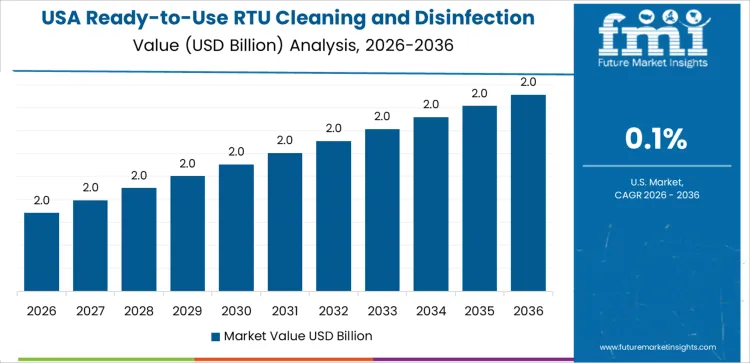
Ready to use cleaning and disinfection chemicals demand in the United States is growing at a CAGR of 5.2% from 2026 to 2036 as healthcare facilities, offices, and commercial sites prioritize products that eliminate on site mixing. Facility managers select RTU formulations to reduce handling errors and training requirements. Healthcare environments rely on pre mixed disinfectants for consistent hygiene routines. Commercial facilities adopt RTU products to support rapid cleaning across shared spaces. Growth reflects steady preference for convenience and reliability in sanitation practices.
- Facility managers adopt RTU products to eliminate mixing errors.
- Healthcare facilities rely on pre mixed disinfectants for hygiene routines.
- Commercial sites use RTU chemicals for rapid surface cleaning.
What Is Driving Ready to Use Cleaning and Disinfection Chemicals Adoption in Germany?
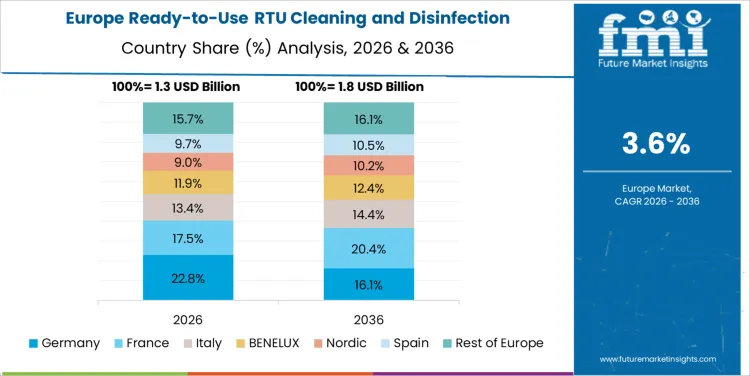
Ready to use cleaning and disinfection chemicals demand in Germany is expanding at a CAGR of 5.1% from 2026 to 2036 as industrial sites, offices, and public institutions integrate pre mixed solutions into maintenance routines. Industrial facilities rely on RTU products to maintain consistent application across work zones. Office buildings adopt RTU disinfectants to support daily cleaning. Public institutions integrate these products into standardized sanitation programs. Growth reflects disciplined adoption driven by safety and operational consistency.
- Industrial facilities use RTU products for consistent application.
- Offices adopt pre mixed disinfectants for daily cleaning.
- Public institutions integrate RTU chemicals into sanitation programs.
Why Is China Recording Higher Growth in Ready to Use Cleaning and Disinfection Chemicals Demand?
Ready to use cleaning and disinfection chemicals demand in China is increasing at a CAGR of 6.5% from 2026 to 2036 as commercial complexes, healthcare facilities, and manufacturing plants adopt convenient sanitation solutions. Commercial complexes use RTU products to manage high traffic areas. Healthcare facilities rely on ready formulations to maintain hygiene standards. Manufacturing plants apply RTU chemicals to simplify cleaning workflows. Growth reflects broad adoption across expanding facilities nationwide.
- Commercial complexes use RTU products for high traffic areas.
- Healthcare facilities rely on ready formulations for hygiene control.
- Manufacturing plants apply RTU chemicals to simplify workflows.
How Are Service Sector Needs Influencing Demand in the United Kingdom?
Ready to use cleaning and disinfection chemicals demand in the United Kingdom is growing at a CAGR of 5.2% from 2026 to 2036 as offices, hospitality venues, and healthcare sites favor convenient sanitation products. Office managers select RTU cleaners to support quick turnaround between cleaning cycles. Hospitality venues rely on ready disinfectants to maintain guest areas. Healthcare sites use pre mixed products to ensure consistent sanitation. Growth reflects steady preference for ease of use across service environments.
- Offices select RTU cleaners for quick turnaround cleaning.
- Hospitality venues rely on ready disinfectants for guest areas.
- Healthcare sites use pre mixed products for sanitation consistency.
What Is Supporting Demand Growth in Brazil?
Ready to use cleaning and disinfection chemicals demand in Brazil is expanding at a CAGR of 6.3% from 2026 to 2036 as commercial facilities, public buildings, and service providers adopt convenient sanitation solutions. Commercial facilities use RTU products to manage daily cleaning. Public buildings rely on ready formulations for routine disinfection. Service providers integrate RTU chemicals to support efficiency across multiple sites. Growth reflects increasing demand for practical sanitation products across diverse environments.
- Commercial facilities use RTU products for daily cleaning needs.
- Public buildings rely on ready formulations for routine disinfection.
- Service providers integrate RTU chemicals for operational efficiency.
What Is Driving the Demand for Ready to Use RTU Cleaning and Disinfection Chemicals and Which Companies Shape Institutional and Household Use?
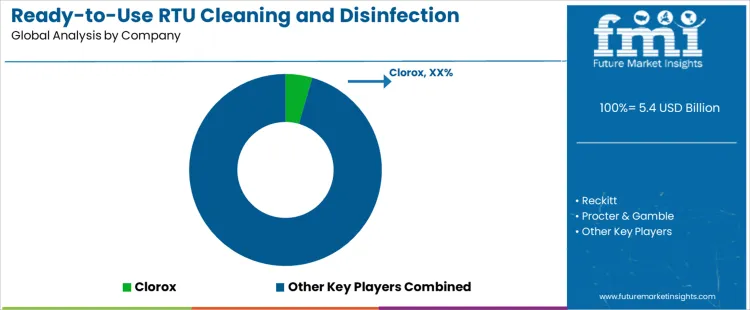
Demand for ready to use cleaning and disinfection chemicals is driven by preference for convenience, reduced handling risk, and faster turnaround in high traffic environments. Hospitals, offices, schools, and retail outlets rely on RTU formats to eliminate dilution errors and simplify staff training. Ecolab and Diversey support institutional demand through surface specific disinfectants supplied for healthcare and foodservice settings. SC Johnson Professional and 3M serve workplaces and public buildings with wipe and spray based RTU solutions designed for frequent use. Zep and Betco support contract cleaning firms that require portable products across multiple sites. These formats reduce preparation time and support consistent hygiene execution.
Household and light commercial demand is shaped by time constrained consumers and strong awareness of surface hygiene. Clorox, Reckitt, Procter and Gamble, and Unilever influence retail adoption through branded RTU sprays and wipes used in kitchens, bathrooms, and shared living spaces. Buyers focus on kill claims, surface compatibility, and residue control. Retailers favor products with clear labeling and stable shelf life. Usage expands in childcare facilities, fitness centers, and transportation hubs where immediate application is required. Demand visibility tracks growth in convenience driven cleaning habits, increased outsourcing of janitorial services, and steady preference for simplified disinfection solutions in occupied spaces.
Key Players in the Ready to Use RTU Cleaning and Disinfection Chemicals Market
- Clorox
- Reckitt
- Procter & Gamble
- SC Johnson Professional
- Ecolab
- Diversey
- Unilever
- 3M
- Zep
- Betco
Scope of the Report
| Items | Values |
|---|---|
| Quantitative Units (2026) | USD billion |
| Product Category | RTU Disinfectants; RTU Surface Cleaners; RTU Degreasers; RTU Specialty Cleaners |
| Packaging | Spray Bottles; Wipes; Refill Packs; Other Packaging |
| End Use Sector | Commercial Facilities; Healthcare and Institutions; Hospitality and Foodservice; Residential |
| Compliance and Claims | Hospital Grade and Registered Disinfectants; Low Odor and Low VOC RTU; Eco Labeled RTU; Standard RTU |
| Regions Covered | Asia Pacific; Europe; North America; Latin America; Middle East and Africa |
| Countries Covered | China; Japan; South Korea; India; Australia and New Zealand; ASEAN; Germany; United Kingdom; France; Italy; Spain; Nordic; BENELUX; United States; Canada; Mexico; Brazil; Chile; Kingdom of Saudi Arabia; Turkey; South Africa; plus 40+ additional countries across Asia Pacific, Europe, Latin America, and Middle East and Africa |
| Key Companies Profiled | Clorox; Reckitt; Procter and Gamble; SC Johnson Professional; Ecolab; Diversey; Unilever; 3M; Zep; Betco |
| Additional Attributes | Dollar by sales across product categories, packaging formats, end use sectors, and compliance claims; RTU versus concentrate substitution trends; spray and wipe consumption patterns in high traffic environments; refill adoption and packaging lifecycle considerations; workforce turnover impact on RTU preference; storage and logistics requirements for pre mixed formulations; regulatory registration and labeling requirements; role of contract cleaning services in RTU standardization; inventory turnover and point of use deployment characteristics |
RTU Cleaning and Disinfection Chemicals Market Segmentation
Product Category:
- RTU Disinfectants
- RTU Surface Cleaners
- RTU Degreasers
- RTU Specialty Cleaners
Packaging:
- Spray Bottles
- Wipes
- Refill Packs
- Other Packaging
End-Use Sector:
- Commercial Facilities
- Healthcare & Institutions
- Hospitality & Foodservice
- Residential
Compliance/Claims:
- Hospital-Grade / Registered Disinfectants
- Low-Odor / Low-VOC RTU
- Eco-Labeled RTU
- Standard RTU
Region
- Asia Pacific
- China
- Japan
- South Korea
- India
- Australia & New Zealand
- ASEAN
- Rest of Asia Pacific
- Europe
- Germany
- United Kingdom
- France
- Italy
- Spain
- Nordic
- BENELUX
- Rest of Europe
- North America
- United States
- Canada
- Mexico
- Latin America
- Brazil
- Chile
- Rest of Latin America
- Middle East & Africa
- Kingdom of Saudi Arabia
- Other GCC Countries
- Turkey
- South Africa
- Other African Union
- Rest of Middle East & Africa
Frequently Asked Questions
How big is the ready-to-use RTU cleaning and disinfection chemicals market in 2026?
The global ready-to-use RTU cleaning and disinfection chemicals market is estimated to be valued at USD 5.4 billion in 2026.
What will be the size of ready-to-use RTU cleaning and disinfection chemicals market in 2036?
The market size for the ready-to-use RTU cleaning and disinfection chemicals market is projected to reach USD 9.2 billion by 2036.
How much will be the ready-to-use RTU cleaning and disinfection chemicals market growth between 2026 and 2036?
The ready-to-use RTU cleaning and disinfection chemicals market is expected to grow at a 5.5% CAGR between 2026 and 2036.
What are the key product types in the ready-to-use RTU cleaning and disinfection chemicals market?
The key product types in ready-to-use RTU cleaning and disinfection chemicals market are RTU disinfectants, RTU surface cleaners, RTU degreasers and RTU specialty cleaners.
Which packaging segment to contribute significant share in the ready-to-use RTU cleaning and disinfection chemicals market in 2026?
In terms of packaging, spray bottles segment to command 46.0% share in the ready-to-use RTU cleaning and disinfection chemicals market in 2026.
Preview the report firsthand - request a free sample
Get SampleGet the brochure for pricing and purchase details.
Get PDFTable of Content
- Executive Summary
- Global Market Outlook
- Demand-side Trends
- Supply-side Trends
- Technology Roadmap Analysis
- Analysis and Recommendations
- Market Overview
- Market Coverage / Taxonomy
- Market Definition / Scope / Limitations
- Market Background
- Market Dynamics
- Drivers
- Restraints
- Opportunity
- Trends
- Scenario Forecast
- Demand in Optimistic Scenario
- Demand in Likely Scenario
- Demand in Conservative Scenario
- Opportunity Map Analysis
- Product Life Cycle Analysis
- Supply Chain Analysis
- Investment Feasibility Matrix
- Value Chain Analysis
- PESTLE and Porter’s Analysis
- Regulatory Landscape
- Regional Parent Market Outlook
- Production and Consumption Statistics
- Import and Export Statistics
- Market Dynamics
- Global Market Analysis 2021 to 2025 and Forecast, 2026 to 2036
- Historical Market Size Value (USD Million) Analysis, 2021 to 2025
- Current and Future Market Size Value (USD Million) Projections, 2026 to 2036
- Y-o-Y Growth Trend Analysis
- Absolute $ Opportunity Analysis
- Global Market Pricing Analysis 2021 to 2025 and Forecast 2026 to 2036
- Global Market Analysis 2021 to 2025 and Forecast 2026 to 2036, By Product Category
- Introduction / Key Findings
- Historical Market Size Value (USD Million) Analysis By Product Category , 2021 to 2025
- Current and Future Market Size Value (USD Million) Analysis and Forecast By Product Category , 2026 to 2036
- RTU Disinfectants
- RTU Surface Cleaners
- RTU Degreasers
- RTU Specialty Cleaners
- Y-o-Y Growth Trend Analysis By Product Category , 2021 to 2025
- Absolute $ Opportunity Analysis By Product Category , 2026 to 2036
- Global Market Analysis 2021 to 2025 and Forecast 2026 to 2036, By Packaging
- Introduction / Key Findings
- Historical Market Size Value (USD Million) Analysis By Packaging, 2021 to 2025
- Current and Future Market Size Value (USD Million) Analysis and Forecast By Packaging, 2026 to 2036
- Spray Bottles
- Wipes
- Refill Packs
- Other Packaging
- Y-o-Y Growth Trend Analysis By Packaging, 2021 to 2025
- Absolute $ Opportunity Analysis By Packaging, 2026 to 2036
- Global Market Analysis 2021 to 2025 and Forecast 2026 to 2036, By End-Use Sector
- Introduction / Key Findings
- Historical Market Size Value (USD Million) Analysis By End-Use Sector, 2021 to 2025
- Current and Future Market Size Value (USD Million) Analysis and Forecast By End-Use Sector, 2026 to 2036
- Commercial Facilities
- Healthcare & Institutions
- Hospitality & Foodservice
- Residential
- Y-o-Y Growth Trend Analysis By End-Use Sector, 2021 to 2025
- Absolute $ Opportunity Analysis By End-Use Sector, 2026 to 2036
- Global Market Analysis 2021 to 2025 and Forecast 2026 to 2036, By Compliance/Claims
- Introduction / Key Findings
- Historical Market Size Value (USD Million) Analysis By Compliance/Claims, 2021 to 2025
- Current and Future Market Size Value (USD Million) Analysis and Forecast By Compliance/Claims, 2026 to 2036
- Hospital-Grade / Registered Disinfectants
- Low-Odor / Low-VOC RTU
- Eco-Labeled RTU
- Standard RTU
- Y-o-Y Growth Trend Analysis By Compliance/Claims, 2021 to 2025
- Absolute $ Opportunity Analysis By Compliance/Claims, 2026 to 2036
- Global Market Analysis 2021 to 2025 and Forecast 2026 to 2036, By Region
- Introduction
- Historical Market Size Value (USD Million) Analysis By Region, 2021 to 2025
- Current Market Size Value (USD Million) Analysis and Forecast By Region, 2026 to 2036
- North America
- Latin America
- Western Europe
- Eastern Europe
- East Asia
- South Asia and Pacific
- Middle East & Africa
- Market Attractiveness Analysis By Region
- North America Market Analysis 2021 to 2025 and Forecast 2026 to 2036, By Country
- Historical Market Size Value (USD Million) Trend Analysis By Market Taxonomy, 2021 to 2025
- Market Size Value (USD Million) Forecast By Market Taxonomy, 2026 to 2036
- By Country
- USA
- Canada
- Mexico
- By Product Category
- By Packaging
- By End-Use Sector
- By Compliance/Claims
- By Country
- Market Attractiveness Analysis
- By Country
- By Product Category
- By Packaging
- By End-Use Sector
- By Compliance/Claims
- Key Takeaways
- Latin America Market Analysis 2021 to 2025 and Forecast 2026 to 2036, By Country
- Historical Market Size Value (USD Million) Trend Analysis By Market Taxonomy, 2021 to 2025
- Market Size Value (USD Million) Forecast By Market Taxonomy, 2026 to 2036
- By Country
- Brazil
- Chile
- Rest of Latin America
- By Product Category
- By Packaging
- By End-Use Sector
- By Compliance/Claims
- By Country
- Market Attractiveness Analysis
- By Country
- By Product Category
- By Packaging
- By End-Use Sector
- By Compliance/Claims
- Key Takeaways
- Western Europe Market Analysis 2021 to 2025 and Forecast 2026 to 2036, By Country
- Historical Market Size Value (USD Million) Trend Analysis By Market Taxonomy, 2021 to 2025
- Market Size Value (USD Million) Forecast By Market Taxonomy, 2026 to 2036
- By Country
- Germany
- UK
- Italy
- Spain
- France
- Nordic
- BENELUX
- Rest of Western Europe
- By Product Category
- By Packaging
- By End-Use Sector
- By Compliance/Claims
- By Country
- Market Attractiveness Analysis
- By Country
- By Product Category
- By Packaging
- By End-Use Sector
- By Compliance/Claims
- Key Takeaways
- Eastern Europe Market Analysis 2021 to 2025 and Forecast 2026 to 2036, By Country
- Historical Market Size Value (USD Million) Trend Analysis By Market Taxonomy, 2021 to 2025
- Market Size Value (USD Million) Forecast By Market Taxonomy, 2026 to 2036
- By Country
- Russia
- Poland
- Hungary
- Balkan & Baltic
- Rest of Eastern Europe
- By Product Category
- By Packaging
- By End-Use Sector
- By Compliance/Claims
- By Country
- Market Attractiveness Analysis
- By Country
- By Product Category
- By Packaging
- By End-Use Sector
- By Compliance/Claims
- Key Takeaways
- East Asia Market Analysis 2021 to 2025 and Forecast 2026 to 2036, By Country
- Historical Market Size Value (USD Million) Trend Analysis By Market Taxonomy, 2021 to 2025
- Market Size Value (USD Million) Forecast By Market Taxonomy, 2026 to 2036
- By Country
- China
- Japan
- South Korea
- By Product Category
- By Packaging
- By End-Use Sector
- By Compliance/Claims
- By Country
- Market Attractiveness Analysis
- By Country
- By Product Category
- By Packaging
- By End-Use Sector
- By Compliance/Claims
- Key Takeaways
- South Asia and Pacific Market Analysis 2021 to 2025 and Forecast 2026 to 2036, By Country
- Historical Market Size Value (USD Million) Trend Analysis By Market Taxonomy, 2021 to 2025
- Market Size Value (USD Million) Forecast By Market Taxonomy, 2026 to 2036
- By Country
- India
- ASEAN
- Australia & New Zealand
- Rest of South Asia and Pacific
- By Product Category
- By Packaging
- By End-Use Sector
- By Compliance/Claims
- By Country
- Market Attractiveness Analysis
- By Country
- By Product Category
- By Packaging
- By End-Use Sector
- By Compliance/Claims
- Key Takeaways
- Middle East & Africa Market Analysis 2021 to 2025 and Forecast 2026 to 2036, By Country
- Historical Market Size Value (USD Million) Trend Analysis By Market Taxonomy, 2021 to 2025
- Market Size Value (USD Million) Forecast By Market Taxonomy, 2026 to 2036
- By Country
- Kingdom of Saudi Arabia
- Other GCC Countries
- Turkiye
- South Africa
- Other African Union
- Rest of Middle East & Africa
- By Product Category
- By Packaging
- By End-Use Sector
- By Compliance/Claims
- By Country
- Market Attractiveness Analysis
- By Country
- By Product Category
- By Packaging
- By End-Use Sector
- By Compliance/Claims
- Key Takeaways
- Key Countries Market Analysis
- USA
- Pricing Analysis
- Market Share Analysis, 2025
- By Product Category
- By Packaging
- By End-Use Sector
- By Compliance/Claims
- Canada
- Pricing Analysis
- Market Share Analysis, 2025
- By Product Category
- By Packaging
- By End-Use Sector
- By Compliance/Claims
- Mexico
- Pricing Analysis
- Market Share Analysis, 2025
- By Product Category
- By Packaging
- By End-Use Sector
- By Compliance/Claims
- Brazil
- Pricing Analysis
- Market Share Analysis, 2025
- By Product Category
- By Packaging
- By End-Use Sector
- By Compliance/Claims
- Chile
- Pricing Analysis
- Market Share Analysis, 2025
- By Product Category
- By Packaging
- By End-Use Sector
- By Compliance/Claims
- Germany
- Pricing Analysis
- Market Share Analysis, 2025
- By Product Category
- By Packaging
- By End-Use Sector
- By Compliance/Claims
- UK
- Pricing Analysis
- Market Share Analysis, 2025
- By Product Category
- By Packaging
- By End-Use Sector
- By Compliance/Claims
- Italy
- Pricing Analysis
- Market Share Analysis, 2025
- By Product Category
- By Packaging
- By End-Use Sector
- By Compliance/Claims
- Spain
- Pricing Analysis
- Market Share Analysis, 2025
- By Product Category
- By Packaging
- By End-Use Sector
- By Compliance/Claims
- France
- Pricing Analysis
- Market Share Analysis, 2025
- By Product Category
- By Packaging
- By End-Use Sector
- By Compliance/Claims
- India
- Pricing Analysis
- Market Share Analysis, 2025
- By Product Category
- By Packaging
- By End-Use Sector
- By Compliance/Claims
- ASEAN
- Pricing Analysis
- Market Share Analysis, 2025
- By Product Category
- By Packaging
- By End-Use Sector
- By Compliance/Claims
- Australia & New Zealand
- Pricing Analysis
- Market Share Analysis, 2025
- By Product Category
- By Packaging
- By End-Use Sector
- By Compliance/Claims
- China
- Pricing Analysis
- Market Share Analysis, 2025
- By Product Category
- By Packaging
- By End-Use Sector
- By Compliance/Claims
- Japan
- Pricing Analysis
- Market Share Analysis, 2025
- By Product Category
- By Packaging
- By End-Use Sector
- By Compliance/Claims
- South Korea
- Pricing Analysis
- Market Share Analysis, 2025
- By Product Category
- By Packaging
- By End-Use Sector
- By Compliance/Claims
- Russia
- Pricing Analysis
- Market Share Analysis, 2025
- By Product Category
- By Packaging
- By End-Use Sector
- By Compliance/Claims
- Poland
- Pricing Analysis
- Market Share Analysis, 2025
- By Product Category
- By Packaging
- By End-Use Sector
- By Compliance/Claims
- Hungary
- Pricing Analysis
- Market Share Analysis, 2025
- By Product Category
- By Packaging
- By End-Use Sector
- By Compliance/Claims
- Kingdom of Saudi Arabia
- Pricing Analysis
- Market Share Analysis, 2025
- By Product Category
- By Packaging
- By End-Use Sector
- By Compliance/Claims
- Turkiye
- Pricing Analysis
- Market Share Analysis, 2025
- By Product Category
- By Packaging
- By End-Use Sector
- By Compliance/Claims
- South Africa
- Pricing Analysis
- Market Share Analysis, 2025
- By Product Category
- By Packaging
- By End-Use Sector
- By Compliance/Claims
- USA
- Market Structure Analysis
- Competition Dashboard
- Competition Benchmarking
- Market Share Analysis of Top Players
- By Regional
- By Product Category
- By Packaging
- By End-Use Sector
- By Compliance/Claims
- Competition Analysis
- Competition Deep Dive
- Clorox
- Overview
- Product Portfolio
- Profitability by Market Segments (Product/Age /Sales Channel/Region)
- Sales Footprint
- Strategy Overview
- Marketing Strategy
- Product Strategy
- Channel Strategy
- Reckitt
- Procter & Gamble
- SC Johnson Professional
- Ecolab
- Diversey
- Unilever
- 3M
- Zep
- Betco
- Clorox
- Competition Deep Dive
- Assumptions & Acronyms Used
- Research Methodology


