

- Industry Size (2026)
- USD 561 Mn
- Forecast (2036)
- USD 1369.1 Mn
- CAGR (2026 to 2036)
- 9.2%
Disinfection Byproduct Control Chemicals in Drinking Water Market Forecast and Outlook 2026 to 2036
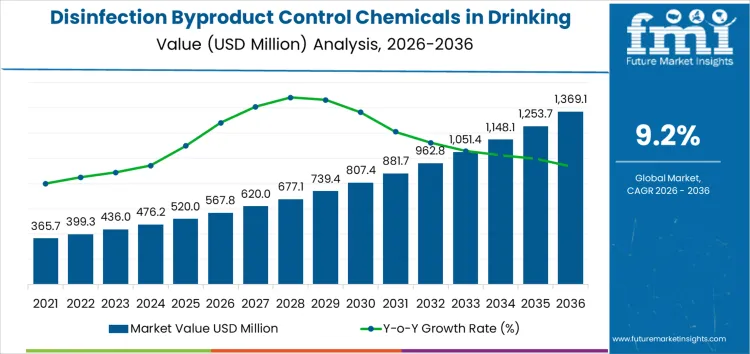
The disinfection byproduct (DBP) control chemicals market is estimated at USD 561 million in 2026 and is projected to reach USD 1,369.1 million by 2036, reflecting a CAGR of 9.2%. Early-stage growth between 2026 and 2028 is driven by municipal drinking water plants and industrial potable water systems adopting activated carbon, adsorbents, and chlorine scavengers to meet regulatory standards. Rising awareness of DBP-related health risks and enforcement of stricter water quality regulations mark the first adoption plateau for these solutions.
Between 2030 and 2034, the market experiences accelerated expansion as bio-based DBP control agents, pH adjusters, and coagulant aids gain traction across residential, commercial, and decentralized water systems. Household point-of-entry filtration systems contribute to demand growth, complementing industrial adoption. Companies are focusing on advanced adsorption technologies and specialty chemistries to improve efficiency, regulatory compliance, and safety outcomes, establishing a second significant growth breakpoint ahead of full-scale market maturity by 2036.
Quick Stats for Disinfection Byproduct Control Chemicals in Drinking Water Market
- Disinfection Byproduct Control Chemicals in Drinking Water Market Value (2026): USD 561 million
- Disinfection Byproduct Control Chemicals in Drinking Water Market Forecast Value (2036): USD 1,369.1 million
- Disinfection Byproduct Control Chemicals in Drinking Water Market Forecast CAGR: 9.2%
- Leading Type in Disinfection Byproduct Control Chemicals in Drinking Water Market: Activated Carbon & Adsorbents
- Key Growth Regions in Disinfection Byproduct Control Chemicals in Drinking Water Market: North America, Europe, and Asia Pacific
- Top Players in Disinfection Byproduct Control Chemicals in Drinking Water Market: Kemira, Ecolab, Solenis, Veolia Water Technologies, SUEZ Water Technologies
What is the Growth Forecast for the Disinfection Byproduct Control Chemicals in Drinking Water Market through 2036?
From 2026 to 2031, the disinfection byproduct control chemicals market grows from USD 561 million to approximately USD 829 million, representing the early adoption phase. Annual increments rise from USD 56 million in 2026 to USD 77 million in 2031. Growth is driven by adoption in municipal water treatment plants and industrial facilities where regulatory standards demand reduction of disinfection byproducts to ensure safe drinking water. North America and Europe account for roughly 65% of early adoption, with uptake concentrated in high-volume urban water networks validating chemical efficacy, regulatory compliance, and integration into existing treatment processes.
Between 2031 and 2036, the market expands from roughly USD 829 million to USD 1,418 million, illustrating the late adoption phase characterized by broader commercialization and multi-site deployment. Annual increments increase from USD 77 million to USD 132 million, driven by repeat procurement, multi-reservoir adoption, and expansion into emerging regions in Asia Pacific and Latin America. Growth is reinforced by regulatory mandates, increasing population and urbanization, and structural integration of disinfection byproduct control chemicals into automated and large-scale water treatment systems. Early-stage growth relied on selective pilot programs, while later expansion reflects normalized adoption across global drinking water networks.
Disinfection Byproduct Control Chemicals in Drinking Water Market Key Takeaways
| Metric | Value |
|---|---|
| Market Value (2026) | USD 561 million |
| Forecast Value (2036) | USD 1,369.1 million |
| Forecast CAGR (2026 to 2036) | 9.2% |
What Is Driving Growth in the Disinfection Byproduct Control Chemicals in Drinking Water Market?
Demand for disinfection byproduct control chemicals in drinking water emerged from limitations in traditional disinfection practices rather than general treatment expansion alone. Chlorination and other common disinfectants successfully inactivated pathogens, but they also reacted with natural organic matter and other precursors in source water to form regulated byproducts such as trihalomethanes and haloacetic acids. Water utilities observed compliance challenges with maximum contaminant levels, public concern over long-term health risks, and pressure from regulators to reduce byproduct formation. Initial adoption of control chemicals focused on precursor removal, alternative oxidants, and scavengers that reduced reaction pathways rather than on broader water quality planning.
Future demand in this market is being shaped by tightening regulatory standards, source water protection strategies, and integrated treatment optimization rather than by isolated byproduct concerns alone. Regulatory agencies are lowering allowable disinfection byproduct thresholds and requiring more frequent monitoring, prompting utilities to adopt chemicals that control precursor levels upstream of disinfection and minimise byproduct formation. Formulations such as enhanced coagulants, adsorbents, and targeted scavengers are integrated into treatment trains to stabilise organics before they can form harmful compounds. Utilities are also aligning chemical selection with source water characteristics, seasonal variation in organic loads, and optimisation of disinfection processes to balance microbial safety with byproduct control. Growth will follow documented compliance needs and performance testing that demonstrates consistent achievement of regulatory targets, rather than simple expansion of disinfection capacity.
What Factors Are Affecting the Demand for Disinfection Byproduct Control Chemicals in Drinking Water Market in Terms of Chemical Type and Application Area?
The disinfection byproduct control chemicals market in drinking water is shaped by tightening health regulations, rising concern over long term exposure risks, and upgrades to water treatment infrastructure. Utilities focus on reducing regulated byproducts while maintaining effective disinfection performance. Demand concentrates on solutions that integrate smoothly into existing treatment trains and demonstrate predictable performance. Market leadership reflects regulatory compliance pressure, public health accountability, and operational reliability rather than experimentation with novel chemistries.
What Is Driving Leadership by Chemical Type in the Disinfection By product Control Chemicals Market?
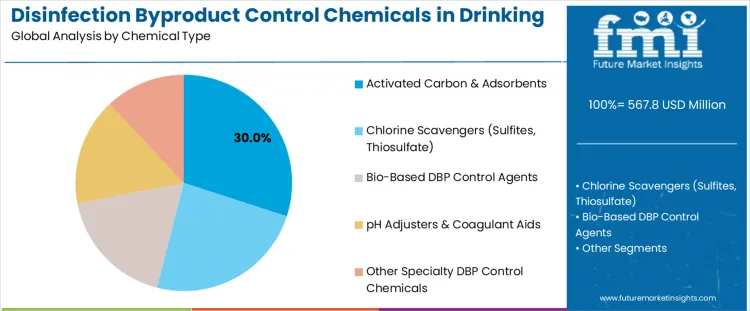
Activated carbon and adsorbents account for about 30% of demand because they provide effective removal of DBP precursors and formed byproducts without disrupting core disinfection processes. Utilities adopt these materials to control taste, odor, and organic content while reducing trihalomethanes and haloacetic acids. Their compatibility with granular and powdered dosing systems supports flexible integration. Proven performance and regulatory familiarity reinforce adoption across large scale municipal treatment plants worldwide today.
Chlorine scavengers, bio based DBP control agents, pH adjusters, and specialty chemicals address specific treatment challenges but remain more situational. Scavengers neutralize residual disinfectants in controlled contexts. Bio based agents appeal where chemical reduction is prioritized. pH and coagulant aids optimize upstream conditions. These options complement adsorbents rather than replace them, reinforcing leadership driven by broad applicability, predictable outcomes, and operational familiarity across diverse water treatment configurations globally.
What Is Driving Leadership by Application Area in the Disinfection By product Control Chemicals Market?
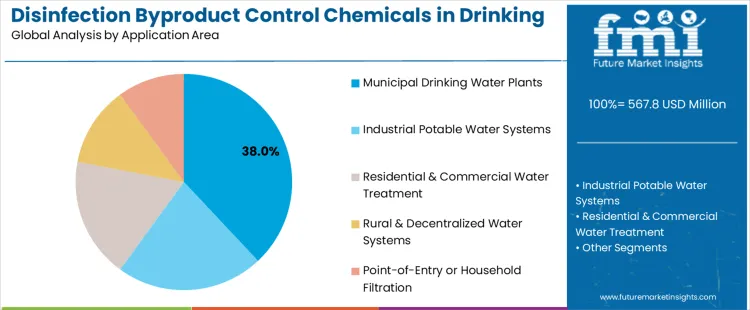
Municipal drinking water plants represent about 38% of demand because they operate under the strictest regulatory oversight and serve large populations. DBP compliance is a central performance metric for utilities, driving consistent use of control chemicals. Large scale treatment plants benefit from economies of scale and standardized dosing systems, supporting adoption of adsorbents and coagulant aids. Continuous monitoring requirements reinforce recurring demand across municipal networks globally today.
Industrial potable systems, residential treatment, rural systems, and point of entry filtration represent secondary applications. Industrial users focus on compliance for workforce safety. Residential and commercial systems adopt DBP control selectively through filtration products. Rural systems face budget and infrastructure limits. These segments contribute incremental demand but lack the scale and consistency of municipal utilities. Application leadership therefore reflects regulatory intensity, population exposure, and centralized treatment responsibility rather than total number of treatment points.
How Are Disinfection Byproduct Control Chemicals Being Applied Across Drinking Water Treatment Systems?
Use appears in municipal and industrial water treatment facilities where chlorine or chloramine disinfection can form harmful byproducts such as trihalomethanes (THMs) and haloacetic acids (HAAs). Operators incorporate control chemicals, including precursors scavengers, inhibitors, or alternative oxidants, to reduce byproduct formation while maintaining microbial safety. Facilities supplying potable water, bottling plants, and industrial process water adopt these chemicals to comply with regulatory limits and protect public health. These applications reflect operational and safety priorities rather than aesthetic objectives, with adoption driven by regulatory compliance, water quality, and operational efficiency.
What Operational and Material Conditions Support Adoption of Disinfection Byproduct Control Chemicals?
Selection aligns with treatment systems using chlorine, chloramine, or other oxidants where precursor compounds such as natural organic matter are present. Chemicals are formulated to react selectively, minimize residual toxicity, and remain compatible with downstream filtration and distribution infrastructure. Water treatment teams monitor dosing, contact time, pH, and temperature to optimize efficacy. Facilities implement real-time and laboratory testing protocols to ensure compliance with THM and HAA limits. These conditions emerge from operational reliability, regulatory adherence, and water quality assurance priorities in structured water treatment workflows.
Which Practical Considerations Limit Wider Use of Disinfection By product Control Chemicals?
Effectiveness can be reduced in highly variable source water with fluctuating organic loads. Cost per volume may be higher than conventional disinfectants. Chemical compatibility with coagulants, corrosion inhibitors, and filtration media must be verified. Regulatory approvals and reporting requirements vary across jurisdictions. These factors lead to selective deployment where byproduct control, water quality, and compliance justify incremental cost and operational monitoring.
What is the Demand for Disinfection Byproduct Control Chemicals in Drinking Water by Country?
| Country | CAGR (%) |
|---|---|
| India | 10.0% |
| China | 9.7% |
| USA | 8.2% |
| Germany | 7.6% |
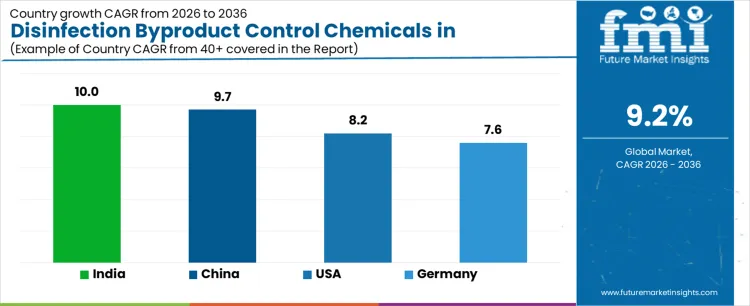
The demand for disinfection byproduct control chemicals in drinking water varies across countries, driven by regulatory compliance, water quality standards, and industrial and municipal water treatment needs. India leads with a 10.0% CAGR, supported by growing urban populations, expanding municipal water systems, and focus on safe drinking water. China follows at 9.7%, driven by large scale water treatment infrastructure and adoption of chemicals to control disinfection byproducts. The USA grows at 8.2%, reflecting steady regulatory enforcement and water safety initiatives. Germany records 7.6%, shaped by mature water treatment systems, strict environmental standards, and consistent use of disinfection byproduct control chemicals.
How Are Disinfection Byproduct Control Chemicals Supporting Drinking Water Safety in India?
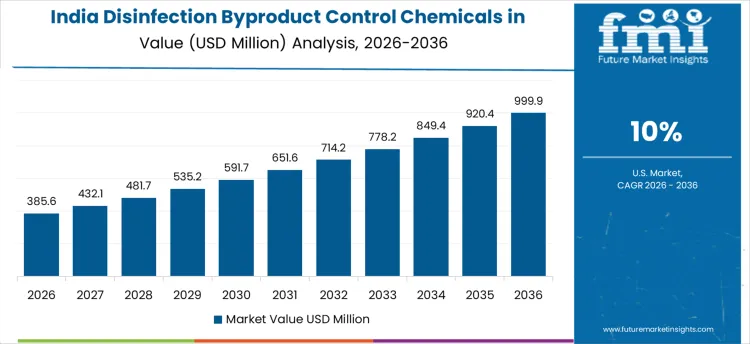
In India, the Disinfection Byproduct Control Chemicals in Drinking Water Market is expanding at a CAGR of 10% through 2036, driven by growing adoption of chemical solutions to reduce harmful byproducts from chlorination and other disinfection processes. Municipal water utilities and industrial water treatment facilities are integrating these chemicals to maintain safe water quality, comply with regulatory standards, and prevent health risks. Demand is concentrated in urban water supply networks, municipal treatment plants, and large industrial facilities. Domestic suppliers provide high-performance, regulatory-compliant chemicals compatible with existing treatment infrastructures. Recurring water treatment cycles and rising population water demand are sustaining robust adoption nationwide.
- Urban water supply networks, municipal plants, and industrial facilities drive adoption
- Chemicals reduce harmful disinfection byproducts and maintain safe water quality
- Domestic suppliers provide regulatory-compliant, high-performance solutions
- Recurring treatment cycles sustain robust adoption
How Are Regulatory Standards Driving Adoption in China?
In China, revenue is growing at a CAGR of 9.7% through 2036, supported by strict water safety regulations and increasing demand for safe drinking water. Municipal utilities and industrial treatment facilities are using disinfection byproduct control chemicals to reduce chlorination byproducts, improve water quality, and meet environmental compliance requirements. Demand is concentrated in urban municipal water plants, industrial water systems, and large-scale treatment facilities. Domestic suppliers are scaling production of chemicals compatible with various water treatment technologies. Expansion of urban water infrastructure, regulatory enforcement, and recurring treatment programs are sustaining rapid adoption nationwide.
- Municipal water plants, industrial systems, and treatment facilities drive adoption
- Chemicals reduce chlorination byproducts and improve water safety
- Domestic suppliers scale compatible, high-performance solutions
- Recurring treatment programs sustain rapid adoption
How Is Drinking Water Safety Driving Growth in the United States?
In the United States, the market is expanding at a CAGR of 8.2% through 2036, driven by adoption of chemicals to control disinfection byproducts in municipal and industrial water systems. Water utilities are integrating these solutions to reduce trihalomethanes, haloacetic acids, and other byproducts while maintaining safe drinking water standards. Demand is concentrated in urban water treatment plants, industrial facilities, and municipal water networks. Domestic suppliers provide high-performance, regulatory-compliant chemicals compatible with existing treatment technologies. Regulatory oversight, recurring water treatment schedules, and public health initiatives are sustaining predictable adoption nationwide.
- Urban water treatment plants, industrial facilities, and municipal networks drive adoption
- Chemicals reduce disinfection byproducts and maintain safe drinking water
- Domestic suppliers provide regulatory-compliant, high-performance solutions
- Recurring treatment schedules sustain predictable adoption
How Are Water Quality Standards Supporting Adoption in Germany?
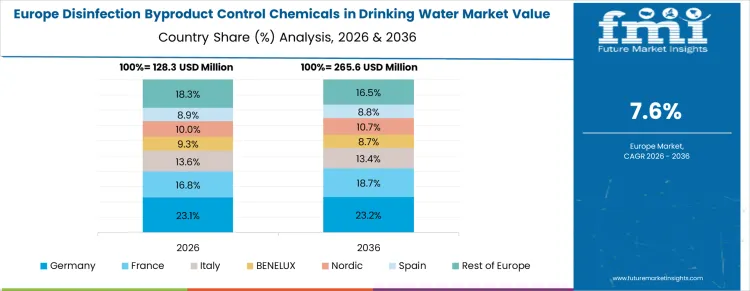
In Germany, revenue is growing at a CAGR of 7.6% through 2036, driven by strict regulations on drinking water quality and industrial discharge limits. Municipal utilities and industrial water treatment facilities are adopting disinfection byproduct control chemicals to minimize harmful compounds and ensure compliance with EU and national standards. Demand is concentrated in municipal water treatment plants, industrial facilities, and urban distribution networks. Domestic suppliers provide high-performance, environmentally compatible chemicals compatible with advanced treatment processes. Regulatory enforcement, recurring water treatment operations, and growing public health awareness are sustaining steady adoption nationwide.
- Municipal water plants, industrial facilities, and distribution networks drive adoption
- Chemicals minimize harmful disinfection byproducts and ensure compliance
- Domestic suppliers provide high-performance, environmentally compatible solutions
- Recurring water treatment operations sustain steady adoption
Which Strategic Approaches Are Companies Using to Compete in The Disinfection Byproduct Control Chemicals in Drinking Water Market?
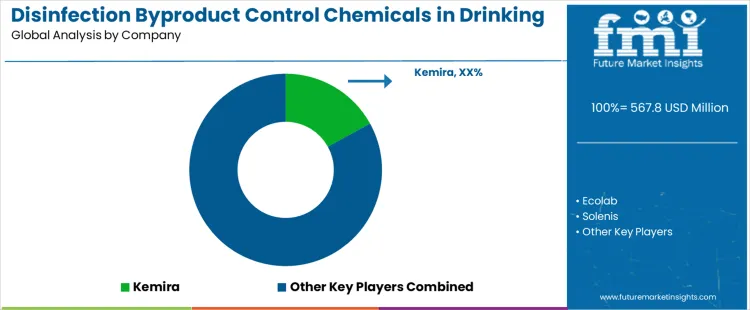
Competition in the Disinfection Byproduct Control Chemicals in Drinking Water Market is shaped by how utilities manage regulatory risk while maintaining microbiological safety. Kemira, Ecolab, and Solenis compete by positioning DBP control as a process adjustment problem rather than a single chemical substitution. Their strategies focus on upstream organic load reduction, targeted oxidant demand management, and chemistry that limits precursor formation before disinfection occurs. These suppliers work closely with utilities to tune coagulants, adsorbents, and treatment aids around site specific source water characteristics. Success depends on demonstrating predictable DBP reduction across seasonal variability, not on achieving short term compliance under ideal conditions. Utilities favor approaches that stabilize performance without increasing operational complexity.
System level integration defines differentiation among service oriented providers. Veolia Water Technologies and SUEZ Water Technologies approach DBP control through treatment train design, combining chemicals, monitoring, and process optimization within long term operating frameworks. Their strategies emphasize pilot validation, modeling of formation potential, and alignment with asset lifecycle planning rather than standalone chemical supply. Across the market, companies invest in field trials, regulatory engagement, and operator training to support conservative adoption. Competitive advantage is built through trust in repeatability, documentation strength, and the ability to adapt control strategies as regulations evolve. Market dynamics are governed by compliance assurance, operational resilience, and long planning horizons rather than rapid product turnover or price based competition.
Key Players in the Disinfection Byproduct Control Chemicals in Drinking Water Market
- Kemira
- Ecolab
- Solenis
- Veolia Water Technologies
- SUEZ Water Technologies
Scope of the Report
| Items | Values |
|---|---|
| Quantitative Units (2026) | USD million |
| Chemical Type | Activated Carbon & Adsorbents, Chlorine Scavengers (Sulfites, Thiosulfate), Bio-Based DBP Control Agents, pH Adjusters & Coagulant Aids, Other Specialty DBP Control Chemicals |
| Application Area | Municipal Drinking Water Plants, Industrial Potable Water Systems, Residential & Commercial Water Treatment, Rural & Decentralized Water Systems, Point-of-Entry / Household Filtration |
| DBP Type Controlled | Trihalomethanes (THMs), Haloacetic Acids (HAAs), Chloramines, Bromate / Chlorite, Other Emerging DBPs |
| End-Use Industry | Municipal Water Utilities, Industrial Water Facilities, Residential & Commercial Water Supply, Rural Water Programs, Household Filtration Systems |
| Region | Asia Pacific, Europe, North America, Latin America, Middle East & Africa |
| Countries Covered | China, Japan, South Korea, India, Australia & New Zealand, ASEAN, Rest of Asia Pacific, Germany, United Kingdom, France, Italy, Spain, Nordic, BENELUX, Rest of Europe, USA, Canada, Mexico, Brazil, Chile, Rest of Latin America, Kingdom of Saudi Arabia, Other GCC Countries, Turkey, South Africa, Other African Union, Rest of Middle East & Africa |
| Key Companies Profiled | Kemira, Ecolab, Solenis, Veolia Water Technologies, SUEZ Water Technologies |
| Additional Attributes | Dollar by sales by chemical type, Dollar by sales by application area, Dollar by sales by DBP type controlled, Dollar by sales by region, Annual procurement cycles, Adoption intervals / breakpoints, Regulatory compliance (EPA, EU, local standards), Operational efficiency metrics, Water treatment system compatibility, Lifecycle impact assessment, Recurring water treatment operations, Performance under varying source water characteristics, Integration with automated dosing systems, Domestic vs. international supplier distribution |
Disinfection Byproduct Control Chemicals in Drinking Water Market Segmentation
By Chemical Type:
- Activated Carbon & Adsorbents
- Chlorine Scavengers (Sulfites, Thiosulfate)
- Bio-Based DBP Control Agents
- pH Adjusters & Coagulant Aids
- Other Specialty DBP Control Chemicals
By Application Area:
- Municipal Drinking Water Plants
- Industrial Potable Water Systems
- Residential & Commercial Water Treatment
- Rural & Decentralized Water Systems
- Point-of-Entry / Household Filtration
By DBP Type Controlled:
- Trihalomethanes (THMs)
- Haloacetic Acids (HAAs)
- Chloramines
- Bromate / Chlorite
- Other Emerging DBPs
By Region:
- Asia Pacific
- China
- Japan
- South Korea
- India
- Australia & New Zealand
- ASEAN
- Rest of Asia Pacific
- Europe
- Germany
- United Kingdom
- France
- Italy
- Spain
- Nordic
- BENELUX
- Rest of Europe
- North America
- United States
- Canada
- Mexico
- Latin America
- Brazil
- Chile
- Rest of Latin America
- Middle East & Africa
- Kingdom of Saudi Arabia
- Other GCC Countries
- Turkey
- South Africa
- Other African Union
- Rest of Middle East & Africa
Bibliography
- Richardson, S. D., Plewa, M. J., Wagner, E. D., Schoeny, R., & DeMarini, D. M. (2007). Occurrence, genotoxicity, and carcinogenicity of regulated and emerging disinfection by-products in drinking water: A review and roadmap for research. Mutation Research, 636(1-3), 178-242.
- U.S. Environmental Protection Agency. (2020). National primary drinking water regulations: Disinfectants and disinfection byproducts rule (Stage 1 and Stage 2). U.S. Environmental Protection Agency, Office of Water.
Frequently Asked Questions
How big is the disinfection byproduct control chemicals in drinking water market in 2026?
The global disinfection byproduct control chemicals in drinking water market is estimated to be valued at USD 567.8 million in 2026.
What will be the size of disinfection byproduct control chemicals in drinking water market in 2036?
The market size for the disinfection byproduct control chemicals in drinking water market is projected to reach USD 1,369.1 million by 2036.
How much will be the disinfection byproduct control chemicals in drinking water market growth between 2026 and 2036?
The disinfection byproduct control chemicals in drinking water market is expected to grow at a 9.2% CAGR between 2026 and 2036.
What are the key product types in the disinfection byproduct control chemicals in drinking water market?
The key product types in disinfection byproduct control chemicals in drinking water market are activated carbon & adsorbents, chlorine scavengers (sulfites, thiosulfate), bio-based dbp control agents, ph adjusters & coagulant aids and other specialty dbp control chemicals.
Which application area segment to contribute significant share in the disinfection byproduct control chemicals in drinking water market in 2026?
In terms of application area, municipal drinking water plants segment to command 38.0% share in the disinfection byproduct control chemicals in drinking water market in 2026.
Preview the report firsthand - request a free sample
Get SampleGet the brochure for pricing and purchase details.
Get PDFTable of Content
- Executive Summary
- Global Market Outlook
- Demand-side Trends
- Supply-side Trends
- Technology Roadmap Analysis
- Analysis and Recommendations
- Market Overview
- Market Coverage / Taxonomy
- Market Definition / Scope / Limitations
- Market Background
- Market Dynamics
- Drivers
- Restraints
- Opportunity
- Trends
- Scenario Forecast
- Demand in Optimistic Scenario
- Demand in Likely Scenario
- Demand in Conservative Scenario
- Opportunity Map Analysis
- Product Life Cycle Analysis
- Supply Chain Analysis
- Investment Feasibility Matrix
- Value Chain Analysis
- PESTLE and Porter’s Analysis
- Regulatory Landscape
- Regional Parent Market Outlook
- Production and Consumption Statistics
- Import and Export Statistics
- Market Dynamics
- Global Market Analysis 2021 to 2025 and Forecast, 2026 to 2036
- Historical Market Size Value (USD Million) Analysis, 2021 to 2025
- Current and Future Market Size Value (USD Million) Projections, 2026 to 2036
- Y-o-Y Growth Trend Analysis
- Absolute $ Opportunity Analysis
- Global Market Pricing Analysis 2021 to 2025 and Forecast 2026 to 2036
- Global Market Analysis 2021 to 2025 and Forecast 2026 to 2036, By Chemical Type
- Introduction / Key Findings
- Historical Market Size Value (USD Million) Analysis By Chemical Type , 2021 to 2025
- Current and Future Market Size Value (USD Million) Analysis and Forecast By Chemical Type , 2026 to 2036
- Activated Carbon & Adsorbents
- Chlorine Scavengers (Sulfites, Thiosulfate)
- Bio-Based DBP Control Agents
- pH Adjusters & Coagulant Aids
- Other Specialty DBP Control Chemicals
- Activated Carbon & Adsorbents
- Y-o-Y Growth Trend Analysis By Chemical Type , 2021 to 2025
- Absolute $ Opportunity Analysis By Chemical Type , 2026 to 2036
- Global Market Analysis 2021 to 2025 and Forecast 2026 to 2036, By Application Area
- Introduction / Key Findings
- Historical Market Size Value (USD Million) Analysis By Application Area, 2021 to 2025
- Current and Future Market Size Value (USD Million) Analysis and Forecast By Application Area, 2026 to 2036
- Municipal Drinking Water Plants
- Industrial Potable Water Systems
- Residential & Commercial Water Treatment
- Rural & Decentralized Water Systems
- Point-of-Entry or Household Filtration
- Municipal Drinking Water Plants
- Y-o-Y Growth Trend Analysis By Application Area, 2021 to 2025
- Absolute $ Opportunity Analysis By Application Area, 2026 to 2036
- Global Market Analysis 2021 to 2025 and Forecast 2026 to 2036, By DBP Type Controlled
- Introduction / Key Findings
- Historical Market Size Value (USD Million) Analysis By DBP Type Controlled, 2021 to 2025
- Current and Future Market Size Value (USD Million) Analysis and Forecast By DBP Type Controlled, 2026 to 2036
- Trihalomethanes (THMs)
- Haloacetic Acids (HAAs)
- Chloramines
- Bromate or Chlorite
- Other Emerging DBPs
- Trihalomethanes (THMs)
- Y-o-Y Growth Trend Analysis By DBP Type Controlled, 2021 to 2025
- Absolute $ Opportunity Analysis By DBP Type Controlled, 2026 to 2036
- Global Market Analysis 2021 to 2025 and Forecast 2026 to 2036, By Region
- Introduction
- Historical Market Size Value (USD Million) Analysis By Region, 2021 to 2025
- Current Market Size Value (USD Million) Analysis and Forecast By Region, 2026 to 2036
- North America
- Latin America
- Western Europe
- Eastern Europe
- East Asia
- South Asia and Pacific
- Middle East & Africa
- Market Attractiveness Analysis By Region
- North America Market Analysis 2021 to 2025 and Forecast 2026 to 2036, By Country
- Historical Market Size Value (USD Million) Trend Analysis By Market Taxonomy, 2021 to 2025
- Market Size Value (USD Million) Forecast By Market Taxonomy, 2026 to 2036
- By Country
- USA
- Canada
- Mexico
- By Chemical Type
- By Application Area
- By DBP Type Controlled
- By Country
- Market Attractiveness Analysis
- By Country
- By Chemical Type
- By Application Area
- By DBP Type Controlled
- Key Takeaways
- Latin America Market Analysis 2021 to 2025 and Forecast 2026 to 2036, By Country
- Historical Market Size Value (USD Million) Trend Analysis By Market Taxonomy, 2021 to 2025
- Market Size Value (USD Million) Forecast By Market Taxonomy, 2026 to 2036
- By Country
- Brazil
- Chile
- Rest of Latin America
- By Chemical Type
- By Application Area
- By DBP Type Controlled
- By Country
- Market Attractiveness Analysis
- By Country
- By Chemical Type
- By Application Area
- By DBP Type Controlled
- Key Takeaways
- Western Europe Market Analysis 2021 to 2025 and Forecast 2026 to 2036, By Country
- Historical Market Size Value (USD Million) Trend Analysis By Market Taxonomy, 2021 to 2025
- Market Size Value (USD Million) Forecast By Market Taxonomy, 2026 to 2036
- By Country
- Germany
- UK
- Italy
- Spain
- France
- Nordic
- BENELUX
- Rest of Western Europe
- By Chemical Type
- By Application Area
- By DBP Type Controlled
- By Country
- Market Attractiveness Analysis
- By Country
- By Chemical Type
- By Application Area
- By DBP Type Controlled
- Key Takeaways
- Eastern Europe Market Analysis 2021 to 2025 and Forecast 2026 to 2036, By Country
- Historical Market Size Value (USD Million) Trend Analysis By Market Taxonomy, 2021 to 2025
- Market Size Value (USD Million) Forecast By Market Taxonomy, 2026 to 2036
- By Country
- Russia
- Poland
- Hungary
- Balkan & Baltic
- Rest of Eastern Europe
- By Chemical Type
- By Application Area
- By DBP Type Controlled
- By Country
- Market Attractiveness Analysis
- By Country
- By Chemical Type
- By Application Area
- By DBP Type Controlled
- Key Takeaways
- East Asia Market Analysis 2021 to 2025 and Forecast 2026 to 2036, By Country
- Historical Market Size Value (USD Million) Trend Analysis By Market Taxonomy, 2021 to 2025
- Market Size Value (USD Million) Forecast By Market Taxonomy, 2026 to 2036
- By Country
- China
- Japan
- South Korea
- By Chemical Type
- By Application Area
- By DBP Type Controlled
- By Country
- Market Attractiveness Analysis
- By Country
- By Chemical Type
- By Application Area
- By DBP Type Controlled
- Key Takeaways
- South Asia and Pacific Market Analysis 2021 to 2025 and Forecast 2026 to 2036, By Country
- Historical Market Size Value (USD Million) Trend Analysis By Market Taxonomy, 2021 to 2025
- Market Size Value (USD Million) Forecast By Market Taxonomy, 2026 to 2036
- By Country
- India
- ASEAN
- Australia & New Zealand
- Rest of South Asia and Pacific
- By Chemical Type
- By Application Area
- By DBP Type Controlled
- By Country
- Market Attractiveness Analysis
- By Country
- By Chemical Type
- By Application Area
- By DBP Type Controlled
- Key Takeaways
- Middle East & Africa Market Analysis 2021 to 2025 and Forecast 2026 to 2036, By Country
- Historical Market Size Value (USD Million) Trend Analysis By Market Taxonomy, 2021 to 2025
- Market Size Value (USD Million) Forecast By Market Taxonomy, 2026 to 2036
- By Country
- Kingdom of Saudi Arabia
- Other GCC Countries
- Turkiye
- South Africa
- Other African Union
- Rest of Middle East & Africa
- By Chemical Type
- By Application Area
- By DBP Type Controlled
- By Country
- Market Attractiveness Analysis
- By Country
- By Chemical Type
- By Application Area
- By DBP Type Controlled
- Key Takeaways
- Key Countries Market Analysis
- USA
- Pricing Analysis
- Market Share Analysis, 2025
- By Chemical Type
- By Application Area
- By DBP Type Controlled
- Canada
- Pricing Analysis
- Market Share Analysis, 2025
- By Chemical Type
- By Application Area
- By DBP Type Controlled
- Mexico
- Pricing Analysis
- Market Share Analysis, 2025
- By Chemical Type
- By Application Area
- By DBP Type Controlled
- Brazil
- Pricing Analysis
- Market Share Analysis, 2025
- By Chemical Type
- By Application Area
- By DBP Type Controlled
- Chile
- Pricing Analysis
- Market Share Analysis, 2025
- By Chemical Type
- By Application Area
- By DBP Type Controlled
- Germany
- Pricing Analysis
- Market Share Analysis, 2025
- By Chemical Type
- By Application Area
- By DBP Type Controlled
- UK
- Pricing Analysis
- Market Share Analysis, 2025
- By Chemical Type
- By Application Area
- By DBP Type Controlled
- Italy
- Pricing Analysis
- Market Share Analysis, 2025
- By Chemical Type
- By Application Area
- By DBP Type Controlled
- Spain
- Pricing Analysis
- Market Share Analysis, 2025
- By Chemical Type
- By Application Area
- By DBP Type Controlled
- France
- Pricing Analysis
- Market Share Analysis, 2025
- By Chemical Type
- By Application Area
- By DBP Type Controlled
- India
- Pricing Analysis
- Market Share Analysis, 2025
- By Chemical Type
- By Application Area
- By DBP Type Controlled
- ASEAN
- Pricing Analysis
- Market Share Analysis, 2025
- By Chemical Type
- By Application Area
- By DBP Type Controlled
- Australia & New Zealand
- Pricing Analysis
- Market Share Analysis, 2025
- By Chemical Type
- By Application Area
- By DBP Type Controlled
- China
- Pricing Analysis
- Market Share Analysis, 2025
- By Chemical Type
- By Application Area
- By DBP Type Controlled
- Japan
- Pricing Analysis
- Market Share Analysis, 2025
- By Chemical Type
- By Application Area
- By DBP Type Controlled
- South Korea
- Pricing Analysis
- Market Share Analysis, 2025
- By Chemical Type
- By Application Area
- By DBP Type Controlled
- Russia
- Pricing Analysis
- Market Share Analysis, 2025
- By Chemical Type
- By Application Area
- By DBP Type Controlled
- Poland
- Pricing Analysis
- Market Share Analysis, 2025
- By Chemical Type
- By Application Area
- By DBP Type Controlled
- Hungary
- Pricing Analysis
- Market Share Analysis, 2025
- By Chemical Type
- By Application Area
- By DBP Type Controlled
- Kingdom of Saudi Arabia
- Pricing Analysis
- Market Share Analysis, 2025
- By Chemical Type
- By Application Area
- By DBP Type Controlled
- Turkiye
- Pricing Analysis
- Market Share Analysis, 2025
- By Chemical Type
- By Application Area
- By DBP Type Controlled
- South Africa
- Pricing Analysis
- Market Share Analysis, 2025
- By Chemical Type
- By Application Area
- By DBP Type Controlled
- USA
- Market Structure Analysis
- Competition Dashboard
- Competition Benchmarking
- Market Share Analysis of Top Players
- By Regional
- By Chemical Type
- By Application Area
- By DBP Type Controlled
- Competition Analysis
- Competition Deep Dive
- Kemira
- Overview
- Product Portfolio
- Profitability by Market Segments (Product/Age /Sales Channel/Region)
- Sales Footprint
- Strategy Overview
- Marketing Strategy
- Product Strategy
- Channel Strategy
- Ecolab
- Solenis
- Veolia Water Technologies
- SUEZ Water Technologies
- Kemira
- Competition Deep Dive
- Assumptions & Acronyms Used
- Research Methodology


