

- Industry Size (2026)
- USD 6.5 Bn
- Forecast (2036)
- USD 10.0 Bn
- CAGR (2026 to 2036)
- 4.5%
Pool and Spa Water Treatment Chemicals Market Forecast and Outlook 2026 to 2036
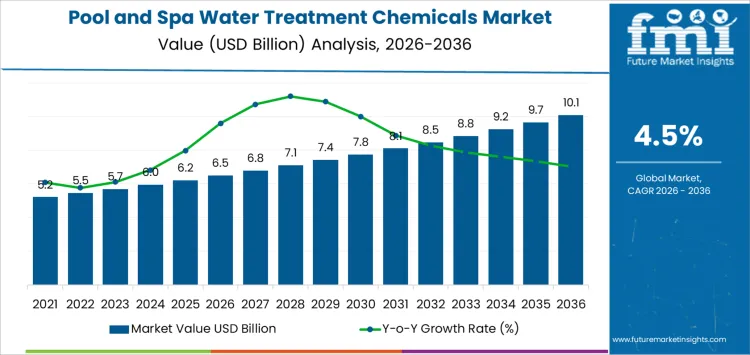
In 2026, the global pool and spa water treatment chemicals sector stands at USD 6.5 billion and is expected to expand to USD 10.0 billion by 2036, recording a CAGR of 4.5%. The increase from USD 5.0 billion in 2020 reflects consistent chemical usage across residential pools, public swimming facilities, and spa installations. Chlorine and bromine based sanitizers continue to account for the largest volume share because routine disinfection remains mandatory. Tablets and granular products remain preferred due to ease of storage, dosing accuracy, and compatibility with standard pool maintenance routines.
Between 2027 and 2031, market value rises from USD 6.8 billion to USD 8.1 billion, before advancing steadily toward USD 10.0 billion by 2036. Residential pools continue to generate the majority of demand, while spas and hot tubs contribute incremental volume through year round maintenance requirements. pH control agents, algaecides, and shock treatments maintain regular consumption aligned with cleaning cycles. Specialty pool retailers and mass retail channels remain central to distribution. Long term expansion is shaped by routine upkeep practices, seasonal usage patterns, and gradual growth in installed pool and spa capacity.
Quick Stats of the Pool and Spa Water Treatment Chemicals Market:
- Pool and Spa Water Treatment Chemicals Market Value (2026): USD 6.5 billion
- Pool and Spa Water Treatment Chemicals Market Forecast Value (2036): USD 10.0 billion
- Pool and Spa Water Treatment Chemicals Market Forecast CAGR (2026 to 2036): 4.5%
- Leading Chemical Type in the Market: Sanitizers (Chlorine/Bromine) (44%)
- Key Growth Regions: China, Brazil, USA, UK, Germany
- Top Players: Archroma, Lonza, Olin (chlor-alkali), Westlake, Nouryon, Kemira, BioLab (KIK), Ecolab, HydroTools, Haviland Enterprises
What is the Growth Forecast for the Pool and Spa Water Treatment Chemicals Market through 2036?
Between 2026 and 2031, the pool and spa water treatment chemicals market grows from USD 6.5 billion to around USD 7.8 billion, reflecting a demand pattern closely linked to the installed base of pools and spas rather than new construction alone. Consumption during this phase is driven by routine water balancing, sanitation requirements, and refurbishment of aging recreational facilities. Residential pool ownership stability and steady activity in hotels and fitness centers support predictable purchasing volumes. Value growth is reinforced by gradual movement toward blended treatment solutions that reduce handling complexity and support consistent water conditions across frequent maintenance cycles.
From 2031 to 2036, the market expands from approximately USD 7.8 billion to USD 10.0 billion, indicating a firmer upward shift in spending intensity. Growth in this period is influenced by higher chemical usage per site, professional service expansion in commercial pool management, and rising expectations around water quality reliability. Demand benefits from increased servicing frequency, broader adoption of automated dosing systems, and greater emphasis on preventive water treatment. Earlier expansion followed stable upkeep needs, while later growth reflects deeper service integration, higher compliance standards, and more structured maintenance programs across residential, hospitality, and public aquatic facilities.
Pool and Spa Water Treatment Chemicals Market Key Takeaways
| Metric | Value |
|---|---|
| Market Value (2026) | USD 6.5 billion |
| Forecast Value (2036) | USD 10.0 billion |
| Forecast CAGR (2026 to 2036) | 4.50% |
What Is Driving the Demand for the Pool and Spa Water Treatment Chemicals Market from 2026 to 2036?
Use of pool and spa water treatment chemicals expanded as residential complexes, hotels, and leisure facilities increased controlled water recreation spaces. Operators relied on sanitizers, pH balancers, and algaecides to maintain water clarity and meet health inspection standards. Historical demand followed construction of indoor pools, fitness centres, and hospitality projects that required year-round water maintenance. Buyers focused on predictable dosing, ease of handling, and compatibility with filtration systems. Consumption patterns aligned with seasonal usage, facility size, and routine water replacement cycles.
From 2026 to 2036 demand is expected to evolve with growth in private spas, wellness centres, and compact residential pools. Operators seek chemicals that support stable water quality with reduced maintenance effort. Product development targets longer-lasting sanitizers, improved scale control, and formulations compatible with automated dosing systems. Buyers assess effectiveness under varying bather loads and water temperatures. Demand reflects expansion of wellness tourism, ageing housing stock upgrades, and preference for consistent water hygiene across residential, hospitality, and recreational facilities.
What Is the Demand for the Pool and Spa Water Treatment Chemicals Market by Chemical Type and Pool Type for 2026 to 2036?
The pool and spa water treatment chemicals market from 2026 to 2036 is shaped by steady residential pool ownership, regulated hygiene standards for public facilities, and consistent maintenance cycles across leisure infrastructure. Sanitizers based on chlorine and bromine account for the largest chemical share at 44% due to their central role in pathogen control. Residential pools lead by pool type at 52% as private homeowners maintain regular water treatment routines to preserve water clarity, safety, and equipment condition throughout extended usage seasons.
Why do sanitizers account for 44% of demand in the pool and spa water treatment chemicals market by chemical type from 2026 to 2036?
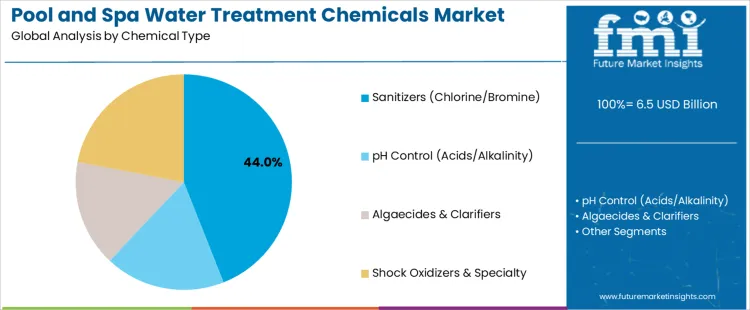
Sanitizers account for 44% of demand because continuous microbial control remains the foundation of pool and spa water management. Consumption intensity is highest where pools and spas experience frequent human contact, warm water temperatures, and organic load introduction from skin cells, oils, and environmental debris. Usage remains steady as chlorine and bromine provide rapid disinfection and residual protection within circulating water systems. Procurement decisions prioritize sanitizer stability, predictable dissolution rates, and compatibility with automated dosing equipment.
Buyers value chemical reliability that maintains free available sanitizer levels across varying bather loads. Price sensitivity remains moderate since sanitizer failure carries direct health and compliance risks. Specification control focuses on purity, solubility, and controlled release behavior to avoid water imbalance or surface damage. Demand remains strong from 2026 to 2036 as regulatory oversight and consumer awareness reinforce routine sanitizer application. Repeat utilization stays predictable because sanitizers are replenished continuously throughout operating periods. Substitution pressure from alternative disinfection technologies remains limited where chemical sanitizers provide cost-effective, scalable, and widely accepted protection across diverse pool and spa configurations.
Why do residential pools represent 52% of demand in the pool and spa water treatment chemicals market by pool type from 2026 to 2036?
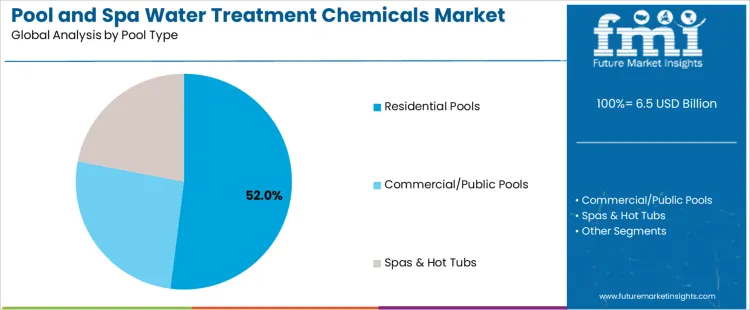
Residential pools represent 52% of demand because private ownership drives recurring, owner-managed maintenance cycles that rely heavily on chemical treatment. Consumption is spread across single-family homes, residential complexes, and vacation properties where water quality is maintained independently rather than through centralized service contracts. Usage remains steady as homeowners apply routine treatment schedules for sanitation, pH balance, algae prevention, and water clarity. Procurement favors easy-to-handle packaging, clear dosing instructions, and products compatible with small-volume circulation systems.
Buyers prioritize chemicals that support stable water conditions with minimal adjustment complexity. Price sensitivity remains moderate since ongoing maintenance costs are viewed as part of property upkeep. Specification control emphasizes user safety, storage stability, and compatibility with common residential pool surfaces and equipment. Demand continues from 2026 to 2036 as residential pool installations remain active and existing pools require continuous chemical replenishment. Repeat purchasing patterns remain consistent because water treatment chemicals are consumed throughout the swimming season and during off-season conditioning. Substitution pressure from service-based treatment remains limited where homeowners retain direct control over pool care routines.
How Is Demand for Pool and Spa Water Treatment Chemicals Shaped by Day to Day Operations in Recreational Facilities? Demand forms through continuous maintenance needs in hotels, fitness clubs, public pools, and residential complexes where water clarity and hygiene require close control. Hotel spas adjust chemical dosing to manage frequent temperature changes that affect water balance. Municipal pools schedule regular treatment cycles to handle high swimmer turnover during seasonal peaks. Fitness centers rely on stabilized formulations to maintain water quality with limited downtime between sessions. Residential management firms select products that simplify routine testing and correction. These patterns arise from operational realities tied to usage intensity, scheduling constraints, and facility responsibility.
What Facility Level Practices Are Driving Demand for Pool and Spa Water Treatment Chemicals?
Drivers originate from local management practices focused on compliance, user safety, and cost control. Public pools follow municipal guidelines that require precise control of disinfectant levels and pH stability. Hotels and resorts adopt multi-function chemicals to reduce handling steps for maintenance staff. Fitness clubs select fast acting treatments to keep pools open during long operating hours. Residential complexes use packaged solutions to standardize care across multiple sites. These drivers reflect practical decisions made by operators seeking predictable water quality within routine maintenance frameworks.
What Operational Constraints Are Limiting Wider Use of Advanced Pool and Spa Treatment Chemicals?
Barriers develop from staffing limits, budget sensitivity, and equipment compatibility. Smaller facilities rely on basic chemicals because advanced blends carry higher upfront costs. Some treatment systems are calibrated for traditional products, making transitions complex. Limited staff training can lead operators to avoid formulations that require precise dosing. Storage rules and handling requirements also discourage broader product ranges. Seasonal facilities reduce purchases outside peak periods, which affects consistent adoption. These constraints slow uptake where simplicity, cost predictability, and existing routines outweigh performance improvements.
What is the Growth Outlook for Pool and Spa Water Treatment Chemicals Across Key Countries?
| Country | CAGR (%) |
|---|---|
| China | 5.5% |
| Brazil | 5.3% |
| USA | 4.2% |
| UK | 4.2% |
| Germany | 4.1% |
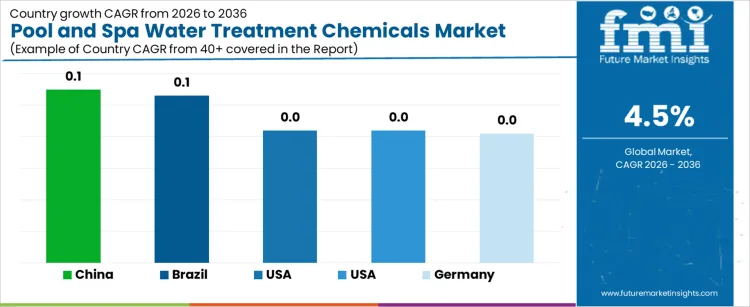
The pool and spa water treatment chemicals sector is expanding at a moderate pace across major regions, supported by residential pool ownership, commercial leisure facilities, and hospitality infrastructure. China leads at 5.5%, driven by new hotel developments, wellness centers, and growing recreational water installations in urban areas. Brazil follows at 5.3%, reflecting strong demand from resort properties and private pool maintenance. The USA and UK each record 4.2%, shaped by mature residential pool bases, routine maintenance cycles, and steady replacement demand. Germany at 4.1% shows stable growth linked to public swimming facilities, spas, and regulated water quality standards. Overall expansion is influenced by seasonal usage patterns, regulatory compliance requirements, and consistent demand for sanitation, pH control, and algae prevention chemicals.
How Are Maintenance Standards Supporting Pool and Spa Water Treatment Chemicals Demand in the United States?
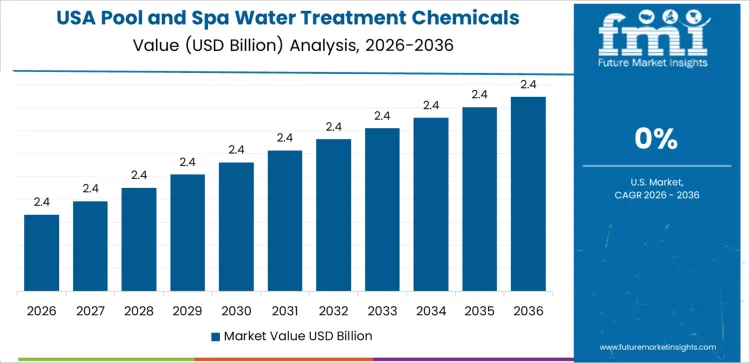
Pool and spa water treatment chemicals demand in the United States is growing at a CAGR of 4.2% from 2026 to 2036 as residential pools, hospitality facilities, and recreational centers maintain consistent water quality programs. Pool operators use treatment chemicals to manage sanitation, clarity, and equipment protection. Hospitality facilities rely on routine dosing to support guest safety and comfort. Residential users purchase treatment products for seasonal maintenance and long term water balance. Growth reflects steady upkeep practices across private and commercial pool environments nationwide.
- Pool operators rely on chemicals to maintain sanitation and clarity.
- Hospitality facilities apply treatment products to support guest safety.
- Residential users purchase chemicals for routine pool maintenance.
What Is Shaping Pool and Spa Water Treatment Chemicals Demand in Germany?
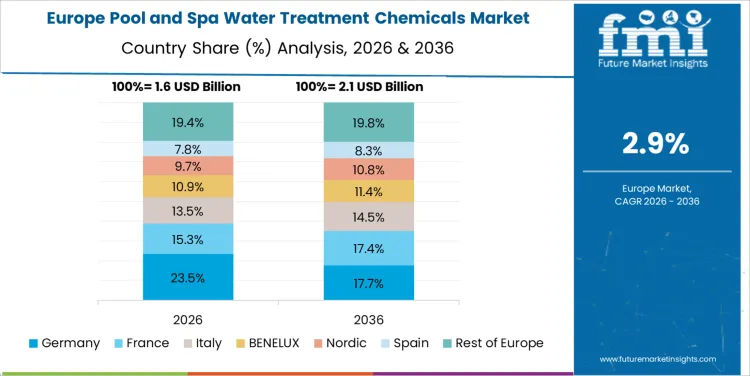
Pool and spa water treatment chemicals demand in Germany is expanding at a CAGR of 4.1% from 2026 to 2036 as public pools, wellness centers, and residential facilities follow structured water management practices. Public pool operators use treatment chemicals to meet hygiene regulations. Wellness centers apply controlled dosing to maintain stable water conditions. Residential pool owners rely on standardized products for seasonal upkeep. Growth reflects disciplined water treatment routines aligned with regulatory compliance and organized facility management.
- Public pool operators use chemicals to meet hygiene standards.
- Wellness centers apply controlled dosing for water stability.
- Residential owners rely on standardized treatment products.
Why Is China Recording Higher Growth in Pool and Spa Water Treatment Chemicals Demand?
Pool and spa water treatment chemicals demand in China is increasing at a CAGR of 5.5% from 2026 to 2036 as hospitality developments, residential complexes, and recreational facilities expand water treatment activity. Hotels and resorts use treatment chemicals to maintain guest pools. Residential complexes integrate water care products into shared facility management. Recreational centers rely on chemical treatment to manage high usage levels. Growth reflects expanding leisure infrastructure and broader adoption of structured water maintenance practices.
- Hotels and resorts use chemicals to maintain guest pools.
- Residential complexes integrate treatment into shared facilities.
- Recreational centers rely on chemicals for high usage management.
How Are Service Sector Needs Influencing Demand in the United Kingdom?
Pool and spa water treatment chemicals demand in the United Kingdom is growing at a CAGR of 4.2% from 2026 to 2036 as leisure centers, hospitality venues, and private pool owners maintain consistent water care routines. Leisure centers apply chemicals to support daily public use. Hospitality venues rely on treatment products for spa and pool facilities. Private owners use water care chemicals for seasonal and year round maintenance. Growth reflects steady service sector reliance on routine water treatment.
- Leisure centers apply chemicals to support public use.
- Hospitality venues rely on treatment products for spa facilities.
- Private owners use chemicals for routine water care.
What Is Driving Strong Growth in Brazil?
Pool and spa water treatment chemicals demand in Brazil is expanding at a CAGR of 5.3% from 2026 to 2036 as residential pools, hotels, and recreational facilities manage water quality under warm climate conditions. Residential users apply treatment chemicals to manage frequent pool use. Hotels rely on water care products to support guest facilities. Recreational venues integrate treatment routines to maintain safety and clarity. Growth reflects consistent demand across leisure focused environments.
- Residential users apply chemicals to manage frequent pool use.
- Hotels rely on treatment products to support guest facilities.
- Recreational venues integrate chemicals into water care routines.
What Is Driving the Demand for Pool and Spa Water Treatment Chemicals and Which Companies Shape Commercial and Residential Use?
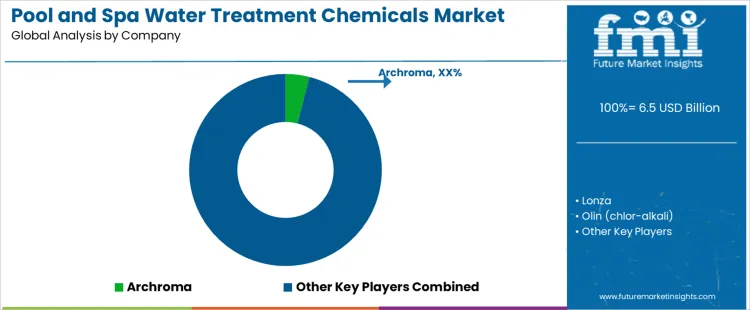
Demand for pool and spa water treatment chemicals is supported by steady operation of hotels, fitness clubs, municipal pools, and residential spas that require consistent water quality management. Archroma and Nouryon support this demand through specialty treatment chemistries used for stabilization, oxidation control, and water clarity. Olin and Westlake influence supply through chlor alkali production that underpins chlorine based disinfection programs used globally. Lonza contributes through biocidal formulations applied in spa systems and small commercial pools. Kemira supports balancing and conditioning needs in public facilities where water turnover is high. BioLab under KIK provides branded pool care chemicals distributed through specialty retail and service providers.
Chemical selection is governed by disinfection efficacy, byproduct control, compatibility with filtration systems, and safety during handling. Ecolab participates through integrated water management programs used by hospitality operators seeking consistent compliance and simplified maintenance. HydroTools and Haviland Enterprises support accessory chemicals, feeders, and maintenance focused solutions used by service technicians and residential owners. Buyers emphasize predictable performance, ease of dosing, and stability under varying bather loads. Usage spans shock treatments, sanitizers, algaecides, and pH control agents. Demand visibility follows hospitality occupancy trends, home pool installations, seasonal maintenance cycles, and continued emphasis on hygienic water management in leisure and wellness environments.
Key Players in the Pool and Spa Water Treatment Chemicals Market
- Archroma
- Lonza
- Olin (chlor-alkali)
- Westlake
- Nouryon
- Kemira
- BioLab (KIK)
- Ecolab
- HydroTools
- Haviland Enterprises
Scope of the Report
| Items | Values |
|---|---|
| Quantitative Units (2026) | USD billion |
| Chemical Type | Sanitizers including Chlorine and Bromine; pH Control Agents including Acids and Alkalinity Adjusters; Algaecides and Clarifiers; Shock Oxidizers and Specialty Treatments |
| Pool Type | Residential Pools; Commercial and Public Pools; Spas and Hot Tubs |
| Delivery Form | Tablets and Granules; Liquids; Cartridges and Pods; Other Forms |
| Sales Channel | Specialty Pool Retail; Mass Retail and E commerce; Service and Contractor Supply; Other Channels |
| Regions Covered | Asia Pacific; Europe; North America; Latin America; Middle East and Africa |
| Countries Covered | China; Japan; South Korea; India; Australia and New Zealand; ASEAN; Germany; United Kingdom; France; Italy; Spain; Nordic; BENELUX; United States; Canada; Mexico; Brazil; Chile; Kingdom of Saudi Arabia; Turkey; South Africa; plus 40+ additional countries across Asia Pacific, Europe, Latin America, and Middle East and Africa |
| Key Companies Profiled | Archroma; Lonza; Olin; Westlake; Nouryon; Kemira; BioLab under KIK; Ecolab; HydroTools; Haviland Enterprises |
| Additional Attributes | Dollar by sales across chemical types, pool types, delivery forms, and sales channels; seasonal consumption patterns linked to residential and public pool usage; sanitizer replenishment cycles and shock treatment frequency; compatibility with filtration and automated dosing systems; storage stability and handling requirements for tablets liquids and granules; regulatory compliance for public pool water quality; role of service contractors in routine maintenance; influence of installed pool base and refurbishment cycles on purchasing behavior |
Pool and Spa Water Treatment Chemicals Market Segmentation
By Chemical Type:
- Sanitizers (Chlorine/Bromine)
- pH Control (Acids/Alkalinity)
- Algaecides & Clarifiers
- Shock Oxidizers & Specialty
By Pool Type:
- Residential Pools
- Commercial/Public Pools
- Spas & Hot Tubs
By Delivery Form:
- Tablets/Granules
- Liquids
- Cartridges/Pods
- Other Forms
By Sales Channel:
- Specialty Pool Retail
- Mass Retail & E-commerce
- Service/Contractor Supply
- Other Channels
By Region:
- Asia Pacific
- China
- Japan
- South Korea
- India
- Australia & New Zealand
- ASEAN
- Rest of Asia Pacific
- Europe
- Germany
- United Kingdom
- France
- Italy
- Spain
- Nordic
- BENELUX
- Rest of Europe
- North America
- United States
- Canada
- Mexico
- Latin America
- Brazil
- Chile
- Rest of Latin America
- Middle East & Africa
- Kingdom of Saudi Arabia
- Other GCC Countries
- Turkey
- South Africa
- Other African Union
- Rest of Middle East & Africa
Frequently Asked Questions
How big is the pool and spa water treatment chemicals market in 2026?
The global pool and spa water treatment chemicals market is estimated to be valued at USD 6.5 billion in 2026.
What will be the size of pool and spa water treatment chemicals market in 2036?
The market size for the pool and spa water treatment chemicals market is projected to reach USD 10.1 billion by 2036.
How much will be the pool and spa water treatment chemicals market growth between 2026 and 2036?
The pool and spa water treatment chemicals market is expected to grow at a 4.5% CAGR between 2026 and 2036.
What are the key product types in the pool and spa water treatment chemicals market?
The key product types in pool and spa water treatment chemicals market are sanitizers (chlorine/bromine), ph control (acids/alkalinity), algaecides & clarifiers and shock oxidizers & specialty.
Which pool type segment to contribute significant share in the pool and spa water treatment chemicals market in 2026?
In terms of pool type, residential pools segment to command 52.0% share in the pool and spa water treatment chemicals market in 2026.
Preview the report firsthand - request a free sample
Get SampleGet the brochure for pricing and purchase details.
Get PDFTable of Content
- Executive Summary
- Global Market Outlook
- Demand-side Trends
- Supply-side Trends
- Technology Roadmap Analysis
- Analysis and Recommendations
- Market Overview
- Market Coverage / Taxonomy
- Market Definition / Scope / Limitations
- Market Background
- Market Dynamics
- Drivers
- Restraints
- Opportunity
- Trends
- Scenario Forecast
- Demand in Optimistic Scenario
- Demand in Likely Scenario
- Demand in Conservative Scenario
- Opportunity Map Analysis
- Product Life Cycle Analysis
- Supply Chain Analysis
- Investment Feasibility Matrix
- Value Chain Analysis
- PESTLE and Porter’s Analysis
- Regulatory Landscape
- Regional Parent Market Outlook
- Production and Consumption Statistics
- Import and Export Statistics
- Market Dynamics
- Global Market Analysis 2021 to 2025 and Forecast, 2026 to 2036
- Historical Market Size Value (USD Million) Analysis, 2021 to 2025
- Current and Future Market Size Value (USD Million) Projections, 2026 to 2036
- Y-o-Y Growth Trend Analysis
- Absolute $ Opportunity Analysis
- Global Market Pricing Analysis 2021 to 2025 and Forecast 2026 to 2036
- Global Market Analysis 2021 to 2025 and Forecast 2026 to 2036, By Chemical Type
- Introduction / Key Findings
- Historical Market Size Value (USD Million) Analysis By Chemical Type , 2021 to 2025
- Current and Future Market Size Value (USD Million) Analysis and Forecast By Chemical Type , 2026 to 2036
- Sanitizers (Chlorine/Bromine)
- pH Control (Acids/Alkalinity)
- Algaecides & Clarifiers
- Shock Oxidizers & Specialty
- Y-o-Y Growth Trend Analysis By Chemical Type , 2021 to 2025
- Absolute $ Opportunity Analysis By Chemical Type , 2026 to 2036
- Global Market Analysis 2021 to 2025 and Forecast 2026 to 2036, By Pool Type
- Introduction / Key Findings
- Historical Market Size Value (USD Million) Analysis By Pool Type, 2021 to 2025
- Current and Future Market Size Value (USD Million) Analysis and Forecast By Pool Type, 2026 to 2036
- Residential Pools
- Commercial/Public Pools
- Spas & Hot Tubs
- Y-o-Y Growth Trend Analysis By Pool Type, 2021 to 2025
- Absolute $ Opportunity Analysis By Pool Type, 2026 to 2036
- Global Market Analysis 2021 to 2025 and Forecast 2026 to 2036, By Delivery Form
- Introduction / Key Findings
- Historical Market Size Value (USD Million) Analysis By Delivery Form, 2021 to 2025
- Current and Future Market Size Value (USD Million) Analysis and Forecast By Delivery Form, 2026 to 2036
- Tablets/Granules
- Liquids
- Cartridges/Pods
- Other Forms
- Y-o-Y Growth Trend Analysis By Delivery Form, 2021 to 2025
- Absolute $ Opportunity Analysis By Delivery Form, 2026 to 2036
- Global Market Analysis 2021 to 2025 and Forecast 2026 to 2036, By Sales Channel
- Introduction / Key Findings
- Historical Market Size Value (USD Million) Analysis By Sales Channel, 2021 to 2025
- Current and Future Market Size Value (USD Million) Analysis and Forecast By Sales Channel, 2026 to 2036
- Specialty Pool Retail
- Mass Retail & E-commerce
- Service/Contractor Supply
- Other Channels
- Y-o-Y Growth Trend Analysis By Sales Channel, 2021 to 2025
- Absolute $ Opportunity Analysis By Sales Channel, 2026 to 2036
- Global Market Analysis 2021 to 2025 and Forecast 2026 to 2036, By Region
- Introduction
- Historical Market Size Value (USD Million) Analysis By Region, 2021 to 2025
- Current Market Size Value (USD Million) Analysis and Forecast By Region, 2026 to 2036
- North America
- Latin America
- Western Europe
- Eastern Europe
- East Asia
- South Asia and Pacific
- Middle East & Africa
- Market Attractiveness Analysis By Region
- North America Market Analysis 2021 to 2025 and Forecast 2026 to 2036, By Country
- Historical Market Size Value (USD Million) Trend Analysis By Market Taxonomy, 2021 to 2025
- Market Size Value (USD Million) Forecast By Market Taxonomy, 2026 to 2036
- By Country
- USA
- Canada
- Mexico
- By Chemical Type
- By Pool Type
- By Delivery Form
- By Sales Channel
- By Country
- Market Attractiveness Analysis
- By Country
- By Chemical Type
- By Pool Type
- By Delivery Form
- By Sales Channel
- Key Takeaways
- Latin America Market Analysis 2021 to 2025 and Forecast 2026 to 2036, By Country
- Historical Market Size Value (USD Million) Trend Analysis By Market Taxonomy, 2021 to 2025
- Market Size Value (USD Million) Forecast By Market Taxonomy, 2026 to 2036
- By Country
- Brazil
- Chile
- Rest of Latin America
- By Chemical Type
- By Pool Type
- By Delivery Form
- By Sales Channel
- By Country
- Market Attractiveness Analysis
- By Country
- By Chemical Type
- By Pool Type
- By Delivery Form
- By Sales Channel
- Key Takeaways
- Western Europe Market Analysis 2021 to 2025 and Forecast 2026 to 2036, By Country
- Historical Market Size Value (USD Million) Trend Analysis By Market Taxonomy, 2021 to 2025
- Market Size Value (USD Million) Forecast By Market Taxonomy, 2026 to 2036
- By Country
- Germany
- UK
- Italy
- Spain
- France
- Nordic
- BENELUX
- Rest of Western Europe
- By Chemical Type
- By Pool Type
- By Delivery Form
- By Sales Channel
- By Country
- Market Attractiveness Analysis
- By Country
- By Chemical Type
- By Pool Type
- By Delivery Form
- By Sales Channel
- Key Takeaways
- Eastern Europe Market Analysis 2021 to 2025 and Forecast 2026 to 2036, By Country
- Historical Market Size Value (USD Million) Trend Analysis By Market Taxonomy, 2021 to 2025
- Market Size Value (USD Million) Forecast By Market Taxonomy, 2026 to 2036
- By Country
- Russia
- Poland
- Hungary
- Balkan & Baltic
- Rest of Eastern Europe
- By Chemical Type
- By Pool Type
- By Delivery Form
- By Sales Channel
- By Country
- Market Attractiveness Analysis
- By Country
- By Chemical Type
- By Pool Type
- By Delivery Form
- By Sales Channel
- Key Takeaways
- East Asia Market Analysis 2021 to 2025 and Forecast 2026 to 2036, By Country
- Historical Market Size Value (USD Million) Trend Analysis By Market Taxonomy, 2021 to 2025
- Market Size Value (USD Million) Forecast By Market Taxonomy, 2026 to 2036
- By Country
- China
- Japan
- South Korea
- By Chemical Type
- By Pool Type
- By Delivery Form
- By Sales Channel
- By Country
- Market Attractiveness Analysis
- By Country
- By Chemical Type
- By Pool Type
- By Delivery Form
- By Sales Channel
- Key Takeaways
- South Asia and Pacific Market Analysis 2021 to 2025 and Forecast 2026 to 2036, By Country
- Historical Market Size Value (USD Million) Trend Analysis By Market Taxonomy, 2021 to 2025
- Market Size Value (USD Million) Forecast By Market Taxonomy, 2026 to 2036
- By Country
- India
- ASEAN
- Australia & New Zealand
- Rest of South Asia and Pacific
- By Chemical Type
- By Pool Type
- By Delivery Form
- By Sales Channel
- By Country
- Market Attractiveness Analysis
- By Country
- By Chemical Type
- By Pool Type
- By Delivery Form
- By Sales Channel
- Key Takeaways
- Middle East & Africa Market Analysis 2021 to 2025 and Forecast 2026 to 2036, By Country
- Historical Market Size Value (USD Million) Trend Analysis By Market Taxonomy, 2021 to 2025
- Market Size Value (USD Million) Forecast By Market Taxonomy, 2026 to 2036
- By Country
- Kingdom of Saudi Arabia
- Other GCC Countries
- Turkiye
- South Africa
- Other African Union
- Rest of Middle East & Africa
- By Chemical Type
- By Pool Type
- By Delivery Form
- By Sales Channel
- By Country
- Market Attractiveness Analysis
- By Country
- By Chemical Type
- By Pool Type
- By Delivery Form
- By Sales Channel
- Key Takeaways
- Key Countries Market Analysis
- USA
- Pricing Analysis
- Market Share Analysis, 2025
- By Chemical Type
- By Pool Type
- By Delivery Form
- By Sales Channel
- Canada
- Pricing Analysis
- Market Share Analysis, 2025
- By Chemical Type
- By Pool Type
- By Delivery Form
- By Sales Channel
- Mexico
- Pricing Analysis
- Market Share Analysis, 2025
- By Chemical Type
- By Pool Type
- By Delivery Form
- By Sales Channel
- Brazil
- Pricing Analysis
- Market Share Analysis, 2025
- By Chemical Type
- By Pool Type
- By Delivery Form
- By Sales Channel
- Chile
- Pricing Analysis
- Market Share Analysis, 2025
- By Chemical Type
- By Pool Type
- By Delivery Form
- By Sales Channel
- Germany
- Pricing Analysis
- Market Share Analysis, 2025
- By Chemical Type
- By Pool Type
- By Delivery Form
- By Sales Channel
- UK
- Pricing Analysis
- Market Share Analysis, 2025
- By Chemical Type
- By Pool Type
- By Delivery Form
- By Sales Channel
- Italy
- Pricing Analysis
- Market Share Analysis, 2025
- By Chemical Type
- By Pool Type
- By Delivery Form
- By Sales Channel
- Spain
- Pricing Analysis
- Market Share Analysis, 2025
- By Chemical Type
- By Pool Type
- By Delivery Form
- By Sales Channel
- France
- Pricing Analysis
- Market Share Analysis, 2025
- By Chemical Type
- By Pool Type
- By Delivery Form
- By Sales Channel
- India
- Pricing Analysis
- Market Share Analysis, 2025
- By Chemical Type
- By Pool Type
- By Delivery Form
- By Sales Channel
- ASEAN
- Pricing Analysis
- Market Share Analysis, 2025
- By Chemical Type
- By Pool Type
- By Delivery Form
- By Sales Channel
- Australia & New Zealand
- Pricing Analysis
- Market Share Analysis, 2025
- By Chemical Type
- By Pool Type
- By Delivery Form
- By Sales Channel
- China
- Pricing Analysis
- Market Share Analysis, 2025
- By Chemical Type
- By Pool Type
- By Delivery Form
- By Sales Channel
- Japan
- Pricing Analysis
- Market Share Analysis, 2025
- By Chemical Type
- By Pool Type
- By Delivery Form
- By Sales Channel
- South Korea
- Pricing Analysis
- Market Share Analysis, 2025
- By Chemical Type
- By Pool Type
- By Delivery Form
- By Sales Channel
- Russia
- Pricing Analysis
- Market Share Analysis, 2025
- By Chemical Type
- By Pool Type
- By Delivery Form
- By Sales Channel
- Poland
- Pricing Analysis
- Market Share Analysis, 2025
- By Chemical Type
- By Pool Type
- By Delivery Form
- By Sales Channel
- Hungary
- Pricing Analysis
- Market Share Analysis, 2025
- By Chemical Type
- By Pool Type
- By Delivery Form
- By Sales Channel
- Kingdom of Saudi Arabia
- Pricing Analysis
- Market Share Analysis, 2025
- By Chemical Type
- By Pool Type
- By Delivery Form
- By Sales Channel
- Turkiye
- Pricing Analysis
- Market Share Analysis, 2025
- By Chemical Type
- By Pool Type
- By Delivery Form
- By Sales Channel
- South Africa
- Pricing Analysis
- Market Share Analysis, 2025
- By Chemical Type
- By Pool Type
- By Delivery Form
- By Sales Channel
- USA
- Market Structure Analysis
- Competition Dashboard
- Competition Benchmarking
- Market Share Analysis of Top Players
- By Regional
- By Chemical Type
- By Pool Type
- By Delivery Form
- By Sales Channel
- Competition Analysis
- Competition Deep Dive
- Archroma
- Overview
- Product Portfolio
- Profitability by Market Segments (Product/Age /Sales Channel/Region)
- Sales Footprint
- Strategy Overview
- Marketing Strategy
- Product Strategy
- Channel Strategy
- Lonza
- Olin (chlor-alkali)
- Westlake
- Nouryon
- Kemira
- BioLab (KIK)
- Ecolab
- HydroTools
- Haviland Enterprises
- Archroma
- Competition Deep Dive
- Assumptions & Acronyms Used
- Research Methodology


