

- Industry Size (2025)
- USD 0.7 Bn
- Forecast (2035)
- USD 1.3 Bn
- CAGR (2025 to 2035)
- 6.6%
Sterile Water Treatment System Market Forecast and Outlook 2025 to 2035
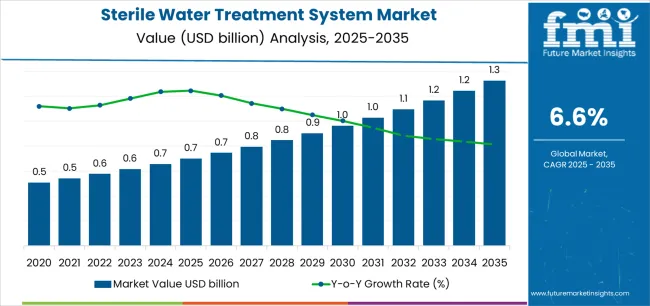
The sterile water treatment system market is valued at USD 0.7 billion in 2025 and is projected to reach USD 1.3 billion by 2035 at a CAGR of 6.6 percent. Growth is supported by rising sterile processing requirements across pharmaceutical production units, food and beverage facilities, and healthcare infrastructure. The transition from USD 0.7 billion to USD 1.3 billion indicates stronger adoption of controlled purification systems that ensure microbiological safety, particulate reduction, and adherence to water purity specifications. The sterile water treatment system market continues to expand based on operational needs in contamination-sensitive environments where variability in water quality can compromise batch reliability and procedural hygiene.
The pharmaceutical sector plays a defining role in shaping the direction of the sterile water treatment system market. Use cases span bioprocessing plants, injectable drug formulation units, and sterile compounding environments where water quality parameters require precise validation. Quality assurance teams now treat water purity documentation as an essential release requirement. This has encouraged procurement of purification units that support traceable monitoring records, validated performance consistency, and minimal manual oversight. These expectations have influenced decision-making across facility planning, equipment replacement cycles, and regulatory audit preparation.
System attributes have gained importance as evaluation criteria in the sterile water treatment system market. Preferred configurations incorporate multi-stage purification supported by microbial control mechanisms and sanitary-grade construction materials. Continuous monitoring features provide real-time visibility into conductivity, microbial load, and particulate integrity. Facilities value these capabilities for maintaining uniform water quality during ongoing operations. The ability to meet batch traceability expectations without process interruption strengthens equipment adoption in regulated settings.
Quick Stats for Sterile Water Treatment System Market
- Sterile Water Treatment System Market Value (2025): USD 0.7 billion
- Sterile Water Treatment System Market Forecast Value (2035): USD 1.3 billion
- Sterile Water Treatment System Market Forecast CAGR: 6.6%
- Leading Type in Sterile Water Treatment System Market: Fully Automatic (52.3%)
- Key Growth Regions in Sterile Water Treatment System Market: Asia Pacific, North America, and Europe
- Key Players in Sterile Water Treatment System Market: Krones AG, Lehui International, Steriwater (Interscience), BWT AG, NGK Insulators Ltd., TSA Process Equipments
Regional market dynamics reveal distinct growth patterns influenced by pharmaceutical development levels, healthcare infrastructure capabilities, and sterile water adoption rates. Developed markets in North America and Europe demonstrate steady growth driven by regulatory modernization, replacement cycles, and advanced manufacturing processes that prioritize high-quality water treatment systems. Emerging markets in Asia-Pacific show accelerated expansion supported by rapid pharmaceutical development, healthcare infrastructure growth, and increasing adoption of sterile water technologies. The competitive landscape encompasses established water treatment manufacturers alongside specialized purification solution providers, creating a diverse ecosystem that serves various market segments with tailored solutions.
The first half of the decade (2025 to 2030) will witness the sterile water treatment system market climbing from USD 0.7 billion to approximately USD 983.7 million, adding USD 270.9 million in value, which constitutes 42.5% of the total forecast growth period. This phase will be characterized by the rapid adoption of advanced sterile water treatment technologies, driven by increasing demand for high-purity water solutions and enhanced pharmaceutical manufacturing capabilities worldwide. Superior water quality and regulatory compliance will become standard expectations rather than premium options.
The latter half (2030 to 2035) will witness continued growth from USD 983.7 million to USD 1.3 billion, representing an addition of USD 366.9 million or 57.5% of the decade's expansion. This period will be defined by mass market penetration of specialized treatment systems, integration with comprehensive pharmaceutical platforms, and seamless compatibility with existing healthcare infrastructure. The sterile water treatment system market trajectory signals fundamental shifts in how pharmaceutical facilities approach water treatment selection, with participants positioned to benefit from continued demand across multiple application segments.
Sterile Water Treatment System Market Year-over-Year Forecast (2025 to 2035)
The sterile water treatment system market demonstrates distinct growth phases with varying market characteristics and competitive dynamics. Between 2025 and 2030, the sterile water treatment system market progresses through its pharmaceutical quality optimization phase, expanding from USD 0.7 billion to USD 983.7 million with steady annual increments averaging 6.7% growth. This period showcases the transition from traditional water treatment technologies to advanced sterile water treatment systems with enhanced purification performance and integrated quality management becoming mainstream features.
The 2025 to 2030 phase adds USD 270.9 million to market value, representing 42.5% of total decade expansion. Market maturation factors include standardization of treatment specifications, declining production costs for sterile water systems, and increasing pharmaceutical awareness of water purity reaching 85-90% effectiveness in healthcare applications. Competitive landscape evolution during this period features established manufacturers like Steriwater and LEHUI expanding their sterile water treatment portfolios while new entrants focus on specialized purification solutions and enhanced pharmaceutical technology.
From 2030 to 2035, market dynamics shift toward comprehensive pharmaceutical integration and multi-application deployment, with growth accelerating from USD 983.7 million to USD 1.3 billion, adding USD 366.9 million or 57.5% of total expansion. This phase transition centers on universal sterile water treatment systems, integration with advanced pharmaceutical platforms, and deployment across diverse healthcare scenarios, becoming standard rather than specialized treatment formats. The competitive environment matures with focus shifting from basic treatment performance to comprehensive quality excellence and compatibility with modern pharmaceutical operations.
Sterile Water Treatment System Market Key Takeaways
At-a-Glance Metrics
| Metric | Value |
|---|---|
| Market Value (2025) | USD 0.7 billion |
| Market Forecast (2035) | USD 1.3 billion |
| Growth Rate | 6.6% CAGR |
| Leading Type | Fully Automatic |
| Primary Application | Pharmaceuticals Segment |
The sterile water treatment system market demonstrates strong fundamentals, with fully automatic systems capturing a dominant share through superior automation characteristics and pharmaceutical compatibility. Pharmaceutical applications drive primary demand, supported by increasing purification requirements and enhanced quality development solutions. Geographic expansion remains concentrated in developed pharmaceutical markets with established infrastructure, while emerging economies show accelerating adoption rates driven by healthcare expansion and rising water quality sophistication.
Why is the Sterile Water Treatment System Market Growing?
Market expansion rests on three fundamental shifts driving adoption across pharmaceutical and healthcare sectors. Pharmaceutical quality growth creates compelling advantages through sterile water treatment systems that provide comprehensive purification properties with operational compatibility, enabling manufacturers to manage increasing performance requirements and maintain quality standards while ensuring contamination-controlled operations and justifying investment over traditional treatment methods. Advanced quality modernization accelerates as companies worldwide seek reliable systems that deliver superior performance directly to pharmaceutical operations, enabling contamination reduction that aligns with regulatory expectations and maximizes manufacturing productivity. Healthcare transformation drives adoption from infrastructure operators requiring specialized systems that maximize performance while maintaining high-quality reliability during pharmaceutical and healthcare operations.
Growth faces headwinds from advanced technology cost variations that differ across treatment suppliers regarding pricing stability and supply chain reliability, potentially limiting margin consistency in price-sensitive pharmaceutical categories. Manufacturing complexity also persists regarding system specifications and pharmaceutical requirements that may increase production costs in facilities with demanding quality standards.
Opportunity Pathways - Sterile Water Treatment System Market
The sterile water treatment system market represents a compelling intersection of pharmaceutical innovation, water quality advancement, and healthcare optimization management. With robust growth projected from USD 0.7 billion in 2025 to USD 1.3 billion by 2035 at a 6.6% CAGR, this market is driven by increasing pharmaceutical quality expansion trends, advanced purification requirements, and demand for high-performance treatment formats.
The market's expansion reflects a fundamental shift in how pharmaceutical facilities and healthcare operators approach water treatment infrastructure. Strong growth opportunities exist across diverse applications, from pharmaceutical operations requiring high-purity water to healthcare systems demanding reliable purification components. Geographic expansion is particularly pronounced in Asia-Pacific markets, LED by China (8.9% CAGR) and India (8.3% CAGR), while established markets in North America and Europe drive innovation and specialized segment development.
The dominance of Fully Automatic systems and pharmaceutical applications underscores the importance of proven treatment technology and healthcare reliability in driving adoption. System standardization and quality complexity remain key challenges, creating opportunities for companies that can deliver seamless treatment performance while maintaining water purity.
- Pathway A - Pharmaceutical Expansion. Development of specialized sterile water treatment systems for pharmaceutical applications, manufacturing infrastructure, and production systems with enhanced purification performance, quality assurance, and compatibility with pharmaceutical standards. Focus on operational efficiency and integration with pharmaceutical protocols. Expected revenue pool: USD 540.3-723.6 million.
- Pathway B - Geographic Expansion & Healthcare Penetration. Strong growth opportunities in China (8.9% CAGR) and India (8.3% CAGR) through partnerships with pharmaceutical companies, region-specific treatment requirements, and compliance with local healthcare standards. Localization addresses cost requirements and enables market penetration. Revenue opportunity: USD 445.8-597.3 million.
- Pathway C - Food and Beverage Applications. Developing specialized systems for food and beverage infrastructure, processing equipment, and production facilities. Focus on water quality, purification, and compatibility with food safety manufacturing. Pool: USD 377.4-505.6 million.
- Pathway D - Advanced Fully Automatic Technology Development. Specialized products incorporating enhanced purification technologies, improved system performance, advanced pharmaceutical capabilities, and superior automation characteristics where premium performance and pharmaceutical applications justify enhanced specifications. Focus on high-performance healthcare and quality assurance. Revenue uplift: USD 331.5-444.3 million.
- Pathway E - Treatment Type Diversification Programs. Systems designed for specialized purification applications, custom treatment solutions, advanced pharmaceutical systems, and precision healthcare operations that appeal to manufacturing companies and equipment producers. Integration of treatment specifications and pharmaceutical requirements. Expected upside: USD 283.1-379.3 million.
- Pathway F - Custom Treatment Solutions & Application Engineering. Incorporating specialized purification compositions for custom applications, engineered solutions, technical services, and specialized pharmaceutical production that enhance treatment capabilities while providing quality optimization. Focus on customer-specific requirements and technical support systems. Innovation pool: USD 234.9-314.7 million.
- Pathway G - Research & Development Integration. Tailored solutions incorporating laboratory-grade specifications, testing services, and precision treatment systems for university research programs and pharmaceutical R&D facilities. Enhanced appeal for academic institutions and pharmaceutical research companies. Strategic value: USD 186.9-250.4 million.
What Are the Key Segments in the Sterile Water Treatment System Market and How Do They Perform?
Primary Classification: The market segments by type into Fully Automatic, Semi-automatic, and others categories, representing the evolution from manual treatment solutions to high-automation purification systems for comprehensive operations.
Secondary Breakdown: Application segmentation divides the sterile water treatment system market into Pharmaceuticals, Food and Beverages, Cosmetics, and others sectors, reflecting distinct requirements for purification characteristics, quality specifications, and operational performance.
Tertiary Classification: End-use industry segmentation covers pharmaceutical manufacturing, healthcare operations, food processing systems, beverage equipment, cosmetic applications, and precision facilities, representing diverse requirements for treatment specifications and application performance.
Regional Classification: Geographic distribution covers North America, Europe, Asia Pacific, Latin America, and the Middle East & Africa, with developed pharmaceutical markets leading innovation while emerging economies show accelerating growth patterns driven by healthcare programs.
The segmentation structure reveals technology progression from manual treatment systems toward integrated high-performance platforms with enhanced purification capabilities and precision performance, while application diversity spans from pharmaceutical systems to healthcare requiring comprehensive treatment properties and intelligent quality solutions.
By Type, the Fully Automatic Segment Accounts for Dominant Market Share
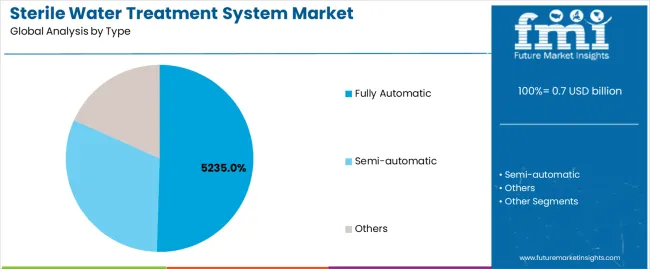
Fully Automatic segment is estimated to account for 52.3% of the sterile water treatment system market share in 2025. The segment's leading position stems from its fundamental role as a critical component in modern pharmaceutical applications and its extensive use across multiple healthcare and manufacturing sectors. The Fully Automatic range's dominance is attributed to its superior automation properties, including excellent purification, quality control, and balanced cost-effectiveness that make it indispensable for pharmaceutical operations.
Market Position: Fully Automatic systems command the leading position in the sterile water treatment system market through advanced treatment technologies, including comprehensive purification properties, uniform performance, and reliable automation characteristics that enable operators to deploy systems across diverse pharmaceutical environments.
Value Drivers: The segment benefits from pharmaceutical preference for proven treatment interfaces that provide exceptional purification performance without requiring ultra-premium treatment costs. Efficient automation implementation enables deployment in pharmaceutical, healthcare, and manufacturing applications where treatment reliability and quality compatibility represent critical selection requirements.
Competitive Advantages: Fully Automatic systems differentiate through excellent treatment capacity, proven pharmaceutical reliability, and compatibility with standard pharmaceutical processes that enhance system capabilities while maintaining economical purification profiles suitable for diverse healthcare applications.
Key market characteristics:
- Advanced treatment systems with precision quality control, consistent purification properties, and specialized manufacturing capabilities
- System optimization enabling comprehensive pharmaceutical integration with minimal contamination impact
- Healthcare accessories, including monitoring equipment, quality systems, and control tools for high-volume operations
By Application, the Pharmaceuticals Segment Accounts for the Largest Market Share
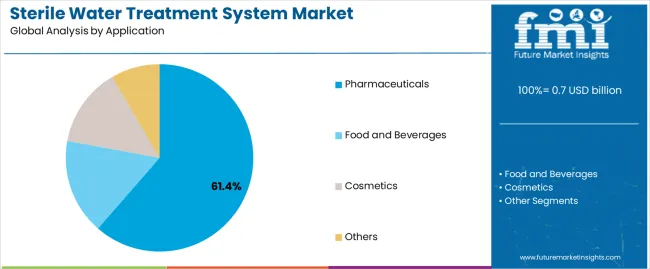
Pharmaceuticals segment is projected to hold 61.4% of the sterile water treatment system market share in 2025. The segment's market leadership is driven by the extensive use of sterile water treatment systems in drug manufacturing, pharmaceutical production, healthcare manufacturing, and medical infrastructure, where systems serve as both a purification component and quality solution. The pharmaceutical sector's consistent demand for reliable treatment systems supports the segment's dominant position.
Market Context: Pharmaceutical applications dominate the sterile water treatment system market due to widespread adoption of efficient treatment solutions and increasing focus on pharmaceutical quality, performance optimization, and operational management that support pharmaceutical operations while maintaining quality standards.
Appeal Factors: Pharmaceutical consumers prioritize system durability, purification performance, and integration with standard pharmaceutical operations that enable coordinated deployment across multiple pharmaceutical needs. The segment benefits from substantial drug manufacturing growth and pharmaceutical development that emphasize reliable systems for healthcare applications.
Growth Drivers: Pharmaceutical programs incorporate sterile water treatment systems as standard components for manufacturing operations and healthcare programs. At the same time, regulatory compliance initiatives are increasing demand for advanced features that comply with pharmaceutical standards and enhance system performance.
Market Challenges: System cost fluctuations and standardization requirements may limit deployment flexibility in ultra-price-sensitive markets or regions with varying pharmaceutical requirements.
Application dynamics include:
- Strong growth in pharmaceutical companies and drug manufacturing facilities requiring standardized treatment formats
- Increasing adoption in healthcare manufacturers and medical integrators for enhanced pharmaceutical development
- Rising integration with healthcare systems and manufacturing infrastructure control programs
By End-Use Industry, the Pharmaceutical Manufacturing Segment Demonstrates Strong Growth
Pharmaceutical Manufacturing segment is anticipated to capture 44.7% of the sterile water treatment system market share in 2025. The segment's growth is driven by increasing drug production demand, pharmaceutical manufacturing initiatives, and sophisticated treatment requirements that require high-quality purification systems. The pharmaceutical industry's expansion and focus on water quality efficiency support this segment's robust performance.
Market Position: Pharmaceutical applications leverage sterile water treatment systems for manufacturing operations in pharmaceutical equipment, production facilities, installation operations, and component integration where system quality and purification precision are critical performance factors.
Growth Catalysts: Rising drug production activities, pharmaceutical development trends, and expanding manufacturing capabilities drive demand for specialized systems that deliver consistent performance across diverse pharmaceutical applications.
What are the Drivers, Restraints, and Key Trends of the Sterile Water Treatment System Market?
Growth Accelerators: Pharmaceutical quality expansion drives primary adoption as sterile water treatment systems provide exceptional purification properties that enable pharmaceutical development without performance compromise, supporting quality advancement and operational efficiency that require reliable treatment formats. Advanced purification growth accelerates market expansion as companies seek specialized systems that maintain performance during operation while enhancing pharmaceutical convenience through standardized specifications and compatibility. Healthcare awareness increases worldwide, creating continued demand for sterile water treatment systems that complement pharmaceutical routines and provide operational advantages in quality performance.
Growth Inhibitors: Advanced technology cost volatility challenges differ across treatment markets regarding price stability and supply chain consistency, which may limit margin predictability and cost planning in price-sensitive pharmaceutical categories with demanding affordability requirements. Manufacturing complexity persists regarding system specifications and pharmaceutical standards that may increase production costs in facilities with complex quality protocols. Market fragmentation across multiple treatment specifications and application standards creates compatibility concerns between different treatment systems and existing pharmaceutical infrastructure.
Market Evolution Patterns: Adoption accelerates in pharmaceutical and healthcare sectors where treatment benefits justify equipment investments, with geographic concentration in developed markets transitioning toward mainstream adoption in emerging economies driven by healthcare expansion and pharmaceutical development. Technology advancement focuses on enhanced purification properties, improved pharmaceutical performance, and integration with automated systems that optimize pharmaceutical performance and quality control. The sterile water treatment system market could face disruption if alternative treatment technologies or pharmaceutical changes significantly challenge traditional sterile water treatment advantages in pharmaceutical applications.
Analysis of the Sterile Water Treatment System Market by Key Country
The sterile water treatment system market demonstrates varied regional dynamics with growth leaders including China (8.9% CAGR) and India (8.3% CAGR) driving expansion through pharmaceutical infrastructure growth and healthcare modernization. Steady Performers encompass Germany (7.6% CAGR), Brazil (6.9% CAGR), and the USA (6.3% CAGR), benefiting from established pharmaceutical systems and advanced treatment adoption.
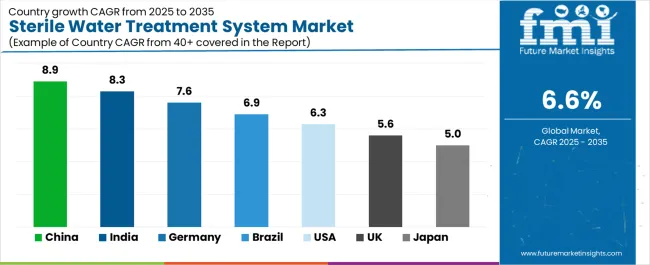
| Country | CAGR (2025 to 2035) |
|---|---|
| China | 8.9% |
| India | 8.3% |
| Germany | 7.6% |
| Brazil | 6.9% |
| USA | 6.3% |
| UK | 5.6% |
| Japan | 5% |
Regional synthesis reveals Asia-Pacific markets leading growth through pharmaceutical expansion and healthcare development, while European countries maintain steady expansion supported by specialized applications and precision treatment requirements. North American markets show strong growth driven by pharmaceutical demand and healthcare facility upgrades.
How Is China Contributing to the Development of the Sterile Water Treatment System Market?
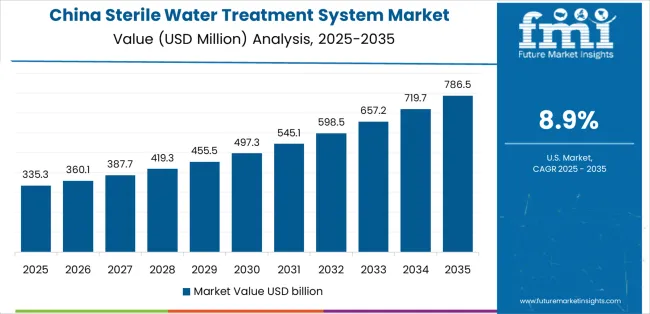
China establishes regional leadership through rapid pharmaceutical development and comprehensive healthcare modernization, integrating advanced sterile water treatment systems as standard components in drug manufacturing and healthcare operations. The country's 8.9% CAGR through 2035 reflects pharmaceutical growth promoting infrastructure quality and healthcare development that mandate the use of reliable treatment systems in pharmaceutical operations. Growth concentrates in major pharmaceutical centers, including Beijing, Shanghai, and Guangzhou, where pharmaceutical networks showcase integrated treatment systems that appeal to manufacturers seeking enhanced production efficiency and international quality standards.
Chinese manufacturers are developing innovative sterile water treatment solutions that combine local production advantages with international pharmaceutical specifications, including advanced purification compositions and enhanced quality capabilities.
Strategic Market Indicators:
- Pharmaceutical infrastructure growth providing substantial support for domestic healthcare development
- Drug manufacturing capacity expansion driven by pharmaceutical development and treatment demand
- Research sector development for cost-effective treatment solutions targeting domestic and export applications
What Role Is India Playing in the Growth of the Sterile Water Treatment System Market?
The Indian market emphasizes pharmaceutical infrastructure applications, including rapid healthcare development and comprehensive treatment expansion that increasingly incorporates sterile water treatment systems for pharmaceutical enhancement and healthcare applications. The country is projected to show a 8.3% CAGR through 2035, driven by massive pharmaceutical activity under healthcare initiatives and demand for standardized, high-quality treatment systems. Indian pharmaceutical facilities prioritize cost-effectiveness with sterile water treatment systems delivering healthcare efficiency through economical treatment usage and reliable performance capabilities.
Technology deployment channels include major pharmaceutical companies, healthcare integrators, and treatment institutions that support high-volume usage for pharmaceutical and healthcare applications.
Performance Metrics:
- Pharmaceutical facilities in Mumbai, Hyderabad, and Bangalore leading sterile water treatment system adoption for healthcare operations
- Healthcare development compliance with pharmaceutical standards, driving quality selection criteria
How Is Germany Driving the Advancement of the Sterile Water Treatment System Market?
The German market emphasizes advanced pharmaceutical infrastructure features, including innovative treatment technologies and integration with comprehensive healthcare platforms that manage manufacturing operations, pharmaceutical facilities, and institutional applications through unified treatment systems. The country is projected to show a 7.6% CAGR through 2035, driven by pharmaceutical expansion under healthcare development trends and demand for premium, reliable treatment systems. German pharmaceutical institutions prioritize precision with sterile water treatment systems delivering comprehensive healthcare performance through enhanced quality protection and operational innovation.
Technology deployment channels include major pharmaceutical companies, healthcare institutions, and treatment equipment manufacturers that support custom development for premium operations.
Performance Metrics:
- Pharmaceutical companies in North Rhine-Westphalia, Bavaria, and Baden-Württemberg leading sterile water treatment system adoption for healthcare operations
- Healthcare compatibility with pharmaceutical requirements, driving specification selection criteria
How Is Brazil Shaping the Sterile Water Treatment System Market?
In São Paulo, Rio de Janeiro, and Belo Horizonte, Brazilian pharmaceutical facilities and healthcare operators are implementing advanced sterile water treatment systems to enhance purification capabilities and support operational performance that aligns with healthcare protocols and pharmaceutical standards. The Brazilian market demonstrates continued growth with a 6.9% CAGR through 2035, driven by pharmaceutical compliance programs and healthcare investments that emphasize reliable treatment systems for pharmaceutical and healthcare applications. Brazilian pharmaceutical facilities are prioritizing sterile water treatment systems that provide exceptional purification properties while maintaining compliance with healthcare standards and minimizing operational complexity, particularly important in pharmaceutical and healthcare facility operations.
Market expansion benefits from healthcare programs that mandate enhanced treatment compliance in pharmaceutical specifications, creating continued demand across Brazil's pharmaceutical and healthcare sectors, where treatment quality and system consistency represent critical requirements.
Strategic Market Indicators:
- Pharmaceutical operators and healthcare companies leading adoption with compliance programs requiring reliable treatment systems
- Healthcare standards providing framework support for high-performance treatment acquisition
- Quality control requirements driving demand for certified systems with performance testing documentation
- Specialized pharmaceutical segments adopting comprehensive sterile water treatment solutions for healthcare facilities and manufacturing projects
What Impact Is the USA Having on the Growth of the Sterile Water Treatment System Market?
The USA market emphasizes pharmaceutical infrastructure features, including innovative treatment technologies and integration with comprehensive healthcare platforms that manage manufacturing operations, pharmaceutical facilities, and commercial applications through unified treatment systems. The country is projected to show a 6.3% CAGR through 2035, driven by pharmaceutical expansion under healthcare development trends and industry demand for premium, reliable treatment systems. American pharmaceutical companies prioritize innovation with sterile water treatment systems delivering comprehensive healthcare performance through enhanced quality protection and operational advancement.
Technology deployment channels include major pharmaceutical companies, healthcare institutions, and treatment manufacturers that support custom development for pharmaceutical operations.
Performance Metrics:
- Pharmaceutical companies in New Jersey, California, and Massachusetts leading sterile water treatment system adoption for healthcare operations
- Treatment compatibility with pharmaceutical development requirements, driving specification selection criteria
How Is the UK Shaping the Future of the Sterile Water Treatment System Market?
The UK market demonstrates advanced pharmaceutical infrastructure deployment, growing at 5.6% CAGR, with documented operational excellence in healthcare control and pharmaceutical applications through integration with existing healthcare systems and quality assurance infrastructure. The country leverages engineering expertise in pharmaceutical manufacturing and treatment science to maintain market leadership. Healthcare centers, including London, Cambridge, and Oxford, showcase advanced installations where sterile water treatment systems integrate with comprehensive pharmaceutical platforms and healthcare systems to optimize pharmaceutical development and operational efficiency.
British pharmaceutical facilities prioritize treatment precision and system consistency in product selection, creating demand for premium sterile water treatment systems with advanced features, including enhanced purification compositions and integration with automated healthcare systems. The sterile water treatment system market benefits from established pharmaceutical infrastructure and willingness to invest in specialized treatment technologies that provide superior quality and healthcare compliance.
Market Intelligence Brief:
- Precision focus on treatment quality and system uniformity, driving healthcare segment growth
- Technology collaboration between British pharmaceutical manufacturers and international treatment companies
- Premium healthcare systems expanding sterile water treatment integration in manufacturing infrastructure and pharmaceutical applications
How Is Japan Influencing the Sterile Water Treatment System Market?
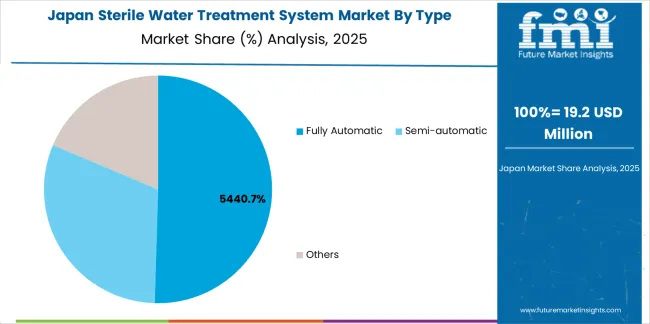
Japan's advanced pharmaceutical market demonstrates meticulous sterile water treatment system deployment, growing at 5% CAGR, with documented operational excellence in healthcare control and manufacturing applications through integration with existing pharmaceutical systems and quality assurance infrastructure. The country leverages engineering expertise in pharmaceutical manufacturing and treatment technology to maintain market leadership. Pharmaceutical centers, including Tokyo, Osaka, and Kyoto, showcase advanced installations where sterile water treatment systems integrate with comprehensive healthcare platforms and quality systems to optimize pharmaceutical development and operational efficiency.
Japanese pharmaceutical facilities prioritize treatment precision and system consistency in product selection, creating demand for premium sterile water treatment systems with advanced features, including ultra-high quality and integration with automated healthcare protocols. The sterile water treatment system market benefits from established pharmaceutical infrastructure and a willingness to invest in specialized treatment technologies that provide superior performance and healthcare compliance.
Market Intelligence Brief:
- Precision focus on treatment quality and purification uniformity, driving healthcare segment growth
- Technology collaboration between Japanese pharmaceutical manufacturers and international treatment companies
- Premium healthcare systems expanding sterile water treatment integration in manufacturing infrastructure and pharmaceutical applications
How Is the Sterile Water Treatment System Market Distributed Across European Countries?
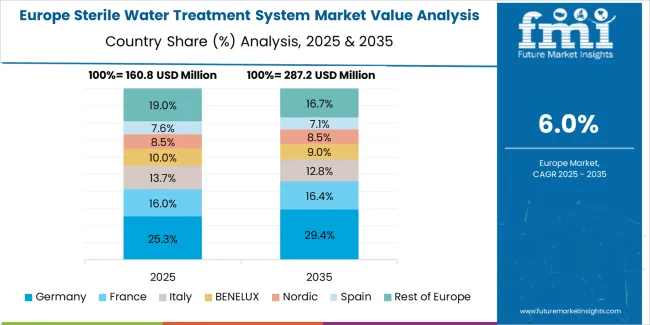
The sterile water treatment system market in Europe is projected to grow from USD 201.4 million in 2025 to USD 382 million by 2035, registering a CAGR of 6.6% over the forecast period. Germany is expected to maintain its leadership position with a 36.8% market share in 2025, declining slightly to 36.5% by 2035, supported by its healthcare excellence and major pharmaceutical centers, including North Rhine-Westphalia and Bavaria.
France follows with a 23.7% share in 2025, projected to reach 23.9% by 2035, driven by comprehensive pharmaceutical programs and healthcare facility initiatives. The United Kingdom holds a 19.6% share in 2025, expected to maintain 19.8% by 2035 through established healthcare sectors and pharmaceutical adoption. Italy commands a 12.4% share, while Spain accounts for 4.2% in 2025.
The Rest of Europe region is anticipated to gain momentum, expanding its collective share from 3.3% to 3.5% by 2035, attributed to increasing pharmaceutical development in Eastern European countries and emerging healthcare programs implementing standardized treatment systems.
How Are Companies Competing in the Sterile Water Treatment System Market?
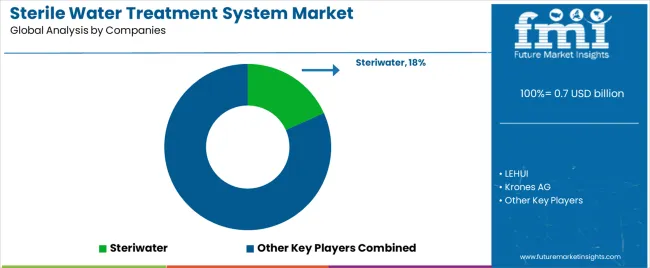
The sterile water treatment system market operates with moderate concentration, featuring approximately 15-22 participants, where leading companies control roughly 58-64% of the global market share through established distribution networks and comprehensive product portfolio capabilities. Competition emphasizes system performance, healthcare reliability, and quality optimization rather than premium feature rivalry.
Market leaders encompass Steriwater, LEHUI, and Krones AG, which maintain competitive advantages through extensive pharmaceutical infrastructure expertise, regional distribution networks, and comprehensive technical support capabilities that create healthcare industry loyalty and support pharmaceutical requirements. These companies leverage decades of treatment experience and ongoing healthcare technology investments to develop advanced sterile water treatment systems with exceptional quality and pharmaceutical features.
Specialty challengers include regional manufacturers and treatment specialists, which compete through specialized application innovation focus and efficient production solutions that appeal to pharmaceutical buyers seeking reliable performance formats and custom treatment flexibility. These companies differentiate through operational efficiency emphasis and specialized market focus.
Market dynamics favor participants that combine consistent treatment performance with advanced healthcare support, including automated systems and distribution capabilities. Competitive pressure intensifies as traditional treatment manufacturers expand into sterile water treatment systems. At the same time, specialized pharmaceutical producers challenge established players through innovative manufacturing methods and cost-effective production targeting emerging healthcare segments.
Who Are the Key Players in the Sterile Water Treatment System Market?
- Steriwater
- LEHUI
- Krones AG
- AmeriWater LLC
- Fabtech Technologies Ltd.
- Xylem
- Jiangsu Huihe Packaging Machinery Co., Ltd.
Scope of the Report
| Item | Value |
|---|---|
| Quantitative Units | USD 0.7 billion |
| Type | Fully Automatic, Semi-automatic, Others |
| Application | Pharmaceuticals, Food and Beverages, Cosmetics, Others |
| End-Use Industry | Pharmaceutical Manufacturing, Healthcare Operations, Food Processing Systems, Beverage Equipment, Cosmetic Applications, Precision Facilities |
| Regions Covered | North America, Europe, Asia Pacific, Latin America, Middle East & Africa |
| Countries Covered | China, India, Germany, Brazil, U.S., U.K., Japan, and 25+ additional countries |
| Key Companies Profiled | Steriwater, LEHUI, Krones AG, AmeriWater LLC |
| Additional Attributes | Dollar sales by type and application categories, regional adoption trends across Asia Pacific, North America, and Europe, competitive landscape with treatment manufacturers and pharmaceutical producers, customer preferences for treatment characteristics and healthcare performance, integration with pharmaceutical equipment and healthcare systems, innovations in treatment technology and advanced healthcare systems, and development of specialized treatment solutions with enhanced properties and pharmaceutical-grade features |
Sterile Water Treatment System Market by Segments
Type:
- Fully Automatic
- Semi-automatic
- Others
Application:
- Pharmaceuticals
- Food and Beverages
- Cosmetics
- Others
End-Use Industry:
- Pharmaceutical Manufacturing
- Healthcare Operations
- Food Processing Systems
- Beverage Equipment
- Cosmetic Applications
- Precision Facilities
Region:
- North America
- United States
- Canada
- Mexico
- Europe
- Germany
- France
- United Kingdom
- Italy
- Spain
- Nordic
- BENELUX
- Rest of Europe
- Asia Pacific
- China
- Japan
- India
- South Korea
- ASEAN
- Australia & New Zealand
- Rest of Asia Pacific
- Latin America
- Brazil
- Chile
- Rest of Latin America
- Middle East & Africa
- Kingdom of Saudi Arabia
- Other GCC Countries
- Turkey
- South Africa
- Other African Union
- Rest of Middle East & Africa
Frequently Asked Questions
How big is the sterile water treatment system market in 2025?
The global sterile water treatment system market is estimated to be valued at USD 0.7 billion in 2025.
What will be the size of sterile water treatment system market in 2035?
The market size for the sterile water treatment system market is projected to reach USD 1.3 billion by 2035.
How much will be the sterile water treatment system market growth between 2025 and 2035?
The sterile water treatment system market is expected to grow at a 6.6% CAGR between 2025 and 2035.
What are the key product types in the sterile water treatment system market?
The key product types in sterile water treatment system market are fully automatic, semi-automatic and others.
Which application segment to contribute significant share in the sterile water treatment system market in 2025?
In terms of application, pharmaceuticals segment to command 61.4% share in the sterile water treatment system market in 2025.
Preview the report firsthand - request a free sample
Get SampleGet the brochure for pricing and purchase details.
Get PDFTable of Content
- Executive Summary
- Global Market Outlook
- Demand-side Trends
- Supply-side Trends
- Technology Roadmap Analysis
- Analysis and Recommendations
- Market Overview
- Market Coverage / Taxonomy
- Market Definition / Scope / Limitations
- Market Background
- Market Dynamics
- Drivers
- Restraints
- Opportunity
- Trends
- Scenario Forecast
- Demand in Optimistic Scenario
- Demand in Likely Scenario
- Demand in Conservative Scenario
- Opportunity Map Analysis
- Product Life Cycle Analysis
- Supply Chain Analysis
- Investment Feasibility Matrix
- Value Chain Analysis
- PESTLE and Porter’s Analysis
- Regulatory Landscape
- Regional Parent Market Outlook
- Production and Consumption Statistics
- Import and Export Statistics
- Market Dynamics
- Global Market Analysis 2020 to 2024 and Forecast, 2025 to 2035
- Historical Market Size Value (USD Million) Analysis, 2020 to 2024
- Current and Future Market Size Value (USD Million) Projections, 2025 to 2035
- Y-o-Y Growth Trend Analysis
- Absolute $ Opportunity Analysis
- Global Market Pricing Analysis 2020 to 2024 and Forecast 2025 to 2035
- Global Market Analysis 2020 to 2024 and Forecast 2025 to 2035, By Type
- Introduction / Key Findings
- Historical Market Size Value (USD Million) Analysis By Type , 2020 to 2024
- Current and Future Market Size Value (USD Million) Analysis and Forecast By Type , 2025 to 2035
- Fully Automatic
- Semi-automatic
- Others
- Y-o-Y Growth Trend Analysis By Type , 2020 to 2024
- Absolute $ Opportunity Analysis By Type , 2025 to 2035
- Global Market Analysis 2020 to 2024 and Forecast 2025 to 2035, By Application
- Introduction / Key Findings
- Historical Market Size Value (USD Million) Analysis By Application, 2020 to 2024
- Current and Future Market Size Value (USD Million) Analysis and Forecast By Application, 2025 to 2035
- Pharmaceuticals
- Food and Beverages
- Cosmetics
- Others
- Y-o-Y Growth Trend Analysis By Application, 2020 to 2024
- Absolute $ Opportunity Analysis By Application, 2025 to 2035
- Global Market Analysis 2020 to 2024 and Forecast 2025 to 2035, By Region
- Introduction
- Historical Market Size Value (USD Million) Analysis By Region, 2020 to 2024
- Current Market Size Value (USD Million) Analysis and Forecast By Region, 2025 to 2035
- North America
- Latin America
- Western Europe
- Eastern Europe
- East Asia
- South Asia and Pacific
- Middle East & Africa
- Market Attractiveness Analysis By Region
- North America Market Analysis 2020 to 2024 and Forecast 2025 to 2035, By Country
- Historical Market Size Value (USD Million) Trend Analysis By Market Taxonomy, 2020 to 2024
- Market Size Value (USD Million) Forecast By Market Taxonomy, 2025 to 2035
- By Country
- USA
- Canada
- Mexico
- By Type
- By Application
- By Country
- Market Attractiveness Analysis
- By Country
- By Type
- By Application
- Key Takeaways
- Latin America Market Analysis 2020 to 2024 and Forecast 2025 to 2035, By Country
- Historical Market Size Value (USD Million) Trend Analysis By Market Taxonomy, 2020 to 2024
- Market Size Value (USD Million) Forecast By Market Taxonomy, 2025 to 2035
- By Country
- Brazil
- Chile
- Rest of Latin America
- By Type
- By Application
- By Country
- Market Attractiveness Analysis
- By Country
- By Type
- By Application
- Key Takeaways
- Western Europe Market Analysis 2020 to 2024 and Forecast 2025 to 2035, By Country
- Historical Market Size Value (USD Million) Trend Analysis By Market Taxonomy, 2020 to 2024
- Market Size Value (USD Million) Forecast By Market Taxonomy, 2025 to 2035
- By Country
- Germany
- UK
- Italy
- Spain
- France
- Nordic
- BENELUX
- Rest of Western Europe
- By Type
- By Application
- By Country
- Market Attractiveness Analysis
- By Country
- By Type
- By Application
- Key Takeaways
- Eastern Europe Market Analysis 2020 to 2024 and Forecast 2025 to 2035, By Country
- Historical Market Size Value (USD Million) Trend Analysis By Market Taxonomy, 2020 to 2024
- Market Size Value (USD Million) Forecast By Market Taxonomy, 2025 to 2035
- By Country
- Russia
- Poland
- Hungary
- Balkan & Baltic
- Rest of Eastern Europe
- By Type
- By Application
- By Country
- Market Attractiveness Analysis
- By Country
- By Type
- By Application
- Key Takeaways
- East Asia Market Analysis 2020 to 2024 and Forecast 2025 to 2035, By Country
- Historical Market Size Value (USD Million) Trend Analysis By Market Taxonomy, 2020 to 2024
- Market Size Value (USD Million) Forecast By Market Taxonomy, 2025 to 2035
- By Country
- China
- Japan
- South Korea
- By Type
- By Application
- By Country
- Market Attractiveness Analysis
- By Country
- By Type
- By Application
- Key Takeaways
- South Asia and Pacific Market Analysis 2020 to 2024 and Forecast 2025 to 2035, By Country
- Historical Market Size Value (USD Million) Trend Analysis By Market Taxonomy, 2020 to 2024
- Market Size Value (USD Million) Forecast By Market Taxonomy, 2025 to 2035
- By Country
- India
- ASEAN
- Australia & New Zealand
- Rest of South Asia and Pacific
- By Type
- By Application
- By Country
- Market Attractiveness Analysis
- By Country
- By Type
- By Application
- Key Takeaways
- Middle East & Africa Market Analysis 2020 to 2024 and Forecast 2025 to 2035, By Country
- Historical Market Size Value (USD Million) Trend Analysis By Market Taxonomy, 2020 to 2024
- Market Size Value (USD Million) Forecast By Market Taxonomy, 2025 to 2035
- By Country
- Kingdom of Saudi Arabia
- Other GCC Countries
- Turkiye
- South Africa
- Other African Union
- Rest of Middle East & Africa
- By Type
- By Application
- By Country
- Market Attractiveness Analysis
- By Country
- By Type
- By Application
- Key Takeaways
- Key Countries Market Analysis
- USA
- Pricing Analysis
- Market Share Analysis, 2024
- By Type
- By Application
- Canada
- Pricing Analysis
- Market Share Analysis, 2024
- By Type
- By Application
- Mexico
- Pricing Analysis
- Market Share Analysis, 2024
- By Type
- By Application
- Brazil
- Pricing Analysis
- Market Share Analysis, 2024
- By Type
- By Application
- Chile
- Pricing Analysis
- Market Share Analysis, 2024
- By Type
- By Application
- Germany
- Pricing Analysis
- Market Share Analysis, 2024
- By Type
- By Application
- UK
- Pricing Analysis
- Market Share Analysis, 2024
- By Type
- By Application
- Italy
- Pricing Analysis
- Market Share Analysis, 2024
- By Type
- By Application
- Spain
- Pricing Analysis
- Market Share Analysis, 2024
- By Type
- By Application
- France
- Pricing Analysis
- Market Share Analysis, 2024
- By Type
- By Application
- India
- Pricing Analysis
- Market Share Analysis, 2024
- By Type
- By Application
- ASEAN
- Pricing Analysis
- Market Share Analysis, 2024
- By Type
- By Application
- Australia & New Zealand
- Pricing Analysis
- Market Share Analysis, 2024
- By Type
- By Application
- China
- Pricing Analysis
- Market Share Analysis, 2024
- By Type
- By Application
- Japan
- Pricing Analysis
- Market Share Analysis, 2024
- By Type
- By Application
- South Korea
- Pricing Analysis
- Market Share Analysis, 2024
- By Type
- By Application
- Russia
- Pricing Analysis
- Market Share Analysis, 2024
- By Type
- By Application
- Poland
- Pricing Analysis
- Market Share Analysis, 2024
- By Type
- By Application
- Hungary
- Pricing Analysis
- Market Share Analysis, 2024
- By Type
- By Application
- Kingdom of Saudi Arabia
- Pricing Analysis
- Market Share Analysis, 2024
- By Type
- By Application
- Turkiye
- Pricing Analysis
- Market Share Analysis, 2024
- By Type
- By Application
- South Africa
- Pricing Analysis
- Market Share Analysis, 2024
- By Type
- By Application
- USA
- Market Structure Analysis
- Competition Dashboard
- Competition Benchmarking
- Market Share Analysis of Top Players
- By Regional
- By Type
- By Application
- Competition Analysis
- Competition Deep Dive
- Steriwater
- Overview
- Product Portfolio
- Profitability by Market Segments (Product/Age /Sales Channel/Region)
- Sales Footprint
- Strategy Overview
- Marketing Strategy
- Product Strategy
- Channel Strategy
- LEHUI
- Krones AG
- AmeriWater LLC
- Fabtech Technologies Ltd.
- Xylem
- Global Filter
- Avidity Science
- Aquastream
- Absolute Water Technologies
- Moerk Water
- Anhui Pingjude Medical Technology Co., Ltd.
- Jiangsu Huihe Packaging Machinery Co., Ltd.
- Steriwater
- Competition Deep Dive
- Assumptions & Acronyms Used
- Research Methodology


