

- Industry Size (2025)
- USD 26.7 Bn
- Forecast (2035)
- USD 38.7 Bn
- CAGR (2025 to 2035)
- 3.8%
Sterile and Antiviral Packaging Market Size and Share Forecast Outlook 2025 to 2035
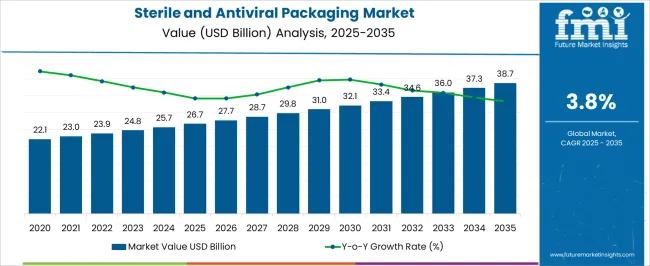
The Sterile and Antiviral Packaging Market is estimated to be valued at USD 26.7 billion in 2025 and is projected to reach USD 38.7 billion by 2035, registering a compound annual growth rate (CAGR) of 3.8% over the forecast period.
The sterile and antiviral packaging market is experiencing strong growth driven by rising healthcare demands, stringent regulatory standards, and increased focus on infection prevention. The current market landscape reflects growing adoption across pharmaceutical, biotechnology, and medical device sectors. The need for packaging that ensures product integrity, sterility, and extended shelf life has intensified following heightened awareness of contamination control.
Technological advancements in packaging design, barrier coatings, and material sterilization are enabling higher efficiency and compliance with safety norms. The future outlook remains positive as expanding healthcare infrastructure and global vaccination initiatives accelerate demand for sterile packaging solutions.
Manufacturers are investing in recyclable materials and smart sterilization techniques to align with sustainability goals and reduce environmental impact Growth rationale is supported by rising R&D activities, increased biologics production, and the widespread implementation of high-standard packaging protocols, positioning the market for continuous expansion and enhanced penetration across key healthcare applications.
Quick Stats for Sterile and Antiviral Packaging Market
- Sterile and Antiviral Packaging Market Industry Value (2025): USD 26.7 billion
- Sterile and Antiviral Packaging Market Forecast Value (2035): USD 38.7 billion
- Sterile and Antiviral Packaging Market Forecast CAGR: 3.8%
- Leading Segment in Sterile and Antiviral Packaging Market in 2025: Thermoform Trays (27.4%)
- Key Growth Region in Sterile and Antiviral Packaging Market: North America, Asia-Pacific, Europe
- Top Key Players in Sterile and Antiviral Packaging Market: Amcor plc, Billerud AB, DuPont, Inc, Sonoco Products Company, Wihuri Group, ProAmpac, LLC, GY Packaging, Berry Global Inc., Sabre Medical, Pty Ltd, Placon Corp, UFP Technologies, Inc., Puracon GmbH, OLIVER Healthcare Packaging, Westfield Medical Ltd, Deufol SE, Technipaq, Inc, Tekni-Plex Inc., UFlex Limited, AptarGroup, Inc., Beacon Converters Inc.
| Metric | Value |
|---|---|
| Sterile and Antiviral Packaging Market Estimated Value in (2025 E) | USD 26.7 billion |
| Sterile and Antiviral Packaging Market Forecast Value in (2035 F) | USD 38.7 billion |
| Forecast CAGR (2025 to 2035) | 3.8% |
Segmental Analysis
The market is segmented by Packaging Types, Material Type, and End-Use and region. By Packaging Types, the market is divided into Thermoform Trays, Sterile Bottles/Containers, Vials And Ampoules, Sterile Closures, Prefilled Syringes, Blister And Clamshells, IV Bags And Pouches, Sterile Wraps, and Others. In terms of Material Type, the market is classified into Plastic, Glass, Metal, Paper, and Paperboard. Based on End-Use, the market is segmented into Pharmaceutical And Biological, Surgical And Medical Instruments, Food And Beverage Packaging, and Others. Regionally, the market is classified into North America, Latin America, Western Europe, Eastern Europe, Balkan & Baltic Countries, Russia & Belarus, Central Asia, East Asia, South Asia & Pacific, and the Middle East & Africa.
Insights into the Packaging Types Segment
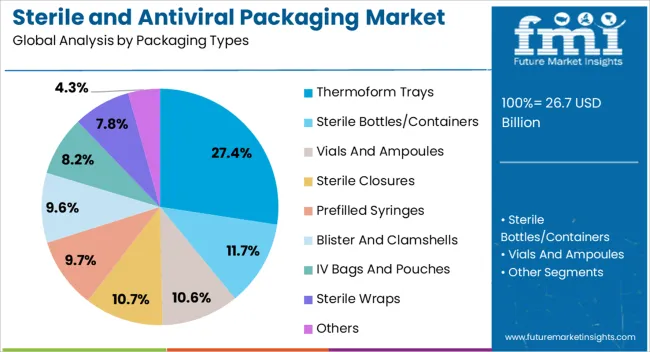
The thermoform trays segment, accounting for 27.40% of the packaging types category, has emerged as a leading format due to its superior product protection, customization flexibility, and compatibility with sterilization processes. Demand growth has been supported by increasing usage in pharmaceutical and medical device packaging where contamination control is critical.
Consistent dimensional accuracy and durability under various temperature and pressure conditions have strengthened adoption across sterile production environments. Manufacturers have focused on improving sealing integrity and material transparency to meet stringent quality standards.
The segment continues to benefit from rising demand for single-use and pre-sterilized solutions that simplify logistics and ensure compliance With healthcare institutions emphasizing safe handling and efficient packaging disposal, thermoform trays are expected to maintain their leadership position through ongoing innovation and global standardization in sterile packaging operations.
Insights into the Material Type Segment
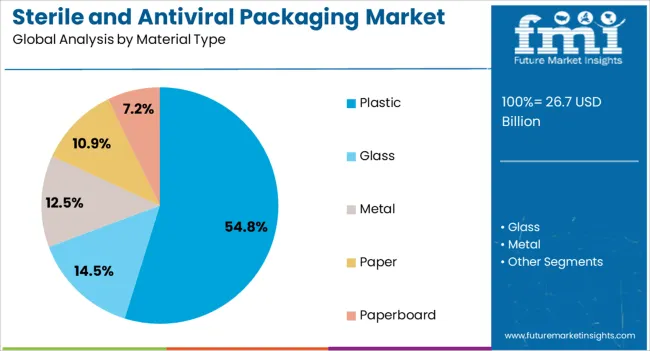
The plastic segment, representing 54.80% of the material type category, has been leading the market due to its versatility, lightweight characteristics, and excellent barrier properties. Plastic-based sterile packaging solutions are favored for their cost-effectiveness, scalability, and adaptability to advanced sterilization techniques such as gamma and ethylene oxide processing.
Manufacturers have adopted medical-grade polymers to ensure biocompatibility and contamination resistance. Continuous improvements in polymer formulations are enhancing tensile strength and reducing permeability, enabling longer product shelf life.
The segment’s dominance is further supported by ease of molding into complex designs, which ensures suitability for high-precision medical components and pharmaceutical products As sustainability becomes a priority, the development of recyclable and bio-based plastics is gaining momentum, allowing manufacturers to meet environmental standards while preserving functional performance and safety reliability.
Insights into the End-Use Segment
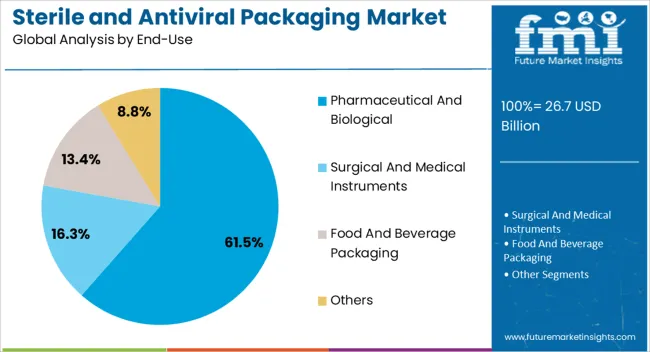
The pharmaceutical and biological segment, holding 61.50% of the end-use category, remains the largest contributor to market demand. Its dominance is attributed to the growing production of vaccines, injectables, and biologics that require sterile containment and contamination-free handling. Rising investments in biopharmaceutical manufacturing and global expansion of clinical research have reinforced the need for advanced antiviral packaging systems.
Manufacturers are focusing on integrating sterilization validation and contamination risk mitigation in line with regulatory expectations. The segment benefits from strong institutional procurement by hospitals, laboratories, and contract manufacturing organizations.
Continuous innovations in antiviral coatings and nanotechnology-based barrier materials are improving packaging functionality and extending protection efficacy Over the forecast period, the pharmaceutical and biological sector is expected to sustain its leadership position through continued emphasis on patient safety, regulatory compliance, and expansion of biologic drug portfolios worldwide.
Key Industry Highlights
Rising Concern towards Spread of Infections during Medical Treatments
The sterile and antiviral packaging market is considered to be the most accelerating market in the pharmaceutical and healthcare industry. The rising prevalence of infectious and non-infectious diseases or viruses such as Corona, Ebola, and others are supplementing the market growth.
With time, the types of infections, diseases, and their method of treatment have been changing on a large scale. To stop the spread of infectious diseases, organizations are raising awareness about the steps that need to be taken to prevent infectious diseases.
Increasing demand for protective packaging solutions to prevent the spread of infections by anesthesia equipment, laryngoscope blades, blood pressure cuffs, stethoscopes, and oxygen saturation monitors is propelling the sterile and antiviral packaging market.
According to the study by Amcor Plc, a global packaging company, medical pouches are excellent for packaging medical equipment. Bags and pouches are used prominently for packaging medical apparatus such as canisters, hypodermic needles, thermometers, aspirators, and nebulizers.
Sterilized packaging is an essential component of the medical industry as it can be life-threatening to patients. Increasing pressure from regulatory authorities dealing with the medical and pharmaceutical industry is boosting the sales of sterile and antiviral packaging.
Increasing Demand for Secured Packaging in the Food and Beverage Industry Pushes Sales
A rise in the consumption of packaged foods and beverages across regions is pushing the sale of sterilized and antiviral packaging. The consumption of spoiled, contaminated, and damaged foods and beverages leads to various types of food-borne diseases.
This has generated a necessity for sterile and antiviral packaging solutions with the objective that packaged foods, and beverages reach the customers pure in quality and safe. Packaged food and beverages have to face severe situations after their production phase during storing, warehousing, transport, and distribution.
Sterile and antiviral packaging is the most crucial aspect to keeping the products safe for human consumption and free from contamination due to exposure to excessive sunlight, moisture, and other external factors. Packaging solutions of multiple materials can be made as per the desired product and demand of the end user.
Materials like plastic, glass, metal, paper, and many more offer effective sterile and antiviral packaging solutions for a wide range of food and beverages. Various organizations are stepping ahead to provide sterile and antiviral packaging solutions.
The Environmental Protection Agency (EPA) stated that antimicrobial technology be built into plastic and textiles used in food packaging to prevent the growth of bacteria, mold, mildew, fungi, discoloration and odor. Companies are investing and developing suitable materials that continue with antimicrobial costing is emerging as a trend in the industry.
A study has been going on the development of edible food packaging that can create traction in the packaging industry of food and beverage.
High Production Cost to Hamper the Demand for Sterile and Antiviral Packaging
In the current scenario, there are very few sterile and antiviral packaging manufacturers in the market. These packaging solutions are associated with different types of added costs , such as environmental, safety, and regulatory barriers, which lead to increased costs of the packaging solutions. Thus, high production costs have been a current challenge for the sterile and antiviral packaging industry.
2020 to 2025 Global Sterile and Antiviral Packaging Sales Outlook Compared to Demand Forecast from 2025 to 2035
The global market recorded a CAGR of 3.1% during the historical period between 2020 and 2025. Market growth of sterile and antiviral packaging was positive as it reached a value of USD 26.7 billion in 2025 from USD 22.1 billion in 2020.
The industry is experiencing growth due to increased usage of sterile and antiviral packaging options for surgical and medical equipment. Sterile and antiviral packaging has ensured safety for maintaining the sterility and integrity of the product.
Awareness about the effects of the spread of infections has made consumers alert for safe packaging for medical devices. Consequently, consumers have a preferred choice for packaging solutions that ensure zero contamination of medical equipment like syringes, needles, vials, ampoules, and many more. Increasing applications of sterile and antiviral packaging in the healthcare industry have propelled the market.
The use of plastic as a packaging material is projected to rise amid its versatility and ability to be made in any shape and size. It is used as a major sterile and antiviral packaging solution for the pharmaceutical, food, and beverage industries.
On the other hand, metal is also another material used by a variety of end users. Products for sterile and antiviral packaging that require protection from sunlight, moisture, and high temperatures are often packed in sterile and antiviral containers made up of aluminum, tinplate, or stainless steel.
Companies engaged in the manufacturing of pharmaceutical equipment and devices are using plastic as their ideal material for sterile and antiviral packaging options. The rise in demand for packaging solutions with diversity in size and shapes for packaging from several end users is expected to create opportunities in the sterile and antiviral packaging market.
Country-wise Insights
The section below covers the future forecast for the sterile and antiviral packaging market in terms of countries. Information on key countries in several parts of the globe, including North America, Latin America, East Asia, South Asia, Europe, Oceania, and MEA, is provided.
Canada is anticipated to remain at the forefront in North America, with a CAGR of 3.5% through 2035. In East Asia, China is projected to witness a CAGR of 4.5% by 2035.
| Country | Value CAGR (2025 to 2035) |
|---|---|
| United States | 3.5% |
| Canada | 3.6% |
| Mexico | 3.8% |
| BENELUX | 4.2% |
| India | 4.8% |
| China | 4.5% |
| New Zealand | 3.3% |
| Northern Africa | 3.8% |
Rising Healthcare Expenditure in India is Propelling the Demand
The sterile and antiviral packaging industry in India is projected to create an incremental opportunity of USD 38.7 million over the forecast period. The country is estimated to hold more than 41% share of the South Asia region by 2035. The post-pandemic period has opened eyes regarding the precautions to be taken for the prevention of infections.
Infectious diseases like dengue, hepatitis, and flu can be life-threatening if necessary precautions are not taken. Individuals have become aware of their health safety, which has led to a high demand for sterile and antiviral packaging, as effective packaging can help prevent such infections.
Rising Food and Beverage Industry in New Zealand
New Zealand’s food and beverage manufacturing sector offers a lot of opportunities for the market. The country is anticipated to hold a value share of 34.8% in 2035 and record a CAGR of 3.3% during the valuation period.
The food and beverage manufacturing industry is one of the prominent sectors in New Zealand, accounting for a significant share of total manufacturing income. This is resulting in sales generation in the domestic retail food, grocery, beverage, and products market in New Zealand.
The food and beverages industry in New Zealand registered a Y-o-Y increase of 3.6% in 2025. The packaging is responsible for eliminating spoilage of the product and preserving the product's shelf life. For instance, food and beverage manufacturing companies are using heat-shrink packages for meat products and aluminum cans possessing tamper-evident features for beverages to prevent their deterioration when exposed to heat.
Rising Flexible Packaging Industry in the United States to Drive Sterile and Antiviral Packaging Adoption
The USA is projected to showcase a CAGR of 3.5% in the forecast period. The growing flexible packaging trend in the country is projected to play a significant role in pushing demand for sterile and antiviral packaging solutions.
The preferences of customers are showing transition with time, and to satisfy their demands, the companies have been forced to offer flexible packaging solutions with variety in size, shapes and capacity. For instance, beverage manufacturers offer carbonated drinks in a wide range of pouches ranging from 100ml, 200ml and 250ml.
By presenting their products with variations in capacities, the companies have been able to cater to customers across all groups as per their food, eating habits, and appetite.
Flexible packaging is likely to be a dominant packaging segment in the country, accounting for a significant share of the total packaging market in the USA The need for safe packaging solutions compelling manufacturers to use sterile and antiviral solutions.
Category-wise Insights
The section contains information about the leading segments in the industry. In terms of packaging type, the vials and ampoules segment is estimated to account for a share of 21.4% by 2035. By end-use, the surgical and medical instruments category is projected to dominate by holding a share of 57.0% by the end of 2035.
Vials and Ampoules are used extensively for Sterile and Antiviral Packaging
| Packaging Type | Vials and Ampoules |
|---|---|
| Value CAGR (2035) | 4.0% |
Vials and ampoules are expected to lead the sterile and antiviral packing market in comparison with other packaging types during the forecast period. These are anticipated to rise at a CAGR of 4.0%, generating an incremental growth opportunity worth USD 2,889.2 million by 2035.
Vials and ampoules are set to be predominantly used for the storage of different types of liquid medical drugs. Ampoules are used for packaging single-dose drugs , whereas vials have multiple doses of drugs and can be reused several times.
They offer excellent barrier properties against sunlight, moisture, and other contaminants, which guarantee in preservation of the drugs and maintain their sterility and quality. Ampoules and vials are made up of glass a highly recyclable material. High demand for eco-friendly and sustainable packaging solutions is also estimated to fuel the growth of sterile and antiviral packaging.
Blisters and clamshells have also proven to be an ideal primary sterile and antiviral packaging solution due to their tight seal ability whereas clamshells are used for secondary packaging purposes.
Companies are looking for blister and clamshells that can be tailored in various shapes and sizes to meet specific packaging requirements. The target segment is anticipated to rise at a CAGR of 3.8% during the forecast period.
Packaging Solutions for Surgical and Medical Instruments to Gain Impetus
| End-use | Surgical and Medical Instruments |
|---|---|
| Value CAGR (2035) | 3.8% |
The surgical and medical instruments segment is estimated to lead the sterile and antiviral packaging industry. It is anticipated to hold around 3.8% CAGR value share in 2035. The rise in the spread of infections at the time of medical treatments and surgeries is contributing to the high demand for sterile and antiviral packaging.
All the devices and apparatus used during any treatment must be free from contamination and properly sterilized. This can be achieved by using effective sterile and antiviral packaging of different materials as per the need and demand.
Smart packaging techniques can be employed , such as radio-frequency identification (RFID), near-field communication (NFC) technology, and indicators to indicate whether the product is sterile or contaminated, which can now be added to pharmaceutical packaging which assists with lots of information , including manufacturing data, expiry date, contents, etc.
This might help in avoiding the use of damaged products ultimately reducing the number of infections caused by using contaminated surgical and medical instruments.
Competitive Landscape
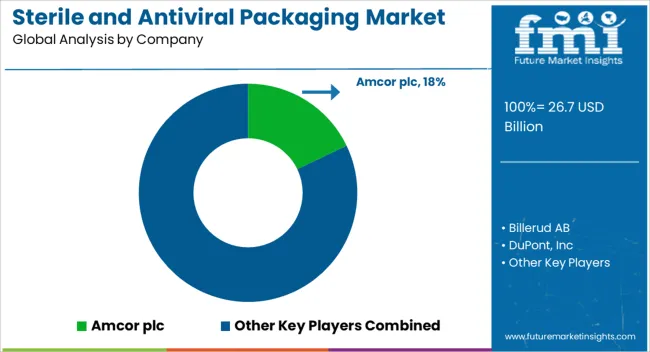
The sterile and antiviral packaging market is quite saturated and diverse, which means that large companies are competing with each other as well as with new market entrants. Some leading suppliers of sterile and antiviral packaging include Amcor Plc and Becton, Dickinson, and Company (BD), which provide a wide range of packaging solutions.
These solutions are sterilization films, pouches, containers, and even antiviral coatings on the packaging material. This approach covers all the needs of the pharmaceutical and medical device industries to the extent that they require them.
Other prominent industry players, including BillerudKorsnas AB and Placon Corporation Inc., are also embracing sustainability. BillerudKorsnas focuses on the designing of paper-based packaging materials that are free from contaminants and antiviral coated cartons. At the same time, Placon has a variety of recyclable and bio-based packaging products.
The emphasis on green solutions responds to the development of environmental issues and places these companies well in a market that is gradually shifting its preference to sustainable solutions.
Key Developments in the Sterile and Antiviral Packaging Market:
- In April 2025, Amcor Plc, along with Kimberly Clark, launched a packaging bag with 30% recycled materials for its Eco Protect diapers. The bags are made from post-consumer recycled material and offer a more sustainable packaging solution for hypoallergenic diapers made with certified plant-based fibers.
- In January 2025, ProAmpac launched ProActive Intelligence Moisture Protect (MP-1000) to curb the moisture level in the packaging solutions.
- In May 2025, DuPont acquired Spectrum Plastics Group (“Spectrum”), a manufacturer of specialty medical devices and components.
Key Players in Sterile and Antiviral Packaging Manufacturers
- Amcor plc
- Billerud AB
- DuPont. Inc
- Sonoco Products Company
- Wihuri Group
- ProAmpac. LLC
- GY Packaging.
- Berry Global Inc.
- Sabre Medical. Pty Ltd
- Placon. Corp
- UFP Technologies, Inc.
- Puracon GmbH
- OLIVER Healthcare Packaging
- Westfield Medical Ltd
- Deufol SE.
- Technipaq, Inc
- Tekni-Plex Inc.
- UFlex Limited
- AptarGroup, Inc.
- Beacon Converters Inc
Sterile and Antiviral Packaging Market Segmentation
By Packaging Types:
In terms of packaging types, the industry is divided into thermoform trays, sterile bottles/containers, vials and ampoules, sterile closures, prefilled syringes, blister and clamshells, IV bags and pouches, sterile wraps, and others. The other segments included sterile lids, etc.
By Material Type:
A few of the important material types include plastic, glass, metal, paper, and paperboard.
By End-use:
Few of the leading end-use include pharmaceutical and biological, surgical and medical instruments, food and beverage packaging, and others.
By Region:
Key countries of North America, Latin America, East Asia, South Asia, Europe, Oceania, Middle East and Africa are covered.
Frequently Asked Questions
How big is the sterile and antiviral packaging market in 2025?
The global sterile and antiviral packaging market is estimated to be valued at USD 26.7 billion in 2025.
What will be the size of sterile and antiviral packaging market in 2035?
The market size for the sterile and antiviral packaging market is projected to reach USD 38.7 billion by 2035.
How much will be the sterile and antiviral packaging market growth between 2025 and 2035?
The sterile and antiviral packaging market is expected to grow at a 3.8% CAGR between 2025 and 2035.
What are the key product types in the sterile and antiviral packaging market?
The key product types in sterile and antiviral packaging market are thermoform trays, sterile bottles/containers, vials and ampoules, sterile closures, prefilled syringes, blister and clamshells, iv bags and pouches, sterile wraps and others.
Which material type segment to contribute significant share in the sterile and antiviral packaging market in 2025?
In terms of material type, plastic segment to command 54.8% share in the sterile and antiviral packaging market in 2025.
Preview the report firsthand - request a free sample
Get SampleGet the brochure for pricing and purchase details.
Get PDFTable of Content
- Executive Summary
- Global Market Outlook
- Demand-side Trends
- Supply-side Trends
- Technology Roadmap Analysis
- Analysis and Recommendations
- Market Overview
- Market Coverage / Taxonomy
- Market Definition / Scope / Limitations
- Market Background
- Market Dynamics
- Drivers
- Restraints
- Opportunity
- Trends
- Scenario Forecast
- Demand in Optimistic Scenario
- Demand in Likely Scenario
- Demand in Conservative Scenario
- Opportunity Map Analysis
- Product Life Cycle Analysis
- Supply Chain Analysis
- Investment Feasibility Matrix
- Value Chain Analysis
- PESTLE and Porter’s Analysis
- Regulatory Landscape
- Regional Parent Market Outlook
- Production and Consumption Statistics
- Import and Export Statistics
- Market Dynamics
- Global Market Analysis 2020 to 2024 and Forecast, 2025 to 2035
- Historical Market Size Value (USD Million) Analysis, 2020 to 2024
- Current and Future Market Size Value (USD Million) Projections, 2025 to 2035
- Y-o-Y Growth Trend Analysis
- Absolute $ Opportunity Analysis
- Global Market Pricing Analysis 2020 to 2024 and Forecast 2025 to 2035
- Global Market Analysis 2020 to 2024 and Forecast 2025 to 2035, By Packaging Types
- Introduction / Key Findings
- Historical Market Size Value (USD Million) Analysis By Packaging Types , 2020 to 2024
- Current and Future Market Size Value (USD Million) Analysis and Forecast By Packaging Types , 2025 to 2035
- Thermoform Trays
- Sterile Bottles/Containers
- Vials And Ampoules
- Sterile Closures
- Prefilled Syringes
- Blister And Clamshells
- IV Bags And Pouches
- Sterile Wraps
- Others
- Y-o-Y Growth Trend Analysis By Packaging Types , 2020 to 2024
- Absolute $ Opportunity Analysis By Packaging Types , 2025 to 2035
- Global Market Analysis 2020 to 2024 and Forecast 2025 to 2035, By Material Type
- Introduction / Key Findings
- Historical Market Size Value (USD Million) Analysis By Material Type, 2020 to 2024
- Current and Future Market Size Value (USD Million) Analysis and Forecast By Material Type, 2025 to 2035
- Plastic
- Glass
- Metal
- Paper
- Paperboard
- Y-o-Y Growth Trend Analysis By Material Type, 2020 to 2024
- Absolute $ Opportunity Analysis By Material Type, 2025 to 2035
- Global Market Analysis 2020 to 2024 and Forecast 2025 to 2035, By End-Use
- Introduction / Key Findings
- Historical Market Size Value (USD Million) Analysis By End-Use, 2020 to 2024
- Current and Future Market Size Value (USD Million) Analysis and Forecast By End-Use, 2025 to 2035
- Pharmaceutical And Biological
- Surgical And Medical Instruments
- Food And Beverage Packaging
- Others
- Y-o-Y Growth Trend Analysis By End-Use, 2020 to 2024
- Absolute $ Opportunity Analysis By End-Use, 2025 to 2035
- Global Market Analysis 2020 to 2024 and Forecast 2025 to 2035, By Region
- Introduction
- Historical Market Size Value (USD Million) Analysis By Region, 2020 to 2024
- Current Market Size Value (USD Million) Analysis and Forecast By Region, 2025 to 2035
- North America
- Latin America
- Western Europe
- Eastern Europe
- East Asia
- South Asia and Pacific
- Middle East & Africa
- Market Attractiveness Analysis By Region
- North America Market Analysis 2020 to 2024 and Forecast 2025 to 2035, By Country
- Historical Market Size Value (USD Million) Trend Analysis By Market Taxonomy, 2020 to 2024
- Market Size Value (USD Million) Forecast By Market Taxonomy, 2025 to 2035
- By Country
- USA
- Canada
- Mexico
- By Packaging Types
- By Material Type
- By End-Use
- By Country
- Market Attractiveness Analysis
- By Country
- By Packaging Types
- By Material Type
- By End-Use
- Key Takeaways
- Latin America Market Analysis 2020 to 2024 and Forecast 2025 to 2035, By Country
- Historical Market Size Value (USD Million) Trend Analysis By Market Taxonomy, 2020 to 2024
- Market Size Value (USD Million) Forecast By Market Taxonomy, 2025 to 2035
- By Country
- Brazil
- Chile
- Rest of Latin America
- By Packaging Types
- By Material Type
- By End-Use
- By Country
- Market Attractiveness Analysis
- By Country
- By Packaging Types
- By Material Type
- By End-Use
- Key Takeaways
- Western Europe Market Analysis 2020 to 2024 and Forecast 2025 to 2035, By Country
- Historical Market Size Value (USD Million) Trend Analysis By Market Taxonomy, 2020 to 2024
- Market Size Value (USD Million) Forecast By Market Taxonomy, 2025 to 2035
- By Country
- Germany
- UK
- Italy
- Spain
- France
- Nordic
- BENELUX
- Rest of Western Europe
- By Packaging Types
- By Material Type
- By End-Use
- By Country
- Market Attractiveness Analysis
- By Country
- By Packaging Types
- By Material Type
- By End-Use
- Key Takeaways
- Eastern Europe Market Analysis 2020 to 2024 and Forecast 2025 to 2035, By Country
- Historical Market Size Value (USD Million) Trend Analysis By Market Taxonomy, 2020 to 2024
- Market Size Value (USD Million) Forecast By Market Taxonomy, 2025 to 2035
- By Country
- Russia
- Poland
- Hungary
- Balkan & Baltic
- Rest of Eastern Europe
- By Packaging Types
- By Material Type
- By End-Use
- By Country
- Market Attractiveness Analysis
- By Country
- By Packaging Types
- By Material Type
- By End-Use
- Key Takeaways
- East Asia Market Analysis 2020 to 2024 and Forecast 2025 to 2035, By Country
- Historical Market Size Value (USD Million) Trend Analysis By Market Taxonomy, 2020 to 2024
- Market Size Value (USD Million) Forecast By Market Taxonomy, 2025 to 2035
- By Country
- China
- Japan
- South Korea
- By Packaging Types
- By Material Type
- By End-Use
- By Country
- Market Attractiveness Analysis
- By Country
- By Packaging Types
- By Material Type
- By End-Use
- Key Takeaways
- South Asia and Pacific Market Analysis 2020 to 2024 and Forecast 2025 to 2035, By Country
- Historical Market Size Value (USD Million) Trend Analysis By Market Taxonomy, 2020 to 2024
- Market Size Value (USD Million) Forecast By Market Taxonomy, 2025 to 2035
- By Country
- India
- ASEAN
- Australia & New Zealand
- Rest of South Asia and Pacific
- By Packaging Types
- By Material Type
- By End-Use
- By Country
- Market Attractiveness Analysis
- By Country
- By Packaging Types
- By Material Type
- By End-Use
- Key Takeaways
- Middle East & Africa Market Analysis 2020 to 2024 and Forecast 2025 to 2035, By Country
- Historical Market Size Value (USD Million) Trend Analysis By Market Taxonomy, 2020 to 2024
- Market Size Value (USD Million) Forecast By Market Taxonomy, 2025 to 2035
- By Country
- Kingdom of Saudi Arabia
- Other GCC Countries
- Turkiye
- South Africa
- Other African Union
- Rest of Middle East & Africa
- By Packaging Types
- By Material Type
- By End-Use
- By Country
- Market Attractiveness Analysis
- By Country
- By Packaging Types
- By Material Type
- By End-Use
- Key Takeaways
- Key Countries Market Analysis
- USA
- Pricing Analysis
- Market Share Analysis, 2024
- By Packaging Types
- By Material Type
- By End-Use
- Canada
- Pricing Analysis
- Market Share Analysis, 2024
- By Packaging Types
- By Material Type
- By End-Use
- Mexico
- Pricing Analysis
- Market Share Analysis, 2024
- By Packaging Types
- By Material Type
- By End-Use
- Brazil
- Pricing Analysis
- Market Share Analysis, 2024
- By Packaging Types
- By Material Type
- By End-Use
- Chile
- Pricing Analysis
- Market Share Analysis, 2024
- By Packaging Types
- By Material Type
- By End-Use
- Germany
- Pricing Analysis
- Market Share Analysis, 2024
- By Packaging Types
- By Material Type
- By End-Use
- UK
- Pricing Analysis
- Market Share Analysis, 2024
- By Packaging Types
- By Material Type
- By End-Use
- Italy
- Pricing Analysis
- Market Share Analysis, 2024
- By Packaging Types
- By Material Type
- By End-Use
- Spain
- Pricing Analysis
- Market Share Analysis, 2024
- By Packaging Types
- By Material Type
- By End-Use
- France
- Pricing Analysis
- Market Share Analysis, 2024
- By Packaging Types
- By Material Type
- By End-Use
- India
- Pricing Analysis
- Market Share Analysis, 2024
- By Packaging Types
- By Material Type
- By End-Use
- ASEAN
- Pricing Analysis
- Market Share Analysis, 2024
- By Packaging Types
- By Material Type
- By End-Use
- Australia & New Zealand
- Pricing Analysis
- Market Share Analysis, 2024
- By Packaging Types
- By Material Type
- By End-Use
- China
- Pricing Analysis
- Market Share Analysis, 2024
- By Packaging Types
- By Material Type
- By End-Use
- Japan
- Pricing Analysis
- Market Share Analysis, 2024
- By Packaging Types
- By Material Type
- By End-Use
- South Korea
- Pricing Analysis
- Market Share Analysis, 2024
- By Packaging Types
- By Material Type
- By End-Use
- Russia
- Pricing Analysis
- Market Share Analysis, 2024
- By Packaging Types
- By Material Type
- By End-Use
- Poland
- Pricing Analysis
- Market Share Analysis, 2024
- By Packaging Types
- By Material Type
- By End-Use
- Hungary
- Pricing Analysis
- Market Share Analysis, 2024
- By Packaging Types
- By Material Type
- By End-Use
- Kingdom of Saudi Arabia
- Pricing Analysis
- Market Share Analysis, 2024
- By Packaging Types
- By Material Type
- By End-Use
- Turkiye
- Pricing Analysis
- Market Share Analysis, 2024
- By Packaging Types
- By Material Type
- By End-Use
- South Africa
- Pricing Analysis
- Market Share Analysis, 2024
- By Packaging Types
- By Material Type
- By End-Use
- USA
- Market Structure Analysis
- Competition Dashboard
- Competition Benchmarking
- Market Share Analysis of Top Players
- By Regional
- By Packaging Types
- By Material Type
- By End-Use
- Competition Analysis
- Competition Deep Dive
- Amcor plc
- Overview
- Product Portfolio
- Profitability by Market Segments (Product/Age /Sales Channel/Region)
- Sales Footprint
- Strategy Overview
- Marketing Strategy
- Product Strategy
- Channel Strategy
- Billerud AB
- DuPont, Inc
- Sonoco Products Company
- Wihuri Group
- ProAmpac, LLC
- GY Packaging
- Berry Global Inc.
- Sabre Medical, Pty Ltd
- Placon Corp
- UFP Technologies, Inc.
- Puracon GmbH
- OLIVER Healthcare Packaging
- Westfield Medical Ltd
- Deufol SE
- Technipaq, Inc
- Tekni-Plex Inc.
- UFlex Limited
- AptarGroup, Inc.
- Beacon Converters Inc.
- Amcor plc
- Competition Deep Dive
- Assumptions & Acronyms Used
- Research Methodology


