

- Industry Size (2026)
- USD 1.9 Bn
- Forecast (2036)
- USD 2.9 Bn
- CAGR (2026 to 2036)
- 4.3%
Pool and Spa Water Treatment Chemicals for Hotels and Clubs Market Size, Market Forecast and Outlook By FMI
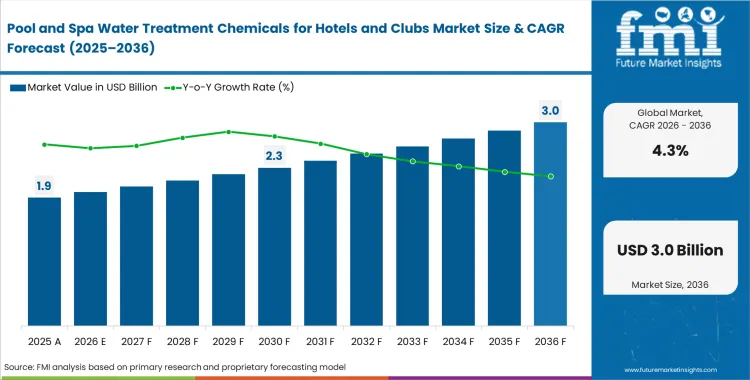
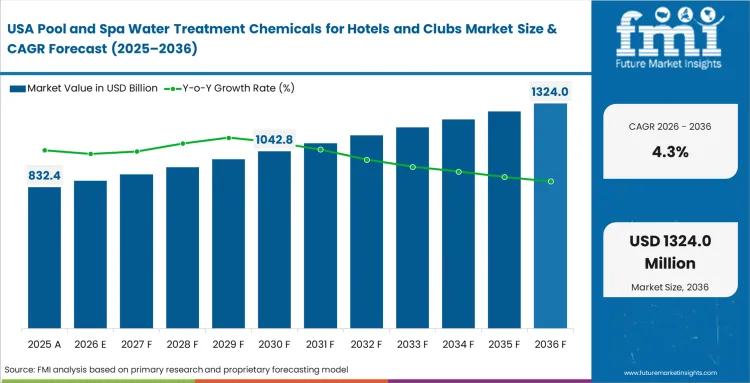
The pool and spa water treatment chemicals for hotels and clubs market crossed a valuation of USD 1.8 billion in 2025. Revenue is projected to reach USD 1.9 billion in 2026, expanding at a CAGR of 4.3% during the forecast period. Sustained demand drives total valuation to USD 2.9 billion by 2036 as hotels and clubs increasingly adopt automated dosing systems that rely on standardized commercial-grade formulations over manual retail chemical applications.
Summary of Pool and Spa Water Treatment Chemicals for Hotels and Clubs Market
- The market is forecast to reach USD 2.9 billion by 2036.
- The market is expected to grow at a CAGR of 4.3% from 2026 to 2036.
- The market was estimated at USD 1.8 billion in 2025.
- The forecast period represents an incremental opportunity of USD 1.0 billion.
- Rising adoption of automated dosing systems and expansion of hotel and club aquatic facilities are the primary demand drivers.
- Compliance requirements and public health safety standards are increasing reliance on standardized commercial-grade chemical formulations.
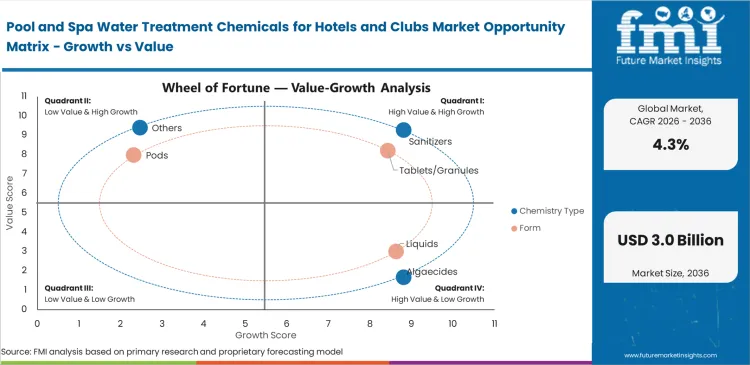
- Sanitizers lead the chemistry segment with a 45% share, while tablets and granules dominate form with a 41% share.
- Hotels and resorts account for 54% of facility demand, with routine disinfection leading applications at 36%.
- Ecolab, Westlake Water Solutions, Solenis Pool Solutions, BioLab (a KIK company), and Haviland Pool & Spa are among the key players in the market.
Hotel engineering and aquatic operations teams are under increasing pressure to reduce dosing inconsistency across multi-property portfolios. When chlorine and pH balancing are left to site-level maintenance staff, results often vary from property to property, which raises liability risk and increases the chance of equipment corrosion. That is pushing hospitality groups toward integrated delivery systems and more centralized supply arrangements that match chemicals with approved equipment platforms. Properties that postpone standardization usually face greater operating risk, quicker wear on treatment systems, and less control over water quality during peak guest periods. Reported consumption volumes also tend to understate actual demand, since major hotel chains often build safety buffers into their commercial chemical programs to manage sudden increases in bather load.
Once aquatic teams shift to ORP oxidation-reduction potential sensor-linked dosing controllers, chemical purchasing becomes more structured. Automated feeder systems perform best with tightly specified chlorinated isocyanurate formulations, which leaves less room for product variation and reduces the number of suitable suppliers. At that point, supplier selection depends less on price alone and more on the ability to support controller-compatible treatment programs across the installed base.
China is expected to grow at a CAGR of 5.7% through 2036, supported by continued resort construction and rising chemical requirements across newly added hospitality pools. India is projected to expand at 5.5%, aided by ongoing investment in premium hotels and wellness-led properties. Brazil is likely to record 5.4% CAGR over the forecast period, as warm-weather usage keeps treatment cycles active throughout the year. The United Arab Emirates is set to post 5.2%, with luxury operators maintaining tight standards for water clarity and guest-facing pool conditions. The United States is anticipated to advance at a CAGR of 4.3%, supported by stricter operating discipline around commercial pool maintenance. The United Kingdom is expected to register 4.2%, while Germany is projected at 4.1%, with both markets shaped more by upgrades to existing aquatic infrastructure than by new site additions. The regional pattern remains distinct, with Asia led by new-build hospitality expansion, while Western markets are rising through refurbishment demand and tighter facility-management standards.
Segmental Analysis
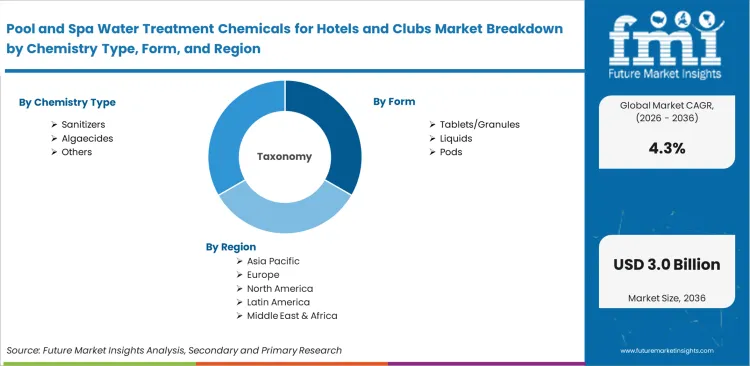
Pool and Spa Water Treatment Chemicals for Hotels and Clubs Market Analysis by Chemistry Type
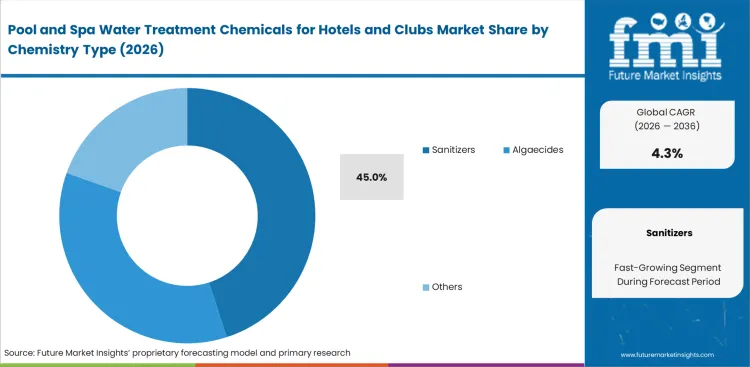
Resort operators work under constant pressure to maintain pathogen control without allowing indoor chloramine levels to build to the point of guest discomfort. Sanitizers are expected to account for 45.0% share in 2026 because a continuous halogen residual remains essential for keeping commercial pools compliant and operational. FMI notes that aquatic teams focus first on stabilizing free chlorine before testing alternative oxidation approaches. Guest traffic can shift sharply within a few hours, so operators need enough oxidative reserve to absorb sudden spikes in organic contaminants without setting off low-chlorine alerts. Daily consumption figures alone do not show how aggressively indoor properties dose chlorine overnight to burn off combined chloramines before morning use. That operating discipline matters because weak oxidation control quickly leads to eye irritation complaints and undermines the guest experience.
- Baseline requirement: Municipal health codes always require measurable halogen residuals. Aquatic teams keep high-capacity sanitizers available to support uninterrupted dosing under commercial operating conditions comparable to industrial and institutional cleaning chemical discipline.
- Organic load buffering: Heavy weekend resort traffic causes sharp contaminant loading. Pool operators use slow-dissolving sanitizers so chemical reserves remain effective through the busiest usage periods.
- Chloramine prevention: Incomplete oxidation allows irritating combined chloramines to accumulate. Engineering teams maintain strong sanitizer ratios to push contaminants through full oxidation before indoor air quality deteriorates.
Pool and Spa Water Treatment Chemicals for Hotels and Clubs Market Analysis by Form
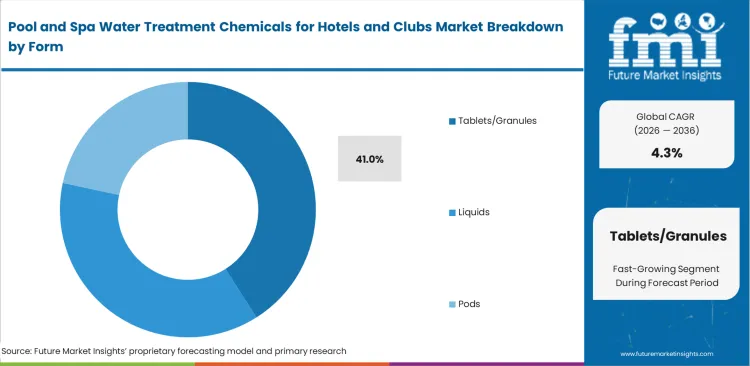
Tablets/granules are projected to secure 41.0% share in 2026 because commercial erosion feeders depend on compressed formats that dissolve at a controlled and predictable rate. Feeder design largely determines which formats a property can use in practice. FMI’s assessment indicates that operating teams favor solids because liquids lose strength faster in hot utility rooms and create greater spill exposure. Solid pucks also reduce handling frequency, allowing staff to reload hoppers on a weekly cycle instead of dealing with bulk liquid transfers every day. One practical issue often missed is that bulk chlorine tablet programs at resort properties can create vendor dependence, since feeder tubes are usually built around specific dimensions of pool chemicals. Once properties move to the wrong format, jamming, unstable dosing, and equipment disruption follow quickly.
- Feeder compatibility: Commercial erosion feeders require exact puck dimensions. Operations teams must source matching pool chemicals that work with installed dosing hardware.
- Storage stability: Hot mechanical rooms reduce liquid bleach strength over time. Site managers prefer solid granules that retain active chlorine content through long summer operating cycles.
- Handling safety: Bulk liquid transfers raise employee exposure risk. Maintenance teams favor solid tablets that reduce splash hazards during routine hopper refilling.
Pool and Spa Water Treatment Chemicals for Hotels and Clubs Market Analysis by Facility Type
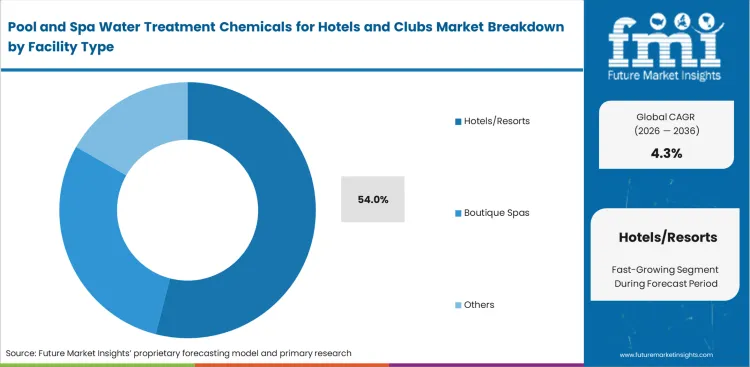
Large resort properties consume chemicals at a very different rate from smaller aquatic sites because they manage high water volumes and extended daily operating hours across multiple zones. Regional hospitality groups approve substantial chemical budgets because pool quality directly influences guest satisfaction, premium room positioning, and amenity value. These sites also run pools, spas, and recreation areas in parallel, which increases formulation complexity across the property. In 2026, hotels/resorts are estimated to represent 54.0% share of the market. Operators often keep calcium hardness slightly off ideal balance to protect expensive tile and finish materials, which then increases dependence on pH correction and high performance descaling and deliming elsewhere in the loop. Any interruption in chemical supply can put major guest-facing attractions at risk of closure.
- Volume dominance: Mega-resorts operate large multi-pool footprints. Commercial teams negotiate bulk supply arrangements to support heavy daily chemical consumption.
- Aesthetic mandates: Cloudy water quickly damages guest perception. Resort managers authorize preventive clarifier dosing even when measured turbidity has not yet reached a critical threshold.
- Temperature variance: Spas and colder pools require different halogen control profiles. Engineering teams maintain separate bromine and chlorine inventories for each aquatic zone.
Pool and Spa Water Treatment Chemicals for Hotels and Clubs Market Analysis by Application
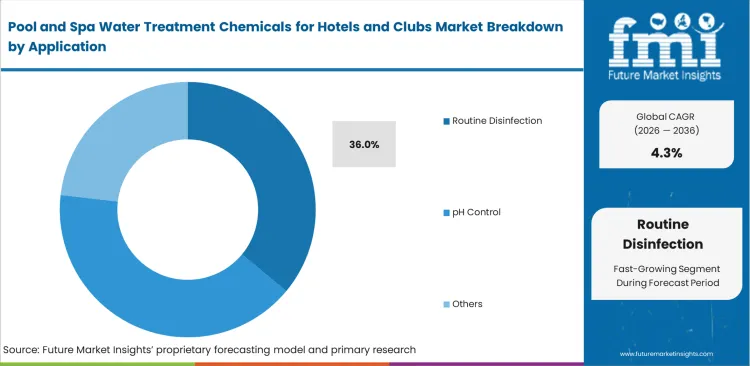
Aquatic engineers balance two priorities every day: dependable pathogen control and the visual clarity standards expected in guest-facing water facilities. Inspection programs focus most heavily on residual disinfectant performance, so routine disinfection remains the operating baseline across all active systems. Maintaining target parts-per-million halogen levels requires continuous feed control through all service hours. Chemical interaction also adds complexity, since disinfectant dosing often pushes pH upward and creates a constant need for acid correction. Routine disinfection is anticipated to account for 36.0% share in 2026. That position reflects its role as the first requirement for safe operations, even when other treatments can be adjusted more flexibly. Properties that let routine disinfection slip expose themselves to shutdown risk and wider liability tied to weak water-control discipline and low VOC cleaning chemicals.
- Pathogen elimination: Health inspectors expect water systems to remain microbiologically safe. Facility teams run continuous routine disinfection programs to maintain acceptable bathing conditions.
- Sensor integration: Modern ORP controllers track active disinfectant levels continuously. Technicians use these systems to adjust sanitizer feed rates with minimal delay.
- pH antagonism: Hypochlorite dosing gradually raises water pH. Routine disinfection is usually paired with ongoing acid addition to keep water chemistry within the required operating range.
Pool and Spa Water Treatment Chemicals for Hotels and Clubs Market Analysis by Sales Channel
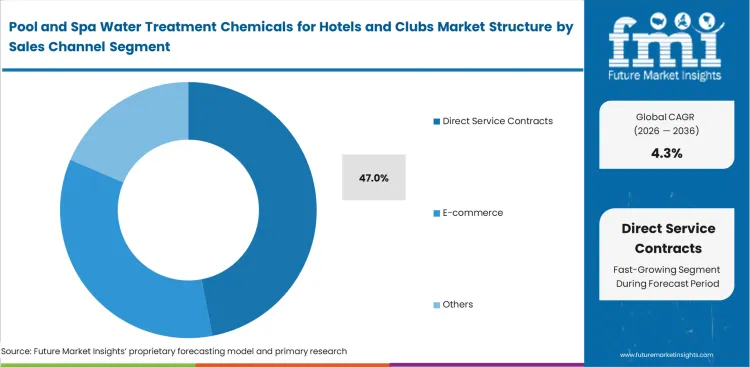
Corporate hotel groups are increasingly handing aquatic chemical management to specialist service partners instead of maintaining full in-house capability. The appeal is straightforward. These arrangements combine chemical supply, handling discipline, and compliance documentation under one service model. Direct service contracts are expected to account for 47.0% share in 2026. FMI analysts indicate that hotel operators often prefer fixed monthly agreements that cover both chemical supply and the documentation required under a dedicated pool service contract. This route sends volume directly from formulators into hotel mechanical rooms and reduces dependence on standard distribution channels. Many service providers also install dosing systems linked to proprietary consumables, including industrial biocides, pollution equipment, and non-dispersive infrared NDIR monitoring integration, which makes switching more difficult than it may appear at the outset. Hotels that try to move away from these agreements often end up facing hardware replacement costs and mechanical room rework.
- Liability transfer: Hazardous chemical management brings legal and operational exposure. Hotel managers assign that responsibility to specialist service contractors with the required insurance and handling capability.
- Hardware lock-in: Service providers often install proprietary dispensing equipment at low upfront cost. Commercial teams later find that the installed systems only function with contracted chemical formats.
- Predictable budgeting: Chemical usage can swing sharply in peak season. Finance teams prefer direct service contracts that convert variable aquatic treatment costs into steadier monthly spending.
Pool and Spa Water Treatment Chemicals for Hotels and Clubs Market Drivers, Restraints, and Opportunities
Liability associated with waterborne illness outbreaks forces hospitality brands into hyper-vigilant chemical dosing regimens. Aquatic directors simply cannot risk a public health incident traced back to their properties, elevating guest safety hotel pool chemicals to a non-negotiable operational mandate. Delaying chemical purchase risks immediate facility closure by local health inspectors, instantly destroying guest satisfaction metrics and causing massive refund demands. This compliance terror ensures continuous, predictable chemical consumption regardless of broader economic downturns or reduced hotel occupancy rates, like stringent vent hood cleaning protocols.
Chronic shortages of certified commercial pool operators represent severe friction slowing advanced chemical system adoption. Sophisticated secondary oxidation protocols demand deep chemical knowledge to prevent dangerous mixing events or sensor fouling. While corporate brands want pristine water, finding local maintenance staff capable of understanding complex Langelier Saturation Index calculations remains incredibly difficult. Automated water softening systems offer partial relief, yet improperly calibrated controllers frequently overdose acid, destroying copper heat exchangers and creating unexpected capital repair costs.
Opportunities in Pool and Spa Water Treatment Chemicals for Hotels and Clubs Market
- Sensor-compatible formulations: Modern ORP probes suffer rapid scaling in hard water environments. Chemical formulators developing non-fouling compounds capture premium contracts from high-tech mega-resorts via digital monitoring for commercial pools.
- Low-odor spa treatments: Indoor luxury wellness centers despise heavy chloramine smells. Suppliers offering advanced super concentrate chemicals utilizing advanced oxidation avoid off-gassing issues completely.
- Pre-packaged dose compliance: Untrained hospitality staff frequently mishandle bulk liquids. Brands creating pre-measured dissolvable pods eliminate dosing errors while vastly improving employee handling safety.
Regional Analysis
Based on regional analysis, pool and spa water treatment chemicals for hotels and clubs market is segmented into North America, Latin America, Western Europe, Eastern Europe, East Asia, South Asia and Pacific, and Middle East and Africa across 40 plus countries.
.webp "Top Country Growth Comparison Pool And Spa Water Treatment Chemicals For Hotels And Clubs Market Cagr (2026 2036)")
| Country | CAGR (2026 to 2036) |
|---|---|
| China | 5.7% |
| India | 5.5% |
| Brazil | 5.4% |
| United Arab Emirates | 5.2% |
| United States | 4.3% |
| United Kingdom | 4.2% |
| Germany | 4.1% |
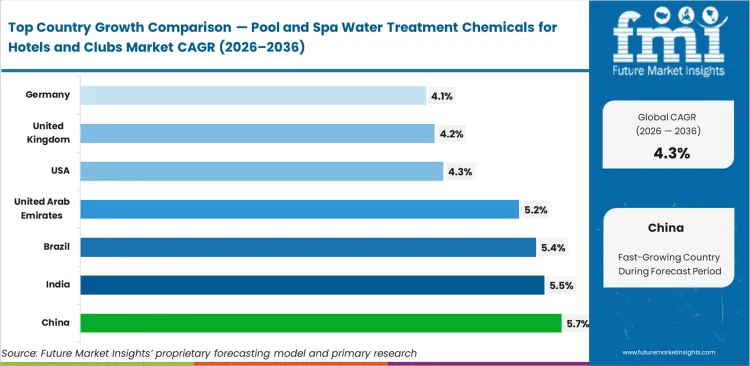
Source: Future Market Insights (FMI) analysis, based on proprietary forecasting model and primary research
East Asia Pool and Spa Water Treatment Chemicals for Hotels and Clubs Market Analysis
Massive greenfield hospitality development across tropical zones defines regional chemical consumption patterns here. Newly constructed mega-resorts bypass legacy manual dosing entirely, installing sophisticated automated chemical feed architectures from day one. Based on FMI's assessment, international hotel chains expanding into this region demand identical water quality standards found in Western markets, forcing local purchase directors to source premium imported commercial sanitizers. Continuous warm weather guarantees year-round bather loads, eliminating seasonal consumption dips characterizing northern climates. This forces formulators to establish localized manufacturing hubs, as shipping heavy liquid bulk chemicals across oceans destroys competitive pricing margins against domestic industrial chemical producers.
- China: Unprecedented domestic tourism expansion causes massive new waterpark and hotel pool construction. Regional aquatic managers face pressure maintaining pristine water aesthetics against daily bather volumes. Demand for the China hotel pool chemicals segment is anticipated to rise at a CAGR of 5.7% through 2036. International chemical suppliers securing early master contracts with dominant domestic hospitality developers lock in decades of guaranteed high-volume recurring consumable revenue.
South Asia and Pacific Pool and Spa Water Treatment Chemicals for Hotels and Clubs Market Analysis
Aggressive premium wellness property buildouts fundamentally alter how chemicals move through this geography. Resort developers prioritize complex hydrotherapy circuits and massive infinity pools, demanding specialized non-chlorine shock treatments preventing irritating odors in confined luxury spaces. FMI's analysis indicates local health ministries continuously upgrade commercial aquatic safety standards, forcing legacy properties to abandon cheap retail bleach for stabilized commercial disinfection byproduct control formulations. Deep geographic fragmentation means logistics dominate competitive positioning; suppliers controlling island-hopping distribution networks dictate pricing completely, as isolated resorts cannot survive chemical stock-outs without shutting down primary guest attractions.
- India: Rapid middle-class wealth accumulation fuels an explosion in premium domestic resort destinations. Facility engineers grapple with extremely hard local source water, forcing massive reliance on commercial scale inhibitors alongside primary sanitizers. Sales in the India hotel spa chemicals segment are expected to increase at a CAGR of 5.5% during this forecast period. Formulators mastering hard-water-compatible sanitizer blends gain absolute dominance over competitors pushing standard global formulations.
North America Pool and Spa Water Treatment Chemicals for Hotels and Clubs Market Analysis
Strict municipal health code enforcement dictates every single operational decision across commercial aquatic facilities. County inspectors possess unquestioned authority to padlock resort pools exhibiting insufficient halogen residuals, making reliable chemical dosing an existential requirement for hospitality properties. According to FMI's projections, an aging installed base of commercial pools increases demand for specialty clarifiers and heavy metal sequestering agents as old plaster surfaces continuously degrade into circulation systems. Corporate consolidation among pool service route operators creates massive centralized purchasing entities wielding extreme negotiating leverage against chemical formulators, demanding customized bulk packaging formats.
- United States: Highly litigious environments compel hotel brands to meticulously document automated chemical feed rates proving regulatory compliance. Acquisition officers mandate standardized tablet formats ensuring foolproof application by rotating seasonal maintenance staff. The US hotel pool chemical industry is poised to expand at a CAGR of 4.3% from 2026 to 2036. Chemical producers successfully integrating smart-feeder telemetry with automated chemical delivery logistics completely sideline traditional wholesale distribution networks.
FMI's report includes detailed analysis extending into Brazil, United Arab Emirates, United Kingdom, and Germany. Extreme environmental constraints in Middle Eastern territories force resorts to combat massive evaporation rates that rapidly concentrate total dissolved solids, driving unique demand for specialized professional cleaning products preventing aggressive waterline scaling.
Competitive Aligners for Market Players
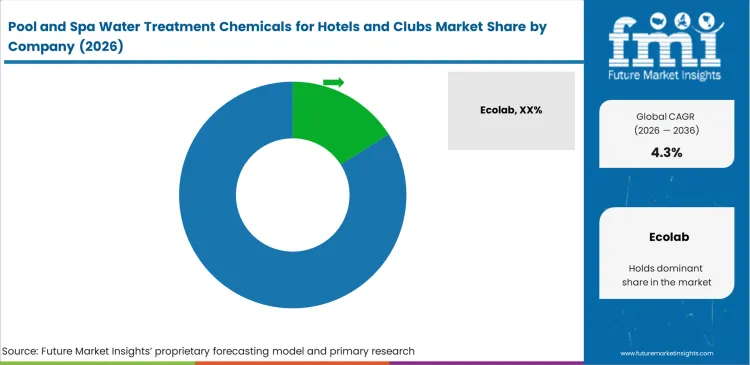
Leading chemical formulators hold their position in the hospitality sector less through chemical purity and more through control of bulk distribution and site-level service logistics. Companies such as Ecolab and Solenis Pool Solutions have built strong advantages through direct-to-property delivery networks. When a large resort requires hundreds of gallons of liquid sodium hypochlorite each week, conventional retail-oriented distribution channels are not enough. Supplier evaluation often comes down to delivery reliability during peak holiday periods, when even one missed shipment can force immediate pool closures.
Established suppliers also protect recurring revenue by subsidizing proprietary automated dosing equipment at client properties. Westlake Water Solutions and BioLab, for instance, combine specialized treatment programs with erosion feeders designed around their own chemical formats. That makes supplier replacement more difficult, since any switch may require hardware removal, equipment replacement, and added capital spending. This remains one of the main reasons regional chemical blenders struggle to enter large corporate hotel portfolios.
Large hospitality groups are trying to reduce that dependence by designing new aquatic mechanical rooms around open-architecture liquid pumping systems instead of closed tablet-feeder setups. That gives them more flexibility to rebid liquid bulk contracts to regional suppliers such as Haviland Pool & Spa on commercial terms. As smart-sensor telemetry becomes more common across commercial pools, competition is starting to move beyond basic chlorine supply toward integrated digital water management systems that can support ongoing compliance visibility.
Key Players in Pool and Spa Water Treatment Chemicals for Hotels and Clubs Market
- Ecolab
- Westlake Water Solutions
- Solenis Pool Solutions
- BioLab, a KIK company
- Haviland Pool & Spa
Scope of the Report
| Metric | Value |
|---|---|
| Quantitative Units | USD 1.9 billion to USD 2.9 billion, at a CAGR of 4.30% |
| Market Definition | Commercial-grade compounds engineered to maintain safe, balanced, and clear recreational water in high-volume hospitality environments, requiring compatibility with automated dosing systems and adherence to strict public health mandates. |
| Segmentation | Chemistry type, Form, Facility type, Application, Sales channel, Region |
| Regions Covered | North America, Latin America, Western Europe, Eastern Europe, East Asia, South Asia and Pacific, Middle East and Africa |
| Countries Covered | China, India, Brazil, United Arab Emirates, United States, United Kingdom, Germany |
| Key Companies Profiled | Ecolab, Westlake Water Solutions, Solenis Pool Solutions, BioLab, a KIK company, Haviland Pool & Spa |
| Forecast Period | 2026 to 2036 |
| Approach | Commercial hotel room count expansion correlated against baseline per-gallon chemical consumption rates. |
Source: Future Market Insights (FMI) analysis, based on proprietary forecasting model and primary research
Pool and Spa Water Treatment Chemicals for Hotels and Clubs Market Analysis by Segments
Chemistry type
- Sanitizers
- pH balancers
- Algaecides
- Shock oxidizers
- Clarifiers
Form
- Tablets/granules
- Liquids
- Pods
- Powders
Facility type
- Hotels/resorts
- Private clubs
- Fitness clubs
- Country clubs
- Boutique spas
Application
- Routine disinfection
- pH control
- Algae control
- Shock treatment
- Scale control
Sales channel
- Direct service contracts
- Specialty distributors
- Jan-san dealers
- Facility suppliers
- E-commerce
Region:
- North America
- United States
- Canada
- Europe
- Germany
- United Kingdom
- France
- Italy
- Spain
- Asia Pacific
- China
- Japan
- South Korea
- Taiwan
- Singapore
- Latin America
- Brazil
- Mexico
- Argentina
- Middle East & Africa
- GCC Countries
- South Africa
Bibliography
- Centers for Disease Control and Prevention. (2024). 2024 Annex to the Model Aquatic Health Code (5th edition): Scientific rationale. U.S. Department of Health and Human Services.
- Jarin, M., Ly, J., Goldman, J., & Xie, X. (2025). Water disinfection systems for pools and spas: Advantages, disadvantages, and consumer views in the US. ACS ES&T Water, 5(2), 525-538.
- Kunz, J., & Laco, J. P. (2025). Key changes in the new edition of the Model Aquatic Health Code. Journal of Environmental Health, 87(9), 40-42.
- Papadakis, A., Chochlakis, D., Koufakis, E., Carayanni, V., & Psaroulaki, A. (2024). Recreational water safety in hotels: Lessons from the COVID-19 pandemic and the way forward for a safe aquatic environment. Tourism and Hospitality, 5(4), 1167-1181.
- Hussain, G., Mian, H. R., Hewage, K., MacNeill, A. J., & Sadiq, R. (2025). Disinfection by-products in indoor swimming pools: A critical review to prioritize commonly occurring species and influencing factors. Journal of Hazardous Materials, 495, 138739.
This bibliography is provided for reader reference. The full FMI report contains the complete reference list with primary source documentation.
This Report Addresses
- Sourcing strategies for mitigating bulk chlorine price volatility across multi-property hospitality portfolios.
- Operational consequences of transitioning from liquid sodium hypochlorite to solid cal-hypo erosion feeders.
- Regulatory impact of updated municipal aquatic health codes on commercial chemical consumption rates.
- Generating a reliable commercial pool chemicals demand forecast leveraging facility construction pipelines.
- Heat exchanger failure rates associated with poor calcium hardness management in mega-resort thermal spas.
- Proprietary vendor lock-in mechanics driven by specialized automated chemical dosing hardware installations.
- Creating an RFQ hotel pool treatment chemicals document mapping exact dosage requirements for resorts.
- Hidden operational costs associated with balancing extreme bather load spikes during peak holiday weekends.
Frequently Asked Questions
What is the size of the hotel and club pool treatment chemicals market?
Total valuation reaches USD 2.9 billion by 2036, reflecting massive sustained demand for commercial-grade sanitizers across expanding global hospitality portfolios. Resort operators authorize vast chemical expenditures guaranteeing pristine aquatic attractions that lead to premium room bookings.
What is the hotel pool chemicals CAGR through 2036?
Stringent municipal health codes mandate uninterrupted halogen residuals across all commercial public pools, sustaining a 4.30% compound annual growth rate. Aquatic directors constantly over-feed sanitizers anticipating weekend bather load spikes, guaranteeing high baseline chemical consumption regardless of seasonal occupancy fluctuations.
What are the hotel pool treatment chemicals key players?
The market is led by major commercial blenders and service route operators including Ecolab, Westlake Water Solutions, Solenis Pool Solutions, BioLab, and Haviland Pool & Spa. These entities control massive distribution logistics capable of servicing multi-property corporate hotel portfolios.
What is the best sanitizer for hotel pools?
Baseline pathogen control represents absolute operational necessity preventing facility closures, making stabilized chlorine compounds the dominant choice. Engineering directors prioritize stabilizing free chlorine over secondary aesthetic treatments, purchasing massive bulk volumes ensuring compliance against aggressive local health department inspections.
What chemicals are used in hotel spas?
Heated spa environments rapidly degrade standard chlorine efficacy. Operations staff stock dedicated bromine inventories maintaining stable residuals within hot tubs, multiplying total required chemical SKUs managed within centralized hotel mechanical rooms alongside pH adjusters and specialized defoamers.
Chlorine vs bromine for commercial hot tubs: which is better?
Bromine significantly outperforms chlorine in high-temperature commercial hot tubs due to its superior stability and lower off-gassing profile. Indoor luxury wellness centers despise heavy chloramine smells, making bromine the required standard for maintaining relaxing atmospheres without irritating guest respiratory systems.
Why use a pool chemical service contract for hotels?
Hotel general managers outsource environmental liability by hiring specialized route operators supplying chemicals alongside safety documentation. These contractors install proprietary dispensing equipment physically locking hospitality properties into long-term predictable monthly purchasing agreements.
How do hotel pool water quality regulations impact demand?
County inspectors possess unquestioned authority to padlock resort pools exhibiting insufficient halogen residuals, making reliable chemical dosing an existential requirement. Strict enforcement dictates continuous, predictable chemical consumption regardless of broader economic downturns or reduced hotel occupancy rates.
What are the dynamics of the China hotel pool chemicals market?
Asian developers continuously construct massive greenfield waterparks integrating sophisticated automated chemical feed architectures immediately. Regional aquatic managers face pressure maintaining pristine water aesthetics against high daily bather volumes, driving the market at a rapid 5.7% growth rate.
How is the India hotel spa chemicals market evolving?
Rapid middle-class wealth accumulation fuels an explosion in premium domestic resort destinations expanding at 5.5%. Facility engineers grapple with extremely hard local source water, forcing massive reliance on commercial scale inhibitors alongside primary sanitizers protecting luxury hydrotherapy circuits.
What operational friction slows advanced chemical system adoption?
Sophisticated secondary oxidation controllers frequently demand precise Langelier Saturation Index monitoring exceeding typical maintenance staff capabilities. Untrained operators improperly calibrating these advanced sensors inadvertently overdose acid, destroying expensive copper heat exchangers.
Why do routine disinfection applications continuously antagonize pH balance?
Bulk hypochlorite injection constantly forces water pH upward during standard operation. Maintenance directors combat this inevitable chemical shift utilizing simultaneous continuous acid dosing regimens, tying baseline disinfection costs to mandatory secondary pH adjustment expenditures.
What defines incumbent competitive advantage over regional blenders?
Dominant producers subsidize expensive automated dosing equipment installations at client properties. Challengers attempting penetration face massive friction forcing hotels to absorb capital costs ripping out existing hardware, protecting incumbent recurring revenue streams across major hospitality portfolios.
How do unpredictable guest volumes impact chemical expenditures?
Heavy weekend traffic introduces sudden massive organic contaminant loads depleting free chlorine reserves instantly. Operators intentionally over-feed sanitizers overnight forcing complete chloramine oxidation, preventing morning guest complaints regarding eye irritation and chemical odors.
Why are residential consumer-grade formulations excluded from commercial use?
Retail chemical concentrations fail meeting extreme oxidative demands required by commercial bather loads. Municipal inspectors explicitly reject residential formulations lacking appropriate commercial safety certifications, forcing hospitality portfolios toward specialized industrial-grade bulk suppliers.
What non-obvious consequence follows UV purification hardware installation?
Hospitality executives assume advanced oxidation eliminates baseline chemical requirements. Health codes still mandate measurable halogen residuals, forcing properties to purchase highly pure, fast-acting sanitizers avoiding interference with sensitive new UV sensor probes.
How do logistics determine competitive positioning in fragmented regions?
Island-hopping resort destinations depend entirely on uninterrupted chemical supply chains. Suppliers controlling localized distribution networks dictate pricing completely since isolated wellness properties cannot survive chemical stock-outs without shutting down primary revenue-generating aquatic attractions.
What role do scale inhibitors play in hard-water geographies?
Facilities operating within hard source water regions grapple with aggressive calcium scaling destroying heaters. Engineering managers authorize massive preventive scale control expenditures protecting million-dollar imported tile finishes alongside critical internal pumping infrastructure.
Why do corporate engineering directors prefer open-architecture pumping stations?
Solid tablet feeders physically lock properties into purchasing specific proprietary puck dimensions. Open-architecture liquid systems allow purchase officers bidding out generic bulk contracts annually, utilizing commodity pricing leverage against regional chemical suppliers.
What specific liability forces hotels to over-specify clarifiers?
Cloudy pool water immediately activates negative online hospitality reviews regardless of actual measured pathogen safety. Resort managers authorize continuous preventive clarifier dosing preventing microscopic turbidity, prioritizing aesthetic guest perception alongside strict bacterial elimination.
How do temperature variances impact specialized chemical stocking?
Heated spa environments rapidly degrade standard chlorine efficacy. Operations staff stock dedicated bromine inventories maintaining stable residuals within hot tubs, multiplying total required chemical SKUs managed within centralized hotel mechanical rooms.
What drives demand for low-odor spa treatments?
Indoor luxury wellness centers despise heavy chemical off-gassing ruining relaxing atmospheres. Suppliers providing highly concentrated advanced oxidation compounds eliminate irritating chloramine odors completely, capturing premium supply contracts from high-end boutique properties.
Why do risk management teams mandate pre-packaged dissolvable pods?
Rotating seasonal hospitality staff frequently mishandle dangerous liquid bulk transfers. Dissolvable pre-measured formats eliminate dosing errors while vastly improving employee safety metrics during routine hopper refilling operations.
What happens when facilities fail maintaining precise oxidative thresholds?
Insufficient sanitization allows combined chloramines accumulating indoors. This immediately causes widespread guest eye irritation, prompting severe public health complaints, surprising municipal inspections and potential operational shutdowns.
Preview the report firsthand - request a free sample
Get SampleGet the brochure for pricing and purchase details.
Get PDFTable of Content
- Executive Summary
- Global Market Outlook
- Demand-side Trends
- Supply-side Trends
- Technology Roadmap Analysis
- Analysis and Recommendations
- Market Overview
- Market Coverage / Taxonomy
- Market Definition / Scope / Limitations
- Research Methodology
- Chapter Orientation
- Analytical Lens and Working Hypotheses
- Market Structure, Signals, and Trend Drivers
- Benchmarking and Cross-market Comparability
- Market Sizing, Forecasting, and Opportunity Mapping
- Research Design and Evidence Framework
- Desk Research Programme (Secondary Evidence)
- Company Annual and Sustainability Reports
- Peer-reviewed Journals and Academic Literature
- Corporate Websites, Product Literature, and Technical Notes
- Earnings Decks and Investor Briefings
- Statutory Filings and Regulatory Disclosures
- Technical White Papers and Standards Notes
- Trade Journals, Industry Magazines, and Analyst Briefs
- Conference Proceedings, Webinars, and Seminar Materials
- Government Statistics Portals and Public Data Releases
- Press Releases and Reputable Media Coverage
- Specialist Newsletters and Curated Briefings
- Sector Databases and Reference Repositories
- FMI Internal Proprietary Databases and Historical Market Datasets
- Subscription Datasets and Paid Sources
- Social Channels, Communities, and Digital Listening Inputs
- Additional Desk Sources
- Expert Input and Fieldwork (Primary Evidence)
- Primary Modes
- Qualitative Interviews and Expert Elicitation
- Quantitative Surveys and Structured Data Capture
- Blended Approach
- Why Primary Evidence is Used
- Field Techniques
- Interviews
- Surveys
- Focus Groups
- Observational and In-context Research
- Social and Community Interactions
- Stakeholder Universe Engaged
- C-suite Leaders
- Board Members
- Presidents and Vice Presidents
- R&D and Innovation Heads
- Technical Specialists
- Domain Subject-matter Experts
- Scientists
- Physicians and Other Healthcare Professionals
- Governance, Ethics, and Data Stewardship
- Research Ethics
- Data Integrity and Handling
- Primary Modes
- Tooling, Models, and Reference Databases
- Desk Research Programme (Secondary Evidence)
- Data Engineering and Model Build
- Data Acquisition and Ingestion
- Cleaning, Normalisation, and Verification
- Synthesis, Triangulation, and Analysis
- Quality Assurance and Audit Trail
- Market Background
- Market Dynamics
- Drivers
- Restraints
- Opportunity
- Trends
- Scenario Forecast
- Demand in Optimistic Scenario
- Demand in Likely Scenario
- Demand in Conservative Scenario
- Opportunity Map Analysis
- Product Life Cycle Analysis
- Supply Chain Analysis
- Investment Feasibility Matrix
- Value Chain Analysis
- PESTLE and Porter’s Analysis
- Regulatory Landscape
- Regional Parent Market Outlook
- Production and Consumption Statistics
- Import and Export Statistics
- Market Dynamics
- Global Market Analysis 2021 to 2025 and Forecast, 2026 to 2036
- Historical Market Size Value (USD Million) Analysis, 2021 to 2025
- Current and Future Market Size Value (USD Million) Projections, 2026 to 2036
- Y-o-Y Growth Trend Analysis
- Absolute $ Opportunity Analysis
- Global Market Pricing Analysis 2021 to 2025 and Forecast 2026 to 2036
- Global Market Analysis 2021 to 2025 and Forecast 2026 to 2036, By Chemistry Type
- Introduction / Key Findings
- Historical Market Size Value (USD Million) Analysis By Chemistry Type , 2021 to 2025
- Current and Future Market Size Value (USD Million) Analysis and Forecast By Chemistry Type , 2026 to 2036
- Sanitizers
- Algaecides
- Others
- Sanitizers
- Y-o-Y Growth Trend Analysis By Chemistry Type , 2021 to 2025
- Absolute $ Opportunity Analysis By Chemistry Type , 2026 to 2036
- Global Market Analysis 2021 to 2025 and Forecast 2026 to 2036, By Form
- Introduction / Key Findings
- Historical Market Size Value (USD Million) Analysis By Form, 2021 to 2025
- Current and Future Market Size Value (USD Million) Analysis and Forecast By Form, 2026 to 2036
- Tablets/Granules
- Liquids
- Pods
- Tablets/Granules
- Y-o-Y Growth Trend Analysis By Form, 2021 to 2025
- Absolute $ Opportunity Analysis By Form, 2026 to 2036
- Global Market Analysis 2021 to 2025 and Forecast 2026 to 2036, By Facility Type
- Introduction / Key Findings
- Historical Market Size Value (USD Million) Analysis By Facility Type, 2021 to 2025
- Current and Future Market Size Value (USD Million) Analysis and Forecast By Facility Type, 2026 to 2036
- Hotels/Resorts
- Boutique Spas
- Others
- Hotels/Resorts
- Y-o-Y Growth Trend Analysis By Facility Type, 2021 to 2025
- Absolute $ Opportunity Analysis By Facility Type, 2026 to 2036
- Global Market Analysis 2021 to 2025 and Forecast 2026 to 2036, By Application
- Introduction / Key Findings
- Historical Market Size Value (USD Million) Analysis By Application, 2021 to 2025
- Current and Future Market Size Value (USD Million) Analysis and Forecast By Application, 2026 to 2036
- Routine Disinfection
- pH Control
- Others
- Routine Disinfection
- Y-o-Y Growth Trend Analysis By Application, 2021 to 2025
- Absolute $ Opportunity Analysis By Application, 2026 to 2036
- Global Market Analysis 2021 to 2025 and Forecast 2026 to 2036, By Sales Channel
- Introduction / Key Findings
- Historical Market Size Value (USD Million) Analysis By Sales Channel, 2021 to 2025
- Current and Future Market Size Value (USD Million) Analysis and Forecast By Sales Channel, 2026 to 2036
- Direct Service Contracts
- E-commerce
- Others
- Direct Service Contracts
- Y-o-Y Growth Trend Analysis By Sales Channel, 2021 to 2025
- Absolute $ Opportunity Analysis By Sales Channel, 2026 to 2036
- Global Market Analysis 2021 to 2025 and Forecast 2026 to 2036, By Region
- Introduction
- Historical Market Size Value (USD Million) Analysis By Region, 2021 to 2025
- Current Market Size Value (USD Million) Analysis and Forecast By Region, 2026 to 2036
- North America
- Latin America
- Western Europe
- Eastern Europe
- East Asia
- South Asia and Pacific
- Middle East & Africa
- Market Attractiveness Analysis By Region
- North America Market Analysis 2021 to 2025 and Forecast 2026 to 2036, By Country
- Historical Market Size Value (USD Million) Trend Analysis By Market Taxonomy, 2021 to 2025
- Market Size Value (USD Million) Forecast By Market Taxonomy, 2026 to 2036
- By Country
- USA
- Canada
- Mexico
- By Chemistry Type
- By Form
- By Facility Type
- By Application
- By Sales Channel
- By Country
- Market Attractiveness Analysis
- By Country
- By Chemistry Type
- By Form
- By Facility Type
- By Application
- By Sales Channel
- Key Takeaways
- Latin America Market Analysis 2021 to 2025 and Forecast 2026 to 2036, By Country
- Historical Market Size Value (USD Million) Trend Analysis By Market Taxonomy, 2021 to 2025
- Market Size Value (USD Million) Forecast By Market Taxonomy, 2026 to 2036
- By Country
- Brazil
- Chile
- Rest of Latin America
- By Chemistry Type
- By Form
- By Facility Type
- By Application
- By Sales Channel
- By Country
- Market Attractiveness Analysis
- By Country
- By Chemistry Type
- By Form
- By Facility Type
- By Application
- By Sales Channel
- Key Takeaways
- Western Europe Market Analysis 2021 to 2025 and Forecast 2026 to 2036, By Country
- Historical Market Size Value (USD Million) Trend Analysis By Market Taxonomy, 2021 to 2025
- Market Size Value (USD Million) Forecast By Market Taxonomy, 2026 to 2036
- By Country
- Germany
- UK
- Italy
- Spain
- France
- Nordic
- BENELUX
- Rest of Western Europe
- By Chemistry Type
- By Form
- By Facility Type
- By Application
- By Sales Channel
- By Country
- Market Attractiveness Analysis
- By Country
- By Chemistry Type
- By Form
- By Facility Type
- By Application
- By Sales Channel
- Key Takeaways
- Eastern Europe Market Analysis 2021 to 2025 and Forecast 2026 to 2036, By Country
- Historical Market Size Value (USD Million) Trend Analysis By Market Taxonomy, 2021 to 2025
- Market Size Value (USD Million) Forecast By Market Taxonomy, 2026 to 2036
- By Country
- Russia
- Poland
- Hungary
- Balkan & Baltic
- Rest of Eastern Europe
- By Chemistry Type
- By Form
- By Facility Type
- By Application
- By Sales Channel
- By Country
- Market Attractiveness Analysis
- By Country
- By Chemistry Type
- By Form
- By Facility Type
- By Application
- By Sales Channel
- Key Takeaways
- East Asia Market Analysis 2021 to 2025 and Forecast 2026 to 2036, By Country
- Historical Market Size Value (USD Million) Trend Analysis By Market Taxonomy, 2021 to 2025
- Market Size Value (USD Million) Forecast By Market Taxonomy, 2026 to 2036
- By Country
- China
- Japan
- South Korea
- By Chemistry Type
- By Form
- By Facility Type
- By Application
- By Sales Channel
- By Country
- Market Attractiveness Analysis
- By Country
- By Chemistry Type
- By Form
- By Facility Type
- By Application
- By Sales Channel
- Key Takeaways
- South Asia and Pacific Market Analysis 2021 to 2025 and Forecast 2026 to 2036, By Country
- Historical Market Size Value (USD Million) Trend Analysis By Market Taxonomy, 2021 to 2025
- Market Size Value (USD Million) Forecast By Market Taxonomy, 2026 to 2036
- By Country
- India
- ASEAN
- Australia & New Zealand
- Rest of South Asia and Pacific
- By Chemistry Type
- By Form
- By Facility Type
- By Application
- By Sales Channel
- By Country
- Market Attractiveness Analysis
- By Country
- By Chemistry Type
- By Form
- By Facility Type
- By Application
- By Sales Channel
- Key Takeaways
- Middle East & Africa Market Analysis 2021 to 2025 and Forecast 2026 to 2036, By Country
- Historical Market Size Value (USD Million) Trend Analysis By Market Taxonomy, 2021 to 2025
- Market Size Value (USD Million) Forecast By Market Taxonomy, 2026 to 2036
- By Country
- Kingdom of Saudi Arabia
- Other GCC Countries
- Turkiye
- South Africa
- Other African Union
- Rest of Middle East & Africa
- By Chemistry Type
- By Form
- By Facility Type
- By Application
- By Sales Channel
- By Country
- Market Attractiveness Analysis
- By Country
- By Chemistry Type
- By Form
- By Facility Type
- By Application
- By Sales Channel
- Key Takeaways
- Key Countries Market Analysis
- USA
- Pricing Analysis
- Market Share Analysis, 2025
- By Chemistry Type
- By Form
- By Facility Type
- By Application
- By Sales Channel
- Canada
- Pricing Analysis
- Market Share Analysis, 2025
- By Chemistry Type
- By Form
- By Facility Type
- By Application
- By Sales Channel
- Mexico
- Pricing Analysis
- Market Share Analysis, 2025
- By Chemistry Type
- By Form
- By Facility Type
- By Application
- By Sales Channel
- Brazil
- Pricing Analysis
- Market Share Analysis, 2025
- By Chemistry Type
- By Form
- By Facility Type
- By Application
- By Sales Channel
- Chile
- Pricing Analysis
- Market Share Analysis, 2025
- By Chemistry Type
- By Form
- By Facility Type
- By Application
- By Sales Channel
- Germany
- Pricing Analysis
- Market Share Analysis, 2025
- By Chemistry Type
- By Form
- By Facility Type
- By Application
- By Sales Channel
- UK
- Pricing Analysis
- Market Share Analysis, 2025
- By Chemistry Type
- By Form
- By Facility Type
- By Application
- By Sales Channel
- Italy
- Pricing Analysis
- Market Share Analysis, 2025
- By Chemistry Type
- By Form
- By Facility Type
- By Application
- By Sales Channel
- Spain
- Pricing Analysis
- Market Share Analysis, 2025
- By Chemistry Type
- By Form
- By Facility Type
- By Application
- By Sales Channel
- France
- Pricing Analysis
- Market Share Analysis, 2025
- By Chemistry Type
- By Form
- By Facility Type
- By Application
- By Sales Channel
- India
- Pricing Analysis
- Market Share Analysis, 2025
- By Chemistry Type
- By Form
- By Facility Type
- By Application
- By Sales Channel
- ASEAN
- Pricing Analysis
- Market Share Analysis, 2025
- By Chemistry Type
- By Form
- By Facility Type
- By Application
- By Sales Channel
- Australia & New Zealand
- Pricing Analysis
- Market Share Analysis, 2025
- By Chemistry Type
- By Form
- By Facility Type
- By Application
- By Sales Channel
- China
- Pricing Analysis
- Market Share Analysis, 2025
- By Chemistry Type
- By Form
- By Facility Type
- By Application
- By Sales Channel
- Japan
- Pricing Analysis
- Market Share Analysis, 2025
- By Chemistry Type
- By Form
- By Facility Type
- By Application
- By Sales Channel
- South Korea
- Pricing Analysis
- Market Share Analysis, 2025
- By Chemistry Type
- By Form
- By Facility Type
- By Application
- By Sales Channel
- Russia
- Pricing Analysis
- Market Share Analysis, 2025
- By Chemistry Type
- By Form
- By Facility Type
- By Application
- By Sales Channel
- Poland
- Pricing Analysis
- Market Share Analysis, 2025
- By Chemistry Type
- By Form
- By Facility Type
- By Application
- By Sales Channel
- Hungary
- Pricing Analysis
- Market Share Analysis, 2025
- By Chemistry Type
- By Form
- By Facility Type
- By Application
- By Sales Channel
- Kingdom of Saudi Arabia
- Pricing Analysis
- Market Share Analysis, 2025
- By Chemistry Type
- By Form
- By Facility Type
- By Application
- By Sales Channel
- Turkiye
- Pricing Analysis
- Market Share Analysis, 2025
- By Chemistry Type
- By Form
- By Facility Type
- By Application
- By Sales Channel
- South Africa
- Pricing Analysis
- Market Share Analysis, 2025
- By Chemistry Type
- By Form
- By Facility Type
- By Application
- By Sales Channel
- USA
- Market Structure Analysis
- Competition Dashboard
- Competition Benchmarking
- Market Share Analysis of Top Players
- By Regional
- By Chemistry Type
- By Form
- By Facility Type
- By Application
- By Sales Channel
- Competition Analysis
- Competition Deep Dive
- Ecolab
- Overview
- Product Portfolio
- Profitability by Market Segments (Product/Age /Sales Channel/Region)
- Sales Footprint
- Strategy Overview
- Marketing Strategy
- Product Strategy
- Channel Strategy
- Westlake Water Solutions
- Solenis Pool Solutions
- BioLab, a KIK company
- Haviland Pool & Spa
- Ecolab
- Competition Deep Dive
- Assumptions & Acronyms Used


