

- Industry Size (2026)
- USD 0.9 Mn
- Forecast (2036)
- USD 2.3 Mn
- CAGR (2026 to 2036)
- 9.8%
Bio-Enzymatic Odor Control Chemicals for Restrooms and Waste Areas Market Size, Market Forecast and Outlook By FMI
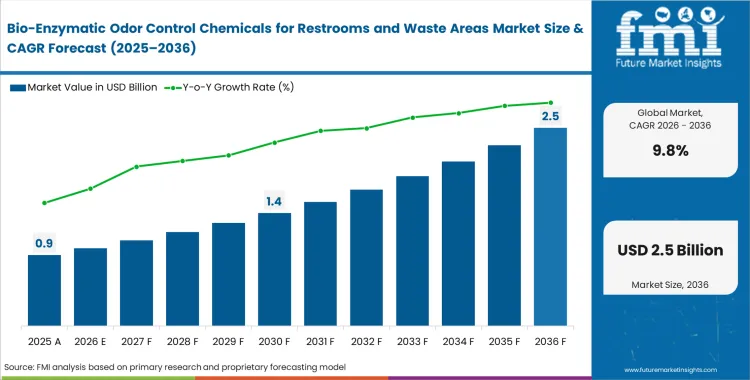
The bio-enzymatic odor control chemicals for restrooms and waste areas market were valued at USD 0.8 million in 2025 and is estimated at USD 0.9 million in 2026. The market is projected to expand at a CAGR of 9.8% from 2026 to 2036 and reach USD 2.3 million by 2036. This outlook reflects a clear shift in buyer evaluation criteria, as facility operators move away from short-lived fragrance masking and place greater weight on residue digestion, drain performance, and odor control that remains effective between cleaning cycles.
High-traffic commercial sites are under greater pressure to solve odor issues at the source, especially where uric acid buildup, organic residue, and recurring waste accumulation raise cleaning frequency and increase maintenance costs. Buyers across industrial and institutional cleaning chemicals are paying closer attention to formulations that continue working after application rather than products that deliver only temporary sensory relief. That change matters because continuous microbial action can reduce repeat odor events between janitorial shifts, lower the need for aggressive rework, and improve consistency across restroom blocks, waste rooms, and drain-heavy service areas. Facilities that continue relying on fragrance-led treatment often see the same complaints return despite heavier scrubbing and more frequent product use.
Report Summary of Bio-Enzymatic Odor Control Chemicals for Restrooms and Waste Areas Market
- Market Snapshot
- The bio-enzymatic odor control chemicals for restrooms and waste areas market are valued at USD 0.8 million in 2025 and is projected to reach USD 2.3 million by 2036.
- The industry is expected to expand at a 9.8% CAGR from 2026 to 2036, creating an incremental opportunity of about USD 1.4 million over the period.
- This remains a specialized institutional cleaning chemicals market where performance is judged less by fragrance strength and more by source digestion, dwell time, residue control, and compatibility with routine janitorial workflows.
- Market scope covers bio-enzymatic products used in restrooms, drains, waste rooms, dumpsters, and portable sanitation touchpoints, but not the full universe of disinfectants, air fresheners, or general-purpose cleaners.
- Demand and Growth Drivers
- Demand is rising because institutional buyers increasingly want odor removal at source rather than temporary masking, especially where urine, organic residue, drain film, and trash decomposition create recurring odor loads.
- Adoption is also supported by clearer buyer preference for products that can deliver repeat-use performance across high-traffic sanitation environments without adding complexity to existing maintenance routines.
- Portable sanitation and waste-side applications strengthen the category because microbial and enzymatic systems are gaining wider use for odor suppression, residue breakdown, and recurring treatment in difficult service environments.
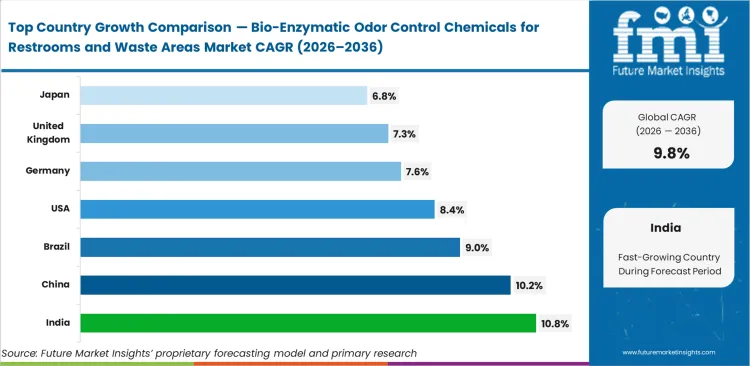
- Among key countries, India leads at 10.8% CAGR, followed by China at 10.2%, Brazil at 9.0%, the United States at 8.4%, Germany at 7.6%, the United Kingdom at 7.3%, and Japan at 6.8%.
- Growth is moderated by one practical constraint: facility buyers still expect proof that these formulations can deliver consistent treatment value before expanding purchase across larger restroom and waste-management networks.
- Product and Segment View
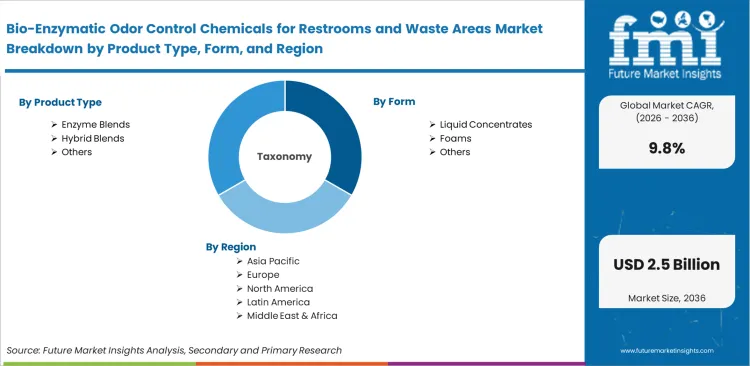
- The market covers enzyme blends, microbial blends, hybrid blends, and drain digesters, supplied mainly as liquid concentrates, ready-to-use formats, foams, and powders.
- These products are used across surface treatment, drain dosing, dumpsters, portable toilets, and waste rooms, with recurring demand in facilities where organic malodor builds up faster than standard cleaning cycles can neutralize it.
- Enzyme blends lead the Product Type segment with 39% share, helped by their strong fit for urine, body-odor, trash, and drain-film applications in institutional buildings.
- Liquid concentrates lead the Form segment with 46% share, reflecting the dominance of dilution-control programs and recurring service-led supply models in jan-san sourcing.
- Surface treatment leads to the Application segment with 31% share, as restroom floors, grout lines, urinals, toilet perimeters, and adjacent hard surfaces remain the most visible odor-control touchpoints.
- Institutional restrooms lead the End Use segment with 34% share, supported by offices, hospitals, hospitality venues, schools, and transport facilities that cannot tolerate persistent malodor in public-facing spaces.
- Direct sales lead the Sales Channel segment with 52% share, because many institutional customers still buy through manufacturer representatives, jan-san distributors, or service-linked contracts rather than open retail channels.
- The scope includes finished odor-control chemicals for restroom and waste-area treatment, but excludes air freshener-only products, antimicrobial disinfectants sold primarily for infection control, consumer toilet-care blocks, and upstream enzyme raw materials.
- Geography and Competitive Outlook
- India, China, and Brazil are the faster-growing markets in this model, while the United States remains the most stable high-value demand base because institutional cleaning penetration is already deep.
- Competition is shaped by formulation credibility, odor-source specificity, distributor reach, dilution-system integration, and service support, rather than by commodity price alone.
- Key participants include Ecolab, Diversey, A Solenis Company, Betco, Zep, Spartan Chemical, and Momar.
- The market is fragmented because odor control sits across janitorial, drain-maintenance, waste-side treatment, and broader institutional hygiene portfolios rather than within one tightly concentrated pure-play category.
Adoption strengthens once service protocols are aligned with biological chemistry. Cleaning teams cannot treat bio-enzymatic formulations as a simple drop-in substitute if adjacent products disrupt microbial activity or shorten dwell effectiveness. Buyers that standardize compatible professional cleaning products across the sanitation program are more likely to see stable odor control, lower residue recurrence, and better labor efficiency. Daily use then becomes part of an ongoing treatment cycle rather than a repetitive masking routine, which raises product value in contract cleaning, healthcare, hospitality, transport, and other high-footfall environments.
India is projected to expand at a CAGR of 10.8% through 2036, supported by the rapid formalization of facility-service contracts and rising sanitation standards across dense urban sites. China is expected to grow at 10.2%, helped by tighter waste-handling requirements in high-density municipal settings. Brazil is likely to record 9.0% CAGR, where humidity and persistent organic odor loads support wider use of active biological formulations. The United States is anticipated to rise at 8.4%, backed by stricter operating standards in healthcare and institutional buildings. Germany is expected to register 7.6%, while the United Kingdom is projected at 7.3% and Japan at 6.8%, where replacement demand is steadier and product selection faces tighter environmental screening.
Segmental Analysis
Bio-Enzymatic Odor Control Chemicals for Restrooms and Waste Areas Market Analysis by Product Type
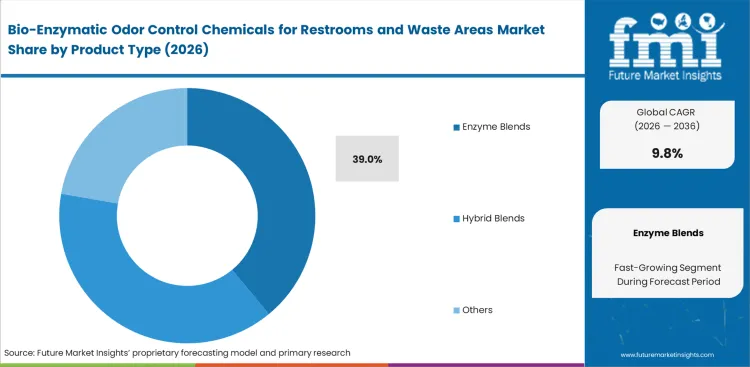
Catalytic response time shapes product selection when buyers evaluate microbial odor-control chemistries for demanding facilities. Janitorial contractors dealing with persistent restroom odors often prefer enzyme-led formulations because they break down uric acid deposits quickly at the point of contact, making them useful in high-traffic sites where complaints must be resolved without delay. The enzyme blends segment is expected to account for 39.0% share in 2026. Facility teams use these fast-acting solutions when immediate odor reduction matters before bacterial cultures fully establish on the treated surface. FMI notes that this performance profile also changes cleaning routines, since enzymes do not multiply after application and need consistent reapplication to remain effective. Suppliers serving cleaning chemicals for airports and transport hubs recognize a clear limitation here: enzyme-only programs can break organic matter apart quickly, but odor control weakens if the remaining fragments are not further digested through bacterial action. Sites relying only on rapid enzymatic knockdown often face recurring odor issues deeper in drains and plumbing lines.
- Initial screening: Commercial janitors raise purchase requests when standard masking products fail against embedded grout and drain odors. Buyers usually need visible odor relief quickly before approving a higher-cost biological option.
- Qualification validation: Environmental health and safety teams generally approve broader rollout once ATP testing shows lower residual organic loading. Fast protease action helps these formulations perform within short validation windows.
- Renewal catalysts: Contract extensions depend on whether service logs show fewer emergency plumbing interventions over time. Facility operators tend to widen usage when drain backups and trap clogs begin to decline.
Bio-Enzymatic Odor Control Chemicals for Restrooms and Waste Areas Market Analysis by Form
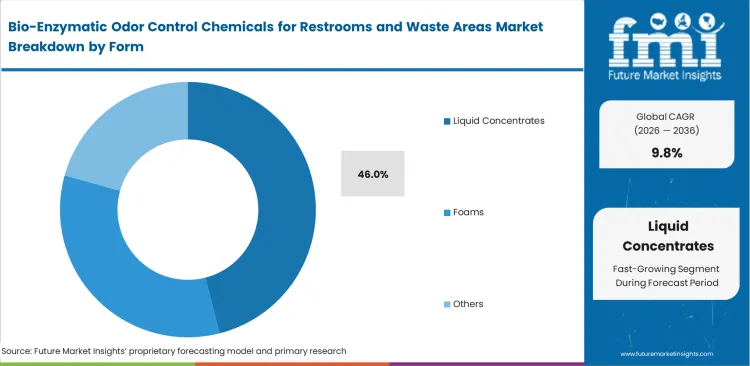
Large cleaning portfolios favor formats that reduce freight costs, improve dosing control, and simplify use across multiple sites. Liquid concentrates fit that requirement well because they move less water through the supply chain and work effectively with dispenser-based chemical management programs. The format also suits custodial networks that need standardized application across many buildings, especially where manual pouring has historically caused waste and inconsistent treatment strength. In 2026, liquid concentrates are projected to secure 46.0% share. FMI indicates that the commercial case weakens when dilution hardware is poorly maintained, because excess heat, residual sanitizer carryover, or bad calibration can damage dormant bacterial spores before they reach the point of use. Suppliers working with hospitals and cleaning chemicals for senior care and long term care facilities often note that many buyers still treat concentrated biological formulations as if they behave like standard synthetic cleaners. That assumption creates avoidable performance failure at the site level.
- Sourcing savings: Sourcing teams cut freight expense by removing unnecessary water weight from the supply chain. Concentrated liquids also help custodial networks extend chemical budgets across a wider facility base.
- Hidden operational leaks: Dispensing equipment requires upkeep, and that upkeep adds labor pressure for site teams. Faulty valves often under-dose active cultures, which leads to odor return and repeat cleaning work.
- Lifecycle calculation: The real cost benefit becomes clearer when chemical use is compared against annual drain maintenance and plumbing intervention frequency. Sites that manage automated dosing well usually show stronger lifecycle economics.
Bio-Enzymatic Odor Control Chemicals for Restrooms and Waste Areas Market Analysis by Application
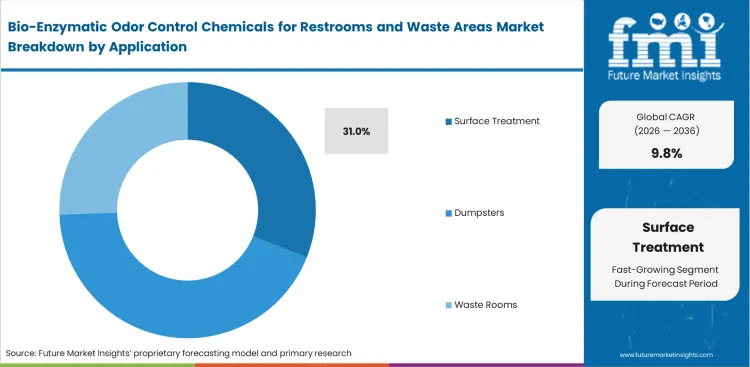
Surface treatment remains the preferred application route where odors are tied to porous flooring, grout lines, and restroom surfaces that retain organic residue below the visible layer. Custodial teams use targeted formulations in these areas because standard mopping cannot reach contamination embedded inside fine surface irregularities. Specialized restroom grout and urinal-area treatments are used to push active material into crevices where odor sources continue to build after routine cleaning. FMI’s assessment indicates that this segment is anticipated to capture 31.0% of the market in 2026. Results depend heavily on cleaning sequence, since active cultures can be neutralized when they are applied too soon after chlorine or other incompatible chemistries. Product developers working on fragrance free cleaning chemicals for sensitive environments also recognize that surface treatment demand can appear stronger than it truly is when facilities over-apply product to offset poor dwell-time discipline. Contractors that rush through cleaning cycles without allowing bio-active materials to establish properly usually face recurring odor complaints. That weakens contract performance even when the formulation itself is sound.
- Friction prevention: Daily bio-active floor treatment helps stop uric acid from hardening inside porous ceramic and grout boundaries. Routine maintenance reduces the need for heavy restorative scrubbing later.
- Residual exposure: Fine grout fissures continue to trap waste molecules when spray coverage lacks enough penetration support. Supervisors need to enforce dwell-time discipline to reduce ongoing ammonia release from untreated depths.
- Value capture: Intended return improves when adjacent cleaning programs stop exposing treated surfaces to incompatible heavy disinfectants. Stable biological activity gives the treatment a better chance of lasting through routine traffic and repeated wash cycles.
Bio-Enzymatic Odor Control Chemicals for Restrooms and Waste Areas Market Analysis by End Use
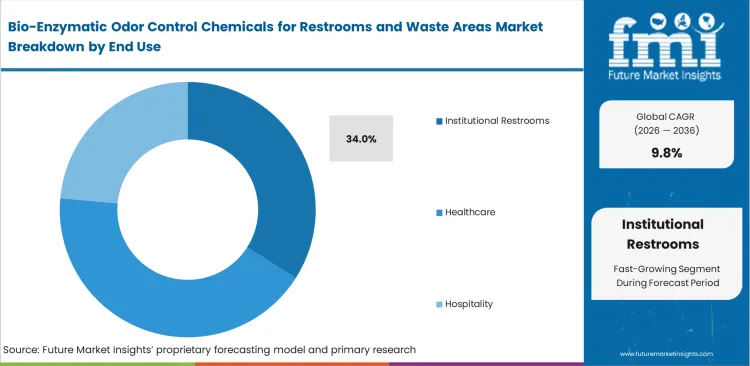
Institutional restrooms generate the most consistent requirement because usage intensity places constant pressure on ventilation systems, drain lines, and routine sanitation programs. Building operators in schools, hospitals, transport facilities, public venues, and care environments need formulations that can keep working across mixed waste loads and uneven cleaning quality. Product selection in these settings often depends on whether the microbial system can tolerate varied pH conditions and still reduce odor reliably under continuous footfall. FMI analysts expect institutional restrooms to represent 34.0% share in 2026. This segment also exposes a practical operating issue, many of the sites generating the largest biological treatment requirement depend on lower-skilled custodial labor and inconsistent protocol execution. Suppliers designing low VOC cleaning chemicals for these accounts often include a limited masking component because many workers still associate a strong scent with cleaning effectiveness. Facilities that fail to retrain teams often undermine product performance by mixing biological solutions with bleach or other incompatible chemicals.
- Performance peaks: Bio-active formulations often outperform traditional sanitizers in aging public buildings with poor drainage gradients and chronic organic buildup. Facility leaders usually notice better ambient air conditions when biological action remains active between cleaning cycles.
- Edge vulnerabilities: Very cold water in exposed or unheated facilities can temporarily slow microbial activity. Cleaning teams may need short-acting odor neutralizers during colder periods to maintain acceptable conditions.
- Acceptance standards: Public inspectors and facility auditors often rely on ambient ammonia levels as a practical signal of restroom condition. Large property operators increasingly specify microbial performance thresholds in tenders to support compliance outcomes.
Bio-Enzymatic Odor Control Chemicals for Restrooms and Waste Areas Market Analysis by Sales Channel
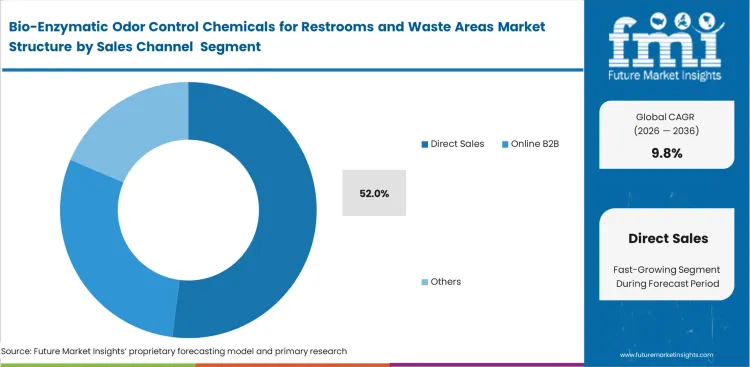
Manufacturers keep tighter control of biological odor-control products because product performance depends on storage handling, training quality, and correct site use after delivery. Direct supplier relationships help solve those issues by allowing formulators to train users, install dosing systems, and explain dwell-time requirements without relying on generalist intermediaries. That model is expected to remain dominant, with direct sales set to capture 52.0% market share in 2026. National account teams use these relationships to standardize application protocols across large facility portfolios and reduce misuse at the point of service. FMI’s view is that this channel strength also creates a commercial limit, because smaller contractors often struggle to access premium formulations when suppliers avoid low-volume accounts. Regional operators looking for super concentrate cleaning chemical programs are frequently pushed into secondary channels where poor warehousing discipline can reduce bacterial viability before delivery. Inconsistent product condition at receipt then leads to uneven field performance. That weakens trust in the category well beyond the individual account.
- Primary production: Leading formulators retain control over proprietary bacterial libraries that shape product effectiveness. Direct engagement helps them set application conditions more tightly across large facility groups.
- Logistical bottlenecks: Dormant bacterial suspensions require stable temperature management during storage and transport. Distribution teams must plan routing carefully in hotter months to protect viable colony density.
- Landscape trajectory: Major producers continue to absorb smaller biological specialists to gain access to differentiated strain libraries. Buyers planning long-term supply strategies may face fewer vendor options for tailored microbial solutions.
Bio-Enzymatic Odor Control Chemicals for Restrooms and Waste Areas Market Drivers, Restraints, and Opportunities
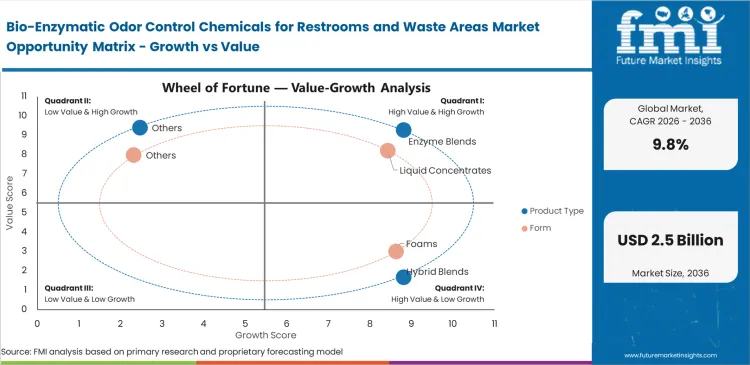
Severe corrosion costs associated with daily harsh chemical applications compel commercial facility directors to seek facility management odor control chemicals. Maintenance budgets facing premature plumbing replacement force officers to evaluate total lifecycle impacts rather than simple unit costs per gallon. Operations managers recognize that highly concentrated cleaning refills containing active microbial agents offer unique residual cleaning action, continuing to digest organic waste inside traps and pipes long after janitorial staff depart. Delaying this transition ensures ongoing physical infrastructure damage from highly acidic conventional cleaners, elevating overall capital expenditure.
Strict operational incompatibilities between bio-enzymatics and legacy cleaning chemicals create internal friction during facility transitions. Custodial teams cannot seamlessly integrate biologicals into existing carts; buyers weighing an enzymatic odor remover vs fragrance deodorizer realize that using active bacteria requires entirely removing quaternary ammonium compounds and bleaches that instantly kill microbial colonies. Transitioning mandates comprehensive staff retraining, new color-coded equipment, and total protocol restructuring.
Opportunities in the Bio-Enzymatic Odor Control Chemicals for Restrooms and Waste Areas Market
- Automated drain inoculation: Facility directors install timed perimeter dosing pumps directly into main plumbing lines. Maintenance teams gain continuous biological protection against severe fat, oil, and grease blockages without relying on manual waste room odor treatment chemicals application.
- Synergistic odor pairing: Formulators blend specific spore suspensions with immediate-action toilet cistern blocks to provide instant olfactory relief while bacteria establish colonies. Custodial supervisors deploy dumpster odor control chemicals with immediate results to appease facility users while securing long-term organic degradation.
- Smart-sensor integration: Sourcing departments deploy ammonia-detecting monitors that activate targeted portable toilet bio enzyme chemicals only when ambient odor thresholds exceed acceptable limits. Operations managers avoid wasteful over-application, optimizing expensive chemical consumption across large venues.
Regional Analysis
Based on regional analysis, Bio-Enzymatic Odor Control Chemicals for Restrooms and Waste Areas is segmented into Asia Pacific, North America, and Europe across 40 plus countries.
.webp "Top Country Growth Comparison Bio Enzymatic Odor Control Chemicals For Restrooms And Waste Areas Market Cagr (2026 2036)")
| Country | CAGR (2026 to 2036) |
|---|---|
| India | 10.8% |
| China | 10.2% |
| Brazil | 9.0% |
| United States | 8.4% |
| Germany | 7.6% |
| United Kingdom | 7.3% |
| Japan | 6.8% |
Asia Pacific Bio-Enzymatic Odor Control Chemicals for Restrooms and Waste Areas Market Analysis
Urban commercial property management shifts toward biological sanitation as municipal bodies restrict toxic chemical runoff from large transit complexes. FMI's analysis indicates high ambient humidity and temperature accelerate organic waste decomposition, creating odor challenges beyond the capacity of mechanical ventilation. Contractors deploy bio-active dosing to establish bacterial biofilms inside aging plumbing, preventing uric acid crystallization. Reliance on temporary toilet care wipes gives way to biochemical degradation strategies as developers enforce stricter hygiene standards.
- India: Expansion of privatized transport hubs and premium commercial real estate dictates stringent hygiene expectations across the country. The bio-enzymatic odor control chemicals industry in India is expected to grow at a CAGR of 10.8% during the study period. Operations managers replace basic acid washes with active bio-enzymatic to secure premium facility-management contracts. Buyers modernizing sourcing protocols capture distinct commercial advantages in a highly competitive maintenance sector.
- China: High-density public infrastructure requires automated odor mitigation solutions to handle massive user volumes. The bio-enzymatic odor control chemicals market in China is poised to expand at a CAGR of 10.2% from 2026 to 2036. Maintenance directors face strict municipal water-quality discharge mandates, forcing a shift away from traditional chemical washes. Maturing supply chains allow local formulators to compete against imported biological strains, lowering entry barriers.
- Japan: Established hygiene systems limit broad-based new adoption in Japan, which keeps demand centered on high-performance microbial strains built for specialized odor control use. The bio-enzymatic odor control sector in Japan is projected to expand at a CAGR of 6.8% through the forecast period. Strict environmental certification requirements continue to shape supplier selection for incoming chemical inputs. That screening process favors biological formulations with proven stability and documented performance, giving established vendors an advantage in corporate supply chains.
FMI's report includes South Korea and Australia. Southeast Asian transport authorities specify biological odor control in long-term maintenance tenders to prevent pipe degradation.
North America Bio-Enzymatic Odor Control Chemicals for Restrooms and Waste Areas Market Analysis
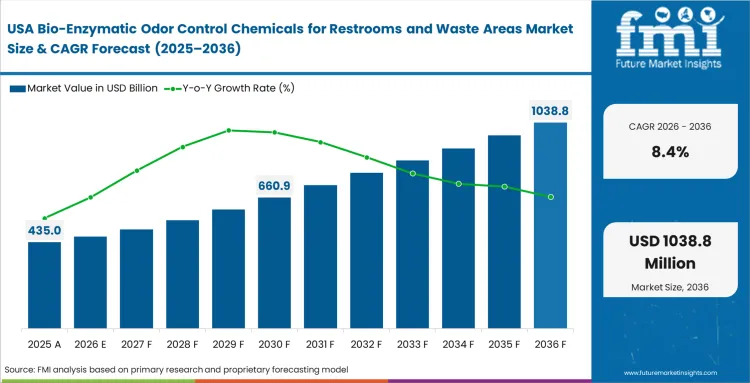
Strict occupational health regulations and green-building certifications push major commercial portfolios away from volatile organic compounds. Hospital compliance officers and corporate real estate directors mandate biological treatments to secure environmental safety points and reduce janitorial chemical exposure. As per FMI's projection, existing installed bases of automated dilution systems allow integration of concentrated biological liquids without major hardware overhauls. Real estate managers use air freshener solutions alongside targeted bio-enzymatics, aiming to balance immediate public perception with deep cleaning. Continuous pressure from labor unions regarding workplace chemical safety accelerates phase-outs of harsh synthetic biocides across public school districts and municipal facilities.
- United States: Strict healthcare infection control mandates require delicate balancing between total surface sterilization and continuous organic odor degradation. Bio-enzymatic odor control chemical sales in the United States are expected to increase at a CAGR of 8.4% during the forecast period. Facilities directors compartmentalize chemical usage, keeping biocides isolated from biological drain treatments. Organizations mastering this dual-protocol approach significantly reduce chronic maintenance interventions and plumbing repair costs.
FMI's report includes Canada and Mexico. Canadian municipal facilities adopt biological waste treatments to comply with strict localized green-purchasing mandates.
Europe Bio-Enzymatic Odor Control Chemicals for Restrooms and Waste Areas Market Analysis
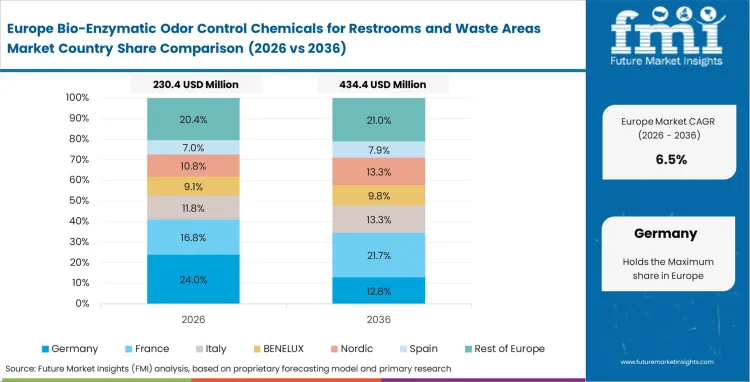
Chemical restriction frameworks redefine acceptable commercial sanitation components across institutional networks. Facility management companies face regulatory pressure to eliminate traditional masking agents and toxic sanitizers from daily operational use. FMI analysts note that historic building infrastructure characterized by narrow, aging plumbing favors continuous microbial action over corrosive chemical clearing methods. European operations directors expanding the waste area odor control chemicals market transition from conventional global air freshener aerosols toward direct source-treatment biologicals. Public sector purchasing weights environmental degradation profiles, giving substantial contract advantages to certified bio-enzymatic formulators.
- Germany: Deep environmental consciousness permeates corporate purchasing logic, forcing widespread adoption of organically certified cleaning agents. Germany is set to record a CAGR of 7.6% in the bio-enzymatic odor control sector during the assessment period. Facility contractors deploy advanced bio-active solutions to meet strict worker safety regulations. Consistent regulatory pressure pushes formulators toward continuous performance improvements, ensuring compliance while maintaining high sanitation standards.
- United Kingdom: Privatized healthcare facility managers standardize microbial drain and surface treatments to lower long-term infrastructure repair costs. The United Kingdom bio-enzymatic odor control sector is expected to register a CAGR of 7.3% from 2026 to 2036. Custodial teams executing these integrated biological protocols move away from basic masking agents. What appears as simple chemical swapping represents a shift in commercial maintenance economics, altering long-term facility operational budgets.
FMI's report includes France and Italy. Southern European hospitality sectors adopt bio-enzymatics to combat localized humidity-driven odor challenges during peak tourist seasons.
Competitive Aligners for Market Players
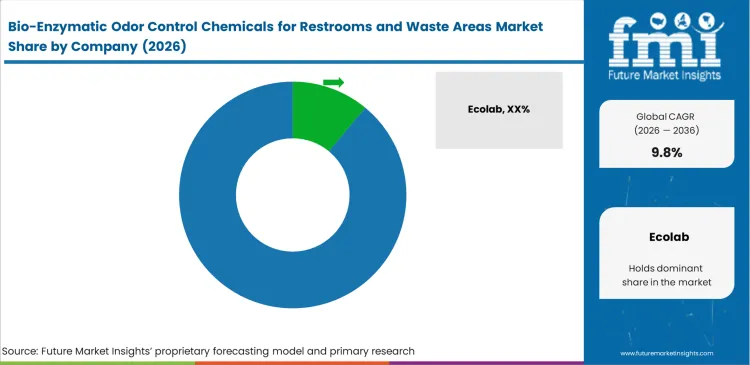
Biological formulation expertise separates primary manufacturers from basic chemical blenders. Assessing the bio-enzymatic odor control chemicals key players, Ecolab and Diversey leverage massive proprietary bacterial strain libraries to engineer highly specific degradation profiles, creating targeted solutions for unique environments like hospital drains or transport hubs. True competitive differentiation relies on stabilizing dormant spores within liquid concentrates, ensuring bacteria remain viable during harsh transport while activating instantly upon encountering organic waste. Smaller regional players struggle to maintain this delicate suspension stability, often delivering dead product that fails end-user efficacy trials.
Incumbents hold powerful advantages through entrenched automated dilution hardware installed directly inside client facilities. Switching biological chemical providers requires ripping out legacy dispensing hardware and recalibrating entirely new dosing systems, creating massive operational friction for facility managers. Top bio enzyme odor neutralizer manufacturers producing specialized gel air fresheners integrate biological action into proprietary wall-mounted dispensers, further locking buyers into exclusive consumable contracts. Specialized formulation libraries matched with captive dispensing hardware effectively insulate major players from simple price-based competition.
Large institutional buyers resist this lock-in by mandating open-source dilution equipment in new facility construction tenders. Acquisition directors explicitly ban proprietary closed-loop chemical cartridges, forcing formulators to supply standard bulk packaging compatible with generic dispensing systems. Facility managers use massive volume leverage to source green certified enzyme restroom chemicals and demand rigorous independent colony-forming unit testing prior to contract execution, refusing to accept basic marketing claims regarding bacterial viability.
Key Players in Bio-Enzymatic Odor Control Chemicals for Restrooms and Waste Areas Market
- Ecolab
- Diversey, A Solenis Company
- Betco
- Zep
- Spartan Chemical
- Momar
Scope of the Report
| Metric | Value |
|---|---|
| Quantitative Units | USD 0.9 million to USD 2.3 million, at a CAGR of 9.8% |
| Market Definition | Bio-enzymatic odor control chemicals utilize live bacterial cultures and active enzymes to organically digest uric acid and complex proteins at the molecular source, preventing recurring commercial restroom odors. |
| Segmentation | Product Type, Form, Application, End Use, and Sales Channel |
| Regions Covered | North America, Latin America, Europe, Asia Pacific, and Middle East and Africa |
| Countries Covered | India, China, Brazil, United States, Germany, United Kingdom, Japan |
| Key Companies Profiled | Ecolab, Diversey, Betco, Zep, Spartan Chemical, Momar |
| Forecast Period | 2026 to 2036 |
| Approach | Annual commercial sanitation culture purchase rates cross-validated against institutional facility footprint expansion. |
Bio-Enzymatic Odor Control Chemicals for Restrooms and Waste Areas Market Analysis by Segments
Product Type
- Enzyme blends
- Microbial blends
- Hybrid blends
- Drain digesters
Form
- Liquid concentrates
- Ready-to-use
- Foams
- Powders
Application
- Surface treatment
- Drain dosing
- Dumpsters
- Portable toilets
- Waste rooms
End Use
- Institutional restrooms
- Healthcare
- Hospitality
- Transport hubs
- Municipal waste
Sales Channel
- Direct sales
- Jan-san distributors
- Facility contractors
- Online B2B
Region:
- North America
- United States
- Canada
- Europe
- Germany
- United Kingdom
- France
- Italy
- Spain
- Asia Pacific
- China
- Japan
- South Korea
- Taiwan
- Singapore
- Latin America
- Brazil
- Mexico
- Argentina
- Middle East & Africa
- GCC Countries
- South Africa
Bibliography
- Denkel, L. A., Voss, A., Caselli, E., Dancer, S. J., Leistner, R., Gastmeier, P., & Widmer, A. F. (2024). Can probiotics trigger a paradigm shift for cleaning healthcare environments? A narrative review. Antimicrobial Resistance & Infection Control, 13(1), Article 119.
- Falagas, M. E., Kontogiannis, D. S., Sargianou, M., Falaga, E. M., Chatzimichali, M., & Michaeloudes, C. (2025). Probiotic-Based Cleaning Solutions: From Research Hypothesis to Infection Control Applications. Biology, 14(8), Article 1043.
- Lyu, Q., Feng, Z., Liu, Y., Wang, J., Xu, L., Tian, X., Yan, Z., & Ji, G. (2024). Analysis of latrine fecal odor release pattern and the deodorization with composited microbial agent. Waste Management, 178, 371–384.
- Maczukin, J., Yazıcıoğlu, A., & Ciesielski, S. (2026). The Future of Portable Sanitation: From Harmful Chemicals to Sustainable Green Cleaning Technologies. Sustainability, 18(6), Article 2828.
- Ministry of Housing and Urban Affairs. (2024). World Toilet Day 2024: Ensuring Safely Managed Sanitation for Cities. Press Information Bureau, Government of India.
- Toledo, M., & Muñoz, R. (2025). Odour prevention strategies in wastewater treatment and composting plants: A review. Journal of Environmental Management, 375, Article 124402.
This bibliography is provided for reader reference. The full FMI report contains the complete reference list with primary source documentation.
This Report Addresses
- Chronic uric acid crystallization inside aging commercial plumbing infrastructure.
- Institutional buyer transition from immediate chemical masking to biological degradation.
- Automated liquid concentrate dilution integration across major facility portfolios.
- Protocol friction between active microbial application and legacy biocide sterilization.
- Specific spore suspension viability during complex chemical supply chain logistics.
- Municipal wastewater discharge mandates driving healthcare facility sourcing changes.
- Biological treatment performance gradients in high-footfall transport hub environments.
- Active formulation requirements for continuous digestion inside porous ceramic grout lines.
Frequently Asked Questions
How large is the bio-enzymatic odor control chemicals market size in 2026?
FMI notes sales are poised to reach USD 0.9 million in 2026. This establishes a baseline for institutional migration away from temporary synthetic masking agents toward permanent biological waste degradation.
How do bio-enzymatic odor control chemicals work?
These chemicals utilize live bacterial cultures and active enzymes to organically digest uric acid and complex proteins at the molecular source. Continuous microbial colonization inside porous grout lines and drains permanently removes the organic matter causing recurring smells.
What is the difference between enzymatic and disinfectant restroom products?
Enzymatic products use live bacteria and enzymes to digest organic waste over time. Disinfectants use heavy chemicals like bleach or quaternary ammonium to instantly kill all microbes, effectively destroying the beneficial bacteria required for bio-enzymatic odor control.
Are microbial odor control products safe for institutional restrooms?
Yes, strict occupational health regulations and green-building certifications favor biological treatments over volatile organic compounds. Hospital compliance officers mandate biological drain treatments to reduce janitorial chemical exposure and secure environmental safety points.
Why do enzyme blends dominate product type purchase?
Enzyme blends hold 39.0% share because facility directors require immediate catalytic action against acute uric acid buildups. Instant molecular cleavage satisfies rapid odor-knockdown expectations while setting conditions for subsequent bacterial colonization.
What drives liquid concentrates' leading form factor position?
Liquid concentrates represent 46.0% share due to favorable transport economics and seamless integration into automated facility dilution systems. Centralized dosing hardware prevents janitorial over-pouring, securing critical long-term budget compliance.
Why do surface treatments account for significant application volume?
Surface treatment captures 31.0% share as deep uric acid penetration into porous ceramic grout requires specialized microbial seepage. Daily biological mopping prevents organic solidification that standard physical scrubbing cannot resolve.
How do institutional restrooms shape adoption curves?
Institutional restrooms command 34.0% share because massive foot traffic blocks basic mechanical ventilation capabilities. Operations managers deploy resilient bacterial strains engineered specifically to digest extreme commercial waste volumes.
Why do direct sales channels maintain dominant market positions?
Direct sales secure 52.0% share, allowing primary formulators to bypass generalist distributors. Manufacturers directly train facility staff on complex biological protocols, preventing end-users from mistakenly destroying live cultures with bleach.
What difference puts India's growth ahead of Japan's?
India expands at 10.8% CAGR driven by rapid initial formalization of urban commercial sanitation contracts. Japan tracks at 6.8% CAGR because established, highly developed hygiene infrastructure shifts focus toward slower, replacement-led specialized strain adoption.
How does automated drain inoculation alter buyer behavior?
Timed perimeter dosing pumps install active microbial protection directly into main plumbing lines. Operations managers capture severe fat and grease blockage prevention without relying on manual daily janitorial compliance.
What hidden costs emerge from dilution hardware failures?
Malfunctioning automated dilution valves routinely under-dose active bacteria into mop buckets. Custodial supervisors face insidious odor rebound that forces uncompensated labor rework across massive commercial floorplans.
Why do electric air freshener installations fail to replace biologicals?
Purely mechanical aerosol dispensers temporarily mask ambient smells but leave crystallized uric acid intact on surfaces. Facility managers realize only active bacterial digestion permanently eliminates the source organic matter generating the offensive molecules.
How do environmental safety officers evaluate efficacy?
Compliance teams utilize ATP fluorescence testing to measure total residual organic soil loads following initial applications. Fast-acting biological protocols must demonstrate verifiable bacterial colonization within critical 48-hour testing windows.
What severe vulnerability threatens dormant bacterial viability?
Improperly calibrated facility dilution stations mixing overly hot water instantly neutralize fragile dormant spores. Janitorial staffs utilizing high-temperature mixing convert expensive biological formulations into entirely useless, biologically inert liquids.
Why do hospitals isolate biological treatments from standard sanitizers?
Strict healthcare infection control mandates require heavy biocides for surface sterilization. Compliance officers must physically separate these applications from biological drain treatments, as mixing them massacres deployed beneficial bacteria.
How do formulators bridge immediate performance expectations?
Chemists bundle specific spore suspensions with immediate-action temporary fragrances. Custodial supervisors appease facility users with immediate olfactory improvement while slower biological colonies establish permanent degradation capabilities.
What role do proprietary bacterial libraries play in supplier dominance?
Major chemical manufacturers control exclusive, highly stabilized microbial strains tailored for extreme pH environments. Access to resilient, specialized bacteria insulates leading suppliers from simple price-based competition by secondary blenders.
Why do large institutional buyers mandate open-source dispensing equipment?
Acquisition directors actively ban proprietary closed-loop chemical cartridges in new facility construction. Utilizing generic dispensing hardware prevents chemical suppliers from enforcing monopolistic consumable pricing across long-term facility contracts.
How do winter temperatures affect exterior sanitation strategies?
Extreme cold water temporarily inhibits microbial metabolic rates in unheated park facilities. Sanitation contractors must supplement dormant biological treatments with immediate-action odor neutralizers during deep freezes to maintain required hygiene standards.
What forces drive widespread European adoption?
Aggressive chemical restriction frameworks redefine acceptable commercial sanitation inputs. Historic European building infrastructure, featuring narrow, aging plumbing, heavily favors continuous microbial waste digestion over highly corrosive physical clearing methods.
How do smart-sensor integrations optimize biological usage?
Ammonia-detecting monitors activate targeted biological spray applications only when ambient odor thresholds exceed predefined parameters. Facility directors eliminate wasteful daily over-application, dramatically lowering total chemical consumption across massive venues.
What residual risks face facilities using odor control system masking?
Facilities relying strictly on ambient masking experience chronic uric acid solidification inside underlying plumbing architecture. Delaying biological source treatment guarantees eventual pipe blockages requiring expensive physical infrastructure demolition.
How do odor control chemicals for wastewater plants relate to restroom biologicals?
Municipal wastewater limits increasingly restrict heavy metal-based sanitizers entering broader water streams. Downstream treatment regulations force upstream commercial facilities to adopt organic bacterial degradation to maintain municipal discharge compliance.
What role does portable toilet rental play in extreme biological stress testing?
Closed-loop portable systems concentrate extreme organic volume without continuous water flushing. Formulators utilize these harsh environments to test highly resilient microbial strains before deploying them into standard commercial restroom product lines.
Preview the report firsthand - request a free sample
Get SampleGet the brochure for pricing and purchase details.
Get PDFTable of Content
- Executive Summary
- Global Market Outlook
- Demand-side Trends
- Supply-side Trends
- Technology Roadmap Analysis
- Analysis and Recommendations
- Market Overview
- Market Coverage / Taxonomy
- Market Definition / Scope / Limitations
- Research Methodology
- Chapter Orientation
- Analytical Lens and Working Hypotheses
- Market Structure, Signals, and Trend Drivers
- Benchmarking and Cross-market Comparability
- Market Sizing, Forecasting, and Opportunity Mapping
- Research Design and Evidence Framework
- Desk Research Programme (Secondary Evidence)
- Company Annual and Sustainability Reports
- Peer-reviewed Journals and Academic Literature
- Corporate Websites, Product Literature, and Technical Notes
- Earnings Decks and Investor Briefings
- Statutory Filings and Regulatory Disclosures
- Technical White Papers and Standards Notes
- Trade Journals, Industry Magazines, and Analyst Briefs
- Conference Proceedings, Webinars, and Seminar Materials
- Government Statistics Portals and Public Data Releases
- Press Releases and Reputable Media Coverage
- Specialist Newsletters and Curated Briefings
- Sector Databases and Reference Repositories
- FMI Internal Proprietary Databases and Historical Market Datasets
- Subscription Datasets and Paid Sources
- Social Channels, Communities, and Digital Listening Inputs
- Additional Desk Sources
- Expert Input and Fieldwork (Primary Evidence)
- Primary Modes
- Qualitative Interviews and Expert Elicitation
- Quantitative Surveys and Structured Data Capture
- Blended Approach
- Why Primary Evidence is Used
- Field Techniques
- Interviews
- Surveys
- Focus Groups
- Observational and In-context Research
- Social and Community Interactions
- Stakeholder Universe Engaged
- C-suite Leaders
- Board Members
- Presidents and Vice Presidents
- R&D and Innovation Heads
- Technical Specialists
- Domain Subject-matter Experts
- Scientists
- Physicians and Other Healthcare Professionals
- Governance, Ethics, and Data Stewardship
- Research Ethics
- Data Integrity and Handling
- Primary Modes
- Tooling, Models, and Reference Databases
- Desk Research Programme (Secondary Evidence)
- Data Engineering and Model Build
- Data Acquisition and Ingestion
- Cleaning, Normalisation, and Verification
- Synthesis, Triangulation, and Analysis
- Quality Assurance and Audit Trail
- Market Background
- Market Dynamics
- Drivers
- Restraints
- Opportunity
- Trends
- Scenario Forecast
- Demand in Optimistic Scenario
- Demand in Likely Scenario
- Demand in Conservative Scenario
- Opportunity Map Analysis
- Product Life Cycle Analysis
- Supply Chain Analysis
- Investment Feasibility Matrix
- Value Chain Analysis
- PESTLE and Porter’s Analysis
- Regulatory Landscape
- Regional Parent Market Outlook
- Production and Consumption Statistics
- Import and Export Statistics
- Market Dynamics
- Global Market Analysis 2021 to 2025 and Forecast, 2026 to 2036
- Historical Market Size Value (USD Million) Analysis, 2021 to 2025
- Current and Future Market Size Value (USD Million) Projections, 2026 to 2036
- Y-o-Y Growth Trend Analysis
- Absolute $ Opportunity Analysis
- Global Market Pricing Analysis 2021 to 2025 and Forecast 2026 to 2036
- Global Market Analysis 2021 to 2025 and Forecast 2026 to 2036, By Product Type
- Introduction / Key Findings
- Historical Market Size Value (USD Million) Analysis By Product Type , 2021 to 2025
- Current and Future Market Size Value (USD Million) Analysis and Forecast By Product Type , 2026 to 2036
- Enzyme Blends
- Hybrid Blends
- Others
- Enzyme Blends
- Y-o-Y Growth Trend Analysis By Product Type , 2021 to 2025
- Absolute $ Opportunity Analysis By Product Type , 2026 to 2036
- Global Market Analysis 2021 to 2025 and Forecast 2026 to 2036, By Form
- Introduction / Key Findings
- Historical Market Size Value (USD Million) Analysis By Form, 2021 to 2025
- Current and Future Market Size Value (USD Million) Analysis and Forecast By Form, 2026 to 2036
- Liquid Concentrates
- Foams
- Others
- Liquid Concentrates
- Y-o-Y Growth Trend Analysis By Form, 2021 to 2025
- Absolute $ Opportunity Analysis By Form, 2026 to 2036
- Global Market Analysis 2021 to 2025 and Forecast 2026 to 2036, By Application
- Introduction / Key Findings
- Historical Market Size Value (USD Million) Analysis By Application, 2021 to 2025
- Current and Future Market Size Value (USD Million) Analysis and Forecast By Application, 2026 to 2036
- Surface Treatment
- Dumpsters
- Waste Rooms
- Surface Treatment
- Y-o-Y Growth Trend Analysis By Application, 2021 to 2025
- Absolute $ Opportunity Analysis By Application, 2026 to 2036
- Global Market Analysis 2021 to 2025 and Forecast 2026 to 2036, By End Use
- Introduction / Key Findings
- Historical Market Size Value (USD Million) Analysis By End Use, 2021 to 2025
- Current and Future Market Size Value (USD Million) Analysis and Forecast By End Use, 2026 to 2036
- Institutional Restrooms
- Healthcare
- Hospitality
- Institutional Restrooms
- Y-o-Y Growth Trend Analysis By End Use, 2021 to 2025
- Absolute $ Opportunity Analysis By End Use, 2026 to 2036
- Global Market Analysis 2021 to 2025 and Forecast 2026 to 2036, By Sales Channel
- Introduction / Key Findings
- Historical Market Size Value (USD Million) Analysis By Sales Channel, 2021 to 2025
- Current and Future Market Size Value (USD Million) Analysis and Forecast By Sales Channel, 2026 to 2036
- Direct Sales
- Online B2B
- Others
- Direct Sales
- Y-o-Y Growth Trend Analysis By Sales Channel, 2021 to 2025
- Absolute $ Opportunity Analysis By Sales Channel, 2026 to 2036
- Global Market Analysis 2021 to 2025 and Forecast 2026 to 2036, By Region
- Introduction
- Historical Market Size Value (USD Million) Analysis By Region, 2021 to 2025
- Current Market Size Value (USD Million) Analysis and Forecast By Region, 2026 to 2036
- North America
- Latin America
- Western Europe
- Eastern Europe
- East Asia
- South Asia and Pacific
- Middle East & Africa
- Market Attractiveness Analysis By Region
- North America Market Analysis 2021 to 2025 and Forecast 2026 to 2036, By Country
- Historical Market Size Value (USD Million) Trend Analysis By Market Taxonomy, 2021 to 2025
- Market Size Value (USD Million) Forecast By Market Taxonomy, 2026 to 2036
- By Country
- USA
- Canada
- Mexico
- By Product Type
- By Form
- By Application
- By End Use
- By Sales Channel
- By Country
- Market Attractiveness Analysis
- By Country
- By Product Type
- By Form
- By Application
- By End Use
- By Sales Channel
- Key Takeaways
- Latin America Market Analysis 2021 to 2025 and Forecast 2026 to 2036, By Country
- Historical Market Size Value (USD Million) Trend Analysis By Market Taxonomy, 2021 to 2025
- Market Size Value (USD Million) Forecast By Market Taxonomy, 2026 to 2036
- By Country
- Brazil
- Chile
- Rest of Latin America
- By Product Type
- By Form
- By Application
- By End Use
- By Sales Channel
- By Country
- Market Attractiveness Analysis
- By Country
- By Product Type
- By Form
- By Application
- By End Use
- By Sales Channel
- Key Takeaways
- Western Europe Market Analysis 2021 to 2025 and Forecast 2026 to 2036, By Country
- Historical Market Size Value (USD Million) Trend Analysis By Market Taxonomy, 2021 to 2025
- Market Size Value (USD Million) Forecast By Market Taxonomy, 2026 to 2036
- By Country
- Germany
- UK
- Italy
- Spain
- France
- Nordic
- BENELUX
- Rest of Western Europe
- By Product Type
- By Form
- By Application
- By End Use
- By Sales Channel
- By Country
- Market Attractiveness Analysis
- By Country
- By Product Type
- By Form
- By Application
- By End Use
- By Sales Channel
- Key Takeaways
- Eastern Europe Market Analysis 2021 to 2025 and Forecast 2026 to 2036, By Country
- Historical Market Size Value (USD Million) Trend Analysis By Market Taxonomy, 2021 to 2025
- Market Size Value (USD Million) Forecast By Market Taxonomy, 2026 to 2036
- By Country
- Russia
- Poland
- Hungary
- Balkan & Baltic
- Rest of Eastern Europe
- By Product Type
- By Form
- By Application
- By End Use
- By Sales Channel
- By Country
- Market Attractiveness Analysis
- By Country
- By Product Type
- By Form
- By Application
- By End Use
- By Sales Channel
- Key Takeaways
- East Asia Market Analysis 2021 to 2025 and Forecast 2026 to 2036, By Country
- Historical Market Size Value (USD Million) Trend Analysis By Market Taxonomy, 2021 to 2025
- Market Size Value (USD Million) Forecast By Market Taxonomy, 2026 to 2036
- By Country
- China
- Japan
- South Korea
- By Product Type
- By Form
- By Application
- By End Use
- By Sales Channel
- By Country
- Market Attractiveness Analysis
- By Country
- By Product Type
- By Form
- By Application
- By End Use
- By Sales Channel
- Key Takeaways
- South Asia and Pacific Market Analysis 2021 to 2025 and Forecast 2026 to 2036, By Country
- Historical Market Size Value (USD Million) Trend Analysis By Market Taxonomy, 2021 to 2025
- Market Size Value (USD Million) Forecast By Market Taxonomy, 2026 to 2036
- By Country
- India
- ASEAN
- Australia & New Zealand
- Rest of South Asia and Pacific
- By Product Type
- By Form
- By Application
- By End Use
- By Sales Channel
- By Country
- Market Attractiveness Analysis
- By Country
- By Product Type
- By Form
- By Application
- By End Use
- By Sales Channel
- Key Takeaways
- Middle East & Africa Market Analysis 2021 to 2025 and Forecast 2026 to 2036, By Country
- Historical Market Size Value (USD Million) Trend Analysis By Market Taxonomy, 2021 to 2025
- Market Size Value (USD Million) Forecast By Market Taxonomy, 2026 to 2036
- By Country
- Kingdom of Saudi Arabia
- Other GCC Countries
- Turkiye
- South Africa
- Other African Union
- Rest of Middle East & Africa
- By Product Type
- By Form
- By Application
- By End Use
- By Sales Channel
- By Country
- Market Attractiveness Analysis
- By Country
- By Product Type
- By Form
- By Application
- By End Use
- By Sales Channel
- Key Takeaways
- Key Countries Market Analysis
- USA
- Pricing Analysis
- Market Share Analysis, 2025
- By Product Type
- By Form
- By Application
- By End Use
- By Sales Channel
- Canada
- Pricing Analysis
- Market Share Analysis, 2025
- By Product Type
- By Form
- By Application
- By End Use
- By Sales Channel
- Mexico
- Pricing Analysis
- Market Share Analysis, 2025
- By Product Type
- By Form
- By Application
- By End Use
- By Sales Channel
- Brazil
- Pricing Analysis
- Market Share Analysis, 2025
- By Product Type
- By Form
- By Application
- By End Use
- By Sales Channel
- Chile
- Pricing Analysis
- Market Share Analysis, 2025
- By Product Type
- By Form
- By Application
- By End Use
- By Sales Channel
- Germany
- Pricing Analysis
- Market Share Analysis, 2025
- By Product Type
- By Form
- By Application
- By End Use
- By Sales Channel
- UK
- Pricing Analysis
- Market Share Analysis, 2025
- By Product Type
- By Form
- By Application
- By End Use
- By Sales Channel
- Italy
- Pricing Analysis
- Market Share Analysis, 2025
- By Product Type
- By Form
- By Application
- By End Use
- By Sales Channel
- Spain
- Pricing Analysis
- Market Share Analysis, 2025
- By Product Type
- By Form
- By Application
- By End Use
- By Sales Channel
- France
- Pricing Analysis
- Market Share Analysis, 2025
- By Product Type
- By Form
- By Application
- By End Use
- By Sales Channel
- India
- Pricing Analysis
- Market Share Analysis, 2025
- By Product Type
- By Form
- By Application
- By End Use
- By Sales Channel
- ASEAN
- Pricing Analysis
- Market Share Analysis, 2025
- By Product Type
- By Form
- By Application
- By End Use
- By Sales Channel
- Australia & New Zealand
- Pricing Analysis
- Market Share Analysis, 2025
- By Product Type
- By Form
- By Application
- By End Use
- By Sales Channel
- China
- Pricing Analysis
- Market Share Analysis, 2025
- By Product Type
- By Form
- By Application
- By End Use
- By Sales Channel
- Japan
- Pricing Analysis
- Market Share Analysis, 2025
- By Product Type
- By Form
- By Application
- By End Use
- By Sales Channel
- South Korea
- Pricing Analysis
- Market Share Analysis, 2025
- By Product Type
- By Form
- By Application
- By End Use
- By Sales Channel
- Russia
- Pricing Analysis
- Market Share Analysis, 2025
- By Product Type
- By Form
- By Application
- By End Use
- By Sales Channel
- Poland
- Pricing Analysis
- Market Share Analysis, 2025
- By Product Type
- By Form
- By Application
- By End Use
- By Sales Channel
- Hungary
- Pricing Analysis
- Market Share Analysis, 2025
- By Product Type
- By Form
- By Application
- By End Use
- By Sales Channel
- Kingdom of Saudi Arabia
- Pricing Analysis
- Market Share Analysis, 2025
- By Product Type
- By Form
- By Application
- By End Use
- By Sales Channel
- Turkiye
- Pricing Analysis
- Market Share Analysis, 2025
- By Product Type
- By Form
- By Application
- By End Use
- By Sales Channel
- South Africa
- Pricing Analysis
- Market Share Analysis, 2025
- By Product Type
- By Form
- By Application
- By End Use
- By Sales Channel
- USA
- Market Structure Analysis
- Competition Dashboard
- Competition Benchmarking
- Market Share Analysis of Top Players
- By Regional
- By Product Type
- By Form
- By Application
- By End Use
- By Sales Channel
- Competition Analysis
- Competition Deep Dive
- Ecolab
- Overview
- Product Portfolio
- Profitability by Market Segments (Product/Age /Sales Channel/Region)
- Sales Footprint
- Strategy Overview
- Marketing Strategy
- Product Strategy
- Channel Strategy
- Diversey, A Solenis Company
- Betco
- Zep
- Spartan Chemical
- Momar
- Ecolab
- Competition Deep Dive
- Assumptions & Acronyms Used


