

- Industry Size (2026)
- USD 18.3 Bn
- Forecast (2036)
- USD 30.2 Bn
- CAGR (2026 to 2036)
- 5.1%
Air Freshener Market Forecast and Outlook 2026 to 2036
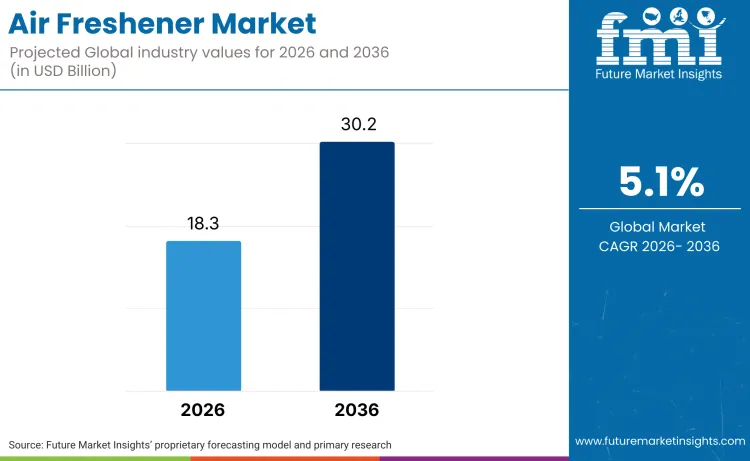
A fundamental structural shift from simple "odor masking" to sophisticated "air treatment" is propelling the global air freshener market toward a substantial USD 30.2 billion valuation by 2036, advancing vigorously from a baseline of USD 18.3 billion in 2026. This upward trajectory represents a steady 5.1% CAGR over the forecast period. The primary catalyst driving this expansion is the declining indoor air quality in major urban centers; the U.S. EPA reported in April 2024 that over 43.9 million Americans now reside in areas with failing air quality grades, fundamentally changing consumer purchasing behavior from viewing air care as a luxury to an essential home maintenance requirement.
Validating such high-growth environment, Jon Moeller, CEO of Procter & Gamble, stated in the company’s 2024 annual results that “The team met or exceeded our going-in plans for organic sales growth, core EPS growth, cash generation and cash returned to shareowners in a challenging economic and geopolitical environment.” This underscores how the execution of P&G’s integrated strategy helped the company deliver strong underlying performance, even amidst inflationary pressures and soft consumer demand, which in turn highlights the resilience and vitality of categories such as home care.
Companies are aggressively pivoting their R&D pipelines toward "clean label" technologies and electric air freshener innovations to capture the lucrative premium segment. Reckitt Benckiser capitalized on this evolving demand in 2024 by launching Air Wick Active Fresh, a non-aerosol automatic spray that eliminates traditional propellants, directly addressing the environmental concerns highlighted by DEFRA (2024), which attributed 29% of UK particulate emissions to domestic sources. The strategic implication for the next decade is clear: brands that can successfully decouple fragrance efficacy from volatile organic compounds (VOCs) and integrate with smart air purifiers ecosystems will secure the highest margins through 2036, as consumers increasingly scrutinize the chemical footprint of the products they introduce into their living spaces.
Summary of Air Freshener Market
What Is the Growth Outlook for the Air Freshener Market as per Future Market Insights Projection?
Future Market Insights projects the global air freshener market to expand from USD 18.3 Billion in 2026 to USD 30.2 Billion by 2036, registering a CAGR of 5.1% over the forecast period.
FMI Research Approach: Based on FMI’s proprietary global modeling framework incorporating household expenditure surveys, urban air quality indices, and corporate organic growth reports from market leaders like P&G and Reckitt.
How Do FMI Analysts Perceive the Air Freshener Market to Evolve?
FMI analysts perceive the market transitioning away from chemical-heavy masking agents toward "Functional Air Care" ecosystems where neurobiology-based scents and air purification converge.
FMI Research Approach: Developed using analysis of global patent filings for non-aerosol dispersion, examination of innovation pipelines such as Godrej’s smart diffusers, and sustainability disclosures regarding VOC reduction from major FMCG conglomerates.
Which Country Holds the Largest Share in the Global Air Freshener Market?
The United States holds the largest value share globally, supported by a cultural propensity for "home scentscaping" and high adoption of advanced, app-controlled electric diffusers.
FMI Research Approach: Built using country-level revenue modeling, analysis of retail scanner data, and evaluation of patent filings related to air care technologies in North America. Inputs also include consumer sentiment analysis regarding indoor air quality.
How Large Will the Air Freshener Market Be by 2036?
The global air freshener market is expected to reach USD 30.2 Billion by 2036, supported by sustained demand for premium electric devices and the rapid expansion of the automotive segment in emerging economies.
FMI Research Approach: Long-term forecasts rely on urbanization trends in India and China, industrial capacity expansion data supporting global non-aerosol availability, and channel-specific scaling assumptions for subscription-based refill models.
What Is the Definition of the Air Freshener Market?
The air freshener market encompasses all revenue generated from consumer products specifically designed to mask, neutralize, or eliminate unpleasant odors and introduce fragrance into indoor environments. This includes aerosol sprays, electric plug-ins, gels, candles, and automotive air care products, while excluding industrial HVAC filtration systems and personal perfumes not intended for ambient room usage.
FMI Research Approach: Definition structured using FMI’s segmentation taxonomy covering product types, end-use applications, and distribution channels. The classification draws from operational inclusion criteria for residential and commercial scenting solutions.
What Are Globally Unique Trends Shaping the Air Freshener Market?
Globally, the sector is being shaped by the "Neuro-Scent" revolution, where fragrances are designed to elicit specific emotional responses, and the "Aerosol-Free" mandate driven by sustainability goals.
FMI Research Approach: Insights derived from global patent tracking, sustainability reports from major FMCG companies, and consumer sentiment analysis regarding indoor air quality and chemical safety.
Air Freshener Market Key Takeaways
| Metric | Value |
|---|---|
| 2026 Market Value | USD 18.3 Billion |
| 2036 Market Value | USD 30.2 Billion |
| Global CAGR (2026-2036) | 5.1% |
How is the "Health-First" Home Environment Driving Sales?
The convergence of hygiene protocols and home fragrance is currently the single largest driver of market value expansion. World Health Organization (WHO) data from January 2024 confirms that household air pollution remains a critical health risk affecting urban populations, prompting a massive shift where consumers seek products with "sanitizing" claims rather than just aesthetic perfume. Godrej Consumer Products responded to this shift in 2024 by expanding its "Aer" smart diffuser line, which offers controlled release technology to maintain consistent air quality. This validates that the market is moving toward "intelligent air care" where devices play an active role in home health management, often overlapping with the india air treatment products sector as consumers look for multifunctional devices that protect as well as perfume.
Beyond health, the demand is fueled by the integration of IoT and smart technologies into everyday home care products. The rise of "set it and forget it" solutions has revitalized the fragrance diffuser sector, as busy urban consumers prefer automated systems that ensure a pleasant ambiance without manual intervention. Unilever's investment in "Fragrance Centres of Excellence" in 2025 to develop next-level fragrance experiences for brands like Comfort and Cif further highlights the industry's commitment to technological superiority. This trend is creating a bifurcated market where high-tech, app-controlled devices cater to the premium segment, while advanced, long-lasting passive formats cater to value-conscious demographics, ensuring that convenience remains the core value proposition across all price tiers.
How is the Air Freshener Market Segmented?
Air freshener market is structurally divided into three major segmentation pillars: product type, application, and distribution channel, each reflecting distinct consumer needs and usage environments. By product type, the market spans sprays/aerosols, electric air fresheners, gel formats, candle-based fresheners, liquid diffusers, and other solid formats such as beads, each category representing a different balance of immediacy, longevity, aesthetics, and price point. applications segment the market into residential, commercial, and automotive use cases, acknowledging how demand differs between home ambiance, business environments, and the rapidly expanding in-car fragrance segment in high‑growth economies. distribution channel segmentation includes Online Stores, Supermarkets/Hypermarkets, Convenience Stores, and Specialty Stores, reflecting the diverse retail pathways through which consumers access both mass-market and premium formats across global markets. Together, these segmentation layers illustrate a market structured around functional diversity, usage context, and evolving retail dynamics.
Which Product Segments Dominate the Landscape?
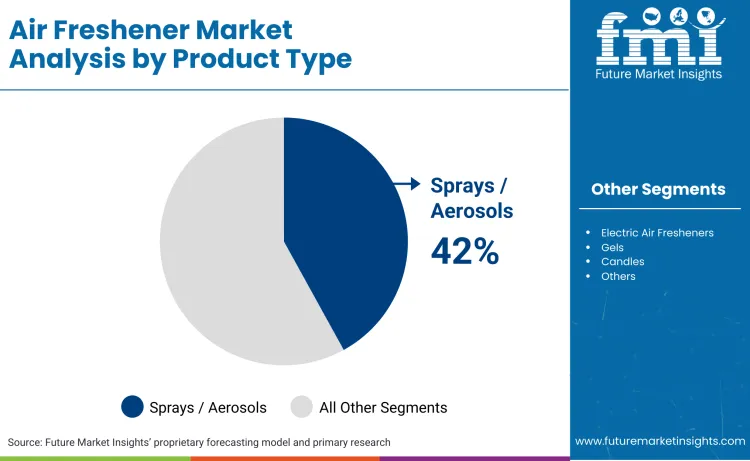
Sprays and Aerosols continue to maintain their stronghold on the market, commanding a robust 42% share of total revenue. This dominance is anchored by their unparalleled cost-effectiveness and capability to deliver instant gratification in neutralizing acute malodors, making them a staple in households globally. However, the landscape is shifting as the gel air fresheners segment experiences a notable resurgence in emerging economies, favored for their continuous action and budget-friendly price points. Conversely, in developed markets such as Germany and the United States, the Electric Air Fresheners segment is rapidly seizing market share, driven by consumer preference for consistent, adjustable scent delivery and seamless compatibility with modern smart home ecosystems.
What Emerging Dynamics are Impacting Car and Candle Segments?
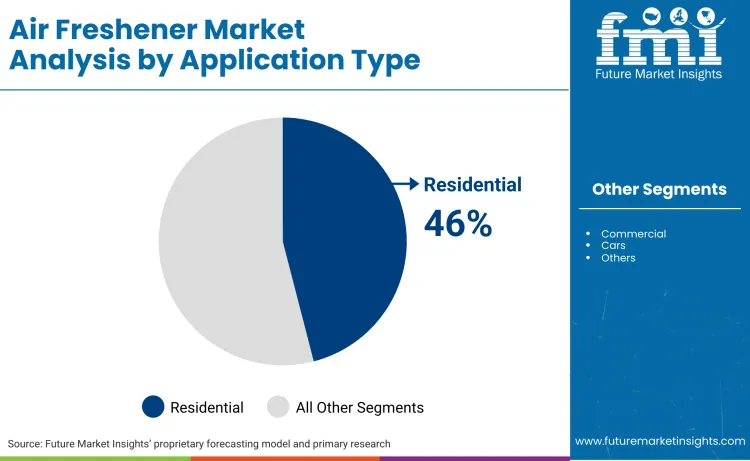
The Residential application sector remains the primary engine of consumption, holding a dominant share at 46%, a trend solidified by the permanent adoption of hybrid work models which have increased the time consumers spend at home. Simultaneously, the car air freshener segment is witnessing renewed vigor, particularly in high-growth automotive markets like China and India, where rising vehicle ownership is transforming the car into an extension of the living space. In parallel, Candles maintain a resilient niche in China and the US, serving as the primary vehicle for "scentscaping" and premiumization, frequently crossing over into the candle air fresheners category. Glade's January 2024 launch of the "Fresh Collection" candles specifically targeted this experiential segment, validating the consumer desire for multi-sensory experiences that combine olfactory satisfaction with visual ambiance to create a "sanctuary" feel.
What is the "Scent-as-Décor" Premiumization Trend?
Air fresheners are evolving from functional utility items into home décor accessories that signal status and taste. Febreze launched "Romance & Desire" as its 2024 Scent of the Year, positioning the product as a mood enhancer rather than a mere odor eliminator. This trend pushes the Average Selling Price (ASP) upward as consumers are willing to pay more for aesthetically pleasing designs and complex fragrance profiles that rival personal perfumes. This shift is also evident in the fragrance product sector, where home scents are increasingly designed by master perfumers to mimic high-end colognes and botanicals.
How is the "Aerosol-Free" Mandate Reshaping Formulations?
Regulatory pressure and consumer eco-consciousness are forcing a structural shift to nitrogen and water-based propellants. SC Johnson achieved a significant milestone with 25% post-consumer recycled content in its packaging globally in 2024, setting a new sustainability benchmark. Startups like Adsorbi in Germany secured €1 million in 2025 to scale cellulose-based air purification materials, replacing fossil-based activated carbon. This trend implies that non-compliant aerosol products face potential delisting in the EU, driving innovation in car air purifier technologies that rely on filtration rather than chemical masking to achieve air purity.
Why are Smart & Connected Scents Gaining Mass Adoption?
App-controlled diffusers are moving from niche luxury items to mass-market expectations. Godrej's Smart Matic launch in 2024 brings IoT capabilities to the mass market in Asia, allowing users to control spray frequency via smartphone. Similarly, Pura raised $15 million in September 2025 to expand its "Open Air Technology™", which uses molecular neutralizers to target malodors chemically. This connectivity enables subscription-based refill models, locking consumers into a brand ecosystem and generating recurring revenue, a model that is transforming the smart air purifiers landscape into a service-based economy.
How Will Regional Expansion Unfold Across Key Markets?
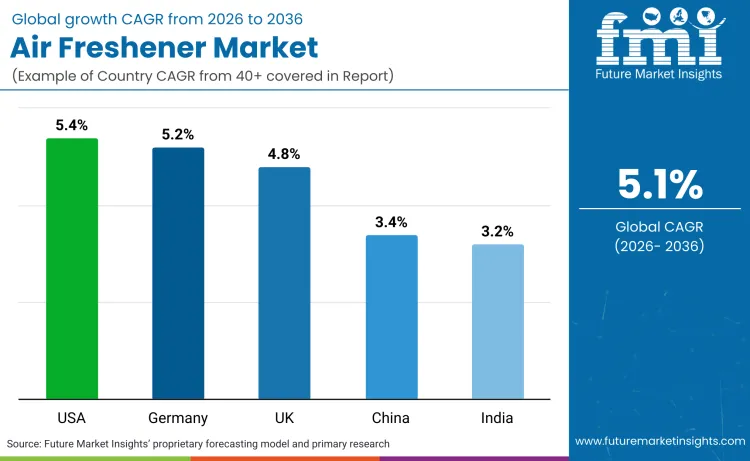
Regional expansion in the global air freshener market is set to unfold unevenly across key economies, reflecting differing stages of consumer maturity, regulatory pressures, and adoption of smart home technologies. The United States is projected to lead growth with a 5.4% CAGR, supported by strong consumer inclination toward premium, experience‑driven home scenting solutions that integrate seamlessly with smart living ecosystems. Close behind, Germany is expected to grow at 5.2%, buoyed by sustainability mandates and rising demand for eco‑friendly, non‑aerosol formats that align with stringent European environmental norms.
The United Kingdom, expanding at 4.8%, represents a hybrid market where regulatory shifts toward low‑emission products and significant corporate restructuring are driving innovation and flameless alternatives. In Asia, China is set for 3.4% growth as the market pivots from pollution‑defense products to ambiance‑enhancing technologies, supported by improved air quality metrics and localized fragrance innovation centers. India, growing at 3.2%, is witnessing rapid expansion in value‑driven formats and mass‑premium devices fueled by rising rural consumption and an emerging middle class increasingly seeking “guest‑ready” home environments. Together, these dynamics illustrate a market where regional growth trajectories are defined by the intersection of technology adoption, cultural scent preferences, and evolving environmental priorities.
| Country | CAGR (2026-2036) |
|---|---|
| United States | 5.4% |
| Germany | 5.2% |
| United Kingdom | 4.8% |
| China | 3.4% |
| India | 3.2% |
What Dynamics Drive The United States Professional Landscape?
The United States is forecast to expand at a 5.4% CAGR, representing the highest growth rate globally, primarily driven by the "Experience Economy." American consumers increasingly view home fragrance as an emotional necessity rather than a functional chore, fueling demand for fragranced personal care products cross-over scents. Rafael Trujillo, Master Perfumer at Febreze, articulated this sentiment in April 2025 regarding the Vanilla Suede launch:
“Amidst the chaos of everyday life, we’re seeing a rise in self-indulgence and a desire to take back control of our spaces. People are looking for reasons to spend more time at home, whether that means hosting friends or curating the perfect night in and Vanilla Suede helps them do just that: transform any space into a personal oasis.”
Such emotional branding allows manufacturers to command premium price points. Furthermore, patents like US Patent 9,402,930 B2 for solid water-soluble formulations indicate a continued push for industrial innovation within the region to meet the diverse needs of American households.
How Are Digital Ecosystems Reshaping the Indian Market?
India is projected to grow at a steady 3.2% CAGR in the baseline forecast, although specific premium segments are exploding with double-digit growth rates. The Ministry of Statistics (MOSPI) reported in June 2024 that rural consumption expenditure rose by 9%, unlocking millions of new customers for entry-level products. Sudhir Sitapati, MD & CEO of Godrej Consumer (GCPL), highlighted the massive scale of this opportunity in July 2025: "Air Care in India delivered over 20% growth and an ~700 bps market share gain. The Aer brand scaled on the back of a sharp consumer insight, using air care to create guest-ready homes." This innovation translates to affordable "pocket" sprays and hanging gels that cater to the newly affluent middle class, bridging the gap to the India air treatment products sector.
Why Is the United Kingdom A Critical Hybrid Market?
The UK industry is rising at a 4.8% CAGR and is uniquely shaped by stringent environmental controls and significant corporate restructuring. With DEFRA identifying domestic combustion as a major pollutant, the market has seen a rapid shift toward "flameless" options. A major strategic development occurred in late 2025 when Reckitt divested its "Essential Home" portfolio (including Air Wick) to Advent International.
Kris Licht, CEO of Reckitt Benckiser Group plc, commented on the company’s agreement to divest its Essential Home business, saying: “We are executing our strategic plan at pace. The divestment of Essential Home represents a significant step forward in unlocking the substantial value in our business. This moves Reckitt towards becoming a simpler, more effective world-class consumer health and hygiene company and it will enable us to focus on a core portfolio of high-growth, high-margin Powerbrands.”
This move underscores company’s strategic pivot toward agile innovation and portfolio focus, aiming to sharpen growth strategies, prioritise regulatory compliance, and streamline operations, factors that contribute to more sustainable long-term value creation and reduced operational complexity.
What Trends are Defining the Chinese Market?
China demand outlook indicates rise at a 3.4% CAGR as the sector is stabilizing with frequency of "good air" days increasing. Ministry of Ecology and Environment reported 87.2% good air quality days in 2024. The market focus is pivoting from "pollution defense" to "ambiance creation." CPL Aromas opening a Fine Fragrance Centre of Excellence in Shanghai in 2025 demonstrates the intense localization of innovation required to succeed. The focus here is increasingly on automotive cabin air quality sensor integration, where air fresheners work in tandem with vehicle sensors to provide a holistic "healthy car" environment, catering to a tech-savvy consumer base that demands empirical proof of air quality improvement alongside olfactory satisfaction.
How Is Competition Evolving in the Air Freshener Market?
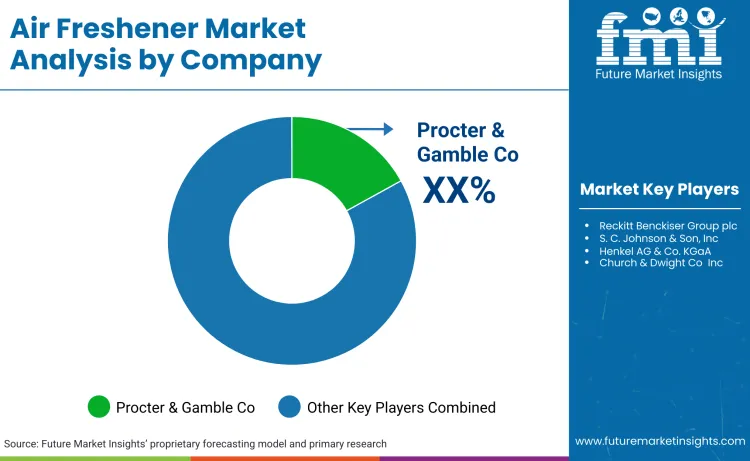
The competitive arena has fundamentally shifted from a price-based commodity war to a sophisticated "Platform War," where major players are no longer simply selling individual units of spray but are instead marketing comprehensive "Scent Ecosystems" designed for long-term retention. Reckitt and P&G are aggressively pushing proprietary refill formats for their electric diffusers, effectively locking consumers into a specific brand universe. Once a consumer invests in the hardware, the high switching cost ensures a steady stream of refill revenue, creating a durable annuity stream for manufacturers.
The automotive air filter players are also entering this space, offering scented cabin filters, blurring the lines between filtration and fragrancing and intensifying cross-industry competition. Strategic moves by key players highlight this evolution towards sustainability and digital integration. Procter & Gamble is leveraging "Scent of the Year" campaigns to maintain media buzz and relevance, while SC Johnson is using sustainability as a wedge issue, marketing products with 25% PCR plastic to steal share from generic brands. Matthew Farrell, CEO of Church & Dwight Co., Inc., commented on the company’s financial performance for full year 2024, stating: “Our outstanding full year 2024 results reflect the strength of our brands, the success of our new products, and our continued focus on execution.” This competitive dynamism ensures that only those brands that can master the trifecta of Scent, Sustainability, and Smart Tech will survive the consolidation phase of the next decade.
Recent Developments:
- In November 2024, California Scents partnered with Oracle Red Bull Racing to launch the Armor All Podium Series, a premium auto care line including racing-themed air fresheners featuring innovative ceramic technology for enhanced performance in the automotive fragrance segment.
- In March 2025, Reckitt Benckiser launched a new range of biodegradable plug-in refills under its “Fresh Earth” line, made with essential oils and 100% recyclable packaging, targeting eco-conscious consumers in the home air freshener market.
- In July 2025, Reckitt Benckiser acquired a niche brand specializing in organic air fresheners, expanding its product portfolio to include more natural options and strengthening its position in the sustainable fragrance category.
Key Players in Air Freshener Market
- Procter & Gamble Co.
- Reckitt Benckiser Group plc
- S. C. Johnson & Son, Inc.
- Henkel AG & Co. KGaA
- Church & Dwight Co., Inc.
- Godrej Consumer Products Limited
- Newell Brands
- California Scents
- Farcent Enterprise Co. Ltd
- Kobayashi Pharmaceutical Co. Ltd
Market Definition
The air freshener market encompasses the aggregate revenue generated from the sale of consumer products specifically designed to mask, neutralize, or eliminate unpleasant odors and introduce fragrance into indoor environments. This includes a wide array of formats such as aerosol sprays, pump sprays, electric plug-in diffusers, gelatinous solids (gels), scented candles, liquid wicks, and automotive air care products. The market definition extends to both residential and commercial applications (e.g., offices, hotels, public restrooms) where these products are deployed for ambient scenting and odor control.
Excluded from this specific market definition are industrial-grade air filtration systems (HVAC integrated), medical-grade sterilization equipment, and personal perfumes or body sprays not intended for ambient room usage. However, the market increasingly intersects with the vehicle interior air quality monitoring technology sector as smart air fresheners begin to integrate with broader air quality monitoring ecosystems. The revenue figures cited represent the retail sales value (RSV) of these products across all distribution channels, including supermarkets, hypermarkets, online retail, and specialty stores.
Scope of Report
| Items | Values |
|---|---|
| Quantitative Units (2026) | USD 18.3 Billion |
| Product Type | Sprays / Aerosols, Electric Air Fresheners (Plug-ins), Gel Air Fresheners, Candle Air Fresheners, Liquid Air Fresheners (Wicks / Diffusers), Others (Beads, Solids) |
| Application | Residential, Commercial, Automotive |
| Distribution Channel | Online Stores, Supermarkets / Hypermarkets, Convenience Stores, Specialty Stores |
| Technology & Format Focus | Aerosol-free delivery systems, Electric and IoT-enabled diffusers, Controlled-release gels, Non-VOC formulations |
| Fragrance & Functional Positioning | Odor Masking, Odor Neutralization, Sanitizing & Air Treatment, Neuro-scent and Mood-based Fragrance Systems |
| Regions Covered | North America, Europe, Asia Pacific, Latin America, Middle East & Africa |
| Countries Covered | United States, Germany, United Kingdom, China, India, and 40+ countries |
| Key Companies Profiled | Procter & Gamble Co., Reckitt Benckiser Group plc, S. C. Johnson & Son, Inc., Henkel AG & Co. KGaA, Church & Dwight Co., Inc., Godrej Consumer Products Limited, Newell Brands, California Scents, Farcent Enterprise Co. Ltd, Kobayashi Pharmaceutical Co. Ltd |
| Additional Attributes | Revenue analysis by product type and application, aerosol versus non-aerosol format transition assessment, smart and connected diffuser adoption tracking, regulatory impact analysis on VOCs and propellants, sustainability and recycled-content benchmarking, premiumization and “scent-as-décor” pricing analysis, automotive air care growth assessment, and competitive ecosystem positioning |
Air Freshener Market by Segments
By Product Type:
- Sprays/Aerosols
- Electric Air Fresheners (Plug-ins)
- Gel Air Fresheners
- Candle Air Fresheners
- Liquid Air Fresheners (Wicks/Diffusers)
- Others (Beads, Solids)
By Application:
- Residential
- Commercial
- Automotive
By Distribution Channel:
- Online Stores
- Supermarkets/Hypermarkets
- Convenience Stores
- Specialty Stores
By Region:
- North America
- Europe
- Asia Pacific
- Latin America
- Middle East & Africa
Bibliography
- World Customs Organization. (2024). HS nomenclature explanatory notes for packaging materials and household products. WCO.
- European Chemicals Agency. (2024). Substances of concern in consumer products and packaging guidance. ECHA.
- U.S. Geological Survey. (2024). Mineral commodity summaries: Industrial minerals used in paper and packaging. USGS.
- Bureau of Transportation Statistics. (2024). Freight analysis framework for paper, packaging, and household goods. U.S. DOT.
- International Resource Panel. (2024). Global material flows and circular economy indicators. UNEP IRP.
- Central Pollution Control Board. (2024). Annual report on plastic and packaging waste management. Government of India.
- European Topic Centre on Circular Economy and Resource Use. (2024). Material flow indicators for packaging waste streams. ETC-CE.
- International Labour Organization. (2024). Employment trends in pulp, paper, packaging, and consumer goods manufacturing. ILO.
- World Meteorological Organization. (2024). Air quality and particulate exposure trends in urban environments. WMO.
- National Institute for Occupational Safety and Health. (2024). Indoor air quality and chemical exposure guidance for households. CDC/NIOSH.
Frequently Asked Questions
What is the current global market size for Air Fresheners?
The global market is valued at USD 18.3 Billion in 2026, driven by increasing urbanization and the prioritization of home hygiene and ambiance.
What is the projected CAGR for the air freshener market?
Revenue is projected to expand at a 5.1% CAGR from 2026 to 2036, significantly supported by the shift toward premium, sustainable, and smart air care devices.
Which product segment currently dominates the industry?
Sprays and Aerosols hold the dominant share at 42%, serving as the primary solution for immediate odor elimination due to their affordability and ease of use.
What are the primary market drivers?
Growth is driven by the "Health-First" home trend, rising concerns over indoor air quality, and the integration of IoT technologies in home care devices.
Who are the leading players in the Air Freshener space?
Procter & Gamble, Reckitt Benckiser (and its spun-off portfolio), SC Johnson, and Godrej Consumer Products lead the market, differentiating through scent innovation and regional adaptability.
Preview the report firsthand - request a free sample
Get SampleGet the brochure for pricing and purchase details.
Get PDFTable of Content
- Executive Summary
- Global Market Outlook
- Demand Side Trends
- Supply Side Trends
- Technology Roadmap Analysis
- Analysis and Recommendations
- Market Overview
- Market Coverage / Taxonomy
- Market Definition / Scope / Limitations
- Research Methodology
- Chapter Orientation
- Analytical Lens and Working Hypotheses
- Market Structure, Signals, and Trend Drivers
- Benchmarking and Cross-market Comparability
- Market Sizing, Forecasting, and Opportunity Mapping
- Research Design and Evidence Framework
- Desk Research Programme (Secondary Evidence)
- Expert Input and Fieldwork (Primary Evidence)
- Data Engineering and Model Build
- Quality Assurance and Audit Trail
- Market Background
- Market Dynamics
- Drivers (Health-First Home Environment, Indoor Air Quality)
- Restraints
- Opportunity (Smart & Connected Scents)
- Trends (Scent-as-Décor, Aerosol-Free Mandate)
- Scenario Forecast
- Demand in Optimistic Scenario
- Demand in Likely Scenario
- Demand in Conservative Scenario
- Opportunity Map Analysis
- Product Life Cycle Analysis
- Supply Chain Analysis
- Investment Feasibility Matrix
- Value Chain Analysis
- PESTLE and Porter's Analysis
- Regulatory Landscape (VOC Reduction, Sustainability)
- Regional Parent Market Outlook
- Production and Consumption Statistics
- Import and Export Statistics
- Market Dynamics
- Global Market Analysis 2021 to 2025 and Forecast, 2026 to 2036
- Historical Market Size Value (USD Billion) Analysis, 2021 to 2025
- Current and Future Market Size Value (USD Billion) Projections, 2026 to 2036
- Y-o-Y Growth Trend Analysis
- Absolute $ Opportunity Analysis
- Global Market Pricing Analysis 2021 to 2025 and Forecast 2026 to 2036
- Y-o-Y Growth Trend Analysis 2021 to 2025
- Absolute $ Opportunity Analysis 2026 to 2036
- Global Market Analysis 2021 to 2025 and Forecast 2026 to 2036, By Product Type
- Introduction / Key Findings
- Historical Market Size Value (USD Billion) Analysis By Product Type, 2021 to 2025
- Current and Future Market Size Value (USD Billion) Analysis and Forecast By Product Type, 2026 to 2036
- Sprays/Aerosols
- Electric Air Fresheners (Plug-ins)
- Gel Air Fresheners
- Candle Air Fresheners
- Liquid Air Fresheners (Wicks/Diffusers)
- Others (Beads, Solids)
- Y-o-Y Growth Trend Analysis By Product Type, 2021 to 2025
- Absolute $ Opportunity Analysis By Product Type, 2026 to 2036
- Global Market Analysis 2021 to 2025 and Forecast 2026 to 2036, By Application
- Introduction / Key Findings
- Historical Market Size Value (USD Billion) Analysis By Application, 2021 to 2025
- Current and Future Market Size Value (USD Billion) Analysis and Forecast By Application, 2026 to 2036
- Residential
- Commercial
- Automotive
- Y-o-Y Growth Trend Analysis By Application, 2021 to 2025
- Absolute $ Opportunity Analysis By Application, 2026 to 2036
- Global Market Analysis 2021 to 2025 and Forecast 2026 to 2036, By Distribution Channel
- Introduction / Key Findings
- Historical Market Size Value (USD Billion) Analysis By Distribution Channel, 2021 to 2025
- Current and Future Market Size Value (USD Billion) Analysis and Forecast By Distribution Channel, 2026 to 2036
- Online Stores
- Supermarkets/Hypermarkets
- Convenience Stores
- Specialty Stores
- Y-o-Y Growth Trend Analysis By Distribution Channel, 2021 to 2025
- Absolute $ Opportunity Analysis By Distribution Channel, 2026 to 2036
- Global Market Analysis 2021 to 2025 and Forecast 2026 to 2036, By Region
- Introduction
- Historical Market Size Value (USD Billion) Analysis By Region, 2021 to 2025
- Current Market Size Value (USD Billion) Analysis and Forecast By Region, 2026 to 2036
- North America
- Latin America
- Western Europe
- Eastern Europe
- East Asia
- South Asia and Pacific
- Middle East & Africa
- Market Attractiveness Analysis By Region
- North America Market Analysis 2021 to 2025 and Forecast 2026 to 2036, By Country
- Historical Market Size Value (USD Billion) Trend Analysis By Market Taxonomy, 2021 to 2025
- Market Size Value (USD Billion) Forecast By Market Taxonomy, 2026 to 2036
- By Country
- USA
- Canada
- Mexico
- By Product Type
- By Application
- By Distribution Channel
- By Country
- Market Attractiveness Analysis
- By Country
- By Product Type
- By Application
- By Distribution Channel
- Key Takeaways
- Latin America Market Analysis 2021 to 2025 and Forecast 2026 to 2036, By Country
- Historical Market Size Value (USD Billion) Trend Analysis By Market Taxonomy, 2021 to 2025
- Market Size Value (USD Billion) Forecast By Market Taxonomy, 2026 to 2036
- By Country
- Brazil
- Rest of Latin America
- By Product Type
- By Application
- By Distribution Channel
- By Country
- Market Attractiveness Analysis
- Key Takeaways
- Western Europe Market Analysis 2021 to 2025 and Forecast 2026 to 2036, By Country
- Historical Market Size Value (USD Billion) Trend Analysis By Market Taxonomy, 2021 to 2025
- Market Size Value (USD Billion) Forecast By Market Taxonomy, 2026 to 2036
- By Country
- Germany
- UK
- Rest of Western Europe
- By Product Type
- By Application
- By Distribution Channel
- By Country
- Market Attractiveness Analysis
- Key Takeaways
- Eastern Europe Market Analysis 2021 to 2025 and Forecast 2026 to 2036, By Country
- Historical Market Size Value (USD Billion) Trend Analysis By Market Taxonomy, 2021 to 2025
- Market Size Value (USD Billion) Forecast By Market Taxonomy, 2026 to 2036
- Market Attractiveness Analysis
- Key Takeaways
- East Asia Market Analysis 2021 to 2025 and Forecast 2026 to 2036, By Country
- Historical Market Size Value (USD Billion) Trend Analysis By Market Taxonomy, 2021 to 2025
- Market Size Value (USD Billion) Forecast By Market Taxonomy, 2026 to 2036
- By Country
- China
- Japan
- South Korea
- By Product Type
- By Application
- By Distribution Channel
- By Country
- Market Attractiveness Analysis
- Key Takeaways
- South Asia and Pacific Market Analysis 2021 to 2025 and Forecast 2026 to 2036, By Country
- Historical Market Size Value (USD Billion) Trend Analysis By Market Taxonomy, 2021 to 2025
- Market Size Value (USD Billion) Forecast By Market Taxonomy, 2026 to 2036
- By Country
- India
- ASEAN
- Australia & New Zealand
- Rest of South Asia and Pacific
- By Product Type
- By Application
- By Distribution Channel
- By Country
- Market Attractiveness Analysis
- Key Takeaways
- Middle East & Africa Market Analysis 2021 to 2025 and Forecast 2026 to 2036, By Country
- Historical Market Size Value (USD Billion) Trend Analysis By Market Taxonomy, 2021 to 2025
- Market Size Value (USD Billion) Forecast By Market Taxonomy, 2026 to 2036
- Market Attractiveness Analysis
- Key Takeaways
- Key Countries Market Analysis
- USA
- Pricing Analysis
- Market Share Analysis, 2026
- By Product Type
- By Application
- By Distribution Channel
- Germany
- Pricing Analysis
- Market Share Analysis, 2026
- UK
- Pricing Analysis
- Market Share Analysis, 2026
- China
- Pricing Analysis
- Market Share Analysis, 2026
- India
- Pricing Analysis
- Market Share Analysis, 2026
- USA
- Market Structure Analysis
- Competition Dashboard
- Competition Benchmarking
- Market Share Analysis of Top Players
- By Regional
- By Product Type
- By Application
- By Distribution Channel
- Competition Analysis
- Competition Deep Dive
- Procter & Gamble Co.
- Reckitt Benckiser Group plc
- S. C. Johnson & Son, Inc.
- Henkel AG & Co. KGaA
- Church & Dwight Co., Inc.
- Godrej Consumer Products Limited
- Newell Brands
- California Scents
- Farcent Enterprise Co. Ltd
- Kobayashi Pharmaceutical Co. Ltd
- Competition Deep Dive
- Assumptions & Acronyms Used


