

- Industry Size (2026)
- USD 1.0 Bn
- Forecast (2036)
- USD 3.3 Bn
- CAGR (2026 to 2036)
- 12.7%
Car Air Freshener Packaging Market Forecast and Outlook 2026 to 2036
Global valuation for the car air freshener packaging market is estimated to reach USD 1.0 billion in 2026, with forecasts projecting a surge to USD 3.3 billion by 2036. The industry is poised to expand at a 12.7% CAGR over the coming decade, a trajectory heavily influenced by the urgent removal of single-use plastics from retail supply chains. This shift is quantified by major industry movements; for instance, DS Smith reported replacing or avoiding over 1.2 billion pieces of plastic since 2020, signaling a massive industrial pivot that supports the market's aggressive growth forecast. As the broader global air freshener sector pivots toward premiumization, packaging manufacturers are under intense pressure to deliver formats that reduce plastic usage without compromising shelf appeal. The shift is not merely cosmetic; it is a response to stringent regulatory environments, particularly in Europe and California, which are effectively penalizing traditional PVC-heavy formats.
Leading manufacturers are responding by moving from pilot programs to mass adoption of fiber-based alternatives to secure their operational future. Michael Doss, President and CEO of Graphic Packaging, articulated this strategic necessity in February 2025: "Our Vision 2030 strategy places more focus than ever on innovation across our business. Combined with our foundational commitment to sustainability, we are positioned to meet growing global demand for packaging innovations that are more circular, more functional and more convenient than existing alternatives."
This commitment underscores a broader industry realization: sustainability is now a functional requirement for volume sales. As companies leverage innovations that allow for the "lightweighting" of board materials, they ensure that hanging cards remain rigid enough for display while consuming less raw fiber. This evolution is critical for supporting the mass-market volume of gel air fresheners and vent clips, where unit economics are sensitive to packaging costs and consumer perception is increasingly tied to environmental responsibility.
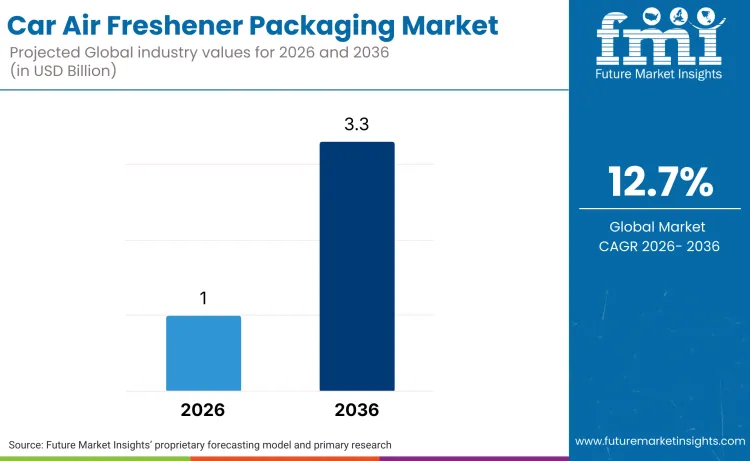
Summary of Car Air Freshener Packaging Market
What Is the Growth Outlook for the Car Air Freshener Packaging Market as per Future Market Insights Projection?
Future Market Insights projects the global car air freshener packaging market to grow from USD 1.0 billion in 2026 to USD 3.3 billion by 2036, representing a robust 12.7% CAGR over the forecast period.
FMI Research Approach: Based on FMI’s proprietary global modeling framework incorporating regulatory compliance costs (EU PPWR), retail activity indicators validating automotive accessory consumption resilience, and industrial demand assessments informed by nearshoring logistics data.
How Do FMI Analysts Perceive the Car Air Freshener Packaging Market to Evolve?
FMI analysts perceive the market transitioning away from traditional window cartons and PET blisters toward cellulose-based clear films and fiber-heavy formats.
FMI Research Approach: Developed using analysis of regional regulatory requirements, examination of material innovation pipelines such as Stora Enso's fiber treatments, and facility expansion disclosures from integrated paper and fiber manufacturers.
Which Country Holds the Largest Share in the Global Car Air Freshener Packaging Market?
The United States holds one of the highest value shares globally, supported by a strong automotive culture and stringent state-level regulations like California SB 54 that drive continuous demand for compliant packaging solutions.
FMI Research Approach: Built using country-level retail activity indicators, analysis of packaging material shifts driven by producer responsibility mandates, and mapping of supplier concentration among North America’s integrated packaging manufacturers.
How Large Will the Car Air Freshener Packaging Market Be by 2036?
The global car air freshener packaging market is expected to reach USD 3.3 billion by 2036, supported by sustained demand from the hanging card segment, which currently commands a significant volume share.
FMI Research Approach: Long-term forecasts rely on demographic and vehicle ownership trends in emerging markets, industrial capacity expansion data supporting global paperboard availability, and channel-specific scaling assumptions for premium packaging value.
What Is the Definition of the Car Air Freshener Packaging Market?
The car air freshener packaging market encompasses all revenue generated from purpose-designed primary and secondary packaging solutions used for bundling vent clips, hanging trees, cans, and sprays. It includes window cartons, blister cards, flexible pouches, and specialty paper-based formats marketed explicitly for automotive fragrance applications.
FMI Research Approach: Definition structured using FMI’s segmentation taxonomy covering product types, end-use channels, and material compositions. The classification draws from operational inclusion criteria for automotive kits, alongside explicit exclusions for non-retail specific packaging categories.
What Are Globally Unique Trends Shaping the Car Air Freshener Packaging Market?
Globally, the sector is shaped by an ongoing shift toward mono-material recyclability and the elimination of solvent-based adhesives in consumer goods packaging.
FMI Research Approach: Insights derived from global regulatory tracking (EU PPWR), sustainability performance disclosures from major manufacturers like Berry Global and Graphic Packaging, and assessment of competitive reinvestment patterns across Europe, Asia, and North America.
Why Is Regulatory Elimination of Single-Use Plastics Reshaping the Market?
The enforcement of the EU Packaging and Packaging Waste Regulation (PPWR) has radically altered the compliance landscape by mandating that all packaging must be recyclable by 2030. This regulatory pressure is forcing a redesign of the traditional blister packaging utilized for car air fresheners, pushing brands to eliminate virgin plastic backing cards entirely. Manufacturers are now accountable for the full lifecycle of their materials, leading to a massive substitution effect where fiber-based solutions are displacing polymers. The industry is seeing concrete results from this shift; for example, major suppliers have reported replacing or avoiding over 1.2 billion pieces of plastic in recent years. This indicates a shift where compliance is no longer just about avoiding fines but about securing shelf space in major retailers that are increasingly hostile to non-recyclable plastics.
The transition is further accelerated by consumer demand for sustainability, which is influencing the design of electric air freshener kits and refill packs. Brands are adopting "hybrid-fiber" formats—molded fiber shells that mimic the visibility of plastic without the environmental footprint. This move is essential for maintaining the visibility of the product, which is a key driver for impulse purchases in automotive aisles, while simultaneously meeting the rigorous recycled content targets set by new legislation. The elimination of mixed materials simplifies the recycling process for the end consumer, ensuring that the packaging actually enters the circular economy rather than ending up in landfill, a critical factor for brand loyalty in the modern marketplace.
How Is the Car Air Freshener Packaging Market Segmented?
The market is dissected by product format, material composition, and retail pack type to address the specific needs of automotive logistics and shelf display. The segmentation reflects a diverging marketplace where low-cost, high-volume items are optimizing for material reduction, while premium segments are focusing on unboxing experiences. This split is evident in how different clamshell packaging solutions are being adapted or phased out depending on the price point of the fragrance product.
Why Are Hanging Cards and Blister Packs Dominating the Format Share?
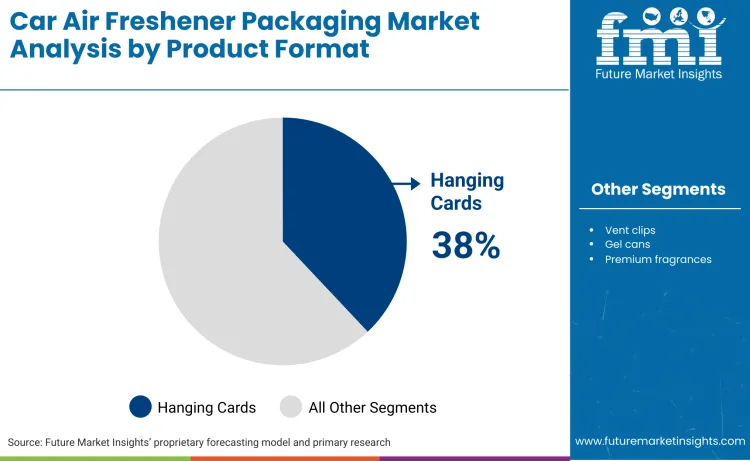
Hanging cards currently hold 38% of the product format share, while blister packs account for 42% of the retail pack type. This dominance is driven by the retail necessity for high-density display on pegboards in gas stations and auto shops. However, the material composition of these cards is undergoing a revolution. Innovation is focused on replacing the plastic backing with rigid paperboard while maintaining the "see-through" utility consumers expect. Alternatives like digital folding cartons are gaining traction as they offer superior printability for branding without the environmental tax of plastic blisters.
How Is Material Composition shifting from PET to Recycled Content?
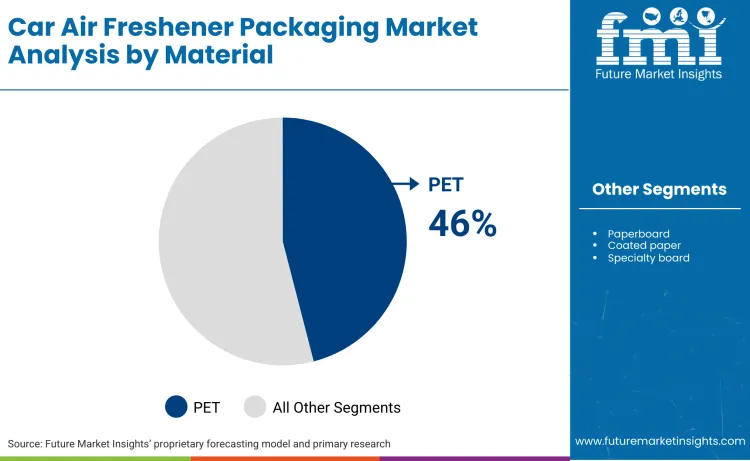
While PET currently holds a 46% share of the material mix, the industry is witnessing a rapid pivot toward recycled content and fiber. Leading converters are aggressively increasing their use of post-consumer resin (PCR), with some reporting year-over-year purchase increases of up to 43% for these materials. This demonstrates a strategic defensive moat for rigid plastic formats like vent clips; rather than abandoning plastic, manufacturers are integrating circularity. This trend is crucial for aerosol packaging used in car sprays, where metal and plastic components must now align with higher sustainability standards to remain viable in regulated markets.
Why Is the Consolidation of Global Manufacturers Accelerating?
Strategic M&A activity and capital expenditure pivots are reshaping the supply chain as leaders seek to unify production capabilities and secure sustainable material sources. After years of heavy infrastructure investment, major players are pivoting to harvesting returns. For instance, Graphic Packaging announced an expected capital spending reduction of roughly USD 700 million between 2024 and 2026 as they focus on driving returns from their established innovation systems. This signal indicates a mature innovation phase where the focus shifts from building new capacity to optimizing existing assets for sustainable output, influencing the availability of luxury packaging solutions for premium car perfumes.
How Are Technological Innovations Driving Material Efficiency?
Cost pressures and carbon targets are driving "lightweighting" beyond simple plastic reduction. Recent deployments of advanced fiber treatments have successfully reduced board weight by more than 5% without sacrificing rigidity. This technology is critical for hanging card displays that must withstand the rigors of retail handling without warping. Such advancements allow brands to produce metallized folding cartons and other premium formats that offer the visual appeal of traditional materials but with a significantly lower carbon footprint and material weight.
How Will Car Air Freshener Packaging Market Expansion Unfold Across Key Global Regions?
Market expansion varies significantly across regions, influenced by automotive culture, retail infrastructure, and environmental mandates. Developed markets like the USA and Germany are prioritizing material innovation and supply chain security to meet circular economy goals. In contrast, emerging economies are witnessing volume-driven growth fueled by rising vehicle ownership. FMI analysis suggests that while the West focuses on the "Death of the Blister Pack," the East is rapidly modernizing its perfume packaging to support booming export sectors.
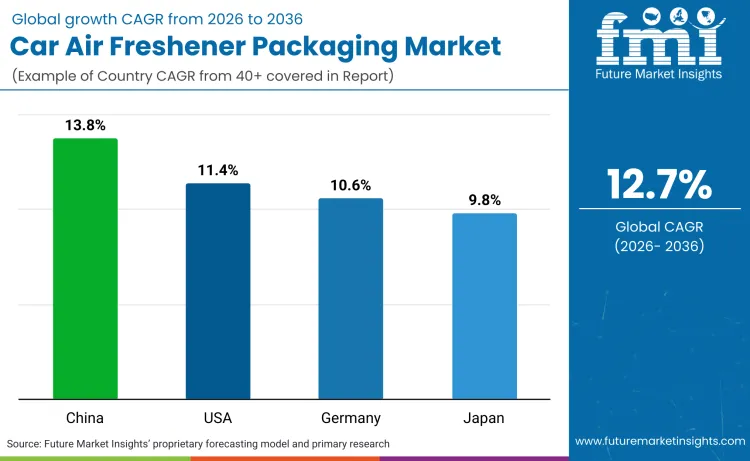
| Country | CAGR (2026 to 2036) |
|---|---|
| USA | 11.4% |
| Germany | 10.6% |
| China | 13.8% |
| Japan | 9.8% |
Why Does the USA Represent a Mature, High-Value Market?
The United States is forecast to expand at an 11.4% CAGR, anchored by a resilient retail sector and significant investments in domestic manufacturing efficiency. The market is increasingly defined by a shift from capital-intensive expansion to asset optimization, evidenced by major players planning to reduce annual capital spending by approximately USD 700 million through 2026. This financial discipline allows US firms to focus heavily on integrating candle air fresheners and car fragrance kits with market-proven European sustainability innovations. Michael Doss, President and CEO of Graphic Packaging, highlighted this cross-pollination strategy in February 2025:
"When we acquired AR Packaging in 2021, we knew that Europe would remain the center of packaging innovation for years to come. In 2024, when the European Union approved sweeping new packaging regulations, we brought U.S. innovations to European customers.” This strategic agility ensures that American retailers can offer car fragrance kits that meet consumer expectations for sustainability without waiting for federal mandates. By leveraging European advancements, US manufacturers are effectively future-proofing their portfolios against potential state-level EPR laws, securing long-term growth in a high-volume consumption market.
Why Does Germany Focus on Premium Sustainability?
Germany remains a hub for premium innovation, growing at a 10.6% CAGR as heritage brands adapt to the EU's strict circular economy rules. The market is defined by the technical challenge of reducing material weight while maintaining the durability required for automotive logistics. Malin E. Strömberg, Technical Product Manager at Stora Enso, emphasized the operational benefits of these material advancements in July 2024:
“The board becomes more than 5 percent lighter than it would be without the treatment. This, of course benefits our customers, as their packaging becomes lighter, which means they can produce the same amount of packaging with less material and lower emissions, also during transport.” This focus on efficiency is paramount for German manufacturers who export metal aerosol packaging and luxury car scents globally. By reducing the weight of the packaging, they not only lower their carbon footprint but also mitigate rising logistics costs. This dual benefit reinforces Germany's position as a leader in engineering sustainable packaging solutions that do not compromise on the premium quality associated with their automotive exports.
Why Is China Pivoting to Export-Led Quality?
China is poised to register a 13.8% CAGR, leveraging its dominance in manufacturing to capture the global car air purifier and accessories export markets. The sector is undergoing a rapid modernization, moving away from low-cost PVC towards higher-quality recycled plastics to meet Western standards. This is evidenced by the adoption of supply chain practices similar to global leaders who have increased post-consumer resin (PCR) purchases by 43% year-over-year. Chinese manufacturers are increasingly integrating these high-quality recycled materials to ensure their exports remain compliant with the EU's PPWR and US state regulations. This strategic pivot safeguards their massive export volume of hanging cards and vent clips, ensuring that "Made in China" automotive accessories continue to find shelf space in strictly regulated Western retail environments.
Why Does Japan Maintain Premium Maturity?
Japan is anticipated to expand at a 9.8% CAGR, reflecting a mature market deeply rooted in a culture of gifting and precision. The market is characterized by a demand for ultra-efficient, high-aesthetic packaging that minimizes waste without sacrificing the "unboxing" experience. Innovations such as ultra-thin, PVC-free aluminum foil solutions are gaining traction, replicating the functionality of traditional blisters while cutting material costs by up to 60%. This drive for efficiency aligns perfectly with Japan's limited waste disposal space and high consumer expectations. Japanese brands are integrating these advanced materials into digital folding cartons and rigid packs, ensuring that premium air fresheners are presented in packaging that is as sophisticated and technologically advanced as the automotive culture they serve.
How is the Competition in the Car Air Freshener Packaging Market?
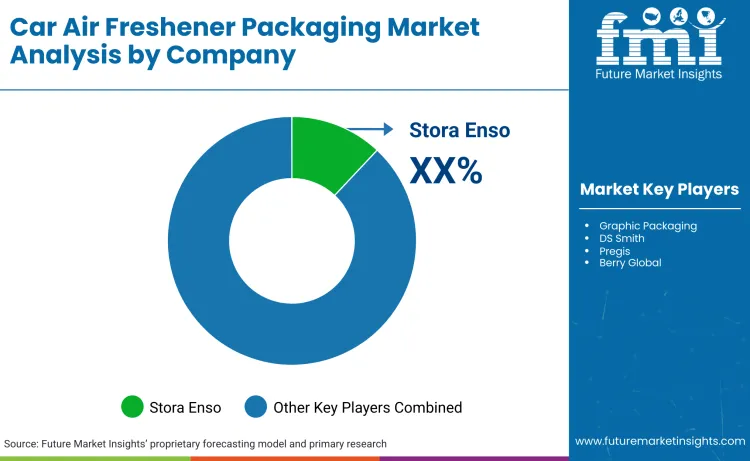
The competitive landscape of the car air freshener packaging market is currently defined by intense consolidation and a race for vertical integration. Major global players are reshaping the supply chain by unifying production capabilities to secure sustainable material sources and improve operational efficiency. This trend is exemplified by the strategic moves of industry leaders who are reducing capital expenditure by hundreds of millions of dollars to focus on optimizing their existing innovation systems. By pivoting from aggressive expansion to maximizing returns on recent investments, these giants are creating a barrier to entry for smaller regional converters. This scale allows them to offer standardized, plastic-free solutions to global automotive accessory brands, effectively squeezing out competitors who cannot match their efficiency or access to capital-intensive recycling technologies.
Sustainability has become the primary battleground for market share, with competition centering on the ability to deliver verifiable plastic reduction. The market is witnessing a clear divide between companies that are merely "greenwashing" and those delivering tangible results, such as the removal of over 1.2 billion pieces of plastic from the supply chain by top-tier firms. This operational discipline extends to the material science itself, where the race is on to develop "hybrid-fiber" formats that offer the visibility of clamshell packaging without the environmental penalty. Companies are aggressively securing their positions by investing in technologies like "FiberLight Tec," which allows for lighter, stiffer boards, ensuring they can meet the dual mandates of cost reduction and regulatory compliance better than their peers.
Recent Developments:
- In January 2024, Stora Enso partnered with Radpak to expand its "Packaging Automation" portfolio, combining corrugated materials with machinery for primary and secondary packaging automation in Central/Northern Europe. This collaboration enhances the efficiency of packaging lines for high-volume items like car air fresheners.
- In July 2025, Graphic Packaging signed its first virtual power purchase agreement (VPPA) to cover 70% of EMEA electricity usage with renewable energy. This move significantly lowers the embedded carbon of their packaging products, appealing to eco-conscious automotive brands.
- In March 2025, Berry Global developed a custom 600ml Alpha bottle with Vamoosh using an environmental stress crack resistant additive. While focused on chemical durability, this innovation in polymer science has direct applications for the longevity and safety of liquid car air freshener refills.
Key Players in Car Air Freshener Packaging Market
- Stora Enso
- Graphic Packaging Holding Company
- DS Smith
- Berry Global Group Inc.
- Pregis Corporation
- Romaco Siebler
- PulPac
- Huhtamaki
Market Definition
The car air freshener packaging market represents revenue generated from packaging solutions specifically designed for automotive fragrance products, including hanging trees, vent clips, gel cans, and spray bottles. As operationally defined in the article, the market measures rigid and flexible packaging formats including blister cards, folding cartons, window boxes, and rigid plastic containers sold to manufacturers and private label brands.
Market sizing reflects the wholesale value of packaging materials, analyzed by retail pack type and material composition, and expressed in USD billion. The market includes primary packaging for consumer distribution, such as hanging cards for pegboards, and secondary packaging for multipacks. It covers adoption by mass-market automotive retailers, gas stations, car washes, and e-commerce fulfillment channels.
The market excludes packaging for general household air fresheners unless explicitly marketed for automotive use, and bulk chemical transport containers. It also excludes the value of the fragrance product itself. Revenue from smart packaging features or RFID integration is included when embedded into the primary packaging solution for inventory management or anti-theft purposes.
Scope of Report
| Items | Values |
|---|---|
| Quantitative Units (2026) | USD 1.0 billion |
| Product Format | Hanging cards, Gel cans, Premium fragrances, Vent clips |
| Material Type | PET (46%), Paperboard, Coated paper, Specialty board |
| Retail Pack Type | Blister packs (42%), Folding cartons, Window boxes, Rigid packs |
| Regions Covered | North America, Europe, Asia Pacific, Latin America, Middle East & Africa |
| Countries Covered | United States, Germany, China, Japan |
| Key Companies Profiled | Stora Enso, Graphic Packaging, DS Smith, Berry Global, Pregis |
| Additional Attributes | Revenue and volume analysis by format and material type, channel-wise demand assessment, material mix optimization, recyclability compliance analysis, and competitive positioning across global packaging brands. |
Car Air Freshener Packaging Market by Segments
By Product Format:
- Hanging cards
- Vent clips
- Gel cans
- Premium fragrances
By Retail Pack Type:
- Blister packs
- Folding cartons
- Window boxes
- Rigid packs
By Material Composition:
- PET and rPET
- Paperboard
- Coated paper
- Specialty board
By Region:
- North America
- Europe
- Asia Pacific
- Latin America
- Middle East & Africa
Bibliography
- European Food Safety Authority. (2024). Safety assessment guidance for food contact materials used in packaging. EFSA.
- International Maritime Organization. (2024). Guidelines on reduction of plastic waste from ships and cargo packaging. IMO.
- United Nations Economic Commission for Europe. (2024). Circular economy transition and packaging material flows in Europe. UNECE.
- Basel Convention Secretariat. (2024). Technical guidelines on plastic and composite packaging waste movements. UNEP.
- International Trade Centre. (2024). Trade statistics for paperboard containers, cartons, and blister-type packaging. ITC Trade Map.
- USA Department of Agriculture Forest Service. (2024). Forest products laboratory report on molded fiber and paperboard packaging performance. USDA.
- German Environment Agency (Umweltbundesamt). (2024). Packaging waste prevention and fiber substitution performance. UBA.
Frequently Asked Questions
What is the current global market size for Car Air Freshener Packaging?
Global sales reached USD 1.0 billion in 2026, driven by the strong demand for automotive accessories and the transition to premium, sustainable materials.
What is the projected CAGR for the Car Air Freshener Packaging market?
Market revenues are projected to grow at a 12.7% CAGR from 2026 to 2036, reaching USD 3.3 billion.
Which packaging format currently dominates the industry?
Blister packs currently hold the dominant share of 42% in retail pack types, though this is rapidly shifting toward fiber-based alternatives due to regulatory pressure.
What are the primary regulatory drivers reshaping the market?
The EU Packaging and Packaging Waste Regulation (PPWR) and US state-level EPR laws are the primary forces compelling the elimination of single-use plastics and the adoption of recyclable materials.
Who are the leading players in the Car Air Freshener Packaging space?
Stora Enso, Graphic Packaging, DS Smith, and Berry Global lead the sector through their global scale, innovation in fiber technologies, and sustainable material supply chains.
Preview the report firsthand - request a free sample
Get SampleGet the brochure for pricing and purchase details.
Get PDFTable of Content
- Executive Summary
- Global Market Outlook
- Demand Side Trends
- Supply Side Trends
- Technology Roadmap Analysis
- Analysis and Recommendations
- Market Overview
- Market Coverage / Taxonomy
- Market Definition / Scope / Limitations
- Research Methodology
- Chapter Orientation
- Analytical Lens and Working Hypotheses
- Market Structure, Signals, and Trend Drivers
- Benchmarking and Cross-market Comparability
- Market Sizing, Forecasting, and Opportunity Mapping
- Research Design and Evidence Framework
- Desk Research Programme (Secondary Evidence)
- Company Annual and Sustainability Reports
- Peer-reviewed Journals and Academic Literature
- Corporate Websites, Product Literature, and Technical Notes
- Earnings Decks and Investor Briefings
- Statutory Filings and Regulatory Disclosures
- Technical White Papers and Standards Notes
- Trade Journals, Industry Magazines, and Analyst Briefs
- Conference Proceedings, Webinars, and Seminar Materials
- Government Statistics Portals and Public Data Releases
- Press Releases and Reputable Media Coverage
- Specialist Newsletters and Curated Briefings
- Sector Databases and Reference Repositories
- FMI Internal Knowledge Base and Historical Datasets
- Subscription Datasets and Paid Sources
- Social Channels, Communities, and Digital Listening Inputs
- Additional Desk Sources
- Expert Input and Fieldwork (Primary Evidence)
- Primary Modes
- Qualitative Interviews and Expert Elicitation
- Quantitative Surveys and Structured Data Capture
- Blended Approach
- Why Primary Evidence is Used
- Field Techniques
- Interviews
- Surveys
- Focus Groups
- Observational and In-context Research
- Social and Community Interactions
- Stakeholder Universe Engaged
- C-suite Leaders
- Board Members
- Presidents and Vice Presidents
- R&D and Innovation Heads
- Technical Specialists
- Domain Subject-matter Experts
- Scientists
- Packaging Engineers and Material Scientists
- Governance, Ethics, and Data Stewardship
- Research Ethics
- Data Integrity and Handling
- Primary Modes
- Tooling, Models, and Reference Databases
- Desk Research Programme (Secondary Evidence)
- Data Engineering and Model Build
- Data Acquisition and Ingestion
- Cleaning, Normalisation, and Verification
- Synthesis, Triangulation, and Analysis
- Quality Assurance and Audit Trail
- Market Background
- Market Dynamics
- Drivers
- Restraints
- Opportunity
- Trends
- Scenario Forecast
- Demand in Optimistic Scenario
- Demand in Likely Scenario
- Demand in Conservative Scenario
- Opportunity Map Analysis
- Product Life Cycle Analysis
- Supply Chain Analysis
- Investment Feasibility Matrix
- Value Chain Analysis
- PESTLE and Porter's Analysis
- Regulatory Landscape (EU PPWR, California SB 54)
- Regional Parent Market Outlook
- Production and Consumption Statistics
- Import and Export Statistics
- Market Dynamics
- Global Market Analysis 2021 to 2025 and Forecast, 2026 to 2036
- Historical Market Size Value (USD Billion) Analysis, 2021 to 2025
- Current and Future Market Size Value (USD Billion) Projections, 2026 to 2036
- Y-o-Y Growth Trend Analysis
- Absolute $ Opportunity Analysis
- Global Market Pricing Analysis 2021 to 2025 and Forecast 2026 to 2036
- Y-o-Y Growth Trend Analysis 2021 to 2025
- Absolute $ Opportunity Analysis 2026 to 2036
- Global Market Analysis 2021 to 2025 and Forecast 2026 to 2036, By Product Format
- Introduction / Key Findings
- Historical Market Size Value (USD Billion) Analysis By Product Format, 2021 to 2025
- Current and Future Market Size Value (USD Billion) Analysis and Forecast By Product Format, 2026 to 2036
- Hanging Cards
- Vent Clips
- Gel Cans
- Premium Fragrances
- Y-o-Y Growth Trend Analysis By Product Format, 2021 to 2025
- Absolute $ Opportunity Analysis By Product Format, 2026 to 2036
- Global Market Analysis 2021 to 2025 and Forecast 2026 to 2036, By Retail Pack Type
- Introduction / Key Findings
- Historical Market Size Value (USD Billion) Analysis By Retail Pack Type, 2021 to 2025
- Current and Future Market Size Value (USD Billion) Analysis and Forecast By Retail Pack Type, 2026 to 2036
- Blister Packs
- Folding Cartons
- Window Boxes
- Rigid Packs
- Y-o-Y Growth Trend Analysis By Retail Pack Type, 2021 to 2025
- Absolute $ Opportunity Analysis By Retail Pack Type, 2026 to 2036
- Global Market Analysis 2021 to 2025 and Forecast 2026 to 2036, By Material Composition
- Introduction / Key Findings
- Historical Market Size Value (USD Billion) Analysis By Material Composition, 2021 to 2025
- Current and Future Market Size Value (USD Billion) Analysis and Forecast By Material Composition, 2026 to 2036
- PET and rPET
- Paperboard
- Coated Paper
- Specialty Board
- Y-o-Y Growth Trend Analysis By Material Composition, 2021 to 2025
- Absolute $ Opportunity Analysis By Material Composition, 2026 to 2036
- Global Market Analysis 2021 to 2025 and Forecast 2026 to 2036, By Region
- Introduction
- Historical Market Size Value (USD Billion) Analysis By Region, 2021 to 2025
- Current Market Size Value (USD Billion) Analysis and Forecast By Region, 2026 to 2036
- North America
- Latin America
- Western Europe
- Eastern Europe
- East Asia
- South Asia and Pacific
- Middle East & Africa
- Market Attractiveness Analysis By Region
- North America Market Analysis 2021 to 2025 and Forecast 2026 to 2036, By Country
- Historical Market Size Value (USD Billion) Trend Analysis By Market Taxonomy, 2021 to 2025
- Market Size Value (USD Billion) Forecast By Market Taxonomy, 2026 to 2036
- By Country
- USA
- Canada
- Mexico
- By Product Format
- By Retail Pack Type
- By Material Composition
- By Country
- Market Attractiveness Analysis
- By Country
- By Product Format
- By Retail Pack Type
- By Material Composition
- Key Takeaways
- Latin America Market Analysis 2021 to 2025 and Forecast 2026 to 2036, By Country
- Historical Market Size Value (USD Billion) Trend Analysis By Market Taxonomy, 2021 to 2025
- Market Size Value (USD Billion) Forecast By Market Taxonomy, 2026 to 2036
- By Country
- Brazil
- Chile
- Rest of Latin America
- By Product Format
- By Retail Pack Type
- By Material Composition
- By Country
- Market Attractiveness Analysis
- By Country
- By Product Format
- By Retail Pack Type
- By Material Composition
- Key Takeaways
- Western Europe Market Analysis 2021 to 2025 and Forecast 2026 to 2036, By Country
- Historical Market Size Value (USD Billion) Trend Analysis By Market Taxonomy, 2021 to 2025
- Market Size Value (USD Billion) Forecast By Market Taxonomy, 2026 to 2036
- By Country
- Germany
- UK
- Italy
- Spain
- France
- Nordic
- BENELUX
- Rest of Western Europe
- By Product Format
- By Retail Pack Type
- By Material Composition
- By Country
- Market Attractiveness Analysis
- By Country
- By Product Format
- By Retail Pack Type
- By Material Composition
- Key Takeaways
- Eastern Europe Market Analysis 2021 to 2025 and Forecast 2026 to 2036, By Country
- Historical Market Size Value (USD Billion) Trend Analysis By Market Taxonomy, 2021 to 2025
- Market Size Value (USD Billion) Forecast By Market Taxonomy, 2026 to 2036
- By Country
- Russia
- Poland
- Hungary
- Balkan & Baltic
- Rest of Eastern Europe
- By Product Format
- By Retail Pack Type
- By Material Composition
- By Country
- Market Attractiveness Analysis
- By Country
- By Product Format
- By Retail Pack Type
- By Material Composition
- Key Takeaways
- East Asia Market Analysis 2021 to 2025 and Forecast 2026 to 2036, By Country
- Historical Market Size Value (USD Billion) Trend Analysis By Market Taxonomy, 2021 to 2025
- Market Size Value (USD Billion) Forecast By Market Taxonomy, 2026 to 2036
- By Country
- China
- Japan
- South Korea
- By Product Format
- By Retail Pack Type
- By Material Composition
- By Country
- Market Attractiveness Analysis
- By Country
- By Product Format
- By Retail Pack Type
- By Material Composition
- Key Takeaways
- South Asia and Pacific Market Analysis 2021 to 2025 and Forecast 2026 to 2036, By Country
- Historical Market Size Value (USD Billion) Trend Analysis By Market Taxonomy, 2021 to 2025
- Market Size Value (USD Billion) Forecast By Market Taxonomy, 2026 to 2036
- By Country
- India
- ASEAN
- Australia & New Zealand
- Rest of South Asia and Pacific
- By Product Format
- By Retail Pack Type
- By Material Composition
- By Country
- Market Attractiveness Analysis
- By Country
- By Product Format
- By Retail Pack Type
- By Material Composition
- Key Takeaways
- Middle East & Africa Market Analysis 2021 to 2025 and Forecast 2026 to 2036, By Country
- Historical Market Size Value (USD Billion) Trend Analysis By Market Taxonomy, 2021 to 2025
- Market Size Value (USD Billion) Forecast By Market Taxonomy, 2026 to 2036
- By Country
- Kingdom of Saudi Arabia
- Other GCC Countries
- Turkiye
- South Africa
- Other African Union
- Rest of Middle East & Africa
- By Product Format
- By Retail Pack Type
- By Material Composition
- By Country
- Market Attractiveness Analysis
- By Country
- By Product Format
- By Retail Pack Type
- By Material Composition
- Key Takeaways
- Key Countries Market Analysis
- USA
- Pricing Analysis
- Market Share Analysis, 2025
- By Product Format
- By Retail Pack Type
- By Material Composition
- Germany
- Pricing Analysis
- Market Share Analysis, 2025
- By Product Format
- By Retail Pack Type
- By Material Composition
- China
- Pricing Analysis
- Market Share Analysis, 2025
- By Product Format
- By Retail Pack Type
- By Material Composition
- Japan
- Pricing Analysis
- Market Share Analysis, 2025
- By Product Format
- By Retail Pack Type
- By Material Composition
- USA
- Market Structure Analysis
- Competition Dashboard
- Competition Benchmarking
- Market Share Analysis of Top Players
- By Regional
- By Product Format
- By Retail Pack Type
- By Material Composition
- Competition Analysis
- Competition Deep Dive
- Stora Enso
- Graphic Packaging Holding Company
- DS Smith
- Berry Global Group Inc.
- Pregis Corporation
- Romaco Siebler
- PulPac
- Huhtamaki
- Competition Deep Dive
- Assumptions & Acronyms Used


