

- Industry Size (2026)
- USD 5 Bn
- Forecast (2036)
- USD 7.5 Bn
- CAGR (2026 to 2036)
- 4.2%
Hair-Care Surfactants Market Forecast and Outlook 2026 to 2036
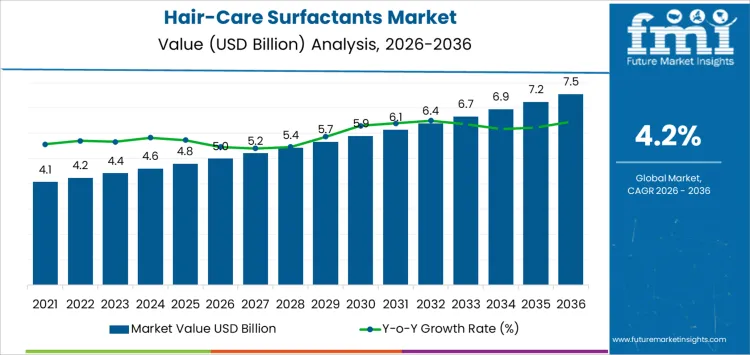
The hair-care surfactants market is expected to grow from USD 5 billion in 2026 to USD 7.5 billion by 2036, reflecting a compound annual growth rate (CAGR) of 4.2%. Surfactants are key ingredients in hair care products such as shampoos, conditioners, and styling products, as they help to cleanse, emulsify, and provide the desired texture to hair. The increasing demand for hair care products that cater to different hair types and concerns, along with the growing awareness of ingredient transparency, is driving the adoption of hair-care surfactants. Furthermore, the demand for natural and organic ingredients in personal care products is also encouraging innovation in surfactants, contributing to market growth.
The market growth is also supported by the expansion of the global beauty and personal care industry, which continues to innovate and diversify its product offerings. As consumers increasingly seek products that are effective yet gentle, manufacturers are developing more advanced surfactants that provide better cleansing power while being milder on the scalp and hair. The rising popularity of multifunctional hair-care products is expected to further drive the adoption of hair-care surfactants, positioning the market for steady expansion in the coming years.
Quick Stats of the Hair-Care Surfactants Market
- Hair-Care Surfactants Market Value (2026): USD 5 billion
- Hair-Care Surfactants Market Forecast Value (2036): USD 7.5 billion
- Hair-Care Surfactants Market Global Forecast CAGR (2026-2036): 4.2%
- Hair-Care Surfactants Market Leading Segment: Application (Shampoo) 52%
- Key Growth Regions in Hair-Care Surfactants Market: North America and Asia Pacific
- Top Players in Hair-Care Surfactants Market: BASF, Kao Corporation, Evonik, Stepan, Nouryon, Croda, Clariant, Solvay, Dow, Galaxy Surfactants
What is the Growth Forecast for the Hair-Care Surfactants Market through 2036?
The absolute dollar opportunity for the hair-care surfactants market highlights consistent growth in both volume and value over the forecast period. Starting at USD 5 billion in 2026, the market grows to USD 5.2 billion in 2027 and USD 5.4 billion in 2028, reflecting gradual increases in adoption and demand. These early years indicate steady growth driven by ongoing consumer interest in innovative hair-care products and surfactants that address a variety of hair concerns.
From 2028 to 2030, the market experiences moderate expansion, reaching USD 5.6 billion in 2029 and USD 5.9 billion in 2030. The growth in these years is attributed to the continued demand for advanced surfactant-based products, particularly those made with natural or gentle ingredients. Between 2030 and 2035, the market sees a stronger rise, reaching USD 6.1 billion in 2031, USD 6.4 billion in 2032, and USD 6.6 billion in 2033. By 2035, the market is projected to reach USD 6.9 billion, with the final market value of USD 7.5 billion expected in 2036. The absolute dollar opportunity indicates steady growth across the years, driven by both increased consumer demand and innovations in surfactant formulations.
Hair-Care Surfactants Market Key Takeaways
| Metric | Value |
|---|---|
| Industry Sales Value (2026) | USD 5 billion |
| Industry Forecast Value (2036) | USD 7.5 billion |
| Industry Forecast CAGR (2026-2036) | 4.2% |
What Is Driving the Demand for the Hair Care Surfactants Market Globally?
The global demand for hair care surfactants is being driven by sustained growth in the personal care and beauty sector, increasing consumer focus on hair health, and rising interest in multifunctional hair care products. Surfactants are key ingredients in shampoos, conditioners, cleansers, and styling products, where they perform cleansing, foaming, emulsifying, and conditioning functions. As urbanisation and disposable income rise in Asia Pacific, Latin America, and Middle East regions, more consumers are purchasing formulated hair care products that promise gentle cleansing, scalp health benefits, and improved manageability.
In mature markets such as Europe and North America, demand is also shaped by trends toward premium, targeted solutions that address specific concerns such as dandruff, dryness, colour protection, and hair loss. Personalisation of hair care regimens is increasing interest in surfactants that are mild, sulfate free, or tailored to sensitive scalps and specific hair types. Brands respond by formulating with advanced surfactant systems that deliver desired sensory properties-rich lather, silkiness, and minimal irritation-while supporting performance claims. Growing awareness of ingredient safety, biodegradability, and sustainability further influences surfactant selection, with many manufacturers seeking naturally derived or readily biodegradable options to meet consumer expectations and regulatory requirements.
Future demand for hair care surfactants is expected to expand as innovation in formulation technology and changing consumer behaviour continue to evolve the market. Advances in green chemistry and biotechnology are making bio based surfactants more accessible, enabling manufacturers to reduce reliance on traditional petrochemical derived materials and meet sustainability commitments. Hair care products incorporating mild, amphoteric, and conditioning surfactants that support scalp microbiome balance and gentler cleansing are likely to gain traction, particularly among health and environment conscious consumers.
The proliferation of multi format products-such as 2 in 1 shampoo/conditioners, co washes, and leave in treatments-will sustain demand for versatile surfactant systems capable of delivering multiple functionalities in a single formulation. Digital and social media influence in beauty and grooming trends will continue to drive demand for innovative hair care products with differentiated sensory profiles and performance benefits, reinforcing the role of surfactants as foundational ingredients in new product development. Regulatory focus on ingredient transparency and safety, along with increased distribution through e commerce channels, will further shape how surfactants are formulated and marketed. As global hair care consumption patterns evolve, demand for advanced, sustainable surfactant systems is expected to grow steadily across regions.
What are the Leading Segments in the Global Hair-Care Surfactants Market?
The global hair-care surfactants market is divided into two main segments: product format and application. Among the product formats, liquid concentrates hold the largest market share, primarily due to their ease of use and versatility in various hair-care products. Other product formats, such as pastes, powders/flakes, and pre-blends/systems, are also part of the market but account for smaller shares. On the application side, shampoo is the dominant category, followed by significant demand in conditioners/2-in-1 products, scalp care & anti-dandruff treatments, and co-wash/cleansing conditioners. The demand for effective, mild, and functional surfactants in hair-care products continues to drive growth across both segments, as consumer preferences evolve toward cleaner, more sustainable formulations.
What Drives the Growth of Liquid Concentrates in the Hair-Care Surfactants Market?
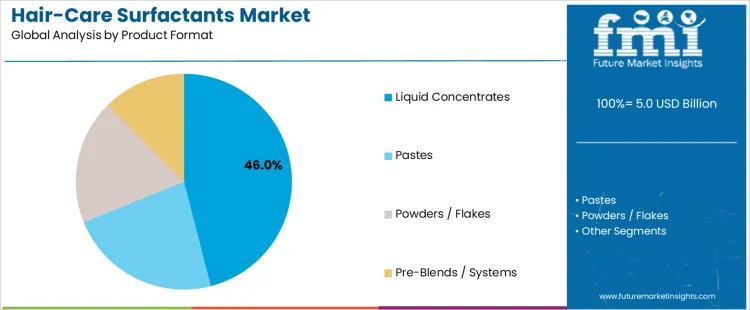
Liquid concentrates dominate the hair-care surfactants market, accounting for the largest share of the product format segment. This is due to their high efficiency, ease of formulation, and versatility in a wide range of hair-care products, including shampoos, conditioners, and specialty treatments. Liquid concentrates offer the advantage of being highly concentrated, allowing manufacturers to provide products with higher performance and functionality while reducing the need for additional ingredients. This makes liquid concentrates particularly suitable for consumer preferences, which demand high-quality, effective products with fewer added chemicals. The growing focus on sustainability and clean formulations has also supported the demand for liquid concentrates, as they can deliver more effective performance with lower environmental impact. In addition, their compatibility with a wide array of hair-care applications, such as scalp care, anti-dandruff treatments, and co-washes, contributes to their market dominance. Liquid concentrates offer excellent solubility and compatibility with other ingredients, making them ideal for creating smooth, consistent formulations in a variety of product types. The growing preference for mild, gentle hair-care products further supports the continued growth of liquid concentrates, as these ingredients can effectively clean the hair without causing irritation. As consumer demand for functional, high-performance hair-care products rises, liquid concentrates are expected to remain a key driver of growth in the hair-care surfactants market.
What is Driving the Demand for Shampoo in the Hair-Care Surfactants Market?
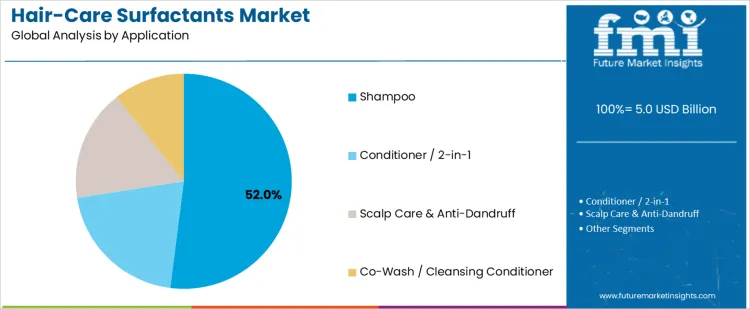
Shampoo is the leading application in the hair-care surfactants market, driven by its widespread use and the increasing demand for products that cater to various hair types and concerns. Surfactants are key ingredients in shampoo formulations, as they effectively cleanse the scalp and hair while maintaining product stability and performance. The growing consumer interest in shampoo products that offer not only cleaning but also additional benefits such as moisturizing, anti-dandruff, and strengthening properties has fueled the demand for advanced surfactant formulations. As the market continues to evolve, shampoos are increasingly being designed to cater to specific hair-care needs, with many consumers seeking products that promote scalp health, prevent hair damage, or address concerns like thinning hair or dryness. The shift toward natural and gentle ingredients has also driven innovation in shampoo formulations, with surfactants derived from renewable resources or designed to be milder and less harsh on the scalp. Furthermore, the growing preference for sulfate-free shampoos, driven by increased awareness of scalp health, has led to the development of new, more gentle surfactants that effectively cleanse without stripping the hair of its natural oils. As shampoo remains an essential and everyday product for consumers worldwide, its dominant position in the hair-care surfactants market is expected to continue, driven by product innovation, evolving consumer preferences, and increased focus on hair health.
What are the Key Dynamics of the Global Hair Care Surfactants Market?
The global hair care surfactants market is expanding as personal care brands innovate with cleansing, conditioning and multifunctional formulations. Surfactants lower surface tension to help remove sebum, dirt and styling products while supporting foam formation and texture. Growth is linked to rising consumer demand for sulfate free, mild and sustainable ingredients in shampoos, conditioners and scalp treatments. Expansion of e commerce channels and premiumization of hair care products encourage brands to differentiate through performance and sensory experiences. Adoption spans developed and emerging markets as consumers seek effective and gentle cleansing solutions.
What are the Key Drivers for the Global Hair Care Surfactants Market?
One primary driver is rising awareness of scalp and hair health, which motivates consumers to choose products formulated with advanced surfactants that balance cleansing with gentleness. Demand for sulfate free, mild and biodegradable surfactants is increasing as users look for products suitable for sensitive scalps and colored or treated hair. Growth in personal grooming, male grooming and premium hair care segments supports broader use of specialized surfactant systems. Innovation in green chemistry and plant derived surfactants meets consumer interest in sustainable, renewable ingredients. Expansion of hair care categories and targeted solutions for dandruff, dryness or oil control continues to stimulate demand worldwide.
What are the Restraints for the Global Hair Care Surfactants Market?
One challenge is the high cost of specialty and green surfactants compared with conventional options, which can limit adoption among cost sensitive manufacturers or brands targeting entry level price points. Reformulating products to incorporate novel surfactants often requires technical expertise, testing and stability evaluation, increasing development time and expense. Variability in raw material supply and pricing for natural or bio based surfactants affects consistency and cost planning. Regulatory restrictions on certain surfactant classes in specific regions require careful compliance and may delay product launches. Consumer skepticism about performance of alternative surfactants compared to traditional formulas can slow uptake in some markets.
What is the Key Trends in the Global Hair Care Surfactants Market?
A key trend is growth in mild, low irritation and eco certified surfactants that align with clean and sustainable product positioning. Demand for plant based and biodegradable surfactants is rising, supported by innovation in novel chemistries such as amino acid based, sugar derived and alkyl polyglucoside systems. Brands are integrating multifunctional surfactants that deliver cleansing, conditioning and foam stability in a single ingredient to streamline formulations. Use of digital formulation tools and in silico screening accelerates selection of surfactants that meet targeted performance and sensory profiles. Collaboration between suppliers and hair care brands focuses on tailored surfactant blends that address specific hair types and consumer preferences.
What is the Country-Wise Analysis of the Hair-Care Surfactants Market?
The hair-care surfactants market is projected to grow steadily, driven by increasing consumer demand for high-performance and eco-friendly hair-care products. Surfactants are key ingredients in shampoos, conditioners, and other hair-care formulations, providing essential functions such as cleansing, foaming, and emulsifying. As consumers become more conscious of ingredient safety and environmental impact, there is growing interest in sustainable and mild surfactants. High-growth regions like China and the USA are leading the market due to their large consumer bases and increasing focus on personal care. Meanwhile, markets in the UK, Germany, and Japan are seeing moderate growth, driven by strong consumer demand for premium and effective hair-care solutions.
| Country | CAGR (2026-2036) |
|---|---|
| China | 5.2% |
| United States | 4% |
| United Kingdom | 3.6% |
| Germany | 3.6% |
| Japan | 3.3% |
What is the Growth Outlook for the Hair-Care Surfactants Market in China?
The hair-care surfactants market in China is expected to grow at the highest rate, with a projected CAGR of 5.2%. China’s rapidly expanding beauty and personal care industry, along with its growing middle class and increasing demand for high-quality hair-care products, is driving the demand for surfactants. The country’s large consumer base is increasingly seeking mild and eco-friendly ingredients in their hair-care products, which is contributing to the rise in demand for sustainable surfactants. Additionally, China’s shift toward more premium and innovative hair-care formulations is expected to further drive the growth of the market for surfactants.
What is the Market Outlook for the Hair-Care Surfactants Market in the United States?
The hair-care surfactants market in the United States is expected to grow at a moderate pace, with a projected CAGR of 4%. The U.S. market is driven by strong consumer demand for premium and high-performance hair-care products. As consumers increasingly prioritize sustainability and safety, there is a growing preference for surfactants that are mild, effective, and eco-friendly. The focus on clean beauty and safer formulations is driving the market for hair-care surfactants, with manufacturers focusing on ingredient transparency and environmental responsibility. As the demand for sustainable and gentle hair-care solutions continues to rise, the U.S. market for hair-care surfactants is expected to experience steady growth.
What is the Growth Forecast for the Hair-Care Surfactants Market in the United Kingdom?
The hair-care surfactants market in the United Kingdom is expected to grow at a moderate pace, with a projected CAGR of 3.6%. The UK’s well-established beauty and personal care sector is experiencing increased demand for hair-care products that offer both performance and sustainability. As UK consumers become more aware of the environmental and health impacts of ingredients in personal care products, the demand for eco-friendly and safe surfactants is growing. The increasing trend towards natural and clean beauty products is driving the market for hair-care surfactants in the UK, and as the focus on product safety and sustainability continues to rise, the market is expected to grow steadily.
What is the Market Outlook for the Hair-Care Surfactants Market in Germany?
The hair-care surfactants market in Germany is projected to grow at a steady rate, with a projected CAGR of 3.6%. Germany’s strong consumer preference for high-quality, sustainable, and eco-conscious personal care products is driving demand for hair-care surfactants. The market is witnessing a shift toward the use of milder, plant-based surfactants in hair-care formulations, as consumers become increasingly concerned about the impact of traditional surfactants on the environment and their health. As Germany continues to prioritize sustainability and ingredient transparency, the demand for safe and effective surfactants in hair-care products is expected to continue growing at a steady pace.
What are the Growth Prospects for the Hair-Care Surfactants Market in Japan?
The hair-care surfactants market in Japan is expected to grow at a moderate pace, with a projected CAGR of 3.3%. Japan’s well-established hair-care and personal care industry is evolving with a growing preference for premium, effective, and eco-friendly products. Consumers in Japan are increasingly seeking products that are not only effective but also align with their values of sustainability and ingredient safety. The rising demand for milder and more natural surfactants in hair-care formulations is driving market growth. As Japan’s focus on innovation and sustainability in personal care continues, the market for hair-care surfactants is expected to grow steadily, though at a slightly slower pace compared to other regions.
What is the Competitive Landscape for the Hair-Care Surfactants Market?
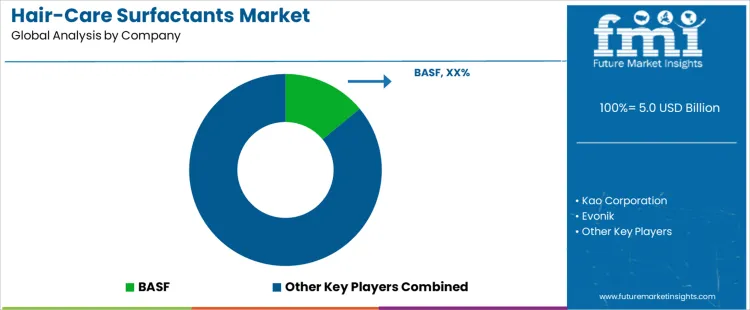
The hair-care surfactants market is expanding as consumers increasingly demand products that offer effective cleansing, conditioning, and sustainability. BASF leads the market with its wide range of innovative surfactants designed to improve hair care formulations, focusing on high performance and environmental sustainability. Their extensive portfolio and commitment to research and development position them as a dominant player. Kao Corporation, Evonik, and Stepan are major competitors, each offering specialized surfactants that cater to the growing demand for mild, effective, and eco-friendly ingredients in hair-care products. Kao Corporation focuses on creating surfactants that enhance both product performance and consumer safety, while Evonik and Stepan provide a variety of functional surfactants for a broad range of applications in hair care.
Nouryon, Croda, Clariant, Solvay, Dow, and Galaxy Surfactants further contribute to the competitive dynamics by offering tailored solutions in hair-care surfactants. Nouryon focuses on providing sustainable surfactants with exceptional performance in personal care, while Croda and Clariant offer high-quality, eco-conscious surfactants designed to meet the needs of natural and premium hair-care formulations. Solvay and Dow bring advanced surfactant technologies that improve cleansing, foaming, and conditioning properties in hair-care products. Galaxy Surfactants delivers specialized surfactants for both mass-market and premium hair-care brands. These companies compete through innovations in formulation, sustainability, and the ability to meet the diverse needs of the modern hair-care market.
Key Players of the Hair-Care Surfactants Market
- BASF
- Kao Corporation
- Evonik
- Stepan
- Nouryon
- Croda
- Clariant
- Solvay
- Dow
- Galaxy Surfactants
Scope of the Report
| Items | Values |
|---|---|
| Quantitative Units (2026) | USD Billion |
| Surfactant Class | Anionic (Sulfates, Sulfonates), Amphoteric / Zwitterionic, Nonionic, Cationic (Conditioning Surfactants) |
| Product Format | Liquid Concentrates, Pastes, Powders / Flakes, Pre-Blends / Systems |
| Application | Shampoo, Conditioner / 2-in-1, Scalp Care & Anti-Dandruff, Co-Wash / Cleansing Conditioner |
| Positioning / Claim | Sulfate-Free Systems, Mild / Sensitive Scalp, Bio-Based / Naturally Derived, High-Foam / Sensory |
| Companies | BASF, Kao Corporation, Evonik, Stepan, Nouryon, Croda, Clariant, Solvay, Dow, Galaxy Surfactants |
| Regions Covered | North America, Latin America, Western Europe, Eastern Europe, South Asia and Pacific, East Asia, Middle East & Africa |
| Countries Covered | United States, Canada, Mexico, Brazil, Argentina, Germany, France, United Kingdom, Italy, Spain, Netherlands, China, India, Japan, South Korea, ANZ, GCC Countries, South Africa |
| Additional Attributes | Dollar by sales by surfactant class, product format, application, positioning/claim, and region. Includes market trends in hair-care surfactants, focusing on anionic, amphoteric, nonionic, and cationic surfactants. Highlights the role of sulfate-free systems, mild/sensitive scalp care, and bio-based/naturally derived claims in applications like shampoo, conditioner, and scalp care. Focus on cost-effectiveness, sustainability, market share, and competitive positioning of key companies in the hair-care surfactants market. |
Hair-Care Surfactants Market Segmentation
Surfactant Class
- Anionic (sulfates, sulfonates)
- Amphoteric / Zwitterionic
- Nonionic
- Cationic (conditioning surfactants)
Product Format
- Liquid Concentrates
- Pastes
- Powders / Flakes
- Pre-Blends / Systems
Application
- Shampoo
- Conditioner / 2-in-1
- Scalp Care & Anti-Dandruff
- Co-Wash / Cleansing Conditioner
Positioning / Claim
- Sulfate-Free Systems
- Mild / Sensitive Scalp
- Bio-Based / Naturally Derived
- High-Foam / Sensory
Region
- Asia Pacific
- China
- Japan
- South Korea
- India
- Australia & New Zealand
- ASEAN
- Rest of Asia Pacific
- Europe
- Germany
- United Kingdom
- France
- Italy
- Spain
- Nordic
- BENELUX
- Rest of Europe
- North America
- United States
- Canada
- Mexico
- Latin America
- Brazil
- Chile
- Rest of Latin America
- Middle East & Africa
- Kingdom of Saudi Arabia
- Other GCC Countries
- Turkey
- South Africa
- Other African Union
- Rest of Middle East & Africa
Frequently Asked Questions
How big is the hair-care surfactants market in 2026?
The global hair-care surfactants market is estimated to be valued at USD 5.0 billion in 2026.
What will be the size of hair-care surfactants market in 2036?
The market size for the hair-care surfactants market is projected to reach USD 7.5 billion by 2036.
How much will be the hair-care surfactants market growth between 2026 and 2036?
The hair-care surfactants market is expected to grow at a 4.2% CAGR between 2026 and 2036.
What are the key product types in the hair-care surfactants market?
The key product types in hair-care surfactants market are anionic (sulfates, sulfonates), amphoteric / zwitterionic, nonionic and cationic (conditioning surfactants).
Which product format segment to contribute significant share in the hair-care surfactants market in 2026?
In terms of product format, liquid concentrates segment to command 46.0% share in the hair-care surfactants market in 2026.
Preview the report firsthand - request a free sample
Get SampleGet the brochure for pricing and purchase details.
Get PDFTable of Content
- Executive Summary
- Global Market Outlook
- Demand-side Trends
- Supply-side Trends
- Technology Roadmap Analysis
- Analysis and Recommendations
- Market Overview
- Market Coverage / Taxonomy
- Market Definition / Scope / Limitations
- Market Background
- Market Dynamics
- Drivers
- Restraints
- Opportunity
- Trends
- Scenario Forecast
- Demand in Optimistic Scenario
- Demand in Likely Scenario
- Demand in Conservative Scenario
- Opportunity Map Analysis
- Product Life Cycle Analysis
- Supply Chain Analysis
- Investment Feasibility Matrix
- Value Chain Analysis
- PESTLE and Porter’s Analysis
- Regulatory Landscape
- Regional Parent Market Outlook
- Production and Consumption Statistics
- Import and Export Statistics
- Market Dynamics
- Global Market Analysis 2021 to 2025 and Forecast, 2026 to 2036
- Historical Market Size Value (USD Million) Analysis, 2021 to 2025
- Current and Future Market Size Value (USD Million) Projections, 2026 to 2036
- Y-o-Y Growth Trend Analysis
- Absolute $ Opportunity Analysis
- Global Market Pricing Analysis 2021 to 2025 and Forecast 2026 to 2036
- Global Market Analysis 2021 to 2025 and Forecast 2026 to 2036, By Surfactant Class
- Introduction / Key Findings
- Historical Market Size Value (USD Million) Analysis By Surfactant Class , 2021 to 2025
- Current and Future Market Size Value (USD Million) Analysis and Forecast By Surfactant Class , 2026 to 2036
- Anionic (sulfates, sulfonates)
- Amphoteric / Zwitterionic
- Nonionic
- Cationic (conditioning surfactants)
- Y-o-Y Growth Trend Analysis By Surfactant Class , 2021 to 2025
- Absolute $ Opportunity Analysis By Surfactant Class , 2026 to 2036
- Global Market Analysis 2021 to 2025 and Forecast 2026 to 2036, By Product Format
- Introduction / Key Findings
- Historical Market Size Value (USD Million) Analysis By Product Format, 2021 to 2025
- Current and Future Market Size Value (USD Million) Analysis and Forecast By Product Format, 2026 to 2036
- Liquid Concentrates
- Pastes
- Powders / Flakes
- Pre-Blends / Systems
- Y-o-Y Growth Trend Analysis By Product Format, 2021 to 2025
- Absolute $ Opportunity Analysis By Product Format, 2026 to 2036
- Global Market Analysis 2021 to 2025 and Forecast 2026 to 2036, By Application
- Introduction / Key Findings
- Historical Market Size Value (USD Million) Analysis By Application, 2021 to 2025
- Current and Future Market Size Value (USD Million) Analysis and Forecast By Application, 2026 to 2036
- Shampoo
- Conditioner / 2-in-1
- Scalp Care & Anti-Dandruff
- Co-Wash / Cleansing Conditioner
- Y-o-Y Growth Trend Analysis By Application, 2021 to 2025
- Absolute $ Opportunity Analysis By Application, 2026 to 2036
- Global Market Analysis 2021 to 2025 and Forecast 2026 to 2036, By Positioning
- Introduction / Key Findings
- Historical Market Size Value (USD Million) Analysis By Positioning, 2021 to 2025
- Current and Future Market Size Value (USD Million) Analysis and Forecast By Positioning, 2026 to 2036
- Sulfate-Free Systems
- Mild / Sensitive Scalp
- Bio-Based / Naturally Derived
- High-Foam / Sensory
- Y-o-Y Growth Trend Analysis By Positioning, 2021 to 2025
- Absolute $ Opportunity Analysis By Positioning, 2026 to 2036
- Global Market Analysis 2021 to 2025 and Forecast 2026 to 2036, By Region
- Introduction
- Historical Market Size Value (USD Million) Analysis By Region, 2021 to 2025
- Current Market Size Value (USD Million) Analysis and Forecast By Region, 2026 to 2036
- North America
- Latin America
- Western Europe
- Eastern Europe
- East Asia
- South Asia and Pacific
- Middle East & Africa
- Market Attractiveness Analysis By Region
- North America Market Analysis 2021 to 2025 and Forecast 2026 to 2036, By Country
- Historical Market Size Value (USD Million) Trend Analysis By Market Taxonomy, 2021 to 2025
- Market Size Value (USD Million) Forecast By Market Taxonomy, 2026 to 2036
- By Country
- USA
- Canada
- Mexico
- By Surfactant Class
- By Product Format
- By Application
- By Positioning
- By Country
- Market Attractiveness Analysis
- By Country
- By Surfactant Class
- By Product Format
- By Application
- By Positioning
- Key Takeaways
- Latin America Market Analysis 2021 to 2025 and Forecast 2026 to 2036, By Country
- Historical Market Size Value (USD Million) Trend Analysis By Market Taxonomy, 2021 to 2025
- Market Size Value (USD Million) Forecast By Market Taxonomy, 2026 to 2036
- By Country
- Brazil
- Chile
- Rest of Latin America
- By Surfactant Class
- By Product Format
- By Application
- By Positioning
- By Country
- Market Attractiveness Analysis
- By Country
- By Surfactant Class
- By Product Format
- By Application
- By Positioning
- Key Takeaways
- Western Europe Market Analysis 2021 to 2025 and Forecast 2026 to 2036, By Country
- Historical Market Size Value (USD Million) Trend Analysis By Market Taxonomy, 2021 to 2025
- Market Size Value (USD Million) Forecast By Market Taxonomy, 2026 to 2036
- By Country
- Germany
- UK
- Italy
- Spain
- France
- Nordic
- BENELUX
- Rest of Western Europe
- By Surfactant Class
- By Product Format
- By Application
- By Positioning
- By Country
- Market Attractiveness Analysis
- By Country
- By Surfactant Class
- By Product Format
- By Application
- By Positioning
- Key Takeaways
- Eastern Europe Market Analysis 2021 to 2025 and Forecast 2026 to 2036, By Country
- Historical Market Size Value (USD Million) Trend Analysis By Market Taxonomy, 2021 to 2025
- Market Size Value (USD Million) Forecast By Market Taxonomy, 2026 to 2036
- By Country
- Russia
- Poland
- Hungary
- Balkan & Baltic
- Rest of Eastern Europe
- By Surfactant Class
- By Product Format
- By Application
- By Positioning
- By Country
- Market Attractiveness Analysis
- By Country
- By Surfactant Class
- By Product Format
- By Application
- By Positioning
- Key Takeaways
- East Asia Market Analysis 2021 to 2025 and Forecast 2026 to 2036, By Country
- Historical Market Size Value (USD Million) Trend Analysis By Market Taxonomy, 2021 to 2025
- Market Size Value (USD Million) Forecast By Market Taxonomy, 2026 to 2036
- By Country
- China
- Japan
- South Korea
- By Surfactant Class
- By Product Format
- By Application
- By Positioning
- By Country
- Market Attractiveness Analysis
- By Country
- By Surfactant Class
- By Product Format
- By Application
- By Positioning
- Key Takeaways
- South Asia and Pacific Market Analysis 2021 to 2025 and Forecast 2026 to 2036, By Country
- Historical Market Size Value (USD Million) Trend Analysis By Market Taxonomy, 2021 to 2025
- Market Size Value (USD Million) Forecast By Market Taxonomy, 2026 to 2036
- By Country
- India
- ASEAN
- Australia & New Zealand
- Rest of South Asia and Pacific
- By Surfactant Class
- By Product Format
- By Application
- By Positioning
- By Country
- Market Attractiveness Analysis
- By Country
- By Surfactant Class
- By Product Format
- By Application
- By Positioning
- Key Takeaways
- Middle East & Africa Market Analysis 2021 to 2025 and Forecast 2026 to 2036, By Country
- Historical Market Size Value (USD Million) Trend Analysis By Market Taxonomy, 2021 to 2025
- Market Size Value (USD Million) Forecast By Market Taxonomy, 2026 to 2036
- By Country
- Kingdom of Saudi Arabia
- Other GCC Countries
- Turkiye
- South Africa
- Other African Union
- Rest of Middle East & Africa
- By Surfactant Class
- By Product Format
- By Application
- By Positioning
- By Country
- Market Attractiveness Analysis
- By Country
- By Surfactant Class
- By Product Format
- By Application
- By Positioning
- Key Takeaways
- Key Countries Market Analysis
- USA
- Pricing Analysis
- Market Share Analysis, 2025
- By Surfactant Class
- By Product Format
- By Application
- By Positioning
- Canada
- Pricing Analysis
- Market Share Analysis, 2025
- By Surfactant Class
- By Product Format
- By Application
- By Positioning
- Mexico
- Pricing Analysis
- Market Share Analysis, 2025
- By Surfactant Class
- By Product Format
- By Application
- By Positioning
- Brazil
- Pricing Analysis
- Market Share Analysis, 2025
- By Surfactant Class
- By Product Format
- By Application
- By Positioning
- Chile
- Pricing Analysis
- Market Share Analysis, 2025
- By Surfactant Class
- By Product Format
- By Application
- By Positioning
- Germany
- Pricing Analysis
- Market Share Analysis, 2025
- By Surfactant Class
- By Product Format
- By Application
- By Positioning
- UK
- Pricing Analysis
- Market Share Analysis, 2025
- By Surfactant Class
- By Product Format
- By Application
- By Positioning
- Italy
- Pricing Analysis
- Market Share Analysis, 2025
- By Surfactant Class
- By Product Format
- By Application
- By Positioning
- Spain
- Pricing Analysis
- Market Share Analysis, 2025
- By Surfactant Class
- By Product Format
- By Application
- By Positioning
- France
- Pricing Analysis
- Market Share Analysis, 2025
- By Surfactant Class
- By Product Format
- By Application
- By Positioning
- India
- Pricing Analysis
- Market Share Analysis, 2025
- By Surfactant Class
- By Product Format
- By Application
- By Positioning
- ASEAN
- Pricing Analysis
- Market Share Analysis, 2025
- By Surfactant Class
- By Product Format
- By Application
- By Positioning
- Australia & New Zealand
- Pricing Analysis
- Market Share Analysis, 2025
- By Surfactant Class
- By Product Format
- By Application
- By Positioning
- China
- Pricing Analysis
- Market Share Analysis, 2025
- By Surfactant Class
- By Product Format
- By Application
- By Positioning
- Japan
- Pricing Analysis
- Market Share Analysis, 2025
- By Surfactant Class
- By Product Format
- By Application
- By Positioning
- South Korea
- Pricing Analysis
- Market Share Analysis, 2025
- By Surfactant Class
- By Product Format
- By Application
- By Positioning
- Russia
- Pricing Analysis
- Market Share Analysis, 2025
- By Surfactant Class
- By Product Format
- By Application
- By Positioning
- Poland
- Pricing Analysis
- Market Share Analysis, 2025
- By Surfactant Class
- By Product Format
- By Application
- By Positioning
- Hungary
- Pricing Analysis
- Market Share Analysis, 2025
- By Surfactant Class
- By Product Format
- By Application
- By Positioning
- Kingdom of Saudi Arabia
- Pricing Analysis
- Market Share Analysis, 2025
- By Surfactant Class
- By Product Format
- By Application
- By Positioning
- Turkiye
- Pricing Analysis
- Market Share Analysis, 2025
- By Surfactant Class
- By Product Format
- By Application
- By Positioning
- South Africa
- Pricing Analysis
- Market Share Analysis, 2025
- By Surfactant Class
- By Product Format
- By Application
- By Positioning
- USA
- Market Structure Analysis
- Competition Dashboard
- Competition Benchmarking
- Market Share Analysis of Top Players
- By Regional
- By Surfactant Class
- By Product Format
- By Application
- By Positioning
- Competition Analysis
- Competition Deep Dive
- BASF
- Overview
- Product Portfolio
- Profitability by Market Segments (Product/Age /Sales Channel/Region)
- Sales Footprint
- Strategy Overview
- Marketing Strategy
- Product Strategy
- Channel Strategy
- Kao Corporation
- Evonik
- Stepan
- Nouryon
- Croda
- Clariant
- Solvay
- Dow
- Galaxy Surfactants
- BASF
- Competition Deep Dive
- Assumptions & Acronyms Used
- Research Methodology


