

- Industry Size (2026)
- USD 3.3 Bn
- Forecast (2036)
- USD 5.0 Bn
- CAGR (2026 to 2036)
- 4.20%
Low Foaming Surfactants Market Forecast and Outlook 2026 to 2036
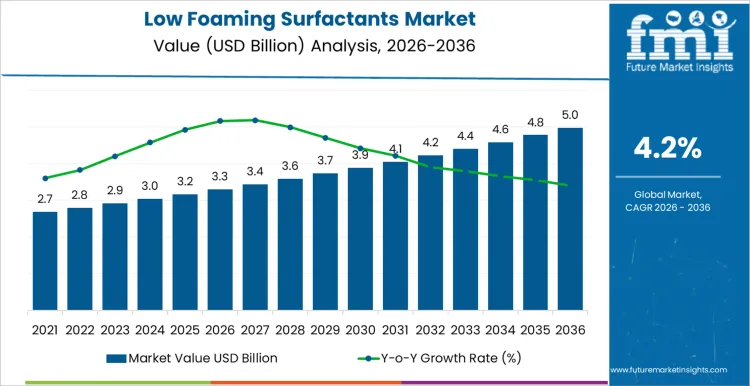
The low foaming surfactants market is estimated at USD 3.3 billion in 2026 and is forecast to reach USD 5.0 billion by 2036, at a CAGR of 4.20%. Market performance is shaped primarily by process reliability requirements rather than discretionary demand growth. Consumption is closely tied to automate and closed-loop cleaning systems where foam control directly affects uptime, throughput, and operating cost. Buyers exhibit moderate risk aversion, favoring proven formulations with predictable behavior across temperature, pH, and water-hardness conditions. Switching costs are non-trivial, as changes in surfactant chemistry can disrupt validated cleaning protocols and equipment calibration. Pricing discipline is maintained through long-term supply agreements and standardized formulations rather than spot purchasing. Supplier leverage is derived from formulation know-how and application support rather than scale alone. Volume visibility is relatively stable due to recurring industrial cleaning cycles, but upside is capped by incremental adoption rather than rapid substitution. Growth reflects steady integration into efficiency-driven processes rather than aggressive market expansion.
Quick Stats for Low Foaming Surfactants Market
- Low Foaming Surfactants Market Value (2026): USD 3.3 Billion
- Low Foaming Surfactants Market Forecast Value (2036): USD 5.0 Billion
- Low Foaming Surfactants Market Forecast CAGR 2026 to 2036: 4.20%
- Leading Chemistry in Low Foaming Surfactants Market: Nonionic EO or PO Block Surfactants (44% share)
- Key Growth Regions in Low Foaming Surfactants Market: Asia Pacific, Europe, North America, Latin America, Middle East & Africa
- Top Key Players in Low Foaming Surfactants Market: BASF SE, Dow Chemical Company, Evonik Industries AG, Clariant AG, Solvay SA, Croda International Plc, Stepan Company, Nouryon, Huntsman Corporation, Kao Corporation
Low Foaming Surfactants Market Key Takeaways
| Metric | Value |
|---|---|
| Low Foaming Surfactants Market Value (2026) | USD 3.3 Billion |
| Low Foaming Surfactants Market Forecast Value (2036) | USD 5.0 Billion |
| Low Foaming Surfactants Market Forecast CAGR 2026 to 2036 | 4.20% |
How are Process Efficiency Requirements and Automated Cleaning Systems Driving the Low Foaming Surfactants Market?
The low foaming surfactants market is expanding as industrial and institutional users prioritize cleaning efficiency in high-speed, automated processes. Excess foam can disrupt pumps, sensors, and spray systems, leading to downtime and inconsistent results. Low foaming surfactants enable effective soil removal while maintaining stable operation in clean-in-place (CIP), clean-out-of-place (COP), bottle washing, and industrial parts cleaning systems. For formulators, performance is measured not by foam volume but by consistency and reliability under dynamic conditions.
Application specificity and formulation stability are central to purchasing decisions. End users evaluate low foaming surfactants based on wetting efficiency, detergency at low concentrations, and performance across wide temperature and water-hardness ranges. Compatibility with alkaline, acidic, and enzymatic systems is increasingly important in food & beverage processing, pharmaceuticals, and manufacturing. Suppliers that offer tailored surfactant chemistries such as EO/PO block copolymers and modified alcohol ethoxylates-are better positioned to meet diverse process requirements.
Scale deployment and regulatory alignment are further supporting market growth. As hygiene standards tighten and automation expands across industries, demand for low foaming formulations is rising in institutional cleaning, industrial maintenance, and specialty detergents. Sustainability considerations, including biodegradability and low aquatic toxicity, are also influencing surfactant selection. For producers, competitive advantage increasingly depends on formulation expertise, consistent supply, and application support positioning low foaming surfactants as a steady, efficiency-driven segment within the global surfactants market.
How is the Low Foaming Surfactants Market Structured by Chemistry and Application?
The low foaming surfactants market is segmented by chemistry and application, reflecting how control, cleaning efficiency, and process compatibility influence surfactant selection foam. By chemistry, nonionic EO or PO block surfactants represent the leading segment, as they provide controlled foam behavior across a wide temperature range. Other chemistries include low-foam ethoxylates, silicone-modified surfactants, and other low-foaming systems formulated for specialized cleaning environments. By application, industrial and institutional cleaning accounts for the largest demand, followed by food and beverage CIP/COP, metal cleaning and precision cleaning, and other applications where foam suppression is critical for process efficiency.
Why Do Nonionic EO Or PO Block Surfactants Lead Chemistry Adoption In The Low Foaming Surfactants Market?
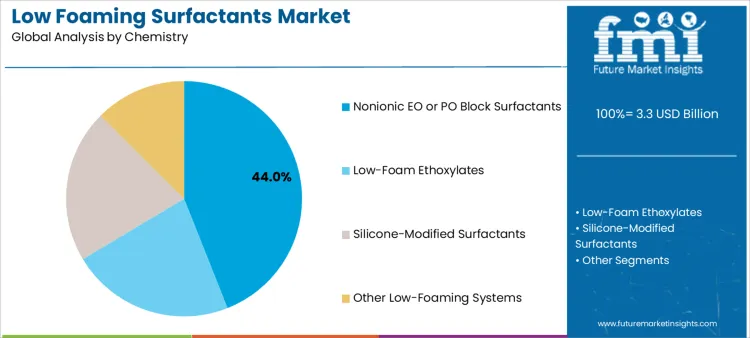
Nonionic EO or PO block surfactants account for 44% share of the low foaming surfactants market because they deliver effective detergency while maintaining stable, low-foam profiles. These surfactants are designed to suppress foam generation under agitation, high-pressure spraying, and elevated temperatures. Manufacturers favor EO/PO block structures due to their predictable cloud point behavior and compatibility with alkaline and acidic formulations. Their performance consistency across diverse cleaning systems supports adoption in automated processes. Broad formulation flexibility and reliable foam control explain why nonionic EO or PO block surfactants remain the dominant chemistry.
Why Does Industrial And Institutional Cleaning Dominate Application Demand In The Low Foaming Surfactants Market?
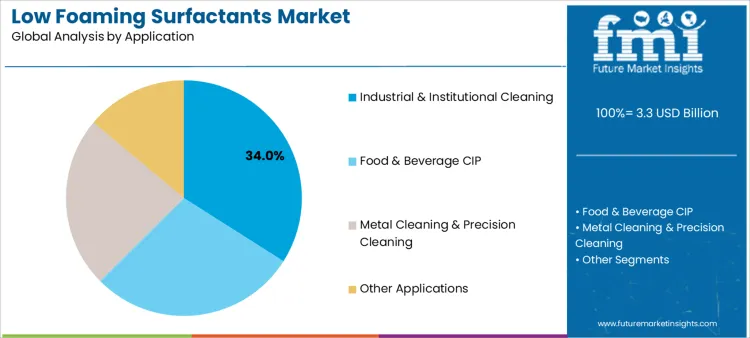
Industrial and institutional cleaning holds 34% share of the low foaming surfactants market because large-scale cleaning operations require efficient soil removal without excessive foam formation. Automated cleaning systems, floor scrubbers, and high-pressure washers depend on low-foam formulations to maintain productivity and avoid equipment downtime. Facilities prioritize cleaning agents that perform consistently across varying water hardness and temperatures. High cleaning frequency in factories, warehouses, healthcare facilities, and commercial buildings drives steady consumption. These operational efficiency and volume-driven requirements explain why industrial and institutional cleaning remains the leading application segment.
What are the Key Dynamics of the Low Foaming Surfactants Market?
The low foaming surfactants market is driven by demand for surfactants that deliver effective wetting, emulsification, dispersion, and cleaning without generating excessive foam in targeted applications. These surfactants are essential in industrial processes, metalworking fluids, cookware and dishwash formulations, agricultural adjuvants, oilfield chemicals, and certain personal care and institutional cleaning products where foam can impede process efficiency, interfere with equipment operation, or compromise performance. For chemical suppliers and formulators, foam control performance, compatibility with other formulation components, environmental and regulatory compliance, and cost effectiveness are key factors guiding selection and long-term adoption.
Why do Technical, Compatibility, and Regulatory Challenges Restrain Market Growth?
Technical, compatibility, and regulatory challenges restrain growth in the low foaming surfactants market because achieving targeted low foam levels while maintaining desired functional performance can be complex. Some low foaming surfactants may have limited wetting, emulsification, or detergency compared with higher foam counterparts, requiring careful formulation balance and additional optimization effort. Compatibility with other formulation ingredients such as solvents, builders, polymers, and additives must be validated to avoid stability issues or unexpected interaction effects. Regulatory frameworks especially in industrial, agricultural, and institutional sectors demand surfactants meet environmental and safety criteria, including biodegradability and aquatic toxicity standards, which can narrow formulation options or increase development cost and time.
What Opportunities are emerging for Suppliers and End Users?
Opportunities in the low foaming surfactants market are emerging with specialty performance demands, formulation innovation, and process-driven application growth. Suppliers can differentiate by offering engineered surfactant blends and tailored additive systems that deliver consistent low foam performance while addressing specific functionality such as corrosion inhibition, enhanced wetting, or temperature stability. Collaboration with industrial OEMs and formulators to co-develop application-specific solutions accelerates adoption and reduces qualification cycles. Expansion in sectors such as automatic industrial cleaning, high-speed manufacturing, precision agriculture, and water treatment increases demand for low foam chemistries. Surfactants that support eco-friendly profiles and meet evolving regulatory criteria strengthen positioning in markets where sustainable performance is increasingly valued.
How the Low Foaming Surfactants Is Market Growing Across Key Countries?
The low foaming surfactants market is expanding steadily as industrial and institutional users seek effective cleaning, wetting, and emulsification performance without excessive foam generation. These surfactants are widely used in industrial cleaners, food & beverage processing, textile processing, agrochemicals, coatings, and automated cleaning systems where foam control is critical for operational efficiency. Country-wise growth varies based on industrial activity, adoption of automated processes, and regulatory standards governing cleaning efficiency. High-growth markets benefit from expanding manufacturing and processing industries, while mature regions emphasize process optimization, consistency, and compatibility with high-speed and closed-loop systems.
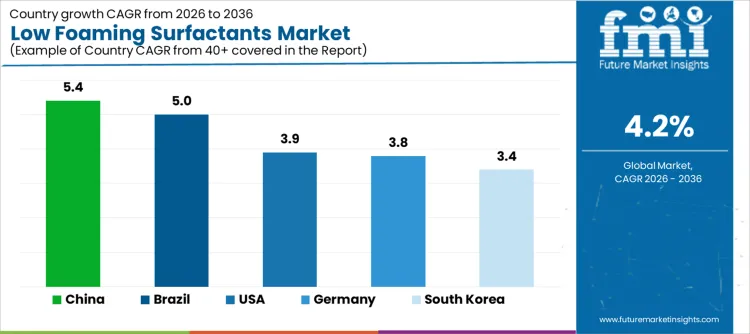
| Country | CAGR (%) |
|---|---|
| China | 5.4 |
| Brazil | 5.0 |
| United States | 3.9 |
| Germany | 3.8 |
| South Korea | 3.4 |
Why is China Leading the Low Foaming Surfactants Market?
China’s low foaming surfactants market is expanding at a CAGR of 5.4% during 2026 to 2036, driven by rapid growth in industrial manufacturing, food processing, and institutional cleaning applications. Low foaming surfactants are increasingly used in automated cleaning systems, bottle washing, CIP processes, and industrial surface cleaning where excessive foam can disrupt operations. Chinese manufacturers prioritize surfactants that deliver strong detergency, stability across temperature ranges, and compatibility with hard water and alkaline formulations. Domestic chemical suppliers benefit from large-scale production capabilities and the ability to supply cost-effective solutions for high-volume industrial applications. Procurement decisions emphasize cost efficiency, supply reliability, and consistent performance across batches. As China continues to modernize manufacturing facilities and expand food and beverage processing capacity, demand for low foaming surfactants is expected to remain strong.
Why Is Brazil Seeing Steady Growth in Low Foaming Surfactants Demand?
Brazil’s low foaming surfactants market is growing at a CAGR of 5.0% during 2026 to 2036, supported by expanding food processing, textile manufacturing, and industrial cleaning activities. Low foaming surfactants are widely used in cleaning-in-place systems, textile wet processing, and industrial maintenance applications where foam control is essential. Brazilian buyers value surfactants that maintain cleaning efficiency under warm and humid conditions while minimizing foam formation. Adoption is strong in food and beverage plants, breweries, dairy processing, and textile finishing units. Cost-performance balance remains a key consideration for formulators and end users. Procurement decisions often favor suppliers offering local availability, technical application support, and formulations compatible with existing equipment. Market growth is supported by industrial expansion and increasing adoption of automated cleaning practices.
What Is Driving Demand for Low Foaming Surfactants in the United States?
The United States low foaming surfactants market is expanding at a CAGR of 3.9% during 2026 to 2036, driven by demand from industrial cleaning, food processing, and institutional hygiene applications. Low foaming surfactants are critical for high-efficiency cleaning systems, including automated washers, CIP systems, and industrial surface cleaners. USA buyers emphasize formulation consistency, regulatory compliance, and performance under a wide range of operating conditions. Demand is strongest in food & beverage manufacturing, healthcare facilities, and industrial maintenance. Adoption is performance-driven rather than volume-driven. Procurement decisions prioritize supplier reliability, technical documentation, and long-term supply assurance. Market growth is shaped by continued automation, stricter hygiene protocols, and ongoing replacement of traditional high-foaming formulations.
How Is Germany Supporting Growth in the Low Foaming Surfactants Market?
Germany’s low foaming surfactants market is growing at a CAGR of 3.8% during 2026 to 2036, supported by demand from industrial manufacturing, automotive cleaning, and precision processing industries. German users emphasize process efficiency, cleanliness standards, and controlled foam behavior in automated systems. Low foaming surfactants are widely used in metal cleaning, parts washing, and industrial maintenance applications. Buyers prioritize reproducibility, low residue formation, and compatibility with closed-loop systems. Procurement decisions favor suppliers with robust quality systems, detailed technical data, and the ability to support customized industrial formulations. Market growth is reinforced by Germany’s focus on advanced manufacturing and high-efficiency industrial processes.
How Is South Korea Expanding Use of Low Foaming Surfactants?
South Korea’s low foaming surfactants market is expanding at a CAGR of 3.4% during 2026 to 2036, driven by demand from electronics manufacturing, food processing, and industrial cleaning sectors. Low foaming formulations are essential in precision cleaning applications where foam can interfere with automated equipment and surface quality. Buyers emphasize compatibility with automated systems, stable cleaning performance, and minimal residue. Adoption is strongest in electronics-related manufacturing and export-oriented processing facilities. Procurement decisions are influenced by supplier technical capability, consistent product quality, and alignment with global industrial standards. Market growth is supported by steady industrial activity and increasing adoption of automated cleaning technologies.
How are Companies Competing in the Low Foaming Surfactants Market?
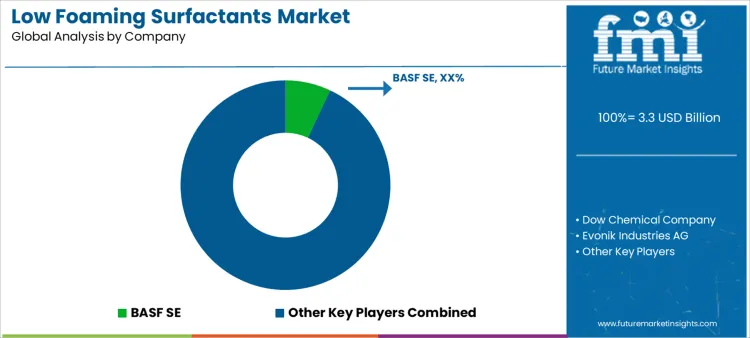
Competition in the low foaming surfactants market is driven by formulation performance under rigorous industrial and institutional conditions, sustainability credentials, and adaptability across diverse cleaning and process applications where foam control is critical. Low-foaming surfactants are essential in cleaning-in-place (CIP) systems, industrial parts washers, pulp & paper processing, and food-industry cleaning where uncontrolled foam can reduce efficiency, interfere with machinery, or compromise product quality.
BASF SE positions its low-foaming surfactants around robust wetting and soil-release capabilities with minimal foam generation, emphasizing reliable performance in high-temperature and high-shear environments. Its formulations are promoted for versatility across industrial cleaners and process washes. Dow Chemical Company competes through multi-functional chemistries engineered for stability across broad pH and temperature ranges, enabling formulators to minimize foam while maintaining strong detergency.
Specialty chemical leaders differentiate through tailored molecule design and sustainability. Evonik Industries AG and Clariant AG offer low-foaming surfactants optimized for hard surface and industrial applications, with formulations designed for efficient rinse-offs and improved process flow. Solvay SA and Croda International Plc emphasize biodegradable, low-environmental-impact options that align with regulatory sustainability targets.
Regional and niche formulators bolster the competitive landscape. Stepan Company, Nouryon, Huntsman Corporation, and Kao Corporation offer low-foaming surfactants with specific performance claims for industrial cleaners, food processing, and institutional maintenance products. Across suppliers, competitive advantage is defined by verifiable low foam behavior, formulation support, and alignment with environmental expectations rather than price alone.
Key Players in Low Foaming Surfactants Market
- BASF SE
- Dow Chemical Company
- Evonik Industries AG
- Clariant AG
- Solvay SA
- Croda International Plc
- Stepan Company
- Nouryon
- Huntsman Corporation
- Kao Corporation
Scope of Report
| Attribute | Details |
|---|---|
| Market Size Unit | USD Billion |
| Chemistry Covered | Nonionic EO or PO Block Surfactants, Low-Foam Ethoxylates, Silicone-Modified Surfactants, Other Low-Foaming Systems |
| Application Covered | Industrial & Institutional Cleaning, Food & Beverage CIP, Metal Cleaning & Precision Cleaning, Other Applications |
| Countries Covered | China, Japan, South Korea, India, Australia & New Zealand, ASEAN, Rest of Asia Pacific, Germany, United Kingdom, France, Italy, Spain, Nordic, BENELUX, Rest of Europe, United States, Canada, Mexico, Brazil, Chile, Rest of Latin America, Kingdom of Saudi Arabia, Other GCC Countries, Turkey, South Africa, Other African Union, Rest of Middle East & Africa |
| Regions Covered | Asia Pacific, Europe, North America, Latin America, Middle East & Africa |
| Key Companies Profiled | BASF SE, Dow Chemical Company, Evonik Industries AG, Clariant AG, Solvay SA, Croda International Plc, Stepan Company, Nouryon, Huntsman Corporation, Kao Corporation |
| Additional Attributes | Dollar sales of low foaming surfactants are analyzed by chemistry type and end-use application across industrial, institutional, and process-cleaning environments. The scope evaluates foam suppression efficiency, wetting and detergency performance, temperature and alkali stability, and compatibility with automated cleaning systems. Country-level analysis reflects growth in industrial cleaning standards, expansion of food and beverage processing infrastructure, increasing adoption of CIP systems, and regulatory requirements related to cleaning efficiency, residue control, and wastewater management. |
Low Foaming Surfactants Market by Key Segments
Chemistry:
- Nonionic EO or PO Block Surfactants
- Low-Foam Ethoxylates
- Silicone-Modified Surfactants
- Other Low-Foaming Systems
Application:
- Industrial & Institutional Cleaning
- Food & Beverage CIP
- Metal Cleaning & Precision Cleaning
- Other Applications
Region:
- Asia Pacific
- China
- Japan
- South Korea
- India
- Australia & New Zealand
- ASEAN
- Rest of Asia Pacific
- Europe
- Germany
- United Kingdom
- France
- Italy
- Spain
- Nordic
- BENELUX
- Rest of Europe
- North America
- United States
- Canada
- Mexico
- Latin America
- Brazil
- Chile
- Rest of Latin America
- Middle East & Africa
- Kingdom of Saudi Arabia
- Other GCC Countries
- Turkey
- South Africa
- Other African Union
- Rest of Middle East & Africa
Bibliography
- Organisation for Economic Co‑operation and Development. (2023). Surfactants and detergents: Environmental performance, biodegradability, and foam control considerations. OECD Environment, Health and Safety Publications.
- European Chemicals Agency. (2024). Surfactants in industrial and institutional cleaning: Use patterns, environmental exposure, and regulatory considerations. ECHA.
- United Nations Environment Programme. (2023). Sustainable chemistry in industrial cleaning and processing applications. UNEP Chemicals and Pollution Action Programme.
- USA Environmental Protection Agency. (2024). Safer Choice criteria for surfactants used in industrial and institutional cleaning products. USA EPA.
- World Health Organization. (2023). Water, sanitation, hygiene, and cleaning systems in institutional and industrial environments. WHO Technical Report Series.
- Food and Agriculture Organization of the United Nations. (2024). Cleaning‑in‑place systems in food processing: Chemical performance and foam management. FAO Animal Production and Health Guidelines.
Frequently Asked Questions
How big is the low foaming surfactants market in 2026?
The global low foaming surfactants market is estimated to be valued at USD 3.3 billion in 2026.
What will be the size of low foaming surfactants market in 2036?
The market size for the low foaming surfactants market is projected to reach USD 5.0 billion by 2036.
How much will be the low foaming surfactants market growth between 2026 and 2036?
The low foaming surfactants market is expected to grow at a 4.2% CAGR between 2026 and 2036.
What are the key product types in the low foaming surfactants market?
The key product types in low foaming surfactants market are nonionic eo or po block surfactants, low-foam ethoxylates, silicone-modified surfactants and other low-foaming systems.
Which application segment to contribute significant share in the low foaming surfactants market in 2026?
In terms of application, industrial & institutional cleaning segment to command 34.0% share in the low foaming surfactants market in 2026.
Preview the report firsthand - request a free sample
Get SampleGet the brochure for pricing and purchase details.
Get PDFTable of Content
- Executive Summary
- Global Market Outlook
- Demand-side Trends
- Supply-side Trends
- Technology Roadmap Analysis
- Analysis and Recommendations
- Market Overview
- Market Coverage / Taxonomy
- Market Definition / Scope / Limitations
- Market Background
- Market Dynamics
- Drivers
- Restraints
- Opportunity
- Trends
- Scenario Forecast
- Demand in Optimistic Scenario
- Demand in Likely Scenario
- Demand in Conservative Scenario
- Opportunity Map Analysis
- Product Life Cycle Analysis
- Supply Chain Analysis
- Investment Feasibility Matrix
- Value Chain Analysis
- PESTLE and Porter’s Analysis
- Regulatory Landscape
- Regional Parent Market Outlook
- Production and Consumption Statistics
- Import and Export Statistics
- Market Dynamics
- Global Market Analysis 2021 to 2025 and Forecast, 2026 to 2036
- Historical Market Size Value (USD Million) Analysis, 2021 to 2025
- Current and Future Market Size Value (USD Million) Projections, 2026 to 2036
- Y-o-Y Growth Trend Analysis
- Absolute $ Opportunity Analysis
- Global Market Pricing Analysis 2021 to 2025 and Forecast 2026 to 2036
- Global Market Analysis 2021 to 2025 and Forecast 2026 to 2036, By Chemistry
- Introduction / Key Findings
- Historical Market Size Value (USD Million) Analysis By Chemistry , 2021 to 2025
- Current and Future Market Size Value (USD Million) Analysis and Forecast By Chemistry , 2026 to 2036
- Nonionic EO or PO Block Surfactants
- Low-Foam Ethoxylates
- Silicone-Modified Surfactants
- Other Low-Foaming Systems
- Nonionic EO or PO Block Surfactants
- Y-o-Y Growth Trend Analysis By Chemistry , 2021 to 2025
- Absolute $ Opportunity Analysis By Chemistry , 2026 to 2036
- Global Market Analysis 2021 to 2025 and Forecast 2026 to 2036, By Application
- Introduction / Key Findings
- Historical Market Size Value (USD Million) Analysis By Application, 2021 to 2025
- Current and Future Market Size Value (USD Million) Analysis and Forecast By Application, 2026 to 2036
- Industrial & Institutional Cleaning
- Food & Beverage CIP
- Metal Cleaning & Precision Cleaning
- Other Applications
- Industrial & Institutional Cleaning
- Y-o-Y Growth Trend Analysis By Application, 2021 to 2025
- Absolute $ Opportunity Analysis By Application, 2026 to 2036
- Global Market Analysis 2021 to 2025 and Forecast 2026 to 2036, By Region
- Introduction
- Historical Market Size Value (USD Million) Analysis By Region, 2021 to 2025
- Current Market Size Value (USD Million) Analysis and Forecast By Region, 2026 to 2036
- North America
- Latin America
- Western Europe
- Eastern Europe
- East Asia
- South Asia and Pacific
- Middle East & Africa
- Market Attractiveness Analysis By Region
- North America Market Analysis 2021 to 2025 and Forecast 2026 to 2036, By Country
- Historical Market Size Value (USD Million) Trend Analysis By Market Taxonomy, 2021 to 2025
- Market Size Value (USD Million) Forecast By Market Taxonomy, 2026 to 2036
- By Country
- USA
- Canada
- Mexico
- By Chemistry
- By Application
- By Country
- Market Attractiveness Analysis
- By Country
- By Chemistry
- By Application
- Key Takeaways
- Latin America Market Analysis 2021 to 2025 and Forecast 2026 to 2036, By Country
- Historical Market Size Value (USD Million) Trend Analysis By Market Taxonomy, 2021 to 2025
- Market Size Value (USD Million) Forecast By Market Taxonomy, 2026 to 2036
- By Country
- Brazil
- Chile
- Rest of Latin America
- By Chemistry
- By Application
- By Country
- Market Attractiveness Analysis
- By Country
- By Chemistry
- By Application
- Key Takeaways
- Western Europe Market Analysis 2021 to 2025 and Forecast 2026 to 2036, By Country
- Historical Market Size Value (USD Million) Trend Analysis By Market Taxonomy, 2021 to 2025
- Market Size Value (USD Million) Forecast By Market Taxonomy, 2026 to 2036
- By Country
- Germany
- UK
- Italy
- Spain
- France
- Nordic
- BENELUX
- Rest of Western Europe
- By Chemistry
- By Application
- By Country
- Market Attractiveness Analysis
- By Country
- By Chemistry
- By Application
- Key Takeaways
- Eastern Europe Market Analysis 2021 to 2025 and Forecast 2026 to 2036, By Country
- Historical Market Size Value (USD Million) Trend Analysis By Market Taxonomy, 2021 to 2025
- Market Size Value (USD Million) Forecast By Market Taxonomy, 2026 to 2036
- By Country
- Russia
- Poland
- Hungary
- Balkan & Baltic
- Rest of Eastern Europe
- By Chemistry
- By Application
- By Country
- Market Attractiveness Analysis
- By Country
- By Chemistry
- By Application
- Key Takeaways
- East Asia Market Analysis 2021 to 2025 and Forecast 2026 to 2036, By Country
- Historical Market Size Value (USD Million) Trend Analysis By Market Taxonomy, 2021 to 2025
- Market Size Value (USD Million) Forecast By Market Taxonomy, 2026 to 2036
- By Country
- China
- Japan
- South Korea
- By Chemistry
- By Application
- By Country
- Market Attractiveness Analysis
- By Country
- By Chemistry
- By Application
- Key Takeaways
- South Asia and Pacific Market Analysis 2021 to 2025 and Forecast 2026 to 2036, By Country
- Historical Market Size Value (USD Million) Trend Analysis By Market Taxonomy, 2021 to 2025
- Market Size Value (USD Million) Forecast By Market Taxonomy, 2026 to 2036
- By Country
- India
- ASEAN
- Australia & New Zealand
- Rest of South Asia and Pacific
- By Chemistry
- By Application
- By Country
- Market Attractiveness Analysis
- By Country
- By Chemistry
- By Application
- Key Takeaways
- Middle East & Africa Market Analysis 2021 to 2025 and Forecast 2026 to 2036, By Country
- Historical Market Size Value (USD Million) Trend Analysis By Market Taxonomy, 2021 to 2025
- Market Size Value (USD Million) Forecast By Market Taxonomy, 2026 to 2036
- By Country
- Kingdom of Saudi Arabia
- Other GCC Countries
- Turkiye
- South Africa
- Other African Union
- Rest of Middle East & Africa
- By Chemistry
- By Application
- By Country
- Market Attractiveness Analysis
- By Country
- By Chemistry
- By Application
- Key Takeaways
- Key Countries Market Analysis
- USA
- Pricing Analysis
- Market Share Analysis, 2025
- By Chemistry
- By Application
- Canada
- Pricing Analysis
- Market Share Analysis, 2025
- By Chemistry
- By Application
- Mexico
- Pricing Analysis
- Market Share Analysis, 2025
- By Chemistry
- By Application
- Brazil
- Pricing Analysis
- Market Share Analysis, 2025
- By Chemistry
- By Application
- Chile
- Pricing Analysis
- Market Share Analysis, 2025
- By Chemistry
- By Application
- Germany
- Pricing Analysis
- Market Share Analysis, 2025
- By Chemistry
- By Application
- UK
- Pricing Analysis
- Market Share Analysis, 2025
- By Chemistry
- By Application
- Italy
- Pricing Analysis
- Market Share Analysis, 2025
- By Chemistry
- By Application
- Spain
- Pricing Analysis
- Market Share Analysis, 2025
- By Chemistry
- By Application
- France
- Pricing Analysis
- Market Share Analysis, 2025
- By Chemistry
- By Application
- India
- Pricing Analysis
- Market Share Analysis, 2025
- By Chemistry
- By Application
- ASEAN
- Pricing Analysis
- Market Share Analysis, 2025
- By Chemistry
- By Application
- Australia & New Zealand
- Pricing Analysis
- Market Share Analysis, 2025
- By Chemistry
- By Application
- China
- Pricing Analysis
- Market Share Analysis, 2025
- By Chemistry
- By Application
- Japan
- Pricing Analysis
- Market Share Analysis, 2025
- By Chemistry
- By Application
- South Korea
- Pricing Analysis
- Market Share Analysis, 2025
- By Chemistry
- By Application
- Russia
- Pricing Analysis
- Market Share Analysis, 2025
- By Chemistry
- By Application
- Poland
- Pricing Analysis
- Market Share Analysis, 2025
- By Chemistry
- By Application
- Hungary
- Pricing Analysis
- Market Share Analysis, 2025
- By Chemistry
- By Application
- Kingdom of Saudi Arabia
- Pricing Analysis
- Market Share Analysis, 2025
- By Chemistry
- By Application
- Turkiye
- Pricing Analysis
- Market Share Analysis, 2025
- By Chemistry
- By Application
- South Africa
- Pricing Analysis
- Market Share Analysis, 2025
- By Chemistry
- By Application
- USA
- Market Structure Analysis
- Competition Dashboard
- Competition Benchmarking
- Market Share Analysis of Top Players
- By Regional
- By Chemistry
- By Application
- Competition Analysis
- Competition Deep Dive
- BASF SE
- Overview
- Product Portfolio
- Profitability by Market Segments (Product/Age /Sales Channel/Region)
- Sales Footprint
- Strategy Overview
- Marketing Strategy
- Product Strategy
- Channel Strategy
- Dow Chemical Company
- Evonik Industries AG
- Clariant AG
- Solvay SA
- Croda International Plc
- Stepan Company
- Nouryon
- Huntsman Corporation
- Kao Corporation
- BASF SE
- Competition Deep Dive
- Assumptions & Acronyms Used
- Research Methodology


