

- Market Size (2026)
- USD 459.4 Mn
- Forecast (2036)
- USD 1128.1 Mn
- CAGR (2026 to 2036)
- 9.4%
Low-Noise Anti-Squeak Additives for Automotive Interiors Market Size, Market Forecast and Outlook By FMI
Summary of the Low-Noise Anti-Squeak Additives for Automotive Interiors Market
- Demand and Growth Drivers
- Automakers are raising interior noise checks as electric cabins make trim squeak easier to hear.
- Tier-1 molders are adding slip and damping packages to cut rework after instrument panel and console testing.
- PC ABS and PP parts gain attention as hard plastic contact points create repeat noise complaints during warranty review.
- Product and Segment View
- Silicone additives are set to lead additive chemistry with 38.0% share in 2026 because they cut stick-slip friction inside plastic joints.
- PC ABS systems are anticipated to represent 42.0% share in 2026. Instrument panels and consoles require stable surface feel.
- Masterbatch pellets are projected to account for 44.0% share in 2026. Compounders prefer simple dosing at the resin stage.
- Door trim is expected to lead interior application demand with 36.0% share in 2026 because clips and armrests face repeated contact.
- Geography and Competitive Outlook
- China is projected to record 10.9% CAGR by 2036 because local electric vehicle programs create more cabin noise checks.
- India is expected to expand at 10.4% CAGR by 2036 as new passenger vehicle programs raise comfort expectations.
- Lubrizol and BASF hold material depth across polymer additives and automotive plastic support.
- Specialty players such as SILIKE and BYK compete through friction control products and compounding support.
- Analyst Opinion
- Nikhil Kaitwade, Principal Analyst for Automotive at FMI, opines, "I view this sector as a cabin quality control business. Electric vehicles remove engine masking noise and small plastic contact sounds become easier to hear. Interior suppliers need materials able to pass squeak tests before tool release. Cost pressure comes from late-stage rework and warranty risk. Suppliers gain an advantage through polymer-specific dosing support and test evidence. Clients should watch PC ABS trials and low-VOC material rules through 2036. These signals show which additive suppliers can protect cabin feel without extra coating steps."
- Low-Noise Anti-Squeak Additives for Automotive Interiors Market Value Analysis
- The low-noise anti-squeak additives for automotive interiors market is moving from a comfort additive category into a defined interior material input area.
- Automakers seeking quieter cabins are adopting these additives across dashboards and door trims in daily vehicle use.
- Industry value is supported by wider use of additives that reduce friction noise in plastic and rubber interior parts.
- Interior formulations support demand when they balance noise control and material compatibility with cost discipline through 2036.
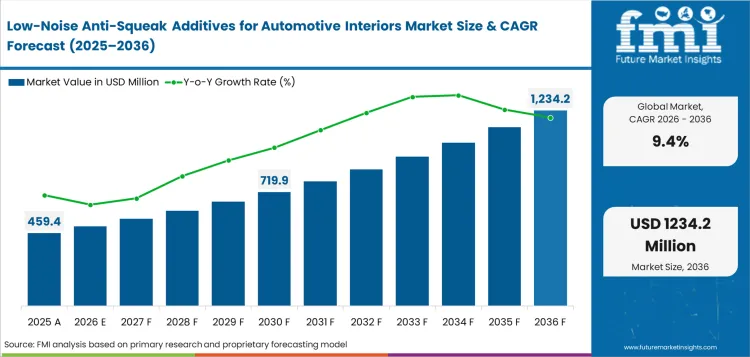
Key Takeaways
- The low-noise anti-squeak additives for automotive interiors market value stood at USD 419.9 million in 2025.
- Industry value is projected to reach USD 1,128.1 million by 2036 as electric vehicle cabins expose small trim noises faster.
- The sector is expected to expand at 9.4% CAGR from 2026 to 2036 across interior plastics and elastomer trim programs.
- The sector is projected to create an incremental opportunity of USD 668.7 million between 2026 and 2036.
- Direct technical supply is expected to account for 48.0% share in 2026 as cabin programs need additive support before tool release.
- China at 10.9% CAGR and India at 10.4% CAGR are expected to post steady rise by 2036.
Low-Noise Anti-Squeak Additives for Automotive Interiors Market Definition
The sector covers additive packages used in automotive interior plastics and elastomers to reduce friction noise between contacting parts. Included products cover silicone additives, wax slips, PTFE-free slips, oleamide slips, and hybrid packages used in molded trim. The scope includes additive masterbatches and pre-compounds sold for door trim, consoles, instrument panels, seat hardware, and pillar parts. Finished interior parts without additive claims and exterior weather seals remain outside this study.
Low-Noise Anti-Squeak Additives for Automotive Interiors Market Inclusions
The study includes silicone additives, wax additives, PTFE-free slips, oleamide slips, hybrid packages, PC ABS systems, PP systems, TPE systems, ABS systems, POM systems, interior applications, customer types, delivery forms, sales channels, and global geography.
Low-Noise Anti-Squeak Additives for Automotive Interiors Market Exclusions
The study excludes engine oil additives, driveline additives, tire noise materials, exterior weatherstrips, acoustic foam pads, adhesive tapes, finished molded trim without additive claims, and after-sale lubricant sprays.
Low-Noise Anti-Squeak Additives for Automotive Interiors Market Research Methodology
- Primary Research: FMI analysts reviewed additive makers and automotive compounders using anti-squeak masterbatches. Interviews focused on squeak tests and part validation in interior trim programs.
- Desk Research: The desk review used automotive production data and official company product pages.
- Market Sizing and Forecasting: Forecast aligned the FMI additive base with interior polymer part demand and vehicle platform cycles. Segment leaders were checked against material choice and customer use patterns.
- Data Validation: Country growth and segment shares were compared with vehicle output and electric cabin material needs.
Why is the Low-Noise Anti-Squeak Additives for Automotive Interiors Market Growing?
- Electric powertrains reduce engine masking noise which makes small plastic squeak more noticeable inside premium cabins.
- Interior molders use additive packages to avoid secondary greasing and cut rework after squeak tests.
- Large molded parts need stable surface friction as automotive interior polypropylene laminates and PC ABS surfaces face repeated contact.
- Low-emission interior material rules support additive systems that avoid extra coatings and reduce part handling.
Cabin quietness has moved from a comfort feature into a quality check for interior material approval. OICA reported global vehicle production of 96.4 million units in 2025 after 92.7 million units in 2024. This shows a large addressable base for trim suppliers. Even small additive use per vehicle can create steady volume across dashboards and door trims. Additives used during resin or compound preparation can reduce friction noise without adding extra assembly steps. Suppliers able to support squeak testing and dosing control are better placed through 2036. Electric vehicle growth strengthens this case. IEA reported more than 17 million electric cars sold in 2024 with a global sales share above 20%. Quiet powertrains make console joints and door trim contact points easier to hear during low-speed use.
Market Segmentation Analysis
- Silicone additives are projected to account for 38.0% share of additive chemistry demand in 2026, driven by friction reduction inside PC ABS joints.
- PC ABS systems are expected to hold 42.0% share of polymer compatibility demand in 2026 as dashboards and consoles require stable feel after molding.
- Automotive OEMs and Tier-1s are anticipated to represent 46.0% share of customer type demand in 2026 because of approval work starting before mass production.
- Masterbatch pellets are projected to account for 44.0% share of delivery form demand in 2026 since compounders require dosing control at scale.
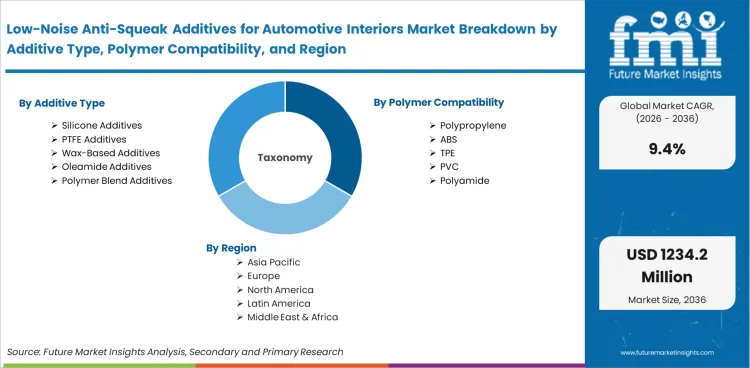
The low-noise anti-squeak additives for automotive interiors market is segmented by additive type into silicone additives, PTFE additives, wax-based additives, oleamide additives, and polymer blend additives. By polymer compatibility, the market is divided into polypropylene, ABS, TPE, PVC, and polyamide. Based on interior application, it is segmented into dashboards, door panels, center consoles, seat components, and trim assemblies. By vehicle type, the market is segmented into passenger cars, SUVs, light commercial vehicles, electric vehicles, and premium vehicles. Based on customer type, the market is categorized into Tier 1 interior suppliers, OEMs, compounders, aftermarket suppliers, and material converters. By sales channel, the market is segmented into direct supply, distributors, specialty compounders, and technical service partners.
Low-Noise Anti-Squeak Additives for Automotive Interiors Market Analysis by Additive Type
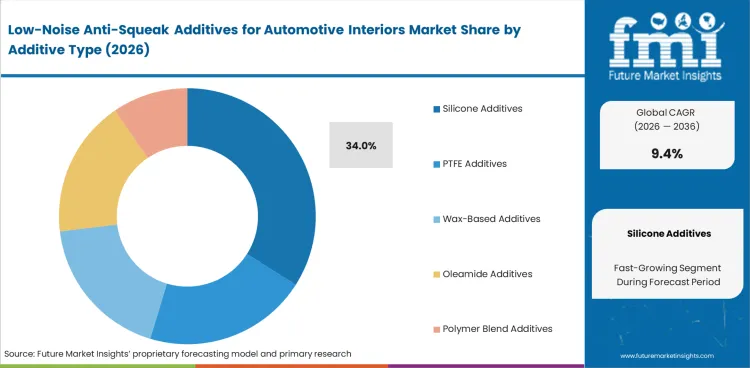
- Silicone additives are expected to account for 34.0% share in 2026. Stable slip performance supports use across plastic cabin parts facing repeated contact.
- Silicone chemistry helps compounders reduce friction noise in molded trim without adding extra pads or films during assembly.
Insights into PTFE Additives Segment
- PTFE additives provide low-friction needs in premium cabin parts where small contact points can create audible squeak during vehicle use.
- Cost and processing limits keep PTFE use more selective compared with silicone additives in high-volume interior molding programs.
Low-Noise Anti-Squeak Additives for Automotive Interiors Market Analysis by Polymer Compatibility
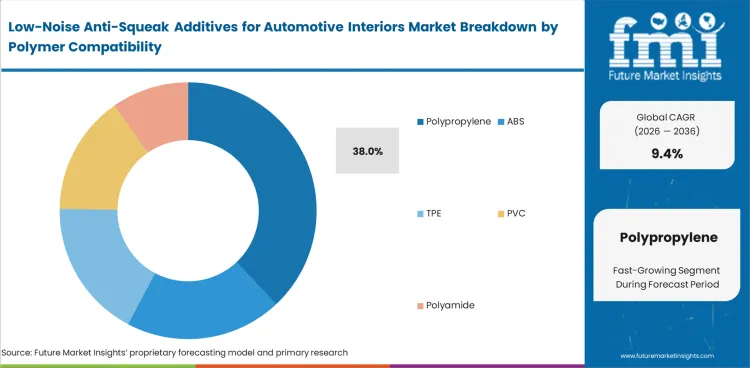
- Polypropylene is projected to represent 38.0% share of polymer compatibility demand in 2026 because door panels and consoles use PP compounds across large vehicle programs.
- PP compounders value additive packages that lower squeak risk without reducing surface finish or basic molding stability.
Insights into TPE Segment
- TPE use depends on soft-touch cabin parts requiring quiet contact between flexible surfaces and harder trim structures.
- Low-VOC TPE platforms influence additive choice as automakers review odor and cabin air performance during material approval.
Low-Noise Anti-Squeak Additives for Automotive Interiors Market Analysis by Interior Application
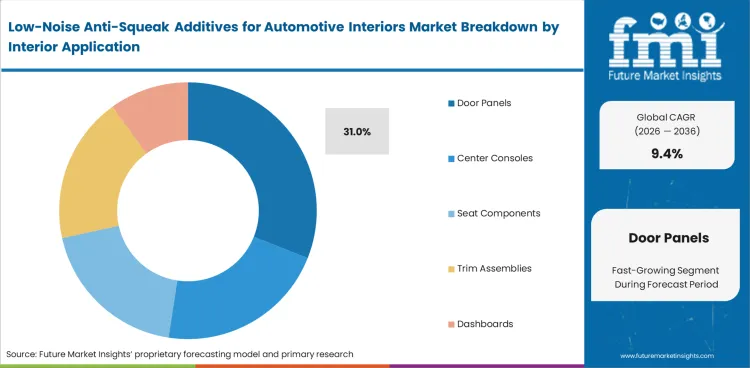
- Door panels are anticipated to represent 31.0% share in 2026 as armrests and contact edges face frequent movement during vehicle use.
- Door trim programs often need early squeak testing due to clip points and map-pocket contact surfaces creating repeat warranty issues.
Insights into Dashboard Segment
- Dashboard applications use anti-squeak additives to control friction noise around vents and trim joints exposed to heat changes.
- Premium cabin programs place more weight on dashboard sound quality as front-seat occupants hear minor surface noise quickly.
Low-Noise Anti-Squeak Additives for Automotive Interiors Market Analysis by Vehicle Type
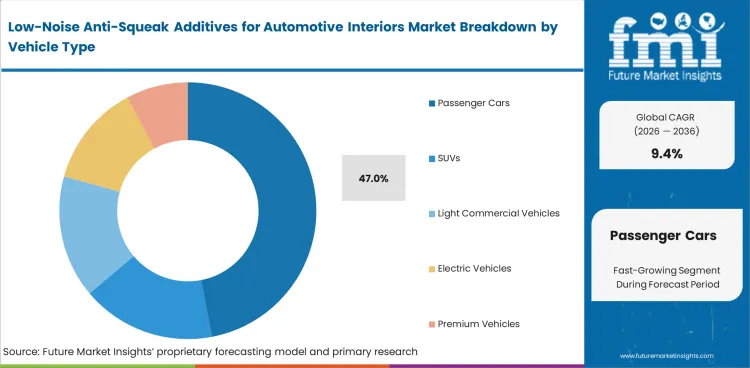
- Passenger cars are expected to hold 47.0% share in 2026. Global production scale keeps interior additive volumes high.
- Large car platforms favor proven additives because material changes across dashboards and door trims can delay production approval.
Insights into Electric Vehicles Segment
- Electric vehicles create a stricter need for cabin noise control since quiet powertrains make trim contact sounds easier to detect.
- EV interior programs often review low-friction additives earlier during material selection to reduce late-stage squeak fixes.
Low-Noise Anti-Squeak Additives for Automotive Interiors Market Analysis by Customer Type
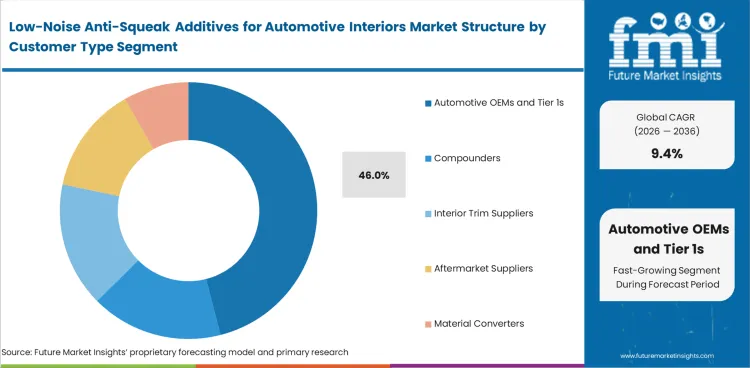
- Automotive OEMs and Tier 1s are expected to hold 46.0% share in 2026 because they control interior material approval directly.
- Tier 1 suppliers prefer additives backed by squeak test data because approved compounds must pass program checks before launch.
Insights into Compounders Segment
- Compounders influence additive selection by preparing resin blends used in door panels and console parts before molding begins.
- Regional compounders gain orders matching OEM-approved grades and providing stable dosing at repeat batch scale.
Low-Noise Anti-Squeak Additives for Automotive Interiors Market Analysis by Sales Channel
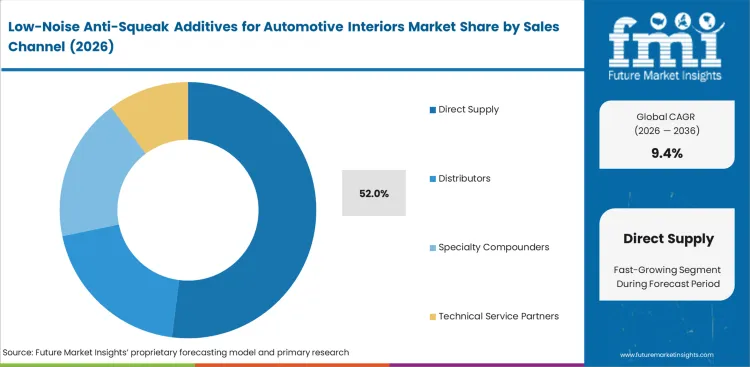
- Direct supply is projected to secure 52.0% share of sales channel demand in 2026 because approved automotive accounts require technical support and repeat quality.
- Direct contracts help additive suppliers support compound trials and squeak testing before full interior part approval.
Insights into Distributors Segment
- Distributors serve smaller converters needing standard additive grades without long approval cycles across regional molding operations.
- Distributor demand connects with aftermarket trim repair and small-batch molding. Fast supply access outweighs custom formulation support.
Low-Noise Anti-Squeak Additives for Automotive Interiors Market Drivers, Restraints, and Opportunities
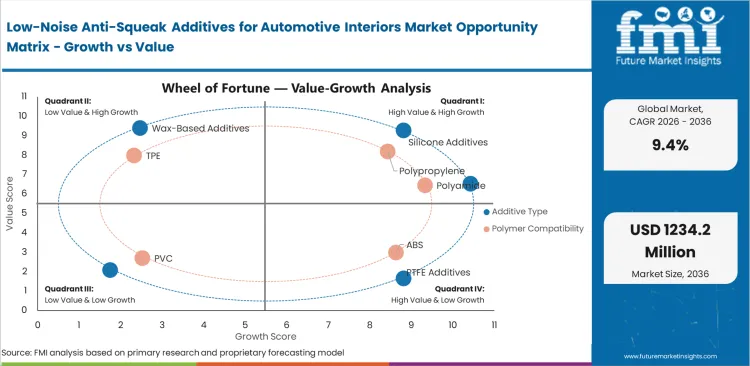
- Squeak testing is likely to support additive use as cabin part suppliers require fewer late-stage trim fixes before vehicle launch.
- Low dosing rates protect margins because compounders can improve part feel without a large resin cost increase.
- Validation delays are anticipated to slow adoption as each additive requires polymer-specific testing before approval.
Material cost pressure is likely to limit margins in lower specification interior accounts during firmer resin pricing cycles. BLS data listed plastics material and resin manufacturing primary products at 282.386 in March 2026, up from 274.273 in February 2026. This input movement affects compound cost for PP and ABS interior parts. Suppliers cannot absorb every cost change through price discounts in approved automotive programs. Formulators with dose-efficient additives and test support will have better room to protect margins by 2036.
Production Capacity and Supplier Footprint Analysis
Low-noise anti-squeak additives are expected to expand with automotive interior production by 2036 as OEMs tighten cabin noise expectations. Supplier footprint will remain closest to polymer compounding hubs and trim molding clusters because squeak-and-rattle validation needs quick formulation support. China is likely to anchor the largest capacity pull after the IEA reported 27 million cars produced in 2024 and named the country the world’s largest car exporter in November 2025. This production base supports local blending of silicone additives and wax dispersions for instrument panels and consoles.
Door-pad applications add a separate formulation route. North America should remain a higher-value supply region where OEM-approved grades and platform-specific testing matter more than basic additive availability. India is likely to gain relevance as vehicle production and export-oriented compounding expand across domestic interior part programs. Supplier concentration is expected to stay moderate because global additive companies control chemistry platforms while regional compounders handle resin matching and color compatibility.
Import Dependence and Trade Flow Analysis
Import dependence in the low-noise anti-squeak additives for automotive interiors market is expected to remain tied to cross-border movement of resin compounds and interior trim parts. OEM-approved additive packages add a separate trade layer. Export competitiveness will increase around Asian production hubs as vehicle platforms expand across regional assembly networks.
North America and Europe are likely to rely on imported or licensed additive chemistries for some programs while final compounding stays closer to OEM validation sites. Trade dependency will depend more on resin compatibility and approved formulations than on basic additive availability. Industry outlook points to Asia as the main export-linked supply base. Regional compounders gain value by localizing noise-control additives for each OEM interior platform.
Regional Analysis
.webp "Top Country Growth Comparison Low Noise Anti Squeak Additives For Automotive Interiors Market Cagr (2026 2036)")
| Country | CAGR 2026 to 2036 |
|---|---|
| China | 10.9% |
| India | 10.4% |
| United States | 9.3% |
| Germany | 8.9% |
| South Korea | 8.8% |
| United Kingdom | 8.7% |
| Japan | 8.6% |
Source: Future Market Insights analysis based on country demand narratives and public source checks in 2026.
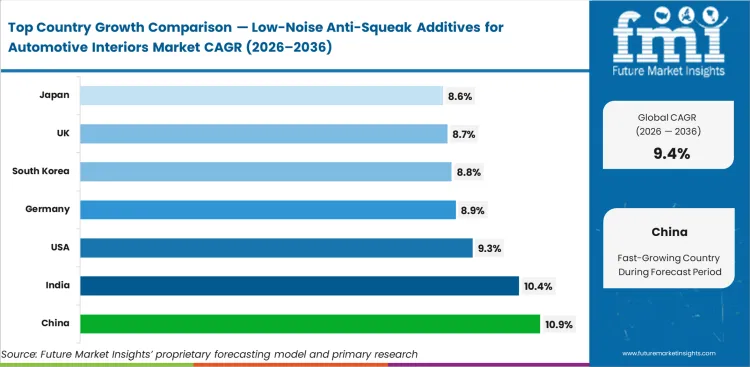
Analysis of Low-Noise Anti-Squeak Additives for Automotive Interiors Market by Key Countries
- China is likely to post the fastest pace at 10.9% CAGR by 2036. Large vehicle production and growing cabin comfort checks lead domestic automotive programs.
- India is expected to follow at 10.4% CAGR by 2036 because of expanding passenger vehicle output and stronger interior quality requirements across local OEM platforms.
- United States demand is projected at 9.3% CAGR by 2036 as EV adoption and premium cabin programs keep low-friction additive use steady in interior trim compounds.
- South Korea is projected at 8.8% CAGR by 2036, influenced by export-focused vehicle production and tighter noise quality checks across compact cabin designs.
- Germany at 8.9% CAGR and the United Kingdom at 8.7% CAGR expand by 2036. Japan follows at 8.6% CAGR through mature automotive engineering systems and steadier replacement demand.
Country growth differs with vehicle production scale and cabin noise expectations. China leads as high vehicle output and EV manufacturing deepen additive use in trim compounds. India follows as local passenger car platforms move toward better cabin finish. United States demand advances through premium interiors and quieter EV powertrains. Germany and United Kingdom grow through engineering-led material checks. South Korea and Japan maintain steady adoption as mature vehicle programs refine squeak control rather than add large new volume.
Demand Outlook for Low-Noise Anti-Squeak Additives for Automotive Interiors in China
Demand for low-noise anti-squeak additives for automotive interiors in China is projected to rise at 10.9% CAGR by 2036 as high vehicle production and EV growth increase use of quieter trim materials. Domestic compounders require low-friction additive systems that reduce contact noise across door panels and console parts. China leads the country outlook because it has a large automotive manufacturing base and faster cabin comfort upgrades.
- Local vehicle production supports repeat additive use as interior suppliers depend on stable materials across large molding programs.
- EV platforms raise demand for low-noise plastic compounds led by quiet powertrains making trim contact sounds easier to detect.
- Specialty additive suppliers gain more prospects to serve domestic compounders through dosing support and faster material approval.
Demand Outlook for Low-Noise Anti-Squeak Additives for Automotive Interiors in India
The sector in India is expected to expand at 10.4% CAGR by 2036. Passenger vehicle growth and rising cabin-quality focus lead compact car platforms. Local OEMs require additives that reduce squeak points without adding extra pads or assembly steps.
- Passenger car production supports additive intake as interior suppliers scale door trim and dashboard molding programs.
- Local compounders use slip additives to improve contact noise control in polypropylene interior parts.
- Faster vehicle premiumization creates prospects for suppliers able to provide consistent batches and squeak testing support.
Demand Outlook for Low-Noise Anti-Squeak Additives for Automotive Interiors in the United States
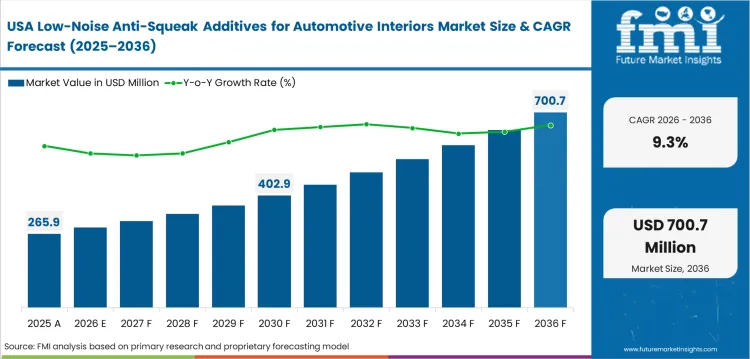
Sales of low-noise anti-squeak additives for automotive interiors in the United States are likely to increase at 9.3% CAGR by 2036. EV platforms and premium cabin quality programs shape demand. Established automotive suppliers need additive systems working across plastics and elastomers used in door panels and consoles. United States demand remains steady as material approval centers on noise control and long-term surface performance.
- EV programs support demand for low-friction additives reducing audible trim contact during low-speed driving.
- Tier 1 interior suppliers need consistent additive packages across molded dashboards and console assemblies.
- OEM quality checks require materials reducing squeak risk without affecting surface finish or odor targets.
Demand Outlook for Low-Noise Anti-Squeak Additives for Automotive Interiors in South Korea
Industry in South Korea is projected to record 8.8% CAGR by 2036 due to export-focused automotive production places more attention on quiet cabin performance. Additive suppliers need test data and compound support before trim suppliers approve new grades. South Korea demand stays firm as automakers refine interior noise control across compact and electric models.
- Export vehicle programs support additives with consistent performance across door trims and console joints.
- Compact cabin layouts increase attention on small contact points creating repeated squeak sounds.
- Local compounders need low-friction systems supporting molded part quality without adding extra assembly cost.
Demand Outlook for Low-Noise Anti-Squeak Additives for Automotive Interiors in Germany
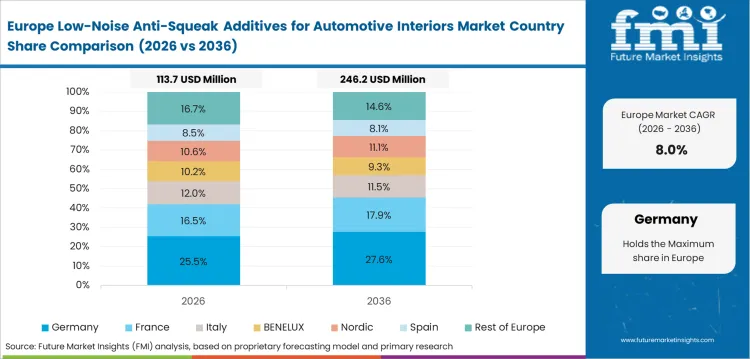
Low-noise anti-squeak additive demand in Germany is projected to advance at 8.9% CAGR by 2036, driven by premium vehicle engineering and stricter cabin quality checks. German interior suppliers focus on material consistency and long-term noise control. Germany grows at a measured pace influenced by mature automotive programs and detailed supplier qualification.
- Premium vehicle interiors require additive systems lowering trim friction without changing surface feel.
- Interior material approvals often include squeak checks under heat and vibration exposure.
- Local compounders favor suppliers providing repeatable additive quality with technical testing support.
Demand Outlook for Low-Noise Anti-Squeak Additives for Automotive Interiors in the United Kingdom
Demand for low-noise anti-squeak additives for automotive interiors in the United Kingdom is expected to post 8.7% CAGR by 2036 due to specialty vehicle production and quality-led interior material use. Local suppliers need additive packages that influence quiet trim performance in smaller production batches.
- Specialty vehicle programs support additive use in premium trim parts requiring better cabin sound control.
- Interior suppliers use anti-squeak additives to reduce noise from contact edges and hidden joints.
- Product differentiation centers on quiet feel and repeat material quality across smaller production lines.
Demand Outlook for Low-Noise Anti-Squeak Additives for Automotive Interiors in Japan
The sector in Japan is expected to grow at 8.6% CAGR by 2036. Mature automotive production sustains steady additive adoption. Japanese automakers focus on low cabin noise and dependable material behavior across compact interiors.
- Mature vehicle platforms influence steady additive adoption in formulations requiring consistent squeak control.
- Japanese compounders need low-odor additive systems reducing friction noise without affecting cabin material feel.
- Interior trim suppliers use anti-squeak additives to maintain quiet performance across dashboards and door panels.
Competitive Positioning and Strategic Supplier Strength
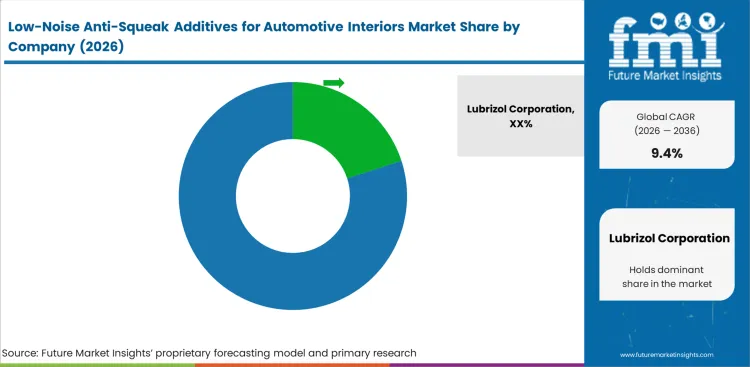
- Competition centers on polymer test evidence and direct support for squeak validation in interior parts.
- BASF holds automotive interior material depth through plastics and polyurethane systems with acoustic performance positioning.
- SILIKE competes depending on a direct anti-squeak masterbatch route for ABS and PC ABS systems.
- Avient competes based on additive and engineered material support for automotive plastic applications.
- BYK aligns with automotive surface-additive chemistry and meets nearby formulation requirements in coatings and plastic surface performance.
Large suppliers hold stronger access to global cabin programs through material testing and application support across several resin systems. Specialty suppliers can still gain projects through clear stick-slip evidence and faster support for compounders. SILIKE published SILIPLAS 2073 data in October 2025 and positioned the additive for PC/ABS automotive interior parts. Avient highlighted colorants and additives at Chinaplas 2025 with lightweighting examples for automotive applications. Supplier competition should be framed around test data and material support including price.
Key Companies in the Low-Noise Anti-Squeak Additives for Automotive Interiors Market
Competition spans additive makers and compound support suppliers serving automotive cabin materials.
- Global additive suppliers: Lubrizol and BASF compete with Dow and Evonik through polymer additive depth. Clariant and DuPont add chemistry range. LANXESS and Croda support long qualification histories.
- Compounding and application support suppliers: Companies such as Avient and BYK are focusing on colorant and surface additive portfolios. Their role is strongest as interior molders need additive packages matched with processing needs.
- Specialist anti-squeak suppliers: SILIKE competes through focused masterbatches for ABS and PC ABS. These suppliers gain access if fast trials reduce post-treatment work.
Competitive Benchmarking: Low-Noise Anti-Squeak Additives for Automotive Interiors Market
| Company | Interior Squeak Test Support | Polymer Additive Range | Automotive Account Access | Footprint |
|---|---|---|---|---|
| Lubrizol | High | Large | Large | Global |
| BASF | High | Large | Large | Global |
| Dow | Large | Large | Large | Global |
| Evonik | Large | Large | Large | Global |
| Clariant | Large | Large | Moderate | Global |
| LANXESS | Moderate | Large | Large | Global |
| Avient | Large | Large | Large | Global |
| BYK | Large | Large | Moderate | Global |
| SILIKE | High | Moderate | Moderate | Asia centered |
Source: Future Market Insights competitive analysis based on product portfolios and public company activity in 2026.
Key Developments in Low-Noise Anti-Squeak Additives for Automotive Interiors Market
- In March 2024, Stahl positioned Stahl Stay Silent as an automotive anti-squeak coating with up to 100,000 km noise-reduction performance for vehicle interiors.
- In October 2025, SILIKE introduced SILIPLAS 2073 for ABS and PC/ABS automotive interior parts with 4 wt.% dosage reaching RPN 1 under VDA 230-206 testing.
Key Players in the Low-Noise Anti-Squeak Additives for Automotive Interiors Market
Global additive suppliers
- Lubrizol Corporation
- BASF SE
- Dow Inc.
- Evonik Industries AG
- Clariant AG
- DuPont de Nemours Inc.
- LANXESS AG
- Croda International Plc
- Infineum International Limited
Compounding and application support suppliers
- Avient Corporation
- BYK Additives and Instruments
Specialist anti-squeak suppliers
- Chengdu SILIKE Technology Co. Ltd.
Report Scope and Coverage
| Item | Value |
|---|---|
| Market value in 2025 | USD 419.9 million |
| Market value in 2026 | USD 459.4 million |
| Market value in 2036 | USD 1,128.1 million |
| CAGR from 2026 to 2036 | 9.4% |
| Quantitative units | USD million |
| Market definition | Additives used in automotive interior plastics and elastomers to reduce friction-induced squeak |
| By additive chemistry | Silicone additives, wax additives, PTFE-free slips, oleamide slips, hybrid packages |
| By polymer compatibility | PC ABS systems, PP systems, TPE systems, ABS systems, POM systems |
| By interior application | Door trim, consoles, instrument panels, seat hardware, pillars |
| By customer type | Automotive OEMs and tier-1s, compounders, interior moldings, aftermarket converters, test labs |
| By delivery form | Masterbatch pellets, liquid additives, powder blends, pre-compounds, surface coats |
| By sales channel | Direct technical supply, distributors, compounder supply, online B2B, regional agents |
| Regions covered | North America, Latin America, Europe, East Asia, South Asia, Oceania, Middle East and Africa |
| Countries covered | China, India, United States, Germany, South Korea, United Kingdom, Japan |
| Key companies profiled | Lubrizol, BASF, Dow, Evonik, Clariant, DuPont, LANXESS, Croda, Infineum, Avient, BYK, SILIKE |
| Forecast period | 2026 to 2036 |
| Approach | FMI analysis based on vehicle output, interior material use, product portfolios, and country demand narratives |
Source: Future Market Insights analysis, 2026.
Low-Noise Anti-Squeak Additives for Automotive Interiors Market Breakdown by Additive Type, Polymer Compatibility, Interior Application, Vehicle Type, Customer Type, Sales Channel, and Region
Low-Noise Anti-Squeak Additives for Automotive Interiors Market Segmented by Additive Type
- Silicone Additives
- PTFE Additives
- Wax-Based Additives
- Oleamide Additives
- Polymer Blend Additives
Low-Noise Anti-Squeak Additives for Automotive Interiors Market Segmented by Polymer Compatibility
- Polypropylene
- ABS
- TPE
- PVC
- Polyamide
Low-Noise Anti-Squeak Additives for Automotive Interiors Market Segmented by Interior Application
- Dashboards
- Door Panels
- Center Consoles
- Seat Components
- Trim Assemblies
Low-Noise Anti-Squeak Additives for Automotive Interiors Market Segmented by Vehicle Type
- Passenger Cars
- SUVs
- Light Commercial Vehicles
- Electric Vehicles
- Premium Vehicles
Low-Noise Anti-Squeak Additives for Automotive Interiors Market Segmented by Customer Type
- Automotive OEMs and Tier 1s
- Compounders
- Interior Trim Suppliers
- Aftermarket Suppliers
- Material Converters
Low-Noise Anti-Squeak Additives for Automotive Interiors Market Segmented by Sales Channel
- Direct Supply
- Distributors
- Specialty Compounders
- Technical Service Partners
Low-Noise Anti-Squeak Additives for Automotive Interiors Market by Region
- North America
- United States
- Canada
- Latin America
- Brazil
- Europe
- Germany
- United Kingdom
- France
- Italy
- Spain
- East Asia
- China
- Japan
- South Korea
- South Asia and Pacific
- India
- ASEAN
- Australia and New Zealand
- Middle East and Africa
- Saudi Arabia
- Other GCC Countries
- South Africa
Research Sources and Bibliography
- International Energy Agency. (2025, November 18). What next for the global car industry: An Energy Technology Perspectives special report.
- International Organization of Motor Vehicle Manufacturers. (2026, April 23). Auto industry growth shifted east in 2025 amid global repositioning.
- The State Council of the People’s Republic of China. (2025, January 13). China’s auto output, sales both reach new heights in 2024.
- Society of Indian Automobile Manufacturers. (2025, April 15). Auto industry sales performance of March 2025, Q4 (Jan–March 2025) and April 2024–March 2025.
- International Trade Administration. (2025, November 20). Japan - Automotive.
- Verband der Automobilindustrie. (2025, February 4). Double-digit rise in passenger car production in January.
- Society of Motor Manufacturers and Traders. (2025, January 30). Vehicle production dips amid EV transformation and intense market pressure.
- International Organization of Motor Vehicle Manufacturers. (2025, October). World motor vehicle production by country and type 2024. SILIKE. (2024, December 3). Anti-squeaking masterbatch, PC/ABC material noise reduction solution to solve the noise problem of auto parts and home appliances.
- SILIKE. (2025, October 16). Solving squeak challenges in PC/ABS automotive interior parts: SILIKE anti-squeak additive SILIPLAS 2073.
- Ebadi, N. (2025, April 16). NVH solutions for quiet electric cars. Antala.
- Stahl. (2024, March 6). Why noise reduction is to the future of automotive interiors.
The bibliography is provided for reader reference and direct source checking.
This Report Answers
- How large is the low-noise anti-squeak additives for automotive interiors sector in 2026, and how far can it rise by 2036?
- Which additive type, polymer compatibility, and sales channel hold the largest projected share positions in 2026?
- Why do silicone additives and polypropylene hold the clearest lead in current material use?
- Why do China and India lead the published country growth set through 2036?
- How does direct supply shape access for large OEM and Tier 1 interior accounts?
- Which supplier capabilities help companies defend position in anti-squeak masterbatch and low-friction additive supply?
- What vehicle production and EV sales signals support the forecast method used in this study?
Frequently Asked Questions
What is the global market demand for low-noise anti-squeak additives for automotive interiors market in 2026?
In 2026, the global market is expected to be worth USD 459.4 million as cabin noise control integrates into material choice.
What will be the market value for low-noise anti-squeak additives for automotive interiors market by 2036?
By 2036, the sector is projected to reach USD 1,128.1 million led by electric cabins raising trim squeak testing intensity.
What CAGR is forecast for low-noise anti-squeak additives for automotive interiors market?
The market is anticipated to expand at 9.4% CAGR from 2026 to 2036 across interior plastics and elastomer programs.
Which segment leads low-noise anti-squeak additives for automotive interiors market?
Direct technical supply is expected to account for 48.0% share in 2026 due to large cabin programs need supplier test support.
Which additive chemistry leads low-noise anti-squeak additives for automotive interiors market?
Silicone additives are estimated to hold 38.0% share in 2026 as they reduce stick-slip friction inside plastic contact zones.
Why does China lead growth in low-noise anti-squeak additives for automotive interiors market?
China is projected to record 10.9% CAGR by 2036, driven by electric vehicle platforms raising cabin noise checks across trim parts.
What is included in low-noise anti-squeak additives for automotive interiors market?
The scope includes additive packages used in interior plastics and elastomers to reduce squeak between contacting cabin parts.
How was the low-noise anti-squeak additives for automotive interiors market forecast built?
FMI aligned additive values with vehicle output and interior polymer use. It checked segment shares and country platform activity through 2036.
Preview the report firsthand - request a free sample
Get SampleGet the brochure for pricing and purchase details.
Get PDFTable of Content
- Executive Summary
- Global Market Outlook
- Demand-side Trends
- Supply-side Trends
- Technology Roadmap Analysis
- Analysis and Recommendations
- Market Overview
- Market Coverage / Taxonomy
- Market Definition / Scope / Limitations
- Research Methodology
- Chapter Orientation
- Analytical Lens and Working Hypotheses
- Market Structure, Signals, and Trend Drivers
- Benchmarking and Cross-market Comparability
- Market Sizing, Forecasting, and Opportunity Mapping
- Research Design and Evidence Framework
- Desk Research Programme (Secondary Evidence)
- Company Annual and Sustainability Reports
- Peer-reviewed Journals and Academic Literature
- Corporate Websites, Product Literature, and Technical Notes
- Earnings Decks and Investor Briefings
- Statutory Filings and Regulatory Disclosures
- Technical White Papers and Standards Notes
- Trade Journals, Industry Magazines, and Analyst Briefs
- Conference Proceedings, Webinars, and Seminar Materials
- Government Statistics Portals and Public Data Releases
- Press Releases and Reputable Media Coverage
- Specialist Newsletters and Curated Briefings
- Sector Databases and Reference Repositories
- FMI Internal Proprietary Databases and Historical Market Datasets
- Subscription Datasets and Paid Sources
- Social Channels, Communities, and Digital Listening Inputs
- Additional Desk Sources
- Expert Input and Fieldwork (Primary Evidence)
- Primary Modes
- Qualitative Interviews and Expert Elicitation
- Quantitative Surveys and Structured Data Capture
- Blended Approach
- Why Primary Evidence is Used
- Field Techniques
- Interviews
- Surveys
- Focus Groups
- Observational and In-context Research
- Social and Community Interactions
- Stakeholder Universe Engaged
- C-suite Leaders
- Board Members
- Presidents and Vice Presidents
- R&D and Innovation Heads
- Technical Specialists
- Domain Subject-matter Experts
- Scientists
- Physicians and Other Healthcare Professionals
- Governance, Ethics, and Data Stewardship
- Research Ethics
- Data Integrity and Handling
- Primary Modes
- Tooling, Models, and Reference Databases
- Desk Research Programme (Secondary Evidence)
- Data Engineering and Model Build
- Data Acquisition and Ingestion
- Cleaning, Normalisation, and Verification
- Synthesis, Triangulation, and Analysis
- Quality Assurance and Audit Trail
- Market Background
- Market Dynamics
- Drivers
- Restraints
- Opportunity
- Trends
- Scenario Forecast
- Demand in Optimistic Scenario
- Demand in Likely Scenario
- Demand in Conservative Scenario
- Opportunity Map Analysis
- Product Life Cycle Analysis
- Supply Chain Analysis
- Investment Feasibility Matrix
- Value Chain Analysis
- PESTLE and Porter’s Analysis
- Regulatory Landscape
- Regional Parent Market Outlook
- Production and Consumption Statistics
- Import and Export Statistics
- Market Dynamics
- Global Market Analysis 2021 to 2025 and Forecast, 2026 to 2036
- Historical Market Size Value (USD Million) Analysis, 2021 to 2025
- Current and Future Market Size Value (USD Million) Projections, 2026 to 2036
- Y-o-Y Growth Trend Analysis
- Absolute $ Opportunity Analysis
- Global Market Pricing Analysis 2021 to 2025 and Forecast 2026 to 2036
- Global Market Analysis 2021 to 2025 and Forecast 2026 to 2036, By Additive Type
- Introduction / Key Findings
- Historical Market Size Value (USD Million) Analysis By Additive Type , 2021 to 2025
- Current and Future Market Size Value (USD Million) Analysis and Forecast By Additive Type , 2026 to 2036
- Silicone Additives
- PTFE Additives
- Wax-Based Additives
- Oleamide Additives
- Polymer Blend Additives
- Silicone Additives
- Y-o-Y Growth Trend Analysis By Additive Type , 2021 to 2025
- Absolute $ Opportunity Analysis By Additive Type , 2026 to 2036
- Global Market Analysis 2021 to 2025 and Forecast 2026 to 2036, By Polymer Compatibility
- Introduction / Key Findings
- Historical Market Size Value (USD Million) Analysis By Polymer Compatibility, 2021 to 2025
- Current and Future Market Size Value (USD Million) Analysis and Forecast By Polymer Compatibility, 2026 to 2036
- Polypropylene
- ABS
- TPE
- PVC
- Polyamide
- Polypropylene
- Y-o-Y Growth Trend Analysis By Polymer Compatibility, 2021 to 2025
- Absolute $ Opportunity Analysis By Polymer Compatibility, 2026 to 2036
- Global Market Analysis 2021 to 2025 and Forecast 2026 to 2036, By Interior Application
- Introduction / Key Findings
- Historical Market Size Value (USD Million) Analysis By Interior Application, 2021 to 2025
- Current and Future Market Size Value (USD Million) Analysis and Forecast By Interior Application, 2026 to 2036
- Door Panels
- Center Consoles
- Seat Components
- Trim Assemblies
- Dashboards
- Door Panels
- Y-o-Y Growth Trend Analysis By Interior Application, 2021 to 2025
- Absolute $ Opportunity Analysis By Interior Application, 2026 to 2036
- Global Market Analysis 2021 to 2025 and Forecast 2026 to 2036, By Vehicle Type
- Introduction / Key Findings
- Historical Market Size Value (USD Million) Analysis By Vehicle Type, 2021 to 2025
- Current and Future Market Size Value (USD Million) Analysis and Forecast By Vehicle Type, 2026 to 2036
- Passenger Cars
- SUVs
- Light Commercial Vehicles
- Electric Vehicles
- Premium Vehicles
- Passenger Cars
- Y-o-Y Growth Trend Analysis By Vehicle Type, 2021 to 2025
- Absolute $ Opportunity Analysis By Vehicle Type, 2026 to 2036
- Global Market Analysis 2021 to 2025 and Forecast 2026 to 2036, By Customer Type
- Introduction / Key Findings
- Historical Market Size Value (USD Million) Analysis By Customer Type, 2021 to 2025
- Current and Future Market Size Value (USD Million) Analysis and Forecast By Customer Type, 2026 to 2036
- Automotive OEMs and Tier 1s
- Compounders
- Interior Trim Suppliers
- Aftermarket Suppliers
- Material Converters
- Automotive OEMs and Tier 1s
- Y-o-Y Growth Trend Analysis By Customer Type, 2021 to 2025
- Absolute $ Opportunity Analysis By Customer Type, 2026 to 2036
- Global Market Analysis 2021 to 2025 and Forecast 2026 to 2036, By Sales Channel
- Introduction / Key Findings
- Historical Market Size Value (USD Million) Analysis By Sales Channel, 2021 to 2025
- Current and Future Market Size Value (USD Million) Analysis and Forecast By Sales Channel, 2026 to 2036
- Direct Supply
- Distributors
- Specialty Compounders
- Technical Service Partners
- Direct Supply
- Y-o-Y Growth Trend Analysis By Sales Channel, 2021 to 2025
- Absolute $ Opportunity Analysis By Sales Channel, 2026 to 2036
- Global Market Analysis 2021 to 2025 and Forecast 2026 to 2036, By Region
- Introduction
- Historical Market Size Value (USD Million) Analysis By Region, 2021 to 2025
- Current Market Size Value (USD Million) Analysis and Forecast By Region, 2026 to 2036
- North America
- Latin America
- Western Europe
- Eastern Europe
- East Asia
- South Asia and Pacific
- Middle East & Africa
- Market Attractiveness Analysis By Region
- North America Market Analysis 2021 to 2025 and Forecast 2026 to 2036, By Country
- Historical Market Size Value (USD Million) Trend Analysis By Market Taxonomy, 2021 to 2025
- Market Size Value (USD Million) Forecast By Market Taxonomy, 2026 to 2036
- By Country
- USA
- Canada
- Mexico
- By Additive Type
- By Polymer Compatibility
- By Interior Application
- By Vehicle Type
- By Customer Type
- By Sales Channel
- By Country
- Market Attractiveness Analysis
- By Country
- By Additive Type
- By Polymer Compatibility
- By Interior Application
- By Vehicle Type
- By Customer Type
- By Sales Channel
- Key Takeaways
- Latin America Market Analysis 2021 to 2025 and Forecast 2026 to 2036, By Country
- Historical Market Size Value (USD Million) Trend Analysis By Market Taxonomy, 2021 to 2025
- Market Size Value (USD Million) Forecast By Market Taxonomy, 2026 to 2036
- By Country
- Brazil
- Chile
- Rest of Latin America
- By Additive Type
- By Polymer Compatibility
- By Interior Application
- By Vehicle Type
- By Customer Type
- By Sales Channel
- By Country
- Market Attractiveness Analysis
- By Country
- By Additive Type
- By Polymer Compatibility
- By Interior Application
- By Vehicle Type
- By Customer Type
- By Sales Channel
- Key Takeaways
- Western Europe Market Analysis 2021 to 2025 and Forecast 2026 to 2036, By Country
- Historical Market Size Value (USD Million) Trend Analysis By Market Taxonomy, 2021 to 2025
- Market Size Value (USD Million) Forecast By Market Taxonomy, 2026 to 2036
- By Country
- Germany
- UK
- Italy
- Spain
- France
- Nordic
- BENELUX
- Rest of Western Europe
- By Additive Type
- By Polymer Compatibility
- By Interior Application
- By Vehicle Type
- By Customer Type
- By Sales Channel
- By Country
- Market Attractiveness Analysis
- By Country
- By Additive Type
- By Polymer Compatibility
- By Interior Application
- By Vehicle Type
- By Customer Type
- By Sales Channel
- Key Takeaways
- Eastern Europe Market Analysis 2021 to 2025 and Forecast 2026 to 2036, By Country
- Historical Market Size Value (USD Million) Trend Analysis By Market Taxonomy, 2021 to 2025
- Market Size Value (USD Million) Forecast By Market Taxonomy, 2026 to 2036
- By Country
- Russia
- Poland
- Hungary
- Balkan & Baltic
- Rest of Eastern Europe
- By Additive Type
- By Polymer Compatibility
- By Interior Application
- By Vehicle Type
- By Customer Type
- By Sales Channel
- By Country
- Market Attractiveness Analysis
- By Country
- By Additive Type
- By Polymer Compatibility
- By Interior Application
- By Vehicle Type
- By Customer Type
- By Sales Channel
- Key Takeaways
- East Asia Market Analysis 2021 to 2025 and Forecast 2026 to 2036, By Country
- Historical Market Size Value (USD Million) Trend Analysis By Market Taxonomy, 2021 to 2025
- Market Size Value (USD Million) Forecast By Market Taxonomy, 2026 to 2036
- By Country
- China
- Japan
- South Korea
- By Additive Type
- By Polymer Compatibility
- By Interior Application
- By Vehicle Type
- By Customer Type
- By Sales Channel
- By Country
- Market Attractiveness Analysis
- By Country
- By Additive Type
- By Polymer Compatibility
- By Interior Application
- By Vehicle Type
- By Customer Type
- By Sales Channel
- Key Takeaways
- South Asia and Pacific Market Analysis 2021 to 2025 and Forecast 2026 to 2036, By Country
- Historical Market Size Value (USD Million) Trend Analysis By Market Taxonomy, 2021 to 2025
- Market Size Value (USD Million) Forecast By Market Taxonomy, 2026 to 2036
- By Country
- India
- ASEAN
- Australia & New Zealand
- Rest of South Asia and Pacific
- By Additive Type
- By Polymer Compatibility
- By Interior Application
- By Vehicle Type
- By Customer Type
- By Sales Channel
- By Country
- Market Attractiveness Analysis
- By Country
- By Additive Type
- By Polymer Compatibility
- By Interior Application
- By Vehicle Type
- By Customer Type
- By Sales Channel
- Key Takeaways
- Middle East & Africa Market Analysis 2021 to 2025 and Forecast 2026 to 2036, By Country
- Historical Market Size Value (USD Million) Trend Analysis By Market Taxonomy, 2021 to 2025
- Market Size Value (USD Million) Forecast By Market Taxonomy, 2026 to 2036
- By Country
- Kingdom of Saudi Arabia
- Other GCC Countries
- Turkiye
- South Africa
- Other African Union
- Rest of Middle East & Africa
- By Additive Type
- By Polymer Compatibility
- By Interior Application
- By Vehicle Type
- By Customer Type
- By Sales Channel
- By Country
- Market Attractiveness Analysis
- By Country
- By Additive Type
- By Polymer Compatibility
- By Interior Application
- By Vehicle Type
- By Customer Type
- By Sales Channel
- Key Takeaways
- Key Countries Market Analysis
- USA
- Pricing Analysis
- Market Share Analysis, 2025
- By Additive Type
- By Polymer Compatibility
- By Interior Application
- By Vehicle Type
- By Customer Type
- By Sales Channel
- Canada
- Pricing Analysis
- Market Share Analysis, 2025
- By Additive Type
- By Polymer Compatibility
- By Interior Application
- By Vehicle Type
- By Customer Type
- By Sales Channel
- Mexico
- Pricing Analysis
- Market Share Analysis, 2025
- By Additive Type
- By Polymer Compatibility
- By Interior Application
- By Vehicle Type
- By Customer Type
- By Sales Channel
- Brazil
- Pricing Analysis
- Market Share Analysis, 2025
- By Additive Type
- By Polymer Compatibility
- By Interior Application
- By Vehicle Type
- By Customer Type
- By Sales Channel
- Chile
- Pricing Analysis
- Market Share Analysis, 2025
- By Additive Type
- By Polymer Compatibility
- By Interior Application
- By Vehicle Type
- By Customer Type
- By Sales Channel
- Germany
- Pricing Analysis
- Market Share Analysis, 2025
- By Additive Type
- By Polymer Compatibility
- By Interior Application
- By Vehicle Type
- By Customer Type
- By Sales Channel
- UK
- Pricing Analysis
- Market Share Analysis, 2025
- By Additive Type
- By Polymer Compatibility
- By Interior Application
- By Vehicle Type
- By Customer Type
- By Sales Channel
- Italy
- Pricing Analysis
- Market Share Analysis, 2025
- By Additive Type
- By Polymer Compatibility
- By Interior Application
- By Vehicle Type
- By Customer Type
- By Sales Channel
- Spain
- Pricing Analysis
- Market Share Analysis, 2025
- By Additive Type
- By Polymer Compatibility
- By Interior Application
- By Vehicle Type
- By Customer Type
- By Sales Channel
- France
- Pricing Analysis
- Market Share Analysis, 2025
- By Additive Type
- By Polymer Compatibility
- By Interior Application
- By Vehicle Type
- By Customer Type
- By Sales Channel
- India
- Pricing Analysis
- Market Share Analysis, 2025
- By Additive Type
- By Polymer Compatibility
- By Interior Application
- By Vehicle Type
- By Customer Type
- By Sales Channel
- ASEAN
- Pricing Analysis
- Market Share Analysis, 2025
- By Additive Type
- By Polymer Compatibility
- By Interior Application
- By Vehicle Type
- By Customer Type
- By Sales Channel
- Australia & New Zealand
- Pricing Analysis
- Market Share Analysis, 2025
- By Additive Type
- By Polymer Compatibility
- By Interior Application
- By Vehicle Type
- By Customer Type
- By Sales Channel
- China
- Pricing Analysis
- Market Share Analysis, 2025
- By Additive Type
- By Polymer Compatibility
- By Interior Application
- By Vehicle Type
- By Customer Type
- By Sales Channel
- Japan
- Pricing Analysis
- Market Share Analysis, 2025
- By Additive Type
- By Polymer Compatibility
- By Interior Application
- By Vehicle Type
- By Customer Type
- By Sales Channel
- South Korea
- Pricing Analysis
- Market Share Analysis, 2025
- By Additive Type
- By Polymer Compatibility
- By Interior Application
- By Vehicle Type
- By Customer Type
- By Sales Channel
- Russia
- Pricing Analysis
- Market Share Analysis, 2025
- By Additive Type
- By Polymer Compatibility
- By Interior Application
- By Vehicle Type
- By Customer Type
- By Sales Channel
- Poland
- Pricing Analysis
- Market Share Analysis, 2025
- By Additive Type
- By Polymer Compatibility
- By Interior Application
- By Vehicle Type
- By Customer Type
- By Sales Channel
- Hungary
- Pricing Analysis
- Market Share Analysis, 2025
- By Additive Type
- By Polymer Compatibility
- By Interior Application
- By Vehicle Type
- By Customer Type
- By Sales Channel
- Kingdom of Saudi Arabia
- Pricing Analysis
- Market Share Analysis, 2025
- By Additive Type
- By Polymer Compatibility
- By Interior Application
- By Vehicle Type
- By Customer Type
- By Sales Channel
- Turkiye
- Pricing Analysis
- Market Share Analysis, 2025
- By Additive Type
- By Polymer Compatibility
- By Interior Application
- By Vehicle Type
- By Customer Type
- By Sales Channel
- South Africa
- Pricing Analysis
- Market Share Analysis, 2025
- By Additive Type
- By Polymer Compatibility
- By Interior Application
- By Vehicle Type
- By Customer Type
- By Sales Channel
- USA
- Market Structure Analysis
- Competition Dashboard
- Competition Benchmarking
- Market Share Analysis of Top Players
- By Regional
- By Additive Type
- By Polymer Compatibility
- By Interior Application
- By Vehicle Type
- By Customer Type
- By Sales Channel
- Competition Analysis
- Competition Deep Dive
- Lubrizol Corporation
- Overview
- Product Portfolio
- Profitability by Market Segments (Product/Age /Sales Channel/Region)
- Sales Footprint
- Strategy Overview
- Marketing Strategy
- Product Strategy
- Channel Strategy
- BASF SE
- Dow Inc.
- Evonik Industries AG
- Clariant AG
- DuPont de Nemours Inc.
- LANXESS AG
- Croda International Plc
- Infineum International Limited
- Avient Corporation
- BYK Additives and Instruments
- Lubrizol Corporation
- Competition Deep Dive
- Assumptions & Acronyms Used


