

- Industry Size (2026)
- USD 62.8 Mn
- Forecast (2036)
- USD 114.6 Mn
- CAGR (2026 to 2036)
- 6.2%
Automotive Active Grille Shutter Actuator Gear Market Size, Market Forecast and Outlook By FMI
Automotive active grille shutter actuator gear market recorded a value of USD 59.1 million in 2025. Sector valuation is projected to hit USD 62.8 million in 2026 at a CAGR of 6.2% during the forecast period. Total valuation is expected to reach USD 114.6 million by 2036 as drag-reduction hardware remains relevant in vehicle efficiency programs across global platforms.
Summary of Automotive Active Grille Shutter Actuator Gear Market Snapshot
- The market is forecast to reach USD 114.6 million by 2036.
- The market is expected to grow at a CAGR of 6.2% from 2026 to 2036.
- The market was estimated at USD 59.1 million in 2025.
- The forecast period represents an incremental opportunity of USD 51.8 million.
- Passenger cars lead the vehicle segment with a 52.0% share, supported by widespread adoption of AGS systems in mass-market platforms.
- POM dominates the material segment with a 41.0% share, due to its durability, wear resistance, and suitability for compact gear designs.
- Worm gears account for 38.0% share, aligned with compact torque-reduction requirements in actuator systems.
- ICE vehicles hold a 46.0% share, reflecting strong integration of grille shutter systems in conventional and hybrid powertrains.
- OEM channels represent 88.0% share, as actuator gears are primarily supplied within integrated assemblies rather than as standalone parts.
- China, India, and Mexico are the fastest-growing markets, while the United States remains a stable demand base.
- Market growth is driven by increasing focus on vehicle efficiency, aerodynamic optimization, and thermal management across ICE and EV platforms.
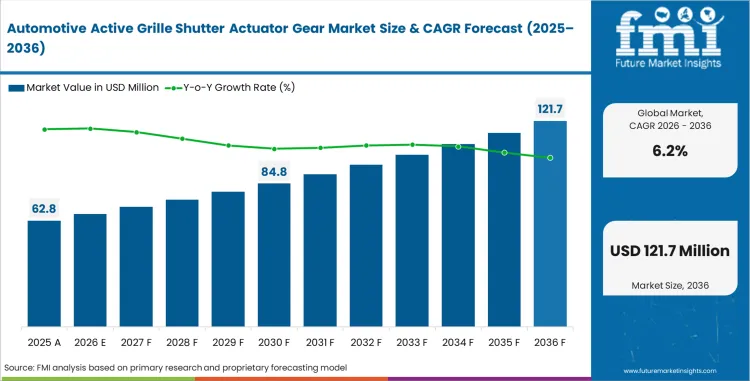
Automotive Active Grille Shutter Actuator Gear Market Key Takeaways
| Metric | Details |
|---|---|
| Industry Size (2026) | USD 62.8 million |
| Industry Value (2036) | USD 114.6 million |
| CAGR (2026-2036) | 6.2% |
Source: Future Market Insights (FMI) analysis, based on proprietary forecasting model and primary research
Engineering teams face intense pressure to maximize range in electric vehicles and fuel efficiency in combustion engines. Thermal management leads must balance cooling requirements against aerodynamic friction penalties. Active aero systems rely heavily on precision gears for active grille shutters to control louvers accurately under high wind loads and freezing conditions. Failure to specify durable components leads to motor stall or stripped teeth, triggering costly warranty claims. Powertrain integrators prioritize polyoxymethylene materials for self-lubricating properties and dimensional stability across extreme temperature gradients. One unexpected dynamic complicating vendor selection is packaging constraint near high-temperature radiators.
Actuator mechanisms operating within millimeters of heat exchangers require advanced resin formulations to prevent thermal degradation over thousands of duty cycles. It has been noted engineers navigating these tight tolerances often over-engineer gear trains, inadvertently increasing weight and cost. Selecting optimal front-end modules necessitates rigorous lifecycle testing under simulated road debris scenarios. Adding a specialized electric motor further complicates integration parameters.
Transitioning to electrified architectures changes thermal demands placed on vehicle front ends. Battery pack cooling requires intermittent but high-volume airflow, contrasting with constant demands of internal combustion engines. This operational shift forces component engineering heads to adopt smarter, faster-acting shutter mechanisms. Once OEMs standardize electronic control units to communicate directly with shutter assemblies, integration accelerates rapidly. Smarter automotive actuator systems capable of micro-adjustments provide significant efficiency gains, making legacy two-position mechanisms obsolete across premium segments.
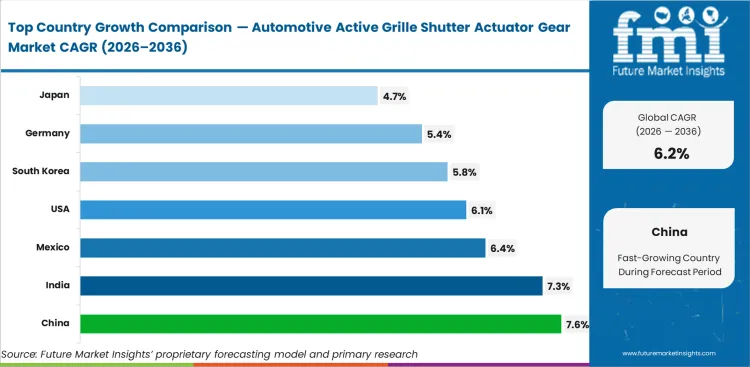
China is anticipated to rise at 7.6% CAGR from 2026 to 2036 driven by aggressive electric vehicle production scaling. India is projected to register a CAGR of 7.3%, supported by rising passenger car production and increasingly stringent domestic emissions regulations. Mexico is anticipated to witness around 6.4% expansion, as North American OEMs continue localizing component sourcing to improve supply chain resilience. The United States is expected to grow at nearly 6.1%, driven by sustained SUV penetration and continued demand for heavy‑duty aerodynamic systems. South Korea is forecast to advance at approximately 5.8%, aided by strong hybrid vehicle exports. Germany is estimated to grow by about 5.4% amid premium automakers’ transition toward electric mobility, while Japan is projected to expand at roughly 4.7%, supported by its entrenched hybrid vehicle ecosystem.
Segmental Analysis
Automotive Active Grille Shutter Actuator Gear Market Analysis by Vehicle Type
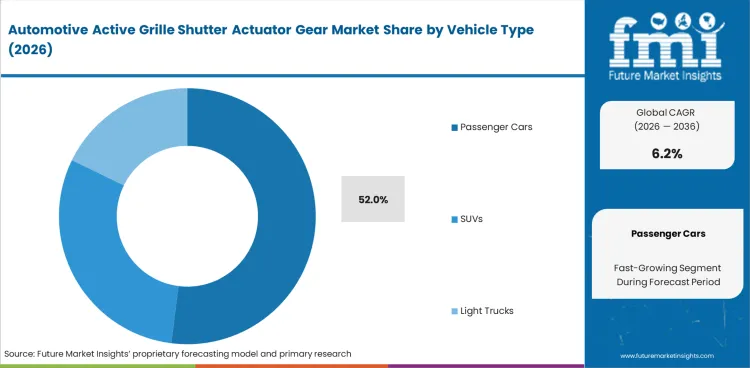
Aerodynamics leads face complex calculations when deciding which platforms receive advanced shutter systems versus static grilles. Passenger cars are projected to command 52.0% share in 2026 as these vehicles require maximum drag coefficient reductions to meet strict fuel economy fleet averages. High production volumes allow component engineering heads to amortize expensive tooling costs associated with precision plastic injection molding.
Incorporating these mechanisms into high-volume sedans and hatchbacks fundamentally alters cooling system design, allowing radiators to shrink slightly due to optimized airflow control. What overall production statistics fail to highlight is how standardizing gear sets across diverse car platforms often forces compromises in motor torque specifications. Attempting to utilize identical active spoiler and grille gear trains on both compacts and full-size sedans occasionally leads to premature wear on heavier louver assemblies. Engineers who ignore platform-specific wind load data risk high warranty claims from stripped teeth operating beyond design limits. This pushes the industry toward custom molded gears for automotive actuators to meet specific aerodynamic loads.
- Torque limits: High-speed driving creates substantial wind resistance against closed louvers. Aerodynamics leads must specify components capable of overcoming this pressure without gear tooth deflection.
- Cold-weather binding: Ice accumulation physically blocks shutter movement during winter conditions. Component engineering heads test parts under extreme freezing to ensure motors stall before internal components shatter.
- Acoustic thresholds: Cabin noise requirements dictate how loudly mechanisms can operate. Quality control teams reject parts producing excessive whining sounds during low-speed actuation sequences.
Automotive Active Grille Shutter Actuator Gear Market Analysis by Material
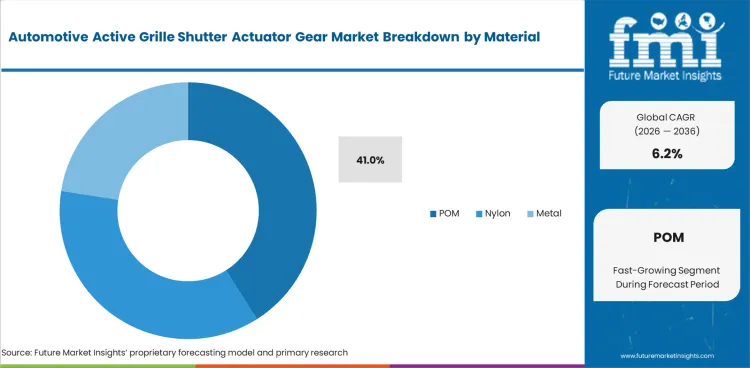
Inherent lubricity and high fatigue resistance drive widespread adoption of polyoxymethylene across automotive mechatronics. Replacing heavy metallic equivalents with advanced polymers yields critical weight savings at vehicle front ends. Transitioning toward engineered plastics fundamentally changes manufacturing workflows, eliminating secondary machining operations required for metal counterparts. POM gears in grille shutter actuators are anticipated to account for 41.0% active grille shutter gear share by material in 2026, representing the default choice for engineers designing mechanisms subjected to continuous rotational wear. One reality rarely discussed outside materials testing laboratories is how certain chemical de-icing sprays degrade specific nylon blends over extended exposure periods. Material science teams working on thermal management assemblies continually adjust resin additives to prevent premature embrittlement caused by winter road chemicals. Failing to validate chemical resistance profiles guarantees field failures after multiple winter seasons, destroying supplier credibility among major automakers.
- Premium platform integration: High-end vehicle designers utilize complex composite blends first. Material science teams validate these expensive formulations to guarantee zero failure rates on flagship models.
- Volume brand transition: Mainstream automakers adopt proven plastic formulations once tooling costs decrease. Manufacturing engineers optimize injection parameters to hit aggressive unit cost targets.
- Aftermarket adoption: Replacement part manufacturers reverse-engineer successful OEM designs. Quality engineers struggle to replicate proprietary resin mixes, often resulting in inferior durability.
Automotive Active Grille Shutter Actuator Gear Market Analysis by Gear Type
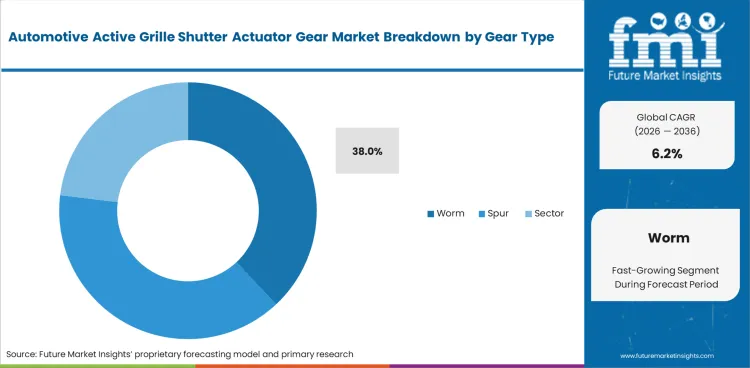
Friction reduction demands conflict directly with holding-torque requirements inside compact motor housings. This advantage allows electrical engineering leads to implement zero-power hold states, conserving battery energy during highway cruising. Specifying this architecture alters internal packaging, requiring perpendicular motor alignments relative to driven shafts. Worm gears for active grille shutter actuators are expected to secure 38.0% share in 2026 because inherent self-locking capability prevents aerodynamic pressure from forcing closed louvers open when motors remain unpowered. What basic schematic diagrams omit is how extreme temperature fluctuations affect grease distribution along helical thread interfaces.Selecting improper tooth geometries or substandard lubrication profiles ensures rapid mechanical degradation inside inaccessible automotive gear reducer housings, necessitating complete module replacement rather than simple component swaps. This operational risk forces OEMs to meticulously evaluate failure modes of AGS actuator gears.
- Tooth shear: High torque loads applied instantly can snap plastic projections. Component engineering heads specify wider root widths to distribute stress across larger surface areas.
- Thermal expansion binding: Different expansion coefficients between plastic parts and metal shafts cause tight clearances to vanish. Design engineers calculate precise tolerances to maintain smooth operation across temperature extremes.
- Lubricant starvation: Centrifugal forces push grease away from friction points. Reliability engineers mandate specialized viscous materials that adhere strongly to working surfaces.
Automotive Active Grille Shutter Actuator Gear Market Analysis by Powertrain Fitment
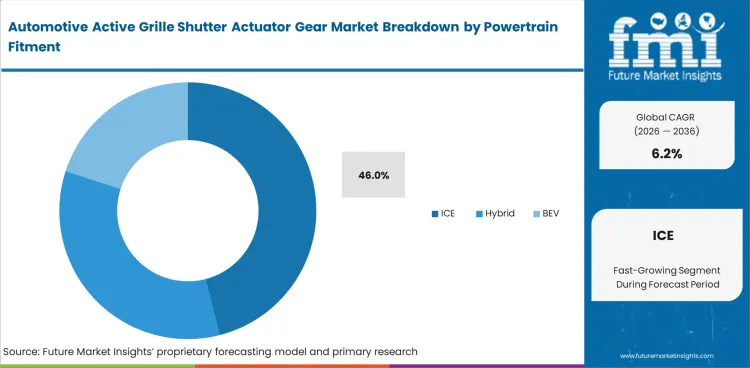
Transitioning toward electric mobility rewrites airflow management protocols at vehicle front ends. Battery electric vehicles require drastically different cooling strategies, opening louvers only during rapid charging sessions or high-load conditions. ICE platforms are estimated to command 46.0% share in 2026, relying on active grilles primarily for accelerating cold-engine warm-up and highway drag reduction. This shift in thermal logic forces management leads to specify actuators capable of much longer dormant periods followed by rapid, precise positioning. Engineers must design EV thermal system components with higher break-away torque capacities to overcome dirt-induced binding after extended closed states. Overlooking this operational nuance results in jammed assemblies triggering software fault codes, forcing frustrating dealership visits for simple cleanings.
- Initial tooling expenditure: Creating high-precision molds requires heavy capital outlays. Manufacturing managers amortize these costs across millions of units to achieve acceptable piece prices.
- Warranty claim impact: Replacing buried front-end components demands extensive labor hours. Platform chief engineers prioritize strong internal parts to avoid severe financial hits from high failure rates.
- Lifecycle cost evaluation: Cheaper materials save pennies upfront but cause expensive field failures. Quality control directors utilize accelerated aging tests to prove long-term value of premium resins.
Automotive Active Grille Shutter Actuator Gear Market Analysis by Sales Channel
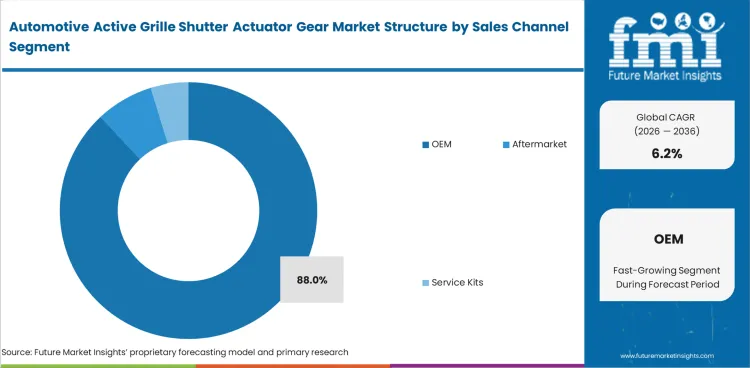
Fragmented repair strategies struggle against integrated module approaches favored by modern assembly lines. FMI analysts note supplying individual components to tier-1 integrators rather than aftermarket retailers ensures predictable volume forecasting and long-term contract stability. OEM channels are projected to secure 88.0% share in 2026 as automakers demand complete, pre-tested mechatronic assemblies delivered directly to production floors. This tight integration forces supply chain managers to maintain flawless delivery metrics, as missing parts halt entire vehicle production lines. What distribution data obscures is how proprietary communication protocols embedded in actuator circuit boards actively discourage aftermarket component substitution. Independent repair technicians attempting to install non-OEM automotive electronics face software calibration errors, effectively locking out unauthorized replacement parts. Suppliers failing to navigate complex tier-1 qualification matrices lose access to high-volume contracts entirely, relegating them to low-margin service kit production.
- Initial validation: Tier-1 integrators demand extensive durability data before considering new suppliers. Component engineering heads review thousands of test cycles simulating decades of field abuse.
- Production qualification: Manufacturing facilities undergo rigorous audits ensuring consistent quality control. Supply chain managers verify raw material traceability and automated inspection capabilities.
- Contract renewal: Consistent zero-defect delivery performance guarantees ongoing business. Quality engineers monitor field failure rates meticulously to defend existing supply agreements against competitors.
Automotive Active Grille Shutter Actuator Gear Market Drivers, Restraints, and Opportunities
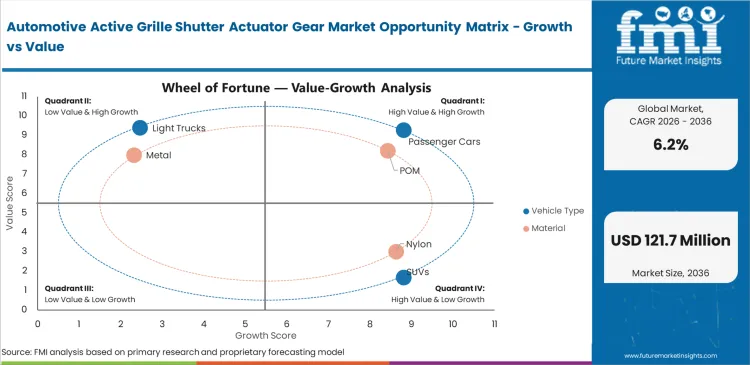
Strict global fuel economy standards force aerodynamics leads to squeeze every possible efficiency gain from vehicle exterior designs. Reducing aerodynamic drag remains one of few cost-effective methods for improving internal combustion mileage and extending electric vehicle battery range. Active aero systems rely fundamentally on precision actuator mechanisms to function reliably under harsh real-world conditions. This commercial reality compels platform chief engineers to integrate motorized shutters across wider model ranges, moving technology from premium segments down to compact vehicles. Without highly reliable internal gearing, these aerodynamic systems fail, negatively impacting certified emission profiles and triggering regulatory penalties.
Material degradation under continuous thermal cycling presents significant friction slowing integration across heavy-duty platforms. Thermal management leads face immense difficulty finding polymer blends capable of surviving decades inside superheated engine bays while remaining resilient during sub-zero cold starts. Traditional plastic formulations become brittle, leading to sudden tooth shear under high wind loads. While advanced hybrid composites offer solutions, high raw material costs disrupt tight bill-of-material budgets. Until material science teams achieve cost parity between high-performance resins and basic polyoxymethylene, integration into budget-conscious commercial vehicles remains limited.
Opportunities in the Automotive Active Grille Shutter Actuator Gear Market
- Compact heavy-duty designs: Component engineering heads require smaller actuator footprints capable of generating heavy torque. Developing miniaturized compound gear sets opens doors to lucrative commercial vehicle thermal system contracts.
- Self-diagnosing modules: Integrating micro-sensors directly into gear housings allows predictive maintenance tracking. Electronics engineering leads favor intelligent systems detecting wear before cooling system failures occur.
- Acoustic optimization: Electric vehicles lack engine noise to mask mechanical whining. Creating ultra-quiet gear trains alongside silent electric power steering motors appeals strongly to acoustic engineers designing premium battery-electric platforms.
Regional Analysis
Based on regional analysis, Automotive Active Grille Shutter Actuator Gear Market is segmented into Asia Pacific, North America, and Europe across 40 plus countries.
.webp "Top Country Growth Comparison Automotive Active Grille Shutter Actuator Gear Market Cagr (2026 2036)")
| Country | CAGR (2026 to 2036) |
|---|---|
| China | 7.6% |
| India | 7.3% |
| Mexico | 6.4% |
| United States | 6.1% |
| South Korea | 5.8% |
| Germany | 5.4% |
| Japan | 4.7% |
Source: Future Market Insights (FMI) analysis, based on proprietary forecasting model and primary research
Asia Pacific Automotive Active Grille Shutter Actuator Gear Market Analysis
Electric vehicle output across Asia Pacific is reshaping how actuator gear programs are sourced and manufactured. Local production economics now favor regional precision molding and shorter component supply loops rather than reliance on imported subassemblies. High-volume vehicle platforms also give manufacturers room to test alternative composite blends that lower unit cost without compromising cycle performance. Competitive pressure across domestic passenger vehicle programs is bringing active aerodynamic content into lower vehicle tiers earlier than expected. Operating conditions remain uneven across the region, so durability targets cannot be standardized across all countries. Components calibrated for smoother urban roads often lose performance faster in dust-heavy, uneven, or water-exposed driving environments, which is pushing localized material and gear-train tuning. Expanded BRIC automotive plastics capacity is helping reduce this localization gap and supports broader regional scale-up.
- China: China is projected to register a CAGR of 7.6% in Automotive Active Grille Shutter Actuator Gear through 2036, supported by large-scale electric vehicle production and deep domestic component manufacturing capacity. Local supply chains continue expanding precision molding capability, which keeps cost competitiveness strong in mechatronic subcomponents and supports wider fitment across high-volume vehicle programs.
- India: The industry is expected to advance at a CAGR of 7.3% through 2036.Passenger vehicle output and tighter emissions alignment are keeping the Automotive Active Grille Shutter Actuator Gear industry in India on an inclining path. Gear-train design in this market is being shaped by dust exposure, water ingress risk, and demanding road conditions.
- South Korea: Export-oriented hybrid and advanced passenger vehicle programs continue supporting the industry outlook, with Automotive Active Grille Shutter Actuator Gear in South Korea anticipated to rise at a CAGR of 5.8% by 2036. South Korea benefits from established electronics integration capability and a vehicle mix that favors precise, compact actuator systems.
- Japan: Priority remains centered on quiet operation, long service life, and tight performance consistency, and the industry in Japan is forecast to record a CAGR of 4.7% through 2036. Long-standing hybrid vehicle production keeps baseline requirement steady for refined shutter actuator systems in Japan.
FMI’s report includes detailed analysis of China, India, South Korea, Japan, Thailand, and other Asia Pacific automotive manufacturing centers, with coverage of production trends, actuator localization, material usage, and forecast movement in Automotive Active Grille Shutter Actuator Gear demand.
North America Automotive Active Grille Shutter Actuator Gear Market Analysis
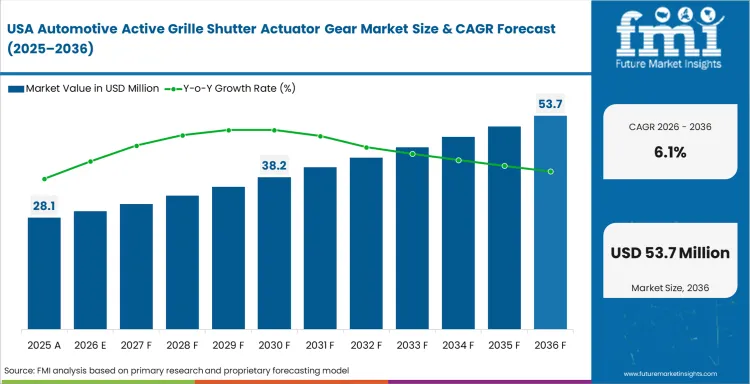
Light trucks and large SUVs set the operating requirements for much of the Automotive Active Grille Shutter Actuator Gear industry in North America. Wide grille openings increase mechanical load on shutter systems, which raises the torque burden on compact actuator motors and the internal gears that transfer that motion. Gear-train design in this region therefore depends on force multiplication within tight packaging limits, especially where large frontal areas are involved. Material selection also carries more weight here because repeated load cycles, highway-speed airflow, and seasonal temperature swings raise the risk of tooth wear and deformation. Winter operation adds another layer of strain, since ice buildup can sharply increase breakaway force during shutter movement. Programs that pair reinforced gear design with tighter electronic load control are better positioned to limit service-life erosion in cold-weather use.
- Mexico: Automotive active grille shutter actuator gear demand in Mexico is projected to grow at an estimated CAGR of 6.4% through 2036. The country’s strong integration with North American vehicle assembly continues to underpin market expansion, supported by high‑volume injection molding capabilities and efficient cross‑border supply chains. These structural advantages sustain Mexico’s role as a cost‑competitive manufacturing hub for AGS actuator components.
- United States: The United States is forecast to register growth at a CAGR of approximately 6.1% through 2036. Broad climatic exposure, ranging from extreme heat to snow and long‑distance highway usage, drives higher durability expectations for actuator gear systems. Persistent dominance of large SUVs and pickup‑based platforms keeps active grille shutter content relevant within fuel‑efficiency and thermal‑management programs.
FMI’s report includes assessment of the United States, Mexico, and Canada, with focus on light truck and SUV platform requirements, durability expectations, regional manufacturing concentration, and forecast direction for Automotive Active Grille Shutter Actuator Gear across North America.
Europe Automotive Active Grille Shutter Actuator Gear Market Analysis
Premium vehicle programs and the shift toward electric mobility continue shaping actuator gear specifications across Europe. Product development in the region places greater emphasis on quiet operation, tight integration, and reliable long-cycle performance than on simple unit-cost reduction. Material choice and gear geometry are therefore being refined for smoother engagement, lower friction, and better under-hood durability in compact actuator packages. Entry barriers remain relatively high because precision molding quality, dimensional consistency, and acoustic performance all matter more in premium vehicle platforms.
High-speed driving conditions also influence gear requirements in parts of the region, as sustained airflow loads can place reverse force on closed shutter systems. Worm-based layouts remain important in such applications because they help retain position under aerodynamic load without sacrificing compact packaging. Integrated automotive smart surface modules can conceal much of this mechanism, but the internal gear requirement remains technically demanding.
- Germany: Germany is projected to record a CAGR of around 5.4% through 2036 in the Automotive Active Grille Shutter Actuator Gear market. Ongoing emphasis on premium vehicle engineering continues to drive demand for highly precise and low‑noise mechatronic assemblies, keeping material performance, acoustic control, and dimensional consistency central to the country’s market outlook.
FMI’s report includes coverage of Germany, France, Italy, Spain, the United Kingdom, and other key European automotive hubs, with analysis of premium vehicle engineering requirements, actuator refinement trends, material performance priorities, and Automotive Active Grille Shutter Actuator Gear outlook through 2036.
Competitive Aligners for Market Players
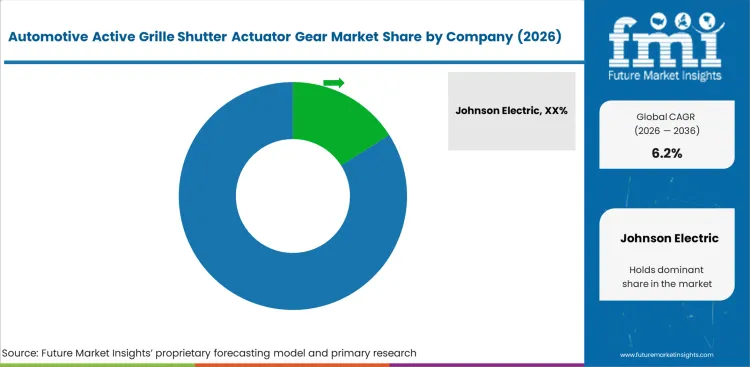
Supply chain dominance in automotive mechatronics relies heavily on controlling specialized injection molding capabilities and proprietary material formulations. Companies like Johnson Electric and Valeo maintain strong positions because they offer complete, pre-validated actuator modules rather than isolated components. Component engineering heads heavily favor suppliers delivering fully tested units, offloading significant integration risk from automaker shoulders. This dynamic forces smaller automotive grille shutter gear manufacturers to either develop advanced system-level testing capabilities or accept lower-margin roles as sub-tier part providers. Competition centers on raw unit pricing and on demonstrated field reliability data prioritizing reliability seen in automotive active roll control modules.
Incumbents possess deep libraries of validated thermal shock data and established relationships with global resin suppliers. AGS actuator gear suppliers leverage decades of aerodynamic system design to optimize internal gear geometries specifically for automotive front-end environments. These companies possess proprietary thermal management technologies balancing lubricity, strength, and acoustic dampening perfectly. Challengers attempting to replicate these OEM validated gears for grille shutter actuators often discover visual duplication fails to capture critical molecular alignments achieved during specialized molding processes. Overcoming this capability gap requires heavy capital investment in precision tooling and exhaustive physical testing regimens.
Tier-1 integrators fiercely defend intellectual property regarding tooth profiles and zero-backlash designs. Large automakers combat single-source dependencies by forcing suppliers to license critical interfaces or adopt standardized mounting points. This specific tension shapes how companies approach new vehicle contracts, balancing proprietary innovations against OEM demands for interchangeable components. Success requires developing intelligent actuators capable of self-diagnosing wear patterns, shifting value away from raw mechanical strength toward embedded electronic monitoring capabilities matching epb actuator sophistication.
Key Players in Automotive Active Grille Shutter Actuator Gear Market
- Johnson Electric
- Padmini VNA Mechatronics
- Magna International
- Valeo
- AISIN
- Röchling Automotive
- OPmobility
Scope of the Report
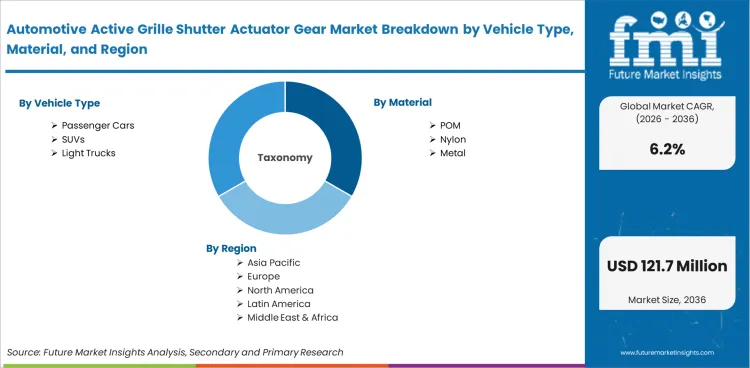
| Metric | Value |
|---|---|
| Quantitative Units | USD 62.8 million to USD 114.6 million, at a CAGR of 6.2% |
| Market Definition | Automotive active grille shutter actuator gear components represent mechanical force-transmission elements inside motorized assemblies controlling airflow into vehicle engine compartments. |
| Segmentation | By vehicle type, By material, By gear type, By powertrain fitment, By sales channel, Region |
| Regions Covered | North America, Latin America, Europe, Asia Pacific, Middle East and Africa |
| Countries Covered | United States, Canada, Brazil, Mexico, Germany, United Kingdom, France, Spain, Italy, China, Japan, South Korea, India, GCC Countries, South Africa |
| Key Companies Profiled | Johnson Electric, Padmini VNA Mechatronics, Magna International, Valeo, AISIN, Röchling Automotive, OPmobility |
| Forecast Period | 2026 to 2036 |
| Approach | Annual vehicle production volumes multiplied by active aero system penetration rates per region. |
Source: Future Market Insights (FMI) analysis, based on proprietary forecasting model and primary research
Automotive Active Grille Shutter Actuator Gear Market Analysis by Segments
By Vehicle Type:
- Passenger Cars
- SUVs
- Light Trucks
- Commercial Vehicles
By Material:
- POM
- Nylon
- Metal
- Hybrid Composites
By Gear Type:
- Worm Gears
- Spur Gears
- Sector Gears
- Compound Gears
By Powertrain Fitment:
- ICE
- Hybrid
- BEV
- PHEV
By Sales Channel:
- OEM
- Aftermarket
- Service Kits
Region:
- North America
- Latin America
- Europe
- Asia Pacific
- Middle East and Africa
Bibliography
- European Automobile Manufacturers' Association. (2025, March 13). Economic and Market Report: Global and EU auto industry - Full year 2024.
- International Energy Agency. (2025). Global EV Outlook 2025.
- International Organization of Motor Vehicle Manufacturers. (2025). World motor vehicle production by country/region and type: 2024.
- Johnson Electric Holdings Limited. (2025, May 28). Johnson Electric reports results for the year ended 31 March 2025.
- Magna International Inc. (2025). 2024 Annual Report.
This bibliography is provided for reader reference. The full FMI report contains the complete reference list with primary source documentation.
This Report Addresses
- Component engineering heads evaluating polyoxymethylene materials against hybrid composite alternatives.
- Aerodynamics leads calculating holding torque requirements for high-speed highway driving conditions.
- Thermal management engineers specifying cold-weather operation tolerances for battery electric vehicles.
- Supply chain managers mapping regional molding capabilities across Asian and North American hubs.
- Platform chief engineers balancing noise-vibration-harshness constraints within premium European platforms.
- Manufacturing directors estimating capital expenditures required for high-precision compound gear tooling.
- Quality control teams establishing accelerated aging protocols for chemical resistance validation.
- Electronics engineering leads integrating predictive maintenance sensors into legacy mechanical housings.
Frequently Asked Questions
What is the active grille shutter actuator gear market size in 2026?
Sector valuation is estimated to reach USD 62.8 million in 2026, driven by aerodynamic efficiency mandates.
Give me the market size of automotive active grille shutter actuator gears by 2036.
Demand is projected to hit USD 114.6 million by 2036 across global electrified vehicle architectures.
What is the AGS actuator gear CAGR 2026 2036?
Forecast models project a 6.2% compound annual growth rate through 2036.
Why do passenger cars command highest vehicle type share?
Strict fuel economy fleet averages compel aerodynamics leads to specify active shutters on high-volume sedan platforms.
Why does polyoxymethylene dominate material specifications?
Thermal management leads rely on POM for its inherent self-lubricating properties under continuous rotational wear.
Why are worm gears used in grille shutter actuators?
Unique self-locking characteristics prevent wind pressure from back-driving closed louvers when motors are unpowered.
How does ICE fitment impact component usage?
Internal combustion engines rely on shutters for rapid cold-start warm-up routines, dictating highly durable components.
Why do OEM channels command distribution pathways?
Automakers demand fully integrated, pre-tested front-end modules, making independent aftermarket replacement extremely difficult.
Which countries are growing fastest for AGS actuator gears?
China is projected to register growth at an estimated CAGR of 7.6% through 2036, driven by aggressive electric vehicle production targets and localized component sourcing mandates.
How does India compare to China?
India is expected to follow closely with a projected CAGR of 7.3%, supported by rising vehicle output and demand for ruggedized ICE‑focused actuator systems designed to operate reliably under severe monsoon and road‑condition challenges.
What specific mechanical failure plagues cold-weather regions?
Actuator motors generating heavy torque frequently strip internal plastic gear teeth attempting to force frozen louvers open.
How do engineers prevent winter tooth shear?
Component engineering heads specify wider root widths, hybrid composite materials, and electronic current-limiting software safeguards.
What limits commercial vehicle adoption?
Heavy-duty trucks require heavy louver systems exceeding standard motor torque limits, disrupting tight bill-of-material budgets.
Can EVs use active grille shutter actuators?
Yes, electric platforms keep shutters closed significantly longer to maximize aerodynamic range, requiring specialized component design.
Why do aftermarket replacement parts fail frequently?
Minor deviations in polymer additives drastically reduce long-term fatigue resistance inside replacement actuator housings.
What pushes supply chain managers toward advanced composite blends?
Weight reduction mandates compel replacing legacy metallic gears with advanced plastics matching metal strength.
How does high-speed highway driving affect actuator design?
Aerodynamics leads must specify self-locking gear geometries preventing aerodynamic forces from overpowering electrical holding torque.
What acoustic challenges emerge in electric vehicle applications?
Acoustic engineers demand ultra-quiet gear trains utilizing specialized noise-dampening polymers for premium models without engine noise.
Who are the key suppliers of grille shutter actuator gears?
Leading AGS actuator gear suppliers include Johnson Electric, Padmini VNA Mechatronics, Magna International, Valeo, and AISIN.
How do proprietary communication protocols affect component replacement?
Installing unauthorized replacement gears triggers system fault codes, effectively locking out aftermarket competitors.
Preview the report firsthand - request a free sample
Get SampleGet the brochure for pricing and purchase details.
Get PDFTable of Content
- Executive Summary
- Global Market Outlook
- Demand-side Trends
- Supply-side Trends
- Technology Roadmap Analysis
- Analysis and Recommendations
- Market Overview
- Market Coverage / Taxonomy
- Market Definition / Scope / Limitations
- Research Methodology
- Chapter Orientation
- Analytical Lens and Working Hypotheses
- Market Structure, Signals, and Trend Drivers
- Benchmarking and Cross-market Comparability
- Market Sizing, Forecasting, and Opportunity Mapping
- Research Design and Evidence Framework
- Desk Research Programme (Secondary Evidence)
- Company Annual and Sustainability Reports
- Peer-reviewed Journals and Academic Literature
- Corporate Websites, Product Literature, and Technical Notes
- Earnings Decks and Investor Briefings
- Statutory Filings and Regulatory Disclosures
- Technical White Papers and Standards Notes
- Trade Journals, Industry Magazines, and Analyst Briefs
- Conference Proceedings, Webinars, and Seminar Materials
- Government Statistics Portals and Public Data Releases
- Press Releases and Reputable Media Coverage
- Specialist Newsletters and Curated Briefings
- Sector Databases and Reference Repositories
- FMI Internal Proprietary Databases and Historical Market Datasets
- Subscription Datasets and Paid Sources
- Social Channels, Communities, and Digital Listening Inputs
- Additional Desk Sources
- Expert Input and Fieldwork (Primary Evidence)
- Primary Modes
- Qualitative Interviews and Expert Elicitation
- Quantitative Surveys and Structured Data Capture
- Blended Approach
- Why Primary Evidence is Used
- Field Techniques
- Interviews
- Surveys
- Focus Groups
- Observational and In-context Research
- Social and Community Interactions
- Stakeholder Universe Engaged
- C-suite Leaders
- Board Members
- Presidents and Vice Presidents
- R&D and Innovation Heads
- Technical Specialists
- Domain Subject-matter Experts
- Scientists
- Physicians and Other Healthcare Professionals
- Governance, Ethics, and Data Stewardship
- Research Ethics
- Data Integrity and Handling
- Primary Modes
- Tooling, Models, and Reference Databases
- Desk Research Programme (Secondary Evidence)
- Data Engineering and Model Build
- Data Acquisition and Ingestion
- Cleaning, Normalisation, and Verification
- Synthesis, Triangulation, and Analysis
- Quality Assurance and Audit Trail
- Market Background
- Market Dynamics
- Drivers
- Restraints
- Opportunity
- Trends
- Scenario Forecast
- Demand in Optimistic Scenario
- Demand in Likely Scenario
- Demand in Conservative Scenario
- Opportunity Map Analysis
- Product Life Cycle Analysis
- Supply Chain Analysis
- Investment Feasibility Matrix
- Value Chain Analysis
- PESTLE and Porter’s Analysis
- Regulatory Landscape
- Regional Parent Market Outlook
- Production and Consumption Statistics
- Import and Export Statistics
- Market Dynamics
- Global Market Analysis 2021 to 2025 and Forecast, 2026 to 2036
- Historical Market Size Value (USD Million) Analysis, 2021 to 2025
- Current and Future Market Size Value (USD Million) Projections, 2026 to 2036
- Y-o-Y Growth Trend Analysis
- Absolute $ Opportunity Analysis
- Global Market Pricing Analysis 2021 to 2025 and Forecast 2026 to 2036
- Global Market Analysis 2021 to 2025 and Forecast 2026 to 2036, By Vehicle Type
- Introduction / Key Findings
- Historical Market Size Value (USD Million) Analysis By Vehicle Type , 2021 to 2025
- Current and Future Market Size Value (USD Million) Analysis and Forecast By Vehicle Type , 2026 to 2036
- Passenger Cars
- SUVs
- Light Trucks
- Passenger Cars
- Y-o-Y Growth Trend Analysis By Vehicle Type , 2021 to 2025
- Absolute $ Opportunity Analysis By Vehicle Type , 2026 to 2036
- Global Market Analysis 2021 to 2025 and Forecast 2026 to 2036, By Material
- Introduction / Key Findings
- Historical Market Size Value (USD Million) Analysis By Material, 2021 to 2025
- Current and Future Market Size Value (USD Million) Analysis and Forecast By Material, 2026 to 2036
- POM
- Nylon
- Metal
- POM
- Y-o-Y Growth Trend Analysis By Material, 2021 to 2025
- Absolute $ Opportunity Analysis By Material, 2026 to 2036
- Global Market Analysis 2021 to 2025 and Forecast 2026 to 2036, By Gear Type
- Introduction / Key Findings
- Historical Market Size Value (USD Million) Analysis By Gear Type, 2021 to 2025
- Current and Future Market Size Value (USD Million) Analysis and Forecast By Gear Type, 2026 to 2036
- Worm
- Spur
- Sector
- Worm
- Y-o-Y Growth Trend Analysis By Gear Type, 2021 to 2025
- Absolute $ Opportunity Analysis By Gear Type, 2026 to 2036
- Global Market Analysis 2021 to 2025 and Forecast 2026 to 2036, By Powertrain Fitment
- Introduction / Key Findings
- Historical Market Size Value (USD Million) Analysis By Powertrain Fitment, 2021 to 2025
- Current and Future Market Size Value (USD Million) Analysis and Forecast By Powertrain Fitment, 2026 to 2036
- ICE
- Hybrid
- BEV
- ICE
- Y-o-Y Growth Trend Analysis By Powertrain Fitment, 2021 to 2025
- Absolute $ Opportunity Analysis By Powertrain Fitment, 2026 to 2036
- Global Market Analysis 2021 to 2025 and Forecast 2026 to 2036, By Sales Channel
- Introduction / Key Findings
- Historical Market Size Value (USD Million) Analysis By Sales Channel, 2021 to 2025
- Current and Future Market Size Value (USD Million) Analysis and Forecast By Sales Channel, 2026 to 2036
- OEM
- Aftermarket
- Service Kits
- OEM
- Y-o-Y Growth Trend Analysis By Sales Channel, 2021 to 2025
- Absolute $ Opportunity Analysis By Sales Channel, 2026 to 2036
- Global Market Analysis 2021 to 2025 and Forecast 2026 to 2036, By Region
- Introduction
- Historical Market Size Value (USD Million) Analysis By Region, 2021 to 2025
- Current Market Size Value (USD Million) Analysis and Forecast By Region, 2026 to 2036
- North America
- Latin America
- Western Europe
- Eastern Europe
- East Asia
- South Asia and Pacific
- Middle East & Africa
- Market Attractiveness Analysis By Region
- North America Market Analysis 2021 to 2025 and Forecast 2026 to 2036, By Country
- Historical Market Size Value (USD Million) Trend Analysis By Market Taxonomy, 2021 to 2025
- Market Size Value (USD Million) Forecast By Market Taxonomy, 2026 to 2036
- By Country
- USA
- Canada
- Mexico
- By Vehicle Type
- By Material
- By Gear Type
- By Powertrain Fitment
- By Sales Channel
- By Country
- Market Attractiveness Analysis
- By Country
- By Vehicle Type
- By Material
- By Gear Type
- By Powertrain Fitment
- By Sales Channel
- Key Takeaways
- Latin America Market Analysis 2021 to 2025 and Forecast 2026 to 2036, By Country
- Historical Market Size Value (USD Million) Trend Analysis By Market Taxonomy, 2021 to 2025
- Market Size Value (USD Million) Forecast By Market Taxonomy, 2026 to 2036
- By Country
- Brazil
- Chile
- Rest of Latin America
- By Vehicle Type
- By Material
- By Gear Type
- By Powertrain Fitment
- By Sales Channel
- By Country
- Market Attractiveness Analysis
- By Country
- By Vehicle Type
- By Material
- By Gear Type
- By Powertrain Fitment
- By Sales Channel
- Key Takeaways
- Western Europe Market Analysis 2021 to 2025 and Forecast 2026 to 2036, By Country
- Historical Market Size Value (USD Million) Trend Analysis By Market Taxonomy, 2021 to 2025
- Market Size Value (USD Million) Forecast By Market Taxonomy, 2026 to 2036
- By Country
- Germany
- UK
- Italy
- Spain
- France
- Nordic
- BENELUX
- Rest of Western Europe
- By Vehicle Type
- By Material
- By Gear Type
- By Powertrain Fitment
- By Sales Channel
- By Country
- Market Attractiveness Analysis
- By Country
- By Vehicle Type
- By Material
- By Gear Type
- By Powertrain Fitment
- By Sales Channel
- Key Takeaways
- Eastern Europe Market Analysis 2021 to 2025 and Forecast 2026 to 2036, By Country
- Historical Market Size Value (USD Million) Trend Analysis By Market Taxonomy, 2021 to 2025
- Market Size Value (USD Million) Forecast By Market Taxonomy, 2026 to 2036
- By Country
- Russia
- Poland
- Hungary
- Balkan & Baltic
- Rest of Eastern Europe
- By Vehicle Type
- By Material
- By Gear Type
- By Powertrain Fitment
- By Sales Channel
- By Country
- Market Attractiveness Analysis
- By Country
- By Vehicle Type
- By Material
- By Gear Type
- By Powertrain Fitment
- By Sales Channel
- Key Takeaways
- East Asia Market Analysis 2021 to 2025 and Forecast 2026 to 2036, By Country
- Historical Market Size Value (USD Million) Trend Analysis By Market Taxonomy, 2021 to 2025
- Market Size Value (USD Million) Forecast By Market Taxonomy, 2026 to 2036
- By Country
- China
- Japan
- South Korea
- By Vehicle Type
- By Material
- By Gear Type
- By Powertrain Fitment
- By Sales Channel
- By Country
- Market Attractiveness Analysis
- By Country
- By Vehicle Type
- By Material
- By Gear Type
- By Powertrain Fitment
- By Sales Channel
- Key Takeaways
- South Asia and Pacific Market Analysis 2021 to 2025 and Forecast 2026 to 2036, By Country
- Historical Market Size Value (USD Million) Trend Analysis By Market Taxonomy, 2021 to 2025
- Market Size Value (USD Million) Forecast By Market Taxonomy, 2026 to 2036
- By Country
- India
- ASEAN
- Australia & New Zealand
- Rest of South Asia and Pacific
- By Vehicle Type
- By Material
- By Gear Type
- By Powertrain Fitment
- By Sales Channel
- By Country
- Market Attractiveness Analysis
- By Country
- By Vehicle Type
- By Material
- By Gear Type
- By Powertrain Fitment
- By Sales Channel
- Key Takeaways
- Middle East & Africa Market Analysis 2021 to 2025 and Forecast 2026 to 2036, By Country
- Historical Market Size Value (USD Million) Trend Analysis By Market Taxonomy, 2021 to 2025
- Market Size Value (USD Million) Forecast By Market Taxonomy, 2026 to 2036
- By Country
- Kingdom of Saudi Arabia
- Other GCC Countries
- Turkiye
- South Africa
- Other African Union
- Rest of Middle East & Africa
- By Vehicle Type
- By Material
- By Gear Type
- By Powertrain Fitment
- By Sales Channel
- By Country
- Market Attractiveness Analysis
- By Country
- By Vehicle Type
- By Material
- By Gear Type
- By Powertrain Fitment
- By Sales Channel
- Key Takeaways
- Key Countries Market Analysis
- USA
- Pricing Analysis
- Market Share Analysis, 2025
- By Vehicle Type
- By Material
- By Gear Type
- By Powertrain Fitment
- By Sales Channel
- Canada
- Pricing Analysis
- Market Share Analysis, 2025
- By Vehicle Type
- By Material
- By Gear Type
- By Powertrain Fitment
- By Sales Channel
- Mexico
- Pricing Analysis
- Market Share Analysis, 2025
- By Vehicle Type
- By Material
- By Gear Type
- By Powertrain Fitment
- By Sales Channel
- Brazil
- Pricing Analysis
- Market Share Analysis, 2025
- By Vehicle Type
- By Material
- By Gear Type
- By Powertrain Fitment
- By Sales Channel
- Chile
- Pricing Analysis
- Market Share Analysis, 2025
- By Vehicle Type
- By Material
- By Gear Type
- By Powertrain Fitment
- By Sales Channel
- Germany
- Pricing Analysis
- Market Share Analysis, 2025
- By Vehicle Type
- By Material
- By Gear Type
- By Powertrain Fitment
- By Sales Channel
- UK
- Pricing Analysis
- Market Share Analysis, 2025
- By Vehicle Type
- By Material
- By Gear Type
- By Powertrain Fitment
- By Sales Channel
- Italy
- Pricing Analysis
- Market Share Analysis, 2025
- By Vehicle Type
- By Material
- By Gear Type
- By Powertrain Fitment
- By Sales Channel
- Spain
- Pricing Analysis
- Market Share Analysis, 2025
- By Vehicle Type
- By Material
- By Gear Type
- By Powertrain Fitment
- By Sales Channel
- France
- Pricing Analysis
- Market Share Analysis, 2025
- By Vehicle Type
- By Material
- By Gear Type
- By Powertrain Fitment
- By Sales Channel
- India
- Pricing Analysis
- Market Share Analysis, 2025
- By Vehicle Type
- By Material
- By Gear Type
- By Powertrain Fitment
- By Sales Channel
- ASEAN
- Pricing Analysis
- Market Share Analysis, 2025
- By Vehicle Type
- By Material
- By Gear Type
- By Powertrain Fitment
- By Sales Channel
- Australia & New Zealand
- Pricing Analysis
- Market Share Analysis, 2025
- By Vehicle Type
- By Material
- By Gear Type
- By Powertrain Fitment
- By Sales Channel
- China
- Pricing Analysis
- Market Share Analysis, 2025
- By Vehicle Type
- By Material
- By Gear Type
- By Powertrain Fitment
- By Sales Channel
- Japan
- Pricing Analysis
- Market Share Analysis, 2025
- By Vehicle Type
- By Material
- By Gear Type
- By Powertrain Fitment
- By Sales Channel
- South Korea
- Pricing Analysis
- Market Share Analysis, 2025
- By Vehicle Type
- By Material
- By Gear Type
- By Powertrain Fitment
- By Sales Channel
- Russia
- Pricing Analysis
- Market Share Analysis, 2025
- By Vehicle Type
- By Material
- By Gear Type
- By Powertrain Fitment
- By Sales Channel
- Poland
- Pricing Analysis
- Market Share Analysis, 2025
- By Vehicle Type
- By Material
- By Gear Type
- By Powertrain Fitment
- By Sales Channel
- Hungary
- Pricing Analysis
- Market Share Analysis, 2025
- By Vehicle Type
- By Material
- By Gear Type
- By Powertrain Fitment
- By Sales Channel
- Kingdom of Saudi Arabia
- Pricing Analysis
- Market Share Analysis, 2025
- By Vehicle Type
- By Material
- By Gear Type
- By Powertrain Fitment
- By Sales Channel
- Turkiye
- Pricing Analysis
- Market Share Analysis, 2025
- By Vehicle Type
- By Material
- By Gear Type
- By Powertrain Fitment
- By Sales Channel
- South Africa
- Pricing Analysis
- Market Share Analysis, 2025
- By Vehicle Type
- By Material
- By Gear Type
- By Powertrain Fitment
- By Sales Channel
- USA
- Market Structure Analysis
- Competition Dashboard
- Competition Benchmarking
- Market Share Analysis of Top Players
- By Regional
- By Vehicle Type
- By Material
- By Gear Type
- By Powertrain Fitment
- By Sales Channel
- Competition Analysis
- Competition Deep Dive
- Johnson Electric
- Overview
- Product Portfolio
- Profitability by Market Segments (Product/Age /Sales Channel/Region)
- Sales Footprint
- Strategy Overview
- Marketing Strategy
- Product Strategy
- Channel Strategy
- Padmini VNA Mechatronics
- Magna International
- Valeo
- AISIN
- Röchling Automotive
- OPmobility
- Johnson Electric
- Competition Deep Dive
- Assumptions & Acronyms Used


