

- Industry Size (2026)
- USD 76.4 Mn
- Forecast (2036)
- USD 275.9 Mn
- CAGR (2026 to 2036)
- 13.7%
Automotive Charge Port Actuator Market Size, Market Forecast and Outlook By FMI
The automotive charge port actuator market was valued at USD 67.2 million in 2025. FMI estimates the market will reach USD 76.4 million in 2026 and rise to USD 275.9 million by 2036, registering a 13.7% CAGR over the forecast period. Growth is being supported by EV programs that are replacing manual charge-port access with automated systems designed to match connected vehicle functionality and more premium exterior execution.
Report Summary
- The market is forecast to reach USD 275.9 million by 2036.
- The market is expected to grow at a CAGR of 13.7% from 2026 to 2036.
- The market was estimated at USD 67.2 million in 2025.
- The forecast period represents an incremental opportunity of USD 200.0 million.
- The market is projected to reach USD 76.4 million in 2026.
- Battery electric vehicles (BEVs) dominate the segment with a 72.0% share.
- Smart BLDC actuators lead the actuation type segment with a 48.0% share.
- Automatic systems account for 61.0% of operation type, reflecting strong OEM preference for powered charge-port access.
- Integrated modules hold 57.0% share, driven by demand for compact, preassembled mechatronic solutions.
- OEM sales channel dominates with 88.0% share, as systems are integrated during vehicle production.
- Key companies in the market include Magna International, WITTE Automotive, Motion Controls International, Minebea AccessSolutions, Padmini VNA Mechatronics, and Marquardt.
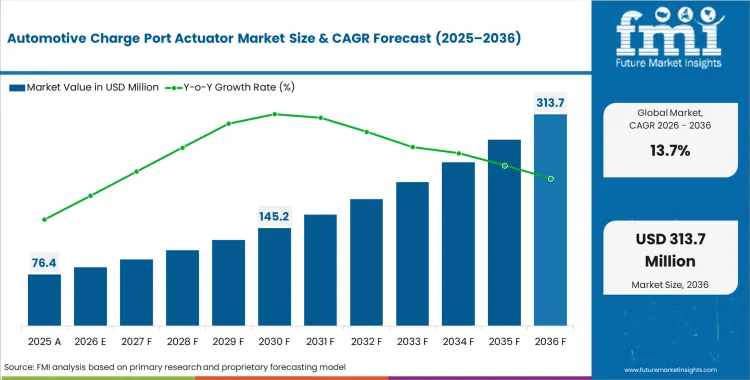
Charge-port access is becoming part of the broader vehicle interaction system rather than a simple hardware feature. As EV platforms adopt phone-as-a-key functions, remote access controls, and more tightly integrated body electronics, manufacturers are moving away from basic push-latch designs toward powered opening mechanisms. Early placement of the automotive electric actuator within the vehicle program matters because actuator packaging affects flap geometry, sheet metal clearances, sealing strategy, and inlet-zone component layout. Flush body surfaces are adding to that pressure, since cleaner exterior styling leaves less scope for recessed manual handling features. Ease of use remains important, but the stronger commercial driver is the need to align charging access hardware with locking logic, electronic controls, and exterior design standards already being built into next-generation EV platforms.
Volume adoption improves when vehicle designs shift toward concealed charging interfaces that open through fully managed motion rather than simple mechanical release. That change increases the technical role of the actuator because it must deliver repeatable movement within a tight package while also meeting cycle-life and weather-resistance targets. The component is also moving beyond a single-purpose opening function as manufacturers look for more integrated kinematics around charge-port security and controlled access. Based on FMI’s analysis, this evolution is steadily strengthening the position of charge port actuators in EV architectures where exterior refinement and system integration carry greater product value.
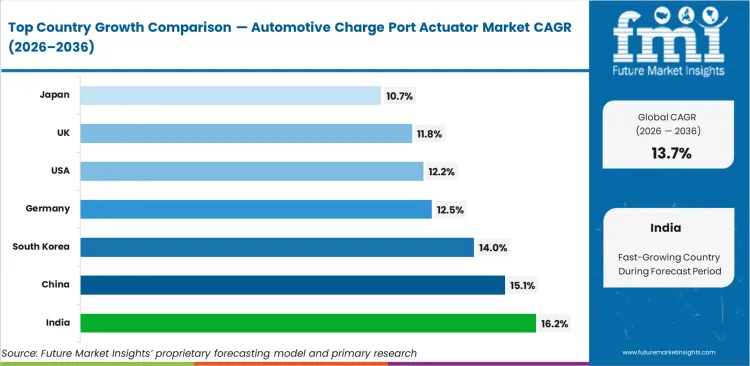
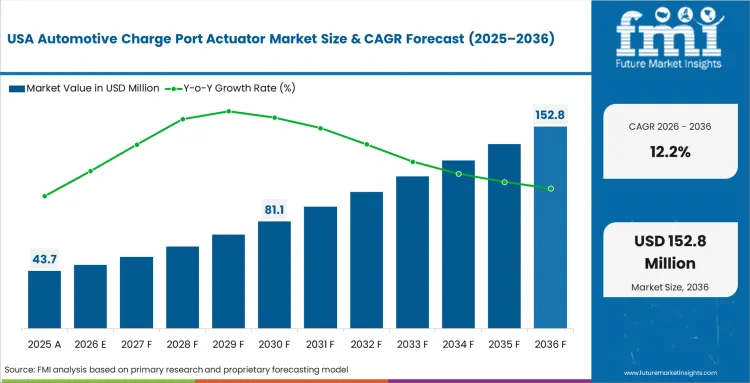
India is poised to expand at a 16.2% CAGR through 2036 as domestic EV manufacturers use motorized charging flaps to improve feature differentiation in early model launches. China is expected to grow at 15.1% CAGR over the forecast period, supported by large-scale EV production and more standardized charging infrastructure. South Korea is estimated to register a 14.0% CAGR through 2036 as premium electric vehicle programs continue to widen actuator use in exterior access systems. Germany is projected to rise at 12.5% CAGR, with luxury vehicle platforms sustaining demand for more advanced charging interface execution. In the United States, the market is anticipated to grow at a 12.2% CAGR through 2036 as electric pickups and larger EV platforms move further into production. The United Kingdom is estimated to expand at 11.8% CAGR, while Japan is projected to record 10.7% CAGR over the same period. Market differences across these countries continue to reflect whether manufacturers are prioritizing lower hardware cost or placing greater emphasis on connected features and higher-end exterior integration.
Segmental Analysis
Automotive Charge Port Actuator Market Analysis by Vehicle Type
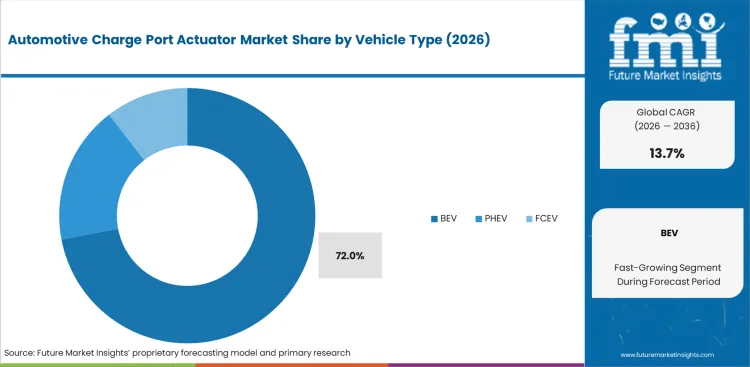
BEV is estimated to account for 72.0% share in 2026. Dedicated battery-electric platforms operate with much higher charging frequency than hybrid layouts, which raises durability requirements for actuator systems. Suppliers therefore prioritize these programs because repeated daily flap operation changes long-term wear exposure and warranty risk. Shared body-panel architecture in plug-in hybrids also restricts space available for complex EV charge port covers, limiting design flexibility. Weak cycle-life assumptions at the sourcing stage usually translate into more service interventions once vehicles enter regular use. High-use BEV platforms therefore remain the primary demand base for advanced actuator designs.
- Initial specification: Firms define actuator requirements around expected charging-cycle counts across a ten-year vehicle life.
- Validation testing: Prototype systems must clear icing and dust-chamber trials, with failed ice-break performance leading to immediate rejection.
- Volume expansion: Once proven on flagship programs, actuator designs are commonly rolled into higher-volume entry models.
Automotive Charge Port Actuator Market Analysis by Actuation Type
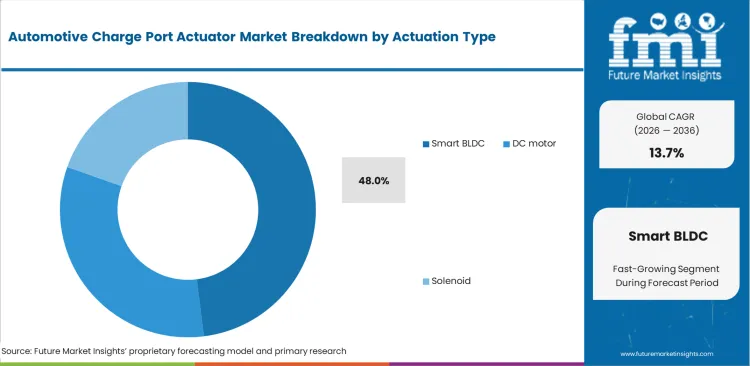
Motion quality and local intelligence are becoming central to charge-port access design. Smart BLDC category is poised to hold 48.0% share in 2026 because vehicle programs increasingly require smoother movement, local communication capability, and obstacle detection in a single compact unit. Basic solenoids and low-cost motor options struggle to deliver the controlled motion expected in newer vehicle designs. That gap becomes more visible when systems must reverse direction after detecting frozen or obstructed EV charging cables near the flap area. Lower-cost motor choices can reduce upfront component spend, but they usually create higher complaint rates tied to harsh movement, trapped objects, or inconsistent actuation. This keeps smart BLDC systems better aligned with current vehicle integration requirements.
- Sourcing savings: Buyers assess full ownership cost by factoring in the reduced need for separate external sensing hardware.
- Operational hidden costs: Service diagnostics take longer when replacement motors cannot report fault conditions to the vehicle network.
- Lifecycle comparison: Higher brushless motor cost is often offset by fewer field failures over the operating life of the actuator.
Automotive Charge Port Actuator Market Analysis by Operation Type
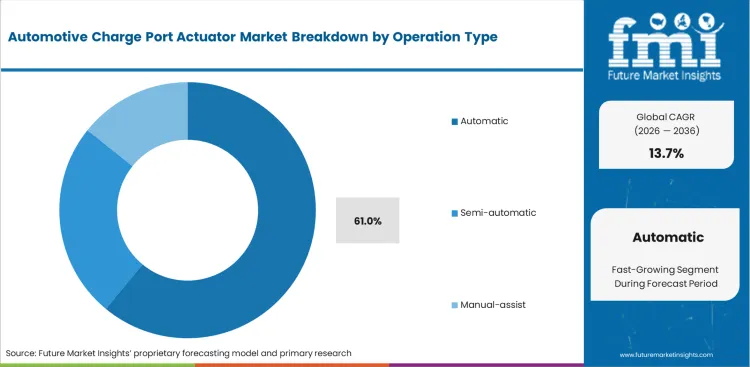
Exterior access design is being reshaped by smartphone pairing, proximity logic, and rising user expectations around convenience. Manual-assist systems remain less aligned with premium EV design because they still require drivers to push exterior panels directly. Automatic segment is expected to capture 61.0% share in 2026 as vehicle developers move toward fully motorized opening sequences that better match connected entry experiences. That shift also requires careful coordination between flap motion and the electric vehicle battery connector layout inside the charging zone. Software calibration becomes a critical part of the system because unintended opening during wash cycles or approach events can create avoidable launch delays and validation issues. Automatic operation therefore extends beyond convenience and becomes part of overall interface control.
- Prevented failures: Motorized operation reduces the risk of users forcing frozen flaps open and damaging the mechanism.
- Residual risk: Communication lag between the vehicle and flap system can still delay opening commands near charging points.
- Value capture: Full feature value is stronger when powered flap systems are paired with illuminated port surrounds for night use.
Automotive Charge Port Actuator Market Analysis by Integration Type
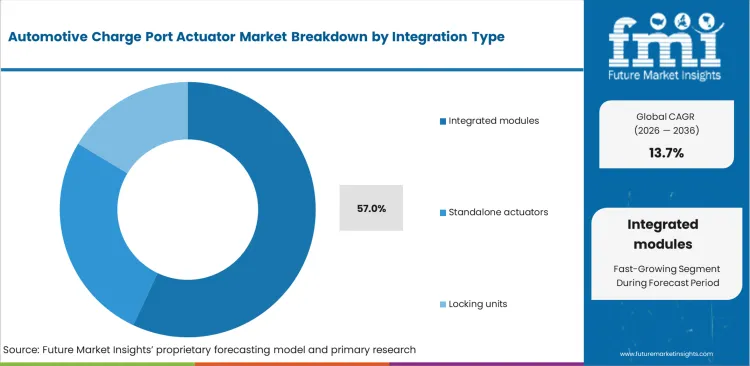
Assembly efficiency is pushing automakers away from multi-part sourcing toward more consolidated packages. Manufacturers prefer pre-tested modules because they reduce line-side complexity and shift sealing responsibility upstream. Standalone actuator installation also creates more chances for alignment inconsistency and water-ingress issues during end-of-line testing. Integrated modules are anticipated to represent 57.0% share in 2026 because they combine actuation, locking, lighting, and housing functions in one install-ready unit. Accurate flap alignment is especially important where EV charger interface consistency depends on repeatable positioning and sealing performance. As integration depth rises, supplier capability in electronics, molding, and subassembly coordination becomes more important than simple unit cost.
- Production control: Large suppliers lead this segment because they can combine molding, motor production, and PCB assembly under one program.
- Constraint planning: Semiconductor availability remains a major planning issue where integrated control electronics are included in the module.
- Landscape trajectory: Future designs are expected to move toward even deeper integration of electrical and mechanical port functions by 2036.
Automotive Charge Port Actuator Market Analysis by Sales Channel
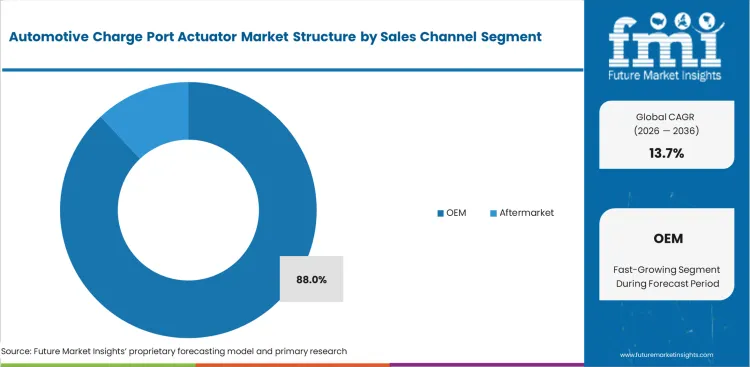
Vehicle-network integration keeps this product category heavily concentrated in factory supply channels. Contracts are usually secured years before production because validation requirements are extensive and tightly linked to platform electronics. Retrofitting motorized port flaps onto vehicles that were not originally designed for them remains difficult because the wiring, software, and control logic are rarely available in the field. Independent repair activity is also constrained by the need for proprietary diagnostics to pair replacement units with vehicle systems. OEM channel is forecast to command 88.0% share in 2026. That dominance is reinforced by the need to match exact factory specifications tied to electric vehicle charging cable and plug compatibility, sealing performance, and locking behavior. Aftermarket participation is therefore expected to remain limited to narrow replacement cases rather than broad retrofit demand.
- Expectation baseline: Factory-approved modules must operate quietly and consistently across wide temperature ranges without vibration or hesitation.
- Edge condition gaps: Non-OEM substitutes face higher risk when later software updates disrupt communication with the vehicle.
- Qualification standards: Locking systems are validated against strict safety requirements so release cannot occur during active high-voltage transfer.
Automotive Charge Port Actuator Market Drivers, Restraints, and Opportunities
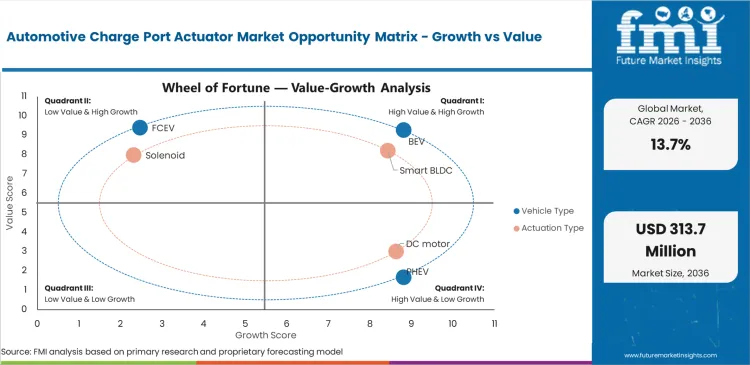
Smooth vehicle access and charging interactions continue to shape feature priorities across premium electric platforms. Automakers are increasingly expected to reduce manual touchpoints by integrating automated charge port doors with proximity keys and smartphone-linked access systems. Demand growth in the automotive charge port actuator market is closely tied to this shift, as visible convenience features now carry more weight in purchase decisions for higher-end vehicle models. Delayed adoption can make a vehicle interface feel dated within a segment where design updates move quickly and user experience has become a stronger point of differentiation. Shorter vehicle refresh cycles add further pressure, since missing convenience-focused upgrades can weaken showroom appeal at launch.
Packaging limitations inside vehicle fenders remain a key engineering constraint for actuator design. Space for motorized gearsets, manual override mechanisms, and protective housings must fit within increasingly tighter exterior layouts shaped by styling and aerodynamic targets. This pressure keeps manufacturers focused on reducing component size without weakening durability. Compact planetary gear layouts help lower space requirements, yet torque output must still remain high enough to open the charge port reliably in low-temperature conditions. Balancing compact packaging, mechanical strength, and weather resistance remains central to product development across this category.
Opportunities in Automotive Charge Port Actuator Market
- Local processing integration: Mechatronics engineers can embed small microcontrollers directly into motor housings. Platform architects gain immediate diagnostic feedback without burdening main vehicle networks.
- Standardized platform architectures: Companies look to consolidate purchasing around single actuator designs capable of fitting multiple vehicle models, optimizing a broader charge port actuator sourcing strategy.
- Alternative linkage designs: Manufacturers investigate smart materials to replace traditional automotive door latch kinematics, reducing overall weight and part counts.
Regional Analysis
Based on regional analysis, automotive charge port actuator market is segmented into North America, Latin America, Western Europe, Eastern Europe, East Asia, South Asia and Pacific, and Middle East and Africa across 40 plus countries.
.webp "Top Country Growth Comparison Automotive Charge Port Actuator Market Cagr (2026 2036)")
| Country | CAGR (2026 to 2036) |
|---|---|
| India | 16.2% |
| China | 15.1% |
| South Korea | 14.0% |
| Germany | 12.5% |
| United States | 12.2% |
| United Kingdom | 11.8% |
| Japan | 10.7% |
Source: Future Market Insights (FMI) analysis, based on proprietary forecasting model and primary research
East Asia Automotive Charge Port Actuator Market Analysis
Surging electric vehicle production volumes shape the trajectory across East Asia. Local manufacturers cascade premium convenience features into mid-tier passenger cars to secure competitive advantages. Aggressive price competition compels tier-1 suppliers to engineer cost-reduced mechatronic designs while maintaining basic reliability. Suppliers capable of scaling production to millions of units annually gain an edge by matching localized battery supply chain velocity. Similar scaling requirements appear in automotive door module manufacturing.
- China: Broader feature penetration across mid-priced electric vehicles is expected to keep China at the front of actuator adoption. Automotive charge port actuator demand in China is projected to expand at an estimated CAGR of 15.1% during 2026 to 2036, supported by intense local competition and strong pressure to bring convenience features below traditional premium price bands. Cost discipline across the domestic supply base continues to make motorized charging flaps commercially workable at larger volumes. High vehicle output also improves scale efficiency, allowing this feature to move into more price-sensitive segments without placing the same pressure on vehicle cost structure seen in smaller markets.
- South Korea: Export-oriented vehicle programs are likely to keep South Korea on a strong growth path, with the market anticipated to rise at a CAGR of 14.0% from 2026 to 2036. Automated charging flap operation is increasingly being treated as part of the expected user experience for globally positioned electric models. Much of this momentum comes from platform-level standardization, where manufacturers prefer to align convenience functions across multiple geographies rather than engineer separate feature sets for each market. This approach is expected to support steady actuator demand as new EV platforms move through production cycles.
- Japan: Japan is expected to remain more measured in adoption, with demand likely to advance at an estimated CAGR of 10.7% during 2026 to 2036. Long product qualification cycles continue to shape this market, especially where established mechanical linkages already meet durability expectations. Manufacturers generally require deeper life-cycle validation before approving motorized replacements in visible exterior systems. Growth is still likely, though it will be led less by feature speed and more by confidence in long-term reliability under repeated use and varied environmental conditions.
South Asia and Pacific Automotive Charge Port Actuator Market Analysis
Domestic vehicle manufacturers are adding automated access functions to narrow the experience gap with imported premium models and strengthen perceived technology value. Supply capability for precision micro-motors is still developing locally, which keeps dependence on imported mechatronic components relatively high in the near term. This sourcing pattern adds exposure to currency movement and longer delivery timelines, especially when critical actuator parts are not available from domestic vendors. Local production partnerships are therefore becoming more important, not as a branding exercise, but as a practical way to improve supply stability and reduce cost variability.
- India: Consumer preference for visible technology features encourages domestic automotive manufacturers to bypass basic manual designs in favor of fully motorized systems. Validating sensitive components against severe monsoon weather conditions remains a technical hurdle. Adoption of automotive charge port actuators in India is expected to move ahead at a CAGR of 16.2% from 2026 to 2036. Localizing production of these complex assemblies accelerates broader platform adoption.
North America Automotive Charge Port Actuator Market Analysis
Deploying high-capacity electric pickup trucks fundamentally alters actuator specifications across North America. Flap mechanisms must possess the capability to survive heavy-duty commercial use alongside severe winter freezing events. FMI analysts note that torque requirements for breaking ice on massive truck-scale charging doors exceed the capabilities of standard passenger car motors. Manufacturers require heavy-duty gearsets and robust manual override cables to prevent fleet downtime. Similar heavy-duty engineering applies to power liftgate systems.
- United States: Fleet operators evaluate total cost of ownership rigorously, requiring charge port mechanisms that withstand daily commercial abuse without failing. Sales of automotive charge port actuators in the United States are expected to increase at a CAGR of 12.2% during the forecast period. Extended warranty coverage for extreme-weather operation dictates supplier selection. Mastering these heavy-duty requirements secures lucrative contracts across the expanding electric commercial vehicle sector.
Western Europe Automotive Charge Port Actuator Market Analysis
Stringent luxury vehicle standards dictate mechatronic precision across traditional automotive manufacturing centers. Maintaining premium vehicle perception requires near-silent operation and perfectly flush panel gaps. FMI estimates that acoustic engineering functions as a primary differentiator for tier-1 suppliers competing for these high-end platforms. Actuator modules producing audible gear whine during opening sequences face immediate rejection during factory validation phases.
- Germany: Deeply embedded engineering standards force component suppliers to deliver modules that integrate with complex software-defined vehicle architectures. Managing the entire hardware and software validation process falls heavily on tier-1 manufacturers. Germany is anticipated to see automotive charge port actuators grow at a CAGR of 12.5% over the forecast period. Navigating this rigorous manufacturing environment yields some of the most advanced smart motor designs globally.
- United Kingdom: High concentrations of luxury vehicle manufacturing facilities generate demand for highly customized, brand-specific charging access kinematics. Automotive charge port actuator sales in the United Kingdom are set to record a CAGR of 11.8% during the assessment period. Unique opening arcs and specialized illumination triggers represent standard manufacturing requests. Mastering these bespoke engineering requirements cements long-term supply relationships with prestigious automotive nameplates.
FMI's report includes extensive analysis of emerging electric vehicle markets outside primary regions. Local regulatory requirements for charging standardization influence how future connector housing dimensions will dictate actuator packaging space globally.
Competitive Aligners for Market Players
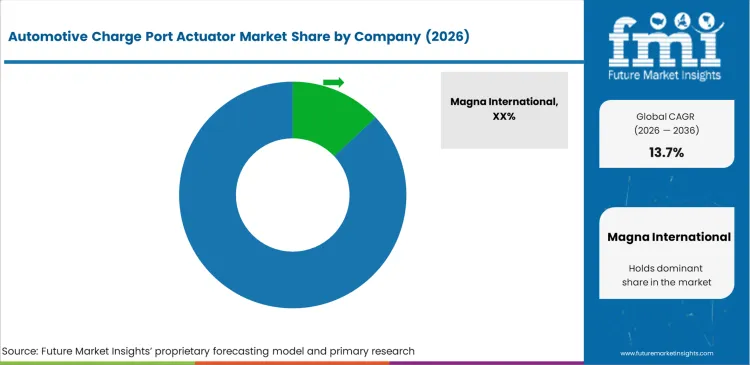
Supplier selection in this category is increasingly shaped by vertical integration across the full mechatronic assembly rather than by motor output alone. Stronger suppliers usually control more of the actuator system, from connector architecture to flap movement geometry, which improves consistency during validation and makes module delivery easier for vehicle manufacturers. Market preference is steadily shifting toward sealed, pre-tested units that can move directly into fender assembly without added coordination across multiple component vendors. This shift continues to define the automotive charging port door actuator market, where ease of integration now carries as much weight as individual component performance.
Established suppliers benefit from large banks of validated weather-sealing designs and acoustic performance data, which remain difficult for newer entrants to match quickly. Reliable operation in low-temperature conditions depends on repeated material and gear tuning, especially where compact motors must open flaps under ice-loading stress without damaging internal components. Experience drawn from adjacent closure systems also supports design refinement and helps reduce common actuator failure points. Proven durability in harsh-use conditions remains a meaningful qualification factor across this market.
Large vehicle manufacturers are also limiting supplier influence by standardizing mounting geometry and communication protocols across platform portfolios. This approach keeps competition centered on packaging efficiency, durability, and unit economics rather than on proprietary control logic. As software functions move into central vehicle architectures, actuator modules are increasingly expected to perform as dependable execution devices within a broader electronic system. That shift is likely to keep pricing discipline tighter while raising the importance of compact design and reliable mechanical performance.
Key Players in Automotive Charge Port Actuator Market
- Magna International
- WITTE Automotive
- Motion Controls International
- Minebea Access Solutions
- Padmini VNA Mechatronics
- Marquardt
Scope of the Report
| Metric | Value |
|---|---|
| Quantitative Units | USD 76.4 million to USD 275.9 million, at a CAGR of 13.7% |
| Market Definition | Automotive charge port actuators are mechatronic assemblies designed to automate physical opening, closing, and secure locking of electric vehicle charging interfaces. These systems convert electrical signals from vehicle controllers into precise physical motion to manage exterior flaps and secure power plugs during energy transfer. |
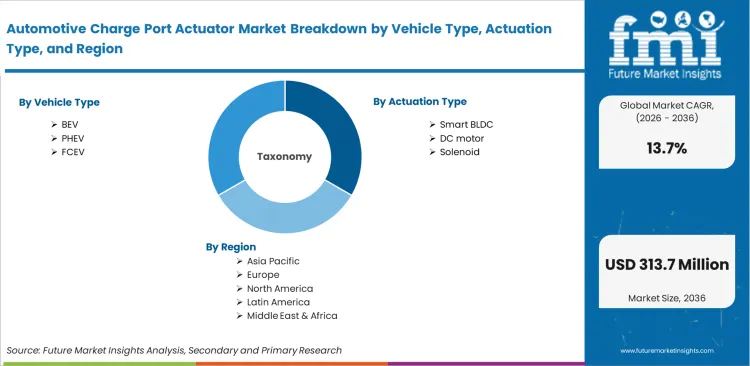
| Segmentation | Vehicle Type, Actuation Type, Operation Type, Integration Type, and Sales Channel |
| Regions Covered | North America, Latin America, Western Europe, Eastern Europe, East Asia, South Asia and Pacific, Middle East and Africa |
| Countries Covered | China, India, South Korea, Germany, United States, United Kingdom, Japan |
| Key Companies Profiled | Magna International, WITTE Automotive, Motion Controls International, Minebea AccessSolutions, Padmini VNA Mechatronics, Marquardt |
| Forecast Period | 2026 to 2036 |
| Approach | Global electric vehicle production volumes multiplied by penetration rates of automated charging access systems. |
Source: Future Market Insights (FMI) analysis, based on proprietary forecasting model and primary research
Automotive Charge Port Actuator Market Analysis by Segments
By Vehicle Type:
- BEV
- PHEV
- FCEV
By Actuation Type:
- Smart BLDC
- DC motor
- Solenoid
By Operation Type:
- Automatic
- Semi-automatic
- Manual-assist
By Integration Type:
- Integrated modules
- Standalone actuators
- Locking units
By Sales Channel:
- OEM
- Aftermarket
Region:
- North America
- United States
- Canada
- Europe
- Germany
- United Kingdom
- France
- Italy
- Spain
- Asia Pacific
- China
- Japan
- South Korea
- Taiwan
- Singapore
- Latin America
- Brazil
- Mexico
- Argentina
- Middle East & Africa
- GCC Countries
- South Africa
Bibliography
- SAE International. (2024). J3400_202409: North American Charging System (NACS) electric vehicles.
- Tolbert, I., Kogalur, N., Martin, J., & Meintz, A. (2024). CharIN Megawatt Charging System: 4th event summary report. National Renewable Energy Laboratory.
- National Renewable Energy Laboratory. (2024). Impact of electric vehicle charging station reliability, resilience, and location on electric vehicle adoption.
- National Highway Traffic Safety Administration. (2024). Federal Motor Vehicle Safety Standards; FMVSS No. 305a electric-powered vehicles: Electric powertrain integrity Global Technical Regulation No. 20 incorporation by reference. Federal Register.
- National Institute of Standards and Technology. (2024). 2024 NCWM Specifications and Tolerances (S&T) executive summary report.
This bibliography is provided for reader reference. The full FMI report contains the complete reference list with primary source documentation.
This Report Addresses
- Actuation type penetration rates across BEV and PHEV passenger platforms globally.
- Packaging constraints reshaping mechatronics supply chains for flush exterior styling surfaces.
- Regional adoption differences between pure cost-driven economies and feature-rich luxury vehicle environments.
- Operational friction slowing standalone actuator usage in favor of fully integrated sensor modules.
- Purchasing priorities shifting from basic brushed DC motors toward smart brushless diagnostic units.
- Warranty liability transfers associated with sealing integrated charging assemblies.
- Competitive dynamics forcing hardware standardizations across multiple vehicle models to escape vendor lock-in.
- Supply chain vulnerabilities impacting integrated control chip availability for mega-suppliers.
Frequently Asked Questions
Tell me the market size for automotive charge port actuators?
Valuation sits at USD 76.4 million in 2026. This metric signals the rapid commercialization of automated sequences as vehicle manufacturers upgrade exterior styling to align with software-defined interior experiences.
Which companies make EV charge port actuators?
Magna International, WITTE Automotive, Motion Controls International, Minebea Access Solutions, Padmini VNA Mechatronics, and Marquardt represent key suppliers. These firms dominate because they control full mechatronic integration from motor windings to sealed housings.
Forecast demand for automatic EV charge flap actuators through 2036?
Demand advances at 13.7% CAGR through 2036. Consistent expansion stems from pure battery electric architectures reaching price parity, driving premium convenience features downward into mass-market segments.
Compare smart BLDC and DC charge port actuators in EVs?
Smart BLDC holds 48.0% share because advanced diagnostic capabilities integrate directly with central vehicle communication networks, whereas basic DC motors lack self-reporting fault codes and obstacle detection capabilities.
What drives growth in the automotive charge port actuator market?
Consumer expectations for frictionless vehicle interactions compel product planners to eliminate manual touchpoints. This urgency stems from rapidly shortening vehicle redesign cycles where lagging on visible convenience features translates directly to lost showroom conversions.
How does a charge port door actuator work?
These systems convert electrical signals from vehicle controllers into precise physical motion. They manage exterior flaps and secure power plugs during energy transfer by activating small internal gearsets or solenoids upon proximity command.
Which EVs use automatic charging flaps?
High-end luxury platforms initially pioneered this motorized kinematics. Rapid scaling now forces inclusion on premium mid-tier battery electric vehicles to maintain competitive positioning against imported models offering connected vehicle features.
Are charge port actuators standard in EVs?
Adoption splits fundamentally by region and vehicle class. While premium platforms mandate motorized operation, entry-level platforms in highly price-sensitive segments still utilize manual-assist springs to maintain strict cost discipline.
How do automatic charging flaps alter EV charge port cover market dynamics?
Fully automated sequences eliminate need for drivers to physically handle dirty covers. This integration transfers complex sealing and waterproofing liability entirely to tier-1 suppliers providing unified modules.
What differentiates a charge port actuator vs manual flap?
Manual flaps rely on mechanical springs and physical user force, contradicting premium aesthetic goals. Actuators provide sensor-integrated, proximity-triggered opening sequences that align perfectly with smartphone-as-key protocols.
How do commercial electric vehicles alter actuator specifications?
Heavy-duty electric trucks require massive torque to break thick ice on oversized charging doors. Heavy-duty gearsets and robust manual override cables to prevent fleet downtime is used.
What hidden costs impact standalone actuator sourcing?
Companies piecing together separate components frequently battle water ingress issues during leak testing. Integrated modules transfer complex sealing liability entirely to tier-1 suppliers, lowering overall manufacturing risk.
Why do basic solenoids lose share?
Solenoids cannot provide smooth, variable-speed motion expected in modern vehicle designs. Sourcing departments find that abrupt snapping motions generate higher customer complaints regarding pinched fingers.
How does software latency impact automatic flaps?
Communication lags arise during vehicle approach to charging stations, leading to delayed execution of flap commands. Network latency remains persistent friction when relying entirely on proximity key fobs for access.
What forces tier-1 suppliers to miniaturize internal components?
Aerodynamic styling demands for thinner exterior panels severely restrict packaging depth. This spatial conflict forces engineers to compress entire mechatronic assemblies into 40-millimeter depths without sacrificing durability.
How do platform architects combat vendor lock-in?
Automotive manufacturers standardize physical mounting points and electronic communication protocols across platform portfolios. This forces suppliers to compete strictly on internal packaging depth rather than proprietary software integration.
Why do aftermarket suppliers struggle to capture share?
Replacing damaged actuators requires proprietary diagnostic software to pair new motors with central vehicle computers. Collision repair centers must purchase exact replacement modules directly from dealer networks.
What extreme weather testing do quality engineers require?
Prototype mechanisms undergo severe icing and dust chamber tests. Components failing to break five-millimeter ice layers using internal motorized torque face immediate rejection before production approval.
How do smart motors reduce warranty claims?
Smart brushless motors can actively reverse direction upon sensing physical obstructions. This capability prevents damaged plastic gears and pinched fingers, drastically reducing field failures compared to basic brushed units.
Why are independent sensors being eliminated?
Buyers evaluate total cost of ownership rigorously. Integrated smart motors combine motion and position sensing natively, allowing companies to remove separate external position sensors from purchasing bills entirely.
How do export strategies shape South Korean component manufacturing?
Export-driven brands adopt globally competitive user experience features early in design phases. Local tier-1 suppliers scaling these automated sequences gain favorable positioning to capture international contracts alongside domestic partners.
What limits plugin hybrid actuator complexity?
Plugin hybrids utilize shared body panels originally designed for internal combustion engines. This architectural compromise limits space available for complex, deep-set mechatronic flap assemblies.
How do semiconductor shortages affect integrated modules?
Firms must plan around chip availability for integrated LIN-bus control boards. Shortages in these specific microcontrollers halt entire automated charging module production lines immediately.
Why do conservative engineering cultures resist automatic sequences?
Manufacturers specify rigorous life-cycle testing before approving transitions away from proven mechanical linkages. Achieving zero-defect manufacturing for mechatronic assemblies requires extensive long-term validation.
Preview the report firsthand - request a free sample
Get SampleGet the brochure for pricing and purchase details.
Get PDFTable of Content
- Executive Summary
- Global Market Outlook
- Demand-side Trends
- Supply-side Trends
- Technology Roadmap Analysis
- Analysis and Recommendations
- Market Overview
- Market Coverage / Taxonomy
- Market Definition / Scope / Limitations
- Research Methodology
- Chapter Orientation
- Analytical Lens and Working Hypotheses
- Market Structure, Signals, and Trend Drivers
- Benchmarking and Cross-market Comparability
- Market Sizing, Forecasting, and Opportunity Mapping
- Research Design and Evidence Framework
- Desk Research Programme (Secondary Evidence)
- Company Annual and Sustainability Reports
- Peer-reviewed Journals and Academic Literature
- Corporate Websites, Product Literature, and Technical Notes
- Earnings Decks and Investor Briefings
- Statutory Filings and Regulatory Disclosures
- Technical White Papers and Standards Notes
- Trade Journals, Industry Magazines, and Analyst Briefs
- Conference Proceedings, Webinars, and Seminar Materials
- Government Statistics Portals and Public Data Releases
- Press Releases and Reputable Media Coverage
- Specialist Newsletters and Curated Briefings
- Sector Databases and Reference Repositories
- FMI Internal Proprietary Databases and Historical Market Datasets
- Subscription Datasets and Paid Sources
- Social Channels, Communities, and Digital Listening Inputs
- Additional Desk Sources
- Expert Input and Fieldwork (Primary Evidence)
- Primary Modes
- Qualitative Interviews and Expert Elicitation
- Quantitative Surveys and Structured Data Capture
- Blended Approach
- Why Primary Evidence is Used
- Field Techniques
- Interviews
- Surveys
- Focus Groups
- Observational and In-context Research
- Social and Community Interactions
- Stakeholder Universe Engaged
- C-suite Leaders
- Board Members
- Presidents and Vice Presidents
- R&D and Innovation Heads
- Technical Specialists
- Domain Subject-matter Experts
- Scientists
- Physicians and Other Healthcare Professionals
- Governance, Ethics, and Data Stewardship
- Research Ethics
- Data Integrity and Handling
- Primary Modes
- Tooling, Models, and Reference Databases
- Desk Research Programme (Secondary Evidence)
- Data Engineering and Model Build
- Data Acquisition and Ingestion
- Cleaning, Normalisation, and Verification
- Synthesis, Triangulation, and Analysis
- Quality Assurance and Audit Trail
- Market Background
- Market Dynamics
- Drivers
- Restraints
- Opportunity
- Trends
- Scenario Forecast
- Demand in Optimistic Scenario
- Demand in Likely Scenario
- Demand in Conservative Scenario
- Opportunity Map Analysis
- Product Life Cycle Analysis
- Supply Chain Analysis
- Investment Feasibility Matrix
- Value Chain Analysis
- PESTLE and Porter’s Analysis
- Regulatory Landscape
- Regional Parent Market Outlook
- Production and Consumption Statistics
- Import and Export Statistics
- Market Dynamics
- Global Market Analysis 2021 to 2025 and Forecast, 2026 to 2036
- Historical Market Size Value (USD Million) Analysis, 2021 to 2025
- Current and Future Market Size Value (USD Million) Projections, 2026 to 2036
- Y-o-Y Growth Trend Analysis
- Absolute $ Opportunity Analysis
- Global Market Pricing Analysis 2021 to 2025 and Forecast 2026 to 2036
- Global Market Analysis 2021 to 2025 and Forecast 2026 to 2036, By Vehicle Type
- Introduction / Key Findings
- Historical Market Size Value (USD Million) Analysis By Vehicle Type , 2021 to 2025
- Current and Future Market Size Value (USD Million) Analysis and Forecast By Vehicle Type , 2026 to 2036
- BEV
- PHEV
- FCEV
- BEV
- Y-o-Y Growth Trend Analysis By Vehicle Type , 2021 to 2025
- Absolute $ Opportunity Analysis By Vehicle Type , 2026 to 2036
- Global Market Analysis 2021 to 2025 and Forecast 2026 to 2036, By Actuation Type
- Introduction / Key Findings
- Historical Market Size Value (USD Million) Analysis By Actuation Type, 2021 to 2025
- Current and Future Market Size Value (USD Million) Analysis and Forecast By Actuation Type, 2026 to 2036
- Smart BLDC
- DC motor
- Solenoid
- Smart BLDC
- Y-o-Y Growth Trend Analysis By Actuation Type, 2021 to 2025
- Absolute $ Opportunity Analysis By Actuation Type, 2026 to 2036
- Global Market Analysis 2021 to 2025 and Forecast 2026 to 2036, By Operation Type
- Introduction / Key Findings
- Historical Market Size Value (USD Million) Analysis By Operation Type, 2021 to 2025
- Current and Future Market Size Value (USD Million) Analysis and Forecast By Operation Type, 2026 to 2036
- Automatic
- Semi-automatic
- Manual-assist
- Automatic
- Y-o-Y Growth Trend Analysis By Operation Type, 2021 to 2025
- Absolute $ Opportunity Analysis By Operation Type, 2026 to 2036
- Global Market Analysis 2021 to 2025 and Forecast 2026 to 2036, By Integration Type
- Introduction / Key Findings
- Historical Market Size Value (USD Million) Analysis By Integration Type, 2021 to 2025
- Current and Future Market Size Value (USD Million) Analysis and Forecast By Integration Type, 2026 to 2036
- Integrated modules
- Standalone actuators
- Locking units
- Integrated modules
- Y-o-Y Growth Trend Analysis By Integration Type, 2021 to 2025
- Absolute $ Opportunity Analysis By Integration Type, 2026 to 2036
- Global Market Analysis 2021 to 2025 and Forecast 2026 to 2036, By Sales Channel
- Introduction / Key Findings
- Historical Market Size Value (USD Million) Analysis By Sales Channel, 2021 to 2025
- Current and Future Market Size Value (USD Million) Analysis and Forecast By Sales Channel, 2026 to 2036
- OEM
- Aftermarket
- OEM
- Y-o-Y Growth Trend Analysis By Sales Channel, 2021 to 2025
- Absolute $ Opportunity Analysis By Sales Channel, 2026 to 2036
- Global Market Analysis 2021 to 2025 and Forecast 2026 to 2036, By Region
- Introduction
- Historical Market Size Value (USD Million) Analysis By Region, 2021 to 2025
- Current Market Size Value (USD Million) Analysis and Forecast By Region, 2026 to 2036
- North America
- Latin America
- Western Europe
- Eastern Europe
- East Asia
- South Asia and Pacific
- Middle East & Africa
- Market Attractiveness Analysis By Region
- North America Market Analysis 2021 to 2025 and Forecast 2026 to 2036, By Country
- Historical Market Size Value (USD Million) Trend Analysis By Market Taxonomy, 2021 to 2025
- Market Size Value (USD Million) Forecast By Market Taxonomy, 2026 to 2036
- By Country
- USA
- Canada
- Mexico
- By Vehicle Type
- By Actuation Type
- By Operation Type
- By Integration Type
- By Sales Channel
- By Country
- Market Attractiveness Analysis
- By Country
- By Vehicle Type
- By Actuation Type
- By Operation Type
- By Integration Type
- By Sales Channel
- Key Takeaways
- Latin America Market Analysis 2021 to 2025 and Forecast 2026 to 2036, By Country
- Historical Market Size Value (USD Million) Trend Analysis By Market Taxonomy, 2021 to 2025
- Market Size Value (USD Million) Forecast By Market Taxonomy, 2026 to 2036
- By Country
- Brazil
- Chile
- Rest of Latin America
- By Vehicle Type
- By Actuation Type
- By Operation Type
- By Integration Type
- By Sales Channel
- By Country
- Market Attractiveness Analysis
- By Country
- By Vehicle Type
- By Actuation Type
- By Operation Type
- By Integration Type
- By Sales Channel
- Key Takeaways
- Western Europe Market Analysis 2021 to 2025 and Forecast 2026 to 2036, By Country
- Historical Market Size Value (USD Million) Trend Analysis By Market Taxonomy, 2021 to 2025
- Market Size Value (USD Million) Forecast By Market Taxonomy, 2026 to 2036
- By Country
- Germany
- UK
- Italy
- Spain
- France
- Nordic
- BENELUX
- Rest of Western Europe
- By Vehicle Type
- By Actuation Type
- By Operation Type
- By Integration Type
- By Sales Channel
- By Country
- Market Attractiveness Analysis
- By Country
- By Vehicle Type
- By Actuation Type
- By Operation Type
- By Integration Type
- By Sales Channel
- Key Takeaways
- Eastern Europe Market Analysis 2021 to 2025 and Forecast 2026 to 2036, By Country
- Historical Market Size Value (USD Million) Trend Analysis By Market Taxonomy, 2021 to 2025
- Market Size Value (USD Million) Forecast By Market Taxonomy, 2026 to 2036
- By Country
- Russia
- Poland
- Hungary
- Balkan & Baltic
- Rest of Eastern Europe
- By Vehicle Type
- By Actuation Type
- By Operation Type
- By Integration Type
- By Sales Channel
- By Country
- Market Attractiveness Analysis
- By Country
- By Vehicle Type
- By Actuation Type
- By Operation Type
- By Integration Type
- By Sales Channel
- Key Takeaways
- East Asia Market Analysis 2021 to 2025 and Forecast 2026 to 2036, By Country
- Historical Market Size Value (USD Million) Trend Analysis By Market Taxonomy, 2021 to 2025
- Market Size Value (USD Million) Forecast By Market Taxonomy, 2026 to 2036
- By Country
- China
- Japan
- South Korea
- By Vehicle Type
- By Actuation Type
- By Operation Type
- By Integration Type
- By Sales Channel
- By Country
- Market Attractiveness Analysis
- By Country
- By Vehicle Type
- By Actuation Type
- By Operation Type
- By Integration Type
- By Sales Channel
- Key Takeaways
- South Asia and Pacific Market Analysis 2021 to 2025 and Forecast 2026 to 2036, By Country
- Historical Market Size Value (USD Million) Trend Analysis By Market Taxonomy, 2021 to 2025
- Market Size Value (USD Million) Forecast By Market Taxonomy, 2026 to 2036
- By Country
- India
- ASEAN
- Australia & New Zealand
- Rest of South Asia and Pacific
- By Vehicle Type
- By Actuation Type
- By Operation Type
- By Integration Type
- By Sales Channel
- By Country
- Market Attractiveness Analysis
- By Country
- By Vehicle Type
- By Actuation Type
- By Operation Type
- By Integration Type
- By Sales Channel
- Key Takeaways
- Middle East & Africa Market Analysis 2021 to 2025 and Forecast 2026 to 2036, By Country
- Historical Market Size Value (USD Million) Trend Analysis By Market Taxonomy, 2021 to 2025
- Market Size Value (USD Million) Forecast By Market Taxonomy, 2026 to 2036
- By Country
- Kingdom of Saudi Arabia
- Other GCC Countries
- Turkiye
- South Africa
- Other African Union
- Rest of Middle East & Africa
- By Vehicle Type
- By Actuation Type
- By Operation Type
- By Integration Type
- By Sales Channel
- By Country
- Market Attractiveness Analysis
- By Country
- By Vehicle Type
- By Actuation Type
- By Operation Type
- By Integration Type
- By Sales Channel
- Key Takeaways
- Key Countries Market Analysis
- USA
- Pricing Analysis
- Market Share Analysis, 2025
- By Vehicle Type
- By Actuation Type
- By Operation Type
- By Integration Type
- By Sales Channel
- Canada
- Pricing Analysis
- Market Share Analysis, 2025
- By Vehicle Type
- By Actuation Type
- By Operation Type
- By Integration Type
- By Sales Channel
- Mexico
- Pricing Analysis
- Market Share Analysis, 2025
- By Vehicle Type
- By Actuation Type
- By Operation Type
- By Integration Type
- By Sales Channel
- Brazil
- Pricing Analysis
- Market Share Analysis, 2025
- By Vehicle Type
- By Actuation Type
- By Operation Type
- By Integration Type
- By Sales Channel
- Chile
- Pricing Analysis
- Market Share Analysis, 2025
- By Vehicle Type
- By Actuation Type
- By Operation Type
- By Integration Type
- By Sales Channel
- Germany
- Pricing Analysis
- Market Share Analysis, 2025
- By Vehicle Type
- By Actuation Type
- By Operation Type
- By Integration Type
- By Sales Channel
- UK
- Pricing Analysis
- Market Share Analysis, 2025
- By Vehicle Type
- By Actuation Type
- By Operation Type
- By Integration Type
- By Sales Channel
- Italy
- Pricing Analysis
- Market Share Analysis, 2025
- By Vehicle Type
- By Actuation Type
- By Operation Type
- By Integration Type
- By Sales Channel
- Spain
- Pricing Analysis
- Market Share Analysis, 2025
- By Vehicle Type
- By Actuation Type
- By Operation Type
- By Integration Type
- By Sales Channel
- France
- Pricing Analysis
- Market Share Analysis, 2025
- By Vehicle Type
- By Actuation Type
- By Operation Type
- By Integration Type
- By Sales Channel
- India
- Pricing Analysis
- Market Share Analysis, 2025
- By Vehicle Type
- By Actuation Type
- By Operation Type
- By Integration Type
- By Sales Channel
- ASEAN
- Pricing Analysis
- Market Share Analysis, 2025
- By Vehicle Type
- By Actuation Type
- By Operation Type
- By Integration Type
- By Sales Channel
- Australia & New Zealand
- Pricing Analysis
- Market Share Analysis, 2025
- By Vehicle Type
- By Actuation Type
- By Operation Type
- By Integration Type
- By Sales Channel
- China
- Pricing Analysis
- Market Share Analysis, 2025
- By Vehicle Type
- By Actuation Type
- By Operation Type
- By Integration Type
- By Sales Channel
- Japan
- Pricing Analysis
- Market Share Analysis, 2025
- By Vehicle Type
- By Actuation Type
- By Operation Type
- By Integration Type
- By Sales Channel
- South Korea
- Pricing Analysis
- Market Share Analysis, 2025
- By Vehicle Type
- By Actuation Type
- By Operation Type
- By Integration Type
- By Sales Channel
- Russia
- Pricing Analysis
- Market Share Analysis, 2025
- By Vehicle Type
- By Actuation Type
- By Operation Type
- By Integration Type
- By Sales Channel
- Poland
- Pricing Analysis
- Market Share Analysis, 2025
- By Vehicle Type
- By Actuation Type
- By Operation Type
- By Integration Type
- By Sales Channel
- Hungary
- Pricing Analysis
- Market Share Analysis, 2025
- By Vehicle Type
- By Actuation Type
- By Operation Type
- By Integration Type
- By Sales Channel
- Kingdom of Saudi Arabia
- Pricing Analysis
- Market Share Analysis, 2025
- By Vehicle Type
- By Actuation Type
- By Operation Type
- By Integration Type
- By Sales Channel
- Turkiye
- Pricing Analysis
- Market Share Analysis, 2025
- By Vehicle Type
- By Actuation Type
- By Operation Type
- By Integration Type
- By Sales Channel
- South Africa
- Pricing Analysis
- Market Share Analysis, 2025
- By Vehicle Type
- By Actuation Type
- By Operation Type
- By Integration Type
- By Sales Channel
- USA
- Market Structure Analysis
- Competition Dashboard
- Competition Benchmarking
- Market Share Analysis of Top Players
- By Region
- By Vehicle Type
- By Actuation Type
- By Operation Type
- By Integration Type
- By Sales Channel
- Competition Analysis
- Competition Deep Dive
- Magna International
- Overview
- Product Portfolio
- Profitability by Market Segments (Product/Age /Sales Channel/Region)
- Sales Footprint
- Strategy Overview
- Marketing Strategy
- Product Strategy
- Channel Strategy
- WITTE Automotive
- Motion Controls International
- Minebea AccessSolutions
- Padmini VNA Mechatronics
- Marquardt
- Magna International
- Competition Deep Dive
- Assumptions & Acronyms Used


